The University of Notre Dame Marching Band — the Band of the Fighting Irish — came to Arizona for the Fiesta Bowl. Their practice space had a familiar name. The band rehearsed on Bemis Field at Notre Dame Preparatory in Scottsdale Dec. 31.
Here are some highlights. To hear a tribute to America’s military, jump to the 1:55 mark.
The band also played at the Phoenix Zoo. Here are highlights of its journey.
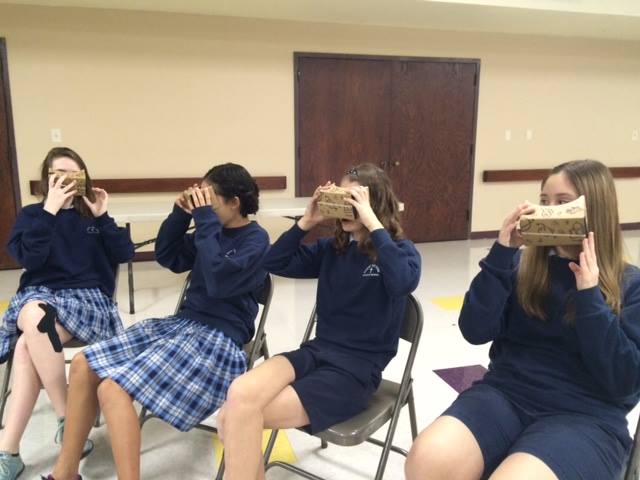
Eighth-graders at Christ the King School in Mesa traveled to Iceland via a Google Expedition to virtually experience key sites Jan. 4. (courtesy photo)
Eighth-graders at Christ the King School in Mesa traveled to Iceland via a Google Expedition to virtually experience key sites Jan. 4. (courtesy photo)
Students at Christ the King School in Mesa just returned from Christmas break, but are already leaving the classroom again. At least virtually.
They used part of their first day back from vacation Jan. 4 to virtually visit an array of places across the globe via Google Expeditions. Students embarked on a total of 18 field trips, chosen from close to 150 destination options.
Destinations included places such as Jerusalem, Gettysburg and the Grand Canyon. The trips were collections of virtual reality panoramas — 360° photo spheres, 3D images and video — annotated with details, points of interest, and questions that made them easy to integrate into the classroom.
The expeditions helped kick off new units of study as the third quarter of the school year gets underway. Eighth-graders, for example, explored Iceland to see Waterfall Svartifoss, the Highlands — a place virtually inaccessible for centuries — and the Blue Lagoon Thermal Resort.
“It was a wonderful start to a new unite because the 3D images immerse the students to give the bigger picture to better understand what we are learning,” said Patti Diedrick, a teacher.
The Wildlife Conservation Society, PBS, the American Museum of Natural History, the Planetary Society, and the Palace of Versailles contributed to developing the curriculum for students. While nothing replaces hopping on the bus for a field trip, school leadership said the expeditions provided an unique chance for the students to see places they wouldn’t otherwise.
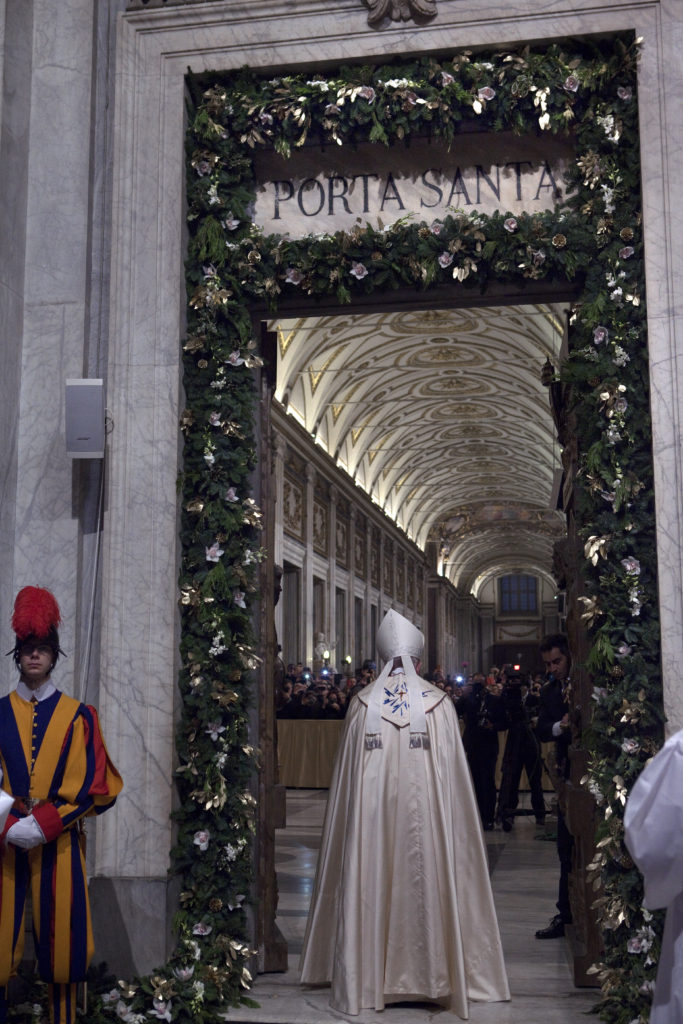
Pope Francis opens the Holy Door before celebrating Mass at the Basilica of St. Mary Major in Rome Jan. 1, 2016. The Holy Doors of Rome's four major basilicas are now open. (CNS photo/Maria Grazia Picciarella, pool)
VATICAN CITY (CNS) — God’s ability to forgive “knows no limits” as his mercy frees people from bitterness and despair, Pope Francis said.
“The church’s forgiveness must be every bit as broad as that offered by Jesus on the cross and by Mary at his feet. There is no other way,” he said after opening the Holy Door of the Basilica of St. Mary Major Jan. 1, the feast of Mary, Mother of God, and the World Day of Prayer for Peace.
Pope Francis pauses after opening the Holy Door before Mass at the Basilica of St. Mary Major in Rome Jan. 1, 2016. The Holy Doors of Rome’s four major basilicas are now open. (CNS photo/Maria Grazia Picciarella, pool)
On the first day of the new year, Pope Francis opened the last holy door in Rome as part of the extraordinary Holy Year of Mercy.
“The door we have opened is, in fact, a Door of Mercy,” he said in his homily, referring to the Roman basilica’s large bronze doors depicting Mary presenting her resurrected son, Jesus.
“Those who cross its threshold are called to enter into the merciful love of the father with complete trust and freedom from fear; they can leave this basilica knowing with certainty that Mary is ever at their side,” especially during times of trouble and sorrow, he said.
At the church dedicated to Mary and on her feast day as Mother of God, the pope explained how Mary is the mother of mercy because she bore “the very face of divine mercy,” the son of God “made incarnate for our salvation.”
“Mary is an icon of how the church must offer forgiveness to those who seek it. The mother of forgiveness teaches the church that the forgiveness granted on Golgotha knows no limits. Neither the law with its quibbles, nor the wisdom of this world with its distinctions, can hold it back,” he said.
Mary offers the world Jesus, who in turn, offers that forgiveness which “renews life, enables us once more to do God’s will and fills us with true happiness,” the pope said.
“The power of forgiveness is the true antidote to the sadness caused by resentment and vengeance,” which do nothing but “trouble the mind and wound the heart, robbing it of rest and peace.”
After the Mass, the pope symbolically opened another door, this time the large iron gates in front of a smaller chapel housing a Marian icon he is particularly devoted to — the “Salus Populi Romani” (health of the Roman people).
A deacon told the congregation to pray together with the Holy Father and ask Mary “to take us by the hand and lead us to the Lord Jesus.” After the pope pushed open the gates, he brought up a small floral arrangement of white lilies to the altar and prayed in silence before the icon.
Earlier in the day, the pope further marked the World Day of Peace in his noon Angelus address, when he said peace must not only be cultivated but also conquered in a spiritual fight being waged by war and indifference.
Christians are called at the beginning of the new year to open their hearts and “reawaken the attention to one’s neighbor, to those who are closest,” he said.
“War is not the only enemy of peace, but also indifference, which makes us think only of ourselves and creates barriers, suspicions, fears and closures. These are the enemies of peace,” the pope said.
Recalling the church’s celebration of the solemnity of Mary, Mother of God, the pope asked for her intercession so that the faithful may imitate her in guarding and meditating on all that happens in their hearts.
Mary “preserves the joys and loosens the knots of our lives, taking them to the Lord,” he said.
The pope also celebrated Mass in St. Peter’s Basilica in the morning to mark the Marian feast day.
God is present in human history, he said, despite signs and events that “tend to make us think instead that he is absent.”
“Sometimes we ask ourselves how it is possible that human injustice persists unabated, and that the arrogance of the powerful continues to demean the weak, relegating them to the most squalid outskirts of our world,” he said.
“How can the fullness of time have come when we are witnessing hordes of men, women and children fleeing war, hunger and persecution, ready to risk their lives simply to encounter respect for their fundamental rights?”
Pope Francis went on to say that notwithstanding those events, the “swollen torrent” of misery is powerless “before the ocean of mercy which floods our world.” The grace of Christ “brings our hope of salvation to fulfillment” and gives Christians the strength to build a more “just and fraternal world.”
“Where philosophical reason and political negotiation cannot arrive, there the power of faith, which brings the grace of Christ’s Gospel, can arrive, opening ever new pathways to reason and to negotiation,” he said.
In an Angelus address Jan. 3, the pope reminded visitors in St. Peter’s Square to keep a small book of the Gospels with them at all times and read at least one verse each day “in order to know Jesus better, to open our heart up wide to Jesus” and share him with others.
The pope warned against “the mystery of evil which threatens our lives, too, and demands our vigilance and attention so it not prevail.”
“Woe to us if we let in” sin which always lies in wait “at the door,” he said.
He also asked people take on the title of his World Day of Peace message, “Overcome Indifference and Win Peace,” like a New Year’s resolution to “put into practice” with God’s help.
Gisela Mota takes the oath of office as new mayor of Temixco, Mexico, Jan. 1. She was killed the next day at her home by four gunmen. (CNS photo/Stringer, Reuters)
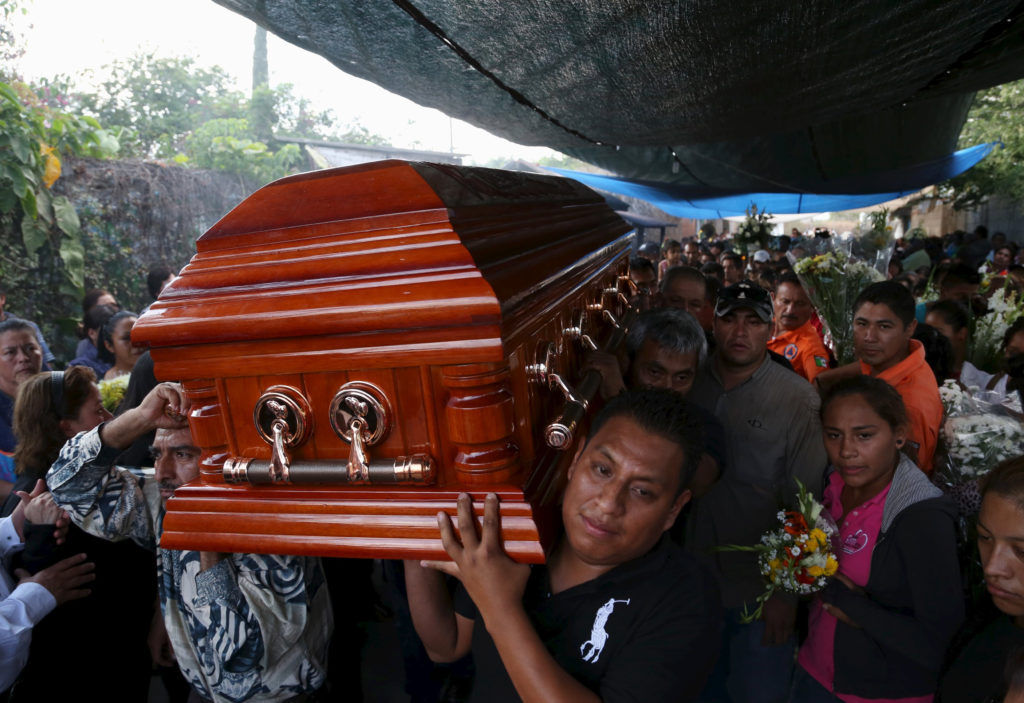
The coffin of Gisela Mota, former mayor of Temixco, Mexico, is carried out of her home Jan. 3. Mota was killed Jan. 2, one day after taking oath of office. (CNS photo/Margarito Perez, Reuters)
MEXICO CITY (CNS) — The assassination of a Mexican mayor the day after she assumed office was a message from organized crime and evidence of its influence in the area around the city of Cuernavaca, said the bishop who celebrated her funeral Mass.
“How is it possible that all of a region of the state is in the hands of organized crime, that people are paying protection money,” said Bishop Ramon Castro Castro of Cuernavaca, in comments published by the newspaper Reforma.
“This is evidence of our reality,” Bishop Castro said Jan. 3 outside the home of slain Mayor Gisela Mota in Temixco, about 50 miles south of Mexico City in Morelos state. “I’ve been saying it for some time and pleading, and no one has been able to do anything.”
He said Mota’s murder sends the message, “If you don’t cooperate with organized crime, look at what’s going to happen to you.”
Gisela Mota takes the oath of office as new mayor of Temixco, Mexico, Jan. 1. She was killed the next day at her home by four gunmen. (CNS photo/Stringer, Reuters)
“This crime is a signature act that characterizes the failed public security system in the state,” he said at the funeral. “I hope and pray to God that Gisela’s death helps to make us all more conscious.”
Authorities said Mota was murdered after assailants burst into her home Jan. 2, one day after she took the oath of office. Two of the suspects were subsequently killed in a shootout with police, while three more were arrested. The exact motive remains unclear, though Mota promised to clean up Temixco, a suburb of Cuernavaca.
Morelos Gov. Graco Ramirez said the suspects belonged to a drug cartel known as Los Rojos. The mayor’s Party of the Democratic Revolution said at least 100 mayors in Mexico had been attacked over the past 10 years as criminal groups attempt to infiltrate and corrupt local governments.
Drug cartels have been fighting over territory in Morelos for much of the past decade, causing crime to escalate and damaging the tourism economy of Cuernavaca, a city once popular with expatriates and weekenders from Mexico City and known previously for its local pastor, now-deceased Bishop Sergio Mendez Arceo, nicknamed the “Red Bishop.”
Former Mexican soccer star Cuauhtemoc Blanco — controversial for his on- and off-field behavior and a novice to politics — assumed office as mayor of Cuernavaca in late December, sparking a dispute with the state government over policing.
Ramirez took to Twitter to blast Blanco for backing out of a scheme for putting all police in the state under a single commander, a concept promoted as an attempt to prevent police corruption. Blanco, who won the last mayoral race with less than 30 percent of the vote, said the scheme was not working.
Bishop Castro has stayed out of politics and has promoted peace in the Diocese of Cuernavaca since arriving in 2013, although his work has not been without controversy.
Before the June election, he organized a Walk for Peace that resulted in attempts at a boycott and buses from one parish being prevented from leaving.
On this feast of St. Elizabeth Seton, founder of the first free Catholic school in the U.S., here’s a mini profile of a student whose alma mater, Seton Catholic Preparatory in Chandler, now stands in her honor. Brianna Antram is now studying at Ave Maria University in Florida. If her name or voice sounds familiar, it could be because Antram had a large role in Seton’s Feb. 2015 production of “Into the Woods.”
Rebecca De La Torre, director of music and webmaster for Queen of Peace Parish in Mesa, wrote a bilingual tribute song in honor of Fr. Thomas Bennett’s 25 years of priesthood.
Young people walk with a banner past the U.S. Capitol in 2012 during the annual March for Life in Washington. (CNS photo/Bob Roller)
Young people walk with a banner past the U.S. Capitol in 2012 during the annual March for Life in Washington. (CNS photo/Bob Roller)
WASHINGTON (CNS) — The annual March for Life, set for Jan. 22, will convene in a new location in the nation’s capital for the traditional midday rally.
Because of the ongoing refurbishment of the National Mall and strict new regulations that require temporary flooring to protect the grass, the rally has been moved from the West Front of the Capitol to the Washington Monument grounds.
“We were lucky to get that. It’s going to cost us $70,000, and it’s not something we budgeted for,” said Jeanne Monahan-Mancini, president of March for Life. “It’s the most economical wide-open space we could afford.”
Other than the venue, the event, which draws busloads of Catholic parishioners and parochial school students, is expected to remain much the same.
Held since 1974, the march marks the anniversary of the U.S. Supreme Court’s Roe v. Wade decision in 1973, which legalized abortion.
“Pro-Life is Pro-Woman” is this year’s theme.
“We know that abortion takes the life of one and wounds the life of another, so we always try to emphasize … that there’s always hope and healing for anyone who’s made that sad decision, and it’s very important in terms of our messaging,” Monahan-Mancini told Catholic News Service.
It’s also intended as a way to blunt critics, “because of the (presidential) election and a lot of the rhetoric about the false ‘war on women,'” Monahan-Mancini added.
Retired Baltimore Ravens football player Matt Birk is the headline speaker at the rally and that evening’s Rose Dinner. Monahan-Mancini said she expected at least a couple of Republican presidential candidates to speak at the rally as well, but that any announcement would come just before the event.
The day before the march, Fr. Frank Pavone, national director of Priests for Life, will lead a prayer rally at the Planned Parenthood offices in Washington. A youth rally at the Renaissance Hotel follows.
Other march-related activities include a Mass opening the overnight National Prayer Vigil for Life at the Basilica of the National Shrine of the Immaculate Conception Jan. 21 and a Mass the next morning at the Basilica; a Mass and interdenominational prayer service at Constitution Hall prior to the march; and two similar events, Youth Rally and Mass for Life, sponsored by the Archdiocese of Washington at the Verizon Center and the D.C. Armory.
Kansas Gov. Sam Brownback will be honored at the Constitution Hall event for being the first governor to sign the Unborn Child Protection from Dismemberment Abortion Act. The legislation is under review in a state appeals court.
Two recent events loom over this year’s march. Last summer, an anti-abortion organization in California, the Center for Medical Progress, released a series of secretly recorded videos that it claimed show representatives from Planned Parenthood clinics discussing the use of aborted infant parts for profit. In November, a gunman opened fire at a Colorado Springs Planned Parenthood clinic, killing three and wounding nine. The suspect, Robert Dear, was reported as telling police, “No more baby parts,” in an apparent reference to the videos.
The videos are the subject of litigation in U.S. District Court, Northern District of California, where a judge will decide whether the videos should be permanently suppressed because they violate California laws about secret recordings and also contributed to clinic arsons. Excerpts of the videos remain available on YouTube.
Even in truncated form, they videos have had an effect, said Michael Ciccocioppo, executive director of Pennsylvania Pro-Life Federation, a march participant.
“I haven’t seen every single video from start to finish, but I’ve seen parts of all the videos,” he said. “When you listen to these doctors sitting around eating their lunch, eating their salad, drinking their wine and talking so callously about what they do and how much they can get for these body parts, I mean it really has exposed to the nation how horrendous these things are that are going on.”
Monahan-Mancini agreed that the videos are “very hard to watch.” However, she finds them helpful to the pro-life effort.
“The thing with abortion is, it’s very much in the dark. It’s a violent kind of thing,” she said. “The great gift, regardless if you agree with the (recording) approach, is bringing into the light what happens behind closed doors. It was just so clear that there was a lack of respect for these little babies. They were just objects, objects for material gain.”
As for the Colorado shooter, “That’s their responsibility when people like that act in that way,” Ciccocioppo said. “It’s not the responsibility of the (anti-abortion) movement. This man has nothing to do with us.”
“The truth is going to come out one way or the other,” Fr. Pavone said. “The safest way to proceed for the vast majority of those involved in the march is through the peaceful, prayerful activities and legitimate avenues of government.”
Nationally, support for legalized abortion remains strong. An Associated Press poll taken shortly after the Colorado incident showed support at its highest level in two years.
The poll found that 58 percent of the respondents thought abortion should be legal in most or all cases. That’s an increase from 51 percent who said so at the beginning of 2015. The poll showed equal support among both Democrats and Republicans.
“I don’t think that poll is fair,” Monahan-Mancini said. “And I don’t think it’s reflective of the average American and what they think.”
Reversing the landmark Supreme Court decision remains the long-term goal of the march. But organizers told CNS they prefer to focus on changing the nationwide conversation.
“I think we have a much loftier goal, and that’s to change the hearts and minds of Americans. That no woman, in her right mind, would ever choose abortion. Because we really have a deprived culture when any woman thinks that’s an empowering act,” Monahan-Mancini said.
Ciccocioppo said the challenge to the pro-life movement in its quest to overturn Roe v. Wade is “that the court is still stacked against us.”
“But we’re in this for the long haul. This is going to be going on for as long as it takes,” he said.
“First of all, to recognize the humanity of the unborn child in law,” he continued. “But also, another focus of the march is obviously to help get the truth out there about how abortion harms women physically, emotionally and mentally, and kills living human beings, so we can get the hearts and minds of the culture to really accept the fact that this is killing of little human beings, citizens of our country.”
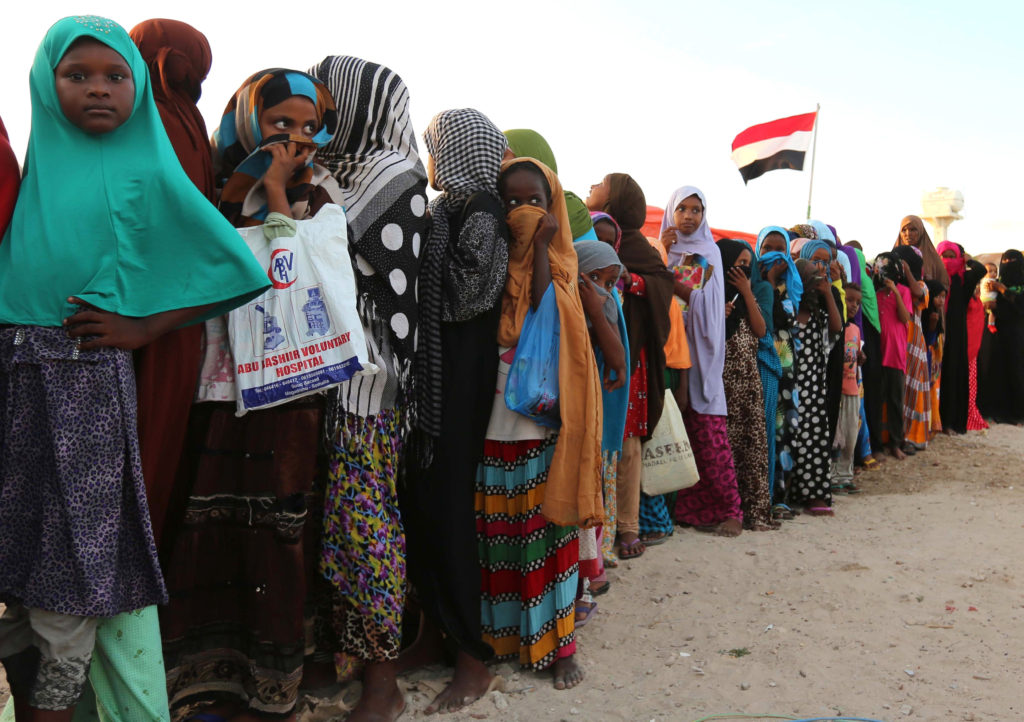
Yemeni refugees wait in line for food rations Dec. 16 at a makeshift camp in Somalia's capital, Mogadishu. (CNS photo/Feisal Omar, Reuters)
Yemeni refugees wait in line for food rations Dec. 16 at a makeshift camp in Somalia’s capital, Mogadishu. (CNS photo/Feisal Omar, Reuters)
WEST PALM BEACH, Fla. (CNS) — The explosive global refugee crisis — likely the top debate-generating news story of 2015 — seems destined to dominate domestic and foreign politics for years to come at a time when Pope Francis has been calling for a compassionate world response.
Early in 2015, Pope Francis again called attention to the plight of mostly Libyan refugees who perish en route to Europe during the Mediterranean Sea crossing to the southern Italian coastal island of Lampedusa. The pope has concluded the year by confirming his intention to visit the Mexico-U.S. border during an anticipated papal visit to Mexico set for February, an action that will likely been seen as provocative by some U.S. lawmakers.
Waves of refugees have been fleeing war-torn Syria for new opportunities in the West. By year’s end a new surge of Central Americans — mainly unaccompanied minors — crossing the U.S.-Mexico border and entering the United States has added to tensions over accepting newcomers into this country.
And deadly terrorist-related shootings this fall in Paris and in San Bernardino, California, have now further strained refugee response initiatives as top politicians such as U.S. President Barack Obama and German Chancellor Angela Merkel are facing heavy criticism and even open resistance to the resettlement of North African and Middle Eastern refugees.
Pope Francis’ U.S. visit in September and his newly inaugurated Year of Mercy for the church worldwide are seen as further teaching moments from the pontiff on the need for mercy and compassion for migrants and refugees.
[quote_box_right]
[/quote_box_right]
The number of refugees and internally displaced persons currently in need of protection is the largest since World War II, according to the Washington-based Jesuit Refugee Service/USA, which serves and advocates for the rights of refugees and other forcibly displaced persons.
In 2014, there were almost 60 million refugees and internally displaced people around the globe, according to the U.N. High Commissioner for Refugees.
Past mass migration events — including those prompted by unrest in Southeast Asia, Afghanistan, Colombia and the Balkans — indicate that the current crisis in the Mediterranean and Middle East may be a decade-long affair with an average time a refugee remains displaced at around 15 years, possibly longer, according to Mitzi Schroeder, director for policy for Jesuit Refugee Service/USA.
The agency is currently commemorating its 35th anniversary, looking back on the Indochinese boat and land crisis that led to its founding by Jesuit Father Pedro Arrupe, then superior general of the Society of Jesus.
The experience of responding to that situation led to the establishment of JRS’ triple mission to accompany, serve and advocate on behalf of the forcibly displaced, Schroeder notes.
“As in the present crisis in the Mideast, the flight of refugees from Vietnam, Cambodia and Laos was initially large and chaotic,” she told CNS. “Many died at sea in the process. Many victims of that crisis were never able to return to their homes, nor were offered permanent protection in the neighboring region.
Ultimately, a “Comprehensive Plan of Action” was created to guarantee immediate assistance, temporary protection and permanent resettlement of the Asian refugees to countries like the United States, which responded by taking in over a million people: The present crisis similarly requires a broad international effort to save lives, preserve the human dignity, and find durable solutions, according to Schroeder, who joined JRS in 2003. Currently, she is chair of the protection committee of Refugee Council USA, co-chair of the Humanitarian Partnerships Working Group of InterAction and co-chair of the UNHCR-NGO Urban Refugees Task Team.
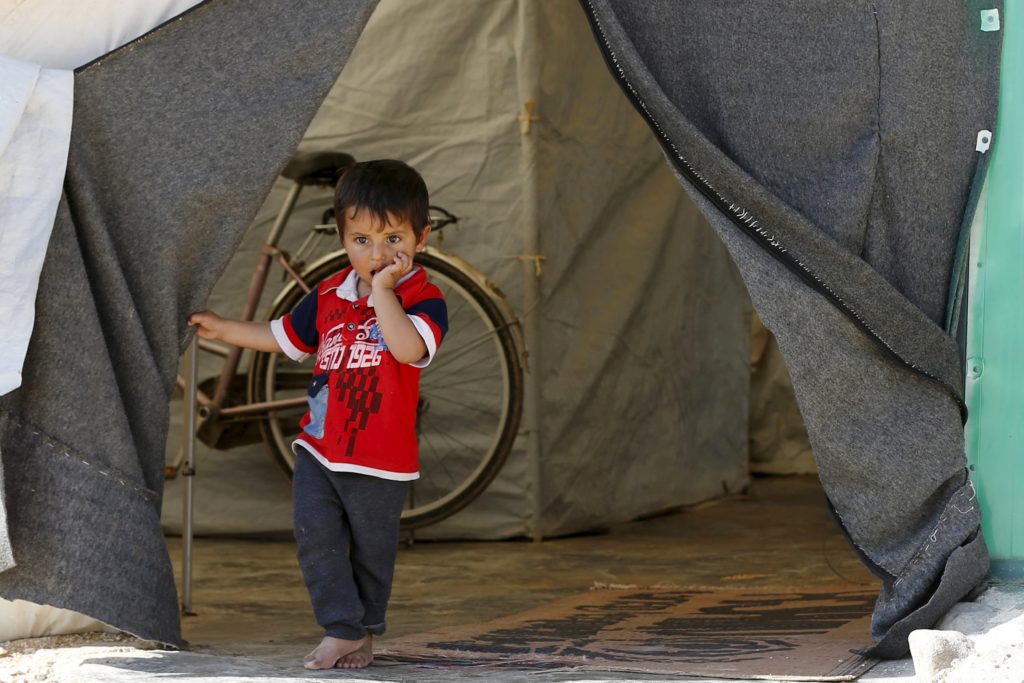
A Syrian refugee boy stands in front of his family’s tent in late November at a camp in the Jordanian city of Mafraq, near the border with Syria. (CNS photo/Muhammad Hamed, Reruters)
The sheer size of the current refugee crisis, the difficulty in reaching suffering people within Syria because of ongoing war, and the public perception that terrorists are hiding among the refugees moving to neighboring countries, Europe and the United States multiplies the difficulty in addressing the situation.
Anti-Muslim backlash and pushback to resettling Syrian refugees in particular has resulted in local dioceses and even parishes having to respond to local parishioners who express no desire to see more Middle East refugees resettled in their community for fear of harboring terrorists.
JRS believes that those refugees who pass the U.S. screening applied to Middle Eastern asylum seekers who are chosen for their persecution and vulnerability to further harm are very unlikely to constitute a threat to the country, according to Schroeder. Syrians and other refugees seeking entry for purposes of resettlement are subject to the most rigorous security screening of any group entering the United States, she added.
“This screening extends the time they must wait for resettlement to as much as two years,” Schroeder said, noting that the situation of refugees flooding unscreened into Europe in a “self-selected” fashion does include many risks that would necessarily not be in play in the U.S.
One silver lining in the crisis is that a greater awareness of the Syrian meltdown has caused the most stress on neighboring countries in the region and those countries need continued refugee response support from the rest of the world. The Syrian refugees in particular are now facing a fifth winter without adequate food, shelter, heat, medical care or access to education for their children.
“The international community has not been willing or able to come up with the resources needed to support the growing displaced population adequately. How they would support a vastly increased number of people in so called ‘safe zones’ within Syria, given cost plus the additional logistical efforts that would entail, I do not know,” Schroeder said in response to calls for keeping the Syrian refugees closer to home instead of resettling them in Europe and the West.
In addition, Schroeder said the legal implications of establishing such a zone and the military costs and dangers — especially given the involvement of Russia in the situation — would have to be very seriously considered.
“Safe havens have not worked very well in the past. If the intent is to “contain” people who have a right to flee under international law, this would be totally unacceptable,” she added.
Meanwhile, one of the most pressing needs of Middle East refugees, both in acute crises and in protracted situations like Syria, is for education.
“Refugees can languish for a generation without the ability to rebuild their lives. It is tragic that during this period refugee children and youth too often do not have access to education which can sustain hope and provide the tools necessary for them to grow and thrive as individuals and as a community,” Schroeder said.
As an initiative of the “Year of Mercy,” Pope Francis has asked JRS to launch a new initiative that will almost double the agency’s present education programs by providing educational opportunities to an additional 100,000 refugees a year.
JRS already has begun a new effort to increase awareness of the issue of refugee education, and to raise the resources needed to reach that goal. And even the enormous Syrian crisis cannot be allowed to divert full attention to other international refugee problems affecting other populations including the Rohingya of Myanmar, South Sudanese, the people of the Central African Republic, and the displaced children of Central America and others, Schroeder noted.
“The U.S. resettlement program has been one of the most successful means of protection of refugees ever created, and has brought new life opportunities to some three million people since its inception, people who are now our friends, neighbors, family members, and fellow citizens. We should be very proud of this,” Schroeder said.
Pope Francis arrives to lead a special audience with the International Congress of Pueri Cantores in Paul VI hall at the Vatican Dec. 31. (CNS photo/Max Rossi, Reuters)
[quote_box_center]Above shows papal arrival to the audience and full address. To hear the youth sing, skip to the 45:30 mark.[/quote_box_center]
VATICAN CITY (CNS) — Singing is good for one’s soul and, as St. Augustine says, Christian life is not a sad path but a joyous one that is done “singing and walking,” Pope Francis said.
“Remember this: Sing and walk,” the pope said Dec. 31 to 6,000 young choristers, their families, friends and choirmasters from 18 countries. “And in this way, your soul will enjoy more the joy of the gospel.”
The pope took questions from several young choir members, choosing to address the youth off-the-cuff. A young girl asked the pope what he thought about their music and if he liked to sing.
“I would much rather like to hear you all sing today,” the pope said. “But if I sang, I would sound like a donkey because I do not know how to sing. I don’t even know how to speak well.”
Recalling his childhood, the pope said his mother would sit him and his siblings in front of the radio to listen to operas and explain the meaning of what was sung, so they learned to appreciate music.
“As a child, I learned the pleasure of listening to singing, but I could never sing,” he said. “Also my grandfather, who was a carpenter, would always sing while he worked. And the pleasure of listening to someone sing I have had since I was little child.”
Pope Francis arrives to lead a special audience with the International Congress of Pueri Cantores in Paul VI hall at the Vatican Dec. 31. (CNS photo/Max Rossi, Reuters)
Singing, he continued, educates the soul and does well for the soul. “St. Augustine says a beautiful phrase, and everyone should learn it. Speaking on Christian life, on the joy of Christian life, he says: ‘Sing and walk.’ Christian life is a path, but it is not a sad path, it is a joyous path, and this is why one must sing.”
The next question, asked by another young girl, took a more personal turn. “How are you so good? Do you ever get angry?” she asked. She also asked the pope if he had any resolutions for the coming new year.
The pope remembered Jesus’ response to the young rich man who addressed him as “good master,” saying that “only God is good.”
“We all have the wound of original sin that brings us to not be good all the time, but always remember, only God is good. And if you want to find goodness, go to God. There you will find all goodness, all love, all mercy,” he said.
He laughingly admitted, however, that while he does get angry, “I do not bite.” The pope also said that although he gets mad when someone “does something that isn’t good,” he calms down by reflecting on the times he has angered others.
“Anger is poisonous, it poisons the soul,” he warned. “To become angry doesn’t only hurt others, it hurts you. There are people who have a bitter soul, always bitter and living angry. It’s almost as if they wake up every morning and brush their teeth with vinegar. It is a sickness.”
Regarding his New Year resolutions, the pope said that after some time of reflection during a personal spiritual retreat, he resolved “to pray more,” adding that, like all bishops, his “first job is to pray.”
The final questions asked to the pope came from a young chorister who wondered what the pope dreamed of becoming when he grew up. She also asked if, with so much bad news seen on television, the world would continue to be so broken when she is older.
The pope once again recalled his childhood, saying that when asked by his mother and grandmother what he would like to be when he grew up, he told them he would like to become a butcher.
“The way the butchers would cut meat with their knives was like an art form, and I loved seeing that,” he said. “Obviously, I changed my mind, but when I was little, I would’ve like to become a butcher.”
Taking a more serious tone, the pope answered the young girl’s second question, saying that although there are many bad things happening in the world, there are also good things that often are not covered by the media.
Pope Francis reminded the young choir members that there is “a war against the truth of God, the truth life and joy” and, as the Bible says, “this battle between the devil and God will continue until the end of time.” However, he also said that despite so many negative reports, there are still many who through their lives, manifest the beauty of God.
“Let us not be deceived: in the world there are ugly things that are the work of the devil, but there are also holy things that are the work of God,” he said.
The Church’s Jubilee of Mercy began Dec. 8. That has Catholics more interested in the concept of mercy, whether it’s the image of Divine Mercy from God the Father — the idea that God loves everyone regardless of sin — a merciful father like Catholics encounter in the confessional or mercy as it relates to spiritual or corporal works.
So far, five parishes throughout the Diocese of Phoenix’s metro area are hosting “Faustina: Messenger of Divine Mercy” come January 2016. It’s reached 23 states and 64 dioceses since its debut on the feast of St. Faustina two years ago. The live drama shares the saint’s life and message.
It’s produced and directed by Leonardo Defilippis, whose company Saint Luke Productions brought the lives of three other saints to local Catholics in recent years. The Catholic Sun asked Defilippis, president and founder of Saint Luke Productions, to shed further light on the drama.
The Catholic Sun: What inspired you to adapt this story for the stage?
Leonardo Defilippis: Years ago, I was inspired to undertake this challenge by a lot of young people on our staff and our actresses who were very devoted to the Divine Mercy Chaplet. In the years following the making of our movie on St. Thérèse of Lisieux, I became more drawn to the Divine Mercy movement and to St. Faustina.
Little did we know that the Year of Mercy would be announced, and that this show would become such a timely tool of evangelization.
Sun: Without giving away too much, what is the story about?
Leonardo Defilippis: The “Faustina” drama is based on the life and message of St. Maria Faustina Kowalska (1905-1938) a Polish visionary whose personal encounters with Jesus have inspired a world-wide devotion to Christ’s Divine Mercy. A parallel modern story within the drama offers audiences a compelling personal connection to the current moral issues of our times. Audiences witness a very dynamic and dramatic battle for souls in this multimedia production.
Sun: During research, what did you uncover or re-discover about the life of St. Faustina that really resonated with you?
Leonardo Defilippis: There were two things that struck me. One was her parallel with St. Thérèse: both led lives so hidden on earth, and yet had an immense spiritual outreach to the world once they passed into Heaven.
Second, in reading the entire diary of St. Faustina, I was very moved by her intimate relationship with Jesus, whose Divine Mercy is manifest in His suffering and glorious representations to her, and by her incredible honesty with Christ to save the worst of sinners.
[quote_box_right]
See ‘Faustina: Messenger of Divine Mercy’
Admission is free-will offering unless otherwise noted.
Sun: Can you describe a scene that still captivates you?
Leonardo Defilippis: There is a very moving scene in the play where St. Faustina is weeping for souls that seem like they will not be saved. This happens in the real presence of Christ, as she is sitting and He is standing near. Finally, Jesus tries to comfort her with such loving kindness, and He actually kneels down beside her. His compassion is so real and accessible, which is hard for most souls to truly believe and trust. I usually tear up at this scene.
Sun: What is [the production’s] message?
Leonardo Defilippis: The message of “Faustina” is that Christ, who is Divine Mercy Himself, is reaching out to all souls — especially those who are trapped in sin or at the hour of their death. He is a compassionate and loving God in this violent and self-centered world. All things can be healed. There is no barrier that can stop Christ’s love for souls. In addition, one sees that we are all called to be like St. Faustina in thinking of others. It is a compelling message.
Sun: What are you excited to see or hear about from everyday Catholics or from the Church in general during the Year of Mercy?
Leonardo Defilippis: That people will reach out to others and forgive, and that they will not be afraid to have mercy for the poor and forgotten souls in our society. Also, that there will be a renewed focus on healing in all families and in the Church itself.
Sun: Two of our parishes are hosting the drama at public venues. What kind of feedback have you heard from non-Catholics or fallen away Catholics who have seen the drama?
Leonardo Defilippis: Protestants have been very moved by this presentation, and so touched by the new insights into Christ’s Passion and Mercy. Non-Catholics are struck by its dramatic power. A Jewish man saw the drama and was fascinated by its professionalism and powerful story. He was a producer in Los Angeles.
In regard to fallen away Catholics, there was one story that I remember that caught my attention. A young woman did not want to come to the play, but was persuaded at the last minute by a friend to come. She had a boyfriend who was always pressuring her to have sex with him and she was on the verge of great danger. As she sat in the audience, she slowly became immersed in the story and was deeply touched. She could really relate to the modern woman in the story. After the show, she made the decision to dump the boyfriend. I thought, wow, bad boyfriends beware!
Sun: What is your hope for future audiences?
Leonardo Defilippis: My hope is that they come to know the riches of God’s mercy — that He is always ready to forgive, even the greatest sin, if one opens that door to His Mercy. We offer this performance up as a gift of Mercy to the world. May there be a wave of healing in our culture and in our Church.
We pray for a great conversion of our country and world, and a new, vibrant civilization of love and respect for all human beings. May God use us as His instruments!