
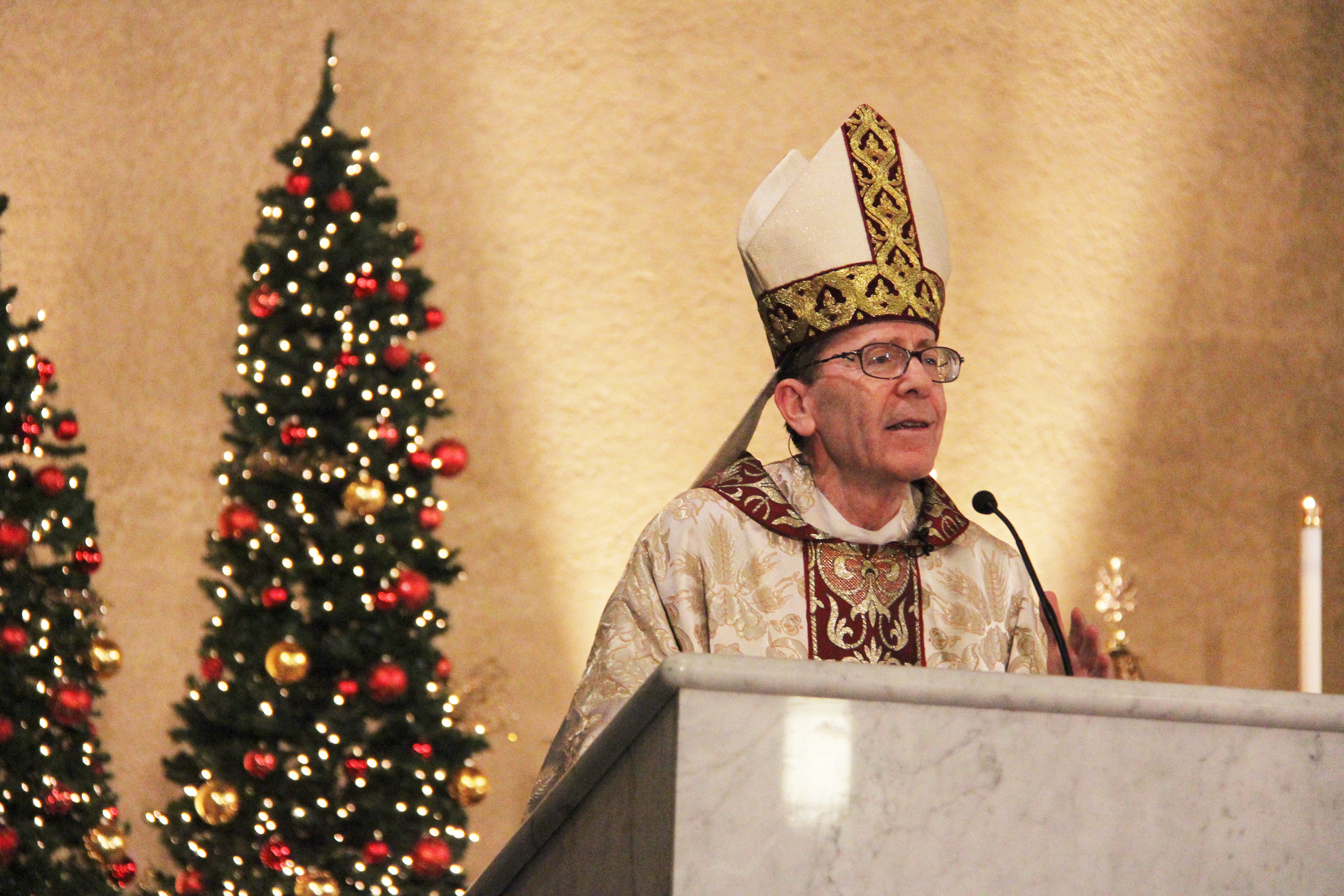
Bishop Olmsted’s Christmas message highlights peace by giving God glory

Bishop Thomas J. Olmsted addresses God’s glory and peace that come with Christ’s birth in his homily for the Christmas Eve Midnight Mass. (Justin Bell/CATHOLIC SUN)

Click here for more photos from the Christmas Eve Midnight Mass at Ss. Simon and Jude Cathedral.

Drawing on lessons from the angels, the little town of Bethlehem, Caesar Augustus, shepherds and the Magi, Bishop Thomas J. Olmsted, highlighted true peace and the key to finding it in his Christmas message during Midnight Mass at Ss. Simon and Jude Cathedral.

“The peace of the Lord is what the shepherds felt as soon as they saw Mary and Joseph and the baby lying in the manger,” said Bishop Olmsted, drawing much of his message from St. Luke’s Nativity narrative.

He said that St. Luke “shows us a stark contrast between the kingdoms of earth and the Kingdom of God, between the Roman Emperor and the Savior of the world.”

Bishop Olmsted highlighted the irony of the nomadic shepherds who were not included in the census, but still had a front row view of the Son of God.

“The shepherds were the first, after Mary and Joseph, to see the kingdom of God breaking into our world. It came to the lowly and humble hearts and ones too insignificant to be counted,” he said.

During the opening procession at the beginning of Mass, Bishop Olmsted incensed the altar and the creche scene of Baby Jesus, Mary and a lantern holding Joseph.

At the beginning of his homily, the bishop drew attention to the multitude angels singing ‘Glory to God in the highest and on earth, peace.”

He noted that “this first Christmas hymn was not man-made” and its place in Sunday Masses throughout the whole world.

“The news acclaimed by the angels is of such joy that it could not just be announced, it had to be sung. And not sung by the Cathedral choir — but they’re very good — but sung by the heavenly choir,” he said.
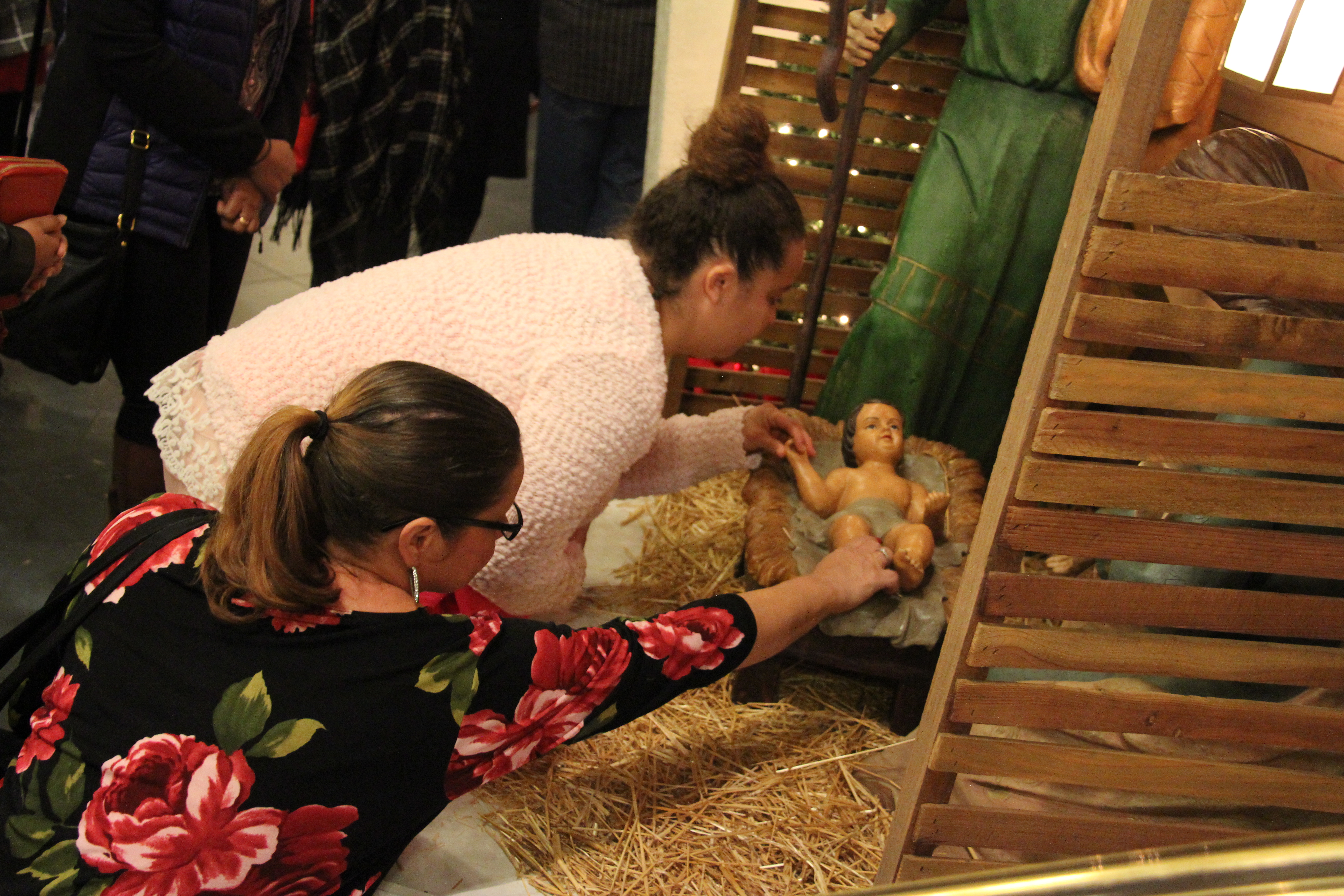
Two women venerate a statue of the Baby Jesus in a manger scene after the Christmas Eve Midnight Mass. (Justin Bell/CATHOLIC SUN)

Bishop Olmsted looked to Pope Emeritus Benedict XVI to anchor the dual themes, referring to the retired Pontiff as saying, “the song of the angels lifts up the importance of two things: the glory of God and the gift of His peace.”

He continued, giving a mini-treatise about the peace of God.

“It was a peace Caesar Augustus didn’t know and could not provide … nor has any emperor or king or president in history,” he said. “For the peace of Christ is far more than the absence of war; it’s where trust and brotherhood convey, where fear and pride are cast out. … Peace is where justice and mercy kiss, where truth and love embrace, where forgiveness restores dignity and hope.”

Then Bishop Olmsted pivoted to the other theme and said, “there can be no peace without the glory of God,” and we learn from the manger in Bethlehem that peace comes from God’s glory.

Bishop Olmsted taught that although God does not need our giving Him glory, instead the glorifying of God is needed and good for us with the internal change it brings.

“What we’re doing tonight, in worship and music and adoration, this is the way peace is built in the heart, where it must begin to be built. If you and I care about peace, if we care about the poor, the forgotten, we must care about the glory of God,” he said.

When God is not honored, “people are not honored and their dignity is lost and forgotten and trampled underfoot.”

However, the bishop said towards the end of his homily, “when Christ the King rules human hearts, there is peace, there is mercy and there is hope — there is singing and there is the bright light in the midst of any darkness.”

After the Mass concluded, a steady stream of the faithful, including children, venerated the Baby Jesus at the manger scene. With seemingly childlike innocence, a candy cane and small lollipop were left as gifts.

Observers say Chinese government-religious relations worsened in 2015

An altar server carries a crucifix as he leads a procession during Christmas Eve Mass at a Catholic church in Beijing. After claiming 2014 to be the worst year for religious persecution in China since the Cultural Revolution, observers in and outside the country say 2015 saw the situation deteriorate further. (CNS photo/Wu Hong, EPA)

HONG KONG (CNS) — When Chinese Minister of Housing Chen Zhenggao traveled to bustling Yiwu in mid-October, news reports said he told housing and law enforcement officials to “battle against illegal constructions” by learning from Zhejiang.

Zhejiang has used the pretext of illegal building to bulldoze churches and remove their crosses. By Christmas 2014, reports said 500 churches had been targeted in the province. By this past Christmas, the number had exploded to more than 1,500, reported ucanews.com.

After claiming 2014 to be the worst year for religious persecution in China since the Cultural Revolution, observers in and outside the country say this year saw the situation deteriorate further. Relations between China’s faithful and the Communist Party have not been this strained since the days of Chairman Mao.

An altar server carries a crucifix as he leads a procession during Christmas Eve Mass at a Catholic church in Beijing. After claiming 2014 to be the worst year for religious persecution in China since the Cultural Revolution, observers in and outside the country say 2015 saw the situation deteriorate further. (CNS photo/Wu Hong, EPA)

In Tibetan monasteries, monks and nuns complained the Communist Party is interfering more in daily life than it has for years. In Xinjiang, burqas were banned; so too was “terrorist clothing.”

“Authorities have lost the hearts of the people after the cross-removal campaign,” said a former Catholic journalist in Zhejiang who gave only her Christian name, Clare.

Although authorities succeeded in forcing churches to display less-conspicuous crosses in Zhejiang, few doubt the provincial government’s campaign has achieved anything except harden Christian resolve, let alone curb an appetite for evangelism.

“It helped unite all the clergy to fight for their rights,” said John, a catechist in Wenzhou.

As the cross-removal campaign reached a crescendo midyear, ordinary Christians and priests took to social media to announce a campaign making minicrosses, and bishops took the rare step of publicly denouncing authorities.

With the campaign winding down in Zhejiang, Christians say they now face something even worse: the cross-removal campaign was all about controlling the church facades, but in recent weeks authorities have interfered inside churches.

In Wenzhou, Christians reported state officials attending church on Sundays to silence critical voices. In other areas of Zhejiang, authorities put up propaganda notices on church pin-boards, according to state media. This is all part of a new campaign called “five entries and transformations,” which aims to make churches more Chinese — and by default less foreign — while picking and choosing Bible verses that correlate to party doctrine.

Ucanews.com reported that some estimates put the number of Christians in China at more than 100 million, and the Communist Party is attempting to co-opt Christianity to its own political ends. But it remains unclear whether its policy comes from the very center of the party, and therefore whether it will endure, said Fenggang Yang, director of the Center on Religion and Chinese Society at Purdue University in West Lafayette, Indiana.

High-ranking party officials appear to disagree about whether Christianity should adapt to China, or the other way round, he added, and a firm direction won’t be made until a delayed religious meeting led by President Xi Jinping takes place.

Fenggang told ucanews.com the fact that the meeting had been postponed multiple times “is a sign of Xi’s dissatisfaction with the work and direction of religious affairs, and probably a sign of an impasse of internal debates and disagreements.”

For China’s diverse religious communities, the future remains less certain than it has been for many years.

Whatever happens, few Chinese Christians appear hopeful of a reprieve from Xi’s strict, rule-of-law handling of the communist government in 2016. On China’s periphery, minority Tibetan Buddhists and ethnic Uighur Muslims appear even less optimistic.

This year started with an official ban on burqas in Xinjiang, then in May Beijing extended what is in effect a state of emergency following a series of attacks.

Stricter measures have seen the first mass trials in China in 20 years and thousands of additional troops deployed in cities, including Urumqi.

Alarmed by a series of attacks blamed on Uighurs and recent violence overseas by the Islamic State group, which released its first call to arms in Mandarin in December, the Chinese government has pushed ahead with drafting a new, controversial anti-terror law.

International rights groups acknowledged China needs to tackle a surge in violence in the west of the country, but also warned repeatedly that the draft risks enshrining a vague catch-all to help Beijing target opponents, real and imagined.

In January, authorities in Tibet posted public notices offering rewards of up to 300,000 yuan to informants who tip off police ahead of “violent terror attacks.”

The main targets were vaguely described as “overseas terrorist organizations and their members’ activities inside China and those spreading religious extremism.”

In July, police in a Tibetan region of Sichuan province opened fire on protesters demanding the return of the body of spiritual leader Tenzin Delek Rinpoche, who died after nearly 13 years in prison. His conviction and 20-year sentence for a series of bombings in Chengdu in 2002 remains disputed by most Tibetans.

Although his represents the most high-profile case this year, overall more Tibetan monks and nuns were confirmed detained — 31 in 2015 compared to 21 the previous year, according to a tally by London-based Free Tibet.

As Tibet’s spiritual leader, the Dalai Lama, turned 80 in July, Beijing seemed to turn up criticism denouncing his “Middle Way” approach of greater Tibetan autonomy. Then, two weeks after his birthday, a Tibetan delegation returned from Beijing saying more dialogue would soon follow. It had been five years since the previous official talks.

Advocates for homeless remember men, women who died on the streets

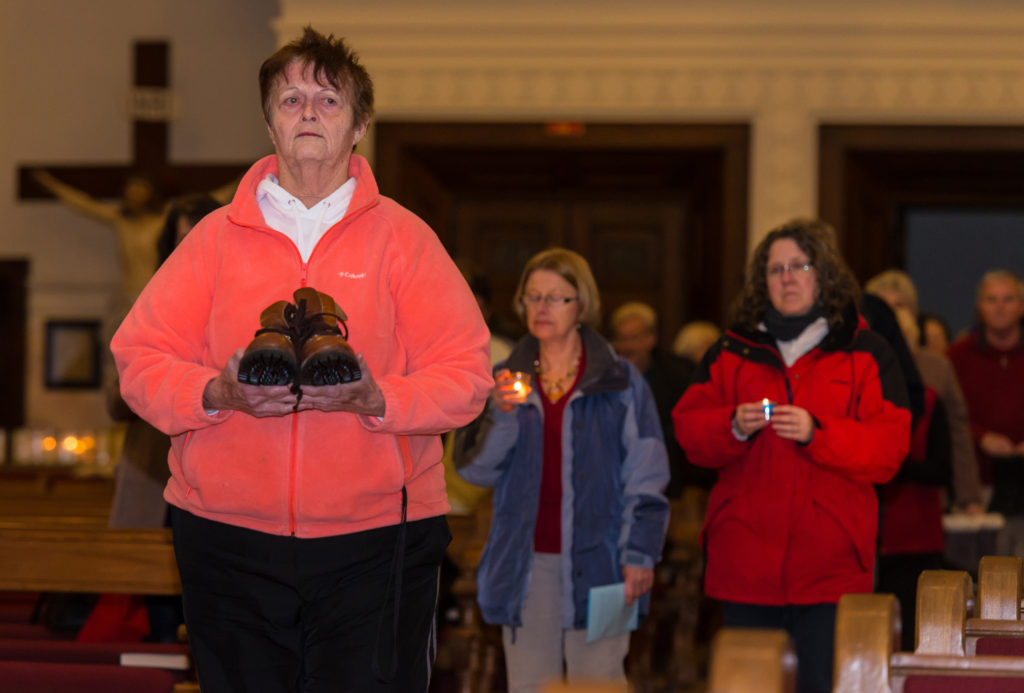
Participants at the seventh annual Greater Green Bay Area Homeless Persons' Interfaith Memorial Service, held Dec. 21 at St. John the Evangelist Church in Green Bay, Wis., join in a procession carrying shoes and candles representing homeless men and women who died in 2015. (CNS photo/Sam Lucero, The Compass)
Participants at the seventh annual Greater Green Bay Area Homeless Persons’ Interfaith Memorial Service, held Dec. 21 at St. John the Evangelist Church in Green Bay, Wis., join in a procession carrying shoes and candles representing homeless men and women who died in 2015. (CNS photo/Sam Lucero, The Compass)

GREEN BAY, Wis. (CNS) — The first day of winter, Dec. 21, is also known as the winter solstice. It is the shortest day and longest night of the year. For people who are homeless, it’s a night that represents the harsh challenges of living on the streets.

For the past seven years, St. John the Evangelist Homeless Shelter, a ministry of the Diocese of Green Bay, has sponsored an interfaith memorial prayer service to remember local men and women who have died while homeless. The service is part of Homeless Persons’ Memorial Day, which has been sponsored nationally by the National Coalition for the Homeless since 1990.

Green Bay’s memorial service began near the entrance of St. John the Evangelist Church with a candlelight prayer service and circle walk. The walk was led by members of the Open Heart Mindfulness Community, a Buddhist Sangha community.

A procession into the church featured men and women carrying candles and a pair of shoes or boots representing each homeless person who died in the Green Bay area in the past year.

Susan Perrault, a member of the St. John Homeless Shelter Ministry Team, said 12 people, whose names were submitted by the Brown County Housing and Homeless Coalition and other sources, were remembered at the service. A 13th candle was lit to remember all those who died and whose names were unknown.

Dcn. Tom Mahoney, on behalf of the parish, welcomed the group of about 145 people to the church.

“We appreciate your involvement tonight to join and share in prayer, song, stories and reflections,” he told those gathered. “Let us remember to give thanks for the progress made” in addressing homelessness.

In particular, he cited the shelter and its newest program, the Micah Center, a daytime resource center for men and women who have no home.

“In addition, let us hold in prayer and gratitude the plethora of committed advocates, volunteers and supporters involved with all of our local shelters and agencies,” Dcn. Mahoney said. “Alone we can do so little, but working together, with God’s grace, we can do much more.”

Sr. Judy Miller, a Sister of St. Joseph of Carondelet and member of the shelter’s board of trustees, offered a reflection about her experiences. She said her time at the shelter has been positive and she saluted the shelter guests who attended the service.

“I want to thank you … for the ways you have influenced my life,” she said.

“This is the longest night of the year. As light will soon penetrate the darkness, may we take seriously those prayers that we sang in the opening hymn when we voiced, ‘Show us Christ in one another. Make us servants strong and true. Give us all your love of justice so we will do what you would do,'” she said.

Sr. Judy offered a few ways that people can address homelessness.

“I think for starters, we can give of our time,” she said. “We can share of our gifts and talents. We can share our resources with any one of the five shelters that are in our Green Bay area and with any of the many agencies which reach out to help the homeless. … None of us is heartless, so together we are invited to open our hearts and address this issue.”

Guests were invited to share remembrances of men and women they knew who had died homeless in the past year. Bernie Schmitt, a volunteer at the shelter, was among those who spoke. He recalled a man at the shelter, Randall, whom he came to know and love for his compassion.

“He loved to write and he wrote many poems and many letters,” Schmitt said. “If he saw someone at the shelter and they did something he thought was really neat, he wrote a poem about it and went up to thank them by handing them what he had written. He did this many times.”

When his friend died, Schmitt spoke to the man’s mother and he said she told him to donate his belongings and take what he wanted.

“I found this packet of writings that he had. I’ve read that many times,” Schmitt continued. “They have so much in them thanking other people for what they did for not just him, but to anything that he saw that they were helping. … I miss him, I pray for him, and I continue to love him for what he did for everyone and for us.”

By Sam Lucero, Catholic News Service. Lucero is the news and information manager at The Compass, newspaper of the Diocese of Green Bay.

In Bethlehem, Latin patriarch says mercy must include more than kin

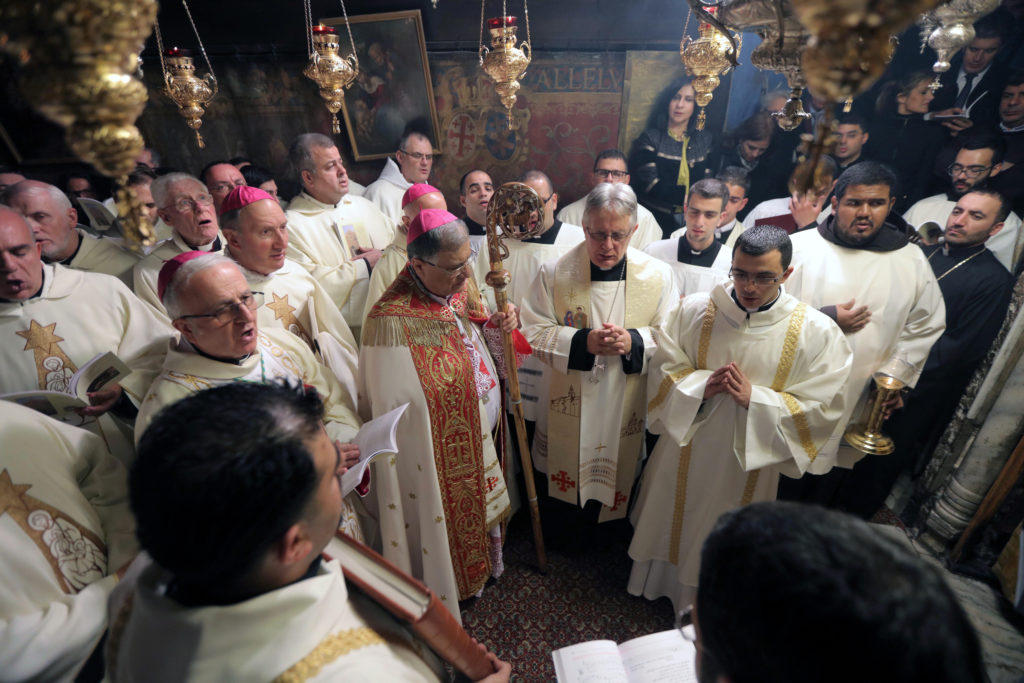
Latin Patriarch Fouad Twal of Jerusalem, center left, leads a Christmas procession in the Church of the Nativity in Bethlehem, West Bank. (CNS photo/Fadi Arouri, pool via EPA)
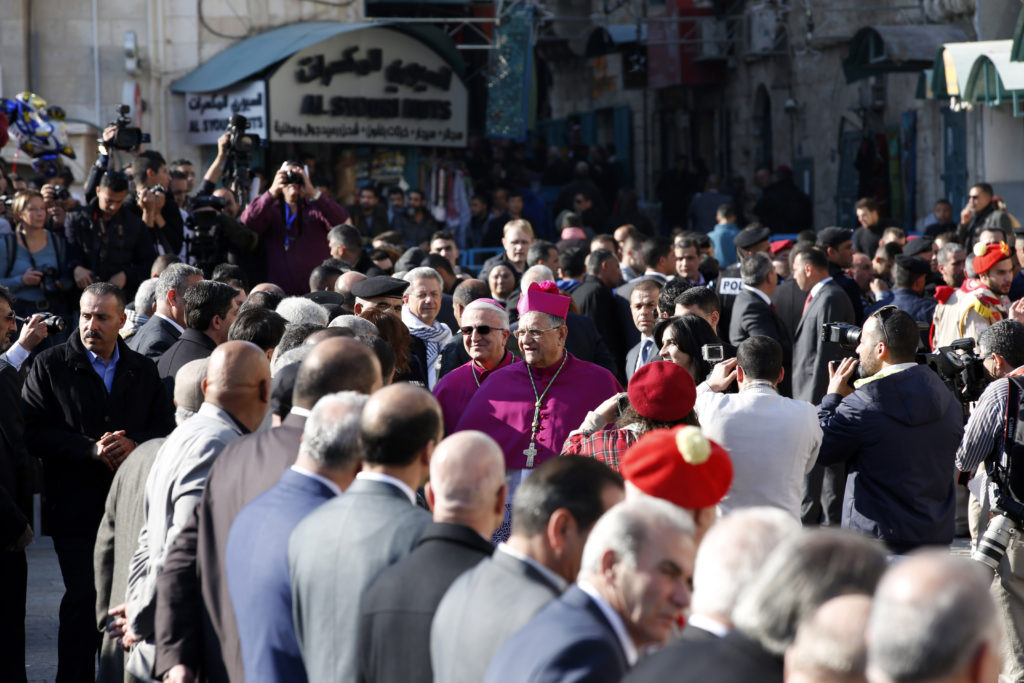
Latin Patriarch Fouad Twal of Jerusalem proceeds to Manger Square to lead the annual Christmas Eve procession into the Church of the Nativity in Bethlehem, West Bank. (CNS photo/Abed Al Hashlamoun, EPA)

JERUSALEM (CNS) — Latin Patriarch Fouad Twal said in the Jubilee Year of Mercy called by Pope Francis that mercy must include every person — both kin and foe.

“In these days and time, we suffer from the absence of compassion in our hearts — as if the coming of Jesus Christ and the message of Christmas were in vain,” he said in his homily at midnight Mass at the Church of St. Catherine, adjacent to the Church of the Nativity in Bethlehem, West Bank.

“It is easy to show mercy to those with whom we are related by blood, kinship, religion and race. However, it is difficult to extend the relationship to include the poor and marginalized, prisoners and the victims of violence and terrorism in Palestine and in our neighboring countries,” he said. “Our hearts go out to the millions of refugees living in camps and shanties, suffering from the biting cold; people fleeing from areas of conflict, many are drifting on vast waters aboard fragile boats, and the sea becoming a collective graveyard.”

“Mercy, compassion and benevolence still exist throughout the world. Fortunately, not all people have lost their humanity,” he said, adding that mercy is not limited to just individual actions and relations, but is all-encompassing.

Patriarch Twal celebrated midnight Mass after leading the traditional procession into Bethlehem and into the Church of the Nativity. During Patriarch Twal’s traditional exit from Bethlehem on Christmas Day, his car was hit with stones thrown by Palestinians who were demonstrating against Israeli soldiers near Rachel’s Tomb, where the convoy passed by, said Jerusalem Auxiliary Bishop William Shomali. He said he did not believe the stones were thrown intentionally, and there was no damage to the cars.

In the days leading up to the Christmas celebration, Palestinian police arrested 10 men, including some believed to be possibly planning attacks against Christian holy sites and pilgrims and others suspected of possible physical harassment of pilgrims in Bethlehem over the holiday, Bishop Shomali said. One Palestinian was arrested for burning a Christmas tree in the northern, largely Christian Palestinian village of Zababdeh. Bishop Shomali said this was unusual, since most Palestinian Muslims enjoy the Christmas trees, though some do not accept the public display of Christian symbols.

Latin Patriarch Fouad Twal of Jerusalem, center left, leads a Christmas procession in the Church of the Nativity in Bethlehem, West Bank. (CNS photo/Fadi Arouri, pool via EPA)


In his homily, Patriarch Twal said that in a time when the world is becoming increasingly brutal, the faithful of all religions have the responsibility to nurture the seeds of mercy so that it becomes a “common culture” within public and personal life.

“Seeds of mercy are entrenched in all religions that bind us with Judaism and Islam. Mercy is recognized as one of the most prominent attributes of God. Before being omnipotent, almighty, creator and supreme, God remains the all-merciful,” he said.

“Consequently, we can work toward a new world, characterized by equality, peace, charity and mutual respect, so that mercy becomes a common culture within public and family lives,” he added.

In celebrating the birth of Jesus at Christmas, people should remember that Jesus came to show the merciful face of God, Patriarch Twal said.

He said the call of mercy should reach out to those involved in corruption and to those in the production, financing and selling of lethal weapons “at the cost of blood of others.” He urged those people to begin “thinking sensibly, to listen to their conscience and uphold the dignity of every human being over and above their own personal interests.”

“There is no contradiction between God’s mercy and justice, because he is both just and merciful. Anyone who refuses to seek his mercy will ultimately fall under the firm grip of his justice. That is what gives hope to people and individuals, victims of injustice,” he said. “In this evening, as we celebrate the birth of the Prince of Peace, we have come to pray for all the intentions previously mentioned. Together we pray to change the face of the world, that our world be a safe dwelling place and refuge, where justice prevails over rivalry and conflict, mercy over vengeance, charity over hatred.”

Since violence flared between Israelis and Palestinians three months ago, Palestinian attackers have killed 20 Israelis, mostly by stabbings. Some 124 Palestinians have been killed by Israeli gunfire, 85 of whom Israel says were attackers and the rest during demonstrations.

By Judith Sudilovsky, Catholic News Service.

Hope for modern day refugees

Tomorrow’s Gospel reading chronicles the Holy Family’s journey to Egypt after an angel told Joseph of Harod’s plan to kill young children. The Holy Family became refugees.

There are plenty of refugees around the world today. The Catholic Sun has pages of online articles about them.

Agencies such as Catholic Relief Services and Catholic Community Services make it their life’s work to support refugees whether in a camp or more permanently resettled in a foreign land. Secular media picked up on their plight in early September after a photo of a 3-year-old Syrian boy went viral when his body washed ashore.

While many of the headlines can be heartbreaking, there have been some that are heartwarming.

Phoenix

Arizona Horizon recently took a look at some of the refugees that Phoenix’s Catholic Charities Community Services is supporting through The Refuge, a social entrepreneur venture into the world of cafés and art. As the café’s name suggests, it supports local refugees.

Watch the episode.

Buffalo, New York

Anab Riyaleh, a graduate of the Hospitality and Tourism Training Institute, postes with Nagara University President Fr. James Maher, C.M. (courtesy photo)

The Catholic Charities outreach in Buffalo recently graduated its third cohort of refugees from a Hospitality and Tourism Training Institute. Catholic Charities and Niagara University’s College of Hospitality and Tourism Management collaborated to develop the training. It includes classroom training, visits to local hotels and internship experiences. Originally constructed to span 10 weeks, the program has been condensed to an eight-week timeframe, allowing graduates to enter the workforce sooner.

Several graduates are already being interviewed by local hotels, including the Hyatt Regency Buffalo, Courtyard Buffalo, Hampton Inn and Suites and Buffalo Marriott HARBORCENTER, all partners of the institute. A Somalian father and son were among the latest graduates.

“As a Catholic and Vincentian university, we consider it our mission to work with the community and provide assistance wherever and whenever we can,” said Fr. James Maher, C.M., president of Niagara University. “By providing participants with the skills they’ve obtained during this program, the foundation has been set for them to pave a sustainable career path, thereby enhancing their lives and the community in the process.”

Exactly 37 refugees ages 19 to 55 have now completed the program. They came from countries such as Burma, Iraq, Somalia, Nepal, Democratic Republic of the Congo and Myanmar.

The next training session begins Jan. 25. Niagara University’s College of Hospitality and Tourism Management, founded in 1968, was the first program in the world to offer a bachelor’s degree in tourism and has a long history of training individuals to succeed in the industry.

Christ’s birth can bring peace, hope to suffering world, pope says

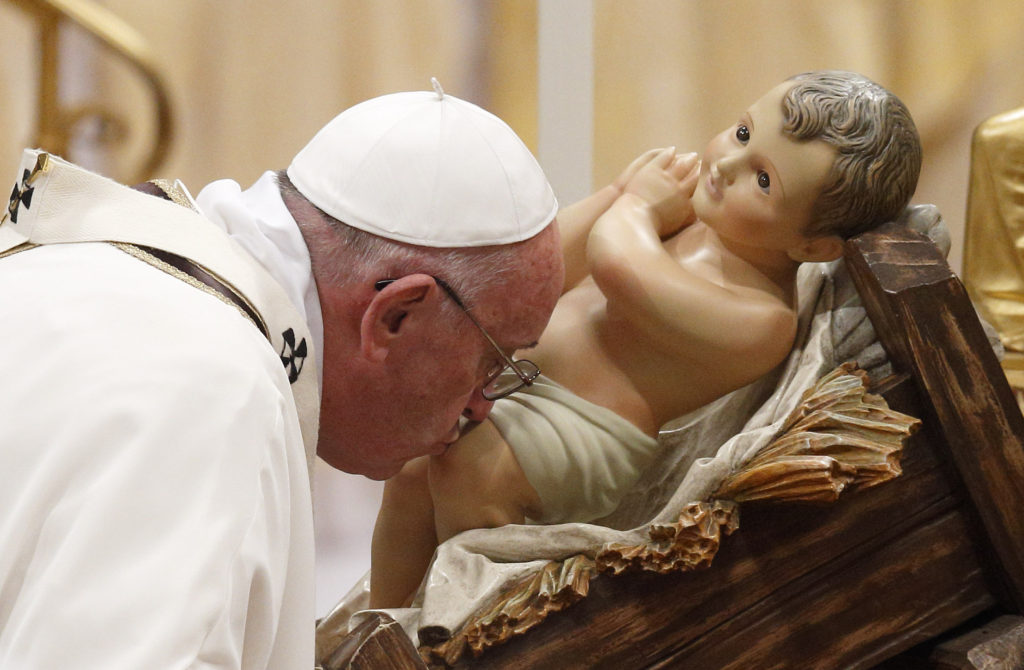
Pope Francis kisses a figurine of the baby Jesus as he arrives to celebrate Christmas Eve Mass in St. Peter's Basilica at the Vatican Dec. 24. (CNS photo/Paul Haring)
Pope Francis kisses a figurine of the baby Jesus as he arrives to celebrate Christmas Eve Mass in St. Peter’s Basilica at the Vatican Dec. 24. (CNS photo/Paul Haring)

VATICAN CITY (CNS) — Christmas is a reminder that through the birth of Christ, hope and peace are possible and that only through his grace can humanity find peaceful solutions to the world’s most difficult problems, Pope Francis said.

“Only God’s mercy can free humanity from the many forms of evil, at times monstrous evil, which selfishness spawns in our midst,” the pope said Dec. 25. “Where God is born, hope is born. Where God is born, peace is born. And where peace is born, there is no longer room for hatred and for war.”

Heightened security around St. Peter’s Square did little to dampen the spirits of an estimated 50,000 people attending the pope’s solemn Christmas blessing “urbi et orbi” (to the city and the world). Many in the crowd dressed festively and applauded the music of the Vatican’s marching band.

However, police and anti-terrorism task forces were a visible sign of a world shaken by violence and extremism; conflicts that have not even spared the birthplace of Jesus Christ. The pope prayed that Israelis and Palestinians would reach a peaceful agreement that would end the “conflict which has long set them at odds, with grave repercussions for the entire region.”

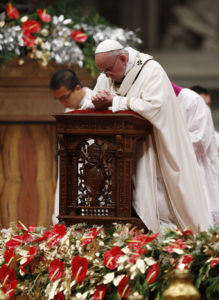
Pope Francis kneels in prayer as he celebrates Christmas Eve Mass in St. Peter's Basilica at the Vatican Dec. 24. (CNS photo/Paul Haring)
Pope Francis kneels in prayer as he celebrates Christmas Eve Mass in St. Peter’s Basilica at the Vatican Dec. 24. (CNS photo/Paul Haring)

The pope also prayed that recently approved agreements would bring a quick end to the wars afflicting Syria and Libya, two countries ravaged by war for several years. He also prayed that the international community would find ways to end atrocities in Iraq, Yemen, Congo, Burundi, South Sudan and Ukraine.

Victims of terrorism were also in the pope’s thoughts and prayers as he remembered the victims of the Russian airliner bombed in Egyptian airspace and terrorist attacks in Beirut and Paris; Bamako, Mali and Tunis, Tunisia.

Christians persecuted for their faith were remembered as the pope prayed that “the Child Jesus grant consolation and strength” to those suffering.

Recalling the thousands of refugees and migrants fleeing poverty and war, Pope Francis compared the lack of respect for their dignity to the situation of Christ who was born into the world suffering “cold, poverty and rejection.”

“May our closeness today be felt by those who are most vulnerable, especially child soldiers, women who suffer violence, and the victims of human trafficking and the drug trade,” he said.

As the church celebrates the Holy Year of Mercy, the pope said mercy is the “most precious gift which God gives us” and that Christians “are called to discover that tender love of our heavenly Father for each of us.”

The bells of St. Peter’s Basilica pealed at midday, just as they did late Dec. 24 when thousands packed the church for Christmas Mass. Hundreds of people who could not find room in the basilica braved the cold weather and watched on giant screens from St. Peter’s Square.

With his voice noticeably hoarse from a bout of flu, the pope said in his homily that the prophetic words of Isaiah are those of a fulfilled promise of joy and gladness that are “a sure sign that the message contained in the mystery of this night is truly from God.”

Doubt and indifference, he stressed, should be left to skeptics who “by looking to reason alone, never find the truth.”

“There is no room for the indifference which reigns in the hearts of those unable to love for fear of losing something,” he said. “All sadness has been banished, for the Child Jesus brings true comfort to every heart.”

The birth of Jesus, he continued, is a call for all Christians to “put away all fear and dread” and to follow the path that leads to Christ “who has been ‘born to us,’ he was ‘given to us’ as the prophet Isaiah proclaims.”

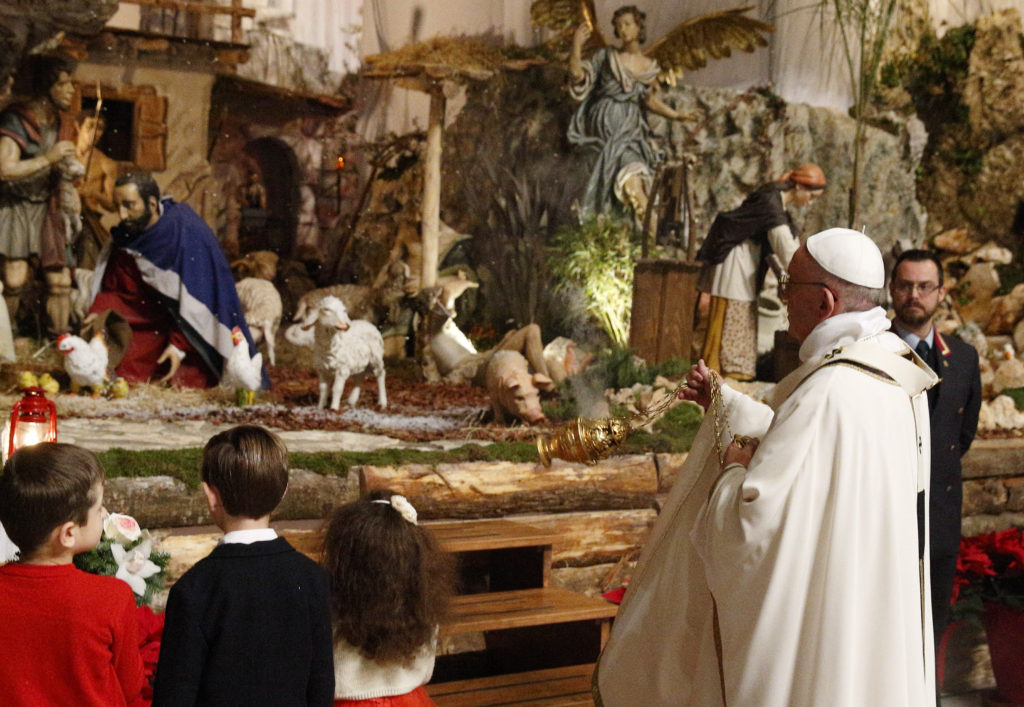
Pope Francis uses incense as he visits the Nativity scene at the conclusion of Christmas Eve Mass in St. Peter's Basilica at the Vatican Dec. 24. (CNS photo/Paul Haring)
Pope Francis uses incense as he visits the Nativity scene at the conclusion of Christmas Eve Mass in St. Peter’s Basilica at the Vatican Dec. 24. (CNS photo/Paul Haring)

The coming of Christ into the world, the pope said, shows what is truly essential in life. Despite his birth into the “nothingness” of poverty, Jesus shows men and women who are simple of heart the true path of “authentic liberation and perennial redemption” while giving them strength to reject “godless ways and the richness of the world.”

“In a society so often intoxicated by consumerism and hedonism, wealth and extravagance, appearances and narcissism, this Child calls us to act soberly, in other words, in a way that is simple, balanced, consistent, capable of seeing and doing what is a essential,” he said.

Christians, the pope said, are called to cultivate a sense of justice, discernment and doing God’s will in a world that is often “merciless to the sinner and lenient to the sin.”

As a choral rendition of “Silent Night” echoed through the basilica during the distribution of Communion, many attending the Mass were visibly moved. A nun looking reverently toward the main altar shed a single tear while smiling; gazing with the eyes that Pope Francis said in his homily all Christians are called to look upon the Baby Jesus.

“Like the shepherds of Bethlehem, may we too, with eyes full of amazement and wonder, gaze upon the Child Jesus, the Son of God. And in his presence may our hearts burst forth in prayer: ‘Show us, Lord, your mercy, and grant us your salvation,'” the pope said.

By Junno Arocho Esteves, Catholic News Service.

Merry Christmas [VIDEO]

Enjoy some Christmas messages from our Catholic places of learning plus one parish.

[quote_box_center]Tip: Above clip is the entire performance. For snippets, try jumping to either the 17:10 mark, 39:00 mark or the 13:00 mark

To view following three clips, you must be logged in to Facebook as yourself, not an administrator.[/quote_box_center]


There are plenty more snippets from Immaculate Heart of Mary Parish on its Facebook page.


School program teaches students to be good pet parents

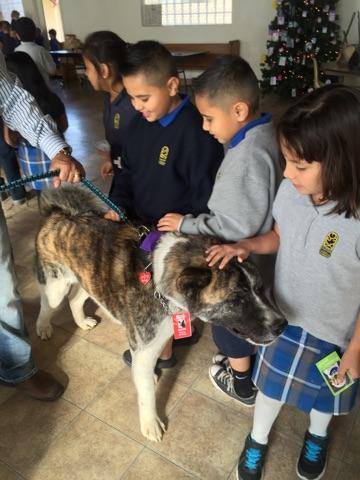
St. Gregory students interact with a pet therapy dog as part of a wrap-up session on humane care of animals. (courtesy photo)

Second-grade students at St. Gregory School know how to be good pet parents after completing a five-week cross-curricular program.

They successfully finished the Kindhearted Kids Character Education Program Dec. 10. It takes a hands-on approach to instill humane care of animals and their habitats.

Each student received a stuffed animal dog or cat and  transported it to and from school in a carrier daily so they could better reflect in a journal, read and solve math problems related to their care of the pet. The goal was to instill Christ-like values of empathy, respect and responsibility.

Fr. Andres Arango, pastor, blessed the students’ stuffed animals on their final day before the students were allowed to take their “pets” home permanently.

The second-graders had a chance to interact with real animals on campus too. Members of the Phoenix K-9 unit visited Dec. 3 to show how working dogs have to show respect and responsibility. Therapy dogs from Phoenix Children’s Hospital visited the following week to show how the therapy dogs need to show kindness and empathy to patients of the hospital.

Remembering who we are at Christmas — and who Christ is

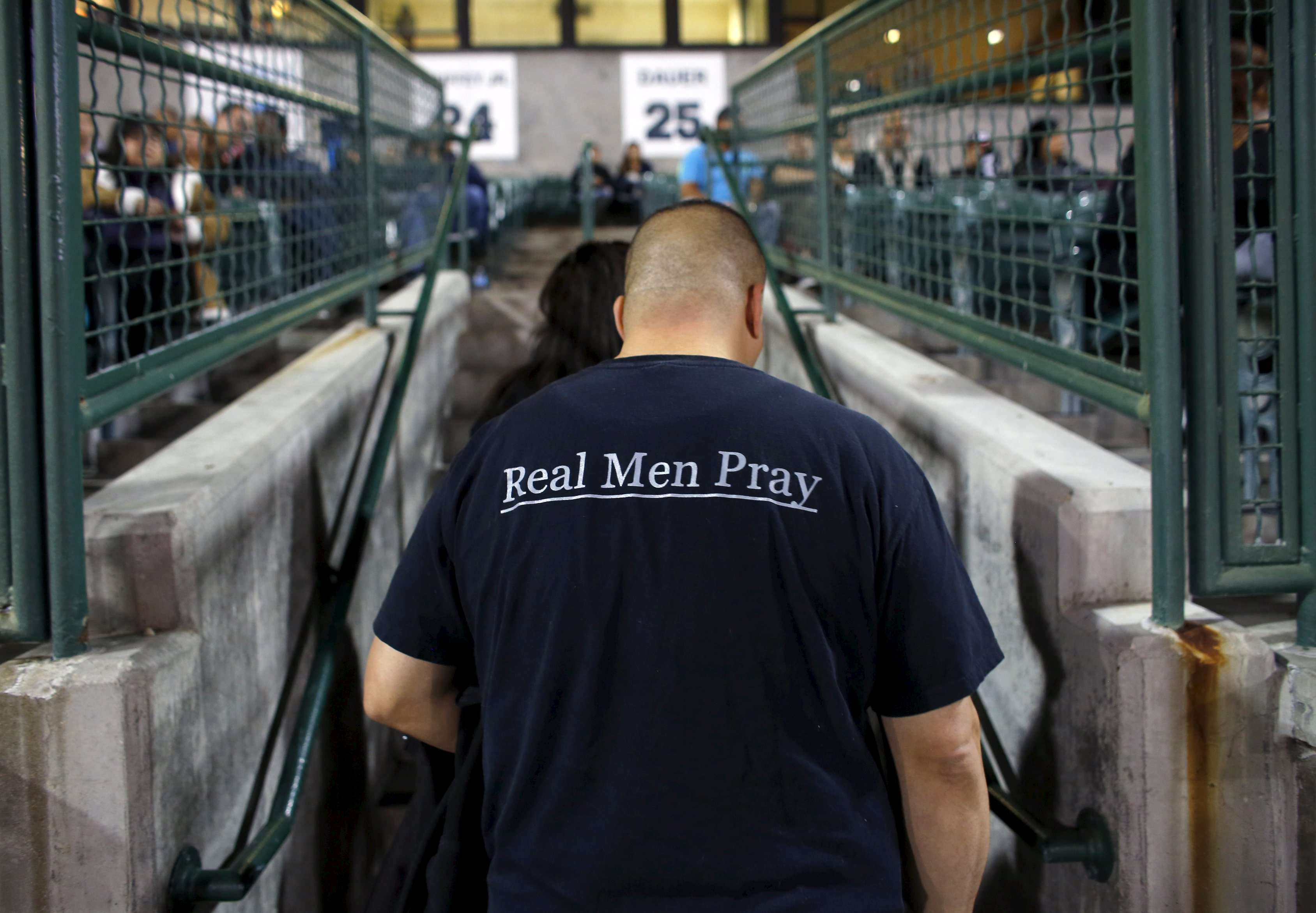
"Real Men Pray," says a T-shirt worn by an attendee of a candlelight vigil in San Bernardino, Calif., Dec. 3 for the victims of a mass shooting the previous day at the Inland Regional Center. At least 14 people were killed when gunmen opened fire during a function at a center for people with developmental disabilities. (CNS photo/Mike Blake, Reuters)
“Real Men Pray,” says a T-shirt worn by an attendee of a candlelight vigil in San Bernardino, Calif., Dec. 3 for the victims of a mass shooting the previous day at the Inland Regional Center. At least 14 people were killed when gunmen opened fire during a function at a center for people with developmental disabilities. (CNS photo/Mike Blake, Reuters)

[dropcap]W[/dropcap]ith Christmas just days away, we turn our hearts toward the humble stable in Bethlehem where the Savior of the world was born.

In the midst of the clamor of the world and the unrelenting violence around us, this conscious decision to focus on Jesus Christ, Ruler of the Universe, girds us with the truth: the Child born in the silence and stillness of the night was sent to redeem us and heal our broken world.

We need to remember who we are and who He is.

Joyce Coronel is a regular contributor to The Catholic Sun and author of “A Martyr’s Crown.” Opinions expressed are the writers’ and not necessarily the views of The Catholic Sun or the Diocese of Phoenix.

I truly believe we are at a point in our country’s history where most of us have forgotten — or never even learned — this fundamental truth.

Who are we? What do we stand for? What are we living for? What are we willing to die for?

The Islamic State terrorists who struck Paris and who inspired the San Bernadino massacre this month continue to strike throughout the world, day after day. They know exactly who they are, what they stand for and what their objectives are. ISIS has never wavered in its aims.

They stand for a worldwide caliphate that will impose its interpretation of Islam, complete with beheadings of Christians and the stoning of adulterers. They stand for fear and absolute power and control. They stand for death and destruction. They are appalled by the notion that God would take on human flesh and dwell among us, that He would heal the sinner and embrace the prodigal.

In short, they have made their objective clear: to stamp out all other religions and have their repulsive black flag fly over the White House and the Vatican.

And what is our response? Right now, a third of U.S. adults under 30 have no religious affiliation whatsoever. Atheism, secularism and agnosticism are growing steadily. “The majority of adult Catholics are not even certain that a personal relationship with God is possible,” says author Sherry Weddell in her blockbuster “Forming Intentional Disciples” (p. 46).

Reality check: we won’t defeat a diabolical, rapidly growing, murderous ideology with vague notions of spirituality. We won’t defeat ISIS with a few airstrikes and some rhetoric.

During World War II, there was a national consensus about the necessity to band together and defeat evil regimes intent on swallowing the world. There was a spiritual quality to the national mood, a common conviction that good would triumph. I don’t think you could say that about the U.S. today. We have become a nation of navel gazers, unsure of what we believe. We define our own truths at our peril.

The truth is that the same God who raised the dead and healed the blind lives today, answers prayers today, listens to our hearts’ earnest pleas today. He created us to be free and to live in freedom. He’s calling us to turn toward Bethlehem and consider the frail humanity He embraced by living among us as the Son of God, Son of Mary.

He calls us to defend the weak, to ransom the captive. He empowers us by His Spirit, strengthens us by grace and the sacraments. He arms us with boldness and confidence that His love will conquer all, even the most hardened of hearts.

Our identity as Christians is inextricably intertwined with the Person of Christ, the Suffering Servant, who told us bluntly, “Without Me, you can do nothing.”

“You’ve got to wake them up!” one Catholic priest from the Middle East told me recently. “Americans will not understand until it is too late.”

So consider this a wake-up call. Pray that more and more people will come to know Jesus Christ personally, that they will commit themselves to lives of service and sacrifice. Pray that terrorists will be thwarted and that their hearts will be converted. Pray that Christians who risk their lives for our faith will be protected. Pray that we will remember who we are in Christ.

Bleak Christmas faces church in quake-ravaged Nepal amid crippling blockade

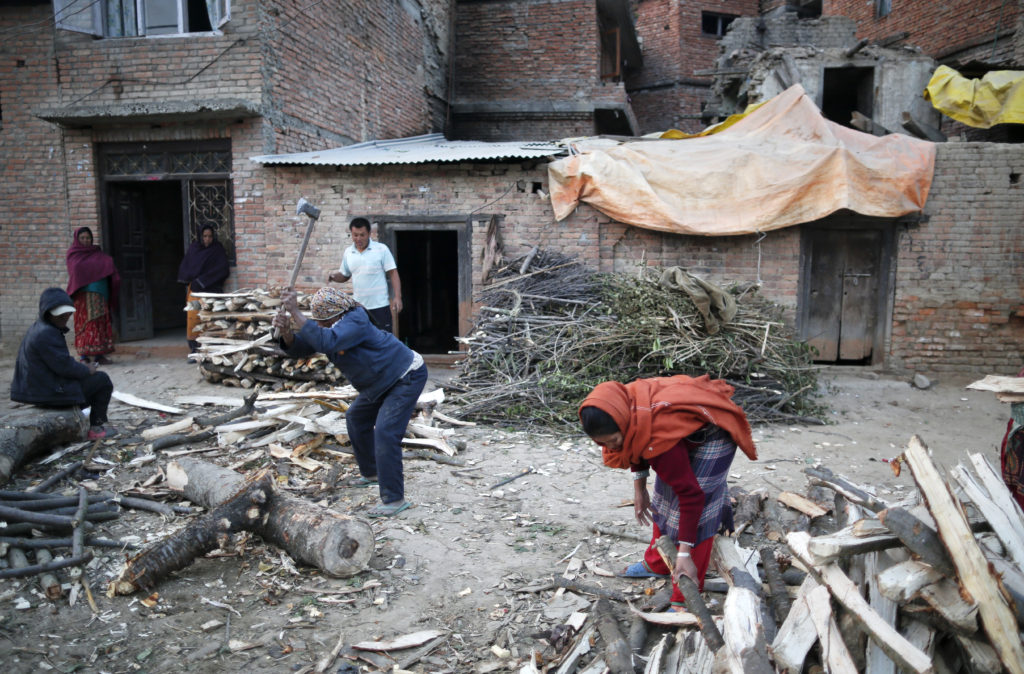
Nepalese who lost their home in the April 25 earthquake chop firewood in Lalitpur Dec. 21. The church in Nepal is preparing for a bleak Christmas as the Himalayan nation passes through one of the worst crisis in its history following the earthquake and an Indian blockade. (CNS photo/Narendra Shrestha, EPA)

Church officials told Catholic News Service that the Nepalese face a heightened crisis as winter settles in because supplies of fuel for vehicles and cooking gas have dwindled and electricity service has become intermittent.

“The situation here is worse than the (post-) earthquake scenario. It will be a very harsh Christmas for us this year,” Fr. Pius Perumana, director of Caritas Nepal, said Dec. 22 from Kathmandu, the capital.

“The economic blockade has crippled life here. We have hardly any electricity, fuel or cooking gas. We are using firewood for cooking,” Fr. Perumana said.

Fr. Perumana traced the difficulties to the Sept. 20 adoption of a new Nepalese constitution that declared the former Hindu kingdom as a “secular state,” nine years after the Hindu monarchy was overthrown by a popular uprising.

Soon after, political parties and groups in the Madhesi region bordering India launched a blockade of the key supply routes from India to the Himalayan nation, alleging marginalization of the Madhesi people under the new constitution.

“The general perception here is that the (Hindu nationalist Bharatiya Janata Party-controlled) Indian government is supporting the blockade because Nepal has chosen to be a secular state and not a Hindu state,” Fr. Perumana said.

More than 50 people have died in three months of protests. Vital supplies have been blocked by demonstrators opposed to the new constitution. Nepal Prime Minister Khadga Prasad Oli has blamed India for the blockade.

Despite the distress, Hindu groups that had unsuccessfully campaigned for Nepal being declared a Hindu nation continue to protest in the capital, seeking a change from the government.

Expressing concern over the obstruction of essential supplies, U.N. Secretary-General Ban Ki-moon Nov. 11 urged all sides to lift the blockade at the border, invoking the landlocked country’s right of free transit.

As a result of the “man-made disaster,” Fr. Perumana said, Nepal has slipped into a “horrible situation” with acute shortage of essential items, including medicine and food.

“The relief work had been hit badly. When there is no fuel, regular transport or commodities available, what can you do?” the priest said of the blockade’s effect on relief work for the victims of the earthquake that left more than 8,000 dead and more than 1 million homeless.

“Many of the charities have scaled down the relief work due to the lack of supplies and logistical problems. Sadly, the victims of are made to suffer again,” Fr. Perumana told CNS.

Chirendra Satyal, spokesman for the Catholic vicariate of Nepal, confirmed that the situation is “worse than after the earthquake.”

[quote_box_center]

Catholic Relief Services reports on efforts three months after the quake. (July 2015)

[/quote_box_center]

“This Christmas will be a very bleak one,” he said. “Normally, we have lot of stars and illuminations but not this year. The electricity supply is very erratic due to break downs.”

Satyal estimated that Mass attendance has declined by two-thirds because of the lack of fuel.

“More importantly people are dying even in hospitals due to lack of oxygen and medicines. Prices of every item have gone up several times. Taxis charge five times (the normal rate). Cooking gas costs still more,” Satyal said.

He narrated a litany of woes facing the Nepalese: People travel precariously atop crowded buses, banks are open for a few hours a day and staff in government offices rotate working shifts, slowing the response to constituent needs.

Religions for Peace Nepal, the country’s largest interreligious organization, received U.N. funding for its relief and development work, but has been unable to access the money through a local bank because of the crisis, Satyal said.

Salesian Father Joji John told CNS from the Don Bosco Technical Institute at Thecho, a Kathmandu suburb, that people’s lives were “miserable.”

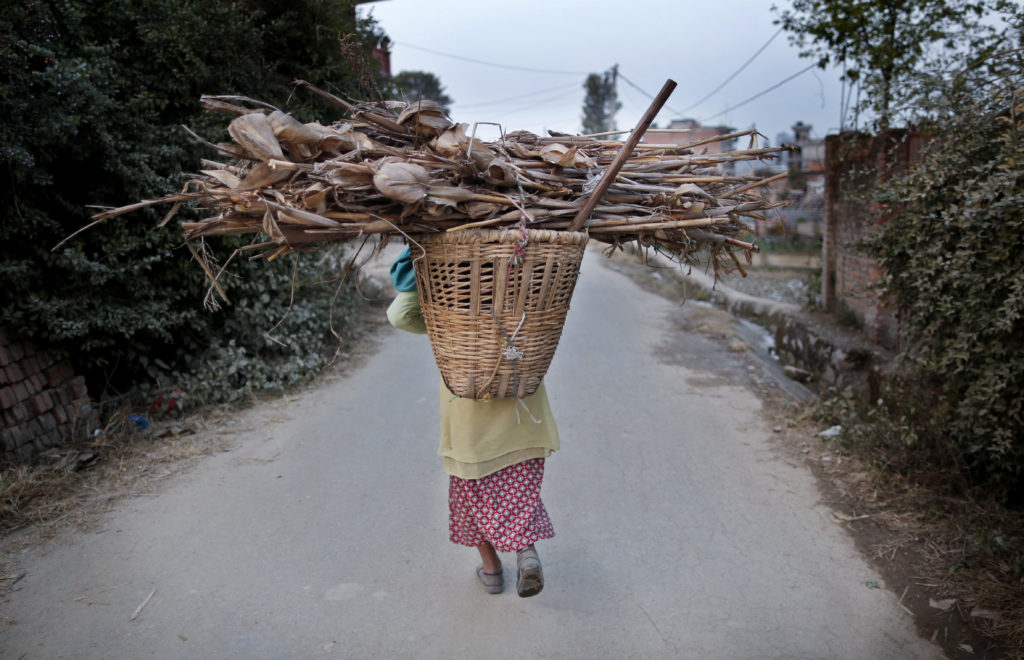
A Nepalese woman carries firewood on her back as she returns home in Lalitpur Dec. 21. The church in Nepal is preparing for a bleak Christmas as the Himalayan nation passes through one of the worst crisis in its history following the April 25 earthquake and an Indian blockade. (CNS photo/Narendra Shrestha, EPA)

“Our (earthquake) rehabilitation and reconstruction work is held up badly as the cost of commodities has gone up by leap and bounds,” Fr. John said.

“We are not able to visit our area of operations due to the shortage of fuel,” he added. “The most affected are the people in remote areas where they are still living in tents and fighting with the cold winter.”

The blockade has forced the government to divert funding from relief work, acknowledged Prakash Khadka, a Catholic social worker and member of Pax Romana, the international Catholic movement for intellectual and cultural affairs.

“(The) fuel shortage and black market has brought movement of relief agencies to a halt,” he told CNS in an email.

“The common sight on the roads was of men, women and children carrying bundles of firewood,” Khadka said. “Selling firewood to the families and restaurants in those towns is new income for these people.”

By Anto Akkara, Catholic News Service.