Pope Francis greets the crowd as he leads the Angelus from the window of his studio overlooking St. Peter's Square at the Vatican March 27, 2022. The pope appealed for an end to the war in Ukraine, calling it "a barbarous and sacrilegious act." (CNS photo/Vatican Media)
By Carol Glatz, Catholic News Service
VATICAN CITY (CNS) — God always forgives and joyously welcomes back everyone who returns to him, even after a life of mistakes and sin, Pope Francis said.
“God does not know how to forgive without celebrating! And the father celebrates because of the joy he has because his son has returned,” the pope said before reciting the Angelus prayer March 27 with visitors gathered in St. Peter’s Square.
The pope reflected on the day’s Gospel reading about the parable of the prodigal son, “who has returned home after having squandered all his possessions,” Pope Francis said.
“We are that son, and it is moving to think about how much the Father always loves us and waits for us,” he said.
But the older son in the parable who becomes indignant because he has always obeyed his father “is also within us and we are tempted to take his side,” he said.
“He had always done his duty, he had not left home,” and he is angry seeing their father embracing the child who had behaved so badly, he said.
The problem with this reaction, the pope said, is the older son “bases his relationship with his father solely on pure observance of commands, on a sense of duty.”
“This could also be our problem, the problem among ourselves and with God: to lose sight that he is a father and to live a distant religion, composed of prohibitions and duties,” the pope said.
People who live this cold distance from God become rigid toward others and find it hard to welcome, much less rejoice over, the return of a repentant or struggling child of God, he added.
“Those who have made mistakes often feel reproached in their own hearts. Distance, indifference and harsh words do not help. Therefore, like the father, it is necessary to offer them a warm welcome that encourages them to go ahead,” the pope said.
People must “look for those who are far away,” have an open heart, truly listen and never make them feel uncomfortable, he said.
The father “celebrates because of the joy he has because his son has returned,” and, like the father, “we need to rejoice,” too, when someone repents, no matter how serious their mistakes may have been, he said.
In the parable, the father reassures the older son, saying, “you are here with me always; everything I have is yours. But now we must celebrate and rejoice, because your brother was dead and has come to life again; he was lost and has been found.”
The parable shows, the pope said, that the father has “two needs, which are not commands, but essentials for his heart.”
The pope asked people to reflect and “see if we too have in our hearts these two things the father needs” — to be able to celebrate and rejoice for others.
Stretching across the pine-brush and open grasslands about 50 miles south of the Grand Canyon are 40 acres of land where a visitor can gaze for miles at the blue sky and hear the soft breezes blowing across the countryside, the San Francisco Peaks in the background.
It is in this bucolic Southwest setting that the Diocese of Phoenix hopes men overcome by the ravages of substance abuse and other addictions will come to heal and reclaim their lives.
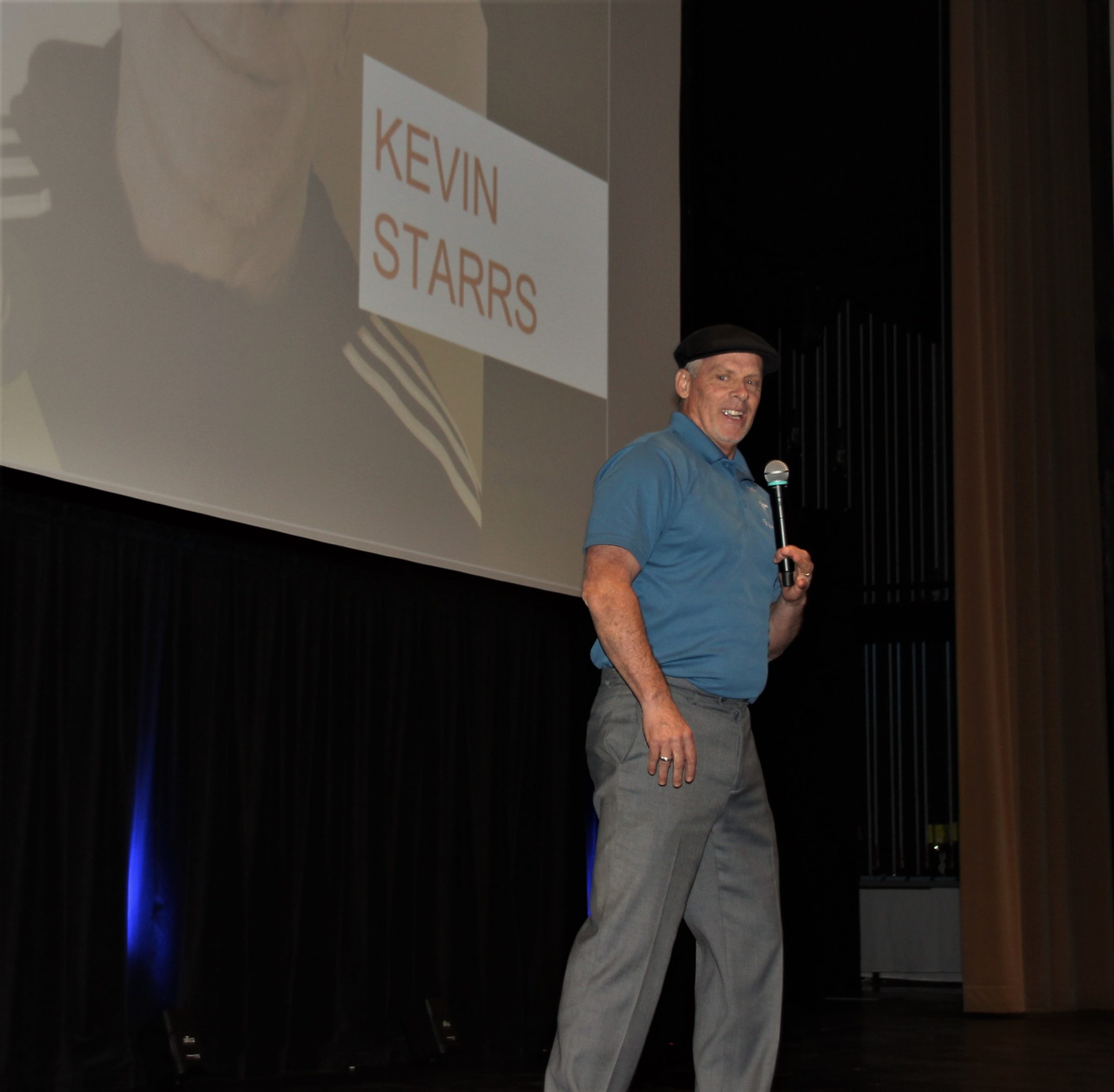
“Sometimes, people need to get away to clear their mind and body,” explained Kevin Starrs, leader of the Diocese’s Prison Ministry and the plan’s guiding force.
“That’s why going out of the city is part of it. It is about 2 miles off dirt road, mountain desert with a view of the Peaks.”
The setting also helps facilitate what Starrs likes to refer to as getting into one’s daily prayer closet, where the individual can soak in God’s Word and listen to the Holy Spirit.
Kevin Starrs of the Diocese of Phoenix’s Prison Ministry addresses the annual Catholic Mens Conference in February. Starrs is leading a plan to open the diocese’s first addiction rehabilitation center near Williams. Jeff Grant/THE CATHOLIC SUN
There is much to be done before the rehab center becomes reality, including fundraising, government approval, planning and construction.
But some of the basics are in place.
The Diocese owns the property, and Starrs said the use has been cleared by the Office of Buildings and Properties.
The model for the facility comes from a center in Birmingham, Ala., where Starrs was led through conversations with Bishop Thomas J. Olmsted, who is enthusiastically behind the idea.
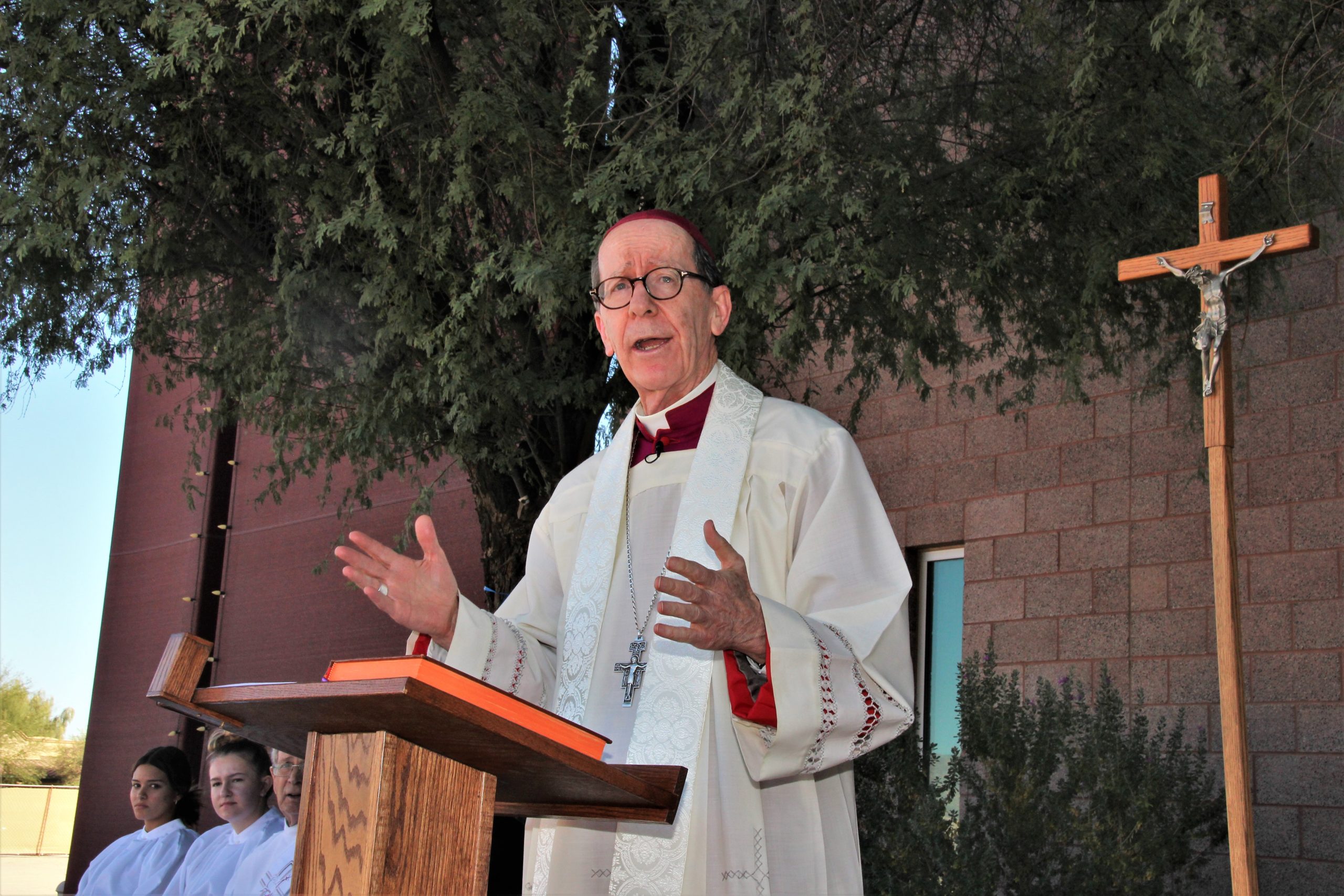
“It’s really badly needed. I totally support it,” the bishop said.
Bishop Thomas J. Olmsted speaks at St. Benedict in Phoenix expansion groundbreaking last fall/ CATHOLIC SUN File
Serving since 1994 with the diocesan Office of Prison Ministry – whose primary mission is bringing the Gospel to the incarcerated throughout Arizona, Starrs has had desire to establish a rehab center based on Catholic teaching and practice where clients can overcome addiction to a variety of self-destructive behaviors, including drugs, alcohol, pornography, gambling and others. He began earnestly praying about it in 2018 with four colleagues, and soon afterward shared the idea with Bishop Olmsted.
The bishop was aware of several programs in the United States that used Catholic practices and teaching as part of recovery. He suggested Starrs visit one in Birmingham, Ala., that he had heard success stories about.
“He said, ‘Kevin, you need to get to Alabama as soon as possible. (and) within 3 weeks we were there. We loved what we saw,” Starrs said.
Men pray the rosary together, attend Mass, receive Communion, go to Confession, spend time in Adoration and pray – both with one another and alone. The men also share their fears, anxieties and challenges, as well as transgressions.
“They build real accountability and encouragement. It’s wonderful,” Bishop Olmsted said.
There is a community, Starrs added.
“They gather for lunch, work in agricultural fields, pray “Hail Mary(s)” on their way in. It’s the most beautiful thing I experienced.”
Starrs said the Arizona center will include all that as well as recreation and nonreligious activities. Men will take turns working the kitchen, baking bread, and have much time for conversation.
The facility will sleep 25, and include a chapel, kitchen and grotto, Starrs said.
The center will be named for St. Maximilian Kolbe, the patron saint of drug addicts, prisoners, families, journalists and the pro-life movement. Ordained a Franciscan in 1918, Kolbe and six other friars formed the Marian Franciscan movement known as The Immaculate. Kolbe served in Poland, where he was taken prisoner twice by the Nazis during World War II. Following his second arrest in 1941, he was held at Auschwitz, where he later asked to take the place of another inmate who had been sentenced to die. Kolbe was supposed to be starved to death, but when he continued to survive, the Germans executed him by lethal injection in August 1941.
He was canonized Oct. 10, 1982, by St. John Paul II, who called him, “the St. Francis of our times.”
At Kolbe Mission, Starrs, his colleagues and the Diocese envision men experiencing the love of Christ and the healing that can come only through the Gospel and participation in the Sacraments.
There will be no fee, and no requirement to be Catholic, but prior to acceptance, individuals must agree to take part in the center’s Catholic activities.
The facility would be an attractive option for those serving time, Bishop Olmsted said, adding that many prisoners have an addiction problem.
“So, to help prisoners get back on their feet, we need it, and to keep (others) from becoming prisoners because they have an addiction problem, we need it, too.”
Fr. Andrew McNair, spiritual adviser to the Prison Ministry, is praying the center becomes a reality.
“This is long overdue. I encounter people all the time struggling with addiction. I would love to recommend to them something Catholic,” he said.
“It brings with it Catholic spirituality — understanding that grace perfects nature; it perfects our humanity. In other programs, you are not going to get that vision of the human person.”
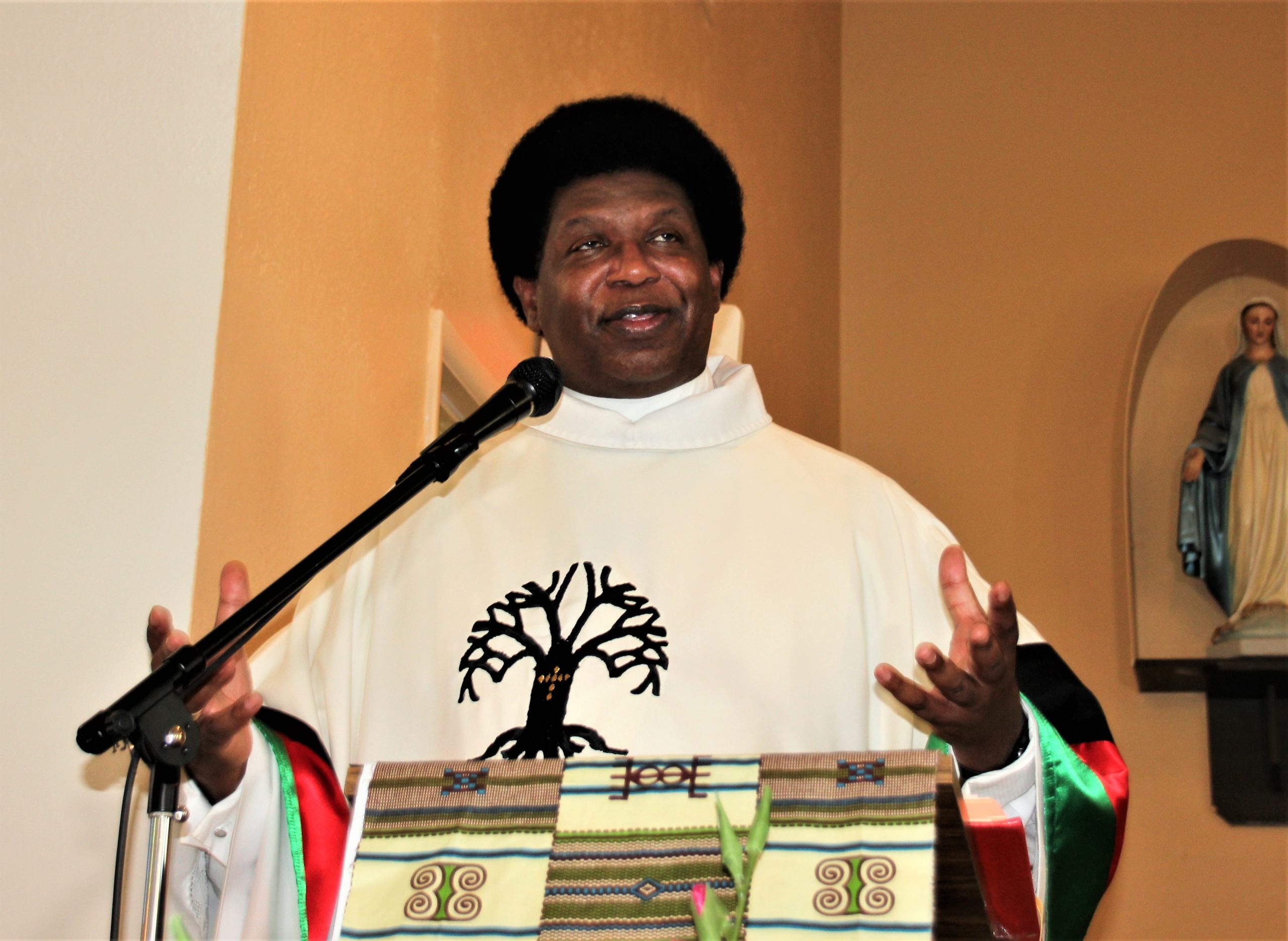
Fr. Andrew McNair in an undated foto / CATHOLIC SUN File
Kolbe will use what Bishop Olmsted described as “the strongest part of Catholic spirituality” to help addicts.
“It is men helping men and finding their strength through God,” he said.
Fr. McNair said the environment will help Kolbe’s residents focus on their task in a way that a secular institution does not.
“It builds a sense of community, centered around prayer. It reminds me of kind of a monastery. We abandon the world to focus on God and be renewed in God.”
It is often a lack of reliance on, or recognition of an all-knowing, all-loving and all-forgiving God that is at the heart of an “aggressive” secular environment where addiction flourishes, Fr. McNair pointed out.
“Overindulgence, excesses…so often people are encouraged to indulge themselves, it can be devastating. With no vision of a higher power, we are encouraged to center life around ourselves — you are the center of everything, but obviously that isn’t true,” he said.
The Diocese’s center will be unique among a wide and varied list of other rehab facilities across the state.
StartYourRecovery.org, an informational website on substance-use recovery, lists over 400 facilities or programs available here.
In Arizona and elsewhere, research suggests a strong need for these types of facilities.
A 2019 survey by the global analytics and advice firm Gallup found 46 percent of U.S. adults have dealt with substance-abuse problems in their family. Eighteen percent of those listed alcohol abuse; 10 percent drug abuse, and another 18 percent said their families experienced both.
Loneliness, anxiety, depression and other problems brought on by the COVID 19 pandemic have only worsened the problem.
The U.S. Centers for Disease Control reported that alcohol and drug overdoses have increased since the pandemic began in March 2020.
Starr hopes the Valle site will be one of many operated by Kolbe Mission, with some serving women.
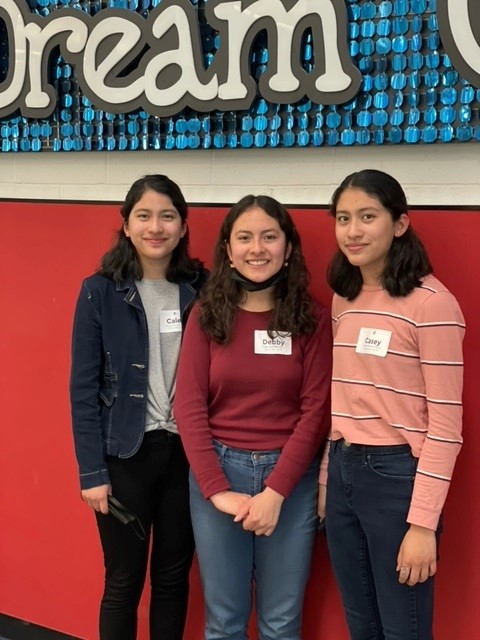
A nourishing meal and the Suárez sisters’ smiling faces are a given in the SVdP Dream Center, which provides educational activities for families during dinnertime. What started as a monthly service quota for their high school blossomed into a weekly activity of choice for Debby, Caley, and Casey Suárez.
Debby, a junior at Metro Tech High School of Phoenix, exudes enthusiasm and ease as she greets guests and volunteers. “During the pandemic I almost lived here. While people were waiting in the drive-thru for their food, they really opened up in the safety of their cars. We know their stories, their problems. It keeps us coming back,” she says.
The Dream Center’s vibrant space in the SVdP Family Dining Room is open from 4:00 – 6:00 p.m. on weeknights and provides children with an opportunity to learn and have fun in a safe environment. Homework help, tutoring, arts and crafts, STEM projects, chess matches, and more are available any given night. Dream Center volunteers, who range from high school students to community members, support approximately 30 children that take part in the nightly activities, and they need more volunteers.
Caley and Casey, first-year twins at Metro Tech, followed in the footsteps of their three elder siblings and enjoyed interacting with kids and finding common ground. “It changes you,” says Casey, “and you try to understand people more.” The sisters agree that their Catholic spirituality feels alive while volunteering.
In between the hustle and bustle of high school life, volleyball, and homework, the Suárez sisters’ prioritization of volunteerism makes an impact. Debby recalled a particular connection with a young boy who lost his mother to COVID-19. Whether building block towers or working with his learning disability, she understood the importance of giving his father a little break and being a supportive presence in the boy’s life.
When they were very young, the Suárez sisters experienced the Family Dining Room from the other perspective receiving meals at SVdP during a tough time. They know their presence matters.
With their humble charity, dedication, and plans to attend university, Debby, Caley and Casey Suárez show the families of the Dream Center that a better tomorrow is possible.
How to Support the Dream Center at SVdP
You can financially support kids and their families through the Dream Big campaign. Just $3.25 provides a nutritious hot meal and a night of education for children in need. Visit https://www.stvincentdepaul.net/2022-dream-big-campaign to learn more and give today.
If you would like to learn more about volunteer opportunities at SVdP, please email volunteer@svdpaz.org or call the Volunteer Services Office at 602-261-6886.
Pope Francis burns incense in front of a Marian statue after consecrating the world and, in particular, Ukraine and Russia to the Immaculate Heart of Mary during a Lenten penance service in St. Peter's Basilica at the Vatican March 25, 2022. (CNS photo/Vatican Media)
By Junno Arocho Esteves, Catholic News Service
VATICAN CITY (CNS) — As Russia’s violent monthlong invasion continued to devastate Ukraine, Pope Francis laid the fates of both countries at the feet of Mary in the hopes that peace would finally reign.
“Mother of God and our mother, to your Immaculate Heart we solemnly entrust and consecrate ourselves, the church and all humanity, especially Russia and Ukraine,” the pope said March 25, pronouncing the Act of Consecration after leading a Lenten penance service in St. Peter’s Basilica.
Praying before a statue of Mary that was loaned by the Shrine of Our Lady of Fatima at San Vittoriano on the outskirts of Rome, the pope pleaded with Mary to “accept this act that we carry out with confidence and love. Grant that war may end, and peace spread throughout the world.”
Sitting in front of the statue, which was placed before the steps of the main altar on a red platform and adorned with white roses, the pope proclaimed the act of consecration. During the prayer, the pope paused at several moments to gaze at the statue of Mary before continuing to recite the prayer.
“To you we consecrate the future of the whole human family, the needs and expectations of every people, the anxieties and hopes of the world,” he prayed.
After the consecration, the pope, accompanied by a young boy and girl, placed a bouquet of white roses at the feet of the statue. He then remained for a few moments, with eyes closed and head bowed in silent prayer, before stepping away.
According to the Vatican, an estimated 3,500 people filled St. Peter’s Basilica, while 2,000 people watched on video screens from St. Peter’s Square. Police asked pilgrims who entered St. Peter’s Basilica carrying or wearing Ukrainian flags to put them away, since the event was a prayer service.
Among those present at the liturgy were Andrii Yurash, Ukraine’s ambassador to the Holy See. The consecration, he tweeted March 25, is “another attempt (by the pope) to defend Ukraine from the devil’s war,” referring to Russia’s attacks on the country.
Joe Donnelly, who soon will present his credentials to the pope as the U.S. ambassador to the Holy See, also attended the service.
The Vatican announced March 18 that Pope Francis also asked bishops around the world to join him in consecrating Ukraine and Russia to the Immaculate Heart of Mary.
Cardinal Konrad Krajewski, the papal almoner, led a similar act of consecration at the Shrine of Our Lady of Fatima in Portugal.
Bishops from around the world had announced special services to coincide with the timing of the consecration in Rome, even in the early hours of the morning.
At the Dulce Nombre de Maria Cathedral-Basilica in Hagatña, Guam, Archbishop Michael Byrnes led the faithful in praying the rosary before reciting the Act of Consecration at 2 a.m. local time March 26.
Archbishop Georg Gänswein, private secretary of retired Pope Benedict XVI, had told reporters that the former pope would join in the consecration from his residence.
In a video released before the liturgy, Archbishop Sviatoslav Shevchuk of Kyiv-Halych, major archbishop of the Ukrainian Catholic Church, said he would join in the consecration “because today we need very much the victory of good.”
The consecration, Archbishop Shevchuk said, “means that it is never possible to make a deal, to cooperate with this evil that emerges from Russia today.”
“And that is why we must pray for its conversion, for the eradication of that evil, ‘so that it,’ as the Mother of God of Fatima said, ‘might not destroy other states, might not cause yet another world war.’ We, as Christians, have a duty to pray for our enemies,” he said.
In Rome, the bells of St. Peter’s Basilica rang out after Pope Francis concluded the Act of Consecration.
In his homily during the Lenten penance service, the pope acknowledged that the war in Ukraine, which “has overtaken so many people and caused suffering to all, has made each of us fearful and anxious.”
While calls to “not be afraid” may soothe one’s helplessness in the face of war, violence and uncertainty, the pope said that “human reassurance is not enough.”
“We need the closeness of God and the certainty of his forgiveness, and once renewed by it, Christians can also turn to Mary and present their needs and the needs of the world,” he said.
Pope Francis said the Act of Consecration was “no magic formula but a spiritual act” of trust by “children who, amid the tribulation of this cruel and senseless war that threatens our world, turn to their mother, reposing all their fears and pain in her heart and abandoning themselves to her.”
“It means placing in that pure and undefiled heart, where God is mirrored, the inestimable goods of fraternity and peace, all that we have and are, so that she, the mother whom the Lord has given us, may protect us and watch over us,” the pope said.
In his prayer, Pope Francis specifically asked Mary to be with those suffering directly because of the war.
“May your maternal touch soothe those who suffer and flee from the rain of bombs,” he prayed to Mary. “May your motherly embrace comfort those forced to leave their homes and their native land. May your sorrowful heart move us to compassion and inspire us to open our doors and to care for our brothers and sisters who are injured and cast aside.”
Leading the Act of Consecration to the Immaculate Heart of Mary for all humanity, and especially Ukraine and Russia, are Archbishop Borys Gudziak of the Ukrainian Catholic Archeparchy of Philadelphia and Philadelphia Archbishop Nelson J. Pérez in union with the clergy and faithful gathered March 25, 2022, in the Cathedral Basilica of SS. Peter and Paul. (CNS photo/Sarah Webb, CatholicPhilly.com)
By Rhina Guidos, Catholic News Service
WASHINGTON (CNS) — Bishops in the U.S. took part in Pope Francis’ invitation to join him in a moment of prayer, consecrating Russia and Ukraine to the Immaculate Heart of Mary March 25, entrusting the people of both countries to the care and protection of the Blessed Virgin Mary.
“Friends, we are all deeply disturbed by the war in Ukraine, and the unconscionable attacks on innocent men, women, and children in their homes and neighborhoods,” said Los Angeles Archbishop José H. Gomez, president of the U.S. Conference of Catholic Bishops, in a video message.
“In this time when our world is weighed down under the shadow of war, I invite you to enter into this solemn moment of prayer with the Holy Father,” the archbishop said. “Together with him, let us ask our Blessed Mother to turn her eyes of mercy toward all her children. Let us ask her to intercede with her son, to deliver her children from evil and grant us peace.”
Father John Broussard, of the Fathers of Mercy and rector of the National Shrine of Our Lady of Good Help in Wisconsin, explained what consecration means in a March 18 statement.
“To consecrate something is the act of setting it apart for our Lord and, furthermore, to consecrate it to our Blessed Mother is to deliberately put that intention into her hands,” he said.
Some bishops celebrated a Mass with their parish or school community with the intention of praying for peace with a particular focus on the people of Ukraine and Russia.
The Archdiocese of Los Angeles suggested that parishes ring their bells “29 times to mark the 29 days since the invasion of Ukraine began on Feb. 24, 2022.”
The March 25 prayer of consecration took place on the feast of the Annunciation of the Lord, when tradition says, the Angel Gabriel visited Mary to tell her she would be the mother of Christ.
And she’s the one Pope Francis has offered as an example to deal with the tribulation of war, with uncertainty and darkness, said Cardinal Wilton D. Gregory of Washington during a homily at the Basilica of the National Shrine of the Immaculate Conception, where he lead the faithful in the prayer of consecration.
“We come together today in one of the darker moments in human history. We can literally see the war being conducted via our smartphones,” he said, watching the path of rockets resulting in the death of defenseless children and the elderly and worrying about the threat of nuclear war.
But in the midst of that, “it is better to welcome a glimmer of light from Christ, our light, than to turn to darkness,” he said to a crowd that included about 40 members of various diplomatic missions to the U.S.
He praised Pope Francis for his efforts, including for breaking with protocol and directly walking into the Russian Embassy to the Holy See to express his concern a day after the attacks against Ukraine began Feb. 24.
“He has shown us how important it is to put our words into action,” he said. “We come here this afternoon at the encouragement of Pope Francis.”
Like other prelates around the world, he recited the act of consecration for close to nine minutes and then remained kneeled for several minutes before a statue of Mary as a choir sang.
Hundreds of the faithful filled Philadelphia’s Cathedral Basilica of SS. Peter and Paul for the act of consecration, led by Philadelphia Archbishop Nelson J. Pérez and Archbishop Borys Gudziak, metropolitan archbishop for Ukrainian Catholics in the U.S.
Some three dozen Catholic clergy of both the Latin rite and the Byzantine rite concelebrated Mass with the two prelates immediately following the act of consecration.
The feast of the Annunciation marks what in Byzantine tradition is known as “the day of the beginning of salvation,” when “the Son of God (became) incarnate through the Holy Spirit and the humility of his divine Mother,” said Archbishop Gudziak, who preached the homily for the liturgy.
The need for Christ’s redemption has been underscored by the suffering from the war in Ukraine, he said.
“Things are clear,” said Archbishop Gudziak, who heads the Ukrainian Catholic Archeparchy of Philadelphia. “The danger of evil, the will of the enemy of mankind, the frailty of our human nature is starkly before our eyes.”
He admitted that he himself has struggled to pray for Russian persecutors amid that nation’s brutal assaults on Ukrainians.
“I’ll be frank with you in expressing some of the concerns of the people of Ukraine. Some (ask), ‘How can you put the rapist and the one being raped in the same room?'” said Archbishop Gudziak, adding that in noting such questions, “I’m speaking about myself.”
Yet such forgiveness is “the spiritual height to which this moment calls us,” he said.
Pointing to the global outpouring of support for Ukraine, Archbishop Gudziak also said he believed “never in human history have people of goodwill around the globe been so united.”
After Communion, Archbishop Pérez thanked Archbishop Gudziak “for reminding us that the Christian heart is a heart that can find hope in the middle of despair.”
In Pittsburgh, Bishop David A. Zubik said in a March 24 statement that “following the lead of Pope Francis, we need to continue to pray for the end of the war on Ukraine and that world leaders may find a bridge that brings the world to global peace.”
But the war in Eastern Europe showed no sign of dissipating as of March 25. Ukraine provided a video showing a large Russian ship under attack. Despite fending off occupation, many Ukrainian cities have been nearly destroyed.
The U.N. High Commissioner for Refugees said 6.5 million people are internally displaced in Ukraine and 3.7 million have fled the country as of March 25, with most of them heading to neighboring Poland.
President Joe Biden visited some of the refugees in Poland March 25 as well as soldiers as the U.S., with NATO leaders, prepared for contingency plans in case of biological or nuclear attacks by Russia.
The Texas Catholic Conference of Bishops March 21 said they were calling, not just on Catholics, but “on all people of goodwill to pray that world leaders will find an end to the conflict and to provide solace and support to the millions of people who are now refugees.”
Pope Francis blesses a boy during his general audience in the Paul VI hall at the Vatican March 23, 2022. (CNS photo/Paul Haring)
By Carol Glatz, Catholic News Service
VATICAN CITY (CNS) — Handing on the faith from generation to generation requires listening personally and directly to older people’s lived experiences and stories of faith, Pope Francis said.
“Today the catechism of Christian initiation generously draws on the Word of God and conveys accurate information on dogmas, the morals of the faith and the sacraments,” the pope said at his weekly general audience March 23.
“What is often lacking, however, is a knowledge of the church that comes from listening to and witnessing the real history of the faith and the life of the church community, from the beginning to the present day,” he said.
The pope’s catechesis was part of a series of talks dedicated to the meaning and value of “old age” and focused on the role of memory and personal witness in handing down the faith.
“Listening personally and directly to the story of lived faith, with all its highs and lows, is irreplaceable,” Pope Francis said.
The pope gave an example from his own experience, saying, “I learned hatred and anger for war from my grandfather,” who fought in northern Italy during World War I. “He passed on to me this rage at war because he told me about the suffering of a war,” and this can only be learned from passing it down from one generation to another.
Being able to learn about the faith from written materials, films and the Internet is useful, he said, but it “will never be the same thing” as communicating face-to-face through storytelling.
Older people, in particular, who have so much experience and receive “the gift of a lucid and passionate testimony” of their own history are “an irreplaceable blessing,” said the pope.
A first-person transmission of the faith, “which is true and proper tradition,” is seriously lacking today and the situation is only getting worse, he said, because today’s culture believes the elderly are useless and “must be discarded.”
Also, he said, this path of handing on the faith from generation to generation seems to be hindered in families, society and Christian communities themselves because of today’s emphasis on being “politically correct.”
When handing on the faith lacks “the passion of ‘lived history,'” he said, “how can it draw people to choose love forever, fidelity to the given word, perseverance in dedication, compassion for the wounded and disheartened faces?”
However, he said, these testimonies must be honest and faithful to the Word of God.
Testimonies that are not faithful are those that reflect an “ideology that bends history to its own schemes,” promote “propaganda that adapts history to promote its own group” or transform history into “a tribunal in which the past is condemned, and any future is discouraged.”
“No. To be faithful is to tell history as it is; and only those who have lived it can tell it well,” which is why it is so important for everyone, especially children, to listen to the elderly, he said.
The right kind of witness is seen in the Gospels and the Acts of the Apostles, which “honestly tell the blessed story of Jesus without hiding the mistakes, misunderstandings and even betrayals of the disciples,” he said.
The story of Moses, too, is also an example of narrating the history of faith as “a story capable of recalling God’s blessings with emotion and our failings with sincerity,” the pope added.
Catechesis, he said, should include “the habit of listening: to the lived experience of the elderly; to the candid confession of the blessings received from God, which we must cherish; and to the faithful testimony of our own failures of fidelity, which we must repair and correct.”
Faith cannot be merely handed on with books but passed on “from hand to hand” with the familiar speech, stories and witness between grandparents and grandchildren, between parents and their children, he said.
“This is the reason dialogue in a family is so important, the dialogue of children with their grandparents, who are the ones who have the wisdom of the faith,” he said.
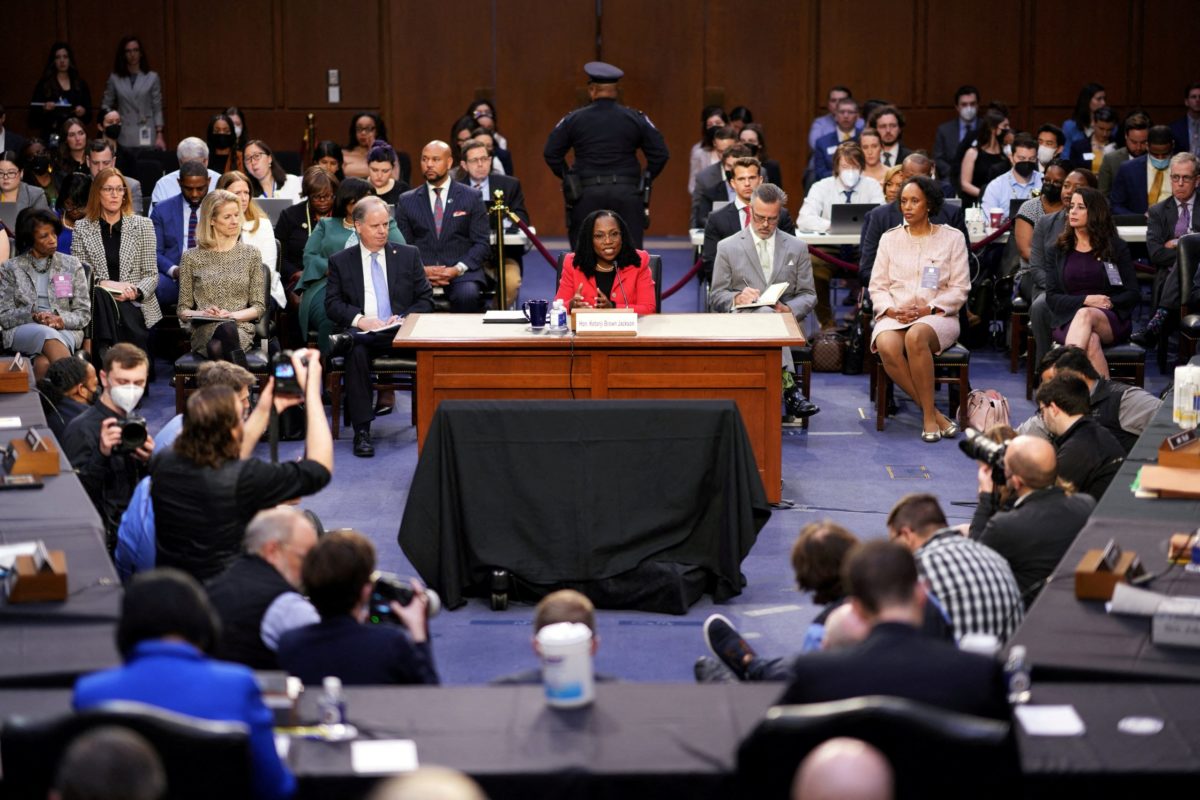
Supreme Court nominee Ketanji Brown Jackson, a federal appeals court judge, participates in her confirmation hearing before the Senate Judiciary Committee on Capitol Hill in Washington March 22, 2022. (CNS photo/Doug Mills, Pool via Reuters)
By Carol Zimmermann, Catholic News Service
WASHINGTON (CNS) — The confirmation hearings for Supreme Court nominee Judge Ketanji Brown Jackson began with introductory remarks March 21 followed by 13 hours of questioning the next day about her role as a judge and a public defender and her views on abortion, critical race theory and her own faith.
Questions continued March 23, to be followed by remarks from witnesses the next day.
Jackson, a judge on the U.S. Circuit Court of Appeals for the District of Columbia Circuit, also was asked by Republican senators about her defense of Guantanamo Bay detainees and sentences she gave in child pornography cases.
The 51-year-old nominee was joined by family members in the hearing room, including her husband, their two daughters, and her parents and other family members and friends.
In her opening statement, she said that as a federal judge she has always taken seriously her responsibility to be independent.
“I decide cases from a neutral posture,” she told members of the Senate Judiciary Committee on the second day of hearings when the senators were each allotted 30 minutes of questioning. “I evaluate the facts, and I interpret and apply the law to the facts of the case before me, without fear or favor, consistent with my judicial oath.”
Jackson said it was “extremely humbling” to be considered for Justice Stephen Breyer’s seat on the court and added that she “could never fill his shoes,” but if she were confirmed, she hoped she would “carry on his spirit.”
On the first day of the nomination hearings, crowds of supporters gathered outside the Supreme Court pleased that, if confirmed, Jackson would be the first Black woman to be a Supreme Court justice; they carried “Confirm KBJ” signs. A group of pro-life protesters also had gathered to protest President Joe Biden’s nominee, stressing that she would support keeping abortion legal.
Jackson was asked a few times March 22 about her abortion views. Sen. Dianne Feinstein, D-Calif., asked Jackson, as she has asked the last three court nominees, if Roe v. Wade, the court’s 1973 decision legalizing abortion nationwide, was settled law. Jackson, as other nominees before her have done, agreed that the court’s decision was a binding precedent.
Later when she was asked by Sen. John Kennedy, R-La., if she has a personal belief on when life begins, she said she did.
“I have a religious belief that I set aside when I am ruling on cases,” she told the committee.
At the end of the March 22 questioning, Sen. Marsha Blackburn, R-Tenn., asked if Jackson would respect the Supreme Court’s decision if it overturned Roe v. Wade later this year in the Mississippi abortion case. Jackson said she would treat it as she “would any other precedent.”
Earlier that day, Sen. Lindsey Graham, R-S.C., asked Jackson about her faith and she responded that she is “Protestant, nondenominational.” When pressed further about how important her faith is to her she said that it was very important but added: “There is no religious test in the Constitution under Article 6.”
She also said it’s very important to “set aside one’s personal views about things” in the role of a judge.
Graham, who kept on this topic, asked: “On a scale of 1 to 10, how faithful would you say you are in terms of religion?”
The judge said she was reluctant to talk about her faith in this way because she wants the public to know she has the ability to separate out her views.
Graham said he had no doubt about that and then went into how poorly Justice Amy Coney Barrett had been treated in her questioning referring to Barrett’s federal judiciary nomination hearing in 2017 where Feinstein said to her: “The dogma lives loudly within you, and that’s a concern.”
When Jackson was asked by Sen. Ted Cruz, R-Texas, about her potential support for critical race theory, an academic theory about how racism is spread in society, the nominee said the theory doesn’t “come up in my work as a judge, which I’m respectfully here to address.”
She later told Sen. Christopher Coons, D-Del., that she has never used critical race theory in judging a case.
In the second round of questioning March 23, members of the Senate Judiciary Committee were allotted 20 minutes each for questioning. Jackson will not appear March 24 when senators will hear from the American Bar Association, which assesses judicial nominees’ qualifications, and outside witnesses.
The committee then determines if it will pass Jackson’s nomination to the full Senate for a vote. It takes a simple majority of the Senate — 51 votes — to confirm a nominee. Democrats now have 50 seats and Vice President Kamala Harris could cast a tie-breaking vote.
The senators have said they hope to finish the confirmation process before they break for Easter recess April 11.
Pope Francis prays in front of the original statue of Our Lady of Fatima during a Marian vigil in St. Peter's Square at the Vatican in this Oct. 12, 2013, file photo. The pope has invited "every community and every believer" to join him in consecrating and entrusting Russia and Ukraine to Mary March 25, 2022. (CNS photo/Paul Haring)
By Cindy Wooden, Catholic News Service
VATICAN CITY (CNS) — While Pope Francis and bishops around the world will consecrate themselves and all humanity to the Immaculate Heart of Mary, they will include the phrase, “especially Russia and Ukraine.”
In the text of the pope’s prayer sent to chanceries around the globe so that bishops can join the pope March 25, a key passage for many observers reads: “Mother of God and our mother, to your Immaculate Heart we solemnly entrust and consecrate ourselves, the church and all humanity, especially Russia and Ukraine.”
With Russia’s invasion of Ukraine and responding to a request particularly from Ukrainian bishops, Pope Francis had announced that he would make the act of consecration during a previously scheduled Lenten penance service in St. Peter’s Basilica.
Cardinal Konrad Krajewski, the papal almoner, will lead the act of consecration at the same time at the Shrine of Our Lady of Fatima in Portugal. When Mary appeared to three shepherd children at Fatima in 1917 with a message encouraging prayer and repentance, she also asked for the consecration of Russia to Mary’s immaculate heart.
While popes, especially St. John Paul II in 1984, made acts of consecration, they did not mention “Russia” out loud, which led some people to think that the Fatima request had not been fulfilled, even though the last surviving visionary, Sister Lucia dos Santos, said St. John Paul had done so.
The papal text pleads with Mary to “accept this act that we carry out with confidence and love. Grant that war may end, and peace spread throughout the world.”
By saying “yes” to God’s plan — an event remembered on the March 25 feast of the Annunciation — Mary “opened the doors of history to the Prince of Peace,” the prayer says. “We trust that, through your heart, peace will dawn once more.”
“To you we consecrate the future of the whole human family, the needs and expectations of every people, the anxieties and hopes of the world,” the prayer says.
Written with the penance service and the Fatima call to repentance in mind, the pope began the prayer with a statement of trust in Mary’s maternal love for all believers.
“You never cease to guide us to Jesus, the prince of peace,” the prayer says. “Yet we have strayed from that path of peace.”
Humanity, it says, has forgotten the lessons of the 20th century with its “sacrifice of the millions who fell in two world wars.”
What is more, it says, “we have disregarded the commitments we made as a community of nations. We have betrayed peoples’ dreams of peace and the hopes of the young.”
“We grew sick with greed, we thought only of our own nations and their interests, we grew indifferent and caught up in our selfish needs and concerns,” the text says.
“We chose to ignore God, to be satisfied with our illusions, to grow arrogant and aggressive, to suppress innocent lives and to stockpile weapons,” it continues, acknowledging also how people have “ravaged the garden of the earth with war.”
“By our sins,” it says, “we have broken the heart of our heavenly Father, who desires us to be brothers and sisters.”
“Now with shame we cry out: Forgive us, Lord,” the pope wrote.
The abiding presence of Mary, the text says, is a reminder that God never abandons people and is always ready to forgive.
“In every age you make yourself known to us, calling us to conversion,” the pope wrote. “At this dark hour, help us and grant us your comfort. Say to us once more: ‘Am I not here, I who am your Mother?'” as Our Lady of Guadalupe said to Juan Diego.
Like at the wedding feast of Cana, the text says, “in our own day we have run out of the wine of hope, joy has fled, fraternity has faded. We have forgotten our humanity and squandered the gift of peace. We opened our hearts to violence and destructiveness. How greatly we need your maternal help!”
“Amid the thunder of weapons, may your prayer turn our thoughts to peace,” the pope wrote. “May your maternal touch soothe those who suffer and flee from the rain of bombs. May your motherly embrace comfort those forced to leave their homes and their native land. May your Sorrowful Heart move us to compassion and inspire us to open our doors and to care for our brothers and sisters who are injured and cast aside.”
Relics of St. Bernadette are seen in this undated photo. The first U.S. tour of St. Bernadette's relics is scheduled to begin April 7, 2022, in the Miami Archdiocese. They will travel to a total of 26 dioceses, visiting 34 churches, cathedrals and shrines, through the beginning of August 2022. In 1858, between Feb. 11 and July 16, when she was 14, Bernadette Soubirous experienced 18 visions of the Virgin Mary, who called herself the Immaculate Conception. (CNS photo/Pierre Vincent, Sanctuary Our Lady of Lourdes, courtesy StBernadetteUSA.org)
By Toni Pallatto, Catholic News Service
MIAMI (CNS) — The relics of St. Bernadette, the Marian visionary of Lourdes, France, will tour the United States for the first time.
The visit will begin in South Florida at Our Lady of Lourdes Church in Miami, with a morning welcome Mass April 7. The next day the relics will visit St. Bernadette Church in Hollywood, Florida, then return to Our Lady of Lourdes Church.
On April 11, Monday of Holy Week, Archbishop Thomas G. Wenski of Miami will celebrate an evening Mass at the church, which will be followed by a candlelight procession. The relics will stay at Our Lady of Lourdes until April 18, Easter Monday, when a multilingual farewell Mass will be celebrated.
The relics will go to two other Florida dioceses, Palm Beach and St. Petersburg, and then zigzag across the country to 23 other dioceses, visiting 34 churches, cathedrals and shrines. The last stop is St. Bernadette Church in Los Angeles July 31-Aug. 4.
The full schedule of the relics’ U.S. tour can be found at stbernadetteusa.org.
“I saw a great opportunity here, particularly with the current state of our world,” said Msgr. Kenneth Schwanger, pastor of Miami’s Our Lady of Lourdes Parish, who was instrumental in making this tour happen. “I started calling parishes across the country with the names of Our Lady of Lourdes and St. Bernadette to make them aware of this grace,” he said, and the result is the upcoming tour.
For the relics to visit, he explained, Archbishop Wenski had to make a request to the Sanctuary of Our Lady of Lourdes (Sanctuaire de Notre-Dame de Lourdes) in France, which he did so over three years ago, Msgr. Schwanger told the Florida Catholic, Miami’s archdiocesan newspaper. “But with COVID, all requests were delayed.”
Around the time Miami’s request was granted, the Sanctuary of Our Lady of Lourdes expressed an interest in a national tour.
The Vatican has granted a plenary indulgence for those visiting the relics during the tour. During the Miami stay, Masses will be offered daily at Our Lady of Lourdes along with “le geste de l’eau,” the water of Lourdes.
On Feb. 11, 1858, a “lady in white” began her 18 visits to a poor, uneducated 14-year-old girl, Bernadette Soubirous, in the obscure town of Lourdes in southern France — population 4,100 — at the Grotto of Massabielle. Over the course of six months, asked Bernadette to come and visit her.
“I do not promise you the happiness of this world but of the other,” the “lady in white” told Bernadette, who became the messenger to the local community, the priests and the bishop of Tarbes, France. She would appear 18 times to the young girl.
On the 16th apparition, Bernadette asked the “lady” her name, to which she replied: “I am the Immaculate Conception.”
Father Dominique Peyramale, the local priest, was immediately convinced that Bernadette was communicating with Mary, for neither Bernadette, nor anyone in the local community, could have known that some years earlier, in 1854, this theological doctrine was declared by the church as dogma stating that Mary, through God’s grace, “was conceived free from the stain of original sin through her role as the Mother of God.”
The priest brought Mary’s message, that a chapel should be built in that spot, to the bishop of Tarbes, who three years later confirmed the apparition was indeed Mary.
Her instructions become a reality with the building of the Sanctuary of Our Lady of Lourdes, the washing with and drinking of the water of Lourdes, and pilgrims coming to participate in the nightly candlelight processions.
Bernadette left Lourdes to live out her religious vocation within the community of the Sisters of Charity of Nevers in 1866. She saw the chapel completed but never returned to Lourdes. She died in 1879, was proclaimed blessed in 1925 and was canonized in 1933.
Her body, exhumed in April 1925 for her beatification, was found to be uncorrupted. Fragments of the fifth and sixth vertebrae were removed and reserved for veneration by the faithful.
“Our Lady of Lourdes Miami is a reflection of Our Lady of Lourdes France,” said Msgr. Schwanger. “We have our own Hospitalité de Miami, a group within the diocese that is associated with the Hospitalité Notre Dame de Lourdes.”
These two organizations work together to organize two archdiocesan pilgrimages to Lourdes each year, in June and September. “Their service helps to make each pilgrimage a grace-filled encounter with the healing touch of Jesus through the intercession of his mother,” Msgr. Schwanger said.
On the 11th of each month, Our Lady of Lourdes also hosts either a eucharistic procession and benediction or a rosary candlelight procession, alternating every other month. In Lourdes, France, these are held daily.
“People who are sick and their caregivers from across the diocese come to Lourdes, Miami, for healing, much in the same way they would go to Lourdes, France. (Because) not all of us are able to travel to Lourdes, France,” Msgr. Schwanger said. “The Hospitalité de Miami would be happy to share its experience and help other dioceses set up their own organization to make annual pilgrimages.”
Visiting St. Bernadette through her relics while they are in the United States is a rare opportunity.
“St. Bernadette continues to be a vehicle through which Mary points the way to her son, Jesus Christ, through this relics tour,” said Msgr. Schwanger. “It’s an affirmation that the Lord attends to everyone and everyone has an opportunity to be healed and, in turn, to bring healing and peace to the world. And don’t we all need healing in one way or another?”
A woman fills a can with water at a makeshift camp for internally displaced people in Aden, Yemen, March 15, 2022. Pope Francis said the real battles people should be fighting are ones against hunger, thirst, disease, poverty and slavery. He made his remarks during a March 21 audience with the volunteer organization called, "I was thirsty," which is dedicated to getting potable water to people who have none. (CNS photo/Fawaz Salman, Reuters)
By Carol Glatz, Catholic News Service
VATICAN CITY (CNS) — The real battles people should be fighting and funding are the ones against hunger, thirst, poverty, disease and slavery, Pope Francis said.
Instead, vast sums of money are spent on arms for waging war, which is “a scandal” that just drags civilization backward, he said in an address to a group of Italian volunteers.
“What is the point of all of us solemnly committing ourselves together at international level to campaigns against poverty, against hunger, against the degradation of the planet, if we then fall back into the old vice of war, into the old strategy of the power of armaments, which takes everything and everyone backward?” he asked.
The pope made his remarks in an audience at the Vatican March 21 with volunteers representing the Italian organization “I Was Thirsty.” Founded in 2012, the group sets up projects that provide clean drinking water to communities in need around the world.
The United Nations estimates more than 2 billion people live without access to safe drinking water and/or sanitation. The U.N. promotes World Water Day every March 22 to raise awareness about the importance of potable water and the need to manage freshwater sources sustainably.
The pope praised the Italian volunteers for their small but vital contribution to an issue of critical importance “for the life of the planet and for peace between peoples.”
All life on Earth depends on water, he said, so “why should we wage war on each other over conflicts that we should resolve by talking to each other?”
“Why not, instead, join forces and resources to fight the real battles of civilization together: the fight against hunger and thirst; the fight against disease and epidemics; the fight against poverty and modern-day slavery,” he said.
Not all choices are “neutral,” he said, such as the choice to allocate a large percentage of a national budget on arms, which means taking resources away from those who lack basic necessities.
People need to realize that continuing to spend money on weapons “dirties the soul, dirties the heart, dirties humanity,” he said.
In a separate message written on behalf of Pope Francis, Cardinal Pietro Parolin, Vatican Secretary of State, said managing the world’s water resources in a sustainable and cooperative way across national boundaries helps contribute to peace.
“Water is a valuable asset for peace. As a result, it cannot be considered simply as a private good, generating commercial profit and subject to the laws of the market,” the cardinal wrote in a written message March 21 to those taking part in the World Water Forum in Dakar, Senegal, March 21-26. The forum focused on the role of water security in building peace and development.
The right to drinking water and sanitation is closely linked to the right to life, the cardinal said, and “water is a gift to us from God” meant for all people and generations.
It is the pope’s desire, he said, that the forum be an opportunity for people to work together to guarantee the right to drinking water and sanitation for every person and, as a consequence, to make water “a true symbol of sharing, of constructive and responsible dialogue” that promotes peace and is built on trust.