Cardinal Marcello Semeraro, prefect of the Congregation for Saints' Causes, speaks at a news conference to present Pope Francis' document, "Praedicate Evangelium" ("Preach the Gospel"), for the reform of the Roman Curia, during a news conference at the Vatican March 21, 2022. The pope has promulgated the constitution reorganizing the Roman Curia to highlight its role in promoting the church as a community of missionary disciples. Also pictured are Jesuit Father Gianfranco Ghirlanda, a canon lawyer and former rector of Rome's Pontifical Gregorian University; Bishop Marco Mellino, secretary of Pope Francis' Council of Cardinals; and Matteo Bruni, Vatican spokesman. (CNS photo/Paul Haring)
By Cindy Wooden, Catholic News Service
VATICAN CITY (CNS) — A Vatican office led by a cardinal or archbishop has no more authority than one led by a layperson because all offices of the Roman Curia act in the name of the pope, said experts presenting Pope Francis’ new constitution on the Curia’s organization.
“Whoever is in charge of a dicastery or other organism of the Curia does not have authority because of the hierarchical rank with which he is invested, but because of the power he receives from the Roman pontiff and exercises in his name,” said Jesuit Father Gianfranco Ghirlanda, the canon lawyer who helped draft the document.
The constitution, “Praedicate Evangelium” (“Preach the Gospel”), was published in Italian by the Vatican March 19, and experts involved in its development, including Father Ghirlanda, spoke at a Vatican news conference March 21.
The document, emphasizing that the Curia supports the pope and local bishops in the church’s mission of evangelization, said that because every baptized Christian is called to be “a missionary disciple,” the reform of the Curia also needed to “provide for the involvement of laymen and women, including in roles of governance and responsibility.”
“If the prefect and the secretary of a dicastery are bishops, this must not lead to the misunderstanding that their authority comes from the hierarchical rank they have received, as if they were acting with a power of their own and not with the vicarious power conferred on them by the Roman pontiff,” Father Ghirlanda said. “The vicarious power to carry out an office is the same whether received by a bishop, a priest, a consecrated man or woman, or a lay man or woman.”
Replacing “Pastor Bonus,” St. John Paul II’s 1988 constitution, the new document opens the leadership of all but two offices of the Curia to laypeople: the prefect of the Supreme Court of the Apostolic Signature, the church’s highest court; and the president of the Council for the Economy.
Cardinal Marcello Semeraro, who served as secretary of Pope Francis’ international Council of Cardinals from 2013 to 2020, when much of the work on the constitution was being done, told reporters the pope’s decision to open most leadership roles in the Curia to laity was one way in which the document attempts to put into fuller practice the teachings of the Second Vatican Council and, specifically, its focus on the dignity and responsibility of the laity.
“For me personally, Marcello Semeraro, this is something beautiful,” he said. “To put at the head of a dicastery, and not only on its staff, a member of the lay faithful — this is an important fact.”
Father Ghirlanda told reporters that by opening Curia leadership roles to laypeople, Pope Francis clarified a matter that had been debated by canon lawyers since the Second Vatican Council. The new constitution, he said, “confirms that the power of governance in the church does not come from the sacrament of orders, but from the canonical mission” given to the person.
“Obviously, there are and will be dicasteries where it is more suitable to have laity — for example the Dicastery for Laity, the Family and Life because it is a sector where they live and have more experience — and others where perhaps it is less suitable, but there is no established exclusion, just good sense.”
At the same time, Father Ghirlanda said, the constitution “does not abrogate canon law” or the hierarchical structure of the church, which, for example, reserves the celebration of the sacraments, the office of pastor and the judgment of other clerics to priests and bishops.
Bishop Marco Mellino, the current secretary of the Council of Cardinals, told reporters that the idea is not simply to name laypeople to more offices, but to evaluate the needs and responsibilities of the specific dicasteries and find appropriate people to lead them.
The constitution, Cardinal Semeraro said, specifies that the choice will be based on the dicastery’s “particular competence, power of governance and function.”
“So, it cannot be just anyone,” he said. “But I would add, this ‘not just anyone’ goes also for a cleric, a religious or a layperson. The fact that I’m a bishop does not mean that I can be competent in leading a dicastery.”
Bishop Thomas G. Olmsted delivers the Homily during the 40 Days for Life Spring Campaign opening Mass at St. Mary’s Basilica in downtown Phoenix March 1.
Jeff Grant/THE CATHOLIC SUN
By Jeff Grant, The Catholic Sun
PHOENIX — Shawn Carney smiled often as he spoke at the conclusion of 40 Days for Life’s Spring campaign opening Mass at the Diocese of Phoenix’s St. Mary’s Basilica.
The president and CEO of the nationwide pro-life campaign often wore a happy expression while chatting with worshippers during the reception that followed at the Diocesan Pastoral Center.
While Carney said the campaign and its participants carry the joy of a message full of truth and hope, there is an added reason this year for his outlook. Carney and other pro-life supporters said the United States Supreme Court — with its conservative majority — may be ready to overturn the nearly 50-year-old landmark Roe v. Wade ruling legalizing abortion.
“I do think they’re going to overturn it and send it back to the states,” said the Texas resident in an interview after Mass. “The Supreme Court has not taken a lot of cases that could have strong implications to Roe. The Mississippi-Dobbs case is the strongest.”
Dobbs v. Jackson Women’s Health Organization asks the nine justices to decide whether a 2018 Mississippi law banning nearly all abortions after 15 weeks’ gestation is unconstitutional.
So far, lower courts have said yes.
A U.S. District panel previously barred Mississippi from enforcing the law, finding the state had not provided evidence that a fetus would be viable at 15 weeks and that Supreme Court precedent bars states from banning abortions prior to viability. The U.S. Court of Appeals for the Fifth Circuit affirmed that ruling.
But Carney and others are optimistic that when the nation’s highest court rules — likely this June — it will be in their favor.
“(Liberal and now-deceased Justice) Ruth Bader-Ginsburg said herself Roe v. Wade is bad law,” Carney noted. “Sandra Day-O’Connor, another pro-abortion justice, said Roe v. Wade is on a collision course with itself because of science. We have so many cases that protect unborn children, and (yet) we have this dated case from 1973.”
Optimism aside, 40 Days’ approach through Palm Sunday (April 10) is consistent with past efforts in Greater Phoenix and beyond. Nearly 15 years after its founding in Bryan, Texas, the campaign claims over a million volunteers and 20,000 churches across 66 countries. South Korea and Cuba became the latest sites came last year.
Volunteers, families and church groups are praying regularly, fasting, conducting community outreach and holding peaceful daylong vigils on the sidewalks outside abortion businesses in Phoenix, Glendale and Tempe.
“There’s something special about being outside an abortion facility and praying,” Carney explained. “You’re the only one who wants to be there.
“Nobody grows up wanting an abortion or wants to drive their girlfriend for an abortion. No doctor is in medical school right now — studying, striving to be the best abortion doctor. The workers don’t want to be there. The clients don’t want to be there. You’re the only one who truly wants to be there, and that will be evident to those going in.That is powerful,” he told the nearly 200 inside the Basilica.
Earlier, Bishop Thomas J. Olmsted in his Homily reminded volunteers to maintain the spirit of 40 Days – a joyful, yet peaceful, humble frame of mind. There is no screaming, shouting or angry chants from participants seeking to be ambassadors for Christ.
“Keep in mind the words of Jesus: ‘Do not be distressed or fearful.’” he said, referring to Christ’s words recorded in the Gospel of John, (Ch.14:27).
“Not by chance but by God’s providence, you and I are living in the same time as the COVID pandemic, and now the terrible aggression against Ukraine. It is God’s plan to grant us, at this time in history, the gift of being His beloved sons and daughters, and to be faithful witnesses to the Gospel of Life: the life of the child in the womb, and the life of one sick from a pandemic, and the life of innocent people of Ukraine. He’s the one who created us in our mother’s womb and has given us the shared mission of standing up for the dignity of every human person.”
The bishop also urged prayers for women who have undergone abortions.
“The Lord wants us to be His messengers of hope to them. Let us pray that after feeling like an evil sinner who aborted (her) child, they may know – themselves — to be a mother or father of beautiful babies whom Jesus and Mary are (now) caring for and (who) are waiting to greet them,” he said.
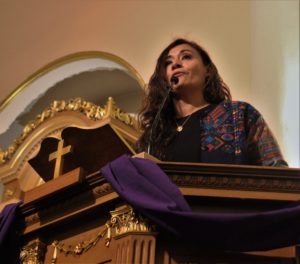
Former Planned Parenthood clinic director Mayra Rodriquez speaks following the 40 Days for Life Spring Campaign opening Mass at St. Mary’s Basilica in downtown Phoenix March 1. Jeff Grant/THE CATHOLIC SUN
If any there doubted the effectiveness of prayer, speaker Mayra Rodriguez reminded the congregation of its fruits. The onetime Planned Parenthood clinic director and former 17-year employee’s story is well-documented. After learning of botched procedures and falsified records, she blew the whistle on Planned Parenthood. And though the business fired her, Rodriguez later won a $3 million wrongful-termination lawsuit against Planned Parenthood.
But her message to 40 Days volunteers March 1 was not one of vengeance or payback, but compassion toward her former colleagues.
“Most of them are good people. They have a good heart. They just don’t get what it is (they’re) really doing there. Many of them really think they’re helping women.
40 Days volunteers reaffirmed an unwavering faith and commitment.
Kathy Roper of Phoenix, who attends Bethany Bible Church, traveled to Washington, D.C., in December to pray outside the U.S. Supreme Court as the justices heard arguments in the Mississippi case. Roper also prays outside the Glendale Planned Parenthood building for clients and workers.
“We feel an ownership and responsibility to give them hope. Where there’s life, there’s hope. The darkness is getting so much darker, and we’re able to show them light.”
Russ Gunther of Phoenix, a parishioner at St. Mary’s Basilica and participant in the annual March for Life, is considering wider involvement “to serve as an influence; to recruit, to help people learn about options to unplanned pregnancies, such as adoption.”
Debbie Cheatham, vice chair of Arizona Life Coalition, has volunteered in the spring and fall 40 Days campaigns for years.
“I am always encouraged every time I participate in anything in the pro-life movement. It’s beautiful, and it’s the most important issue in life. It is life and honoring its sanctity and beauty. When others are sad and worried, we are full of hope.”
There are signs the prayers of 40 Days and other pro-life supporters may be about to bear one of the movements’ largest pieces of fruit ever.
Overturning Roe v. Wade would send the issue back to the states. Carney noted 38 of the 50 now poised to enforce their own laws – either allowing or banning the procedure. In Arizona, the state Senate Feb. 15 approved a ban on abortions after 15 weeks of gestation, similar to the Mississippi law. The Arizona measure next faces consideration in the state House of Representatives.
A Texas law bans abortion after 6 weeks. Enacted in 2021, the law was upheld March 11 by the state Supreme Court, which the U.S. Supreme Court said was the proper forum since the case involved a question of how the state enforces the law. Significant was that the U.S. Supreme Court allowed the law to stand while it was challenged — the first time since Roe v. Wade the nation’s high court “allowed a pro-life law to remain while litigation proceeds in lower courts,” according to the Texas Catholic Conference, the public policy arm of the state’s Catholic bishops.
In Idaho, legislators have sent a measure similar to the Texas law to the governor in Boise.
The Guttmacher Institute, a leading research and policy organization committed to advancing sexual and reproductive health and rights worldwide, acknowledges lawmakers and courts have been inching away from abortion for some time.
“Since 2010, the U.S. abortion landscape has grown increasingly restrictive as more states adopt laws hostile to abortion rights,” the institute states on its website.
According to Guttmacher, 862,320 abortions were provided in U.S. clinical settings in 2017. That year, the rate was 13.5 per 1,000 women ages 15-44. In 1973, the figure was 16.3.
Still, President Joseph Biden, a Roman Catholic, has pledged to defend Roe v. Wade.
“It is a right we believe should be codified into law, and we pledge to defend it with every tool we possess,” he said in a White House statement issued Jan. 22.
Carney said today’s abortion climate is contradictory.
“We do surgeries on unborn children. We don’t allow pregnant women on a rollercoaster, we won’t serve them 10 whiskeys at a bar, but we’ll allow them to have an abortion at 25 weeks. The inconsistency and hypocrisy have caught up to itself – and that’s just from a secular standpoint. We have TV documentaries on the miracle of the womb and the unborn child. So, we can’t have it both ways.
“There are 2,500 abortions a day in the United States,” he continued. “The great injustice of abortion is not only that it actually takes place. It’s that so many think that it’s OK.”
But that may about to change.
“Abortion is an attack on nature, but ultimately, it’s an attack on our Lord, who we can’t fathom how much He loves these children, how much He loves these workers, and how much He wants to see abortion end.”
Growing up Protestant, Lent just was not much of a thing in my home.
I saw banners for the Friday Fish Fry at the local Catholic Church, and McDonald’s would advertise their fish sandwiches, but since I didn’t enjoy seafood it was easy for Lent to pass me by.
When I entered the Church as an adult, I admit I found the menu of possible Lenten practices to adopt as a family overwhelming. Fasting, increasing prayer, paying closer attention to almsgiving, giving up sweets, meats, alcohol, and social media, all while trying to simplify and draw closer to God was not easily done. As a mother of small children, I was lucky to keep us all on track each day in ordinary time, let alone drag them all into a season of penance and sacrifice!
As the years have passed, however, there are a few simple things we have done to mark the season and live differently for the 40 days leading up to Easter, allowing us all to enter into Lent intentionally and without trepidation.
Primarily, Lent is about simplifying and creating space for God and for a deeper relationship with Him. The Church has focused on three aspects of Lent: fasting, prayer, and almsgiving. The various seasons of life may allow for us to put a deeper focus on one aspect or another, but small steps in all of these three areas can be great starting points for making the Lenten season a special one for you and your family.
Fasting
The practice of fasting can dominate the minds of many during Lent. In reality, the Church asks that those persons between the ages of 18-59 observe the two days of actual fasting (Ash Wednesday and Good Friday). Furthermore, only those children 14 and older are required to abstain from consuming meat on Fridays during Lent. Because these observances are compulsory for adults only, it can be suggested that your children fast from something else on Fridays during Lent. My children have very little say any day what they actually eat, so any abstaining by them is done more as a practical result of having the adults and teens abstain rather than as a personal sacrifice.
Giving up their favorite things for the entirety of Lent, however, is something that should be child-led, rather than done out of obligation.
The point of fasting is to detach oneself spiritually and encounter a deeper union with the Lord. It is to set aside some aspect of your day as a sacrifice. It is not designed to make us unhappy.
Prayer
Adopting a special practice of prayer during Lent is a beautiful way to become open to a deeper relationshiop with the Lord. The Church doesn’t require specific practices, and it is good to remember that prayer is simply a conversation with the Lord. As we adopt things like fasting, we are able to unite those sacrifices in prayer.
Simply adding an additional prayer each day during Lent can be one way to grow as a family. Starting the day off together in prayer or ending it in a special way together can unite the family and open them all to more deeply receive God’s love.
Modeling is a wonderful way of teaching in the home. If you are adding a special time of prayer each day, share that with your family and even invite them to join you. You may be surprised by their willingness when it is presented as a choice rather than an edict.
Almsgiving
Whereas prayer and fasting are a bit more obscure, the practice of almsgiving is something in which children of all ages can easily be involved. Almsgiving is a practice of giving more generously of our time, talents, and physical offerings. We have had experiences in the past working with the homeless, cleaning out closets for those in need, making food bags to offer to those on the streets, and making cards for shut-ins or those in community living circumstances. We know families who have adopted families during this time and held lemonade stands to raise money for those in need. This is a wonderful way for the family to take part in an activity that is child-led.
Simplicity has been the key for our family as we enter into Lent. There is great joy that comes from practicing gratitude and helping others. I want my children to look forward to Lent as a time of peace and perhaps more reflective quiet, rather than as a time of grumpiness and no sweets.
May you enter into this season with a spirit of surrender and anticipation of the graces that flow during this time. Perhaps as your children grow they will begin to see Lent as a time of giving of the self in joy, and growing in closeness to the Lord, rather than only a time of suffering.
PHOENIX—Holy Family Academy in Phoenix has officially been recognized as an independent, Catholic school in the Diocese of Phoenix. The announcement came in a formal decree issued by His Excellency Bishop Thomas Olmsted.
“We are most grateful to Bishop Olmsted for this acknowledgement of Holy Family Academy’s faithfulness and its commitment to providing Christ-centered, Catholic traditional education,” said Dr. Shirley Weis, chair of the HFA Board of Directors.
“We have been in discussions with the diocese for about three years,” said Laura Graves, principal. “Part of the process is a review of the content and quality of the curriculum as well as our religious education. This recognition is such a blessing for our students, faculty and parents,” she said.
Principal Graves explained that early in 2018 a group of dads met to pray about and to discuss their responsibilities as parents in the education of their children and options available to them. They wanted a quality, faith-based education in a spiritually enriching environment. They ultimately decided to form Holy Family Academy and they moved into a temporary site in the fall of that year.
“Holy Family was developed to provide students in K-12 with a top quality education in the classical liberal arts in a setting in which faith was present in all activities. We want to ultimately form good Catholic citizens—men and women willing and able to work for the restoration of all things in Christ, freely submitting to Our Lord in the spiritual, moral, intellectual and physical realms,” Principal Graves said.
After extensive renovations to a beautiful new location purchased for this purpose in 2020, the academy is thriving in its permanent home at State Route 51 and Thomas Road, east of Phoenix Children’s Hospital.
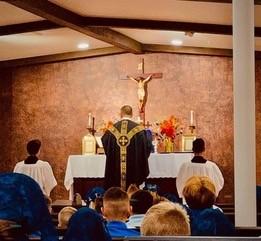
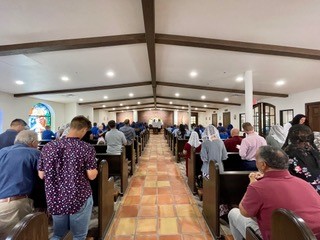
The latest project for the academy was construction of a chapel which can accommodate 170 people. The chapel opened this past August. For the past two years, the school has offered weekly Mass and Confession, daily Rosary and other services based on the liturgical calendar and school schedule.
“The success and growth of the academy has repeatedly demonstrated Divine intervention and grace, “Principal Graves said. “Official designation as an independent, Catholic institution is just the latest example of this.”
Denver Archbishop Samuel J. Aquila speaks at a March 12, 2022, rally at the state Capitol against H.B. 22-1279, an abortion bill that opponents say if passed and enacted will codify into state law abortion up-to-the moment of birth for any reason. The Colorado House passed it March 14, and after hearing 13 hours of testimony March 17, a U.S. Senate committee OK'd the bill in a 3-2 vote along party lines just after midnight. (CNS photo/courtesy Denver Catholic)
By Julie Asher, Catholic News Service
After hearing hours of testimony March 17 from hundreds of people opposed to a measure that would make Colorado “the most radical abortion state in the country,” as many said, the Colorado Senate Judiciary Committee OK’d the bill in a 3-2 party line vote just after midnight.
“Coloradans do not want this law,” said Brittany Vessely, executive director of the Colorado Catholic Conference.
In the previous two weeks, she told the committee, over 350 Coloradans testified against the bill, called the Reproductive Health Equity Act, or RHEA; House members filibustered it for 24 hours “in the longest bill debate in state history”; and hundreds of Coloradans rallied against it at the Capitol.
“The Catholic Church objects to abortion on the principle that every human life has inherent dignity, and thus must be treated with the respect due to a human person. This is the foundation of the church’s social doctrine, and its preeminent issue,” Vessely said. “This bill goes too far and casts aside the voices of millions of Coloradans — especially preborn children.”
Among others who spoke against the bill were Archbishop Samuel J. Aquila of Denver, who submitted testimony, and Auxiliary Bishop Jorge Rodriguez of Denver and Bishop Stephen J. Berg of Pueblo, who testified at the hearing.
Now the Reproductive Health Equity Act goes to the full Senate. The Colorado House passed the bill March 14.
If it becomes law, it would:
— Permit on-demand abortion for the full 40 weeks of a pregnancy.
— Allow abortion based on discrimination of sex, race or children with disabilities such as Down syndrome.
— Remove the requirement that parents of minors be notified if their minor receives an abortion.
— Enshrine in law that “a fertilized egg, embryo, or fetus does not have independent or derivative rights under the laws” of Colorado.
— Prohibit any regulation of abortion based on concerns regarding the health of the woman or baby.
Three Democratic lawmakers — Sen. Julie Gonzales, Rep. Meg Froelich and House Majority Leader Daneya Esgar — co-sponsored the bill, also known as H.B. 22-1279.
According to the Kaiser Family Foundation, Colorado already is one most permissive states when it comes to a woman’s access to abortion. It is one of seven states that do not impose any limits on abortions past the viability of the fetus at around 22 weeks.
“I am a mother of a 6-month-old girl,” Vessely told the Senate committee. “My daughter is just as dependent on me now as she was when she was inside my body.”
“If I abandoned my daughter, she would die for lack of sustenance and care,” she said. “But six months ago (under this bill), I would have been legally able to end her life gruesomely as a full-term preborn child. This bill shamelessly praises the fact that she would not have individual rights even up to birth.”
In testimony he submitted to the committee, Archbishop Aquila said: “At conception, we receive the gift of life, and lay claim to the right of life, which is bestowed by God and not by the government. The government’s only duty and task is to recognize the right to life and to protect life, if it is truly a just government.”
“But abortion denies that gift to some babies,” he continued. “It denies that basic right. It makes government god, and governments can change for good or for evil, depending on who is in charge.”
“Abortion has become an idol, which is tragic, for it promotes evil rather than the common good and the truth of the dignity of human life,” Archbishop Aquila said. “When an abortion is performed, we proclaim that we know better than God. We disregard his wisdom, for he taught us that we should never kill innocent human beings.”
He recalled that when he was “in college, working in hospitals, I witnessed two abortions. Two tiny humans being destroyed by violence. The memory haunts me.”
The archbishop implored the committee not to pass the measure, which he said will deny God’s “most wonderful gift to so many innocent, unique, unrepeatable and beautiful lives.”
“Colorado should be striving to promote a culture of life, not one of death through killing children in the womb,” said Bishop Rodriguez in testifying before the committee.
He called it “unbelievable” that H.B. 22-1279 “will permit abortion in state law up to the moment of birth.”
He noted that he is Hispanic and an immigrant and works closely with the Hispanic community.
“Whatever it has been said here, the Hispanic community is a pro-life community!” Bishop Rodriguez said. “Life, children and family are the great values and treasures of our culture and people. This is how we live, so we bring it with us to the United States. Thus, we hope to pass these values on to our children.”
He cited a 2019 poll by the Public Religion Research Institute showing that most Hispanics affiliated with a religion, Catholic or Protestant, said they were pro-life. Among all respondents, Hispanics were the only race or ethnicity where a majority thought abortion should be illegal in all or most cases, he added.
Noting Colorado’s growing Hispanic population, Bishop Rodriguez asked why the state’s General Assembly is “introducing the most extreme abortion legislation in the country?”
“The issue is about the life of a human being,” Bishop Berg told the committee.
He said that he and his fellow Colorado bishops in 2020 support a Senate bill that repealed Colorado’s death penalty “and promoted human dignity.”
“It is disturbing to me that upon abolishing the death penalty we are now seeking to pass this most extreme and unrestricted abortion law in our state,” he said. “Under this bill it is now being proposed that the fully formed child in the womb has ‘no independent or derivative rights’ in the state of Colorado. Preborn children will live under that same death sentence which we voted to abolish in 2020 under this unrestricted (bill.)”
In his diocese, he said, 19 ecumenical Caring Pregnancy Centers work with 92 Catholic parishes and missions to do “amazing work for young mothers in distress, as well as the fathers and, of course, the children.”
“It would be my dream that we could be debating how we could help them in our state with our legislation,” Bishop Berg added.
Pope Francis prays in front of the original statue of Our Lady of Fatima during a Marian vigil in St. Peter's Square at the Vatican in this Oct. 12, 2013, file photo. The pope has invited the bishops of the world to join him in "consecrating and entrusting" Russia and Ukraine to Mary March 25. (CNS photo/Paul Haring)
VATICAN CITY (CNS) — Pope Francis has asked bishops around the world to join him March 25 in consecrating Ukraine and Russia to the Immaculate Heart of Mary, something bishops in every part of the globe had started announcing the minute they heard what the pope had planned.
“Pope Francis has invited the bishops of the whole world, along with their priests, to join him in the prayer for peace and in the consecration and entrustment of Russia and of Ukraine to the Immaculate Heart of Mary,” Matteo Bruni, director of the Vatican press office, said March 18.
Three days earlier, the Vatican had announced the pope would lead the prayer in St. Peter’s Basilica during a Lenten penance service and that, on the same day, the feast of the Annunciation, Cardinal Konrad Krajewski, the papal almoner, would lead a similar act of consecration at the Shrine of Our Lady of Fatima in Portugal.
When Mary appeared to three shepherd children at Fatima in 1917 with a message encouraging prayer and repentance, she also asked for the consecration of Russia.
Even before the announcement from the Vatican, bishops from around the world had announced special services at which they would join Pope Francis. Bishops in cities across North America joined bishops from New Zealand, Philippines, Russia, Ukraine and other countries planning special services.
Doug Edert of St. Peter's University shoots against the University of Kentucky at Gainbridge Fieldhouse in Indianapolis March 17, 2022. The small 15th-seeded Jesuit school in New Jersey defeated second-seeded Kentucky 85-79 in overtime during "March Madness," the NCAA Division I Men's Basketball Tournament. (CNS photo/Zach Bolinger, Icon Sportswire via St. Peter's University) EDITOR'S NOTE: FOR EDITORIAL USE ONLY.
By Carol Zimmermann, Catholic News Service
WASHINGTON (CNS) — St. Peter gained the upper hand on St. Patrick’s Day when the underdog team of the small Jesuit school, Saint Peter’s University of Jersey City, New Jersey, upset the mighty University of Kentucky in the first round of the NCAA tournament.
The Peacocks’ 85-79 win over No. 2-seeded Wildcats in overtime March 17 was one for record books since the New Jersey team went into the tournament at the Gainbridge Fieldhouse in Indianapolis as the No. 15 seed in the East Regional.
The Peacocks also had never won a game in this tournament before and were up against a team that had won the NCAA Division I men’s basketball championship eight times.
“Peacocks Win!” was on university website’s homepage, and soon after the team’s victory, so many people were on the school’s site that it crashed.
On the team’s Instagram account just prior to the game, someone from the school said the Peacocks “might have the luck of the Irish on their side tonight.”
That luck and talent was celebrated at a watch party on campus for the school of about 3,000 students across the Hudson River from New York City.
“It’s huge,” said Daryl Banks III, who scored 27 points for Saint Peter’s. “We’re putting Jersey City on the map,” he told ESPN, noting the team is from a small school and “probably a lot of people don’t even know who we are.”
But they know now, especially since the team has messed with many basketball fans’ bracket picks to win the tournament.
One person’s picks that weren’t changed by the upset were those of New Jersey Gov. Phil Murphy who tweeted his bracket picks, with Saint Peter’s to win, after the victory and said: “NEVER A DOUBT.”
The win also put all eyes on the team’s coach, Shaheen Holloway, a former coach and player at Seton Hall University, a Catholic university in South Orange, New Jersey, who was matched up against Kentucky’s legendary coach, John Calipari.
When asked by a reporter after the game what the March Madness tournament means to him, Holloway said: “You just have to be good on this night,” adding that it’s not about the team record or the school. “It’s whoever is good on that night and tonight it was our night.”
The Peacocks now advance to the next round, facing another Kentucky team, Murray State, March 19.
Murray State beat another Jesuit school’s team, the University of San Francisco, in overtime March 17. That same night, yet another Jesuit school, Creighton University in Omaha, Nebraska, won in overtime against San Diego State University.
Other Jesuit college teams that made it to the NCAA men’s basketball tournament are top-ranked Gonzaga University in Spokane, Washington, which defeated Georgia State; Marquette University in Milwaukee, which lost to the University of North Carolina; and Loyola University Chicago, which lost to Ohio State March 18.
At Loyola’s matchup in Pittsburgh, Sister Jean Dolores Schmidt, the 102-year-old team chaplain, who is a Sister of Charity of the Blessed Virgin Mary, was cheering, and praying, the team on.
When asked by USA Today if she had any hesitations about praying for a basketball game when there are so many troubles in the world, she said she prays for those situations too, referring to the war in Ukraine.
“God hears all prayers,” she said, adding: “I don’t have any problem praying for the team. If it’s God’s will, it’ll happen.”
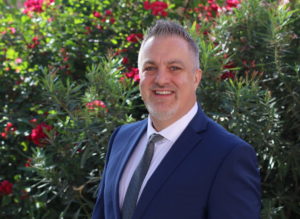
PHOENIX (March 10, 2022) — The Roman Catholic Diocese of Phoenix is pleased to announce that it has named Brett Meister its new Director of Communications. He joins the Catholic Diocese of Phoenix after nearly three decades leading communications and goodwill outreach for global sports organizations, including most recently the world-famous Harlem Globetrotters.
“We are grateful to have Brett as the newest member of the leadership team and look forward to his professional assistance in the efforts of communicating and sharing the beauty and truth of our Catholic faith,” said Father Fred Adamson, Vicar General and Moderator of the Curia for the Diocese of Phoenix.
During his 23-year tenure with the Globetrotters, Meister traveled with the team to more than 30 countries around the world as the organization fulfilled its role as global ambassadors of goodwill, including historic visits to Iraq, Afghanistan, North Korea and Cuba. Meister also accompanied the team to poverty-stricken regions within Honduras, Uzbekistan, Mozambique, Lithuania and Estonia, and personally secured two visits to the Vatican for the Globetrotters, meeting Pope John Paul II (2000) and Pope Francis (2015).
“I am grateful and excited to come work with an outstanding group of talented people who lead the Diocese of Phoenix,” said Meister. “I look forward to working with the parishioners, the clergy and the great people across the Diocese, along with Bishop Olmsted and his leadership team to fulfill the great mission of the Catholic faith in Arizona.”
Before joining the Globetrotters in 1997, Meister served as VP of Communications for the Continental Basketball Association in St. Louis, where he worked as the league’s main spokesperson and liaison to the National Basketball Association and USA Basketball. His international experience also included work on the USOC press information team at the 1996 Summer Olympic Games and serving as assistant venue press manager for the 2013 World Baseball Classic. He began his professional career as a television reporter and news editor at KTIV-TV (NBC) in Sioux City, Iowa.
Meister’s faith background has included many facets of the Catholic Church, including his longtime membership in the Knights of Columbus, where he is currently a Fourth-Degree member. A native of Marcus, Iowa, he is a graduate of Briar Cliff University, a Catholic school located in Sioux City, and he is an accomplished photographer. Meister has two adult daughters and four grandchildren, who reside in Mesa, Arizona.
Background Information The Roman Catholic Diocese of Phoenix was established Dec. 2, 1969, by Pope Paul VI. Led by the Most Rev. Thomas J. Olmsted, more than 1.1 million Catholics make this diverse, vibrant and faith-filled diocese their home, including 94 parishes and 23 missions. Nearly 15,000 students attend one of the 29 Catholic elementary schools, seven high schools and 29 preschools in the Diocese of Phoenix. Learn more about the Catholic Church at dphx.org.
A sign in St. Peter's Square calls for the consecration of Russia and Ukraine to Mary, before the start of Pope Francis' Angelus at the Vatican March 13, 2022. The Vatican said Pope Francis will consecrate Russia and Ukraine to the Immaculate Heart of Mary March 25. (CNS photo/Paul Haring)
VATICAN CITY (CNS) — Pope Francis will consecrate Russia and Ukraine to the Immaculate Heart of Mary during a penitential prayer service in St. Peter’s Basilica March 25, the Vatican said.
On the same day, the Vatican said, Cardinal Konrad Krajewski, the papal almoner, will carry out a similar consecration at the Shrine of Our Lady of Fatima in Portugal.
According to the Vatican’s translation of the messages of Fatima, when Mary appeared to the three shepherd children in Fatima in 1917, she told them, “God wishes to establish in the world devotion to my Immaculate Heart. If what I say to you is done, many souls will be saved, and there will be peace.”
Warning of “war, famine, and persecutions of the church and of the Holy Father,” Mary told the children, “to prevent this, I shall come to ask for the consecration of Russia to my Immaculate Heart.”
Some groups have continued to argue that Mary’s wish was never fulfilled or that it was never done properly because the pope consecrated the world and not “Russia.” The Vatican, however, has insisted St. John Paul II did so in 1984 when he led the world’s bishops in the consecration of Russia and the world. The late Sister Lucia dos Santos, the last surviving visionary and the one who received the instructions for the consecration, had said that it was properly performed.
At his Sunday recitations of the Angelus since Russia invaded Ukraine Feb. 24, people have been showing up in St. Peter’s Square with signs asking the pope for the consecration of Russia or of Russia and Ukraine to Mary.
The Fatima message promised: “If my requests are heeded, Russia will be converted, and there will be peace; if not, she will spread her errors throughout the world, causing wars and persecutions of the church. The good will be martyred; the Holy Father will have much to suffer; various nations will be annihilated.”
But, the message continued: “In the end, my Immaculate Heart will triumph. The Holy Father will consecrate Russia to me, and she shall be converted, and a period of peace will be granted to the world.”
Archbishop Borys Gudziak of the Ukrainian Catholic Archdiocese of Philadelphia gestures during an interview with Catholic News Service at the headquarters of the U.S. Conference of Catholic Bishops in Washington March 14, 2022. (CNS photo/Bob Roller)
By Barb Fraze, Catholic News Service
WASHINGTON (CNS) — Russian President Vladimir Putin did not invade Ukraine out of concern that NATO would encroach on his borders, but concern about “the disease of democracy that could spread like a virus, and that’s deadly for oligarchies and authoritarian rulers,” said the archbishop who serves as a “foreign minister” for the Ukrainian Catholic Church.
Russia needs “Ukraine’s territory, its population, its market, its technological capacity …. This country, with its seaports, helps Russia return to its nostalgic colonizing and imperial building,” said Archbishop Borys Gudziak, the Ukrainian Catholic archbishop of Philadelphia and the head of external relations for the worldwide Ukrainian Catholic Church.
He said people must understand the invasion was “not a response to a military threat, but it’s a response to moral danger. Democracy could spread.”
In a wide-ranging interview March 14, Archbishop Gudziak spoke of Putin’s ruthlessness, the faith of Ukrainians, and Western leaders’ “naivete, blindness, lack of courage and capacity to act (during) 22 years of Putin’s rule.” He sprinkled the interview with Biblical references such as David (Ukraine) and Goliath (Russia), the sin of Adam, and Herod’s massacre of the Holy Innocents.
Archbishop Gudziak spoke of Russia’s “devastating air assault” targeting civilians: “a maternity hospital, schools — some 200 schools have been damaged or destroyed; it’s hitting churches; tanks are firing at apartment buildings. All of this is documented. The whole world is seeing it. What more is needed? What conscience cannot be moved to defend these innocent civilians?”
The result is a division of families, 3 million refugees, 2 million additional people displaced within Ukraine and billions of dollars of damage to infrastructure, he told Catholic News Service.
“The psychological, social, economic devastation is incalculable,” he said. “It will take decades to deal with the trauma.”
Putin “has demonstrated a capacity to be utterly ruthless: killing, maiming, destroying civilian populations and civilian objects,” he said, referring to the monthlong battle to capture the Chechen capital of Grozny in 1994 and 1995 and the monthlong bombing of Aleppo, Syria, in 2016.
He said Western leaders were realizing too late that Putin could not be trusted. He cited examples of U.S. Presidents George W. Bush, Barack Obama — as a candidate — and Donald Trump misreading Putin. He said they had no understanding of what it took for a young man to join the KGB and stay in it and “foster its legacy” for the 22 years he has been in power. All of this has convinced Putin of the West’s weakness, “and so he will push forward in a devastating way.”
People think the war began Feb. 24, but it began in March 2014, when Russia annexed the Crimean Peninsula, the archbishop added. “We’re into the ninth year of this,” he said, and it could have been avoided with more decisive action.
Some people have expressed concern that Pope Francis has not specifically mentioned Russia when speaking out against the war, but Archbishop Gudziak said, “I think people understand who he’s talking about, and his statements have been incrementally stronger.”
The same day, in a front-page editorial in L’Osservatore Romano, the Vatican newspaper, and in various language editions of Vatican News, Andrea Tornielli, editorial director of the Dicastery for Communication, explained why Pope Francis has not explicitly named Putin and Russia in his condemnations of the war.
“There are those who have accused the pope of ‘silence’ for not having explicitly named Putin, forgetting that once a war began, the pontiffs never called the aggressor by name and surname, not out of cowardice or an excess of diplomatic prudence, but in order not to close the door, in order to always leave a crack open to the possibility of stopping evil and saving human lives,” Tornielli said.
Archbishop Gudziak told Catholic News Service Ukrainians were very grateful to the Holy See, and he wished Pope Francis would “go to Ukraine right now. I think that would save many lives. His unique moral authority could play a role.” He noted that Archbishop Sviatoslav Shevchuk of Kyiv-Halych, head of the Eastern-rite Ukrainian Catholic Church, also has spoken publicly of his wish for a papal visit.
The archbishop was interviewed two days before Ukrainian President Volodymyr Zelenskyy was scheduled to address the U.S. Congress. Asked what he would say if he were to address Congress, Archbishop Gudziak said: “Do you not realize that you are sacrificing Ukraine, its children, its women, its churches, its hospitals? Do you have the moral right to do that?
“Why is every inch of NATO territory worth defending? Are human beings on the other side of the border any less worthy of life, justice, liberty, truth?
“Can you muster up half the courage that Ukrainians are showing? Our people are giving everything — their lives, their livelihoods, their homes. And they’re fighting for peace in Europe and peace in the world.”
Throughout it all, Ukrainians have tried to maintain their faith, with priests celebrating services in private homes or in bomb shelters — he said Ukrainians were getting 5-10 bomb alerts every day.
“The rockets’ red glare helps people to pray,” he said. In those moments, people realize “our sense of great human autonomy is largely an illusion.”
“We’re actually seeing great faith, especially in those who are defending the innocent, protecting the hospitals, the refugees. There’s no greater love than that when one gives their life for one’s friend.”