Pilgrims will walk in the steps of St. Juan Diego in his encounter with the Blessed Virgin Mary. Pope Benedict declared a Year of Faith to call Catholics to deepen their faith and understanding of the Catholic Church. The Oct. 7-14 pilgrimage is designed to answer that call.
“Pilgrimages ask what gifts do I have and how do I live that out?” said Timothy Mullner, director of program for Faith Journeys, the Catholic company organizing the pilgrimage.
“Pilgrimages are adult faith formation,” he said. “This is not just a tour where you click your camera and end up with great pictures and souvenirs. Each day we will begin with morning prayer and end with evening prayer.”
The pilgrimage will be far more than a mere tour of the country. Each day, Mass will be celebrated and there will be time for prayerful reflection on the holy and historic locations.
“A pilgrimage is a deepening of one’s own faith,” Bishop Nevares said, explaining why it is part of the diocesan celebration of the Year of Faith. “You make this sacrifice and you venture out and deepen in faith. The Lord will be generous with us and grant us many blessings.”
Visiting the Basilica of Our Lady of Guadalupe is a way of expressing love for the Mother of God, he said. It’s also a way for local Catholics to better understand the patroness of the Diocese of Phoenix and the Americas.
“The pilgrimage will help us understand the New Evangelization in the deepest way possible. We need to be there,” said Fr. Ernesto Reynoso, JCL, who will join Bishop Nevares and the pilgrims. “Once we know her and what was happening at the time she appeared, the message will be more clear.”
Fr. Reynoso said the message of Our Lady of Guadalupe comes into focus when the clash between Native and European cultures is taken into consideration. Our Lady of Guadalupe, whose mestiza attributes reflected the coming together of the two cultures, made it possible for the New World to come to know Jesus Christ.
In Mexico, the division between faith and culture is blurred. For example, “people relate to Our Lady of Guadalupe as a member of their family. It’s about identity,” Fr. Reynoso said. “Others often relate to her and her relation to human dignity. She’s a symbol of the pro-life movement.”
In Mexico, religion begins in the home, Bishop Nevares said. The Mexican people also feel much more comfortable expressing their faith publicly.
“Children grow up with a sense of the closeness of God,” he said. It’s common for Mexicans to stop in to visit the Blessed Sacrament when they’re walking home from work. Prayer before meals and the rosary is also commonplace.
The pilgrims will also visit Guanajuato, a Cristero stronghold in their war against religious persecution. From 1926-1929, the Calles regime enforced anti-clerical laws in Mexico, systematically oppressing religion.
Bishop Nevares’ great-grandfather was a catechist at the time. As a child, he heard stories of how careful they had to be when Mass was celebrated. His mother told him how she was woken at 3 a.m. to welcome the priest, who celebrated Mass in secret. Homes had special, hidden boxes in the wall where the Blessed Sacrament was reposed.
“When we look at the Cristiada and the appearance of Our Lady of Guadalupe, they are both instances when the faith was challenged,” Fr. Reynoso said. “Our Lady of Guadalupe helped us be prepared for what came in 1926. She leads us to Christ the King.”
That Cristero message — the triumph of Christ over any government — is one Catholics appreciate as it continues to reverberate and have value today. And in Our Lady of Guadalupe, Fr. Reynoso said, we find how an image speaks when words fail.
Year of Faith Pilgrimage
What: Catholic tour of Mexico City, Guanajuato and nearby religious and cultural sites, hosted by Auxiliary Bishop Eduardo A. Nevares. Pilgrimage organized by Faith Journeys.
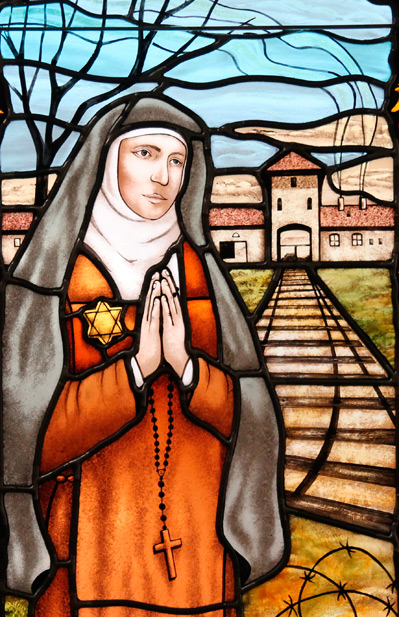
The image of another modern saint now filters colored light into The Virginia G. Piper Chapel at the Diocesan Pastoral Center.
St. Teresa Benedicta of the Cross, the newest stained glass window in The Virginia G. Piper Chapel at the Diocesan Pastoral Center. (Ambria Hammel/CATHOLIC SUN)
Bishop Thomas J. Olmsted blessed and dedicated the image of St. Teresa Benedicta of the Cross, the newest stained glass window in the chapel, March 13 during a special evening liturgy. It’s the 10th window depicting a saint canonized or beatified by Blessed Pope John Paul II to be installed in the chapel.
The late pope beatified Edith Stein — St. Teresa’s birth name — in 1987 and canonized her in 1998. St. Teresa took that name when she joined the Carmelite Order in 1933. It was a discipline JPII embraced.
“He was very in tune with Carmelite spirituality,” said Nicole Delaney, a member of the St. Joseph Community of Discalced Carmelites, said.
The local secular order co-sponsored the window along with the diocesan Office of the Diaconate and a family in memory of a loved one. The late pontiff wrote a doctoral dissertation on St. John of the Cross, a cofounder of the Discalced Carmelites and a mystical doctor of the Church.
“The Carmelites hope that one day she’ll be made a doctor of the Church,” Delaney said of St. Teresa Benedicta, calling her a “brilliant, brilliant philosopher.”
Carmelites are known for both their intellectual and contemplative life. St. Teresa’s writings fill 17 volumes. She was also a professor and a convert from Judaism. The window features the star of David.
Deacon Doug Bogart, associate director of education and formation in the diocesan Office of the Diacaonte, said she was successful and prolific before becoming a Carmelite. He also said co-sponsoring the window “just fit” the diaconate.
“She reached out to the whole world in a sense,” he said.
Edith Stein was a modern, faith-filled woman who was active in her own life and as a Carmelite. Deacons follow a similar model teaching in formal settings and by example.
The stained glass window depicts train tracks, barbed wire and Auschwitz where she died a Catholic martyr in 1942. Some say the gray smoke sparkles — as if it’s active — in certain light.
Artwork in The Virginia G. Piper Chapel
The 140-seat chapel, located at the Diocesan Pastoral Center, holds Mass weekdays for diocesan staff and visiting groups attending meetings and conferences. It’s also open to local Catholic organizations.
To sponsor a stained glass window or other architectural element, call (602) 354-2217.
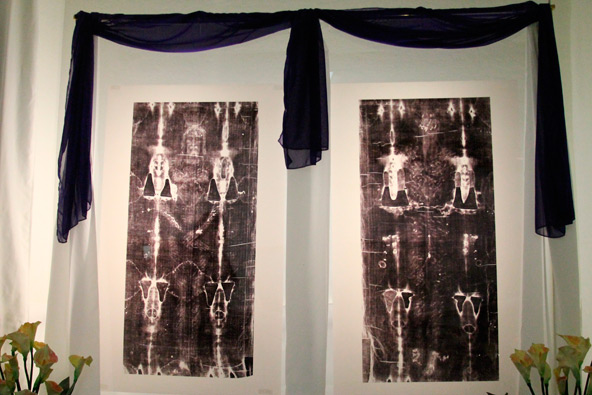
This marks the second year that St. Maria Goretti Parish will host its Shroud of Turin exhibit in the final days of Lent. (Ambria Hammel/CATHOLIC SUN)
SCOTTSDALE — Catholics and those coming into the Church at the Easter Vigil know the story of Christ’s death and resurrection.
Thanks to a recurring exhibit at a Valley parish, they can also gain a deeper understanding of a key object involved. This marks the second year that St. Maria Goretti Parish will host its Shroud of Turin exhibit in the final days of Lent.
The exhibit features a high-resolution photo replica of the shroud that has scientifically been proven in recent years to be from the time of Jesus. Other clues point to it being the very burial cloth used for the crucified Savior.
Greg Biltz, a member of the stewardship committee responsible for securing the replica, described the four-foot by 14-foot image as “very clear, very distinct.”
“You could see and count, if you want to, all 135 strokes that hit His body. It’s that detailed,” Biltz said.
He saw people walk away in tears last year after viewing the image and understanding its context. The exhibit, which runs daily March 18-30, also features reference documents on the history of the shroud, an explanation of the burns and watermarks and a telling of the passion and death of Jesus with Jewish and Roman customs.
Biltz said volunteers would be standing by to help Catholics interpret the scientific information. He said there is also a special preview day March 16 open to clergy and other parish leaders who might be interested in bringing a group to the exhibit. A group of young adults came from as far away as Holbrook last year.
“We basically put together the story of what happened based upon the evidence of the shroud,” Biltz said.
That includes an explanation of how the body got out of the shroud, why some blood marks are washed away yet others aren’t and the expensive linen cloth that uses a herringbone weave typical of that used in Nazareth.
“We try to walk people through the Passion in a very scriptural and scientific way,” he said. “You’re going to go away with a new appreciation for what Jesus did.”
Biltz himself first saw an image of the shroud 30 years ago during Lent in New Orleans. Learning about the beating Jesus endured still haunts him. He described the tri-fold blow each whip brought.
“Every time they hit Him, it tore flesh,” Biltz said. “Their objective was to mark every square inch of His body and they succeeded.”
Shroud of Turin exhibit
Where: St. Maria Goretti Parish, 6261 N. Granite Reef Road in Scottsdale
When: 9 a.m.-8 p.m. March 18-March 30 (closes at noon March 30)
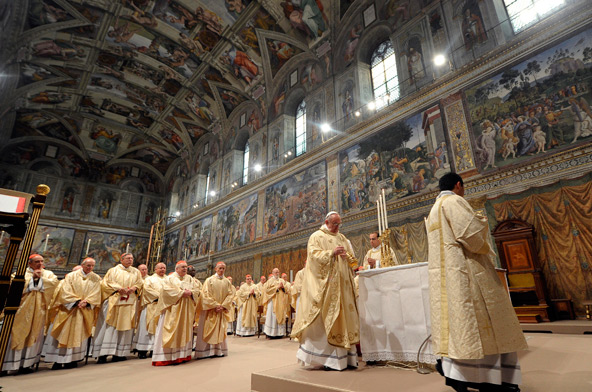
Pope Francis celebrates Mass with cardinal electors in the Sistine Chapel at the Vatican March 14, the day after his election. (CNS photo/L’Osservatore Romano)
VATICAN CITY — Argentine Cardinal Jorge Mario Bergoglio, 76, the leader of a large urban archdiocese in Latin America, was elected the 266th pope and took the name Francis.
He is the first pope in history to come from the New World and the first non-European to be elected in almost 1,300 years. The Jesuit is also the first member of his order to be elected pope, and the first member of any religious order to be elected in nearly two centuries.
The election March 13 came on the second day of the conclave, on the cardinals’ fifth ballot. It was a surprisingly quick conclusion to a conclave that began with many plausible candidates and no clear favorite.
The new pope was chosen by at least two-thirds of the 115 cardinals from 48 countries, who cast their ballots in secret in the Sistine Chapel.
His election was announced in Latin from the balcony of St. Peter’s Basilica, to a massive crowd under the rain in the square below — including at least a handful of Phoenix priests and seminarians — and millions watching around the world.
White smoke poured from the Sistine Chapel chimney at 7:05 p.m., signaling that the cardinals had chosen a successor to retired Pope Benedict XVI. Two minutes later, the bells of St. Peter’s Basilica began pealing continuously to confirm the election. An electric current spread throughout St. Peter’s Square.
At 8:12, French Cardinal Jean-Louis Tauran, the senior cardinal in the order of deacons, appeared at the basilica balcony and read out in Latin: “I announce to you a great joy: We have a pope! The most eminent and most reverend lord, Lord Jorge Mario, Cardinal of the Holy Roman Church, Bergoglio, who has taken for himself the name Francis.”
The crowd in the square responded with cheers, applause and the waving of rain-soaked national flags.
Ten minutes the later the new pope appeared. He sought prayers for Pope Benedict and spoke of the journey the Church was about to begin.
“Now I would like to give my blessing. But first, I will ask a favor. Before the bishop blesses his people, he asks that you pray to the Lord to bless me, the prayer of the people for the blessing of their bishop. Let’s pray for me in silence,” he said.
Fr. Peter Dai Bui, a diocesan priest working in Rome for the Pontifical Council of Cor Unum, which promotes charity for the Church, called that instance “another time for goose bumps.” Fr. Bui was “more or less” right next to the statue of St. Peter when the pope came out.
He explained that sirens and conversation constantly filled the streets of Rome during his last 18 months there. Not when the Church’s new supreme leader called people to prayer.
“At that moment, everything was so quiet,” Fr. Bui said. He could sense the Church as the mystical body of Christ, which supports one another through prayer.
Fr. John Muir, assistant director at both the All Saints Catholic Newman Center in Tempe and the diocesan Office of Worship and Liturgy, was also in St. Peter’s Square. He blogged, Tweeted via social media and granted many media interviews about his experience.
“It’s winning the Super Bowl, combined with being a foster child and getting a new dad,” he wrote in a March 13 blogpost.
Fr. Bui recalled the two-day wait during the conclave and the hour-long interim to see the face of Christ’s vicar on earth.
“It’s a sign of hope and great joy to know we have someone who will lead us, a rock we can hold on to.”
Celsa Negrini, an older woman from Rome, said the new pope’s choice of name was “beautiful. Francis is the patron of Italy. It’s a humble choice, a choice of one who will reach out to the poor.”
That’s the part of his biography that most struck Kevin Grimditch, a Phoenix seminarian studying in Rome. He said choosing “Francis” as his papal name speaks “loudly that he wants to bring us in this same path, a kind of evangelical poverty.”
Grimditch also praised the pope’s prayerful spirit calling him “a father teaching his children to pray.” He said that set a tone for the new evangelization, one of prayerful and silent witness.
Jesuit Father Federico Lombardi told reporters it was “beautiful that a Latin American was chosen.”
“I don’t know him well, even though we are part of same religious family,” he said. “I greeted him the other day, but didn’t expect to see him again dressed in white.”
Bishop Thomas J. Olmsted addressed Phoenix media shortly after the announcement at the Diocesan Pastoral Center.
“What’s very significant to me about this election is that we have someone from the New World,” he said during the press conference. “So America now has a pope. Pope John Paul II said we should think of being united as one America.”
The bishop also noted that the first Jesuit to be named pope chose the name Francis. “This tells us a lot about who inspires him and what will mostly likely impact how he serves the Church.”
The last pope to have belonged to a religious order was Pope Gregory XVI, a Benedictine elected in 1831.
Pope Francis is from Buenos Aires, but he’s a pope for the whole world, the bishop said. The mission of the Successor of Peter is one of unity, he said, to lead the believers of Jesus Christ be one and to act as one, and to make Jesus’ love better known.
Both Jesuits and Franciscans have had a profound impact on the history of the Church in Arizona, the bishop said, noting Jesuit Father Eusebio Kino in particular. Yet the larger number of missionaries to the area were Franciscans.
“It’s a day of great joy for us,” the bishop said. “The first words we hear are ‘Habemus papam.’ That means ‘We have a father.’ That’s why there’s a feeling of uneasiness [when there isn’t a pope]. We naturally call the new pope ‘Holy Father.’ It gives us a sense that God is with us and He will, through this Vicar of Christ, this successor of St. Peter, continue to help us be faithful in loving Jesus Christ and serving the world.”
Pope Francis has had a growing reputation as a very spiritual man with a talent for pastoral leadership serving in a region with the largest number of the world’s Catholics.
Since 1998, he has been archbishop of Buenos Aires, where his style is low-key and close to the people.
He rides the bus, visits the poor, lives in a simple apartment and cooks his own meals, noted Fr. Ernesto Reynoso, host of the locally produced “Essencia de Fe” radio program on 740 AM.
“The more selfish the world grows, the more humble a pope the Lord gives us,” he said. To many in Buenos Aires, he is known simply as “Fr. Jorge.”
Auxiliary Bishop Eduardo A. Nevares, also on hand to answer questions from the media, noted Pope Francis’ humility in particular.
“He’s a very humble and simple man, but at the same time, a great theologian and pastor,” he said. “He will be bringing many gifts to the chair of St. Peter.”
Fr. Paul Sullivan, director of the Office of Vocations for the Diocese of Phoenix, also noted the new pope’s humility, saying the election “just seems perfect.”
“The Gospel can be so much more easily shared by a humble servant,” he said. “We had that with Pope Benedict and with Blessed John Paul II, and this election continues it.”
Fr. Bui from his temporary home in Rome said, “The Holy Spirit really outdid itself in electing a pope.”
Education and ministry
Jorge Bergoglio was born in Buenos Aires, Argentina’s capital city, Dec. 17, 1936.
He studied and received a master’s degree in chemistry at the University of Buenos Aires, but later decided to become a Jesuit priest and studied at the Jesuit seminary of Villa Devoto.
He studied liberal arts in Santiago, Chile, and in 1960 earned a degree in philosophy from the Catholic University of Buenos Aires. Between 1964 and 1965 he was a teacher of literature and psychology at Inmaculada high school in the province of Santa Fe, and in 1966 he taught the same courses at the prestigious Colegio del Salvador in Buenos Aires.
In 1967, he returned to his theological studies and was ordained a priest Dec. 13, 1969. After his perpetual profession as a Jesuit in 1973, he became master of novices at the Seminary of Villa Barilari in San Miguel. Later that same year, he was elected superior of the Jesuit province of Argentina.
In 1980, he returned to San Miguel as a teacher at the Jesuit school, a job rarely taken by a former provincial superior. In May 1992 he was appointed auxiliary bishop of Buenos Aires. He was one of three auxiliaries and he kept a low profile, spending most of his time caring for the Catholic university, counseling priests and preaching and hearing confessions.
On June 3, 1997, he was named coadjutor archbishop. He was installed as the new archbishop of Buenos Aires Feb. 28, 1998.
Some controversy had arisen over the position taken by Pope Francis during Argentina’s 1976-1983 military dictatorship, which cracked down brutally on political opponents. Estimates of the number of people killed and forcibly disappeared during those years range from about 13,000 to more than 30,000.
Citing a case in which two young priests were detained by the military regime, critics say that the cardinal, who was Jesuit provincial at the time, did not do enough to support Church workers against the military dictatorship.
Others, however, have said that he attempted to negotiate behind the scenes for the priests’ release, and a spokesman for the cardinal, quoted in the daily newspaper La Nación, called the accusation “old slander.”
As archbishop, he created new parishes, restructured the administrative offices, led pro-life initiatives and started new pastoral programs, such as a commission for divorcees. He co-presided over the 2001 Synod of Bishops and was elected to the synod council, so he is well-known to the world’s bishops.
“It’ll be exciting to see how he provides an example to the other diocesan bishops,” said Fr. Chris Fraser, judical vicar for the Diocese of Phoenix. Fr. Fraser added that the Code of Canon Law can serve as a handbook for diocesan bishops.
In 2010, when Argentina became the first Latin American country to legalize same-sex marriage, Pope Francis encouraged clergy across the country to tell Catholics to protest against the legislation because, if enacted, it could “seriously injure the family.”
He also said adoption by same-sex couples would result in “depriving (children) of the human growth that God wanted them given by a father and a mother.”
In 2006, he criticized an Argentine proposal to legalize abortion under certain circumstances as part of a wide-ranging legal reform. He accused the government of lacking respect for the values held by the majority of Argentines and of trying to convince the Catholic Church “to waver in our defense of the dignity of the person.”
His role often forced him to speak publicly about the economic, social and political problems facing his country. His homilies and speeches are filled with references to the fact that all people are brothers and sisters and that the Church and the country need to do what they can to make sure that everyone feels welcome, respected and cared for.
A New World pontiff
“People from developing countries will be able to identify with Pope Francis,” said Ignacio Rodriguez, associate director of the Office of Ethnic Ministries in the Diocese of Phoenix.
Rodriguez also said the new pope would have a keen appreciation of migration between countries. “He will lead us into conversion, communion and solidarity,” he said, referencing Blessed John Paul II’s encyclical, Ecclesia in America, in which the late pontiff spoke of the New World as one America, north, central and south.
While not overtly political, Pope Francis has not tried to hide the political and social impact of the Gospel message, particularly in a country still recovering from a serious economic crisis.
After becoming archbishop of Buenos Aires in 1998, he created new parishes, restructured the administrative offices, took personal care of the seminary and started new pastoral projects, such as the commission for divorcees. He mediated in almost all social or political conflicts in the city; recently ordained priests have been described as “the Bergoglio generation”; and no political or social figure missed requesting a private encounter with him.
A respected Italian journal said Pope Francis had the second-highest number of votes on each of the four ballots in the 2005 conclave.
“I was surprised, but it makes good sense,” said Sr. Jean Steffes, CSA, chancellor of the Diocese of Phoenix and director of the Office of Religious. “He’s someone from the New World who recognizes a different way of life. He has beautiful qualities.”
Parishes worldwide began offering Masses of Thanksgiving, especially once priests had a papal name they could fill in during the eucharistic prayer. There were at least three of them held in the Phoenix Diocese the same day in Surprise, Tempe and Bullhead City.
Fr. Peter Dobrowski, pastor of St. Margaret Mary in Bullhead City, started the regular 12:10 p.m. liturgy knowing the world had a pope, but not his name. During Mass, his receptionist put a note on the credence table with the name.
“St. Margaret Mary’s Church was one of the first churches in the world to use the new pope’s name in the Mass,” Fr. Dobrowski said.
After Mass, he began to learn more about the new Holy Father. He said the pope’s Italian heritage is exciting and said parishioners have expressed excitement that he’s from this side of the world. Others talked about the mission work of priests and about his ability to revive the Catholic faith in Latin America.
Pope Francis was installed as the supreme pontiff on the feast of St. Joseph, patron of the universal Church.
Francis X. Rocca, Cindy Wooden, Carol Zimmermann and Carol Glatz in Rome with Catholic News Service and The Catholic Sun’s Ambria Hammel and J.D. Long-García in Phoenix contributed to this story.
Missie D’Aunoy, who captured the hearts of all she met with her warm, Southern spirit and compassionate heart, died March 3. She was 56.
Missie D’Aunoy served as director of the Office of Stewarship for three years. She died March 3. (Ambria Hammel/CATHOLIC SUN FILE PHOTO)
D’Aunoy was the director of the diocesan Office of Stewardship for the past three years. She was responsible for stewardship formation, planning and development and the annual Charity and Development Appeal.
Originally from New Orleans, D’Aunoy felt it her responsibility last year to help the staff of the Diocesan Pastoral Center celebrate Mardi Gras for the first time.
She would also lead the Office of Stewardship in the annual reading of “A Cajun Night Before Christmas,” incorporating the best of her Southern voices into each role.
“She’s like the Irish,” said Fr. Greg Schlarb, vicar of stewardship. “When she needed something, her accent would come right out.”
Fr. Schlarb said D’Aunoy’s stewardship was innate.
“She was born a good steward; to her family, community and living out her faith,” he said. “She was a Southern lady who did so much and met everything with a smile. No matter what it was, she went after it with passion.”
D’Aunoy attended both a Catholic elementary and high school, graduating from St. Mary’s Dominican High School in New Orleans.
She met her husband, Gerard, when he was an altar server at Our Lady of Prompt Succor, in Chalmette, La.
The couple moved to Arizona in 1990, residing in the West Valley with their two daughters so they could attend St. Vincent de Paul Catholic School. Although her plan was to become an active volunteer in her children’s school, God’s hand gently guided her onto the staff as its development director for the next seven years.
“She would say, ‘never let your head hit the pillow until you mention something about St. Vincent de Paul,’” Fr. Schlarb recalled.
During her tenure, the school grew and was able to add a computer lab, and the first grant proposal she wrote resulted in the addition of a basketball court on the unfenced school grounds.
Knowing that the surrounding homes filled with children had access to the court gave D’Aunoy great joy and satisfaction, which ultimately led to another career.
For the next nine years she worked with Habitat for Humanity as a Major Gifts Officer, Chief Development Officer and Chief Operations Officer. D’Aunoy was often heard saying how she fell in love with the idea of people working together to achieve home ownership.
She relished knowing the children in a Habitat house would have a safe place to live, and value and appreciate their home and community.
Her work for the Phoenix Diocese fed her passion to empower and help others. D’Aunoy took great pride involving people in the mission of the Church, and knowing CDA funds made an impact for families and individuals with very basic needs.
She was born July 11, 1956, in New Orleans, to Walter P. Guillot and Marilyn T. Taranto. D’Aunoy is survived by her husband, Gerard R. D’Aunoy, daughters Danielle (David) Brady and Nicole D’Aunoy, mother Marilyn Guillot, brothers Walter Guillot and Craig Guillot, and sister Laurie Conard. She was preceded in death by her father Walter P. Guillot.
Visitation was March 6, with recitation of the rosary, at St. John Vianney Parish in Goodyear. Bishop Thomas J. Olmsted celebrated the Mass of Christian Burial March 7 at St. John Vianney, which was followed by entombment at Holy Redeemer Catholic Cemetery, Cave Creek.
In lieu of flowers, donations can be directed to the Missie D’Aunoy memorial fund, 400 E. Monroe St., Phoenix, AZ 85004.
Memories and condolences may be made by visiting the online obituary Guest Book at www.obits.azcentral.com. Arrangements were entrusted to Queen of Heaven Mortuary.
Chris Benguhe is a columnist for The Catholic Sun. Opinions expressed are the writers' and not necessarily the views of The Catholic Sun or the Diocese of Phoenix.
Sometimes when things don’t go right in our lives we blame God, casting our fists in the sky in anger as if God is supposed to make everything perfect for us.
But the promise of Easter is not that everything will be perfect, but that He will aid, comfort and be our guide and salvation in an imperfect world.
Chris Benguhe is a columnist for The Catholic Sun.
He does all that by sending us the love and comfort of others.
That’s what Chrissy and Ryan realized after life took a few unexpected turns for the couple.
Growing up in a big family of seven super successful sibling athletes, with college scholarships to boot, Chrissy dreamed her whole life of becoming a successful volleyball player. While playing volleyball in high school, she was well on her way to a college scholarship.
But when she injured her knee, a college career in competitive sports was no longer in the cards. “I was crying my eyes out every day,” Chrissy said. “Volleyball was all I knew since I was kid.”
It was a devastating end to her dreams — or so she thought. But while getting help for her torn ACL, she found another dream.
“I actually had a blast in physical therapy,” Chrissy recalled. “It was painful and difficult. But I felt such an incredible bond with my therapists, and they cared about me so deeply. Suddenly I started thinking about doing that for a living one day.”
Chrissy never looked back, starting the long road to a doctorate degree in physical therapy. Her new dream and new life were fueling her full speed ahead to help others to recover their lives and dreams.
Then in her last year of her physical therapy program, into her life walked another dream, a young military pilot battling not only a bruised body but a shattered dream of his own.
Blessing in disguise
Ryan was preparing to go overseas to fly F-16s when a death-defying car crash landed him in the hospital. In a wheelchair for two months, he was then sent back to Luke Air Force Base for therapy. But when the injury proved a little more serious, they sent him off base for therapy, where he wound up in the care of Chrissy.
“He walked with the most ridiculous limp,” recalls Chrissy. “And I thought this has got to be the most beat-up looking 28-year-old man I have ever seen. But he was also the friendliness person I ever met too.”
It wasn’t just because of his injury that he looked so bad; Ryan was demoralized. He was terrified that he wouldn’t be able to fly again.
“All that he ever wanted to do was fly airplanes and he was thinking he could never do it again,” Chrissy said. “I told him how he was young and strong, and I knew he was going to be able to recover. It gave him hope again.”
It wasn’t long before Ryan’s spirits were soaring again, and her fellow co-workers started noticing that Ryan was taking a shining to his therapist, something Chrissy was oblivious to because she was so focused on her job. They suggested the two date when his therapy was over.
So on the last day of Chrissy’s rotation in the center, Ryan asked her and another therapist if they wanted to have a casual dinner and then take a ride in a flight simulator at Luke.
From that night forward the two were inseparable, dating for two years before Ryan asked Chrissy to marry him on top of a mountain on Christmas Day in 2011. Six months later they walked through a military arch of swords after exchanging vows at Brophy Chapel in Phoenix.
Oh, and Ryan did indeed fly again. And the two of them soar higher than ever nowadays with God’s love under their wings.
“But how can you be so sure that what you believe is true? People in other religions are sure they are following the truth, too!”
Ah, youth. There comes a time in the life of every parent of a teenager or college student that you have The Discussion. High school and college-age kids — even the nicest of them — will at eventually come smack up against a parent’s prohibitions. “Why do I still have a curfew?” they moan, or, “What’s so bad about (fill in the blank) as long as I’m not hurting anybody?”
Joyce Coronel is a regular contributor to The Catholic Sun and author of “A Martyr’s Crown.”
Or, a personal favorite: “But I’m basically a good person. I mean, I haven’t killed anybody!” Cue the violins.
Parenting is not for the fainthearted, as the guardian of any strong-willed 2-year-old will tell you. When older children begin to challenge us by questioning the teachings of the Church, we have to “always have an answer ready for people who ask us the reason for our hope” (1 Peter 3:15).
“For starters, we have eyewitness accounts — people who walked with Jesus, who saw Him die and later saw Him resurrected. We have historical records, a faith passed down to us from the Apostles themselves.”
That’s always a good answer for the brain, but how about the heart? If our faith is only based on data, then it will not have the power to transform our own lives, much less anyone else’s. It most certainly will not bring about conversion. And we all need conversion.
To be able to defend our faith and explain it to others, we ourselves must have a vibrant relationship with the person of Jesus Christ. We ourselves must be convinced of the veracity of what the Catholic Church teaches. We have to keep our eyes of faith open to see what God is teaching us.
In my own life, I recently saw God do something so amazing that even as I write this, I am struck by how real, how tender His love for us truly is.
Lenten surprise
On Ash Wednesday, I decided that I would try to spend more time with a lovely elderly widow in our neighborhood. Last week when I stopped by, she offered me some rosaries she had tucked away.
As we stood there in her bedroom that afternoon, I began unzipping the various cases and examining the rosaries. And then I came upon it, hidden away in a small black leather pouch. It wasn’t a rosary — it was a first-class relic of a saint, similar to the one my mother once had.
“S. Luciae” read a small label under the glass.
“Jeanie, this is a relic of St. Lucy!” I exclaimed. She smiled knowingly.
“I can’t take this from you,” I protested. She insisted.
What amazed me was that just three weeks earlier, I had released a novel about the faith of martyrs. St. Lucy, I knew, had given her life for the faith. I also knew St. Lucy is the patron saint of those with eye diseases. Since someone very dear to me is losing her vision, I knew I could share the blessing of the relic with her. I gave Jeanie a big hug and went home to read up on the saint.
As it turns out, the third century martyr is also one of four patron saints of authors. I, a freshly minted author, felt that Jesus was giving me a gentle embrace in bestowing the relic of St. Lucy on me.
How do I know my faith is real? How could I ever begin to doubt it? I see God blessing me each day in countless ways, at times overwhelming me with the sweetness of His love.
“You see, my daughter? I have my eye on you.” That’s what He’s saying. He knows who I am and He knows who you are, too. He is waiting, patiently, to shower His love on you and anyone else who seeks Him with a sincere heart. Teenagers included.
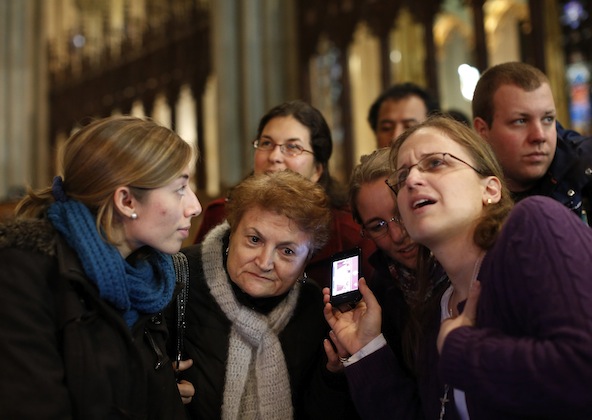
Valentina Bruner of Peru, left, and Florencia Silva of Trumbell, Conn., right, share a webcast of newly-elected Pope Francis, Cardinal Jorge Mario Bergoglio of Buenos Aires, Argentina, at St. Patrick’s Cathedral in New York March 13. (CNS photo/Brendan McDermid, Reuters)
Television screens and radios weren’t guaranteed to be the first to tell the Catholic world it had a new pope March 13. The second conclave in the third millennium was the first that social media played a large role.
So much so that a seagull who came to rest on the smokestack atop the Sistine Chapel prior to the puff of white smoke March 13 temporarily had two Twitter accounts to its name, but not before @ConclaveSeagull tweeted “That’s a lot of votes for Cardinal what’s his name…” Ultimately, the @SistineSeagull account endured although it’s now racing @ConclaveChimney to get the most followers.
The seagull’s microblogging account accrued 500 followers every eight minutes in its infancy. Social media users, including at least two Phoenix-area priests, followed the bird’s high-tech Tweets such as “It once took three years to select a pope. I’m prepared to build a nest if need be.”
Fr. John Muir, associate director for both the All Saints Catholic Newman Center in Tempe and the diocesan Office of Worship and Liturgy, was in St. Peter’s Square during the conclave. He quipped via Twitter, “Apparently, the Holy Spirit can also descend in the form of a seagull.”
The infamous bird, who left before the smoke came, now has 9,000 followers on its Twitter account. Conclave watchers took to Facebook to discuss the seagull as well. John Triscik, whose profile says he lives in Hershey Penns., responded to an AmericanPapist Facebook post requesting captions for the seagull.
He wrote, “Will the smoke match my chest or my tail”?
His Facebook feed shows Triscik was also among the more than 552,000 worldwide who pledged through adoptacardinal.org to pray for one of the 115 voting members of the conclave. Once elected, unofficial Facebook pages with Pope Francis’ profile popped up and people started following his feeds as a chef — the simple servant cooks his own meals — as a public figure, government official and monarch.
There are also community pages. Some identify him as “Francis I.” Others don’t. All of them still have awhile to go, however, to catch Pope [emeritus] Benedict XVI’s public figure page. Some 94,000 people hit “like” on that page.
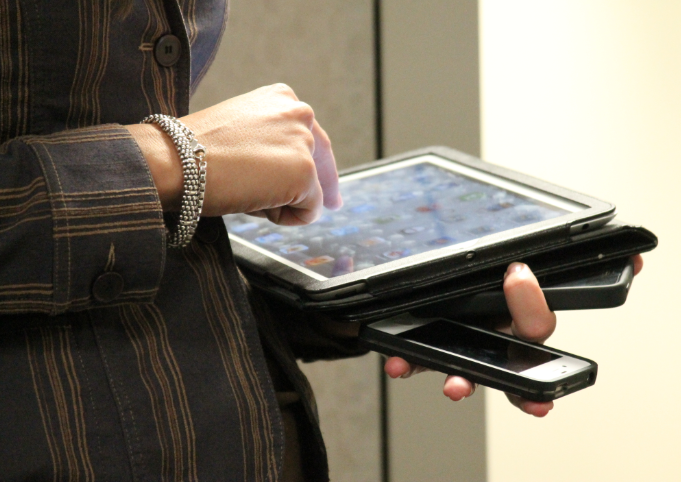
A woman switches between applications on her iPad after white smoke appeared from the temporary smokestack atop the Sistine Chapel March 13. Social media and online sites played a large role in the conclave. (Ambria Hammel/CATHOLIC SUN)
Fr. Hans Ruygt, pastor of St. Clare of Assisi Parish in Surprise, enjoys using social media. He found some clear “likes” and “dislikes” when it came to apps for his iPhone for pre-conclave and conclave news.
The Conclave App wasn’t user-friendly, he wrote to The Catholic Sun in an email. It lacked search features such as alphabetizing cardinal names or clearly displaying their last names. Users had to “eyeball” the list as would users of traditional media, he wrote.
The app didn’t support a widescreen view when turned sideways, either so he couldn’t see the last names of cardinals. Any step would have aided his discovery of the new pope’s name.
“I found the Pope app to be more useful and interesting and I used the notifications option on it to alert me,” Fr. Ruygt wrote. He plans to continue using it.
Still, for all the immediacy social media offers, many tuned in to a television feed or a main network’s live stream online for the announcement. Fr. Ruygt said FOX News and similar secular sites loaded faster on his office computer than live streams from Catholic media. Some 55,000 people were watching the Vatican’s live web feed when the Catholic world learned it had a pope.
Face-to-face
Fr. Muir also uses social media. The actual announcement of “Habemus Papam” for him, however, was face-to-face.
Fr. Muir took his best guess on when the conclave would start, found decent airfare and snatched the last room at one hotel close to St. Peter’s Square. He left it to God whether he should be a simple pilgrim or use his voice to “share the emotions on the ground.”
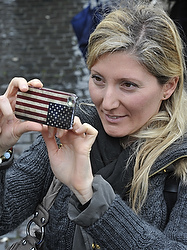
A woman in St. Peter’s Square uses her phone to photograph smoke from the chimney of the Sistine Chapel at the Vatican March 13. Black smoke was emitted shortly before noon signifying that a new pope was not elected. (CNS photo/Chris Warde-Jones)
Fr. Muir learned his answer when the head of BBC Europe sat next to him on the plane. Instead of using social media to get the story on the conclave, the priest — who was still in seminary when Pope Benedict XVI was elected — used social media to deliver the story.
“I was trying to be pro-active and positively putting things out there,” Fr. Muir told The Catholic Sun.
He posted blogs, videos and Tweets about his experience nearly daily so the people of the Phoenix Diocese could experience the conclave with him.
“When the smoke first came out, it looked a little black,” Fr. Muir said in one video post, while donning his self-described “Pope Bergoglio” glasses. “And I have to tell you, I just felt this real deep disappointment that I was going home [the next day] with apparently no pope and then it just turned to this beautiful bright white and it was a complete reversal of emotions and the place went crazy.”
Fr. Muir estimated granting seven media interviews the day Pope Francis was elected and up to a dozen during his week-long journey.
“It was dramatic and spiritual on every level,” he said, describing the feeling as that of winning the Super Bowl and being a foster child getting a new Dad.
Media reports and spoofs on the new pope may have just begun. Pictures of him using public transportation and paying his hotel bill went viral. Google, the Internet search engine giant, temporarily changed its homepage image to “BerGooglio.”
_____
Editor’s Note:
Here is a video recap of the conclave. It’s produced by Catholic Sun friend, CatholicVote.org
Liturgical music — 6 p.m. March 15 at Corner Bakery Cafe in downtown Phoenix. Hosted by OurGodSpot Young Adults, a local Catholic outreach. Event page.
Diocesan Women’s Conference — 9 a.m.-5 p.m. March 16 at St. Bernard of Clairvaux in Scottsdale (map). Event site.
Unity Mass — 1 p.m. March 17 at St. Pius X Church, 809 S. 7th Ave. in Phoenix. Monthly Mass hosted by the diocesan Office of Black Catholic Ministry celebrates Black heritage.
Open house — 11 a.m.-12:30 p.m. March 16 at Ozanam Manor. Refreshments provided. RSVP: (602) 850-6900. Related Q-and-A and blogpost.
Annual Rosary Dinner/Book sale — 6:30 p.m. March 16 at St. Paul (map). Catered dinner, auction, entertainment and book sale. Peggy (602) 840-8185
Book sale — 9 a.m.-evening March 16 at St. Paul (map). Benefits Radio Family Rosary. Genevieve (602) 954-0316
Rummage sales
7 a.m.-3 p.m. March 16 at St. Rose Philippine Duchesne in Anthem. Event page
8 a.m.-2 p.m. March 16 at Catholic Charities. Benefits DIGNITY program. Flyer.
School benefits
St. Patrick’s Day Dinner — 4-7:30 p.m. March 16 at Sacred Heart School in Prescott (map). Live entertainment, adult and kid’s menu. Tickets: $10 adults and $5 kids. Benefits parish activities, painting of church, support of Claretian seminarian.
Softball benefit — 4-9 p.m. March 16 at Town Talk II Barbeque. Enjoy $10 plates and St. Mary’s softball team receives 20 percent back on all beverages. Raffle tickets also available.
Tuition Scholarship dinner/auction — 5-11 p.m. March 16 at St. Agnes (map). Donation: $35 per person.
St. Patrick’s Day Dinner and Dance — 6-10 p.m. March 16 at St. Francis Xavier. Event flyer.
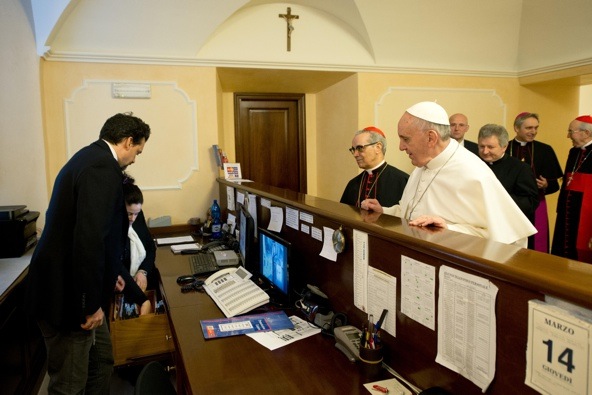
Newly elected Pope Francis checks out of the church-run residence March 14 where he had stayed in Rome. The pope returned to the residence where he stayed before becoming pontiff and insisted on paying the bill, despite now effectively being in charge of the business, the Vatican said. (CNS photo/L’Osservatore Romano)
Habemus papam — we have a pope!
An hour after the white smoke billowed from the chimney of the Sistine Chapel, the world learned the name of the man who was elected to be the 265th successor to St. Peter: Cardinal Jorge Mario Bergoglio, the Jesuit cardinal of Buenos Aires. He chose the name Francis.
It was on that day, Wednesday March 13, when Catholics around the world rejoiced with an outpouring of love and praise for God. For as it goes, the College of Cardinals guided the Holy Spirit to elect the next leader of the world’s 1 billion Catholics. It was after just five ballots that the humble, gentle cardinal stepped out onto the balcony overlooking St. Peter’s Square as Pope Francis, greeting the world with the words: “Buona sera” — good evening.
And the crowd went crazy.
By all accounts, the world’s reaction to our new Holy Father has been nothing short of irrepressible joy. Here is a Jesuit (a first) from Latin America (another first) who has demonstrated throughout his clerical life a love for Christ that is manifest in his compassion for the least of us, his defense of the Catholic faith, and his servant leadership.
Famously he is a “man of the people” who embraces his vow of poverty, casting aside the luxuries due to a cardinal. He would ride the bus to and from his modest apartment, where he cooked and cleaned for himself. His decision to take the name of St. Francis of Assisi — a great reformer devoted to a life of poverty — has not gone unnoticed or unappreciated.
St. Francis had one rule that he gave to his followers, the friars: “To follow the teachings of our Lord Jesus Christ and to walk in His footsteps.”
Pope Francis has already made waves in just the hours following his election. For example, he rode the bus back from the Sistine Chapel with his brother cardinals. He paid the bill for his hotel room stay in Rome and carried his own luggage. He didn’t want a special seat when he sat down for dinner. And in another sign of humility, he asked for the crowds gathered in St. Peter’s Square the night of March 13 for their prayers that the Lord bless him — “the prayer of the people for the blessing of their bishop” — before the traditional blessing from him upon the people.
We join with the world in congratulating Pope Francis. We are elated for this humble man to lead us as our Holy Father. We ask that our readers join us in praying for the Lord’s blessing upon Pope Francis, and that he leads us “to follow the teachings of our Lord Jesus Christ and to walk in His footsteps.”



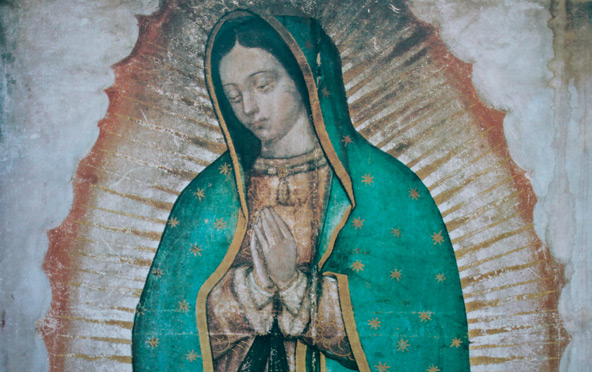 Auxiliary Bishop Eduardo A. Nevares will lead a pilgrimage next October to Mexico City and Guanajuato to mark the closing of the Year of Faith.