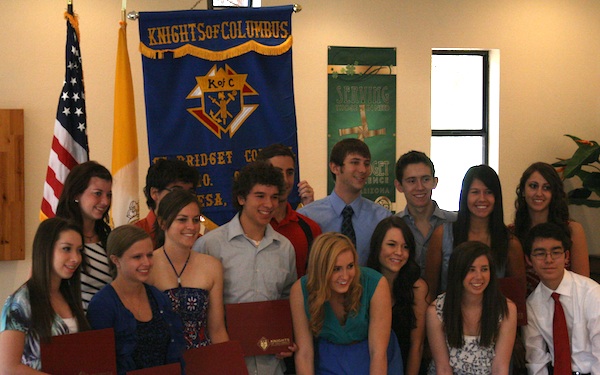
The Knights of Columbus Council 9800 awarded $13,000 in scholarships to high school and college students at St. Bridget Parish May 27. (Ambria Hammel/CATHOLIC SUN)
The men doled out $13,000, bringing its overall scholarship total to more than $100,000 since the program began more than 10 years ago. Awards ranged from $500 to $1,000.
“It amazes me. I wish I was like these kids when I was their age,” Dennis Schauer, Grand Knight, said as the May 27 award presentation got underway. “These kids are the examples scholastically, athletically, in the community.”
Some applicants went far beyond the required 3.0 grade point average to carry a 4.0 GPA or higher. They also made time for normal school activities plus helped out at the parish and in the community.
“Some of them have literally grown up at the parish. We remember when they were getting their first communion. Then they became altar servers and Eucharistic ministers. You almost hate to see them leave,” Kevin Harris, chairman of the scholarship committee told The Catholic Sun.
The Knights hope the scholarships ease the financial burden of Catholic high school and college. They also hope the awards motivate the teenagers and young adults to stay in touch with the Church.
This year’s college recipients are headed to the University of Notre Dame, Regis University, and Arizona’s universities.
Daniel Cortez is one of them. The Seton Catholic Preparatory High School graduate is headed to Arizona State University to study film and media production. He said it’s important for the Knights to give out scholarships to help Catholic students continue to succeed.
The scholarships were open to parishioners or relatives of parishioners attending a Catholic high school or any college. They were judged on academics, service, outside activities and an essay about how they use their Catholicism in daily life.
Harris, scholarship chairman, was impressed when some of the applicants only used half of the word limit for their essay. He said it was a true measure that they wholly embraced the faith; it wasn’t just lip service.
Harris said it’s tough not being able to give something to all 31 applicants, but said it’s affirming to see the quality of kids out there.
Fr. Scott Brubaker, pastor, agreed. He thanked the scholars for their commitment to learning and developing leadership and Christian witness.
Funds came from the parish’s annual “It’s a Good Life” food and wine tasting event. This year, the newly established Msgr. Bernard Collins Foundation through the Knights of Columbus also kicked in half of the scholarship money.
The Knights of Columbus Council at Blessed Sacrament Parish in Scottsdale was also scheduled to award high school and college scholarships May 27. St. Henry Parish in Buckeye offered 14 scholarships this year — nine collegiate scholarships, four for incoming high school freshman and one from the parish council.
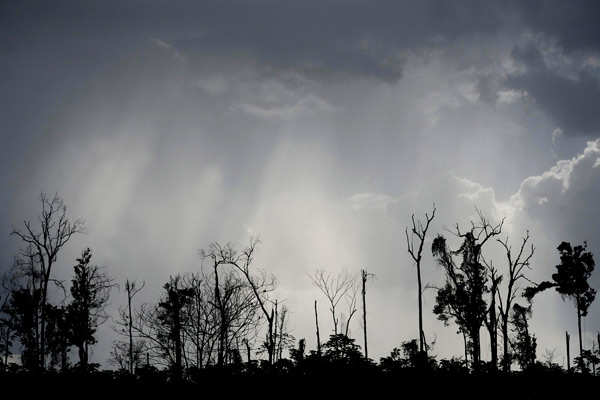
The remains of virgin Amazon rainforest are seen after it was cleared for its wood along a highway near a town in Moju, Brazil, May 26. Delegates will gather for the 2012 Earth Summit in Rio de Janeiro June 20-22 to try to map a sustainable course for th e world's 7 billion people. (CNS photo/Lunae Parracho, Reuters)
LIMA, Peru (CNS) — Twenty years ago, a 12-year-old girl stood before government officials from most of the world’s countries and pleaded for her future. Worried about pollution and overuse of natural resources on her finite planet, she begged, “If you don’t know how to fix it, please don’t break it.”
The occasion was the 1992 Earth Summit in Rio de Janeiro, which ended with the world’s countries committing — at least on paper — to make environmental concerns a priority and eliminate unsustainable forms of production and consumption. Above all, delegates agreed that development must not jeopardize the welfare of future generations.”
Reminding the grownups in the room that their children and grandchildren deserved a decent life, too, the girl asked, “Are we even on your list of priorities?”
Canadian Severn Cullis-Suzuki — who pleaded on behalf of her generation then and who now has a toddler and an infant of her own — will return to Rio in late June, when delegates gather again to try to map a sustainable course for the world’s 7 billion people.
The theme is one often raised by Pope Benedict XVI. During a Sunday blessing last November, he urged delegates to an international climate conference to consider “the needs of the poorest and future generations.”
A few days later, he told young Italian members of a Franciscan environmental group, “There is no good future for humanity or for the earth unless we educate everyone toward a style of life that is more responsible toward the created world.”
Many observers, however, are dubious that delegates in Rio will map a route toward that lifestyle. So far, negotiators have failed to agree on the summit document, which was supposed to be 90 percent complete before the summit begins; an additional writing session was scheduled May 29-June 2.
Industrialized and developing countries have taken different stands on one of the summit’s key themes, the “green economy,” as well as a proposal to set “sustainable development goals” modeled on the Millennium Development Goals, which defined targets in areas such as health, education, maternal and child welfare and poverty reduction, with 2015 as the deadline.
“All people tend to find it easier to borrow than to pay back, but environmental debt, like all debt, tends to catch up with us,” Robert Engelman, director of the nonprofit Worldwatch Institute in Washington, said in April at the presentation of the organization’s annual State of the World report.
Titled “Moving Toward Sustainable Prosperity,” the report offers input for the Rio conference. Cullis-Suzuki spoke at the presentation via video link.
Engelman said the world needs “creative thinking about how to restructure economies, governance and our own lives.”
“Sustainable prosperity” is one name for a goal that would be reached when everyone’s basic needs are met, the dignity of all people is respected, and everyone is free to pursue happiness and allow others to do the same, according to speakers at the Worldwatch presentation.
“We need a new global solidarity for sustainability … that can produce win-win outcomes for everyone,” Worldwatch researcher Michael Renner said. “The winners will ultimately lose if the losers can’t win.”
In the market-driven world, development has become synonymous with economic growth, but Renner and others said that unlimited economic growth will strain the planet’s resources beyond their capacity. A key to sustainable development is “transforming a consumer culture,” said State of the World researcher Erik Assadourian. “We are trapped in a system that stimulates consumption.”
If everyone on the planet consumed at the rate of Americans, he said, the planet could support about 6.2 billion people, not the 7 billion who now inhabit it and a far cry from the 9 billion projected by the end of this century.
Suggestions for curbing consumption range from redistribution of tax burdens to retraining workers for a “green” economy. Such ideas, however, are likely to meet with opposition from both industrialized countries, which fear erosion of their standard of living, and developing countries, which exploit their natural resources to generate revenue to reduce poverty, provide services and build infrastructure.
The conflict plays out not only between nations, but also within countries. Throughout Latin America, rural communities are protesting plans for dams, mines, biofuel plantations and other large infrastructure projects. Proponents say the projects are crucial to maintain economic growth and support growing populations that want the comforts and conveniences — from private automobiles to televisions to smart phones — that are staples of life in industrialized countries.
Opponents say the projects’ social and environmental costs outweigh their benefits. Many opponents are indigenous people who espouse a principle called “buen vivir,” a Spanish term that means, roughly, “living well.”
They argue that while most people in Western society are intent on “living better” and obtaining more things, indigenous people only want to “live well,” meeting their own needs in a way that leaves enough for future generations.
Despite the skepticism over the Rio summit, Cullis-Suzuki finds hope at the grass roots.
“Real change lies in the communities,” she told the audience at the Worldwatch presentation. “Because we love our children, we must and we will find a way to become sustainable.”
WASHINGTON (CNS) — A Dominican sister from Nashville, Tenn., has been named executive director of the Secretariat of Catholic Education of the U.S. Conference of Catholic Bishops.
Dominican Sister John Mary Fleming, a member of her religious community’s St. Cecilia Congregation, will succeed Marie Powell, who earlier this year announced she will be retiring.
Powell has been executive director since July 2007.
Sister Fleming currently is principal of St. Dominic School in Bolingbrook, Ill., which is in the Diocese of Joliet.
Msgr. Ronny Jenkins, USCCB general secretary, announced her appointment May 29.
He said in a statement that both Sister Fleming and her community “have shown a commitment to Catholic education” that resonates with “our conference and which has been a hallmark of the Catholic Church in this country.”
He also praised Powell for her many years of service with the USCCB and the secretariat and for her long career as an educational leader.
“Marie served well for many years as a strong advocate for Catholic schools and as a leader in the education community,” Msgr. Jenkins said. “She can be proud of her contributions, as we are proud of her.”
Sister Fleming holds a licentiate in canon law from The Catholic University of America, a master’s degree in theology from Franciscan University of Steubenville in Ohio, a master of education degree in educational leadership and supervision from the University of Southern Mississippi, and a bachelor’s degree in education from Belmont University, Nashville.
Prior to her term as St. Dominic’s principal, from 2010 to the present, Sister Fleming was director of education for her religious congregation, 2000-2007; interim vice president of operations at Aquinas College, Nashville, 2000-2001; and coordinator of her congregation’s $46 million motherhouse building project, 2000-2006.
She served on the board of Aquinas College, 2000-2007, and currently is a board member of Providence Academy, Minneapolis. In 2012, she also served on the 10-member team to develop a program for the year of Faith for the Joliet Diocese.
Before Powell was named executive director for Catholic education at the USCCB, she had been assistant secretary for parental advocacy in the education department since 2002.
Prior to joining the staff of the USCCB, Powell was assistant principal and academic dean at Paul VI Catholic High School in Fairfax, Va., from 1996 to 2002. She was superintendent of schools in the Diocese of Arlington, Va., from 1986 to 1995.
She also has served on a variety of school committees, associations and boards.
LEVITTOWN, Pa. (CNS) — The mass media have done the public a disservice by consistently referring to health reform law regulations so narrowly as the “contraceptive mandate,” because it leads people to think the regulations are a matter of interest only to Catholics, according to Harvard Law professor Mary Ann Glendon.
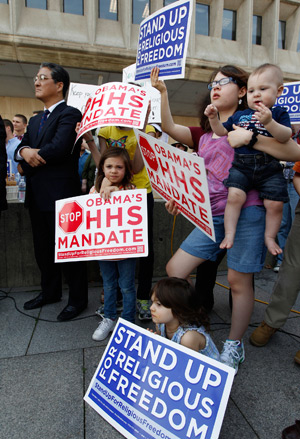
People rally in March outside the Department of Health and Human Services in Washington against the government mandate the would require nearly all employers to cover contraceptives and sterilization in their health plans. Forty-three Catholic dioceses, schools, hospitals, social service agencies and other institutions filed suit in federal court May 21 to stop three government agencies from implementing the mandate. (CNS photo/Bob Roller)
Rather, she said, the regulations that would require employers to provide free health insurance coverage for contraceptives, abortion-inducing drugs and sterilizations are a contravention of religious freedom, “and that’s everybody’s business.”
Legal experts interviewed by Catholic News Service said the lawsuits filed May 21 by 43 Catholic entities in 12 federal district courts, as well as those filed separately by other organizations and concerned individual employers, are based on three principles.
The first is the free exercise clause of the First Amendment to the U.S. Constitution.
Helen Alvare, a law professor at George Mason University in the Washington suburb of Arlington, Va., said the Supreme Court has ruled that statutes may breach religious freedom if a law is neutral with regard to religion and of general applicability, that is, applied across the board without exemptions.
But, she said, the Department of Health and Human Services regulations to implement the Patient Protection and Affordable Care Act contain numerous exemptions affecting thousands of people — unions, for example, and grandfathered programs — and so cannot be considered generally applied.
A second reason cited for the lawsuits is the 1993 federal Religious Freedom Restoration Act. The law says that if the government is going to place a substantial burden on religious practice, the government must have a compelling interest to do so and must use the least restrictive means available.
The HHS regulations do not meet that test, the scholars agreed.
Finally, enforcing the regulations’ narrow definition of religiously exempt entities would, Glendon said, require a searching government inquiry into what is and isn’t religious activity, “intruding into religious affairs in an unprecedented way.”
To be exempt, the religious employer must meet four criteria, that it “has the inculcation of religious values as its purpose”; primarily employs people “who share its religious tenets”; primarily serves people “who share its religious tenets”; and is a nonprofit organization under specific sections of the Internal Revenue Code.
Alvare said she thinks the case being made in the lawsuits is really strong but expects that however district courts rule the matter is likely to be appealed to higher courts, unless the Supreme Court rules the whole health Affordable Care Act unconstitutional in a case currently under consideration.
Ned Dolejsi, executive director of the California Catholic Conference, said no California diocese was among those bringing the current batch of lawsuits, but he said that was not a decision the bishops made together nor does it indicate that they disagree with the dioceses bringing suit.
Rather, he noted that the bishops of California went through a similar process in challenging California state law, but the U.S. Supreme Court ultimately declined to hear their appeal.
The California statute, like the proposed HHS regulations has a very narrow religious exemption, for any employer offering insurance for pharmaceuticals. But he said the Catholic dioceses have been protected from it by federal and state laws that allow them to self-insure in a variety of ways.
However, that protection would be lost if the federal law goes into effect with its current regulations.
“We (in California) share the angst (of other U.S. Catholics) over allowing this definition of religious employer to remain” in force, he said, but different bishops are using different strategies.
Richard Garnett, professor of law and associate dean at the University of Notre Dame Law School, said that with respect to the district court suits filed by various Catholic entities, it is entirely possible that there will be different decisions in different jurisdictions.
He said that at least some of the plaintiffs will probably be successful, and in those cases the court may issue an injunction on enforcement of the HHS regulations within the area of the court’s jurisdiction.
Garnett also said the Obama administration may just decide to change the regulations.
The Catholic Health Association, which has not joined in any of the lawsuits, told CNS its only statement on the lawsuits could be found in a May 21 blog post by E.J. Dionne of The Washington Post. In it, Michael Rodgers, CHA senior vice president for public affairs and advocacy, was quoted as saying in an interview that the association “was not made aware that lawsuits were being filed now.”
Rodgers is quoted as adding that CHA is working with the administration to “broaden the exemption by broadening the definition of what a religious institution is.”
Julie Billmeier, who serves in young adult ministry in the Diocese of Dallas — which is among the groups suing the government over the regulations — said the definition in the regulations “would completely change our Catholic approach to what it means to serve others.”
She sees accessible health care for all as an important social justice issue, but says, “It can’t happen at the expense of us being able to live out what we believe.”
Also in Dallas Kate Dailey, principal of Bishop Dunne Catholic School, said hers is a very diverse school where some 50 percent of students require financial aid. She sees her ministry at the school, which serves grades six through 12, as “who we are, the heart and soul of who we are” as the Catholic Church, and is appalled that the HHS regulations would not consider it a religiously exempt institution.
But she is optimistic the suits will be successful or the regulations changed, saying, “I don’t think it (contraceptive requirement) will happen.”
Paolo Gabriele, private assistant to Pope Benedict XVI, is seen at left in the front seat of the popemobile as the pontiff arrives to lead his general audience in St. Peter's Square at the Vatican May 2. Vatican spokesman Father Federico Lombardi said Ga briele was arrested the evening of May 23 by Vatican police after they found private Vatican documents in his home on Vatican property. (CNS photo/Paul Haring)
VATICAN CITY (CNS) — The Vatican said it is committed to restoring a sense of trust and transparency as it seeks the truth behind leaks of letters written by Vatican officials to each other and Pope Benedict XVI.
Paolo Gabriele — the pope’s private assistant accused of having a cache of illicitly obtained Vatican documents — was still under arrest and would face his first round of formal preliminary questioning by Vatican judges “later this week or early next week,” Jesuit Father Federico Lombardi, Vatican spokesman, said May 29.
The spokesman confirmed that an unspecified number of other individuals also had been questioned by Vatican police recently, a process that could be expected to continue, but no one else had been charged or arrested.
Gabriele has been able to meet and speak with his lawyers and his wife regularly, and is “very serene and calm,” said his chief counsel, Carlo Fusco, in a written statement released May 28.
Father Lombardi said May 28 that the Vatican “is committed to seeking to restore as soon as possible a climate of transparency, truth and trust.”
“The pope is informed about everything and can’t help but be saddened, however, he remains serene” concerning the latest crisis, Father Lombardi told journalists.
Gabriele, the dark-haired assistant often pictured sitting in the front seat of the popemobile next to the driver, was arrested the evening of May 23 by Vatican police after private Vatican documents were found in his home, which is on Vatican territory.
Gabriele, who had been serving Pope Benedict since 2006, had performed his regular duties the morning of the day of his arrest, suggesting perhaps that Vatican police did not find enough evidence until later in the day, Father Lombardi said.
Gabriele’s arrest was part of a Vatican investigation into a series of document leaks, popularly referred to as “VatiLeaks” in the media.
The leaks began in January with the publication of letters written by Archbishop Carlo Maria Vigano when he was secretary-general of the Governor’s Office of Vatican City State. The archbishop, who now is nuncio to the United States, warned of corruption, abuse of power, a lack of transparency in awarding Vatican contracts and opposition to financial reforms.
Later leaks included a letter from a Vatican official questioning the current reform of the Vatican’s finance laws.
Father Lombardi told journalists May 28 that the leaks’ scandal and the recent dismissal of the president of the Vatican Bank were “distinct and separate” cases. Bank president Ettore Gotti Tedeschi was fired May 24 by the bank’s board of supervisors, who censured him for neglecting his duties amid worsening management problems.
“The only thing the vote of no-confidence of president Gotti Tedeschi and the arrest of Gabriele have in common is the fact that they happened around the same time,” the Vatican spokesman said.
Meanwhile, Fusco, Gabriele’s lawyer, said in a written statement May 28 that his client told a Vatican judge that he “will offer his utmost collaboration.”
However, Gabriele’s formal testimony will only come after his two lawyers have completed studying the case, the statement said.
“Therefore, Paolo (Gabriele) will respond as soon as possible to every question and will collaborate with investigators in order to ascertain the truth,” wrote the lawyer, who added that he and his client have been friends from childhood. Fusco said he holds his friend in “great esteem.”
Father Lombardi said May 29 that in the next few days Piero Antonio Bonnet, a Vatican magistrate, would begin the second stage of the formal inquiry, questioning Gabriele in the presence of his two lawyers and Nicola Picardi, another Vatican magistrate, who conducted the preliminary investigation.
Father Lombardi said the investigation would continue until enough evidence has been collected and then Bonnet would either call Gabriele to stand trial or would acquit him, Father Lombardi said.
In April, Pope Benedict appointed a committee of three retired cardinals to investigate the document leaks; the cardinals turned to the Vatican gendarmes for assistance.
Dozens of private letters to Pope Benedict and other confidential Vatican correspondence and reports, including encrypted cables from Vatican embassies around the world, were leaked to an Italian journalist, Gianluigi Nuzzi. He published the documents in a book, “Your Holiness,” which was released May 17. While some of the leaked letters are gossipy, others include allegations of serious financial misconduct.
In a statement two days later, Father Lombardi called the publication of the letters for commercial gain a “criminal act” and said the Vatican would take legal action. The publication, he said, violated the right to privacy and the “freedom of correspondence” of Pope Benedict, the letter writers and the pope’s closest collaborators.
In the book’s introduction, Nuzzi said the main source for the texts told him he was acting with a “small group” of Vatican insiders concerned about corruption and a thirst for power within the Vatican. According to his source, Nuzzi said, none of the people giving him documents knew who the others were.
– – –
— By By Carol Glatz, Catholic News Service. Contributing to the story was Cindy Wooden at the Vatican.
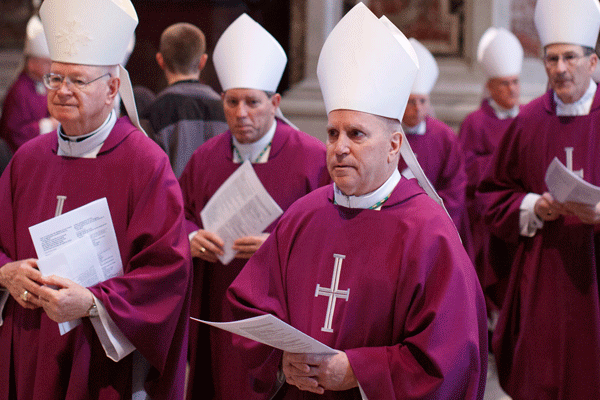
Bishop Samuel J. Aquila of Fargo, N.D., center, walks in procession with other bishops after concelebrating Mass in St. Peter's Basilica at the Vatican during his "ad limina" visit in this March 6 file photo. Bishop Aquila has been named to lead the Arch diocese of Denver. (CNS photo/Paul Haring)
WASHINGTON (CNS) — Pope Benedict XVI has named Bishop Samuel J. Aquila of Fargo, N.D., as the new archbishop of Denver and also named Bishop Richard J. Malone of Portland, Maine, to head the Diocese of Buffalo, N.Y.
The pope also accepted the resignation of Bishop Edward U. Kmiec, who is 75, the age at which canon law requires bishops to submit their resignation to the pope.
The changes were announced in Washington May 29 by Archbishop Carlo Maria Vagano, apostolic nuncio to the United States.
Archbishop Aquila, 61, succeeds Archbishop Charles J. Chaput, who was named to head the Philadelphia Archdiocese last July. The new archbishop has headed the Fargo Diocese since 2002. Bishop Malone, 66, has been Portland’s bishop since 2004.
Archbishop Aquila will be installed July 18 during a Mass at Denver’s Cathedral Basilica of the Immaculate Conception. Bishop Malone will be installed Aug. 10 during a Mass at St. Joseph’s Cathedral in Buffalo.
“It is a tremendous blessing to be able to return to the particular church where I was ordained and to a place that I consider home because I lived there the majority of my life and served in the priesthood there,” Archbishop Aquila said at a news conference in Denver.
A Denver archdiocesan priest, he left in 2001 to serve the Fargo Diocese, he said, adding, “I never imagined that I would return one day as archbishop … yet it is all part of God’s plan.”
God’s “providential love filled me with peace and joy as I was called by him to serve as shepherd for the church that gave birth to my vocation as a priest,” he said.
At a news conference in Buffalo, Bishop Malone said: “While there is sadness in my heart at leaving the Catholic faithful of Maine … I look forward with enthusiasm to taking up my responsibility as chief shepherd of the Church of Buffalo.”
“I am very grateful to follow in the footsteps of Bishop Kmiec who is a loving, faithful and generous servant of the Gospel,” he added.
Archbishop Aquila, a native of California who was ordained a priest in 1976, was named coadjutor bishop of Fargo in 2001 and became bishop of Fargo in 2002, when his predecessor, Bishop James S. Sullivan retired for health reasons. Bishop Sullivan died in 2006.
As a Denver priest, he served the archdiocese in several posts, including as co-director for continuing education for priests, as an adviser to the Bishop’s Committee on the Liturgy, and as assistant secretary for Catholic education before being named secretary, a position he held from 1995 until 1999.
He also was the first director of the archdiocese’s St. John Vianney Seminary, and chief executive officer of Our Lady of the New Advent Theological Institute.
Samuel Joseph Aquila was born Sept. 24, 1950, in Burbank, Calif. He studied at what was then Vincentian-run St. Thomas Seminary in Denver, where he earned a master’s degree in theology, and at San Anselmo University in Rome, where he earned a licentiate in theology.
Archbishop Aquila “has been a trusted friend for many years,” Archbishop Chaput said in a statement. “He’s a leader of energy, intelligence and fidelity to the church; a man of kindness, humor, many warm lay friendships and great fraternal love for his priests. His appointment is a ‘coming home’ for one of Colorado’s finest sons.”
Archbishop Jose H. Gomez of Los Angeles — who noted Archbishop Aquila is a native son of his archdiocese — described the new archbishop as “a good priest with a heart for the poor and the unborn.”
“He has deep commitments to vocations and to the sacramental preparation and formation of young people. He will also bring to Denver a special care for Hispanic ministry and the new evangelization of American culture,” Archbishop Gomez added.
Richard Joseph Malone was born in Salem, Mass., March 19, 1946, and ordained a priest for the Boston Archdiocese in 1972. He holds a bachelor of theology degree, a master of divinity degree, and a master of theology in biblical studies from St. John Seminary School of Theology, a doctor of theology degree in religion and education from Boston University, and a licentiate in sacred theology from Weston Jesuit School of Theology.
When Bishop Malone was appointed to head the Diocese of Portland in 2004, he was an auxiliary bishop of Boston, ordained in 2000. Prior to becoming a bishop, he taught theology at the Boston archdiocesan seminary and had served as director of campus ministry at Harvard University.
He also was director of the archdiocesan office of ecumenical and interreligious affairs, director of religious education, and secretary for education.
Bishop Kmiec has headed the Buffalo Diocese since 2004. Before that, he was bishop of Nashville, Tenn., from 1992 until his appointment to Buffalo. He was an auxiliary bishop of the Diocese of Trenton, N.J., from 1982 to 1992.
Edward Urban Kmiec was born in Trenton June 4, 1936. He studied in Baltimore at St. Mary’s Seminary and in Rome at the Pontifical Gregorian University and the Pontifical North American College. He was ordained a priest in 1961.
In a statement welcoming Bishop Malone to the province of New York, Cardinal Timothy M. Dolan said he looked forward to working with Buffalo’s new bishop, adding that the diocese’s “priests, religious, and faithful … will find in him a most capable and pastoral shepherd.”
The cardinal also thanked Bishop Kmiec for “his years of wise and caring leadership of the church in western New York.”
“He has been a good friend, whose insights and advice I have come to rely upon during the past three years that I have been archbishop of New York,” Cardinal Dolan said. “I hope we can count on his wise counsel for many years to come.”
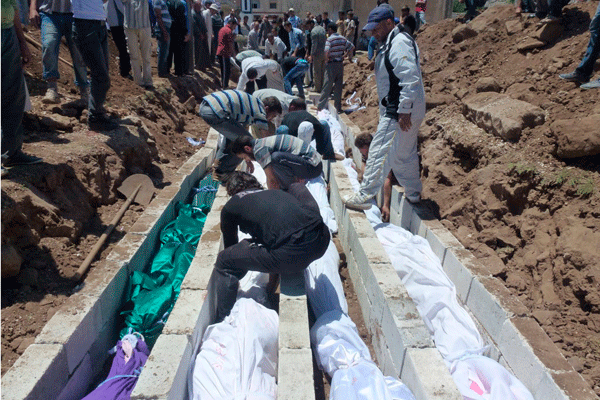
People gather at a mass burial for the victims killed during an artillery barrage from Syrian forces in Houla, Syria, in this handout image dated May 26. Pope Benedict XVI joined the international community in condemning a massacre in Houla, Syria, May 2 5-26, which left about 108 people dead, including 49 children and 34 women. (CNS photo/Shaam News Network handout via Reuters)
VATICAN CITY (CNS) — Pope Benedict XVI joined the international community in condemning a massacre in Syria, and he called for Christian and Muslim leaders in the country to guide their faithful in prayer and collaboration to restore peace and calm.
The massacre in Houla May 25-26 left about 108 people dead, including 49 children and 34 women. The U.N. Security Council May 27 condemned the massacre of civilians and, while not pinning all the blame on the Syrian government, it accused the government of inappropriately using heavy weapons in a residential area.
In a statement May 28, Jesuit Father Federico Lombardi, Vatican spokesman, said the massacre was “a motive of great sorrow and concern for the Holy Father and the entire Catholic community, as it is for the international community which has expressed unanimous condemnation of the incident.”
“Renewing its appeal for an end to all forms of violence, the Holy See exhorts the parties involved and the entire international community to spare no efforts to resolve this crisis through dialogue and reconciliation,” Father Lombardi said.
The Vatican also said religious leaders and those who believe in God “are called to commit themselves to promoting the peace which is so much sought after, for the good of the whole population.”
The United Nations estimates that about 9,000 civilians have died since the uprising against President Bashar al-Assad’s government began in March 2011.
OXFORD, England (CNS) — Greece’s Catholic Church accused a leader of the Orthodox Church of “intolerance and fanaticism” after he sued a Catholic archbishop for illegal proselytism.
“I hope the court rejects his petition, which has no legal or juridical basis,” said Nikolaos Gasparakis, spokesman for the Greek bishops’ conference. “It’s a pity he doesn’t say more about the plight of citizens during our grave economic crisis, rather than just attacking Catholics.”
In April, Orthodox Metropolitan Seraphim of Piraeus filed suit against Athens Archbishop Nikolaos Foskolos, for allegedly violating the Greek constitution by running a Catholic school in Piraeus. The metropolitan cited Article 13 of Greece’s constitution, which prohibits proselytism.
In a May 24 interview with Catholic News Service, Gasparakis said Metropolitan Seraphim’s actions “infringed canonical rules” and “contradicted the Gospel,” but added that he was concerned other Orthodox leaders had not reacted to his actions.
“In the 11 years since Pope John Paul II visited our country, Greek society has become more tolerant and less hostile toward Catholics,” Gasparakis said. However, he said, that was not true of the Orthodox leaders.
In March, Ecumenical Patriarch Bartholomew I — considered first among equals of the Orthodox patriarchs — wrote the Orthodox archbishop of Athens about an “unjustified and dangerous” sermon by Metropolitan Seraphim. In that early March sermon, the metropolitan invoked an anathema against Pope Benedict XVI as well as against Protestants, Jews, Muslims and ecumenists.
The 200,000-member Catholic Church has often complained of discrimination in Greece, a European Union and NATO member-state whose constitution declares Orthodoxy the “prevailing religion” and prohibits Bible translations without Orthodox consent.
On May 7, the bishops’ conference said it would take action in the European Court of Human Rights against Greece’s failure to provide equal rights and legal status for the Catholic Church.
The statement, published a day after inconclusive May 6 elections worsened Greece’s economic crisis, said the church would also protest the “unacceptable and offensive aggression” by Orthodox leaders.
Electoral coordinators prepare to count ballots at a school used as a polling station in Cairo May 24. Egyptian voters of many ages, occupations and beliefs stood in line for hours to cast their ballots for a new president. The winner would replace Hosn i Mubarak, deposed in an uprising last year. (CNS photo/Asmaa Waguih, Reuters)
WASHINGTON (CNS) — As Egyptians began voting to replace ousted President Hosni Mubarak, Christian minorities were anxious to see if the next government would end restrictions on religious freedom and attacks on religious minorities that had been on the rise the past couple of years.
Egypt was one of 16 countries that the U.S. Commission on International Religious Freedom singled out for particular concern in its 2012 annual report, released in March. Egypt made the list for the second year in a row.
“Over the past year, the Egyptian transitional government continued to engage in and tolerate systematic, ongoing, and egregious violations of freedom of thought, conscience and religion or belief,” the report said.
Violent sectarian attacks targeted Coptic Orthodox Christians in 2011, it said. About 100 Copts were killed, according to the report, surpassing the death toll of the previous decade. In most of the more than 40 sectarian attacks, the perpetrators were not convicted, the report said.
“This high level of violence and the failure to convict those responsible continued to foster a climate of impunity, making further violence more likely,” the report said.
The U.S. Commission on International Religious Freedom reported that the transitional government also failed to prevent the Egyptian media from vilifying religious groups including Coptic Christians, Jews and Baha’is.
That classification as a “country of particular concern” encourages the State Department to take diplomatic and economic actions intended to improve religious freedom in those countries.
The commission members and Assistant Secretary of State for Democracy, Human Rights and Labor Michael Posner have discussed religious violence in Egypt, as well as in China. Posner visited Egypt in April of last year.
The other countries listed for concern this year were Myanmar, North Korea, Eritrea, Iran, Iraq, Nigeria, Pakistan, China, Saudi Arabia, Sudan, Tajikistan, Turkey, Turkmenistan, Uzbekistan and Vietnam.
As in Egypt, many of the violations of religious freedom included attacks on religious minority members, it said.
“Across much of the Middle East, Christian communities that have been a presence for nearly 20 centuries have experienced severe declines in population, aggravating their at-risk status in the region,” the report said.
In Nigeria, Muslim-Christian violence resulted in more than 800 deaths, the displacement of 65,000 people and the destruction of churches and Mosques in 2011, it said.
The report cited blasphemy laws in Pakistan and Egypt as creating an environment of chronic violence, especially after the March 2, 2011, assassination of Shahbaz Bhatti.
Bhatti, a Catholic who was Pakistan’s federal minister for minority affairs, was and a longtime religious freedom advocate. China’s Tibetan Buddhists and Uighur Muslims also suffered the worst attacks in decades it said.
The commission also maintains a watch list of countries where it says trends need to be monitored before they become severe religious freedom violations. The list includes Afghanistan, Belarus, Cuba, India, Indonesia, Laos, Russia, Somalia, and Venezuela.
Egypt had been on the commission’s watch list since 2002.
The recommendations to the U.S. government about Egypt emphasized the need to “press the transitional, and future civilian government to undertake reforms to improve religious freedom conditions, including repealing decrees banning religious minority faiths, removing religion from official identity documents, and passing a unified law for the construction and repair of places of worship.”
In Egypt, some changes have started to take place, the report said. In early 2012, the Egyptian Supreme Council of Armed Forces, known for using deadly force against opponents and protesters lifted the “Emergency Law” under which it restricted human rights such as freedom of religion. The supreme council took control of Egypt after Mubarak was removed from power in February 2011.
Other recommendations include holding sectarian groups accountable. In Egypt, where the Arab Spring took off in 2010, the report said extremist groups’ violence also rose during the countries’ transition. Sufi Muslims were targeted, with attacks on at least five Sufi shrines in Cairo as well as other actions against Coptic Christians and other minorities, it said.
The report cited Egypt’s blasphemy laws affecting other groups and individuals, including Ahmadis, Quranists, Christians, and Sunni, Shiite, and Sufi Muslims. Under the law, members of religious groups who hold other than the mainstream Islamic beliefs or whose beliefs are considered potentially harmful to the community may be detained and prosecuted. On Feb. 1, a comedian from Cairo was sentenced to three months in prison for “contempt of religion” and fined because of the characters he portrayed.
Another source of concern listed by the commission is the accusation by outside sources that Saudi Arabia is financing extremist sectarian groups in Egypt. The commission made note of reports saying Saudi Arabia has funded similar practices across the Middle East and into parts of Africa, Asia, and Europe.
The commission continued to list Saudi Arabia’s involvement in funding “religious schools, mosques, hate literature, and other activities that support religious intolerance and, in some cases, violence toward non-Muslims and disfavored Muslims.”
The commission was established by the 1998 International Religious Freedom Act. The law also established the Office of International Religious Freedom in the State Department’s Bureau of Democracy, Human Rights and Labor, whose staff monitors religious persecution and discrimination worldwide.
The commission is an independent, bipartisan government agency charged with reviewing violations of religious freedom throughout the world and making appropriate policy recommendations to the president, secretary of state and Congress.
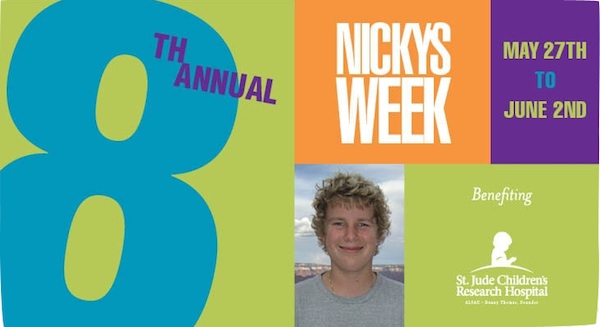
May 27-June 2 at RA Sushi locations nationwide. Click on image to learn more.
It’s Nicky’s Week once again at all RA Sushi locations in Arizona, Maryland, California, Florida and five states in between. All proceeds from select menu items May 27-June 2 will benefit St. Jude Children’s Research Hospital, a leading source of pediatric cancer treatment and research.
Nicky Mailliard would be 20 right now had the former Bl. Pope John XXIII student not lost a long battle with brain cancer in 2005. The fundraiser is in his memory.
Here is an excerpt about the event posted on our blog in 2010. It shows just how far this boy’s name and his family’s mission to support St. Jude goes:
I just returned from a rather unusual vacation involving three one-way flights.
For once, I put work completely on hold and instead of writing during take off on the first leg, I thumbed through the airline magazine. I reached page 20 as the plane lifted off the ground and paused to quiz my young traveling companion on number recognition, for the ad on the opposite page advertised some sort of sixth (displayed as “6th”) annual event.
Thanks to some incorrect guesses on the number — color answers came out instead — I happened to read the rest of the ad. Lo and behold, I recognized the ad’s photo from an article a co-worker wrote during my early days at The Catholic Sun.
I read the short verbiage just to confirm that it indeed was Nicky Mailliard, a former Pope John XXIII student in the photo. He lost a four-year battle with brain cancer in 2005 and we published the same courtesy photo used in the ad.
Turns out I had all but forgotten about the annual Nicky’s Week. RA Sushi bar and restaurant — Mailliard’s uncle is among its founders — will donate all proceeds from the sale of select menu items to fund cancer research and treatment at St. Jude Children’s Research Hospital. There’s a host of other sponsors for the event and diners can find their nearest RA Sushi in Arizona, on both coasts and six other states in between.
So, if you’re in the mood for sushi and would like to support a much-needed charity while you’re at it, head to RA Sushi. Select menu items will feed your body as well as feed the “kitty” aiding St. Jude Children’s Research Hospital.
Nicky’s legacy still lives on outside of the special week that honors his memory.
Bl. Pope John XXIII named its basketball gym after him
His parents established the Nicky Mailliard Fund through Phoenix’s Catholic Community Foundation shortly after his death. See page 4 of CCF’s newsletter from 2005. Funds support the school and local hospitals and nonprofits that support sick children and the dieing.
The Phoenix Diocese has lost other young Catholics to cancer over the years:
Most recently was Arie Fitzhugh, a St. Mary-Basha graduate who went on to finish at Seton Catholic Preparatory High School last year. He battled cancer throughout his senior year and finally lost the fight earlier this month. Here is what his friends had to say about him.
The Catholic community rallied around Ethan Mills and Julia Hillebrand in the fall of 2009 raising $30,000 during one benefit concert. Mills, 19, died the following summer (view his guestbook) and Hillebrand, 12, six months after that.
Here’s her tribute video featuring lyrics she wrote before her diagnosis. St. Timothy School in Mesa, where Hillebrand was a student, dedicated a memorial archway last May in her honor. Every student, including Hillebrand, creating a tile for the archway.