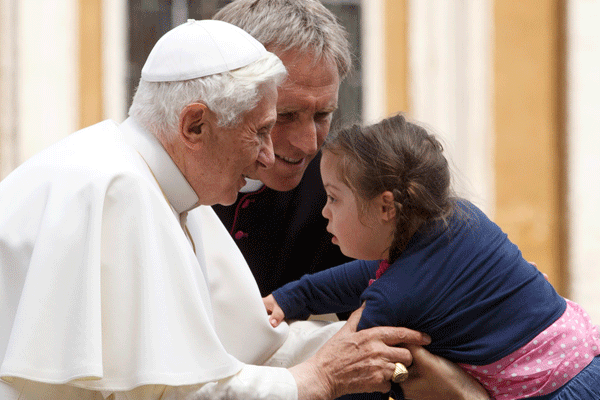
Pope Benedict XVI greets a child as he leaves his general audience in St. Peter's Square at the Vatican May 23. Also pictured is Msgr. Georg Ganswein, the pope's personal secretary. (CNS photo/Paul Haring)
VATICAN CITY (CNS) — Addressing God as “Father” is an acknowledgement that God is the one who created, supports and guides humanity, Pope Benedict XVI said.
“Maybe people today do not understand the beauty, greatness and deep consolation” that comes from recognizing God as father, “because the paternal figure is not sufficiently present today,” the pope said May 23 during his weekly general audience.
Addressing an estimated 20,000 people gathered in St. Peter’s Square, Pope Benedict continued a series of audience talks about prayer in the letters of St. Paul.
Focusing on St. Paul’s assertion that it is the Holy Spirit that enables people to pray and to address God as “Abba, Father,” the pope said, “the absence of one’s father or the lack of a father’s presence in a child’s life today is a big problem that always makes it difficult to understand fully what it means to say that God is our father.”
From the beginning of Christianity, believers adopted Jesus’ form of addressing God as father, especially in the Lord’s Prayer, the pope said.
“Christianity is not a religion of fear, but of trust and love for the Father who loves us,” he said.
Pope Benedict acknowledged that “critics of religion have said that speaking of God as ‘father’ is simply a projection” of our own longings and desires, but the Gospel shows that the opposite is true, because “Christ shows us who the father is and what a true father is, so that we can understand and also learn what true fatherhood is.”
Jesus demonstrated that God is love, he said, and when people pray to God as father, they enter into “a cycle of love” that offers them support, but also correction and guidance.
The assertion that human beings are made in God’s image and likeness means that he is their father, the pope said. “A line in the Psalms always touches me when I pray it: ‘Your hands made me and fashioned me.'”
“Every one of us, every man and woman, is a miracle of God, desired by God and personally known by him,” he said.
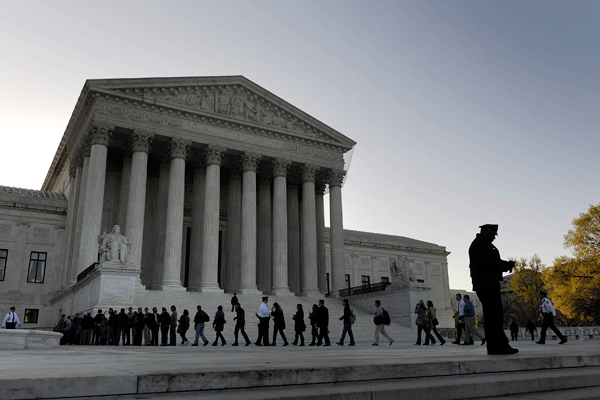
People enter the Supreme Court building in Washington March 26 to attend oral arguments in challenges to the Patient Protection and Affordable Care Act. Two years after President Barack Obama signed the health care overhaul into law, the high court began three days of oral arguments on challenges to various aspects of the law. (CNS photo/Jonathan Ernst, Reuters)
GENEVA (CNS) — The Vatican praised national efforts to provide universal and affordable health care access and coverage, noting that policies based on the principles of equity, human rights and social justice ensure the best care for the most people.
Governments also should recognize and support the work of nongovernmental organizations, including the church, in their efforts to provide wider health care access “without obliging them to participate in activities they find morally abhorrent,” said Archbishop Zygmunt Zimowski, head of the Pontifical Council for Health Care Ministry.
The archbishop made his comments to senior government health care officials attending the World Health Organization’s annual World Health Assembly in Geneva.
The May 21-26 meeting focused on a number of public health issues, including universal health coverage, mental disorders and the Millennium Development Goals.
Archbishop Zimowski, who headed the Vatican delegation to the assembly, urged all 194 member states “to aim for affordable universal coverage and access for all citizens on the basis of equity and solidarity.”
He reiterated Pope Benedict XVI’s call for “real distributive justice which, on the basis of objective needs, guarantees adequate care to all,” while adding that health care should never “disregard the moral rules that must govern it.”
The archbishop said the Catholic Church is a valuable partner with the state in providing health care. “The efforts and contribution of such organizations and institutions toward universal access merit the recognition and support of both the states and the international community” without requiring such organizations to take part in gravely immoral activities, he said.
Developing nations with emerging economies “are moving toward universal coverage, and this is very encouraging,” he said.
Such a positive development, he said, is due not just to these states having more financial resources at their disposal, but also to their commitment to upholding principles that value the well-being of all citizens.
“It has been observed that good policies that promote equity have guaranteed better health for a greater number of citizens” in such countries, he said.
Therefore, to better promote universal coverage “fundamental values such as equity, human rights and social justice need to become explicit policy objectives,” he said.
Achieving universal coverage “cannot be the effort of the state machinery alone,” as it requires support from all of society and local communities, he said.
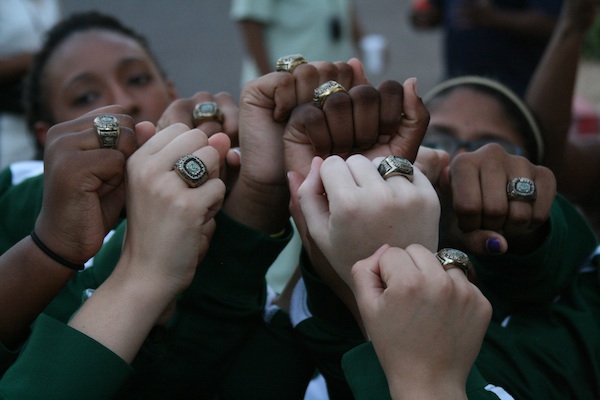
The Lady Knights at St. Mary's High School show off their national championship ring.
The Lady Knights at St. Mary's High School show off their national championship ring.
School ends for most Catholic campuses in the diocese this week. That hasn’t stopped many students from continuing to grow in the faith nor has it slowed down their achievements in academics, athletics or service.
Take a look at what they’ve accomplished in May:
Faith
Club 13 — A new club at Bourgade Catholic High School, inducted 42 students as its first members. All of them have spent their entire lives (K-12) in Catholic school.
Retreat — The eighth-grade class at Most Holy Trinity made their final retreat May 7-9. They stayed at Living Waters Retreat Center in Cornville and, according to a Facebook post, reflected on “why they are not ashamed to have a firm foundation in Christ before their journey into high school.” They were among many eighth-grade graduates who gathered in recent weeks for a final retreat together.
The Senior Threshold Retreat for Brophy grads drew 52 seniors.
Mary — Sacred Heart preschoolers in Prescott learned about science, nature and devotion to Mary earlier this month when they planted flowers in their new devotional garden (see page six of newsletter). Mary Tibshraeny of Scottsdale and Mr. and Mrs. Thomas Watson of Sun City donated the statue.
Academics
International Science and Engineering Fair — Xavier sophomore Sarah Sakha won the Grand Prize at the Arizona Science and Engineering Fair (AZSEF), and captured 4th place in microbiology at the International Science and Engineering Fair. Her project involved the use of spice in the preservation of emergency food rations.
In other engineering news, Morgan Kelley, a senior at Xavier, won the Catholic Community Foundation’s Ralph M. Knight Chemistry and Engineering Scholarship.
First in Math — St. Theresa’s sixth-grade math class earned First place in state for First in Math Online Program. The students completed over four million online math problems competing peers statewide. It’s now a Million Sticker School, something that only 34 among more than 5,000 participating schools have earned.
Fifth grade has three of the top five First in Math players for the school: Matthew Villanueva, Zak Coleman and Connor White.
At Our Lady of Perpetual Help in Glendale, the students have solved 324,675 math problems. Six students already have over 3,000 virtual stickers and are mathematicians in the fun, instructional activity.
Honors — St. Mary’s High School inducted 27 students into the National Honor Society
Student-produced video game — For students who want another shot at finishing the school year strong should check out “The Great Fitzgerald Hall,” a video game (PC users only) developed in class by Shannon Burke and Roxy DeAsis at Xavier College Preparatory. The game takes its Gator through the classrooms and corridors of Fitzgerald Hall, collecting objects along the way, until she finishes the school year in triumph.
In related news, Michelle Klein, a junior at Xavier, won an ward from ASU’s College of Technology and Innovation for her passion in the field.
Power of One commercial — Hector Salinas, a student at St. Mary’s High School, is featured in a commercial for Cox Charities’ Power of One Campaign.
Biomedical Research — Brophy junior Tanner Tuohy received recognition from the Southwest Association for Education in Biomedical Research (SwAEBR’s) essay contest for Summer Research Internships. His essay, “Hits that Really Hurt,” was one of the 2012 honorees.
Learning Chinese — Matthew Frankel, a sophomore at Brophy, earned a merit-based scholarship to study Mandarin Chinese this summer in China. The National Security Language Imitative for Youth is sponsored by the U.S. Department of State.
New curriculum — Most Holy Trinity School will add Great Books to its reading curriculum in the fall. It combines outstanding literature with the Shared Inquiry method of learning to help develop higher-level critical thinking skills in reading, writing, speaking, and listening. These skills are very beneficial in all curriculum areas.
Athletics
National champions — Bishop Thomas J. Olmsted presented the Lady Knights at St. Mary’s High School with their national championship rings last week. The varsity basketball team went undefeated in their season including national tournaments, and is ranked No. 1 in the nation. See highlight video.
Wrestling goes national — Chase Frank, a junior at Brophy, won the AzWAY National Qualifier at 200 lbs and will be one of 14 wrestlers representing Arizona at the America’s Cup Western States Nationals over Memorial Day weekend. Thirty-five states are sending All-Star teams to this 3-day tournament. Coach Brad Frank, alongside Tim Berrier from Ironwood Ridge High School, have been asked to coach the Arizona team.
Overall Excellence — Xavier College Preparatory received the H.A. Hendrickson Overall Excellence Award by the Arizona Interscholastic Association May 21. The award signifies that the all-girls institution has won more state championship, runner-up, and sectional titles than any co-ed or single-sex school in its conference (62 schools). Xavier won the same award in 2009.
State champion — Nick Thomas a senior at Seton Catholic Preparatory High School in Chandler, and Nick Thorpe, a senior at Notre Dame Preparatory in Scottsdale, qualify for the national championships through USA Cycling. According to a Seton newsletter, Thomas is the 2012 State Champion in Mountain Biking for individuals aged 15-18 and will attend the USAA Cycling Development Camp at the Olympic Training Center in Colorado Springs, CO this summer.
Service
Forty Under 40 — Kristin Parrack, Capital Campaign Coordinator at St. Francis Xavier and Best In Class Member, Ann-Marie Donaldson Alameddin were both announced as part of the Phoenix Business Journal’s Forty Under 40 program.
Collections for poor, refugees — Our Lady of Perpetual Help students in Scottsdale are collecting shoes and socks all month for homeless guests at André House in Phoenix.
Eighth-graders at Sacred Heart in Prescott are collecting paper towels and toiletries through the end of the year for the Prescott Area Women’s Shelter. The school’s preschoolers raised more than $700 during a nearly 90-minute Trike-a-thon. The local Sheriff’s Office taught them bike safety. The Girl Scouts at Most Holy Trinity recruited school students to help collect books, crayons and coloring books for Serrano Village Refugees.
Teachers We Love — Molly Woods, a sixth-grade math and social studies teacher at St. Theresa in east Phoenix, was selected as this month’s “Teachers We Love” by Arcadia News.
Box tops — St. Theresa earned $745.38 in box tops through its latest campus collection. That was enough to purchase new playground balls.
Other
Battle of the Books— Three St. John Bosco students took first place in various categories of the Regional/City Battle of the Books competition May 8 at Chandler Public Library. The competition was through a co-curricular activity at St. John Bosco in Ahwatukee. Each student read four books on their own to per round of competition. The “battle” tested each team’s comprehension.
Social studies grants — Two Phoenix Catholic schools were among 13 schools that was awarded a social studies grant from SRP. St. Theresa earned $1,500 to purchase a Time for Kids subscription for kindergarten through sixth-grade. It Includes personal copies, digital editions and online access and will help school meet common core standard that says half of the reading curriculum be from informational text.
St. Jerome earned $1,500 to update Encyclopedia Britannica for library including an up-to-date presidential biography series. Students get research assignments and reports using these materials. The grant was awarded this past academic year and will expand next year.
Learning grant — Xavier College Preparatory was among 27 recipients of an SRP Learning grant. The school received nearly $4,700 for its Engineering Projects in Community Service program. This problem-based, service-learning model engages students in traditionally male-dominated fields of science, technology, engineering and math through real-world projects to improve the lives of others. Students complete projects for non-profit community organizations.
Expansion — St. Thomas Aquinas in Avondale is opening a second fourth-grade classroom in August. This is a year earlier than planned.
Xavier — 19 Xavier students were named National Honor Society for Dance Arts award recipients. Another 21 were induced into the International Thespian Society.
Artsonia — Abi Arnold, a St. Theresa student, recently had her painting featured on Artsonia’s main web page slide show. The school regularly uploads projects which the public can vote on weekly.
Eighth grade paintings (largely landscape) Self-portraits
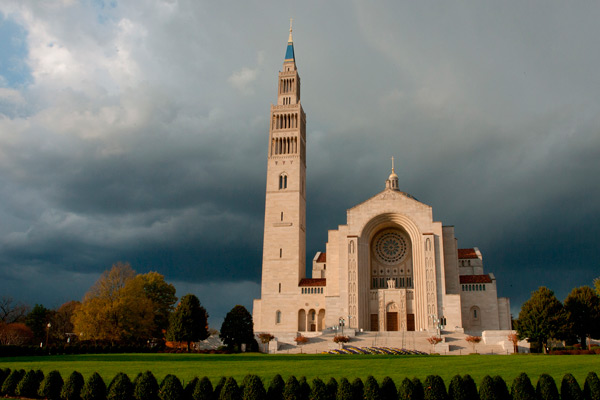
The National Shrine of the Basilica of the Immaculate Conception in Washington will host the closing liturgy of the U.S. Catholic Church's national education campaign on religious liberty the afternoon of Independence Day. The so-called "fortnight for fr eedom" begins June 21 with Mass at Baltimore's historic Basilica of the National Shrine of the Assumption of the Blessed Virgin Mary. (CNS file photo/Nancy Wiechec)
WASHINGTON (CNS) — Masses at well-known basilicas in Baltimore and Washington will open and close the “fortnight for freedom,” a special period of prayer, study, catechesis and public action proclaimed by the U.S. bishops for June 21 to July 4.
Archbishop William E. Lori of Baltimore will celebrate the opening Mass at Baltimore’s historic Basilica of the National Shrine of the Assumption of the Blessed Virgin Mary at 7 p.m. June 21 to kick off the Catholic Church’s national education campaign on religious liberty.
The closing liturgy will be at 12:10 p.m. July 4 at the Basilica of the National Shrine of the Immaculate Conception in Washington. Cardinal Donald W. Wuerl of Washington will celebrate the Mass, and Archbishop Charles J. Chaput of Philadelphia will be the homilist.
The Eternal Word Television Network will carry the shrine Mass live.
Both national and local efforts will comprise the campaign that has been launched by the bishops’ Ad Hoc Committee on Religious Liberty.
In addition to the Baltimore and Washington liturgies, national efforts include establishment of a website at www.fortnight4freedom.org. The site features resources such as frequently asked questions about religious liberty, including quotes from the Founding Fathers, the Second Vatican Council and Popes John Paul II and Benedict XVI.
Also available is a study guide on “Dignitatis Humanae,” the Second Vatican Council’s document on religious liberty. In addition, the site provides several one-page sheets outlining current threats to religious freedom both in the United States and abroad.
The website also lists a sample of activities already planned in particular dioceses, as well as resources and recommendations for other local efforts, such as special liturgies and prayer services. Bell ringing is planned for noon on July 4 to remind citizens nationwide of the primary place of religious freedom in the history, law and culture of the United States.
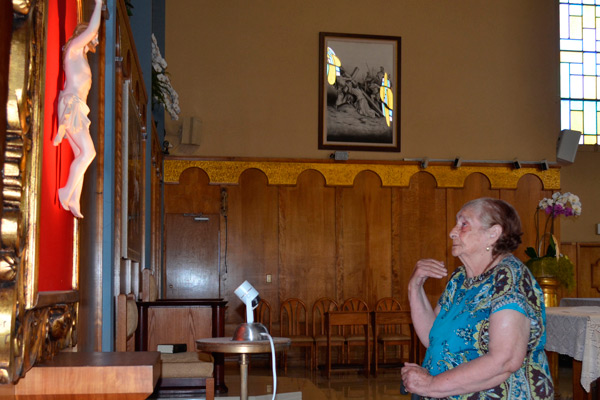
Maria Meza, a 92-year-old survivor of Mexico's Cristeros War, prays in front of a crucifix May 9 at Resurrection Church in Los Angeles. Meza, whose father was killed in the Cristeros War, hid many priests in his house to help them avoid getting killed by the government that persecuted all Catholics during the three-year civil war. (CNS photo/Doris Benavides, The Tidings)
LOS ANGELES — As she shut off the garden hose and set it next to her recently planted flowers, Maria Meza greeted a visitor.
“Yes, come in, everything’s all wet, clean,” she said with a smile.
The 92-year-old said she likes to exchange good-natured banter, but all smiles vanish when Meza begins narrating her family’s ordeal back when she was 7 years old and living in her native Michoacan, Mexico.
“Las balas tronaban (The bullets whistled),” said the survivor of the Cristero War of the 1920s, in which Catholics took up arms to contest the Mexican government’s systematic repression of religion. It is depicted in the movie “For Greater Glory,” opening in U.S. theaters June 1.
In an interview with The Tidings, newspaper of the Los Angeles Archdiocese, Meza said welcomes the idea about the movie and would like to see it if it was shown in Spanish. She taught herself to read and write but found it very difficult to learn English, although she attended several classes after arriving in the U.S. in the 1970s with her husband and 10 children.
Her father, Jose Meza Galvez, was a strong Cristero who hid many priests in his house to help them avoid getting killed by the government that persecuted all Catholics during the three-year civil war. More than 90,000 people died, mostly men and numerous priests, including her uncle, St. Rafael Guizar Valencia. A bishop, he was beatified by Pope John Paul II in 1995 and canonized by Pope Benedict XVI in 2006.
For three days, Maria Meza, her four sisters and their mother, Maria Ayala, hid in a cave while all the men in town fought against the government’s army.
With sadness, she recalled when the war ended. A few days after the war was over a group of military burst into her home and killed her father.
“One shot was enough,” she said. He was about 40 years old.
The rest of the family survived because the army went after the men, Meza said.
“But he died bravely, shouting, ‘Viva Cristo Rey!’ ‘Vivan los Cristeros!'” she said proudly.
After that sad day, her mother made sure that the family’s Catholic heritage stayed alive among her children. Two of the girls entered the religious community Sagrada Familia (Sacred Family); the other three married and passed their strong faith on to their children, along with the Cristero War story.
“I’ve heard this story many times in my life since I was a small boy,” said her son Manuel, 62, the fourth of her 14 children. Four died at a young age.
Although the story has been passed through generations of survivors, it did not make it in the annals of Mexican history. Many analysts presume it is because the Mexican president at that time, Plutarco Elias Calles, who led the war, was one of the founders of the Institutional Revolutionary Party, which ruled the country for the next seven decades.
Even for Manuel, it is hard to believe that the dead were hanged from poles on the roads under the fearful watch of survivors. Others were buried in mass graves.
“Thank God that war finally ended,” Meza said. “They were three long years. They (the soldiers) put houses on fire, raped many women and tried to destroy all religious images.”
That is why she tries to preserve her Catholic beliefs, she confides.
“I don’t want my family to change to another religion,” Meza said. “I respect other people’s beliefs, but we went through so much and I think it was worth it.”
Purposefully, 12 years ago she and her husband bought a house across the street from Resurrection Church in East Los Angeles.
Unless she is sick, which rarely happens, she gets up at 5 o’clock every morning and by 6:45 she is sitting at one of the pews.
“Every single day,” Meza said, except on Sundays, when she attends the 10:30 a.m. Mass together with other family members. She has 60 grandchildren and 40 great-grandchildren.
“I am preparing myself to receive my glory,” she said. She receives Communion every day and prays the rosary every night before going to bed at 9 p.m. sharp.
“When I stand in front of the Judge, I think I will be prepared,” she said proudly. “I think I have a solid faith. Although I don’t know him, I do believe in him. And I don’t lack anything; even in hard times he has provided.
“That shot to my father’s head was not in vain. The seed that my parents planted in me doesn’t wither that easily.”
Responding to editors’ requests for a regular sampling of current commentary from around the Catholic press, here is an editorial titled “Why we are suing the government” from the June 3 issue of Our Sunday Visitor, a national Catholic newsweekly based in Huntington, Ind. It was written by the newspaper’s editorial board.
The Catholic Church in the United States is in the midst of a historic conflict that it did not initiate, that it cannot avoid, and that — if lost — may have serious implications for the ability of all churches to define themselves and to live their faith in the public square.
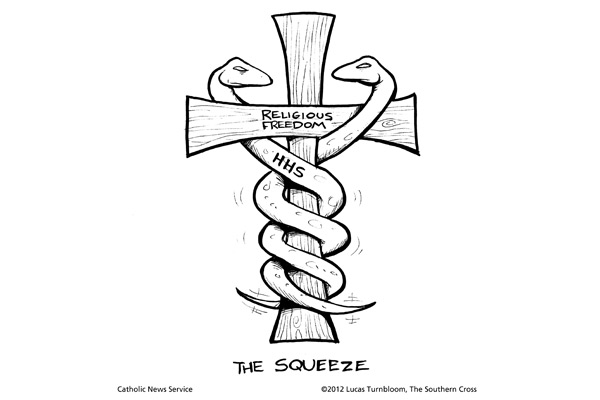
There have been a growing number of assaults on religious liberty at both the federal and the state level, but none may be more severe nor have a broader impact than regulations issued by the U.S. Department of Health and Human Services forcing Catholic organizations to provide and facilitate abortion-inducing drugs, contraceptives and sterilization for their employees. It did so by identifying these as “preventive services” under the Patient Protection and Affordable Care Act, and then narrowly defining what would constitute a religious employer who could seek an exemption.
According to the government, a religious employer could only qualify for an exemption if:
1. The inculcation of religious values is the purpose of the organization.
2. The organization primarily employs persons who share the religious tenets of the organization.
3. The organization primarily serves persons who share the religious tenets of the organization.
4. The organization is a certain type of nonprofit organization.
In a host of Catholic apostolates, from health care and charity to higher education and publishing, not all of these criteria are likely to be met, yet all of these apostolates are most surely doing the work of the Gospel — employing non-Catholics as well as Catholics, serving non-Catholics as well as Catholics, practicing works of mercy even if no religious tract is exchanged or evangelizing message uttered.
These criteria mean that the government now determines whether Catholic organizations are sufficiently religious, using criteria that are not consistent with the Catholic faith.
Although the president had promised — in his 2009 speech at Notre Dame and elsewhere — that he would respect freedom of religious conscience in the health care debate, these regulations are an enormous violation of religious liberty, forcing Catholic organizations to fund medical procedures and drugs that the church teaches are morally wrong.
A so-called accommodation announced last February would ostensibly make the insurance companies used by religious organizations provide “contraceptive care free of charge.” It is unclear to what extent this accommodation in fact changes the regulations. Furthermore, even assuming that the insurance companies do provide such services “free of charge,” this accommodation does nothing to relieve the burden of all those Catholic organizations — including Our Sunday Visitor — that are self-insured.
At this point, sincere and good-faith efforts by the U.S. bishops to resolve this issue with the White House have failed. Legislative efforts to grant relief have failed as well. Nonprofit companies such as Our Sunday Visitor — as well as medical systems, charitable organizations, universities and more — have no recourse but to take their case to the courts before the die is cast and we lose all opportunity to appeal.
For this reason, on May 21, 2012, Our Sunday Visitor joined with 42 other Catholic dioceses and organizations in suing the federal government to nullify the HHS preventive care mandate and declare it unconstitutional.
It seems to us hardly a coincidence that this suit is taking place in our centennial year. Founded 100 years ago by then-Father John Noll, Our Sunday Visitor from its beginning sought to inform Catholics about the issues of the day, form them in the faith, and defend that faith from attack. It was Father John Noll who stood up to those who attacked Catholic immigrants as un-American and seditious. It was Father John Noll who faced down false preachers who spread slanders about the church. It was Father John Noll who resisted the power of the Ku Klux Klan when it was such a powerful political force. And it is his courageous spirit that we invoke as we engage in this great struggle today.
We know that many Americans — and even many Catholics — are confused about this debate. Politicians and elements of the news media have sought to make it a war against women or contraception, and they have portrayed the church as seeking to impose its values on others or as being covertly political.
We also acknowledge that many Catholics do not understand the reasons for the church’s moral opposition to contraception, sterilization and abortion-inducing drugs. This lack of understanding points to a significant catechetical need that the church should address internally.
We reiterate, however, that this is not about the legality of such practices in society, nor is it about how many Catholics understand the church’s position. It is about the church’s right to practice what it preaches.
In fact, this lawsuit is about fundamental challenges to the First Amendment right to religious liberty: the government determining what constitutes a sufficiently Catholic organization and the government imposing on such an organization a requirement that it provide and facilitate services that the church teaches are immoral.
In opposing the HHS regulations, the church is also defending the religious liberty of all believers guaranteed to us in the Constitution. Even those who may not be inclined to agree with the church’s position on issues like contraception and sterilization recognize that once this precedent has been set, once the guarantee of religious liberty has been breached, other governments and other elected officials will find it much easier to impose their standards and their priorities on our church or others.
Today, Our Sunday Visitor stands proudly with our fellow Catholic apostolates and with our bishops in resisting this challenge. We ask all of our readers to stand with us — in charity, praying first and foremost for conversions of heart; in civility, arguing the facts of this case without recourse to bitter partisanship or political rhetoric; and in solidarity, knowing that whatever sacrifices we bear and whatever challenges we endure, we are only doing what is our responsibility as American citizens practicing our faith in the public square.
The views or positions presented in this or any guest editorial are those of the individual publication and do not necessarily represent the views of Catholic News Service or of the U.S. Conference of Catholic Bishops.
Mary Ann Ronan, director of faith formation at St. Paul Parish, is retiring after 45 "hope-filled" years in faith formation.
Six of the 146 local confirmation and First Communion Masses scheduled this spring will get underway this week. Overall, more than 25,000 children participated in catechetical programs throughout the Phoenix Diocese this year.
The Department of Family Catechesis noted these and other milestones during its annual Celebration of Gratitude and Hope May 17 at the Diocesan Pastoral Center. Ryan Hanning, director of parish leadership support, presented token gifts purchased through Catholic Relief Services, to catechetical leaders marking significant years of service.
That included:
45 years — Mary Ann Ronan, director of faith formation at St. Paul Parish in Phoenix. She is retiring this month.
30 years — Paula Seamans, director of Christian formation at Queen of Peace Parish in Mesa.
25 years — Laura Sweet, director of children’s ministry at Christ the King Parish in Mesa and Sr. MaryAnn Mahoney, IHM, who heads children and adult formation at St. Louis the King Parish in Glendale.
20 years — Mary Mirrione, national director and local consultant for Catechesis of the Good Shepherd.
Five leaders at as many parishes marked 15 years working in faith formation in the diocese. Ten youth and catechetical leaders marked five years of service including Celia Sanchez and Meagan Rippee at Most Holy Trinity Parish.
Eight leaders “survived” their first year as Hanning described it and another eight celebrated 10 “wonderful” years. The latter group included Cathy Rogers and Roxanna Clower, both at St. Gabriel the Archangel Parish in Cave Creek.
Gov. Jan Brewer signed legislation May 11 that allows religiously affiliated employers to opt out of coverage for contraceptives and abortifacients. The issue has been a sticking point in the national debate over the Patient Protection and Affordable Care Act, better known as “Obamacare.”
Ron Johnson, executive director of the Arizona Catholic Conference, the legislative arm that represents the Dioceses of Phoenix, Tucson and Gallup, N.M. as well as the Holy Protection of Mary Byzantine Eparchy of Phoenix, said HB 2625 is designed to protect religious liberty in Arizona.
“It’s a good model for the rest of the country and other states but it will also provide Arizonans a better opportunity to sue the Obama administration and the HHS contraceptive mandate in particular,” Johnson said. “It gives them better standing to do so and if and when we prevail on this, we’ll be much better protected in Arizona for having this become law.”
The bishops of the ACC issued a statement expressing their thanks for the governor’s signature on the legislation.
“HB 2625 will be very helpful in protecting religious liberty for religiously affiliated employers who have an objection to abortion inducing drugs and contraceptives,” the bishops’ statement read. “This new law will not preempt the HHS contraceptive mandate, if it is upheld. However, if it is not, religious freedom in Arizona will be better protected.”
The ACC bishops also thanked the bill’s sponsor, Rep. Debbie Lesko and Sen. Nancy Barto for shepherding the bill through the legislature.
Johnson said the new law would address Arizona’s contraceptive mandate passed in 2002, something many in the state weren’t aware even existed in Arizona — at least until now.
“[The contraceptive mandate] is an extremely offensive piece of law and now the federal government is trying to mandate it across the country in other ways,” Johnson said. “It’s important to remove it. Forcing people to provide contraceptives and abortifacients against their faith is horrible.”
Arizona’s contraceptive mandate, Johnson said, required employers to pay for any FDA-approved contraceptives—some of which caused early abortions. “There were only vary narrow exemptions for religious beliefs,” Johnson said.
For years the ACC has worked to undo the damage done by the contraceptive mandate. Legislation similar to HB 2625 that address these concerns was vetoed by then-Governor Janet Napolitano.
“We’ve been at this a long time,” Johnson said. “The end of the battle makes us very happy that it’s been signed.”
The new law doesn’t completely remove Arizona’s contraceptive mandate, but it does broaden the exemptions for religiously affiliated employers.
Under the new law, a business such as Christian book store or a non- profit such as St. Vincent de Paul that is religiously affiliated under its articles of incorporation and has objections to contraception, would be exempt from having to provide that coverage to employees.
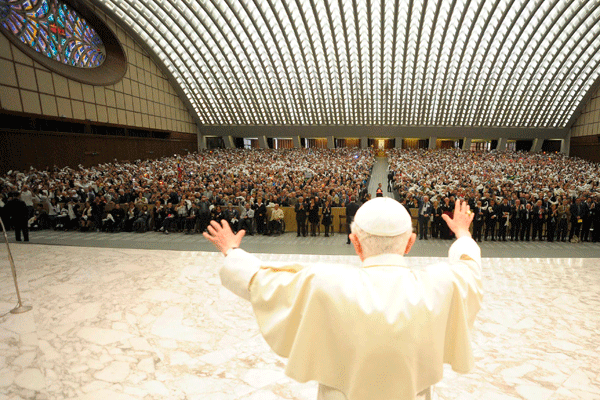
Pope Benedict XVI waves as he arrives to lead an audience with Christian volunteers in Paul VI Hall at the Vatican May 19. (CNS photo/L'Osservatore Romano via Reuters)
VATICAN CITY (CNS) — The Italian television journalist who set off the “VatiLeaks” controversy by releasing private letters to Pope Benedict XVI and between Vatican officials has published a large collection of leaked documents in a new book called “Your Holiness.”
In a statement May 19, Jesuit Father Federico Lombardi, Vatican spokesman, called the publication of the letters for commercial gain a “criminal act” and said the Vatican would take legal action.
“The latest publication of documents of the Holy See and private documents of the Holy Father can no longer be considered a questionable — and objectively defamatory — journalistic initiative, but clearly assumes the character of a criminal act,” Father Lombardi said.
The spokesman said the publication of the letters violates the right to privacy and the “freedom of correspondence” of Pope Benedict, the letter writers and some of the pope’s closest collaborators.
In the letters, which include accusations of corruption and financial mismanagement in the Vatican, and focus heavily on internal Italian church matters or Vatican-Italian relations, Cardinal Tarcisio Bertone, Vatican secretary of state, is particularly presented in an unfavorable light.
In late April, Pope Benedict appointed three retired cardinals to a commission to investigate the leaking of the letters.
Father Lombardi said, “The Holy See will continue to explore the different implications of these acts of violation of the privacy and dignity of the Holy Father — as a person and as the supreme authority of the church and Vatican City State — and will take appropriate steps so that the authors of the theft, those who received stolen property and those who disclosed confidential information, using illegally obtained private documents for commercial use, answer for their acts before the law.”
Nuzzi’s book was published May 17 and immediately went to the No. 1 spot on the Italian best-selling books lists.
Facsimiles of dozens of letters and notes are printed in the back of the book. But more than 100 others are quoted — in part or entirely — within the book’s chapters focusing on “corruption” in the Vatican, making donations in exchange for a personal meeting with the pope, Vatican-Italian relations, the thirst for power among curia officials, the influence of new religious orders and movements and the way church officials handle a variety of scandals around the globe.
The reproductions include a note from an Italian television host to the pope’s personal secretary and a copy of a check for 10,000 euro (about $12,650) with a handwritten postscript saying, “When can we have a meeting to greet the Holy Father?”
The book includes what Nuzzi says is the Vatican’s decryption of a message from the Vatican nunciature in Washington passing on a request from Chicago Cardinal Francis E. George that the Secretariat of State intervene to prevent the Rome-based Community of Sant’Egidio from giving an award to Illinois Gov. Pat Quinn. Sant’Egidio, a lay movement involved in a variety of social issues, apparently planned to honor Quinn for abolishing the death penalty in Illinois.
The nunciature said that while Quinn is Catholic, the cardinal felt the honor was “inopportune” because of the governor’s support for gay marriage and legalized abortion and because Illinois refused to renew foster care and adoption contracts with Catholic Charities in four dioceses.
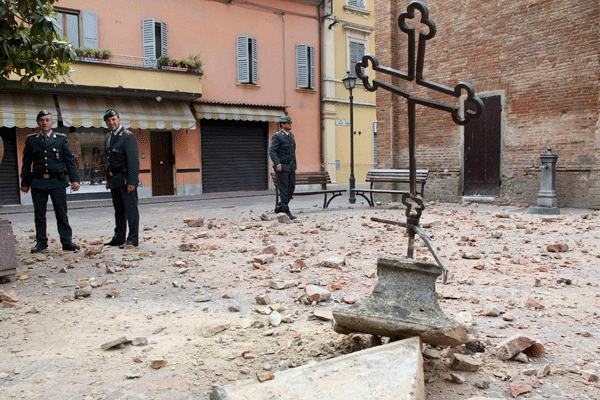
Officers stand near a cross that fell from a church in Crevalcore near Bologna, Italy, May 20. A strong earthquake rocked a large portion of northern Italy early that day, killing at least seven people and causing serious damage to centuries-old cultural sites. (CNS photo/Reuters)
VATICAN CITY (CNS) — Pope Benedict XVI called on Chinese Catholics to be faithful to the pope, asked that mass media worldwide promote mutual respect and dialogue, and prayed for those hit by a deadly earthquake near Bologna and a school bombing in Brindisi.
After reciting the “Regina Coeli” prayer with those gathered in St. Peter’s Square May 20, the pope denounced a May 19 bombing of a high school in southern Italy, calling it “a vile attack.”
A bomb was detonated outside the Brindisi school gates early in the morning as teenagers were arriving for classes. One girl was killed and 10 others injured — one seriously. Police said they suspected the attack was the work of a lone individual unrelated to the Mafia and the city’s organized crime ring.
The pope prayed for the victims and lamented the death of the girl, saying she was an “innocent victim of brutal violence.”
The pope also prayed for those hit by a 6.0 magnitude earthquake that struck near Bologna in the pre-dawn hours of May 20. At least four people were killed as a result of the quake and its aftershocks.
“I am spiritually close to those hit by this calamity,” the pope said.
Pope Benedict also recalled the church’s May 24 celebration of the feast of Our Lady, Help of Christians, which he established as a world day of prayer for the church in China.
Mentioning Chinese Catholics’ devotion to Mary at the Sheshan Marian shrine in Shanghai, he asked that all Catholics in China proclaim Christ “with humility and joy, be faithful to their church and to the successor of Peter, and live their lives in accordance with the faith they profess.”
He prayed for Mary to help China’s Catholics and to help members of the universal church grow in their love and concern for the church in China.
The pope also highlighted “Silence and Word: Path of Evangelization,” the theme of World Communications Day, marked in most dioceses May 20.
“Silence is an integral part of communication; it is a privileged place for encountering the Word of God and our brothers and sisters,” the pope said.
The pope asked that all forms of communication work to establish between people authentic dialogue, “founded on mutual respect, listening and sharing.”
The pope also greeted thousands of members of Italy’s Pro-Life Movement. He encouraged them to continue to defend human life, noted their work in protecting the dignity and rights of every person starting from the moment of conception and asked them to give witness to and build a culture of life.