
Spring athletes make their mark in history

Bourgade Catholic captured its first state softball title May 12 (Image from Bourgade Catholic's Facebook album)
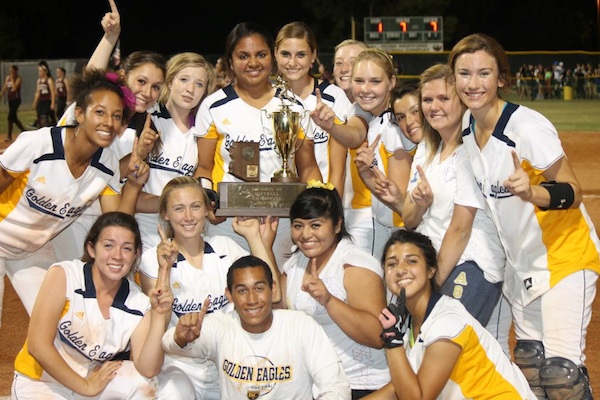
Bourgade Catholic captured the Division III state softball title May 12, its first since 1984 (Image from Bourgade Catholic’s Facebook album)

Athletes at three Catholic schools made some historic feats during the spring season with plenty of other teams adding state or runner up trophies to their trophy case.

Only time will tell which trophy Brophy College Preparatory will come home with. The No. 4 seed baseball team plays No. 2 seed Chaparral tomorrow for the Division I state title. The Broncos only held the state baseball title once in 2006.

Historic feats

  • Softball — Bourgade Catholic’s girls team left their opponents scoreless in two of their four post-season games. That put them in the state championship game (Division III) for the first time since 1993, according to The Arizona Republic. This time, the No. 5 ranked Eagles took on No. 3 seed Winslow May 12. They dominated 7-1 to capture the school’s first state softball title since 1984. View the team’s photo album from the game.
    The Eagles were poised for success early on. Bourgade Catholic was state runner up in 1984, 1985, 1988 and 1993.
  • Crew — Brophy and Xavier College Preparatories both have crew teams who qualified at the Southwest Junior Regional May 5-6 to advance to the U.S. Youth National Rowing Championships next month. It’s a first-time appearance for Xavier’s Gators who will compete in a a two-person boat and a 4+-person boat.
    The Brophy duo of senior Matthew Nelson and junior Sean McMahon will also compete. The Nationals are June 8-10 in Tennessee and will feature more than 1,500 athletes from high school and junior rowing programs across the country competing for national titles in 18 boat classes.
  • Sand volleyball — It was a pilot season for this sport and top-ranked Xavier College Prep went undefeated. Full story.
  • School record — May 4 junior Jack Rubenzer, a junior at Brophy, set the school record May 4 for the half mile (800m) at 1:54.00. He shaved off Tommy Williams’ record, who graduated last year, by one-tenth of a second.
  • Undefeated — Brophy’s club lacrosse team finished its first perfect season May 5. The final win (17-0) was the championship against Chaparral, which ended with a final score of 8-5. The teams also played each other in last year’s championship game

Others

  • Lacrosse — Xavier College Prep took home the state title in this club sport for Division 2 play. The Gators also held the state championship title 2004-2010.
  • Tennis — Top ranked Xavier College Prep, the top-ranked Division I team, only lost one match in post-season play. The Gators beat Scottsdale’s Chaparral in the finals, capturing its first state title since 2003.
    — Likewise, Brophy, Arizona’s top-ranked boys’ team left its opponents scoreless until the championship match May 5. It was against No. 2 Desert Mountain. Brophy still won 5-2.
    See Republic story about both schools and a student recap of Brophy’s match.
    — Tucson’s Salpointe had a top-ranked tennis duo in brothers Matt and Andrew Dunn. They captured the Division I state title April 28 leaving No. 6 seed Brophy’s Hudson Blake and Zach Cihlar with the runner up title. Article from Tucson Citizen.
    — The girls doubles tennis match in Division I had a picture perfect state matchup: Tucson’s Salpointe and Phoenix’s Xavier, ranked No. 1 and N. 2, respectively. Xavier’s Maggie Cohen and Scarlet Rush gave Salpointe the upset for the win April 28. The same thing happened in singles play, except Xavier’s Madison Clarke was ranked No. 1 and Salpointe’s Courtney Amos, ranked No. 2, took the state title. Clarke only lost one match before advancing to the state finals.
  • Golf — Yuma Catholic captured the state golf title with an eight-stroke lead in Division III match-ups May 11-12.
  • Track and Field — Salpointe Catholic’s fetes in 17 track field events over the weekend put both the boys team and the girls team first in Division II competition.

Runners up, Third place

  • An unusual state championship matchup May 12 had the state’s fifth- and sixth-ranked volleyball teams competing for the title. Brophy, No.5, bowed out to Gilbert High.
  • Brophy’s fetes in 17 individual track and field events put the boys second in Division I competition.
  • Brophy tennis doubles Hudson Blake and Zach Cihlar finished second in Division I competition.
  • #4 Yuma Catholic lost to #2 St. David in the Division IV baseball game May 12.
  • Arizona’s No. 3 ranked tennis duo defeated their ranking with Notre Dame Prep’s Adrian Cordova and Luke Carstens taking third place in the Division II match April 28. Likewise, the Notre Dame duo of Kelsie Sanborn and Caitlin Railson, ranked No. 2, also captured third place.
Veterans create beauty for others in spite of pain, loss

Recently I was invited to attend the Phoenix VA Health Care System Arts Festival to honor and display the artwork of veterans.
Since so many veterans benefit from VA recreational therapy activities like painting, pottery making, leather craft, creative writing and dance, the VA decided to shine a light on some of those creative talents with an arts festival called “Put Your Heart into Art.”

The art was pretty amazing. The vets were even more compelling. What it taught me about people, pain, redemption, love and our ultimate purpose was utterly amazing.

The first thing it made me realize is that we must learn to see our military not only as soldiers, but as human beings who have survived what is arguably the most horrible, most challenging of human experiences — war.

But what also struck me was the uncanny human transformation that occurs in those vets when they funnel their energy into creating something.

Case in point, Jay Gustafson was just barely a man — only 18 — when he was whisked away to swift boat duty in Vietnam. A few months later he was shooting at anything that moved.

“I saw plenty of action,” recalls Jay. “I would rather not discuss it.”

The experience took an obvious toll on him emotionally, as it would anyone. But he refused to let it stop him from leading a meaningful and rewarding life. He came home four years later to be a carpenter, a husband and a father to four children.

Creating something special

But like so many who are tapped to defend their nation, the end of the war was just the beginning of his battle. Those memories he would rather not discuss and undoubtedly wishes he never had aren’t easy to keep at bay. So discovering the intricate art of leatherwork was a miracle for him.

“It takes total concentration,” explains Jay. “And that keeps me from thinking about other things.”

But a little prodding reveals what might be the deeper medicinal value of the arts program for Jay and others.

He recently spent almost four months working day and night on an exquisitely ornate saddle for his equestrian daughter. And the only thing more beautiful than the saddle was the look on his face when he talked about making it for her.

“It gives a lot of meaning to it when you make something like that and you know how much she appreciates it,” explained Jay. “You put a lot into it, and you know that nobody else can do it, and how much it means to her.”

Jay wasn’t just making a saddle but creating something special for someone, and it gave him great pleasure and purpose to do so.

Maybe that’s what God meant when He said we were created in His image; we were given the ability to create something good for others. And just as God created the world for us because He loved us, and it gave Him pleasure to do so, so might we gain pleasure by creating for others.

Arguably the most difficult thing we can ever subject a human being to is the act of war. But if we can learn through these soldiers that even the worst of human experiences can be counteracted by that impulse and ability to create in many different ways beyond the world of art, then maybe there is some insight we can all use in our own battles to turn disappointment and disaster into love.

Then maybe we all can take a very important step toward being a little more like our Creator wants us to be—and creating a life and a world a little more like He would like us to.

If these soldiers can teach us that, then they will truly be defending our spiritual and psychological lives.

Too busy to pray? Finding time for God brings peace

You may have heard the clever observation that people nowadays have become human “doings” rather than human beings. Multi-tasking, packed calendars and smart phones can keep us bustling from sunrise until long after sunset.
There’s nothing wrong with a busy schedule — as long as we don’t become “too busy” to pray. And by that I don’t mean a muttered, “God help me get through this construction zone so I can get to work on time!”

If we don’t have time to entrust our plans and our day to the Lord, it’s easy to be deceived, and then blind to God’s action in our lives.

It starts out with distorted thinking: What’s the point of sitting in the Blessed Sacrament chapel for adoration? Does it really make a difference?

Then there’s the rosary, that ancient prayer that’s been referred to as one of our greatest spiritual weapons. Maybe we’ve questioned the importance of saying so many Hail Mary prayers. Wouldn’t our time be better spent, say, serving the poor?

Blessed Mother Teresa of Calcutta was once asked by a reporter how she and her sisters spent hours in prayer each day when there was so much work to be done.

Her response must have surprised him. “If we don’t take time to pray, we could not do this work,” she said simply.

Fr. Sergio Fita, the pastor of St. Anne Parish in Gilbert — one of the largest parishes in the Phoenix Diocese — had a similar answer when I asked him how he and his associate pastor manage to spend about four to five hours throughout the day in prayer, including 15 to 20 decades of the rosary.

“Activity is not worth anything if it is not born of the love of Christ and intimacy with Him through prayer. So it’s not losing time — it’s just the opposite,” Fr. Fita told me. “Prayer is first for the Christian.”

When Our Lady appeared at Fatima, she asked us all to pray the rosary daily for conversion and world peace. She assured the three humble shepherd children that there was no problem — in the family, the Church or the world — that could not be solved by praying the rosary.

Change of heart

I must admit that even though I knew the rosary was a very powerful weapon, I didn’t start praying it daily until about a year ago. That’s when I stumbled on a CD version of the rosary I could listen to in the car.

With lots of time behind the wheel each day getting the kids back and forth to school and covering stories for The Catholic Sun, I realized I could use 20 minutes of that time to pray the rosary.

It wasn’t as though I had this sudden change of heart about it. A good friend had given me a copy of the Liturgy of the Hours, the book of prayer with the psalms, hymns and prayers offered by Catholic clergy, religious and laity around the world for centuries.

I found myself drawn into the rhythm of morning, evening and night prayer. The next thing I knew, it was unthinkable to not have that time carved out each day, devoted to honoring God in union with the Church throughout the world.

Those prayers began to form my heart and mind, giving way to a deep desire to spend more time in prayer. The daily rosary became a natural extension of that. Instead of just enduring the daily drive, I started looking forward to having that time to pray with Our Lady.

A curious thing happens to the soul that begins to build its life around union with God through prayer. There are still just 24 hours in each day, but somehow God makes them more productive and peaceful.

Prayer — whether it’s eucharistic adoration, the rosary, the Liturgy of the Hours, or simply quiet contemplation — draws us closer to Truth, beauty and peace, strengthening us to meet life’s challenges — even rush hour in a city perpetually under construction.

Not my will, but yours be done: Marriage, faith and NFP

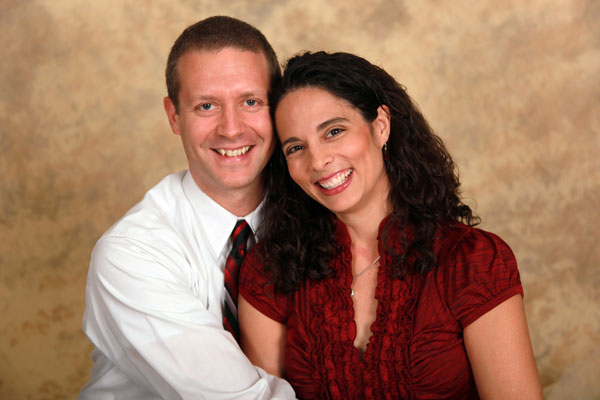
Steve and Becky Greene.

Becky Greene is a home-schooling mother and freelance writer who started reclaimingthewomb.com. Steve Greene is an adjunct philosophy professor for Mesa Community College and director of parish administration at St. Anne Parish in Gilbert. They both speak on marriage, life, family and Natural Family Planning.

We weren’t always on board with Natural Family Planning — it seemed a little pie-in-the-sky at first. As we went through marriage preparation some 10 years ago, we questioned whether this was a reliable method for spacing pregnancies. Sure it’s Church teaching, but is it realistic? We needed proof that the science was sound and that the moral arguments made sense.

We were blown away by not only its effectiveness, but its greater benefits — like achieving conception, enhancing the intimacy of our relationship, modeling virtues of chastity and self-mastery for our children, and deepening our Catholic faith. For us, the Church gained all credibility on this issue, reaffirming our trust in her to lead us lovingly in all other matters of life. As a result, NFP has become one of the pillars of our marriage, integrally defining us individually and as a couple.

The bottom line revealed itself when we took the classes. We concluded we had two choices: trust and embrace the beautiful purpose of our biology as God designed and intended it, or trust a pharmaceutical company to suppress it.

That self-knowledge created a mutual respect for our feminine and masculine dignity and compatibility, and instilled awe for the profound significance of each and every act of lovemaking, especially during our fertile window. We realize that in becoming one, we may not just be witness to, but participants in, a miracle. There is no greater natural dignity bestowed on man than the opportunity to be co-creators with God.

NFP virtually eliminates the possibility of seeking selfish sexual satisfaction because it demands appreciation for, not resentment of, our fertility. Our communication and prayer regarding God’s will for marriage transcends the bedroom — we must talk about everything because everything is involved when sexual union and possible procreation go hand-in-hand.

But we’ve also learned that even when the act does not produce a child, it still bears spiritual fruit. We have the opportunity to renew our wedding vows every time we enter the marital embrace — truly becoming one flesh. That bond resets our intimacy, even as the hectic nature of life causes strain and disconnects.

Because NFP calls us to prudently decide whether to abstain or engage during our fertile time, we’ve been trained to be open to both life and sacrifice — the husband learns how to love his wife as Christ loves His Church, and the wife learns how to receive that love, allowing it to potentially generate new life in her womb.

Yes, we can validate its effectiveness — we successfully postponed pregnancy for the first two years of our marriage, conceiving our first son in our first attempt to achieve pregnancy, and spaced our second and third pregnancies by three years. But more telling of its beauty is not how it worked to help us avoid children but in how it inspired us to welcome them. In surrendering to His will, we became more intimately tuned to nudges from the Holy Spirit.

The gift of children

One night in particular stands out. We knew we were fertile, but with a 10-month-old still waking at night, financial stresses, and the question of whether we were ready to be pregnant again, lovemaking would have to wait.

But then a revelation overtook us, one we would have been deaf to without the insight Natural Family Planning affords.

We profoundly recognized that we could conceive a new life if we entered the marital embrace. If we abstained, the possibility of that life would cease… forever — we of course could have other children down the line. But this child would never exist.

Nine months later, our second son — the fruit of that surrender — was born, and he is a daily reminder of the responsibility and empowerment that comes with our God-given freedom. NFP helps us see that children are neither burdens nor rights; they are divine gifts entrusted to us. This was further highlighted for us with the recent loss of our fourth child to miscarriage.

Children puncture the illusion that our lives are our own, and we are in control of them. Parenthood has become the ultimate act of faith, and acts of faith grow our faith. Through practicing NFP, we’ve been invited into holiness. We’ve learned the utter necessity of clinging to Christ in both our joys and our sorrows, genuinely proclaiming, “Not my will but yours be done.”

Updated May 16, 2012 with video:

The blessing of a fruitful life; Part two: Openness to life and personal identity

A particularly dramatic moment of human freedom occurs in a Catholic wedding when a man and woman stand before the altar and answer three “questions of clarification” about the nature of marriage, just before the vows are exchanged.
“Have you come here freely, and without reservation?” The couple answers, Yes.

“Will you honor each other as husband and wife for the rest of your lives?” Yes.

“Will you accept children lovingly from God, and bring them up according to the law of God and His Church?” Yes.

Our postmodern culture balks: “Wait! Is the third question really necessary? Certainly, we must be all about freedom, and unconditional love, yes, and even fidelity is an attractive ideal (if not realistic for most humans), but a promise to be open to children? Is this necessary to promises of marriage?”

“Yes,” says the Church, “it is entirely necessary.” The Church does not invent the meaning of marriage — she merely protects and promotes it, in all of its natural and sacramental beauty. At the center of the beauty of marriage is the gift of children, and of being a mother and a father.

In other words, when Pope Paul VI’s encyclical of 1968, Humanae Vitae, echoes the 2,000-year teaching of the Church, “…each and every marital act must of necessity retain its intrinsic relationship to the procreation of human life,” (no. 12) more than a clear teaching against contraception is taught, though that teaching is clear and unchangeable. For those that have “eyes to see and ears to hear,” an ennobling call from our mother the Church, and therefore from Christ Himself, is heard. It is the high call to married couples to reject the stultifying, fear-based shadow of marriage encouraged by the contraceptive mentality of our age; and, instead, to embrace the fullness of the call to marriage in all its life-giving splendor and dignity.

A person’s identity and the call to be life-giving

If the choice of sterility (I am not talking here about infertility, which I will discuss in the next article) were not in some odd sense attractive, it would not be such an effective lie, and it would not be chosen by so many today. What lurks always as a temptation near the human heart is the desire to be undeterred in one’s choices by any law outside of the self.

In his 1964 play “Radiation of Fatherhood,” a dramatic reflection on the Trinity and human freedom, the future John Paul II placed in the mouth of the mysterious character Adam the following expression, “Ah, to stand apart from everything, so that I could be only within myself!” Adam, not accidentally the Biblical word for man himself, fears the call to parenthood, to bring a child into existence, because he fears the death of his ego which this entails. He fears the suffering that will of necessity accompany becoming and being a father. And yet in the play, God calls him to become who he truly is by becoming a father. It turns out that there is no other path to human fulfillment than the path of fruitfulness, of motherhood and fatherhood.

“Become who you are!” Blessed John Paul II was fond of repeating to priests, consecrated persons, and parents. He knew the all-too-human fear to which we are subject in living our vocations, and he knew the antidotes.

‘Love and Responsibility,’ four spousal benefits

In his philosophical work on marital love, “Love and Responsibility,” the future Polish pope was concerned with explaining how spouses can engage in the marital act of sexual intercourse without falling into using each other, a situation he calls “the internal problem of every marriage.” The key is that a couple must understand the great meaning of what they are doing, and understand the possibility of motherhood and fatherhood in each act:

“Mutual betrothed love demands a union of persons. But the union of persons is not the same as sexual union. This (union) is raised to the level of the person only when it is accompanied in the mind and the will by acceptance of the possibility of parenthood… Neither in the man nor in the woman can affirmation of the value of the person be divorced from awareness and willing acceptance that he may become a father and she may become a mother… If the possibility of parenthood is deliberately excluded from marital relations, the character of the relationship between the partners automatically changes. The change is away from unification in love and in the direction of mutual, or rather, bilateral “enjoyment” (p. 228).

This quote from Blessed John Paul is theologically rich; let us focus only on one specific element of it. For the marital act to truly be a personal union it must include the activity of the powers of the soul which identify us as being human: intellect and will. For the marital act to retain its full meaning the spouses must rationally accept the full potential of the act: the possibility of becoming parents (this does not negate the legitimacy of abstaining during fertile periods, when there are good reasons for doing so). To deliberately not include this possibility would be to negate one of the essential goals of the marital act and to render the entire act sinful.

Such is the pattern of contraception in a marriage, and we see it in the brokenness of countless marriages today, in the radical cultural disconnect between sex and children on display everywhere, from soap operas to abortion. As priests, we feel the weight of it in the confessional and grieve the losses.

Yet, for those who generously accept the potentiality of motherhood and fatherhood in their marital love, benefits arise which our world desperately needs. Karol Wojtyla in “Love and Responsibility” points to four personal strengths which grow in married couples who are open to life, which I have simplified somewhat from Wojtyla’s dense philosophical language:

  1. Awareness of the call to parenthood assists growth in self-mastery;
  2. Marital love flourishes when the goodness of parenthood is understood;
  3. Raising a child teaches one to love, to make a gift of self; and
  4. Married persons understand their greatness as procreators with God of a new human person.

Blessed John Paul II insisted that if a couple wants a virtuous, happy, generous, awe-filled marriage, they must remain open to the natural end of the consummating act of marital love, open to the possibility that a child, a new person from God, might come into being through that act.

The drama and beauty of this calling is not lost on many of our young couples currently preparing for marriage in the Diocese of Phoenix; they share their gratitude for the clarity of Church teaching and for the witness of the couples who presented it. These couples are on a path to a joy-filled marriage, which deepens like any Christian vocation authentically lived.

In the final part of this series, I will consider the mission of the fruitful life of marriage, including the couple struggling with infertility.

Read “The blessing of a fruitful life; Part one: Blessed is the fruit of the womb”

Two local Catholic writers join CatholicMom.com

Look for regular columns by local Catholics Jean Briese and Sherry Boas on www.CatholicMom.com.

If you’ve never directed your mouse and keyboard to CatholicMom.com, or it’s been while since your last visit, now might be the time to go. And the reason is not just because Mother’s Day is around the corner. It’s also because you’ll also find two local voices among its newest.

Sherry Boas, who avid Catholic Sun readers might recognize as the author of “The Lily Trilogy” and the “Rosary Meditations for Moms,” joined in April.

Jean Briese, a Cave Creek Catholic mother and grandmother plus children’s catechist who is also involved with her parish’s women’s group, joined in March. Be on the lookout for their regular columns.

Their columns so far:

  • The Mystery of Motherhood
  • The Little Lamb’s Prayer
  • Chaos on Mount Calvary

Briese will contribute monthly. I couldn’t tell for sure a frequency for Boas, but I would think at least monthly. Their profile pages (linked from their names above) also link to their personal pages so you can stay in touch with them more regularly.

In our work through the diocesan Communications Office, at least one of us, if not more, has had the opportunity to speak to both of these Catholic writers. They have a conversational tone and appear very gentle, yet very devout in living their faith. So I think that devout Catholics at all stages of their faith journey will be able to gain some insight into motherhood and the Church from them.

Check them out and let us know what you think.

Parish birthdays: May

Two parishes, established the same day, mark 50 years of service to the local Catholic community May 12.

The following parishes celebrate a birthday this month. Is yours one of them?

Only two of them are younger than the diocese itself with the others established before Dec. 2, 1969.
*=still the only Catholic church serving the city

  • May 5, 1956     St. Henry* (Buckeye)
    The second of three parishes established that year.
    Currently raising funds for a new church with donors in 43 of the 50 states so far plus pledges from the Philippines and several other countries.
    Parish website and capital campaign site
    1,200 families
  • May 10, 1969     Our Lady of the Lake* (Lake Havasu City)
    Second-to-last parish established before the Diocese of Phoenix was formed.
    Parish website
    2,476 families
  • May 11, 1947     St. Margaret Mary* (Bullhead City)
    First chapel was purchased in the area that is now “Davis Camp” on the Nevada border.
    Fr. Peter Dobrowski has been pastor since 1991.
    1,308 families
  • May 11, 1965     St. John Vianney* (Sedona)
    Grounds include three prayer grottos and a Mary Garden
    Parish website
    794 families
  • May 12, 1962     St. Jerome (35th Avenue north of Peoria Avenue)
    Eudist Father Andres Arango, pastor since 2005, is the parish’s fifth pastor
    Parish website
    1,980 families
  • May 12, 1962     St. Louis the King (Maryland and 43rd Avenue in Glendale)
    Tucson’s Bishop selected the parish name to honor Arizona’s early French missionaries.
    Parish website
    1,084 families
  • May 13, 1961     St. Daniel the Prophet (Hayden Rod north of McKellips in Scottsdale)
    Named in honor of Tucson’s retired bishop
    First Mass celebrated in a Motorola Plant for 647 people
    Parish website
    1,500 families
  • May 15, 1953     Ss. Simon and Jude Cathedral (27th Avenue north of Bethany Home Road)
    The diocese’s Mother Church and the seat of the bishop
    Parish website
    4,568 families
  • May 20, 1988   St. Steven* (Dobson and Riggs in Sun Lakes)
    Originally a mission of St. Mary Parish in Chandler
    Parish website
    1,619 families
  • May 22, 1946   St. Catherine of Siena (Central Ave. south of Southern)
    First church was an Army barracks building that parishioners remodeled.
    Parish website
    4,431 families
  • May 25, 1980   St. Patrick (Shea Blvd. west of Loop 101 in Scottsdale)
    Fr. Eric Tellez has been pastor since 1995.
    Parish website
    4,211 families

Traditionalist leader says group could divide over unity with Rome

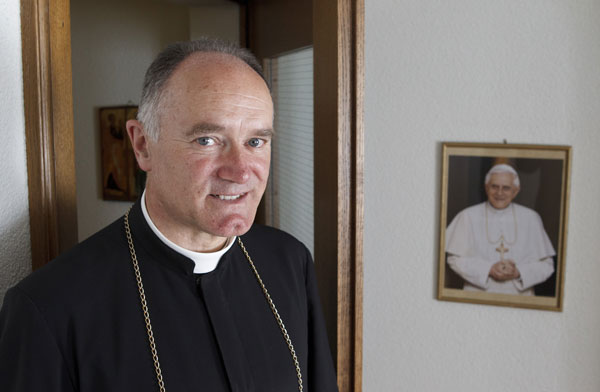
Bishop Bernard Fellay, superior of the Society of St. Pius X, is pictured near a photo of Pope Benedict XVI at the society's headquarters in Menzingen, Switzerland, May 11. Bishop Fellay acknowledged there could be a split in the breakaway society if it decides to reconcile with the Vatican. (CNS photo/Paul Haring)

MENZINGEN, Switzerland (CNS) — The leader of a breakaway group of traditionalist Catholics spoke in unusually hopeful terms about a possible reconciliation with Rome, but acknowledged significant internal resistance to such a move, which he said might lead to the group splitting apart.

Bishop Bernard Fellay, superior general of the Society of St. Pius X, spoke to Catholic News Service May 11 at the society’s headquarters in Switzerland about the latest events in more than two years of efforts at reconciliation with the Vatican.

The society effectively broke with Rome in 1988, when its founder, the late Archbishop Marcel Lefebvre, ordained four bishops without the permission of Blessed John Paul II in a protest against modernizing changes that followed the Second Vatican Council of 1962-65.

In April the society responded to a “doctrinal preamble” stipulating the group’s assent to certain church teachings, presumably including elements of the teaching of Vatican II, as a prerequisite for reconciliation. The Vatican has yet to respond, but the director of the Vatican press office initially described the latest position as a “step forward.”

The society is hardly united behind its leader’s position, however. In April, according to a letter which surfaced on the Internet May 10, the society’s other three bishops warned Bishop Fellay that the Vatican’s apparent offer to establish the group as a personal prelature — a status currently held only by Opus Dei — constituted a “trap,” and urged him to say no.

“There are some discrepancies in the society,” Bishop Fellay told CNS. “I cannot exclude that there might be a split.”

But the bishop defended his generally favorable stance toward the Vatican’s offer against the objections of his peers.

“I think that the move of the Holy Father — because it really comes from him — is genuine. There doesn’t seem to be any trap,” he said. “So we have to look into it very closely and if possible move ahead.”

He cautioned, however, that the two sides still have not arrived at an agreement, and that unspecified guarantees from the Vatican are still pending. He said the guarantees are related to the society’s traditional liturgical practices and teachings, among other areas.

“The thing is not yet done,” the bishop said. “We need some reasonable understanding that the proposed structure and conditions are workable. We are not going to do suicide there, that’s very clear.”

Bishop Fellay insisted the impetus for a resolution comes from Pope Benedict XVI.

“Personally, I would have wished to wait for some more time to see things clearer,” he said, “but once again it really appears that the Holy Father wants it to happen now.”

Bishop Fellay spoke appreciatively of what he characterized as the pope’s efforts to correct “progressive” deviations from Catholic teaching and tradition since Vatican II. “Very, very delicately — he tries not to break things — but tries also to put in some important corrections,” the bishop said.

Although he stopped short of endorsing Pope Benedict’s interpretation of Vatican II as essentially in continuity with the church’s tradition — a position which many in the society have vocally disputed — Bishop Fellay spoke about the idea in strikingly sympathetic terms.

“I would hope so,” he said, when asked if Vatican II itself belongs to Catholic tradition.

“The pope says that … the council must be put within the great tradition of the church, must be understood in accordance with it. These are statements we fully agree with, totally, absolutely,” the bishop said. “The problem might be in the application, that is: is what happens really in coherence or in harmony with tradition?”

Insisting that “we don’t want to be aggressive, we don’t want to be provocative,” Bishop Fellay said the Society of St. Pius X has served as a “sign of contradiction” during a period of increasing progressive influence in the church. He also allowed for the possibility that the group would continue to play such a role even after reconciliation with Rome.

“People welcome us now, people will, and others won’t,” he said. “If we see some discrepancies within the society, definitely there are also (divisions) in the Catholic Church.”

“But we are not alone” in working to “defend the faith,” the bishop said. “It’s the pope himself who does it; that’s his job. And if we are called to help the Holy Father in that, so be it.”

— By Francis X. Rocca, Catholic News Service

Cardinal covers wide range of topics during Town Hall on SiriusXM radio

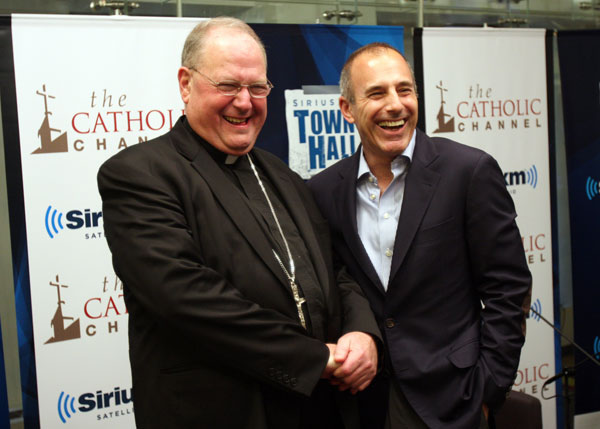
Cardinal Timothy M. Dolan of New York and NBC "Today" co-host Matt Lauer share a light moment during a break in the cardinal's town-hall-style satellite radio broadcast on the Catholic Channel at SiriusXM studios in New York May 8. (CNS photo/Gregory A. Shemitz)

NEW YORK (CNS) — In a genial, live, two-hour national satellite radio broadcast May 8, Cardinal Timothy M. Dolan of New York sent his first Twitter message and fielded questions on issues ranging from his priesthood to his favorite foods and beverages.

Cardinal Dolan was featured in a Town Hall event on SiriusXM’s the Catholic Channel 129. Twenty invited listeners perched on stools in a small glass-enclosed studio at SiriusXM’s New York headquarters. They read their queries from prepared cards and responded appreciatively to the cardinal’s thoughtful responses.

The broadcast was moderated by Sirius XM personalities Father Jonathan Morris and Tim Farley. NBC’s “Today” co-host Matt Lauer, former Major League Baseball manager Joe Torre and Shirley Dolan, the cardinal’s mother, were “surprise guests.”

Cardinal Dolan said he aspires to be a saint. “I’m longing for it and trying my best. Great saints are just recovering sinners,” he quipped.

He cited St. Therese of Lisieux, or the “Little Flower,” who famously defined sainthood as doing ordinary things extraordinarily well. “For a cardinal, most of life is routine,” Cardinal Dolan said.

The cardinal applauded St. John Bosco’s creative approach to ministry and said St. Maximilian Kolbe is an inspiration for priests. The priest, canonized in 1982, gave his life at Auschwitz to spare a young father. “I love Maximilian Kolbe because he came to us at a time when priests were questioning our identity and confidence was flagging.”

“We’re all called to be saints. I hope 50 years from now someone will remember something I said or did and be inspired,” Cardinal Dolan said.

The cardinal, who hosts a weekly talk show on the Catholic Channel, opened the Town Hall with a milkshake toast to the audience and the event was peppered with references to food and drink. Without hesitation, he described his favorite meal — “meatloaf, mashed potatoes, no gravy, butter, a cold beer and cherry pie.” Budweiser is his favorite brand of beer and peach his preferred flavor for a stand-alone snack of pie and cold milk. He also described feigning indecision at a gelato stand to sample many flavors before ordering.

Cardinal Dolan said his guests at an imaginary dinner party would include St. Peter, the Roman emperor Constantine, Abraham Lincoln and Archbishop Fulton Sheen. He said he would ask how St. Peter “recuperated so quickly from denying Jesus to being at his tomb” on Easter.

The cardinal said Lincoln is “one of the holiest and wisest men I’ve ever read about” and then laughingly acknowledged that Archbishop Sheen, a skilled broadcaster, “would probably dominate the conversation.” Jesus, he said, is a presumed guest at the dinner, one whom he meets every day in the eucharistic meal.

Addressing priestly vocations, Cardinal Dolan said families and parishes should invite and encourage young men without pressuring them. He said he aspired to the parish priesthood from an early age, but would likely have become a married father and history teacher if he was not ordained.

“Pope Paul VI said a priest should want to be a husband and a father,” Cardinal Dolan said. “We’re not called to be bachelors. A bachelor freely chooses not to be married. We’re called to be celibate, which means we have a deep longing for a wife and children but we have placed that under God’s domain. We then have a spiritual spousal relationship with the Church and a spiritual paternity with our people.”

Cardinal Dolan said his faith was tested in 2000 when his young niece was diagnosed with bone cancer.

“I was never tempted to doubt God, but I was tempted to doubt that God knew what he was doing,” he said. Ultimately, he latched onto the Gospel question “Lord, to whom shall we go?” and adopted it as his prayer and part of his episcopal coat of arms. His niece is now a young adult.

Cardinal Dolan advised a new grandmother to be gentle, prayerful and persistent in encouraging the baby’s lapsed Catholic father to have the child baptized. “A genius of the Catholic faith is that adults return to the faith through their kids,” he said.

Asked to speculate about an American papacy, Cardinal Dolan said it might happen eventually, but not in the near future. Traditionally, he said, the pope is a referee in international affairs, and the College of Cardinals would “shy away” from choosing someone from a superpower because it might place a burden on him.

When Lauer appeared in the studio, he reminisced with Cardinal Dolan about a moving 2011 visit they made to St. Peter’s Basilica after it was closed to the public for the day. Lauer described himself as “deeply spiritual, but not religious” and said he was raised by a Jewish father and a Christian Scientist mother. Cardinal Dolan said, “Rome brings out a natural inquisitiveness about religion.”

Joe Torre called in to the program and Cardinal Dolan said, “You’re one of my heroes, Joe. You take your faith seriously.” The former baseball manager and the cardinal had a rapid-fire exchange worthy of late-night sports radio, including updates on former major leaguers Stan Musial, Whitey Herzog, Tony La Russa and Frank Torre, Joe’s brother.

Cardinal Dolan said there is an analogy between the Catholic Church and sports. “Strength in athletics and spiritual life are allied. The same traits that serve well on the field apply to spiritual life: team work, perseverance, grittiness and vigilance,” he said.

Diocesan bishops, like sports managers, have to “craft a team to fit the park,” Cardinal Dolan said. Both have to assess the local situation and develop their personnel to meet the challenges and opportunities.

During the broadcast, the cardinal used an iPad to send his first Tweet. With the handle @CardinalDolan, he wrote: “Hey everybody. It’s Timothy Cardinal Tebow. I mean Dolan. I’m on Twitter. And I’m live on Town Hall on SiriusXM’s The Catholic Channel 129.”

— By Beth Griffin, Catholic News Service

– – –

Editor’s Note: Rebroadcasts of the Town Hall program with Cardinal Dolan were scheduled for Saturday, May 12, (10 a.m. and 7 p.m. EDT) and Sunday, May 13, (noon and 10 p.m. EDT) on SiriusXM’s the Catholic Channel 129.

Local Catholic launches ‘Rosary for the USA’

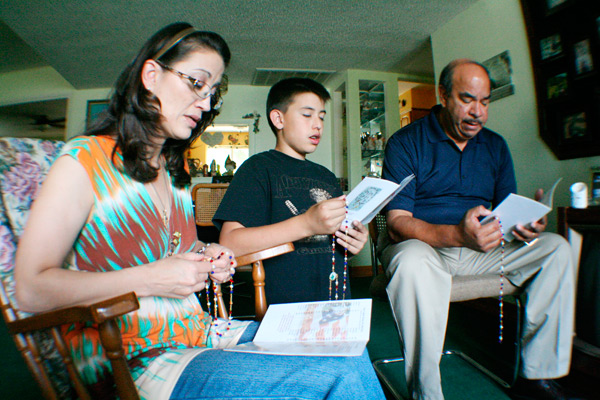
Dee, Antonio and Manny Yrique pray the rosary May 8 in their Phoenix home. (J.D. Long-Garcia/CATHOLIC SUN)

As Manny Yrique prayed before the Blessed Sacrament, his heart was burdened with concerns about the United States and the level of animosity in American discourse.

“I knelt down to pray and I was overwhelmed by the feeling that Our Lord wanted me to pray a rosary,” Yrique said. “I felt Him telling me, ‘Take it to My Mother.’”

Manny Yrique displays the Rosary for the United States of America (J.D. Long-Garcia/CATHOLIC SUN)

He pulled out his rosary beads and as he began to pray, was struck by the realization that the 50 Hail Mary prayers of the rosary could each be offered for one of the 50 United States.

Yrique said he’s always had a strong devotion to the Blessed Virgin Mary. He remembers being 8 years old, kneeling with his 6-year-old sister to pray the rosary while their mother was undergoing surgery.

“We didn’t know if our mom was coming back home, so we took out our plastic rosaries, knelt down at the Virgin of Guadalupe statue that was over my mom’s bed and we prayed a rosary,” Yrique said. “It was like, ‘Nothing’s going to happen as long as Mary’s with you.’”

That conviction about the love of the Mother of God is something that Yrique said can partly be explained by his own mother’s unshakeable devotion to her children.

“I believe that a mother has tremendous impact on her family — I saw that in my mother,” Yrique said. “We knew that nothing would happen to us as children as long as Mom was there.

“I believe the Blessed Virgin Mary is the same way — she’s always been my Mother and I believe she has the ear of God at her command.”

Yrique said he designed the Rosary for the United States of America through prayer, often waking in the middle of the night to compose the intentions. Each of the five decades has a designated intention.

The first three decades are prayed for the executive, legislative and judicial branches of government. The fourth decade is dedicated to state and local governments as well as police and fire fighters. The fifth decade is devoted to U.S. military personnel.

The Rosary for the USA is not a political statement, Yrique said. He’s not praying for a particular candidate to win the upcoming election or for any political party’s success. He’s simply praying for the United States — its leaders and populace.

“At the time I started praying for my country, I was really concerned with how divisive we became over the SB 1070 [immigration] issue,” Yrique said. “So when I saw things happening on the news — when I saw people being angry at one another, shouting at one another, I thought, ‘This is not the way I was brought up.’”

Fr. Johnrita Adegboyega, parochial vicar at St. Mary Parish in Chandler, said the Virgin Mary is always ready to listen and intercede for her children.

“In the midst of every evil, only prayer can make us safe — only  prayer can bring about the truth,” Fr. Adegboyega said. “The Mother of God is there to find solutions to every problem, regardless of the challenges… She is the perfect means to approach the throne of grace through Christ Jesus Our Lord.”

Davonna Serrano, parishioner at St. Mary Magdalene Parish in Gilbert, said the Rosary for the USA should be prayed to defend the nation.

“The only way that we have to fight is through prayer — that’s our first and foremost defense in any kind of battle,” Serrano said. “And right now the battle is for the souls of our children and the future of our country.”

Praying the Rosary for the USA, she said, could also help bring people back to the Catholic Church.

“Whether you’re a grandmother or a parent or just a family member, and you’ve lost family from the Church, all you have to do is pray,” Serrano said. “Pray the rosary, pray for the intercession of the saints and pray for the Blessed Mother to open their eyes, and they will return to the faith.”

Yrique said it’s important for the 30 million Catholics in the United States to pray for their leaders, regardless of political persuasion.

“I really believe that it doesn’t matter who we elect if the power of God is not working through our elected officials,” Yrique said. “I’d like people to get off their soapboxes and get on their knees and pray. God will bless America when Americans remember to bless God.”

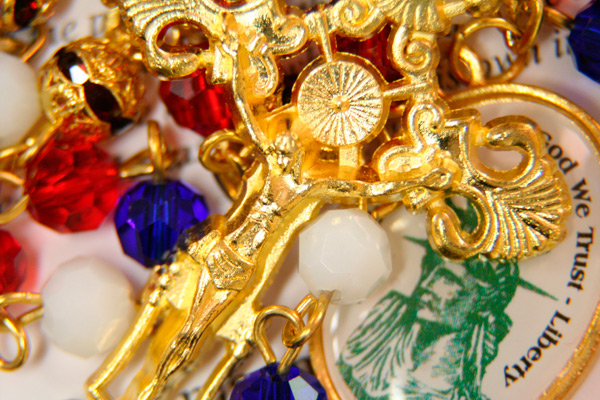
Yrique has already given away or sold 3,000 of the red, white and blue rosary beads and has ordered another 2,000. Along with the rosary, people can order a prayer booklet or prayer card that lists all the intentions as well as the names of the 50 states.

The booklet also lists other intentions for the rosary, depending on the time of day in which it is prayed.  From midnight to 3 a.m. for example, the rosary could be offered for those who work at night, such as truck drivers and railroad workers.

– – –

ROSARY USA: www.magnalitecatholic.com or call (602) 269-0009

– – –


Close-up of the Rosary for the United States of America. (J.D. Long-Garcia/CATHOLIC SUN)