
Misa para migrantes destacará muertes trágicas en la frontera


mass-4-migrants-7x5-spanishVienen en busca de una vida mejor, pero cada año, cientos mueren en el severo desierto cerca a la fronteriza entre los Estados Unidos y México.

Tom McCabe quiere que la gente vea el rostro humano detrás de los números.

“Yo era un partidario firme de SB1070,” dijo McCabe, refiriéndose a la ley controversial sobre inmigración que fue adoptada por la legislatura de Arizona en el 2010. “No entendía los motivos por los que alguien querría inmigrar, las razones económicas”.

Eso fue antes de que participara en la clase de Fe Justa en su parroquia y viera una película que retrataba algunas de las razones por las que la gente está dispuesta a arriesgar la muerte al cruzar el desierto con poco más de un par de zapatillas de gimnasia y un galón de agua.

[quote_box_right]

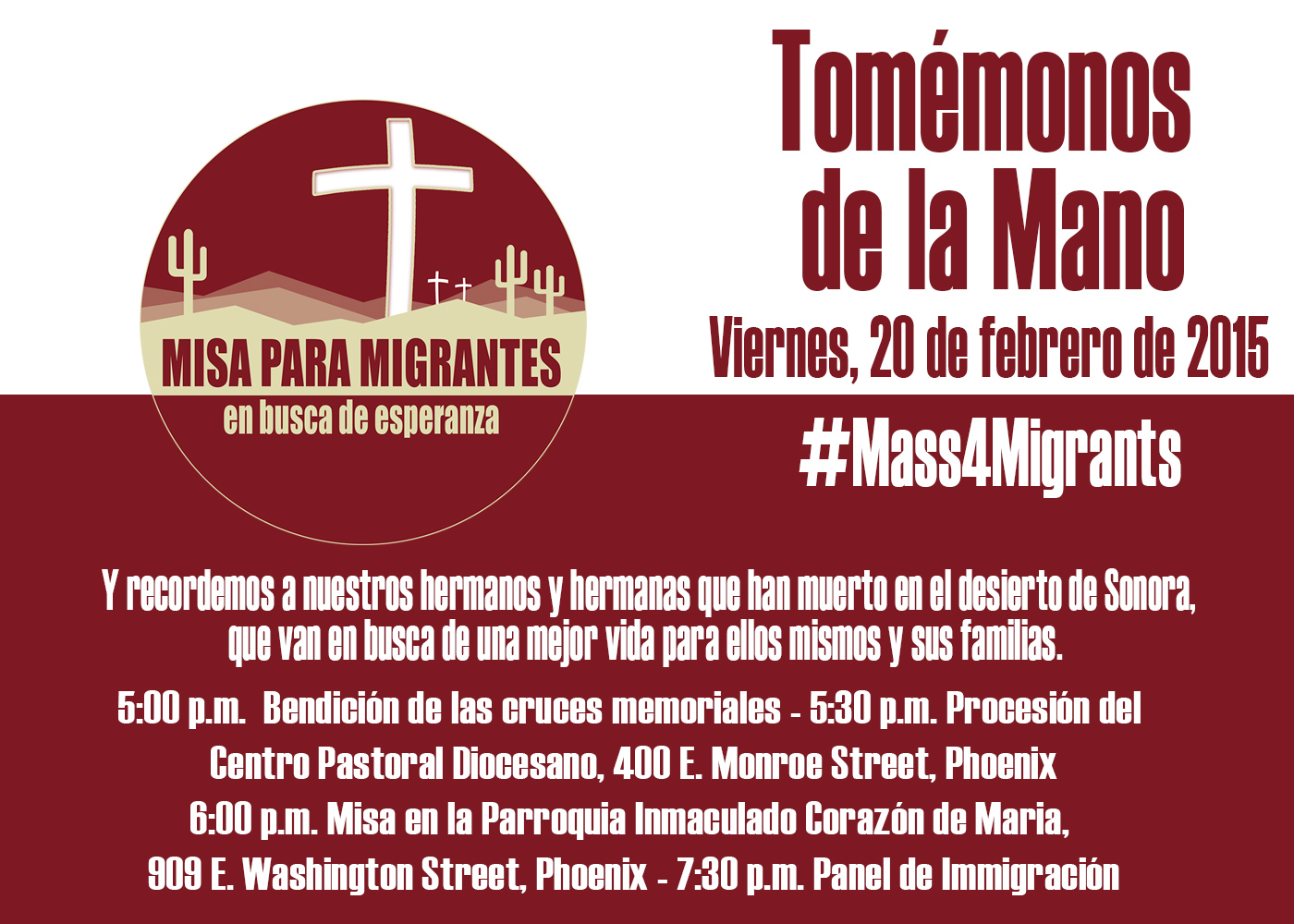
Misa para migrantes – 20 de febrero

5 p.m. bendición de las cruces memoriales, 400 E. Monroe St., Phoenix

5:30 p.m. procesión a Parroquia Inmaculado Corazón de María, 909 E. Washington St., Phoenix

6 p.m. Misa en Iglesia Inmaculado Corazón de María

7:30 p.m. panel de Inmigración

[/quote_box_right]

“Te rompe el corazón ver a la gente dejando a sus familias,” dijo McCabe. “Esta gente solo está tratando de conseguir una vida mejor. No había nadie allí para tomar sus manos o rezar con ellos mientras estaban muriéndose.”

McCabe espera que la “Misa para Migrantes” que tomará lugar el 20 de febrero destacará la situación de los migrantes que han muerto en el desierto, buscando un camino para salir de la pobreza y la violencia que azota México y América Central.

Ignacio Rodríguez, director asociado de la oficina de ministerios étnicos de la Diócesis de Phoenix, dijo que los estudiantes de cuatro escuelas católicas locales estarán decorando cruces conmemorativas por inscribir los nombres de los migrantes cuyos cuerpos fueron identificados por la Oficina del Examinador Médico del Condado de Pima el año pasado. Algunos de las cruces simplemente tienen las palabras “Hermano Desconocido.” Las cruces estarán colgadas de los árboles en la plaza afuera de la Basílica de Santa María ubicada en el Centro Pastoral Diocesano en el centro de Phoenix.

A las 5 p.m. en el 20 de febrero, el Obispo Auxiliar Eduardo A. Nevares bendecirá las cruces decoradas por los estudiantes así como unas otras 200 cruces que serán llevadas en procesión a la Iglesia Inmaculado Corazón de María que queda a una distancia de una media milla. Después de la Misa, habrá una sesión educativa con presentaciones de un abogado de inmigración y una migrante que contará su historia.

Dignidad Humana

Según el Examinador Médico del Condado de Pima, han sido 2,333 muertes en la frontera de Arizona desde el año 2001. Para el año calendario 2014, han sido 131 muertes.

“A algunos nunca los encuentran,” dijo Rodriguez. “Sus cuerpos se descomponen en el desierto y son comidos por animales salvajes.”

Cristofer Pereyra, director de oficina de Misiones hispana para la Diócesis de Phoenix, dijo que algunos residentes del área fronteriza han tomado los asuntos en sus propias manos, creando cementerios improvisados en sus patios traseros.

“No saben los nombres de esta gente — solo se les entierra y ponen cruces,” dijo Pereyra.

En cuanto a los que insisten en que los migrantes están violando la ley, Pereyra dijo que mientras que la Iglesia Católica no aprueba violar la ley, los feligreses deben considerar en oración el tema de la inmigración.

“Si hay algo que debemos poner frente a Cristo y pedir que El nos muestre cuál es Su punto de visto, sería esto,” dijo Pereyra.

“Nuestra fe demanda que recemos por los que han muerto,” dijo Rodriguez. “La Misa es una manera de honrar a los que han muerto: miembros de familias, hombres, mujeres y niños.”

El Padre Sean Carroll, S.J., director ejecutivo de Iniciativa Kino para la Frontera, un grupo que ofrece asistencia humanitaria a los que cruzan la frontera, dijo que los migrantes mueren en el desierto porque “no tenemos maneras legales para que la gente venga a trabajar a los Estados Unidos.” Muchas veces, aseguró, ellos tienen miembros de sus familias — esposos o niños con quienes se quieren reunir. Sin una manera legal de venir, arriesgan sus vidas.

“Vemos a la gente en nuestro trabajo con los pies ampollados severamente, síntomas de gripe, mujeres que han sido violadas y agredidas sexualmente. Estas son violaciones de la dignidad humana,” dijo el Padre Carroll. “Son seres humanos creados a imagen y semejanza de Dios. Nuestro llamado es reconocer su dignidad dada por Dios.”

Feb. 20 ‘Mass for Migrants’ to highlight tragic border deaths

mass-4-migrants-7x5

They come in search of a better life, but hundreds perish in the rugged desert near the U.S.-Mexico border every year.

Tom McCabe wants people to see the human face behind the numbers.

“I was a staunch SB 1070 supporter,” McCabe said, referring to the controversial bill dealing with immigration that was passed in 2010 by Arizona’s legislature. “I didn’t understand all the reasons as to why someone would want to migrate, the economics behind it.”

That was before he participated in the Just Faith class at his parish and saw a film that portrayed some of the reasons why people are willing to risk death crossing the desert with little more than a pair of gym shoes and a gallon of water.

[quote_box_right]

Mass for Migrants – Feb. 20

5 p.m. blessing of Memorial Crosses, 400 E. Monroe St., Phoenix

5:30 p.m. procession to Immaculate Heart of Mary Church, 909 E. Washington St., Phoenix

6 p.m. Mass at Immaculate Heart of Mary Church

7:30 p.m. educational session and Q&A

[/quote_box_right]

“It breaks your heart to see people moving away from their families,” McCabe said. “These folks are just trying to get a better life for themselves. There was no one there to hold their hands or pray with them as they lay dying.”

McCabe is hoping a Feb. 20 “Mass for Migrants” will draw attention to the migrants who have died in the desert, searching for a way out of poverty and an escape from the violence that plagues Mexico and Central America.

Ignacio Rodriguez, associate director of the Office of Ethnic Ministries for the Diocese of Phoenix, said that students at four local Catholic schools are decorating commemorative crosses by inscribing the names of migrants whose bodies have been identified during the past year. Some of the crosses simply say Hermano Desconocido, Spanish for “unknown brother. The crosses will be hung from trees in the plaza between St. Mary’s Basilica and the Diocesan Pastoral Center in downtown Phoenix.

At 5 p.m. on Feb. 20, Bishop Nevares will bless the students’ crosses as well as another 200 that will be carried in procession to Immaculate Heart of Mary Church a half mile away. Following the Mass, there’s an education session that features an immigration attorney and migrant who tells her story.

Human dignity

According to the Pima County Medical Examiner, there have been 2,333 deaths in the Arizona borderland since 2001. For the calendar year 2014, there were 131 deaths.

“Some are never found,” Rodriguez said. “Their bodies decay in the desert and are eaten by wild animals.”

Cristofer Pereyra, director of the Hispanic mission office for the Diocese of Phoenix, said that some border-area residents have at times taken matters into their own hands, creating makeshift cemeteries in their backyards.

“They don’t know the names of these people — they just bury them and put up crosses,” Pereyra said.

As to those who say that the migrants are violating the law, Pereyra said that while the Catholic Church doesn’t condone breaking laws, the faithful ought to prayerfully consider the immigration issue.

“If there’s anything that we need to put in front of Christ and ask Him to show us what His view is, it would be this,” Pereyra said.

“Our faith compels us to pray for those who have died,” Rodriguez said. “The Mass is a way to honor those who died: family members, men, women and children.”

Fr. Sean Carroll, S.., executive director of the Kino Border Initiative in Nogales, a group that renders humanitarian aid to border crossers, said migrants die in the desert because “we don’t have legal ways for people to come to work in areas of the United States.” Often, he said, they have family members — spouses or children, for example — and wish to rejoin them. With no legal way to come, they risk their lives.

“We see people in our work with severely blistered feet, flu-like symptoms, women who have been raped and assaulted. These are violations of their human dignity,” Fr. Carroll said. “They are human beings made in God’s image and likeness. Our call is to recognize their God-given dignity.”

St. Vincent de Paul program aids ex-prisoners’ re-entry into society

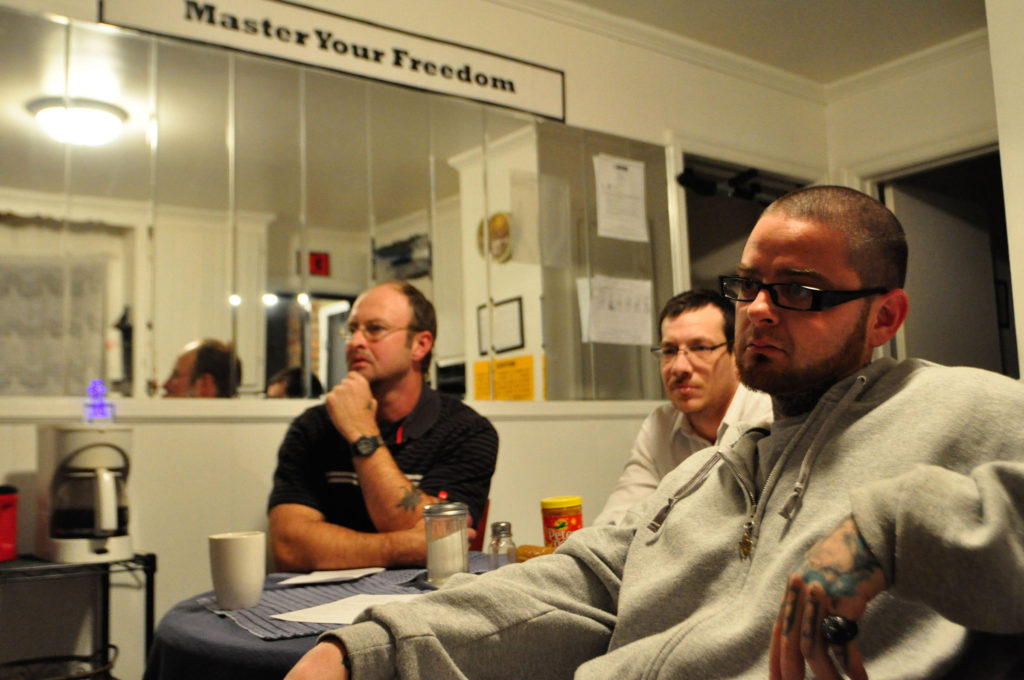
Jerry Webb, left, Jay Cody and Jesse Smith listen during a 2014 prayer service led by Deacon Ted Welsh, of St. Joseph Parish in Madison, Tenn. The deacon leads the weekly service for former prisoners who are making the transition back into society after their release. The prayer service was held at the Aphesis House, a halfway house in Madison, which several men in transition now call home. (CNS photo/Andy Telli, Tennessee Register)

WASHINGTON (CNS) — Mark Walters, one of the staff members of the Vincentian Reentry Organizing Project in New Orleans, confessed that he had “never been an organizer in terms of community organizing.”

“But I organized a lot of drug dealers,” he added.

[quote_box_right]Follow the Reentry Organizing Project on Facebook[/quote_box_right]

Walters is far from the only ex-convict — now thought of as a “returning citizen” — brought in by the Society of St. Vincent de Paul for its Vincentian Reentry Organizing Project, which now operates in five states — Wisconsin, Massachusetts, Ohio, Florida and Louisiana — with the help of a grant from the Catholic Campaign for Human Development, the U.S. bishops’ domestic anti-poverty program.

The point of the project, according to Paul Graham, the project’s national coordinator, is to make former prisoners’ “re-entry into the community more viable, so fathers can get good jobs and support families,” and thus reduce recidivism rates.

The project, which started in 2013, is too new to tout recidivism figures, Graham told Catholic News Service Feb. 10.

But Walters, speaking about the project during a Feb. 8 workshop at the Catholic Social Ministry Gathering, said prisoners, once released, are poorly equipped to shake off the conditions that led them to commit the crimes which put them in jail in the first place.

As for him, he recalled when he was promoting the project at St. David Church in New Orleans and a 14-year-old boy asked him what he called “a plain-Jane question”: “How did you stay out?”

Walters said he answered “God,” but he admitted later there was more to it than that. “I got tired. People are tired when they get out. They want to do something else. But there are so many barriers.”

One of the biggest barriers is in job applications asking whether the applicant has ever committed a felony. Answer truthfully, Walters said, and employers “look at the paperwork, not at the person.” But lie, though, and applicants risk getting caught: “We figured you to be a liar,” is a typical response, he said.

[quote_box_right]

Articles on prison outreach, re-entry

[/quote_box_right]

Benito Vega, Massachusetts state coordinator for the project and himself a former prison inmate, said the stigma of being an ex-offender remains well after the onetime felon has moved on with his life.

He recalled a time when he was falsely accused of armed robbery and arrested for the crime. The district attorney, “when I walked in the courtroom, he said, ‘He’s our guy.’ I had a rap sheet. They already convicted me because of my past.”

Vega said, “They want to jail us on child support payments we can’t make because we can’t get a job.”

Graham, at the workshop, said the state of Ohio once gave a grant to a private firm to train returning citizens on how to become a certified nursing assistant. The firm took the money and trained the former convicts, even though state law at the time banned felons from holding that job.

Graham told CNS that there are about 100 returning citizens like Vega and Walters helping about 600 newly released prisoners through the project. Of those 600, many of them come into contact with St. Vincent de Paul not because they know about the project, but because they visited one of the society’s thrift stores and have sought help.

[quote_box_right]

Shop

[/quote_box_right]

“If incarceration rates stayed the same as in 1980, we would have 20 percent less poverty,” said the 2014 report of the Vincentian Reentry Organizing Project.

“Our organizing model is driven by Catholic social teaching,” the report added. “We are prioritizing the preferential option for the poor, and exercising our power as Vincentians to act in solidarity. Our focus is to invest in the leadership and organizing power of formerly incarcerated men and women.

“By listening, supporting and engaging returning citizens as the core of our work, we develop stronger relationships and more compelling and inspired efforts.”

By Mark Pattison, Catholic News Service.

Archbishop: Iraq needs U.S. boots on ground to fight Islamic State 

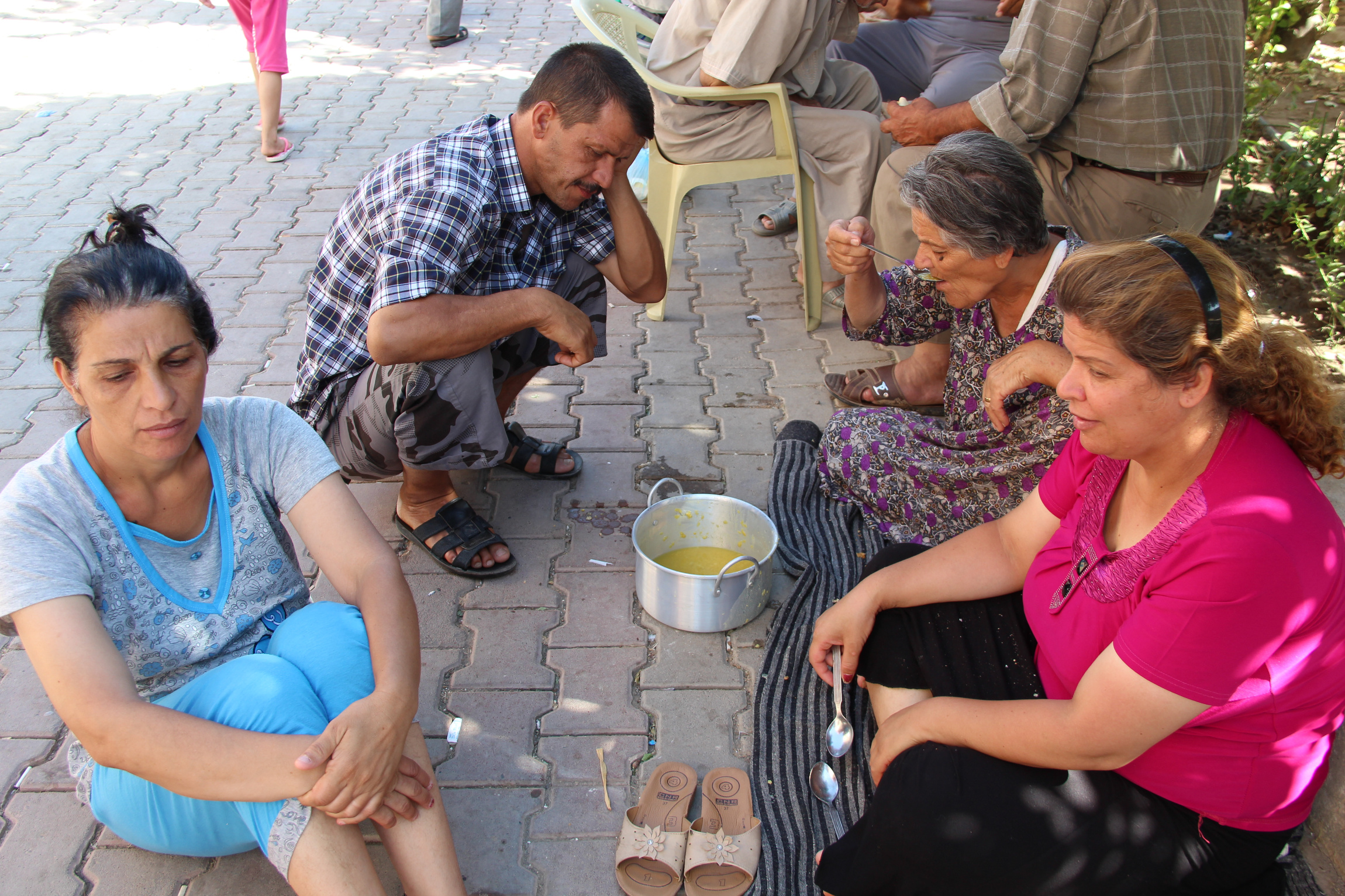
People displaced by violence sit outside St. Joseph Chaldean Catholic Church in Ankawa, Iraq, Aug. 14. A typical day for many Iraqi Christians encamped at Ankawa, near Irbil, would probably involve another round of struggle against desperation, frustration, anxiety, boredom and fear. (CNS photo/courtesyvAid to the Church in Need-USA)
People displaced by violence sit outside St. Joseph Chaldean Catholic Church in Ankawa, Iraq, Aug. 14.  A typical day for many Iraqi Christians encamped at Ankawa, near Irbil, would probably involve another round of struggle against desperation, frustration, anxiety, boredom and fear. (CNS photo/courtesyvAid to the Church in Need-USA)
People displaced by violence sit outside St. Joseph Chaldean Catholic Church in Ankawa, Iraq, Aug. 14. A typical day for many Iraqi Christians encamped at Ankawa, near Irbil, would probably involve another round of struggle against desperation, frustration, anxiety, boredom and fear. (CNS photo/courtesyvAid to the Church in Need-USA)

LONDON (CNS) — A Chaldean Catholic archbishop called for the redeployment of U.S. and British troops in Iraq to prevent the “genocide” of Christians and other minorities by Islamic State militants.

Archbishop Bashar Warda of Irbil, Iraq, said he believed the U.S. had a duty to “finish the mission” in his country by ridding the Ninevah Plain of extremists who last summer drove some 120,000 Christians from their homes.

He described the Islamic State as a “cancer” which had to be cut out if it was not to infect future generations of Muslims and create a potentially greater threat than Afghanistan under the Taliban and al-Qaida.

“I would like to see American or European or international troops alongside Iraqi troops working to liberate these lands, not alone but together,” he told Catholic News Service after meeting with some British politicians in the House of Lords Feb. 9.

“Definitely, I would like to see more involvement — more airstrikes, because that is also needed,” he said.

U.S. military expertise and resources were crucial in defeating the Islamic State, he told CNS, because neither the Iraqi army nor the Kurdish Peshmerga militia were sufficiently trained or equipped for the job.

Archbishop Bashar Warda of Irbil, Iraq, as seen Feb. 9 in the House of Lords in London. The Iraqi archbishop called for U.S. boots on the ground in Iraq to rid the country of the ÒcancerÓ of Islamist extremism that is threatening the genocide of his people. (CNS photo/ Simon Caldwell)

“They (the Americans) know how to tackle these terrorist groups,” said Archbishop Warda. “The sooner they finish the mission the better, because this is a cancer which needs to be stopped and treated, because otherwise we would have generations of people growing up with the Islamic State mentality.”

He added: “We have to stop this cancer now, and we have to go for very difficult measures sometimes and very difficult decisions.”

“We have got 1.8 million displaced people in Kurdistan,” he added. “It is not just Christians; everyone is there.”

U.S. President Barack Obama authorized airstrikes against Islamic State in Iraq Aug. 8 and expanded them to Syria Sept. 24, but has so far resisted any substantial redeployment of troops following more than a decade of military operations in Iraq.

Archbishop Warda told the meeting in London that he would like to see Britain, which took part in the U.S.-led 2003 invasion of Iraq, also recommit ground troops to his country.

“It is hard for a Catholic bishop to say that we have to advocate a military action, but we have to go for that. There is no other option,” he said, warning members of Parliament that airstrikes alone were “not enough” and that time was running out for Christian refugees who wished to return home.

“If you are a politician I beg you to focus on that, to speak about this,” Archbishop Warda continued. “Military action is needed, a powerful one where they could really get those people out of these villages so that our people and others can return. Please use all of your efforts to make this happen.”

“Your voices are needed to speak loudly about the atrocities and the genocide that is there,” he added. “We would like to see our people back home as soon as possible, and I hope that I can meet politicians here to make that point.”

John Pontifex of Aid to the Church in Need, a Catholic charity set up to help persecuted Christians, told the meeting that no minority in the world was suffering with the same intensity as the Christians of Iraq, a community which has survived in the region since the first century but was now squeezed into refugee camps around Irbil.

“Christians in Iraq face the very real threat of being wiped out,” he said. “We recognise that as far as Christianity in Iraq is concerned, Irbil represents the last stand. With Christians gone from Irbil, it is more or less game over for Christians in Iraq.”

He added: “We must be clear that this extremism that we are seeing today bears comparison with some of the most despotic regimes this world has ever known. This is not the time for vacillation … this is the time for action.”

Archbishop of Warda visited Parliament as a guest of Lord Alton of Liverpool, a Catholic peer. He addressed the General Synod of the Church of England Feb. 10 and on Feb. 11 was due to celebrate Mass in Westminster Cathedral, London, with Cardinal Vincent Nichols of Westminster, president of the Bishops’ Conference of England and Wales.

— By Simon Caldwell, Catholic News Service. 

Catholics called to do everything in their power to end trafficking

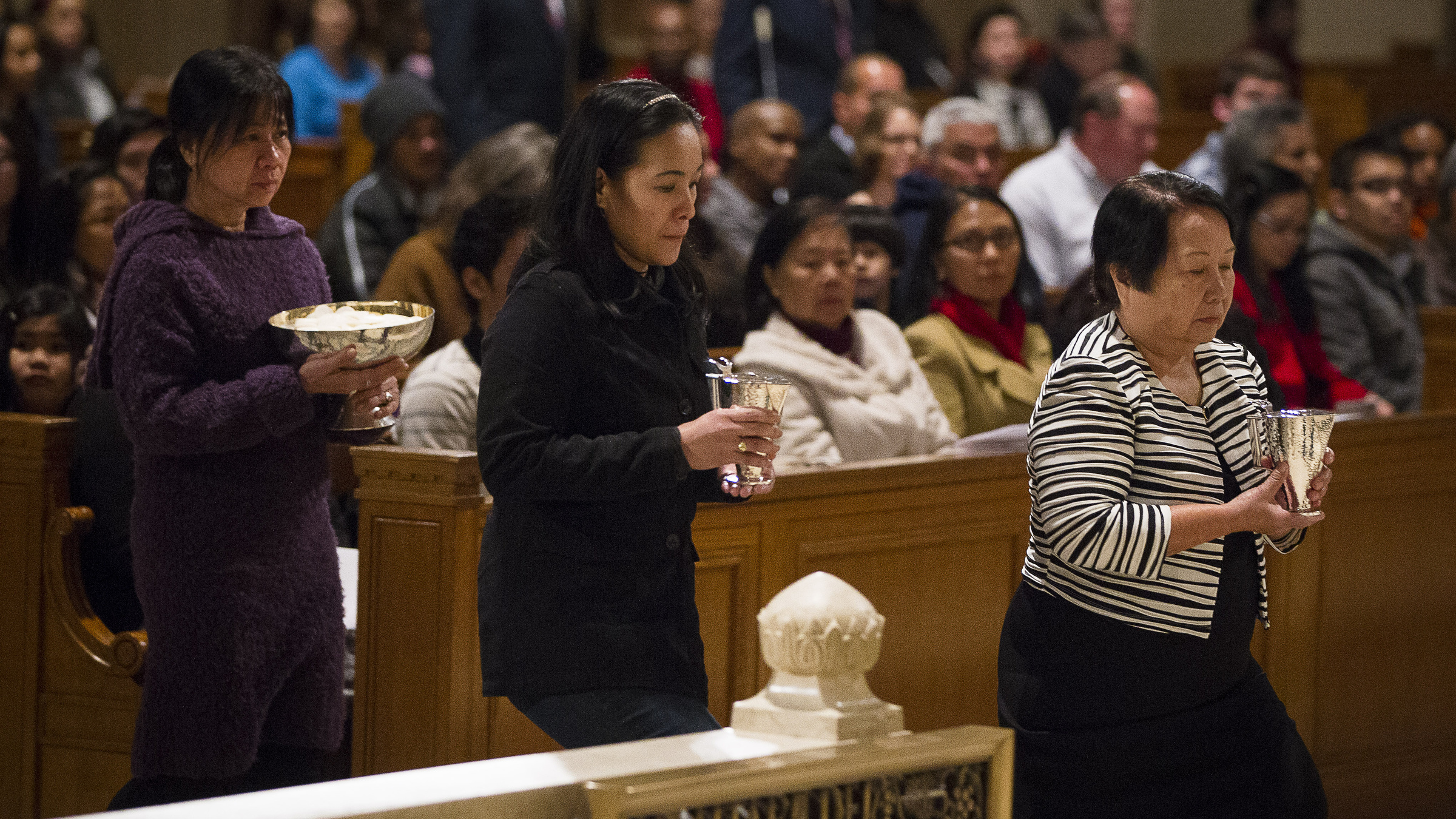
Survivors of human trafficking carry offertory gifts during at Mass celebrated Feb. 8 at the Basilica of the National Shrine of the Immaculate Conception in Washington to mark the International Day of Prayer and Awareness Against Human Trafficking. The Mass was celebrated on the feast of St. Josephine Bakhita, a Sudanese saint who was kidnapped by Arab slave traders in the 1800s. (CNS photo/Tyler Orsburn)

WASHINGTON (CNS) — Highlighting the life, suffering and enduring hope of St. Josephine Bakhita, a Sudanese slave, Washington Auxiliary Bishop Martin D. Holley called for reflection and action to combat modern-day slavery during his homily on the first International Day of Prayer and Awareness Against Human Trafficking Feb. 8.

We must “do everything in our power through the corporal and spiritual works of mercy to eradicate human trafficking,” the bishop told the nearly 1,000 people — including trafficking survivors — gathered for the noon Mass at the Basilica of the National Shrine of the Immaculate Conception in Washington.

Held on the feast of St. Josephine, the day was designated by the Pontifical Council for Justice and Peace and the International Union of Superiors General. Last year, the U.S. Conference of Catholic Bishops’ Migration and Refugee Services organized a national day of prayer for victims and survivors of human trafficking, and it spearheaded this year’s liturgy at the shrine.

The day offered the fruits of “compounded prayer” and was an opportunity to shed light on a pervasive tragedy, said Hilary Chester, associate director of the U.S. bishops’ anti-trafficking program, in an interview Feb. 6.

According to the U.N. International Labor Organization, there are nearly 21 million human trafficking victims worldwide.

Chester said that while there has been increased education and awareness, human trafficking is increasing.

In the United States, victims of labor trafficking are “all around us” in poorly regulated industries like agriculture, in-home domestic work, nursing home work and the food-service industry. Sex trafficked victims can be foreign nationals, but they also are U.S. citizens, often children who are in abusive homes or foster care situations.

“You see it all across the board,” Chester said in an interview with the Arlington Catholic Herald, newspaper of the Diocese of Arlington, Virginia.

In his homily, Bishop Holley told the story of St. Josephine, who was born in 1869 and enslaved as a child. Beaten and whipped nearly every day, young Josephine eventually was taken to Italy and freed with the help of the Canossian Daughters of Charity, an order she later joined. Canonized in 2000, she has been proposed as the patron saint of victims and survivors of human trafficking.

The bishop emphasized that human trafficking involves everyone and quoted Pope Francis’ apostolic exhortation “Evangelii Gaudium” (“The Joy of the Gospel”). The pope writes that many are guilty of “comfortable and silent complicity” in relation to the crime and have “blood on their hands.”

The pope addressed the global issue during his Sunday Angelus Feb. 8, asking government leaders to act decisively “to remove the causes of this shameful wound … a wound that is unworthy of civil society.”

About a dozen women who know such wounds firsthand were present at the shrine Mass and helped carry up the gifts during the offertory.

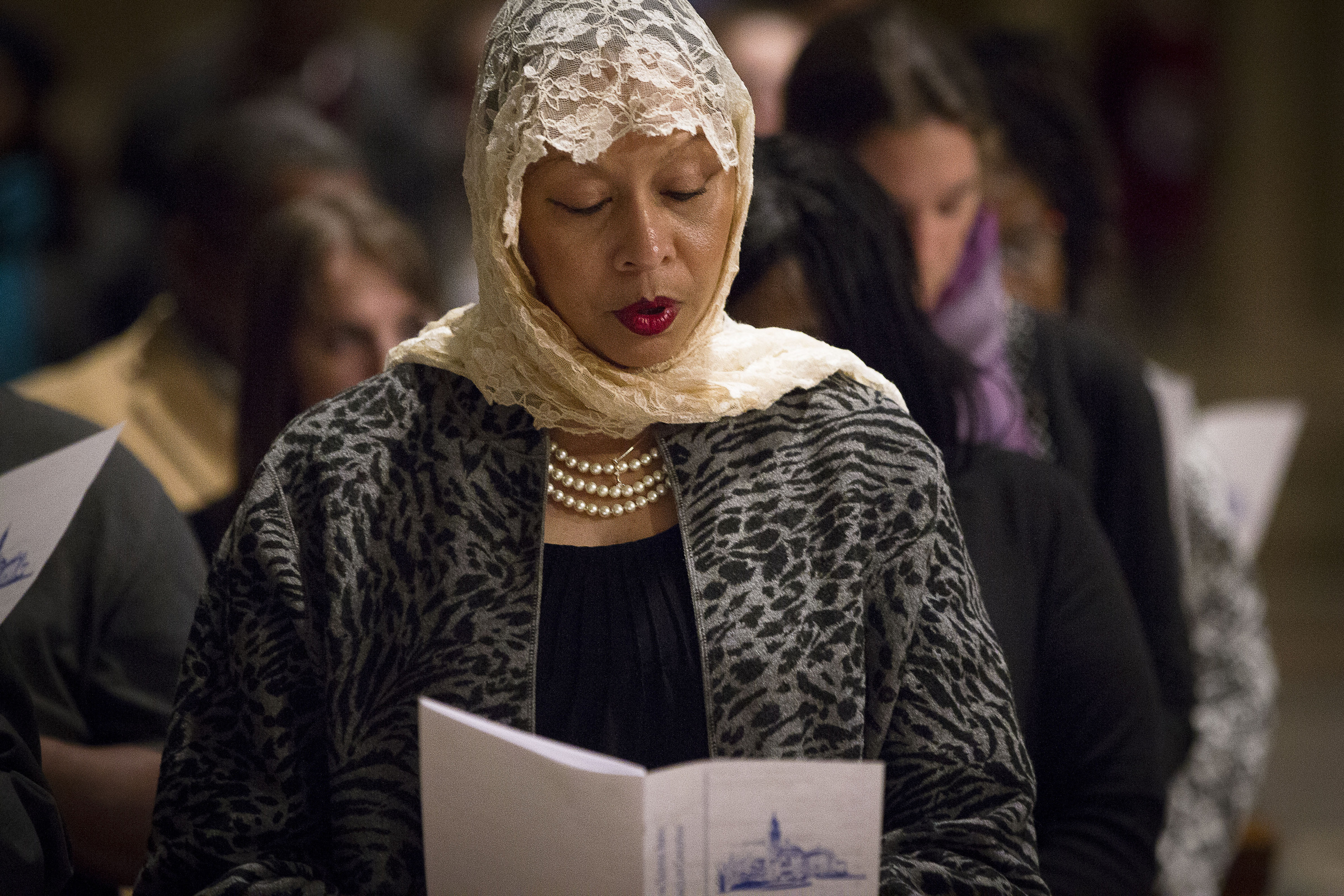
A woman sings during a Mass Feb. 8 to mark the International Day of Prayer and Awareness Against Human Trafficking at the Basilica of the National Shrine of the Immaculate Conception in Washington. The Mass was celebrated on the feast of St. Josephine Bakhita, a Sudanese saint who was kidnapped by Arab slave traders in the 1800s. (CNS photo/Tyler Orsburn) See TRAFFICKING-MASS Feb. 9, 2015.
A woman sings during a Mass Feb. 8 to mark the International Day of Prayer and Awareness Against Human Trafficking at the Basilica of the National Shrine of the Immaculate Conception in Washington. The Mass was celebrated on the feast of St. Josephine Bakhita, a Sudanese saint who was kidnapped by Arab slave traders in the 1800s. (CNS photo/Tyler Orsburn) 

The women, all highly educated teachers from the Philippines, were lured to the United States by recruiters with promises of a better life.

Because of corruption and a poor economy in the Philippines, may people are forced to migrate, according to Jo Quiambao, secretary general for Gabriela DC, a grass-roots organization that works with Filipina human trafficking survivors.

Illegal recruiters use sophisticated tactics to exploit the situation in the island nation, and high-level government agencies are involved, often approving fraudulent travel documents, said Quiambao during a reception after Mass.

Such was the case with around 300 women — 200 now in D.C. — who were promised lucrative teaching jobs in the United States. After selling their homes and exhausting their savings to come to the states, the women found themselves jobless, moneyless and with illegal status.

The U.S. bishops’ anti-trafficking program, carried out through MRS, is working with Gabriela DC to connect the women to social services and to educate and empower them.

Quiambao said the international day of prayer is “essential because it helps survivors heal, and because they are encouraged by knowing other people care — that they are not alone.” She said it also affirms the need to speak out against the crime.

Along with Gabriela DC, a number of representatives from coalitions and organizations attended the Mass, including the Mid-Atlantic Coalition Against Modern Slavery. Composed primarily of women religious, it focuses on advocacy and education while providing some direct service to victims.

Coalition member Sister Carol Ries, of the Sisters of the Holy Names of Jesus and Mary, said human trafficking is an issue that should be close to all Catholics’ heart. It’s a “pro-life issue,” she said. “It’s about respect for women and children; it’s about human rights.”

In partnership with the USCCB, Catholic Charities USA and Catholic Charities of the Washington Archdiocese, the National Catholic School of Social Service at The Catholic University of America in Washington will host a two-day conference on human trafficking this July. Will Rainford, dean of the school, said the conference will raise awareness among priests, diocesan leaders and lay staff who come into contact with victims.

Chester hopes this year’s day of prayer motivates “Catholics in the pews” to discern their own ability to fight human trafficking, whether through volunteering, material donations, awareness-raising or working to change and enforce laws. “There are a lot of opportunities,” she said, “where people can start making a difference.”

— By Katie Scott, Catholic News Service. 

Pope Francis surprises shantytown residents [VIDEO]

Pope Francis made a surprise stop at a shantytown on his way to visit a Rome parish Feb. 8.

Weekend calendar: Feb. 6-8

Oct. 16-18
Feb. 6-8 in the Diocese of Phoenix

The second semester of events for the catechetical year is in full swing. Take a look at some of your Catholic event options:

Young Adult professional first Fridays — 6-8 p.m. Feb. 6 at Diocesan Pastoral Center (map). Join peers for adoration, confession, Mass and a reflection on interior freedom. Info.

Catholic theater — Feb. 7-8 in Chandler and Scottsdale. Read 10 reasons why Catholics should see “Into the Woods” and hear an archived interview with the actor who portrays a nun in “Late Nite Catechism.”

Catholics in Hollywood — 7-10 p.m. Feb. 7 at Xavier College Preparatory (map).
Related story and info.

CDA kickoff — Feb. 7-8 at parishes across the Diocese of Phoenix. Take this sneak peek at the latest stewardship video. It will be shown during Masses this weekend.

Religious open houses — Feb. 7-8 across the diocese. Info on related blogpost.
Live outside the Diocese of Phoenix? Check out open houses nationwide.

Catechist congress — Feb. 7 at St. Mary’s High School (map). Info flyer.

World Day of Sick Mass — 1:30 p.m. Feb. 8 at St. Thomas the Apostle Parish (map).
Celebration is in honor of Our Lady of Lourdes. The Healing Mass includes and anointing of the sick, blessing of caregiver hands and blessing with Lourdes water. Related story on a local Catholic’s healing in Lourdes.

Adoption: A Loving Option — 9 a.m.-noon Feb. 7 at Catholic Charities, 4747 N. 7th Ave. Journey with mothers who have experienced an unplanned pregnancy and chose the loving option of adoption. Heart how the choice affects families who want children, but could not biologically.
RSVP required: (602) 650-4832 or email Alcira, [email protected]. Info.

Abortion: From Debate to Dialogue — Feb. 7. at ASU in Tempe. Hosted by Justice For All, a nationally-acclaimed training program to become a gracious, persuasive ambassador for life. Info.

Catholic, Orthodox leaders urge ‘unity against aggression’ in Ukraine

Ukrainians walk past symbolic crosses set up by protesters in front of the Russian embassy in Kiev, Ukraine, Feb. 1. (CNS photo/Sergey Dolzhenko, EPA)

WARSAW, Poland (CNS) — Catholic and Orthodox archbishops in Ukraine appealed for national unity against pro-Russia separatists as calls mounted for the United States to help arm Ukrainian forces.

Citing constant danger to Ukraine, the church leaders called the war “a crime against life” that brings “suffering and death, grief and injustice” in a Feb. 4 statement.

Archbishop Mieczyslaw Mokrzycki of Lviv, president of Ukraine’s Catholic bishops’ conference, and Ukrainian Orthodox Archbishop Filaret Kucherov of Lviv within the Moscow Patriarchate were among those making the appeal.

“But Ukraine, tired and tested, remains unbowed in its faith and dedicated effort of will,” the religious leaders said. “Before our eyes, a new state is being born, a new generation of heroes willing to sacrifice life, forget comfort and tranquility and be the first to respond to the homeland’s cry for help.”

The appeal was published as fighting intensified after a new separatist offensive in the self-proclaimed rebel republics of Donetsk and Luhansk.

It said Ukrainians had been unprepared for war and should avoid becoming accustomed “to the mundane sight of deaths and injuries” and “the grief of widows and orphans.”

“We urge mutual support, help in finding the truth and establishing unity in doubt and freedom in everything, since peace is a gift from God, the work of justice and the fruit of love,” said the signatories, who included leaders of Ukraine’s Greek Catholic Church and two smaller Orthodox churches.

“By uniting our efforts, we will overcome this aggression and evil in the name of dignity and the moral values, which will be the foundation of our invincible common future. We will safeguard the freedom granted us by God and not allow our country to be divided.”

NATO unveiled plans Feb. 5 to bolster its military presence in Eastern Europe, after Western officials accused Russia of sending troops and heavy weaponry into Ukraine, where fighting since April 2014 has left about 5,400 dead and 1.2 million people uprooted.

On Feb. 5, German chancellor Angela Merkel and French President Francois Hollande visited Kiev and were to travel Moscow Feb. 6 to present a new peace initiative. U.S. Secretary of State John Kerry said in Kiev Feb. 5 that the U.S. wanted a diplomatic solution but was currently “reviewing all options,” including the supply of “defensive weapons” to Ukraine.

In their declaration, the Catholic and Orthodox archbishops said Ukraine still needed “titanic, sacrificial work” to overcome the “disease of corruption,” which affected all of society “from senior officials to ordinary citizens.”

“But we are proud of our new heroes for their fortitude, patience and bravery, and for giving Ukraine so many examples of love of homeland,” added the church leaders, who have previously been divided over competing jurisdictions and property claims.

“We will continue to encourage unity through prayer, spiritual feats and physical accomplishments, since peace also means a struggle for life.”

Pope Francis, who will receive Ukraine’s Greek and Latin Catholic bishops Feb. 16-21 in “ad limina” visits, appealed for a “resumption of dialogue” in the country’s “tormented land” during his Feb. 4 general audience.

—By Jonathan Luxmoore, Catholic News Service.

House Speaker Boehner announces Pope Francis will address Congress

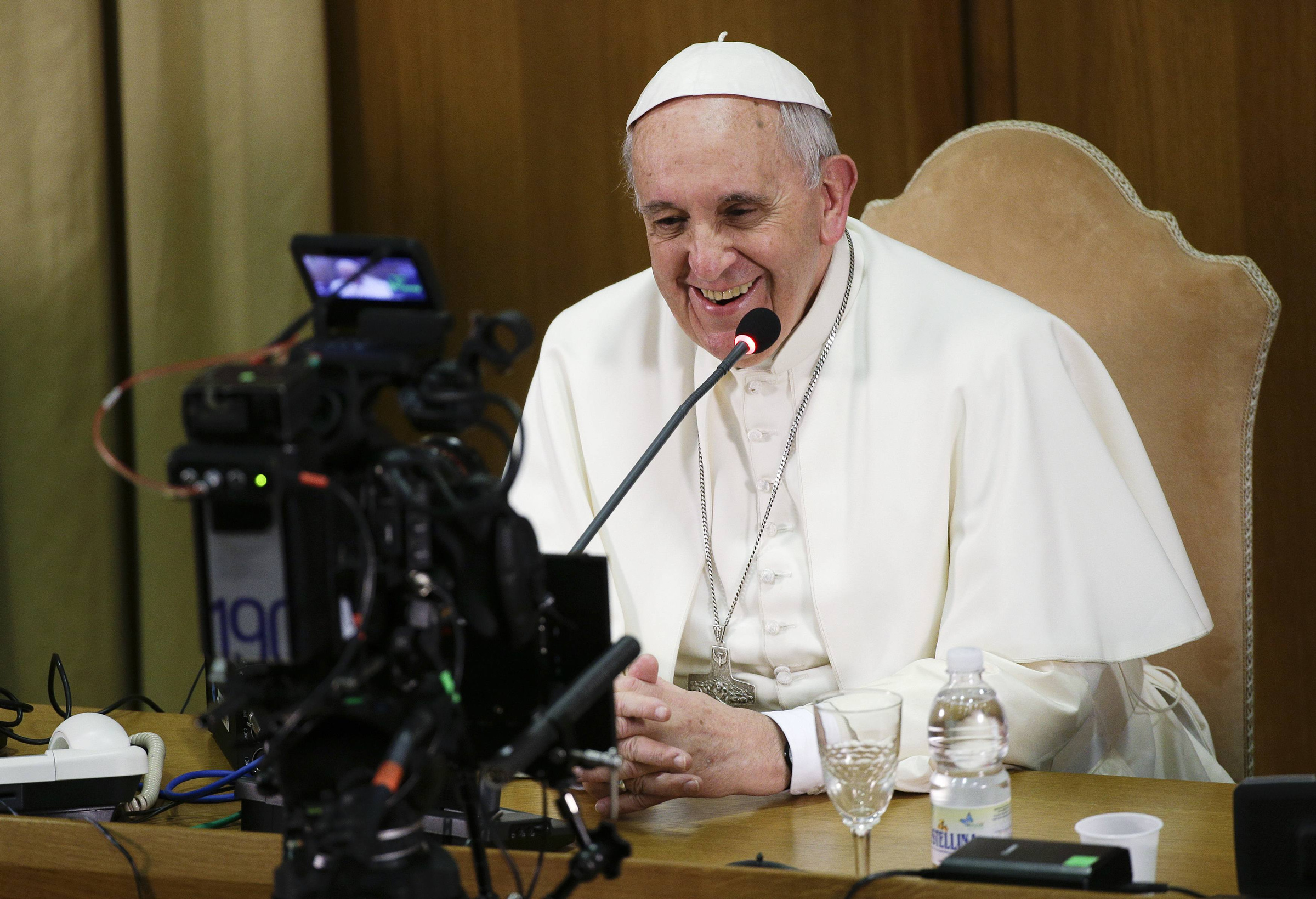
Pope Francis looks into to a camera during a worldwide broadcast online as he leads a meeting at the Vatican Feb. 5. The pontiff will visit the U.S. this fall. (CNS photo/Max Rossi, Reuters)
Pope Francis looks into to a camera during a worldwide broadcast online as he leads a meeting at the Vatican Feb. 5. The pontiff will visit the U.S. this September. (CNS photo/Max Rossi, Reuters)

WASHINGTON (CNS) — House Speaker John Boehner, R-Ohio, announced Feb. 5 that Pope Francis will address a joint meeting of Congress Sept. 24.

The pontiff’s “historic visit” would make him the “first leader of the Holy See to address a joint meeting of Congress,” Boehner said in a statement, adding that he was “truly grateful that Pope Francis has accepted our invitation.”

Boehner noted that “in a time of global upheaval, the Holy Father’s message of compassion and human dignity has moved people of all faiths and backgrounds. His teachings, prayers, and very example bring us back to the blessings of simple things and our obligations to one another.”

“We look forward to warmly welcoming Pope Francis to our Capitol and hearing his address on behalf of the American people,” he added.

A statement from the Archdiocese of Washington called it “a great honor and tremendous joy to welcome our Holy Father, Pope Francis, to the Archdiocese of Washington during his proposed pastoral visit to the United States in September.”

The statement said the announced visit “will be a time of grace for all of us.” It also said the archdiocese looks forward “to the official announcement of more details of the visit.”

On Jan. 19 when the pope was on the plane returning to Rome from his visit to the Philippines, he told reporters that his September trip to the U.S. would take him to Philadelphia, New York and Washington — where he intends to canonize Blessed Junipero Serra.

The pope also confirmed he would visit the United Nations in New York. He had already announced his participation Sept. 26 and 27 in Philadelphia for the World Meeting of Families there.

— By Catholic News Service.

FILMS: The SpongeBob Movie: Sponge Out of Water

Animated characters are seen from "The SpongeBob Movie: Sponge Out of Water." The Catholic News Service classification is A-I -- general patronage. The Motion Picture Association of America rating is PG -- parental guidance suggested. Some material may not be suitable for children. (CNS photo/Paramount)

NEW YORK (CNS) — With the arrival of the genial sequel “The SpongeBob Movie: Sponge Out of Water” (Paramount), self-proclaimed “nautical nonsense” is once again the order of the day.

As for the suitable audience for this fast-paced exercise in silliness, kindergarten-level potty humor and some mildly frightening plot elements aside, director Paul Tibbitt’s mix of animation and live action adds up to an appropriate outing for all.

Fans of the long-running Nickelodeon TV series “SpongeBob SquarePants,” on which Tibbitt has worked in various capacities, have had to wait quite a while for their hero’s second cinematic adventure. After all, his big-screen debut, titled — what else? — “The SpongeBob SquarePants Movie,” was released way back in 2004.

[quote_box_right]

Classification

“The SpongeBob Movie: Sponge Out of Water” (Paramount) — Catholic News Service classification, A-I — general patronage. Motion Picture Association of America rating, PG — parental guidance suggested. Some material may not be suitable for children.

[/quote_box_right]

As SpongeBob (voice of Tom Kenny) returns to the cineplex, his seabed hometown, Bikini Bottom, is thrown into crisis when the secret formula for Krabby Patties — the signature delicacy of the restaurant at which SpongeBob works as a short-order cook — goes missing.

Not only does this spell potential ruin for SpongeBob’s employer, miserly Mr. Krabs (voice of Clancy Brown), it threatens to tear the whole community to shreds since the absence of their favorite foodstuff promptly reduces Bikini Bottom’s normally tranquil residents to a pack of marauding hooligans.

So, with society falling apart around him, SpongeBob joins forces with an unlikely ally, his boss’ long-standing rival Plankton (voice of Mr. Lawrence), to retrieve the vital recipe. He’s also helped on his quest, with varying degrees of effectiveness, by his two best friends: dimwitted starfish Patrick (voiced by Bill Fagerbakke) and easily alarmed chipmunk Sandy (voice of Carolyn Lawrence).

Since Plankton was, as usual, plotting to steal the list of ingredients at the time of their disappearance, he naturally falls under suspicion. But, in an exemplary display of fairness and truth-telling, SpongeBob, who knows Plankton is innocent of the crime, stands up for the unpopular curmudgeon. Yet doubts remain as to Plankton’s true loyalties.

This gives screenwriters Jonathan Aibel and Glenn Berger the chance simultaneously to play with and to promote the commonplace screen message that teamwork is the key to success. Good-hearted SpongeBob preaches the gospel of cooperation unreservedly, but Plankton takes a lot of convincing.

Further obstacles are placed in SpongeBob’s way by luxuriously whiskered pirate Burger Beard (Antonio Banderas), who also serves as the tale’s manipulative narrator. Sometimes inside the story, sometimes working to alter it from the outside to suit his own aims, Burger Beard provides the link between the cartoon world of Bikini Bottom and “real” life.

Religion enters the picture, in a passing way, via Sandy’s panicked avowal that Bikini Bottom’s citizens must appease “the gods” in order to reclaim their meal of choice. It would take considerable interpretive effort, however, to translate her irrational, aimless paganism into even a veiled critique of revelation-based faith.

The film contains occasional menace and a few mildly scatological jokes. The Catholic News Service classification is A-I — general patronage. The Motion Picture Association of America rating is PG — parental guidance suggested. Some material may not be suitable for children.

— By John Mulderig, Catholic News Service.