
Pandemic pushes kids’ mental health issues to forefront

Suzanne Krumpelman, counselor at St. Joseph School in Fayetteville, Ark., reads to first graders about friendship Feb. 9, 2022. (CNS photo/Travis McAfee, Arkansas Catholic)

By Aprille Hanson Spivey, Catholic News Service

FAYETTEVILLE, Ark. (CNS) — Off and on, since the COVID-19 pandemic began and in-person instruction resumed, St. Joseph School counselor Suzanne Krumpelman in Fayetteville has spoken to students to gauge how they are coping.

During one informal survey, Krumpelman asked how many students know someone who has died from COVID-19 or become gravely ill.

“Almost every single one of the kids raised their hand,” she said. “And you know we just don’t think about it. There are kids who lost grandparents, uncles, cousins, friends who were significant in their life. They are dealing with a lot of other difficult things. … Every child has been impacted by this pandemic in one way or another.”

In December, U.S. Surgeon General Vivek Murthy issued a grim advisory regarding the mental health of youth.

While there was a mental health crisis among children before the pandemic shut down the world, the fact one in five children ages 3-17 are having a mental, developmental, emotional or behavioral disorder, the isolation, fear and uncertainty has magnified the problem.

“I think that’s where we all want people to be: ‘The kids are great, they are fine.’ They probably seem that way, but they are not. You have to dig a little deeper,” Krumpelman said.

According to a September report from the Children’s Hospital Association, there was a 45% higher rate of reported self-injury and suicide cases in children ages 5-17 in the first half of 2021 than in the same period in 2019. There also was a 14% increase in mental health emergencies in the same age group in the first two quarters of 2021 compared to 2019.

“I think for sure parents need to be keeping an eye on their kids. The stress level is very, very high for kids right now,” Krumpelman told the Arkansas Catholic, newspaper of the Diocese of Little Rock.

“I have had to work with more kids than I ever had in two years that are having panic attacks for the first time. … Children, they just kind of survive the moment and go along with the moment,” she said, “and it takes a little bit of time for the aftereffects to happen.”

While adults may have processed why quarantining was necessary, younger children may not have. Suddenly, they were not allowed to see friends, go to school, church or anywhere for fear of catching a potentially deadly virus, along with wearing masks and taking other safety precautions. There was no longer a routine.

Msgr. Jack Harris, pastor of Sacred Heart Parish in Morrilton, Arkansas, and a trained crisis counselor, said the biggest threat to mental health he’s seen in his students at the parish school is isolation and loneliness stemming from virtual learning and quarantining.

“School is a traumatic thing, to begin with; it’s hard. It really is; the demands, the requirements are hard to meet. If you are having trouble with that, it’s a trauma,” he said. “These things can really create difficulty. Add that to trying to handle that on your own or virtually.”

The Centers for Disease Control and Prevention characterize anxiety in children as not outgrowing certain fears or worries or when those worries “interfere with school, home or play activities.”

Persistent feelings of sadness or hopelessness can indicate depression. Other indicators include not wanting to do fun activities, changes in eating or sleep patterns, energy level changes from tired to restless, difficulty paying attention, feelings of guilt, uselessness or worthlessness, and self-injury or self-destructive behaviors.

Krumpelman said there are some signs that may not be as obvious to determine if a child is suffering from anxiety, depending on their age.

“The little ones, a lot of times they are just really active, sometimes it looks like ADHD (attention deficit hyperactivity disorder). They are quick to get angry; they are irritable,” she said.

Other signs for younger children could be a hard time concentrating, having dreams or nightmares, wanting to sleep with their parents at night, being clingy, overreacting or obsessively crying over things, stomach aches and making frequent trips to the school nurse.

“Just needing to go to the bathroom a lot in class. That’s their way of getting out of a situation” that might be making them anxious, Krumpelman said.

Older children and teenagers may also experience those things, but older ones typically exhibit constant worrying and extremes — sleeping too much or too little, trouble concentrating, spending too much time with others or always wanting to be alone and fighting about things they haven’t before.

“‘What if this happens, what if that happens.’ They might start worrying about their family, Mom or Dad out in the (bad) weather that wouldn’t (usually) be a huge concern for them and all of the sudden they’re worried about things like that,” Krumpelman said.

Being overly critical of themselves, saying things like, “Oh, I can’t do anything right, nobody likes me” can be an indicator, she added.

Though each child is different, Krumpelman said, in her experience boys do not tend to talk about their feelings but act out more with negative behaviors.

“Girls will tell you a little bit more. But this is not something kids can put into words,” she said.

Krumpelman suggests parents try to talk to their children, but they may not be open to sharing.

At that point, reach out to teachers or other adults in their life to see if they have noticed changes. she suggested. If a pattern of behavior continues for weeks or things get worse, especially with self-harm or talk of suicide, a counselor needs to get involved.

From a pastoral standpoint, it’s about being present. Msgr. Harris greets students as they arrive at school, asking about a canceled game or activity, a hard test or any challenge they might be facing.

“Being out there and doing that is very important. That kind of an informal being on their turf, showing up there when you can be somewhere else, but you’re not,” he said.

Schools can also provide resources to parents. In the fall of 2021, Our Lady of the Holy Souls School in Little Rock hosted a two-night viewing of the 2017 documentary “Angst” about anxiety and a panel discussion. The school has seen “heightened levels of kids that are talking about self-harm” and struggles going back to campus after virtual learning, said principal Amber Bagby.

“I just feel like trauma is trauma no matter where you are. It definitely presents itself differently than some of the public schools I was in, but the feelings are all the same,” Bagby said. “There’s a misconception I think a lot of people have with our private schools that our babies are free of some of that stuff.”

“I think we’re up against a little bit of that stigma of ‘I’m having anxiety or a panic attack, I must be the only person.’ It’s important for kids to know (that) everyone is suffering right now,” Krumpelman said.

Ministry supported through CDA funds sees its mission as addressing unwed pregnancy – one mother at a time

By Jeff Grant

PHOENIX — Unmarried, alone and pregnant.

Three words that together describe a daunting situation for any young woman, even more so for someone in her teen years. But where despair and uncertainty exist, the personnel at 1st Way Pregnancy Support Center see opportunity to share the love of Jesus while providing practical and physical guidance toward delivery of a new baby.

“We really feel the charism the Lord has placed upon our hearts is not only tests, ultrasounds, education, counseling; but really establishing relationships with the women and men who come to us,” explained Katie Wing, 1st Way’s Executive Director.

One of several pregnancy support centers in the Diocese of Phoenix, 1st Way was established in a house in 1972 by a group of volunteers with a burden for the unwed, young mother with little or no resources or support system. Today, it has grown to occupy a modest, two-story office at 16th St. and Whitton Avenue in central Phoenix staffed by three salaried positions and a number of part-time personnel.

In addition to Wing, there are a nurse manager and education coordinator and an operations and business manager, with another nurse, men’s program and community outreach coordinator, and assistants.

“Men are very much a part of what we do. Being a mother. It’s the hardest job on the planet. We let the mothers and fathers know how valued they are,” she said.

While it is rare for a man to accompany the expectant mother – for every 30 new clients two are couples – Wing said men have an innate ability as provider and protector. Men are invited to share in the classes, including post-partum depression, as well as some geared primarily toward fathers and husbands, such as budgeting and time management.

There is no requirement a client be a Catholic or even religious.

“Mother Theresa didn’t go into the streets and say, ‘Before I help you, I have to know do you believe in Jesus Christ?’ She just picked them up and loved them,” Wing explained. “If the Holy Spirit opens an opportunity to talk about faith, we will. If not, we still feel we are yielded to His love.

“We try to be vessels of the love of Christ and the Blessed Mother, and have the words to discuss the beauty of marriage and life.”

To foster its approach, 1st Way continues to serve a mother until her baby is a year old, providing material and educational resources while seeking to help her avoid a repeat occurrence. In addition to pregnancy testing, limited ultrasound imaging and counseling for both women and men, the center provides classes on pregnancy and parenting, as well as community referrals.

The center also offers items such as diapers, wipes, formula, layette items, pacifiers, bottles, bibs and blankets, as well as maternity clothing at three junctures during her pregnancy. Counselors are also available throughout the process.

Supported entirely by donors and its Charity & Development Appeal grant through the Diocese, the organization produces a monthly newsletter, and Wing speaks at parishes, bringing a table with information. The organization also advertises in bulletins.

She said 1st Way would use additional funding to upgrade its technology, and expand its evening hours and courses, as well as hire another nurse.

The need for services such as those offered at 1st Way remain consistent, including among 16-20-year-olds, where Arizona falls exactly in the middle of the 50 United States when it comes to teen births.

The most recent U.S. Centers for Disease Control data show 19 of every 1,000 females in Arizona between ages 15-19 gave birth during 2019 — that’s 4,318 teen births. Arkansas’ was the highest rate – 30 per every 1,000 females — followed closely by Mississippi. The lowest rate (6.6 births for every 1,000) was recorded in New Hampshire.

1st Way also is concerned with preventing young women from having abortions.

According to the Arizona Dept. of Health Services 2020 report, “Abortion in Arizona,” there were 265 procedures performed on girls between 15 and 17 in 2019 – the last year figures were available; 889 for women between 18 and 19; and 3,908 involving women 20-24. The rate of abortions was five per every 1,000 females ages 15-19 and almost 16 women for every 1,000 between ages 20-24.

But Wing and her colleagues don’t view their service as in terms of numbers. Instead, the staff prays and works to treat each person who comes to them as an individual – the way God sees them — created in His image and likeness with their own story.

“So many really have not had anyone care about their story. We want to hear about them. One of the arguments we have found in prochoice circles is, ‘all you care about is the baby.’ We care about the mother, the father and the family. We see pro-life as comprehensive. We feel strongly the Lord has laid on our hearts learning the situations that brought them here. Otherwise, people will repeat the cycle over and over again.”

‘My faith is here’: Participants find inspiration, knowledge as annual Catholic Women’s Conference returns

The audience listens during the morning session of the 11th Annual Catholic Women’s Conference inside the Virginia G. Piper Performing Arts Center at Xavier College Preparatory in Phoenix Saturday, Jan. 29, 2022. Jeff Grant/THE CATHOLIC SUN

By Jeff Grant

PHOENIX — Women from across the Diocese were encouraged in their faith recently through a series of speakers and fellowship during the 11th annual Catholic Women’s Conference sponsored by Catholic Women of Phoenix.

The Jan. 29 gathering at Xavier College Preparatory in central Phoenix drew about 300 women of all ages to the school’s Virginia G. Piper Performing Arts Center, where participants heard a variety of national and local figures offer strategies and inspiration for living their Christian beliefs in a world whose culture increasingly challenges them to do so.

Titled “One Life is All We Have,” the conference also allowed women to spend a day with friends and make new ones, something the pandemic has made difficult.

“Just being here, you feel you’ve come home, in a way, among all these other women,” said Gerianne Heslin, a mother of five grown children ages 22-33 and parishioner at Our Lady of Perpetual Help in Scottsdale. “This is a great shot in the arm.”

Following a welcome from Catholic Women of Phoenix President Roberta Bazuldua, the day began with keynote speaker Noelle Mering discussing Woke culture and how it undermines the Christian faith.

Described by Merriam-Webster as “chiefly U.S. slang,” the dictionary defines Woke as: “Aware of and actively attentive to important facts and issues (especially issues of racial and social justice).” The word has come to represent an embrace of progressive activism.

Author of “Awake, Not Woke: A Christian Response to the Cult of Progressive Ideology,” Mering told the conference Woke has subverted Catholic and Christian beliefs by playing upon the very real and desired faith principle of compassion. “The ideology wins many adherents by operating parasitically off Christian instincts and precepts and seeking to replace them,” she explained. “Pointing to real problems and true injustices prompts us naturally to the sort of compassion that the Christian life truly demands. It appeals to our better natures, then supplies fundamentally destabilizing and dehumanizing answers.”

The growth of Wokism already has done damage, she continued. It has fragmented society and continues to deepen the divide, pitting supporters — who portray themselves as victims of heavy-handed authority — and believers against one another. The Wokist stands in opposition to God’s authority, which is reflected in the family, and embraces community and government order.

“We have destabilized the natural bonds that root and fortify us, and in their absence, we are pulled by the sway of the crowd,” she said.

Further, she said the operating principles of Woke ideology rest on three basic distortions:

“It reduces the person in favor of the group. It corrupts our understanding of a stable human nature by deifying our will. And, it elevates human power over true authority. What is rejected – reason, the person, and authority – are the three characteristics of the Logos that is the reason or mind of God in the person of Jesus Christ, who is author and authority over all,” she continued.

The end result is those who consider themselves “victims” are honored, and the ideology replaces recognition of the individual’s God-given reasoning ability.”

Such is the Woke position that oppression is “at the core” of womanhood. So, as Mering pointed out, the Wokist believes a “woman’s perfection exists in fighting her oppression and striving for power. A woman who is not a feminist is denying something central to her womanhood,” they would argue.

A fellow at the Washington, D.C.-based think tank Ethics and Public Policy Center, Mering said Woke philosophy also preys on the value of compassion, leaving the Christian vulnerable to the flawed thinking.

“From the sexual revolution to the transgender movement, we are told the sexual lives, proclivities and identities of others do not affect us — that love demands we normalize such behaviors and identities,” she said.

Linda Gibson, a grandmother and parishioner at St. Thomas the Apostle in Phoenix, lauded Mering’s talk, saying that Wokism has caused division and pain within her own family. But she said the culture’s effects can be overcome through prayer and perseverance.

“When one person in our family is wounded, we all are wounded. We have truth; God is truth, love, and life. The truth will be what sets us free.”

The next speaker, Christine Accurso, offered practical tips to living one’s faith in the public square by speaking or acting for what is right.

People keep calling our society ‘post-Christian.’ Well, I’m not post-Christian. I am living in Christian society. Until I die, my society is going to be Christian, if I can help it. Our influence is very important,” asserted Accurso, a Gilbert resident and past executive director of First Way Pregnancy Center in Phoenix.

“We are guided by sets of principles. As a Catholic, we live by the Gospel. As an American, we need to know our Constitution. With these and a good prayer life, you’re going to know exactly how to live and thrive as a Catholic in America today,” she continued.

Doing so also requires diving daily into God’s Word.

“If you don’t read the Bible. If you don’t hear the readings at Mass, you’re not going to know what Jesus expects of us. It’s through His parables and what they teach us, that we know how to act.”

Accurso urged her audience to stay informed and be involved.

“We’re not just the hands and feet of Jesus. We are His voice, sometimes, too.
“Use your instincts. For example, if you see something wrong happening in your child’s school, speak up. Don’t make a real big deal about it. Go to the person responsible for the decision, and say, ‘Can you explain this to me? Because that’s not really what I signed up our son to go to your school for.’”

Public meetings are online and can be viewed anytime, she added, noting the schedule challenges many mothers – especially working moms — face.
“Can you imagine if every person in this room took one little thing and acted on it? We would make a loud difference!”

She also urged women to keep their spiritual antenna up.

“The Holy Spirit is not going to speak to you at a designed time every day. The Holy Spirit is going to say what he wants, when He wants.”
The simple, straightforward advice and down-to-earth style reached many in the audience.

“Her talk was very inspirational,” said Angela Filler, a pediatrician, a mother of three grown children, ages 19-29, and parishioner at All Saints in Mesa.

“I admire her willingness to be so open to take the time to engage with people at all levels. I like her willingness to be open to everybody. We are moms with grown children, and I see a lot of missed opportunities for engagement, with regret.”

Still other speakers made impressions as well.

Fr. John Nahrgang, Vicar for Evangelization and Education in the Diocese of Phoenix, at one point said that women can find numerous strong female examples of faith, beginning with the Blessed Mother.

Fr. Nahrgang also said the family has been under attack since before the Fall of Man. In tempting Adam and Eve to violating God’s command against eating from the Tree of the Knowledge of Good and Evil, the serpent worked to divide the first couple by first targeting Eve. Later, he worked to pit brother against brother through Cain’s jealousy toward Abel.

Satan’s lie that man would become like God by eating from the forbidden tree remains very much alive today. Unbelievers often live by their own standards and ideas, “inventing their own terms of good and evil,” he explained.

One of the many manifestations of this is reflected in homosexuality and transgenderism, aberrations of what God created us to be as men and women.

“Our sexuality is a gift of God. We are stewards of that, and with stewardship comes responsibility,” Fr. Nahrgang said.

Afternoon keynote speaker Kathleen Beckman echoed those themes.

The sale of Joseph by his brothers into slavery as yet another example of Satan targeting the family, and she pointed to Mary’s humility, obedience, faith, gratitude and satisfaction with what God has given her as strong examples for women to follow.

Catholic evangelist and administrator for the Diocese of Orange, Calif., exorcism and deliverance ministry administrator Kathleen Beckman, the afternoon keynote speaker, pauses for a photo with author and Ethics and Public Policy Center fellow Noelle Mering, during lunch at the 11th Annual Catholic Women’s Conference at Xavier College Preparatory in Phoenix Saturday, Jan. 29, 2022. Jeff Grant/THE CATHOLIC SUN

Beckman urged her audience to prioritize family, and protect it through prayer and participation in the Sacraments, drilling down into Scripture.

The Diocesan Administrator of Deliverance and Exorcism Ministry in the Diocese of Orange, Calif., for 13 years, Beckman said these weapons in “the Catholic arsenal” are also effective for family healing and restoration. She urged women to “put on the full armor of God,” echoing St. Paul in his letter to the Church at Ephesus (Eph 6:10-18).

During an interview with The Catholic Sun prior to her presentation, Beckman said women who are “not well-Catechized become vulnerable to the loud voices of the world, as well as the flesh.”

The day marked the conference’s return after a 1-year absence. Public-health concerns over COVID-19 cancelled the 2021 event.

Bazuldua said isolation and curtailing of many church activities that allow women to come together was very much on the Catholic Women of Phoenix’s leadership team when assembling its 2022 lineup.

“We (were) focusing on what the last two years have brought out in society and spiritual warfare. Those are two areas we need to know more about and enter the fray with guidance regarding who we are and what we believe. The shutdowns and quarantines placed a lot of responsibility on women’s shoulders. Women needed to rise to that occasion in a different way than men. We had to form our families in a time when we couldn’t get to church and had no Religious Ed classes.

“Most of all, because we are the ‘hearts’ of the home, women had to step up in big way. Many had to do this with grieving hearts because we lost so many people in this pandemic. We hold pain a little differently.”

Participants acknowledged the challenges of pandemic life and their drive to persevere despite its limits.

“You have to get up really early, I mean 5, y’know? You have to be alert, get your spiritual antenna up,” commented Gerianne Heslin. “I think the Mass; receiving the Eucharist is absolutely key. You have to start over every day. The rosary is one of your greatest weapons as well. If I don’t do that every day, it’s a mess.”

Her friend, Angela Filler, saw the motherly challenges from a different perspective at her medical office.

“When schools were shut down, it was extremely taxing on the parents, moms trying to work from home, teach their kids from home, it was chaotic. In my practice, I see a lot of anxiety, depression, a tremendous increase in weight, tremendous amount of obesity over the last 2 years, kids finding ways to cope with carrying out their roles in a confined setting,” the pediatrician explained.

Others cited the role of women in forming their children’s faith.

“You have to instill your values, teach them. You can’t rely on the schools to do it, or even the Church. You have to do it. It has to come from your household and your family. If you don’t, they’re going to learn it somewhere that you don’t want them learning it,” said Adrienne McGurran, a mother of two children, 8 and 11, and parishioner at St. Mary Magdalene, Gilbert.

“It is so important to have the Catholic community to strengthen you and hold you accountable. You learn from them, and they learn from you. It’s impossible to be alone.
It’s very important. …to support one another as we go through life’s trials…to be there to support one another, to pray for one another and to help each other…to have somebody to talk to as our kids grow up and go through life experiences; to share knowledge or wisdom…to teach them our ways, the right ways, the Catholic ways,” she said.

“My faith is here.”


These sisters act on athleticism to spread Gospel

Sister Clare Marie Bailey huddles up with her team during a game of Ultimate Frisbee with GCU students on Dec. 8, 2021.

Story by Mike Kilen
Photos by Ralph Freso
This article was originally posted on GCU Today and is reprinted here with permission.

Nuns are on the run, right on a mid-campus soccer field. Their brown habits flare behind them, sprinting after a soccer ball, when a student runs smack into strong Sister Kelly and crumbles to the turf.

“Are you all right?” Sister Kelly asks because, you know, she’s a good person – before charging after the ball.

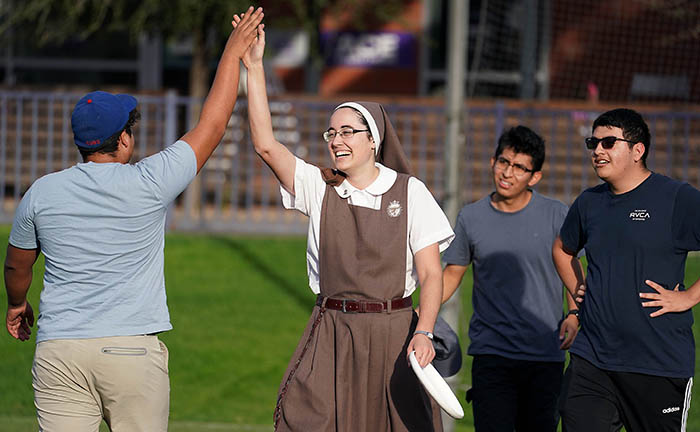
After that, the flying discs appear for a game of Ultimate Frisbee and this time it’s Sister Clare flying downfield, gracefully extending to pull a tailing disc off her shoe top, flicking it ahead to a teammate … and we have a score.

“You gotta want it!” Sister Clare yells.

Cliché alert: Isn’t it cute, the sisters, these athletic versions of “Sister Act?”

Metaphor alert: “You gotta want it” can describe the spiritual journey for these college students at Grand Canyon University who come out to play, sister style, on Wednesday afternoons.

Sister Clare Marie Bailey and Sister Kelly Grace O’Ryan are of the Holy Spirit Catholic Newman Center, which serves GCU students in a purple-door spiritual gathering place just across Camelback Road at 31st Avenue. They are Catholic affiliated, but everyone is welcome, and they attract everyone from the non-denominational Christian campus.

Since their assignment here 18 months ago from their community, the Servants of the Pierced Hearts of Jesus and Mary in Miami, Florida, the Sisters have seen the souls at Sunday Mass triple.

They say they are here to share the Lord with anyone, bring them to His love. But you gotta want it.

“We have a greater mission than soccer or Frisbee,” says Sister Kelly. “We see the Lord working in souls every day, especially college students at such an amazing moment in life, this new astonishing moment, discovering themselves and the world. But they have this great capacity to love the Lord and His plan for them.”

The sisters are young-ish, athletic, so darn smiley. They take students on monthly hikes up Phoenix mountains, and one day Sister Clare sees a pull-up bar on the trail.

She jumps up and rips off some pullups, rapid-fire, says student Juan Diego, “and we’re like, ‘I guess the strength of the Holy Spirit is really in her.’”

The myths of nunnery take a beating.

“I always thought of nuns like in movies,” said student Chapman Koster. “There would be this old woman who is a stickler for the rules: ‘I’m going to heaven, but life is garbage and if you are happy you are sinning.’ But on those hikes, it’s like hot and you go up these mountains and they are in habits and I don’t know if those things are breathable.”

What he’s saying is these sisters changed his view, and not just about nun physical fitness. He saw joy and peace and hope in them, which he will describe after another sprint down the field.

‘Live life together’

Before the play is prayer. Ten students pinch rosary beads in the courtyard between Building 16 and 26. The rhythmic prayer begins, a low murmur of Hail Marys and Our Fathers and Apostles Creeds that becomes a meditation among skateboard wheels scraping on concrete.

Their fingers go from bead to bead. Some close their eyes.

“It’s just a beautiful way for our prayers to get to Jesus and Mary,” said student Anya Ibasco.

Can’t you do that in your room?

It’s community, she says. “It’s that constant looking out for each other, wanting each other to get to heaven.”

The sisters say this public display of game and prayer, as well as wearing the habits the color of the soil of the Holy Land, accented with white for purity and burgundy for sacrifice, are meant to announce that they are here, for everyone.

“The church is a family and families don’t just read together,” Sister Clare said. “So we are out here to live life together.”

Sister Kelly says students are announcing that Christ is the center of their lives, and to come out from the quiet of residence halls or chapels into the open air of campus is a gift. “To say what is most important to me right now, here I am to pray.”

Everywhere they go, the grocery store, the gas station, people come up and ask the sisters to pray for a loved one.

Or they might see Sister Clare at Home Depot the other day, carrying two propane tanks and a bag of sand. “That’s what we do,” she says.

Why they do it becomes clear.

‘For that one heart’

Sister Kelly Grace O’Ryan high fives a teammate after a score during a game of Ultimate Frisbee with GCU students on Dec. 8, 2021.

Sister Kelly wasn’t unlike many GCU students when she was a freshman at Illinois State University. Tall and lean, the high school volleyball player set out to join every club she could and signed up for eight. Busy always but miserable in the quiet of her room.

“What else?” she asked herself. “I become club president, then what? I get my degree and get a job, then what?”

She recalled the happiest people she had ever seen, the students over at the university’s Newman Center. She eventually joined them and went on a mission trip, where she met two sisters “who laid their life down for the Lord.”

Sister Kelly wondered if she could do the same, if she prayed hard enough, if there was a sign of one person who needed her, “if it is for that one heart, then I give it. That’s when He called to my heart, that yes, I am calling you to be a sister for that one heart.”

When Sister Kelly returned, she went to a Bible study, recalling the five-point plan (they call “five stones”) that the sisters taught her involving prayer and Scripture, a way to let go and walk toward peace and freedom, and her path became clear.

“I can’t help but smile,” she said. “That was the greatest moment of my life.”

Sister Clare was coincidentally at the same university, though they weren’t a working pair yet. She was into gymnastics and cheerleading, a shorter, no less strong sister.

She felt the same loneliness until she felt the freedom, peace and joy of living with the Lord.

“I felt like I was crawling blindfolded through life, and then it was like I was soaring,” she said. “It was like this is what we were created to live.”

When a high school friend passed away, the grace that she had received she deeply wanted to share with suffering friends.

“I wanted to give them that more than anything,” she said. “That was where the seed was planted.”

‘Their faces are different’

And now they give it to GCU students.

There are no grand parties at Newman to attract students. There are Bible study nights, Mass, prayer and the occasional cookout (see propane hauling). The sisters see students reaching out, asking the same questions.

“What is my life for? Yeah, maybe a 9-to-5 job, but even more,” Sister Clare said. “Our life is a gift and is made to be given to another. Knowing I am a gift, and it is to be given.”

When it dawns on them, it’s in their faces.

“We see a transformation. Their faces are different,” Sister Kelly said. “It’s that peace, a joy, a newfound love and passion. Living life, not walking through it daydreaming – as so much of our culture has given anesthetic to our young so they sleepwalk through life. And when the Lord comes in it’s like going from black and white to color. They come alive, they wake up and start to experience freedom, peace and joy of the Lord.”

They see the blossoming, the withering, the coming back to their faith in an ongoing process that can become a flourishing of human spirit.

It’s a lot to get and to give.

But Sister Kelly says these nuns are “beautiful artists and musicians and athletic and funny and loud and all those things you don’t think of a sister, all these talents we give to the Lord.”

They have given up marriage, children, professional accolades and material riches, taking the vows of poverty, chastity and obedience.

But they get a lot back. They see freshman Brianna Chavez find her way to Newman, back stronger to her faith, and “it was so powerful and unexpected,” Chavez said. “We all come from different parts of the country but all have this goal to learn more.”

Chapman, coming off the field with a light sheen of sweat on his brow, is still amazed.

He grew up Baptist in South Africa and remembers first spotting the sisters running around and thinking: “I heard they took these vows that sounded miserable – no marriage, no sex, no money. Why would you do that? Then I see they are actually happy. Maybe I should look at it and reassess.

“Now not all Catholics are great, but some have such joy and hope and peace, and I didn’t have anything like that. Even though I haven’t lacked anything in my life – I come from a somewhat wealthy family – but I realized it is not something you can buy.”

On Easter, Chapman will be confirmed into the Catholic Church. He has found a family here, a faith, a kind of peace.

“It’s really been a life-changing event,” he said. “I am so happy.”

The sisters gather the huffing students on the sidelines and trade stories, sitting in the grass, where all good life banter can breathe in the fresh air. Their matching brown running shoes peak out from the habits and they smile.

“It’s amazing,” Chapman said. “You gotta want it. That’s their motto. You guys can do it. I guess I can, too.”

Grand Canyon University senior writer Mike Kilen can be reached at mike.kilen@gcu.edu or at 602-639-6764.

Positive change comes from fixing one’s own failings first, pope says

Pope Francis leads the Angelus from the window of his studio overlooking St. Peter's Square at the Vatican Feb. 27, 2022. (CNS photo/Vatican Media)

By Carol Glatz, Catholic News Service

VATICAN CITY (CNS) — Positive change must begin with oneself and with acknowledging one’s own mistakes, Pope Francis said.

Such change also includes being attentive to how one communicates, because words carry weight and they can be used to “feed prejudices, raise barriers, harm and even destroy,” the pope told people gathered in St. Peter’s Square Feb. 27 for his Sunday Angelus address.

“Especially in the digital world, words travel fast; but too many of them convey anger and aggression, feed false news and take advantage of collective fears to propagate distorted ideas,” he said.

“Every fruitful, positive change must begin from ourselves. Otherwise, there will be no change,” he said.

The pope reflected on the Sunday Gospel reading from St. Luke, in which Christ asks his disciples, “Why do you notice the splinter in your brother’s eye, but do not perceive the wooden beam in your own?”

“What Jesus says is true: we always find reasons for blaming others and justifying ourselves,” Pope Francis said. “And very often we complain about things that are wrong in society, in the church, in the world, without first questioning ourselves and without making an effort to change ourselves first.”

Jesus asks people “to look within ourselves to recognize our failings. Because if we are not capable of seeing our own defects, we will always be inclined to magnify those of others,” he said.

When individuals acknowledge their own mistakes and flaws first, he said, “the door of mercy opens up to us,” providing a chance to experience God’s love and forgiveness.

Then, he said, “Jesus invites us to look at others as he does,” which is to “not see irredeemable errors in us, but children who make mistakes.”

“We know that God always forgives. And he invites us to do likewise: not to look for evil in others, but good,” he said.

It is important people be attentive to the way they speak because “you can tell straightaway what is in their heart” by the words they choose, he said.

Pope Francis asked people to reflect on whether they choose words that “express care, respect, understanding, closeness, compassion or words that aim mainly to make us look good in front of others? And then, do we speak mildly, or do we pollute the world by spreading venom: criticizing, complaining, feeding widespread aggression?”

“Jesus invites us to reflect on the way we look (at others) and the way we speak” and to purify “our gaze and our speech,” he said.

Despite invasion, nuns say they’ll remain in Ukraine to serve the people

Nuns from the Order of St. Basil the Great are pictured Feb. 22, 2022, during a pilgrimage in Zaporizhzhia, Ukraine, just hours ahead of a Russian invasion. (CNS photo/Sister Anna Andrusiv, via catholicphilly.com)

By Gina Christian, Catholic News Service

PHILADELPHIA (CNS) — Women religious in Ukraine are facing Russia’s full-scale invasion of that nation with determined faith and a commitment to service.

Two sisters of the Order of St. Basil the Great spoke with CatholicPhilly.com directly from Ukraine Feb. 23 and 24 via telephone and the messaging app Viber.

“We understand that this is our new mission, to welcome the refugee,” said Basilian Sister Lucia Murashko, whose convent, the monastery of SS. Peter and Paul in Zaporizhzhia, is located about 125 miles from Donetsk in eastern Ukraine.

Earlier Feb. 24, when Russian airstrikes began to impact Ukrainian cities, Sister Murashko and her three fellow women religious welcomed two families, with more expected as residents flee the attacks.

The U.N. High Commissioner for Refugees has estimated more than 100,000 people have already left their homes in Ukraine since Russian forces openly entered that nation Feb. 24. The Ukrainian military reports losing at least 40 troops so far, with an unspecified number of civilian casualties.

Yet amid a fast-moving and fluid situation, Sister Murashko said through “a special grace of God” she “feels very calm.”

“We feel peace here,” she said. “We do not want to move from here; we want to help people and stay with them as long and as much as we can.”

Area residents are grateful for that support, she said, especially one neighbor who is eight months pregnant and advised by her doctor not to travel.

Besides, said Sister Murashko, “in the west (of Ukraine), people are not safer than they are here.”

In particular, eastern Ukraine has become all too accustomed to conflict as part of what Archbishop Borys Gudziak and fellow Ukrainian Catholic bishops in the U.S. recently called “an eight-year Kremlin-led war,” which began with Russia’s 2014 annexation of Ukraine’s Crimean Peninsula.

The same year, Russian-backed separatists proclaimed “people’s republics” in the eastern regions of Donetsk and Luhansk, together known as the Donbas.

That move came just 23 years after Ukraine gained independence following the collapse of the Soviet Union, of which it had been a part.

Memories of oppression under Soviet communism were close at hand for Basilian Sister Anna Andrusiv, whose monastery is in Lviv, in Western Ukraine.

Although born in 1988, she “felt in her heart” a unity with long-deceased sisters who hid in the same convent basement during the German occupation of Ukraine in World War II.

Her own grandmother had vivid memories of hardship, deprivation and a constant fear of “saying what you were thinking,” which could result in being sent “to Siberia,” she said.

Sister Andrusiv said she and some two dozen fellow religious — some of whom are up to 90 years old — have their emergency bags packed “in case we are bombed,” with at least three days’ supplies of “food, water warm clothes and medicine” as well as important documents.

At the same time, she and her companions said they were unafraid.

“We want you to know we are just waiting. If it’s going to happen, it will be hard, but we can take it,” she said. “We just want you to know that it’s not from us, this war. It’s like somebody came to our home and wanted to take it, and we will fight back, all of us. All of us will.”

A recent pilgrimage of men and women religious, which concluded in eastern Ukraine just hours ahead of the invasion, has provided renewed spiritual energy for the days ahead, said Sister Murashko.

“We were walking on the main street (of the town) and the people were crossing themselves … and making bows to the crucifix,” she said. “They came to us and gave us strength to serve and … to continue our mission here, so we cannot want to go anywhere else.”

Pope calls for day of prayer, fasting for peace in Ukraine

Worshippers light candles as they attend a prayer service at St. Michael's Cathedral of the Orthodox Church of Ukraine in Kyiv Feb. 20, 2022. Pope Francis expressed "great sorrow" over the situation in Ukraine and called on Christians to observe a day of prayer and fasting for peace on Ash Wednesday, March 2. (CNS photo/Umit Bektas, Reuters)

By Junno Arocho Esteves, Catholic News Service

VATICAN CITY (CNS) — As the threat of war loomed over the world, Pope Francis called on people to pray and fast for peace in Ukraine on Ash Wednesday.

Before concluding his general audience Feb. 23, the pope called on believers and nonbelievers to combat the “diabolical insistence, the diabolical senselessness of violence” with prayer and fasting.

“I invite everyone to make March 2, Ash Wednesday, a day of fasting for peace,” he said. “I encourage believers in a special way to devote themselves intensely to prayer and fasting on that day. May the Queen of Peace protect the world from the folly of war.”

In his appeal, the pope said he, like many around the world, felt “anguish and concern” after Russian President Vladimir Putin recognized the independence of the eastern Ukrainian regions of Donetsk and Luhansk.

The pope said that due to the “alarming” developments in the region, “once again, the peace of all is threatened by partisan interests.”

“I would like to appeal to those with political responsibilities to do a serious examination of conscience before God, who is the God of peace and not of war, who is the father of all and not only of some, who wants us to be brothers and sisters and not enemies,” he said.

He also urged world leaders to “refrain from any action that would cause even more suffering to the people, destabilizing the coexistence between nations and discrediting international law.”

Putin’s recognition of the two breakaway regions’ independence was seen by Western leaders as a violation of international law protecting Ukraine’s territorial integrity and as a move that could pave the way for a Russian invasion of eastern Ukraine.

In the wake of the Russian president’s actions, the United States, the United Kingdom and the European Union announced sanctions against several Russian banks and institutions.

In a statement released Feb. 22, Archbishop Sviatoslav Shevchuk of Kyiv-Halych, head of the Ukrainian Catholic Church, said Putin’s recognition of the Donetsk and Luhansk regions has caused “irreparable damage” to the “logic of international relations.”

He also said the Russian president “destroyed foundational principles for a long-term process of restoring peace in Ukraine” and “created the path for a new wave of military aggression against our state.”

“Today, all of humanity has been placed in danger,” he said, because Putin’s action asserts that “the powerful have a right to impose themselves on whomever they wish, with no regard for the rule of law.”

Archbishop Shevchuk reminded world leaders of their duty and responsibility “to actively work to avert war and protect a just peace.”

“I call upon all people of good will to not ignore the suffering of the Ukrainian people brought on by Russian military aggression,” he said. “We are a people who love peace. And precisely for that reason we are ready to defend it and fight for it.”

Vatican announces theme for World Day of Migrants and Refugees

Members of Paralelo 31, a search and rescue team, say a prayer before starting a search mission for the corpse of migrants in Gila Bend, Ariz., Feb. 19, 2022. (CNS photo/Go Nakamura, Reuters)

By Junno Arocho Esteves, Catholic News Service

VATICAN CITY (CNS) — Pope Francis’ message for the World Day of Migrants and Refugees 2022 will reflect on the importance of including migrants and refugees in building a better world, the Vatican announced.

For the theme of the church’s Sept. 25 celebration, the pope chose “Building the Future with Migrants and Refugees.”

The theme highlights “the commitment that we are all called to share in building a future that embraces God’s plan, leaving no one behind,” said a statement Feb. 22 from the Migrants and Refugees Section of the Dicastery for Promoting Integral Human Development.

“‘Building with’ means recognizing and promoting the role that migrants and refugees have to play in this work of construction, because only in this way will it be possible to build a world that ensures the conditions for the integral human development of all,” the statement said.

In the lead-up to the event, the dicastery said the pope’s message for the annual celebration will be divided into six sub-themes that “will explore some essential components of how migrants and refugees are able to contribute — already now as well as in the future — to the social, economic, cultural and spiritual growth of societies and ecclesial communities.”

To encourage support and prepare for the World Day of Migrants and Refugees, the dicastery also said it will launch a “communication campaign starting at the end of March.”

The campaign aims to foster “a deeper understanding of the theme and sub-themes of the message through multimedia aids, informational material, and theological reflections,” the dicastery said.

Vatican astronomers are part of two new discoveries in outer space

"2021 XD7," an object orbiting the sun beyond Neptune, is seen in this NASA image. Jesuit Father Richard Boyle, an astronomer at the Vatican Observatory, and two other astronomers discovered "2021 XD7" using the Vatican Advanced Technology Telescope in Arizona. (CNS photo/NASA) EDITORS: HIGHEST RESOLUTION AVAILABLE AT 920 X 600 PIXELS.

By Carol Glatz, Catholic News Service

VATICAN CITY (CNS) — Two Jesuit astronomers from the Vatican Observatory were part of recent discoveries: one finding a new member of the solar system and another finding evidence for a long-lost galaxy “eaten up” by the Milky Way.

Jesuit Father Richard Boyle discovered the existence of a new object, named “2021 XD7,” in the outer solar system past Neptune, and Jesuit Father Richard D’Souza co-authored a new study identifying a previously unknown dwarf galaxy, named Pontus, that merged with Earth’s home galaxy of the Milky Way.

The Vatican Observatory made the first announcement Feb. 2, saying Father Boyle discovered the new object in early December after his observations were analyzed by Kazimieras Cernis, a Lithuanian astronomer and astrophysicist. Peter Vereš, who works at the International Astronomical Union’s Minor Planet Center, computed the object’s orbit, it said. Vereš is an alumnus of the Vatican Observatory’s 2007 summer school program and its “super” summer program for alumni in 2009.

Father Boyle, who specializes in observational astronomy, made the discovery using the Vatican Advanced Technology Telescope on Mount Graham in Arizona.

“2021 XD7” is a “trans-Neptunian object,” which is any minor or dwarf planet in the solar system whose orbit is outside the orbit of Neptune, the system’s outermost planet.

The new body takes nearly 287 Earth years to make a complete orbit around the Sun and it follows an elliptical path ranging from 3.2 billion miles from the sun at its closest point, to 4.8 billion miles from the sun at its furthest away. For comparison, Neptune, which is the eighth and farthest-known solar planet from the Sun, takes about 165 Earth years to make a complete orbit with an average distance of 2.8 billion miles from the sun.

Not much is known yet about the object’s size other than it is smaller than Pluto — the first “trans-Neptunian object” (TNO) to have been discovered. The International Astronomical Union downgraded the status of Pluto from planet to “dwarf planet” in 2006 because it is not “gravitationally dominant” enough to clear away bodies of comparable size in its vicinity.

Discovering TNOs adds to building a model of how the solar system may have formed, and some scientists believe these objects may point out the location of “Planet Nine,” a hypothetical planet about the size of Neptune farther away than Pluto.

The Vatican Observatory announced Feb. 21 that Father D’Souza was one of 10 astronomers contributing to a study led by Khyati Malhan of the Max Planck Institute for Astronomy. The team used new data from the Gaia spacecraft to study the remains of smaller galaxies that merged with the Milky Way, which began forming 12 billion years ago. Mapping out these mergers is like making the Milky Way’s “family tree” and reconstructing how it was formed.

The astronomers confirmed evidence of five previously known mergers with former dwarf galaxies and found evidence for a sixth merger with a dwarf galaxy the authors called Pontus, the name of one of the children of the Greek goddess Gaia, as well as a “new candidate merger,” said the study, published in The Astrophysical Journal Feb. 20.

Detecting such mergers in new ways is now becoming possible “due to the amazingly rich” batches of data being sent by the Gaia space mission, the study said. “This places us in a very exciting position to disentangle the merging events of the Milky Way halo” and to explore the chronological history of the galaxy.