

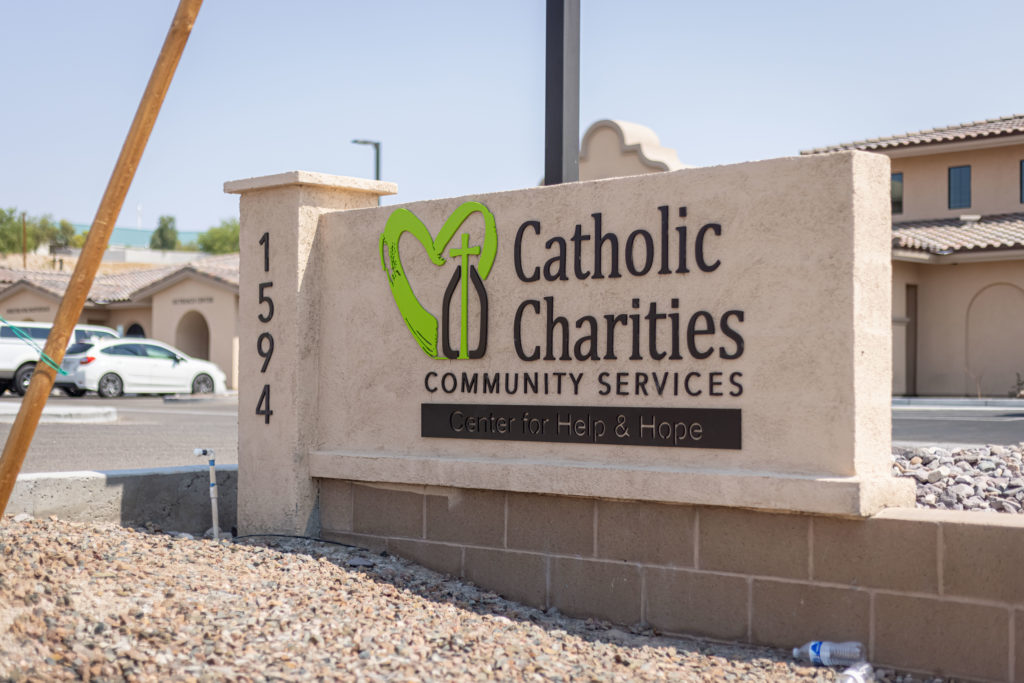
Catholic Charities seeks to empower, not just shelter, homeless

By Jeff Grant, The Catholic Sun

According to the United States Interagency Council on Homelessness (USICH), the only federal agency whose sole mission focuses on preventing and ending homelessness, Arizona had an estimated 10,979 individuals experiencing homelessness on any given day in January 2020 – the last time for which figures are available.

By comparison, Illinois had 10,431, making Arizona’s stat more dramatic, since the Grand Canyon State’s estimated population of 7.4 million in January 2022, according the U.S. Dept. of Housing and Urban Development (HUD)  is over 5 million people fewer than that of its Midwestern neighbor, whose January 2022 estimated figure is 12.5 million.

While there is no breakdown immediately available by region, Northern Arizona has its share of homelessness – and agencies attempting to address it.

“So many are struggling to find housing, especially in Northern Arizona,” said Catholic Charities Senior Program Director Sandi Flores.

According to homelesssheltersdirectory.org – a website that lists facilities – there are five homeless shelters in Flagstaff, including Catholic Charities Community Services Emergency Shelter.

Catholic Charities is the only Northern Arizona shelter that allows fathers to stay with their families as they seek assistance.

The agency focuses on two-parent- or single-father-with-children households who are homeless, since other Northern Arizona agencies provide shelter to single mothers with children or single men and women.

But the goal is well beyond merely providing a roof over one’s head.

Catholic Charities does not charge people to stay but does require those who are there to begin and maintain a savings plan.

The goal is to empower those there to eventually become self-sufficient.

To help, the agency provides life-skills classes, case management, and transportation to appointments and job interviews.

“A lot of people who come to us don’t have IDs. We work with agencies to obtain documents,” Flores said.

“We measure the success of each individual by their own circumstances. The success might be getting that driver’s license or ID to enroll in food stamps or ACCCHS,” Arizona Health Care Cost Containment System – the state’s Medicaid agency that offers health care programs to serve Arizonans.

Catholic Charities also has a 57-bed shelter in Bullhead City.

“We have a 57-bed shelter in Bullhead City and a family shelter offering a 60-90 day stay. They can come in for 90 days at a time as long as they have a firm end goal in mind [for sustainable living].”

In addition to its shelters, the agency offers “day services,” which allow individuals to come in, access a computer, receive a hot meal, do laundry, or pick up donated clothing, Flores pointed out. A medical clinic clinic is planned for the future, with Catholic Charities still working through numerous details to make that a reality. The clinic would be open to anyone in the community, she added.

Sometimes the assistance starts through an outreach done by staff who seek out the homeless in places where they exist “off the grid” – forests, riverbeds, or under bridges.

Teams – armed with supplies they can hand out – look for homeless in Coconino, Yavapai, and Mohave counties. They offer them granola bars, water, socks, and, in the summer, water and sunscreen: items that can be used to build rapport.

“Anyone experiencing homelessness has had serious trauma in their life. Some want to address it, and some aren’t quite there yet,” she explained.

The person also may have mental illness or a history of substance abuse. Flores noted there is a misconception that someone has to be Catholic to receive help. The agency assists anyone.

Flores estimated the teams encounter around 1,600 individuals in a year. Of that amount, around 200 wind up coming into Catholic Charities facilities.

“Everybody matters,” she said. “Sometimes folks just need assistance; they have struggled their whole lives. We believe in the dignity of everyone we encounter. Folks often feel overlooked and stepped on; sometimes a smile or kind words can result in seeing them start to open up.”

Catholic Charities’ support comes through government funding, private donations, and the Diocese of Phoenix Charity and Development Appeal.

The agency is now working to expand affordable-housing opportunities and justice-system-involved programs.

“More donor dollars would allow us to do that,” she said.

Catholic Charities operates with 101 staff in Northern Arizona’s five counties and 305 in central Arizona, which consists only of Maricopa County.

“We rely heavily on volunteers. Day services, mealtimes; we couldn’t do them without significant volunteers. We can use them in any of our programs. We work to find their passion and plug them into a spot that fulfills that.”

There are multiple ways to help, including volunteering, supporting the Charity and Development Appeal, or using the ‘Donate’ link the agency website.

Flores also visits smaller communities on a regular basis and can pick up checks while there. Donors also can use regular mail.

Site tours are available for those considering volunteering.

“We use the story of the good Samaritan, most often that really defines what we do,” she explained. “We believe in the dignity of every person. We will engage you where you are. We are going to stop when no one else will.”

Pope, cardinal look at what ails the priesthood, offer antidotes

Pope Francis gives his blessing after giving the opening talk at an international symposium on the priesthood at the Vatican Feb. 17, 2022. Also pictured is Cardinal Marc Ouellet, prefect of the Congregation for Bishops. (CNS photo/Paul Haring)

By Cindy Wooden, Catholic News Service

VATICAN CITY (CNS) — Opening an international conference on priesthood, Pope Francis insisted that those who are not close to God in prayer, close to their bishop and other priests and immersed in the lives of their people are simply “‘clerical functionaries’ or ‘professionals of the sacred.'”

“A priest needs to have a heart sufficiently ‘enlarged’ to expand and embrace the pain of the people entrusted to his care while, at the same time, like a sentinel, being able to proclaim the dawning of God’s grace revealed in that very pain,” the pope said Feb. 17 as he opened the conference in the Vatican audience hall.

With some 500 people attending in person and hundreds more online, the Feb. 17-19 symposium was organized by Canadian Cardinal Marc Ouellet, prefect of the Congregation for Bishops, and aimed at renewing a theological understanding of Catholic priesthood.

The cardinal told participants he understood how people could wonder about the purpose of such a conference given “the current historical context dominated by the drama of sexual abuse perpetrated by clerics.”

“Should we not rather refrain from talking about the priesthood when the sins and crimes of unworthy ministers are on the front pages of the international press for betraying their commitment or for shamefully covering up for those guilty of such depravity?” he said they could ask. “Shouldn’t we rather keep silent, repent and look for the causes of such misdeeds?”

A discussion of priesthood today, he said, must begin with expressing “our sincere regret and asking again for forgiveness from the victims, who suffer for their lives destroyed by abusive and criminal behavior, which has remained hidden for too long and treated lightly out of a desire to protect the institution and the perpetrators instead of the victims.”

But looking at the priesthood, including ways that it has been distorted by clericalism, could help the church truly turn a new page, Cardinal Ouellet said.

Clericalism, he said, involves “a set of phenomena — abuse of power, spiritual abuse, abuses of conscience — of which sexual abuse is only the tip of the iceberg, visible and perverse, emerging from deeper deviations to be identified and unmasked.”

A rediscovering of the priesthood of all believers, conferred through baptism, and its relationship to the ministerial priesthood must be the starting point, he said. Beginning there also provides a way to value the role of women in the church and the gifts that they bring.

In his talk to the conference, Pope Francis did not mention the abuse crisis specifically, but instead focused on what he said he has learned in more than 50 years of priesthood and from listening to and assisting priests as a Jesuit provincial, archbishop and pope.

“It may be that these reflections are the “swan song” of my own priestly life,” the 85-year-old pope said, “but I can assure you that they are the fruit of my own experience.”

He insisted, as he often has told priests, that “closeness” is essential to their ministry and identity: closeness to God in prayer, closeness to their bishop or superior, closeness to other priests and, especially, closeness to the people of God.

Proximity, he said, allows the priest “to break all temptations of closure, self-justification and of living like a ‘bachelor.'”

Closeness in all four areas allows priests “to manage the tensions and imbalances that we experience daily,” the pope said. They are not “an extra assignment,” but “a gift” that the Lord gives “to keep the vocation alive and fruitful.”

Closeness to God and closeness to the people are intimately and intrinsically linked, he said, “since the prayer of a shepherd is nurtured and becomes incarnate in the heart of God’s people. When he prays, a pastor bears the marks of the sorrows and joys of his people, which he presents in silence to the Lord.”

At a time when many people experience a growing sense of being “orphaned,” Pope Francis said, a pastor who is close to his people knows how to gather them and form a community where people, including priests, grow in their sense of belonging.

“This sense of belonging will in turn prove an antidote to the distortion of vocation that happens whenever we forget that the priestly life is owed to others — to the Lord and to the persons he has entrusted to us,” he said. “Forgetting this is at the root of clericalism and its consequences.”

“Clericalism is a distortion because it is based not on closeness but on distance,” the pope said.

The church is and is meant to be a community of believers who help one another, share each other’s burdens, rejoice with each other and work together to proclaim the Gospel, he insisted.

Pope Francis cited the African proverb, “If you want to go fast, go alone; if you want to go far, go with others,” and told conference participants that while “sometimes it seems that the church is slow — and that is true — I like to think of it as the slowness of those who have chosen to walk in fraternity.”

Priests need to be “clear” and honest about how much envy exists within their ranks and how destructive it is, he said. “And there are also clerical forms of bullying.”

But “when priestly fraternity thrives and bonds of true friendship exist, it likewise becomes possible to experience with greater serenity the life of celibacy,” Pope Francis said. “Celibacy is a gift that the Latin church preserves, yet it is a gift that, to be lived as a means of sanctification, calls for healthy relationships, relationships of true esteem and true goodness that are deeply rooted in Christ.”

“Without friends and without prayer,” he said, “celibacy can become an unbearable burden and a counter-witness to the very beauty of the priesthood.”


Lent 3.0: Third Lent in pandemic offers chance for spiritual reset, healing

Bishop Edward B. Scharfenberger of Albany, N.Y., sprinkles ashes on parishioners during Mass at the Cathedral of the Immaculate Conception Feb. 17, 2021, amid the coronavirus pandemic. Lent 2022 begins March 2, which is Ash Wednesday. (CNS photo/Cindy Schultz, The Evangelist)

By Carol Zimmermann, Catholic News Service

WASHINGTON (CNS) — Lent, the spiritual season of prayer and sacrifice, has an extra pull to it this year because once again — and now for the third time — it will be under the cloud of the coronavirus pandemic.

And even though the third Lent in a pandemic can feel like a lot like a Jesus’ third fall on the road to Calvary, people who spoke with Catholic News Service focused more on the season’s path to Easter and how this year’s Lent also coincides with an optimism around COVID-19 cases dropping in the U.S.

“It’s a perfect storm: lower (coronavirus) numbers just as Lent approaches,” said Mary DeTurris Poust, former communications director for the Diocese of Albany, New York.

And maybe this Lent, which starts on Ash Wednesday, March 2, is the time to do just that, she said about being with the parish community: gathering for Mass, prayer services and also for the returning soup suppers and fish fries.

After the tremendous losses of the past two years, she said, this Lent could be a good time for a reset. “Lent is the perfect opportunity to recalculate the internal GPS” of where we’re going, Poust said, speaking about individuals but also more broadly about what parishes can do as they look to welcome people back.

So many Catholics like the ritual of Lent and all of its “bells and smells,” she said, which makes this season a great opportunity “to pull them back in the best way.”

Jen Sawyer, editor-in-chief of Busted Halo, a Paulist website and satellite radio program, said in times of uncertainty, people “rely on muscle memory” of traditional faith practices they are used to. But this year, she thinks Lent’s usual traditions might have a different feel.

“It seems like this is the Lent we’re most prepared for; we’ve all sacrificed so much” she said. The desert experience of Lent has already been lived out and with so many people exhausted from the past two years, she said this Lent offers new opportunities to find peace, community and faith.

Paulist Father Larry Rice, campus chaplain for Rensselaer Polytechnic Institute in Troy, New York, agreed, saying the church is more than ready for Lent 2022 and he hopes it will help people “respond to all the trauma we have been through.”

“We are living with long-term, low-grade trauma, ” he said, adding that for many, the pain is just under the surface and he sees Lent as the antidote. “As Christian people, we believe our destination is not Good Friday. We go through that to get to Easter,” he said.

He also said this year has the added hope that “by the time we get to Easter, the pandemic we’re experiencing will look different.” And with wisdom acquired in the past two years, he also added: “There are no guarantees; there could be new (coronavirus) variants.”

The past two Lents did not have that same thread of hope.

Lent 2020 started off without a hitch with just a small number of COVID-19 cases in the country but by the second week of Lent, in early March, some dioceses urged parishes to curtail handshaking at the sign of peace and Communion from the chalice. By the third week of Lent, many dioceses lifted Sunday Mass obligations and stopped public Masses and Lenten services such as Stations of the Cross, prayer services and fish fries.

Last year during Lent, more churches were open — although many were limiting congregation sizes and requiring parishioners to sign up for Masses. Fish fries were back, as carry-out events, and in many dioceses, ashes were sprinkled over heads on Ash Wednesday.

This year, parishes are open — with differing mask regulations and social distancing in place — and the beloved fish fries are back with both in-person or carry-out options.

“These past two years for all of us have not been easy, but God has been with us,” said Mercy Sister Carolyn McWatters, a liturgist and chair of the Prayer and Ritual Committee for the Sisters of Mercy.

Sister McWatters, who lives at the Sacred Heart Convent in Belmont, North Carolina, and is involved in ministry there with the order’s retired sisters, emphasized the need to reflect on the pandemic experience this Lent. She said it’s important to recognize how we lived beyond what we could control, the inner resources we relied on and where we saw goodness and grace at work.

“The cross is never a dead end. It points to new life. Where are the signs of life for me, my community, the country, the world?” she asked.

Spiritual growth is often about relinquishing control, she said, which was certainly an aspect to pandemic life but the coronavirus also involved the hardship of isolation which was especially experienced by the retired sisters.

The convent, part of a national center for the Mercy sisters, had been a frequent spot for meetings and gatherings and many came for Sunday Masses and dinners, which was all put on hold for the past two years.

“Everybody is looking for the end,” she said.

The view of these retired Mercy sisters echoes what many are feeling, but Sister McWatters also cautions against people focusing on being victims right now and seeing the pandemic purely as “woe is me.”

Similarly, she said, Lent is not gloom and doom but should be a “joyful embrace of what will help me to grow more deeply.”

Sawyer also stressed that faith is meant to be joyful and said that Busted Halo with its “Fast Pray Give Lent Calendar” and InstaLent photo challenge aims to get that across and will continue that this Lent particularly by urging people to try something new — a new book or prayer — and to check in with others after so much pandemic isolation.

“We don’t often think of Lent as a vibrant time of community connection,” she said, adding that Catholics are “used to the desert” experience often associated with the season. But this Lent, that might change.


Love, protect the church despite its faults, pope says

Pope Francis leads his general audience in the Paul VI hall at the Vatican Feb. 16, 2022. (CNS photo/Paul Haring)

By Junno Arocho Esteves, Catholic News Service

VATICAN CITY (CNS) — The same love that gave St. Joseph the strength to protect Jesus and Mary must inspire Christians to love the church, especially when calling out its sins and flaws, Pope Francis said.

Love “makes us capable of speaking the truth fully in a nonpartisan way; of saying what is wrong but also of recognizing all the goodness and holiness that are present,” the pope said Feb. 16 during his weekly general audience.

“Nowadays it is common, it is an everyday occurrence, to criticize the church, to point out its inconsistencies — and there are many — to point out its sins, which in reality are our inconsistencies, our sins, because the church has always been a people of sinners who encounter God’s mercy,” the pope said. “Let us ask ourselves if, in our hearts, we love the church.”

Reflecting on St. Joseph as the patron of the universal church, the pope said he was concluding his series of audience talks about the foster father of Jesus.

The Gospel stories involving St. Joseph note that he takes Jesus and Mary with him and obeys God’s commands, thus highlighting his role as their protector, the pope said.

Departing from his prepared remarks, he added that “a very beautiful aspect of the Christian vocation” is protecting life and “protecting human development.”

“The Christian is — we may say — like St. Joseph: he or she must protect,” he said. “To be a Christian is not only about receiving the faith, confessing the faith, but protecting life, one’s own life, the life of others, the life of the church.”

Christians, he continued, “must always ask ourselves whether we are protecting with all our strength Jesus and Mary, who are mysteriously entrusted to our responsibility, our care, our custody.”

St. Joseph, “in continuing to protect the church, continues to protect the child and his mother, and we too, in loving the church, continue to love the child and his mother,” he said.

Loving the church, he added, means protecting and walking with all its members.

“The church is not that small group that is close to the priest and bosses everyone around; no. We all are the church, all of us,” he said. “This is a good question: when I have a problem with someone, do I try to protect them or do I immediately condemn them, speak ill of them, destroy them? We must protect, always protect!”

Pope Francis encouraged Christians to seek St. Joseph’s intercession, especially in “the most difficult times in your life and the life of your communities.”

“Where our mistakes become a scandal, let us ask St. Joseph to give us the courage to speak the truth, ask for forgiveness and humbly begin again. Where persecution prevents the Gospel from being proclaimed, let us ask St. Joseph for the strength and patience to endure abuse and suffering for the sake of the Gospel,” the pope said.

St. Joseph’s intercession, he added, is also a source of comfort for the poor and the suffering and an encouragement for those “who serve the least, the defenseless, the orphans, the sick, the rejected of society.”

“How many saints have turned to him! How many people in the history of the church have found in him a patron, a guardian, a father!” the pope said.


Catholic school enrollment increases this school year, NCEA report says

Students compete in a game of tug of war Feb. 1, 2022, at St. Patrick School in Smithtown, N.Y. The event was one of many special activities scheduled by the school to celebrate Catholic Schools Week. (CNS photo/Gregory A. Shemitz)

By Carol Zimmermann, Catholic News Service

WASHINGTON (CNS) — Catholic school enrollment increased for the first time in two decades this school year, according to a preliminary report released by the National Catholic Educational Association Feb. 14.

The enrollment increase was from Catholic elementary schools and overall grew overall by 5.8% — primarily due to the sharp rise in the number of prekindergarten students. Catholic secondary schools’ enrollment went down by 0.4% this year.

Highlights of the annual report, which will be issued in March, showed an enrollment increase of 62,000 students, or a 3.8% jump.

The increase does not put Catholic school numbers back to their pre-pandemic levels though. During the first year of the pandemic, Catholic school enrollment decreased by 6.4%, its largest one-year decline in the 50 years the NCEA has been collecting school data. Right now, Catholic school enrollment is 2.8% lower than it was 2019-2020.

The brief report credited the enrollment bump this year to Catholic schools’ “dedication in safely opening classrooms and supporting their communities’ needs,” but it also stressed this trend must continue.

It pointed out that schools “need to continue to adapt to those needs and use the momentum to retain students and recruit new students in the upcoming years to stabilize or continue to increase enrollment.”

Elementary schools were initially hit hard by the COVID-19 pandemic with an 8.1% decrease in enrollment last year. The report calls this year’s increase a “positive sign for long-term secondary school viability.”

The number of students in Catholic school prekindergarten classes increased by 33.5% this year with nearly every state reporting an increase of students in this age group particularly Utah with a 137% increase and California with a 134% increase.

The brief report pointed out that prekindergarten enrollment accounted for 66% of Catholic schools’ increased enrollment. But this increase, just as with overall enrollment, is still lower than pre-pandemic levels, which the NCEA report said was troubling.

Last year, NCEA announced that 186 elementary schools and 23 high schools closed in 2020. This year’s report says that on average over the past five years, approximately 100 Catholic schools have closed or consolidated. At the end of the 2020-2021 school year, 71 Catholic schools closed or merged.

In breaking down the data by dioceses, the report’s highlights found that the largest dioceses are losing enrollment at more than double the rate of other dioceses over the past two years.

“As the population in the United States shifts away from major cities, the largest dioceses may face more school closures and consolidations. Dioceses will need to determine how they can continue to serve underserved communities in their cities as these changes occur,” the report said.

The NCEA findings also noted how U.S. Catholic schools have adapted in recent years. Currently there are seven Catholic virtual schools, 71 International Baccalaureate programs and 114 dual language immersion programs.

Nationally, 6.8% of Catholic school students utilize a parental choice program and 20.2% of Catholic schools enrolled students using parental choice programs.

The report’s data about principal and teacher retention found that 89% of principals and 86% of teachers returned to their school from the previous year, excluding those who retired. The report credited this high retention rate, even amid the pandemic, to the support Catholic school teachers and principals feel.

To ensure this retention rate continues, it added: “Catholic schools should continue to examine teacher pay as on average it is almost 20% below what local public school districts pay. Further, Catholic schools should offer opportunities for professional and spiritual growth for their teachers, and dioceses need to similarly support their principals.”


Pope chooses theme for July 24 World Day for Grandparents and the Elderly

Pope Francis greets an elderly woman as he meets with people in Asuncion, Paraguay, in this July 12, 2015, file photo. The pope has chosen the theme, "In old age they will still bear fruit" (Psalm 92:15), for the second World Day for Grandparents and the Elderly July 24. (CNS photo/Paul Haring)

By Carol Glatz, Catholic News Service

VATICAN CITY (CNS) — Pope Francis is dedicating the 2022 World Day for Grandparents and the Elderly to the importance of inviting older people to contribute to building a better world.

The pope has chosen “They shall bear fruit even in old age” from the Book of Psalms (92:15) as the theme for the second world day, being celebrated July 24, 2022.

The theme “intends to emphasize how grandparents and the elderly are a value and a gift both for society and for ecclesial communities,” said a Feb. 15 communique from the Dicastery for Laity, the Family and Life, which was promoting the world day.

The same day, the pope tweeted that elderly “should be cared for like a treasure of humanity: they are our wisdom, our memory. It is crucial that grandchildren remain close to their grandparents, who are like roots from which they draw the sap of human and spiritual values.”

In its communique, the dicastery said this year’s theme “is also an invitation to reconsider and value grandparents and the elderly who are too often kept on the margins of families, civil and ecclesial communities. Their experience of life and faith can contribute, in fact, to building societies that are aware of their roots and capable of dreaming of a future based on greater solidarity.”

“The invitation to listen to the wisdom of the years is also particularly significant in the context of the synodal journey that the church has undertaken,” it added.

The dicastery invited parishes, dioceses, associations and other church communities throughout the world to find ways to celebrate the day. It said it also would make some pastoral resources available soon.

Pope Francis established the World Day for Grandparents and the Elderly, celebrated each year on the fourth Sunday of July to coincide with the feast of Sts. Joachim and Anne, to emphasize the pastoral care of the elderly as a priority. Not only are grandchildren and young people called upon to be present in the lives of older people, but older people and grandparents also have a mission of evangelization, proclamation and prayer, and of encouraging young people in their faith, the dicastery has said.


Pope amends canons to give greater authority to bishops, conferences

Code of Canon Law books for the Latin and Eastern Catholic churches are pictured in Rome at the Pontifical Oriental Institute in this Sept. 15, 2016, file photo. Pope Francis has ordered several changes to canon law, giving more authority to local bishops and bishops' conferences. (CNS photo/Paul Haring)

By Cindy Wooden, Catholic News Service

VATICAN CITY (CNS) — Saying he wanted to promote a “healthy decentralization” of some aspects of church life, Pope Francis made several changes to church law, granting greater authority to individual bishops, bishops’ conferences and synods of bishops of the Eastern Catholic churches.

The changes, the pope said, should “foster a sense of collegiality and the pastoral responsibility” of bishops and religious superiors who are closest to the matters being decided and therefore have a better understanding of what is appropriate.

Pope Francis’ amendments to both the Code of Canon Law of the Latin-rite church and the Code of Canons of the Eastern Churches were published by the Vatican Feb. 15, the day they were to go into effect.

The modifications, the pope said, “reflect even more the shared and plural universality of the church,” which includes many legitimate differences, but preserves its unity in communion with the pope.

At the same time, he wrote, the changes “encourage a more rapid efficacy of the pastoral action of governance by the local authority, which is facilitated by its very proximity to the persons and situations which require it.”

For setting up an interdiocesan seminary, drafting a program for the formation of priests or publishing a national catechism, with the new law the bishop or bishops’ conferences involved simply need to obtain a “confirmation” from the Vatican and are no longer required to seek the “approval” of the Vatican.

In church law, “‘approval,’ as opposed to ‘confirmation,’ entails a greater commitment and involvement” of the Roman Curia. “Therefore, it is evident that the shift from requiring ‘approval’ to requiring ‘confirmation’ is not only a terminological change, but a substantial one, which moves precisely in the direction of decentralization,” Bishop Marco Mellino, a member of the Pontifical Council for Legislative Texts, told Vatican News Feb. 15.

In another change, Pope Francis gave local bishops the authority to determine when there is “a just and necessary cause” for reducing the number of Masses to be said in fulfillment of a will or legacy left to the church. Previously such a decision was reserved to the Vatican.

Bishop Mellino told Vatican News the law still insists that donations left to the church be used for the donor’s intentions, but recognizes that over time, especially if the money was left decades ago, adjustments may be necessary.

Pope Francis also added a new paragraph to the canon dealing with consecrated virgins to make clear that a bishop may establish an association for consecrated virgins in his diocese and a bishops’ conference may do the same on the national level.

In addition, he gave religious superiors, when acting in consultation with their councils, broader authority for authorizing long absences from the community or for dismissing or accepting a request of a member with temporary vows to leave the community permanently.


Leave behind personal securities to follow God more closely, pope says

Pope Francis greets the crowd as he leads the Angelus from the window of his studio overlooking St. Peter's Square at the Vatican Feb. 13, 2022. (CNS photo/Vatican Media)

By Carol Glatz, Catholic News Service

VATICAN CITY (CNS) — A disciple of Jesus leaves behind worldly attachments and prejudices to follow God completely, Pope Francis said.

Disciples “know how to question themselves, how to humbly seek God every day,” the pope said Feb. 13 during his Sunday Angelus address.

With a crowd gathered in St. Peter’s Square for the midday Angelus prayer, the pope reflected on the Sunday Gospel reading from St. Luke in which Jesus delivers the sermon on the plain, which, like St. Matthew’s sermon on the mount, begins with the beatitudes.

“Indeed, the beatitudes define the identity of the disciple of Jesus,” Pope Francis said.

The beatitudes may sound strange, “almost incomprehensible to those who are not disciples,” he said.

According to the logic of the world, “happy are those who are rich,” who receive praise, are envied and feel secure, he said; but the beatitudes say that those who are poor and lack material possessions are blessed and happy.

Jesus “declares worldly success to be a failure, since it is based on a selfishness that inflates and then leaves the heart empty,” he said.

“Faced with the paradox of the beatitudes, disciples allow themselves to be challenged, aware that it is not God who must enter into our logic, but we into his,” the pope said.

“This requires a journey, sometimes wearisome, but always accompanied by joy. Because the disciple of Jesus is joyful, with the joy that comes from Jesus,” from the Lord who frees “us from the slavery of self-centeredness, breaks our locks, dissolves our hardness.”

Disciples, he said, “are those who let themselves be led by Jesus, who open their heart to Jesus, who listen to him and follow his path.”


Pope restructures the Congregation for the Doctrine of the Faith

St. Peter's Basilica is seen at the Vatican in this Oct. 9, 2017, file photo. On Feb. 14, 2022, Pope Francis split the Congregation for the Doctrine of the Faith into two main sections: doctrine and discipline. (CNS photo/Paul Haring)

By Carol Glatz, Catholic News Service

VATICAN CITY (CNS) — As part of ongoing measures to reform the Roman Curia, Pope Francis has approved restructuring the Congregation for the Doctrine of the Faith, the oldest of the congregations.

Once comprised of a doctrinal office, a discipline office and a marriage office, the new structure will see the doctrinal and discipline offices become their own special sections led by their own secretaries; the marriage office will become part of the doctrinal office.

The two secretaries will serve under the congregation’s prefect. Spanish Cardinal Luis Ladaria, who has been prefect of the congregation since 2017, will celebrate his 78th birthday April 19. The heads of Vatican offices are required to offer their resignations to the pope when they turn 75.

In “Fidem servare” (Preserving the Faith), published “motu proprio,” (on his own initiative) Feb. 14, Pope Francis said the main task of the congregation has been to safeguard or “keep the faith.” The changes went into effect the same day.

Over time, the congregation has seen modifications to its areas of responsibilities and how it is configured, and now, Pope Francis said, further change is needed “to give it an approach more suited to the fulfillment of its functions.”

The doctrinal section will be responsible for matters concerning “the promotion and safeguarding of the doctrine of the faith and morals.”

Its aim, the pope wrote, is to promote studies aimed at fostering “the knowledge and transmission of the faith in the service of evangelization, so that its light may be the criterion for understanding the meaning of existence, especially before questions posed by the progress of science and the development of society.”

When dealing with faith and morals, the doctrinal section will examine documents to be published by other dicasteries of the Roman Curia, “as well as writings and opinions that appear problematic for the correct faith, encouraging dialogue with their authors and proposing suitable remedies,” according to previously established norms.

The section will also study any questions arising from personal ordinariates for Anglicans entering into full communion with the Catholic Church through the Apostolic Constitution, “Anglicanorum Coetibus.”

The doctrinal section will absorb the duties covered by the congregation’s marriage office, which deals with questions involving the validity of marriages when one of the spouses is not a baptized Christian.

The discipline section, through the currently existing discipline office, will handle those offenses and crimes reserved to the congregation — particularly clerical sexual abuse cases — and its supreme tribunal. It will prepare and elaborate procedures in accordance with canon law so as to “promote a correct administration of justice.”

To that end, the discipline section will promote needed formation initiatives that the congregation can offer to bishops, dioceses and canon lawyers “to promote a correct understanding and application of canonical norms.”

The congregation’s archive will continue to preserve documents for consultation, including its historical archives.

The Congregation for the Doctrine of the Faith is the oldest of the congregations. It began in the 16th century as a commission of six cardinals, known as the Sacred Roman and Universal Inquisition, which served as a tribunal for judging suspected cases of heresy and schism.

Seeing a number of changes over the centuries, St. Paul VI changed its name from the Sacred Congregation of the Holy Office to the Sacred Congregation for the Doctrine of the Faith, and he changed its methods used for doctrinal examination. A more positive disposition of correcting errors, together with the protection, preservation and promotion of the faith prevailed over the more punitive tendency of condemnation.

With changes to the Roman Curia by St. John Paul II, the congregation maintained its competence over all that in any way touches upon the doctrine of faith and morals and was explicitly given “prior judgment” over any other curial documents that enter into its area of competence.

While for decades it also handled requests for dispensations from celibacy from priests seeking laicization, that responsibility later was given to the Congregation for Clergy.


Servicios completos de planificación para la tranquilidad de las familias

by Harry Antram
Director de Misión y Atención
Cementerios Católicos y Funeraria

Perder a un ser querido puede dejarnos abrumados por el dolor y sin saber qué hacer después. A raíz de una pérdida, nos enfrentamos con muchas decisiones importantes que tenemos que hacer cuando estamos planeando los arreglos finales. Si no hemos tenido conversaciones sobre el final de la vida con los miembros de nuestra familia, posiblemente no sabremos cuáles son sus deseos, agregando estrés a una situación ya dolorosa.

En los Cementerios Católicos y las Casas Funerarias, las familias pueden planificar con anticipación los arreglos del funeral y el cementerio. Hacer esto puede ahorrar a los familiares confusión y gastos, permitiéndoles concentrarse en celebrar la vida de su ser querido que falleció. La planificación previa también ofrece a las familias la seguridad de que están siguiendo las pautas y enseñanzas de la Iglesia Católica. Con los detalles bien cuidados, pueden pasar el duelo juntos sin la dificultad de una larga lista de cosas que hacer.

Muchos están inseguros seguros de lo que implica la planificación previa y pueden encontrarla intimidante, pero entender lo que significa, puede hacer que se sienta más cómodo con esta opción.

“…entender lo que significa, puede hacer que se sienta más cómodo con esta opción.”

Cuando usted planifica los arreglos del cementerio previamente, toma decisiones sobre el funeral con anticipación. Esto incluye decidir si le gustaría tener un entierro tradicional o una cremación y si prefiere un entierro en el suelo, un espacio de mausoleo o un nicho, entre otras opciones. En los cementerios católicos y las casas funerarias, estamos aquí para guiarlo durante el proceso de pensar en los detalles necesarios relacionados con su decisión.

En el área metropolitana de Phoenix, somos muy afortunados de tener dos casas funerarias católicas donde lo ayudaremos a realizar los arreglos funerarios. Esto incluye todo, desde el cuidado y preparación del cuerpo y la coordinación con la iglesia; hasta la selección de flores y tarjetas de oraciones. Al planear los arreglos del funeral con anticipación usted puede fijar el costo de los servicios y la mercancía, al precio actual, lo que ahorra dinero a largo plazo.

No importa cuánta planeación previa hayan decidido hacer sus familiares, los seres queridos durante el duelo me han compartido el mismo sentimiento: Están realmente conmovidos porque su familiar se tomó el tiempo para planificar sus arreglos, protegiéndolos en un momento tan emocional de ambas, de la carga financiera y la toma de decisiones.

Mis propios padres nos han dado a mí y a mis siete hermanos este mismo regalo y estoy agradecido por este último gesto amoroso. Muchas bendiciones a ti y a tu familia.