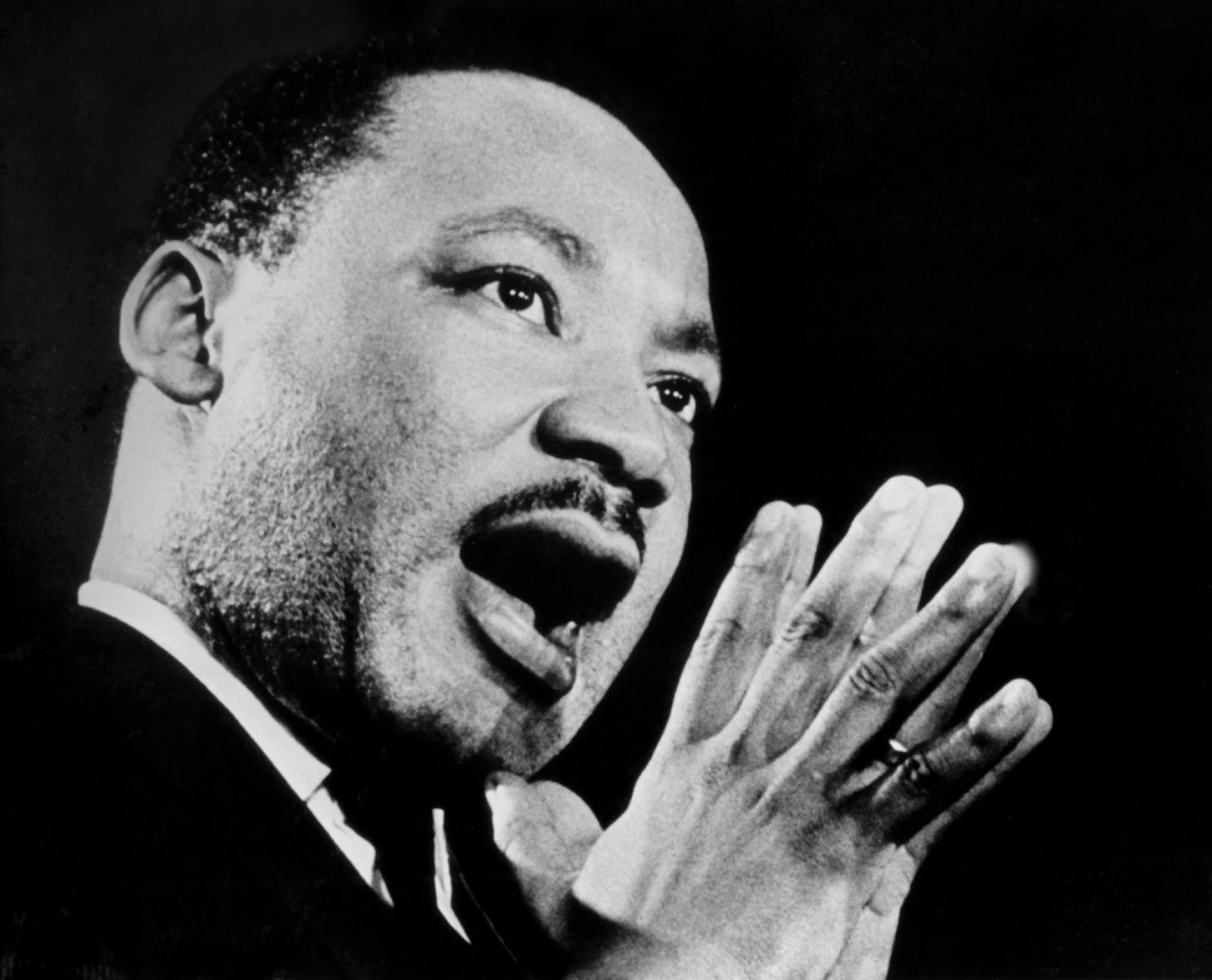
The Rev. Martin Luther King, Jr., is pictured in an undated file photo. The 50th anniversary of the civil rights leader's assassination is April 4. (CNS file photo) See MLK-RIOTS-ANNIVERSARY-CHURCH March 20, 2018.
El Reverendo Martin Luther King, Jr., está representado en este foto archive sin fecha. El Cincuenta aniversario del asesinado del líder de derechos civiles es el 4 de abril. (Foto archive CNS)
The Rev. Martin Luther King Jr. is pictured in an undated file photo. The 50th anniversary of the civil rights leader’s assassination is April 4. (CNS file photo)
No one has greater love than this, to lay down one’s life for one’s friends.
WASHINGTON (CNS) — Fifty years after the Rev. Martin Luther King Jr.’s assassination, “we need to ask ourselves if we are doing all we can to build the culture of love, respect and peace to which the Gospel calls us,” the U.S. bishops’ Administrative Committee said March 28.
On April 4, 1968, James Earl Ray gunned down the civil rights leader as he stood on the balcony of his hotel room in Memphis, Tennessee. Rev. King, a Baptist minister, was 39.
In reflecting on Rev. King’s life and work, “what are we being asked to do for the sake of our brother or sister who still suffers under the weight of racism?” the committee said in a statement. “Where could God use our efforts to help change the hearts of those who harbor racist thoughts or engage in racist actions?”
This 50th anniversary “gives us an important moment to draw inspiration from the way in which Dr. King remained undeterred in his principle of nonviolent resistance, even in the face of years of ridicule, threats and violence for the cause of justice,” the committee said.
As the most prominent civil rights activist of his time, Rev. King fought for all races and against a system that promoted racism and racial divide. He is well-known for advocating nonviolence and civil disobedience to bring about change. He was inspired by his Christian beliefs and the nonviolent activism of Mahatma Gandhi.
In its statement, the Administrative Committee recalled that Rev. King went to Memphis to support underpaid and exploited African-American sanitation workers.
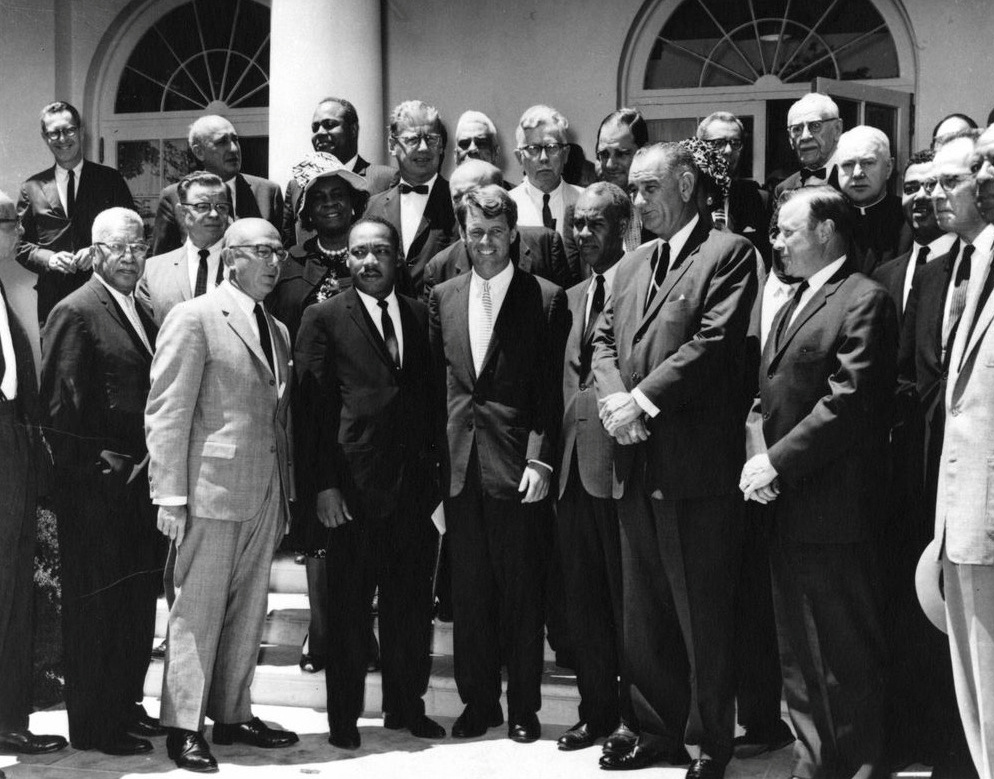
Robert F. Kennedy, center, poses with the Rev. Martin Luther King Jr., at Kennedy’s right, and other civil rights leaders in the Rose Garden of the White House in 1963. Fifty years after Rev. King’s assassination, “we need to ask ourselves if we are doing all we can to build the culture of love, respect and peace to which the Gospel calls us,” the U.S. bishops’ Administrative Committee said March 28. (Abbie Rowe/CNS, via National Parks Service/JFK Presidential Library and Museum handout via Reuters)
“(He) arrived on a plane that was under a bomb threat. He felt God had called him to solidarity with his brothers and sisters in need,” the committee said. “In his final speech on the night before he died, Dr. King openly referenced the many threats against him, and made clear that he would love a long life. But more important to him, he said, was his desire to simply do the will of God.”
“Our faith urges us to be courageous, to risk something of ourselves, in defending the dignity of our neighbor who is made in the image of God,” the committee continued. “Pope Francis reminds us often that we must never sit on the sidelines in the face of great evil or extreme need, even when danger surrounds us.”
The best way to honor Rev. King “and preserve his legacy,” it added, is “by boldly asking God — today and always — to deepen our own commitment to follow his will wherever it leads in the cause of promoting justice.”
Rev. King’s assassination sparked a wave of rioting and other civil disturbances in cities across the country. Known as the Holy Week Uprising, it lasted from April 6 to April 14, which was Easter that year.
The Rev. Martin Luther King, Jr., is pictured in an undated file photo. The 50th anniversary of the civil rights leader's assassination is April 4. (CNS file photo) See MLK-RIOTS-ANNIVERSARY-CHURCH March 20, 2018.
El Reverendo Martin Luther King, Jr., está representado en este foto archive sin fecha. El Cincuenta aniversario del asesinado del líder de derechos civiles es el 4 de abril. (Foto archive CNS)
El Reverendo Martin Luther King Jr. está representado en este foto archive sin fecha. El Cincuenta aniversario del asesinado del líder de derechos civiles es el 4 de abril. (Foto archive CNS)
No hay amor más grande que dar la vida por los amigos.
— Juan 15:13
WASHINGTON (CNS) — Cincuenta años después del asesinato del Reverendo Martin Luther King Jr. “tenemos que preguntarnos si estamos haciendo todo lo que podemos para edificar la cultura del amor, el respeto y la paz a la cual nos llama el Evangelio”, dijo el Comité Administrativo de los obispos de los Estados Unidos el 28 de marzo.
El 4 de abril de 1968 James Earl Ray asesinó al líder de los derechos civiles mientras él estaba parado en el balcón de su habitación de hotel en Memphis, Tennessee. El Reverendo King, ministro bautista, tenía 39 años de edad.
Reflexionando sobre la vida y obra del Reverendo King, el comité preguntó en un comunicado: “¿Qué se nos está pidiendo que hagamos por nuestros hermanos y hermanas que todavía sufren el peso de racismo?”.
Este 50º aniversario “nos ofrece un momento importante para ser inspirados por la manera en que el Dr. King se mantuvo firme en su principio de la resistencia no violenta, aún frente a años de ridículo, amenazas y violencia por la causa de la justicia”, dijo el comité.
Siendo el activista de los derechos civiles más prominente de sus tiempos, el Reverendo King luchó por todas las razas y contra un sistema que promovía el racismo y la división racial. Él es muy conocido por abogar contra la violencia y por la desobediencia civil para lograr cambios.
Robert F. Kennedy, centro, pose con el Reverendo Martin Luther King Jr., al derecho de Kennedy, y otros lideres derechos civiles en el Jardin Rosa de la Casa Blanca en 1963. Cincuenta anos deapues del asesinado del Reverendo King, “tenemos que preguntarnos si estamos haciendo todo lo que podemos para edificar la cultura del amor, el respeto y la paz a la cual nos llama el Evangelio”, dijo el Comité Administrativo de los obispos de los Estados Unidos el 28 de marzo. (Abbie Rowe/CNS, via National Parks Service/JFK Presidential Library and Museum handout via Reuters)
El Comité Administrativo recordó en su comunicado que el Reverendo King fue a Memphis a apoyar a los empleados afroamericanos del saneamiento público mal pagados y explotados.
“Nuestro credo nos insta a ser valientes, a arriesgar parte de nosotros defendiendo la dignidad de nuestro prójimo, que fue hecho a la imagen de Dios”, dijo el comité. “El Papa Francisco a menudo nos recuerda que nunca debemos quedarnos de brazos cruzados ante un gran mal o una necesidad extrema, aún en un entorno de peligro”.
La mejor manera de honrar al Reverendo King “y preservar su legado”, añadió, “es pedirle audazmente a Dios — hoy y siempre — que profundice nuestro compromiso de seguir su voluntad a donde sea que nos lleve en la causa de promover la justicia”.
El asesinato del Reverendo King desencadenó una ola de revueltas y otos disturbios en ciudades de todo el país. Conocido como el Levantamiento de Semana Santa, estos duraron del 6 al 14 de abril, que era la Pascua en ese año.
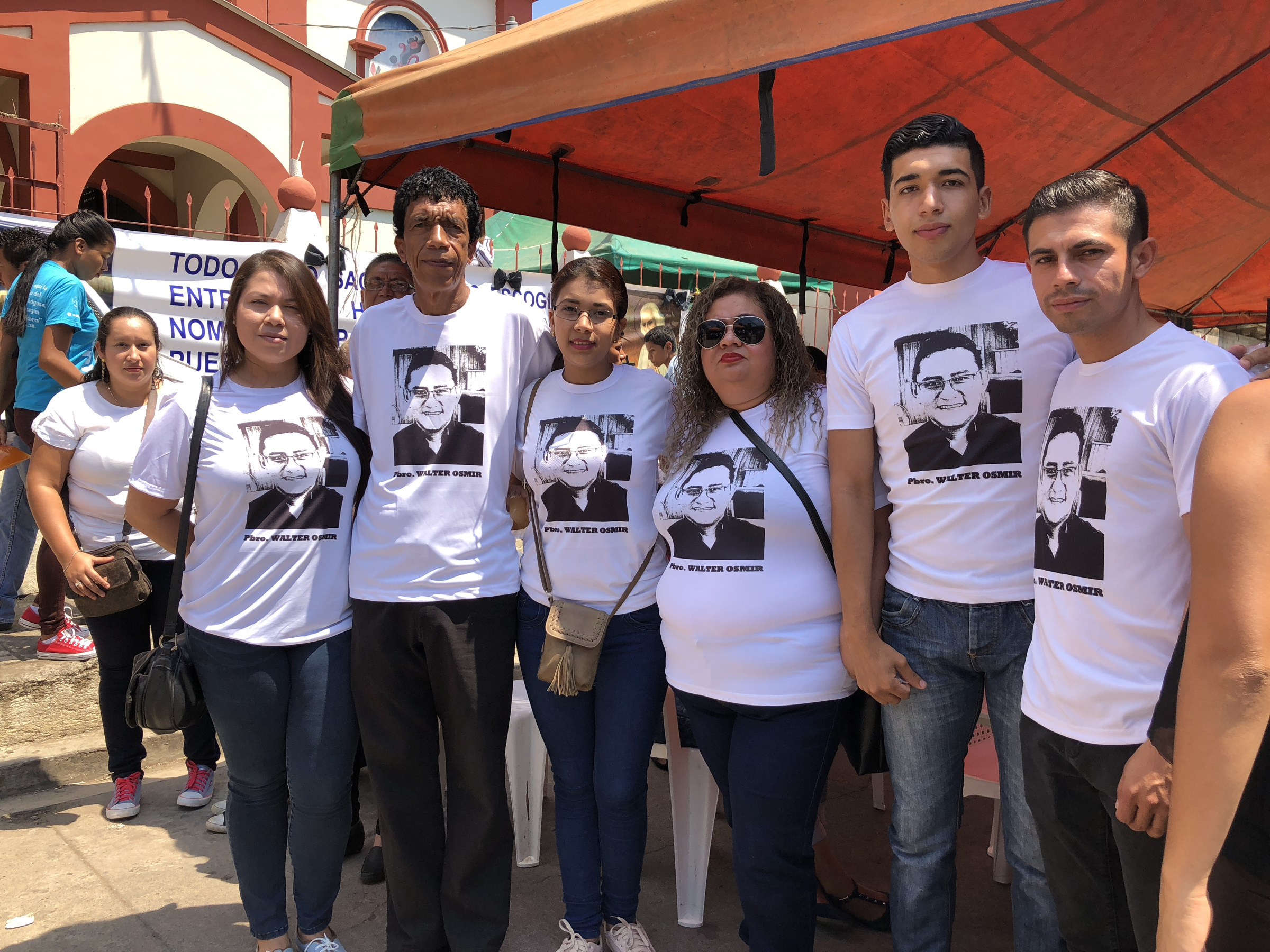
A group from St. Bonaventure Parish in the department of Usulutan, El Salvador, wore T-shirts with a photo of slain Father Walter Vasquez Jimenez before his April 1 funeral at Holy Trinity Church in Lolotique, El Salvador. The 36-year-old priest was killed March 29, Holy Thursday, shortly after renewing his vows. (Rhina Guidos/CNS) See SALVADOR-PRIEST-MURDER-FUNERAL April 2, 2018.
Un grupo de la Parroquia San Buenaventura en el Departamento de Usulután, El Salvador, llevaban camisetas representando un foto del sacerdote asesinado P. Walter Vasquez Jimenez antes de su funeral el 1 de abril en la Parroquia Santísima Trinidad en Lolotique, El Salvador. El sacerdote de 36 anos de edad fue matado el 29 de marzo, el Jueves Santo, un poco después de renovar sus votos sacerdotales. (Rhina Guidos/CNS)
A group from St. Bonaventure Parish in the department of Usulutan, El Salvador, wore T-shirts with a photo of slain Father Walter Vasquez Jimenez before his April 1 funeral at Holy Trinity Church in Lolotique, El Salvador. The 36-year-old priest was killed March 29, Holy Thursday, shortly after renewing his vows. (Rhina Guidos/CNS)
By Rhina Guidos
Catholic News Service
LOLOTIQUE, El Salvador (CNS) — On Easter, as thousands of Salvadorans from around the country packed into the rural town of Lolotique, Catholic Church officials laid to rest a 36-year-old priest violently killed during Holy Week — the latest victim of an unending wave of violence that plagues the country.
Officials held the April 1 funeral Mass for Fr. Walter Vasquez Jimenez, a priest of the Diocese of Santiago de Maria in eastern El Salvador, in his native Lolotique, a picturesque town with indigenous roots. Surrounded by the sounds of drums and marimbas, with a circle full of flower petals on the floor in front of the altar at Lolotique’s Holy Trinity Parish, Fr. Vasquez’s casket was surrounded by his mother, friends, parishioners, the country’s only cardinal and four bishops.
“He was headed to Mass, which he won’t celebrate now, but he will celebrate in the presence of God,” his cousin, José Díaz Vásquez, told Catholic News Service. He was one of the thousands packed into the town square in front of the church to remember the priest.
Fr. Vasquez was headed to celebrate a Holy Thursday Mass in the department of San Miguel March 29, hours after renewing his vows as a priest at a chrism Mass, when a group of heavily armed men wearing masks stopped the car he and parishioners were traveling in. The passengers were robbed at gunpoint and the priest was fatally shot.
The incident brings to mind the assassination of Blessed Oscar Romero, the Salvadoran archbishop who was martyred while celebrating Mass in 1980, and who is set to be canonized later this year.
The killing has shaken Catholic Church officials, who say they still do not know what led to the assassination or what it means for the Church. Many believe gang members killed the priest, but details of what led to the killing are unknown, and Church authorities are calling for answers, not just in the priest’s killing but in the rampant crimes the poor in the country suffer daily. Many of these crimes are never prosecuted.
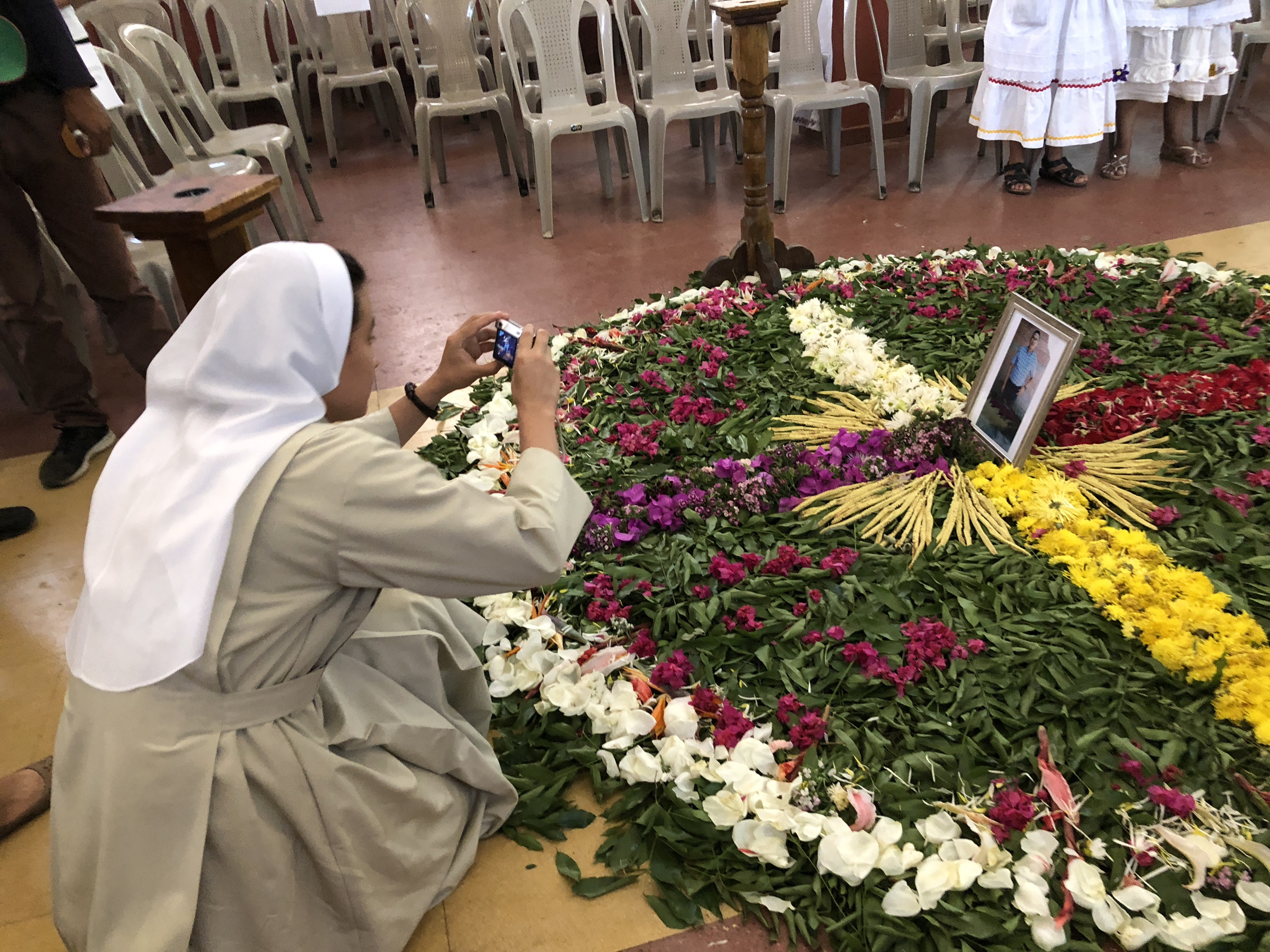
A Carmelite nun takes a photograph April 1 of an arrangement of flower petals surrounding the photo of slain Father Walter Vasquez Jimenez at Holy Trinity Church in Lolotique, El Salvador. The 36-year-old priest was killed March 29, Holy Thursday, shortly after renewing his vows. (Rhina Guidos/CNS)
“We condemn all the acts of violence that are committed daily against our people and that lead to homicides, such as the one committed against Fr. Walter Vasquez,” said a March 30 statement by Frs. Estefan Turcios Carpano and Luciano Ernesto Reyes García, director and adjunct director for the Archdiocese of San Salvador’s human rights office, Tutela Legal de Derechos Humanos.
The office demanded that authorities investigate, capture and prosecute those responsible for the murder of Fr. Vasquez, and those responsible for the general violence that El Salvador suffers.
Priests, as well as bishops, have repeatedly condemned the country’s rampant violence.
Fr. Turcios, who serves in Soyapango, a city near San Salvador that suffers from gang violence, said there is much that is not yet known in Fr. Vasquez’s case, but he has spoken in the past about unequal economic situations that have led to war and now to a culture of violence in El Salvador’s poor areas, such as the one where he serves.
The Holy Week killing of Fr. Vasquez harkened memories for Fr. Turcios of the violence surrounding the 1977 killing of Jesuit Father Rutilio Grande, the first Catholic priest killed prior to the country’s civil war. And it did the same for some of Fr. Turcios’ parishioners, who initially worried about participating in outdoor religious activities during Holy Week following news of Fr. Vasquez’s killing.
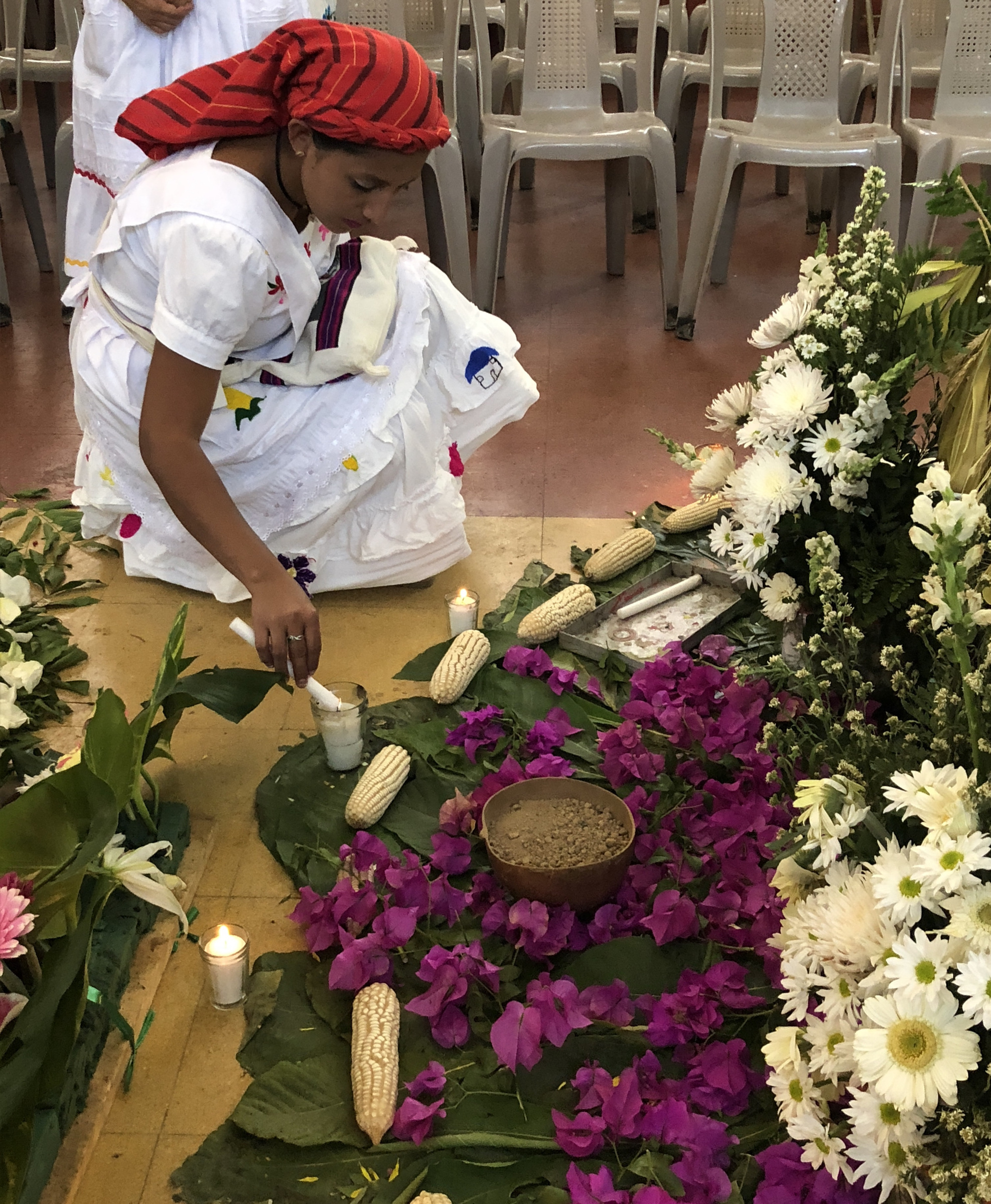
A woman lights a candle April 1 near an arrangement of flower petals just before the funeral of slain Father Walter Vasquez Jimenez at Holy Trinity Church in Lolotique, El Salvador. The 36-year-old priest was killed March 29, Holy Thursday, shortly after renewing his vows. (Rhina Guidos/CNS)
Salvadoran Cardinal Gregorio Rosa Chávez asked those gathered at the priest’s funeral to think about the killing. “What is it trying to say to us as a country?” he asked.
“In this country, life means nothing,” he said tersely. “Let’s respect life … let’s defeat our fears.”
He asked the crowd to work to “protect youth so they’re not in the clutches of the vice of violence.”
San Salvador Archbishop José Luis Escobar Alas marched near the slain priest’s coffin, decorated on the top with a bouquet of purple flowers, as it was carried up to the church, while bands played and the crowd sang hymns and popular songs.
In 2016, the archbishop penned a terse pastoral letter about the country’s escalating violence. The Church, through its programs, has tried to engage the country’s youth, particularly boys who could become victims or inducted into gangs, to seek a path of peace.
Church officials such as Fr. Turcios and Archbishop Escobar blame a history of economic injustice in the country for its latest episode of large-scale violence manifested by gangs, a period that began shortly after the country’s 12-year civil war ended in 1992.
Rampant violence has ravaged the Central American nation — considered one of the most dangerous countries not at war — since the 1990s.
A group from Fr. Vasquez’s St. Bonaventure Parish, in the department of Usulutan, where Fr. Vasquez last served, said they believed the crime was random, and he suffered as many others suffer in the country.
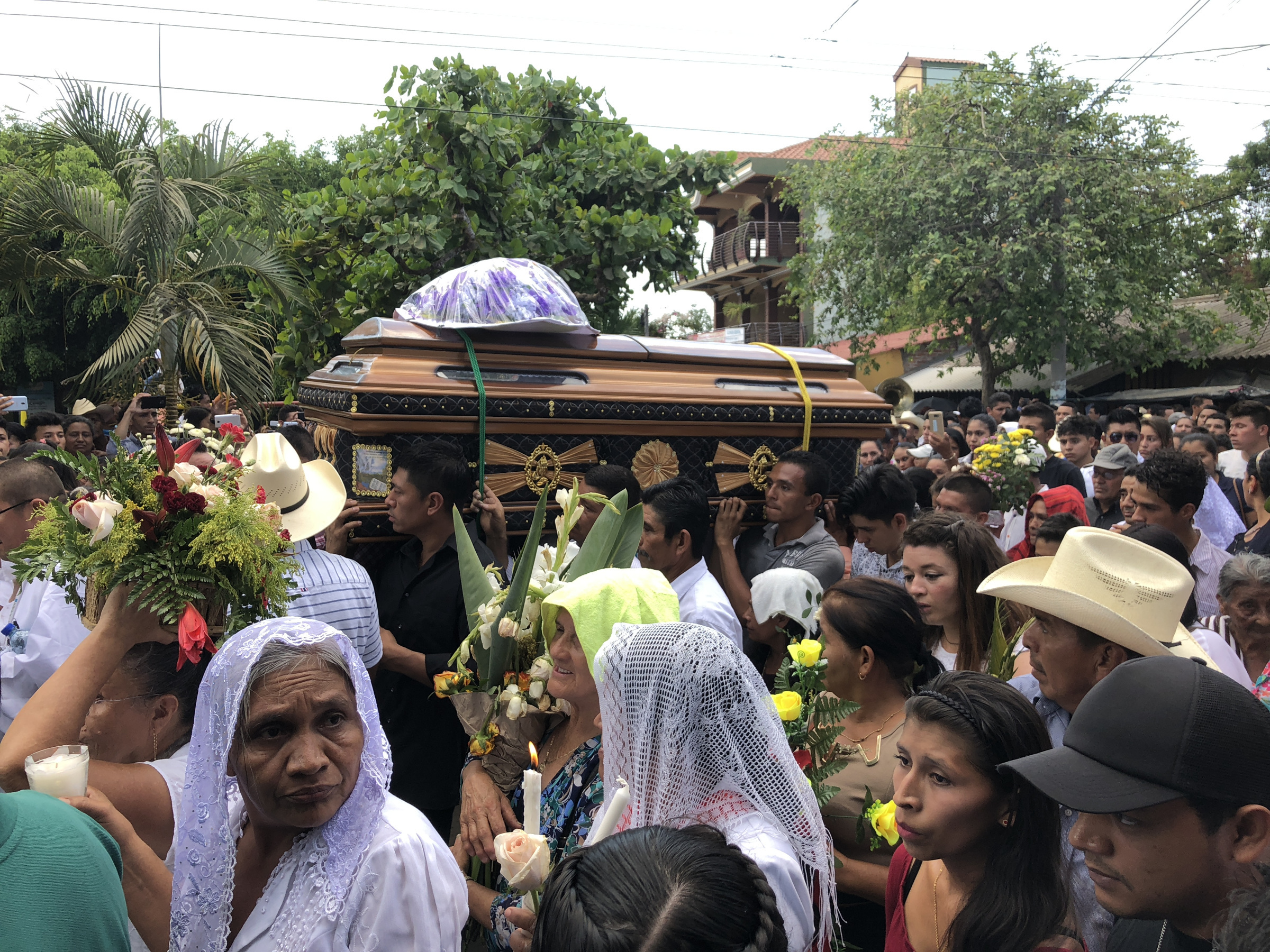
Pallbearers travel through a massive crowd April 1 with the coffin carrying slain Father Walter Vasquez Jimenez to Holy Trinity Church in Lolotique, El Salvador. The 36-year-old priest was killed March 29, Holy Thursday, shortly after renewing his vows. (Rhina Guidos/CNS)
“He didn’t have enemies,” said parishioner Jose Gilberto Aranda Ascorcio. “He transmitted happiness.”
Even in a country where tension exists between Catholics and some Protestants, Fr. Vasquez was a person respected by people from a variety of faiths, Aranda said.
Several women dressed with clothing associated with Evangelical groups in El Salvador — long skirts and heads covered with white lace or a white cloth — lined the path toward the cemetery.
Some of his parishioners wore T-shirts with his face on them, which they say they wore to the Easter Vigil as a sign that they would carry on his work and his spirit, that he would keep living through them.
“He was simple, humble,” said parishioner Liliana Carolina Perez Ramirez, who added he appealed to anyone who came into contact with him.
When the group showed up to the vigil wearing the shirts with his image, it represented their belief in the Resurrection, which includes now Fr. Vasquez’s, Perez said.
During Mass, Cardinal Rosa Chávez said it did not matter who killed Fr. Vasquez or why, but the violence had to stop.
“We can’t continue like this,” he said. “The world is watching us … We defeated the war. Why can’t we defeat this other type of war?”
Pallbearers travel through a massive crowd April 1 with the coffin carrying slain Father Walter Vasquez Jimenez to Holy Trinity Church in Lolotique, El Salvador. The 36-year-old priest was killed March 29, Holy Thursday, shortly after renewing his vows. (Rhina Guidos/CNS)
See SALVADOR-PRIEST-MURDER-FUNERAL April 2, 2018.
Cuadrilla de cargadores camina en medio de una multitud cargando el ataúd del asesinado padre Walter Vásquez Jiménez hacia la iglesia Santísima Trinidad en Lolotique, El Salvador, el 1 de abril. El sacerdote de 36 años de edad fue asesinado el 29 de marzo, Jueves Santo, poco después de renovar sus votos. (Rhina Guidos/CNS)
Cuadrilla de cargadores camina en medio de una multitud cargando el ataúd del asesinado padre Walter Vásquez Jiménez hacia la iglesia Santísima Trinidad en Lolotique, El Salvador, el 1 de abril. El sacerdote de 36 años de edad fue asesinado el 29 de marzo, Jueves Santo, poco después de renovar sus votos. (Rhina Guidos/CNS)
Por Rhina Guidos Catholic News Service
LOLOTIQUE, El Salvador (CNS) — Mientras centenares de salvadoreños de todo el país atestaban el pueblo rural de Lolotique durante la Pascua, oficiales de la Iglesia Católica daban sepultura al sacerdote de 36 años de edad que fue asesinado violentamente durante la Semana Santa — la víctima más reciente de una interminable ola de violencia que plaga el país.
Los oficiales oficiaron la Misa fúnebre del 1 de abril para el P. Walter Vásquez Jiménez, sacerdote de la Diócesis de Santiago de María en el este de El Salvador, en su nativo Lolotique, pueblo pintoresco con raíces indígenas. Al son de tambores y marimbas y dentro de un círculo repleto de pétalos de flores en el piso frente al altar de la Parroquia Santísima Trinidad en Lolotique, el ataúd del P. Vázquez estaba rodeado por su madre, amigos, feligreses, el único cardenal del país y cuatro obispos.
“Él se dirigía a una Misa, que ahora no celebrará, pero él celebrará en presencia de Dios”, dijo a Catholic News Service su primo, José Díaz Vásquez, uno de los miles que atestaron la plaza frente a la iglesia para recordar al sacerdote.
El P. Vásquez se dirigía a celebrar la Misa de Jueves Santo en el departamento de San Miguel el 29 de marzo, horas después de renovar sus votos sacerdotales durante una Misa Crismal, cuando un grupo de hombres enmascarados armados detuvieron el automóvil en que viajaban él y algunos feligreses. A los pasajeros les robaron a punta de arma y el sacerdote recibió un disparo fatal.
Un grupo de la Parroquia San Buenaventura en el Departamento de Usulután, El Salvador, llevaban camisetas representando un foto del sacerdote asesinado P. Walter Vasquez Jimenez antes de su funeral el 1 de abril en la Parroquia Santísima Trinidad en Lolotique, El Salvador. El sacerdote de 36 anos de edad fue matado el 29 de marzo, el Jueves Santo, un poco después de renovar sus votos sacerdotales. (Rhina Guidos/CNS)
El incidente recuerda al asesinato del Beato Oscar Romero, el arzobispo salvadoreño quien fue martiro durante celebrando la Misa en 1980, y quien será canonizado después en este año.
El asesinato ha perturbado a los oficiales de la Iglesia Católica, quienes dicen que todavía no saben qué motivó el asesinato ni lo que eso significa para la Iglesia. Muchos creen que pandilleros mataron al sacerdote, pero se desconoce los detalles de qué llevó al asesinato y las autoridades eclesiásticas están pidiendo respuestas, no solo por el asesinato del sacerdote, sino también por los delitos desenfrenados que sufren los pobres del país diariamente. Muchos de estos delitos nunca son procesados.
“Condenamos todos los actos de violencia que son cometidos contra nuestro pueblo y que llevan a homicidios, tal como el cometido contra el P/ Walter Vásquez”, decía un comunicado del 30 de marzo de los Padres Estefan Turcios Carpano y Luciano Ernesto Reyes García, director y director auxiliar de la oficina de Tutela Legal de Derechos Humanos de la Arquidiócesis de San Salvador.
La oficina exigió que las autoridades investiguen, capturen y enjuicien a los responsables del asesinato del P. Vázquez y a los responsables por la violencia general que sufre El Salvador.
Una mujer enciende una vela el 1 de abril cerca de un arreglo de pétalos de flores rodeando un foto del sacerdote asesinado P. Walter Vasquez Jimenez en la Parroquia Santísima Trinidad en Lolotique, El Salvador. El sacerdote de 36 anos de edad fue matado el 29 de marzo, el Jueves Santo, un poco después de renovar sus votos sacerdotales. (Rhina Guidos/CNS)
Sacerdotes y obispos han condenado repetidamente la violencia desenfrenada del país.
El P. Turcios, quien sirve en Soyapango, ciudad cerca de San Salvador que sufre violencia pandillera, dijo que hay mucho que todavía no se sabe sobre el caso del P. Vásquez, pero él se ha expresado sobre las situaciones económicas desiguales que han llevado a la guerra y ahora a una cultura de violencia en las zonas pobres de El Salvador, como la que él sirve.
El asesinato de Semana Santa del P. Vásquez le trajo al P. Turcios recuerdos de la violencia en torno al asesinato de 1977 del Padre jesuita Rutilio Grande, el primer sacerdote católico asesinado antes de la guerra civil del país. Y también a algunos de los feligreses del P. Turcios, que al principio se preocupaban por la participación en actividades religiosas al aire libre durante la Semana Santa después de las noticias del asesinato del P. Vásquez.
El cardenal salvadoreño Gregorio Rosa Chávez le pidió a los reunidos para el funeral que pensaran sobre el asesinato. “¿Qué está intentando decirnos como país?”, preguntó.
“En este país la vida no significa nada”, dijo secamente. “Respetemos la vida … derrotemos nuestros miedos”.
El cardenal le pidió a la multitud que trabajara para “proteger a los jóvenes para que no estén en las garras del vicio y la violencia”.
Una monja carmelita toma un foto el 1 de abril de un arreglo de pétalos de flores rodeando un foto del sacerdote asesinado P. Walter Vasquez Jimenez en la Parroquia Santísima Trinidad en Lolotique, El Salvador. El sacerdote de 36 anos de edad fue matado el 29 de marzo, el Jueves Santo, un poco después de renovar sus votos sacerdotales. (Rhina Guidos/CNS)
El Arzobispo José Luis Escobar Alas de San Salvador caminó cerca del ataúd del sacerdote asesinado, decorado encima con un ramo de flores púrpuras, mientras era llevado a la iglesia, bandas tocaban y la multitud cantaba himnos y canciones populares.
En 2016 el arzobispo escribió una escueta carta pastoral sobre la ascendente violencia del país. La Iglesia, a través de sus programas, ha intentado involucrar a los jóvenes del país, particularmente a los niños que podrían convertirse en víctimas o ser iniciados en las pandillas, para buscar un camino de paz.
Oficiales eclesiásticos como el P. Turcios y el Arzobispo Escobar culpan la historia de injusticia económica del país por su más reciente episodio de violencia a gran escala manifestada por las pandillas, periodo que comenzó poco después de que la guerra civil de 12 años del país terminara en 1992.
Desde la década de 1990 la violencia desenfrenada ha devastado la nación centroamericana, considerada uno de los países más peligrosos que no están en guerra.
El cardenal dijo durante la Misa que no importa quién haya asesinado al P. Vásquez ni porqué, pero que la violencia tiene que detenerse.
“No podemos continuar de esta manera”, dijo. “El mundo está observándonos. … Derrotamos la guerra. ¿Por qué no podemos derrotar este otro tipo de guerra?”.
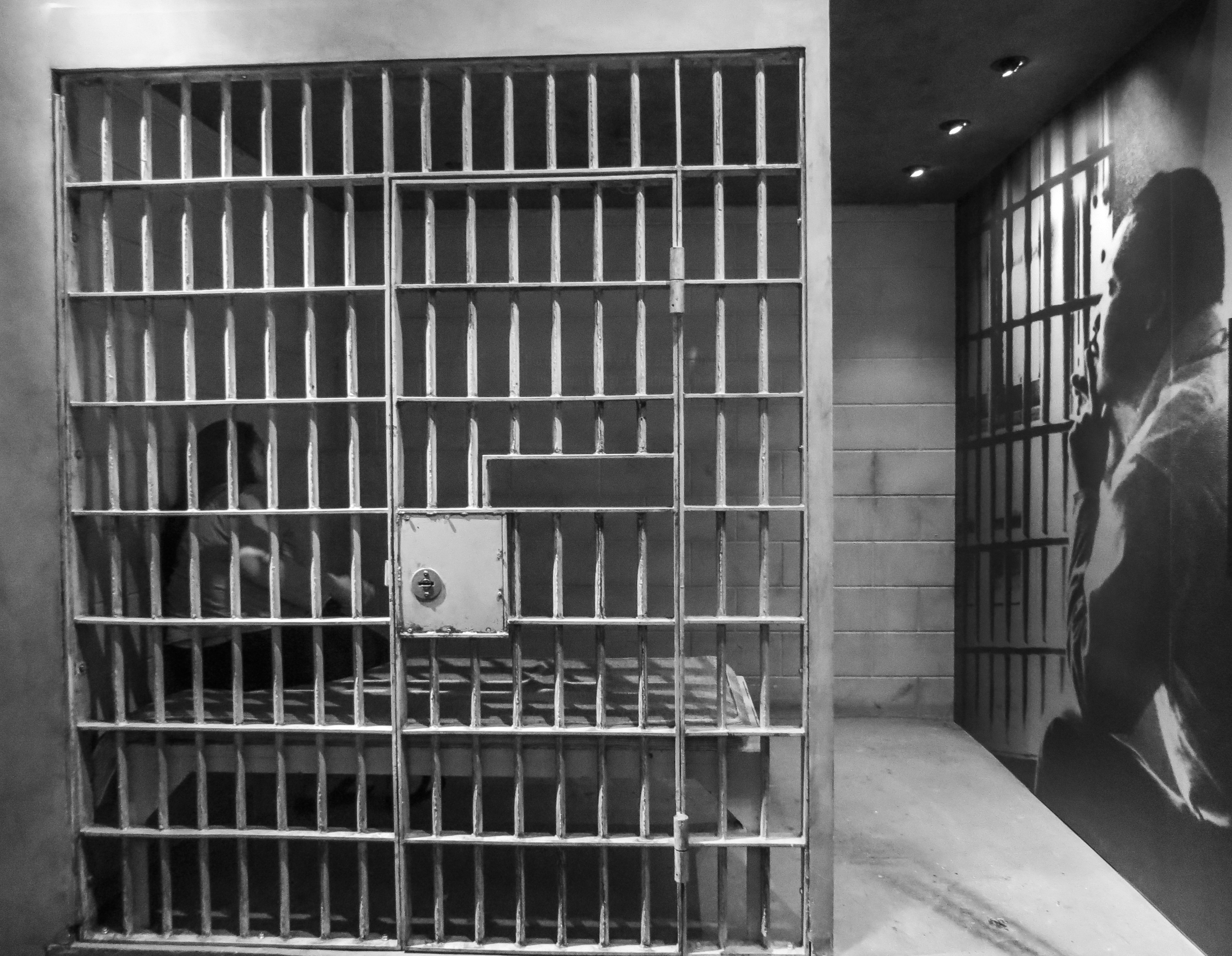
A visitor sits in a replica of a jail cell next to a portrait of the Rev. Martin Luther King Jr., in 2015 at the National Civil Rights Museum in Memphis, Tenn. On April 3, the eve of the 50th anniversary of Rev. King's assassination, a Vatican official said both the slain civil rights leader and Pope Francis have "brought universal attention to a new vision of the world." (Tannen Maury/CNS, via EPA) See POPE-KING-DREAM April 3, 2018.
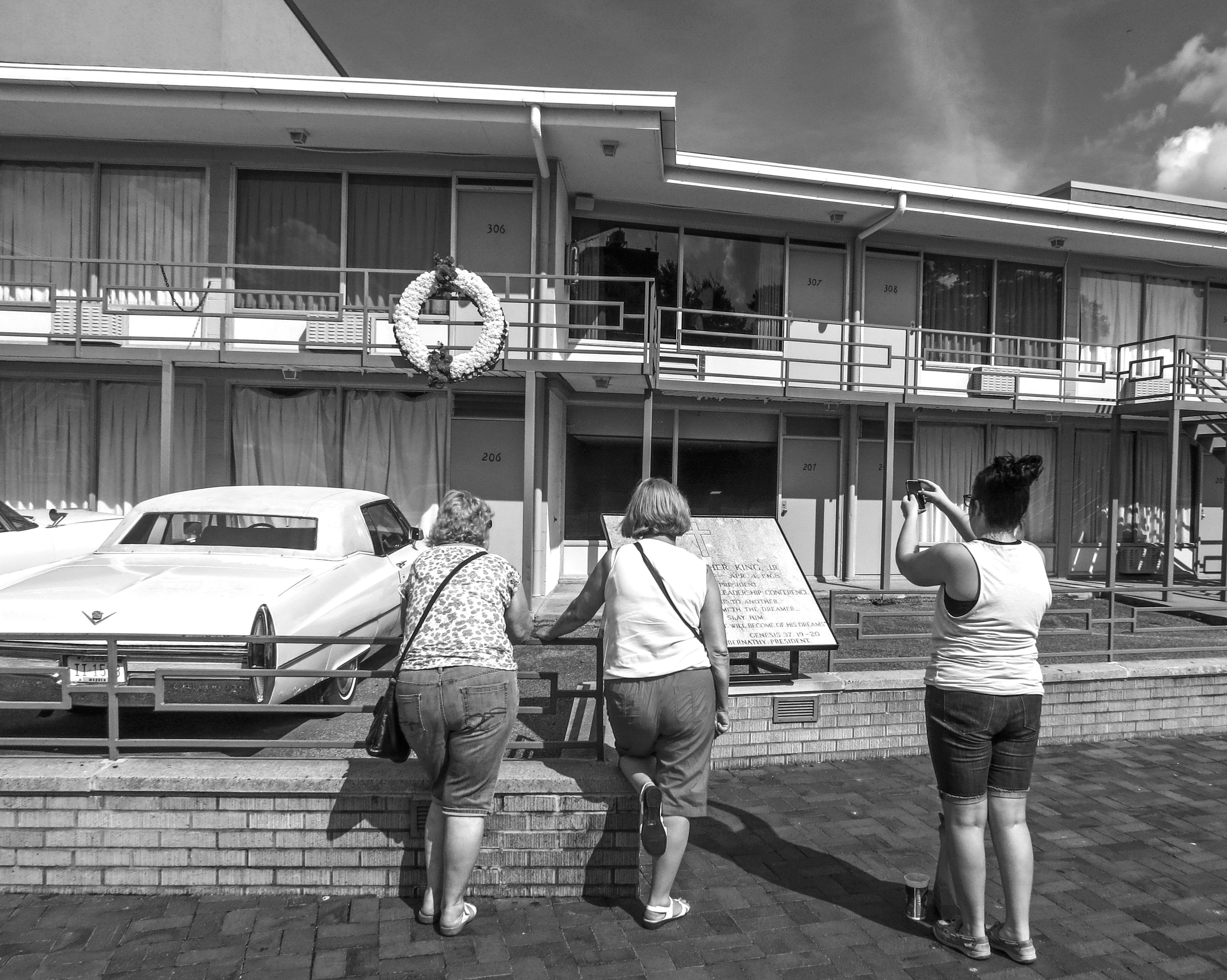
Visitors take photographs of the Lorraine Motel, where the Rev. Martin Luther King Jr. was killed in 1968 in Memphis, Tenn., in this 2015 file photo. Now part of the National Civil Rights Museum, the motel stands nearly the same as it did the day the civil rights leader was assassinated, April 4, 1968. (Tannen Maury/CNS, via EPA)
By Junno Arocho Esteves
Catholic News Service
VATICAN CITY (CNS) — The Rev. Martin Luther King Jr.’s dream of a dignified life for all men and women regardless of color or creed continues to live on in the teachings of one his most influential admirers, Pope Francis, a Vatican representative said.
Speaking to Vatican News April 3, the eve of the 50th anniversary of Rev. King’s assassination, Archbishop Ivan Jurkovic, Vatican observer to U.N. agencies in Geneva, said both the slain civil rights leader and the head of the Catholic Church have “brought universal attention to a new vision of the world.”
“Of course, Martin Luther King did it in the defense of human rights of the African-American people. The pope, instead, brings a new vision of the Church,” Archbishop Jurkovic said.
Rev. King’s legacy of nonviolent resistance to the injustices suffered by African-Americans in the United States, he said, began a “new era” that ushered in “a general development of society and democracy” in the world.
Archbishop Jurkovic said that same Christian-inspired message, echoed by many influential leaders today like Pope Francis, has two important guiding principles that are pertinent in today’s tumultuous political climate.
The first principle “is nonviolence, a principle that has become somewhat problematic today in the face of the many violent actions that surround us. Then there is the principle of universal fraternity: to consider all people as beneficiaries of the same brotherhood,” Archbishop Jurkovic said.
A visitor sits in a replica of a jail cell next to a portrait of the Rev. Martin Luther King Jr., in 2015 at the National Civil Rights Museum in Memphis, Tenn. On April 3, the eve of the 50th anniversary of Rev. King’s assassination, a Vatican official said both the slain civil rights leader and Pope Francis have “brought universal attention to a new vision of the world.” (Tannen Maury/CNS, via EPA)
Those principles, he added, not only must remain relevant for those working at a bureaucratic level crafting policy in the United Nations but must be defended by influential leaders in society today.
“Pope Francis does it — he does it in a splendid way — and everyone recognizes the role he has gained in such a short time,” the archbishop said. “The pope believes that the only future worthy of the human person is one that includes everyone.”
Archbishop Jurkovic said that all people must pursue and defend this vision which brought about change through the life and death of Rev. King.
“We can all be happy, but this only comes if all are included, from the last one to the most privileged and vice versa,” he said.
The Holy Father has long been an admirer of Rev. King, referring to him as a model of virtue for Americans today when addressing a joint session of Congress during his apostolic visit to the United States Sept. 24, 2015.
“A nation can be considered great when it … fosters a culture which enables people to ‘dream’ of full rights for all their brothers and sisters as Martin Luther King sought to do,” the pope said.
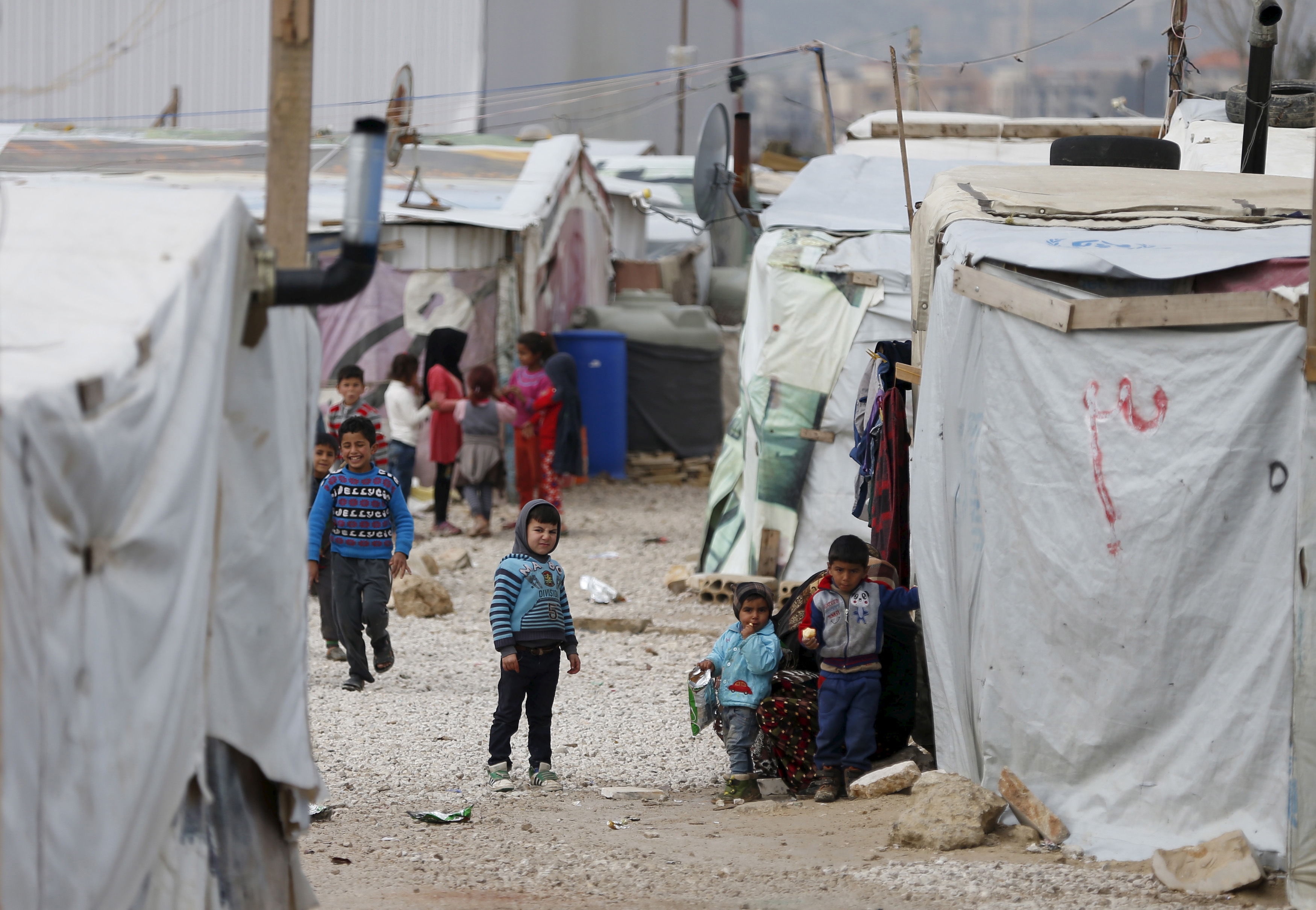
Syrian children are seen inside an informal settlement for refugees in Bar Elias, Lebanon. (Jamal Saidi/CNS, via Reuters) See MIDEAST-EASTER-PATRIARCHS April 3, 2018.
Syrian children are seen inside an informal settlement for refugees in Bar Elias, Lebanon. (Jamal Saidi/CNS, via Reuters)
BEIRUT (CNS) — In Easter messages, Catholic patriarchs of the Middle East evoked the hope of the Resurrection.
“Today’s world needs the resurrection of hearts,” said Lebanese Cardinal Bechara Rai, patriarch of Maronite Catholics. He called for a rekindling of love and compassion.
Cardinal Rai prayed for the displaced and the abducted to return to their homelands and for wars to end in Syria, Iraq, the Palestinian territories and Yemen, consolidating “a just, comprehensive and lasting peace” in the region.
He also warned that Lebanon’s difficult economic, social and living conditions threatened to destabilize the country’s internal steadiness. He said he hoped Lebanon’s parliamentary elections May 6 — the first such elections since 2009 — would “bring responsible and conscious statesmen.”
Of Lebanon’s existing population of nearly 4 million, approximately 40 percent are Christian. Under the country’s power-sharing system, Lebanon’s president is a Maronite Catholic, its prime minister a Sunni Muslim and the speaker of parliament a Shiite Muslim.
Syriac Catholic Patriarch Ignace Joseph III Younan, in his Easter message from Beirut, spoke about the suffering of Eastern Christians “from the pain of persecution, uprooting and horrific events for years,” especially in Syria, Iraq and Egypt. He also referred to his pre-Easter visit to Iraq, where some Iraqi Christians finally returned home after more than three years in exile from Islamic State.
“When we believe that Jesus rose from the dead, we declare the hope and joy that we, too, will,” he said.
From Baghdad, Chaldean Catholic Patriarch Louis Sako touched upon Resurrection and peace in his Easter message.
“The message of Resurrection this year is to do good; to be bridges for dialogue, reconciliation and to be peacemakers,” he said, urging the faithful to be “a gateway to grace and blessings.”
He noted that Iraq “is the cradle of civilization,” but has been transformed to a country of disasters.
“The Iraqi people seek security, stability as well as social, economic and cultural prosperity,” Patriarch Sako stressed. “Therefore, these tragedies must not lead us to give up and to despair but rather to look at these events through the eye of faith, in addition to a historical and political way of analysis.”
He encouraged the faithful to unite and collaborate to build trust and “work hand-in-hand to put an end to our suffering.”
Patriarch Sako also urged all Iraqis to vote in the country’s parliamentary elections set for May 12, referring to it as “our golden opportunity for change and to ensure a bright future for our people.”
He expressed his hope for a civil state in which the law protects and applies to everyone equally.
“Religion is for God and must be protected from politicization and distortion. Religion respects persons and does not enslave them, and the God in whom we believe is a loving and merciful Creator,” the patriarch stressed.
Coverage of international religious freedom issues by Catholic News Service is supported in part by Aid to the Church in Need — USA.
Bella Velasquez’s love of her Catholic faith, animals and reading blossomed into a series of books for young readers that melds the adventures of three furry friends and eternal truths that inspire. A trip to the library was the catalyst for the series.
(Joyce Coronel/CATHOLIC SUN)
Bella Velasquez’s love of her Catholic faith, animals and reading blossomed into a series of books for young readers that melds the adventures of three furry friends and eternal truths that inspire. A trip to the library was the catalyst for the series. (Joyce Coronel/CATHOLIC SUN)
Bella Velasquez had devoured every last book she could find about animal adventures. Her love of reading and man’s best friend runs so deep that it earned her the Ravenous Reader award at school back in second grade, but it was a trip to the library last summer that led to the 12-year-old’s latest achievement: She’s author of a new series of books.
“We were at the library and went up and down the rows,” said Bella’s mother, Mandy. “She’d read every animal series there was.”
“But I couldn’t find Catholic-related chapter books with animals or puppies mixed into it,” said Bella.
That’s when Mandy issued a challenge: “Write your own book,” she told her daughter.
Bella took her mom’s words to heart and spent much of the summer writing and illustrating a children’s book she dubbed “Catholic Puppies: Lucy’s Big Adventure.” Several weeks later, Bella announced that she’d finished the project. “I said, ‘Oh my goodness!’ Sure enough, she’d written a book,” Mandy told The Catholic Sun.
“I really love reading and I like making up stories people want to read — stories with my Catholic faith and love of puppies tied into it.” But would the new book be dog-eared by others?
Bella’s parents were sure the answer was yes. After they read “Catholic Puppies,” they realized their daughter had created something other children might enjoy reading. They had the book professionally edited and then published through Lulu.com. Marco, Bella’s father, built catholicpuppies.com, a website that promotes the book.
The 81-page story traces the adventures of Lucy, Bernadette and Therese, three furry friends who have a faith-filled journey in which they meet new friends, receive the sacrament of Reconciliation and learn to trust God.
Bella’s first book proved so popular among friends, family and those who learned of the intrepid young author that she dove right into penning a full series. All the books meld Catholic faith with the adventures of puppies, each one bearing a saint’s name. “Therese and the Golden Bible” came to life over Christmas vacation and is now in the editing process.
A third book, “Bernadette in the Holy Land,” is in the works and delves into the three puppies preparing for and receiving the sacraments of Confirmation and Communion. Book number four is already outlined and casts the trio of the four-legged friends helping Mary and Joseph arrive safely in Bethlehem.
With her first series of books taking shape at age 11, it’s no surprise that the sixth-grader aspires to a future that includes further writing. At a Catholic women’s conference recently, Bella signed copies of her book for young fans, including a young girl who learned about “Catholic Puppies” from Facebook.
Julie Sikora, Bella’s teacher at St. Timothy Catholic School, said her student is an “exceptional writer” blessed with creativity. “To take on a project of this magnitude at her age is nothing short of inspirational,” Sikora said of Bella. “She combined her strong faith in God, genuine personality and her incredible knack for writing into a wonderful book for children to understand the sacrament of Reconciliation.”
Marco said he’s proud of Bella but he also gave credit to Mandy. “It has everything to do with how my wife inspires creativity in our children in ways that glorify God and the Church.”
“The one thing she keeps telling her readers is, ‘Dream big. God is cheering you on!’ It’s also how she signs all of her books,” Mandy said. “We want to support Bella because we really feel she has a gift in creating magical, adventurous, faith-filled books that are still true to our Catholic roots.”
(from page 6 of “The Southern Cross,” San Diego, March 2018)
Related
San Diego eighth-grader pens book
“Brain Town” is geared toward elementary students dealing with dyslexia. A similar book for older students is in the planning stages as is one for parents and a third for teachers.
Singles of all ages wonder why it’s so hard to meet, date and marry today. In fact, 50 percent of America is single and fewer people are committing to marriage, according to the Bureau of Labor Statistics, 2014. Dating has been replaced by “hooking up” and “hanging out,” making the traditional days of “courtship” obsolete. Or, has it?
A few years ago, one of the most popular professors of Philosophy at Boston College, Kerry Cronin, noticed this decreased dating trend among her undergrad students. “And I thought, ‘Well, this is crazy.’ So I started asking students to go on what I refer to as ‘traditional dates’ as part of an extra-credit assignment.”
However, the act of going on a date was more complicated than she thought. A combination of the prevalent “hook up” culture, as well as the preferred method of social interaction (texting) had all but obliterated skills of basic social interaction. And, so “The Dating Project” began, and her class quickly became one of the most popular courses at Boston College.
“The Dating Project” comes to cinemas nationwide April 17, through Fathom Events, as a special one-night event featuring an exclusive deep-dive discussion with Dating Project brainchild Professor Kerry Cronin of Boston College. Tickets can be purchased online or at participating theater box offices. It’s playing at six theaters throughout the Phoenix metro area.
The documentary follows Professor Cronin and five modern-day singles (ages 20 – 40) in their own quest to find authentic love and meaningful relationships. By engaging in Cronin’s dating philosophy, her mentees find more fulfilling and lasting relationships. Response to this inspiring documentary has been overwhelming:
“There is a huge gulf between single life and relationships in the United States. This powerful documentary is a reflection of today’s culture with a surprising look at how one woman is shifting it, one single person at a time. The Dating Project is a must-see, no matter what your relationship status,” said Michael Scott, CEO and co-founder of Pure Flix.
The film also received critical acclaim from the Heartland Film Festival, the USA Film Festival, and the Downtown LA Film Festival, which awarded it the Audience Favorite Award.
WASHINGTON (CNS) — It has been 50 years since civil rights leader the Rev. Martin Luther King Jr. was assassinated, but Dcn. Timothy E. Tilghman, his sister and his cousin, still remember the enormous sense of loss they felt when they received that news April 4, 1968.
As the 50th anniversary of Rev. King’s murder approaches, these three family members also recalled the turmoil, bewilderment and burning buildings they witnessed as rioting stormed through Washington and other U.S. cities in the days that followed.
The deacon, who is on the staff of Our Lady of Perpetual Help Parish in Southeast Washington, was 15 and said the grief he experienced was akin to a close family member being violently murdered, even though his family’s association with Rev. King was from afar.
He wasn’t alone in his sorrow.
Dcn. Tilghman was at St. Benedict the Moor Catholic School when he heard about the assassination. As he walked on the school’s playground he watched the nuns and his fellow students, most of them young black Catholics like himself, cry as they absorbed the blow.
“There was a sense of despair, there was a great sense of loss,” he told Catholic News Service.
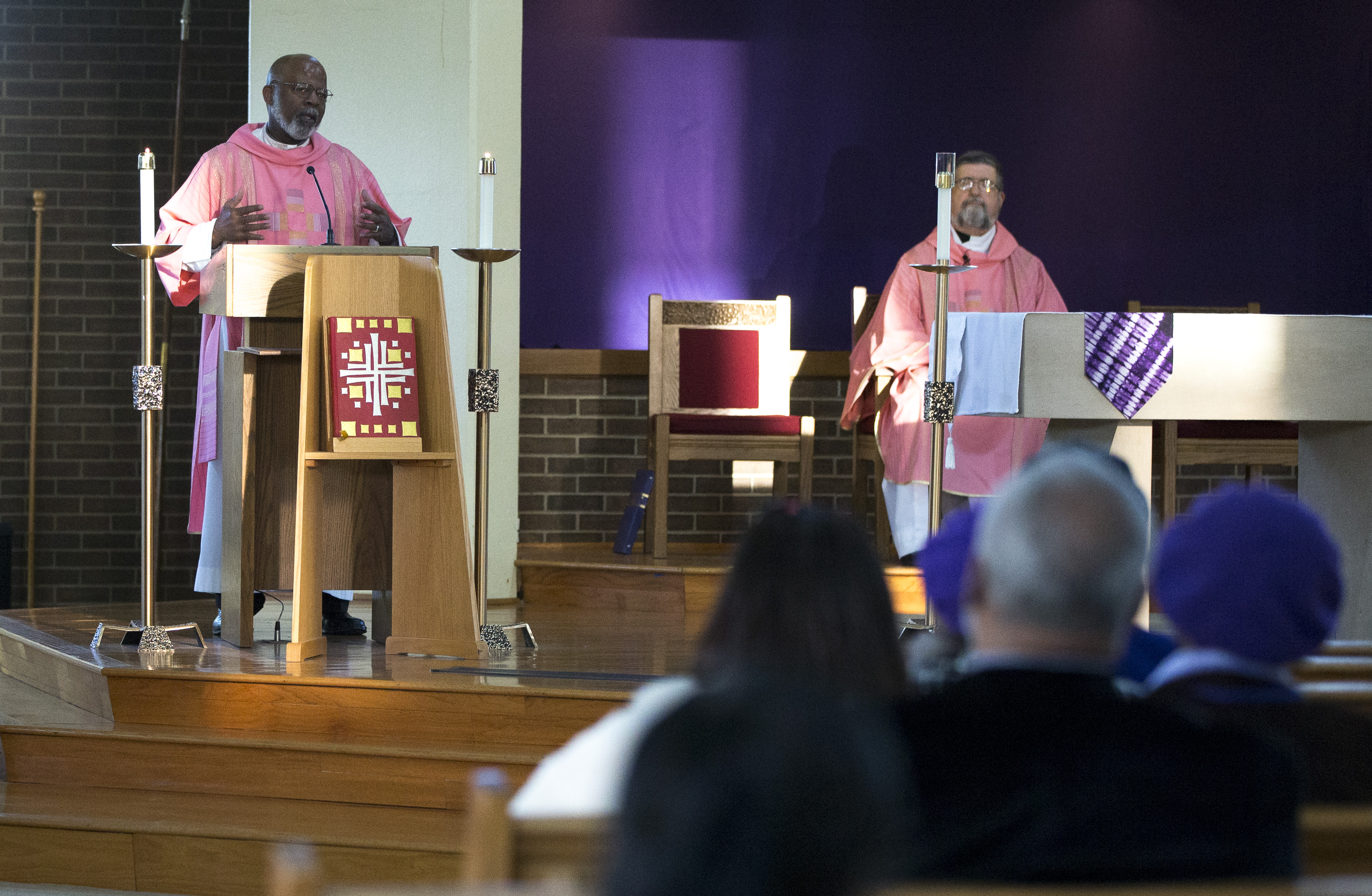
Deacon Timothy E. Tilghman delivers the homily during a March 11 Mass at Our Lady of Perpetual Help Catholic Church in Washington. Deacon Tilghman was 15 when civil rights leader the Rev. Martin Luther King Jr. was assassinated April 4, 1968. He remembers accompanying his father as he traveled through Washington to help those who were impacted during the riots that ensued. (Chaz Muth/CNS)
By the 1960s, Dcn. Tilghman and his family had been Catholic for several generations and had a long connection to the Josephites, a religious community known for its help of the newly freed slaves in America following the U.S. Civil War.
Even though Rev. King was a Baptist minister, he transcended religious identification for the deacon, his parents, his 12 brothers and sisters, his cousins and his fellow black Catholics who saw the civil rights leader as an inspirational crusader for justice and peace.
The family closely watched Rev. King’s rise to national prominence and applauded his efforts in the civil rights movement.
As black Americans, they were motivated to become involved in the movement themselves, along with the leaders of their Church.
On Aug. 28, 1963, the deacon’s sister, Mary Tilghman Shearad, went to the March on Washington for Jobs and Freedom with their father, Cyprian Olave Tilghman, and was thrilled to witness Rev. King’s famed “I Have a Dream” speech.
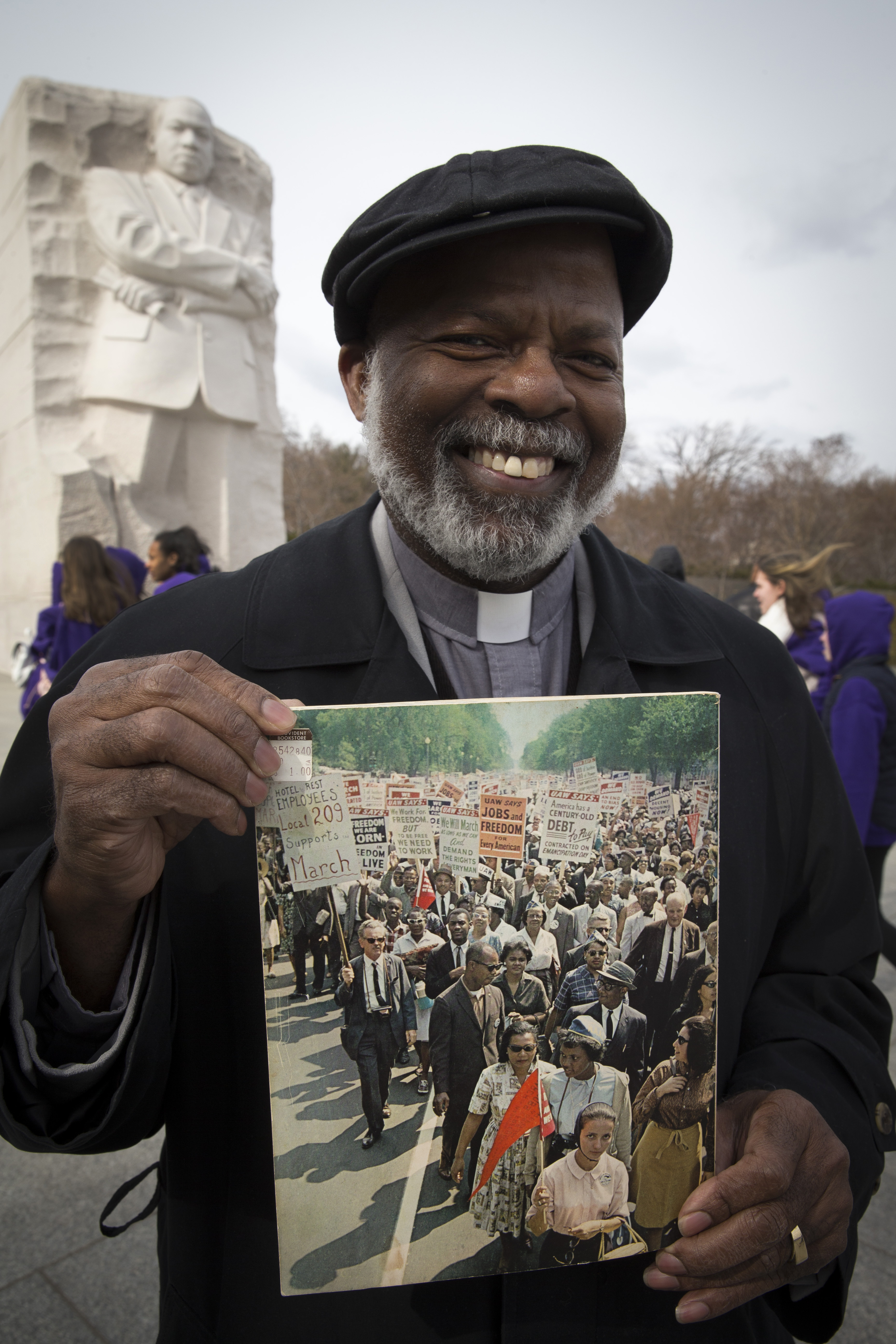
Deacon Timothy E. Tilghman of Our Lady of Perpetual Help Catholic Church in Washington, pictured at the Martin Luther King Jr. Memorial in Washington March 14, holds up a program from the 1963 March on Washington for Jobs and Freedom. It features a photo of his father and sister who participated in the historic event with Rev. King. Deacon Tilghman was 15 when King was assassinated April 4, 1968. (Chaz Muth/CNS)
Shearad was horrified when she heard the news April 4, 1968, that Rev. King had been gunned down in Memphis, Tennessee, and she sensed tension from people all around her in Washington that day.
“There was no calmness in the city,” she told CNS. “You could just feel things brewing.”
The next day, while she was working at American Security Bank in downtown Washington, the riots began.
“The city just exploded,” Shearad said. “You could look out the window, see fires, you could see cars being trampled. It was terrifying.”
She was at the corner of 14th and I streets in Washington’s Northwest section and witnessed a men’s clothing store explode. “The glass blew out and I just started running.”
Shearad and Tilghman’s cousin, Sahon Palmer, was a 22-year-old student at Howard University and attending classes when the riots broke out and she recalls watching the city descend into pandemonium.
“I was so afraid,” Palmer said. “First, someone had just killed Dr. King and I was heartbroken over that, and all of that chaos, burning buildings, noise and sirens and I was trying to get home from school. My mother was having a fit.”
Known as the Holy Week Uprising (because it occurred during the week between Palm Sunday and Easter), the rampage left 39 dead, about 2,600 injured and resulted in an estimated $65 million in property damage in dozens of U.S. cities.
The riots came while the Tilghman family was still grieving the loss of Rev. King, but they knew they wanted to do something, anything, to help, Dcn. Tilghman said.
So, he and one of his brothers mobilized with their father, traveled through the rioting streets of Washington, and delivered food to the people impacted by the chaos, confusion and destruction.
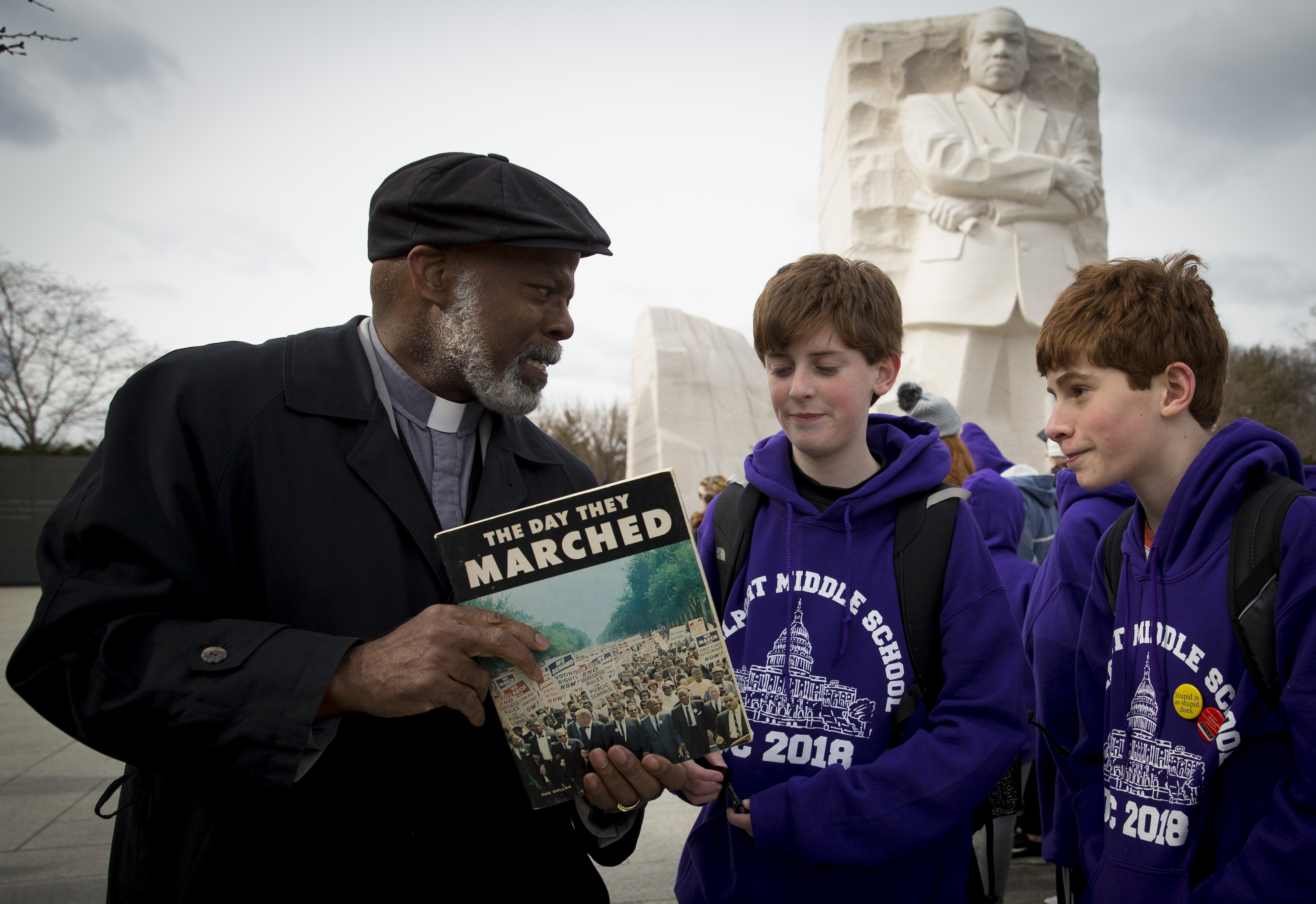
Deacon Timothy E. Tilghman of Our Lady of Perpetual Help Catholic Church in Washington shows two middle school students a program from the 1963 March on Washington for Jobs and Freedom, featuring the Rev. Martin Luther King Jr., while the deacon and youths visit the King memorial in Washington March 14. Deacon Tilghman was 15 when Rev. King was assassinated April 4, 1968. He accompanied his father as he traveled through Washington to help those who were impacted during the riots that ensued. (Chaz Muth/CNS)
Though witnessing the riots was frightening, Dcn. Tilghman said his journey with his father throughout those tumultuous Washington streets was a pivotal moment in his life.
In the midst of the rioting, he recalled witnessing people who were in anguish over the King murder, people who had lost hope that racial equality and human rights would ever become a reality in their country.
But, Dcn. Tilghman also said their simple act of kindness of delivering food throughout the city appeared to help a distraught population.
“Being able to go out and do things with my father took care of that sense of despair for me,” he said, “and there was a sense of hope, there was a sense of joy, because, we could do something to bring something back into somebody’s life. To bring some sense of peace and some sense of stability.”
Dcn. Tilghman said it was his father’s Catholic values that drove him to reach out to the people who were suffering that day and it left an immeasurable impression on him.
It was the catalyst to his future work with the Josephites and then later as an ordained Catholic deacon.
Rev. King too served as the deacon’s inspiration as he established his own ministry.
“I’m trying to live the faith the way all of these men did,” Dcn. Tilghman said. “It drove me in 1968 and I’m much clearer on what drives and informs me today.”
Pope Francis greets the crowd during his Easter message and blessing "urbi et orbi" (to the city and the world) delivered from the central balcony of St. Peter's Basilica at the Vatican April 1. (CNS, via Vatican Media) See POPE-EASTER-SUNDAY April 1, 2018.
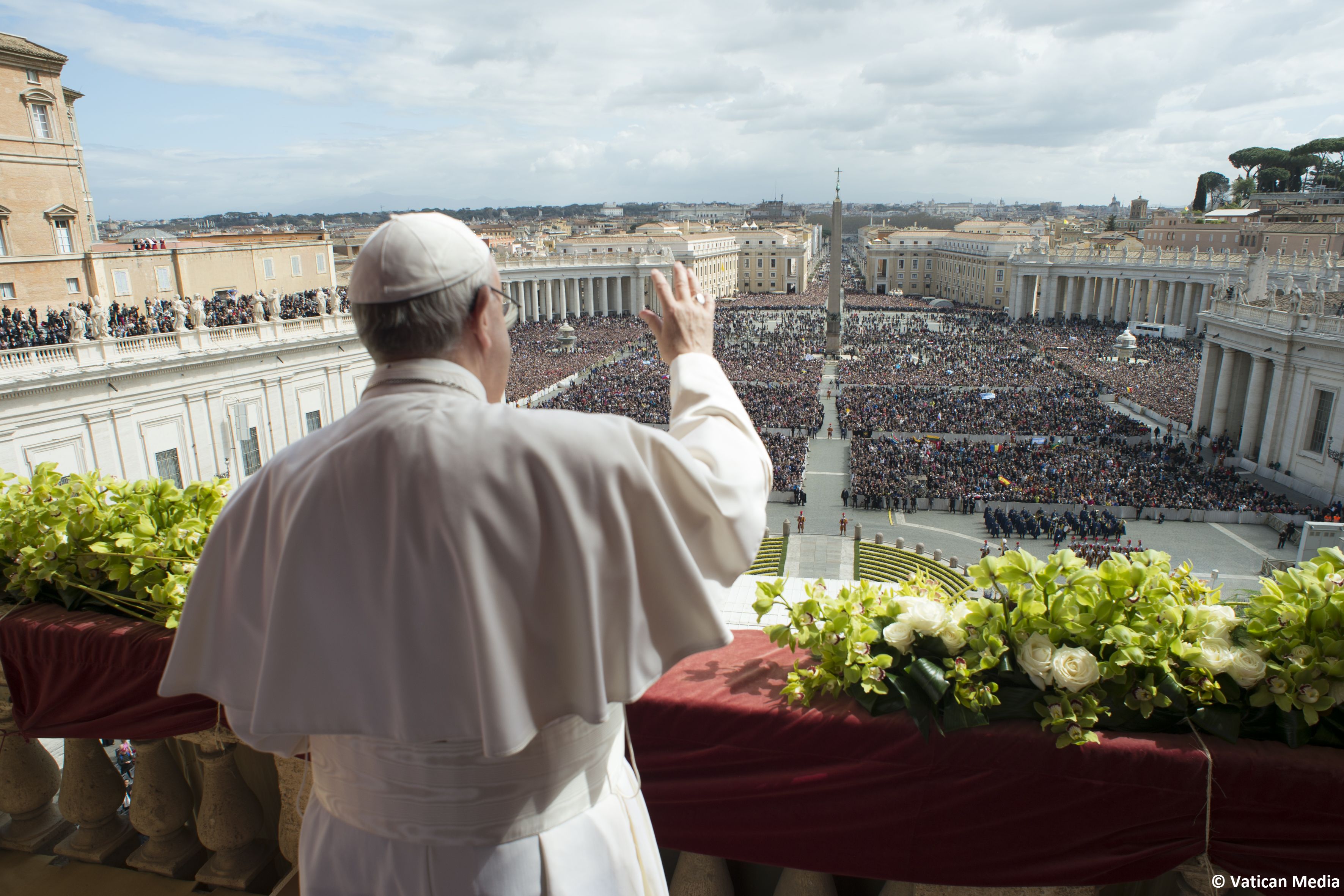
Pope Francis greets the crowd during his Easter message and blessing “urbi et orbi” (to the city and the world) delivered from the central balcony of St. Peter’s Basilica at the Vatican April 1. (CNS, via Vatican Media)
By Cindy Wooden
Catholic News Service
VATICAN CITY (CNS) — Easter is a feast that calls Christians to gather together, make a commitment to dialogue and to work for the common good, Pope Francis said.
In Italy and in other countries, Easter Monday is a day for relaxed family gatherings and picnics because “after having celebrated Easter, one feels a need to gather again with loved ones and friends to celebrate,” the pope said April 2, before reciting the “Regina Coeli” prayer at noon with visitors in St. Peter’s Square.
In a short talk before the prayer, Pope Francis said Easter promotes fraternity because “with his death and resurrection, Christ has defeated the sin that separates human beings from God, from themselves and from their brothers and sisters. We know that sin always separates, always creates enmity.”
Pope Francis said it is important today to rediscover the value of fraternity and community that the first Christians lived, “rediscovering how to give space to Jesus who never separates, but always unites.”
“Without fraternal sharing,” he said, “there can be no ecclesial or civil community; there would exist only a collection of individuals moved or grouped by their own interests.”
Christ’s resurrection from the dead unleashed a new commitment to dialogue, “which for Christians has become a responsibility,” the pope said. “In fact, Jesus said, ‘This is how all will know that you are my disciples, if you have love for one another.’ That is why we cannot close ourselves off in our own group, but we are called to be involved in the common good, take care of our brothers and sisters, especially those who are weakest and most marginalized.”
After reciting the “Regina Coeli,” Pope Francis urged Christians to show support and care for people who are fragile, and he made special mention of day’s celebration of World Autism Awareness Day.
For the occasion, the Vatican published a message from Cardinal Peter Turkson, prefect of the Dicastery for Promoting Integral Human Development.
“With its works the church witnesses to its care for persons with symptoms on the autism spectrum,” he said. “In our communities, there is a general attitude of welcome, even if there is still difficulty in exercising real inclusion.”
For such inclusion to occur, he said, every parish and community must make sure all who enter are treated with the dignity that is theirs as children of God and they must welcome with compassion any family that is struggling and exhausted.