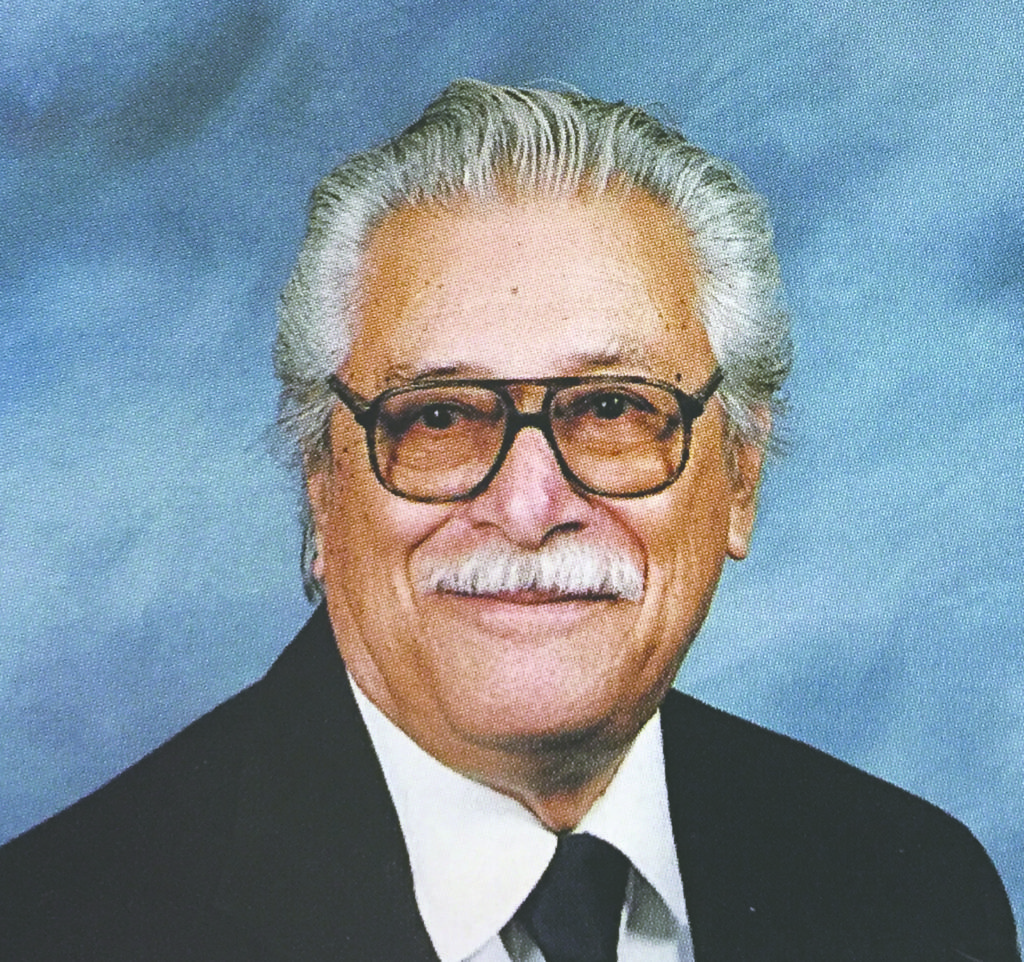
Native Phoenician Dcn. Walter George Valverde, a family man devoted to the corporal works of mercy, died Nov. 22. He was 89. Dcn. Valverde was a member of the first class of deacons ordained into the diaconate for the Diocese of Phoenix on May 25, 1974.
His ministry began at Our Lady of Perpetual Help Parish in Glendale, where he served 1974-1986, followed by St. Philip the Deacon, 1986-1999, and San Martin de Porres, 1999-2004. His last assignment was at St. Louis the King Parish in Glendale in 2006, where he served throughout his retirement.
Fr. Joseph Bui, pastor of St. Louis the King, said Dcn. Valverde was an entrusted member of the parish community.
“Although he was retired, he helped out on Sundays and whenever he could,” Fr. Bui said. “He showed great spirit and love of the people.”
Bette Regan said she recalled meeting Dcn. Valverde at a diocesan event years earlier, and was struck by his genuine delight in sharing his faith.
“He was telling me about Our Lady of Guadalupe and what all the symbols meant. I was so impressed with his knowledge and how gentle and thorough he was,” Regan said. “I was so overwhelmed that he would take the time to tell me about Our Lady. I’ve never forgotten him or the story.”
Dcn. Valverde was born in Phoenix in 1926 and attended Phoenix Union High School.
He enlisted in the United States Navy in 1943 during World War II, serving three years before receiving an honorable discharge in 1946. One year later he married Armida (Pola) Quesada on Dec. 28, 1947, and they were married for over 61 years before her death.
Dcn. Valverde had a career in government, retiring from the U.S. Post Office in 1985 after 35 years of service in the Phoenix area. Throughout his ministry in the diocese, Dcn. Valverde mentored other deacons and provided spiritual guidance to inmates in jail, patients in hospitals and Latinos in underserved communities.
A devoted family man, Dcn. Valverde was preceded in death by his wife, Armida. He is survived by his eight childrenr: Geoge, David, Miguel, Suzanne, Loraine, Paul, Joseph and Felicia; 19 grandchildren; and 15 great-grandchildren.
Bishop Thomas J. Olmsted celebrated the funeral Mass for Dcn. Valverde Dec. 4 at St. Jerome Parish. He was interned at St. Francis Cemetery. Memorial donations can be made to Hospice of the Valley.
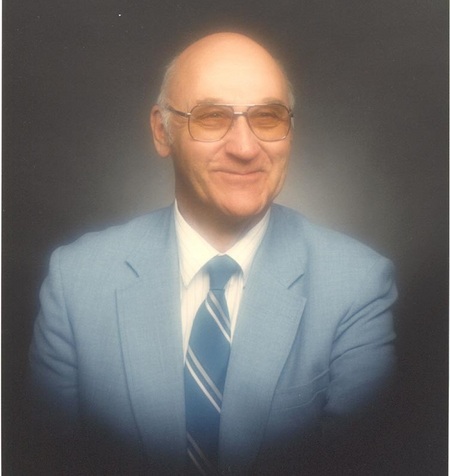
Dcn. Reed Eugene Santa, a “gentle giant” known for his great faith and generosity toward others, died Nov. 19. He was 89.
His ministry in the diaconate for the Diocese of Phoenix spanned 18 years. Dcn. Santa was ordained in 1993, and spent four years at Holy Cross Parish in Mesa. He was then assigned to All Saints Parish about five miles north. That’s where he started a bereavement ministry and served until he retired from active service in 2011. Dcn. Santa was also active in the Society of St. Vincent de Paul where he served the poor and needy in the community.
“Dcn. Reed was friendly, outgoing, loving and never had an unkind word to say about anyone,” said Fr. Robert Caruso, All Saints pastor. “He will be deeply missed.”
Originally from St. Paul, Minnesota, Dcn. Santa was born in 1926 to Eugene and Elizabeth (Korngable) Santa. He graduated from Johnson High School in 1944 at the age of 17.
[quote_box_right]
Dcn. Reed Santa
Born: Aug. 21, 1926 in St. Paul, Minn.
Ordained: Oct. 30, 1993
Service in the Diocese of Phoenix
Holy Cross Parish in Mesa, 1993–1997
All Saints Parish in Mesa, Assigned in 1997
Society of St. Vincent de Paul
Died: Nov. 19, 2015
[/quote_box_right]
He enlisted in the U.S. Navy during World War II, having served in the Atlantic and South Pacific as a gunner’s mate on the destroyer U.S.S. Charles P. Cecil DD-835. He was honorably discharged in 1946, and attended Dunwoody Industrial Institute on the GI Bill learning the printing trade.
Dcn. Santa worked for Perfection Type as a monotype operator and then the City of Maplewood until he retired in 1984, when he and Betty moved to Arizona. He lost his beloved wife of 53 years on June 19, 2001.
Dcn. Santa was preceded in death by his parents, his wife Betty (née Stephani), infant daughter Barbara and grandson Erik Mortenson. He is survived by six children: Sue (Gerald Mortenson) of St. Louis Park, Minnesota, Mary (Gary Hite) of Maplewood, Minnesota, John (Penny) of Longville, Minnesota, Stephen (Linda) of Crystal, Minnesota, Chris (Larry Anderson) of Mesa, and Grace (Jack Wachlarowicz) of Mahtomedi, Minn; twelve grandchildren: Beth (Andy), Kathy (Scott), Jessica, Carrie, Michelle (Steve), Matthew, Andrea, Joshua, Jenna (Emmett), Brendan, Amanda and John, and thirteen great-grandchildren.
Dcn. Santa’s body will be returned to St. Paul, and a memorial service will be arranged at Transfiguration Catholic Church. Burial will be at Fort Snelling National Cemetery, Minneapolis, Minnesota
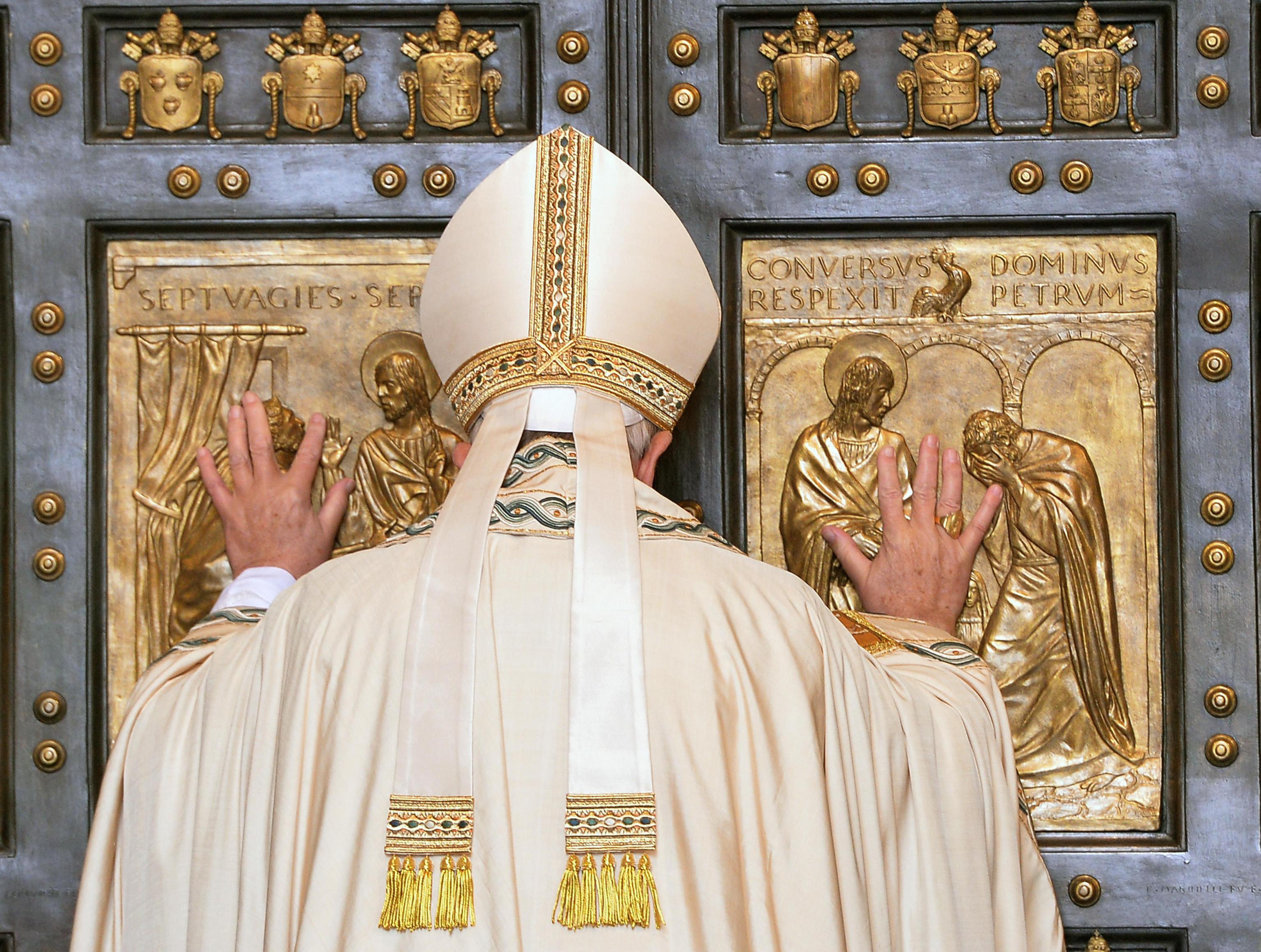
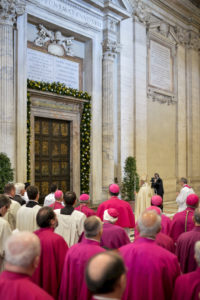
Pope Francis opens the Holy Door of St. Peter's Basilica to inaugurate the Jubilee Year of Mercy at the Vatican Dec. 8. (CNS photo/Maurizio Brambatti, EPA)
Pope Francis opens the Holy Door of St. Peter’s Basilica to inaugurate the Jubilee Year of Mercy at the Vatican Dec. 8. (CNS photo/Maurizio Brambatti, EPA)
VATICAN CITY (CNS) — On a cloudy, damp morning, Pope Francis’ voice echoed in the atrium of St. Peter’s Basilica: “Open the gates of justice.” With five strong thrusts, the pope pushed open the Holy Door, a symbol of God’s justice, which he said will always be exercised “in the light of His mercy.”
The rite of the opening of the Holy Door was preceded by a Mass with 70,000 pilgrims packed in St. Peter’s Square Dec. 8, the feast of the Immaculate Conception and the beginning of the extraordinary Holy Year of Mercy.
As the sun broke through the clouds, heralding the start of the jubilee year, the pope bowed his head and remained still for several minutes in silent prayer.
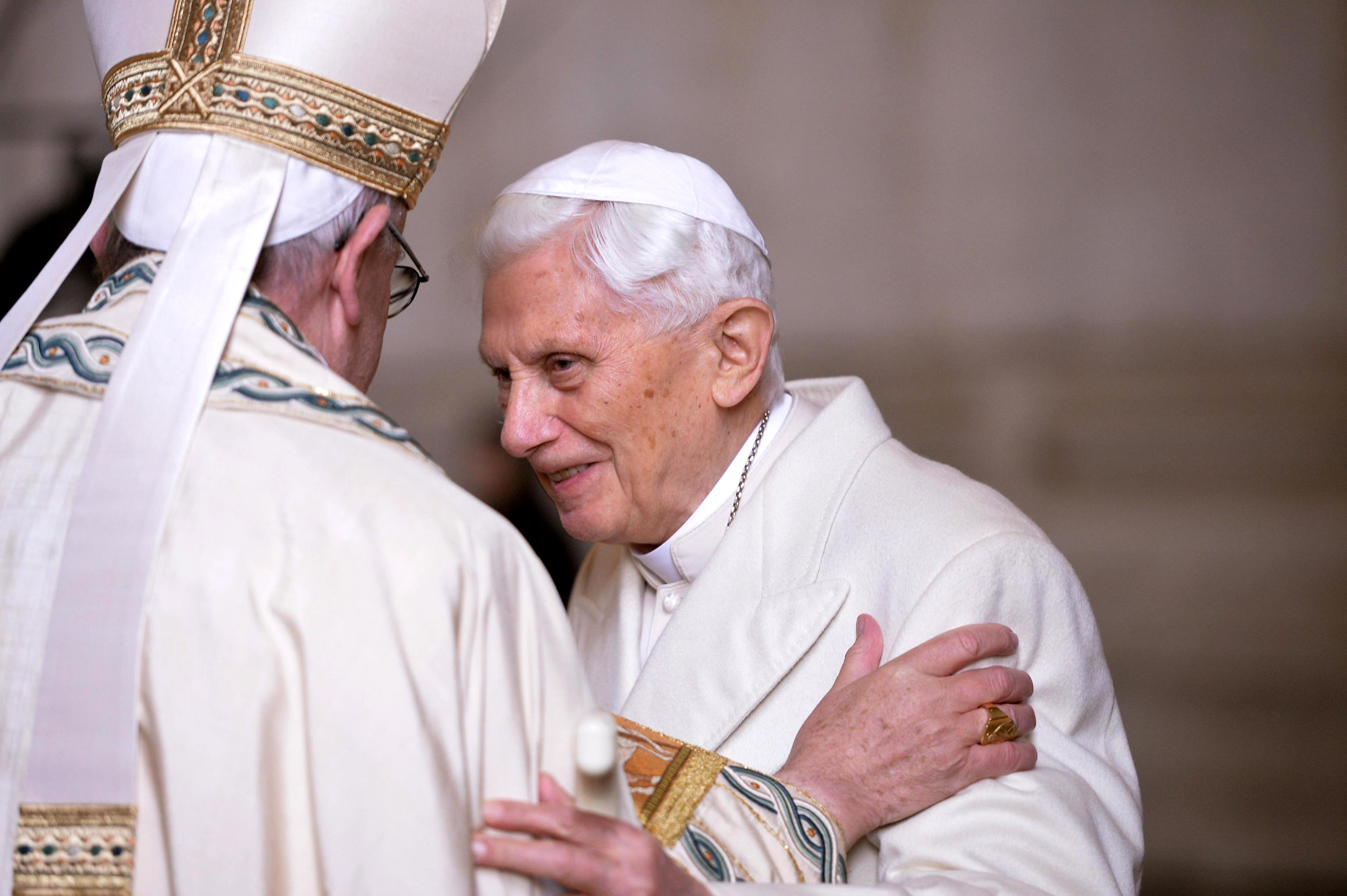
Amid a crowd of dignitaries and pilgrims, a familiar face was also present at the historic event: retired Pope Benedict XVI, who followed Pope Francis through the Holy Door into St. Peter’s Basilica.
During his homily, Pope Francis emphasized the “simple, yet highly symbolic” act of opening the Holy Door, which “highlights the primacy of grace;” the same grace that made Mary “worthy of becoming the mother of Christ.”
“The fullness of grace can transform the human heart and enable it to do something so great as to change the course of human history,” he said.
Pope Francis greets retired Pope Benedict XVI prior to the opening of the Holy Door of Saint Peter’s Basilica at the Vatican Dec. 8. Pope Francis opened the Holy Door to inaugurate the Jubilee Year of Mercy. (CNS photo/Maurizio Brambatti, EPA)
The feast of the Immaculate Conception, he continued, serves as a reminder of the grandeur of God’s love in allowing Mary to “avert the original sin present in every man and woman who comes into this world.”
“This is the love of God which precedes, anticipates and saves,” he said. “Were sin the only thing that mattered, we would be the most desperate of creatures. But the promised triumph of Christ’s love enfolds everything in the Father’s mercy.”
The Year of Mercy, the pope stressed, is a gift of grace that allows Christians to experience the joy of encountering the transforming power of grace and rediscovering God’s infinite mercy toward sinners.
“How much wrong we do to God and His grace when we speak of sins being punished by His judgment before we speak of their being forgiven by His mercy,” he said.
“We have to put mercy before judgment, and in any event God’s judgment will always be in the light of His mercy. In passing through the Holy Door, then, may we feel that we ourselves are part of this mystery of love.”
Fifty years ago, he said, the Church celebrated the “opening of another door,” with the Second Vatican Council urging the Church to come out from self-enclosure and “set out once again with enthusiasm on her missionary journey.” The council closed Dec. 8, 1965.
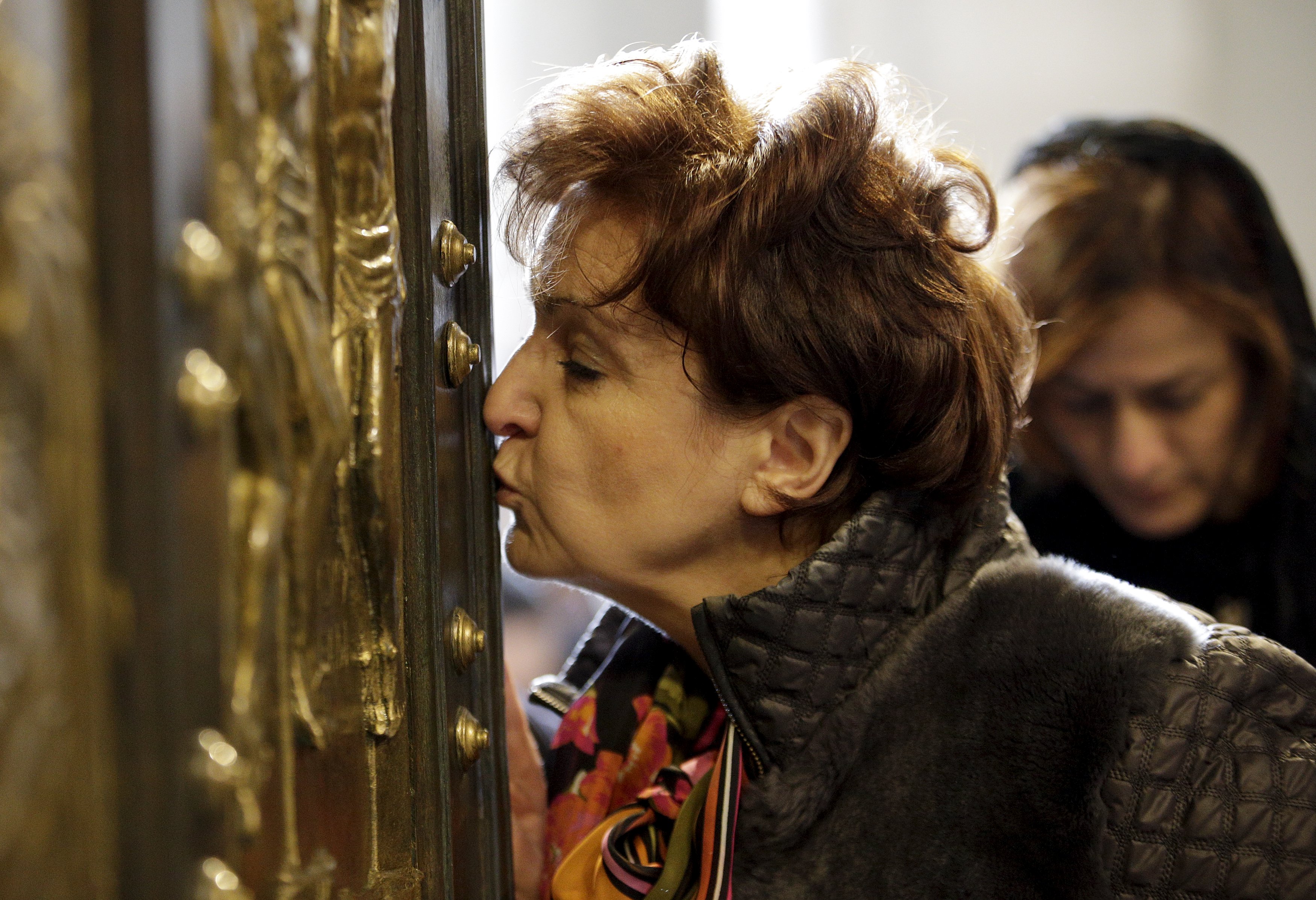
A woman kisses the Holy Door in St. Peter’s Basilica after Pope Francis opened it to mark the inauguration of the Jubilee Year of Mercy at the Vatican Dec. 8. (CNS photo/Max Rossi, Reuters)
Pope Francis, the first pope to be ordained to the priesthood after the council, said the council documents “testify to a great advance in faith,” but the council’s importance lies particularly in calling the Catholic Church to return to the spirit of the early Christians by undertaking “a journey of encountering people where they live: in their cities and homes, in their workplaces. Wherever there are people, the Church is called to reach out to them and to bring the joy of the Gospel. After these decades, we again take up this missionary drive with the same power and enthusiasm.”
Shortly after the Mass, as thousands of people waited in St. Peter’s Square for a chance to walk through the Holy Door, Pope Francis led the midday Angelus prayer.
The feast of the Immaculate Conception has a special connection to the start of the Year of Mercy, he said, because “it reminds us that everything in our lives is a gift, everything is mercy.”
Like Mary, the pope continued, Christians are called to “become bearers of Christ” and to “let ourselves be embraced by the mercy of God who waits for us and forgives everything. Nothing is sweeter than His mercy. Let us allow ourselves to be caressed by God. The Lord is so good and he forgives everything.”
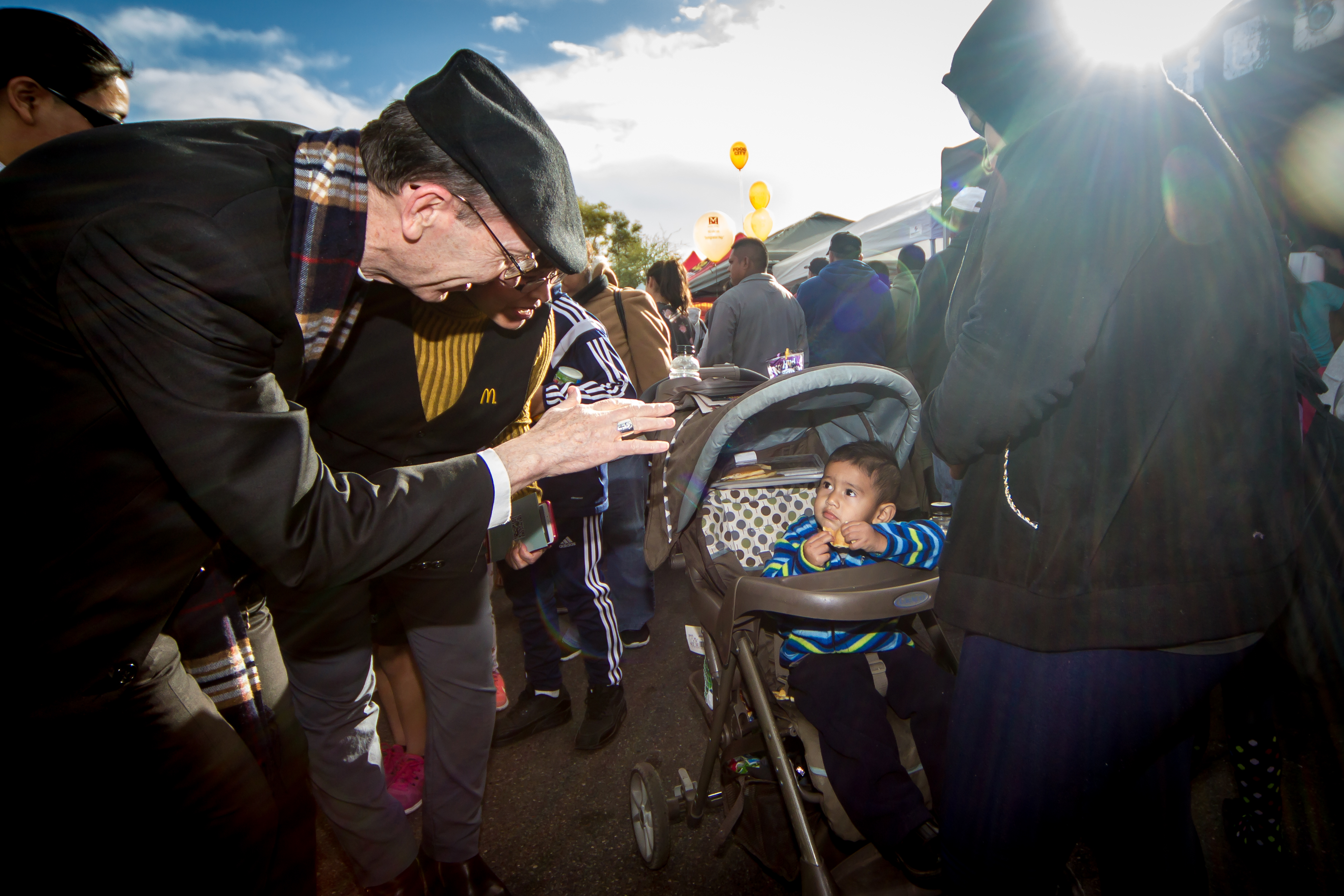
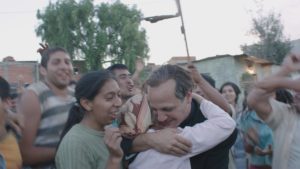
El Obispo Thomas J. Olmsted saluda un niño durante el evento de Acción de Gracias en un McDonald’s en Sur Phoenix. (Billy Hariman/CATHOLIC SUN)
El Obispo Thomas J. Olmsted saluda un niño durante el evento de Acción de Gracias en un McDonald’s en Sur Phoenix. (Billy Hariman/CATHOLIC SUN)
A lo largo y ancho de los Estados Unidos, el pasado 26 de noviembre la mayoría de la gente celebró el tradicional Día de Acción de Gracias reuniéndose y cenando en familia, o entre amigos.
Pero en el restaurante McDonald’s de avenida Central y Southern, en el Sur de Phoenix, hubo una celebración muy especial, en la que el dueño de ese negocio, Julián Nabozny, distribuyó gratuitamente más de 4,000 desayunos a personas de todas las edades.
El empresario y filántropo de origen argentino ha venido haciendo esto por los últimos 22 años, según lo informó él mismo a The Catholic Sun.
“Lo único que hago es regresar algo a la comunidad de lo mucho que me da”, dijo Nabozny, quien se mostró emocionado por ver tanta gente reunida en su restaurante esa mañana.
Comentó que desde muy temprano, alrededor de las 5 a.m., mucha gente comenzó a formarse para recibir su desayuno consistente en pancakes con miel, leche, jugo y manzana.
Tras formarse y recibir su desayuno, las personas se podían sentar cómodamente a degustarlo; mientras, en un escenario hubo música. Asimismo, los miles de asistentes recibieron múltiples regalos de parte de comerciantes y patrocinadores que cada año apoyan el evento.
“Siempre esperamos que llegue este día para venir a desayunar y pasarnos un rato agradable”, manifestó la señora Guadalupe Vidal, una residente de Sur Phoenix quien desde hace cuatro años acude al evento acompañada de su esposo y sus tres niñas. “Gracias al señor Julián y a todas las personas que hacen posible esta celebración para todos nosotros, que Dios los bendiga”, agregó la mujer originaria de Oaxaca, México.
Importantes dignatarios asistieron el evento, incluyeno el Obispo Thomas J. Olmsted de la Diócesis Católica de Phoenix y el Gobernador Doug Ducey y su familia.
“Hoy es una gran ocasión para dar gracias a Dios por la vida y la familia, y también por darnos gente generosa como Julián, a quien agradecemos su apoyo a nuestra gente”, dijo el Obispo Olmsted, que también ofreció un oración y dio su benedición para todos que asistieron.
El gobernador expresó su apreciación al labor filantrópica de Nabozny, y a la generosidad de la comunidad de Sur Phoenix.
“Quiero expresar mi agradecimiento en este día primero por ser gobernador de Arizona, por este gran país y por tener personas como Julián Nabozny que tanto apoyan a nuestra comunidad”, Ducey expresó a los medios.
A ellos y otros políticos y dignatarios, Nabozny les agradeció su asistencia, así como a las decenas de voluntarios que apoyaron.
“Gracias a todos por venir, gracias sobre todo a toda esta gran comunidad de Sur Phoenix, gracias porque luego de estos 22 años de reunirnos cada Día de Acción de Gracias ahora somos una gran familia”, expresó.
Pope Francis stands in front of the Holy Door in early April prior to first vespers of Divine Mercy Sunday in St. Peter’s Basilica at the Vatican. The pope says he wants the Year of Mercy to usher in a “revolution of tenderness.” (CNS photo/Andrea Solaro, Reuters pool)
VATICAN CITY (CNS) — When Pope Francis planned the Year of Mercy and the opening of the Holy Door, he did not mean to give the starting signal for a frenzied wave of pilgrims to Rome.
More than call to sign up for an Eternal City package tour, the pope is inviting people to strike out on a yearlong spiritual journey to recognize a loving God who’s already knocking on their door.
He says he wants the Year of Mercy to usher in a “revolution of tenderness.”
Once people realize “I’m wretched, but God loves me the way I am,” then “I, too, have to love others the same way,” the pope said in an interview published just a few days before the Dec. 8 start of the jubilee year.
Discovering God’s generous love kick-starts a virtuous circle, which “leads us to acting in a way that’s more tolerant, patient, tender” and just, he said.
Speaking with “Credere,” an Italian weekly magazine run by the Pauline Fathers, the pope gave an in-depth look at why he sees such an urgent need to highlight God’s mercy.
“The world needs to discover that God is father, that there is mercy, that cruelty is not the path, that condemnation is not the path,” he said. “Because the church herself sometimes follows a hard line, she falls into the temptation of following a hard line, into the temptation of underlining only moral norms, but so many people remain on the outside,” he said.
The pope said the thought of all those people — sinners, the doubtful, the wounded and disenfranchised — conjured up that iconic image of seeing the church “as a field hospital after the battle.”
“The wounded are to be treated, helped to heal, not subjected to cholesterol tests,” he said, meaning a too narrow scrutiny of minutiae delays staving off the broader disease of conflict and indifference. He once illustrated the same concept by painting a visual image of pastors who prefer to coif and comb the wool of the tiny flock in the pews rather than seek the sheep that are outside in danger or lost.
(CNS graphic/Malcolm Grear Designers)
“I believe this is the time for mercy. We are all sinners, we all carry burdens within us. I felt Jesus wants to open the door of his heart,” he said in the magazine interview.
The opening of the holy doors in Rome and around the world will be a symbol of how Jesus is opening the door of his heart.
[/quote_box_right]In fact, dioceses have been asked to designate and open their own “Door of Mercy” in a cathedral, an important church or sanctuary. The pope also will send out from Rome “missionaries of mercy” — priests mandated to the world’s peripheries to show patience and compassion in their ministry.
Such gestures suggest the pope still wants people to avoid the expense of travel — like his post-election suggestion to fans back home in Argentina to give to the poor the money they would have spent for a trip.
With the appropriate displays or TVs, people will be able to watch events with increased depth and detail, and, for the opening of the Holy Door in St. Peter’s Basilica Dec. 8, 19 cameras were to be deployed to capture every angle, including a unique papal point of view.
The Vatican also planned to set up 4K screens in a prison in Milan, a hospital in Rome and possibly in the Holy Land so people who are physically confined could feel part of the opening ceremony.
From the very start of his pontificate, Pope Francis has been showing what the way of mercy means.
The pope’s very first Angelus address and homily in 2013 centered on mercy, as he explained God always waits for that day of awakening and conversion, then forgives everything. The real problem is people — not God — who give up on forgiveness, he said.
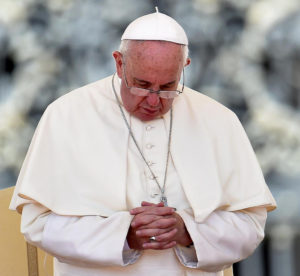
Pope Francis prays during his Aug. 26 general audience in St. Peter’s Square at the Vatican. Pope Francis says he wants the Year of Mercy to usher in a “revolution of tenderness.” (CNS photo/Ettore Ferrari, EPA)
The pope’s own religious vocation is rooted in that concrete experience of mercy, when he — as a 17-year-old student — walked out of a confessional “different, changed.” It was the feast of St. Matthew, and like St. Matthew, he was overcome, feeling “God looked at me with mercy” and said, “Follow me.”
He said in the magazine interview that one Friday of every month during the Year of Mercy “I will make a different gesture” that shows God’s mercy. He had asked the world’s young people to rediscover the corporal and spiritual works of mercy, like feeding the hungry and counsel the doubtful, and choose one to practice each month as they prepare for World Youth Day in July.
The “Credere” interview reveals that the pope has been championing a more merciful church for decades.
In a small group discussion during the 1994 ordinary Synod of Bishops on consecrated life and its role in the church and the world, then then-Auxiliary Bishop Jorge Mario Bergoglio of Buenos Aires, Argentina, he said it was necessary “to institute a revolution of tenderness,” to which one synod father countered, “with reasonable explanations,” how “it wasn’t good to use this kind of language.”
But now two decades later as leader of the universal church, the opening of the Year of Mercy may be his moment to set that revolution into motion.
One of Matt Maher’s latest songs, “FIREFLIGHT,” — from his ‘Saints and Sinners’ album released in March —is a song that tells the story of the interior struggles that we all face in our lives, according to a short write-up on xt3.com, a Catholic social media platform out of the Archdiocese of Sydney. It’s inspired by the experience and legacy of Mother Teresa of Calcutta, whose biographical film, “The Letters,” hits theaters tomorrow.
Maher is quoted on xt3.com explaining,
“One of my favorite stories of someone who struggled and had a very dark side was Mother Teresa. She went through extensive effort to start a religious order. She became a nun, started her own order of nuns and then moved to India; and immediately the presence of God disappeared from her life, and she didn’t feel anything. She started writing letters to her spiritual director, confessing all of her internal struggles. At the same time, her ministry blew up and next thing you know, everyone is finding out about this nun from Calcutta, and everyone loves her. All the while, she was having these moments where she struggled and felt so weak and God felt so distant. She offered a quote that says, ‘If I ever do become a saint, I will surely be one of darkness. For I will not be content to roam the streets of heaven while there’s one soul who still longs for God.’ Her quote captures that hunger of a person, who in the midst of struggle, still loves the marginalized and still loves the oppressed. ‘Firelight’ is a song about disillusionment and that very frail prayer of asking God to burn and shine in the midst of that and to continue to light the way through darkness.” Matt Maher
The songs lyrics make up the video imagery with fainter imagery yet behind them depicting the little nun. Here’s a look at the movie.
There was a small, private screening of the film in our building in recent weeks. One person who saw it noted Mother Teresa’s perseverance serving in a largely Muslim country. The love and dignity Mother Teresa showed to the sick and dying also inspired.
Two things to note if you see the movie, she said:
Keep in mind it largely features earlier portions of her life focusing more on the beginning of her ministry and global recognition. This review seems to allude to that point. Here’s the Catholic News Service review.
Pope Francis said that in evangelizing young churches, missionaries are called to a step-by-step, “kerygmatic approach to faith” and that missionaries must learn to listen to the cry of the poor and the marginalized.
“Let us pray and work so that the church is always more along the lines of the Acts of the Apostles,” which describes the lifestyle and missionary enthusiasm of the first Christians, he said. “Let us be inspired by the power of the Gospel and the Holy Spirit.”
— Pope Francis during a recent assembly of the Congregation for the Evangelization of Peoples.
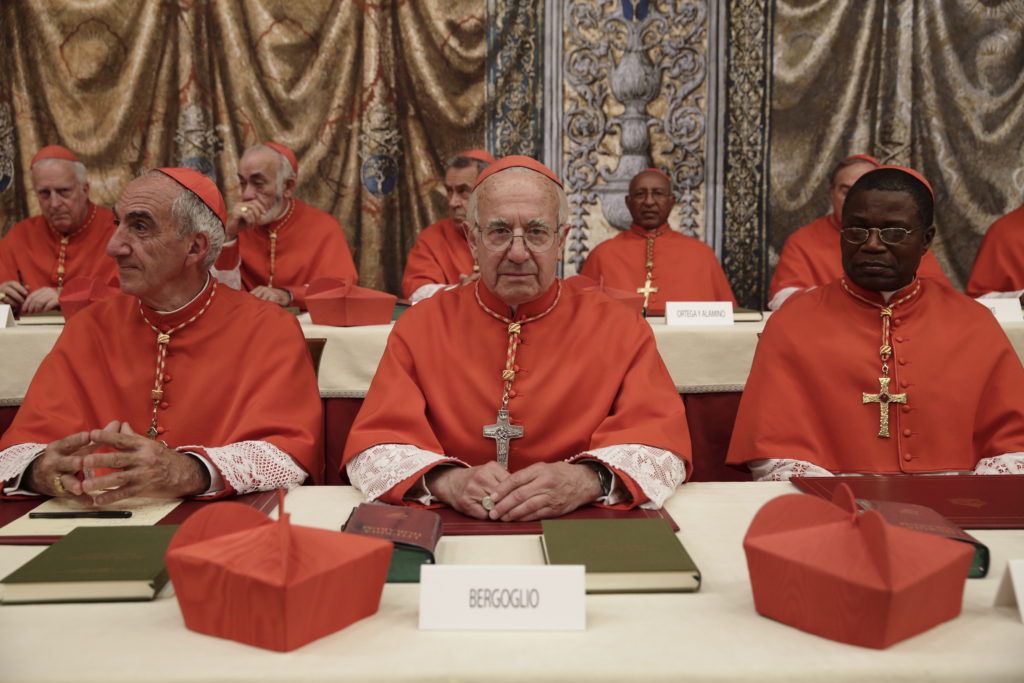
Rodrigo de la Serna stars in a scene from the movie "Call Me Francesco," the first movie based on the life of Pope Francis, shown in the Vatican audience hall Dec. 1. (CNS photo/Angelo Di Pietro, TaodueFilm, distributed by Medusa)
Sergio Hernandez, center, stars in a scene from the movie “Call Me Francesco,” the first movie based on the life of Pope Francis, shown in the Vatican audience hall Dec. 1. (CNS photo/TaodueFilm, distributed by Medusa)
VATICAN CITY (CNS) — The usual fanfare that comes with the world premiere of a movie is pretty standard: the lights and cameras, the celebrities walking down the red carpet and screaming fans trying to catch a glimpse of their favorite actors.
At the Vatican, however, a movie premiere is not your typical star-studded event.
The world premiere of “Call Me Francesco,” the first movie based on the life of Pope Francis, took place in the Vatican audience hall Dec. 1 and those considered celebrities in the eyes of the pope were in attendance.
Rodrigo de la Serna stars in a scene from the movie “Call Me Francesco,” the first movie based on the life of Pope Francis, shown in the Vatican audience hall Dec. 1. (CNS photo/Angelo Di Pietro, TaodueFilm, distributed by Medusa)
“To this exceptional premiere, the Holy Father wished to invite the poor, the homeless, refugees and the people most in need, together with the volunteers, religious and lay people, who work daily in charity,” a statement from the papal almoner’s office said.
Parishes and charitable associations in Rome were given 7,000 tickets for the poor to attend the premiere at the Vatican. The night also included a concert featuring the Pontifical Swiss Guard’s musical band. The papal almoner’s office said that many of the Swiss Guards offered to play during their free time as a gift to the homeless.
The poor were also offered a brown-bag dinner “donated especially for the occasion by several benefactors.”
Directed by Italian filmmaker Daniele Luchetti, “Call Me Francesco” details the life of Jorge Mario Bergoglio, from his humble beginnings in Buenos Aires, Argentina, to his election to the papacy in 2013.
At the premiere, Luchetti expressed his hope that the movie would be “an emotional moment” in following “the footsteps of a man we admire.” While all the details of the pope’s life are not known, the Italian director said he was optimistic that the film would explain “how he came to be and for what reasons.”
For Argentine actor Rodrigo de la Serna, portraying the young Jorge Mario Bergoglio on the silver screen was a dream come true. “It’s crazy, I never imagined in my life to be here at the Vatican, much less portraying Jorge Mario Bergoglio. It’s a dream!” de la Serna told Catholic News Service. Seeing how well the movie was received by the 7,000 guests, he said, was “something that I will never forget.”
David, one of the thousands of homeless people attending the premiere said that it was “truly emotional” to the see the path followed by Pope Francis. “His way of being close to the poor, close to people in need and the endless struggle against evil” was particularly moving, he told CNS.
Of the many groups at the premiere, one stood out in the crowd, holding a large colorful banner with the words, “Thank you, Pope Francis!” The banner belonged to a group of refugees from Eritrea who were invited to attend.
A young refugee who wished to remain anonymous told CNS that he was happy to see the film and that the pope’s life showed that prayer can be a powerful solution, even in the most difficult circumstances.
“Some of us will continue to other countries, others will stay here in Italy. We are refugees,” he said. Pope Francis’ story, he continued, gave him hope that “everything will be all right for us.”
Smoke billows from the chimneys of power plant in 2014 in Belchatow, Poland. Heads of state discussing carbon emission limits must create a global and "transformative" agreement built on justice, solidarity and fairness, a papal representative told the U.N. climate change conference Nov. 30 in Paris. (CNS photo/Kacper Pempel, Reuters)
Smoke billows from the chimneys of power plant in 2014 in Belchatow, Poland. Heads of state discussing carbon emission limits must create a global and “transformative” agreement built on justice, solidarity and fairness, a papal representative told the U.N. climate change conference Nov. 30 in Paris. (CNS photo/Kacper Pempel, Reuters)
VATICAN CITY (CNS) — Heads of state discussing carbon emission limits must create a global and “transformative” agreement built on justice, solidarity and fairness, a papal representative told the U.N. climate conference in Paris.
Pope Francis has said “it would be tragic” if special interests “manipulated information” and won out over the common good, Cardinal Pietro Parolin, Vatican secretary of state, said Nov. 30.
The cardinal delivered a speech on behalf of the pope during the Nov. 30-Dec. 11 Conference of Parties, or COP21, in Paris. The Vatican released a copy of the speech Dec. 1.
A global agreement must have three interrelated goals in mind: “alleviate the impact of climate change, fight poverty and let the dignity of the human person flourish,” the cardinal said in a speech delivered in French.
A meaningful global pact must be guided by a clear ethical vision that sees all of humanity as belonging to one human family, and has “no room for the so-called globalization of indifference,” he said.
“Given the urgency of a situation that requires the broadest collaboration possible in order to reach a common plan,” it is important the agreement recognize everyone’s responsibility to help others and according to one’s abilities and means.
An agreement must send “clear signals” to governments, businesses, the scientific community and local communities on how to adjust or change their behavior and policies in ways that leads to a low carbon economy and integral human development, he said.
Finally, the cardinal said, the COP21 endeavor must be part of an ever-evolving commitment to future generations with constant updates, follow-up and enforcement.
“It’s necessary to take into serious consideration the realization of models of sustainable production and consumption and new behaviors and lifestyles,” he said.
“Technical solutions are necessary but not enough,” he said, adding that teaching and supporting sustainable lifestyles are critical. People must become more aware of their responsibility and that today’s lifestyles based on an unsustainable “culture of waste” have no place in new models of education and development.