Just because it’s summer outside, doesn’t mean Mass attire should go casual too. Two Sense Films, a Florida-based company, interviewed some Catholics across the generations who reflected on what they wear to Mass and why.
Thank you to our St. Clare of Assisi Parish in Surprise for sharing this video on their social media feeds.
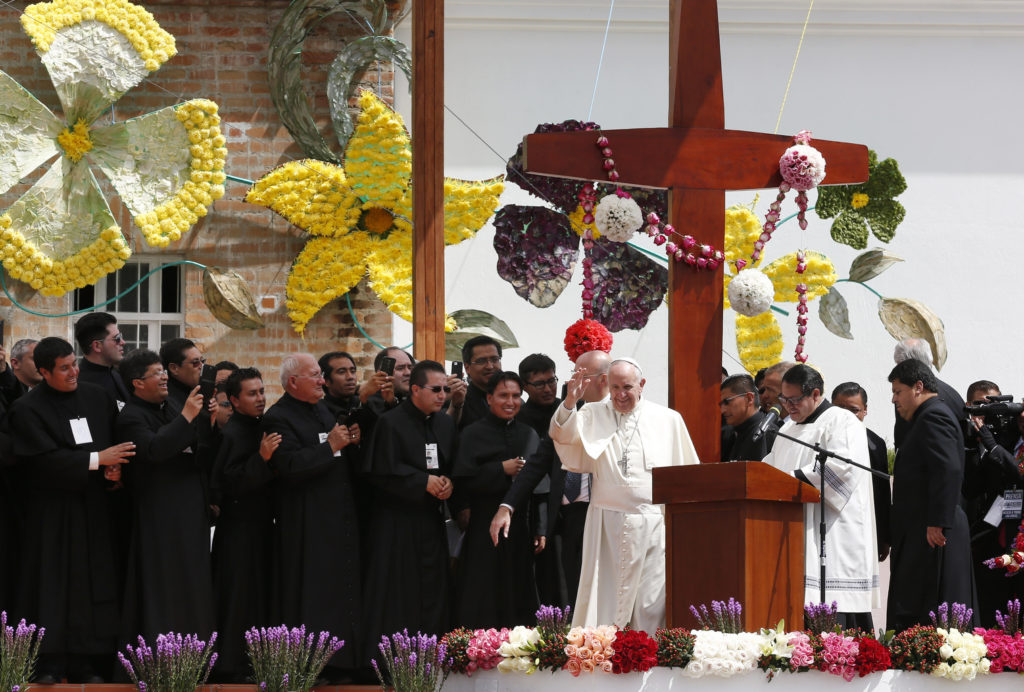
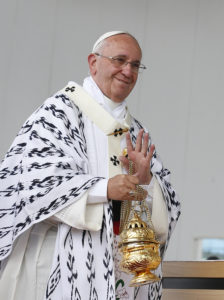
Pope Francis waves during a meeting with clergy, religious men and women, and seminarians at the El Quinche National Marian Shrine in Quito, Ecuador, July 8. (CNS photo/Paul Haring)
Pope Francis waves during a meeting with clergy, religious men and women, and seminarians at the El Quinche National Marian Shrine in Quito, Ecuador, July 8. (CNS photo/Paul Haring)
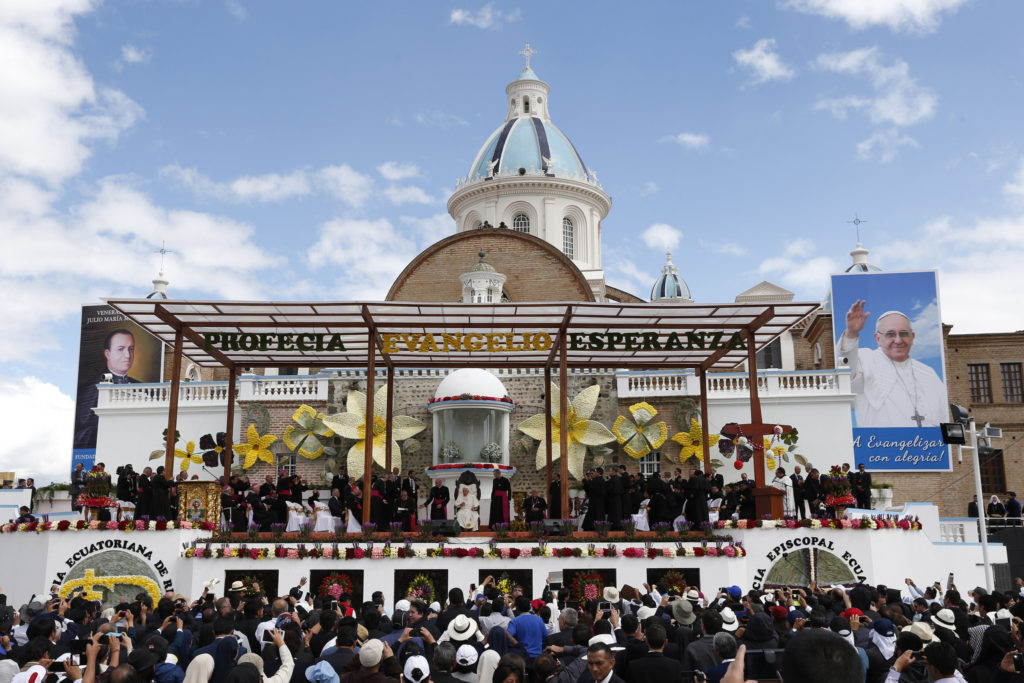
QUITO, Ecuador (CNS) — Clergy and religious must remember that all they have is freely given by God and they must never forget where they came from, Pope Francis told sisters, priests, seminarians and bishops gathered July 8 at the El Quinche Marian shrine near here.
Following those principles allows ministers to serve with joy, even when one is fed up with people, he said.
On the fourth day of a trip that is taking the pope to three countries with indigenous populations, the pope urged his listeners, “Don’t forget where you came from.”
Noting that some priests and religious who grow up speaking an “ancient and noble” indigenous language later give it up, he said: “It’s very sad when they don’t want to speak it. It means they forgot where they came from.”
The pope drew applause when he dropped local words into his speech. He used “guagua,” the Quechua word for “baby,” at one point. And in his retelling of the story of Samuel’s search for David, who would become king of Israel, Samuel addressed Jesse, David’s father, with the Argentine slang word, “che.”
Abandoning his prepared text, the pope used Mary as an example of awareness of God’s freely given love.
When priests or religious lose sight of that gift, “we start to feel that we are important and gradually distance ourselves from that starting point from which Mary never strayed,” he said.
As the pope entered the Marian shrine, the site of one of Ecuador’s most important religious devotions, priests and sisters crowded close and reached out to touch his vestments.
Pope Francis touches a statue of Mary before meeting with clergy, religious men and women, and seminarians at the El Quinche National Marian Shrine in Quito, Ecuador, July 8. (CNS photo/Paul Haring)
He placed a bouquet of roses on the altar and prayed before the statue before speaking to the audience.
“Mary was never the protagonist. She was a disciple all her life, her son’s first disciple,” he said.
He advised his listeners, “Every day, perhaps before you go to sleep, turn your gaze to Jesus and say, ‘You have given me everything for free,’ and get yourself back on track.”
The story of Samuel choosing David, the shepherd boy, is a reminder that “God looks at things differently from the way people do,” the pope said.
“God said, ‘that’s the one,’ and took him out from behind the flock,” he said. “Who am I if they took me from behind the flock?”
Warning his listeners against the illness of “spiritual Alzheimer’s,” Pope Francis said: “Don’t forget where you came from. Do not deny your roots.”
Awareness of the gratuitous nature of God’s gifts — including the call to a vocation — and avoiding a false sense of importance give ministers the strength to serve with joy, the pope said.
Pope Francis meets with clergy, religious men and women, and seminarians at the El Quinche National Marian Shrine in Quito, Ecuador, July 8. (CNS photo/Paul Haring)
The role of priests and religious is “to serve, and nothing else — and to serve when we are tired, when we are fed up with people,” the pope said. “Those who serve must let themselves get fed up without losing patience.”
Service also must be given freely, he said.
“What you received for free, please give it freely. Please do not charge for grace,” the pope said.
Recalling the joy, cordiality and piety with which Ecuadoreans welcomed him during his visit, he told the priests and religious that he had prayed to understand “the recipe” for that attitude of faith.
Part of the answer lies in the country’s consecration to the Sacred Heart of Jesus, he said, but “another recipe, along the same line, is the sense of freely given love like that of Jesus, who became poor to enrich us with his poverty — pure gratuitousness.”
NEW YORK (CNS) — “No one has greater love than this, to lay down one’s life for one’s friends” (Jn 15:13). That’s the overarching theme of “Faith of Our Fathers” (Pure Flix), a well-intentioned but awkwardly uneven account of Christianity’s impact on two generations of families.
Director Carey Scott can’t seem to decide whether his film is a serious drama or a slapstick comedy. The overall result thus falls between two stools.
Still, a faith-promoting message of an evangelical stripe pervades the proceedings — no bad thing these days, especially for adolescents who are more usually bombarded with secular narcissism at the multiplex.
In 1997 California, John Paul George (Kevin Downes) — whose Beatles-evoking name the script treats as a running joke — is a humble, God-fearing postman who’s preparing to marry his fiancee, Cynthia (Candace Cameron Bure).
While cleaning out the garage, John Paul discovers a box of military items that had belonged to his late father Steven (Sean McGowan). In circumstances that remain unclear to John Paul, Steven was killed in Vietnam just after his son’s birth.
[quote_box_right]
‘Faith of Our Fathers’
Pure Flix
Catholic News Service classification, A-II, adults and adolescents
Motion Picture Association of America rating, PG-13, parents strongly cautioned. Some material may be inappropriate for children under 13.
Intrigued by a letter about Steven’s platoon mate Eddie (Scott Whyte), John Paul sets out to find his dad’s erstwhile comrade, and learn the truth about his death.
The search brings him to Mississippi, where he encounters Eddie’s hillbilly son, Wayne (David A.R. White, also a co-writer along with Downes and Harold Uhl). Like Steven, Eddie, it turns out, perished in combat.
As for Eddie’s ornery offspring, the shotgun Wayne brandishes makes it obvious that he’s none too happy to see this uninvited stranger. “You’re not a Jesus freak, are ya?” Wayne loudly demands.
Needless to say, the boy has issues, and zero interest in resurrecting the past. But John Paul is insistent, and an improbable bargain is struck. In exchange for access to Eddie’s letters, John Paul agrees to accompany Wayne on a trip to Washington to visit the Vietnam Veterans Memorial and seek “closure.”
“Faith of Our Fathers” morphs into a spiritual version of “Thelma and Louise” as this odd couple gets into all sorts of trouble on the road while debating big-ticket topics like forgiveness and destiny.
As they bond, flashbacks recall the friendship shared by their fathers, forged in harm’s way. The earlier duo, it seems, were also oil and water: Steven, pious and Bible-reading; Eddie, a master of ridicule.
Slowly, we’re shown, Steven’s sincerity won Eddie over — and the whole platoon with him. Even the skeptical Sgt. Mansfield (Stephen Baldwin) came around, later telling John Paul, “You father taught me that men don’t have to die when they die.”
Despite hokey dialogue and contrived situations, “Faith of Our Fathers” deserves some credit for its godly and patriotic outlook.
— By Joseph McAleer Catholic News Service. McAleer is a guest reviewer for Catholic News Service.
A floral hummingbird is seen as Pope Francis celebrates Mass in Bicentennial Park in Quito, Ecuador, July 7. (CNS photo/Paul Haring)
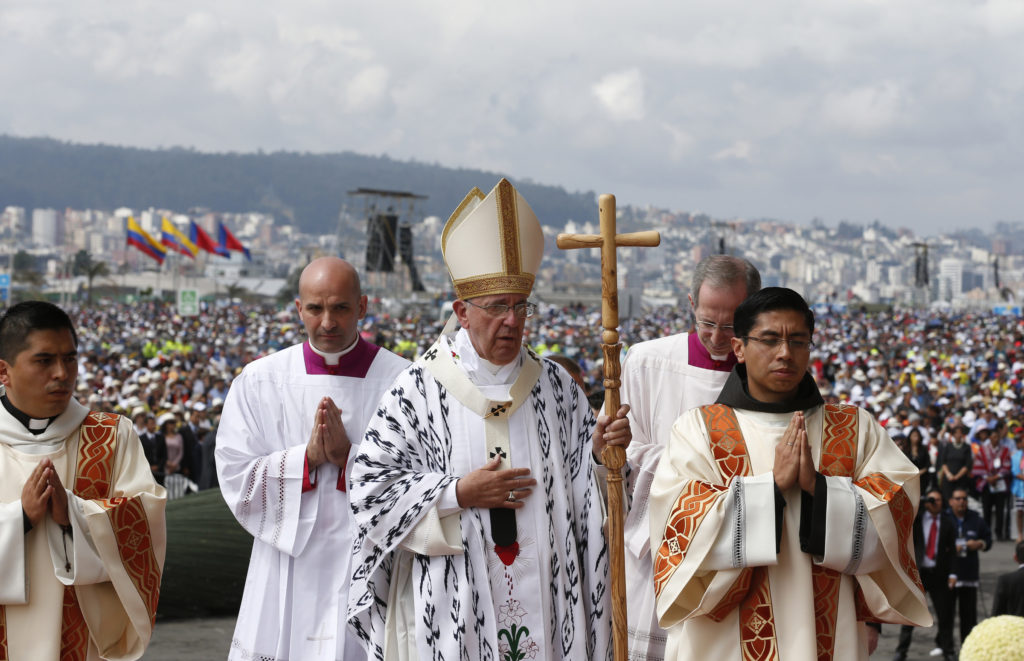
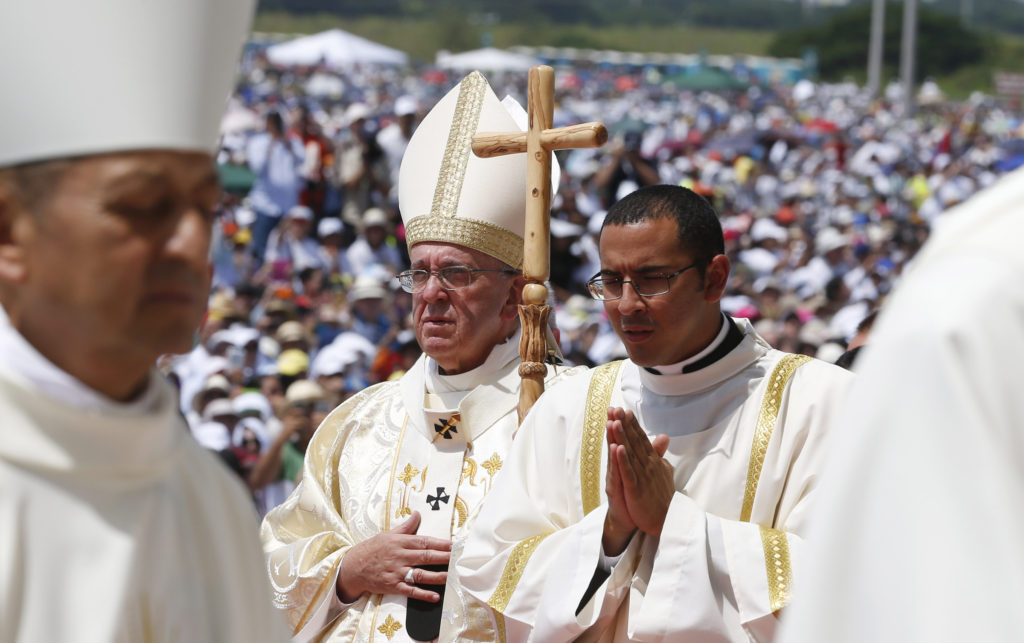
Pope Francis arrives to celebrate Mass in Bicentennial Park in Quito, Ecuador, July 7. The pope is making an eight-day visit to Ecuador, Bolivia and Paraguay. (CNS photo/Paul Haring)
QUITO, Ecuador (CNS) — Catholics will never be effective evangelizers if they are squabbling among themselves, and they cannot show the world how faith in Christ responds to the human yearning for freedom and peace if they are divided, Pope Francis said.
The pope’s Mass July 7 at Quito’s Bicentennial Park was billed as a Mass for evangelization, but the pope insisted Christians would convince no one of the power of the Gospel if they could not demonstrate in their lives and behaviors that faith pushes a person beyond self-interest to concern for others.
Christians do not look at the world through rose-colored glasses, the pope said, but they can dream. Like Jesus, they see the world’s flaws, but also like Jesus, they love the world God created.
“It is precisely into this troubled world that Jesus sends us,” he said. “We must not pretend not to see or claim we do not have the needed resources or that the problems are too big.
Pope Francis waves as he recognizes someone while using incense during Mass in Bicentennial Park in Quito, Ecuador, July 7. (CNS photo/Paul Haring)
“Instead we must respond by taking up the cry of Jesus and accepting the grace and challenge of being builders of unity,” he said.
To evangelize is to live as brothers and sisters with all people, he said. “This is the new revolution — for our faith is always revolutionary — this is our deepest and most enduring cry.”
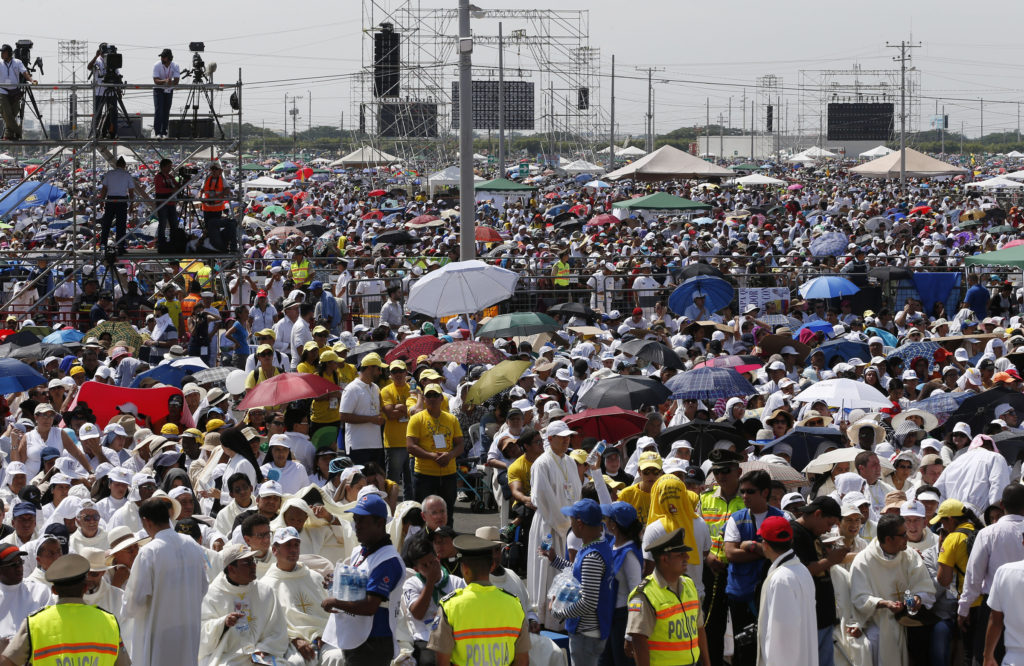
Local church officials said more than 800,000 people gathered at the park, a former airport, for the Mass. Ecuador is the world’s third-largest exporter of cut flowers and roses are queen — a fact evident from the rose petals strewn along the pope’s path, the flower-petal carpets on the altar platform and the colorful arrangements that decorated even the walkway to the makeshift sacristy behind the stage.
The congregation gathered for the Mass was just as varied; members of different indigenous groups and visitors from other South American countries risked a forecast of rain to pray with each other and with the pope. Pope Francis wore a chasuble with an indigenous design, and the second reading at the Mass was in the Kichwa language.
Margarita Maria Jaramillo Escobar, 58, came with a group of 80 people from Medellin, Colombia, to pray with the pope.
“This is a pilgrimage for us,” said Jaramillo, a retired judge who has been blind since birth. “I came to hear the Holy Father’s message of love, peace and mercy.”
Those who gather around the altar and share Communion should be united with one another, setting aside worldly desires for power and petty squabbles in order to show the world the peace and unity that comes with faith in Christ, Pope Francis told them.
Evangelization is not beating down people’s doors, he said, but knocking gently and drawing near to “those who are far from God and the church, who feel themselves judged a priori by those who think they are pure and perfect.”
[quote_box_center]
[/quote_box_center]
In his homily, reflecting on Jesus’ prayer at the Last Supper that his followers would be one so that the world would believe, Pope Francis said that while Jesus probably said the prayer in hushed tones, he likes to think of it “as more of a shout, a cry rising up from this Mass which we are celebrating in Bicentennial Park.”
“The desire for unity,” he said, “involves the delightful and comforting joy of evangelizing, the conviction that we have an immense treasure to share, one which grows stronger from being shared and becomes ever more sensitive to the needs of others.”
Because of sin, he said, unity takes real effort. It requires a commitment to explicitly trying to include everyone, to avoid selfishness, to promote dialogue and encourage collaboration.
Society needs people committed to unity, the pope said, and so does the church.
“Jesus consecrates us so that we can encounter him personally. And this encounter leads us, in turn, to encounter others, to become involved with the world and to develop a passion for evangelization,” he said.
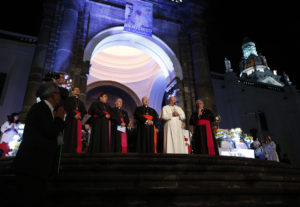
Pope Francis prays as he greets the crowd outside the cathedral in Quito, Ecuador, July 6. The pope is making an eight-day trip to Ecuador, Bolivia and Paraguay. (CNS photo/Paul Haring)
“Communion, communication, self-giving and love” are the hallmarks of a Christian vocation, he said, and they are what makes it possible to take diversity and differences and turn them into a richness.
“What Jesus proposes is not just an idea,” the pope said. “It is concrete: ‘Go and do the same.'”
Unity is not “something we can fashion as we will, setting conditions, choosing who can belong and who cannot,” he said. “This ‘religiosity of the elite’ is not what Jesus proposes.” Recognizing God as one’s father means recognizing all his children as brothers and sisters, he said.
“This is not about having the same tastes, the same concerns, the same gifts,” Pope Francis said. “How beautiful it would be if all could admire how much we care for one another, how we encourage and help each other.”
— By Cindy Wooden, Catholic News Service. Contributing to this story was Barbara Fraser in Quito.
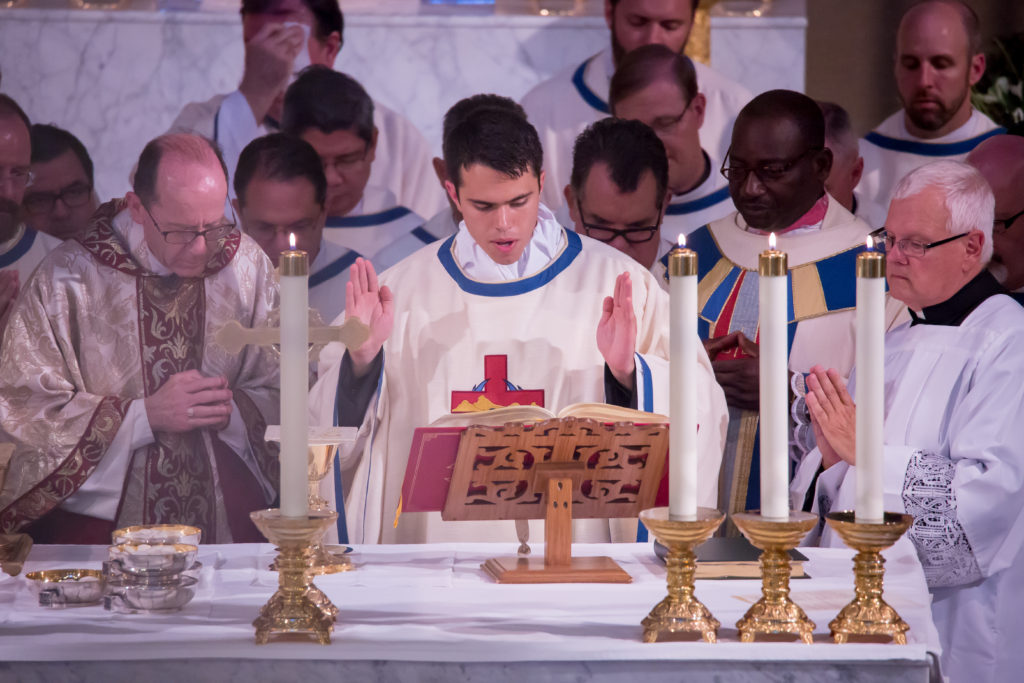
Newly ordained priest, Fr. Fernando Camou administers communion during his ordination mass on June 27, 2015.
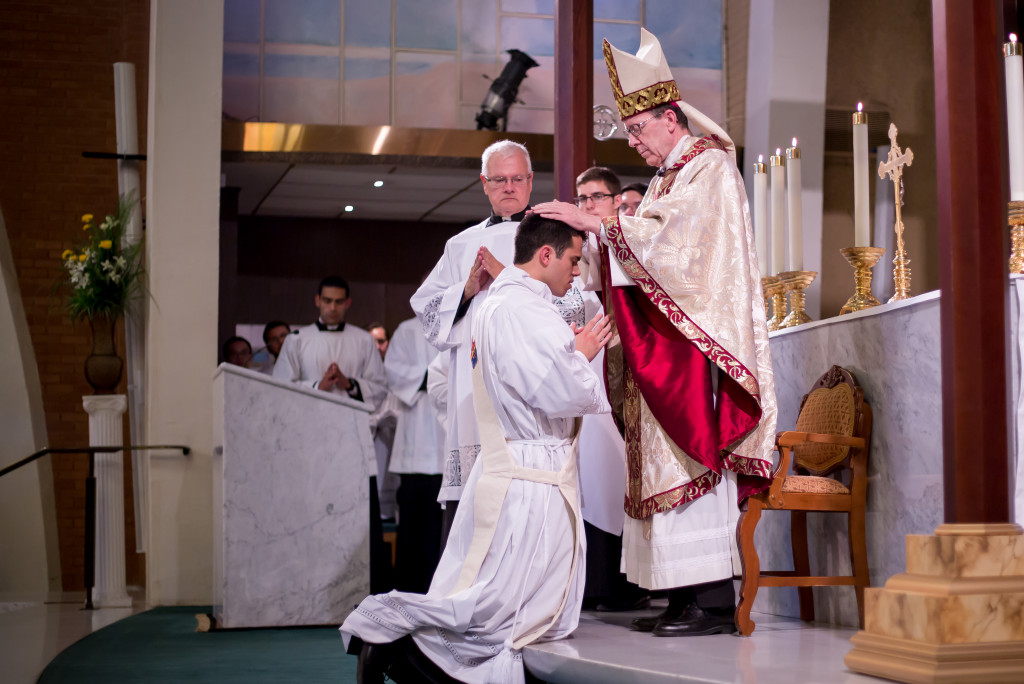
El Obispo Thomas J. Olmsted impuse los manos al Diacono Fernando Camou, ordenándolo al sacerdocio el 27 de junio en la Catedral de Ss. Simon y Jude. (Billy Hardiman/CATHOLIC SUN)
[dropcap type=”4″]A[/dropcap]l estar postrado en el piso de la catedral llena de gente, esperando ser ordenado al sacerdocio, el Padre Fernando Camou bebió la Letanía de los Santos.
Años de estudio, oración y formación habían llegado finalmente a buen puerto. Al estar los fieles, clérigos y religiosos que llenaban la Catedral de Ss. Simón y Judasel 27 de junio invocando la ayuda de los santos, el Padre Camou dijo que oró para que cualquier egoísmo en él muriera. Cuando se levantó de nuevo para que el obispo pusiera sus manos en él y ofreciera una oración de ordenación, el nuevo sacerdote quería subir también con los santos que habían estado intercediendo a su favor.
El recién ordenado Padre Fernando Camou es el primer feligrés de la Parroquia de Nuestra Señora del Perpetuo Socorro en Glendale en ser ordenado al sacerdocio.
Sus primeras horas del sacerdocio fueron un torbellino de actividad, ofreciendo bendiciones e impartiendo breves palabras para seminaristas y otros jóvenes durante un almuerzo privado. Momentos después de ofrecer su ronda final de las bendiciones, el Padre Camou describió sus primeras dos horas del sacerdocio como palpitantes, y dijo que tenía confianza de que tomaría un tiempo para que la totalidad de la mañana y tarde le parezcan realidad.
“Fue mucho más emocional de lo que pensaba”, admitió el Padre Camou.
Ver tanta gente de quienes había aprendido a través de los años mientras estuvo en varias asignaciones de parroquia, compartiendo la ocasión con sus familiares, y sintiendo muchos momentos claves durante la Misa, lo conmovió. Describió la conclusión de la Letanía de los Santos al estar postrado frente al altar como uno de esos momentos.
“Cerca del final, la culmminación del momento fue darme cuenta de que estoy empezando una nueva vida de amor, pero también una batalla”, dijo el Padre Camou.
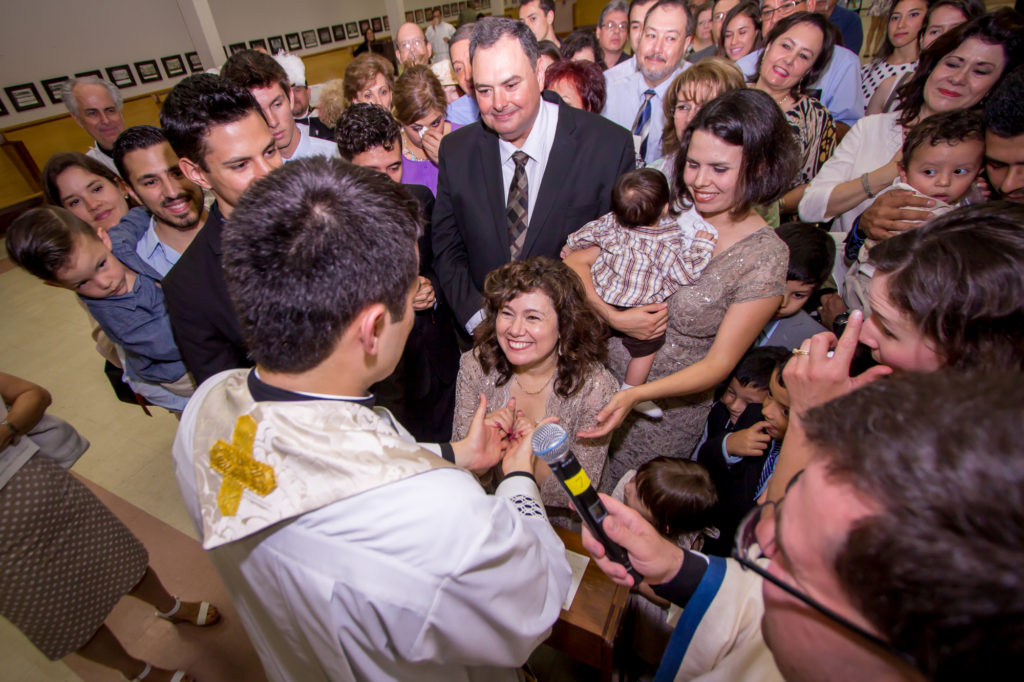
El P. Fernando Camou bendice su familia durante un recepción despues de su ordenación como sacerdote. (Billy Hardiman/CATHOLIC SUN)
El Obispo Thomas J. Olmsted habló un poco de la “gracia y el deber” de paternidad sacerdotal y de las batallas de hoy en día en una homilía ofrecida en español e inglés. La santidad del Padre Camou debe ser una fragancia encantadora para los demás, dijo el obispo.
“Desde este día en adelante, nuestra gente te va a llamar ‘Padre’ y tendrás la gracia y el deber de darles el cuidado de un padre, y hasta de ofrecer tu vida por ellos”, dijo el obispo.
Habló de la necesidad de unirse con los hermanos sacerdotes y diáconos para oponerse a la decisión del 26 de junio por parte de la Corte Suprema que redefinió al matrimonio. Dijo que la paternidad y maternidad importan y que enseñanza clara de tales realidades es tan importante ahora como lo fue en los días de Juan el Bautista, quien fue martirizado por defender el matrimonio.
“Lo que nuestro pueblo necesita más que nunca, son sacerdotes que confían en la misericordia de Dios, sabios maestros de la bondad y la belleza del matrimonio, y felices mensajeros de la buena nueva de Jesús”, dijo el obispo.
Dijo que el testimonio de las parejas casadas, como sus padres — que educaron a sus hijos en casa a través de la escuela secundaria — también llenan un papel insustituible. Todavía necesitan aliento paternal; “y la gracia que les traemos a través de la vida sacramental de la Iglesia”, dijo el obispo
El papá del Padre Camou, Fernando Mayor, está ansioso por embarcar en ese viaje junto a su hijo. Vió a su hijo crecer a pasos agigantados a lo largo de la formación, que afirmó que estaba haciendo la voluntad de Dios, y ahora ve una espiritualidad profunda. Le encantaba cuando los sacerdotes abrazaron a su hijo ante el altar ofreciendo abrazos de felicitación.
“Ahora mi hijo es mi padre. Ahora vamos a estar creciendo y aprendiendo de él”, dijo Fernando Mayor.
El recién ordenado P. Fernando Camou ofrece los oraciónes de consagración durante su Misa de Ordenación. (Billy Hardiman/CATHOLIC SUN)
El Padre Paul Sullivan, director de la Oficina Diocesana de Vocaciones, ha visto mucho crecimiento espiritual de los seminaristas a través de los años, pero más aún con el Padre Camou. Su solicitud de seminario fue la primera que el Padre Sullivan procesó como director de vocaciones en 2008. Fue poco antes que, durante su primera asignación sacerdotal en Nuestra Señora del Perpetuo Socorro, que el joven Fernando Camou se acercó al Padre Sullivan acerca de una posible vocación.
“Él se ha hecho el hombre que Dios creó. Eso es la conversión. Uno se convierte en más de sí mismo”, dijo el Padre Sullivan después de un almuerzo para seminaristas y otros hombres jóvenes.
Él oró que las primeras semanas del sacerdocio de del Padre Camou le trajeran un profundo sentido de Cristo trabajando en él.
“Quisiera que él comience en una unión íntima y permanente con Cristo y que nunca la pierda”, dijo el Padre Sullivan al Catholic Sun.
La madre del Padre Camou, Josefina, ya ve una naturaleza de darse a sí misma en su hijo mayor y la fortaleza en tiempos difíciles y buenos.
“Él está tan entusiasmado de ofrecer su vida para la gente de la Iglesia”, dijo Josefina.
Pope Francis arrives to celebrate Mass in Los Samanes Park in Guayaquil, Ecuador, July 6. (CNS photo/Paul Haring)
Pope Francis arrives to celebrate Mass in Los Samanes Park in Guayaquil, Ecuador, July 6. (CNS photo/Paul Haring)
GUAYAQUIL, Ecuador (CNS) — Even if a pastoral proposal for helping a Catholic family with problems seems scandalous at first, it is possible God could use that proposal to bring healing and holiness, Pope Francis said.
Encouraging and celebrating family life during a Mass July 6 in Guayaquil, Pope Francis asked people to pray for the October Synod of Bishops on the family, and he tied the synod to the Jubilee of Mercy, a yearlong celebration that will begin in December.
The synod will be a time for the church to “deepen her spiritual discernment and consider concrete solutions to the many difficult and significant challenges facing families in our time,” the pope said.
Celebrating Mass with as many as 1 million people gathered under the hot sun in Los Samanes Park, Pope Francis asked them “to pray fervently for this intention, so that Christ can take even what might seem to us impure, scandalous or threatening, and turn it — by making it part of his ‘hour’ — into a miracle. Families today need this miracle!”
Jesuit Father Federico Lombardi, Vatican spokesman, told reporters Pope Francis was not referring to any specific proposal discussed in anticipation of the synod; one of the most common — and most debated pastoral suggestions — was to develop a process or “penitential path” for divorced and civilly remarried Catholics who want to receive Communion but have not received an annulment.
The pope, Fr. Lombardi said, hopes the synod “will find a way to help people move from a situation of sin to a situation of grace.”
Pope Francis acknowledged the suffering and hope of young people who do not experience happiness and love at home, the “many women, sad and lonely,” who wonder how their love “slipped away,” and the elderly who feel cast aside.
The crowd waits for the start of Pope Francis’ Mass in Los Samanes Park in Guayaquil, Ecuador, July 6. The pope is making an eight-day visit to Ecuador, Bolivia and Paraguay. (CNS photo/Paul Haring)
In a family, “no one is rejected; all have the same value,” he said, telling the crowd that when he asked his own mother which of her five children she loved best, she would say that they were like her five fingers: all were important and if one finger was hurt, the pain would be the same as if another finger was hurt.
The Gospel reading at the Mass recounted the story of the wedding feast at Cana where the wine ran out and Mary asked Jesus to do something about it. Jesus turned water into wine.
Despite the 90-degree heat, the 78-year-old pope was upbeat during the Mass and confident — even cheerful and playful — in his homily about the family.
The joy of the wedding feast at Cana, he said, began when Mary was attentive to the needs of others “and acted sensibly and courageously.”
“Mary is not a ‘demanding’ mother, a mother-in-law who revels in our lack of experience, our mistakes and the things we forget to do,” he said. “Mary is a mother! She is there, attentive and concerned.”
As with the guests at the Cana wedding, who were offered the finest wine at the end of the celebration, Pope Francis insisted, so, too, for families today “the richest, deepest and most beautiful things are yet to come.”
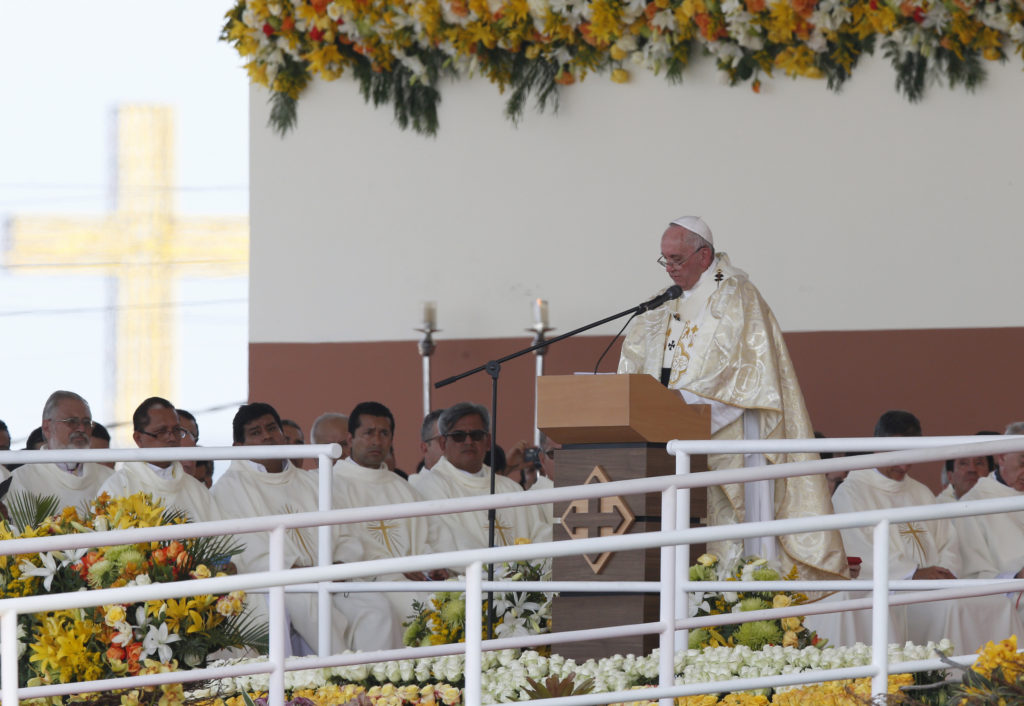
Pope Francis gives the homily while celebrating Mass in Los Samanes Park in Guayaquil, Ecuador, July 6. The pope is making an eight-day visit to Ecuador, Bolivia and Paraguay. (CNS photo/Paul Haring)
“The time is coming when we will taste love daily, when our children will come to appreciate the home we share and our elderly will be present each day in the joys of life,” he said. “The finest of wines will come for every person who stakes everything on love.”
Pope Francis said he knows “all the variables and statistics which say otherwise,” but “the best wine is yet to come for those who today feel hopelessly lost.”
Speeding up his delivery and increasing his volume, the pope made “the best wine is yet to come” into a litany. “Say it until you are convinced of it,” he told the crowd. “The best wine is yet to come.”
“Whisper it to the hopeless and the loveless,” the pope urged.
The whole story of God’s involvement with humanity, he said, demonstrates that he always seeks out those on the margins of society, “those who have run out of wine, those who drink only of discouragement.”
Jesus, he said, will provide flasks of the finest wine “for those who, for whatever reason, feel that all their jars have been broken.”
Strong families, he said, help build strong individuals and strong societies. They are the place where “our hearts find rest in strong, fruitful and joyful love.” Families teach people to be attentive to the needs of others and to place those needs ahead of one’s own.
“Service is the sign of true love,” he said.
When the church asks governments to assist families, he said, it is not asking for “alms,” but rather payment of the “social debt” societies owe to families.
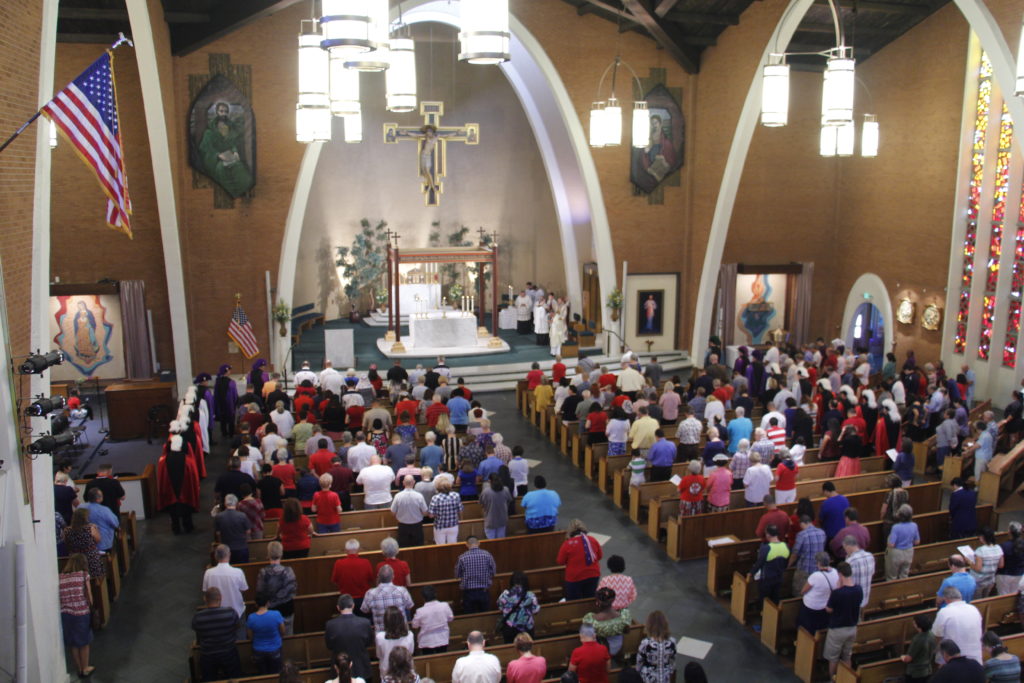
Catholics from across the Valley filled Ss. Simon and Jude Cathedral for a morning Mass and Rosary July 4 that closed out the local observance of the nationwide Fortnight for Freedom. (Ambria Hammel/CATHOLIC SUN)
Catholics from across the Valley filled Ss. Simon and Jude Cathedral for a morning Mass and Rosary for the United States of America July 4 that closed out the local observance of the nationwide Fortnight for Freedom. (Ambria Hammel/CATHOLIC SUN)
“The Virgin Mary struck her claim to our nation from the beginning,” Manny Yrique said July 4 during Phoenix’s Mass and Rosary closing out the local observation of the fourth annual nationwide Fortnight for Freedom.
The observance calls to mind the continued fight for religious liberty, which can yield a strong moral compass for the country. A sizeable crowd rivaling that of a regular Sunday liturgy comfortably filled Ss. Simon and Jude Cathedral.
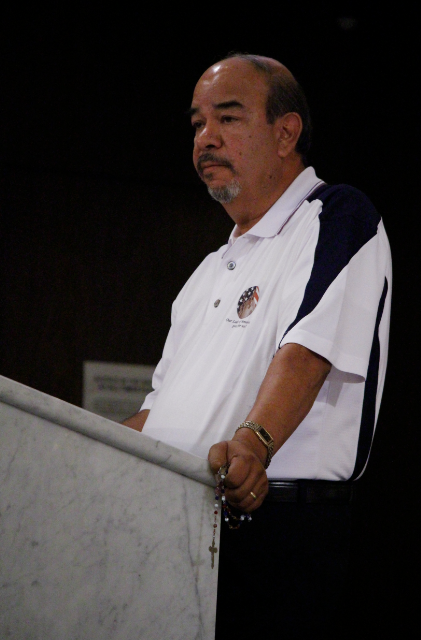
Manny Yrique, who spearheaded the Rosary for the United States of America in 2011, reminds a full Ss. Simon and Jude Cathedral July 4 of the Blessed Mother’s claim to this nation from the onset. He said praying the rosary will have the Blessed Mother leading her children to where real change occurs: at the foot of the cross of Jesus (Ambria Hammel/CATHOLIC SUN)
Yrique spearheaded the Rosary for the United States of America and led the day’s Patriotic Rosary. It offers a Hail Mary for each state and a decade for each branch of national government, one for state and local governments and one for the military.
He described the Blessed Mother as an advocate, who has “a voice so sweet no one can ever turn an ear away from it.”
It’s prayer, particularly to the Blessed Mother, that will change the country’s weakening social climate that’s sliding even faster in the wrong direction since the U.S. Supreme Court legalized gay marriage June 26. Catholics showed up with heavy hearts but joyful spirits — many wearing their best reds, whites and blues — and confident in the power of prayer.
“We are to love one another, but we are to obey God’s laws. His laws come first,” said Patty Schoenen, who came from Avondale with a couple of fellow St. Thomas Aquinas parishioners.
She echoed what Auxiliary Bishop Eduardo A. Nevares said in his homily during the Mass. He reminded the assembly of the need to stand up for the truth when any U.S. Supreme Court decision goes against the faith. It’s not the final word, he said.
“You and I will protest. You and I will once again find ways to uphold God’s law,” the bishop said.
He challenged the faithful to discern ways to do that, namely by voting with a well-formed conscience, not just going with the majority, and by returning to prayer.
“How many of us just go along with the wisdom of the land?” Bishop Nevares questioned. “I think it’s time you and I start making some decisions as to… the God we serve.”
He acknowledged the average Catholic’s day can be busy, but suspected that activities at the computer, using social media, exercising and following the latest diet trend likely far outweigh the time in prayer.
“How much time do we give to these other gods and how much time do we give to the one, true God?” the bishop asked.
The second reading chosen for the day recounts God’s promises to Solomon. The Lord simply requested humble prayer and a turn from their evil ways. God would grant them pardon and peace.
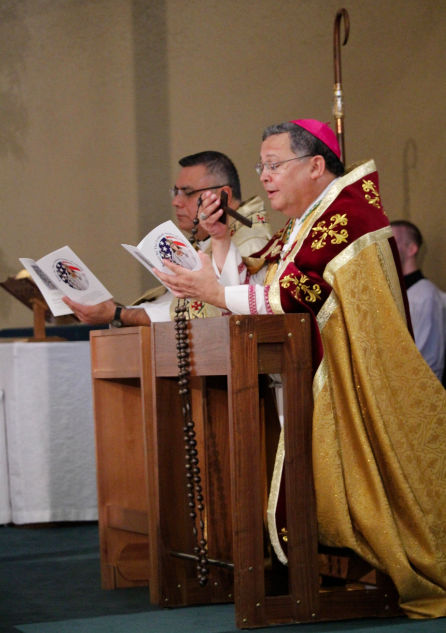
Bishop Eduardo A. Nevares begins the Rosary for the United States of America at Ss. Simon and Jude Cathedral July 4. He said the lord promised healing among nations who humble themselves in prayer and turn from their evil ways. (Ambria Hammel/CATHOLIC SUN)
“The solution for all of our immorality in this land is: we need to pray. We need to pray. It’s the word of God. He promises,” the bishop said.
It’s the lack of fervent prayer that Yrique fears led to last month’s Supreme Court ruling on gay marriage. He felt a tremendous amount of guilt when he heard the decision, saying regretfully, “I didn’t pray enough.”
Yrique advised the crowd to pray that God unite families, transform their own lives and let His transforming grace humble the nation. Don’t be afraid to share the faith, he said.
“People today want to have hope and the hope is still where it has always been: in the Lord Jesus Christ,” Yrique said. “Pray the Rosary and before you know it, she will get you to where real change occurs: at the foot of the cross of Jesus.”
John Paul II Classic aims for ‘nothing but net’ regarding vocations awareness. The first priest v. seminarian basketball game in the Diocese of Phoenix tips off Aug. 5 at Our Lady of Perpetual Help Parish in Scottsdale.
Organizers invite Catholics and friends of all faiths to fill the stands. Cheer on your favorite priest, or root for that favorite seminarian from your home parish or who has been serving at your parish all summer.
Free-will admission. Concessions and T-Shirts will be available.
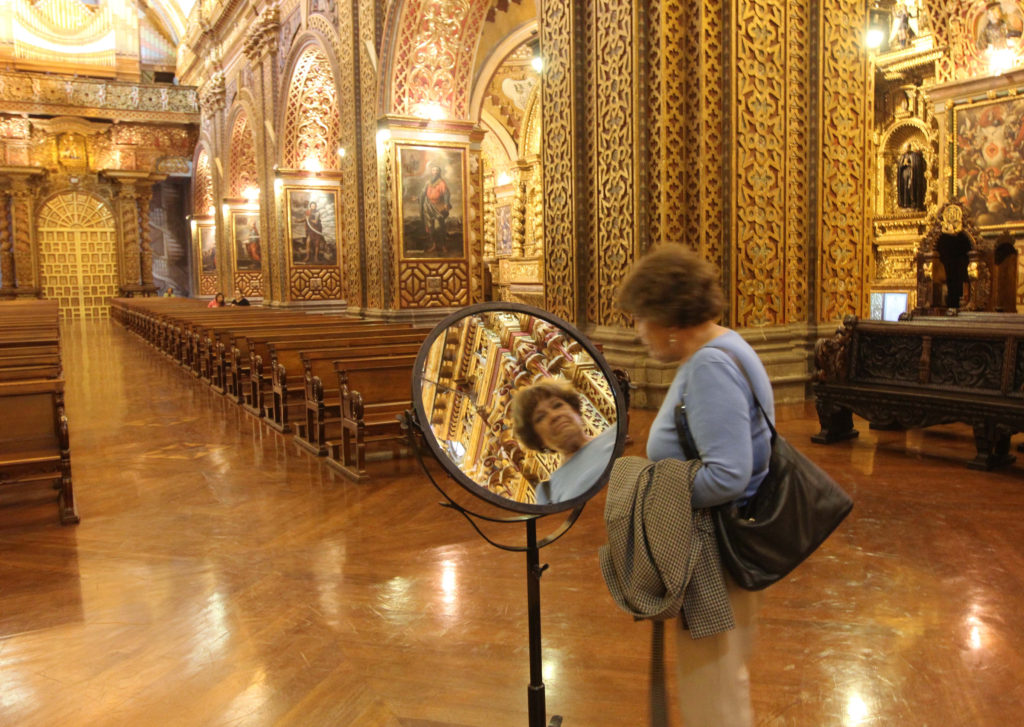
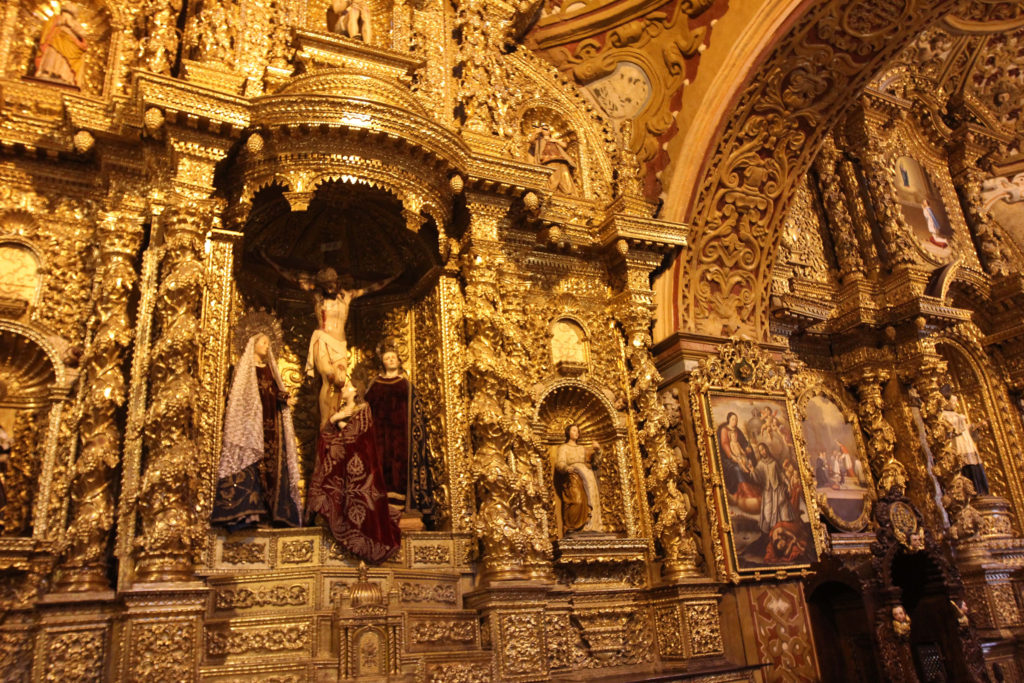
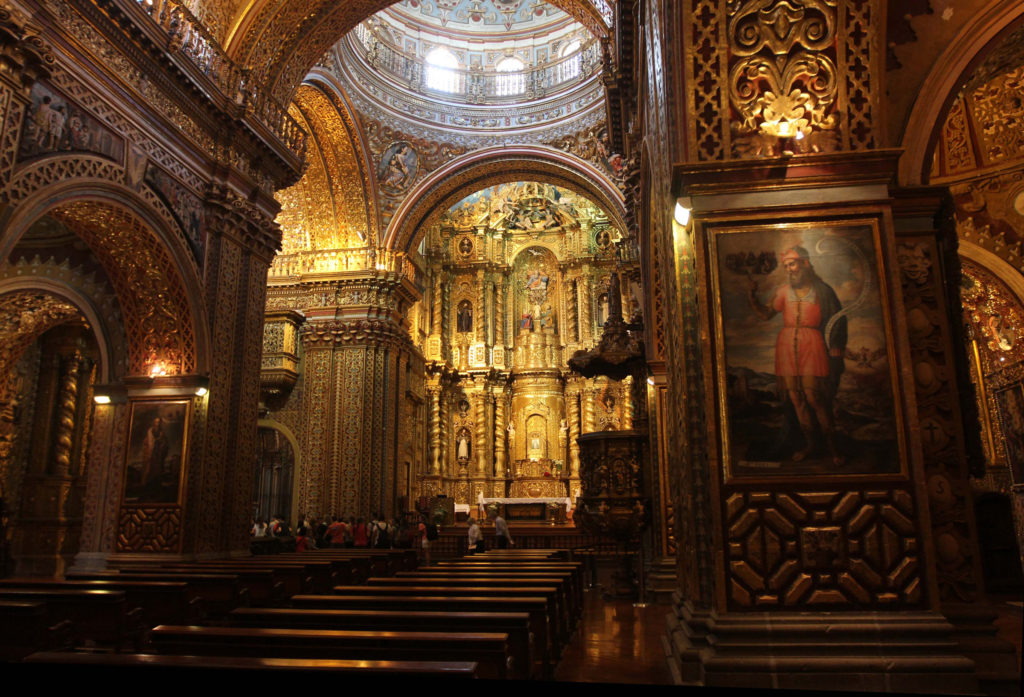
A visitor uses a mirror to take a closer look at the ornate architectural details of Quito's Iglesia de la Compania July 3. (CNS/Barbara Fraser)
A visitor uses a mirror to take a closer look at the ornate architectural details of Quito’s Iglesia de la Compania July 3. (CNS/Barbara Fraser)
QUITO, Ecuador (CNS) — When Pope Francis enters the Jesuit church here July 7 for a moment of private prayer, he will step into an architectural gem where trees once grew up through the floor.
The Iglesia de la Compania — the Jesuits, or Society of Jesus, are known as the Compania de Jesus in Spanish — is a “Baroque icon” that drew 150,000 visitors last year, architect Diego Santander, who heads the foundation that manages and maintains the building, told Catholic News Service.
Although the church’s interior glows gently with light reflected from floor-to-ceiling gold leaf, “There aren’t tons of gold in the church,” as some have claimed, Santander said.
The gold, which he said weighs a little more than 100 pounds, adorns the elaborately carved altarpiece, the eight-pointed stars on the columns, the intricate side altars and the graceful curves of the ceiling.
More than 100 pounds of gold leaf adorns the side altars of the Iglesia de la Compania in Quito, Ecuador’s Jesuit church. (CNS/Barbara Fraser)
The symmetrical building draws on two churches in Rome, taking its cross-shaped layout from the Church of the Gesu, while the side altar carvings of Sts. Francis Xavier and St. Ignatius echo those of the Church of Sant’ Ignazio.
Despite the European influence, several touches — including a sun motif above the main entrance and in the dome — hint at the building’s roots in the New World.
Beneath the main altar lie the relics of St. Mariana of Jesus, and over the altar hangs a miraculous image of Our Lady of Sorrows.
Those are two key reasons why Pope Francis requested time for prayer there with fellow Jesuits, said Fr. Gilberto Freire, Jesuit provincial in Ecuador.
Begun in 1605, the church was built in stages, starting with a simple structure that was open to the public while the larger building was underway. Italian Brother Marcos Guerra oversaw construction of the main structure from 1620 to 1670, while the carving of the side altars followed in the late 1600s.
The imposing facade of volcanic stone came last and was completed in 1765. Just two years later, however, the Jesuits were expelled from Ecuador and the building began a slow decline.
The Jesuits returned to Ecuador in 1852, but were forced to leave again. When they finally returned in 1862, the decades of neglect had left their mark.
“The inside of the church was like a forest,” with vegetation growing up through the floor, Santander said.
Some of the church’s treasures — including a monstrance and the originals of the huge, graphic paintings of the “Last Judgment” and “Hell,” which hang in the back of the nave — had been spirited away during those years, and an earthquake in 1859 had damaged the bell tower.
At 150 feet tall, the tower was a landmark, with chimes that marked the pace of life in the city, Santander said. After another quake weakened it further in 1868, the tower was reduced to less than half its original height.
The pope requested private prayer time before the image of Our Lady of Sorrows, which hangs over the altar in Iglesia de la Compania, in Quito’s colonial-era Jesuit church. (CNS/Barbara Fraser)
Inside the church, beside the carved wooden pulpit, a pillar topped by a statue of St. Mariana of Jesus marks the spot where the young woman used to pray.
Born in 1618, Maria Ana de Paredes Flores Jaramillo was orphaned as a child and led a life of austerity and penitence, with Jesuits as her confessors.
When several earthquakes and a plague struck Quito, the young woman offered her life to stop the disasters. She became ill some time later and died in 1645, at age 27. A lily sprouted in a place where some of her blood spilled, in what is now the Monastery of El Carmen Alto in Quito.
St. Mariana of Jesus was beatified in 1853 and canonized in 1950, five years after the Ecuadorean government proclaimed her a national heroine for her sacrifice.
Between those years, the miracle most closely associated with the church occurred in the adjoining school, where a print of Our Lady of Sorrows, her heart pierced with swords, hung in the dining room. On the evening of April 20, 1906, more than 30 boys, a priest and a brother were in the dining room and saw Our Lady’s eyes open and close, during a period of about 15 minutes.
At the time, the government was taking steps to reduce the Catholic Church’s influence in public education, and the miracle was taken as encouragement to continue efforts to promote education in the faith.
The devotion to Our Lady of the School, as the image became known, began to grow in the mid-20th century. Now one of Ecuador’s major religious devotions, it centers on a novena of prayer around April 20.
The Iglesia de la Compania underwent a more scientific restoration after an earthquake in 1987, with input from architects, archaeologists, historians and other experts, said Santander, who has worked with the Iglesia de la Compania Foundation since the late 1990s and is now director of the organization.
The entrance fee paid by tourists supports the $500,000 budget for maintaining and operating the church.
“The greatest work that remains to be done is further research on religious and cultural aspects related to the church,” Santander said.