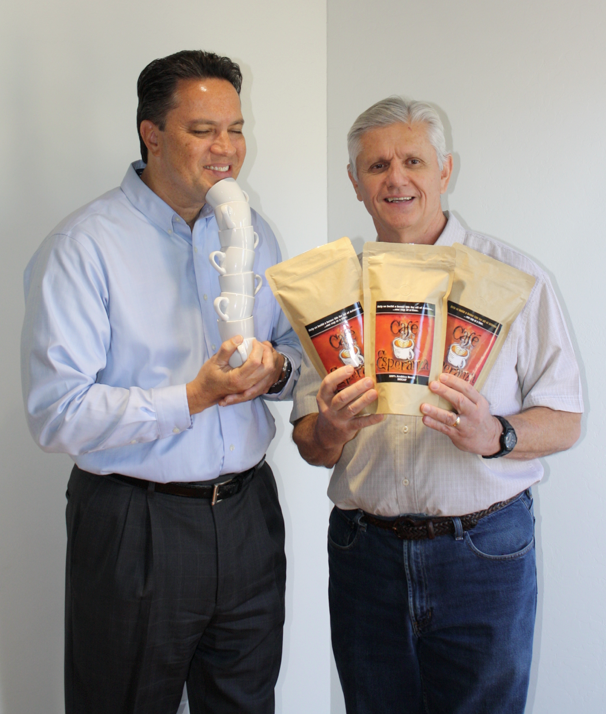
Café Esperanza has a new family member, Café Esperanza Especial, which will sell at Valley Los Altos Ranch Market stores beginning today. (courtesy photo)
Steve Capobres of Catholic Charities and The Refuge and Rodo Sofranac of Café Esperanza show off their locally roasted coffee in a file photo. (courtesy photo)
It’s a good day for coffee lovers. A new specialty ground coffee, Café Esperanza Especial, hits store shelves and purchases support the most vulnerable in the community.
Café Esperanza was created in 2012 as a proprietary blend of 100% Arabica bean coffee from Central and South America that’s roasted, packaged and distributed in Phoenix. Beginning today, the new “Especial” coffee is available for purchase at all seven Los Altos Ranch Market locations throughout the Valley plus stores in El Paso, Texas and Albuquerque, New Mexico.
Shoppers can choose from the house or breakfast blend. Suggested retail price for each 12-ounce bag is $7.99. Café Esperanza Especial also offers a French Roast and decaf. All proceeds benefit Catholic Charities Community Services, Inc., one of Arizona’s oldest and largest nonprofit organizations and its collaborating agencies.
“We’re very excited about our new ground coffee,” said Steve Capobres, vice president, business development, Catholic Charities. “Our premium specialty roast is doing very well and we saw an opportunity to expand the line and reach some new customers with a delicious ground coffee. It’s an opportunity for coffee lovers to support the local community and that’s a win-win for everyone!”
Purchases of Café Esperanza supports the cost of providing shelter for the homeless and abused, protection and nurturing for children and families, assistance to refugees and veterans, and aid to those in crisis and help to the impoverished.
[quote_box_center]
RELATED
This isn’t the first time Ranch Market has supported Catholic Charities. See how the store supported Catholic Charities’ refugee clients in this archived article.
This is the official logo for the July 5-8 visit of Pope Francis to Ecuador. The pope will also visit Bolivia and Paraguay during his July 5-13 trip to Latin America. (CNS photo)
This is the official logo for the July 5-8 visit of Pope Francis to Ecuador. The pope will also visit Bolivia and Paraguay during his July 5-13 trip to Latin America. (CNS photo)
Like many in the U.S., Pope Francis is traveling during this Fourth of July weekend. His journey is just beginning though.
Pope Francis’ trip to three Latin American countries will “put him in touch with his Jesuit roots” and include time with people often on the margins of society. The Catholic Sun, via Catholic News Service, reported on his itinerary when the Vatican released it nearly two months ago.
He departs Rome at midnight for us here in the Diocese of Phoenix. South Americans in Ecuador will greet him first — and hopefully some Xavier College Preparatory students who are there for service work — followed by Bolivia and Paraguay.
Ecuadoreans are ready. Ramon Guato, a well-known sculptor of religious figures in that country, prepared about 2,000 figures to be sold at Catholic libraries ahead of the papal trip. The vendors are out and the welcome poster is up.
Want to follow Pope Francis on his apostolic journey? Here are some suggestions:
This is the official logo for the July 8-10 visit of Pope Francis to Bolivia. (CNS photo)
Pew Research Center gives you a clear and quick low-down on Pope Francis and South America… how widespread Catholicism is in the countries he will visit, geographically where they are, how the nations in general (the non-Catholics too) view him, and how those nations feel about social inequality.
GatorsGoGlobal blog. It’s written with the perfect amount of text/photo ratio and is in a very relatable tone. We would expect nothing less coming from nine Catholic high school girls. Be sure to read about their adventures shopping for papal gear. Scroll toward bottom. They probably found the best deal ever on papal merchandise.
By the way, if you missed it, 12 News captured the girls’ thoughts a few weeks ago before they left.
This is the official logo for the July 10-12 visit of Pope Francis to Paraguay. (CNS photo)
@PapaEnBolivia might be worth a follow too, if you understand Spanish to a certain degree.
CNS’ Rhina sent out the first #popeinparaguay Tweet today. It gives you a peek at the altar and what it’s made of. Pope Francis will celebrate Mass outside the Caacupe Marian shrine in Paraguay July 11 and in the field at Nu Guazu Park July 12.
The New York Times ran a story today about Pope Francis in Latin America.
Don’t be surprised if you see something on CNN either. One of the network’s documentary reporters is working on a piece about people — including those Xavier girls — going to South America to see the pope. I’m fairly sure it’s not the same reporter, but here’s a CNN piece written ahead of Pope Francis’ trip to South America.
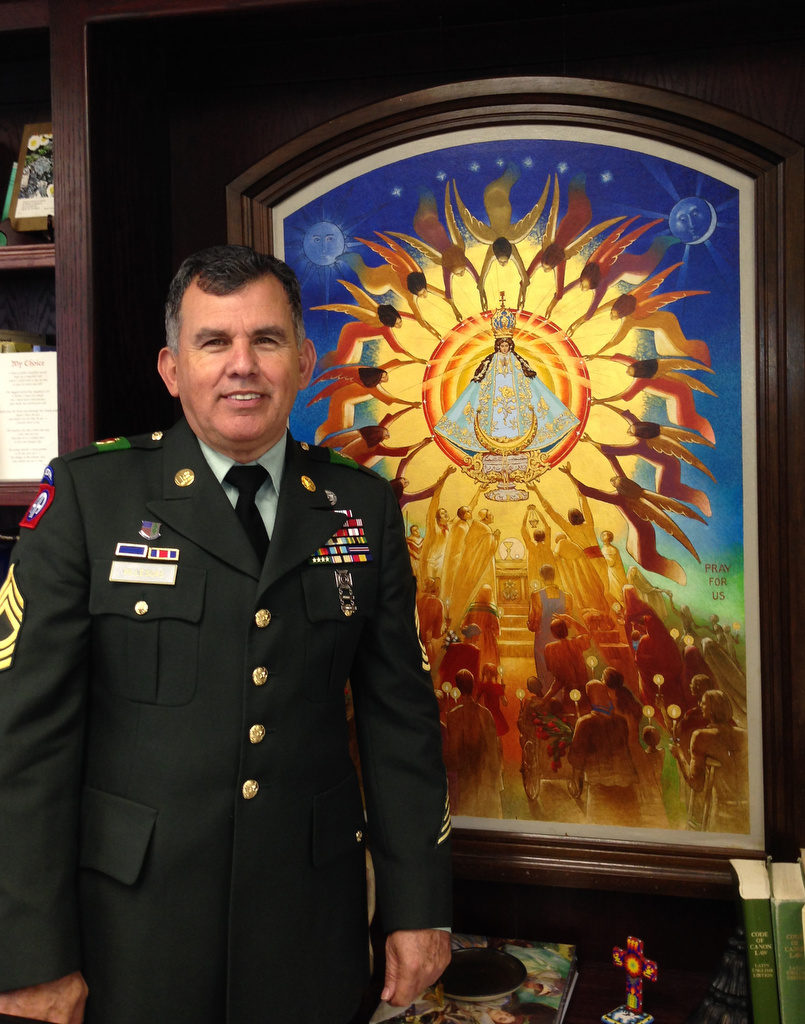
Retired Master Sgt. Pablo H. Villescas stands next to an image of Our Lady of San Juan del Valle. Villescas, who serves as the administrator of the Basilica of Our Lady of San Juan del Valle-National Shrine in San Juan, Texas, has worked at the shrine since he was in high school, starting out as a dishwasher in the cafeteria. (CNS photo/courtesy Fr. Amador Garza)
Retired Master Sgt. Pablo H. Villescas stands next to an image of Our Lady of San Juan del Valle. Villescas, who serves as the administrator of the Basilica of Our Lady of San Juan del Valle-National Shrine in San Juan, Texas, has worked at the shrine since he was in high school, starting out as a dishwasher in the cafeteria. (CNS photo/courtesy Fr. Amador Garza)
SAN JUAN, Texas (CNS) — Master Sgt. Pablo H. Villescas was serving with the Army Reserve in Afghanistan when that country held its first free, direct elections in 2004.
More than three-quarters of Afghanistan’s registered voters cast ballots in the election.
“The people were so happy to finally have a voice, to finally have a say in which direction their country should go,” Villescas said.
He added that some Afghans were also killed so they couldn’t vote.
In the United States, where there are few, if any, barriers to the polls, voter registration and voter turnout is low. In the 2012 U.S. presidential election, only 53.6 percent of eligible voters cast a ballot, according to the Pew Research Center.
“It really bothers me when people don’t vote,” Villescas told The Valley Catholic, newspaper of the Diocese of Brownsville. “A lot of people have given their lives so that we can have that opportunity and it is not appreciated.”
The Fourth of July is a day of celebration, but it is also an ideal time to reflect on our freedoms and the sacrifices our service men and women have made to sustain them — men like Villescas.
“I started working here in August of 1970,” said Villescas, now retired from the reserves. “I was in high school and my first job was as a dishwasher in the cafeteria.”
From there, Villescas was promoted to cashier and then worked in the gift shop, the mailroom and the hotel, just to name a few of his posts. Later, he began learning the administrative side and was responsible for purchasing and acquisitions.
“Even before he stared working here, he was an altar server at the church and a student at the school so that means he has spent his whole life here,” said Fr. Amador Garza, rector of the basilica. “He’s an invaluable resource because he is the institutional memory for the basilica after all these years here.
“When Bishop (Daniel E. Flores) asked me to be the rector, I knew right off the bat I wanted Pablo to be the administrator.”
Villescas was named administrator in 2010, after his last overseas tour with the Army Reserve. He manages a staff of 95. The basilica welcomes more than 25,000 pilgrims a week.
Villescas’ family was instrumental in establishing a shrine to Our Lady of San Juan in the Rio Grande Valley. shrine history In the 1940s, Villescas’ grandparents, Bernardino and Bernadina Villescas, petitioned Fr. Jose Maria Azpiazu, a priest of the Missionary Oblates of Mary Immaculate, to build a shrine for those who could not travel to Mexico.
Villescas said he believes Mary kept him safe during his overseas tours.
“There were times when I thought I was going to die,” he said. “Through all of those incidents, I was able to come back home. I feel like la Virgen protected me. She has always been our family’s patron saint.”
A native of San Juan, Villescas is the fifth of Fortino and Ninfa Villescas’ 10 children. He and his wife, Olga, have been together for 20 years. He also has three daughters, a son and eight grandchildren.
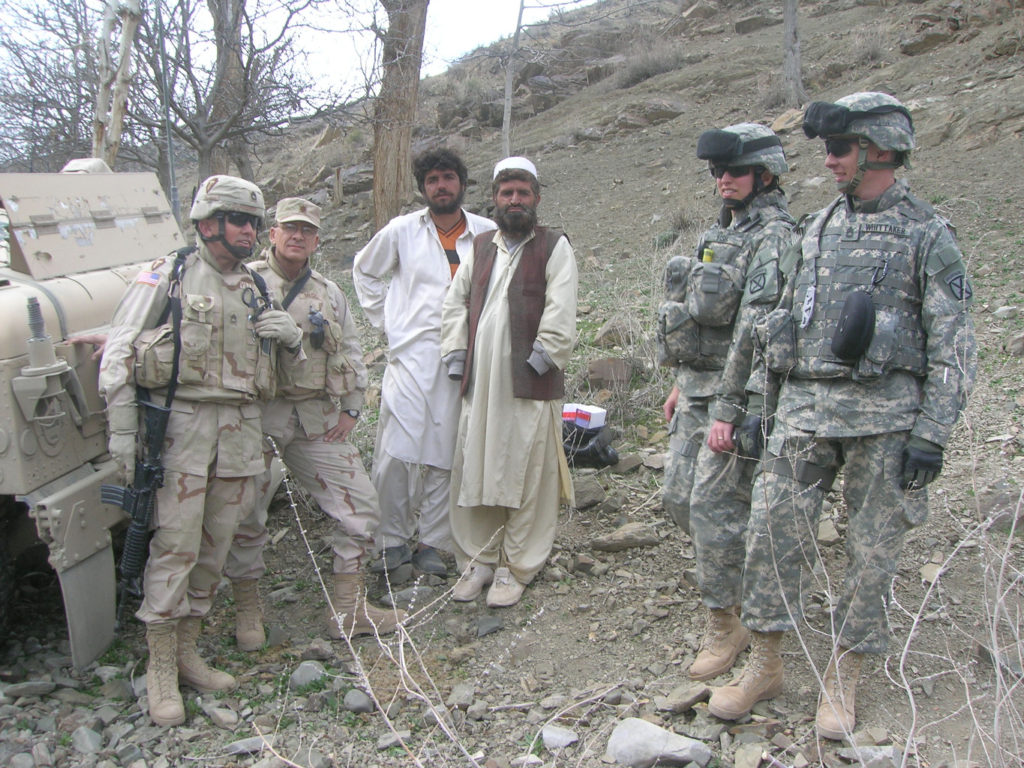
Now-retired Master Sgt. Pablo H. Villescas, far left, is pictured while serving a tour in eastern Afghanistan in 2004. Villescas, the administrator for the Basilica of Our Lady of San Juan del Valle-National Shrine, was in the U.S. Army Reserve for more than 35 years. (CNS photo/courtesy Fr. Amador Garza)
Villescas joined the Army Reserve in 1977 and has served four tours overseas. In 1992, he served in Operation Desert Shield/Desert Storm in Kuwait. In 2000-01, he served in Operation Noble Eagle in Guantanamo Bay, Cuba.
Villescas served a tour in Afghanistan in 2003-04, spent 2005-06 at Darnall Army Medical Center at Fort Hood working with wounded and ill soldiers and served another tour in Afghanistan in 2009-10 before retiring from the Army Reserve in June 2013.
It was his father who inspired him to retire.
Through his father, Villescas learned how much heartache the family members of those who serve in the military endure.
“My father was sick and in the hospital and he asked me, ‘When are you are going to get out?'” Villescas recalled. “‘Well, I’m tired,’ my father said. ‘I’m tired of worrying about you, I’m tired of lighting candles for you.’
“It was painful for me to leave the Reserves, but the way it was requested, I couldn’t say no to my father. This applies to all service men and women. … All your loved ones are worried until you get home safely. More than 10,000 candles are lit at the basilica on any given weekend and I know many of those are for our military.”
His experience with the Catholic Church and the military have impacted his life’s work.
“In large measure, he owes his life to the church and to the Army,” Father Garza said. “They were the ones that shaped him and have molded him into who he has become. His whole life has been at the service of these two institutions, which have given him the sense of commitment and the sense of discipline that he has.”
Another local voice has joined the growing network of hosts offering regular Catholic radio programming.
Debbie Georgianni is finishing her third week of co-hosting “Take 2 with Jerry and Debbie,” a live call-in show that takes a fresh look at personal, spiritual and cultural issues all through a Catholic lens that draws on life experiences, solid theology and a lively conversation. The show airs weekdays on the EWTN radio network, Sirius 130 and the IHeartRadio app with podcasts archived online at take2show.com.
[quote_box_right]
Take 2 with Jerry and Debbie
What: A live call-in show taking a fresh look at personal, spiritual and cultural issues
When: Mon.-Fri. 9 a.m. Pacific Time
Where: EWTN.com/radio, Sirius 130 and the iHeartRadio app with archives online
“Take 2” joins Radio Family Rosary and two Spanish programs on Radio En Familia in offering weekday Catholic programming that features a local voice. “Take 2” launched as a Monday-Friday show June 15 with co-hosts working from their respective home states.
Georgianni is a parishioner at Christ the King in Mesa and community relations representative for Immaculate Heart Radio in Phoenix. It was the latter role that ultimately connected her with radio veteran, Jerry Usher, who co-hosts “Take 2” from Cathedral City in California.
The show invites listeners and its hosts to look again at themselves and the world around them. So far, the show has addressed topics such as anxiety, fatherhood, being “green” in light of the pope’s encyclical, guilt, “divine disruptions” and youth homelessness.
“It’s like a peer ministry where we’re really locking arms,” Georgianni said. “If it makes one soul grow closer to God, then we’ve done our job.”
The goal is to keep a conversation going while live on the air and continue it via social media. Usher sees “Take 2” as a way to help listeners emerge from the brokenness that can hinder them from reaching their “God-ordained potential.”
“We want to cover topics every day that reach people, take a fresh look at life, who they are, who they were made to be and the world around them,” Usher said, “We all come from different places and that includes wounds and traumas.”
Their program, via in-depth discussion on life experiences and Church teaching, aims to help listeners move beyond the trauma to discover authentic peace. Both co-hosts were impressed with the feedback and support they received following the first week on air. For a new call-in show, there was never any difficulty in filling up the lines and calls have come from across the U.S. plus up to a dozen international countries.
Georgianni regretted they could not address every caller within the hour. Both co-hosts commented on the ease of dialogue with listeners.
“I almost felt like they were having a conversation in my living room,” Georgianni said. “We’re just coming from our hearts, from our experiences and people are relating to that.”
The “realness” of listeners and what they’re comfortable sharing impressed Usher.
“There’s a freshness about this show, a realness that people connect with,” he said.
They’ve already received requests to do a live, in-person show.
“I love watching people grow closer to God. In Catholic radio, we hear it every day,” Georgianni said.
“Take 2 with Jerry and Debbie” is just part of a deepening pool of Catholic radio programming that features a local voice. One other local Spanish program and two in English — “The Bishop’s Hour” and “The Catholic Conversation” on Immaculate Heart Radio — provide Catholic content for radio on a weekly basis.
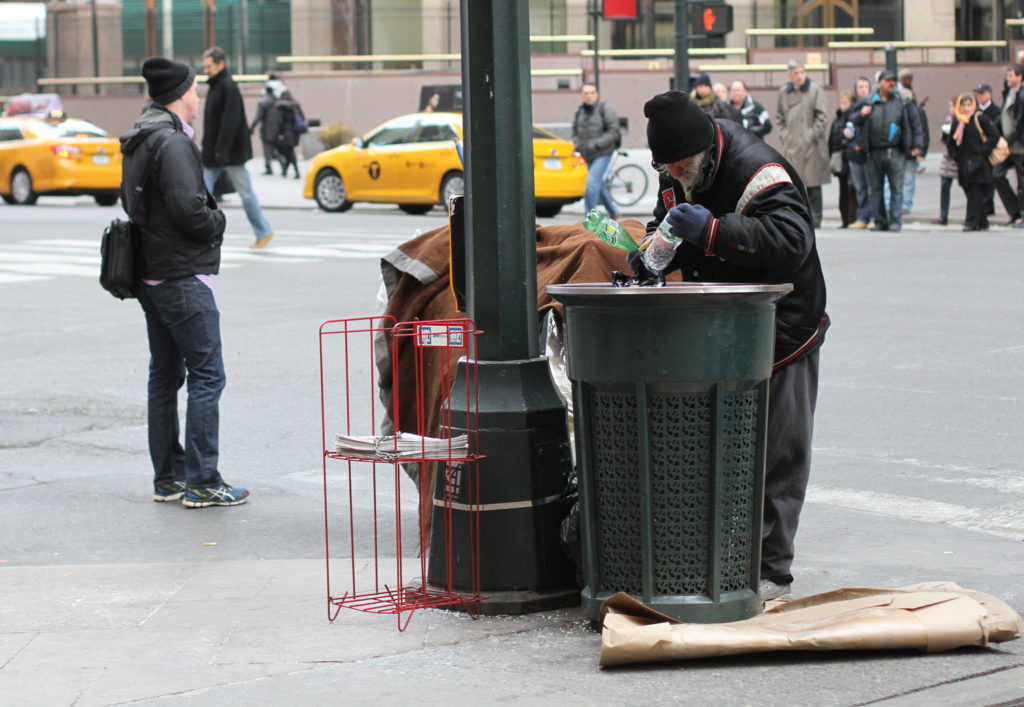
A homeless man searches a trash can for bottles and cans to redeem for money in New York City in 2014. Ahead of Pope Francis' apostolic visit to the United States in September, some are bracing themselves for more criticisms from the pope, this time directed specifically at the U.S. culture and economy. (CNS photo/Gregory A. Shemitz)
A homeless man searches a trash can for bottles and cans to redeem for money in New York City in 2014. Ahead of Pope Francis’ apostolic visit to the United States in September, some are bracing themselves for more criticisms from the pope, this time directed specifically at the U.S. culture and economy. (CNS photo/Gregory A. Shemitz)
VATICAN CITY (CNS) — Harsh criticisms meted out by Pope Francis on free-market capitalism have sparked backlash from some fiscal conservatives and have led some people to call him “anti-capitalist” or even Marxist.
Ahead of his apostolic visit to the United States in September, some are bracing themselves for more criticisms from the pope, this time directed specifically at the U.S. culture and economy.
Joseph Kaboski, a professor of economics at the University of Notre Dame and president of CREDO, an international organization of Catholic economists, said, “As an individual, the pope probably views redistribution programs as a more effective way of tackling poverty than economic growth,” though “most mainstream economists would disagree.”
In addition, he said, the pope would probably “like more government involvement in the economy than many Americans would be comfortable with.”
However, Kaboski said he views the pope “as neither pro- nor anti-capitalist, but instead a measured critic.”
Kaboski said he is “confident Pope Francis finds much to commend” in U.S. economic life, such as private property, the entrepreneurial spirit, human creativity, technological advances, the way it creates jobs, income and products, and the way charities, government and the private sector pitch in to provide services to those in need.
At the same time, the pope “would also criticize the vast disparities in income and wealth … point to the poor in the inner cities, and argue that they are not fully participating in society,” Kaboski said. In addition, the pope would “point to the fact that the global economic crisis started in the U.S. financial sector and wound up shaking economies of many poor nations,” he said.
Kaboski said he is “very excited” about the pope “emphasizing the needs of the poor, but then if he talks about the roots of the financial crisis, it’s hard for me to fully go along with his confidence because academic economists are still debating the root causes of the Great Depression.”
“There are some statements (he makes) that can leave people scratching their heads,” he conceded.
However, it is important to keep in mind that the pope is “never teaching economics,” added Kaboski, who is also a consultant for the U.S. bishops’ Committee on Domestic Justice and Human Development. Rather, the pope is “catechizing on how our Christian view ought to impact our view of a good economy and society.”
Christians are called to evaluate economic activity through the lens of their relationship with God and others, which must be central to their lives, he added.
In homilies and at various audiences throughout his two-year pontificate, Pope Francis has sought to raise awareness and inspire action that would narrow the imbalances between the world’s rich and poor. He has criticized the current global economy, which is says is based on a “throwaway culture” that encourages consumption and waste, and marginalizes or even discards people seen as economically unproductive.
His main criticisms of “unregulated capitalism” are spelled out in his apostolic exhortation, “The Joy of the Gospel,” which calls people to turn from the idolatry of money and indifference to the needs of the poor. The economy must be based on the primacy of the person, honor human dignity and care for the poor, especially by including them in the economy, he said.
“This is related to what the pope has been talking about long before the environment: lifestyle,” said Greg Burke, senior communications adviser to the Vatican’s Secretariat of State. “This encyclical is as much about wealth and poverty as it is about the environment.”
The call to action in “Laudato Si'” is “not just taking out your trash,” Burke told Catholic News Service, “but how much trash … you produce because of rampant consumerism.”
Carolyn Woo, president of Catholic Relief Services and a former business professor, told CNS that the encyclical also includes a call to action for the business sector.
“Pope Francis actually invites business to be a part of the solution,” she said. “But it cannot be business as usual.” Rather, businesses need to shift out of “the same short-term thinking or the same obsession with short-term profits and disregard for people,” she said.
Practically, it means businesses would need to adopt the values of “solidarity and sustainability, oriented toward the common good and the true development of all peoples” and engage in more environmental impact assessments of their activities, she said at the Vatican’s official launch of the encyclical June 18.
Ralph McCloud, director of the Catholic Campaign for Human Development, said cooperatives and other community-based businesses already operate according to the values of sustainability, solidarity and subsidiarity. He said they also are well-positioned to implement green initiatives and “look for green opportunities” that answer the needs of their local communities.
Pope Francis has praised cooperatives as a viable model that fights exclusion and puts people before profit.
“To speak of an economy that we can all share in is not very popular,” said McCloud. But CCHD shares the pope’s concern about how “a broken economy breaks families, communities and the human spirit,” he said. Furthermore, he said, the pope’s comments have been “an inspiration for low-income Americans.”
CCHD, an organization of the U.S. Conference of Catholic Bishops, educates for community-based development and funds community start-ups and cooperatives. Since its founding, CCHD has supported 99 cooperatives, including Golden Steps in Brooklyn, New York, which provides assistance to the elderly, and Opportunity Threads, a textile manufacturing co-op in Morganton, North Carolina.
Co-ops are increasingly understood as “a viable option in a capitalist economy,” he said. In addition to benefiting the families of co-op members, McCloud said co-ops in the U.S. promote the type of personal and community development the pope has called for, including greater participation in education and in the political process.
Kaboski pointed out that recent popes have often used the term “unbridled capitalism” to refer to an economy that is “indifferent to the poor and ideologically rejects any need to circumscribe the economy within a legal, political and cultural framework.”
“A market without rules and morals doesn’t remain free,” he continued. “What (the popes) are really arguing for is an economy that is truly free in the Catholic sense of the word free: an economy that more fully enables people to attain their own perfection.”
In line with the Catholic understanding of freedom, which involves discernment, Kaboski said, the economy requires “reflection and guidance” in order to “best fulfill its proper function, serving all the members of society.”
“The pope is not an economist and his job is not to (propose) concrete economic policies,” he said. “But he is called to be a prophetic voice in the world, praising the work of God and the collaboration of mankind where he sees it” and calling for repentance “where he sees serious social problems.”
For 30 years, the mission of Life Teen has been leading teenagers closer to Christ. As we move forward, our methods and ministry continue to evolve to meet the diverse needs of today’s teenagers. This year at our annual convention, we unveiled the newest version of Life Support, our high school youth ministry resources. The new Life Support features some of the most effective youth ministry resources available, offering frameworks for small group discipleship, large group evangelization, and the formation of missionary disciples.
Watch as Mark Hart, the Executive Vice President of Life Teen, and Joel Stepanek, the Director of Resource Development for Life Teen, unveil the new Life Support at the 2015 Catholic Youth Ministry Convention. Purchase and use these resources for the upcoming youth ministry year.
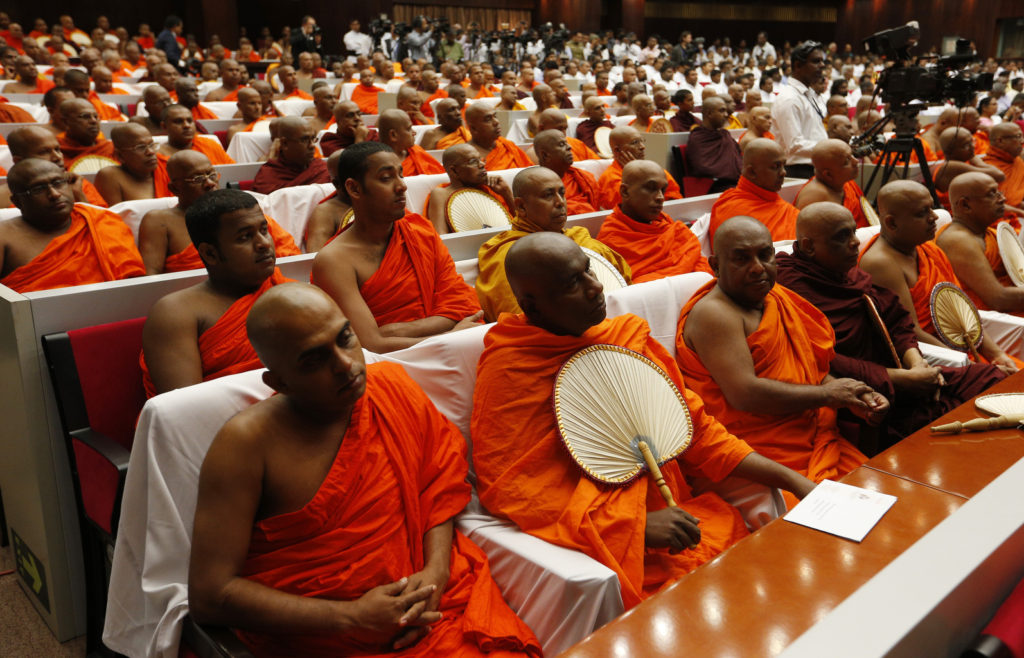
Buddhist monks attend Pope Francis' meeting with religious leaders at the Bandaranaike Memorial International Conference Hall in Colombo, Sri Lanka, Jan. 13. (CNS photo/Paul Haring)
Buddhist monks attend Pope Francis’ meeting with religious leaders at the Bandaranaike Memorial International Conference Hall in Colombo, Sri Lanka, Jan. 13. (CNS photo/Paul Haring)
VATICAN CITY (CNS) — Catholics and Buddhists from five U.S. cities have issued a joint statement expressing their commitment to work together to help lift their communities out of poverty and remedy other social ills in their neighborhoods.
“I see it as a reflection of a maturing of the relationship, where the dialogue shifts from verbal understanding to cooperation in community service,” said Ronald Kobata of the Buddhist Church of San Francisco.
Kobata was in Rome in late June for the first national meeting of U.S. Buddhist and Catholic leaders.
The June 22-27 dialogue included 23 Buddhists and 23 Catholics, mostly clerics involved in interreligious dialogue or social action, from San Francisco, New York, Los Angeles, Chicago and Washington, D.C. The theme was “Suffering, Liberation and Fraternity.” The local archdioceses supported the dialogue. They met in Castel Gandolfo, just outside of Rome.
The meeting was sponsored by the Pontifical Council for Interreligious Dialogue and the U.S. Conference of Catholic Bishops’ Secretariat for Ecumenical and Interreligious Affairs. The dialogue was held in Italy upon the invitation of the council, whose members thought the context would help to establish “a firm footing” for the dialogue, said Anthony Cirelli, associate director of the USCCB secretariat.
Cirelli said this meeting was significant because previous Catholic-Buddhist dialogues were regional and focused more on “theological exchange.”
But for Kobata, interreligious collaboration in the area of social justice is not new. He said his faith community has been involved already in “providing dinners at homeless shelters” in cooperation with the San Francisco Interfaith Council.
“Moving from talking about what we’d like to do, to doing what we can to promote the well-being of our communities, we can see that compassion is not the monopoly of any faith tradition,” said Kobata. “As the saying goes, ‘People do not care how much you know until they know how much you care.'”
Cirelli said Buddhists and Catholics share “much common ground” in their concern to address the “relational suffering” people endure by promoting “sound relationships.”
“Both the Buddhist and the Catholic traditions place much emphasis on extending mercy and compassion to the other,” he said.
Buddhists, for whom mercy is “a supreme priority,” said Cirelli, have taken note that mercy is being given priority by Pope Francis as well, namely in his preaching and teachings and in his proclamation of the upcoming Year of Mercy.
“This naturally translates into a common thread for more intentional collaboration and engagement between Catholics and Buddhists,” he said.
Pope Francis met with members of the U.S. Buddhist-Catholic dialogue at the Vatican June 24.
In his message, he said their efforts “are seeds of peace and fraternity” in “this historic time, so wounded by war and hatred.”
Though the pope’s discourse was short, he took time to greet each participant and exchange a few words with them.
Cirelli said participants felt encouraged by their meeting with the pope.
“I learned right away from the Buddhist leaders that the attention the Holy Father showed them by calling for this audience meant that he was serious about dialogue,” said Cirelli.
Kobata confirmed the importance of the papal audience.
“My impressions are that Pope Francis’ leadership, sincerity and dedication to promoting interfaith cooperation have inspired the participants in this dialogue to bring our communities together in cooperative efforts to promote peace, alleviate suffering, and live responsibly with our natural environment,” Kobata said.
Cirelli said dialogue participants agreed on the importance of recognizing the “brokenness of human relationships” and of “intentional dialogue for bringing healing.” They also agreed that interreligious dialogue can be more effective when academic dialogue at a national level is complemented by grass-roots social action at the local level.
Participants issued a joint statement at the meeting’s conclusion, identifying areas for collaboration and social action projects, such as climate change, youth outreach, prison ministry, restorative justice, affordable housing, and resources for migrants and the homeless.
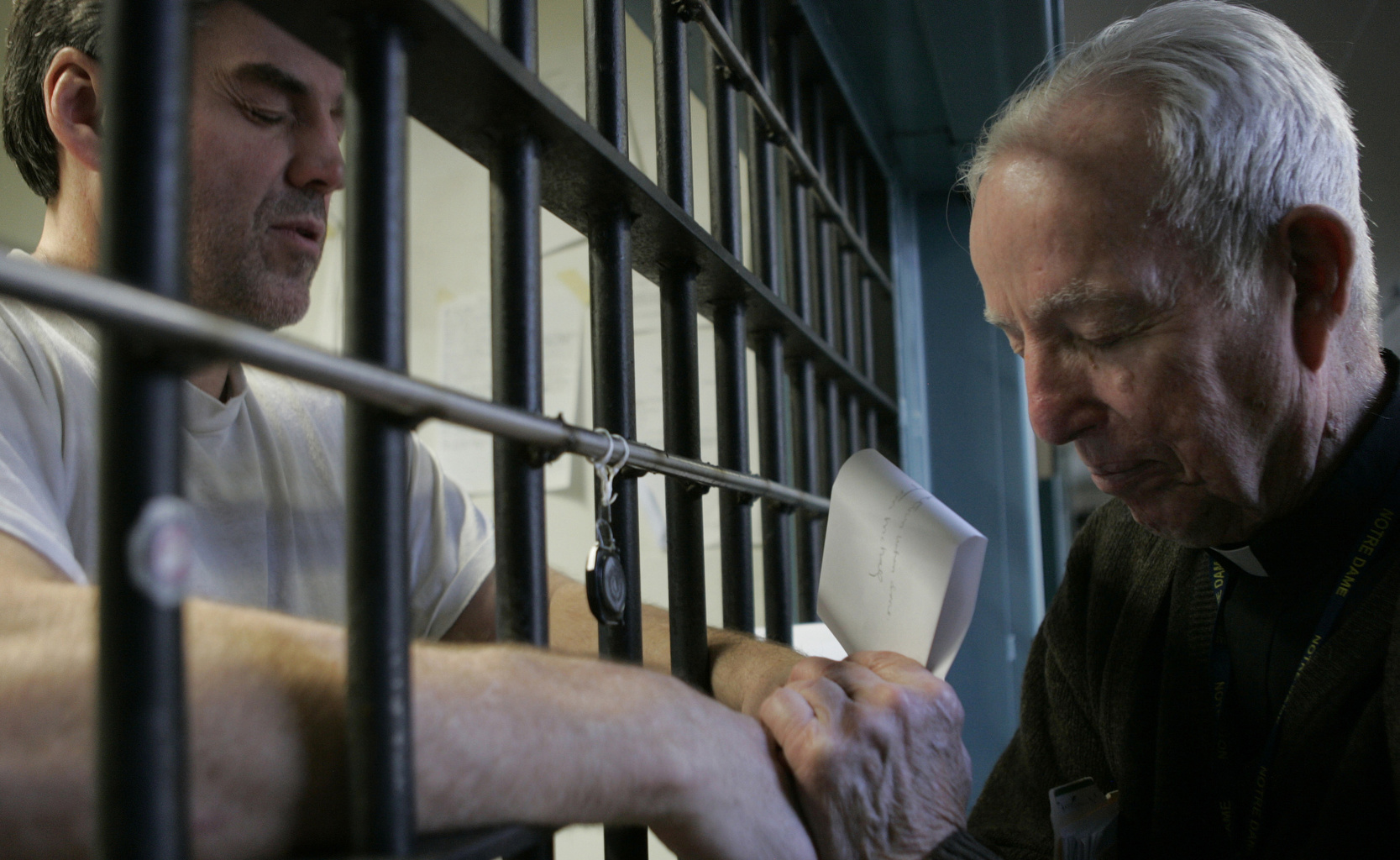
A priest prays with a death-row inmate in 2008 at Indiana State Prison in Michigan City, Ind. (Tim Hunt/Northwest Indiana Catholic via CNS)
A priest prays with a death-row inmate in 2008 at Indiana State Prison in Michigan City, Ind. (Tim Hunt/Northwest Indiana Catholic via CNS)
WASHINGTON (CNS) — In another in a series of bitterly divided end-of-term cases, the Supreme Court June 29 upheld the execution protocol used by Oklahoma and several other states.
In a 5-4 ruling, Justice Samuel Alito upheld lower courts that said the use of the drug midazolam in lethal injection does not violate Eighth Amendment protections against cruel and unusual punishment.
The majority opinion noted that it has been previously established multiple times that capital punishment is constitutional and only delved into whether the claims by Oklahoma death-row inmates that the effects of the drugs used in lethal injection are unnecessarily painful. Among the reasons Alito cited in upholding lower courts were that “the prisoners failed to identify a known and available alternative method of execution that entails a lesser risk of pain.”
According to the “Catechism of the Catholic Church,” the Church does not exclude the use of capital punishment, assuming the offender’s identity and resposiblity are certain, but only “when this is the only practicable way to defend the lives of human beings effectively against the aggressor” (2267).
However, quoting St. John Paul II’s “Evangelium Vitae,” “If, instead, bloodless means are sufficient to defend against the aggressor and to protect the safety of persons, public authority should limit itself to such means, because they better correspond to the concrete conditions of the common good and are more in conformity to the dignity of the human person. Today, in fact, given the means at the State’s disposal to effectively repress crime by rendering inoffensive the one who has committed it, without depriving him definitively of the possibility of redeeming himself, cases of absolute necessity for suppression of the offender ‘today … are very rare, if not practically non-existent.’”
Justices Antonin Scalia and Clarence Thomas each filed concurring opinions with the majority. Alito’s majority ruling also was joined by Chief Justice John Roberts, Scalia, Thomas and Justice Anthony Kennedy.
Two of the four justices who disagreed with Alito each wrote a dissenting opinion, including one in which Justices Stephen Breyer and Ruth Bader Ginsburg called for briefings on whether the death penalty itself ought to be ruled unconstitutional. “I believe it highly likely that the death penalty violates the Eighth Amendment,” Breyer wrote. “At the very least, the court should call for full briefing on the basic question.”
In his majority ruling, Alito devoted a great deal of discussion to the evidence presented about whether midazolam fails to act sufficiently as a sedative to prevent inmates being executed from suffering an undue amount of pain. The cases arose after several cases like that of Clayton Lockett. At his April 2014 execution, he writhed in pain for 40 minutes before dying of apparent heart failure.
Alito recounted the circumstances leading to the use of midazolam, which has become an alternative for other drugs, whose manufacturers refuse to supply them for use in executions. He also went into graphic detail about the murders committed by the death-row inmates who sued.
In his concurrence and pointed disagreement with Breyer, Thomas also described brutal crimes that landed people on death row. It was the third criminal justice case in the last weeks of the term in which Thomas has made a point of writing about severe sentences being necessary because of the pain inflicted on crime victims and their families.
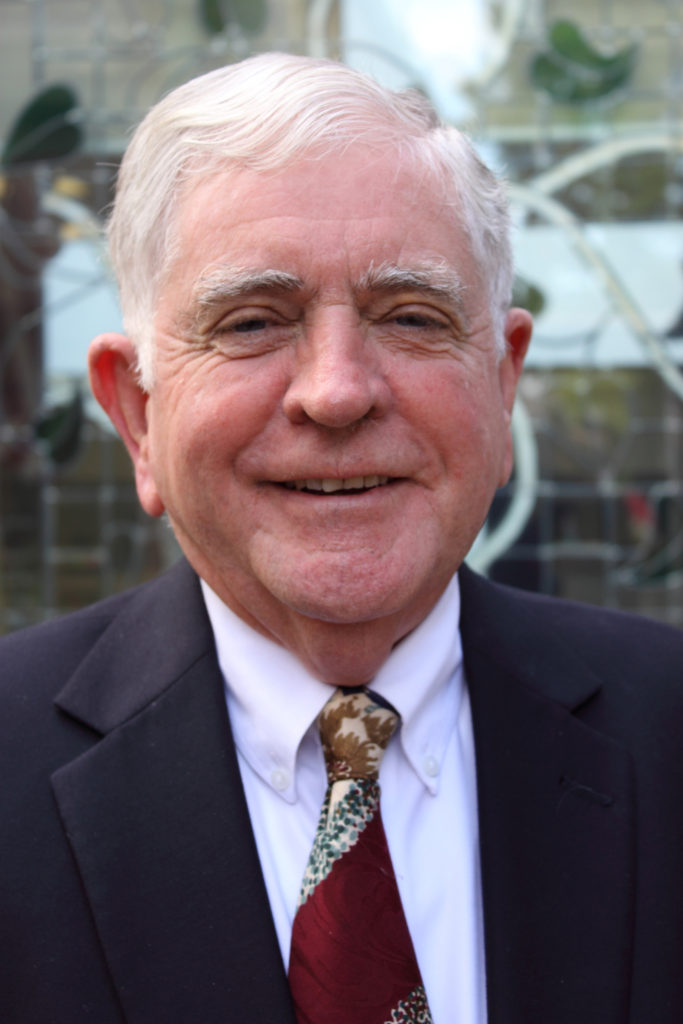
TEMPE — After 26 years as principal of Our Lady of Mount Carmel School, Dr. Vincent Sheridan is retiring.
He began his career in Catholic education in 1972 at Seton Catholic Preparatory High School as a social studies teacher and baseball coach. After five years at the Chandler school, he became vice principal of Gerard Catholic High School in Phoenix.
Gerard shut its doors in 1989, but the memories live on. Sheridan spent 12 years there, patrolling the campus at lunchtime, and frequently seen chomping a cigar. “I’ll see you in my office,” was a phrase he was famous for among students.
Sheridan credits the late Fr. John Hanley, who served as principal of Gerard, for teaching him some valuable lessons about leading a school by being an active, visible presence.
“He did the lunch room,” Sheridan said. “And when he did the lunchroom, he had me walk that campus. You have to get out, get around, see the kids.”
Upon becoming principal of OLMC in 1989, Sheridan began supervising the lunchroom, where he became known for cracking a few jokes. The twinkling eyes and New York accent are part of the charm and both parents and students seem to love it.
“You got to have a sense of humor with kids. You got to have fun with them,” Sheridan said. “Otherwise, if I’m not happy, what does that say about my faith and everything else?”
Sheila Broglia is well-acquainted with the retiring principal’s sense of humor. She remembers getting to know Sheridan when he was an administrator at Gerard. All five of her children have attended OLMC during the last 17 years.
“He would tell my kids, ‘Your mom was so bad in high school. She was always getting into trouble.’ He was just teasing them and they’d laugh,” Broglia said. “He’d refer to that a lot, saying ‘Here comes trouble.’ It was a nice sense of familiarity, but of course, you could appreciate him a lot more as an adult than as a kid.”
In reflecting on what his legacy is, Sheridan pointed to the influence of the Catholic faith.
“Particularly with an elementary school, it’s part of the mission of the parish, the formation in faith. It’s part of that holistic view the Church has, working with the parish to instill Catholic values in the children,” Sheridan said. “At each school that I’ve been at — Seton, Gerard and here at Mount Carmel — I’ve had at least one student ordained a priest.”
Fr. John Bonavitacola, pastor of OLMC Parish offered his own view of Sheridan’s legacy to the school.
“I have worked with Dr. Sheridan for the past 15 years and he is as close to a good old fashioned nun as I could get,” Fr. Bonavitacola said. “His Catholicism permeates everything he does and his greatest legacy is that he is leaving us with a truly Catholic School in our teaching, service and worship. While it is hard to measure the impact he has had on thousands of students during his career, I know he treated each and every student with respect, kindness and love.”
In 2013, Sheridan was awarded the “Guardian of Hope” educator’s award at the annual Night of Hope gala benefiting Catholic schools throughout the diocese.
A product of Catholic schools herself through college, Mary Frances Malinoski found herself out of place during her first teaching assignment.
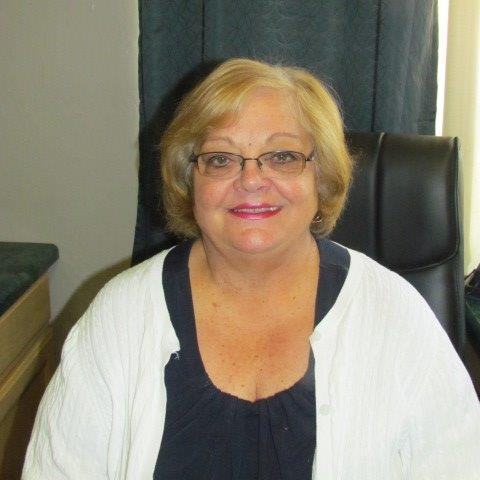
The public school was too large and the “politically correct,” Godless environment bothered her. Malinoski turned to Catholic school campuses and never looked back. Now, after 45 years in education, including 15 of the last 25 as principal in the Diocese of Phoenix, Malinoski retired June 3.
She spent the last six years at San Francisco de Asís in Flagstaff but before that served at St. Daniel the Prophet in Scottsdale and in the ‘90s was principal at Most Holy Trinity and the old St. Mary’s Elementary School in Phoenix.
“Once I began teaching in a Catholic school I knew I was home,” Malinoski said, the eve before her final day of school with the students. “Faith, Catholic traditions, high academics and service to others are the standards that have always kept me in Catholic education.”
That’s not to say that teaching methods didn’t adapt over the years. She recalled classroom days before the concept of a “prep period,” teacher’s aid, dedicated teachers for fine arts or physical education and before computers were necessary.
“Getting purple ink on your hands and clothes when copying papers was always a nightmare,” Malinsoki said. “While the use of technology has improved all areas of education, the demands and requirements at all levels have also increased.”
Class size, she said, has decreased. Today’s Catholic school students also have the luxury of leaning at their pace and style with teachers able to cater to students grasping material at different levels, she said.
“Students today are at a great advantage because we are able to identify areas where learning is a challenge and we have the resources to create programs to help them grow in confidence and knowledge,” Malinoski said.
She is taking many fond memories with her from lunchtime with students to school retreats, staff skits, friendly sports rivalry to ensuring one of the priests isn’t carrying contraband candy for the students.
“The fourth grade students had a tradition that every time I walked into their room, they would jump up and say a new cheer for me. That I will miss,” Malinoski said.
Fr. Pat Mowrer, pastor, acknowledged her efforts in enhancing the school’s Catholic character over the years, which padded its latest accreditation score.
Anna Hoffman’s youngest daughter was an eighth-grader when Malinoski arrived. Hoffman has worked with her since as parish manager and described the May 29 farewell sendoff as a heart-warming celebration and a bittersweet one. Each class offered a tribute via a memory or song with parents putting together a tribute video and teachers also lending a hand. It concluded with a traditional farewell blessing song gifted to anyone leaving the school.
“Everybody was showering her with love and appreciation and gifts,” Hoffman said. They also offered prayers for her retirement years.
“She was very dedicated to our school and put in countless hours to our school and our students,” Hoffman said, noting Malinoski’s level of professionalism, experience and dedication.