
Sister Helen Prejean recounts early years in fight against death penalty

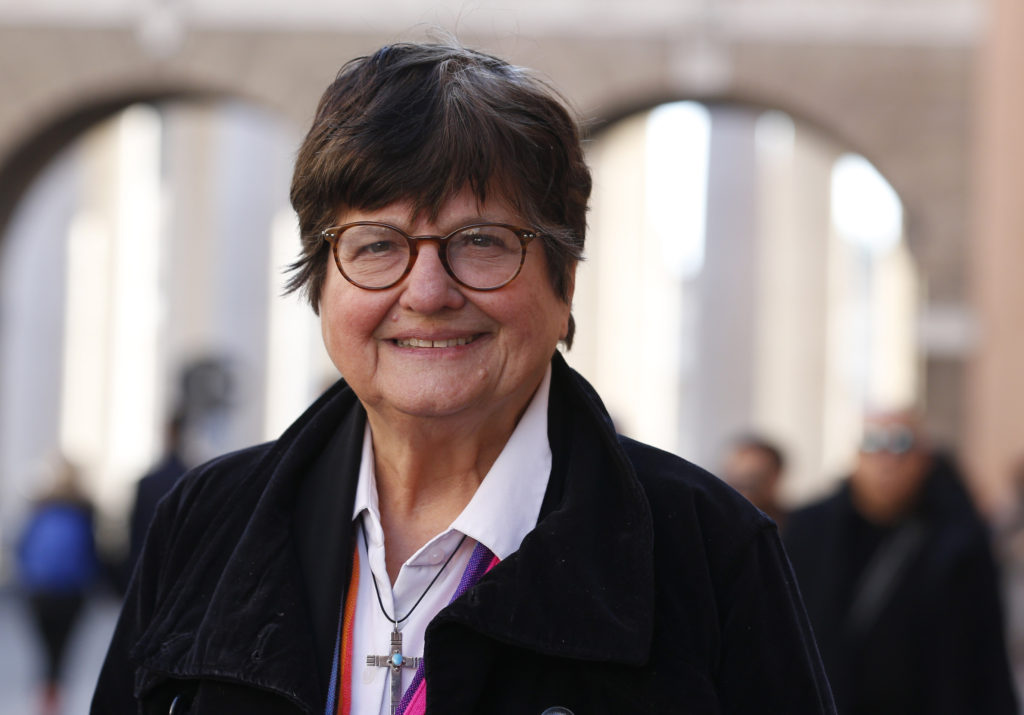
St. Joseph Sister Helen Prejean, who has worked in prison ministry and against the death penalty for decades, is pictured in Rome Jan. 21. During a meeting the same day, Pope Francis asked Sister Prejean about the case of Richard Masterson, a Texas man who was executed the previous day. (CNS photo/Paul Haring)
St. Joseph Sister Helen Prejean, who has worked in prison ministry and against the death penalty for decades, is pictured in Rome Jan. 21. During a meeting the same day, Pope Francis asked Sr. Prejean about the case of Richard Masterson, a Texas man who was executed the previous day. (CNS photo/Paul Haring)

ANAHEIM, Calif. (CNS) — “They killed a man with fire one night. They strapped him in a wooden chair and pumped electricity through his body until he was dead,” Sr. Helen Prejean told an audience in Los Angeles Feb. 27.

“His killing was a legal act because he had killed. No religious leaders protested his killing that night,” she continued. “But I was there. I saw it with my own eyes. What I saw set my soul on fire, a fire that burns me still. And now here is an account of how I came to be and still am.”

With these words from a new book she is in the progress of writing, Sr. Helen began her keynote address on the second day of the 2016 Los Angeles Religious Education Congress.

And for the next hour-plus, the author of the 1993 best-seller “Dead Man Walking: An Eyewitness Account of the Death Penalty in the United States” explained how a shy self-spiritual-centered woman religious in her 40s became one of the nation’s outspoken voices against the death penalty.
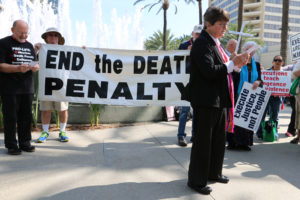
Sister Helen Prejean, a Sister of St. Joseph of Medaille, speaks Feb. 27 during a demonstration against the death penalty held outside the Los Angeles Religious Education Congress in Anaheim, Calif. (CNS photo/J.D. Long-Garcia, The Tidings)
Sr. Helen Prejean, a Sister of St. Joseph of Medaille, speaks Feb. 27 during a demonstration against the death penalty held outside the Los Angeles Religious Education Congress in Anaheim, Calif. (CNS photo/J.D. Long-Garcia, The Tidings)

“And I want to tell you, Jesus is sneaky,” she said in a Louisiana Cajun voice with a no-nonsense tone. But she still broke up the overflow crowd in the Anaheim Convention Center’s arena. “Jesus is sneaky,” she declared. “Jesus is sneaky. Put it on a T-shirt. Stick in the Bible. Watch out. Sneaky Jesus!”

The Sister of St. Joseph of Medaille said she’d been a comfortable suburban junior-high teacher when her community took a close look at its own mission in 1981. And the decision was to return to its French roots of ministering to society’s down-and-out. So she somewhat reluctantly moved into a housing project in New Orleans. “And my African-American neighbors began to teach me about the ‘other’ America,” she recalled. “And their stories broke my heart.”

Sticking with the new social justice line, the 40-something Sr. Helen naively agreed to become the pen pal of a killer on Louisiana’s infamous death row. And when he asked her to visit, she did. Soon she became his prison-registered “spiritual adviser.” She also started learning about how capital punishment was mostly applied to poor black men who had killed whites in Louisiana.

The religious sister witnessed the April 5, 1984, electric-chair execution her pen pal, who was white. “And watching his death, it changed my life,” she confided in a quieter voice. “He had done an unspeakable terrible crime. And that’s part of the spiritual journey, too. That’s the reason why he made me struggle. Others would say, ‘Look at what they did?'”

Patrick Sonnier, 27, and his younger brother Eddie, 20, were found guilty of the rape and murder of Loretta Ann Bourque, 18, and the murder of David LeBlanc, 17, at a lover’s lane Nov. 4, 1977, in St. Martin Parish, a Louisiana civil jurisdiction much like a county. Patrick got the death penalty and his brother was sentenced to life in prison; Eddie fell ill and died in prison Dec. 19, 2013, at age 57.

After Patrick’s execution, a prison vehicle brought Sister Helen back to the gate where sisters from her religious community were waiting. “I was so cold, they put a coat around me,” she said. “And I threw up. I’d never watched a human being get killed in front of my eyes. I don’t know what I’m gonna do about all this. I just know I’m throwing up in the middle of the night, and they just killed a man.”

But then she knew as clear as a bell. Most folks were never going to get close to a real execution. She had just witnessed one. So she had to tell the story. At first it was to any group that would listen. With a straight face, she talked about a nursing home where three brave seniors had shown up for her talk. But 10 minutes into her spiel, two were gone. Again the arena erupted in loud laughs.
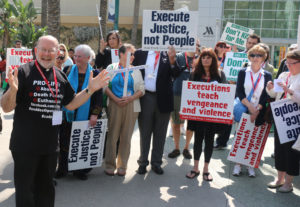
An unidentified priest leads a demonstration against the death penalty Feb. 27 as part of the Los Angeles Religious Education Congress in Anaheim, Calif. (CNS photo/J.D. Long-Garcia, The Tidings)

Next Sr. Helen started writing about the post-midnight execution. Months later she had what she thought was a book, which an editor at Random House went about reshaping. Published in 1993, actress Susan Sarandon read The New York Times best-seller and really wanted to play her in a movie.

Working closely with Sarandon’s husband, actor and director Tim Robbins, the script went through five drafts. The result was the popular film “Dead Man Walking,” nominated for four Academy Award categories, including best picture. And Sarandon took home best actress.

Sr. Helen said the best part of doing the book and movie was meeting with both St. John Paul II and Pope Francis. She got their support against the death penalty as a crucial pro-life issue along with abortion and euthanasia.

“And we as Catholics now, we need to show our opposition to the death penalty,” urged Sr. Helen. “And we’re gonna lead and help California in this initiative campaign that will be on the ballot Nov. 1. But we need a whole lot of signatures. So sign that petition today and get others to act.

“Annunciations are frequent,” she added. “Inclinations are rare. God’s seed will come soon enough, and we will act on what we know to be right.”

By R.W. Dellinger, Catholic News Service. Dellinger is a staff writer at The Tidings, newspaper of the Archdiocese of Los Angeles.

Heavy burdens and Good Confession [VIDEO]

Burdened by past sins? Remove yourself from that heavy burden for good in the confessional.

Churches worldwide will offer 24 straight hours of confession March 4-5 during #24HoursfortheLord. If it has been awhile since your last confession, here are some resources:

Here is what Eudist Father Benoit Drapeau at St. Jerome Parish had to say about confession in a recent letter to parishioners:[quote_box_center]

I would like to share with you an experience I had one Thursday evening. Most of you know that, in response to Pope Francis’ request, Fr. Gary and I have committed ourselves to be more available for confessions during the week. Fr. Gary is in his confessional every Tuesday evening from 6 to 7. I am in my confessional every Thursday evening from 6 to 7.

One Thursday evening, this person came and, before she made her confession, she said to me the number of years she had been away from the confessional and she added that the reason she was coming to confession that evening was because of Pope Francis. I was so glad to hear that. And, thanks be to God, she is not a unique case. For the past year or two, several people have returned to the church and have come to receive God’s forgiveness.

I remember one in particular who, after I shared with him God’s forgiveness, began to cry very loud and just could not stop crying. He was so happy to hear the priest say to him, “God has forgiven all your sins.”
I often have that experience at Lewis prison in Buckeye.

Most of you know that I go three times a month to that prison. I hear the prisoners’ confessions and, then we have a Liturgy of the Word. I preached and, then, I share Holy Communion with them. In general the prisoners have a hard time accepting that God can forgive them. Society does not forgive them. At times even their family does not forgive them. But I remind them that our God is a compassionate and merciful God.

During the month of January I visited all the classrooms at St. Jerome school and, in many of the classrooms, I had them look into the Bible for all the passages where God reveals Himself to be a merciful God. I’m so impressed with them. They enjoy using the Bible and they are already very familiar with the Old and the New Testament. I hope that they will always remember that, yes, our God is a God of mercy, a God who loves them no matter what.

I sure hope that many among you who, for whatever reason, may have stayed away from the confessional for a long time will hear Pope Francis’ invitation and allow our merciful God to share His forgiveness with you.

[/quote_box_center]

Priest’s Lenten meal sizzles [VIDEO]

Celebrity chef Fr. Leo Patalinghug demonstrates how to cook a Lenten seafood pasta meal.

Related article: Priest’s mission starts with getting people to the dinner table.

[quote_box_center]

Recipe

Brown butter, smoked paprika tossed with tomatoes and shrimp over pasta

Ingredients:

Spaghetti

Fresh parsley, finely minced

2 tablespoons butter

1-2 teaspoons smoked paprika

1 clove garlic, finely minced (1/2 teaspoon)

Handful of cherry tomatoes, cut in half

Shrimp (3-4 per person)

Salt and pepper to taste

Directions:

Cook pasta according to instructions and reserve 1/4 cup of starchy water. Put aside.

Melt butter until at smoking point. Add garlic and saute. Add smoked paprika and cook, then add tomatoes, some chopped parsley and shrimp, and cook a few more minutes. Add the pasta and mix all together. Add salt and pepper to taste and add water if necessary. Sprinkle with rest of parsley. Serves four.

[/quote_box_center]

A heart that can’t forgive stays shut to God’s mercy, pardon, pope says

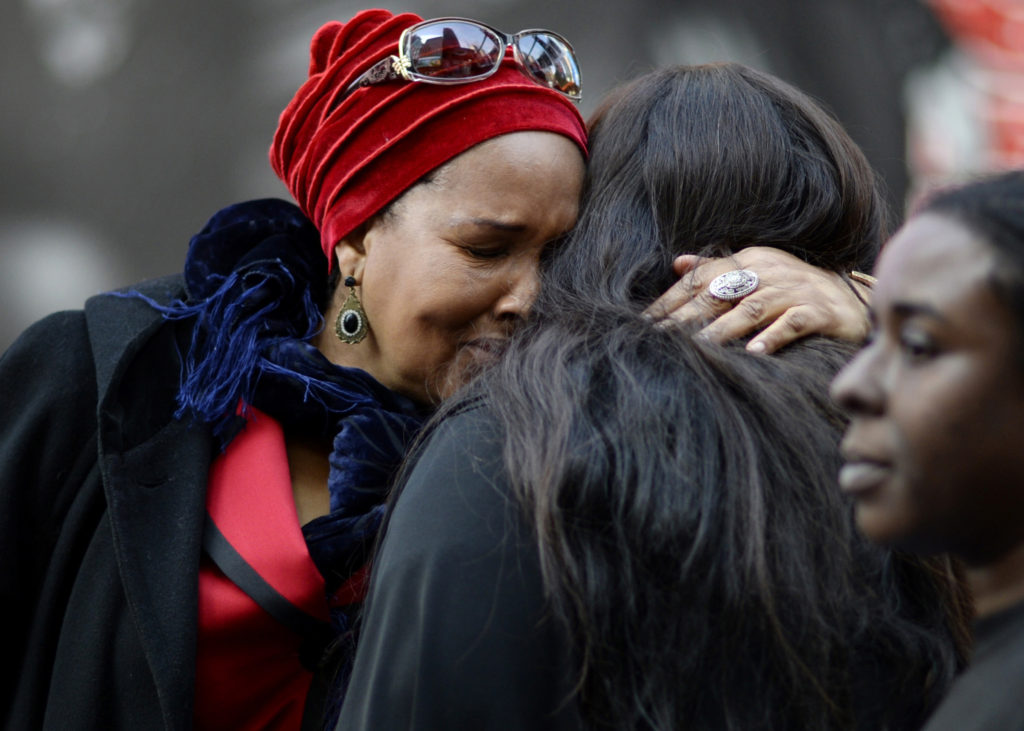
In this Oct. 22, 2015, file photo, mothers who lost their sons to police shootings hug one another during an event in New York City where names of people who died from police violence were read aloud in Times Square. (CNS photo/Justin Lane, EPA)

VATICAN CITY (CNS) — We must always forgive others who have wronged us because that is how our hearts are opened to receive God’s grace, pardon and healing, Pope Francis said at his morning Mass.

“If you aren’t able to forgive, how will God be able to forgive you? He wants to forgive, but he won’t be able to if you have a closed heart and his mercy can’t get in,” he said.

During Mass March 1 in the chapel of the Domus Sanctae Marthae, the pope reflected on Jesus telling Peter he should always forgive and using a parable about a king forgiving his servants’ debts. The Gospel reading (Mt. 18:21-35) showed how the king showed mercy to his servants and he expected his servants to be merciful and forgiving in kind to each other.

“In the Our Father, we pray, ‘Forgive us our trespasses as we forgive those who trespass against us.’ It’s an equation — they go together,” the pope said in his homily, according to Vatican Radio.

People might say, “But Father, I forgive, but I cannot forget that horrible thing done to me,” the pope said, highlighting the difficulty of letting go of the past and the need to ask for the Lord’s help.

Forgiveness is not pardoning with a caveat of “You will pay for this,” too. “No. Forgive like God forgives, forgive to the full,” he said.

When God forgives, the pope said, his pardon is so great “it’s as if he ‘forgets.’ The complete opposite of what we do with our gossip, ‘Well, this person did that and that and that.'”

“We don’t forget. Why? Because we don’t have a merciful heart,” he said.

The pope prayed that Lent would help prepare people to receive God’s forgiveness and then to do the same with others — to forgive “from your heart.”

“By forgiving, we open our heart so that God’s mercy comes in and he pardons us. Because all of us have to ask for forgiveness, all of us,” he said. “Let us forgive and we will be forgiven. We show mercy to others and we will feel that mercy of God who when he forgives, forgets.”

By Carol Glatz, Catholic News Service.

Año de Misericordia, la Cuaresma invita a los fieles a sacramento de Penitencia

En este foto archico, el P. John Parks ofrece absolución a una penitente. (Catholic Sin file photo)
Artículo en inglés * Article in English

Una invitación del Santo Padre llama a los católicos a través del mundo a descubrir la misericordia de Dios y a ofrecer el perdón a los demás.

El Jubileo Extraordinario de la Misericordia proclamado por el Papa Francisco es una oportunidad para reflexionar sobre la misericordia de Dios para toda la humanidad.

“Nuestro Santo Padre nos llamó a un Año de la Misericordia, un año de extender la mano y amar a alguien, sabiendo lo que ha hecho o lo que no ha hecho y amarle a pesar de todo”, dijo la Hna. Colleen Braun, CSA, directora de formación de fe en la Parroquia de San Benedicto en Ahwtaukee.

24 horas para el Señor

4-5 de marzo

Una parroquia en cada decanato será la sede de 24 horas de Adoración y confesiones. Informes: ohmercy.org

Primer viernes Noches de la Misericordia

6-9 p.m.

La diócesis está patrocinando eventos en una parroquia de un decanato diferente cada primer viernes para una noche de Adoración, confesión, veneración y una breve reflexión.

4 de marzo — San Juana Bautista, 5407 W. Pecos Rd., Laveen. Informes.

1 de abril — Inmaculada Concepción, 700 N. Bill Gray Rd., Cottonwood

6 de mayo— Santa Juan de Arco, 3801 E. Greenway Rd.

3 de junio — Cristo Rey, 1551 E. Dana Ave., Mesa

12 de agosto — Santo Tomás de Aquino, 13720 W. Thomas Rd., Avondale

7 de octubre — Cuerpo de Cristo, 3550 E. Knox Rd.

“Cuando estoy consciente de que necesito la misericordia de Dios, creo que puedo ser más misericordiosa con los demás”, dijo.

La Iglesia ofrece el sacramento de la Reconciliación como medio de íntimamente experimentar la misericordia de Dios y recibir la gracia.

Este sacramento sanador tiene tres partes: los penitentes confiesan sus pecados a un sacerdote que representa a Cristo; ellos se reconcilian con Dios y sus hermanos y hermanas a través de las palabras sanadoras de la absolución; y el sacerdote le asigna una penitencia en nombre de Dios para ayudar al penitente a crecer en la santidad.

“Cuando llegamos a entender que cualquier tiempo en que hacemos algo que daña nuestra relación con Dios — hablando de alguien, no actuando de una manera caritativa — es un pecado y necesitamos la reconciliación”, dijo la Hna. Colleen, agregando: “Todos nuestros pecados afectan a otras personas”.

La referencia bíblica está documentada en las Sagradas Escrituras. Juan escribe cómo Jesús capacita a sus discípulos a perdonar los pecados de los demás en Su nombre.

“Sopló sobre ellos y les dijo: ‘Recibid el Espíritu Santo. A quienes perdonéis los pecados, les quedan perdonados; a quienes se los retengáis, les quedan retenidos’” (Jn 20-21-23).

Otras historias revelan la misericordia de Dios a través de las palabras de Jesús en las parábolas como el hijo pródigo, el buen samaritano y las ovejas perdidas.

Una vez que recibimos el sacramento de la Reconciliación, el pecado ya no es un obstáculo”, dijo el P. Zygmunt Mazanowski, vicario parroquial de las Parroquias de San Juan Bautista en Laveen y San Pedro en Bapchule y sus respectivas misiones en las reservas indias. “El objetivo de Jesús es ayudarnos tener una relación más profunda con Él. El sacramento ayuda a facilitar eso porque el pecado es lo que nos impide esa relación”.

Confesar el pecado es esencial para el proceso de la reconciliación. El penitente debe realmente lamentar su pecado y tratar de reparar el daño que el pecado ha causado.

“Encontramos a Dios Padre cuando nos arrepentimos. Sus brazos están siempre abiertos; quiere recibirnos, perdonarnos, y amarnos”’ dijo el P. Mazanowski”, y la reconciliación permite que esto suceda”.

Renuencia a ir al confesionario es a menudo debido a sentimientos de vergüenza, culpa o indignidad.

“La misericordia de Dios es mayor que tu pecado”, dijo el P. Don Kline, párroco de Santa Juana de Arco. “El pecado hiere a la gente físicamente, emocionalmente, espiritualmente y psicológicamente. Las personas sufren de una tremenda culpa y no tienen que sentir esa vergüenza. La confesión es una oportunidad de escuchar esas palabras de perdón de Cristo”.

El sacramento de la Reconciliación está estrechamente relacionado con la Cuaresma, donde los católicos están llamados a esforzarse más y acercarse a Dios.

El Papa Francisco ha designado a nivel mundial las “24 horas para el Señor” para Adoración y Confesión el 4 y 5 de marzo, el viernes y el sábado antes de la cuarta semana de la Cuaresma. Una parroquia en cada decanato de la Diócesis de Phoenix será la sede de “24 horas para el Señor”.

La diócesis también está organizando las “Noches de la Misericordia” el primer viernes de varios meses con los Frailes Franciscanos. Cambiando a una parroquia diferente cada mes, es una noche de veneración, adoración del Santísimo Sacramento, una reflexión y confesión.

El Año de la Misericordia no se limita a la Cuaresma sino que llama a los católicos a contemplar el misterio de la misericordia cada día.

Santo Tomás de Aquino define la misericordia como tener compasión por alguien que está sufriendo, o tener compasión para alguien que es miserable.

“Mostrando misericordia en esta forma es un acto de amor, y Santo Tomás dice que es el mayor acto de misericordia que uno puede mostrar a otra persona”, dijo el P. Mazanowski.

La Iglesia se compromete a obras de misericordia, que son acciones caritativas que ayudan a las necesidades espirituales o corporales del prójimo.

Como las manos y los pies de Cristo, los fieles pueden llegar a una comprensión más profunda del amor y la misericordia de Dios para ellos mismos y otros.

No es una lista de cosas que hacer, sino simplemente una manera de ser”, dijo el P. Thomas Hallsten, párroco de la Parroquia Espíritu Santo en Tempe. “Nuestra alma anhela a Dios … y tenemos un deseo innato de conocer a Dios”.

Year of Mercy invites faithful to sacrament of Reconciliation

En este foto archico, el P. John Parks ofrece absolución a una penitente. (Catholic Sin file photo)
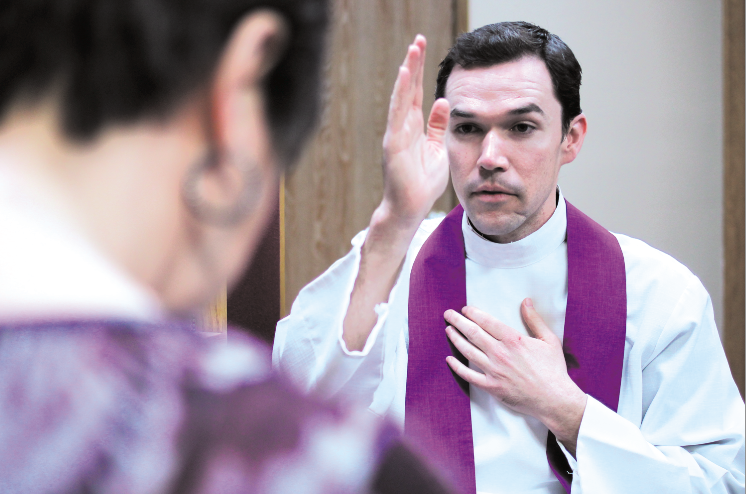
Fr. John Parks demonstrates conferring absolution during the sacrament of Confession with Bobi Martinez at St. Timothy Parish in Mesa. (Catholic Sin file photo)

[quote_box_center]

Article in Spanish   *   Artículo en español

[/quote_box_center]

An invitation by the Holy Father invites Catholics around the globe to discover God’s mercy and extend forgiveness to others.

The Extraordinary Jubilee of Mercy proclaimed by Pope Francis is an opportunity to reflect on God’s mercy for all humanity.

“Our Holy Father called us to a Year of Mercy, a year of reaching out and loving someone — knowing what they’ve done, or haven’t done — and loving them through it,” said Sr. Colleen Braun, CSA, director of faith formation at St. Benedict Parish in Ahwtaukee.

[quote_box_right]

24 Hours for the Lord

What: One parish in each deanery will host 24 hours of Adoration and Confessions

When: March 4-5

East Deanery

  • St. Anne Parish
    440 E. Elliot Rd., Gilbert
    5 p.m., March 4 – 5 a.m., March 5

North Deanery

Central Deanery

Southwest Deanery

  • Our Lady of Guadalupe Chapel, Phoenix
    5 p.m., March 4 – 5 p.m., March 5

Northeast Deanery

South Deanery

Info: ohmercy.org

Examination of conscience (broken by age range and state of life)

First Friday Mercy Nights 6-9 p.m.

The diocese is hosting evenings of Adoration, Confession, worship and a brief reflection.

March 4 — St. John the Baptist, 5407 W. Pecos Road, Laveen. Info.

April 1 — Immaculate Conception, 700 N. Bill Gray Road, Cottonwood

May 6 — St. Joan of Arc, 3801 E. Greenway Road, Phoenix

June 3 — Christ the King, 1551 E. Dana Ave., Mesa

Aug. 12 — St. Thomas Aquinas, 13720 W. Thomas Road, Avondale

Oct. 7 — Corpus Christi, 3550 E. Knox Road, Phoenix

[/quote_box_right]

“When I am aware that I need God’s mercy, I believe I can be more merciful to others,” she said.

The Church offers the sacrament of Reconciliation as a means of intimately experiencing God’s mercy and receiving grace.

This healing sacrament is three-fold: penitents confess their sins to a priest who represents Christ; they are reconciled to God and their brothers and sisters through the healing words of absolution; and the priest assigns a penance on God’s behalf to help the penitent grow in holiness.

“When we come to understand any time we do something that strains our relationship with God — talking about someone, not being charitable — that’s a sin and we need reconciliation,” Sr. Colleen said, adding, “All our sins affect other people.”

The biblical reference is documented in Sacred Scripture. John writes how Jesus empowers His disciples to forgive the sins of others in His name.

“… He breathed on them and said to them, ‘Receive the Holy Spirit. If you forgive the sins of any, they are forgiven them; if you retain the sins of any, they are retained’” (Jn 20:21-23).

Other stories reveal God’s mercy through the words of Jesus in parables such as the Prodigal Son, the Good Samaritan and the Lost Sheep.

“Once we receive the sacrament of Reconciliation, sin is not in the way anymore,” said Fr. Zygmunt Mazanowski, parochial vicar of St. John the Baptist Parish in Laveen and St. Peter Parish in Bapchule and their respective missions on the Native American reservations. “Jesus’ ultimate goal is to help us be in deeper relationship with Him. The sacrament helps facilitate that because sin is the number one thing that keeps us from that relationship.”

Confessing sin is central to the reconciliation process. The penitent must be truly sorry and attempt to repair the damage sin has done.

“We encounter God the Father when we repent. His arms are always open; wanting to receive us, wanting to forgive us, wanting to love us,” Fr. Mazanowski said, “and reconciliation allows that to happen.”

Reluctance to go to the confessional is often due to feelings of embarrassment, shame, guilt or unworthiness.

“God’s mercy is greater than your sin,” said Fr. Don Kline, pastor of St. Joan of Arc Parish. “Sin hurts people physically, emotionally, spiritually and psychologically. People suffer from tremendous guilt and they don’t have to feel that shame. Confession is an opportunity to hear those words of forgiveness from Christ.”

The sacrament of Reconciliation is closely associated with Lent, where Catholics are called to try harder and come closer to God.

Pope Francis has designated a worldwide “24 Hours for the Lord” of Adoration and Confession on March 4-5, the Friday and Saturday preceding the fourth week of Lent. One parish in each deanery of the Diocese of Phoenix will host “24 hours for the Lord.”

The diocese is also hosting First Friday Mercy Nights with the Franciscan Friars. Moving to a different parish each month, it’s a night of worship, Adoration of the Blessed Sacrament, a reflection and Confession.

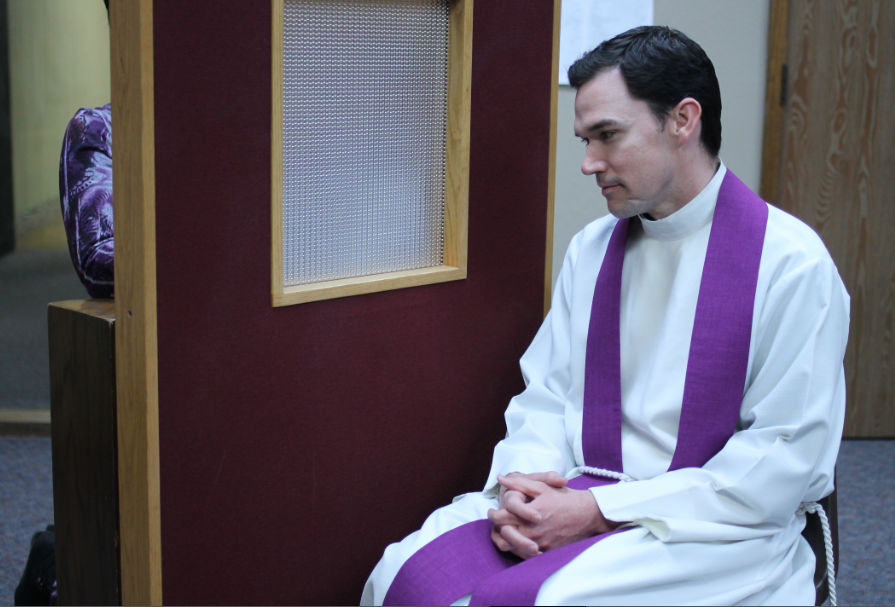
(Catholic Sun file photo)

The Year of Mercy isn’t limited to Lent, but instead calls Catholics to contemplate the mystery of mercy each day. St. Thomas Aquinas defines mercy as having compassion for someone who is suffering, or having pity for someone who is miserable.

“Showing mercy in this way is an act of love, and St. Thomas says, it’s the greatest act of mercy you can show another person,” Fr. Mazanowski said.

The Church commits to works of mercy, which are charitable actions that aid our neighbor’s spiritual or bodily needs.

As the hands and feet of Christ, the faithful can come to a deeper understanding of God’s love and mercy for themselves and others.

“It’s not a list of things to do, but simply a way to be,” said Fr. Thomas Hallsten, pastor of Holy Spirit Parish in Tempe. “Our soul longs for God … and we have an innate desire to know God.”

Student’s tie design takes flight with Southwest Airlines

Emily Thu Nguyen, a sixth-grader at Ss. Simon and Jude, poses with Southwest Airlines pilots including Erick D, who teaches the Adopt-A-Pilot curriculum to fifth-graders each year. (Ambria Hammel/CATHOLIC SUN)

The odds of winning were sky high. Staff whittled some 5,100 entries to 20 or so. Final ballots listed only five.

One thing was for sure: the contest would end with a tie. That’s an important distinction from ending in a tie like a soccer match.

Southwest Airlines sponsors an annual tie design contest open to fifth-graders in its Adopt-A-Pilot program. A likeness of the winning design becomes a real necktie that all 900 pilots involved with the program wear throughout the following year.

A Ss. Simon and Jude student defied the odds. Several Southwest Airlines staff members from its Dallas headquarters flew to Phoenix Feb. 24 and joined the school’s own resident Southwest Adopt-A-Pilot for the surprise announcement.

Emily Thu Nguyen, a sixth-grader at Ss. Simon and Jude, poses with Southwest Airlines pilots including Erick D, who teaches the Adopt-A-Pilot curriculum to fifth-graders each year. (Ambria Hammel/CATHOLIC SUN)
Emily Thu Nguyen, a sixth-grader at Ss. Simon and Jude, poses with Southwest Airlines pilots including Erick Dieckman, who teaches the Adopt-A-Pilot curriculum to fifth-graders each year. (Ambria Hammel/CATHOLIC SUN)

Emily Thu Nguyen won the nationwide contest. Now a sixth-grader, Nguyen showed the entire student body the framed memento of her achievement during the awards assembly. It showcased her original colored pencil design next to the physical tie that features slight modifications — namely the addition of the U.S. flag.

(Ambria Hammel/CATHOLIC SUN)
Emily Bguyen’s original artwork (Ambria Hammel/CATHOLIC SUN)

“I just wanted to incorporate anything that stood with Southwest,” Nguyen told The Catholic Sun. She paid special attention to company colors, the pattern on its planes and the logo. She estimated her design, which featured an in-flight plane sandwiched between buildings and the sun, took an hour to create.

The airline’s pilots who volunteer their time at schools voted on the final winner. That included Eric Dieckman, a Ss. Simon and Jude parent who is in his fifth year both as a Southwest pilot and an Adopt-A-Pilot teacher. He knew there was something special about Nguyen’s design the day she turned it in, but there was no guarantee of how far it would go.

Nguyen’s name and school now grace the back of the tie worn by some 900 Southwest Airlines pilots nationwide. They’ve only been wearing it two weeks, but comments from passengers, flight attendants and passersby are already stacking up.

“I was down in Mexico of all places and they were like, ‘I like your tie,’” Dieckman recalled.

The neckwear is among a handful of themed ties the airline allows its pilots to wear.

“It’s even cooler to tell them it was one of my kids at school,” he said.

Nugyen’s achievement also means she and her family get three tickets on Southwest Airlines. Nguyen said when her family travels, it’s often by car to California, but being able to fly there will make it quicker.

The tie design contest isn’t the first art contest in which Nguyen fared well. Her design for Ss. Simon and Jude’s Accelerated Reader effort was selected as the winner last school year.

The next Adopt-A-Pilot course kicks off at Ss. Simon and Jude after Easter break. The four-week curriculum looks at the science of flying and blends in other core subjects. Students also research careers and develop various life skills.

“It’s set up for core values. It’s teaching them to follow your dreams,” Dieckman said.

The first class begins with informal speeches about their dream career and flight path to get there. Dieckman concludes each year with a field trip to the airport to see the various careers in action.

Flint crisis underlines need to reach out to urban centers, says priest

Vicky Schultz, president and CEO of Catholic Charities of Shiawassee and Genessee counties in Flint, Mich., displays some of the bottled water Jan. 19 that has been donated to help Flint residents whose water has been contaminated with lead. Michigan Gov. Rick Snyder said he has failed Flint residents but pledged to take new steps to fix the city's drinking water crisis, starting with committing millions in state funding. (CNS photo/Jim West)
Flint resident Jerry Adkisson and his two children carry bottled water from a fire station in Michigan Feb. 7. (CNS photo/Rebecca Cook, Reuters)
Flint resident Jerry Adkisson and children carry bottled water from a fire station in Michigan Feb. 7. (CNS photo/Rebecca Cook, Reuters)

PARMA, Ohio (CNS) — The ongoing water crisis in Flint, Michigan, is a reminder for Catholics in suburban parishes of their responsibility to reach out to people in need in urban centers, said Fr. David A. Hannes.

Fr. Hannes is the pastor of St. Michael Byzantine Catholic Parish in Flushing, Michigan, located about 11 miles northwest of Flint, where the tap water is still undrinkable.

The parish, which is in the Byzantine Catholic Eparchy of Parma, has strong links to Flint. It was founded there in the early 20th century; its first church was built in the city center in 1917, at the corner of North Street and Addison Street.

The parish moved twice since then: first to Flint’s north side in 1954, in response to a growing number of parishioners; then to its current location in 1984, following the movement of parishioners out of the city and into the suburbs.

Keeping their connection with Flint, however, parishioners return to the city monthly to volunteer at the North End Soup Kitchen, about six blocks from the site of their first church, where they prepare and serve a meal.

So when Gov. Rick Snyder declared a state of emergency in Flint Jan. 5, after studies had found contaminants in Flint’s drinking water, including high amounts of lead leaching into the water from the city’s dated water pipes, St. Michael’s parishioners wasted no time in responding with action and prayer.

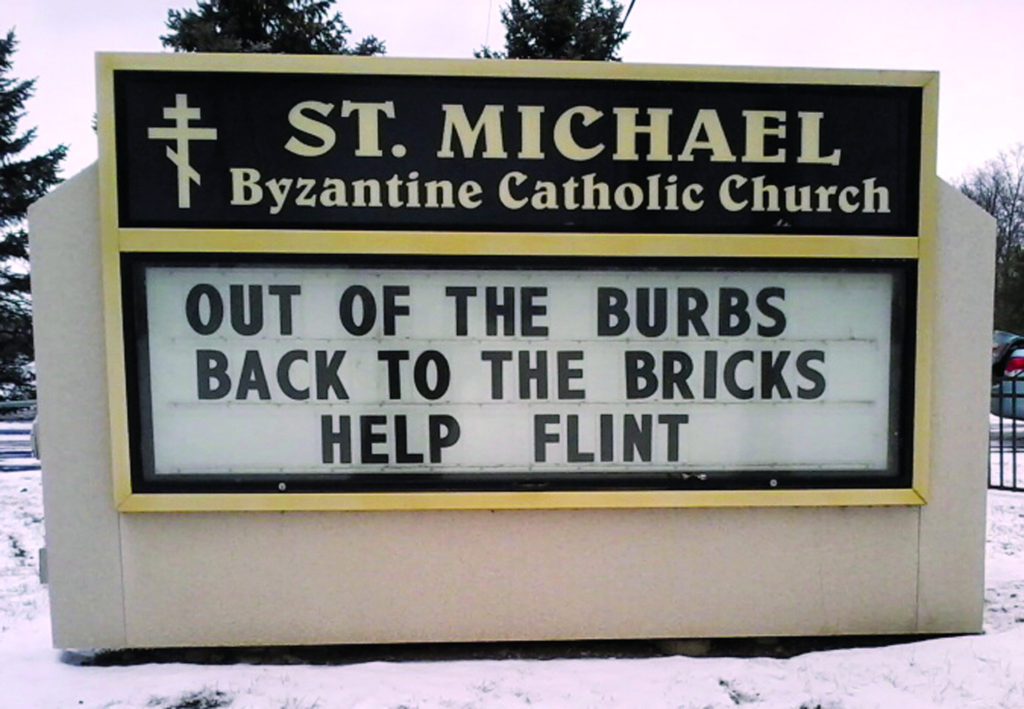
The marquee in front of St. Michael Byzantine Catholic Church in Flushing, Mich., reminds passers-by of the needs of the people of Flint, Mich. (CNS photo/courtesy St. Michael Byzantine Catholic Parish)

The parish community gathered the following day. During the celebration for the feast of the Theophany Jan. 6, which includes the Great Blessing of Water in the Byzantine tradition, the pastor spoke about Flint’s water crisis and prayers were directed to those afflicted. Parishioners also prayed the Akathist Hymn to Mary for the same intention before all liturgies during the parish’s “All Lives Matter” weekend Jan. 22-24.

However, more noticeable to passers-by as a gesture of support for the people of Flint was the message on the church marquee: “Out of the burbs, back to the bricks. Help Flint.”

“The bricks” refer to the old streets of Flint, explained Fr. Hannes in an interview with Horizons, the newspaper of the Parma Eparchy.

“Flint residents feel quite abandoned,” he added.

And the sign is “an outward reminder perhaps, even a warning, to those who are living in the suburbs — many of whom left or perhaps, as they may say, ‘escaped Flint’ — that they have a moral responsibility to live the Gospel and not to abandon the people of Flint or anyone,” he said.

Vicky Schultz, president and CEO of Catholic Charities of Shiawassee and Genessee counties in Flint, Mich., displays some of the bottled water Jan. 19 that has been donated to help Flint residents whose water has been contaminated with lead. Michigan Gov. Rick Snyder said he has failed Flint residents but pledged to take new steps to fix the city's drinking water crisis, starting with committing millions in state funding. (CNS photo/Jim West)
Vicky Schultz, president and CEO of Catholic Charities of Shiawassee and Genessee counties in Flint, Mich., displays some of the bottled water Jan. 19 that has been donated to help Flint residents whose water has been contaminated with lead. (CNS photo/Jim West)

St. Michael’s partnered with Catholic Charities and other churches and organizations in helping Flint with immediate needs, through monetary donations, cases or gallons of water, water filtration kits, and replacement filters.

“We witness to the goodness of Christ by our response in prayer and in action to the world,” he said. “All of us seem to be pulling together.”

Catholic Charities CEO Vicky Shultz said the water crisis was a blow to a city “already dealing with poverty and huge unemployment.”

By Laura Ieraci, Catholic News Service. Ieraci is editor of Horizons, newspaper of the Byzantine Catholic Eparchy of Parma.

Bishop Olmsted establishes new leadership position at Xavier, Notre Dame Preparatories

Phoenix, Scottsdale high schools to implement president/principal model

Bishop Thomas J. Olmsted announced today the establishment of a new executive leadership structure at Xavier College Preparatory in Phoenix and Notre Dame Preparatory in Scottsdale. The two Catholic high schools are implementing a “President/Principal” model, providing for an external-facing institution builder (president) and an internal-facing champion of academics (principal).

Sr. Joan Fitzgerald, BVM, who has served as principal of Xavier College Preparatory since 1974, will take over as the school's president July 1. (CATHOLIC SUN file photo)
Sr. Joan Fitzgerald, BVM, who has served as principal of Xavier College Preparatory since 1974, will take over as the school’s president July 1. (CATHOLIC SUN file photo)

Bishop Olmsted has appointed Xavier Principal Sr. Joan Fitzgerald, BVM, as its president. James M. Gmelich, principal at Notre Dame Preparatory, has been appointed by Bishop Olmsted to serve as the Scottsdale school’s president.

Sr. Joanie Nuckols, BVM, has been appointed by Bishop Olmsted to be the new principal of Xavier. The new structure is effective July 1.

“It is with great joy that we announce this new leadership structure for Xavier College Preparatory and Notre Dame Preparatory,” Bishop Olmsted said. “The president/principal model represents a strategic enhancement of the schools’ approach to mission advancement, educational excellence and the faith formation of students as missionary disciples of Jesus.”

The dual leadership structure of president/principal is an emerging model of administration in Catholic secondary schools in recent years. It offers shared authority and a division of responsibilities between two people, allowing for efforts between the president and principal to focus on their clearly defined goals to better serve their Catholic high schools, the students and their families, and the communities where they live.

The president’s chief responsibilities include mission advancement, development and fundraising, donor and alumni relations, enrollment management, partnerships with businesses, and public relations.

The principal’s role includes leadership in developing and implementing academics, curriculum, staff and faculty development, and administration of day-to-day operations at the school.

Both share in the responsibilities of providing spiritual leadership, personnel and institutional management, and creating and maintaining a vibrant Catholic culture.

“This new dual executive leadership model at Xavier and Notre Dame is a reflection of Bishop Olmsted’s commitment to the community,” said MaryBeth Mueller, superintendent of the Diocese of Phoenix’s Catholic schools. “This new structure will allow the schools to more effectively focus on mission advancement and development, ultimately ensuring for students a culture of faith, academics and service that forms them to be missionary disciples, good citizens and people who put their faith into action.”

Since becoming principal in 1974, Sr. Joan has led Xavier to become an institution whose reputation as a community of faith has reached excellence in academics, athletics and the arts. Xavier has received many accolades, being named a Blue Ribbon School three times, selected for the Catholic High School Honor Roll twice, winning the 2008 Siemens Award for the best Advanced Placement program in Arizona and received the Blue Cup for the best athletics and activities program in Arizona. Sr. Joan received the Elizabeth Seton Award for Leadership to Diocesan Schools, the Ministry Award from the Diocese of Phoenix, and the National Catholic Education Association’s Secondary Education Award.

James Gmelich, who has served as principal of Notre Dame Preparatory since 2013, will take over as the school's president July 1. (CATHOLIC SUN file photo)
James Gmelich, who has served as principal of Notre Dame Preparatory since 2013, will take over as the school’s president July 1. (CATHOLIC SUN file photo)

Principal at Notre Dame Preparatory since 2013, Gmelich currently directs both the internal and external work of all school personnel and departments. Prior to joining the community at Notre Dame Preparatory, Gmelich served as teacher and administrator in three Catholic secondary schools as well as supporting the mission of Catholic schools as an educational consultant for Catholic secondary and pre-secondary schools.

He oversees the fiscal management of the school and ensures its stability through direct oversight of the business operations, development, alumni, community relations and enrollment management activities. He also acts as the primary liaison between the school, the Advisory School Board and the Diocese of Phoenix.

New Xavier Principal Sr. Joanie joined the Phoenix school in 1974 as a history teacher. She previously served as chair of the Department of Social Studies and Theology, and is now the vice principal of Academics and Campus Ministry. In addition to her responsibilities as vice principal, Sr. Joanie teaches AP European History. She has earned two Masters Degrees, one in Modern European History (1975) from St. Louis University and in Educational Administration (2007) from Grand Canyon University.

The national search for Notre Dame’s next principal will begin immediately. Conducted by the Diocese of Phoenix and the school’s administration, the search seeks to identify and secure a passionate and accomplished Catholic school leader to advance the school’s mission and award winning programs.

Xavier College Preparatory is a Roman Catholic High School for young women, founded in 1943 by St. Francis Parish and staffed by the Sisters of Charity of the Blessed Virgin Mary. Today the 1,200 students from diverse cultural, socioeconomic and ethnic backgrounds hail from more than 150 different middle schools from across the Phoenix metropolitan area.

Notre Dame Preparatory has been providing a rigorous Catholic college preparatory education to students in Scottsdale and the surrounding communities since 2002. Notre Dame Preparatory, with its 900 students, is located in north Scottsdale, 20 miles from downtown Phoenix.


Socially responsible investors press companies to do the right thing

Demonstrators protest medicine prices outside Pfizer headquarters in New York City in this Dec. 4, 2015, file photo. (CNS photo/Andrew Gombert, EPA)

WASHINGTON (CNS) — If it’s spring, it must be corporate annual general meeting season.

For investors concerned about corporate accountability and transparency, it’s one of the busiest times of the year.

The annual general meetings give shareholders the chance to publicly engage corporate leadership on hot-button issues such as human rights, climate change, sustainability, lobbying expenditures and human trafficking.

Faith-based investors — many of which are members of the Interfaith Center on Corporate Responsibility — have led shareholder advocacy campaigns for more than four decades. Over the years, they have leveraged their financial clout as stockholders to air grievances about corporate activities and to pursue responsible corporate action.

“There’s a unique role for faith-based investors in pushing the world’s biggest companies to acting as responsible and accountable corporate citizens,” said Josh Zinner, ICCR’s new CEO. “Primarily this is about using the role of investor to push companies not to do the right thing purely for moral reasons … but to do the right thing for shareholders as well.”

Such engagement affects small investors as well through the pension funds and mutual funds in which their contributions are invested. Capuchin Father Michael H. Crosby, executive director of the Wisconsin/Iowa/Minnesota Coalition for Responsible Investment, an ICCR member, said each investor, whether small or large, should have a say in any company in which they hold shares.

“It’s their responsibility because stocks give you ownership,” Father Crosby told Catholic News Service. “Ownership makes you responsible for the acts (of a company) like any other ownership makes you responsible under law.”

He suggested that shareholders, when they receive a proxy statement in the mail, examine it carefully and send in their vote.

Not all ICCR members are faith-based institutions. Among ICCR members sponsoring resolutions are the California State Teachers’ Retirement System, Calvert Investments and the United Steelworkers.

One ICCR member, Northwest Coalition for Responsible Investment in Seattle, has used the leverage of its 15 members to press major companies on numerous interests throughout its 22-year history.

“We feel if we own the companies, we need to be responsible shareholders, which means they’re using our money for what they’re doing,” said Dominican Sister Judy Byron, the coalition’s coordinator. “I learned in owning these companies we have a responsibility for what they’re doing and to call them to be responsible.”

The coalition is supporting one of its member institutions, the Northwest Women Religious Investment Trust, which this year has filed proxy resolutions with ExxonMobil on climate change, Phillips 66 on greenhouse gas emissions, Chevron on hydraulic fracturing and Google/Alphabet on human rights risk assessment.

Such shareholder activism comes down to integrating personal values with the investment world, the Rev. David Schilling, a senior program director at ICCR, told Catholic News Service. “What’s at stake here is the lives of human beings. Publicly traded companies are given charters by the public to work for the common good, but it doesn’t always work out that way,” he said.

ICCR is tracking 257 resolutions filed by its members with 174 companies this annual meeting season. Included are 91 resolutions addressing climate change, which were filed on the heels of the historic COP21 agreement reached in Paris in December. Overall, the number of resolutions filed by ICCR members has increased by 60 percent since 2011.

A proxy can be voted on during a company’s annual general meeting. Investors filing resolutions say success is not dictated by their proposal being adopted, but by how much it moves corporate executives to act. Under Securities and Exchange Commission rules, a proxy resolution can be reintroduced if it achieves at least 3 percent of shareholder votes the first year, 6 percent its second year and 10 percent its third year and beyond.

“One of the real significant learnings from my involvement over the years is that persistence and perseverance pays off,” said Oblate Father Seamus Finn, of the order’s Washington-based Justice, Peace and Integrity of Creation Office and ICCR chairman.

“You (first) bring up an issue and they’re likely to say, ‘We’ve never thought of that’ or might say, ‘We’re not sure how that affects our business.’ But you come back a year later, they’re going to listen. You come back a third or fourth year and you end up with changes,” Fr. Finn said.

Shareholder resolutions are part of the larger socially responsible investment strategy of Catholic Health Initiatives, an ICCR member in Englewood, Colorado. Colleen Scanlon, senior vice president for advocacy, said the nonprofit health system also directs funds to local businesses to keep the region’s economy strong.

Much of Catholic Health Initiatives’ socially responsible investment effort has involved pharmaceutical firms over the rising cost of prescription drugs and the impact on vulnerable people including the elderly. Scanlon said the health system had seen some success through meetings with pharmaceutical representatives, but has resorted to filing more shareholder resolutions to bring more attention to what it sees as a growing problem.

Elsewhere, Mary Baudouin, assistant for social ministries for the Jesuits of the Central and Southern Province based in New Orleans, told CNS that resolutions filed in recent years with the global agribusiness giant Bunge led to a series of meetings that resulted in the company altering its water-use practices to the betterment of local communities in developing countries.

That engagement with Jesuit partners resulted in company officials signing in June the CEO Water Mandate, a public-private initiative of the United Nations to assist companies in the development, implementation and disclosure of water sustainability policies and practices. The company also established a Sustainability and Corporate Responsibility Committee led by Carol Browner, former administrator of the U.S. Environmental Protection Agency.

“Our preference is to enter into dialogue with those companies,” Baudouin said. “It’s a really long process. Once we file the resolution it’s just the tip of the iceberg. It gets us in the door to have these constructive dialogues that can last a long time.”

By Dennis Sadowski, Catholic News Service.