
In crime-plagued periphery, pope preaches conversion

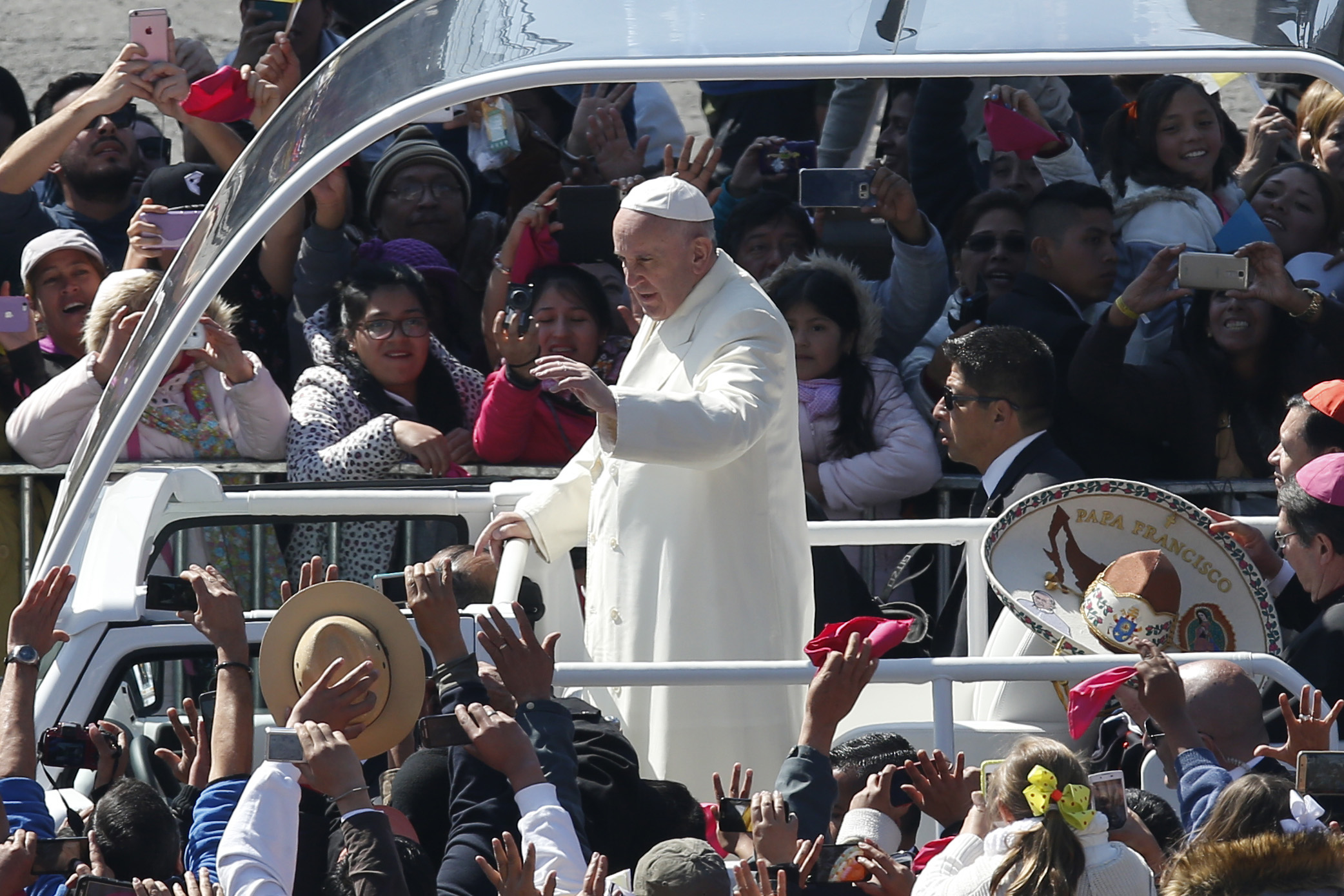
People wave the flags of Mexico and the Vatican as they wait for Pope Francis' arrival to celebrate Mass in Ecatepec near Mexico City Feb. 14. (CNS photo/Paul Haring)
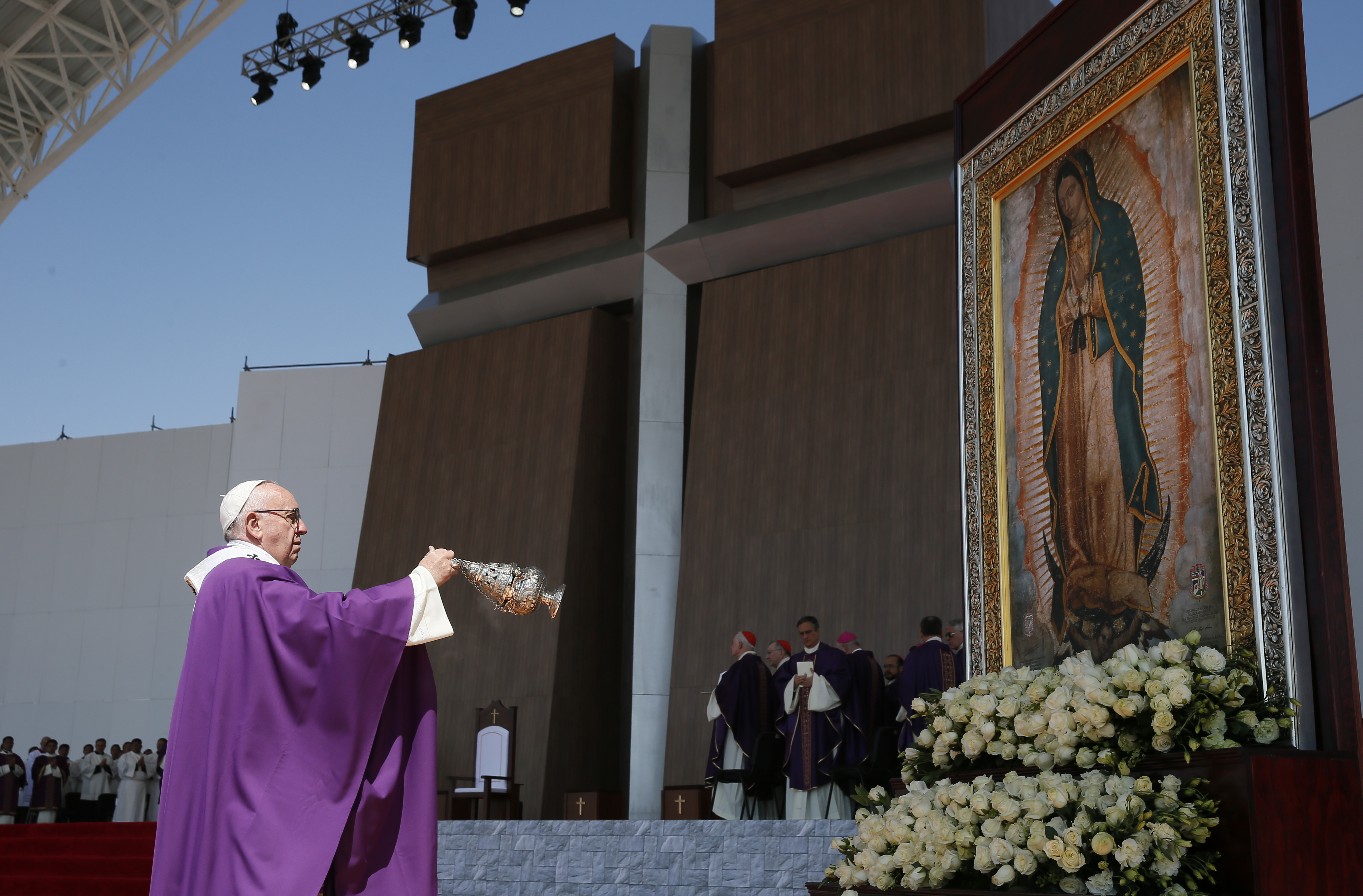
Pope Francis uses incense to venerate an image of Our Lady of Guadalupe during Mass in Ecatepec near Mexico City Feb. 14. (CNS photo/Paul Haring)

ECATEPEC, Mexico (CNS) — Pope Francis began his travels to Mexico’s “peripheries” by visiting an overcrowded, sprawling settlement known internationally as a hunting ground for girls to force into prostitution and for boys to enlist in the drug trade.

Ecatepec, on the northern edge of Mexico City, also has tidy gated communities and a new shopping mall with department stores like Sears, a big WalMart, Starbucks and dozens of other shops and restaurants.

Pope Francis celebrated Mass Feb. 14 on a vast open field with some 300,000 people. The high altar platform was decorated with Aztec designs — flowers and birds — made of flowers and petals.

More than 1.7 million people live in Ecatepec, which, Vatican Radio described as “a lawless neighborhood where organized crime, pollution and poverty reign and where most people fear to tread.” Like Ciudad Juárez in the north was a decade ago, Ecatepec has now become famous as a place where it is particularly dangerous to be a woman because of murders, kidnappings and human trafficking.

Sr. Angelica Garcia Barela, a member of the Servant Missionaries of the Word, was thrilled the pope was visiting. “He comes to show the faith and to change hearts. The pope’s faith, his enthusiasm and joy, isn’t fleeting and it’s contagious. Much can change.”
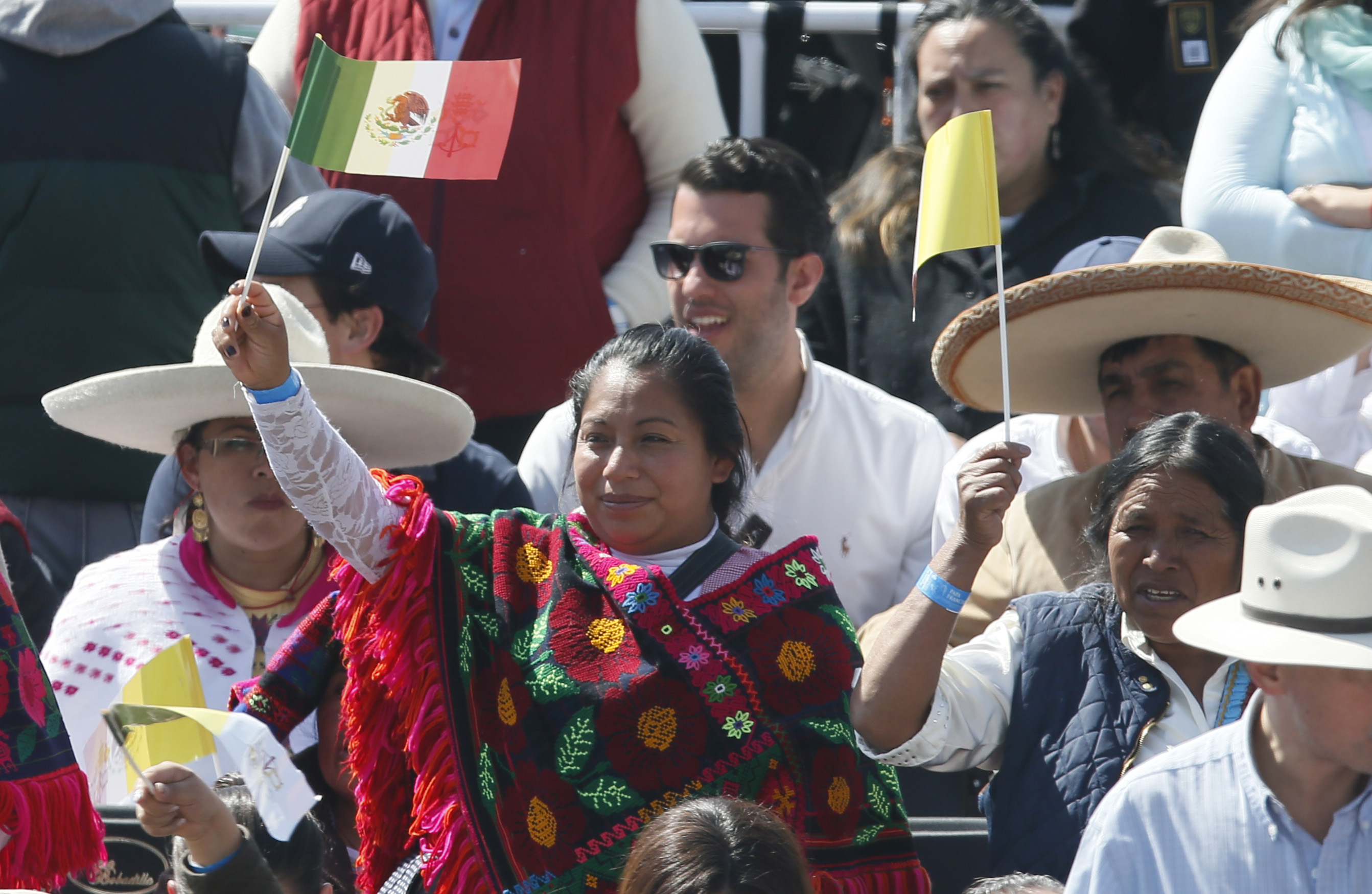
People wave the flags of Mexico and the Vatican as they wait for Pope Francis' arrival to celebrate Mass in Ecatepec near Mexico City Feb. 14. (CNS photo/Paul Haring)
People wave the flags of Mexico and the Vatican as they wait for Pope Francis’ arrival to celebrate Mass in Ecatepec near Mexico City Feb. 14. (CNS photo/Paul Haring)

With other members of her order, Sister Garcia spent the night at the Mass site so she would be in place early to watch over the pre-consecrated hosts she would help distribute during Communion to people far from the papal altar.

Her main ministry is going door-to-door sharing the Bible with families. She knows how to evangelize and said Pope Francis is the perfect example of “evangelization through presence.”

After Mass, Pope Francis recited the Angelus with the thousands gathered on the dusty field. Before leading the prayer, he recognized “how much each one of you has suffered to reach this moment, how much you have ‘walked’ to make this day a day of feasting, a time of thanksgiving.”

He urged the people to step up and work together to “make this blessed land of Mexico a land of opportunities.”

It should be a land where, he said, there is “no need to emigrate in order to dream, no need to be exploited in order to work, no need to make the despair and poverty of many the opportunism of a few, a land that will not have to mourn men and women, young people and children who are destroyed at the hands of the dealers of death.”
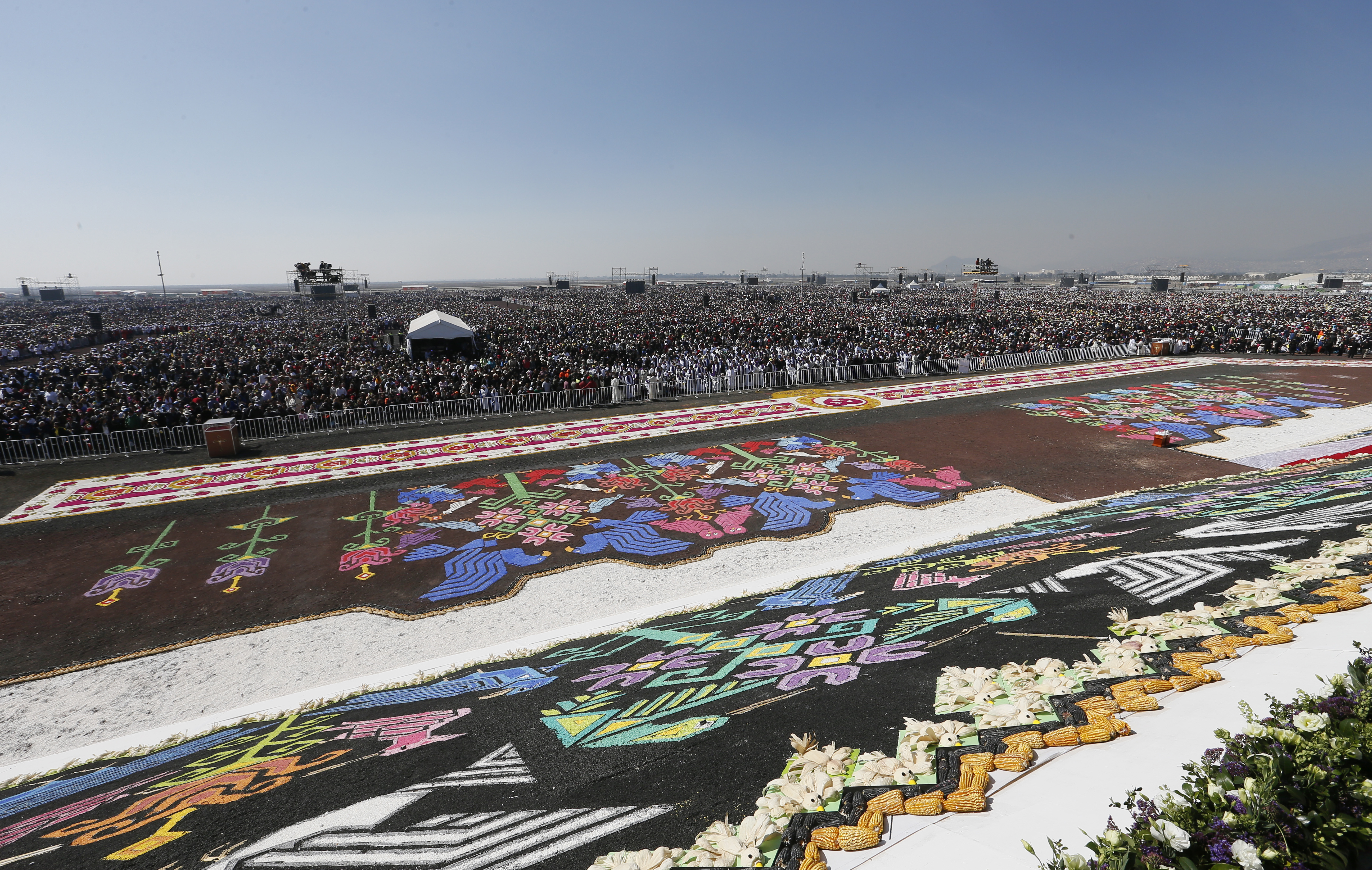
A large crowd is seen gathered for Pope Francis' celebration of Mass in Ecatepec near Mexico City Feb. 14. (CNS photo/Paul Haring)
A large crowd is seen gathered for Pope Francis’ celebration of Mass in Ecatepec near Mexico City Feb. 14. (CNS photo/Paul Haring)

In his homily, Pope Francis did not specifically mention the violence against women or the drug traffickers, but instead addressed the ways in which people give into little temptations that too easily grow into great evil.

In the Gospel story of Jesus being tempted by the devil in the desert, the pope said, “Jesus does not respond to the devil with his own words, instead he uses the words of God, the words of Scripture. Because, brothers and sisters, ingrain this in your minds: You cannot dialogue with the devil!

“You cannot dialogue with the devil because he will always win,” he insisted. “Only the power of the Word of God can defeat him.”

Lent, the pope said, is a time of conversion, which involves acknowledging each day how the devil tries to tempt and divide people. In a country known for huge inequalities in income and opportunity, Pope Francis denounced as a work of the devil the idea of “a society of the few and for the few.”

“Three great temptations” — wealth, vanity and pride — are behind such an attitude and so many other ills that destroy society and attack human dignity, he said.

The sinful use of money and material things, he said, is “seizing hold of goods destined for all and using them only for ‘my own people.’” It involves living off the sweat and labor of others, “even at the expense of their very lives,” the pope said.

Such “bread,” he said, “tastes of pain, bitterness and suffering. This is the bread that a corrupt family or society gives its own children.”

“We know what it means to be seduced by money, fame and power,” Pope Francis said. “For this reason, the Church gives us the gift of this Lenten season, invites us to conversion, offering but one certainty: he is waiting for us and wants to heal our hearts of all that tears us down. He is the God who has a name: mercy. His name is our wealth.”

At the end of Mass, Bishop Oscar Domínguez Couttolenc of Ecatepec told the pope that “like many other places, we experience poverty and violence, made flesh in the pain of those who suffer because of corruption, hunger, poverty and all the manifestations of evil that lead to the deterioration of our common home.”

In response, he said, the faithful of Ecatepec pray, reflect and work, trying to live a “spirituality of communion,” a sense of solidarity strengthened by the pope’s visit.

Before landing by helicopter in Ecatepec, Pope Francis was treated to a special aerial viewing of the nearby Teotihuacan Pyramids, believed to date from about 300 B.C.

― By Cindy Wooden, Catholic News Service. Contributing to this story was Junno Arocho Esteves in Mexico City.

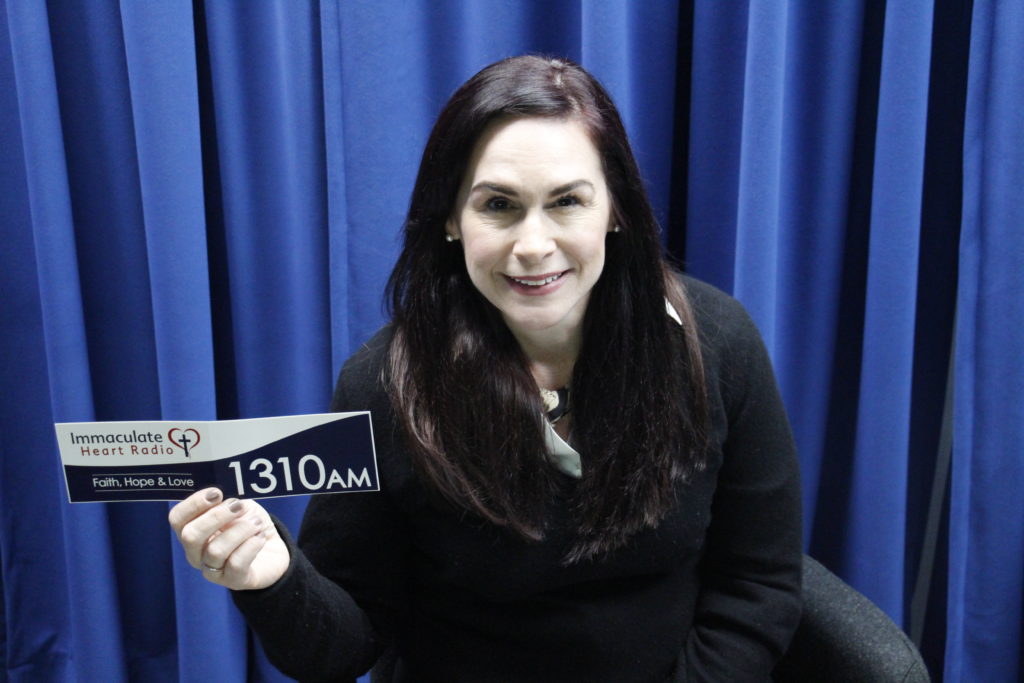
Immaculate Heart Radio’s new advocate says job is ‘all for His glory’

Christine DuPont will be promoting Immaculate Heart Radio, on air 1310AM, online and throughout parishes and business communities in the Diocese of Phoenix and into New Mexico as its new community relations officer. (Ambria Hammel/CATHOLIC SUN)

Christine DuPont has spent much of the last six years telling others about the quality programming on Immaculate Heart Radio. Now it’s her life’s work.

DuPont, a parishioner at St. Joan of Arc, is the new community relations officer for the 11 Immaculate Heart Radio stations and affiliates covering Phoenix and New Mexico. She’s been naturally spreading the word about Immaculate Heart Radio since it launched in Phoenix in 2009.

The original and syndicated programming helped her grow in her faith and she wanted others to avail themselves to the same treasure. It never really mattered if the people she encountered lived within the station’s 33 broadcasting areas in the western U.S. or not. DuPont would encourage new listeners to tune in online or via the Immaculate Heart Radio app.

That’s how she tunes in when she travels. Fortunately for her, most travel now will be within the station’s existing towers as she visits parishes and diocesan events in order to promote Immaculate Heart Radio.

“It’s a huge blessing and honor to do the work of the new evangelization and spread the practice and knowledge of our beautiful faith,” DuPont said.

She takes over for Debbie Georgianni, Phoenix’s first community relations representative. Georgianni went on to co-host a weekday talk show, “Take 2,” which launched on EWTN Radio last summer.

DuPont is a lifelong Catholic with roots in the suburbs of Boston and Philadelphia. She transplanted to Phoenix in 2000 and has held various positions in marketing/business development, account management and education.

With Immaculate Heart Radio, DuPont will help ensure the private donor base remains strong, promote local ministries and organizations that submit items to the community calendar and partner with Catholic-owned businesses eager to support the station.

“They understand what a great evangelization tool radio is,” DuPont said.

[quote_box_right]

Immaculate Heart Radio

Tune in to 1310AM or online at ihradio.com

To reach Christine DuPont, community relations officer for Phoenix, email cdupont@ihradio.com or (602) 315-3460.

Screen Shot 2016-02-13 at 3.58.46 PM

Hear an interview with Christine DuPont on the Feb. 15 episode of #TheBishopsHour at 11 a.m. on 1310 AM or online.

Tuning in to the archived episode? Cue up the 38:35 mark.

[/quote_box_right]

She has been a longtime personal supporter of the station because she wants the airwaves of 1310AM or Immaculate Heart Radio’s other stations or livestream to reach potential converts to the faith. She called her job “all for His glory.”

“To have the ability to reach millions all over the world … is something that I’m honored to be a part of,” DuPont said.

DuPont has shared her testimony as a listener over the years and is eager to hear how station programming has changed the lives of others, particularly for converts to the faith.

“You can never know everything about our beautiful Catholic faith,” DuPont said. “I’m just constantly hungry to learn more about it and share it with people who don’t know as much about it.”

Although DuPont has never been afraid to talk about the faith in her secular jobs where appropriate, she is thrilled that God answered her prayer to have a job where she could practice her faith with the people she works with. Immaculate Heart Radio staff scattered outside of its northern California headquarters can call in daily to the staff Rosary and gather monthly for retreats.

Pope makes long-awaited visit to Our Lady of Guadalupe

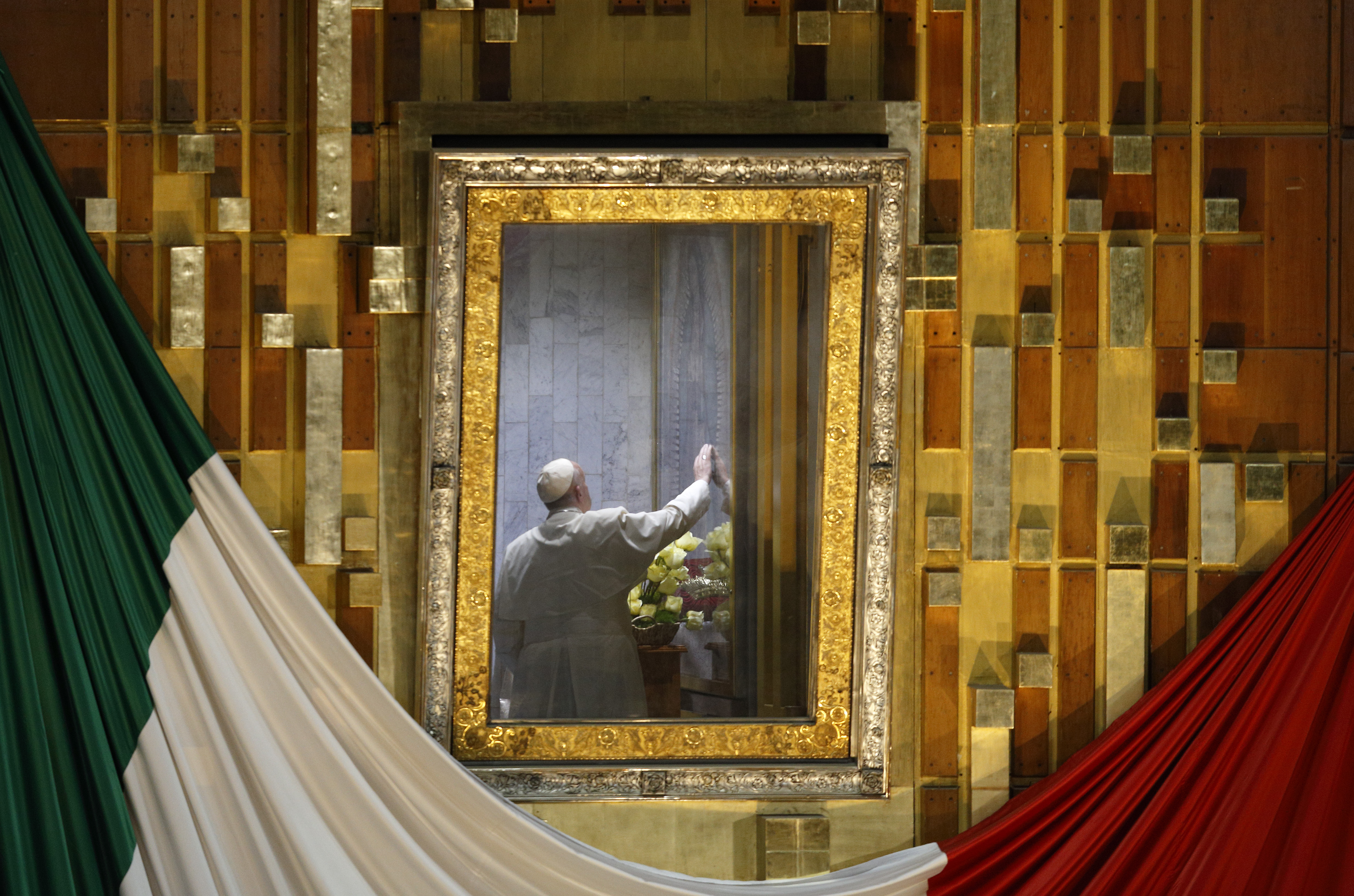
Pope Francis touches the original image of Our Lady of Guadalupe after celebrating Mass in the Basilica of Our Lady of Guadalupe in Mexico City Feb. 13. The Marian image was rotated for the pope to pray in the "camarin" ("little room") behind the main altar. (CNS photo/Paul Haring)
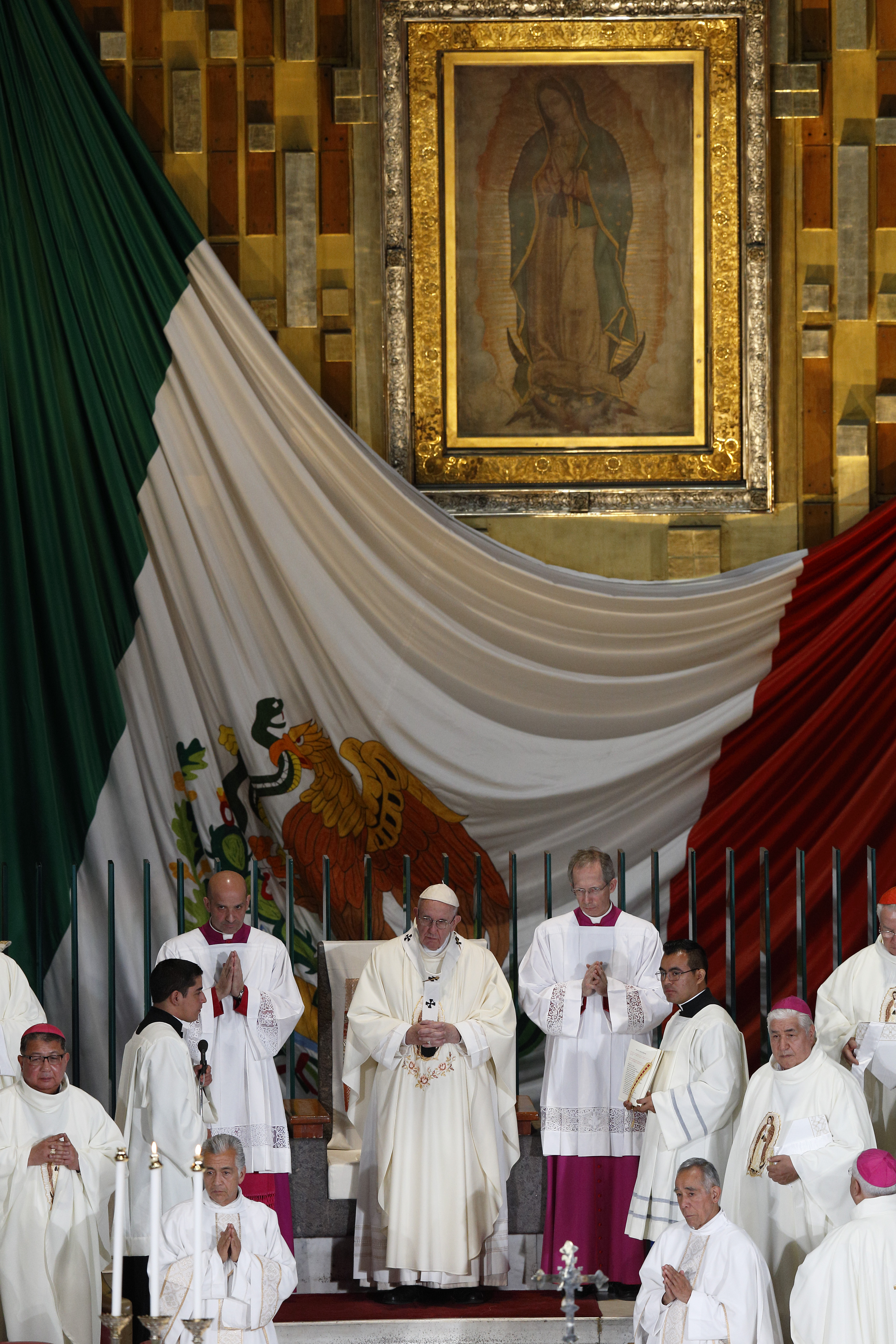
The original image of Our Lady of Guadalupe is seen as Pope Francis celebrates Mass in the Basilica of Our Lady of Guadalupe in Mexico City Feb. 13. (CNS photo/Paul Haring)

MEXICO CITY (CNS) — Pope Francis fulfilled his much-desired wish to pray in silence before the miraculous image of Our Lady of Guadalupe.

After celebrating the first Mass of his papal trip to Mexico Feb. 13, the pope made his way to the “camarin” (“little room”) behind the main altar of the basilica dedicated to Mary. The miraculous mantle, which normally faces the congregation, can be turned around to allow a closer and more private moment of veneration.

Laying a bouquet of yellow roses in front of the image, the pope sat down in prayerful silence with eyes closed and head bowed. After roughly 20 minutes, the pope stood up, laid his hand on the image and departed from the small room.

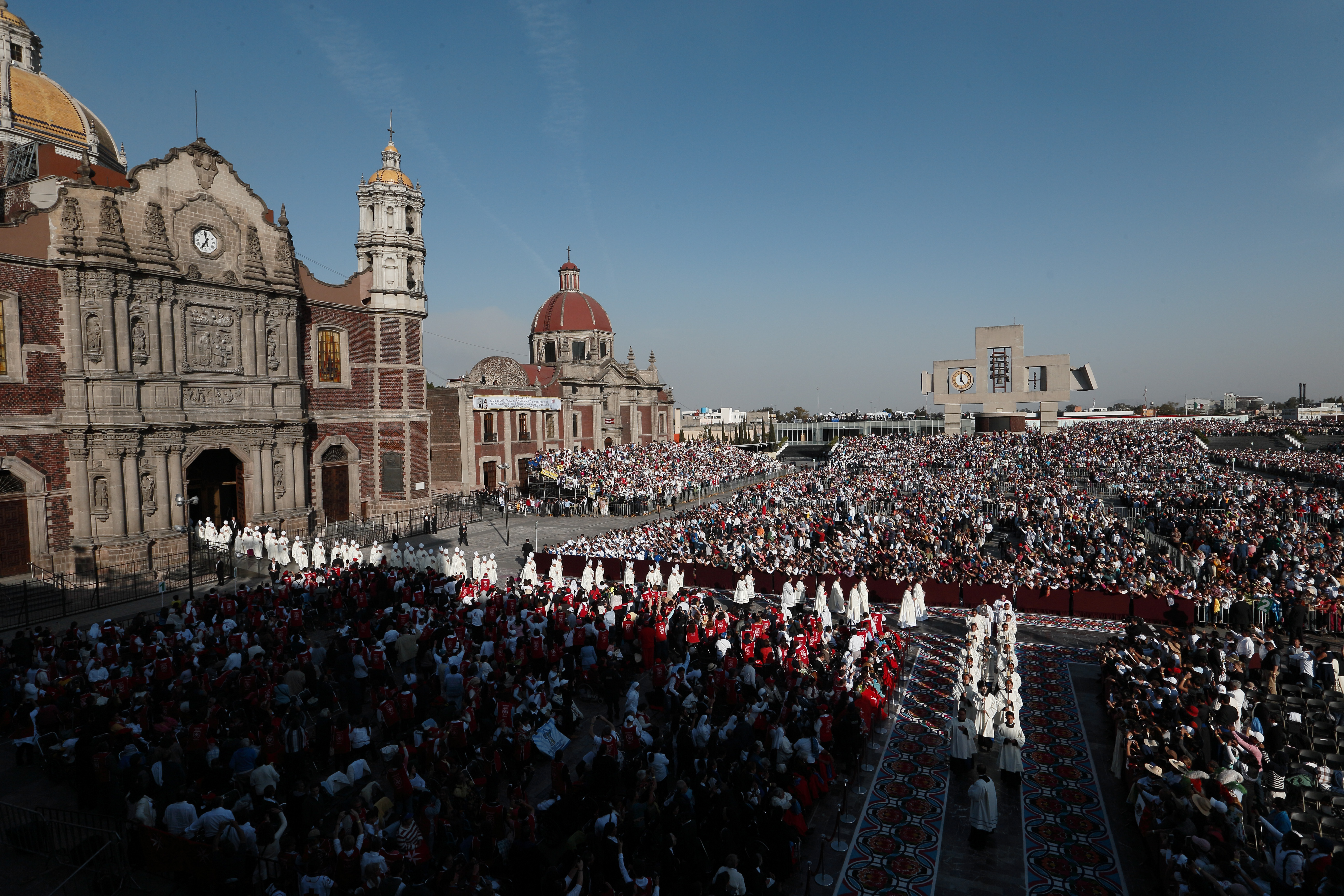
About 12,000 people packed the basilica for the papal Mass and another 30,000 were watching on screens set up in the outer courtyard. Built in 1976, the Basilica of Our Lady of Guadalupe is located near Tepeyac hill, the site of Mary’s apparitions to St. Juan Diego in 1531. With some 12 million people visiting each year, it is Catholicism’s most popular Marian shrine.

Bishops process from the historic Basilica of Our Lady of Guadalupe to the modern basilica for a Mass celebrated by Pope Francis in Mexico City Feb. 13. (CNS photo/Paul Haring)

In his homily, the pope reflected on the Gospel reading, which recalled Mary’s visit to her cousin Elizabeth. Mary’s humility in saying “yes” to God’s will, he said, is a response “which prompted her to give the best of herself, going forth to meet others.”

That very humility also led her to appear to a poor indigenous man, he said. “Just as she made herself present to little Juan, so too she continues to reveal herself to all of us, especially to those who feel — like him — ‘worthless,’” the pope said.

Recalling the miraculous appearance of Mary’s image, Pope Francis noted that through such a miracle, “Juan experienced in his own life what hope is, what the mercy of God is.”

The pope said that despite the indigenous saint’s feelings of inadequacy, Mary chose him to “oversee, care for, protect and promote the building of this shrine.”

“In this way, she managed to awaken something he did not know how to express, a veritable banner of love and justice: no one could be left out in the building of that other shrine: the shrine of life, the shrine of our communities, our societies and our cultures,” he said.

Pope Francis touches the original image of Our Lady of Guadalupe after celebrating Mass in the Basilica of Our Lady of Guadalupe in Mexico City Feb. 13. The Marian image was rotated for the pope to pray in the "camarin" ("little room") behind the main altar. (CNS photo/Paul Haring)
Pope Francis touches the original image of Our Lady of Guadalupe after celebrating Mass in the Basilica of Our Lady of Guadalupe in Mexico City Feb. 13. The Marian image was rotated for the pope to pray in the “camarin” (“little room”) behind the main altar. (CNS photo/Paul Haring)

God’s true shrine, he added, is the life of his children, especially young people without a future, the elderly who are often unacknowledged and forgotten and families lacking even the most basic necessities.

“The shrine of God is the faces of the many people we encounter each day,” the pope said.

Pope Francis said that those who suffer do not weep in vain and their sufferings are a silent prayer that rises to heaven, “always finding a place in Mary’s mantle.”

Like St. Juan Diego, Christians are called to be Mary’s ambassadors and console those who are overwhelmed by trials and sufferings, he said.

“‘Am I not your mother? Am I not here with you?’ Mary says this to us again. Go and build my shrine, help me to lift up the lives of my sons and daughters, your brothers and sisters,” the pope said.

― By Junno Arocho Esteves, Catholic News Service.

Pope Francis tells Mexican bishops be unified, speak out on tough issues

Pope Francis greets the crowd gathered in Mexico City's main square as Pope Francis arrives for a meeting with the nation's bishops in the cathedral Feb. 13. (CNS photo/Paul Haring)
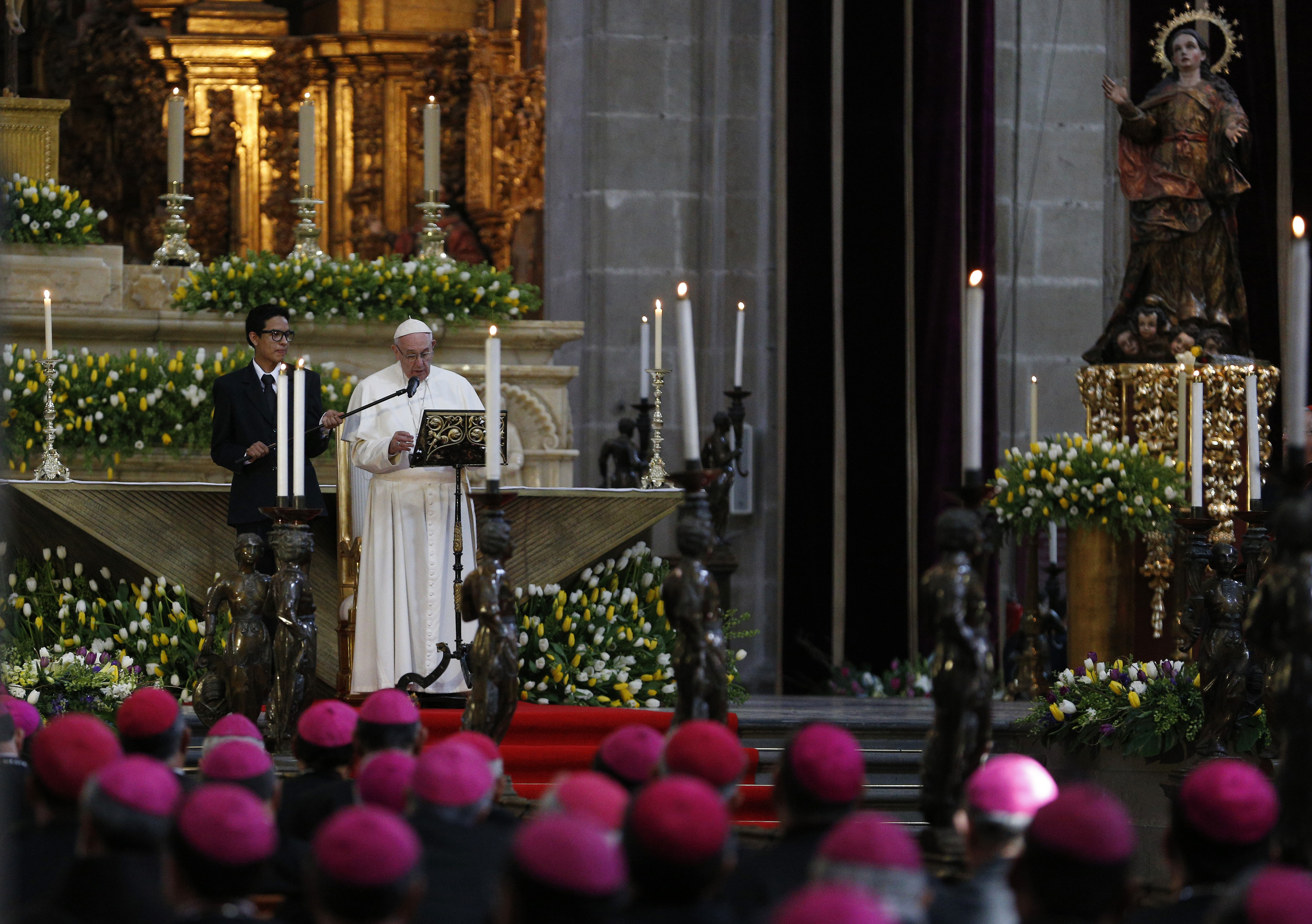
Pope Francis addresses Mexico's bishops in the cathedral in Mexico City Feb. 13. (CNS photo/Paul Haring)
Pope Francis addresses Mexico’s bishops in the cathedral in Mexico City Feb. 13. (CNS photo/Paul Haring)

MEXICO CITY (CNS) — Pope Francis demanded forceful denunciations of drug violence in Mexico from the country’s bishops, who have preferred timid pronouncements instead of speaking prophetically on a tragedy that has claimed more than 100,000 lives over the past 10 years and left another 25,000 Mexicans missing.

Speaking Feb. 13 to an audience of bishops in Mexico City’s Metropolitan Cathedral, Pope Francis urged them to confront the scourge of drug cartels and organized crime by raising their voices, developing pastoral plans, and “drawing in and embracing the fringes of human existence in the ravaged areas of our cities.”

“I urge you not to underestimate the moral and anti-social challenge, which the drug trade represents for young people and Mexican society as a whole,” Pope Francis said. “The magnitude of this phenomenon … and the gravity of the violence … do not allow us as pastors of the Church to hide behind anodyne denunciations.”

The pope spoke to the Mexican bishops for more than 40 minutes, delivering a tough talk on matters the pope plans to highlight in his six-day Mexican trip, including violence, migrants and indigenous issues. In off-the-cuff remarks, he warned of “the temptation of aloofness and clericalism” for bishops, called for clerical transparency and asked for unity in the Mexican bishops’ conference, which has pursued closer ties with political leaders in recent years, while speaking softly — if at all — on uncomfortable issues such as corruption.

Pope Francis hit hardest on the drug issue, something retired Pope Benedict XVI said nothing about in his 2012 trip to Mexico. It’s an issue that has vexed Mexico and the Catholic Church over the past decade as a crackdown on drug cartels and organized crime has caused violence to rise, along with offenses such as extortion and kidnapping. Many of those victims and victimizers were baptized Catholics.

Pope Francis greets the crowd gathered in Mexico City's main square as Pope Francis arrives for a meeting with the nation's bishops in the cathedral Feb. 13. (CNS photo/Paul Haring)
Pope Francis greets the crowd gathered in Mexico City’s main square as Pope Francis arrives for a meeting with the nation’s bishops in the cathedral Feb. 13. (CNS photo/Paul Haring)

The violence has claimed the lives more than a dozen priests over the past five years, while some dioceses have been accused of collecting “narcolimosnas” or “drug alms,” and drug bosses — who often consider themselves proper Catholics — construct and fix parishes and sponsor patron saint feast days.

Pope Francis urged “prophetic courage” and implementing a pastoral approach of going to the peripheries, working with families and building bridges with parish communities, schools and the authorities, saying that only then “will people finally escape the raging waters that drown so many, either victims of the drug trade or those who stand before God with their hands drenched in blood, though with pockets filled with sordid money and their consciences deadened.”

Pope Francis also alluded to the folkloric Santa Muerte, a skeletal pseudo-saint attracting hordes of followers in Mexico and Latin America, including many in the illegal drug trade.

“I am particularly concerned about those many persons who, seduced by the empty power of the world, praise illusions and embrace their macabre symbols to commercialize death in exchange for money which, in the end, ‘moth and rust consume,’” he said.

The rise of Santa Muerte worship over the past 15 years has alarmed the Mexican Church and drawn Vatican condemnations, said Andrew Chesnut, religious studies professor at Virginia Commonwealth University, who has studied the pseudo-saint and estimates it now has 10 million followers in Mexico and abroad.

“It’s the chief concern of the Mexican Church in terms of religious rivals,” he said. “A week doesn’t go by in which some Mexican bishop or priest denounces it as satanic.”

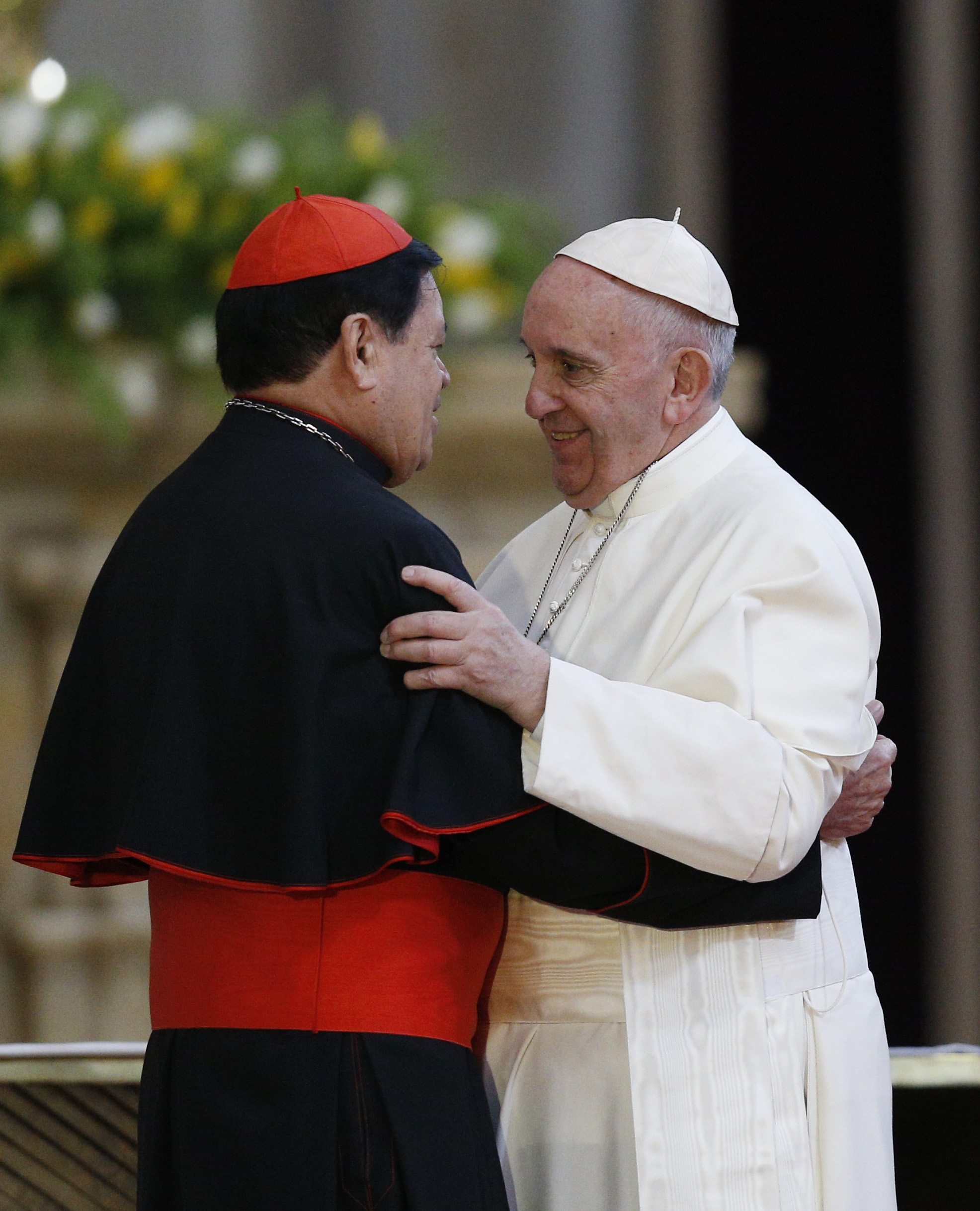
Pope Francis embraces Mexico City Cardinal Norberto Rivera Carrera during a meeting with Mexico's bishops in the cathedral in Mexico City Feb. 13. (CNS photo/Paul Haring)
Pope Francis embraces Mexico City Cardinal Norberto Rivera Carrera during a meeting with Mexico’s bishops in the cathedral in Mexico City Feb. 13. (CNS photo/Paul Haring)

Still, Pope Francis praised popular piety, common in Mexico, where the faithful adore the saints and participate in pilgrimages, while ignoring the sacramental part of the Church.

“I invite you to give yourselves tirelessly and fearlessly to the task of evangelizing and deepening the faith by means of a mystagogical catechesis that treasures the popular religiosity of people,” Pope Francis said. “Our times require pastoral attention to persons and groups who hope to encounter the living Jesus.”

He also lauded the Church for its work with the many mostly Central American migrants transiting the country on trips that expose them to crime such as extortion, robbery and rape.

“There are millions of sons and daughters of the Church who today live in the diaspora or who are in transit, journeying to the North in search of new opportunities,” he said, calling migration, “the challenge of our age.”

Pope Francis plans to celebrate Mass a stone’s throw from the U.S. border in Ciudad Juárez Feb. 17, when he is expected to expand on the migrant issue.

The pope travels to Chiapas at the other end of the country Feb. 15 for a Mass with Mexico’s indigenous peoples, who have fallen away from the Church in droves. He urged the bishops to build a Church more inclusive for indigenous peoples, who often live in impoverished conditions and in communities where Spanish is seldom spoken.

“I ask you to show singular tenderness in the way you regard indigenous peoples and their fascinating but not infrequently decimated cultures,” Pope Francis said.

“Mexico needs its American-Indian roots so as not to remain an unresolved enigma. The indigenous people of Mexico still await true recognition of the richness of their contribution and the fruitfulness of their presence.”

Pope Francis expressed his admiration for Our Lady of Guadalupe, who “teaches us that the only power capable of conquering the hearts of men and women is the tenderness of God.”

He also told the bishops, “We do not need ‘princes,’ but rather a community of the Lord’s witnesses.

“Do not allow yourselves to be corrupted by trivial materialism or by the seductive illusion of underhanded agreements,” he added in an allusion to suggestions that bishops sometimes smooth things out behind closed doors with corrupt officials and even criminals, instead of acting publicly. “Do not place your faith in the ‘chariots and horses’ of today’s pharaohs, for our strength is in the pillar of fire that divides the sea in two, without much fanfare.”

He ended with a call for unity, departing from his prepared comments to do so.

“If you have to fight, then fight; if you have to say things, say them but like men, face-to-face, like men of God, who can pray together, who can discern together, and if you argue to ask for forgiveness,” he said. “But always maintain the unity of the episcopal body.”

Church observers said the pope’s message was unprecedented for Mexico, where the bishops’ conference has become quite conservative over the past quarter-century as the Church and government restored relations. In some Catholic circles, critical voices on issues such as human right have been considered an impediment to that process.

“Francis is saying something along the lines of ‘I am aware of the differences among you,’” said Rodolfo Soriano Nuñez, a sociologist and Church observer in Mexico City. “There are lots of ‘sects’ within the Mexican bishops, groups that fight bitterly with each other while trying to offer themselves as the most reliable partners to the government.”

― By David Agren, Catholic News Service.

St. Elizabeth Seton Parish celebrates 40 years

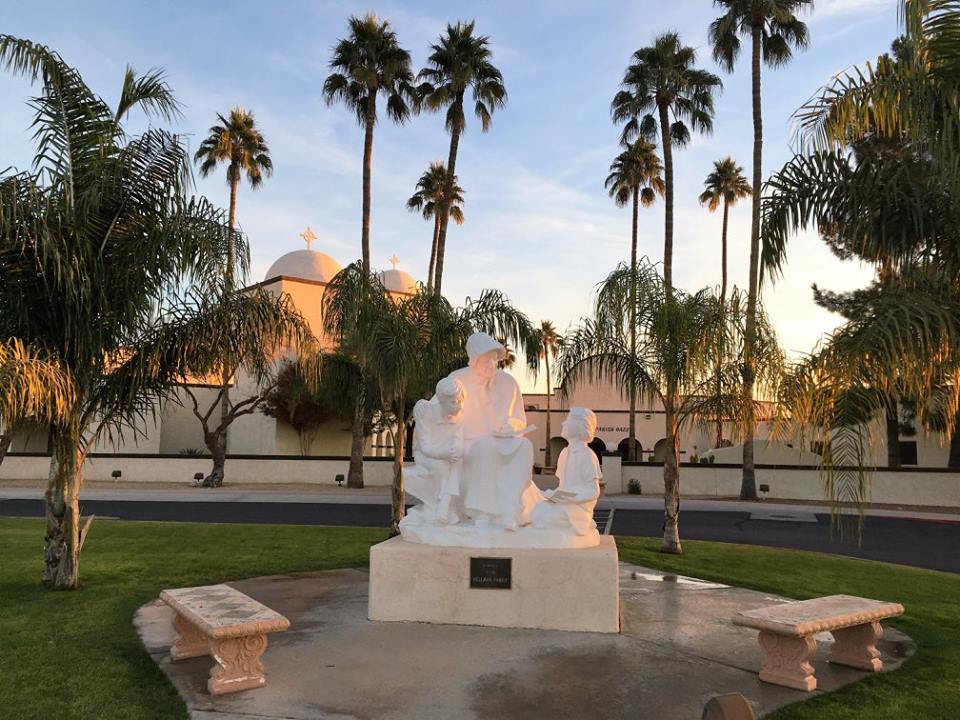
A statue of St. Elizabeth Ann Seton greets parishioners and visitors to the Sun City parish. (courtesy photo)
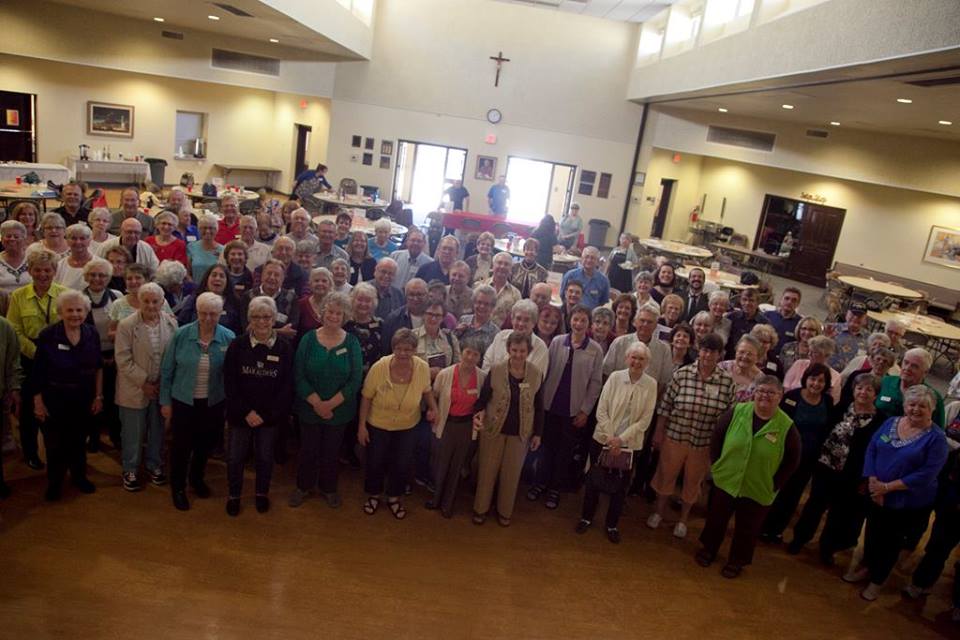
Volunteers gathered for an appreciation event days after St. Elizabeth Seton, "a parish with heart," celebrated its 40th anniversary in Sun City Jan. 31 (courtesy photo)
Volunteers gathered for an appreciation event days after St. Elizabeth Seton, “a parish with heart,” celebrated its 40th anniversary in Sun City Jan. 31 (courtesy photo)

SUN CITY — The community of St. Elizabeth Seton, known as “a parish with heart,” has been beating strong for 40 years.

Its members are eager to share talents and resources as a sign of their faith and as a way to embody the parish’s mission: Gather us together … as we serve one another.

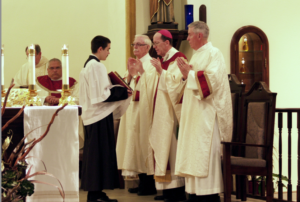
The faithful gathered to honor the parish’s founders and history Jan. 31. Bishop Thomas J. Olmsted celebrated the Mass with five other priests concelebrating. A reception followed at the Westbrook Village Country Club blocks away in Peoria.

“It is a wonderful community,” said Mary Rodgers, 97, a longtime resident. Rodgers was one of the first lectors in the parish in 1976 and resumed her duties for the anniversary Mass.

“We have been blessed with such wonderful priests here at this parish and I knew every one of them,” she said. “We have about 1,700 members now and while I am unable to lector regularly anymore, I still come to Mass every Sunday.”

The Sun City parish, the third in the retirement community, was established Sept. 16, 1976. It was essentially a year to the day that the American saint was canonized. Fr. Paul Smith served as the parish’s first pastor for approximately 300 families.

A statue of St. Elizabeth Ann Seton greets parishioners and visitors to the Sun City parish. (courtesy photo)

A groundbreaking in May 1978 paved the way for the hall and church building. Parishioners began using both just over a year later and still do today although some building and remodeling occurred under the last three pastors.

The parish’s Deacon Tone Room and Library were built in the ‘90s under the direction of Fr. Joseph Gillespie. He retired in 2000 with Fr. Franklin Bartel, his successor, reorganizing the parish, remodeling the church and converting space into classrooms and meeting rooms.

Fr. Joseph McGaffin is finishing his sixth year as the sixth pastor of St. Elizabeth Seton. He has remodeled the parish offices, updated landscaping, converted a fountain into a garden, erected a memorial wall and spearheaded many other updates.

Photos

40th anniversary reception

Ministry appreciation day

On the 40th anniversary, Bishop Olmsted invited the congregation to look back to all who have walked through the doors and in humble gratitude to turn around and trust that God has our lives in His hands. Belief in God must be celebrated, the bishop said. St. Elizabeth Ann Seton had that gift when she entered the Church as a convert to the faith.

“She went to Italy for the health of her husband who died a few days after arriving, ” he said. “She suffered greatly for her faith with her friends and family deserting her, but her faith grew despite her suffering.”

Bishop Olmsted explained that when Jesus allows us to suffer for our faith, the faith could grow exponentially.

Bishop Thomas J. Olmsted and five priests concelebrated the 40th anniversary Mass for St. Elizabeth Seton Jan. 31. (Karen MAhoney/CATHOLIC SUN)
Bishop Thomas J. Olmsted and five priests concelebrated the 40th anniversary Mass for St. Elizabeth Seton Jan. 31. (Karen Mahoney/CATHOLIC SUN)

“The scripture is fulfilled each day; Jesus used the word today over and over. When He met with the tax collector Zacchaeus, He said, ‘Today I must visit this house,’ and after they had a meal together, He said, ‘today, salvation has come to this house,’” he explained. “On the cross with the thief hanging next to Jesus, He said, ‘Today you will be with me,’ and when He taught the apostles to pray, He said, ‘Give us this day our daily bread. We cannot live on yesterday’s faith.”

“Be grateful for the Eucharist,” the bishop said. “St. Augustine said the effect of our daily bread is we become what we receive. Today, let us hear His voice and rejoice.”

Msgr. Jan Olowin, who concelebrated the Mass, honored the ancestors, pastors, priests, sisters and current members affiliated with St. Elizabeth Seton Parish.

“Pope Francis asked that we take the message out to the world that we are a Church of Mercy and Benediction,” he said. “We ask for blessings of the present, hope for the future and take our gifts to the Lord in this Jubilee year.”

Love, amor y Valentine’s Day

Whether you’re looking for a quick read or something deeper, check out five things you might not have known about St. Valentine. Try your hand at understanding it in Spanish. Don’t worry, the short phrases and matching pictures make it easier.

And for those of you who miss “Jaywalking” interviews with the former late night talk show host, enjoy this Valentine’s-themed Busted Halo version. It’s a packaged of archived interviews conducted by Fr. Jack Collins, CSP with couples he encounters on the streets of New York.

And what better place to get Catholic resources than Catholic-Link’s Facebook feed?

Fight corruption, work for common good, pope tells Mexican officials

Pope Francis walks with Mexican President Enrique Pena Nieto during a welcoming ceremony at Benito Juarez International Airport in Mexico City Feb. 12. (CNS photo/Paul Haring)

MEXICO CITY (CNS) — Pope Francis told Mexico’s president and government officials that the country’s future can be bright only if government and business leaders put an end to a culture of “favors” for the influential and scraps for the poor.

“Experience teaches us that each time we seek the path of privileges or benefits for a few to the detriment of the good of all, sooner or later the life of society becomes a fertile soil for corruption, drug trade, exclusion of different cultures, violence and also human trafficking, kidnapping and death, bringing suffering and slowing down development,” the pope said Feb. 13 during a meeting with the leaders at the National Palace.

The pope had landed in Mexico the evening before for a six-day visit. Because of the late hour and the long flight from Rome via Cuba, the official welcoming ceremony was scheduled for the next morning. But that did not stop thousands of Mexicans from packing stadium-type stands at the airport to welcome the pope with singing, dancing and a mariachi band.

Thousands of people also lined the streets from the airport to the Vatican nunciature, where the pope was staying, and a large crowd was gathered there to greet him.

Pope Francis, stopping outside for a while, told them, “Tonight, do not forget to look at Mary and think of the people we love and those who do not love us.” He said good night after leading them in the recitation of the Hail Mary.

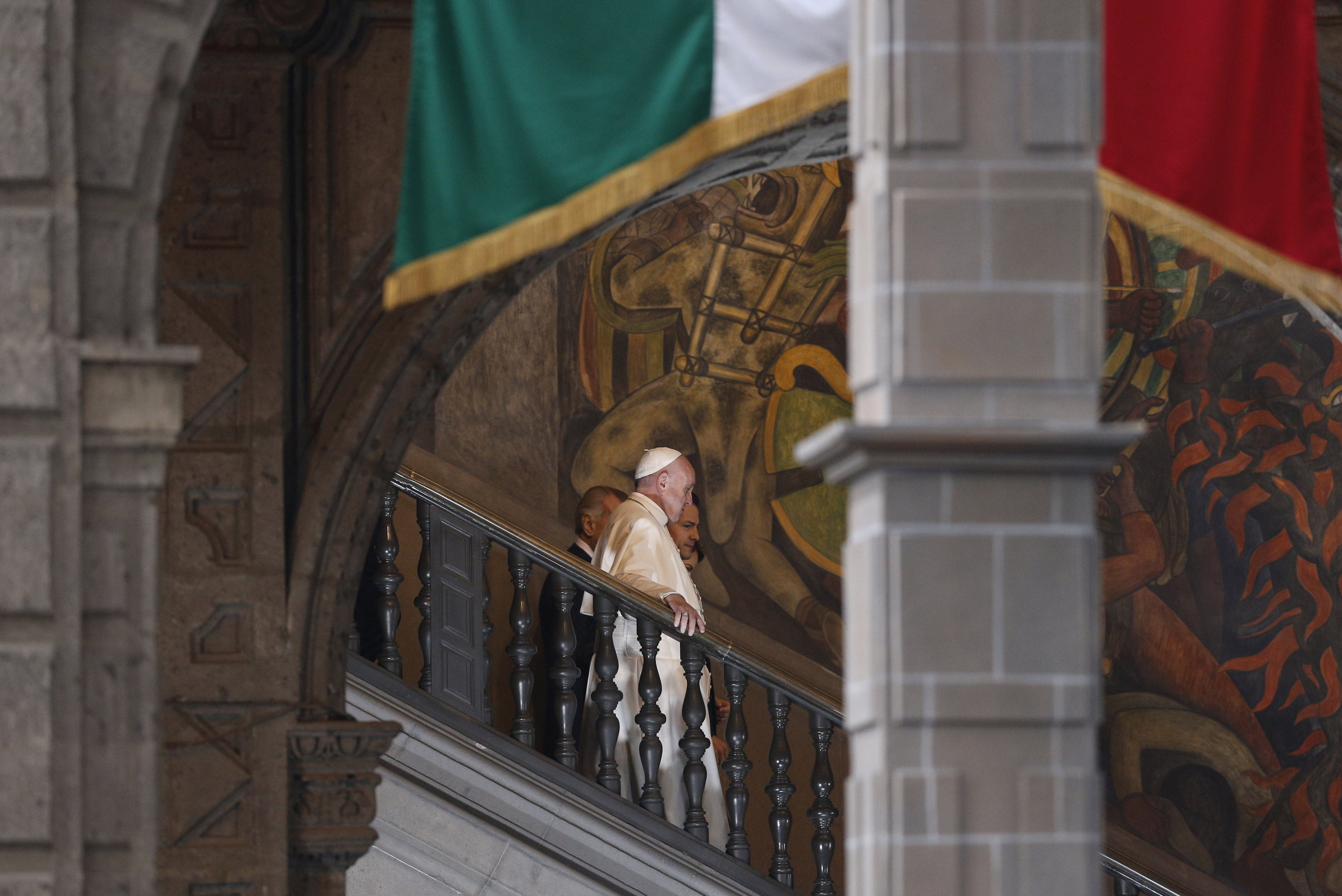
Pope Francis walks down stairs of the National Palace with Mexican President Enrique Pena Nieto and first lady Angelica Rivera as they arrive for a meeting with representatives of civil society and the diplomatic corps at the National Palace in Mexico City Feb. 13. (CNS photo/Paul Haring)

Before the trip, the pope repeatedly spoke of his devotion to Our Lady of Guadalupe and his desire to spend time in prayer before the tilma or cloak imprinted with the image of Mary.

Pope Francis gave President Enrique Peña Nieto a mosaic of Our Lady of Guadalupe made by the Vatican Mosaic Studio; it includes tiny glass tiles that encase gold leaf.

Although protocol dictated the pope’s time at the palace be treated as a state visit, Peña Nieto told the pope, “Your visit transcends an encounter between two states; it is the encounter of a people with its faith.”

“You will find a generous and hospitable people,” the president told him, “a people who are Guadalupan.”

Speaking to the president and government officials, the pope insisted that, like Mary, who took on the traits of Mexico’s indigenous peoples in a sign of respect, Mexico’s leaders must value the multicultural makeup of its people.

Mexico’s “ancestral culture” combined with the youth of its population “should be a stimulus to find new forms of dialogue, negotiation and bridges that can lead us on the way of committed solidarity,” the pope said.

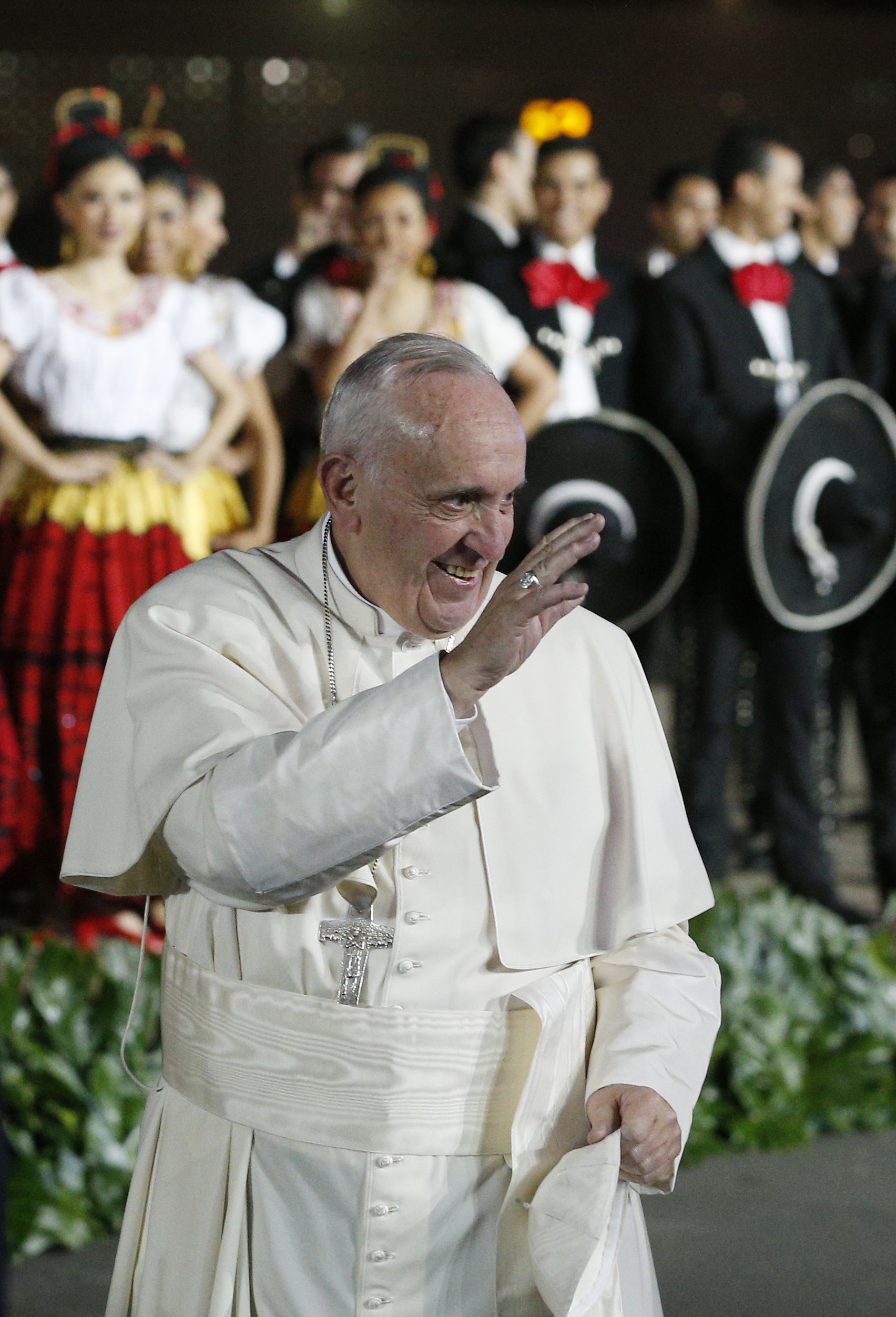
Pope Francis greets the crowd during a welcoming ceremony at Benito Juarez International Airport in Mexico City Feb. 12. (CNS photo/Paul Haring) See POPE-MEXICO-WELCOME Feb. 12, 2016.

Those who identify themselves as Christian must be exemplars of dialogue and solidarity, he said, and those who truly value politics as public service must as well. There is no other way, the pope said, to build “a society in which no one feels like a victim of the culture of waste” and, therefore, disposable.

Mexico’s population is about 120 million; 28 percent of them are 14 years old or younger and another 18 percent are 15-24 years old. The Organization for Economic Cooperation and Development ranks Mexico as one of the countries with the greatest income inequality and reports 21 percent of its population lives in poverty.

Pope Francis told government leaders that those young people are a treasure, a bundle of energy and hope for the future. But the country cannot realize that future hope if the current generation of adults and leaders do not teach values and, especially, if they do not live them.

“A hope-filled future is forged in a present made up of men and women who are upright, honest and capable of working for the common good,” the pope said, adding that, unfortunately, today the common good “is not in such great demand.”

With dialogue and respect, he said, all Mexicans can be helped to contribute to building a better society where there is “real access” to necessary material and spiritual goods: “adequate housing, dignified employment, food, true justice, effective security, a healthy and peaceful environment.”

― By Cindy Wooden, Catholic News Service. Contributing to this story was Junno Arocho Esteves in Mexico City.

Pope to Russian patriarch: ‘We are brothers’

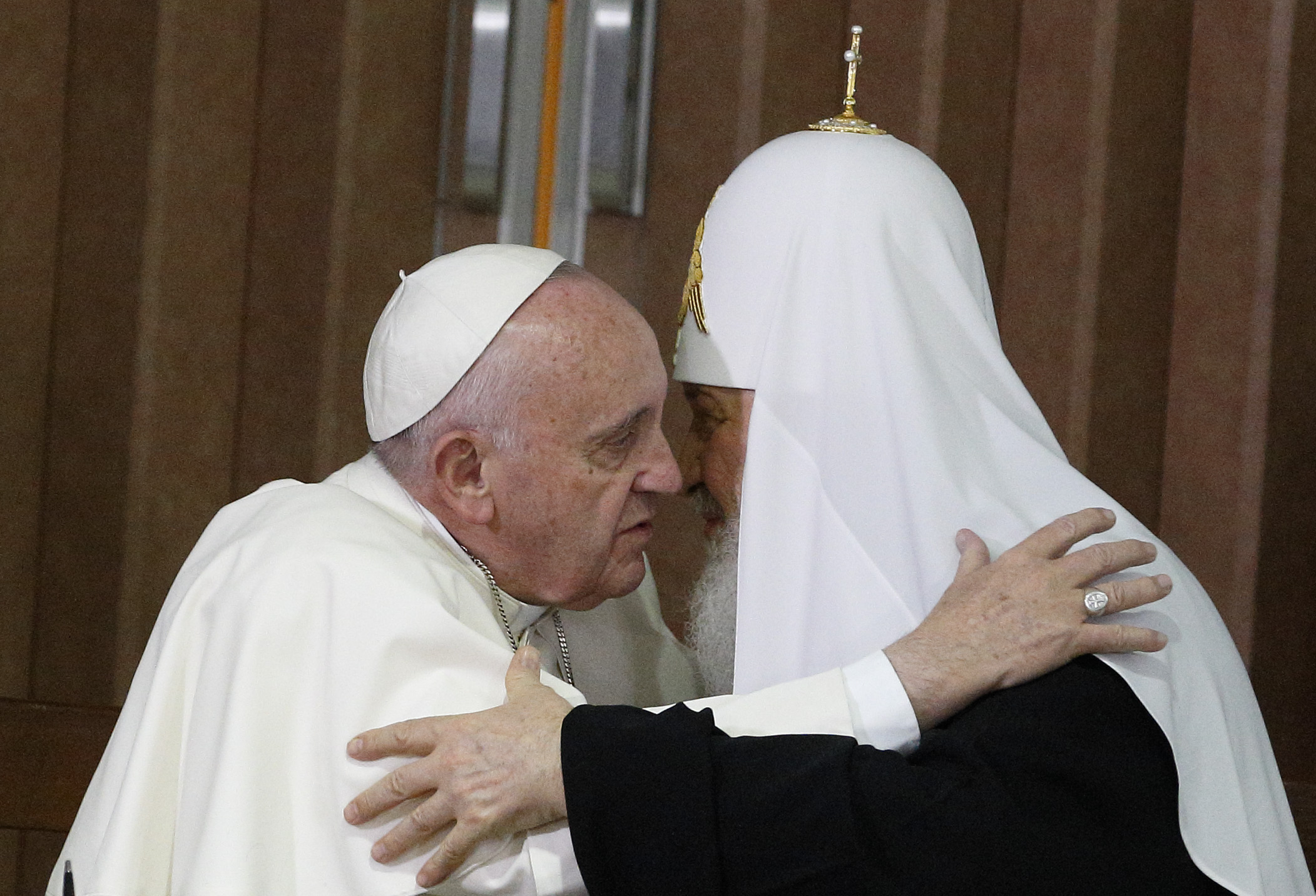
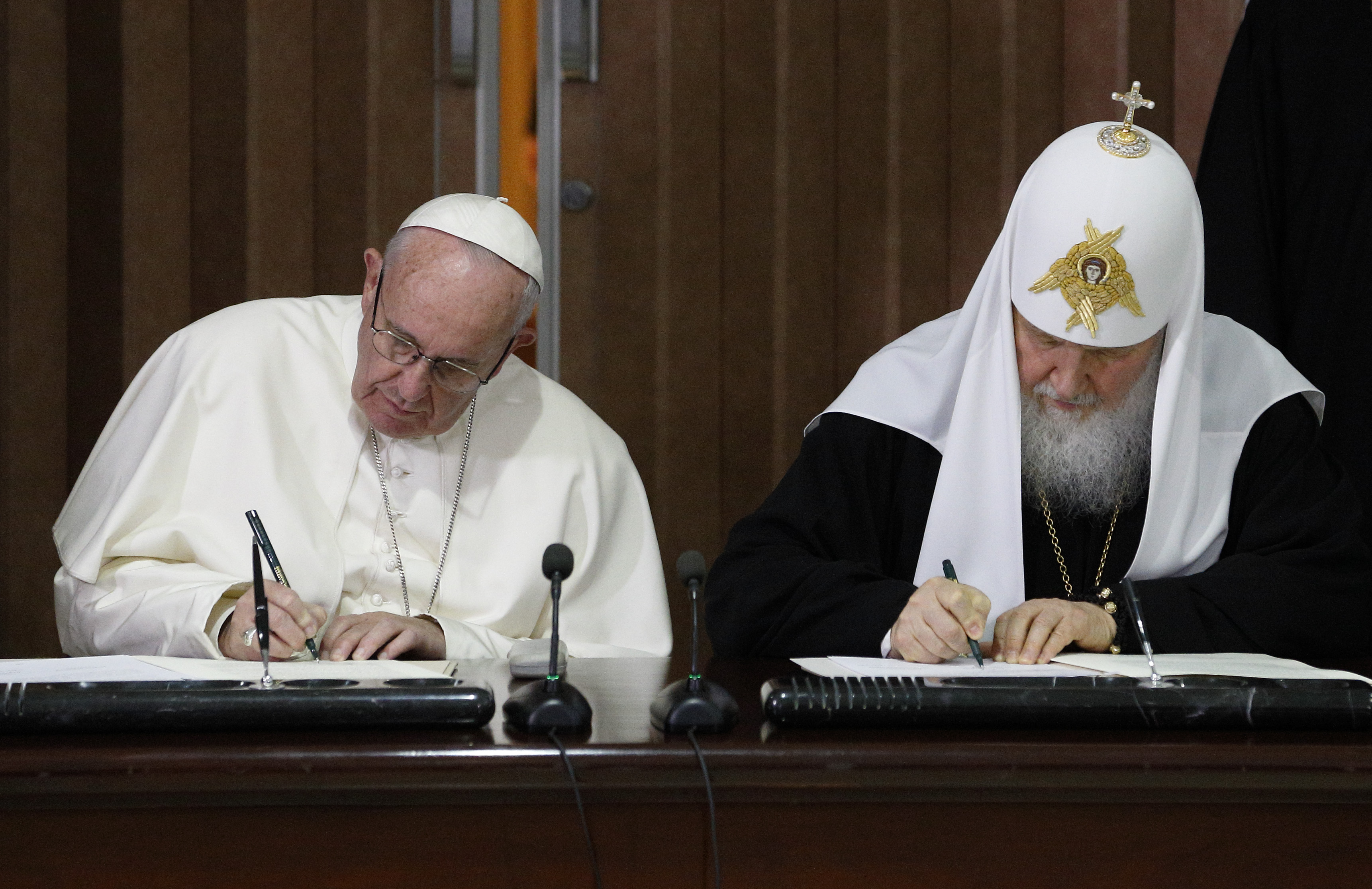
Pope Francis and Russian Orthodox Patriarch Kirill of Moscow embrace after signing a joint declaration during a meeting at Jose Marti International Airport in Havana Feb. 12. (CNS photo/Paul Haring)

HAVANA (CNS) — At long last, Pope Francis and Russian Orthodox Patriarch Kirill of Moscow embraced, kissing each other three times.

“Finally,” the pope told the patriarch Feb. 12 as they met in a lounge at Havana’s José Martí International Airport. “We are brothers,” he told the patriarch.

Amid the clicking of cameras and multiple flashes, Patriarch Kirill was overheard telling the pope, “Things are easier now.”

“It is clearer that this is God’s will,” Pope Francis told him.

A flight of almost 12 hours capped months of intense negotiations and more than two decades of Vatican overtures to bring a pope and a Russian patriarch together for the first time.

Cuban President Raúl Cástro played host to the pope and patriarch, who was on a visit to Russian Orthodox communities on the island-nation. Pope Francis had a pastoral visit to Mexico planned for months; the stop in Havana was announced only a week before the meeting.

Pope Francis and Patriarch Kirill signed a joint declaration that emphasized the things the two Churches have in common.

Addressing the situation in the Middle East and North Africa, they said that “whole families, villages and cities of our brothers and sisters in Christ are being completely exterminated.” They called on the international community “to act urgently in order to prevent the further expulsion” of Christians, to end violence and terrorism and to ensure that large amounts of humanitarian aid reach the victims of violence.

“In raising our voice in defense of persecuted Christians, we wish to express our compassion for the suffering experienced by the faithful of other religious traditions who have also become victims of civil war, chaos and terrorist violence,” they said.

“Attempts to justify criminal acts with religious slogans are altogether unacceptable,” they said. “No crime may be committed in God’s name.”

They called those who have died “martyrs of our times” and said they helped unite various Churches “by their shared suffering.”

They spoke of the need to be vigilant against European integration that is “devoid of respect for religious identities.” They also spoke of extreme poverty, the “millions of migrants and refugees knocking on the doors of wealthy nations” and consumerism.

They spoke of life issues: abortion, euthanasia, new reproductive technologies and threats against the Churches’ view of marriage.

After they signed the document, the two leaders embraced, and each spoke briefly.

Pope Francis and Russian Orthodox Patriarch Kirill of Moscow sign a joint declaration during a meeting at Jose Marti International Airport in Havana Feb. 12. (CNS photo/Paul Haring) See POPE-PATRIARCH-CUBA Feb. 12, 2016.
Pope Francis and Russian Orthodox Patriarch Kirill of Moscow sign a joint declaration during a meeting at Jose Marti International Airport in Havana Feb. 12. (CNS photo/Paul Haring)

Patriarch Kirill said they had a two-hour, “open discussion with full awareness of the responsibility we have for our people, for the future of Christianity, and for the future of human civilization itself. It was a conversation filled with content that gave us the opportunity to understand and hear the position of the other. And the results of the conversation allow me to assure that currently both Churches can cooperate together to defend Christians around the world; with full responsibility to work together so that there may be no war; so that human life can be respected in the entire world; so that the foundations of human, family and social morality may be strengthened through the participation of the Church in the life of human modern society.”

Pope Francis said: “We spoke as brothers, we share the same baptism, we are bishops, we spoke about our Churches. We agreed that unity is done walking (together). We spoke clearly without mincing words. I confess that I felt the consolation of the Spirit in this dialogue. I am grateful for the humility of His Holiness, his fraternal humility and his good wishes for unity. We left with a series of initiatives that I believe are viable and can be done. “

He thanked Patriarch Kirill and others involved in arranging the meeting and also thanked Cuba, “the great Cuban people and their president here present. I am grateful for his active availability; if it continues this way, Cuba will be the ‘capital of unity.’“

Patriarch Kirill gave Pope Francis a small copy of an icon of Our Lady of Kazan, which itself is a symbol of Vatican-Russian Orthodox detente, but also of failed hopes. The oldest known copy of the icon, an ornate 18th-century piece had been hanging in St. John Paul II’s study for a decade as he hoped to return it to Russia personally. Instead, in 2004, he had Cardinal Walter Kasper take it back to its country of origin as a gesture of goodwill.

The icon is one of the most revered and replicated icons in Russian Orthodoxy.

Pope Francis gave Patriarch Kirill a reliquary with a relic of St. Cyril, the patriarch’s patron saint, and a chalice, which not only is a sign of hopes for full communion between the two Churches, but also a sign that the Catholic Church recognizes the validity of the Orthodox sacraments.

The addition of a stopover in Cuba was widely seen as a sign of Pope Francis’ willingness to go the extra mile to reach out a hand in friendship. At the same time, observers said, it gave those Russian Orthodox opposed to ecumenism a sense that their Church is special and that it bowed to no one in agreeing to the meeting.

In a commentary distributed Feb. 11, Ukrainian Catholic Bishop Borys Gudziak of Paris said: “The pope is demonstrating humility; he is going to the territory of the other. In the eyes of nostalgic Russians, Cuba is almost home territory, a last outpost of a lost Soviet Empire.”

For decades, the Russian Orthodox told the Vatican that a meeting between the patriarch and pope was impossible because of the activities of Latin-rite Catholics in Russia and, especially, the Eastern-rite Catholics in Ukraine.

The Moscow Patriarchate had said that while those problems still exist with the Catholic communities, they take a backseat to the urgency of defending together the rights and very existence of persecuted Christians in the Middle East.

The harsh persecution of Christians and other minorities in Syria, Iraq and other parts of the region has been a cause Pope Francis has pleaded before world leaders and for which he has rallied the prayers of Christians across the globe.

He speaks often of the “ecumenism of blood,” the fact that Christians are killed for believing in Christ with the persecutors not knowing or caring what denomination or Church they belong to. Christians are fully united in that suffering and, the pope has said, those who die for their faith are in full communion with each other and with centuries of martyrs now in the presence of God.

But the fate of persecuted Christians was not the pope’s primary motive for meeting Patriarch Kirill. Simply meeting him was the point.

Metropolitan Hilarion Volokolamsk, head of the Moscow Patriarchate’s external affairs department, told reporters a week earlier that Patriarch Kirill chose Havana in the “New World” because Europe, the “Old World,” was the birthplace of Christian division.

Ukrainians, Catholic or not, have expressed concerns about Pope Francis’ meeting with Patriarch Kirill given the patriarch’s apparently close ties to Russian President Vladimir Putin at a time of ongoing fighting in Eastern Ukraine.

“The topics of discussion will not be explicitly political ones,” Bishop Gudziak wrote. “The gist of the rendezvous will be the encounter of Church leaders representing very different experiences, agendas, styles and spiritualities of ecclesial leadership. One can hardly expect revolutionary results. Yet, it is through encounter that spiritual change occurs. Let us pray for good spiritual fruit.”

― By Cindy Wooden, Catholic News Service. Contributing to this story was Junno Arocho Esteves in Mexico City.

Pro-life community mourns loss of Phoenix native who defended life worldwide

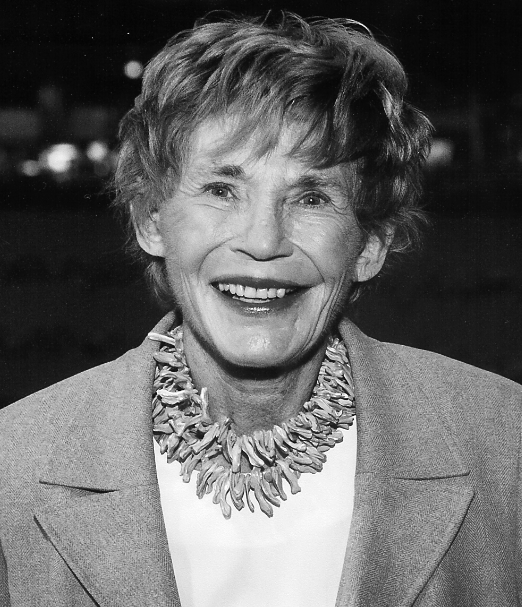
Dr. Carolyn Gerster (1928-2016)

Dr. Carolyn Gerster, co-founder of Arizona Right to Life and former president of the National Right to Life Committee, died Jan. 28. She was 88.

Graduating from medical school at the age of 22, she specialized in internal medicine and cardiology and served two years in the U.S. Army where she attained the rank of captain. While stationed in Frankfurt, Germany, she met her future husband, fellow physician Dr. Josef Gerster. The couple married in 1958 and returned to Carolyn’s childhood home of Phoenix where they raised five sons.

Gerster served her community well, dedicating countless hours as a volunteer at the St. Vincent de Paul Medical Clinic. She will best be remembered, however, for her fervent and fearless defense of human life, believing it to be one of the cornerstones of a physician’s duties. In 1971, she co-founded the Arizona Right to Life Committee, serving over the years as its president and chairman of the board.

When federal laws changed in 1973, she went national, serving as the Arizona director to the National Right to Life Committee the same year. Gerster traveled the world in defense of human life and went on to become NRLC vice president, chairman of the board and president in later years. In 2011 she was honored as a member of the NRLC Board as a Delegate Emeritus.

John Jakubczyk, a Phoenix attorney and the former president of Arizona Right to Life, said Gerster was dedicated to the pro-life movement and to protecting women from abortion.

“She sacrificed her medical career, her family and so much of her time for the cause. When it came to the pro-life effort, she was fearless,” Jakubczyk said. “It was not about her. It was about protecting unborn children and trying to restore the law that had once protected innocent human life. She was an amazing speaker, a brilliant debater and could move audiences with her sincerity and her soulfulness.”
[quote_box_right]

Messages and condolences

link active until March 4[/quote_box_right]

Jinny Perron, who helped found the Arizona East Valley Pro-Life Alliance, knew Gerster well and remembered her as a “true champion of life.”

“She was certainly a lady of distinction and one to admire as an exemplary model of womanhood and someone worthy to strive to imitate, passionately defending life in all its stages from conception through natural death,” Perron said.

A convert to Catholicism, Gerster “loved to make the sign of the cross at the beginning and conclusion of our prayers before and after board meetings,” Perron said. “We can only imagine how joyfully she was welcomed into her heavenly home with the greeting we all hope to receive someday: ‘Well done, my good and faithful servant,’ surrounded by the many babies she strived so diligently to save while on earth.”

Arizona native with key role in papal visit, deep roots in Hispanic community, dies

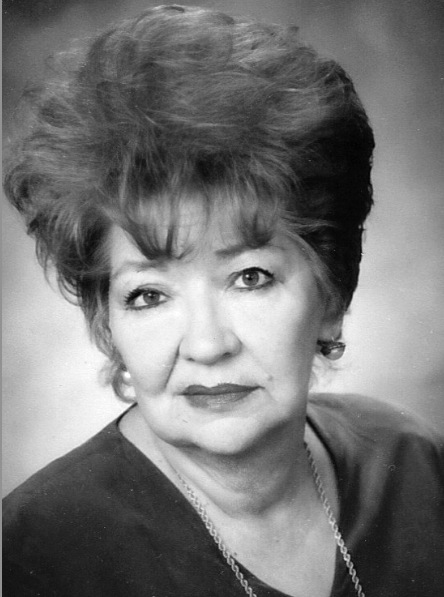
Mary Jo French (1936-2015)

Dr. Maria Josefina “Mary Jo” Franco French, a leader in the Hispanic Catholic community, died Dec. 31. She was days shy of turning 80.

French was the former editor and owner of El Sol, the first Spanish-language newspaper in Phoenix, founded by her parents. A graduate of St. Francis Xavier Catholic School and Xavier College Preparatory, she went on to train as a physician at the Universidad Nacional Autónoma de México School of Medicine in 1967 and specialized in endocrinology.

A native of Arizona, French was a devout Catholic who was charged with logistics and security for the visit of Pope St. John Paul II to Phoenix in 1987. “It was a big job but she worked with her heart and her passion,” said Elvira Espinoza, a close friend of French, who worked alongside her for 18 years in the Alma de la Gente organization. Although it was not a Catholic group, French brought her faith into the mix.

“We had a pageant for girls to get them money for school,” Espinoza said. “Every year we had a Mass at Immaculate Heart [of Mary Parish] for our participants, and Catholic or not Catholic, they had to attend.”

Laura Franco-French remembers her mother’s passion for spreading devotion to the Virgen de Guadalupe and her efforts surrounding the papal visit.

“She worked really hard to make sure people had access to him — it was multiple events around the Valley — so that people could be able to share in seeing him and praying with him. She was really excited to bring a group from Mexico to sing for him,” said Franco-French.

“She really loved her community. She devoted her time and resources for the betterment of the Latino community,” Espinoza said. That included helping people who couldn’t afford proper medical care.

“She worked with several hospitals that started a mercy care program,” Espinoza said. “She and her husband gave money to these medical institutions providing medical services to people.”