

BOOKS: New book challenges societal definitions of justice and equality

[quote_box_right]

SocialJustice_comp.v3.inddImage courtesy of Encounter Books

‘Social Justice isn’t what you think it is’

Author(s): Michael Novak and Paul Adams

Publisher: Encounter Books

Length: 336 pages

Release Date: November 3, 2015

ISBN: 978-1594038273

Website: encounterbooks.com

Cost: $27.99

[/quote_box_right]

[dropcap]S[/dropcap]ocial Justice has been my deepest interest since my former Lay Dominican chapter decided to explore it for a year of on-going formation. The first question that the facilitator asked, to illustrate what social justice meant, was, “How many people in the world live on less than two dollars a day?”

The question struck me as odd for a couple reasons: first, why a “dollar,” why not a “yen”? Second, what did the amount of money have to do with social justice?

In a new book, Social Justice isn’t what you think it is, Michael Novak and Paul Adams answer this latter question — the amount of money has nothing to do with social justice. The amount of money that a person lives on, especially a person to whom money has no place in their culture, is meaningless. In another Lay Dominican chapter, we had a woman from Nigeria tell us about daily life in a village. If a person’s home developed a hole in the roof or wall, no one ran out to the Home Depot and bought materials. They gathered the materials from the same place that they obtained them when they built the home. No money at all was involved! As it turns out, the question was actually political, ideological, and meant to suggest a victim and an oppressor.

The real question, “what is social justice,” has many answers. For Friedrich Hayek, a German social philosopher, social justice was a “mirage — a meaningless, ideological, incoherent, vacuous cliché.” Looking at that original question about money, we can see why.

To the Church, social justice is the total expression of our unique human dignity as imago Dei, the image of God. Every aspect of our relationship with God and each other is defined in the Church’s social teaching.

Politically and ideologically, the term “social justice” has been used in an egalitarian sense, that erroneous notion that all things must be equal for all people. This completely ignores the concept of human dignity, the sanctity of work, and free will. All people are given gifts from God but what people do with those gifts is what makes them very unequal.
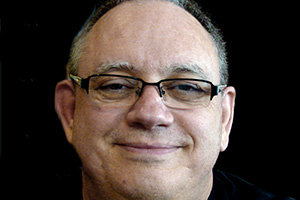
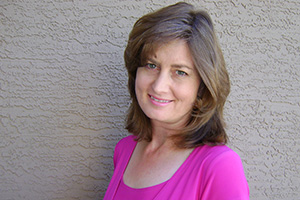
Mr. Robert Curtis, a life-professed Lay Dominican, teaches composition at the University of Phoenix and creative writing at Rio Salado College.

Human actions define the justice of any situation in a society. Scripture teaches us, “Much will be required of the person entrusted with much, and still more will be demanded of the person entrusted with more” (Luke 12:48), and nowhere is this more poignantly illustrated than in the personal responsibility required of freedom.

Each of the five principles of Catholic Social Teaching — common good, universal destination of goods, subsidiarity, solidarity, and participation — details an aspect of true social justice.

Human beings have inherent dignity, as the imago Dei, so that the preservation and nurturing of that dignity is the common good. Human dignity entails universal “access” to the created goods of the earth. Decisions about human dignity should be made at the lowest, most personal level (as opposed to the nanny state), which is the principal of subsidiarity, and we must all be in solidarity with one another as imago Dei by participating in the life of culture.

Novak and Adams make it clear that there is hardly any true justice in the egalitarian notion of equal outcomes, that providing opportunities (education, food and clothing to the needy, clean water, fair wages, etc.) is what the Church is all about.

Novak and Adams then run us through a historical lesson by helping us understand social justice in terms of what the popes have written since Leo XIII’s Rerum Novarum. In this encyclical Leo dismisses socialism for six reasons; they are:

  • It works upon the poor man’s envy of the rich.
  • It strives to do away with ­private property.
  • It contends that all property should become the property of the state.
  • It robs the lawful possessor of what is his natural right.
  • It expands without clear limits the functions of the state.
  • It causes confusion in the community.

These reasons are important for us in our understanding of true social justice and how it differs markedly from the secular, progressive notion.

The book moves us from the historical background to the practical, thus making this book an outstanding read.

Buscando la auténtica masculinidad

[quote_box_right]

Firme en la Brecha

Para leer el exhortación apostólico o para ver el video “Un llamado a la batalla”, visita intothebreach.net.

[/quote_box_right]

[dropcap]H[/dropcap]an pasado cuatro meses desde que el Obispo Thomas J. Olmsted de la Diócesis de Phoenix escribiera su exhortación apostólica Firme en la brecha, dirigida a todos los hombres católicos.

Y a pesar de que muchos medios de comunicación seculares la han ignorado en gran manera, dicho documento ha dado la vuelta al mundo; y está causando una verdadera revolución en aquellos hombres que han abierto su corazón al mensaje del Obispo de Phoenix:

“Tengan confianza. ¡Sean audaces! ¡Hacia adelante, Firmes en la brecha!”

Cristofer Pereyra es el Director de la Oficina de Misiones Hispanas, un ente dedicado a proveer perspectivas sobre como servir mejor a la Iglesia ante el creciente número de católicos hispanos en una de las regiones de más rápido crecimiento en los Estados Unidos.

Desde Chile hasta Australia, en Europa y por todo EE.UU. no dejan de llegar mensajes para el Obispo Olmsted agradeciendo y felicitándole por tener el valor de hablarles claro a los hombres, y decirles lo que desde hace tiempo necesitaban oír: “Muchos hombres católicos no han estado dispuestos a ‘mantenerse firmes sobre la brecha’ — llenando ese espacio abierto y vulnerable al ataque. Un tercio ha dejado la fe y muchos de los que todavía son ‘católicos’ practican la fe con timidez y un compromiso mínimo de transmitirles la fe a sus hijos”.

El mundo católico en los EE.UU. no hace más que hablar al respecto. Y ya se han comenzado a ver los frutos del documento en Phoenix: la Conferencia de Hombres Jóvenes, la Conferencia Hombres en Cristo, los Caballeros de Colón, y próximamente la Conferencia de Hombres Católicos a realizarse el 6 de febrero en Xavier College Preparatory. Todas ellas han hecho suyo el mensaje del Obispo Olmsted, lo están viviendo de manera extraordinaria. Esto también está sucediendo en otras diócesis que han acogido el mensaje, y aceptado el reto de rescatar la auténtica masculinidad.

Y ahora el video “Un llamado a la batalla”. La Diócesis de Phoenix, por primera vez en su historia encomendó la producción de un cortometraje de alta calidad para aprovechar los medios de comunicación social y sacar a la luz la crisis de masculinidad en el mundo de hoy. En la cuenta de la Diócesis en Youtube el video ya es viral con más de ¡112.000 reproducciones!

¿Pero en qué consiste esta revolución que quiere causar el Obispo Olmsted? Sencillo, pero no fácil. Se busca que el hombre reencuentre su sentido de ser, su misión en el mundo, como padre, esposo, hijo, amigo, y ciudadano de provecho para su sociedad. Creo que el documental lo resume muy bien con estas palabras: “Miren a su alrededor, esposas, hijos, hijas, nietos … están esperando, esperando que nosotros seamos los HOMBRES que Dios nos ha llamado a ser”.

Bishop Olmsted joins leaders from other Christian denominations to pray for unity

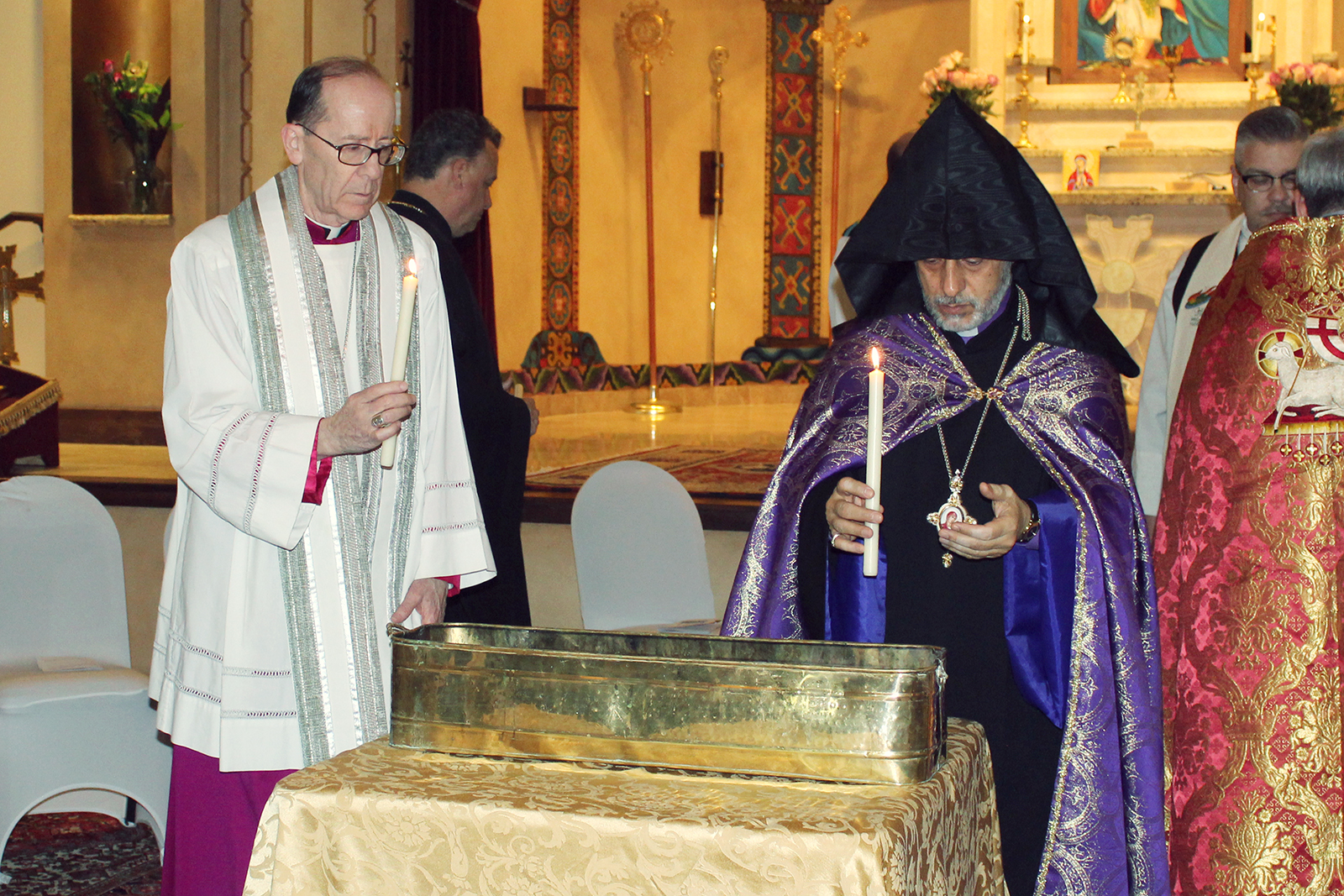
Bishop Thomas J. Olmsted of the Catholic Diocese of Phoenix and the Archbishop Hovnan Derderian of the Armenian Apostolic Church’s Western Diocese hold candles to pray for Christian Unity at St. Apkar Armenian Apostolic Church in Scottsdale. (Photo courtesy of St. Apkar Armenian Apostolic Church)

In a world with more than 33,000 Christian denominations, it’s rare to see leaders of several of them gathered in one place to pray for unity.

[quote_box_right]

Week of Prayer for Christian Unity in history

(Franciscan Intellectual Tradition)

[/quote_box_right]

Yet that’s exactly what happened Jan. 20 at St. Apkar Armenian Apostolic Church in Scottsdale. Leaders of the Arizona Faith Network and members of local congregations gathered for a prayer service during the Week of Prayer for Christian Unity, an international Christian ecumenical event held annually since 1908.

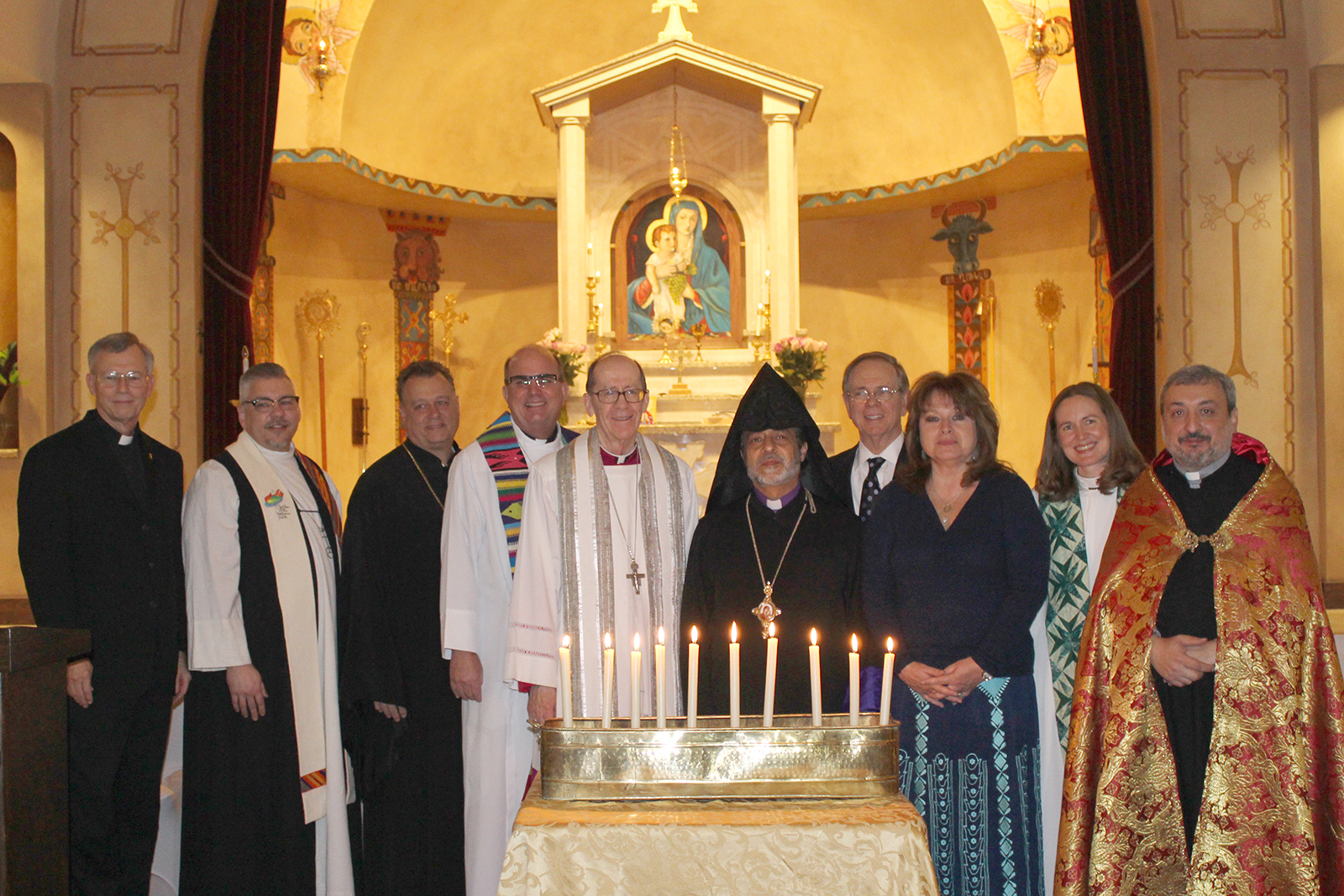
The Arizona Faith Network, an interfaith organization whose mission is to “bring together people of faith, under the inspiration of God, as a bridge to understanding and action,” according to azfaithnetwork.org, organized the prayer event. Bishop Thomas J. Olmsted and Fr. Michael Diskin, diocesan vice-chancellor and AFN president, sat at the foot of the altar at St. Apkar along with other leaders during the evening of prayer.

Bishop Olmsted led those gathered in a series of prayer intentions, praying that the faithful would be of “one heart and mind.” Fr. Diskin, who also serves as director of the diocesan Office of Ecumenism and Interreligious Affairs, led a series of prayers for reconciliation among the faithful, asking that God would “make us apostles of love wherever we go.”

The Rev. Sarah Stadler, pastor of Grace Evangelical Lutheran Church in downtown Phoenix, shared a message focused on the baptism in Christ that Christians share, regardless of denomination. She also spoke following a vespers service focused on Christian unity Jan. 24 at St. Mary’s Basilica.

“Wherever we can break down walls and educate ourselves for the sake of the world and not us, let’s do that. Our unity is not dependent on our action,” Stadler said. “All of our ecumenical efforts are important … but our effort does not give us our unity. We are already united by God in Christ.”

Bishop Thomas J. Olmsted joined leaders from other Christian denominations throughout the Valley for a prayer service for Christian unity at St. Apkar Armenian Apostolic Church. The event was organized by the Arizona Faith Network. The network’s president, Fr. Michael Diskin (far left), also serves the Diocese of Phoenix as vice chancellor and director of the Office of Ecumenism and Interreligious Affairs. (Photo courtesy of St. Apkar Armenian Apostolic Church)

Archbishop Hovnan Derderian of the Armenian Apostolic Church’s Western Diocese called the service “inspiring, spiritually uplifting and empowering” and said it “reminds us all that we all are co-workers in God’s holy work.” The leaders of various denominations must be role models, he said, and “when church leaders and faith leaders are united in prayer, no doubt that same unity will be reflected in the life of our communities.”

Bishop Olmsted told The Catholic Sun that praying for unity among the baptized is “both Christ’s desire and our responsibility” and that the ecumenical gathering at St. Apkar was a good way to build relationships of trust and friendship. “In a world fractured by violence and mistrust, such ecumenical work is truly important,” the bishop noted.

Acknowledging that “much has been done to overcome historic animosity between various Christian traditions through respectful dialogue,” Fr. Diskin told The Catholic Sun that “the unity that Christ desires can only be achieved through the work of the Holy Spirit, and so ‘Spiritual Ecumenism’ must be the very soul of these efforts. For this reason, we join in prayer that the divisions among Christians that continue to exist will one day be healed.”

The ecumenical gathering featured prayers led by Bishop Steven Talmage of the Evangelical Lutheran Church in America’s Grand Canyon Synod; St. Apkar pastor Fr. Zacharia Saribekyan; AFN vice president Billie Fidlin of the United Methodist Church; the Rev. Dr. Bill Lyons, designated conference minister for the Southwest Conference of the United Church of Christ; and Mr. Gerrit Steenblick, Church of Jesus Christ Of Latter-Day Saints.

[quote_box_center]

Related

On the final day of the Week of Prayer for Christian Unity, Pope Francis celebrated an ecumenical prayer service and asked forgiveness for sins against Christian unity Jan. 25.

[/quote_box_center]

‘Year of Consecrated Life’ closes Feb. 1

The renewed effort to celebrate the work of men and women religious formally draws to a close with a special liturgy at St. Mary's Basilica Feb. 1.
The renewed effort to celebrate the work of men and women religious formally draws to a close with a special liturgy at St. Mary’s Basilica Feb. 1.


[quote_box_right]

Year of Consecrated Life Closing Mass

When: 6 p.m. Feb. 1

Where: St. Mary’s Basilica, 231 N. Third Street, Phoenix

Followed by reception. Info.

Can’t attend? Offer a final prayer or oración for those living a consecrated life and those in discernment. For a longer version, offer up to 12 intercessions.

[/quote_box_right]

The Year of Consecrated Life, which began Nov. 29, 2014, officially concludes Feb. 2 with a local closing Mass Feb. 1. Throughout the Diocese of Phoenix — and indeed throughout the world — the year proclaimed by Pope Francis, himself a Jesuit, focused attention on the blessings and beauty of consecrated life in an effort to “Wake up the World!”

Sr. Anthony Mary Diago, RSM, in the midst of her inaugural year as director of the Office of Consecrated Life for the Phoenix Diocese, spent the year speaking at schools and parishes, telling young people about consecrated life and meeting with religious communities. Those visits were key.

“It gave me the opportunity to reach out to all the religious orders,” Sr. Anthony Mary said. “We shared a lot of our vocation stories together. Just learning about the Sisters and how they were called to the religious life, to dedicate their life to Christ and the joy of their vocations.”

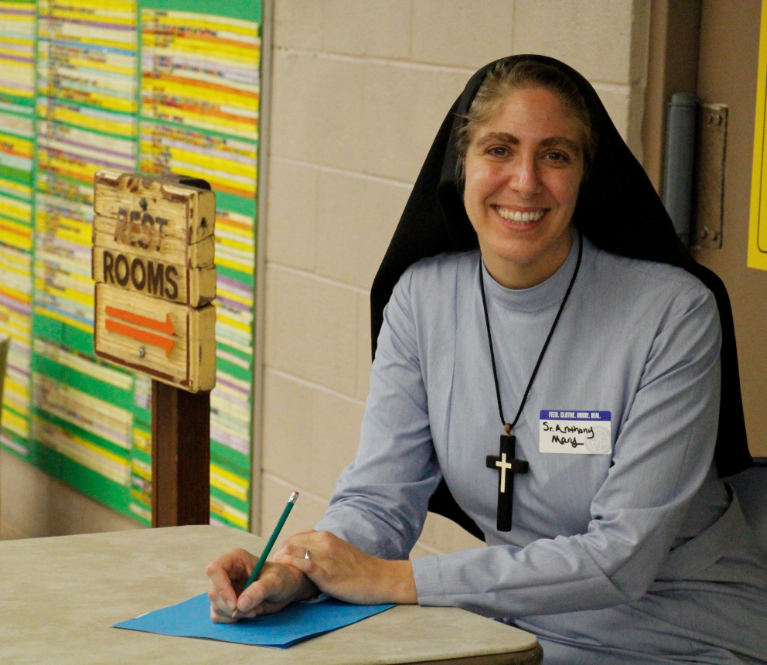
Sr. Anthony Mary Diago, RSM, (Ambria Hammel/CATHOLIC SUN)
Sr. Anthony Mary Diago, RSM, put extra focus on sharing about life as a consecrated religious throughout the Year of Consecrated Life. (Ambria Hammel/CATHOLIC SUN)

A young nun with piercing blue eyes that shine from beneath a dark veil, she spoke of working alongside Fr. Paul Sullivan, diocesan vocations director, to promote consecrated life.

One such endeavor involved planning a vocations day. The celebration was so successful, she has plans to continue it during this year and beyond in both English and Spanish. There was also a Pizza Night with Religious in which religious made and served pizza to families at the St. Vincent de Paul main dining hall. That too will continue in 2016.

“I’ve had women contact me on the average once every two weeks asking for guidance,” Sr. Anthony Mary said. “Definitely there’s interest in religious life.”

Bishop Thomas J. Olmsted’s series in The Catholic Sun about consecrated men and women who became saints was another means of focusing attention during the holy year, Sr. Anthony Mary said. The bishop wrote of many heroic figures, including St. Frances Xavier Cabrini (Missionary Sisters of the Sacred Heart); St. Junípero Serra (Franciscan); and St. Teresa Benedicta of the Cross (Carmelites), among others.

[quote_box_left]

Office of Religious:

Twitter: @oclphoenix

Blog: phxconsecratedlife.com

[/quote_box_left]

Sr. Anthony Mary also brought her office into the digital age during the Year of Consecrated Life. Her Twitter page and blog draw readers who want to know more about what it means to live the life of a religious.

“I’ve gotten a lot followers on Twitter and the blog who are starting to read more about religious life and wanting to know more about it,” Sr. Anthony Mary said.

“I think it sparks curiosity but more than curiosity, a real search for fulfillment in their life and for wanting to understand, what is God asking me for in my life and how can I grow deeper in my faith? They see women religious who are very satisfied by a total surrender to Christ and so they want to have that same joy and satisfaction and this happiness that they know comes from a life lived for Christ.”

The fact that the Year of Consecrated Life overlaps with the Year of Mercy was not lost on the Sister of Mercy.

Screen Shot 2016-01-27 at 11.48.56 AM
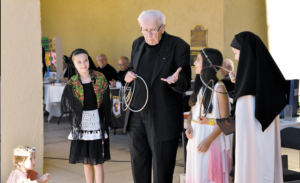
Fr. Jim Blantz, CSC, entertained crowds at two parishes Nov. 1, 2014, with a series of magic tricks as part of a National Vocations Awareness Week celebration. Children were encouraged to come dressed as saints and learn more about holy men and women who lived virtuous lives within vocations to the laity and religious life. (Photo courtesy of Tim Sells, Blessed Sacrament Parish

“I think that the Holy Father definitely calls religious to lead the faithful in living a Christian life and in this case revealing the mercy of God,” she said. “I’m a Sister of Mercy, so in a particular way we are especially called to be dispensers of mercy.”

The Year of Consecrated Life saw Franciscan Father Michael Weldon, OFM, relocate from Milwaukee to the Southwest where he became rector of St. Mary’s Basilica. He hailed the Franciscan Friars who brought the faith to the rugged territory centuries ago.

“We Friars Minor brought the Church to Phoenix. I am so very proud of that settlement. There were heroes and some very committed religious here between ourselves, the Sisters of Mercy and the Sisters of the Precious Blood,” Fr. Weldon said.

His life as a Franciscan, he said, is a bit different from a diocesan priest.

“As a religious and a priest I have had the privilege to see a form of priestly service not always connected to a parish. Religious priesthood is often exercised on the road. It is more itinerant,” Fr. Weldon said.

Often his work has involved ministering to the poor and marginalized, and like all religious, he goes where his superiors send him.

“Our identity as religious presbyters is not to a place, but we move among the presbyters, sometimes only for just awhile, and then take our experience to another local church,” Fr. Weldon said. “Vocations come when we do that well.”

Pope: Patch up family feuds, forgive, let go of painful past

VATICAN CITY (CNS) — Let the Year of Mercy be the time to end all family feuds, to forgive each other and let bygones be bygones, Pope Francis said.

“I think about so many brothers and sisters who are estranged from their families; they don’t speak to each other,” he said during his weekly general audience in St. Peter’s Square Jan. 27.

“This Year of Mercy is a good occasion to meet up again, to embrace each other and forgive each other, to leave bad things behind,” he said.

[quote_box_left]

Photos from general audience

[/quote_box_left]

The pope continued a series of talks dedicated to divine mercy, looking specifically at how God has always been faithful and merciful toward his people.

God never ignored the Israelites’ cry of suffering and he sent Moses as a “mediator” on his behalf to free his people and lead them to salvation, the pope said.

“We can do this work, too, during this Year of Mercy, of being mediators of mercy with works of mercy” that bring people together, foster unity and offer people comfort and relief, he said. There are “so many good things people can do.”

“Mercy can never remain indifferent before the suffering of the oppressed, the cry of those who are exposed to violence, reduced to slavery, condemned to die,” he said.

Such suffering has existed throughout history, including in today’s world, he said, and that can often make people feel “helpless, tempted to harden their hearts and think about other things.”

God, however, is never indifferent, as he always fixes his gaze upon those in pain and intervenes by helping people become aware of and involved in the lives of those who suffer and are oppressed, he said.

In remarks to pilgrims from Iraq and other nations in the Middle East, Pope Francis again highlighted that God is not deaf to the plight of those facing “injustice and persecution.”

God always “intervenes and gives, with his mercy, salvation and assistance,” the pope said. “He practices patience with the sinner in order to bring about conversion and he seeks the lost until they return because he ‘wills everyone to be saved and to come to knowledge of the truth.'”

“May the Lord bless all of you and protect you from evil,” he said.
[quote_box_right]

Lenten retreat program

[/quote_box_right]

The pope also invited Catholic individuals and groups who are involved in charitable service to take part in a day of spiritual retreat.

Individual dioceses will be sponsoring such events during Lent, he said, and he asked people to take advantage of the special occasion to reflect more deeply on God’s mercy and become more merciful.

The pope also greeted German-speaking pilgrims during the audience and welcomed members of the Independent Commission for the Protection of Victims in Austria, including Cardinal Christoph Schonborn of Vienna and Bishop Klaus Kung of Sankt Polten. The national commission was launched by the bishops in 2010 to investigate allegations of sexual abuse by clergy.

By Carol Glatz, Catholic News Service.

Men’s and Women’s conferences to highlight ‘Into the Breach,’ Year of Mercy

Participants at last year’s men’s conference enjoyed a day of fellowship. (CATHOLIC SUN File photo)

[quote_box_right]

Catholic Men’s Conference

When: Feb. 6
8 a.m. Conference
3:30 p.m. Mass

Where: Xavier College Preparatory Performing Arts Center, 4710 N. Fifth St.

Info: cmfp.org

Catholic Women’s Conference

When: Feb. 20
9 a.m. Conference
4:30 p.m. Mass

Where: Xavier College Preparatory Founders Hall

Info: pdccw.org

[/quote_box_right]

While both men and women are created in God’s image as children of God, they are uniquely different and complement each other.

“The complementarity of masculinity and femininity is key to understanding how human persons image God. Without knowing and appreciating this, we cannot know ourselves or our mission as men, nor can women embrace their own vocations, confident in the Father’s love,” wrote Bishop Thomas J. Olmsted in his apostolic exhortation to Catholic men, “Into the Breach.”

These complementary differences are a gift. But because of this, it’s also important that men and women take advantage of opportunities to seek spiritual fellowship within their genders.

In the Diocese of Phoenix, there are two opportunities in February: the Catholic Men’s Conference Feb. 6 and the Catholic Women’s Conference Feb. 20. Both will be held at Xavier College Preparatory.

“The masculine and feminine difference is soul-deep so it makes complete sense that we have different spiritual languages in a way,” said Mike Phelan, director of the diocesan Office of Marriage and Respect Life.

The men’s conference, is using “Into the Breach,” Bishop Olmsted’s document as its theme.

“We hope to bring fuller clarification for the men as to actual steps and things they can directly do as a result of bishop’s call,” said Steve Pettit, co-director of the Catholic Men’s Fellowship of Phoenix, which organizes the conference.

More than 1,300 men are expected to attend the conference, and at press time, there were less than 300 seats available, said Pettit,

In addition to Bishop Olmsted, Auxiliary Bishop Eduardo A. Nevares and Fr. Paul Sullivan, whom Bishop Olmsted has designated as the chaplain to men of the diocese, speakers for the conference include renown evangelist Dcn. Harold Burke-Sivers, critically-acclaimed author Chris Stefanick and local Catholic musician Chris Muglia. Confession will be available and the conference will end with a closing Mass celebrated by Bishops Olmsted and Nevares.

Costs to attend the conference are $56 for individuals, $46 for each member of a group of 10 or more and $33 for students. For those unable to attend the conference, the talks will be available for download for $20.

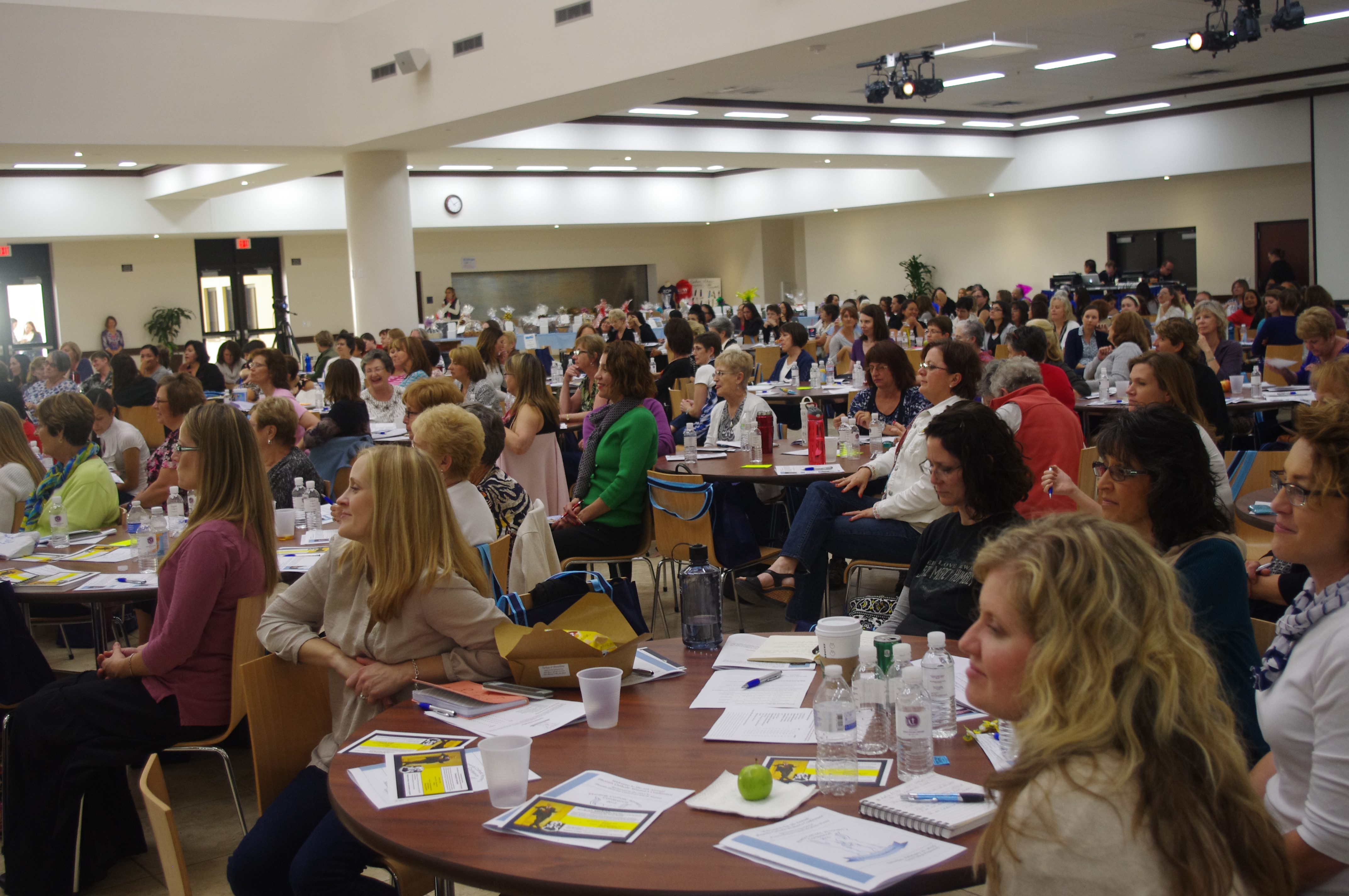
Participants at the 2010 women’s conference enjoyed a day of motivational talks that fortified their faith. (CATHOLIC SUN File Photo)

The women’s conference will have as its theme, “The Lord has crowned you with steadfast love and mercy,” inspired by the Year of Mercy.

“We don’t offer mercy enough to the greater community, and our families and ourselves,” said Roberta Bazaldua, second vice president for the Phoenix Diocesan Council of Catholic Women, which is organizing the conference. “Because women tend to internalize a great deal and maybe not seek healing immediately when they need it, this is one of the reasons mercy isn’t explored in depth.”

Speakers include EWTN anchor Colleeen Carroll Campbell, Catholic blogger Cari Donaldson and Sr. Anthony Mary Diago, RSM, director of the diocese’s Office of Consecrated Life, among others. There will also be an opportunity for confession during the lunch hour, and the day will end with a Vigil Mass celebrated by Bishop Olmsted. Cost to attend the conference is $60.

There is also a youth and young adult track for women between the ages of 16 and 22, “to give our young sisters an opportunity to learn at a level that’s appropriate to them,” Bazaladua said. Cost for those attending this track is $25.

One life, so precious, tells the story of God’s love if only we’ll listen

Patty Chesebrough admires a portrait of the late Fr. John Hanley, the priest who listened and helped her find God’s mercy after she had an abortion. (Joyce Coronel/CATHOLIC SUN)

Driving through a neighborhood once years ago, I remember thinking that behind every door was a person with a story that ought to be told.

I suppose part of that comes from being a pro-lifer: each human life is beloved by God who spilled His precious blood for all humanity — the rich and powerful, the poor and frail, the Hollywood starlet and the beggar on the corner. Each person’s life is unique and worthy of the Father’s love. Each person’s life tells a story.

Joyce Coronel is a regular contributor to The Catholic Sun and author of “A Martyr’s Crown.” Opinions expressed are the writers’ and not necessarily the views of The Catholic Sun or the Diocese of Phoenix.

Journalists are in the story-telling business. We’re called to bring you the latest information, the breaking news, the headlines. As a reporter, you’re in constant motion, chasing down sources, amassing facts and trying to make deadline. A favorite memory comes to mind in that regard: dashing down Washington Street, camera bag slung over my shoulder, credentials flapping the wind, trying to make it to a press conference. Good times!

Beyond the headlines though, there’s a facet of this trade that tells the story of one person’s life. Who is he? What’s his passion? What inspires him? You’ve seen those stories here in the pages of The Catholic Sun under various incarnations through the years, the latest of which is our Missionary of Mercy feature (see page 4).

There’s no quick and efficient way to tell the story of someone’s life, much as a journalist might want to. You block out at least one hour. You sit down face-to-face, ideally in the person’s home or base of operations, and you ask questions designed to probe the heart. What has their life meant? What have they learned? How do they want to be remembered?

Not infrequently, the person sheds a few tears. After all, to answer these questions is to face one’s mortality, one’s regrets. I’ve had people make stark admissions “off the record” mostly because they wanted me to understand who they were in all of their humanity. I take these encounters quite seriously and feel honored that people share their very lives with me, if only for an hour.

This month, I sat down with Patty.

Sitting there, listening to her story, I watched as her eyes filled with tears. Though more than 20 years had passed since her abortion, she still grieved for a child lost, a person whom God created and called into being. Patty encountered the mercy of God through the ministry of Fr. John Hanley, a priest of our diocese who passed away in 2014. She told him her story and he listened.

This telling and listening began a healing process that continues even today. After a time, Patty began to share the love and mercy she encountered through Fr. Hanley. She listened to other women who’d had abortions, allowing them to share their stories.

Now, if you walk down any street in America, you’ll see that most people aren’t listening to each other’s stories or even looking at each other at all — they’re looking at their phones! (I’m including myself in that, by the way.) We’re so busy checking our Twitter feeds and emails and Facebook pages that we often don’t take the time to look into the eyes of the people we encounter.

So here’s my twofold challenge for the New Year. One: Let’s listen to each other more. Make eye contact with your spouse, your children, your neighbor, your co-worker. Listen carefully. Let them tell their story.

Two: Take at least five minutes each day to sit quietly and listen to God. It doesn’t have to be at church, though Eucharistic Adoration is powerful. Simply close your eyes. Surrender yourself to Him completely and ask Him to direct your path and speak to your heart. Then listen.

There’s a Person who lives deep in the silence of your soul. He longs to tell you the story of His love for you, a story that ought to be told with your life.

Seminarian reflects on missionary life in Central America

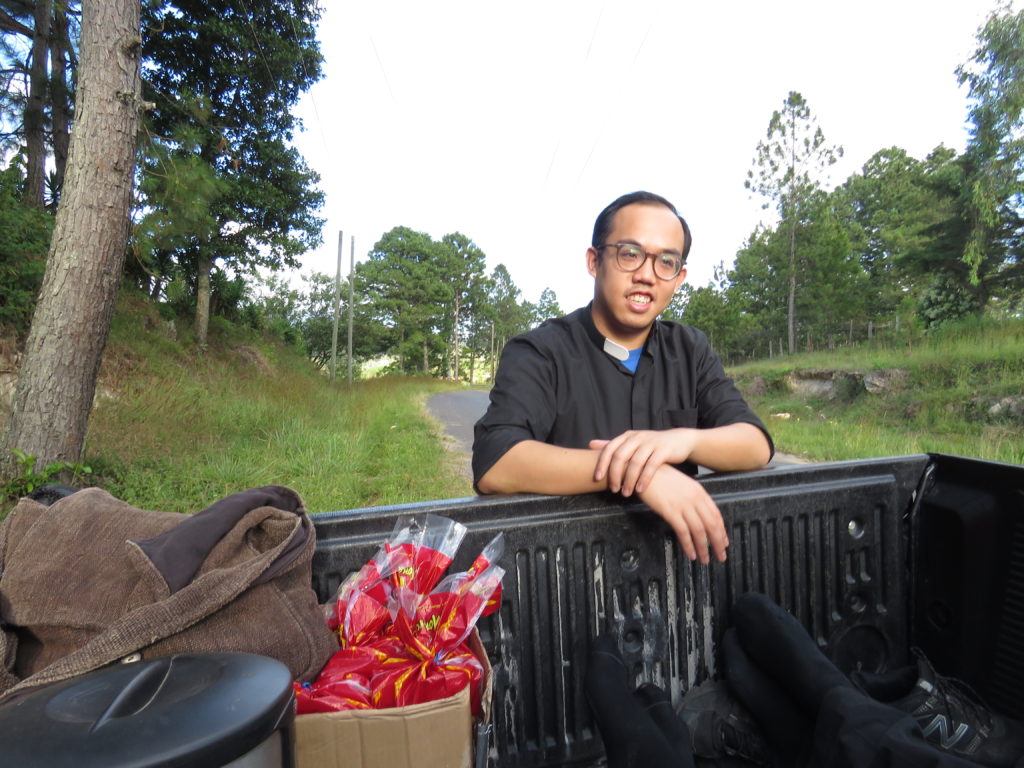
Vinhson Nguyen is a seminarian for the Diocese of Phoenix in his second year of theological studies. He spent Christmas break serving in Central America. (courtesy photo)

[quote_box_center]

“If we are worth anything, it is not because we have more money or more talent, or more human qualities. Insofar as we are worth anything, it is because we are grafted on to Christ’s life, His cross and resurrection. That is a person’s measure.”

— Blessed Archbishop Óscar Romero

[/quote_box_center]

Vinhson Nguyen is a seminarian for the Diocese of Phoenix in his second year of theological studies. He spent Christmas break serving in Central America. (courtesy photo)
Vinhson Nguyen is a seminarian for the Diocese of Phoenix in his second year of theological studies. He spent Christmas break serving in poor Central American villages. (courtesy photo)

As seminarians studying at the Pontifical North American College in Rome, we spend our first three Christmases away from home. It is a difficult reality to accept, however, it affords us some wonderful opportunities to go on missions and pilgrimages. This year, I had the amazing opportunity to take part in a mission trip in Central America.

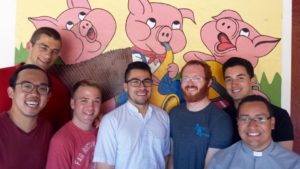
Vinhson Nguyen, left, and fellow seminarians spent Christmas break serving in Central America. (Courtesy photo)

We first settled into the mountain village of Guajiquiro, Honduras after a few hours in the back of a pickup truck, half of the time climbing up a hill on a bumpy dirt road. The instructions we received before heading out to the smaller villages consisted of being ready to offer ourselves in all of our weakness and to be flexible. Flexibility soon became the theme of the rest of our trip; however, we knew we were offering all of ourselves by our exhaustion at the end of each day.

The village of Guajiquiro is connected by dirt road with dozens of smaller aldeas, or villages, each under the care of the pastor of Guajiquiro itself. On our first day of work, we were up by five and out the door by six on our way to the first aldea. We split into three groups, one to work with the children, one to work with the young adults, and the third to work with the adults.

This particular morning I was with the children and what a joy it was. As the entire adult population of the village headed to confession, we sang, danced, and played games. We shared stories from the Bible and led them in a Eucharistic procession. Our time with them ended as the entire community came together to celebrate Mass. In the afternoon, we split up into three groups and each headed to different aldeas.

In each one of these villages, we put on roughly the same program except for certain special celebrations. By the end of the mission trip we celebrated each of the sacraments save for an ordination!

These children had some help from Vinhson Nguyen, a Phoenix seminarian, in preparing for their first reconciliation and communion.  (courtesy photo)
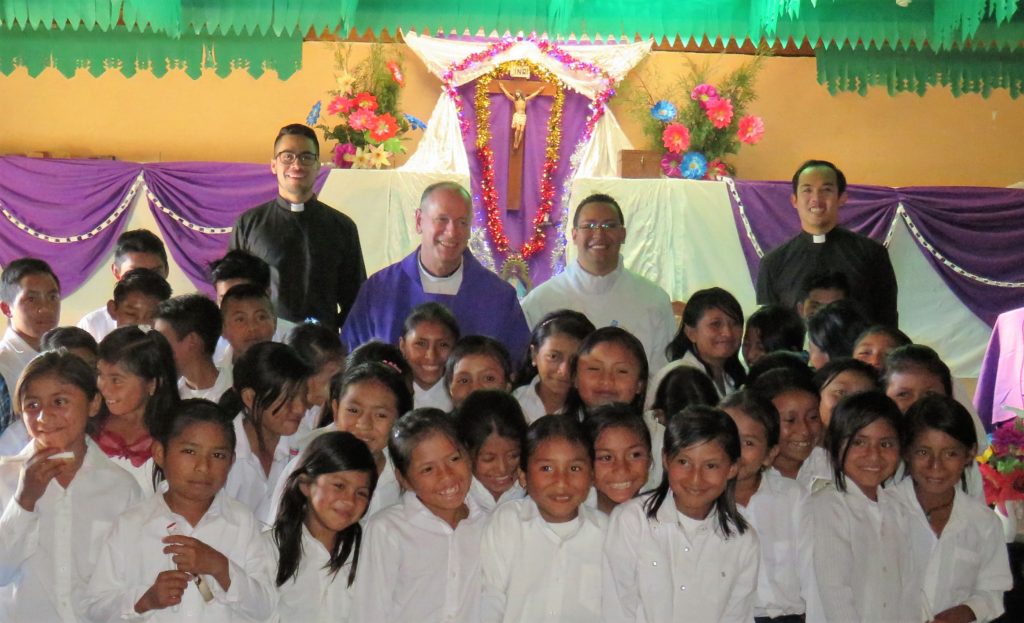
These children had some help from Vinhson Nguyen, a Phoenix seminarian (back row, right), in preparing for their first reconciliation and communion. (courtesy photo)

The most powerful moment I encountered in Honduras occurred in a small village that was not only getting ready for a group of youngsters to receive first Communion and reconciliation, but the wedding of a young couple as well. To prepare for these beautiful sacraments, preceding the Mass, we held a holy hour of prayer in front of the Blessed Sacrament. As part of the holy hour, our deacon, with a veil draped over his shoulders, held the Blessed Sacrament in front of the altar, allowing folks to step forward and pray in front of the True Presence of Jesus Christ.

My simple work was to stand next to the deacon and the Blessed Sacrament and help people up off their knees as they finished praying. The raw love and faith in Christ was unlike anything I have ever witnessed in my life. The faithful began crawling on their knees towards the Eucharist, as tears welled up in their eyes and they cried out their prayers to the Lord. I saw mothers carrying their young children, kneeling in front of the Lord, placing the deacon’s veil on their child’s head offering themselves and their children to the Lord.

The faith of the people in this village and the offering of their powerful prayers hit me to my core. It reminded me of the poor widow who gives two small coins out of her need, her livelihood, rather than her surplus.

Vinhson Nguyen, a seminarian for the Diocese of Phoenix, reads from the pulpit (courtesy photo)
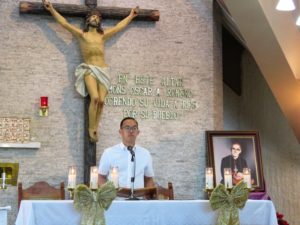
Vinhson Nguyen, a seminarian for the Diocese of Phoenix, reads from the pulpit in the home diocese of Blessed Óscoar Romero. (courtesy photo)

The last part of our trip we traveled to San Miguel in El Salvador. In this urban city, the home diocese of Blessed Óscar Romero, we stayed at the orphanage of San Antonio. A group of Franciscan Sisters runs this particular orphanage that cares for young children through high school age. In addition to this, they sponsor some of the same orphans who work hard enough to enter university. Each one has faced a life full of suffering, now transformed into a life filled with love from the sisters and one another.

One 8-year-old boy witnessed the murder of his father and grew up on the streets. The sisters welcomed him into the orphanage to work with him and help him adjust to life with a roof over his head and a place to lay his head.

When I first arrived at the orphanage, I asked myself what we could do for someone who has suffered so greatly. The answer was that we were to be present to them. Although the sisters do amazing work, the fact of the matter is that the children have little contact with men in their lives. The small amount of time that we spent playing soccer with them, eating Pizza Hut, and celebrating Mass, was impactful and will remain with them for a long time. In a world that is so dark, it helps to be a light in the life of others and to allow them to be a light in your own.

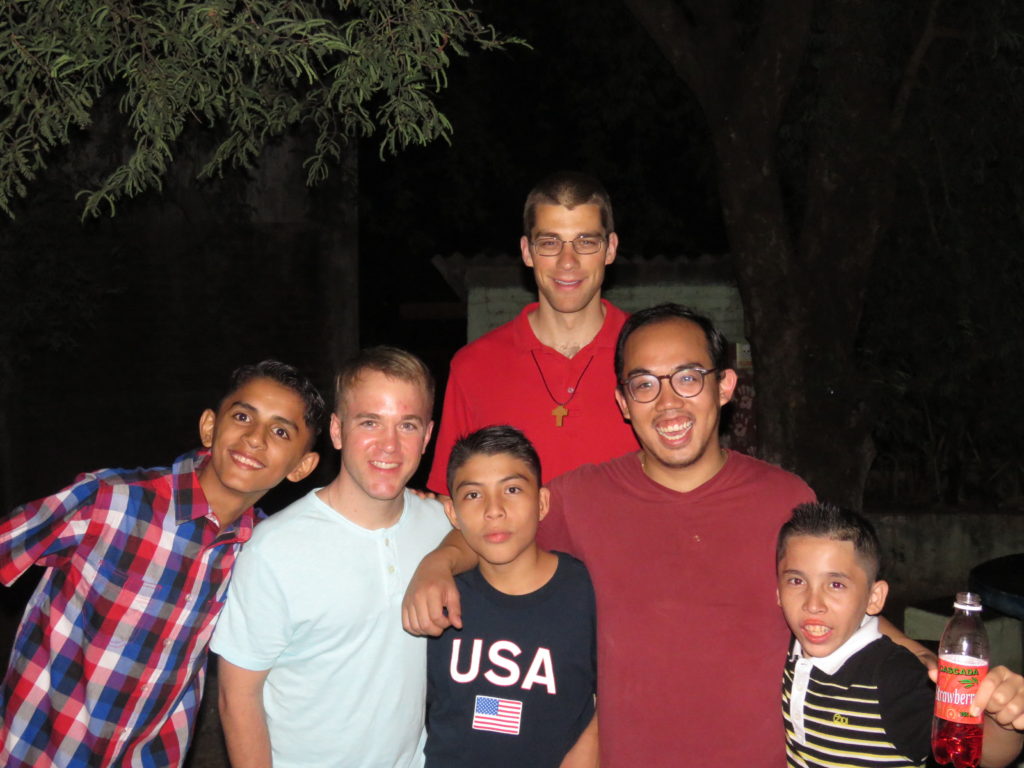
Vinhson Nguyen, second from right, poses with fellow seminarians and children he served in Central America. (courtesy photo)

This mission trip was different from any other I have done. In the past, I would go to places to bring food, clothes, or money. Instead of bringing material things to these people that lack even electricity, we brought Christ to them.

These people of God did not expect us to bring money or clothes but rather they waited patiently, sometimes hours, for the holy Mass and for confession, something that they only get a few times a year. The reality of this caused me to reflect on what it is that we truly need, how we need to live, to keep hold of our dignity, to be holy.

I didn’t return to the seminary more thankful for all of the “stuff” that I have, but rather I came back pondering whether I truly need this or that thing. These communities taught me to ask, “How can I best love and serve the Lord?” To desire a true relationship with Christ for others and for ourselves is how we define love. However, it must not remain a desire; rather, we must put love into action. I ask myself each day, how am I going to bring Christ to my brother seminarians and those that I meet, how will I bring Christ to the people of Phoenix one day, how is my own relationship with Christ? In order to know ourselves and to know others, we need to know Christ.

Vinhson Nguyen joins Central American Catholics for Mass during a mission trip. (courtesy photo)

We spent our last day in Central America in San Salvador, the capital of El Salvador. We visited the place where Blessed Óscar Romero gave his life for his people and his Church. In the midst of a country mired in violence and hatred, Romero knew that in the end, love wins out.

He taught that we find our worth not in earthly things such as money or talents, but rather we find our dignity in the person of Jesus Christ and our ability to live more like Him, in his life, death, and resurrection.

Meeting a people of God that have suffered so greatly and are still willing to walk hours for Mass and confession has greatly encouraged my vocation to the priesthood. We cannot wait around for others to bring Christ to us; we must act first and bring Christ to others. As I progress towards the priesthood, along with my brother seminarians in the Diocese of Phoenix, we not only ask for your prayers but we also ask that you encourage our vocations by living out your own.

— Special to The Catholic Sun by Diocese of Phoenix seminarian Vinhson Nguyen

Fr. Renna Reading Room [VIDEO]

No matter how long it has been since stepping on to a high school campus, this tour of the new reading room at Brophy College Preparatory should bring back some memories. It might even inspire some innovative ways to decorate the walls of your reading nook.

Grand jury indicts leaders behind undercover Planned Parenthood videos

HOUSTON (CNA/EWTN News) — A Houston grand jury on Monday indicted the leaders behind the undercover videos which exposed Planned Parenthood’s role in offering fetal tissue for compensation. The grand jury had been investigating alleged misconduct by Planned Parenthood.

David Daleiden, project lead at the Center for Medical Progress, and fellow worker Sandra Merritt were indicted Jan. 25 on a second-degree felony charge of “tampering with a governmental record.”

Daleiden was also indicted for a misdemeanor charge of “purchase and sale of human organs,” according to Brian M. Rosenthal of the Houston Chronicle.

The Center for Medical Progress issued a statement saying it “uses the same undercover techniques that investigative journalists have used for decades in exercising our First Amendment rights to freedom of speech and of the press, and follows all applicable laws. We respect the processes of the Harris County District Attorney, and note that buying fetal tissue requires a seller as well. Planned Parenthood still cannot deny the admissions from their leadership about fetal organ sales captured on video for all the world to see.”

Back in August, the Harris County district attorney Devon Anderson had announced a criminal investigation into Planned Parenthood after a video released by the Center for Medical Progress showed the director of research for Planned Parenthood Gulf Coast, based in Houston, discussing how abortion procedures could be altered to better obtain “intact” fetal tissue for harvesters.

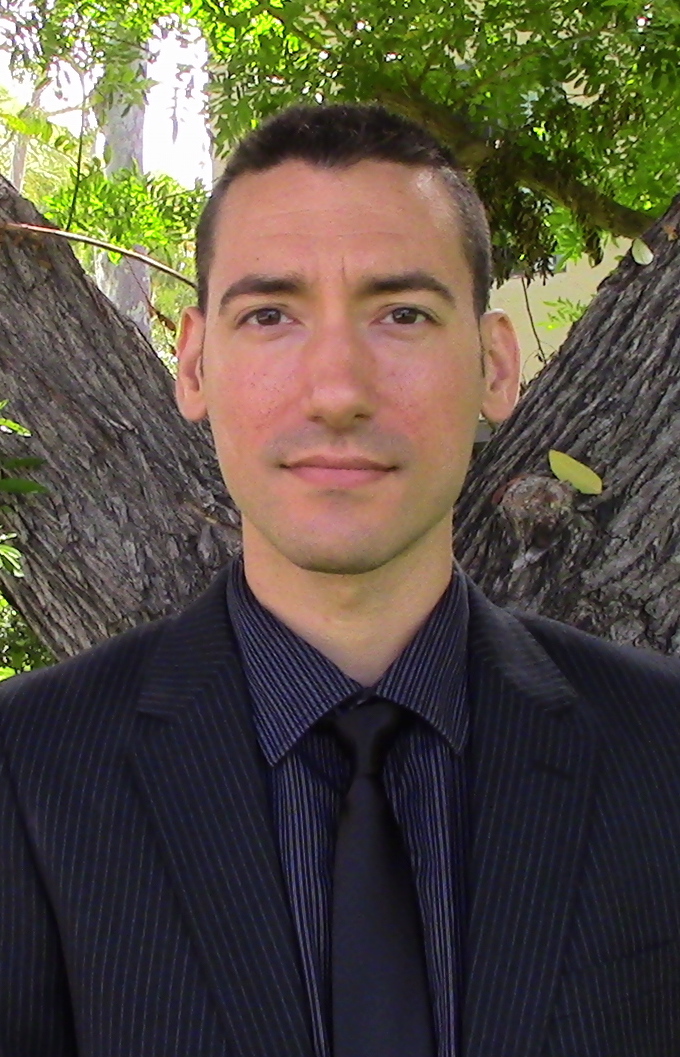
David Daleiden, who filmed undercover videos of Planned Parenthood officials discussing the sale of human tissue from aborted children, was indicted by a grand jury in Houston for "tampering with a governmental record" and the "purchase and sale of human organs." Daleidan has maintained that the methods he used in obtaining the footage was a standard practice used by undercover journalists and was protected by the First Amendment. (Photo courtesy of Center for Medical Progress)
David Daleiden, who filmed undercover videos of Planned Parenthood officials discussing the sale of human tissue from aborted children, was indicted by a grand jury in Houston for “tampering with a governmental record” and the “purchase and sale of human organs.” Daleidan has maintained that the methods he used in obtaining the footage was a standard practice used by undercover journalists and was protected by the First Amendment. (Photo courtesy of Center for Medical Progress)

Daleiden and Merritt had posed as representatives of a biologics company, meeting with Farrell to discuss possible transactions of fetal tissue.

According to her July 29 testimony before the Texas Senate, former Planned Parenthood Gulf Coast clinic director Abby Johnson claimed that the clinic made up to $120,000 per month off of fetal tissue transactions.

On Monday, however, the grand jury announced that instead of indicting Planned Parenthood, they were indicting Daleiden and Merritt.

Anderson announced that “we must go where the evidence leads us,” according to the Houston Chronicle.

Texas Governor Greg Abbott announced afterward that the indictment would not alter the state’s investigation into Planned Parenthood.

Rep. Diane Black (R-Tenn.), a former nurse, called it “a sad day in America when those who harvest the body parts of aborted babies escape consequences for their actions, while the courageous truth-tellers who expose their misdeeds are handed down a politically motivated indictment instead.”

Last summer, the Center for Medical Progress released a series of undercover video interviews with Planned Parenthood officials as an exposé of the role the organization and its affiliates played in the transfer of fetal tissue to harvesters for compensation.

Federal law generally prohibits the sale of fetal tissue, but allows for “reasonable” compensation for the donation of tissue from aborted babies for research. This compensation would cover expenses like operating and transportation costs. The compensation cannot be for “valuable consideration.”

Planned Parenthood has maintained that its affiliates have acted within the law. The Center for Medical Progress has claimed that the organization broke the law by earning unlawful profits from the transactions.

Both House and Senate committees have launched investigations into the organization for wrongdoing, and the House has created a special investigative committee for that purpose, but no evidence has yet been publicized confirming the accusations.