
Catholic Diocese of Phoenix Announces New Appointments

Bishop John P. Dolan (center) has appointed Fr. John R. Muir (far right) as vicar general and moderator of the curia and Dr. Maria Chavira (left) as vice-moderator of the curia in addition to her current role as chancellor. They are pictured here with Most Rev. Eduardo A. Nevares, Auxiliary Bishop of Phoenix, and outgoing vicar general and moderator of the curia, Fr. Fred Adamson.

Bishop John P. Dolan Appoints New Leadership Roles at Diocesan Pastoral Center

PHOENIX (Nov. 7, 2022) – Bishop John P. Dolan, who was installed as the new bishop of the Roman Catholic Diocese of Phoenix on August 2, announced two new key leadership roles at the Diocesan Pastoral Center. The new appointments include Fr. John R. Muir as moderator of the curia and vicar general and Dr. Maria Chavira to serve as vice-moderator of the curia, in addition to her current role as chancellor. Fr. Muir, who will replace Fr. Fred Adamson in both roles, assumes his new duties on Jan. 1, 2023, while Dr. Chavira’s new title is effective immediately.

“Fr. Muir holds the esteem of the faithful in this diocese and will be a blessing to me, the Diocesan Pastoral Center, and the Diocese of Phoenix,” said Bishop Dolan. “I am equally grateful to Dr. Chavira for her outstanding leadership, and I look forward to her future service as chancellor and vice-moderator of the curia.”

Fr. Muir has been the pastor at St. Thomas Aquinas Parish in Avondale since 2015 and has also led the Diocese of Phoenix’s Office of Worship for the past two years. He played an instrumental role in the liturgical planning of Bishop Dolan’s Installation Mass in August. A native of South Burlington, Vt., he moved with his family to Arizona in 1989 and later graduated from Arcadia High School where he was a multi-sport athlete and musician.
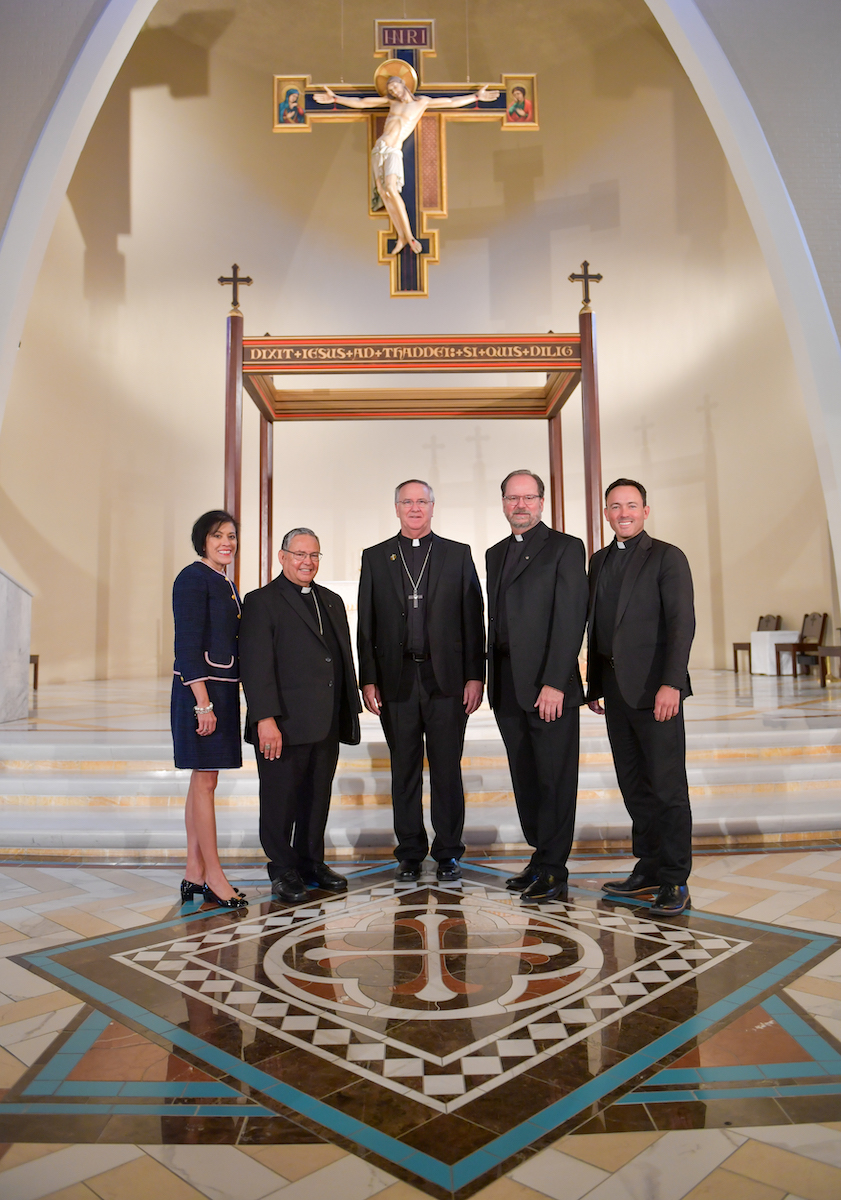
Bishop John P. Dolan (center) has appointed Fr. John R. Muir (far right) as vicar general and moderator of the curia and Dr. Maria Chavira (left) as vice-moderator of the curia in addition to her current role as chancellor. They are pictured here with Most Rev. Eduardo A. Nevares, Auxiliary Bishop of Phoenix, and outgoing vicar general and moderator of the curia, Fr. Fred Adamson.

After attending Regis University and St. John Vianney Theological Seminary in Denver, and Mundelein Seminary in Chicago, Fr. Muir was ordained a priest in 2007. He has served in various roles at St. Joan of Arc Parish in Phoenix (2008-2010), Xavier College Preparatory in Phoenix (2008-2011), All Saints Newman Center in Tempe (2010-2013), St. Rose Philippine Duchesne in Anthem (2013-2015), Good Shepherd Mission in New River, and St. Michael Mission in Gila Bend.

“I am grateful to Bishop Dolan for his invitation to serve in these new roles and delighted to say yes to him,” said Fr. Muir. ”The love of Jesus in the Church is the gift everyone needs, and I am energized by any chance to help each one of us to abide in that love.”

Dr. Chavira, who earned a Ph.D. in Educational Psychology from The University of Arizona, is believed to be the first woman to be named a vice-moderator of the curia.  She has served the Diocese of Phoenix as the chancellor for the past nine years, being appointed by Bishop Thomas J. Olmsted in 2013 and becoming one of the first Latina women in the Catholic Church to serve in that role.

“Bishop Dolan is encouraging us to live out the universal call to holiness emphasized by our Holy Father and proclaimed by the Second Vatican Council,” Dr. Chavira shared in a statement to The Catholic Sun. “In the last three months, he has reminded us of our baptismal identity as priest, prophet and king. I pray that the Lord may continue to guide me as I serve in a new leadership role to bring others to Christ and help them live their baptismal call alongside Bishop Dolan and Fr. Muir.”

Mother, wife, leader: Chavira’s personal and professional life reflect her ‘witness of Christ’

Fr. Fred Adamson will remain active in ministry at the Diocesan Pastoral Center through February, at which point he will take a six month sabbatical – in part to care for ailing parents – before returning to a yet-to-be-determined parish assignment in the Diocese of Phoenix.

“Fr. Adamson has served this diocese in many capacities over the last 19 years and has faithfully assisted Bishop Olmsted and me in the governance of our Diocese as Vicar General and Moderator of the Curia,” added Bishop Dolan. “In my first three months as the bishop, I have come to appreciate Father Adamson’s attention to detail, and his tenacity in seeing projects fulfilled, all while maintaining a prayerful love for his priestly ministry. I ask you to please pray for Fr. Adamson, Fr. Muir, and Dr. Chavira during this time of transition.”

The Roman Catholic Diocese of Phoenix consists of 94 parishes, 23 missions, 29 elementary schools, seven high schools, three universities, and one seminary, and is one of the fastest growing dioceses in the United States, with an increase of over 300,000 Catholics in the past 10-years alone.  The Diocese of Phoenix is comprised of Mohave, Coconino (except Navajo Indian Reservation), Yavapai, and Maricopa Counties, and the Gila Indian Reservation in the State of Arizona for a total of 43,967 square miles.


U.S. bishops launch new approach to teaching the faith

Bishop Frank J. Caggiano of Bridgeport, Conn., is seen in this Oct. 1, 2020, file photo. He is chairman of the U.S. bishops' Subcommittee on the Catechism. (CNS photo/Gregory A. Shemitz)

By Carol Zimmermann, Catholic News Service

WASHINGTON (CNS) — Catholic church leaders are taking a new approach to passing on the faith, saying they recognize a pressing need to do this in a way that adapts to the modern world.

This new outreach, called the Institute on the Catechism, is not a place but instead a new springboard for faith formation developed by the U.S. Conference of Catholic Bishops’ Subcommittee on the Catechism.

It will involve catechetical publishers working directly with the USCCB subcommittee on new ways to pass on the faith using digital tools and aiming to reach a more diverse church. It will also provide resources to dioceses and yearly, in-person training conferences and retreats for diocesan catechetical leaders.

As Bishop Frank J. Caggiano of Bridgeport, Connecticut, chairman of the bishops’ Subcommittee on the Catechism, sees it: Catholic parishes need to re-create a “Catholic culture that recognizes we’re in the 21st century. We can’t go back to 1950; it’s gone.”

Re-creating what he describes as a “radically different model” for teaching the faith is something he has been working on with this subcommittee for the past several years.

The bishop announced the proposal to create the institute at the bishops’ spring meeting last June. It will officially launch Nov. 10-12 just ahead of the bishops’ annual fall meeting in Baltimore.

This new approach, starting on the 30th anniversary of the Catechism of the Catholic Church, draws inspiration from Pope Francis’ 2021 document “Antiquum Ministerium” (“Ancient Ministry”) that described catechesis as an official church ministry. It also builds on the Vatican’s Directory for Catechesis, issued in 2020, that gives guidelines for catechists and pastors particularly in the role of evangelization.

The most frequently used description for the Institute on the Catechism is evangelizing catechesis.

In explaining this to Catholic News Service Oct. 19, Bishop Caggiano said this new method will emphasize truth, beauty and goodness and it “recognizes that the passing on of the faith is no longer in a Catholic culture but in a secular and hostile culture toward Christian faith.”

He said the institute’s mandate is to “create multiple opportunities where a young person can encounter Christ in an ongoing way” and have the “leadership of the church and their parents accompany them.”

In other words, it’s not just religious education through textbook learning or even service projects but a more concentrated effort to engage young people with the church and provide role models for them with diocesan and parish resources to facilitate this. One of the hopes is that these youths will in turn reinvigorate the church.

In a previous interview with CNS about this project, catechetical consultants said the institute has the potential to change the fundamental relationship between publishers and bishops into something that’s less reactive to a finished product and more collaborative.

Mike Raffio, vice president director of sales for Pflaum Publishing Group and the president of the Association of Catholic Publishers, said leading people to a meaningful encounter with Christ through catechesis and an understanding of their role in the mission of the church is something many catechetical materials attempt. “But we must admit our own limitations,” he added.

“Any person’s faith development is a lifelong journey. That journey, even for young people, includes so many more variables than catechetical texts can be expected to provide,” he said.

Similarly, Sabrina Magnuson, a catechetical consultant for Loyola Press, said the institute’s aim of forming leaders who will in turn inspire and form parents, teachers and catechists in their home diocese is a daunting prospect.

“At the end of the day, the textbook is a resource, a tool,” she said. “Encounter is so much more than that.”

Bishop Caggiano said about 17 bishops plan to attend the institute’s launch, committing to using this new model in their dioceses, and he hopes more dioceses will join next year.

In the meantime, he said, participating dioceses will get the support they need to get this work started. It will also be a learning experience for all participating dioceses and a time to come to a deeper understanding of what parishes really need to make this work.

“It has to be the work of the Holy Spirit,” he added, and he also said it will need financial support that he hopes to get from those who want to be partners in this effort.


French cardinal admits to abusing teen girl 35 years ago

French Cardinal Jean-Pierre Ricard of Bordeaux is pictured in a 2013 photo at the Vatican. He has admitted to abusing a 14-year-old girl 35 years ago. (CNS photo/Max Rossi, Reuters)

LOURDES, France (CNS) — French Cardinal Jean-Pierre Ricard, former head of the French bishops’ conference, admitted to abusing a 14-year-old girl 35 years ago.

The revelation came in a letter from Cardinal Ricard read by Archbishop Eric de Moulins-Beaufort of Reims, president of the bishops’ conference, during a news conference on abuse Nov. 7, during the French bishops’ general assembly.

The cardinal said the “reprehensible” action occurred when he was a priest, and he said his behavior “has necessarily caused serious and lasting consequences for this person.”

He said he asked the woman for forgiveness and asked for forgiveness from her family. He also said he was going on retreat to pray.

“This is a difficult process. But what comes first is the suffering experienced by the victims and the recognition of the acts committed,” he said.

“Finally, I ask forgiveness to those whom I have hurt and who will live this news as a real test,” he said.

The cardinal did not provide additional details.

He is a member of the Dicastery for the Doctrine of the Faith, the Vatican office charged with investigating clerics accused of abuse.

Archbishop Moulins-Beaufort said the cardinal was among 11 bishops or former bishops who are being or have been investigated by church or judicial authorities for abuse.

Four days earlier, the archbishop had rearranged the bishops’ schedule to deal with abuse and urged his fellow bishops to have as their first concern “the victims, those who spoke out two years ago and more recently, and those, perhaps, who have not yet made themselves known.”

The archbishop was referring to the case of retired Bishop Michel Santier of Créteil. When the Vatican announced in 2021 that the bishop was retiring, the bishop had said it was for health reasons. No one contradicted him publicly until mid-October, when the Diocese of Créteil confirmed he had been credibly accused of sexual misconduct and disciplined by the Vatican.

The bishops, who were meeting in Lourdes, acknowledged the sense of betrayal felt by people in the Diocese of Créteil, the archbishop said, as well as “the anger, shame, discouragement and weariness of the most committed faithful, deacons, priests, seminarians.” Those feelings, he said, are “reaching a new level, no doubt unbearable for some.”

“All of us are shaken, personally and in our apostolic authority in the service of the Lord Jesus and the people of God, by suffering a collective criticism for a matter that most of us have had nothing to do with,” he said.

The Vatican did not immediately say what, if any, disciplinary measures would be taken against 78-year-old Cardinal Ricard, who retired in 2019 as archbishop of Bordeaux. The possibilities range from being ordered to live a life of prayer and penance out of the public view to being removed from the College of Cardinals or even from the priesthood, although that usually is a punishment reserved to serial abusers.

In the 1990s, Austrian Cardinal Hans Hermann Groër was forced to step down as archbishop of Vienna and eventually to relinquish all public ministry after allegations of the sexual abuse and harassment of seminarians and priests; he died in 2003 without having undergone a canonical trial.

Pope Benedict XVI forced Scottish Cardinal Keith O’Brien to step down as archbishop of St. Andrews and Edinburgh in early 2013; after an investigation, Pope Francis withdrew his “rights and duties” as a cardinal, although he retained the title until his death in March 2018.

And, in the case of Theodore E. McCarrick, the former cardinal and archbishop of Washington, Pope Francis initially suspended him from ministry and removed him from the College of Cardinals in 2018 after an investigation found “credible and substantiated” allegations of abuse. The pope removed him from the priesthood in 2019 after a Vatican trial found him guilty of “solicitation in the sacrament of confession and sins against the Sixth Commandment with minors and with adults, with the aggravating factor of the abuse of power.”


Despair over declining numbers shows lack of faith, pope tells religious

Pope Francis blesses a nun during an audience at the Vatican with students and staff of the Claretian Institute of the Theology of Consecrated Life in Rome, Nov. 7, 2022. (CNS photo/Vatican Media)

VATICAN CITY (CNS) — Aging or declining membership should prompt members of religious orders to ask, “What do we do?” but not to despair, Pope Francis said.

Numbers are a real challenge, but “those who get caught up in pessimism put faith aside,” the pope told students and staff of the Claretian Institute of the Theology of Consecrated Life in Rome and its affiliated programs in the Philippines, India, Colombia and Nigeria.

“It is the Lord of history who sustains us and invites us to faithfulness and fruitfulness,” the pope insisted Nov. 7. “He takes care of his ‘remnant,’ looks with mercy and benevolence on his work, and continues to send his Holy Spirit.”

Pope Francis was helping the students and staff celebrate the 50th anniversary of the institute, which specializes in theology, spirituality and canon law specifically for and regarding religious orders.

“The more we approach religious life through the Word of God and the history and the creativity of the founders,” the pope said, “the more we are able to live the future with hope.”

The pope, a Jesuit, told the group that “religious life is understood only by what the Spirit does in each of the people called. There are those who focus too much on the external — the structures, the activities — and lose sight of the superabundance of grace that there is in the people and the communities.”

With most religious orders having elderly members, Pope Francis also used his speech to the institute to plead with religious communities to make sure that older members are not sent off to a home where they have no contact with younger members — “this is a crime,” he said.

“The young need to spend time with the elderly, talk with them and the elderly members need to be with the young,” he said.


In Bahrain, pope sees joy of Catholic minority, deepens ties with Muslims

Sheikh Ahmad el-Tayeb, grand imam of Egypt's Al-Azhar mosque and university, Pope Francis and Bahrainís King Hamad bin Isa Al Khalifa arrive for the Bahrain Forum for Dialogue: East and West for Human Coexistence, Nov. 4, 2022, in Al-Fida' Square at Sakhir Palace in Awali, Bahrain. (CNS photo/Hamad I Mohammed, Reuters)

By Carol Glatz, Catholic News Service

AWALI, Bahrain (CNS) — Traveling as a “sower of peace” to the Kingdom of Bahrain, Pope Francis further strengthened ties with the Muslim world and witnessed the joy and vitality of its minority and predominately expatriate Christian population.

His message promoting the peaceful coexistence of different cultures and ethnicities also included the wider Persian Gulf region, which is also increasingly more diverse due to growing communities of migrant workers, who constitute a significant percentage of the population.

The 85-year-old pope’s visit to Bahrain Nov. 3-6 was his 39th international trip in nearly 10 years as pope and his 13th trip to a Muslim-majority nation, reflecting his deep commitment to interreligious dialogue and the need to work together to face today’s global challenges and moral crises.

The pope’s first stop in Awali Nov. 3 was Sakhir Palace, home of King Hamad bin Isa Al Khalifa and the royal family.

Meeting with authorities, members of the diplomatic corps and local representatives at the palace, the pope said, “The numerous national, ethnic and religious groups that coexist in Bahrain testify that we can and must live together in our world.”

He commended the kingdom’s efforts to promote mutual respect, tolerance and religious freedom. However, he said more should be done to: offer equal opportunities to all groups and individuals; counter discrimination; protect immigrant workers; guarantee human rights; and abolish the death penalty.

The following day was the busiest for the pope, whose chronic knee pain had worsened, keeping him in a wheelchair when he needed to move around and seeing him stand only briefly with a cane for support.

Pope Francis helped close the Bahrain Forum for Dialogue: East and West for Human Coexistence, an event sponsored by the king, Nov. 4 in Al-Fida’ Square at the palace.

Riding in a compact white Fiat with Vatican City plates, the pope was accompanied through the lush green oasis of the palace’s walled compound by royal guards on horseback. The pope was then invited to pour water from a metal pitcher onto the base of a large palm tree.

He told representatives of different religions and international leaders that “it is our duty to encourage and assist our human family,” especially those who are neglected by the powerful: the poor, the unborn, the elderly, the infirm and migrants.

God wants his children to be “one family, not islands, but one great archipelago,” like Bahrain, the pope said. The world can “only advance by rowing together; if we sail alone, we go adrift.”

Later in the day in the courtyard of the palace’s mosque, the pope addressed Sheikh Ahmad el-Tayeb, grand imam of Egypt’s Al-Azhar mosque and university, and top representatives of the Muslim Council of Elders, an international group of Islamic scholars and experts.

He encouraged those working to avoid divisions and conflicts in Muslim communities, to promote mutual respect, tolerance and moderation, and to dispel “erroneous interpretations that, through violence, misconstrue, exploit and do a disservice to religious belief.”

“The God of peace never brings about war, never incites hatred, never supports violence,” he said. Peace is built with “encounter, patient negotiations and dialogue,” and it is based on justice.

Prayer and fraternity “are our weapons,” Pope Francis said, again condemning the world’s arms trade, calling it “the ‘commerce of death’ that, through ever-increasing outlays, is turning our common home into one great arsenal.”

“Unity in diversity and witness of life” was the central theme of the pope’s talk at Our Lady of Arabia Cathedral, the largest cathedral in the Persian Gulf region, for an ecumenical meeting and a prayer for peace. Many local Christians and Catholics were in attendance as well as King Al Khalifa, Orthodox Ecumenical Patriarch Bartholomew of Constantinople and other dignitaries.

The new cathedral serves the Apostolic Vicariate of Northern Arabia, which includes Bahrain, Kuwait, Qatar and, formally, Saudi Arabia, and was built in response to the Gulf region’s increasing Catholic population, now estimated at 2.5 million.

The pope traveled Nov. 5 to Bahrain National Stadium to celebrate Mass for the more than 20,000 foreign residents working in Bahrain and thousands more from neighboring countries, all together representing more than 100 different nationalities.

“This very land is a living image of coexistence in diversity, and indeed an image of our world,” the pope said in his homily.

He encouraged the faithful to live as “children of the Father and build a world of brothers and sisters.” They must “learn how to love everyone, even our enemies,” and find the courage to take the risk of overcoming evil with good.

That evening he went to Sacred Heart School, whose 1,215 students represent 29 different nationalities, cultures, languages and religious backgrounds. A choir treated the pope to Christian songs and another group of boys and girls showcased a traditional Bahraini dance.

The pope praised their enthusiasm and openness, saying, “As I look out at you, who are not all of the same religion and are not afraid of being together, I think that without you this coexistence of differences would not be possible.”

On his last day Nov. 6 in the kingdom, the pope prayed and spoke with bishops, priests, religious, seminarians and pastoral workers from the Persian Gulf region at Sacred Heart Church in Manama.

Again, he pressed the need for Catholics in the region to be guardians and builders of unity, reaching out to dialogue with others and living as brothers and sisters.


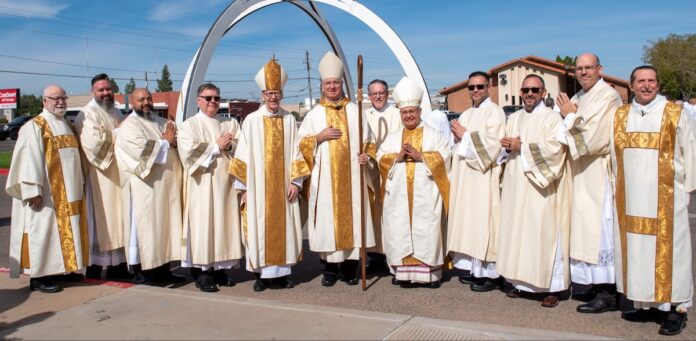
NEWS BRIEF: Seven men ordained to serve through the permanent diaconate

On Saturday, November 5, Most Rev. John P. Dolan, Bishop of Phoenix, ordained seven men to the permanent diaconate.

Seven new deacons eager to lead others to deeper relationship with Christ

Pope: Chauvinism kills human progress; fight for equal rights must go on

Pope Francis speaks with reporters on the flight back to Rome from Bahrain Nov. 6, 2022. (CNS photo/Maurizio Brambatti pool via Reuters)

By Carol Glatz, Catholic News Service

ABOARD THE PAPAL FLIGHT FROM BAHRAIN (CNS) — A society that does not give women the same rights and opportunities as men will become impoverished, Pope Francis said at the end of a four-day visit to Bahrain.

“Women are a gift,” he said. After God made man, he didn’t create “a lapdog for him to play with. No, he created two who are equal, a man and a woman.”

“All the rights of women stem from this equality,” he said, and a society that is not able to make room for women “does not move forward.”

The pope was speaking Nov. 6 to reporters in response to their questions after visiting the Muslim-majority nation of Bahrain in the Persian Gulf.

The aim of the trip, he said, was to experience moments of encounter and dialogue, with Muslims, Christians and Catholics. The majority of all residents are foreigners from many different countries, cultures and religions.

As a result of these moments of encounter and talks, he said, he learned something new, that this small nation boasts “a culture open to everyone” with “room for everyone,” including women, who, for example, all have the right to work.

The pope was then asked about the protests in Iran, which were sparked by young women and men fighting for more freedoms and reforms in the Shiite-led country, and whether he supported their efforts of demanding fundamental human rights.

He said, “The fight for rights for women is an ongoing battle because, in some places, women have achieved rights equal to men” and, elsewhere, they lag behind.

It was also not that long ago, he added, that women had to fight for the right to vote in his home country of Argentina, and women in the United States also had to battle for their right to vote.

“But why, I ask, do women have to fight like this to keep her rights?” he said.

Another violation that must be stopped, he said, is female genital mutilation. “How is it that in the world today we cannot stop” this practice? “It is a crime, a criminal act.”

The pope asked, “Are women objects to use and throwaway? This is terrible, right? Or are they a protected species?”

Instead it is a question of equality, which still has not been universally achieved, he said. Unfortunately, in some places, women are still considered and treated as “second-class” citizens or worse, and “we have to keep fighting this.”

Women are not inferior, “they are complementary,” he said, and this also means women should be bringing their own unique gifts and talent and must not try to be like men.

“A society that erases women from public life is a society that becomes impoverished,” he said.

“Equal rights, yes, also equal opportunities, equality in moving forward,” he said.

There is still a long way to go, he said, because there is so much chauvinism, which “kills humanity.”

The pope was asked whether the church was considering a change in the way it handles known perpetrators of abuse and those found guilty of its cover-up, specifically by making public those who have been sanctioned by the church when found guilty.

The pope did not address the question of providing greater transparency, but he said, “We are working in every way we can.”

“But we well know that there are people in the church who do not see things clearly, who do not agree,” so it is “a process” that requires courage, he added.

“The desire of the church is to clarify everything. For example, I received in the last few months two complaints of abuse that were covered up and the church did not handle it properly, so immediately I said to look into it again” and it will be re-investigated. So there will be a revisiting of judgments that were not handled well, he said.


How prisoners are treated reflects level of dignity, hope of society, pope says

Pope Francis and Bahrainís King Hamad bin Isa Al Khalifa greet each other at a farewell ceremony for the pope at Sakhir air base in Awali Nov. 6, 2022. At far right is Sheikh Ahmad el-Tayeb, grand imam of Egypt's Al-Azhar mosque and university. (CNS photo/Vatican Media via Reuters)

By Carol Glatz, Catholic News Service

MANAMA, Bahrain (CNS) — Seek to be guardians and builders of unity, reaching out to dialogue with others and living as brothers and sisters, Pope Francis told the Catholic faithful and their bishops and priests from throughout the Persian Gulf.

And, he said, be prophetic, attentive “interpreters of reality, capable of perceiving God’s presence amid the frequently obscure course of history and making it known to the people.”

“The words of the prophets are often scathing: they call by name the evil designs lurking in the hearts of the people; they call into question false human and religious certainties, and they invite everyone to conversion,” the pope said Nov. 6, his final day in Bahrain.

The pope thanked Sister Rose Celine, a member of the Sisters of the Apostolic Carmel, for her testimony about her congregation’s work in girls’ education, faith formation and prison ministry.

People should be grateful for the works of mercy carried out for those in prison, the pope said, bringing them consolation, “sharing time with them, breaking open the word of God and praying with them.”

“Caring for prisoners is good for everyone, as a human community, since the way in which these ‘least ones’ are treated is a measure of the dignity and the hope of a society,” he told the small crowd, which included Bahrain’s minister of justice.

As he did throughout his visit, Pope Francis emphasized the importance of the unity of Bahrain’s diverse Catholic community, made up mostly of foreign workers.

“I know that you are already offering a good example of walking this path, but fraternity and communion are gifts that we must never tire of imploring from the Spirit,” he said. “In this way, we can fend off the enemy who always sows weeds.”

For the last stop of his four-day journey, Pope Francis chose to visit Sacred Heart Church, which was consecrated in 1939 and was the first church built in a Gulf nation. The bishops, priests, religious men and women, seminarians, catechists, volunteers and other lay faithful gathered there were representing about 60 priests and 2 million Catholics spread across four countries: Kuwait, Qatar, Saudi Arabia and Bahrain. Also present were Catholics representing Lebanon and other Middle Eastern countries.

In Bahrain, like other Muslim-majority countries, the weekend is Friday and Saturday; Sunday is the start of the work week, so Pope Francis celebrated his main public Mass Nov. 5 and led a prayer service and the recitation of the Angelus with a smaller group in the Manama church the following day.

In his homily, the pope said it is the Holy Spirit “who refreshes our deserts and restores life to what is parched, who washes away all that soils us and quenches our thirst for happiness.”

Everything flows from the spirit, he said, and Christians must always pray for the Spirit’s gifts, such as joy, unity and prophecy, so that they may receive these gifts and reflect them in their lives.

To be prophetic is to receive the light of the Holy Spirit to become attentive and capable interpreters of reality, making God’s presence known to the people, the pope said.

“Prophecy makes us capable of putting the beatitudes into practice in everyday situations, building meekly, yet resolutely God’s kingdom, in which love, justice and peace are opposed to every form of selfishness, violence and degradation,” he said.

Bishop Paul Hinder, administrator of the Apostolic Vicariate of Northern Arabia, told the pope about the joyful yet also difficult life of a “migrant church.” Coming from many different countries and ethnicities, “many are struggling daily, but they do so with deep faith,” trusting in the Lord.

The 1,300 catechists throughout the region all work as volunteers, “sometimes under very difficult conditions because of the restrictions in some countries regarding religious freedom, work permits and residency permits,” Bishop Hinder said.

However, they are also deeply aware of God’s presence with them and are “grateful for several positive experiences and encounters in unexpected places,” he said.

Pope Francis said the Holy Spirit offers Christians the joy of being with God, “knowing that despite the struggles and dark nights that we sometimes endure, we are not alone, lost or defeated, because he is with us.”

The Holy Spirit is a wellspring of unity, making everyone a child of God and brothers and sisters to one another, he said. “There can no longer be room for the works of the flesh, acts of selfishness, such as factions, quarrels, slander and gossip,” or ethnic, cultural and ritual differences.

The Holy Spirit breaks down the barriers of distrust and hate, he said, and “frees us from fear and instills the courage to go out and meet others with the unarmed and disarming force of mercy.”

“Let us seek to be guardians and builders of unity,” Pope Francis said. “In order to be credible when we dialogue with others, let us live in fraternity among ourselves.”


Pope tells young people: Skip Google, search God first for advice

Pope Francis waves as he arrives for a meeting with young people at Sacred Heart School in Awali, Bahrain, Nov. 5, 2022. (CNS photo/Vatican Media)

By Carol Glatz, Catholic News Service

AWALI, Bahrain (CNS) — Everyone needs help to mature and to grow as a person of faith, Pope Francis told young people in Bahrain, so reach out to someone a bit older and wiser and don’t forget to pray.

“Before you go to the Internet for advice, always seek out good counselors in life, wise and reliable people who can guide and help you,” like parents, grandparents, teachers, the elderly and a good spiritual guide, the pope told students at Sacred Heart School in Awali Nov. 5.

“Each of us needs to be accompanied on the road of life!” he told them.

And turn to God, who is always there, waiting “for you to ask him to give you a hand,” the pope said.

The principal of the Sacred Heart School told Pope Francis that the schools’ 1,215 students from 29 different nationalities, cultures, languages and religious backgrounds were a “miniature symbol” of the peaceful co-existence and culture of care he has called for.

“Your presence here with us will surely raise awareness about our cultural diversity and shared beliefs, as well as our commitment to establish a vibrant and respectful society for present and future generations,” Sister Roselyn Thomas, a member of the Sisters of the Apostolic Carmel, told the pope.

Students filled the gym and areas outside the school; some were wearing clothing traditional to their culture or religion. As the pope entered, a choir sang, “All are welcome in this place.”

In the 74 years since the sisters founded the school in Bahrain, “you have been its most treasured and most revered guest,” Sister Thomas told him.

Another honored guest was school alumnus, Lt. Abdulla Attiya. A member of the Bahrain Royal Guards, he broke a world record in December last year, running a marathon in full military gear in 3 hours, 40 minutes and 7 seconds, which also got him a place in the Guinness Book of World Records.

“I can be a champion on the field but what really matters is becoming a champion off the field,” he told the pope. Despite all the hard work, sacrifice, success and medals, he said, he realized the “trophies will eventually rust. It’s friendship and fraternity that will last forever.”

As a Muslim at the school, he said he had “the opportunity to celebrate Christmas, Diwali and many other heart-warming feasts … with no discrimination if one participated in the other’s happiness.”

Speaking on behalf of all young people in Bahrain, Nevin Varghese Fernandez told the pope that growing up as a Catholic in Bahrain “was risk-free and secure, as we are blessed to be living in a country that promotes and supports various religions.”

“Living as a Catholic in a predominantly Muslim country is very joyful as we are surrounded by people of faith who share the same values, and the church has given us a good foundation,” he said.

Young Catholics, he said, are grateful for the church’s support and the “heroic examples of people risking their lives for the faith.”

He told the pope his visit “gives us strength and encourages us in our Catholic identity.”

Merina Joseph Motha also told the pope of the strength her Catholic faith and community have given her.

“Believe in God and believe in yourself, and the rest will fall into place,” she said.

However, she asked for the pope’s advice “to help us combat social issues such as anxiety, stress, bullying and peer pressure.”

The pope responded, “My advice is to press forward without fear, but never go it alone!”

God “wants to help you distinguish what is essential from what is superfluous, what is good from what is harmful to you and to others, what is just from what leads to injustice and disorder,” he said.

Cultivate a life of prayer, he said, and trust that the Lord “constantly watches out for us and keeps us safe.”

The pope told young people that the church and world “need your creativity, your dreams and your courage, your charm and your smiles, your contagious joy and that touch of craziness that you can bring to every situation.”

The gathering included the young people’s prayers with six students reading appeals in their native languages. They prayed: that world leaders would be moved “so that love and peace may once again prevail in all lands”; that educators help young people “bring light where there is darkness, love where there is hatred” and work diligently for truth and justice; that those online and using social media be protected “from all dangers lurking in the world today”; that and those facing addiction or exploitation may find the way to a better life.


Jesus gives people the power to love everyone, even enemies, pope says

A girl watches as Pope Francis arrives to celebrate Mass at Bahrain National Stadium in Awali, Bahrain, Nov. 5, 2022. (CNS photo/Yara Nardi, Reuters)

By Carol Glatz, Catholic News Service

AWALI, Bahrain (CNS) — Bahrain’s National Stadium became an oasis of multiple cultures, languages, nationalities and backstories, all united by their Catholic faith and to celebrate Mass with Pope Francis.

“This very land is a living image of coexistence in diversity, and indeed an image of our world, increasingly marked by the constant migration of peoples and by a pluralism of ideas, customs and traditions,” the pope said in his homily Nov. 5.

Thousands of people from all over the world who live and work in Bahrain, Kuwait, Qatar, Saudi Arabia and other Persian Gulf countries came by bus or car to the huge stadium in Awali for the Mass.

“Raised a Catholic, this is an opportunity of a lifetime,” said Leana Mapie.

The pope’s visit is important not only for local Catholics but is also “a huge step for the Middle East,” she said. “Building a foundation with other cultures is the right direction.”

Mapie, originally from California, and her husband Alec Dahlquist, originally from Idaho, have been stationed at the U.S. Navy base in the Kingdom of Bahrain for the past three months and have another few more months to go, they told Catholic News Service.

“It’s cool to see all the different religions and cultures come together” throughout Bahrain, which is tremendously diverse, Dahlquist said.

Bahrain’s National Communication Center said people from 111 countries were present for the Mass.

A Muslim-majority nation, Bahrain has a population of around 1.5 million people, about half of whom are foreign workers from all over the world. About 9% are Christian and others come from the Hindu, Buddhist and Jewish faiths. The church estimates there are about 80,000 Catholics in Bahrain and a total of 2.5 million Catholics throughout the Gulf region.

Nishma Pereira and her husband Jaison Sequeira are from Mangalore, India, and have been living in Bahrain for four years. They are active members of Manama’s Sacred Heart Church, which was inaugurated in 1939 and where the pope is scheduled to go Nov. 6, his last day in Bahrain.

“We are blessed. It’s the first time for us to see the pope,” Pereira said.

The pope “is a man of peace for governments, people, everyone. He spreads peace,” Sequeira said.

The stadium, which seats 28,000 people, erupted with joy when the pope emerged, standing in the popemobile.

The speaker on stage said history was unfolding before their eyes: “God bless the Kingdom of Bahrain, God bless the king, God bless the royal family, God bless every one of us. Praise God,” said the unidentified speaker. It was the first time a pope had visited this Gulf nation.

Tears came to Jinson Puthussesy’s eyes as the pope passed right in front of him. From Kerala, India, he has been in Bahrain for 10 years, runs a small business and belongs to the Sacred Heart parish.

“I am very happy. This is a once-in-a-lifetime chance,” he told CNS, in awe that he had been invited to move from a seating section out of view of the altar to a VIP area to see the pope up close.

Pope Francis thanked all those present for their “gentle and joyful witness to fraternity, for your being seeds of love and peace in this land.”

“If we want to be children of the Father and build a world of brothers and sisters, the real challenge is to learn how to love everyone, even our enemies,” he told the crowd.

Jesus tells his disciples to find the courage to take the risk of overcoming evil with good, he said.

Jesus does not want people “to dream idealistically of a world of fraternity, but to choose, starting with ourselves, to practice universal fraternity, concretely and courageously, persevering in good even when evil is done to us, breaking the spiral of vengeance, disarming violence, demilitarizing the heart,” Pope Francis said.

It is not easy to “love always” like Christ, and he knows people struggle with relationships and within their own heart, the pope said. “He also knows that, for all our generous efforts, we do not always receive the good we expect and indeed sometimes, incomprehensibly, we suffer evil.”

Jesus, too, suffers “when he sees in our own day and in many parts of the world, ways of exercising power that feed on oppression and violence, seeking to expand their own space by restricting that of others, imposing their own domination and restricting basic freedoms, and in this way oppressing the weak,” the pope said.

“The power of Jesus is love,” he said. “Jesus gives us the power to love in this way,” which is a grace that must be “implored insistently: ‘Jesus, you who love me, teach me to love like you. Jesus, you who forgive me, teach me to forgive like you.'”

At the end of Mass, Bishop Paul Hinder, administrator of the Apostolic Vicariate of Northern Arabia, thanked the pope for his “pastoral care for a tiny church in a tiny country.”

“Like your patron St. Francis of Assisi, you are not afraid to build bridges with the Muslim world and to show your fraternal closeness to all people of goodwill,” said the bishop, who is a Capuchin Franciscan.

“We Christians in the Middle East,” he said, “try to implement the invitation of St. Francis to his brothers to ‘live spiritually among the Muslims … not to engage in arguments and (simply) to acknowledge that (we) are Christians.'”