
School’s new mural invites wide, colorful look into lives of Jesus, Mary

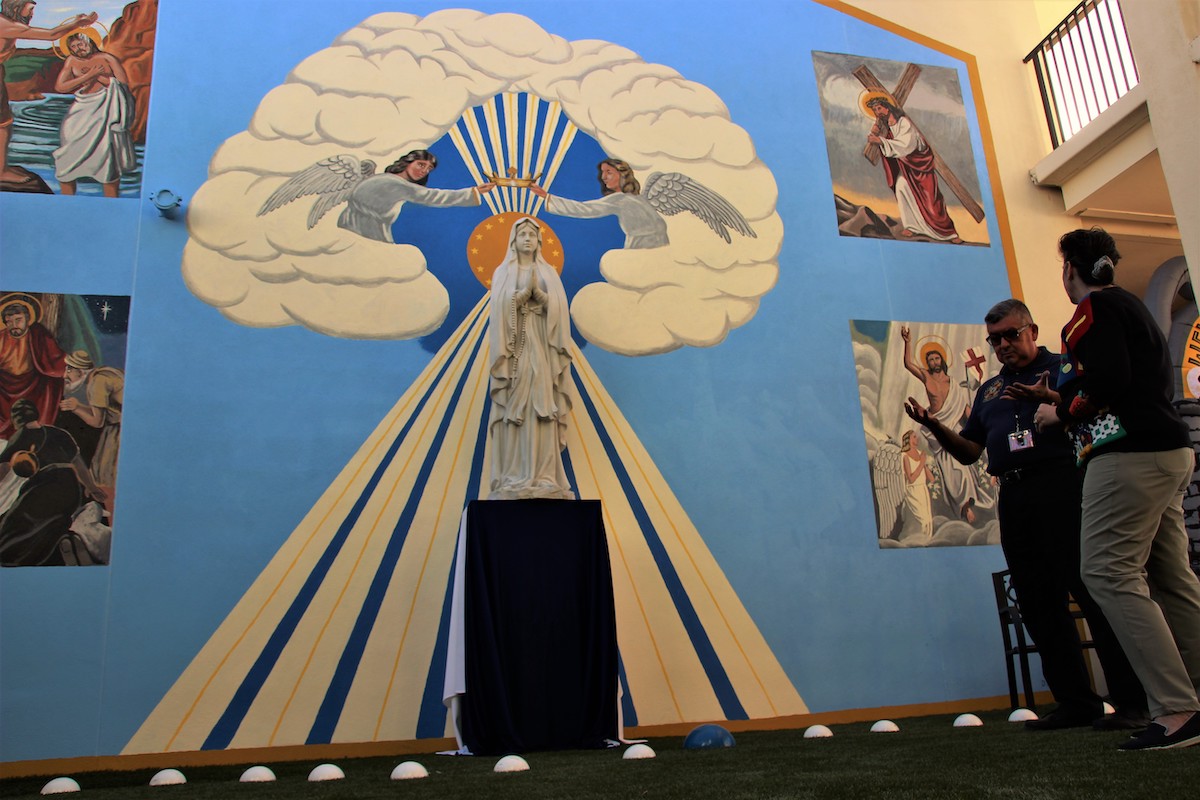
Artist David Murrieta and St. Thomas Aquinas Elementary School Principal Cynthia Scheller discuss Murrieta’s mural of the Mysteries of the Rosary and the Crowning of the Blessed Mother at the school in Avondale Oct. 28. Jeff Grant/THE CATHOLIC SUN
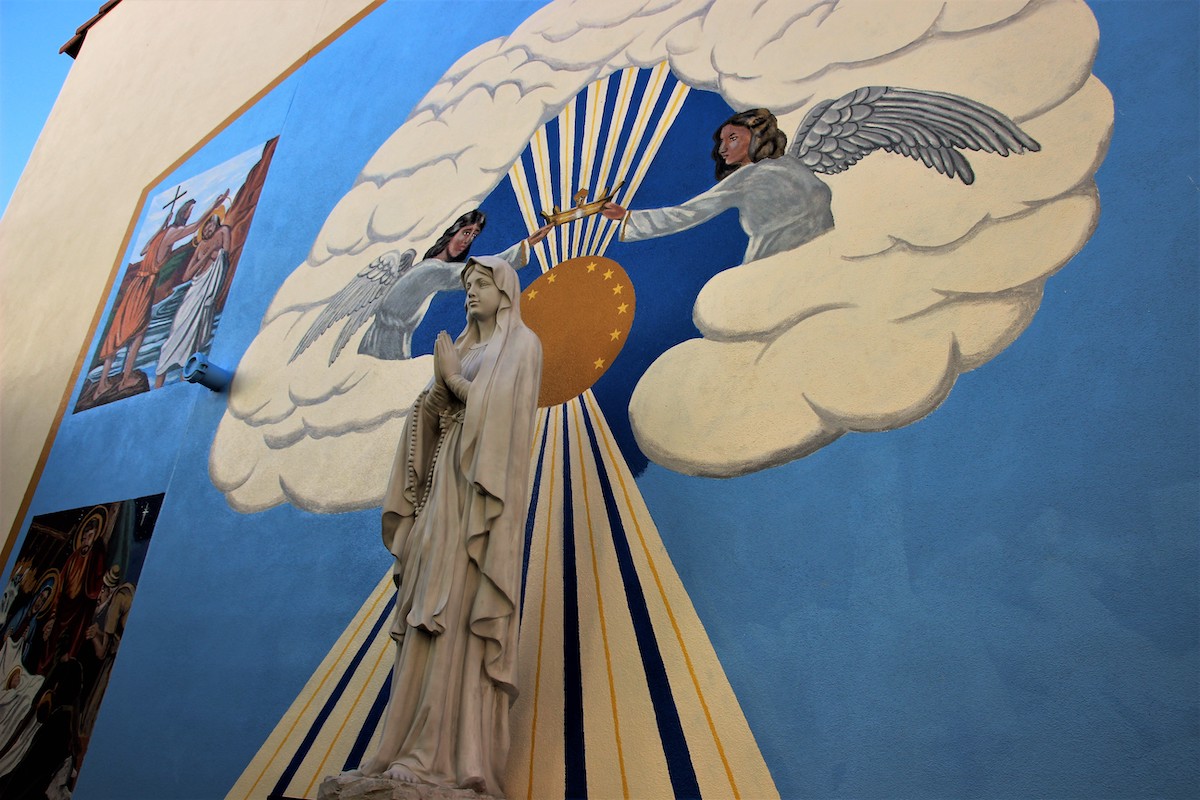
A statue of the Blessed Mother stands at the center of a newly dedicated mural of the Mysteries of the Rosary and the Crowning of Mary at the entrance to St. Thomas Aquinas Elementary School in Avondale Oct. 28. Jeff Grant/THE CATHOLIC SUN

By Jeff Grant, The Catholic Sun

AVONDALE — When a visitor to St. Thomas Aquinas Catholic Elementary School passes through the black, wrought-iron gates and into the center play area surrounded by the school’s two classroom floors, one of the first things he or she encounters is an area of artificial grass — the deep green hue contrasting with the building’s beige walls — and a statue of the Blessed Mother.

On the artificial surface before Mary is a life-size, blue-and-white layout of an item familiar to almost any Catholic.

“The rosary is such a big part of what we do as Catholics, and certainly as we journey with Christ,” explained Principal Cynthia Scheller “The message of what we are as a school and a parish — and our mission — comes through the minute you walk on our campus.”

The vehicle for that message now goes well beyond the rosary.

On Oct. 26, the school dedicated a mural depicting the rosary’s four sets of mysteries and the heavenly crowning of the Blessed Mother in a display of colorful artistry meant to draw the garden’s viewers into the lives of Jesus and Mary.

The 24-by-24-foot painting transformed what had been a blank wall into a collection of scenes of the Joyful, Sorrowful, Glorious, and Luminous mysteries all positioned around the crowning. The display creates what Scheller and Pastor Fr. John Muir hope will be a focal point for children, teachers, staff, and visitors to the 500-student school that opened in 2003 near Thomas and Litchfield roads.

Scheller said that for years she envisioned a rosary garden as a “Wow factor” for those entering the school.

“I knew schoolchildren could ‘walk’ the rosary, classrooms could pray as a class, and more than anything, what a beautiful scene for our students and parents to see twice a day as a reminder of Our Lady,” she explained.

Three years ago, she shared the idea with a former student and Eagle Scout, who agreed to construct the garden as his Eagle project.

It was finished in May 2021.

An artificial grass surface roughly 50 feet by 50 feet with a “rosary” laid out upon it, the “beads” are fashioned from concrete: each slightly bigger than the size of a large softball and painted white. The “Our Father” beads, are larger, just under the size of a bowling ball, and painted dark blue.

Organized activities occur in the space every May – as part of the May crowning of Mary – and in October, the month dedicated by the Church to the rosary.

The mural continues the theme of using art to connect with one’s Catholic faith.

Scheller discussed the idea with Fr. Muir, and the plan began to take shape.
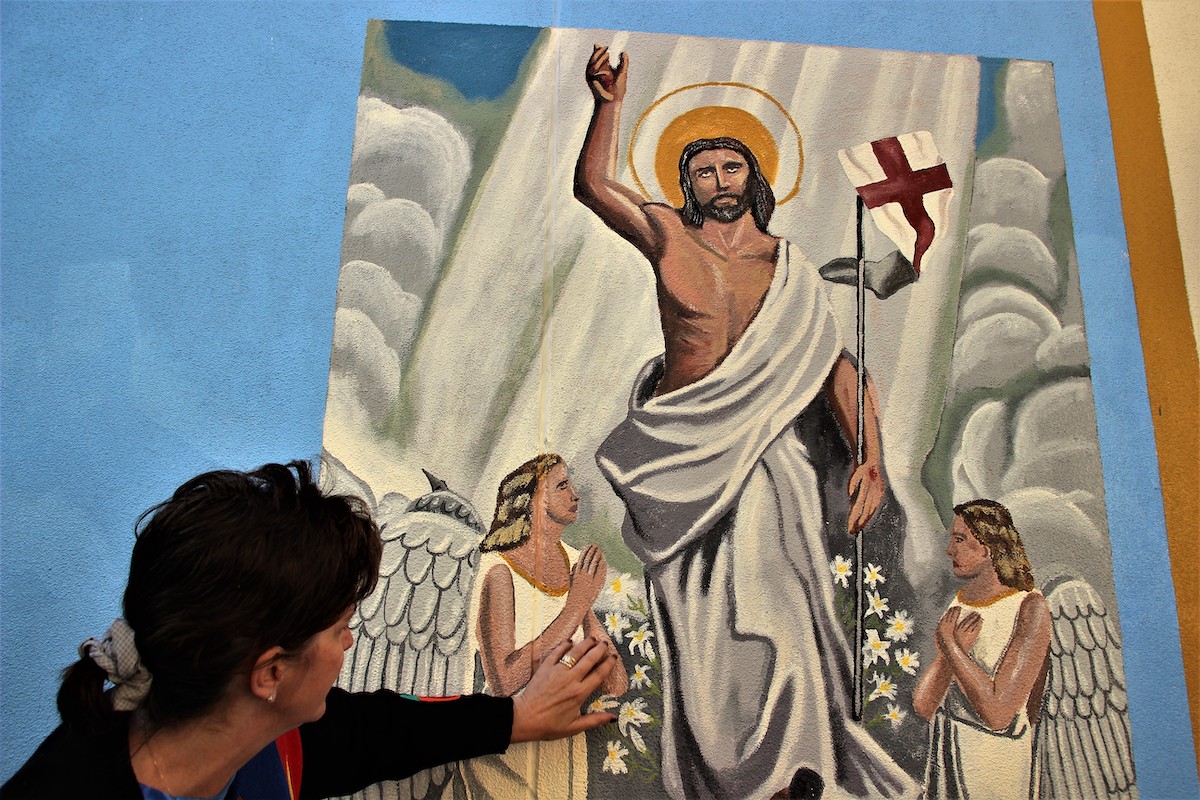
St. Thomas Aquinas Elementary School Principal Cynthia Scheller admires the panel in David Murrieta’s mural representing the Glorious Mysteries of the Rosary at the school in Avondale Oct. 28. Jeff Grant/THE CATHOLIC SUN

Around that time, Cynthia’s husband, Matthew, a Grand Knight with the Knights of Columbus, Holy Family Council No. 11675, was attending a K of C meeting where he spoke to David Murrieta, a fellow parishioner and art teacher at St. Vincent de Paul Elementary School in west Phoenix. Murrieta had done artwork for area businesses, offices and restaurants, but this would be a bit larger.

“They talked about it, and David said he’d be honored to do it,” Cynthia said. “God always has a hand in everything and a plan.”

Cynthia and David met several times, reviewing sketches — Fr. Muir providing input — and Murrieta began work in June while pupils were on summer vacation. Murrieta did most of the painting himself, receiving some help from his two high-school-age daughters.

Working during the hottest part of the year had little effect on Murrieta’s efforts, despite the temperatures.

“It is a north-facing wall, entirely in the shade. (Still) I had to constantly spray water on my paint.”

The heat actually proved helpful when it came to the summer monsoon.

“The paint dried fast. I was worried the rain was going to cause it to run.”

However, Murrieta heeded the forecasts, allowing sufficient drying before any showers showed up.

A bigger challenge was deciding on the colors, but Murrieta used nightly reflections to guide him. Plus, Scheller and Fr. Muir wanted a lot of blue.

The color most associated with Mary, blue symbolizes her purity and obedience to God’s will.

If the project is designed to draw onlookers into a deeper relationship with Jesus and the Blessed Mother, it already has had a profound effect its artist, especially as he painted the scene of Jesus carrying the Cross, which depicts the Sorrowful Mysteries.

“When I was painting the thorns on the crown, I got emotional. I was in tears thinking about all the pain He went through. But I got a warm feeling in my heart at the same time. This is the most emotional painting experience I have ever had,” he said.

Though Murrieta had planned to paint without compensation, Scheller said the school couldn’t agree to that. St. Thomas Aquinas covered $1,100 – including a lift rental – while another $300 for paint and supplies was picked up by the Knights of Columbus.

“We are proud supporters of our Catholic grade school at St. Thomas Aquinas and knew the mural in the rosary garden would be a perfect addition to honor our Blessed Mother Mary,” stated Matthew Scheller, now Council 11675’s Deputy Grand Knight, in an email.

“Our brother Knight, David Murrieta, is a talented artist, and we have seen his beautiful work as a teacher at St. Vincent de Paul Catholic Grade School and the religious murals he has completed at other locations. The beauty of (this) mural will allow the children to see the scenes of Jesus’ life and draw them closer to Him. The Knights’ donation is a small contribution to what we believe will have a lasting impact on the lives of those who encounter this work of art for many years to come. The Knights in our Council enjoyed the frequent updates from David and know it was an emotionally rewarding experience for him. The Knights are honored to be able to support this project and thank our Brother David for his outstanding work.”

Cynthia Scheller said the school’s portion of the costs were raised by students and their families, “dedicated to saying ‘thank you’ for his stewardship to the school and all those that encounter our beautiful place of learning how to be disciples of Christ.”

Murrieta is an art teacher at St. Vincent de Paul Elementary School near 51st Avenue and Thomas Road in west Phoenix. His efforts also further the tie between the two schools, which are about 12 miles apart. St. Vincent de Paul is run by the Daughters of Charity, a Vincentian Order.

Cynthia Scheller said there are plans to enhance the mural.

The next phase will involve framing each portrait of the Mysteries with small royal blue tiles to achieve a three-dimensional effect. The school also plans to put the statue of Mary on a “floating” platform. Scheller is recruiting two more Eagle Scouts for those projects.

The new mural already has made an impression on students.

“I love it. It’s amazing. It reminds me of how great Jesus is and what He did for us. I feel happy when I look at it. I just thought that was really cool (being able to see the mural’s daily progress),” said 5th-grader Rocco Lombardo, age 11.

“It is beautiful. It really represents the life of Jesus and how He suffered for us, but rose again, and how He is one part of the Holy Trinity,” added Rocco’s sister, Sarafina Lombardo, a 9-year-old 4th-grader.

“I am blessed to be at this school. Not every child gets to be at a private school. I am grateful I am here.”
Artist David Murrieta and St. Thomas Aquinas Elementary School Principal Cynthia Scheller discuss Murrieta’s mural of the Mysteries of the Rosary and the Crowning of the Blessed Mother at the school in Avondale Oct. 28. Jeff Grant/THE CATHOLIC SUN

NEWS BRIEF: Million-dollar matching gift supports Catholic schools

https://youtu.be/RCKV8qABrxc

PHOENIX — At the 2022 virtual Night of Hope, Barbara Rechterman announced a generous gift in support of Diocese of Phoenix Catholic schools. For every dollar given to the Catholic School Support 365 fund, Rechterman Family Charities will match with their own gift, dollar for dollar, up to a million dollars.

The Diocese of Phoenix recognizes Rechterman Family Charities as a Guardian of Hope for this year’s Night of Hope. Thank you for supporting Catholic education!

Double your gift now!

‘Night of Hope’ makes Catholic education possible for families in crisis, struggling

Seven new deacons eager to lead others to deeper relationship with Christ

Years of soul-searching, prayer, discernment, and study culminated in ordination for seven men who will now serve the Diocese of Phoenix as permanent deacons. All but one are assigned to their home parishes. Read on for a closer look at the men’s journey.  


Deacon Bill Booth 

First Assignment: St. John Vianney, Goodyear 

Favorite Saint: St. Joseph “because he was a good father figure, and he protected Jesus and Mary.”  

Why he sought the diaconate: As a young man, he lived the party lifestyle but still felt empty inside. A return to the faith led to a deep conversion of heart, two stints in the seminary, and repeated invitations by priests and others to consider the diaconate. “It’s been a blessing ever since. God knows what He’s doing. I’m grateful to Him for where I’m at.” 


Deacon Ramsey Echeveria  

First Assignment: St. Andrew, Chandler 

Favorite Saint: Several. “I carry a different saint with me every day, depending on the situation.”  

Why he sought the diaconate: Once a Christmas-and-Easter-only Catholic, Deacon Ramsey turned 30 and felt his life lacked purpose. His wife brought him back to church, where an intense Bible study group led the couple to serving at their parish. “The thing that I’m looking forward to is spreading the faith, teaching, helping people, getting to know people, and building relationships.” 


Deacon Rob Estes 

First Assignment: St. Anne, Gilbert 

Favorite Saint: St. John of the Cross. “His relationship with the Lord, his contemplative prayer, and how he just had that union with the Lord in his prayer.”   

Why he sought the diaconate: I don’t know how to describe the feeling other than: it was an innate tug at my heart and soul that the Lord has had on me for quite some time.” He’s looking forward to serving at the altar, but he’s also been called to serve in a grief recovery ministry that “helps people get through all kinds of grief.”  


Deacon Antonio Hernandez 

First Assignment: Sacred Heart, Phoenix  

Favorite Saint: St. John the Baptist. He was “a prototype deacon, a herald of the Gospel.” 

Why he sought the diaconate: I think, for me, it was an alignment of this interior calling that I had throughout my life and this exterior invitation that happened for me at Kino when I was getting involved with my parish and also with the diocese’s activities.” He’s looking forward to “serving our bishop, being his heart and ears … Just being that servant.” 


Deacon Wayne Rich 

First Assignment: All Saints Catholic Newman Center, Tempe 

Favorite Saint: St. Francis de Sales. Hedoes just such a wonderful job relating everyday activities to our developing more intimacy with our Lord. 

Why he sought the diaconate: For me, it just seemed like the next step in the growth of our faith. Our family was received into the Church in 2008 … the idea of serving as a deacon captured my imagination.  One of the things I’ve learned about discernment and taking the next step is, it seems like the Lord works through attraction.” 


Deacon Sean Sylvester 

First Assignment: St. Mary Magdalene 

Favorite Saint: St. John Paul II. “I was born the year he was elected and he was pope most of my life. 

Why he sought the diaconate: After years of sensing the call, by 2015 it was unmistakable. “I don’t know if you’ve had the experience where God’s, like, shouting at you; you can’t ignore it anymore. And that’s what it felt like.” He’s looking forward to imparting the Church’s blessing and performing baptisms because “what greater joy is there than to bringing a new Christian into the world?” 


Deacon Pat Thielen  

First Assignment: St. Clement of Rome 

Favorite Saint: St. Joseph because “he is the guy that I think of when I think of being a good father.” 

Why he sought the diaconate: He was away from the Catholic Church for a time, but it was in the back of his mind for years. “It’s like you have this dream, right, this thing you want to do … But it was like this dream that I had now became a possibility.” He’s looking forward to drawing “people into a deeper relationship with Jesus. I want them to know Him better.”   


We invite you to participate in discipleship and evangelization efforts at the Diocesan level, including the Together Let Us Go Forth ~ Juntos Sigamos Adelante campaign, the Charity & Development Appeal, the TV MassCatholic School Support 365, and through supporting our seminarians and Nazareth House. If you would like to receive the magazine at your home, we invite you to support the mission by participating in one of these efforts. You may also call our donor services team at (602) 354-2235 to receive future issues or provide one of our team members with an updated address.

USCCB elections, ‘Faithful Citizenship’ discussion, prayer are on agenda

Candidates for the upcoming 2022 U.S. Conference of Catholic Bishops presidential and vice presidential elections are shown clockwise from top left: Archbishop Timothy P. Broglio of the U.S. Archdiocese for the Military Services; Archbishop Paul S. Coakley of Oklahoma City; Bishop Frank J. Caggiano of Bridgeport, Conn.; Bishop Michael F. Burbidge of Arlington, Va.; San Francisco Archbishop Salvatore J. Cordileone; Seattle Archbishop Paul D. Etienne; Archbishop Gustavo GarcÌa-Siller of San Antonio; Bishop Daniel E. Flores of Brownsville, Texas; Baltimore Archbishop William E. Lori; and Bishop Kevin C. Rhoades of Fort Wayne-South Bend, Ind. (CNS composite/photos by Tyler Orsburn; Archdiocese of Oklahoma City; Gregory A. Shemitz; Bob Roller; Dennis Callahan, Catholic San Francisco; Paul Haring; Bob Roller; Bob Roller; Tyler Orsburn; and Bob Roller)

WASHINGTON (CNS) — The fall general assembly of the U.S. Conference of Catholic Bishops will find the bishops voting on a new president and vice president and how to proceed in disseminating their quadrennial document on Catholic participation in public life.

The agenda for the Nov. 14-17 gathering also incorporates more time for prayer and reflection with opportunities for wider engagement and interaction with each other to build fraternity.

Public sessions are scheduled for the afternoon of Nov. 15 and all day Nov. 16.

USCCB leaders will be elected from a slate of 10 candidates nominated by their fellow bishops.

In addition, the bishops will vote on chairmen-elect for six standing USCCB committees.

The candidates for president and vice president are, in alphabetical order:

  • Archbishop Timothy P. Broglio of the U.S. Archdiocese for the Military Services.
  • Bishop Michael F. Burbidge of Arlington, Virginia.
  • Bishop Frank J. Caggiano of Bridgeport, Connecticut.
  • Archbishop Paul S. Coakley of Oklahoma City.
  • Archbishop Salvatore J. Cordileone of San Francisco.
  • Archbishop Paul D. Etienne of Seattle.
  • Bishop Daniel E. Flores of Brownsville, Texas.
  • Archbishop Gustavo García-Siller of San Antonio.
  • Archbishop William E. Lori of Baltimore.
  • Bishop Kevin C. Rhoades of Fort Wayne-South Bend, Indiana.

The president and vice president are elected to three-year terms, which begin at the conclusion of this year’s general assembly. At that time, Archbishop José H. Gomez of Los Angeles and Archbishop Allen H. Vigneron of Detroit will complete their terms as president and vice president, respectively.

Chairmen-elect will be chosen for the committees on Canonical Affairs, Ecumenical and Interreligious Affairs, Evangelization and Catechesis, International Justice and Peace, the Protection of Children and Young People and Religious Liberty.

The six bishops elected will serve for one year as chairmen-elect of their respective committee before beginning a three-year term as chairman at the conclusion of the bishops’ 2023 fall general assembly.

Also on tap is a discussion on “Forming Consciences for Faithful Citizenship,” the bishops’ document developed as a guide to help Catholics form their consciences in voting and other areas of public life. The bishops will decide what steps to take regarding to whether to begin a routine update or significantly revise the document.

The document was last updated in 2019 and remained unchanged except for the addition of an introductory letter addressing issues of importance to the Catholic Church It was supplemented by four videos in both English and Spanish focusing on Catholic teaching on poverty, immigration, abortion and the care of creation.

The outcome of the discussion will guide USCCB staff members as they prepare any changes in the document and develop related materials over the next year. The bishops will vote on the final document during their 2023 fall general assembly with dissemination of it in advance of the 2024 election.

Archbishop Lori, who chairs the bishops’ Committee on Pro-Life Activities, will provide an overview of how the church can respond following the U.S. Supreme Court’s June 24 ruling in Dobbs v. Jackson Women’s Health Organization that overturned Roe v. Wade, returning the issue of abortion to the states.

His presentation follows an Oct. 26 letter that Archbishop Lori and three other USCCB committee chairmen sent to all members of Congress calling for “radical solidarity” with mothers and babies — born and unborn — and advancing an ambitious legislative and policy agenda that prioritizes the well-being of families.

Archbishop Leonard P. Blair of Hartford, Connecticut, chairman of the bishops’ Committee on Divine Worship, will present for approval revisions in rites related to the anointing of the sick and lay ministry for the sick as well as liturgical texts for two recently instituted feast days.

Votes will be taken on a revision of the U.S. English-language edition of “The Order of the Anointing of the Sick and of their Pastoral Care” and a new U.S. Spanish language edition of the same text.

The revision follows work undertaken by the International Committee on English in the Liturgy, or ICEL, to bring the prayers closer to the original Latin text promulgated in 1972, said Father Andrew Menke, executive director of the bishops’ Secretariat on Divine Worship.

Votes also will be taken on English- and Spanish-language editions of “Lay Ministry to the Sick,” a proposed collection of excerpts from various liturgical books. The texts include the prayers and rites that can be used by lay ecclesial ministers in their ministry to the sick. The material was drawn from multiple sources traditionally used in such ministry.

The last vote will come on liturgical texts for two optional memorials inscribed by Pope Francis in January 2019. The texts are included in an ICEL document known as a “gray book” issued in May 2021. The memorial for St. Paul VI is observed May 29, while the memorial for Our Lady of Loreto is observed Dec. 10.

Approval of all texts requires a two-thirds vote of the Latin-rite bishops. “The Order of the Anointing of the Sick and of their Pastoral Care” also requires “recognitio” from the Vatican.

Updates on the canonization causes of three American women will be presented during the assembly. The bishops will vote whether to advance the causes of Cora Evans, Michelle Duppong and Mother Margaret Mary Healy Murphy.

Evans, a wife, a mother, and possible mystic, was baptized Catholic in Utah in 1935 after becoming disillusioned with the Mormon faith. Born in 1904, she moved to California with her family in 1941. She died at age 74 in Boulder Creek, California, March 30, 1957.

Promoters of her sainthood cause in the Diocese of Monterey, California, have said she reported multiple visions of Jesus and the saints and received a mission from Jesus to promote the “mystical humanity of Christ,” the idea that Christ is always with people and people should behave always as Christ would.

The Diocese of Bismarck, North Dakota, in June opened an investigation into “the holiness of life and love of God” of Duppong, who died of cancer Dec. 25, 2015. She was 31.

When she died, Duppong was the director of adult faith formation for the diocese. Before that, she was a missionary for six years with the Fellowship of Catholic University Students, or FOCUS. In her position, the diocese said, she used “her missionary zeal to bring others closer to Christ.”

Mother Murphy in 1893 founded the Sisters of the Holy Spirit and Mary Immaculate, the first order of women religious in the state of Texas. The congregation was started after Mother Murphy, a native of Ireland, spent years helping the poor and serving African Americans and Mexican Americans as a laywoman. She died in 1907 at age 74.

With 2022 being the 20th anniversary of the bishops’ adoption of the “Charter for the Protection of Children and Young People,” the bishops also plan to spend time in prayer and reflection on their response to clergy sexual abuse during the general assembly.

The document established minimum standards for each diocese to follow as they reviewed abuse allegations.

The agenda for the assembly also includes:

  • Review and approval of the USCCB budget for 2023.
  • A report on progress on implementing the document “The Mystery of the Eucharist in the Life of the Church,” activities under the nationwide eucharistic revival initiative, and the planned 2024 National Eucharistic Congress in Indianapolis.
  • An update on the Synod of Bishops on synodality as the global process initiated by Pope Francis enters the continental phase.
  • A report from the Secretariat for Cultural Diversity in the Church on the “Journeying Together” gathering held this past July in Chicago.
  • Information on the Fourth African National Eucharistic Congress July 21-23, 2023, in Washington.
  • A review of the church’s response to the war in Ukraine.
  • A report from Bishop Burbidge on the work of the National Catholic Partnership on Disability.
  • A preview on preparations for World Youth Day 2023 in Lisbon, Portugal Aug. 1-6, 2023.
  • Presentations from the leaders of Catholic Charities USA, Catholic Relief Services and the Catholic Legal Immigration Network.


French bishops note anger over case of abusive bishop allowed to retire

Pope Francis greets Archbishop …ric de Moulins-Beaufort of Reims, president of the French bishops' conference, during a meeting at the Vatican Dec. 13, 2021. The archbishop announced a change in the agenda for the conference's assembly Nov. 3-8, 2022, to discuss the case of a French bishop who was disciplined by the Vatican after being credibly accused of sexual misconduct. (CNS photo/Vatican Media)

LOURDES, France (CNS) — The French bishops’ conference overhauled its agenda for its November plenary meeting to deal with “the anger, shame, powerlessness (and) incomprehension” they and their people felt after discovering that a bishop allowed by the Vatican to retire actually was disciplined for sexual abuse.

Archbishop Eric de Moulins-Beaufort of Reims, president of the bishops’ conference, announced the changed agenda Nov. 3 and urged his fellow bishops to have as their first concern “the victims, those who spoke out two years ago and more recently, and those, perhaps, who have not yet made themselves known.”

The archbishop was referring to the case of retired Bishop Michel Santier of Créteil. When the Vatican announced in 2021 that the bishop was retiring, the bishop had said it was for health reasons. No one contradicted him publicly until mid-October, when the Diocese of Créteil confirmed he had been credibly accused of sexual misconduct and disciplined by the Vatican.

The bishops, who were meeting in Lourdes, acknowledged the sense of betrayal felt by people in the Diocese of Créteil, the archbishop said, as well as “the anger, shame, discouragement and weariness of the most committed faithful, deacons, priests, seminarians.” Those feelings, he said, are “reaching a new level, no doubt unbearable for some.”

“All of us are shaken, personally and in our apostolic authority in the service of the Lord Jesus and the people of God, by suffering a collective criticism for a matter that most of us have had nothing to do with,” he said.

The permanent council of the bishops’ conference decided, he said, to add to the meeting a discussion about the facts in the case of Bishop Santier, a review of the procedures that exist to verify their implementation, to understand the requirements of the law of our country and of canon law, but also the expectations and needs of the victims and of the people of God.”

A civil lawyer, a canon lawyer, an official of the Dicastery for the Doctrine of the Faith and the nuncio were scheduled to speak, the archbishop said.

Cardinal Pietro Parolin, Vatican secretary of state, sent a letter to the bishops on behalf of Pope Francis expressing his support, but not specifically mentioning Bishop Santier or the Vatican’s role in withholding the reason for his stepping down.

“At a time when the church of France is once again shaken by the drama of abuse on the part of some of its pastors,” the cardinal wrote, Pope Francis “invites you, with your eyes fixed on the cross of Christ, not to be discouraged but to persevere in the assurance that the Holy Spirit will accompany your efforts.”

“You are called to address the wounds of the people of God,” Cardinal Parolin wrote, and especially the wounds “of the victims of these abuses, but also all who are scandalized, disappointed and tested, particularly your priests whose beautiful ministry is dishonored and made even more difficult, and who need your closeness more than ever.”

And regarding a scheduled discussion of the pastoral care of Catholics attached to the pre-Vatican II Mass and disappointed by Pope Francis’ decision to restrict celebrations, the cardinal said the pope asked the bishops to show them special care; “they often are wounded sheep who need to be accompanied, listened to and given time.”


NS documentary, ‘Voices of Vatican II,’ available free online

A photo montage including Sts. John XXIII and Paul VI and the scene inside St. Peterís Basilica during the Second Vatican Council was the cover art for the DVD edition of the Catholic News Service documentary, "Voices of Vatican II: Participants Recall the Council." CNS has released the 50-minute documentary to the public on YouTube. (CNS photo)

VATICAN CITY (CNS) — To help mark the 60th anniversary of the opening of the Second Vatican Council, Catholic News Service has shared with the public a documentary featuring interviews with council participants.

Titled “Voices of Vatican II: Participants Recall the Council,” the 50-minute documentary was released in 2015 only on DVD, but it was posted Nov. 3 on YouTube.

With archival footage and exclusive interviews with prelates who attended the council sessions between its opening in 1962 and closing in 1965, the film pieces together firsthand accounts of that historic era and its impact on the church today.

The entire narration is supplied by 12 bishops and priests who took part in the council, including Pope Benedict XVI, who gave an unscripted talk about the council to Rome’s clergy in 2013.

“Off we went to the council not just with joy but with enthusiasm,” he said in that talk. “There was an incredible sense of expectation. We were hoping that all would be renewed, that there would truly be a new Pentecost, a new era of the church, because the church was still fairly robust at that time — Sunday Mass attendance was still good, vocations to the priesthood and to religious life were already slightly reduced, but still sufficient. However, there was a feeling that the church was not moving forward, that it was declining, that it seemed more a thing of the past and not the herald of the future.”

In that speech, the now-retired pope also observed, “There was the council of the Fathers — the real council — but there was also the council of the media.”

The documentary allows viewers to hear from the participants themselves.

Since the original release of the film, several of those interviewed have died, including: Cardinals Loris Capovilla, Georges Cottier and Roger Etchegaray; Bishops John C. McNabb, William J. McNaughton and Remi De Roo; and Paulist Father Thomas Stransky.

NCEA reports quicker academic recovery from pandemic for Catholic schools

Senior Kenia Viri serves as an extraordinary minister of holy Communion during a Mass marking the feast of St. Francis of Assisi at Franciscan-run St. Anthony's High School in South Huntington, N.Y., Oct. 4, 2022. (CNS photo/Gregory A. Shemitz)

By Mark Pattison, Catholic News Service

WASHINGTON (CNS) — The National Catholic Educational Association says Catholic schools have recovered more quickly from the pandemic than its public school counterparts.

The successes, according to the NCEA, go across the board when looking separately at Black students, Hispanic students, students from low-income households, and students who qualify for free and reduced-price meals.

The scores were first reported in October by the National Assessment of Educational Progress, colloquially known as “The Nation’s Report Card.” The numbers tracked the progress, or lack thereof, in math and reading by both fourth graders and eighth graders.

While Catholic schools’ scores are generally better than those of their public school counterparts — Annie Smith, NCEA vice president of data and research, said eighth graders pre-COVID-19 were about 5% better in math and 6% better in reading — the new numbers, based on testing conducted in 2021, showed a wider separation between the two.

Catholic schools’ scores have pretty much bounced back to the levels they had achieved prior to the coronavirus pandemic’s onset in March 2020. The only area that is still not up to snuff is eighth-grade math, which is still five points behind pre-pandemic levels.

Even so, said NCEA president Lincoln Snyder, those numbers are 15 points ahead of the comparable figures reported by public schools.

“It wasn’t a surprise to me at all,” Snyder told Catholic News Service in an Oct. 28 phone interview. “We’ve been monitoring testing data, really, throughout COVID.”

The NAEP numbers, Snyder said, bear out what a private firm found in 2021 when it conducted a lateral study of 3 million U.S. students to assess learning loss.

Given the upheaval wrought by the pandemic within society in general, and education in particular, Snyder said, “you would expect all students to have some learning loss.” But it was the ability to bounce back that characterized much of Catholic education, he added.

“It’s a testament to our educators to meet in person as soon as possible,” Snyder said. “It greatly did improve our Catholic school outcomes.”

The NAEP numbers dovetail with the NCEA’s own census showing that, for the first time in 20 years, enrollment in Catholic schools across the United States increased by 62,000. The number of Catholic schools also stayed steady, as 50 new schools were created to offset the closing of 50 other schools.

“We did have a big uptick in enrollment. We had an initial drop. In March of ’20, when we went to distance learning, people were fearful for losing their jobs. Or they did lose their jobs, but they quickly recovered. ”

“Our retention of those new families was very high,” Snyder told CNS, citing a rate of 90% percent and “some dioceses were really as high as 98%.”

“They fell in love with the school, but they also stayed because of the community. This is a real opportunity for us to shine,” he said.

Only about one-third of dioceses had reported enrollment numbers for the current school year to the NCEA. A final tally is not expected until the spring.

Smith told CNS in a Nov. 1 phone interview that for Catholic schools to get back to their 2019 achievement levels, “our teachers are doing what they need to do already. They’re in the classroom, they’re working with students, they’re creating individualized learning plans.”

She confessed to being “a little disappointed with the drop in the eighth-grade math” scores, but “they’re going to graduate into our high schools, so we’re going to make sure this doesn’t have a long-term impact.”

Snyder said the NCEA has to “do a good job of telling our story.”

“I think we have a very compelling story to tell,” he explained. “We educate the whole children. We teach them to be servant leaders in Christ. Our teachers really model that servant leadership. I think they were committed to an adult that was committed to them. They can see that commitment and they responded to it.”


Saints were revolutionaries who lived the beatitudes, pope says

Italian teens hold up signs announcing their presence in St. Peter's Square at the Vatican as Pope Francis leads the recitation of the Angelus prayer Nov. 1, 2022, the feast of All Saints. (CNS photo/Vatican Media)

By Cindy Wooden, Catholic News Service

VATICAN CITY (CNS) — The saints were not “starched,” picture-perfect conformists, Pope Francis said; they were “countercultural and revolutionary.”

The multitude of men and women honored on the feast of All Saints lived according to the Eight Beatitudes, which made them decidedly out of place in the world, Pope Francis said Nov. 1 before reciting the Angelus prayer.

With thousands of people gathered in St. Peter’s Square, including runners who had participated in the 10k All Saints’ Day race, Pope Francis also encouraged people not only to visit the burial sites of their loved ones the following day, the feast of All Souls, but to go to Mass and pray for them as well.

Talking about saints and the day’s Gospel reading of the beatitudes, Pope Francis focused particularly on “Blessed are the peacemakers.”

Everyone says they want peace, he said, but often what they mean is they want “to be left in peace, to have no problems, just tranquility.”

But, if one reads the beatitudes in the Gospel, he said, they will see that Jesus does not say, “Blessed are those who are at peace,” but blessed are “those who make peace, the constructors, the peacemakers.”

“Indeed, peace must be built, and like any construction it requires effort, collaboration, patience,” he said. And it requires acts of justice and mercy.

While many people today try to convince everyone that only power and force can guarantee peace, the teaching of Jesus and the example of the saints show “peace is not achieved by conquering or defeating someone, it is never violent, it is never armed.”

To begin to sow peace, Pope Francis asked people to look at themselves and ask, “In the places where we live, study and work, do we bring tension, words that hurt, gossip that poisons, controversy that divides? Or do we open the path to peace: Do we forgive those who have offended us, care for those who are at the margins, redress some injustice by helping those who have less? This is building peace.”

At the end of his midday talk, the pope asked for prayers for his trip Nov. 3-6 to Bahrain so that his meetings with local Christians and with Muslim leaders would promote, “in the name of God, the cause of fraternity and peace, which our times so desperately and urgently need.”

And “please,” he said, “don’t forget martyred Ukraine; let us pray for peace, we pray that in Ukraine there would be peace.”


Pelosi speaks of heartbreak after husband’s attack; bishops offer prayers

Members of law enforcement in San Francisco work outside the home of House Speaker Nancy Pelosi Oct. 28, 2022, where her husband Paul Pelosi was violently assaulted after a break-in at their house. (CNS photo/Carlos Barria, Reuters)

By Rhina Guidos, Catholic News Service

WASHINGTON (CNS) — House Speaker Nancy Pelosi said her family is “heartbroken and traumatized by the life-threatening attack” on her husband, Paul, whom police said was “violently assaulted” at home early Oct. 28 by a man with a hammer.

In an Oct. 30 statement addressed to her colleagues in the House, Pelosi said her family was comforted by their prayers and that her husband is making progress in his recovery.

San Francisco Police Chief William Scott in an Oct. 28 news conference identified 42-year-old David DePape as the suspect, saying he will be charged with attempted homicide.

As the San Francisco District Attorney’s Office prepared charges against DePape, federal prosecutors charged him Oct. 31 with attempted kidnapping and assault of a family member of a federal official.

Scott said authorities were called to the Pelosi home at 2:27 a.m. for a priority well-being check and, upon responding, officers said they encountered the speaker’s husband, 82, and a suspect holding a hammer.

“The suspect pulled the hammer away from (Pelosi) and violently assaulted him … our officers immediately tackled the suspect and disarmed him,” Scott said.

The speaker’s spokesman said Oct. 28 that Paul Pelosi had surgery “to repair a skull fracture and serious injuries to his right arm and hands.”

The suspect also was taken to a local hospital for treatment, police said, and is expected to face additional charges of assault with a deadly weapon, elder abuse, burglary and other additional felonies.

San Francisco Archbishop Salvatore J. Cordileone said he was praying for Paul Pelosi in an Oct. 28 tweet.

“Please join me in praying for the swift recovery of Paul Pelosi and comfort for his wife and family too. Mother Mary hear our prayer,” Archbishop Cordileone tweeted.

Archbishop José H. Gomez of Los Angeles, president of the U.S. Conference of Catholic Bishops, also offered prayers.

“I join with Archbishop Cordileone in offering my prayers for the full recovery of Paul Pelosi and comfort for his family following the terrible attack that occurred earlier this morning,” he said.

“I am deeply grieved over this violence, which should have no place in our communities, our political process, or our great nation,” the archbishop added. “May Our Lady of Perpetual Help intercede for us, provide healing and guide us to paths of peace.”

At Holy Trinity Catholic Church in Washington, the congregation prayed for the recovery of Paul Pelosi and also for an end to violence and division. Pelosi and President Joe Biden periodically attend Mass at the Jesuit parish church.

Scott said the investigation was ongoing and authorities were still determining a motive.

The speaker was in Washington at the time of the attack, but her office said she flew to California to be with her husband.

Some on Twitter lashed out at the Oct. 28 tweet by Archbishop Cordileone, saying he was being a hypocrite because of what he told Speaker Pelosi in a May 19 letter.

“You are not to present yourself for holy Communion,” he told her. “Should you do so, you are not to be admitted to holy Communion, until such time as you publically (sic) repudiate your advocacy for the legitimacy of abortion and confess and receive absolution of this grave sin in the sacrament of penance.”

San Antonio Archbishop Gustavo García-Siller also offered prayers for the speaker’s husband Oct. 28 and for other victims of violence.

“We pray for the children in Uvalde, the migrants burnt to death, and the people killed by shootings and violence, we pray for Mr. Paul Pelosi. We condemn violence. We all could be a target, especially the poor, migrants, the elderly and any life from conception to natural death,” he tweeted.


‘Blessing is meant to be shared,’ Franciscan priest tells Black men

Franciscan Father Agustino Torres, who ministers for his order in Brooklyn, N.Y., and is founder of the Hispanic youth ministry Corazon Puro, prays before delivering a keynote address at the National Black Catholic Men's Conference at St. Rita Church in Indianapolis Oct. 13, 2022. (CNS photo/Mike Krokos, The Criterion)

By Mike Krokos, Catholic News Service

INDIANAPOLIS (CNS) — It was a time of Scripture, prayer, music and fellowship.

It also was a night to honor the late co-founder of the National Black Catholic Men’s Conference.

But for those teenagers and adults from across the United States in attendance, Franciscan Father Agustino Torres’ message Oct. 13 was simple, yet powerful: “The Lord has sent me to bless you.”

Father Agustino, who ministers for his order in the New York borough of the Bronx and is founder of the Hispanic youth ministry Corazon Puro, was the keynote speaker on the first night of the four-day conference at St. Rita Church in Indianapolis.

The gathering drew about 300 people. It was the first in-person gathering since 2019 because of the COVID-19 pandemic.

Father Agustino shared how on his drive to the Newark Liberty Airport in New Jersey for his flight to Indianapolis earlier that day, his usual route led him into gridlock. Instead of fretting about the unforeseen challenge, the priest said he traveled a different way to the airport, trusting that God had a plan for him.

While on the unplanned route, Father Agustino took the time to roll down his window and bless the people he encountered.

“I blessed them all. I blessed them all,” Father Agustino said. “When you share the Lord’s blessings, the Lord blesses you tenfold in return.”

The result? Father Agustino said that when he arrived at the airport, he was notified his ticket was upgraded, which led to laughter and applause from the congregation.

The priest said he ministers to people in the inner city, and the heart of his mission is trying to bring them hope. With that hope he also delivers his blessing, much like the blessing he offered to the attendees.

“This blessing is meant to be shared, this blessing is meant to be given, this blessing brings joy,” he said. “This blessing brings life, this blessing heals. … And I love sharing the blessing because someone has shared the blessing with me.”

Father Agustino reflected on a biblical verse from the prophet Jeremiah: “For I know well the plans I have in mind for you, says the Lord, plans for your welfare and not for woe, so as to give you a future of hope.” (Jer 29:11).

Despite the fact God has a plan for each of person, the priest continued, some have not shared his blessings. He encouraged people of faith to seek God’s gifts.

He encouraged the conference attendees to pray: “Lord forgive me for the times I knew not what to do with the blessing you gave me. Father, may I receive these blessings now.”

Like many of the prophets, each person is called to be faithful to God and trust in the Lord’s plans, the priest said.

“You are here because someone spoke life into your soul. You are here because someone woke you up when you were lost and brought you back to life when you were dead,” he said. “We give thanks to God for those people. What would we be without those people?”

Father Agustino offered a blessing over the audience: “The Lord wants us to be anointed men to bring peace in our streets, in our homes, and in our hearts” to share God’s message of hope.

As he brings Jesus to the streets of his neighborhood, he, at times, must offer peace and prayers when he encounters evil, the priest said. “Sometimes, it takes courage to stand up to evil, but the man who is blessed, the man who has been anointed, is equipped to face evil.”

Encountering a recent domestic dispute between a man and woman in his neighborhood, Father Agustino intervened despite the man’s insistence that he should not. “This is my business!” the priest said to the man with his voice raised. “This neighborhood belongs to God!”

When reflecting on his reaction, Father Agustino said, “Anger is the power given to us by God to confront evil. The Lord wants us to be angry to confront the evil that is there. … My brothers, a man who is blessed, a man who is anointed, puts his anger” into his response to those situations.

As the man approached the priest, Father Agustino said, “I’m gonna pray for you!”

As we face life’s challenges, we must remember, a man who is blessed and anointed “does the right thing because it is the right thing,” Father Agustino added.

In living their vocation, a person at times will face evil within, he explained. But in failing, a person must remember “the Lord promises, we do have the strength, we do have the intelligence, we do have the fortitude, we do have the commitment, and these are the truths that need to inform those lies that they no more have a place within us,” he said.

Receiving God’s blessing in an anointing, a person will be filled with joy, and “your life will never be the same,” Father Agustino continued.

“And you will not know for what you are living, unless you know that you are living for God.”

During the conference, organizers announced the event would be renamed in honor of its co-founder, Divine Word Father Chester Smith. He died in April 2020.

The conference was launched in Indianapolis in 2004, with Father Smith playing an integral role in developing the yearly gathering, which helps carry out the mission of the city’s Bowman-Francis Ministry.

The ministry is named for two Society of the Divine Word priests and Sister Thea Bowman, a Franciscan Sister of Perpetual Adoration. Sister Bowman is a candidate for sainthood and has the title “Servant of God.”

The ministry’s mission is to “minister to the total Black Catholic: spiritually, physically and intellectually (and) … to offer many gainful avenues to meet the needs of Black people everywhere,” according to its website.

Going forward, the event will be known as the Father Chester P. Smith, S.V.D., National Black Catholic Men’s Conference.

– – –

Krokos is editor of The Criterion, newspaper of the Archdiocese of Indianapolis.