‘Blest Are They Who Believe’: New pastoral letter exhorts Catholics to the Year of Faith

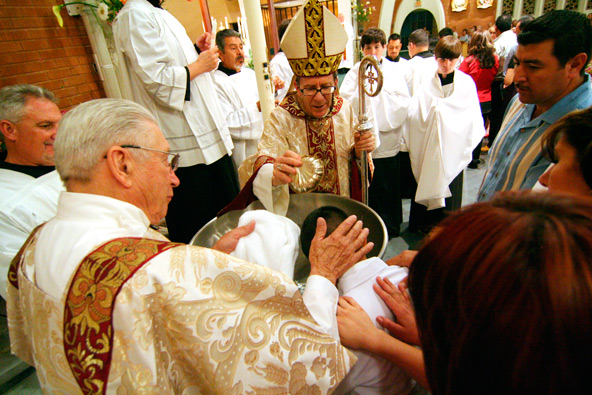
Bishop Thomas J. Olmsted baptizes new Catholics into the faith during Saturday Easter Vigil, April 7. “Our entrance into the faith through the saving waters of baptism should be remembered throughout our pilgrim journey of faith,” Bishop Olmsted and Auxiliary Bishop Eduardo A. Nevares write in their pastoral letter, “Blest Are They Who Believe.”
Pope Benedict XVI has proclaimed a Year of Faith to assist Catholics in deepening, sharing and living out their faith at a time in which he said large portions of society are experiencing a “profound crisis of faith that has affected many people.”
In his apostolic letter, Porta Fidei, Pope Benedict set forth the meaning and purpose of the Year of Faith, which commences Oct. 11, the 50th anniversary of the opening of the Second Vatican Council and the 20th anniversary of the publication of the Catechism of the Catholic Church.
“This will be a good opportunity to usher the whole Church into a time of particular reflection and rediscovery of the faith,” the Holy Father wrote in Porta Fidei. “Faith grows when it is lived as an experience of love received and when it is communicated as an experience of grace and joy.”
Bishop Thomas J. Olmsted and Auxiliary Bishop Eduardo A. Nevares issued a pastoral letter Sept. 14, to coincide with the 25th anniversary of the visit
of Blessed John Paul II to Phoenix. The letter sets forth the principle ways in which Catholics can participate in the Year of Faith.
Portions of the letter are addressed to specific groups, among them, married couples, the elderly, clergy, religious and educators. The longest passage is addressed to families in an effort to encourage and challenge them in their life of faith.
“You are not called to a mediocre, passive existence in the Church,” the bishops wrote. “Rather, you have an indispensable mission in the New Evangelization. “
Ryan Hanning, director of parish leadership support for the diocese, said the Year of Faith will be an opportunity for Catholics to grow in their understanding of the faith and to live it more deeply.
“The vision of the Holy Father is that every Catholic would engage in the New Evangelization by rediscovering the joy of the faith in their life,” Hanning said. “Rediscovering that joy will lead us to sharing the joy we have in our life with others. Our relationship with Christ will then flow out into everything that we do and impact society.”
Helping families pray
Praying together as a family is something Hanning says is a top priority for the Year of Faith in the local Church.
“We’re inviting all families throughout the diocese to pray as a family every night,” Hanning said. “There are lots of resources on the Web to help them if they’re not doing it already.”
The Phoenix Diocese will also launch www.catholicfamilyprayer.org this month in an effort to help families pray together. The rewards of family prayer, the bishops wrote, are “peace, unity, and joy that reach beyond this world.”
In their pastoral letter to the faithful, Bishop Olmsted and Bishop Nevares outline specific ways in which families can grow closer to God. One concrete way, they said, was by reclaiming Sunday as the Sabbath.
“Without regular Sunday worship, our life in Christ can barely survive, and our faith will suffer on many levels,” the bishops wrote. “Attend Sunday Mass together as a family, making this connection to the Church and her communion an immovable element of your family’s week, and where possible, Mass on other days during the week.”
A deeper sacramental life
The Phoenix bishops are calling on Catholics to a richer, more active sacramental life, urging more frequent and worthy reception of the Eucharist as well as the seeking of forgiveness and healing through the sacrament of reconciliation.
“This treasure of frequent reception of the Sacrament of Confession should be rediscovered with great joy and thankfulness,” the pastoral letter reads. The bishops also called on priests to “generously and more frequently [make themselves] available for hearing confessions.”
Hanning said plans are in the works to increase confession times. He quoted Pope Benedict’s statement that “the New Evangelization begins in the confessional.” Evangelization, Hanning emphasized, always involves conversion.
“God always calls us to something greater than ourselves. A relationship with God is not a relationship with the abstract,” Hanning said. “A relationship with a person changes you.”
The process of conversion, he said, begins when we recognize our own inability to save ourselves. “We need the love of Jesus Christ not only to forgive our sins, but to know our purpose in this world,” Hanning said.
Life in Christ begins with the sacrament of baptism. The bishops’ letter urges the faithful to commemorate the day on which they were baptized.
“Every Catholic should know and celebrate the day of their baptism as their ‘birth into new life,’” the bishops wrote. “Parishes should renew their efforts to educate persons of all ages about this foundational sacrament.”
Family mealtime
The bishops’ pastoral letter stressed the importance of families sharing meals together.
“Every family meal can help to strengthen the family bond,” they wrote. “We strongly urge you to rediscover the joy and beauty of the family meal, to make every sacrifice necessary in order to share more meals together as a family, and to work towards making this a daily habit in your home.”
Hanning, the father of six children ages 15 months to 11 years, said sitting down together to share the evening meal is something his family does nightly. He recognizes that this practice is rather uncommon in 2012.
“It’s something that as a culture we’ve lost,” Hanning said. “And it’s really hard to rediscover the joy of faith, to figure out how to trust in God if we don’t have that modeled in our family.”
He referenced a Gallup longitudinal study that shows that only 40 years ago, the vast majority of American families ate dinner together every night. Today, just 23 percent do so. The shared family meal, he said, is about more than simply eating together.
“There’s something special about breaking bread together. We come together as a family to talk about our day, to reflect together on how we’re growing,” Hanning said. “Even in just that simple banter in the arguments over the family meal, all of that is the main way in which God calls us to trust in Him.”
Fr. Chuck Kieffer, VF, pastor of St. Theresa Parish, acknowledged that families are often busy shuttling children back and forth between extracurricular activities. But, he said, a shared meal is important. It’s something he and his brother priests are committed to at the rectory.
“Monday night is our community night. We pray and eat together as priests,” Fr. Kieffer said. “We hold Monday to be kind of sacred, so we don’t make other commitments that interfere with prayer time and mealtime. It tends to work, but it also requires a concerted effort to actually calendar it and say nothing else is going to get in the way.”
Activities at local parishes
Parishes around the Phoenix Diocese are gearing up for Year of Faith by incorporating it into their programs and events.
Several parishes in the diocese are planning sacramental prep retreats that focus on discovering the joy of faith. Others are addressing issues of faith in their weekly bulletins. Throughout the diocese, Hanning said, parishes will “highlight the role of faith and the rediscovery of that faith and that trust in God.”
Fr. Kieffer said he will be taking parish staff on a retreat at St. Andrew’s Abbey, a Benedictine monastery in Valyermo, Calif.
“We’re going to have a retreat on the Year of Faith given by one of the monks at the abbey,” Fr. Kieffer said. “Hopefully we’ll come back from that not only refreshed and recharged but also with some good ideas for the Year of Faith.”
Lily Hannan, director of the youth program at St. Vincent de Paul Parish, has already planned activities to mark the Year of Faith and bring young people closer to God.
“The first half will be on the life of the saints, personal holiness and deeper conversion,” Hannan said. “The second semester is more catechetical.”
That’s when they’ll be studying the Creed by way of YOUCAT, the official youth catechism recommended by Pope Benedict XVI that features a book and an interactive website.
Youth group members will make a public profession of faith at the end of the second semester, something Hannan said she hopes to capture on video.
Bishop Olmsted said the Year of Faith will help Catholics focus on things that last and have endurance in a changing world.
“Without a doubt, the Year of Faith will help us in Arizona to deal more effectively with the challenges of atheism and secularism,” the bishop said, “not just so we can survive them but so that we can use their emergence as a teachable moment for the Church.”
Category: Local News, News


Comments (0)
Trackback URL | Comments RSS Feed
Sites That Link to this Post