For those with disabilities and their families, attending a regular Mass can be more than a little challenging.
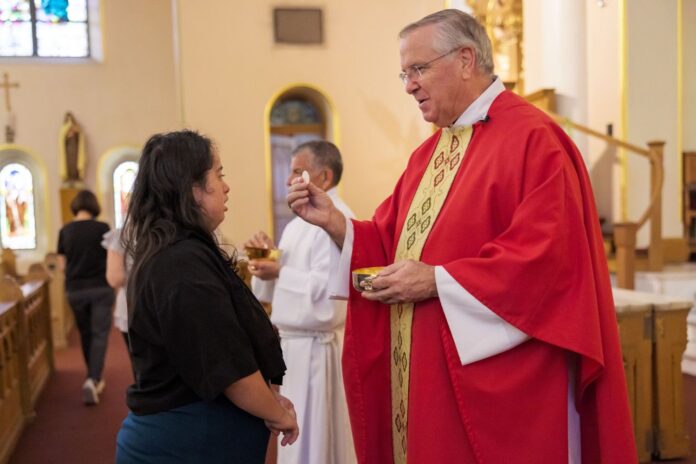
In that vein, the Office of Evangelization, Discipleship and Spirituality and the Office of Worship and Liturgy responded to the need expressed by a diocesan committee known as the Committee for Pastoral Ministry with Persons with Disabilities and their Families. The two diocesan offices worked together to organize and hold what’s known as a sensory-friendly Mass at St. Mary’s Basilica in downtown Phoenix on Oct. 18.
Gail Ratti-Curran, who spent decades in the field of special education and who serves as chair of the committee, spoke to the purpose of the Mass and described how it assists not just the individuals with disabilities and their families, but the entire community.
“It’s definitely a way to welcome back families that have stayed away because they did not have a place for their loved ones with disabilities to feel comfortable and to be able to enjoy the Mass,” Ratti-Curran said.
Piotr and Monique Peña can relate. Luke, their son with disabilities, is 5 years old. Monique and Piotr attend Mass separately so that one of them can stay home with Luke who has not yet been baptized.
“It meant a lot to us to be here today because we haven’t been able to do a family Mass,” Monique said. Having Bishop John Dolan offer the Mass was particularly meaningful, she added.
“It was incredible, just to know that he sees us,” Monique said.
“He sees those of us that have sometimes been excluded. It was huge.”
At a sensory-friendly Mass, music and lighting is considerably softer, homilies are concise and practical, and the pace is noticeably slower. Notably, there’s no incense which can be overstimulating or spark allergic reactions.
These accommodations, Ratti-Curran explained, are helpful because they assist in regulating the sensory system. A standard Mass with booming organ music, clouds of incense and elaborate homilies can be overwhelming for those on the autism spectrum or who might have a host of other conditions.
Bishop Dolan noted during his homily that when we accept a child, we accept Christ. “Whoever welcomes a child such as this, welcomes me,” he said, quoting Scripture.
Ratti-Curran and the committee hope the sensory-friendly Mass at St. Mary’s Basilica will serve as a model for other parishes in the Diocese of Phoenix.
“It’s about building awareness,” Ratti-Curran said. “Many of us don’t understand the struggle that persons with disabilities have just by going to Mass, which means then that their families would have to struggle if they’re young children.”
Older adults with disabilities may just stay away from church altogether.
Mary Young, whose 25-year-old son Mark lives with significant developmental disabilities, said she served as her son’s aide all through religious education at their parish of St. Timothy in Mesa, Ariz. She thinks it would have been helpful to have a sensory-friendly Mass when Mark was younger. At times, people don’t understand the challenges faced by those with disabilities and their families.
“They can be perceived as being disruptive and the Mass itself can seem overwhelming. And because of those things, it is very difficult to bring them to Mass,” Young said.
At a sensory-friendly Mass, families can breathe easy. “Everyone there is not judgmental about it if someone in the congregation is having a difficult moment.”
Cheryl and Chris Butterworth brought their 26-year-old son Collin who has autism to the Mass. The couple accompanied their son in his religious formation so that he could receive his sacraments.
“He’s fully initiated. He enjoys Mass very much,” Cheryl said. “He likes the order of it.
“He just loves God.”
Eneida Scoby of the Office of Evangelization, Discipleship and Spirituality explained the vision for the sensory-friendly Mass.
“It’s often thought that a sensory friendly Mass is only for those with autism but many with disabilities and their families can benefit, including those with ADHD, intellectual and development disabilities, anxiety, adults with dementia and Alzheimer’s disease,” Scoby said.
“There were many surprising outcomes from the morning,” Scoby added, “including how at the end of the Mass, a group of young adults with disabilities gathered on the lawn of the basilica plaza for fellowship, meeting each other for the first time.”
For Diane Saunders, director of the Office of Evangelization, Discipleship and Spirituality, this was a highlight of the event and pointed to the need for this to become a regular opportunity in the diocese.
“Bishop Dolan’s affirming the gifts of those with disabilities among us reminds us of the inherit human dignity within each of us as created by God,” Sauders said. “This is a deeply healing reminder for our time.”