An estimated 10,000 Filipino Catholics make their home in the Diocese of Phoenix. Many hold culturally rooted faith traditions close to their heart, perhaps none stronger than Simbang Gabi, a novena leading up to Christmas that recalls the nine months the Virgin Mary carried the Christ child before giving birth.
Pronounced “sihm–BAHNG gah-BEE,” the celebration has been a staple of the season for Filipino Catholics across the world for hundreds of years and is part of the December calendar for a half dozen parishes in the diocese with Filipino populations.
Last year’s inaugural diocesan Simbang Gabi event saw worshippers pack the historic St. Mary’s Basilica in downtown Phoenix to standing room only, prompting the move of this year’s celebration on Dec. 14 at 4:30 p.m. to the more spacious St. Paul Church, 330 W. Coral Gables Drive in Phoenix.
Its instant popularity is making Simbang Gabi an even bigger gathering this year, during the Church’s Jubilee Year of Hope in 2025.
“Simbang Gabi is one of the most [anticipated] events every year,” said Fr. Joevensie “Jovi” Balang, pastor of All Saints Parish in Mesa, Ariz., one of 19 priests across the diocese of Filipino descent and the lead organizer of the diocese’s celebration.
“This is an occasion of family reunions, get-togethers of friends, parties. It keeps the spirit of Christ’s birth always a season of joy, peace and thanksgiving,” Fr. Balang said.
“In virtually every parish I have served in over the years, Simbang Gabi has been celebrated, and I have found it to be one of the most joyful experiences leading up to Christmas,” added Bishop John Dolan.
Last year’s inaugural diocesan gathering was no exception.
“It really feels like a festival,” said St. John Vianney of Goodyear, Ariz., parishioner Dalton Attig. “They pull out all the stops for the music. Christmastime feels even more joyous,” he said.
One of the fastest-growing dioceses in the United States, the Diocese of Phoenix includes more than 2 million Catholics. It is a diverse diocese, and though Filipinos make up a relatively small segment, Simbang Gabi is finding popularity well beyond its distinctly southeast Asian roots.
The roots of Simbang Gabi
Introduced to Philippines villagers in the late 1600s by an unnamed Mexican friar, the intent was to allow the large agricultural communities there to celebrate the Blessed Virgin’s pregnancy without taking away from the farmers’ early morning workday. December marks the middle of the Philippines’ planting season, so laborers could ill-afford to miss even an hour in the fields.
Given permission by Pope Sixtus V to hold early morning Masses, the local farmers were able to practice their faith and earn their livelihood.
Worshippers prayed, sang hymns, listened to the Word of God and received the Eucharist amid the glow of lighted candles, illuminating the darkness and reminding them of the light of Christ.
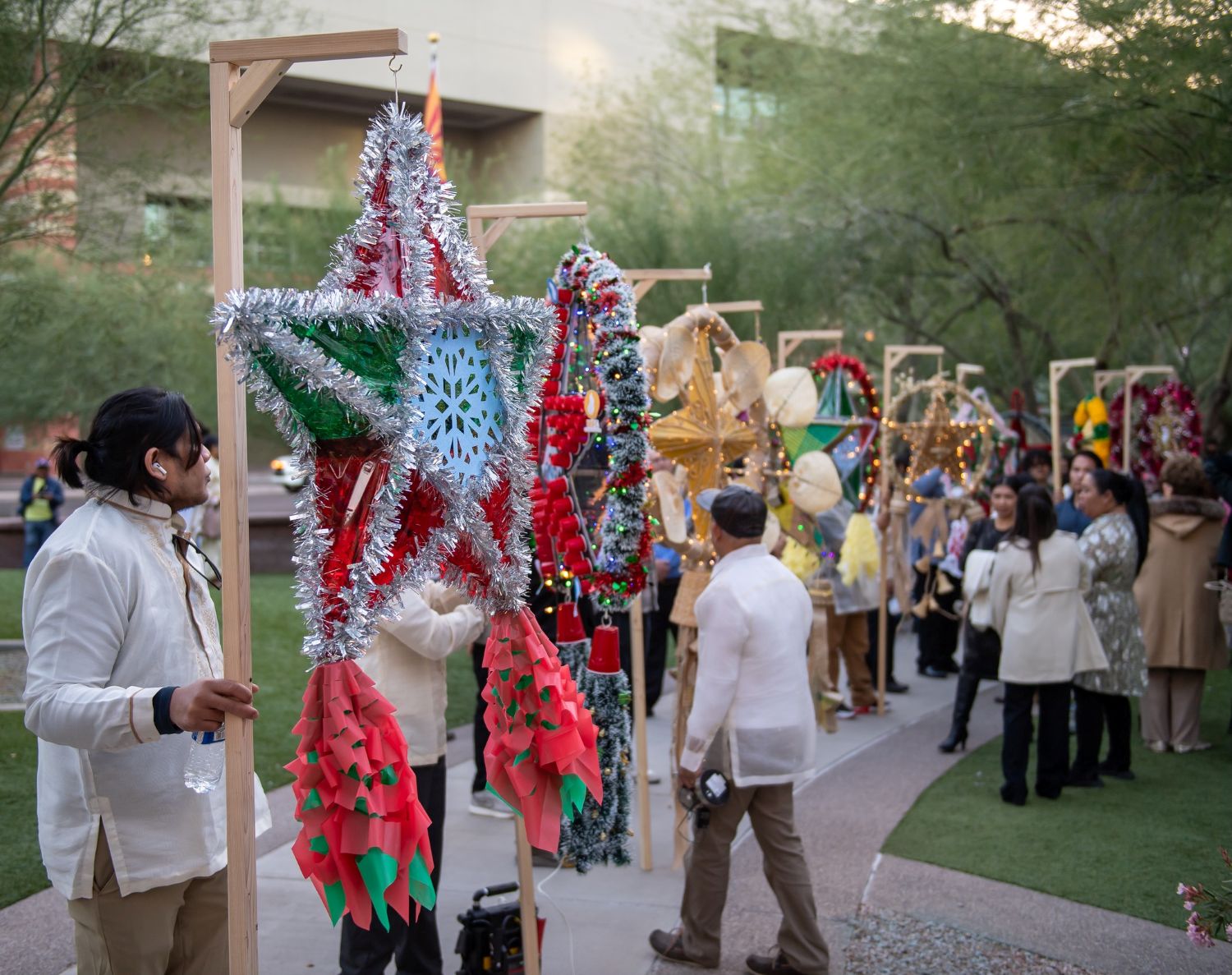
Centuries later, that practice is remembered and honored as participants in the Diocese of Phoenix’s celebration proudly carry their parols, or lanterns, in a parade prior to Mass. The brightly colored lanterns, a remarkable sight, captivate the senses with their five-point, star-shape design that harks back to the unusually bright star that first guided the wise men and the shepherds to the manger where Jesus was born.
The lanterns symbolize not only that first novena but also the message of Christmas itself, noted Bishop Dolan.
“We know that Christ is the Light in the darkness. For those of us who might have struggles in life, whatever [they] may be — there is a light that shines deeply in each and every one of us. And, that light is Christ,” he said. “Christ is the Light of the World.”
A joyous tradition
The opening Simbang Gabi Mass falls on the Third Sunday of Advent, known also as Gaudete Sunday. From the Latin meaning “rejoice,” it is the day the Church’s liturgical celebration pivots from the season’s themes of penance and preparation to one of joy and anticipation of Jesus’ birth. Priests don vestments of rose or white.
“It’s a joyful time,” Bishop Dolan said, “and it’s a sign that something is happening.”
Recalling his experiences as auxiliary bishop in the Diocese of San Diego, Calif., prior to coming to Phoenix, the bishop described a particular Simbang Gabi celebration at one of his former churches as “the most beautiful time in all my parishes.”
“My jaw dropped when I saw the church was absolutely alive because the light of Christ was found in each and every person,” he said.
Simbang Gabi is a highly family-oriented event for Filipino Catholics, and it is becoming one for those outside the culture, as well.
“I don’t feel out of place here,” said Attig, who was introduced by his Filipino Catholic wife and her family to Simbang Gabi at St. Thomas Aquinas Parish in Avondale, Ariz., one of several diocesan churches that has regularly held the novena. The others are: All Saints in Mesa, Ariz., Corpus Christi in Phoenix, Our Lady of the Valley in Phoenix, St. Juan Diego in Chandler, Ariz., and St. Rose Philippine in Anthem, Ariz.
Another hallmark of the celebration is the food after Mass.
“I love … the food,” said Dr. Anne Vargas, a Phoenix area Catholic who grew up in the Philippines. “One really has to experience it for themselves.”
The fare includes bibingka, pancit and lechon. Bibingka is a fluffy rice cake made from rice flour and coconut milk and brushed with butter. Pancit is a noodle dish of either egg or rice noodles, often made with chicken, shrimp or pork; and lechon is a roasted pork dish. But perhaps the most beloved item on the table is the lumpia. A Filipino version of the spring roll, lumpia often are filled with pork or vegetables.
“[The] food,” said Bishop Dolan. “That’s really the best part of the whole thing.”
Nourishment for the body and the soul, during one of the most joyful times of the liturgical calendar. What’s not to like?
And the opening Mass is just the start.
Following the Dec. 14 celebration, the novena continues at the participating local churches through Christmas Eve. Click here for Mass times and locations.
“It’s just such a wonderful tradition,” Bishop Dolan beamed. “It’s just so joyful. The songs, the music, the vibrancy as we lead up to the wonderful season of Christmas.
“It’s just a great experience. You don’t want to miss it!”