Adding a manager to its Catholic schools pilot program, expanding its signature parish-level spaces and launching outreach to those in prison are among the latest developments within the Diocese of Phoenix’s groundbreaking Mental Health Ministry as it enters its fourth year.
The developments were discussed in a wide-ranging interview with Mental Health Ministry Director Mary Permoda and Accompaniment Program Manager Richard DiCarlo during a recent edition of “The Bishop’s Hour,” a weekly radio program airing Saturday mornings at 9 a.m. on Relevant Radio 1310 AM, presenting Church news and theological reflections, and discussing contemporary issues facing today’s Catholics in Arizona.
The ministry, launched by Bishop John Dolan in December 2022, has been transforming, with compassion and dignity, the way resources are delivered surrounding mental health. A core principle “You Are Not Alone,” seeks to assure those experiencing mental health struggles that the Church is ready to lovingly walk with them by connecting them to help.
The ministry is not a clinical resource and is not intended to serve as a substitute for treatment or counseling with a qualified professional. It does not diagnose or treat mental illness.
Its threefold mission is education, accompaniment and advocacy, pillars upon which the ministry has been addressing a topic once little discussed within the Church.
“So many things have happened in these last two years,” Permoda said, referring to her time since joining the ministry about a year after its inception. “My passion has grown deeper [for this ministry.]”
Central to the Ministry’s outreach is a physical space known as The Well.
Modeled after Jesus’ encounter with the woman at the well in chapter 4 of St. John’s Gospel, The Well is a physical location within each participating parish. It aligns with the ministry’s pillar of accompaniment.
At The Well, a person can find someone who will walk with them through conversation, prayer and provide connections to appropriate services.
“What does Jesus do at the well?” Permoda asked. “He listens and walks with that woman from well to wellness.
“It will look different from parish to parish just because their charisms and needs are different. But the one thing that is constant is that we’re developing communities of belonging, healing communities and places where people will feel not shamed, blamed, judged, but loved,” Permoda explained.
“They’re … areas for people to come and kind of decompress and get away from the daily stressors in their lives,” DiCarlo added.
A former City of Phoenix police officer, DiCarlo transitioned from 25 years of mainly street-level law enforcement to serving alongside Permoda at St. Patrick’s Catholic Community in Scottsdale, Ariz., where the pair specialized in social justice and outreach. They both joined the Office of Mental Health Ministry in 2024, Permoda in March and DiCarlo in December. DiCarlo is a lifelong Catholic, husband and father of two grown sons. He has four grandchildren.
His police work familiarized him with issues related to the mental strain tied to many of life’s challenges. “I saw it face-to-face on a daily basis,” he said.
The decision to add a Well ultimately lies with each parish pastor.
A year ago, the diocese had 12 parish-level Wells among its 94 parishes. Today, there are more than 30 Wells operating. At least five more are expected to open by spring 2026. Several nonprofit organizations, including St. Vincent de Paul, Paz de Christo and Catholic Charities have added one.
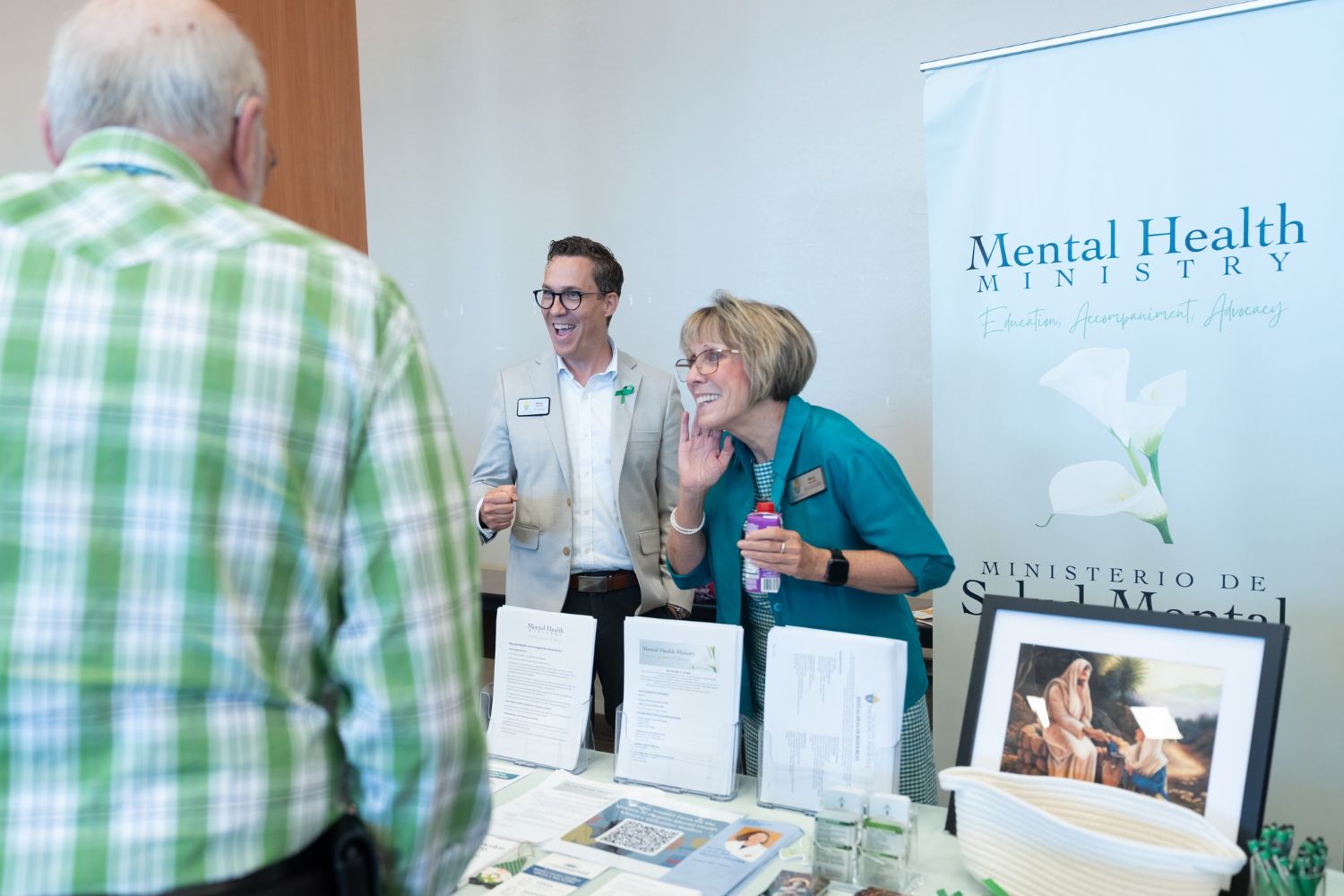
Parishes also have been finding other ways to reach the public. A number have hosted fairs where mental-health services host tables stocked with brochures, pamphlets and other information. Some have added listening sessions and workshops to help tailor their Well to the needs of parishioners.
“Most recently, we had a breakfast gathering at one of the parishes,” DiCarlo noted. “and the topic was mental-health ministry. [Representatives of] three different organizations came and spoke about what they do in the area of mental health. It was very, very well-received.”
Advocacy
The ministry also is expanding its advocacy for mental health resources, in line with its second pillar.
Led by Advocacy Program Manager Brian Cannon, the ministry has developed partnerships with local and nonprofit organizations, health care providers and government leaders. It has worked with coalitions and civic figures to enact social policies and to bring the topic to the forefront of conversations. Last fall its efforts helped secure passage of Arizona Proposition 409, a public question approved by voters to strengthen Maricopa County’s mental health safety net. The City of Mesa, Ariz., is looking to spend a year focusing on youth mental health. Additionally the diocese’s Mental Health Ministry is working with the Arizona Dept. of Corrections, Rehabilitation and Reentry (ADCRR) to share resources.
That effort includes working with other faiths and the diocese’s Office for Prison Ministry to create a toolbox to help those who have been incarcerated upon their release from prison.
“When one of the inmates is re-entering society, there’s a whole lot of things that need to be done and not a lot of resources,” Permoda said. “So, this toolbox is going to include: ‘Can you take someone to get their driver’s license?’ ’Can you take someone to find housing?’ ‘Can you take someone to the doctor?’ all those things when you’re coming out of prison.”
Those entering prison are getting attention, too.
Permoda said that ADCRR Director Ryan Thornell has asked the Ministry to create a team to accompany individuals within their first five-seven days of incarceration who are awaiting sentence and to learn where they’ll serve time. Team members would walk alongside that person, explaining the process and what resources are available while in prison, as well as when they are released.
“So, they’re not going in by themselves,” Permoda said. “Bishop [Dolan] constantly is saying that this is a ministry of accompaniment. How can we accompany the most vulnerable? Those who are incarcerated are very vulnerable.”
Preventing released individuals from repeating their crimes is a challenge, DiCarlo said.
“When I was working at the street level, time and again, we would run into people who just had nowhere to go [after release]. They didn’t have the dignity of employment, housing or food. The very basics of life … just weren’t there. So, they got trapped in the system again. It was very frustrating for them. But, it’s also very frustrating for law enforcement,” he said.
The Mental Health Ministry and ADCRR are also discussing creation of a behavioral peer-support program in prisons.
“Do they have to do their time and punishment for their actions?” Permoda asked. “Absolutely. But, do we believe in rehabilitation? Do we believe that there’s a way back home? Our faith does tell us there’s a way back home. You may have to leave your dignity at the [prison] door, but you can redevelop it on the inside so you can live it when you come out.”
School programs
The Mental Health Ministry is continuing to expand resources into Catholic schools.
A pilot program begun a little over a year ago in seven elementary schools, and one high school is using interns provided through Catholic Charities in each school to connect with children. Two licensed counselors have been hired. Each is responsible for four schools.
In January, the Office of Mental Health Ministry will add a position to manage the schools pilot program, which eventually will become a permanent program.
“[We’re] really excited because it’s going to help grow [the program] within the Catholic school system,” Permoda said.
The initiative goes well beyond discussing mental health with students.
For example, the program connects people to food and housing resources: areas that, if lacking in a family’s life, can affect a student’s mental outlook.
“If a kiddo goes to a counselor in school, then goes home and nothing happens at home, that kiddo comes back with the same [problems]. We’re trying to look at it holistically,” she explained.
“Not only will the kiddo excel, but their family will be better, the school community will be better and their parish community will be better.”
Education
The Mental Health Ministry also continues to expand its third pillar: education.
At its 2022 launch, the Ministry announced it would be offering Mental Health First Aid training, a three-year international certification program to churches, parishes, schools, clergy and laity. The program is now offered in Spanish, and there is a separate version tailored to youth.
“We can’t do this alone,” Permoda said. “The ocean has to move together. So, the more we’re out in the field, training [others] to observe and helping connect [people] to resources, the bigger the ripple will be.”
Its efforts have helped shift the attitude about mental health.
“Historically, as a Church, [we’ve been] a little leery about how we approached it,” DiCarlo noted. “I think we’re becoming more comfortable with … the topic of mental health and destigmatizing it.”
According to the National Institute of Mental Health, the lead federal agency for research on mental disorders, about one in five U.S. adults experiences mental illness each year. In recent years, various surveys have found teens increasingly vulnerable to feeling depressed or isolated.
“We’re all wounded in some way,” DiCarlo said. “We’re all carrying burdens in some way. While my life is different than your life, for example, we all need healing. We all need respite. We all need companionship.”
As word of the diocese’s Mental Health Ministry spreads, so has enthusiasm.
Permoda is thrilled that the conversation is broadening within the entire interfaith community, as well as the secular world.
“For the Catholic Church to be welcomed at some of these tables where government agencies and 501C3s are saying, ‘Let’s talk about this together,’ that’s exciting to me.”
Anyone interested in resources, prayer support, being trained in Mental Health First Aid or finding their nearest Well can contact their local parish or the diocese’s Mental Health Ministry at: https://dphx.org/mentalhealth/.
As the Jubilee Year of Hope draws to a close, Permoda sees hope — the year’s designated theme — in the years ahead through building on the ministry’s early work.
“It’s been amazing,” she said. “There are so many people willing to give of themselves and walk alongside and love others who need assistance.”