
Silence overlooked as a method of communication today, say speakers

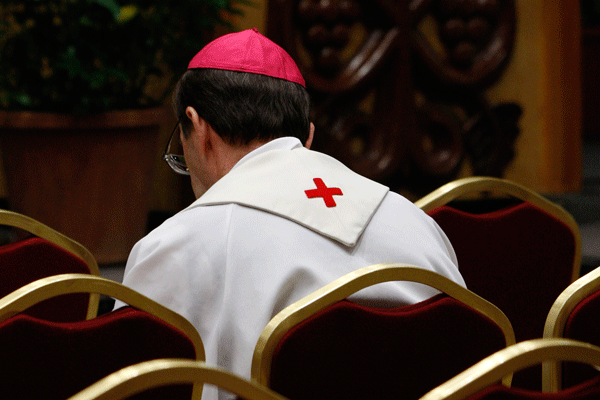
Bishop Thomas J. Olmsted spends a moment in silence before Mass is celebrated Nov. 10, 2008 at the annual fall meeting of the U.S. Conference of Catholic Bishops in Baltimore. (CNS photo/Nancy Wiechec)

By Ed Wilkinson Catholic News Service
BROOKLYN, N.Y. (CNS) — In what appears to be a contradiction in terms, silence as a means of communication was the theme of the Brooklyn Diocese’s 21st annual World Communications Day conference and luncheon May 18.

The topic came from the theme of Pope Benedict XVI’s message for World Communications Day, “Silence and Word: Path of Evangelization.”

Msgr. Kieran Harrington, Brooklyn’s vicar for communications, opened the program by saying, “There is a lot of noise in today’s world. The pope challenges us to be still so that we can have a personal encounter with God.”

Keynote speaker Kathryn Jean Lopez, editor-at-large of National Review Online, said she felt that “silence was disappearing” in the world. She called Pope Benedict’s message about silence” a great gift from a great teacher.”

“No one looks at one another anymore,” she said. “Everyone is tweeting and texting. We need to get over ourselves and to ask God to help us get outside ourselves.”

She pointed out that the pope says silence is necessary because it allows time for contemplation and time to listen to one another, without which no real dialogue or conversation can take place. She recommended that everyone commit to an hour of silence a day to listen to God and to one another.

“Silence is not an escape; it’s meant to be an integral part of our lives,” she said.

She used Archbishop Fulton J. Sheen as an example of a great communicator who took time out of every day to make a holy hour before the Blessed Sacrament.

“We’re living in this new media world and we’re trying to be good Catholics,” she said. “If we seek to be well integrated, God will use the opportunities to communicate with us.”

A second keynoter, Kellianne Conway, a national pollster and frequent TV commentator, explained that “we are living in a time when Catholics are under attack in the media. It’s open season on Catholics. Anti-Catholic rhetoric is part of the expected routine.”

But “people still agree with doctrinal precepts,” she said. “Even if they don’t admit it at times.”

For instance, she maintained that most Americans are opposed to abortion. Those who support keeping abortion legal use the argument of protecting the life of the mother but she explained that only 1 percent of abortions in the United States are performed to save the life of the mother.

She also said most abortion supporters do not want the general public to know that 3 percent of the abortions occur because of gender selection, which is usually anti-feminine.

She added that the nation is increasingly becoming pro-life because science and medicine have stepped up with information and images that are shifting the focus away from the woman and more toward the child in the womb.

“Catholic are seen as out of touch on social issues but facts and figures are on our side,” she said.

Conway, a Catholic and the mother of four, also urged the Catholic Church to embrace immigrants because the newly arrived Asians and Hispanics are “propping up our church, even in the suburbs.”

As a national pollster, she claimed that there is no monolithic Catholic vote because it usually breaks down between churchgoing and fallen-away Catholics.

“The behavior of churchgoing Catholics is much more based on faith,” she said. “If religion is central to you, your faith influences the rest of your life, including the way you vote.”

The Catholic Church, she said, needs to get back to basics and to use facts to communicate shock to the consciences of others.

Bishop Nicholas DiMarzio presented a St. Francis de Sales medal to Christopher Ruddy, founder and CEO of NewsMax, a multimedia publications company that publishes one of the country’s most popular news online services.

Ruddy, a graduate of Chaminade High School in Uniondale on Long Island and St. John’s University in Jamaica, N.Y., said he got into the media business because the country was suffering from a lack of diversity in news and that journalism was becoming one-sided.

He also echoed other speakers that “religious freedom is in the crosshairs” of an increasingly secular society.

Bishop DiMarzio also presented a St. Clare Award to Joe Campo, CEO and founding partner of Grassroots Film Co., a Brooklyn-based video production company.

Grassroots has been commissioned by the U.S. Conference of Catholic Bishops and also has produced national TV spots. Its recent feature film “The Human Experience” has been shown at 30 international film festivals.

In keeping with the theme of the conference, Campo pointed out that one of his poignant pro-life ads for CatholicVote.com was seen on national TV and didn’t have a word in it.

Bishop DiMarzio closed the session by saying that “we cannot pray in the midst of noise. Silence is necessary if we want to communicate with one another. There’s a lot of noise in our lives but God often speaks through silence.”

He used silence as part of his closing prayer. Msgr. Harrington called for a minute of silence during the program.

– – –

By Ed Wilkinson, editor of The Tablet in Brooklyn.
Silence and Word: Path of Evangelization

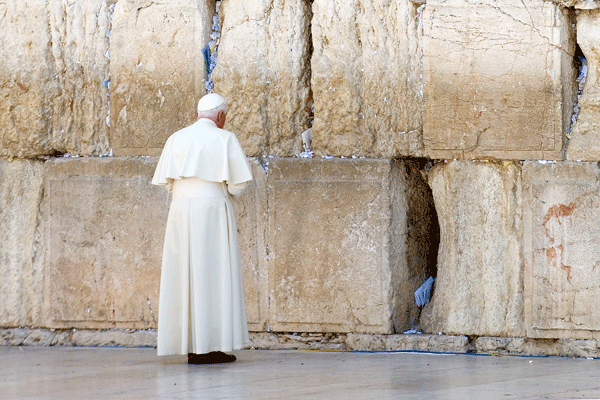
Pope Benedict XVI stands in silence at the Western Wall, the Jewish holy site in Jerusalem's Old City May 12, 2009. (CNS photo/Alessia Giuliani, Catholic Press Photo)

From www.vatican.va

Pope Benedict XVI: For the 46th World Communications Day

[Sunday, 20 May 2012]

Dear Brothers and Sisters,

As we draw near to World Communications Day 2012, I would like to share with you some reflections concerning an aspect of the human process of communication which, despite its importance, is often overlooked and which, at the present time, it would seem especially necessary to recall. It concerns the relationship between silence and word: two aspects of communication which need to be kept in balance, to alternate and to be integrated with one another if authentic dialogue and deep closeness between people are to be achieved. When word and silence become mutually exclusive, communication breaks down, either because it gives rise to confusion or because, on the contrary, it creates an atmosphere of coldness; when they complement one another, however, communication acquires value and meaning.

Silence is an integral element of communication; in its absence, words rich in content cannot exist. In silence, we are better able to listen to and understand ourselves; ideas come to birth and acquire depth; we understand with greater clarity what it is we want to say and what we expect from others; and we choose how to express ourselves. By remaining silent we allow the other person to speak, to express him or herself; and we avoid being tied simply to our own words and ideas without them being adequately tested. In this way, space is created for mutual listening, and deeper human relationships become possible. It is often in silence, for example, that we observe the most authentic communication taking place between people who are in love: gestures, facial expressions and body language are signs by which they reveal themselves to each other. Joy, anxiety, and suffering can all be communicated in silence – indeed it provides them with a particularly powerful mode of expression. Silence, then, gives rise to even more active communication, requiring sensitivity and a capacity to listen that often makes manifest the true measure and nature of the relationships involved. When messages and information are plentiful, silence becomes essential if we are to distinguish what is important from what is insignificant or secondary. Deeper reflection helps us to discover the links between events that at first sight seem unconnected, to make evaluations, to analyze messages; this makes it possible to share thoughtful and relevant opinions, giving rise to an authentic body of shared knowledge. For this to happen, it is necessary to develop an appropriate environment, a kind of ‘eco-system’ that maintains a just equilibrium between silence, words, images and sounds.

The process of communication nowadays is largely fuelled by questions in search of answers. Search engines and social networks have become the starting point of communication for many people who are seeking advice, ideas, information and answers. In our time, the internet is becoming ever more a forum for questions and answers – indeed, people today are frequently bombarded with answers to questions they have never asked and to needs of which they were unaware. If we are to recognize and focus upon the truly important questions, then silence is a precious commodity that enables us to exercise proper discernment in the face of the surcharge of stimuli and data that we receive. Amid the complexity and diversity of the world of communications, however, many people find themselves confronted with the ultimate questions of human existence: Who am I? What can I know? What ought I to do? What may I hope? It is important to affirm those who ask these questions, and to open up the possibility of a profound dialogue, by means of words and interchange, but also through the call to silent reflection, something that is often more eloquent than a hasty answer and permits seekers to reach into the depths of their being and open themselves to the path towards knowledge that God has inscribed in human hearts.

Ultimately, this constant flow of questions demonstrates the restlessness of human beings, ceaselessly searching for truths, of greater or lesser import, that can offer meaning and hope to their lives. Men and women cannot rest content with a superficial and unquestioning exchange of skeptical opinions and experiences of life – all of us are in search of truth and we share this profound yearning today more than ever: “When people exchange information, they are already sharing themselves, their view of the world, their hopes, their ideals” (Message for the 2011 World Day of Communications).

Attention should be paid to the various types of websites, applications and social networks which can help people today to find time for reflection and authentic questioning, as well as making space for silence and occasions for prayer, meditation or sharing of the word of God. In concise phrases, often no longer than a verse from the Bible, profound thoughts can be communicated, as long as those taking part in the conversation do not neglect to cultivate their own inner lives. It is hardly surprising that different religious traditions consider solitude and silence as privileged states which help people to rediscover themselves and that Truth which gives meaning to all things. The God of biblical revelation speaks also without words: “As the Cross of Christ demonstrates, God also speaks by his silence. The silence of God, the experience of the distance of the almighty Father, is a decisive stage in the earthly journey of the Son of God, the incarnate Word …. God’s silence prolongs his earlier words. In these moments of darkness, he speaks through the mystery of his silence” (Verbum Domini, 21). The eloquence of God’s love, lived to the point of the supreme gift, speaks in the silence of the Cross. After Christ’s death there is a great silence over the earth, and on Holy Saturday, when “the King sleeps and God slept in the flesh and raised up those who were sleeping from the ages” (cf. Office of Readings, Holy Saturday)God’s voice resounds, filled with love for humanity.

If God speaks to us even in silence, we in turn discover in silence the possibility of speaking with God and about God. “We need that silence which becomes contemplation, which introduces us into God’s silence and brings us to the point where the Word, the redeeming Word, is born” (Homily, Eucharistic Celebration with Members of the International Theological Commission6 October 2006). In speaking of God’s grandeur, our language will always prove inadequate and must make space for silent contemplation. Out of such contemplation springs forth, with all its inner power, the urgent sense of mission, the compelling obligation to communicate that which we have seen and heard” so that all may be in communion with God (1 Jn 1:3). Silent contemplation immerses us in the source of that Love who directs us towards our neighbours so that we may feel their suffering and offer them the light of Christ, his message of life and his saving gift of the fullness of love.

In silent contemplation, then, the eternal Word, through whom the world was created, becomes ever more powerfully present and we become aware of the plan of salvation that God is accomplishing throughout our history by word and deed. As the Second Vatican Council reminds us, divine revelation is fulfilled by “deeds and words having an inner unity: the deeds wrought by God in the history of salvation manifest and confirm the teaching and realities signified by the words, while the words proclaim the deeds and clarify the mystery contained in them” (Dei Verbum, 2). This plan of salvation culminates in the person of Jesus of Nazareth, the mediator and the fullness of all revelation. He has made known to us the true face of God the Father and by his Cross and Resurrection has brought us from the slavery of sin and death to the freedom of the children of God. The fundamental question of the meaning of human existence finds in the mystery of Christ an answer capable of bringing peace to the restless human heart. The Church’s mission springs from this mystery; and it is this mystery which impels Christians to become heralds of hope and salvation, witnesses of that love which promotes human dignity and builds justice and peace.

Word and silence: learning to communicate is learning to listen and contemplate as well as speak. This is especially important for those engaged in the task of evangelization: both silence and word are essential elements, integral to the Church’s work of communication for the sake of a renewed proclamation of Christ in today’s world. To Mary, whose silence “listens to the Word and causes it to blossom” (Private Prayer at the Holy HouseLoreto, 1 September 2007), I entrust all the work of evangelization which the Church undertakes through the means of social communication.

From the Vatican, 24 January 2012, Feast of Saint Francis de Sales.

BENEDICTUS XVI

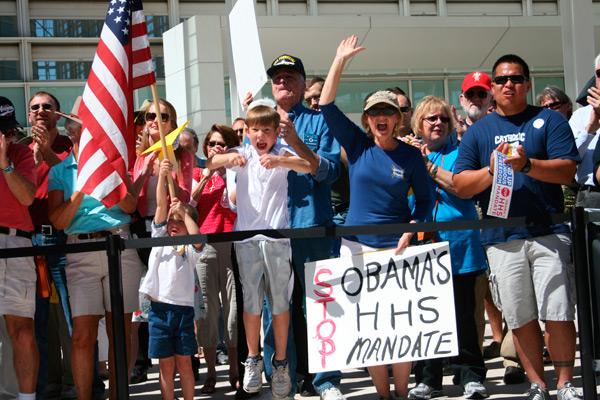
Federal lawsuits by Catholic dioceses, groups seek to stop HHS mandate

Hundreds join together in the Pledge of Allegiance during a March 23 rally in downtown Phoenix. (Ambria Hammel/CATHOLIC SUN).

WASHINGTON (CNS) — Forty-three Catholic dioceses, schools, hospitals, social service agencies and other institutions filed suit in federal court May 21 to stop three government agencies from implementing a mandate that would require them to cover contraceptives and sterilization in their health plans.

“Through this lawsuit, plaintiffs do not seek to impose their religious beliefs on others,” said one of the suits, filed in U.S. District Court for the Northern District of Indiana by the Diocese of Fort Wayne-South Bend, diocesan Catholic Charities, St. Anne Home and Retirement Community, Franciscan Alliance, University of St. Francis and Our Sunday Visitor.

“They simply ask that the government not impose its values and policies on plaintiffs, in direct violation of their religious beliefs,” it added.

Cardinal Timothy M. Dolan of New York, whose archdiocese is among the plaintiffs, said the lawsuits were “a compelling display of the unity of the church in defense of religious liberty” and “a great show of the diversity of the church’s ministries that serve the common good and that are jeopardized by the mandate.”

“We have tried negotiations with the administration and legislation with the Congress — and we’ll keep at it — but there’s still no fix,” the cardinal said. “Time is running out and our valuable ministries and fundamental rights hang in the balance, so we have to resort to the courts now.”

Cardinal Dolan also is president of the U.S. Conference of Catholic Bishops, which is not a party to the lawsuits.

Catholic organizations have objected to the contraceptive mandate since it was announced last Aug. 1 by Kathleen Sebelius, secretary of the U.S. Department of Health and Human Services. Unless they are subject to a narrow religious exemption or have a grandfathered health plan, employers will be required to pay for sterilizations and contraceptives, including some abortion-inducing drugs, as part of their health coverage beginning as soon as Aug. 1, 2012.

In all, 12 lawsuits were filed simultaneously May 21 in various U.S. district courts around the country. The defendants in each case were Sebelius; Labor Secretary Hilda Solis; and Treasury Secretary Timothy Geithner, along with their departments.

The Diocese of Phoenix is not among the 43 Catholic entities which filed suit in federal court, but “fully agree with them and did not feel the need to add our names since we are confident that our concerns and positions will be adequately represented,” according to a statement issued today.

“This is not about preventing access to contraception, nor about preventing the government from providing such services,” according to the statement. “If the government wishes to provide such services, means are readily available that do not force religious organizations to serve as its agents. We do not seek to impose our religious beliefs on others, nor do we seek to force others to agree with those beliefs. We simply ask that the government not impose its values on us, nor force us to take actions that directly conflict with our deeply held beliefs.”

The government, according to diocesan leadership, does not have the right to “coerce the Church to cooperate with what we consider to be immoral practices, and its narrow religious exemption is a direct impingement on religious liberty for all people of faith.”

The statement also lauded the recently passed Arizona law, HB 2625, calling it “a model for achieving a resolution that respects the rights and consciences of all parties.”

Erin Shields, HHS director of communications for health care, told Catholic News Service May 21 that the department cannot comment on pending litigation.

In addition to the Archdiocese of New York and Diocese of Fort Wayne-South Bend, the dioceses involved are the archdioceses of Washington and St. Louis and the dioceses of Rockville Centre, N.Y.; Erie, Pa.; Pittsburgh; Dallas; Fort Worth, Texas; Jackson, Miss.; Biloxi, Miss.; Springfield, Ill.; and Joliet, Ill. The Michigan Catholic Conference, which provides medical benefits to more than 1,100 Catholic institutions and approximately 10,000 employees in the state, also is a plaintiff.

“We need to go to the court and say we are a church institution, we are a provider of health care and, according to the U.S. Constitution, the laws must protect our religious freedom,” said Detroit Archbishop Allen H. Vigneron. “We have a very particular case to make.”

Catholic universities joining in the lawsuits included the University of Notre Dame, The Catholic University of America and Franciscan University of Steubenville, Ohio, as well as the University of St. Francis in Indiana.

Holy Cross Father John I. Jenkins, president of Notre Dame, said the decision to file the lawsuit “came after much deliberation, discussion and efforts to find a solution acceptable to the various parties.”

“This filing is about the freedom of a religious organization to live its mission, and its significance goes well beyond any debate about contraceptives,” he said. “For if we concede that the government can decide which religious organizations are sufficiently religious to be awarded the freedom to follow the principles that define their mission, then we have begun to walk down a path that ultimately leads to the undermining of those institutions.”

Others filing suit include a Catholic cemeteries association, an agency that serves the deaf, health care and social-services organizations, and Catholic elementary and secondary schools.

Our Sunday Visitor, a national Catholic newspaper based in Huntington, Ind., said in an editorial that it “stands proudly with our fellow Catholic apostolates and with our bishops in resisting this challenge.”

The newspaper asked readers “to stand with us — in charity, praying first and foremost for conversions of heart; in civility, arguing the facts of this case without recourse to bitter partisanship or political rhetoric; and in solidarity, knowing that whatever sacrifices we bear and whatever challenges we endure, we are only doing what is our responsibility as American citizens practicing our faith in the public square.”

Each of the lawsuits uses similar wording to make its case and each asks for a jury trial.

Noting that the Founding Fathers agreed “that the mixture of government and religion is destructive to both institutions and divisive to the social fabric upon which the country depends,” the lawsuits contend that the U.S. Constitution and federal law “stand as bulwarks against oppressive government actions even if supported by a majority of citizens.”

“Despite repeated requests from church leaders, the government has insisted that it will not change the core principle of the U.S. government mandate — that plaintiffs must subsidize and/or facilitate providing their employees free access to drugs and services that are contrary to plaintiffs’ religious beliefs,” the suits state. “If the government can force religious institutions to violate their beliefs in such a manner, there is no apparent limit to the government’s power.”

The suits were filed by Jones Day, an international law firm with more than 2,400 attorneys on five continents.

Jones Day said in a statement that the firm “looks forward to presenting its clients’ cases in court.”

The contraceptive mandate “unconstitutionally authorizes the federal government to determine which organizations are sufficiently ‘religious’ to warrant an exemption from the requirement,” the statement says. “This regulation is in violation of the religious liberties guaranteed by the First Amendment, the Religious Freedom Restoration Act and other federal laws.”

— By Nancy Frazier O’Brien, Catholic News Service 


Pope tells U.S. bishops to build Church unity

Pope Benedict XVI poses with U.S. leaders of Eastern Catholic churches May 18 during their "ad limina" visits to the Vatican. From left are: Father Edward G. Cimbala, administrator of the Byzantine Catholic Eparchy of Passaic; Ukrainian Catholic Auxiliar y Bishop John Bura of Philadelphia; Byzantine Catholic Bishop Gerald N. Dino of Phoenix; Chaldean Bishop Ibrahim N. Ibrahim of St. Thomas the Apostle, based in Southfield, Mich.; Maronite Bishop Gregory J. Mansour of Brooklyn, N.Y.; Armenian Bishop Mikae l Mouradian of New York; Melkite Catholic Bishop Nicholas J. Samra of Newton, Mass.; Ukrainian Catholic Archbishop Stefan Soroka of Philadelphia; Pope Benedict; Byzantine Catholic Archbishop William C. Skurla of Pittsburgh; Syriac Bishop Yousif Habash of Newark, N.J.; Romanian Bishop John M. Botean of Canton, Ohio; Ukrainian Catholic Bishop Paul P. Chomnycky of Stamford, Conn.; Ukrainian Catholic Bishop Richard S. Seminack of Chicago; Byzantine Bishop John M. Kudrick of Parma, Ohio; and Chaldean Bishop Sarhad Y. Jammo of the Eparchy of St. Peter the Apostle, based in El Cajon, Calif. (CNS photo/L'Osservatore Romano)

VATICAN CITY (CNS) — Pope Benedict XVI urged American Catholics to strive for greater unity, especially among ethnic groups and between bishops and religious orders, in order to carry out the church’s mission in an increasingly hostile society.

The pope made his remarks May 18 in a speech to U.S. bishops from the Chaldean, Ruthenian, Maronite, Ukrainian, Armenian, Melkite, Syriac and Romanian Catholic churches, who were making their periodic “ad limina” visits to the Vatican.

They were the last of 15 groups of U.S. bishops to make to make “ad limina” visits since November 2011, reporting on the status of their dioceses to Pope Benedict and holding discussions with Vatican officials.

In his speech, Pope Benedict called for greater “Catholic unity” to counter the “forces of disaggregation within the church which increasingly represent a grave obstacle to her mission in the United States.”

The pope echoed his earlier warnings to other U.S. bishops about the dangers of secularization and state curbs on religious freedom.

“With the progressive weakening of traditional Christian values, and the threat of a season in which our fidelity to the Gospel may cost us dearly, the truth of Christ needs not only to be understood, articulated and defended, but to be proposed joyfully and confidently as the key to authentic human fulfillment and to the welfare of society as a whole,” he said.

Pope Benedict noted efforts by various lay movements in the U.S. to encourage Catholics “to move forward together, speaking with one voice in addressing the urgent problems of the present moment.”

He also encouraged bishops to strengthen their “communication and cooperation” with religious orders.

“The urgent need in our time for credible and attractive witnesses to the redemptive and transformative power of the Gospel makes it essential to recapture a sense of the sublime dignity and beauty of the consecrated life,” he said.

In an apparent reference to two recent investigations of American women religious, Pope Benedict thanked “many consecrated women in your country” for their “example of fidelity and self-sacrifice,” and said he prayed that “this moment of discernment will bear abundant spiritual fruit for the revitalization and strengthening of their communities in fidelity to Christ and the church, as well as to their founding charisms.”

In April, the Vatican announced that it had discovered “serious doctrinal problems” in the Leadership Conference of Women Religious, and appointed Archbishop J. Peter Sartain of Seattle to lead a major reform of the group, whose members represent about 80 percent of America’s 57,000 religious women.

U.S. religious women are also awaiting results of an apostolic visitation of their communities, ordered by the Congregation for Religious in 2008, in light of the steep decline in numbers of American women in consecrated life. The visitation’s final report was submitted in December but has not been made public.

In his speech to the bishops, Pope Benedict noted the large proportion of immigrants among American Catholics, and celebrated them as a resource for evangelization, saying that the “immense promise and the vibrant energies of a new generation of Catholics are waiting to be tapped for the renewal of the church’s life and the rebuilding of the fabric of American society.”

But he cautioned that the ethnic diversity which immigration brings also poses the “demanding pastoral task of fostering a communion of cultures” within the church. That task requires a respect for linguistic differences and the provision of social services, the pope said, but also preaching and teaching “aimed at inspiring in all the faithful a deeper sense of their communion” in the faith and their responsibility for the church’s mission.

Pope Benedict also praised the U.S. bishops’ “long-standing commitment … to immigration reform,” as part of an effort to ensure the “just treatment and the defense of the human dignity of immigrants.”

— By Francis X. Rocca, Catholic News Service 

Video: Local Catholic urges patriotic prayer

Manny Yrique,  featured in a recent article in The Catholic Sun, also visited the set of “Catholics Matter,” the Phoenix Diocese’s weekly interview-style television show.

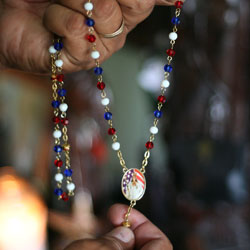
Yrique explained that it was during his time before the Blessed Sacrament that his heart was burdened with concerns about the United States and the level of animosity in American discourse. From that, he felt a perpetual calling over the course of three years to create the Rosary for the United States of America.

From the story in the Sun:

Yrique said he designed the Rosary for the United States of America through prayer, often waking in the middle of the night to compose the intentions. Each of the five decades has a designated intention.

The first three decades are prayed for the executive, legislative and judicial branches of government. The fourth decade is dedicated to state and local governments as well as police and fire fighters. The fifth decade is devoted to U.S. military personnel.

The Rosary for the USA is not a political statement, Yrique said. He’s not praying for a particular candidate to win the upcoming election or for any political party’s success. He’s simply praying for the United States — its leaders and populace.

“At the time I started praying for my country, I was really concerned with how divisive we became over the SB 1070 [immigration] issue,” Yrique said. “So when I saw things happening on the news — when I saw people being angry at one another, shouting at one another, I thought, ‘This is not the way I was brought up.’”

The joy of working in Catholic media

Annual collection is at all parishes May 19-20 in most U.S. dioceses, including Phoenix.

I get asked quite frequently while out in the field if I love my job. I wouldn’t be here if I didn’t. Of course, I don’t say that part out loud. I respond with a simple “yes” and sometimes share a highlight of working for The Catholic Sun:

  • You get to go to the extra-special Masses (anniversaries, ordinations, dedications, groundbreakings)
  • You’re not always stuck at the office desk all day long. You can head to Mass, a prayer vigil, soup kitchen or anywhere else Catholics are making a difference.
  • If you’re working Christmas or Easter, it’s for good reason.
  • You’re generally reporting good news and working with people who don’t try to outrun the camera, like might happen in secular media.
  • You focus on the “hope” aspect. I remember someone telling me that sometime after Immaculate Heart Radio launched. She was familiar with the network when she lived elsewhere and described the difference between that and secular stations as such. Catholic media focuses on “hope.”

The job also comes with its own set of challenges:

  • Spellcheck — You can’t rely too heavily on spell check. If you do, you might accidentally print “sin” instead of “son” or “The Catholic Sin” instead of “The Catholic Sun.” You could also inadvertently elevate any woman religious to sainthood if “St. _____” instead of “Sr. ______” escapes the proofreading process. (Guilty on that one).
  • Advances toward Canonization — Certainly a joyous step every time the pope declares a saint venerable, blessed or canonized, but that also makes the writing process longer. For example, now it’s “Blessed” or “Bl.” Pope John XXIII School.
  • Facebook — An extremely helpful tool to seek out newsworthy announcements or ideas for full stories, but also tough to remember how each parish or priest abbreviates itself online. Some parishes in the Phoenix Diocese spell out “saint” for their Facebook name, others abbreviate “St.” Some don’t use a period. Others tack on a city name or “community” or “Catholic Church” or “Catholic Faith Community” behind the name.
    Priests are just as tough using “Fr.” “Fr” and “Father-”
    Dioceses are guilty too switching between “____ Diocese” and “Diocese of ____” for Facebook screen names, Twitter handles, URLs and such. You also have to remember if they use the “of” and if they’re a diocese or archdiocese.

Clearly, these are all minor setbacks.

It’s an honor working in Catholic media, an outlet which keeps expanding in the Phoenix Diocese. Local Catholics can get their Church news in the following ways:

A recent article highlighted communication efforts in the Phoenix Diocese. It was to promote this weekend’s Catholic Communication Campaign. It’s a nationwide effort that funds local and national media projects. Yes, advertising and sponsorships help a lot, but it doesn’t cover everything.

It’s through Catholic media and other in-depth/impactful stories that media consumers are inspired to think and ideally, act. Pope Benedict spoke of the need for word and silence in his message for the World Day of Communication.

In silence, we are better able to listen to and understand ourselves; ideas come to birth and acquire depth; we understand with greater clarity what it is we want to say and what we expect from others; and we choose how to express ourselves. By remaining silent we allow the other person to speak, to express him or herself; and we avoid being tied simply to our own words and ideas without them being adequately tested. In this way, space is created for mutual listening, and deeper human relationships become possible.

[later] Word and silence: learning to communicate is learning to listen and contemplate as well as speak. This is especially important for those engaged in the task of evangelization: both silence and word are essential elements, integral to the Church’s work of communication for the sake of a renewed proclamation of Christ in today’s world.

That’s what we try to do. Communicate and envangelize through word, certainly, and in silence between issue dates and broadcasts.

Feel free to do your part to support Catholic communication efforts in your area, even if that role is to simply read, listen or watch. Share one of our stories through the mail or social media if you want. Financial support helps too if you’re able.

Three Phoenix seminarians graduate from Josephinum

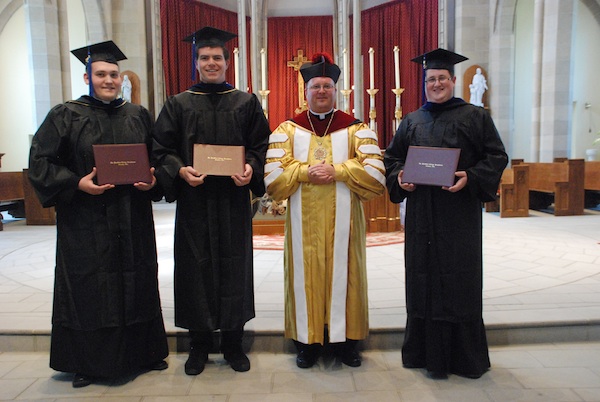
James Wraith, Daniel Connealy, Father James Wehner (Rector) and AJ Enfield at the Pontifical College Josephinum. Click image for more photos(courtesy photo)
Phoenix seminarians James Wraith, Daniel Connealy, Father James Wehner (Rector) and AJ Enfield at the Pontifical College Josephinum. Click image for more photos(courtesy photo)

Three Phoenix seminarians studying for the priesthood earned bachelor degrees May 12 from the Pontifical College Josephinum. It marked completion of the first phase of formation with years of theology classes ahead of them.

A.J. Enfield, James Wraith and Daniel Connealy received a bachelor of arts in philosophy during the Josephinum’s 113th Baccalaureate and Commencement in Columbus, Ohio. Enfield was chosen as the senior class representative. The St. Thomas the Apostle and Brophy graduate is from St. Gabriel the Archangel Parish in Cave Creek.

“When fellow seminarian Jim Wraith asked me if I had considered the priesthood a couple years ago, I laughed it off. It never really left me, however, and ultimately I realized that I owed it to both God and myself to truly discern. That discernment is ultimately what led me to the seminary,” Enfield wrote for the Meet the Seminarians through Phoenix’s Office of Vocations website.

He was one of nine seminarians from across the country who were granted degrees from the Josephinum’s College of Liberal Arts Pre-Theology Program.

“We are here first and foremost to discern if God is calling us to the priesthood,” Enfield told fellow graduates. “Trust the formation process; fully invest yourself into the program. Our priestly fathers have told us that we cannot fail, regardless of whether we go on to theology and eventually the priesthood, or become good, holy, humble Catholic laymen.”

Enfield graduated Cum Laude and Connealy, Magna cum Laude. Connealy spent his elementary years at Most Holy Trinity and two years swimming in college before seeking something more meaningful by serving God’s people. Wraith, a St. Joan of Arc parishioner, had a re-awakening of his faith at a Steubenville conference and the Catholic school alum entered the seminary right after graduating from Scottsdale’s Notre Dame Preparatory.

Fr. Joseph McGaffin, pastor at St. Elizabeth Seton Parish in Sun City, were among those who con-celebrated the Baccalaureate Mass. Msgr. Daniel Torres, vicar general for the Diocese of Lake Charles, delivered the homily.

“Graduates, you must realize that it will be tough, but every day can be a glorious day if you live in Christ and are rich in his mercy. What you have learned can blossom if you truly live in Christ and are strong in your prayer life, humble in your spirit, listen with your ears and heart, and are merciful as Christ is.”

The graduating class at the Pontifical College Josephinum also included 13 men who earned a Master of Divinity and fulfilled all requirements for priestly ordination in their home diocese this spring.

Film revisits the many sides of Mexico’s Cristero Rebellion

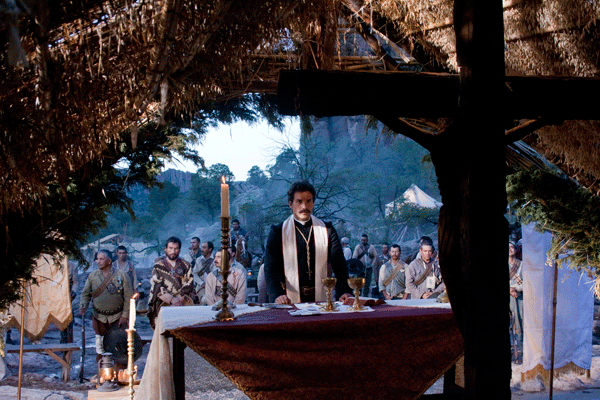
Santiago Cabrera portrays Father Vega in "For Greater Glory." (CNS photo/ARC Entertainment)

MEXICO CITY (CNS) — Even as modern-day church-state relations improve, the impact of Mexico’s three-year Cristero Rebellion in the 1920s on the Catholic Church remains widely debated in Mexican society.

The rebellion saw Catholic clergy and laity taking up arms to oppose government efforts to harshly restrict the influence of the church and defend religious freedom. In the end, the rebellion of the Cristero — soldiers for Christ — was quelled in 1929, leaving the church sidelined for much of the last century and its role limited to a pastoral concerns with no say in the public policy arena.

Ask Mexicans about the rebellion and the answers about what it means today depends on a person’s point of view.

Catholics leaders consider the government’s actions to limit church influence that led to the rebellion an attack on religious freedom. Self-described liberals and many in the Mexican political and intellectual classes consider the suppression of the revolt a triumph of the secular state. Some academics and authors are less passionate, describing the uprising as an agrarian conflict with political and religious overtones.

Now the conflict comes to the big screen at a time with improved church-state interaction — even if the interpretations of one of Mexico’s defining events remain controversial.

“What price would you pay for freedom?” posed the synopsis for the movie, “For Greater Glory,” which stars Andy Garcia and Eva Longoria and opens in the United States June 1.

The synopsis continued, “An impassioned group of men and women each make the decision to risk it all for family, faith and the very future of their country.”

Gen. Enrique Gorostieta Velarde, the protagonist played by Garcia and leader of the Cristero forces, is a “retired military man who at first thinks he has nothing personal at stake. … Yet the man who hesitates in joining the cause will soon become the resistance’s most inspiring and self-sacrificing leader, as he begins to see the cost of religious persecution on his countrymen.”

Like various histories of the rebellion, Gorostieta’s actions remain open to interpretation. Some question his motives for leading the rebel cause despite being a nonbeliever; others wonder if he really did have a conversion late in life.

Victor Ramos Cortes, a professor at the University of Guadalajara, said any reading of history must consider the factors of religious intolerance, agrarian land issues in a country with numerous landless farmers and the threat posed by the church hierarchy to the liberal elites of the time.

Such nuanced readings of the era are rare.

“In our country, each history is presented as if it were the only true version and the other is erroneous,” Ramos said.

The Cristero legacy remains somewhat divisive, with the conflict and the beatification and canonization of Cristero martyrs at the center of the church’s agenda.

The Archdiocese of Guadalajara is building a large sanctuary on a prominent hilltop to memorialize Mexico’s martyrs, and Pope Benedict XVI celebrated Mass during his visit in March for 640,000 people at the foot of the Cerro del Cubilete, site of a giant Christ statue built to remember those fighting the rebellion.

Father Manuel Corral, Mexican bishops’ conference spokesman, has seen the film and speaks well of its message of “showing young people that there’s something worth fighting for.”

He also considers its release a sign of how much Mexico has changed in terms of religious tolerance and the more prominent role the church is taking in public life.

“Twenty-five years ago, it would have been impossible to release a movie like this,” he said.

How far Mexico has come is evident in the film’s subject matter, too.

“It was a violent era and there were a lot of ambitious generals. Gen. Gorostieta was one of them,” said Richard Grabman, author of “Gorostieta and the Cristiada, Mexico’s Catholic Insurgency 1926-1929.”

“The Cristeros attracted a lot of people that were not necessarily religious, but looking for a military solution to social problems,” he said.

Mexico had emerged from a violent revolution during the 1910s, which was fought mainly to end the enduring rule of then-President Jose de la Cruz Porfirio Diaz and give properties to the landless peasants being exploited by hacienda owners.

The revolutionary elite emerging from the conflict were anti-clerical and had approved a 1917 constitution forbidding the church to own property and operate schools, limiting worship to authorized churches and stripping priests of civil political rights. “Iniquis Afflictisque” (“On the Persecution of the Church in Mexico”), a 1926 encyclical by Pope Pius XI, said the constitution “placed (priests) in the same class with criminals and the insane.”

Grabman said that, especially in rural areas, priests competed for influence with teachers whose orders were to spread a secular ethos. Teachers were viewed by the central government as a counterweight to clergy and as such, he explained, were killed in large numbers by Cristero fighters.

Many of the Cristeros were small landowners, unlike those taking up arms in the revolution.

Haciendas were less common in the main areas of the conflict, which covered an area of west-central Mexican known as the Bajio.

“Cristero were small landowners threatened by social change,” Grabman said. “They feared (agrarian reform) would be collective agriculture.”

The relationship between the Bajio landowners and their workers was different from the exploitation on haciendas suffered by peons taking up arms in the revolution.

“They saw their farm workers as family, instead of peons,” Grabman said.

Gorostieta, the retired general, had experience with attempting to suppress peasant uprisings in Morelos state, fighting the forces of revolutionary leader Emilano Zapata, whose troops were fighting for “land and liberty.” Grabman said it left an impression on Gorostieta when he learned that “farmers without military training could be a formidable force when fighting for a belief.”

The Cristero Rebellion was suppressed in 1929, but many of the small landowners persisted, even if the church hierarchy was moving on.

“We have people who are children of Cristeros,” said Father Jorge Raul Villegas, spokesman for the Archdiocese of Leon, which encompasses Bajio.

“For us, it’s a historic reality since there were men who died defending the faith. This isn’t forgotten.”

— By David Agren, Catholic News Service

US, UK faith-based agencies aim to halt trafficking at London Olympics

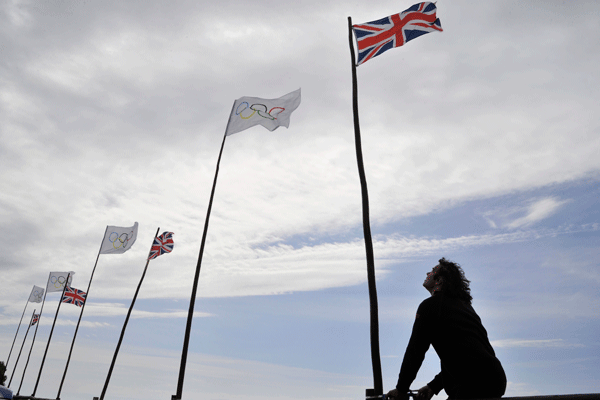
A man raises Olympic and British flags outside his hotel in Sennen near Lands End in Cornwall in southwest England May 17. In advance of the 2012 Summer Olympics, a coalition of U.S. and U.K. investors including Mercy Investment Services and NGOs have co me together to call on corporations to strengthen their focus against human trafficking and modern-day slavery. The games take place in London from July 27 to Aug. 12. (CNS photo/Toby Melville, Reuters)

WASHINGTON (CNS) — More than three dozen U.S. and British faith-based investment firms have banded together to get the Summer Olympics’ major sponsors and tourist hotels to sign a pledge saying they will work to stop human trafficking around the Olympic Games.

So far, the campaign has had some success.

“The issue has taken hold and the hotels are doing training, and their staff is aware that there are issues that require the attention of management or police agencies and social services,” said Julie Tanner, assistant director of socially responsible investing for Christian Brothers Investment Services.

The work builds on efforts to combat human trafficking — sex trafficking, forced labor and child labor among them — at the 2010 World Cup in South Africa and this year’s Super Bowl in Indianapolis.

One new wrinkle is that the 37 faith-based investment firms have not only approached hotels but also the major sponsors of the summer games.

Thirteen hotels and 19 sponsors were chosen. The Olympics has far more than 19 sponsors, but this particular group of 19 was picked because it was “where we felt the companies had risks from trafficking,” Tanner told Catholic News Service in a May 16 telephone interview from New York.

“We get into some of the consumer brands,” Tanner said, many of which have “huge supply chains in terms of their products. … All of these things that make up their products require them to have a number of factories, a number of suppliers.”

“While those companies, on the face of it, may not be apparent” in trafficking, according to Tanner, it is worth prodding companies, he said, to ask themselves, “Are you monitoring your factories? Are you auditing? Are you making sure there’s no forced labor, no slave labor, no child labor?”

One of the problems for the anti-trafficking campaign is “the lack of statistics and information and research,” Tanner said, adding that part of the reason is “it’s very difficult to count.” For example, a minor may be arrested on a prostitution charge, she added, but police do not label it as sex trafficking.

Carol Smolenski, executive director of ECPAT-USA, which works to eliminate child sex trafficking, agreed with Tanner. Precise numbers are hard to come by, she said, even in an age of increased awareness of the problem.

“It’s difficult to say we’ve reduced trafficking by 80 percent because we didn’t know what the numbers were to begin with,” she told CNS May 16 from ECPAT-USA headquarters in New York City. ECPAT, based in Thailand, is an acronym for End Child Prostitution and Trafficking.

The most reliable U.S. numbers, according to Smolenski, are from a decade-old study from the University of Pennsylvania, which estimated that 200,000-300,000 children were being used for sex trafficking. “Since then there has not been a study that has attempted to count them,” she added.

Abby Kuzma from the state of Indiana’s attorney general office, said arrests were made in conjunction with child trafficking at the Super Bowl, Four victims were identified. Two of those were “sent home right away,” Kuzma said in a telephone message left with CNS, while the other two were held pending further investigation.

Firms queried about their practices for the Olympics have given “a very good rate of return” in responding, Tanner told CNS, but what is revealing is the substance of their answers. “The companies are providing very substantive and thorough information. Some were less detailed, but overall it was interesting. There is significant awareness of the issue by companies. One of the things we’re going to do next month (June) is do an analysis of the responses.”

In addition to releasing the analysis, another thing the faith-based investment agencies will do at the end of June is reveal which companies and hotels gave their queries the cold shoulder.

— By Mark Pattison, Catholic News Service

NATO summit, protests provide some lessons for Catholic school students

This sign along Lake Shore Drive May 16 shows one of the many road closures in place as world leaders began to converge on Chicago for the May 20-21 NATO Summit. Security measures are high as thousands of protesters plan demonstrations and rallies. Many Chicago businesses in the downtown area, as well as some Catholic schools, planned to close while the summit was under way. (CNS/Karen Callaway, Catholic New World)

CHICAGO (CNS) — With world leaders descending on Chicago for the May 20-21 NATO summit, some Catholic school teachers were incorporating lessons about the political-military alliance for their students.

And with thousands of people coming to the city to demonstrate and draw attention to focus on issues ranging from war to the environment to poverty, they included a lesson or two about the history of protests, too.

“Since the time of Christ, people have been protesting,” said Mary Lee Calihan, principal of Old St. Mary’s School. “What’s a useful form of protest? What have people done? What has been effective?”

Calihan’s school and a few others were closing for a couple days during the summit, which was to include the leaders of the 28 NATO countries as well as other world leaders. The meeting was taking place at McCormick Place convention center along the lakefront.

Security measures coupled with demonstrations promised to make getting around the downtown area and South Loop a nightmare. Churches in the area planned to stay open, but DePaul University’s downtown campus was closing.

Old St. Mary’s originally planned to be open May 18 and close May 21, but Calihan changed her plans after hearing that a local newscaster had announced the school would be closed both days.

“They made the decision for me,” she told the Catholic New World, newspaper of the Chicago Archdiocese.

More seriously, she said, “we’re on the path of everything happening between Grant Park and McCormick Place.”

That means that, at best, it will be difficult for parents and teachers to get to the school because of the security measures in place and road closures in the surrounding area, she said. Even peaceful protests could completely cut off access, not only for parents and staff but for emergency vehicles.

“School administrators have to plan for the worst and hope for the best,” she said.

The school closures didn’t necessarily mean students would have days to make up, as some extra days were built into the school year.

Old St. Mary’s Church planned to remain open for Masses despite the added commotion. The general thought was that parishioners are used to enduring Bears fans during football season and the Chicago Marathon in October, which goes right past its door, so they would be up for the NATO crowds.

Regarding the protesters, members of the Catholic Worker movement were holding nonviolence training for protesters, and on May 14 kicked off “a week without capitalism.”

On May 16 about 150 protesters marched to banks and government offices calling for a yearlong moratorium on evictions and foreclosures in the Chicago area.

As of May 17, 12 people had been arrested at NATO-related demonstrations, according to Chicago police.

Media reports quoted Police Superintendent Garry McCarthy as saying 10 arrestees had been taken into custody in “voluntary” fashion. The Chicago Tribune daily newspaper reported one protester, a Los Angeles man had been, charged with a felony “for physically attacking a police officer.”

– – –

Michelle Martin is on the staff of the Catholic New World in Chicago.