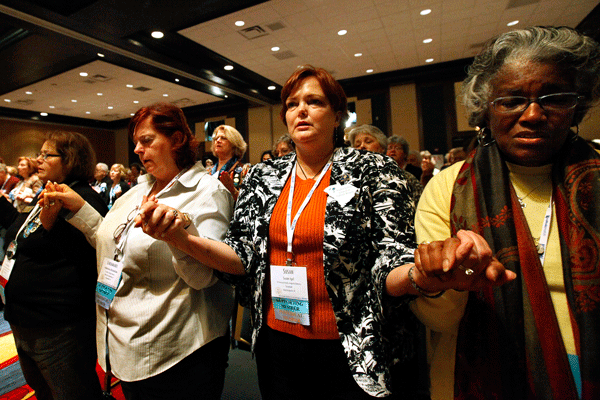
Cherrin Moore, Lindamarie Richardson, Susan Igel and Pearlie Harris, all from South Carolina, pray during the opening Mass at the annual gathering of the National Council of Catholic Women in Chicago Nov.10. Nearly 700 Catholic women from across the Unit ed States were expected to attend NCCW's Nov. 9-12 convention. Representing more than 4,000 groups and 4,000 individual members, the organization seeks to bolster spirituality, leadership and service among Catholic women. (CNS photo/Karen Callaway, Catho lic New World)
MELBOURNE, Fla. (CNS) — The president of the National Council of Catholic Women said she sees “a reawakening of women now that they’re seeing how much our church needs us,” especially with regard to efforts to protect religious freedom.
Women are “stepping forward and speaking about our values. Unfortunately, for so long women thought they should not be speaking on these issues,” said Judy Powers.
“For Catholic women, we would prefer to speak for something — for life, for our values, for marriage, as opposed to speaking against. We prefer to be a force for God’s love,” she added.
Powers made the comments in an interview for Catholic News Service while she was in Melbourne for the recent convention of the Orlando Diocesan Council of Catholic Women.
Regarding threats to religious freedom, she referred to those laid out in a 12-page document titled “Our First, Most Cherished Liberty,” which was released April 12 by the U.S. bishops’ Ad Hoc Committee for Religious Liberty.
Cited first in the document was the Department of Health and Human Services’ mandate that most health plans must include contraception, sterilization and some abortion-inducing drugs free of charge, even if the employer is morally opposed to such services.
Among other examples of “religious liberty under attack” the bishops named:
— Immigration laws in Alabama and other states that “forbid what the government deems ‘harboring’ of undocumented immigrants — and what the church deems Christian charity and pastoral care to those immigrants.”
— An attempt by the Connecticut Legislature in 2009 to restructure Catholic parishes.
— Discrimination against Christian students on college campuses.
— Government actions in Boston, San Francisco, the District of Columbia and the state of Illinois that have “driven local Catholic Charities out of the business of providing adoption or foster care services” because the agencies would not place children with same-sex or unmarried heterosexual couples.
“Now is the time to stand with the bishops against the HHS ruling and for the protection of marriage, parental notification laws and the points of the Religious Liberty document,” continued Powers, who is from the Diocese of Palm Beach.
She urged women to “find out who their legislators are and communicate with them”; read the U.S. bishops’ “Forming Consciences for Faithful Citizenship” document, available online at www.faithfulcitizenship.org, to be informed voters going to the polls in November; and to participate in the “fortnight for freedom” June 21-July 4, a campaign in support of religious freedom called for by the ad hoc committee.
“The other practical thing which we do best is to pray — living God’s agenda not ours,” added Powers, who added.
At a banquet after the closing Mass at the convention of the Orlando Diocesan Council of Catholic Women, Orlando Bishop John G. Noonan spoke of his recent trip to Cuba. He led a contingent of pilgrims there during Pope Benedict XVI’s visit to the island nation March 28-30. The pope had called for full religious freedom and greater respect for human rights.
“There is no hope in their eyes, no joy in their hearts,” Bishop Noonan said of the group of young people he had met there. “They never heard of our pope coming. They never saw the pope in their lives. We talked to them about their future and there was no future. They were told what they would do.”
“Our religious freedom is a great gift,” the bishop added. “And we are not to be afraid to speak up in truth and justice for what is right. The language of the Gospel is right and we are called to speak the truth. We will not compromise on the truth.”
He also told the gathering of 200 women and guests that “it always amazes me what you do, but what touches me most is when we go to Tallahassee for Catholic Days at the Capitol and I see hundreds of women dressed in red speaking out and making a difference in the Legislature.”
He was referring to an annual two-day event where Florida Catholics gather in Tallahassee to attend briefings on issues and meet with their elected officials.
Your grandpa is dying and the family wants you to serve as his health care decision maker. Feeling hesitant, you watch his arrival at the nursing home. He is quiet but alert, smiling weakly when he sees you. The nurse begins her assessment and he tells her the pain isn’t too bad. Later he only takes a little dinner, then lies back and closes his eyes. You whisper a goodbye. Not so bad, you think, he seems peaceful. Outside, you visit with his nurse, wondering how much longer he has. “Oh, I expect he’ll be gone by tomorrow or the next day,” she allows. You thank her, and leave.
Driving home, you’re puzzled that he’d be gone so quickly. OK, he’s dying, but how does she know he’ll be gone that fast?
After work the next day you go see him, and ask how long he’s been sleeping. The nurse tells you, “Ever since we started his morphine.” You wonder why he’s on morphine. “We find it helps,” she answers then leaves.
You follow her out, “Excuse me,” she turns. “If he’s sleeping like that, does he get any food or water? I mean he was alert yesterday.” She sets his chart down, “We find when they’re at this stage, they’re more comfortable if we sedate them, and withhold food and water.”
“OK,” you say, “I can see that, except looking at him yesterday he didn’t seem that bad off.” She opens his chart. “Here is what he signed.” She shows you a form which says “Physician Orders for Life-Sustaining Treatment (POLST).” You see “Do not attempt resuscitation” checked, also “Comfort measures only” and “No artificial means of nutrition.”
You are told the order was signed at the hospital by the doctor who was his caregiver there. You ask how orders in the hospital can continue on at the nursing home without any review. And how grandpa’s signature is valid since he’s somewhat senile. “These are POLST orders,” she says. “They mean from here on out, we just keep him comfortable.”
You subsequently find that the nursing home doctor is aware of your grandpa’s present situation and endorses his treatment. You ask to have his care taken over by your doctor who comes in later that evening.
You sit with him as he goes through the chart. “Hmm. He’s getting a pretty good slug of morphine, but I don’t see ‘pain’ in any of the nurses notes.” He flips a few pages, “He was taking food and water — not a lot, but some.” He sets the chart down. “What’s really wrong with him?” he asks. You’re not sure, “I thought he had cancer.” The doctor flips through the chart aimlessly, “Well, yeah, he has cancer, and he’s senile, and he’s weak, but so what?” You watch him order “discontinue morphine, diet to tolerance,” and some lab.
Next day, grandpa is sitting up in bed, looking very much like the day he came in, alert but weak, seeming happy to see you. “Do you hurt, Grandpa?” you ask. “Just a little,” he says, “but I wanted to be awake for when you come.”
End of life care
We don’t have to use extraordinary means to keep someone alive. But we can never do something — or withhold something — that would directly kill a person, such as over sedating, or withholding nutrition and hydration.
Typically “extraordinary” care means not allowing a dying person to die naturally. It usually means going to some extreme — pain, expense, or burden on the patient or caregivers — and generally doing so when there is little, or at least disproportionate hope of benefit. One may use extraordinary means to stay alive, but there is no obligation under most circumstances. Pastoral advice should be sought.
If you find yourself confronting a POLST (not yet used in Arizona), or similar document or any Advance Directive, evaluate it very carefully and review periodically, because patients change.
Catholics pray for a happy death. And a dying person can feel presumption, despair, or be in denial of impending death. Consider that a patient may need to work through these or other serious conscience issues and they deserve all the time they are allowed. Dying in comfort is an important concern, but it is not the only concern.
We are blessed to have hospice care coming into the Valley committed to the Ethical and Religious Directives for Catholic Health Care Services (ERD’s) and to following Magisterial teaching in care of the dying.
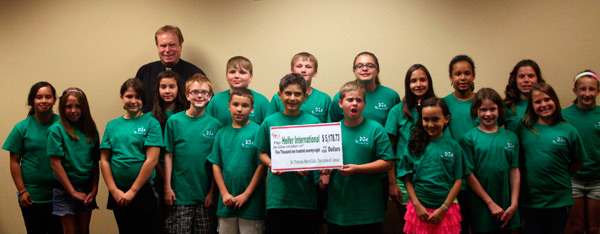
Fr. James Turner poses for a photo with fifth-graders at St. Thomas More in Glendale. (Ambria Hammel/CATHOLIC SUN)
GLENDALE — It’s one thing to know the story of Noah’s Ark and the pairs of animals inside. It’s entirely another to buy such a vessel.
All 75 “DJs” — Disciples of Jesus — in St. Thomas More’s faith formation program fit under both categories. The fifth-graders used donations to buy a Gift Ark from Heifer International, an organization that works to end hunger and poverty.
They presented their nearly $5,200 check to a Heifer representative April 24 at the parish. Monies largely came from monthly dinners the recently confirmed kids hosted between weekday religious education classes.
This marked the maiden voyage of the year-long service effort at St. Thomas More. Religious education leaders wanted to pique the children’s interest in returning to class post-confirmation. It worked.
They’re getting the message that “now is when you start living your faith,” said Ann Maloney, assistant coordinator of Christian Formation.
Maria Buhrman, coordinator, agreed. She said springtime attendance often drops in lieu of sports and other activities. This time, the pair saw consistent attendance all year long among the fifth-graders.
They also remained committed to supplying that Gift Ark filled with 15 pairs of animals to benefit families around the world. Heifer International is in more than 50 countries including the United States.
St. Thomas More students watched videos in class to learn about how other cultures live. Maloney said it was eye opening when the students learned, for example, that the average $250 annual income in Nepal is less than an American parent might spend on soccer.
The kids were proud to reach their goal and hear about the difference they’d be making. Villages helped through Heifer International raise the animals and make a living by selling its byproduct: wool from the sheep in the U.S., milk from the cows in a Russian village or produce that camels in Tanzania or oxen in Uganda helped plow or transport.
“I liked how some little kids were just getting some hot dogs and those few dollars can help buy some goats and chickens,” 10-year-old John Linden said of his group’s fundraiser.
One boy was reportedly so psyched to serve — both the dinner and families across the globe — that wearing the group’s “Disciple of Jesus” T-Shirt while serving dinner wasn’t enough. He opted to wear a tie on top of it.
After the check presentation, Paul Hopkins, a local volunteer with Heifer International, visited the fifth-grade classroom to share more about how the animals help the families. He has traveled to Zambia and Malawi with the organization.
“It is the best thing that’s happened to them in their life. And it’s part of their family,” he said, noting baby chicks he saw in the corner of one family’s home.
Local villages receive training on raising the animals and veterinary care to nurture the best possible outcome for both parties. And families are required to pass on their animal’s first female offspring — alongside their knowledge, resources and skills — to others in need.
Further giving
Local Catholic schools also donated to Heifer International this spring. Ss. Simon and Jude students tripled last year’s collection raising more than $2,100 from the school and the parish’s religious education program. A local bank matched the first $1,000. Funds will sponsor a trio of angora bunnies.
Ss. Simon and Jude’s school students are raising additional funds through ice pop sales this week.
St. Thomas the Apostle students turned “points” they earned by recycling juice pouches and certain potato chip bags through Terra Cycle into a donation to a charitable and environmental organization. Among the fruits it bore were two geese and three chickens to needy families through Heifer International.
Back at St. Thomas More, post-confirmation students are already excited for next year. The incoming fourth-graders who saw the fifth-grade “Disciples of Jesus” as role models, are eager to become “Best Friends in Faith.” They will dedicate their service work to projects at the parish level.
The origins of the Mesoamerican feathered snake god aren’t certain, but the Aztecs believed he came down from heaven twice a year to bring fertility and harvest.
This god of life and of corn, Quetzalcoatl, also appears as a tall, blonde, bearded man. As the feathered serpent, the god represents both spirit and earth, and adorns many pyramids used to offer human sacrifice.
Images of Quetzalcoatl and Centeotl on pyramid ruins Museum of Anthropology, Mexico City.
The Aztecs believed in a second coming of Quetzalcoatl. King Montezuma II believed Hernán Cortés was this god when the Spanish conquistador arrived in 1519.
“Through this mythology, Cortés manages to enter the Aztec capitol peacefully,” said José Alfredo Martinez, a guide with Destination Management Services of Mexico. Cortés enlisted the help of other tribes, too, who could have only entered the Aztec city if they were thought to accompany a god.
“If it were not for this, it would have taken 30-40 years to overtake the Aztecs,” Martinez said. Cortés arrived with a mere 500 mounted soldiers. And while they were armed, they would have been no match for the Aztecs.
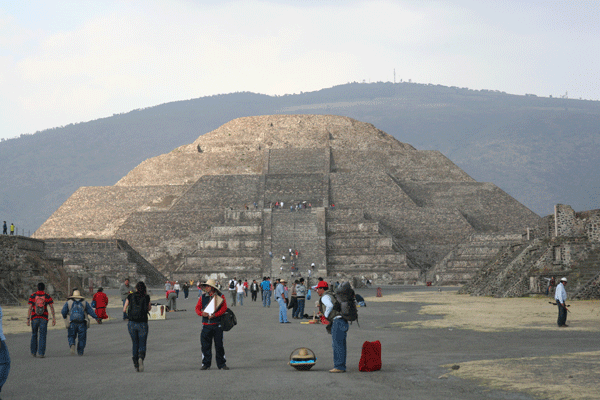
The indigenous maintained devotion to Quetzalcoatl throughout the land now known as Mexico. That included places like Tula, Chichen Itza and Cholula, where major pyramids were built.
It’s generally said that there are 365 churches built in Cholula — one atop each pre-Hispanic temple. There are actually more like 200 churches, if chapels are included.
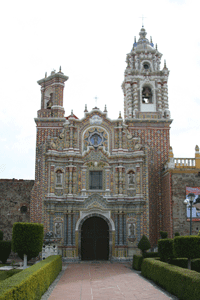
San Francisco de Acatepec, Cholula.
In one of them — on Tuesday morning, Jan. 31 — parishioners sat around a chandelier polishing the brass and shining the crystal. They were all volunteers. They give of their time to beautify the Church of San Francisco de Acatepec, which has served their community for centuries.
San Francisco de Acatepec, Cholula.
The outside is decked with talavera, a ceramic tile from the state of Puebla.
“Religion is part of everyday life,” said Fr. Ernesto Reynoso, adjutant judicial vicar for the Phoenix Diocese, who was born in Mexico. “Many in today’s society want to remove religion. Thanks be to God, others are keeping religiosity alive.”
In the center of every major city in Mexico, you’ll find a cathedral overlooking the main plaza. It’s there, right next to the restaurants and the bars and the chocolate shops. Municipal buildings are in the cathedral’s shadow.
In Oaxaca, old couples, married for decades, dance traditional dances right next to the Cathedral of the Assumption. In Puebla, artwork is displayed in front of the Cathedral of the Immaculate Conception.
The churches are beautiful because the house of God should be beautiful. Inside and out of the churches, the people trust the God they make a part of their celebrations and their mourning.
“It’s part of our nature not to worry,” Fr. Reynoso said. “We rely on God’s will and Divine Providence. The people believe that. That’s why they feed you and welcome you and you’re part of their family as a guest.”
Tourists from all over the world say this at the end of pilgrimages, said Martinez of DMS. “What they enjoy the most — more than the ruins or the museums or the beaches — is the warmth of the Mexican people,” he said.
The people are welcoming despite a history of invasion. It began with the Spanish conquest and continued with incursions by the United States and France.
“The Mexican people are not an indigenous people,” Martinez noted. “We are mestizo, having our roots both in the Native and in the Spanish people.”
Mural depicting St. Juan Diego presenting the tilma. Mural is in a chapel atop mount Tepeyac.
La Guadalupana
The Virgin of Guadalupe, a Marian apparition that transformed the evangelization efforts of early Christian missionaries, embodies this coming together of cultures.
In 1531, the Blessed Mother appeared to San Juan Diego, asking that a church be built in her honor. As proof of her instruction, Juan Diego gathered roses into his tilma, or cactus-fiber cloak, and presented them to the local bishop.
The roses left the miraculous image of Our Lady of Guadalupe, a mestiza woman, that reflected both Spanish and indigenous features.
The indigenous at first saw Our Lady of Guadalupe as Tonantzin — “Our little mother” — an important Aztec goddess, mother of the sun god. The apparition led to the conversion of millions.
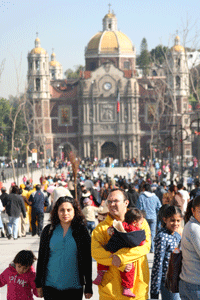
The miraculous image is kept in the Basilica of Our Lady of Guadalupe at the base of Mount Tepeyac, where the Blessed Mother appeared. Scientists cannot explain why the cactus-fiber cloak still exists. Such fabric usually disintegrates after a few decades.
The Miraculous Image of Our Lady of Guadalupe, in the Basilica of Saint Mary of Guadalupe in Mexico City.
But it’s there, in modern day Mexico City, where more than 20 million pilgrims a year come to see the image the Blessed Mother left.
Pilgrims pray next to parishioners, while others wait in line for confession as Mass is celebrated throughout the day. It’s common to find Catholics — young and old, rich and poor — praying in churches and chapels at all hours.
“Everything revolves around the church,” said Luis Efren Zazueta Flores, a parishioner at Immaculate Heart of Mary Parish in Phoenix, who immigrated from Mexico years ago.
“Life there is difficult,” he said. “Sometimes, the people almost tire of asking God for help. So many are in great need there.”
The need drives many — especially farmers — to migrate to the United States, according to Martinez.
“Mexicans and Central Americans aren’t afraid to risk their lives to find a better one,” he said. “A desert or a wall or a river isn’t going to stop them. A law won’t stop them, either.”
The poor U.S. economy seems to have stymied the influx of immigrants. And some just don’t have “the appetite” to cross, Martinez said, preferring their native country to a foreign one. But most Mexicans simply don’t have need to leave their beloved country.
“The people who cross are people that do manual labor,” Martinez said. “They’re poor and often ignorant of what lies ahead of them — both in terms of border security and economic opportunity.
“Among them, you’ll find bad people, of course, those dedicated to making a living selling drugs,” he said. “But in general, the people who cross are agricultural workers from poor farming communities.”
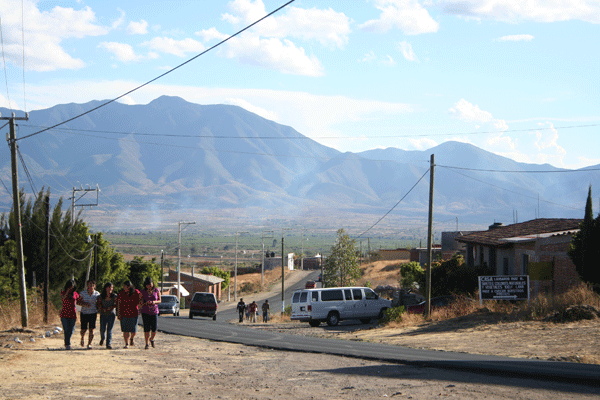
Mexican girls walk arm-in-arm along a road in rural Oaxaca.
Perception vs. reality
Immigration and media reports have had an immeasurable impact on how those in the United States view Mexico. In March, the Trans-border Institute of the University of San Diego tallied more than 50,000 homicides in Mexico between 2006-2011.
Yet David Shirk, who teaches at the university, said the institute tries to keep things in perspective.
“There have been relatively few killings involving U.S. tourists,” he said. “Roughly a million U.S. citizens reside in Mexico. Yet only 120 U.S. citizens were among the 16,000 killed last year, and most of those were likely targeted for connections to organized crime.”
Mexico City and other large cities have good and bad parts, Martinez said, just like anywhere else. But in general, he said even the Mexican states that have seen the highest amount of drug-related violence are relatively safe.
A family walks together after visiting the Basilica of Our Lady of Guadalupe.
Martinez noted specifically the silver mining town of Taxsco, in the state of Guerrero, where thousands have been killed. He said he’s consistently brought tourists there without incident.
He also brings tourists to Mexico City, Oaxaca and Puebla where visitors delight in first-class museums and rich cultural expression. The beauty of the churches and chapels rivals that of Europe.
Through the pyramids, visitors come to see how faith and religion were a part of this land since its inception. Christianity replaced the Native gods, but faith and belief in the supernatural remain essential.
The Mexican government’s oppression of the Church in the 1920s seems somewhat absurd in light of the nation’s history. The Cristero War, or Cristiada, was waged against a government that persecuted Catholics from 1926-1929.
The government prohibited the celebration of Mass, so priests celebrated them in secret. The war was named after the rebels’ rallying call — ¡Viva Cristo Rey!, or “Long live Christ the King!”
John Paul II canonized a group of 25 martyrs from that time. Faith is so close to the heart of the Mexican people that they were willing to die for it.
This rich history, which can serve as an example to Catholics across the world, is on display throughout Mexico. The history, too, is part of every day life.
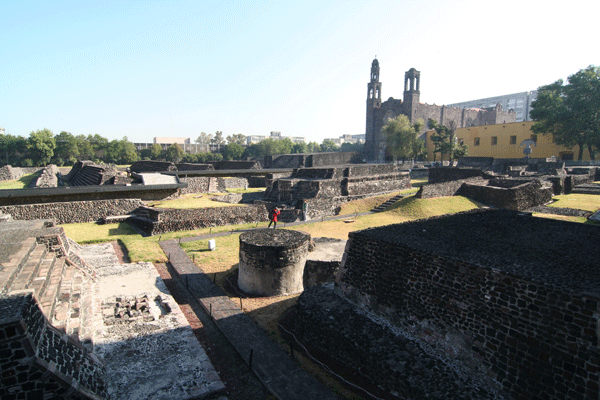
Plaza de las Tres Culturas, Mexico City.
At the “Plaza de las Tres Culturas,” or the “Square of the Three Cultures,” tourists can see the Church of Santiago de Tlatelco, where it is said that San Juan Diego was baptized. The church was built in the 16th century from the remains of the Aztec ruins. The ruins lie before it while modern buildings sit behind it.
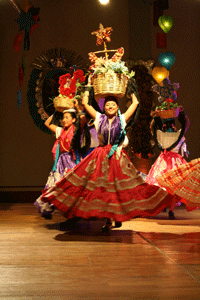
Traditional Mexican dancer, Oaxaca.
Being mestiza, Our Lady of Guadalupe also embodies these three cultures; she reflects the indigenous, the Spanish and the fruit that came from the union of the two. She facilitated this union.
Mexican artwork reflects this coming together as well. Tourists will see it in the murals of Diego Rivera and in the dances of the Ballet Folklorico. But nowhere will they see this union more than in the Mexican people themselves.
It’s as if the people, despite centuries of violence, are born with a disposition that’s open to foreigners. They’ve seen how messy it can get when two cultures collide, but, with God at the center of their lives, they’ve also seen the beauty that comes when two cultures become one.
¡Viva México! ¡Viva la Virgen de Guadalupe! ¡Viva Cristo Rey!
– – –
J.D. Long-García traveled to Mexico City, Puebla and Oaxaca with other Catholic journalists on a familiarization trip sponsored by Regina Tours and the Mexico Tourism Board. For more information, call 1-800-CATHOLIC or visit their website, www.1800Catholic.com.
Coro San Marcos from San Marcos Elementary School sings during the April 14 Crozier Gala. (J.D. Long-Garcia/CATHOLIC SUN)
The Catholic Community Foundation honored Sharon Harper, president and CEO of Plaza Companies, as well as former major league baseball player Joe Garagiola April 14 at its annual Crozier Gala.
Harper is a “champion of the greater community,” according to the foundation, noting her involvement in many charitable boards, including at Brophy College Preparatory.
The foundation recognized Garagiola for his support of St. Peter Mission School in Bapchule, including a community center and a convent for the Franciscan sisters that serve the community.
“He works miracles for us,” said Franciscan Sister Martha Mary Carpenter of St. Peter’s. She reminded those gathered of Garagiola’s nickname — “Awesome Fox” — given to him by the late Emit White, a well-respected member of the community.
“You do awesome things for us in a very foxy way,” she quipped. Sr. Martha met Garagiola at a past Crozier Gala and remembered telling him, “You’ll regret the day you met me.”
Garagiola humbly received the award, saying, “You usually have to die to get an award like this.”
Harper, a distinguished business leader, also serves as a member of the Board of Trustees of the Virginia G. Piper Charitable Trust. The foundation said she “has selflessly dedicated her time and resources to create a future of abundance for all Arizonans.”
Milena and Tony Astorga, the 2012 Crozier Gala chair couple, gave special thanks to the committee. They encouraged all to continue their support of the Catholic Community Foundation.
“It doesn’t take a lot to create abundance,” Tony said. “What we do today changed tomorrow.”
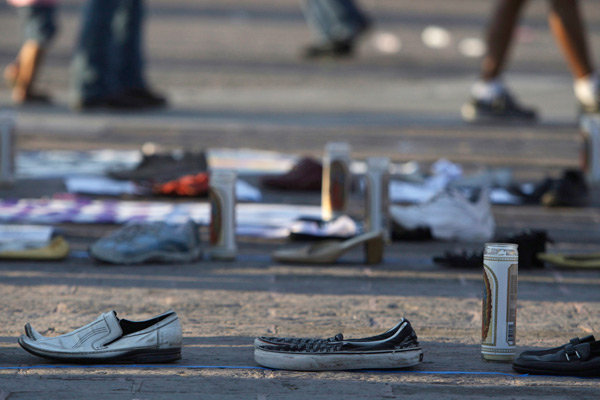
Shoes of missing people form the number 49, in memory of the mutilated victims dumped in Cadereyta, Mexico, are seen at the Macroplaza in Monterrey May 13. Suspected drug-gang killers dumped 49 headless bodies on a highway near Mexico's northern city of Monterrey in one of the country's worst atrocities in recent years. (CNS photo/Daniel Becerril, Reuters)
WASHINGTON (CNS) — In a country that has seen more than 50,000 deaths in six years, it took the finding of 49 headless bodies, some also missing arms or legs, to shock Mexican officials.
The discovery of the bodies, on a road about 120 miles from the United States, highlighted a problem addressed recently during a spring meeting at the World Bank headquarters in Washington.
Outgoing World Bank President Robert B. Zoellick warned that the violence doesn’t solely threaten Latin American citizens. It also poses a security threat to the United States, he said.
“The U.S. (needs) to take it seriously as a nation,” he said, addressing an audience gathered for a forum on “Reducing Murder Rates in Central America: Searching for Solutions.”
The meeting addressed Latin American countries with some of the highest rates of violence, including Honduras, El Salvador and Guatemala. But countries such as Mexico and other nations in South America are not exempt from the problem.
However, Zoellick pointed out that the dramatic numbers of homicides “for countries not at war” are in Central America.
Consider, he said, that Spain has roughly the same population as Central America.
In 2006, Spain registered 336 homicides, but Central America registered 14,257 homicides in the same time period — an average of 40 a day.
Gangs, the drug trade, and widespread and easy access to firearms — leftovers from civil wars — threaten people but also the development and future of the region, Zoellick said.
Even in a cloister, you can’t escape the effects of the violence, said Sister Mary Francis de la Cruz Montero.
Originally from Mexico, she lives in a monastery of the Capuchin Poor Clares in Pueblo, Colo. In a telephone interview with Catholic News Service, she described how her sister and her family were threatened in what started out as a common playground fight in a northern town in Mexico. Her nephew got into an argument with a boy at school and was told, “You’ll be sorry.”
Shortly after the fight, armed men showed up near his house. One of the boys in the family was beaten up. Sister Francis said all she could do was pray. She asked her family to report it to the police but a family in the neighborhood had disappeared after reporting a similar incident, her sister told her.
The armed men stayed in the neighborhood for more than a month and the family refused to go outside for fear of being killed, Sister Francis said.
“Sometimes the psychological damage is worse than death,” she told CNS.
In her ministry, she’s met migrants who have left Mexico, not because they can’t find work, but because of the violence, she added.
Milena Grillo, executive director of a Costa Rican nonprofit, made a presentation at the World Bank event and said the causes behind the numbers of rising violence are not solely drug related. They also can be attributed to interpersonal fights, such as the one described by Sister Francis, as well as to domestic violence and street crime, which is often solved by using firearms. The World Bank said “some 4.5 million small arms were in the region in 2007” and most were illegal.
Violence in Latin America can be prevented for a period of time by implementing a variety of programs, Grillo said, but such efforts often are disrupted with a change of political administrations.
Zoellick said something has to be done and soon.
“This is not just the role of the state or the Catholic Church,” he said, speaking of those trying to solve the problem. “The private sector has to say, ‘This is our problem, too.'”
Carlos M. Gutierrez served as commerce secretary for President George W. Bush and is now vice chairman of Citigroup’s Institutional Clients Group.
“When I was in business, the best region of the world was Latin America,” said Gutierrez, former Kellogg’s chairman and chief executive. “Those who decided to invest there are still there.”
But those who stayed pay a high cost to provide security for their businesses, he said. Other potential investors see that and are afraid of the region, he said.
The World Bank estimates the violence can cost up to 8 percent of Central America’s gross domestic product.
Even small-business owners, like Ines Chavarria, who lives in a Salvadoran suburb near the capital of El Salvador, said entrepreneurs are afraid of any ventures. Her husband used to drive a private school bus. But after being held up and threatened too many times, Chavarria decided the family would focus on baking and selling goods to other vendors. They don’t want to take the chance of handling money and being killed, she told CNS in a telephone interview.
Other small-business owners she knows decided to leave the country altogether, entered the United States illegally and set up business, even at the expense of having it taken away if they’re deported, she said.
Gutierrez, of Citigroup, hinted that mass deportation of Central Americans, especially if immigration reform doesn’t pass in the United States, would affect the lives of decent people and make matters worse.
“Imagine if we return people from Central America who are doing well here?” he asked.
It would have an economic cost to businesses but there would be other costs as well, he said.
“It would be a national security mess if we did that to Central America,” he said.
— By Rhina Guidos, Catholic News Service
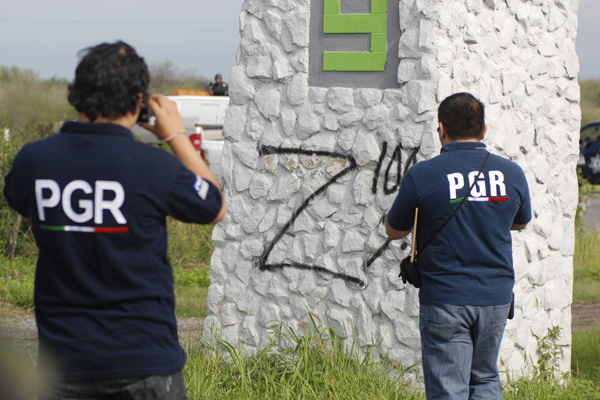
Federal agents take photographs of a sprayed "Z," the symbol of Zetas drug cartel, on a pillar at a crime scene in the municipality of Cadereyta, Mexico, May 13. Authorities found the dismembered bodies of 49 people stuffed into bags and dumped on a high way near the northern city of Monterrey in what appeared to be the latest atrocity by Mexico's brutal drug gangs. (CNS photo/Josue Gonzalez, Reuters)
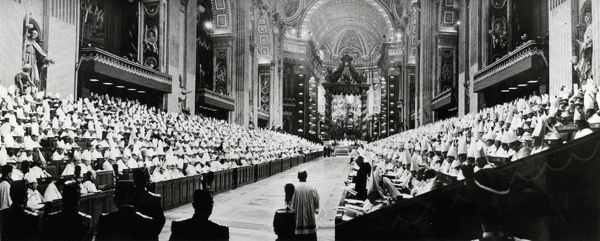
In this panoramic view, bishops of the world line the nave of St. Peter's Basilica during the opening session of the Second Vatican Council Oct. 11, 1962. This year marks the 50th anniversary of the start of the council, one of the monumental events in m odern religious history. (CNS photo)
ROME (CNS) — The Catholic Church’s relationship to Judaism as taught by the Second Vatican Council and the interpretations and developments of that teaching by subsequent popes, “are binding on a Catholic,” said the Vatican official responsible for relations with the Jews.
Swiss Cardinal Kurt Koch, president of the Pontifical Commission for Religious Relations with the Jews and a member of the Congregation for the Doctrine of the Faith, spoke to reporters May 16 after delivering a speech on Catholic-Jewish relations in light of Vatican II’s declaration “Nostra Aetate” on the church’s relations with non-Christian religions.
The afternoon speech followed Cardinal Koch’s participation in a meeting of the doctrinal congregation to examine the latest progress in the Vatican’s reconciliation talks with the traditionalist Society of St. Pius X.
“There are questions to clarify in discussions with this community. I can’t say more than that,” he told reporters, echoing a Vatican statement saying the reconciliation talks are ongoing.
In addition to the highly publicized position of Bishop Richard Williamson, an SSPX bishop who denies the Holocaust, public statements by the society’s superior general, Bishop Bernard Fellay, leave in doubt whether the society as a whole accepts the entirety of “Nostra Aetate,” including its condemnations of anti-Semitism and of the idea that the Jews were to blame for the death of Jesus.
“All the doctrinal decisions of the church are binding on a Catholic, including the Second Vatican Council and all its texts,” Cardinal Koch said when asked if the SSPX would be expected to accept all the teachings of Vatican II. “The ‘Nostra Aetate’ declaration of the Second Vatican Council is a clear decree and is important for every Catholic,” he added.
At the same time, Cardinal Koch said, “it is very necessary to make clear the difference between the position of the Society of St. Pius X and the negation of the Shoah (the Holocaust), which is a position that has no place in the Catholic Church. It is very clear.”
Following the revelation of Bishop Williamson’s comments about the Holocaust, SSPX leaders issued a statement saying his position in no way reflected the views of the society. “I’m very happy about this,” Cardinal Koch said. “The Holy Father has spoken clearly about this position of Williamson, that it’s not possible, there is no place for deniers in the Catholic Church.”
In his speech at Rome’s Pontifical University of St. Thomas Aquinas, Cardinal Koch said “Nostra Aetate” is “the ‘foundation document’ and the ‘Magna Carta’ of the dialogue of the Roman Catholic Church with Judaism.”
The declaration highlighted the Jewish roots of Christianity and took “an unambiguous position against every form of anti-Semitism,” he said.
The church’s theological reflection on its Jewish roots, as well as on the relationship between God’s covenant with the Jewish people and the new covenant instituted by Christ have been developed further and authoritatively by Blessed John Paul II and Pope Benedict XVI, he said.
God’s plan of salvation for humanity began with his covenant with the Jewish people and if Christianity ignores that, he said, “it is in danger of losing its location within salvation history.”
Cardinal Koch said that for Pope Benedict, the key to the theological understanding of the importance of a relationship with Judaism and Jews is that the Bible is one book detailing the entire history of salvation.
While Catholics profess that, in the end, all salvation will be accomplished through Jesus Christ, “it does not necessarily follow that the Jews are excluded from God’s salvation because they do not believe in Jesus Christ as the Messiah of Israel and the son of God,” the cardinal said. “That the Jews are participants in God’s salvation is theologically unquestionable, but how that can be possible without confessing Christ explicitly is and remains an unfathomable divine mystery.”
The cardinal said, “The Catholic Church neither conducts nor supports any specific institutional mission work directed toward the Jews,” but that does not exclude Christians bearing witness to their faith “in an unassuming and humble manner.”
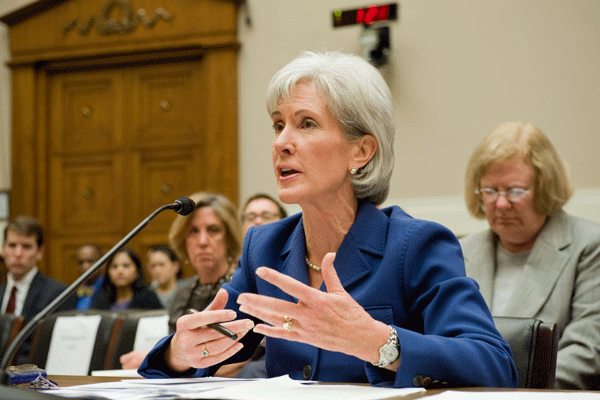
U.S Health and Human Services Secretary Kathleen Sebelius testifies before a House subcommittee on health in Washington March 1. During her session with lawmakers, she said she was confident an acceptable compromise could be reached in the health care law that would allow self-insured religiously affiliated institutions to provide contraception access without violating their religious beliefs. U.S. bishops and other religious leaders continue to press for rescission of a HHS contraceptive mandate, saying it violates religious liberties. (CNS photo/Matthew Barrick)
WASHINGTON (CNS) — Health and Human Services Secretary Kathleen Sebelius delivered her remarks as scheduled May 18 at Georgetown University at an awards ceremony during the university’s commencement week events.
According to The Hill newspaper, she was interrupted after she began her speech by a protester shouting something about “abortion.” The paper said the individual was escorted from the room “and continued yelling for several minutes outside.”
In her remarks at Georgetown’s Public Policy Institute ceremony, Sebelius did not mention the criticism of the university’s invitation to her to speak on campus, but the Archdiocese of Washington was among those who strongly criticized her appearance at the Catholic university because of her role in the HHS contraceptive mandate.
The nation’s Catholic bishops have repeatedly criticized the mandate, saying it threatens the religious freedom of Catholic institutions such as universities, hospitals and social service agencies because it would force them to provide employees with health insurance coverage for abortion-inducing drugs, contraceptives and sterilization procedures in violation of church teaching.
In its May 15 statement, the Washington Archdiocese noted that because of the “dramatic impact this mandate will have on Georgetown and all Catholic institutions, it is understandable that Catholics across the country would find shocking the choice of Secretary Sebelius, the architect of the mandate, to receive such special recognition at a Catholic university. It is also understandable that Catholics would view this as a challenge to the bishops.”
In a May 14 statement Georgetown’s president, John DeGioia, acknowledged concerns were “expressed by some” on the campus and in the larger American Catholic community objecting to Sebelius participating in the institute’s awards ceremony.
But he said the university had extended its invitation in early January, prior to the Obama administration’s Jan. 20 announcement about the HHS mandate.
DeGioia also said the invitation to Sebelius was not made as a challenge to the U.S. Conference of Catholic Bishops, and her presence on campus “should not be viewed as an endorsement of her views.”
As “a Catholic and Jesuit university,” Georgetown “disassociates itself from any positions that are in conflict with traditional church teachings.”
In the days leading up to Sebelius’ address, more than 27,000 people had signed a petition on the website of the Cardinal Newman Society urging DeGioia to “withdraw the invitation to Secretary Sebelius immediately.” Based in Manassas, Va., the society has as its mission “to help renew and strengthen Catholic identity in Catholic higher education.”
DeGioia in his statement said the HHS secretary had been identified by students as a potential speaker “given her role in crafting the landmark legislation that will make health care more accessible to 34 million Americans who are currently uninsured.”
He also said the university is “committed to the free exchange of ideas” and is “a community that draws inspiration from a religious tradition that provides us with an intellectual, moral and spiritual foundation.”
The Washington Archdiocese’s said it had withheld comment on the controversy until Georgetown addressed it.
In response to DeGioia’s statement, the archdiocese said the university’s president did not “address the real issue for concern — the selection of a featured speaker whose actions as a public official present the most direct challenge to religious liberty in recent history and the apparent lack of unity with and disregard for the bishops and so many others across the nation who are committed to the defense of freedom of religion.”
The archdiocese also said the “fundamental issue with the HHS mandate is not about contraception. As the United States bishops have repeatedly pointed out, the issue is religious freedom. Secretary Sebelius’ mandate defines religious ministry so narrowly that our Catholic schools and universities, hospitals and social service ministries do not qualify as ‘religious enough’ to be exempt.”
The archdiocese added that it is “especially distressing to think that the university’s Public Policy Institute would be unaware of this national debate since the mandate was published last August.”
It also said the HHS mandate’s “radical redefining of ministry should prompt Georgetown as a Catholic and Jesuit university to do more to challenge the mandate and speak up for freedom of religion.”
In March, Anna Maria College in Paxton, Mass., which is part of the Worcester Diocese, retracted its invitation to Victoria Reggie Kennedy, widow of the late Sen. Edward Kennedy, D-Mass., to speak at the Catholic college’s commencement. Worcester Bishop Robert J. McManus objected to Kennedy’s support for legalized abortion, contraception and same-sex marriage.
A petition with more than 20,000 signatures was brought to the chancery office urging the diocese to allow Kennedy to speak at the graduation.
The college has asked the bishop not to attend the May 19 commencement saying his presence would be a “distraction.” Two graduating students will give the commencement address.
Kennedy is scheduled to give the commencement address at Boston College Law School May 25.
– – –
Contributing to this story was Mark Zimmermann, editor of the Catholic Standard in Washington.
People stand in line to enter a government employment office in Madrid April 27. Deep austerity measures being discussed by several European governments have led voters to oust incumbent officials, opening the door for less drastic approaches to rebuildi ng fragile economies. (CNS photo/Andrea Comas, Reuters)
VATICAN CITY (CNS) — Pope Benedict XVI will meet with the world’s families at a time when the institution of the family is under threat and many are still struggling with a worldwide economic crisis and a lack of cultural and societal support.
As a sign of his deep concern for bolstering the family based on the lifelong union between a man and a woman, the pope will travel to Milan to meet with those attending the May 30-June 3 World Meeting of Families.
The pope will arrive June 1 and will close the event with an outdoor Mass. His three-day visit is an extraordinary sign of how much the pope wants to reaffirm the importance of families built on Christian values, Bishop Jean Laffitte, secretary of the Pontifical Council for the Family, told Catholic News Service.
“It’s as if the pope wants to say ‘I am giving the maximum importance to what you families live out and I want to be near you; I believe in what you are experiencing and want to renew this hope,'” the bishop said.
The Milan gathering will be the second world family meeting that Pope Benedict has attended in his pontificate. The meetings, held every three years, are hosted by different dioceses around the world and are sponsored by the Vatican’s council for the family as a way for families to meet, discuss critical issues and grow in the faith.
Even though the pope missed the sixth world meeting in Mexico City in 2009, he has always been a vocal advocate of families.
Almost all of his speeches to visiting diplomats, heads of state and the world’s bishops address the need for governments and the church to support this fundamental building block of society. It’s the family where future generations are formed to be members of a constructive, generous, hopeful and peaceful world, the pope has said.
The pope’s message “will certainly be a message of hope, that, yes, it is worthwhile to live the fullness of the meaning of the family” as God designed and intended, as an indissoluble union between a man and a woman, Bishop Laffitte said.
The pope will meet with young people at San Siro Stadium, attend an evening celebration where he will hear people’s testimonies of faith, lead a Sunday morning outdoor Mass and have lunch with event organizers and families. He will pray with priests and religious at Milan’s Duomo cathedral and venerate the relics of St. Charles Borromeo, patron saint of catechists, seminarians, learning and the arts, and co-patron saint of Milan.
The pope will also attend a concert held in his honor at the La Scala opera house, featuring Beethoven’s 9th Symphony conducted by Daniel Barenboim.
The pope will have a chance to get his message out to the wider world when he meets with the people of Milan and civilian authorities. It may be an opportunity for him to weigh in on a major issue facing states in different parts of the world: the ongoing push to legalize or recognize same-sex unions and marriage.
The pope has repeatedly called on governments to respect and defend the traditional definition of marriage and urged the church to promote the natural order in the institution of the family.
Marriage between a man and a woman “is not a simple social convention,” the pope told the world’s ambassadors to the Vatican this year. The family is the basic unit of society and “policies which undermine the family threaten human dignity and the future of humanity itself,” he said.
The pope’s approach has been to win over people’s hearts and minds, in part by having Catholics themselves serve as credible witnesses to the joy and love that come from living in accordance with natural law.
The church needs to help people discover that its teaching not only makes sense, but also protects human dignity and creates a stable society, he has said.
In fact, on his way to his first World Meeting of Families in Valencia, Spain, the pope told reporters he was more interested in highlighting what works and makes families thrive than in lambasting opponents.
He said that stressing what is positive about Christian living can help people see “why the church cannot accept certain things, but at the same time wants to respect people and help them.”
Bishop Laffitte agreed that the church always tries its best to explain its position and to reach out with pastoral concern to people of good will, even if they cannot or do not want to live a life founded on natural law.
However, he said, when it comes to people who are openly hostile to the church’s contribution and propose changing laws in regard to the traditional definition of marriage, then the church must “be very precise, firm and strong in reiterating the principles” of natural law.
The church must “also denounce the relativistic principles” that give rise to a near-infinite array of subjective preferences about what human love and marriage are, he said.
This year’s theme for the gathering, “Work and Celebration,” comes at a critical time for many families struggling with the challenges of unemployment, low wages, long work hours for one or both parents, building a nest egg for a home or the children’s education and many other problems connected with working to support a family.
Pope Benedict is expected to address these real problems, as he did recently when he said work should not hurt the family, “but rather should support and unite it, help it to open itself to life” and take part more fully in the church and community.
Marking the U.N.’s International Day of Families May 15, the pope said employers should also respect Sundays as a day of rest and a time families can strengthen their relationships with each other and with God.
This year’s World Meeting of Families’ lecture series will feature Catholic economists, entrepreneurs, church leaders and other experts sharing best practices for families seeking to sustain themselves both financially and spiritually.
Bishop Laffitte said that with so much attention being paid to resolving economic difficulties, people often forget about cultivating social and spiritual needs.
It’s important to also spend quality time with loved ones and “rediscover the source, inspiration, grace and spiritual strength in the Sunday Eucharist,” he said.
— By Carol Glatz, Catholic News Service
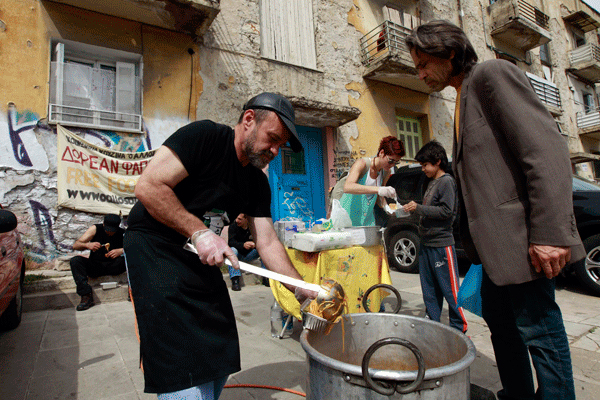
Constantinos Polychronopoulos, 47, an unemployed marketing specialist, distributes food portions at a soup kitchen for the poor in Athens, Greece, April 24. Deep austerity measures being discussed by several European governments have led voters to oust incumbent officials, opening the door for less drastic approaches to rebuilding fragile economies. (CNS photo/John Kolesidis, Reuters)
WASHINGTON (CNS) — While there is no roadmap to solving Europe’s economic crisis, the Catholic Church — with its history of serving the poor — can help in the face of government austerity measures, longtime observers said.
“At the moment, if you gather three European economists, you have four options” of how to solve the crisis, said Raul Gonzalez Fabre, professor of economics and ethics at Comillas Pontifical University in Madrid.
However, he and other European observers said the Catholic Church can help guide discussions so that a balance is achieved among government, charitable agencies and private enterprise.
While Europe’s economic situation poses serious challenges that are expected to take years to resolve, observers such as British Jesuit Father Frank Turner say the church’s steady hand in serving the poor and assisting the newly unemployed will help cement its role as a key adviser in the development of economic solutions aimed at the common good in the 17-nation euro zone.
It’s not that the church offers specific answers. Father Turner, who works at the Jesuit European Social Center in Brussels, pointed to Pope Benedict XVI’s 2009 encyclical “Caritas in Veritate” (“Charity in Truth”) as a basic framework for action. In broad terms, the document calls for a balance between global development and the common good.
Father Turner also cited a January commentary by the Commission of the Bishops’ Conference of the European Community that addressed the importance of developing “a highly competitive social market economy” in response to the growing financial crisis.
In “A European Community of Solidarity and Responsibility,” the bishops called for “equal balancing of the principles of freedom and solidarity.” In particular, they cite the need for binding “freedom of the market with the principle of justice and the commandment to love of neighbor.”
Gonzalez told Catholic News Service that the economic crisis “may be the opportunity (for the church and governments) to work together in order to help the old and new poor survive the situation.”
“New bridges in charity and social commitment may ease doctrinal antagonisms and help create deeper dialogues on culture in the future,” he added.
Overall unemployment in the euro zone rose to 10.9 percent in March, leading to restlessness among workers.
Seeking change, voters have turned to leaders from across the political spectrum in the hope that someone will ease the economic crisis. In Spain in November, where official unemployment has hovered at 24 percent for months, voters ousted the socialist government in favor of the conservative Popular Party.
Next door in France, voters May 6 opted for socialist Francois Hollande over Nicolas Sarkozy, the moderately conservative incumbent, for president. Sarkozy’s austerity measures seemed to be the target of voter backlash.
In Greece, where unemployment stood at 21.7 percent, voters also took aim at austerity measures by propelling the hard-left SYRIZA party to a second-place finish in May 6 elections. Party leaders May 15 blocked any deal with the European Union on a bailout, ending the possibility of a compromise in the formation of a coalition government with mainline parties. New elections were scheduled for June as fears of bankruptcy loomed.
The European Union, largely guided by German government demands, has offered its most recent financial recovery plans to Greece and France. Hollande and SYRIZA’s leaders have stepped back from the deals, saying that Germany should not be the primary driver behind the efforts.
“It is clear that extreme parties gained consensus because European decision-makers did not take into account the social and human consequences of the austerity plans,” said Raul Caruso of the Institute of Economic Policy at the Catholic University of the Sacred Heart in Milan.
He called for economic policies that primarily benefit citizens and for leaders to pay better attention to the needs of citizens in the future if they are concerned about a backlash in future elections. He also suggested that people would agree with austerity measures if they were perceived as “just and fair.”
“In Europe, the widespread sentiment is that decision-makers are completely unable to meet these needs,” he said. “The European leaders seem to lack any imaginative and productive vision of the future.”
Talk has surfaced that Greece may leave the euro zone, returning to its old currency, the drachma. Hollande and German Chancellor Angela Merkel emerged from a May 15 meeting to say they want Greece to keep using the euro.
If Greece exits the euro zone, the move is expected to pose serious challenges in the short term. In the long term, the move may offer the Mediterranean country a chance to forge a new economy as Greek products become more competitive in the global marketplace, explained Erasmus K. Kersting, assistant professor of economics at Villanova University in Philadelphia.
“The average citizen in Greece would see their purchasing power fall at first, but the hope is that the recovery would be swift and strong,” Kersting, a native of Hannover, Germany, said in an email. “That, in turn, would mean a dramatic fall in unemployment and hopefully also a reversal of the feelings of anger and helplessness that seem to currently prevail in the country.”
Regardless of who is in power, economic reforms are necessary, said Laura Gonzalez, a native of Spain who is assistant professor of finance and business economics at Fordham University in New York.
She predicted that new bailout agreements eventually would be in place to allow Greece and France to ease their way out of their economic crises.
“Everyone is convinced about the need to change the current situation,” she said. “The status quo is not sustainable.”
— By Dennis Sadowski, Catholic News Service