
Traditionalist leader says group could divide over unity with Rome

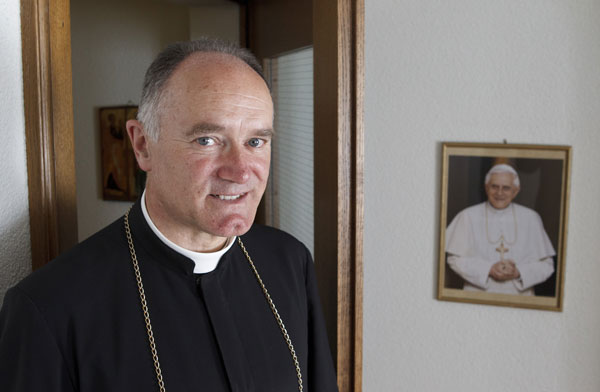
Bishop Bernard Fellay, superior of the Society of St. Pius X, is pictured near a photo of Pope Benedict XVI at the society's headquarters in Menzingen, Switzerland, May 11. Bishop Fellay acknowledged there could be a split in the breakaway society if it decides to reconcile with the Vatican. (CNS photo/Paul Haring)

MENZINGEN, Switzerland (CNS) — The leader of a breakaway group of traditionalist Catholics spoke in unusually hopeful terms about a possible reconciliation with Rome, but acknowledged significant internal resistance to such a move, which he said might lead to the group splitting apart.

Bishop Bernard Fellay, superior general of the Society of St. Pius X, spoke to Catholic News Service May 11 at the society’s headquarters in Switzerland about the latest events in more than two years of efforts at reconciliation with the Vatican.

The society effectively broke with Rome in 1988, when its founder, the late Archbishop Marcel Lefebvre, ordained four bishops without the permission of Blessed John Paul II in a protest against modernizing changes that followed the Second Vatican Council of 1962-65.

In April the society responded to a “doctrinal preamble” stipulating the group’s assent to certain church teachings, presumably including elements of the teaching of Vatican II, as a prerequisite for reconciliation. The Vatican has yet to respond, but the director of the Vatican press office initially described the latest position as a “step forward.”

The society is hardly united behind its leader’s position, however. In April, according to a letter which surfaced on the Internet May 10, the society’s other three bishops warned Bishop Fellay that the Vatican’s apparent offer to establish the group as a personal prelature — a status currently held only by Opus Dei — constituted a “trap,” and urged him to say no.

“There are some discrepancies in the society,” Bishop Fellay told CNS. “I cannot exclude that there might be a split.”

But the bishop defended his generally favorable stance toward the Vatican’s offer against the objections of his peers.

“I think that the move of the Holy Father — because it really comes from him — is genuine. There doesn’t seem to be any trap,” he said. “So we have to look into it very closely and if possible move ahead.”

He cautioned, however, that the two sides still have not arrived at an agreement, and that unspecified guarantees from the Vatican are still pending. He said the guarantees are related to the society’s traditional liturgical practices and teachings, among other areas.

“The thing is not yet done,” the bishop said. “We need some reasonable understanding that the proposed structure and conditions are workable. We are not going to do suicide there, that’s very clear.”

Bishop Fellay insisted the impetus for a resolution comes from Pope Benedict XVI.

“Personally, I would have wished to wait for some more time to see things clearer,” he said, “but once again it really appears that the Holy Father wants it to happen now.”

Bishop Fellay spoke appreciatively of what he characterized as the pope’s efforts to correct “progressive” deviations from Catholic teaching and tradition since Vatican II. “Very, very delicately — he tries not to break things — but tries also to put in some important corrections,” the bishop said.

Although he stopped short of endorsing Pope Benedict’s interpretation of Vatican II as essentially in continuity with the church’s tradition — a position which many in the society have vocally disputed — Bishop Fellay spoke about the idea in strikingly sympathetic terms.

“I would hope so,” he said, when asked if Vatican II itself belongs to Catholic tradition.

“The pope says that … the council must be put within the great tradition of the church, must be understood in accordance with it. These are statements we fully agree with, totally, absolutely,” the bishop said. “The problem might be in the application, that is: is what happens really in coherence or in harmony with tradition?”

Insisting that “we don’t want to be aggressive, we don’t want to be provocative,” Bishop Fellay said the Society of St. Pius X has served as a “sign of contradiction” during a period of increasing progressive influence in the church. He also allowed for the possibility that the group would continue to play such a role even after reconciliation with Rome.

“People welcome us now, people will, and others won’t,” he said. “If we see some discrepancies within the society, definitely there are also (divisions) in the Catholic Church.”

“But we are not alone” in working to “defend the faith,” the bishop said. “It’s the pope himself who does it; that’s his job. And if we are called to help the Holy Father in that, so be it.”

— By Francis X. Rocca, Catholic News Service
Cardinal covers wide range of topics during Town Hall on SiriusXM radio

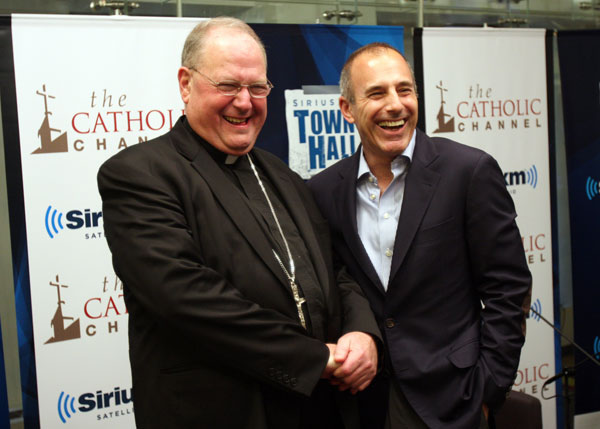
Cardinal Timothy M. Dolan of New York and NBC "Today" co-host Matt Lauer share a light moment during a break in the cardinal's town-hall-style satellite radio broadcast on the Catholic Channel at SiriusXM studios in New York May 8. (CNS photo/Gregory A. Shemitz)

NEW YORK (CNS) — In a genial, live, two-hour national satellite radio broadcast May 8, Cardinal Timothy M. Dolan of New York sent his first Twitter message and fielded questions on issues ranging from his priesthood to his favorite foods and beverages.

Cardinal Dolan was featured in a Town Hall event on SiriusXM’s the Catholic Channel 129. Twenty invited listeners perched on stools in a small glass-enclosed studio at SiriusXM’s New York headquarters. They read their queries from prepared cards and responded appreciatively to the cardinal’s thoughtful responses.

The broadcast was moderated by Sirius XM personalities Father Jonathan Morris and Tim Farley. NBC’s “Today” co-host Matt Lauer, former Major League Baseball manager Joe Torre and Shirley Dolan, the cardinal’s mother, were “surprise guests.”

Cardinal Dolan said he aspires to be a saint. “I’m longing for it and trying my best. Great saints are just recovering sinners,” he quipped.

He cited St. Therese of Lisieux, or the “Little Flower,” who famously defined sainthood as doing ordinary things extraordinarily well. “For a cardinal, most of life is routine,” Cardinal Dolan said.

The cardinal applauded St. John Bosco’s creative approach to ministry and said St. Maximilian Kolbe is an inspiration for priests. The priest, canonized in 1982, gave his life at Auschwitz to spare a young father. “I love Maximilian Kolbe because he came to us at a time when priests were questioning our identity and confidence was flagging.”

“We’re all called to be saints. I hope 50 years from now someone will remember something I said or did and be inspired,” Cardinal Dolan said.

The cardinal, who hosts a weekly talk show on the Catholic Channel, opened the Town Hall with a milkshake toast to the audience and the event was peppered with references to food and drink. Without hesitation, he described his favorite meal — “meatloaf, mashed potatoes, no gravy, butter, a cold beer and cherry pie.” Budweiser is his favorite brand of beer and peach his preferred flavor for a stand-alone snack of pie and cold milk. He also described feigning indecision at a gelato stand to sample many flavors before ordering.

Cardinal Dolan said his guests at an imaginary dinner party would include St. Peter, the Roman emperor Constantine, Abraham Lincoln and Archbishop Fulton Sheen. He said he would ask how St. Peter “recuperated so quickly from denying Jesus to being at his tomb” on Easter.

The cardinal said Lincoln is “one of the holiest and wisest men I’ve ever read about” and then laughingly acknowledged that Archbishop Sheen, a skilled broadcaster, “would probably dominate the conversation.” Jesus, he said, is a presumed guest at the dinner, one whom he meets every day in the eucharistic meal.

Addressing priestly vocations, Cardinal Dolan said families and parishes should invite and encourage young men without pressuring them. He said he aspired to the parish priesthood from an early age, but would likely have become a married father and history teacher if he was not ordained.

“Pope Paul VI said a priest should want to be a husband and a father,” Cardinal Dolan said. “We’re not called to be bachelors. A bachelor freely chooses not to be married. We’re called to be celibate, which means we have a deep longing for a wife and children but we have placed that under God’s domain. We then have a spiritual spousal relationship with the Church and a spiritual paternity with our people.”

Cardinal Dolan said his faith was tested in 2000 when his young niece was diagnosed with bone cancer.

“I was never tempted to doubt God, but I was tempted to doubt that God knew what he was doing,” he said. Ultimately, he latched onto the Gospel question “Lord, to whom shall we go?” and adopted it as his prayer and part of his episcopal coat of arms. His niece is now a young adult.

Cardinal Dolan advised a new grandmother to be gentle, prayerful and persistent in encouraging the baby’s lapsed Catholic father to have the child baptized. “A genius of the Catholic faith is that adults return to the faith through their kids,” he said.

Asked to speculate about an American papacy, Cardinal Dolan said it might happen eventually, but not in the near future. Traditionally, he said, the pope is a referee in international affairs, and the College of Cardinals would “shy away” from choosing someone from a superpower because it might place a burden on him.

When Lauer appeared in the studio, he reminisced with Cardinal Dolan about a moving 2011 visit they made to St. Peter’s Basilica after it was closed to the public for the day. Lauer described himself as “deeply spiritual, but not religious” and said he was raised by a Jewish father and a Christian Scientist mother. Cardinal Dolan said, “Rome brings out a natural inquisitiveness about religion.”

Joe Torre called in to the program and Cardinal Dolan said, “You’re one of my heroes, Joe. You take your faith seriously.” The former baseball manager and the cardinal had a rapid-fire exchange worthy of late-night sports radio, including updates on former major leaguers Stan Musial, Whitey Herzog, Tony La Russa and Frank Torre, Joe’s brother.

Cardinal Dolan said there is an analogy between the Catholic Church and sports. “Strength in athletics and spiritual life are allied. The same traits that serve well on the field apply to spiritual life: team work, perseverance, grittiness and vigilance,” he said.

Diocesan bishops, like sports managers, have to “craft a team to fit the park,” Cardinal Dolan said. Both have to assess the local situation and develop their personnel to meet the challenges and opportunities.

During the broadcast, the cardinal used an iPad to send his first Tweet. With the handle @CardinalDolan, he wrote: “Hey everybody. It’s Timothy Cardinal Tebow. I mean Dolan. I’m on Twitter. And I’m live on Town Hall on SiriusXM’s The Catholic Channel 129.”

— By Beth Griffin, Catholic News Service

– – –

Editor’s Note: Rebroadcasts of the Town Hall program with Cardinal Dolan were scheduled for Saturday, May 12, (10 a.m. and 7 p.m. EDT) and Sunday, May 13, (noon and 10 p.m. EDT) on SiriusXM’s the Catholic Channel 129.

Local Catholic launches ‘Rosary for the USA’

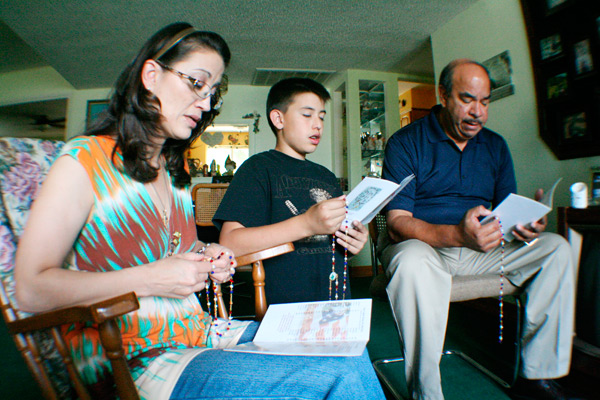
Dee, Antonio and Manny Yrique pray the rosary May 8 in their Phoenix home. (J.D. Long-Garcia/CATHOLIC SUN)

As Manny Yrique prayed before the Blessed Sacrament, his heart was burdened with concerns about the United States and the level of animosity in American discourse.

“I knelt down to pray and I was overwhelmed by the feeling that Our Lord wanted me to pray a rosary,” Yrique said. “I felt Him telling me, ‘Take it to My Mother.’”

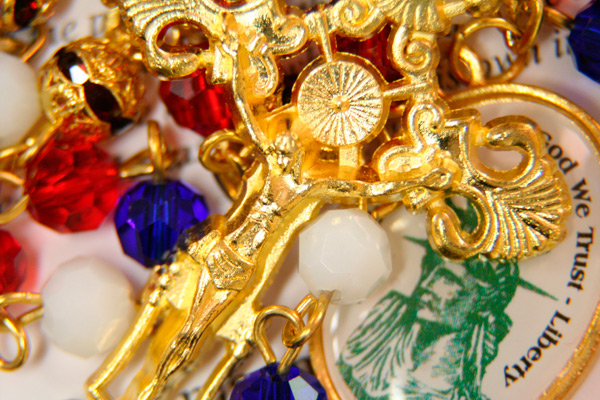
Manny Yrique displays the Rosary for the United States of America (J.D. Long-Garcia/CATHOLIC SUN)

He pulled out his rosary beads and as he began to pray, was struck by the realization that the 50 Hail Mary prayers of the rosary could each be offered for one of the 50 United States.

Yrique said he’s always had a strong devotion to the Blessed Virgin Mary. He remembers being 8 years old, kneeling with his 6-year-old sister to pray the rosary while their mother was undergoing surgery.

“We didn’t know if our mom was coming back home, so we took out our plastic rosaries, knelt down at the Virgin of Guadalupe statue that was over my mom’s bed and we prayed a rosary,” Yrique said. “It was like, ‘Nothing’s going to happen as long as Mary’s with you.’”

That conviction about the love of the Mother of God is something that Yrique said can partly be explained by his own mother’s unshakeable devotion to her children.

“I believe that a mother has tremendous impact on her family — I saw that in my mother,” Yrique said. “We knew that nothing would happen to us as children as long as Mom was there.

“I believe the Blessed Virgin Mary is the same way — she’s always been my Mother and I believe she has the ear of God at her command.”

Yrique said he designed the Rosary for the United States of America through prayer, often waking in the middle of the night to compose the intentions. Each of the five decades has a designated intention.

The first three decades are prayed for the executive, legislative and judicial branches of government. The fourth decade is dedicated to state and local governments as well as police and fire fighters. The fifth decade is devoted to U.S. military personnel.

The Rosary for the USA is not a political statement, Yrique said. He’s not praying for a particular candidate to win the upcoming election or for any political party’s success. He’s simply praying for the United States — its leaders and populace.

“At the time I started praying for my country, I was really concerned with how divisive we became over the SB 1070 [immigration] issue,” Yrique said. “So when I saw things happening on the news — when I saw people being angry at one another, shouting at one another, I thought, ‘This is not the way I was brought up.’”

Fr. Johnrita Adegboyega, parochial vicar at St. Mary Parish in Chandler, said the Virgin Mary is always ready to listen and intercede for her children.

“In the midst of every evil, only prayer can make us safe — only  prayer can bring about the truth,” Fr. Adegboyega said. “The Mother of God is there to find solutions to every problem, regardless of the challenges… She is the perfect means to approach the throne of grace through Christ Jesus Our Lord.”

Davonna Serrano, parishioner at St. Mary Magdalene Parish in Gilbert, said the Rosary for the USA should be prayed to defend the nation.

“The only way that we have to fight is through prayer — that’s our first and foremost defense in any kind of battle,” Serrano said. “And right now the battle is for the souls of our children and the future of our country.”

Praying the Rosary for the USA, she said, could also help bring people back to the Catholic Church.

“Whether you’re a grandmother or a parent or just a family member, and you’ve lost family from the Church, all you have to do is pray,” Serrano said. “Pray the rosary, pray for the intercession of the saints and pray for the Blessed Mother to open their eyes, and they will return to the faith.”

Yrique said it’s important for the 30 million Catholics in the United States to pray for their leaders, regardless of political persuasion.

“I really believe that it doesn’t matter who we elect if the power of God is not working through our elected officials,” Yrique said. “I’d like people to get off their soapboxes and get on their knees and pray. God will bless America when Americans remember to bless God.”

Yrique has already given away or sold 3,000 of the red, white and blue rosary beads and has ordered another 2,000. Along with the rosary, people can order a prayer booklet or prayer card that lists all the intentions as well as the names of the 50 states.

The booklet also lists other intentions for the rosary, depending on the time of day in which it is prayed.  From midnight to 3 a.m. for example, the rosary could be offered for those who work at night, such as truck drivers and railroad workers.

– – –

ROSARY USA: www.magnalitecatholic.com or call (602) 269-0009

– – –


Close-up of the Rosary for the United States of America. (J.D. Long-Garcia/CATHOLIC SUN)

Well-formed faith makes dialogue with opponents easier, cardinal says

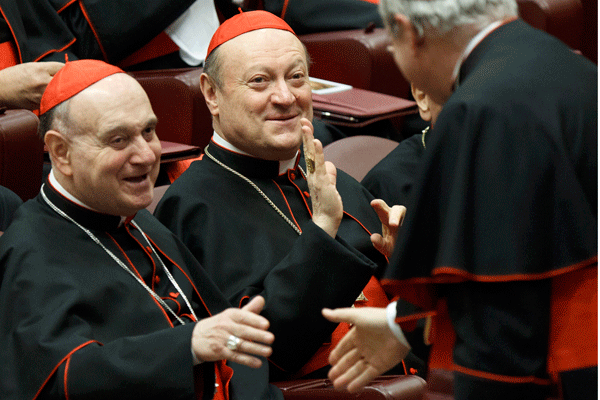
Cardinals Angelo Comastri and Gianfranco Ravasi greet another cardinal before a meeting of the world's cardinals with Pope Benedict XVI in the synod hall at the Vatican Feb. 17. (CNS photo/Paul Haring)

VATICAN CITY (CNS) — The recent call for the resignation of top officials at the Pontifical Academy for Life stems from some members’ concern that inviting speakers who oppose church teaching in their scientific practice confuses the faithful and compromises the academy’s commitment to the truth.

Any kind of “neutral scientific description” of practices opposed to church teaching have “absolutely no place in our academy,” wrote Joseph Seifert, an academy member and founding rector of the International Academy of Philosophy in Liechtenstein.

However, a Vatican cardinal who has been leading a global initiative engaging Catholics, atheists and agnostics in dialogue said when Catholics are well-formed in their faith they have nothing to fear from listening to opposing views.

It’s a shaky or fundamentalist grasp of faith that sparks suspicion or fear of the other, said Cardinal Gianfranco Ravasi, president of the Pontifical Council for Culture. The cardinal spearheads and coordinates the “Courtyard of the Gentiles” project, which seeks to promote discussions between Christians and nonbelievers on themes as diverse as art, spirituality and bioethics.

“Oftentimes this fear (of dialogue) stems from the fact that the person doesn’t feel capable of defending or justifying his own reasons, hence he doesn’t want to listen to the other,” he told Catholic News Service May 10.

The culture council, too, faced negative reaction and controversy in November, he said, when it hosted an international conference on the latest research using adult stem cells.

Though the conference topic focused on adult stem cells, some of the speakers were also involved in research using embryonic stem cells, which the Catholic Church opposes because it involves the destruction of human life. However, the church supports research and therapies utilizing adult stem cells, which can develop into a variety of specialized cells, alleviating degenerative illnesses by repairing damaged tissues.

Cardinal Ravasi said the conference was a success because the key to successful dialogue in any field is not to pick just the best and the brightest, but to choose the most qualified experts who also are open to a mutual exchange of ideas and criticism.

An obstinate fundamentalist attitude, open hostility or blatant indifference are recipes for failure no matter how famous or accomplished the expert, he said.

A handful of members of the Pontifical Academy for Life had harshly criticized the academy’s plans to host a conference in April on adult stem-cell research that would have featured some of the same speakers as the council for culture’s event.

Academy organizers canceled the meeting a month before it was to be held due to a lack of funding; members critical of the event praised its demise citing concern that scientists not in line with church teaching speaking at a Vatican-sponsored event would confuse the faithful.

Another Vatican-related advisory group, the Pontifical Academy of Sciences, had a working group meet to discuss developments in stem-cell research in mid-April. The meeting was held behind closed doors to avoid any media-stoked speculation or controversy.

The latest disagreement at the life academy comes from the reaction of a few members to a workshop held in February on the causes, prevention and treatment of infertility.

Seifert wrote a sharply critical six-page open letter to the life academy’s president, Bishop Ignacio Carrasco de Paula, and distributed to media outlets, saying the academy’s directory board should resign.

He said the infertility workshop was “possibly the worst day in the history” of the academy because there was too much emphasis on “a neutral scientific discussion” of infertility treatments rather than scientific presentations that were “primarily from an ethical and magisterial viewpoint.”

The Pontifical Academy for Life, established in 1994, “was explicitly founded to deal with (scientific) matters in the light of anthropological, theological and moral truth,” Seifert wrote.

“Any ‘purely scientific’ treatment of (topics) falsifies them by failing to take into account the most important truths about the questions at hand,” said his letter, dated May 4.

Father Scott Borgman, an academy official, told CNS that the academy was created for scientific research to further “the promotion and defense of human life from conception to natural death.”

Firmly rooted in “the stability of knowing what the magisterium teaches,” the academy also wants to be aware of advances in scientific research even if they do not conform to church teaching, he said.

“This doesn’t mean that we uphold people’s teachings that are against church teachings,” he said. But there is research that does respect Christian morality being conducted by researchers whose scope also includes methods that do not conform to church teaching and “we want to be able to be open to dialogue” to find the latest therapies that the church can endorse.

Msgr. Michel Schooyans, an academy member and retired professor at the Catholic University of Louvain, Belgium, told CNS that dialogue with people who don’t agree with church teaching may be acceptable outside of the Vatican, but inviting such experts to a Vatican-sponsored event, he said, gives them an opportunity to “falsify the doctrine of the church in respect to human life.”

“When you start compromising the Vatican you are starting a process that troubles public opinion” and confuses the faithful about what the church believes, he said.

When asked whether he believed such a situation could damage the church or would confuse Catholics, Cardinal Ravasi said, “No, that’s not true.”

However, Catholics need to be well-formed first, he said, hence the importance of the Year of Faith to strengthen people’s understanding of what their faith teaches.

“When you are well-formed, you can listen to other people’s reasons,” he said, so solid, serious catechesis goes hand-in-hand with respectful dialogue.

A solid Catholic identity — whether as a layperson, a religious or as a Catholic institution — provides the needed foundation for confronting differing opinions and also for critiquing views, since listening doesn’t always mean agreeing, he said.

When asked specifically about the tensions at the life academy, he said, “this is why it’s necessary to have a precise identity,” which means “an identity that’s serious and well-formed, not just fundamentalist.”

— By Carol Glatz, Catholic News Service

Catholic leaders reject Obama’s support for same-sex marriage

U.S. President Barack Obama gestures during an interview with Robin Roberts of ABC's "Good Morning America" at the White House May 9. During the interview Obama said he believes same-sex couples should be allowed to marry. (CNS photo/Pete Souza, courtesy White House via Reuters)

WASHINGTON (CNS) — Catholic leaders rejected President Barack Obama’s May 9 declaration in a television interview that “personally it is important for me to go ahead and affirm that I think same-sex couples should be able to get married.”

“President Obama’s words today are not surprising since they follow upon various actions already taken by his administration that erode or ignore the unique meaning of marriage,” said Cardinal Timothy M. Dolan of New York, president of the U.S. bishops, in a May 9 statement.

“We cannot be silent in the face of words or actions that would undermine the institution of marriage, the very cornerstone of our society,” Cardinal Dolan added. “The people of this country, especially our children, deserve better.”

In December 2010, Obama said his views on same-sex marriage were “evolving” and that he “struggles with this,” adding he would continue thinking about the issue. An Associated Press story May 10 quoted Obama as saying he wanted to announce his support for such unions “in my own way, on my own terms” but acknowledged earlier remarks by Vice President Joe Biden prompted his announcement.

On May 6, Biden, a Catholic, said he was “absolutely comfortable” with same-sex couples marrying, adding they should get “the same exact rights” heterosexual married couples receive.

The Catholic Church upholds the sanctity of traditional marriage as being only between one man and one woman, and also teaches that any sexual activity outside of marriage is sinful.

“I pray for the president every day, and will continue to pray that he and his administration act justly to uphold and protect marriage as the union of one man and one woman,” Cardinal Dolan said. “May we all work to promote and protect marriage and by so doing serve the true good of all persons.”

In a May 9 statement, the Archdiocese of Washington said it “opposes the redefinition of marriage based on the clear understanding that the complementarity of man and woman is intrinsic to the meaning of marriage. The word ‘marriage’ describes the exclusive and lifelong union of one man and one woman open to generating and nurturing children. Other unions exist, but they are not marriage.”

In its statement, the archdiocese said it would “continue to strongly advocate for the federal government’s existing definition of marriage as the union of one man and one woman,” adding it supports efforts undertaken by those who uphold the traditional meaning of marriage.”

One such effort is a petition drive in the state of Maryland to overturn a law passed earlier this year to allow same-sex marriage in the state. The archdiocese covers five Maryland counties in addition to the District of Columbia.

The Maryland Marriage Alliance said May 2 that a petition to put the law to a vote had collected more than 30,000 voter signatures. Nearly 56,000 valid signatures are needed by June 30 to add the referendum to the November ballot, with half due May 31 to the Maryland State Board of Elections.

“For us in Maryland, the vote on marriage this November has nothing to do with politics,” said Mary Ellen Russell, executive director of the Maryland Catholic Conference, in a May 9 statement. “It will be a vote on the issue of marriage itself.” She added, “The definition of marriage is not a matter of politics. It is a matter of values and the foundation of society and family.”

On May 8, North Carolina voters approved a constitutional amendment defining marriage as a union between one man and one woman by a 3-to-2 margin. According to an initial tally by the North Carolina State Board of Elections, 1,303,952 people — 61.05 percent — voted for the amendment while 831,788 people — 38.95 percent — voted against it.

The amendment read, “Marriage between one man and one woman is the only domestic legal union that shall be valid or recognized in this state.” It enshrines the definition of traditional marriage in the state constitution, elevating it from what has been state law since 1996.

Across the country the views of many Catholics, though, appear to be trending toward support of same-sex marriage.

A March poll conducted jointly by the Public Religion Research Institute and Religion News Service found overall Catholic support for same-sex marriage to be 59 percent, with 36 percent of Catholics opposed. Support by Americans overall is at 52 percent, with 44 percent opposed. Among white Catholics, 57 percent support same-sex marriage and 37 percent oppose it.

The demographic groups that showed majority opposition to same-sex marriage were respondents age 65 and up, white evangelicals, Republicans, African-Americans, and those with a high school education or less. In addition, pluralities of men and “minority Christian” affiliations said they were opposed.

According to polls conducted over the past five years by Gallup, ABC-The Washington Post, NBC-The Wall Street Journal, CNN-Opinion Research Center and the Pew Research Center, public support for same-sex marriage has risen from 40 percent in 2006 to majority support today.

—By Mark Pattison, Catholic News Service 

Half a century later, still answering Fatima questions

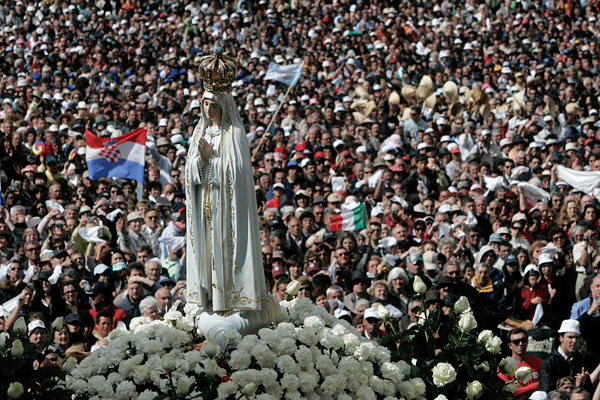
The statue of Our Lady of Fatima is carried May 13 through a crowd of pilgrims at the shrine built in her honor in central Portugal. Hundreds of thousands of pilgrims joined in celebrations of the first apparition of the Virgin Mary to three shepherd children. Lucia dos Santos and her cousins, Francisco and Jacinta Marto, received the first of several visions of Mary May 13, 1917. (CNS photo/Nacho Doce, Reuters)

SOTTO IL MONTE GIOVANNI XXIII, Italy (CNS) — The feast of Our Lady of Fatima, May 13, is the occasion every year for millions of devotees to celebrate the apparition of Mary to three Portuguese peasant children in 1917 and to meditate on her call for repentance and conversion by the modern world.

For a much smaller but highly dedicated group of people, the anniversary of the first apparition is also an occasion for exploring their belief that, 95 years later, the Vatican is still hiding a portion of the Mary’s revelations.

The controversy is associated in a particular way with the pontificate of Blessed John XXIII, because one of the Fatima visionaries, Sister Lucia dos Santos, committed the so-called “Third Secret” to writing, with instructions that the pope should read it in the year 1960. Blessed John, who was pope from 1958 to 1963, declined to reveal the secret, which was published by the Vatican only in 2000.

The official version of the secret comes with a Vatican commentary interpreting it as an allegory of the Catholic Church’s past struggles with 20th-century ideologies and characterizing its description of a “bishop dressed in white” shot down amid the rubble of a ruined city as a prophecy of the 1981 assassination attempt on Blessed John Paul II.

But some argue that the long-suppressed document must contain something even more disturbing, perhaps a prophecy of what they call the “great apostasy”: the modernizing changes that followed the Second Vatican Council (1962-65), which was called by Blessed John.

One man with whom such skeptics would very much like to talk is Archbishop Loris F. Capovilla, Blessed John’s personal secretary, who was present when the pope read the secret for the first time.

Speaking to Catholic News Service, Archbishop Capovilla, now 96, dismisses reports that he told an Italian writer in 2006 that part of the secret remains unpublished. He says that he noticed no discrepancy between the published version and the original.

Yet he qualifies his statement with a rare admission of doubt about his own remarkable memory. “I remember a bit,” he says, “but you will understand, after so many years I wouldn’t know how to reconstruct (the secret) fully.”

Nor does he rule out the presence of such a document elsewhere in the archives of the Vatican’s Congregation for the Doctrine of the Faith, often referred to as “the Holy Office.”

“At the Holy Office there must be a kilometer of paper regarding Fatima,” the archbishop says. “I don’t deny that there may be something else, but I don’t know it.”

When he was prefect of the doctrinal congregation, Pope Benedict XVI wrote the Vatican’s commentary on the secret and insisted that what was published in 2000 was everything. In a book marking the 90th anniversary of the Fatima apparitions, he said publishing the text “was a time of light, not only because the message could be known by all, but also because it unveiled the truth amid the confused framework of apocalyptic interpretations and speculation.”

He said he had written the commentary “after having prayed intensely and meditated deeply on the authentic words of the third part of the secret of Fatima, contained on sheets written by Sister Lucia.”

Archbishop Capovilla does not disguise his reservations about the cult of Fatima, not least, he says, because it was “sometimes exploited a bit for political ends.”

During the Cold War, many interpreted the Virgin’s prophecy that Russia would “convert” as foretelling the fall of the Soviet Union. But Archbishop Capovilla says he considered those words to mean merely that Russia would embrace Christianity, which he suggests did not exclude the survival of communism.

“I have known people in perfectly good faith who were communists, but they weren’t atheists,” he says.

The archbishop’s reservations about Fatima extend more generally to the phenomenon of Marian devotion.

“A cloistered nun who has visions — here we underscore one aspect of the Christian life,” he says.

Amid the enthusiasm for ecumenism that animated Blessed John’s papacy and the Second Vatican Council, he recalls, “it was concluded, as far as Marian devotion was concerned, that perhaps it would not be appreciated by the Protestants.”

An excessive focus on Marian devotion also runs contrary to the express wishes of Mary herself, he says.

Imagining himself receiving an apparition of Mary, Archbishop Capovilla says he would tell her: “Lady, you were present at the wedding at Cana; you said words that remain eternal, ‘Do what Jesus tells you.’ You come now to tell me to convert, to do penance. But he already said all of this; it’s in the holy Gospel.”

He adds that “all of Christianity — all — for me, for the Protestants, for the Orthodox, is summed up in these words: Convert, recognize your condition as little creatures and believe in the Gospel, put it into practice, live it.”

“Having said this,” the archbishop says, “it seems to me that is everything.”

— By Francis X. Rocca, Catholic News Service 
Archbishop hopes June congress will help heal wounds of Irish church

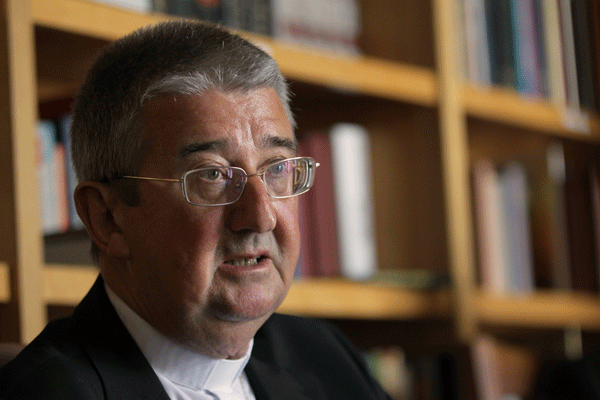
Irish Archbishop Diarmuid Martin of Dublin talks with Catholic News Service at Georgetown University in Washington before giving a lecture on faith and service May 16, 2011. (CNS photo/Nancy Wiechec)

VATICAN CITY (CNS) — The wounds and divisions within the Catholic Church in Ireland make the upcoming International Eucharistic Congress in Dublin an important moment for renewal and reconciliation, said Archbishop Diarmuid Martin of Dublin.

The archbishop spoke at a Vatican news conference May 10 as a growing chorus of voices called for the resignation of Ireland’s Catholic primate, Cardinal Sean Brady of Armagh, Northern Ireland, over allegations he did not do enough to stop an abusive priest in the 1970s.

The news conference about the International Eucharistic Congress scheduled for June 10-17 also came on the heels of reports that the Vatican Congregation for the Doctrine of the Faith recently censured five Irish priests over their stance on issues such as the ordination of women, the ban on artificial birth control, mandatory clerical celibacy and homosexuality.

The eucharistic congress, Archbishop Martin said, “will reflect and showcase the church in Ireland, a church which has faced and still faces enormous challenges, but a church which is alive and vital and anxious to set out on a path of renewal.”

“There are divisions within the Irish church and at times unhealthy divisions,” he said, but the eucharistic congress could be “an event of reconciliation and rebuilding of unity” like the congress held in Dublin in 1932, less than 10 years after the Irish civil war.

Before traveling to Rome, Archbishop Martin had said he thought a government commission should be set up to look into the case of Norbertine Father Brendan Smyth, who was convicted in 1997 of sexually abusing more than 20 victims over a period of 35 years. Archbishop Martin had said it was important to investigate “how he was allowed to abuse for so many years.”

But at the Vatican news conference, Archbishop Martin would not say what he thought the cardinal should do. “Cardinal Brady has made a clear statement; he is dealing with it,” the archbishop said.

During the International Eucharistic Congress, he said, a day has been dedicated to the theme of reconciliation, and it’s not only about helping people rediscover sacramental penance.

The main liturgy that day, he said, will “touch on the theme of child sexual abuse,” and some of the texts were written by victims of clerical abuse.

But Archbishop Martin said the challenge to the church in Ireland goes deeper than the legacy of clerical sexual abuse of children and calls for a renewal of the church, a change in church structures and recognizing that the country is much more profoundly secular than most people thought.

The church, he said, “is trying to address the problems of today with the pastoral methods of the past. We need a much deeper reform of the church in Ireland,” which means not only structures, but most importantly finding new ways to bring people to Christ and revive an enthusiasm for sharing the faith.

The Irish need “a different type of church. It will be more modest in its dimensions and its role. It will be, in many ways — and it is today in many ways — a minority church, but that does not mean it is an irrelevant church,” the archbishop said.

Archbishop Martin said, “The church in Ireland shows signs of tiredness” and he hoped hosting the International Eucharistic Congress would be one step in the process of overcoming that weariness.

“I don’t think that Irish churches will be full a week after the congress,” he said, but gathering around the Eucharist with Catholics from all over the world should spark some new enthusiasm.

Archbishop Martin said he and the Irish bishops had invited Pope Benedict to the congress, but he thinks a papal visit will be even more important in the future as “the crowning moment of the renewal process of the church in Ireland, or at least of the first stage of that process.”
— By Cindy Wooden, Catholic News Service

New Arizona law cuts off all state funds to abortion providers

Gov. Jan Brewer signed legislation May 4 that prevents the state of Arizona or any local government from using taxpayer dollars to contract with organizations that offer abortion as part of their services.

Brewer signed the measure at a reception held in Scottsdale by the Susan B. Anthony List, an organization that works to elect pro-life candidates to public office.

Although state law already prohibits the use of public monies for abortion, the new law closes loopholes that were allowing some funds to trickle through to abortion providers such as Planned Parenthood.

Ron Johnson, executive director of the Arizona Catholic Conference, was pleased with Brewer’s signature on the bill. The conference is the public policy arm of the Tucson and Phoenix dioceses, the Holy Protection of Mary Byzantine Eparchy of Arizona and the Diocese of Gallup, N.M., which includes northeastern Arizona.

“I’m absolutely thrilled that the governor signed House Bill 2800,” Johnson said. “Abortion providers can be very creative in how they use funds and arrange funds and we wanted to make absolutely sure to close any loopholes.”

Brewer’s signature on H.B. 2800 was the culmination of what Johnson called a “tremendously successful, five-star, pro-life legislative session.”

In April, the governor signed H.B. 2036, a bill that outlaws abortions after 20 weeks, and S.B. 1009, which keeps abortion providers out of public and charter schools.

Rep. Justin Olson, the Republican sponsor of H.B. 2800, and Jinny Perron, one of the founders of the East Valley Pro-Life Alliance, both attended the Susan B. Anthony List reception to witness Brewer signing the measure.

“It was awesome,” Perron said. “We are so happy to be one of nine states that have done this. For the state of Arizona to defund Planned Parenthood is a big step.”

Iowa diocese’s decision on scholarship for gay student causes uproar

Student Keaton Fuller of Clinton, Iowa, is pictured in a photo provided by the Eychaner Foundation. The foundation awarded the gay student from Prince of Peace Catholic School in Clinton with its Matthew Shepard Scholarship, given in memory of Matthew Sh epard, a 21-year-old tortured and murdered in Wyoming in 1998 because he was gay. Davenport diocesan officials with oversight of the school will allow Keaton to receive the scholarship award from a school representative during graduation ceremonies May 2 0. (CNS photo/courtesy of Eychaner Foundation)

DAVENPORT, Iowa (CNS) — A gay student at Prince of Peace Catholic School in Clinton has been chosen to receive a scholarship from an Iowa organization that promotes tolerance, but controversy has erupted over presentation of the award.

Keaton Fuller, a senior at Prince of Peace, is one of eight recipients of a Matthew Shepard Scholarship from the Eychaner Foundation based in Des Moines. The scholarship honors the memory of Matthew Shepard, a 21-year-old tortured and murdered in Wyoming in 1998 because he was gay. Scholarship recipients and their schools agreed in the application process to permit an Eychaner representative to present the award during graduation awards ceremonies.

While Keaton can receive the scholarship award during graduation ceremonies at Prince of Peace Church May 20, a school representative — not an Eychaner representative — will present it. That decision has generated national press attention and confusion about the award presentation.

Diocesan officials explained their decision in a May 7 press release: “The Diocese of Davenport congratulates Keaton Fuller on receiving the Matthew Shepard Scholarship. The diocese has a long-standing policy regarding guest speakers. This policy was explained to Keaton’s parents at their meeting with Bishop Martin Amos last week. It states: ‘We cannot allow anyone or any organization which promotes a position that is contrary to the teachings of the Catholic Church to present at a diocesan institution.’ Bishop Amos also expressed his congratulations for Keaton’s reception of the award and recognized his hard work in achieving it.

“We are glad that Keaton and his family chose to pursue his education at Prince of Peace Catholic High School in Clinton, IA.,” the diocesan statement continued. “We hope that Keaton will benefit from the generous award and wish him well in his academic pursuits.”

Keaton expressed disappointment and frustration with the diocese’s decision in a May 7 letter addressed to the Prince of Peace student body and staff. But he had plenty of praise for his school.

“Being the lone openly gay student in a small, Catholic school has not always been easy. Upon first realizing I was gay, I suffered a lot of anxiety over wondering how everybody in this school would treat me if I were to tell people the truth about my sexual orientation,” he said. “When I did begin to tell people, I was pleasantly surprised and touched to find that nearly everybody treated me with the same acceptance and respect as they always had. I have always been very grateful to you for this.”

Learning that he had been awarded the foundation’s highest scholarship — the $40,000 Gold Matthew Shepard Scholarship — was one of the happiest moments in his life, he wrote. “When word got around about this achievement, I received a great deal of praise from many of you, for which I am extremely grateful.”

He said that he felt “invalidated and unaccepted” by the diocese’s decision and felt that he was being “made to feel that my accomplishments are less than everybody else’s.”

The award recipient concluded his letter by asking the student body and staff to “please help me by respectfully requesting that this decision be reversed. Share your thoughts about why all students deserve to be treated with respect and dignity at Prince of Peace.”

Rich Eychaner, who established the foundation that has granted 130 scholarships since 2000, also believes the diocese should reverse its decision.

“The mission of the Eychaner Foundation is to promote tolerance, understanding and anti-bullying policies. We help lesbian, gay, bisexual and transgender students survive and work to prevent teen suicide. We’re shocked that Bishop Amos and the Diocese of Davenport find these positions ‘contrary to the teachings of the Catholic Church.'”

Deacon David Montgomery, diocesan communications director, said the diocese has an anti-bullying policy and is strongly committed to tolerance and respectful behavior toward all people.

The opening statement of the policy reads: “The Diocese of Davenport encourages programs that promote anti-bullying and anti-harassment for all students. The diocese has taken a strong stance against the bullying and/or harassment of any student including on the basis of sexual orientation.”

“While the diocese supports anti-bullying programs promoted by the Eychaner Foundation, its advocacy for same-sex marriage is contrary to Catholic social teaching,” Deacon Montgomery said.

Eychaner told The Catholic Messenger, Davenport diocesan newspaper, in response to a question, that the foundation supports equality in marriage for any two people committed to monogamy.

The Catholic Church opposes efforts to define marriage as anything other than the union of one man and one woman.

Eychaner also said Prince of Peace’s curriculum director had signed the application form which permits a foundation representative to make the presentation. Eychaner said the stipulation was added because three other Catholic schools in Iowa — Kuemper High School in Carroll, Don Bosco High School in Gilbertville and Gehlen Catholic High School in Le Mars — had previously prevented the foundation from making presentations to recipients at those schools.

Kuemper and Gehlen are in the Diocese of Sioux City and Don Bosco is in the Archdiocese of Dubuque.

“How can it be acceptable to have school staff present the award in the school, but not allow the sponsor of the award to make the presentation? How is the award itself acceptable to Catholic beliefs but not those who make it possible? Why would we allow others to present an award we make possible?” he asked.

“Policies are meant to serve people, so let’s create policies that promote human dignity and stand by them,” said Keaton’s mother, Patricia Fuller.

“The diocese is not rejecting the scholarship. We certainly recognize it’s a generous scholarship,” said Lee Morrison, diocesan schools superintendent, who received more than 1,700 emails on May 7 about this issue. “We congratulate Keaton on the award and it will be allowed to be presented by a school representative at graduation along with the awards that all of the other students receive.”

— By Barb Arland-Fye, Catholic News Service 

North Carolina voters approve amendment upholding traditional marriage

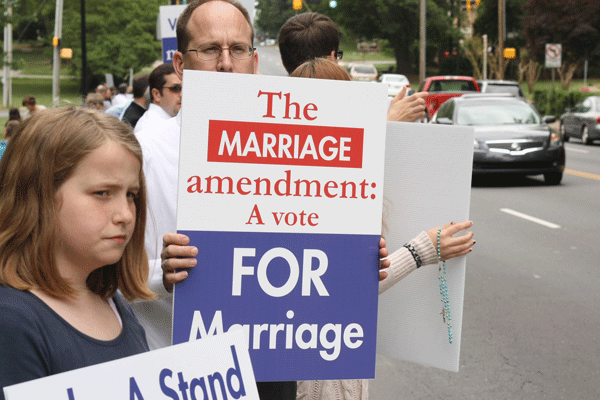
Parishioners of St. Ann Catholic Church in Charlotte, N.C., form a prayer chain in front of the church May 6 to voice support for the proposed statewide constitutional amendment to protect marriage. A few hours before voters in North Carolina were to go to the polls May 8, Bishop Peter J. Jugis of Charlotte prayed with his brother bishops for the courage always to defend the Gospel during their "ad limina" visits to the Vatican. (CNS photo/George Hoffman Jr., Catholic News Herald)

CHARLOTTE, N.C. (CNS) — With a heavy turnout at the polls, North Carolina voters approved a constitutional amendment defining marriage as a union between one man and one woman by a 3-to-2 margin.

In unofficial results calculated late May 8 by the North Carolina State Board of Elections, 1,303,952 people — 61.05 percent — voted for the amendment while 831,788 people — 38.95 percent — voted against it.

The amendment read, “Marriage between one man and one woman is the only domestic legal union that shall be valid or recognized in this state.” It enshrines the definition of traditional marriage in the state constitution, elevating it from what has been state law since 1996.

Bishop Peter J. Jugis of Charlotte and Bishop Michael F. Burbidge of Raleigh, who were at the Vatican May 8 for their “ad limina” visits, had both championed the amendment, which they said would prevent any arbitrary redefinition of marriage.

Marriage, they reminded Catholics, is based in natural law by God and instituted as a sacrament by Jesus Christ. It binds together a family, the fundamental building block of all societies, and provides the most stable and nurturing environment to raise children.

Bishop Jugis said May 8: “I am pleased that the people of North Carolina voted for marriage. The church consistently teaches that marriage is created by God as the faithful and exclusive union of one man and one woman, open to the gift of children.”

In a separate statement, Bishop Burbidge urged Catholics to pray “that whatever divisions may have occurred during this referendum process, may be healed by the grace of God and a mutual renewed commitment by all people of good will, so that we may together build a society reflective of the unity that is ours as members of God’s family.”

Bishop Jugis had mentioned the marriage amendment battle during a meeting with Pope Benedict XVI earlier that day. In his homily at Mass at the altar of the tomb of Blessed John XXIII in St. Peter’s Basilica May 8, Bishop Jugis said he and Bishop Burbidge had endured scorn for their efforts to uphold church teaching on marriage. It was a cross worth bearing, he said, “to be courageous in witnessing to the Gospel.”

“I shared with another bishop my sadness over this criticism of our support for something as beautiful and foundational to society as traditional marriage,” he said. The other bishop “encouraged me by saying, ‘Wear it as a badge of honor.'”

Ever since the amendment was put on the ballot by the Republican-led Legislature last fall, the bishops had urged Catholics to vote for it. They communicated with parishioners in print and online diocesan news media, TV and radio ads, parish bulletins and postcards, billboards and yard signs, and letters read from the pulpit during Masses the weekend before the vote.

The bishops had said the vote presented an opportunity to explain the importance and sanctity of traditional marriage in the church and in society.

In a joint letter read at all Masses May 5-6, the bishops wrote, “We are for marriage, as we believe it is a vocation in which God calls couples to faithfully and permanently embrace a fruitful union in a mutual self-giving bond of love, according to his purposes. It is not only the union itself that is essential to these purposes, but also the life to which spouses are called to be open, the gift of children.”

Their efforts ran parallel to the campaign by Vote For Marriage NC, a nonpartisan coalition of churches, groups and individuals that organized public support for the amendment, which even at the start of the campaign last fall was considered widely popular among North Carolina voters. Each diocese also donated $50,000 to the Vote for Marriage NC campaign for its advertising blitz and voter education efforts.

In a statement released on election night May 8, Tami Fitzgerald, chairwoman of Vote For Marriage NC, said, “We are thankful to God and to the people of North Carolina for joining together today to preserve marriage as the union between one man and one woman in our state constitution.

“North Carolinians have been waiting for nearly a decade to protect marriage — a sacred institution authored by God — from being redefined against the will of the people,” she added. “The marriage protection amendment ensures that it will always be the people of our state who determine what marriage is in North Carolina, not an activist judge or future politicians.”

North Carolina is the 31st state to define traditional marriage in its constitution, and the last among the Southern states to do so.

The amendment attracted large numbers of people to the polls, with 2.1 million (34 percent) of the state’s 6.3 million registered voters casting a ballot on the question, according to the state elections board results. Turnout was as high as 50 percent in some counties.

Meanwhile in Colorado, legislation that would have permitted civil unions in the state died without a vote May 8.

The Colorado Catholic Conference had opposed the legislation, saying it “creates an alternative parallel structure to marriage” and “contradicts the will of the people of Colorado,” who in 2006 approved a constitutional amendment that defined marriage as the union of a man and a woman.

— By Patricia L. Guilfoyle, Catholic News Service