
Five years a bishop — Q&A with Bishop Nevares

Auxiliary Bishop Eduardo A. Nevares of the Diocese of Phoenix.
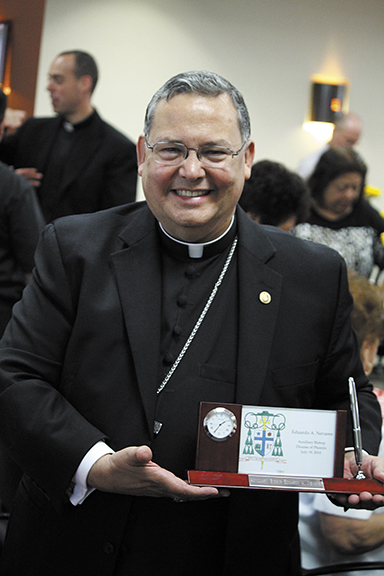
Bishop Eduardo A. Nevares, auxiliary bishop of the Diocese of Phoenix, displays an early five-year anniversary gift that bears his coat of arms. Each symbol honors his priestly ministry. His episcopal motto is "Serve the Lord with gladness." (Ambria Hammel/CATHOLIC SUN)
Bishop Eduardo A. Nevares, auxiliary bishop of the Diocese of Phoenix, displays an early five-year anniversary gift that bears his coat of arms. Each symbol honors his priestly ministry. His episcopal motto is “Serve the Lord with gladness.” (Ambria Hammel/CATHOLIC SUN)

[dropcap type=”4″]O[/dropcap]n July 19, Auxiliary Bishop Eduardo A. Nevares ­celebrates his fifth anniversary serving in the Diocese of Phoenix. Bishop Nevares was ordained a priest for the Missionaries of Our Lady of La Salette July 18, 1981, and was incardinated into the Diocese of Tyler, Texas, before receiving his episcopal
ordination in 2010.

Bishop Nevares reflected on his time as a bishop and on his vocation in an interview with Michael Dixon, host of “The Bishop’s Hour,” which aired on July 13. The following is adapted from a transcript of that interview.

Michael Dixon: We’re celebrating your fifth anniversary here in the Diocese of Phoenix. How has that been?

Bishop Nevares: It has been such a wonderful blessing to be a bishop, and more, to be the auxiliary bishop here in the Diocese of Phoenix. Of all the different possibilities, Phoenix is a wonderful, wonderful diocese to be with.

Michael Dixon: People love you and you have developed wonderful relationships here all over the diocese. It’s a very varied diocese isn’t it?

Bishop Nevares: Yes, it’s very varied, and that’s what I think contributes to the blessings, because I’m so happy to be the liaison from Bishop Olmsted to the ethnic groups. We have like 30 different ethnic groups from all over the world here in the sunny Valley, and they’re all Catholic. So whenever they have their fiesta, or their saint’s day, or their gatherings, they invite me and I go and I celebrate Mass for them, and of course enjoy their beautiful dinners afterward. Just to see all of these different types of Catholic people here in the Valley makes my experience here as the auxiliary bishop so very, very rich.

[quote_box_left]

The Bishop’s Hour

Airing Mondays at 11a.m. and Thursdays at 9 p.m. on Immaculate Heart Radio, 1310 AM.

Shows are available anytime at phoenixcatholicmedia.org or on iTunes.

[/quote_box_left]Michael Dixon: I want to take you back before you were ordained a bishop and all the way back to when your vocation began to make itself known to you. How old were you then?

Bishop Nevares: Probably 4 or 5 years old. … I would be outside laying on the grass just looking up at the night sky and just looking at all the wonderful stars. … I was really just admiring the beautiful stars, and thinking, even as that young boy, “God, you must really be big, and I can do nothing better with my life than give it to you.”

Now I didn’t know exactly what that meant, but at 11 years old, a missionary priest came and talked to our catechism class on the missions in Madagascar, and I said, “That’s what I want to do — I want to be a missionary to Madagascar, and take the Word of God and help these people come to know God and love God in a very special way.

So I think the very beginning of my vocation was way back, but then it started to crystalize at around the age of 11.

Michael Dixon: You were a Missionary of Our Lady of La Salette. How did you find yourself moving in the direction of that order?

Bishop Nevares: When I was about 10, we moved from the east end of Houston to the Southeast end, and in that parish, Missionaries of Our Lady of La Salette staffed the parish, and there I came to discover the beautiful apparition of Our Lady of La Salette, how she appeared weeping for the sin of the world. And those tears of our heavenly Mother just touched my heart so deeply that I just said, “I have to be a priest, and I have to be a missionary for Our Lady so as to dry her tears and console her most sorrowful heart.”

Michael Dixon: Had you any indication ahead of time that you were going to be named an auxiliary bishop?

Bishop Nevares: It was a total surprise.

Michael Dixon: What was that like? Who made the call — the nuncio?

Bishop Nevares: The nuncio, Archbishop Sambi. He calls on the 27th of April at 5:30 in the evening, which was very unusual — usually the calls come in the morning. So we were just finishing Evening Prayer, and one of the seminarians — I was [a formator] at the Josephinum — comes running into the chapel. “Fr. Ed, Fr. Ed, the nuncio is on the phone.” And I say, “The nuncio? What did I do?”

So I go to the phone, I sit down and I answer the phone and he says, “Fr. Nevares?” I said “Yes.” He says, “This is Archbishop Sambi, the papal nuncio.” I said, “Oh?” He says, “Are you sitting down?” I said, “Yes.” He says, “I have great news!” I said, “Oh?” He says, “The Holy Father appoints you auxiliary bishop…” and like that, a lightning bolt right through my head, “Please, Jesus, not Alaska,” and he said “Phoenix!” And my heart and my spirit rejoiced, but you know, there were no words that came out because I was so dumbfounded at what I was hearing — it was such a shock. I was so overwhelmed, I didn’t say a word. After 10 or 15 seconds, the nuncio says, “Are you there?” and I said, “Uh-huh, uh-huh.” And he says, “Well, do you accept?” and I said, “Ummm, ummm, uh-huh, uh-huh.” I mean, real “intelligent” responses.

Michael Dixon:: But how overwhelming that had to be.

Bishop Nevares: Oh, very overwhelming, because never in my entire life did I ever imagine that I’d be a bishop. Never.

Michael Dixon: You’re all over the place and your days are really packed. Is it something you truly love?

Bishop Nevares: Well, I guess I truly love being a bishop, and more, because I’m here with Bishop [Thomas J.] Olmsted.Bishop Olmsted is a wonderful mentor and brother and he’s been so very kind and welcoming and supportive of me in everything, and so very patient with me. I’m very blessed being here with Bishop Olmsted.

Also, I’m very blessed living with Bishop [Thomas J.] O’Brien. So for the last couple of years, I’ve been able to live with Bishop O’Brien, and we’ve become pals. He knows the whole history of the diocese, he knows so many people and he knows so many of the priests. Just to listen to his stories, especially about when the Holy Father John Paul II came — he has lots of tapes and pictures and stories — and when Mother Teresa came, again, he has all these stories. I mean he’s a walking encyclopedia when it comes to the history of the diocese.

So every so often he makes me pancakes for breakfast, and every so often I turn around and I make him French toast, so we get along just fine.

Michael Dixon: It’s wonderful to have you in the diocese, and I really want to thank you because there are people out there who need to hear that kind of a vocation story and that kind of willingness to go where God leads you and then be surprised at all the things that happened.

Bishop Nevares: God picks the least in order to do His most wonderful work. In this way there’s no boasting that can happen in the Lord’s vineyard. So sometimes young people look at a priest and say, “Oh, he must be an angel.” No, we’re no angels — angels are only in heaven. We’re men doing the very best we can to serve God and to serve His holy people and to fall in love with God and with the people. If you really hear the call of the Lord, be generous because it’s a wonderful life. After 34 years as a priest, I can really and honestly say I have no regrets.

Latino families a rising presence in U.S. Catholic Church, study finds

Young adults gather for the Hispanic charismatic Catholic conference in Chicago in 2009. (CNS photo/Karen Callaway, Catholic New World)

WASHINGTON (CNS) — More than half of young Catholic families participating in a recent survey identified themselves as Latino or Hispanic, a finding the president of Holy Cross Family Ministries said will require new ways of ministering in the U.S. Catholic Church.

Overall, 54 percent of young couples in the 25- to 45-year-old age range said they were Latino or Hispanic. That compares with the overall adult Latino/Hispanic Catholic population of 32 percent.

“People may speak English, but culturally they’re Latino. That’s a big piece of information. We’ll have to adjust the kinds of programs. It means we have to be more assertive in looking at the ways we can be of service to these families,” Holy Cross Father Willy Raymond said of the findings in the study his organization commissioned.

While Holy Cross Family Ministries is looking at ways to better meet the needs of Latino families, Father Raymond said the findings of the study will be of interest to the entire American Catholic Church as it attempt to ministers to all families.

The study, “The Catholic Family: 21st-Century Challenges in the United States,” examined the demographics, faith practices and media usage of 1,014 young families. It was conducted in fall 2014 by the Center for Applied Research in the Apostolate at Georgetown University.

The findings were summarized during the recent Catholic Media Conference in Buffalo, New York. Detailed findings in each area were to be released monthly beginning in late July and concluding in September at the 2015 World Meeting of Families in Philadelphia.

[quote_box_right]

Read the first report in a series on “The Catholic Family: 21st-Century Challenges in the United States”

[/quote_box_right]

The statistics in the study have a margin of error of plus or minus 3.1 percentage points.

The study found that 22 percent of parents attend Mass weekly, a number similar to the 23 percent of the overall Catholic adult population. But a larger proportion of parents than all adults attend Mass at least once month — 53 percent to 43 percent.

Parents with a teenager at home also were more likely to attend Mass weekly than those with an infant — 26 percent to 18 percent. Meanwhile, 15 percent of parents who have separated or divorced and 15 percent of parents who are single and have never married attend Mass weekly.

What Father Raymond found surprising is that 68 percent of parents responded that they have not enrolled their children in a Catholic school, a parish school of religion program or a youth ministry program affiliated with a Catholic parish.

The study found that 42 percent of weekly Massgoers have a child enrolled in parish-based religious education compared with 27 percent of monthly attendees, 11 percent of those attending Mass a few times a year and 4 percent of those who rarely or never attend Mass.

“The number that is not exposing their children to catechesis is shocking to me. We’re aware this represents a really clear danger for the faith community in the future. It’s a place we really have to concentrate a lot of our time, energy and resources for the future,” Father Raymond said.

“The danger here, I think, is that for millennials it’s (Catholic education) not been a part of their life. From the number we see, they have not been catechized and so they don’t know the faith and have not developed love for the devotionals and practice of the Catholic faith,” he added.

Still, when it comes to prayer life, 71 percent of parents strongly agreed or somewhat agreed that prayer is essential to their faith.

However, the daily practice of prayer was limited to 36 percent of respondents. Another 23 percent said they pray less than daily but at least once a week, while one in five parents said the pray almost every week or once or twice a month. Nine percent said they rarely or never pray.

The study found that when parents do pray, 76 percent they do so alone. Seven percent said they pray more often with family members than alone while 17 percent reported praying alone and with family equally.

“People may speak English, but culturally they’re Latino. That’s a big piece of information. We’ll have to adjust the kinds of programs. It means we have to be more assertive in looking at the ways we can be of service to these families.”

Father Raymond said the fact that nearly three-quarters of respondents continue to pray in some way was encouraging. At the same, he was concerned that people have “privatized their prayer life.”

“A lot of us do (pray privately). There’s an intimate part of our prayer life, but you’ve got to find expression in the community of the family,” he said. “This is another place for opportunity to encourage fathers and mothers to make a small step to pray with your spouse, maybe once a week or on a family night.

“We’ve got to encourage that this makes a difference in family life,” the priest said.

The study also explored family life, such as the practice of eating dinner together, television watching, social media usage and access to spiritual messaging various forms of media.

While Holy Cross Family Ministries will use the findings to design its own programs, Father Raymond said the organization will share the report with bishops and anyone working in parish ministries interested in improving outreach to families.

— By Dennis Sadowski, Catholic News Service.

Voces de fe: Amor e Igualdad — trágico error de la Corte Suprema

Cristofer Pereyra es el Director de la Oficina de Misiones Hispanas, un ente dedicado a proveer perspectivas sobre como servir mejor a la Iglesia ante el creciente número de católicos hispanos en una de las regiones de más rápido crecimiento en los Estados Unidos.

[dropcap type=”4″]E[/dropcap]n nombre de la igualdad y el amor, la unión que es base para la creación de una familia, célula básica de la sociedad, ha sido distorsionada y las repercusiones están por verse.

¿A quién le sorprende la reciente decisión de la Corte Suprema con respecto al matrimonio?. A mí no. Ciertamente, quienes buscaban redefinir el matrimonio habían estado ganado adeptos con una velocidad feroz en los últimos años. Y es lógico, porque el argumento utilizado para avanzar su causa había sido el del amor y la igualdad. ¿Quién no quiere que el amor triunfe?. ¿Quién no está de acuerdo con la igualdad?.

En realidad, las cosas no son tan sencillas. Para explicar el fallo de la Corte, el juez Anthony Kenedy sostuvo que la “dignidad humana” es inherente a la décimocuarta enmienda de la Constitución. Y que fue la “dignidad humana” la base de la decisión. Para mí, esta es ya una muestra de lo subjetiva que puede ser la interpretación de una ley. ¿Dónde está la dignidad humana de todos los inmigrantes que viven como ciudadanos de segunda clase, a la sombra de la sociedad? ¿Dónde está la dignidad humana del no nacido? Estos dos grupos ciertamente tienen dignidad humana. Lo que no tienen, es una poderosa maquinaria mediática y de cabildeo.

En nombre de la igualdad y el amor, la unión que es base para la creación de una familia, célula básica de la sociedad, ha sido distorsionada y las repercusiones están por verse. La pregunta con respecto al matrimonio heterosexual nunca fue ¿Por qué el estado discrimina cualquier otro tipo de matrimonio? No. La verdadera pregunta siempre fue: ¿Por qué el estado debe favorecer y privilegiar solamente al matrimonio heterosexual? Ojalá tuviera más de 400 palabras para darles la respuesta. Lo cierto es que frente a cualquier actividad humana el estado siempre ha tenido 3 opciones: prohibirlas, permitirlas, o incentivarlas.

El crimen por ejemplo está en la lista de lo prohibido. Y la mayor parte de los oficios se encuentran entre lo que está permitido. Pero el matrimonio entre un hombre y una mujer — una institución con innegables raíces religiosas — fue adoptado por el estado, e incentivado desde que tenemos registros históricos de la civilización. ¿La razón?. Solamente el matrimonio entre un hombre y una mujer dan lugar al ambiente más propicio para la formación de un niño o niña. No hay psicólogo o sociólogo, que se respete a sí mismo y sea capaz de negar que todo ser humano necesita de la amorosa influencia de un padre y una madre para crecer como una persona íntegra. Instintivamente eso lo sabemos todos, homosexuales y heterosexuales.

Y esto no es decir que aquellos que fueron criados solamente por su mamá, o solamente por su papá, no sean personas íntegras. Pero incluso una madre soltera puede corroborar la falta que le hace a un niño la presencia de un padre. Favorecer la unión con la mayor posibilidad de crear un ambiente óptimo para la formación de todo niño, ese es el verdadero amor que deberíamos estar defendiendo. Esa es la verdadera igualdad por la que vale la pena luchar.

El Santo que inspira al Papa Francisco: San Ignacio de Loyola

The Most Rev. Thomas J. Olmsted is the bishop of the Diocese of Phoenix. He was installed as the fourth bishop of Phoenix on Dec. 20, 2003, and is the spiritual leader of the diocese's 1.1 million Catholics.
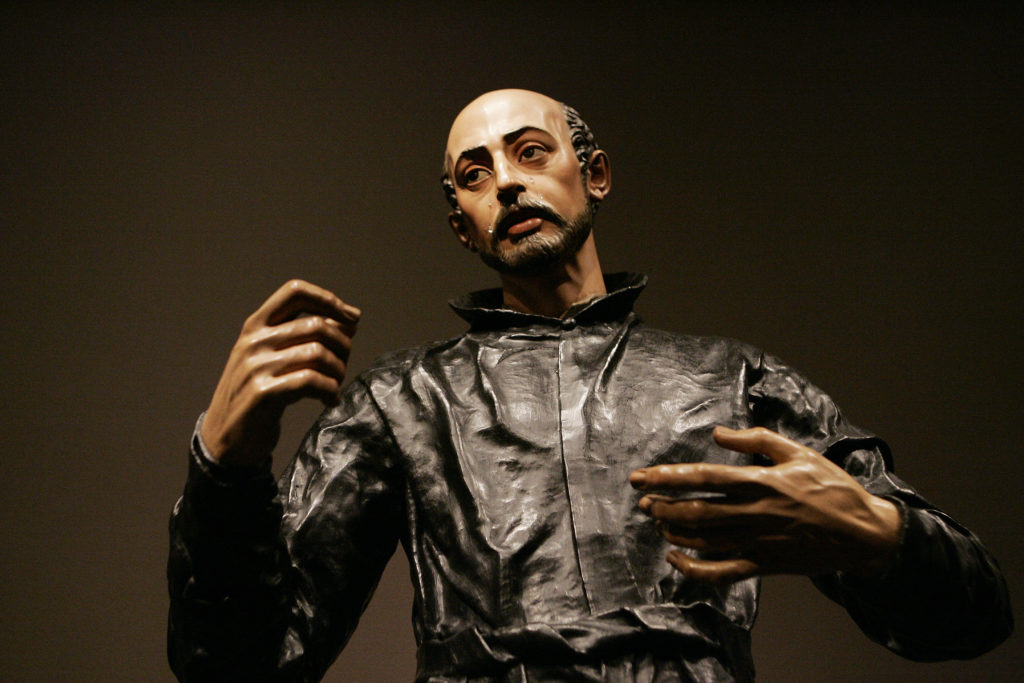
La parte superior de la escultura de “San Ignacio de Loyola,” por Juan Martínez Montañés y Francisco Pacheco, en la exposición “El Sagrado Hecho Real” en la Galería Nacional de Arte en Washington el 24 de febrero del 2010. La exposición incluye pinturas y esculturas religiosas del Siglo de Oro español, cuando artistas representaron a Cristo, María y los santos con un realismo intenso. (CNS photo/Nancy Wiechec)
The Most Rev. Thomas J. Olmsted is the bishop of the Diocese of Phoenix. He was installed as the fourth bishop of Phoenix on Dec. 20, 2003, and is the spiritual leader of the diocese's Catholics.
The Most Rev. Thomas J. Olmsted is the bishop of the Diocese of Phoenix. He was installed as the fourth bishop of Phoenix on Dec. 20, 2003, and is the spiritual leader of the diocese’s Catholics.

[dropcap type=”4″]L[/dropcap]a primera comunidad religiosa en tener un cuarto juramento de disponibilidad al Papa es la Compañía de Jesús (los Jesuitas), fundada por San Ignacio de Loyola y sus compañeros. Es por providencia de Dios, que ahora tenemos, por primera vez en la historia, un Papa Jesuita. No ha de sorprender, entonces, que el Papa Francisco se sienta cerca a San Ignacio y que haya sido grandemente impactado por su vida y su enseñanza. Al acercamos a la fiesta anual de San Ignacio el 31 de julio, les invito a acompañarme en examinar lo que el Papa Francisco dijo a sus compañeros Jesuitas el día de fiesta de su fundador en el año 2013 AD.

Descentrado de uno mismo para que Cristo esté allí

En sus Ejercicios Espirituales (una guía confiable para discernir la voluntad de Dios), San Ignacio, dice el Santo Padre, “nos sitúa ante nuestro Señor Jesucristo, nuestro Creador y Salvador (cf. EE, 5). Y esto nos lleva … a estar ‘descentrados’, a tener delante al ‘Cristo siempre mayor’, … a salir del ‘propio amor, querer e interés’ (EE, 189). No está descontada la pregunta para nosotros, para todos nosotros: ¿es Cristo el centro de mi vida? ¿Pongo verdaderamente a Cristo en el centro de mi vida? Porque existe siempre la tentación de pensar que estamos nosotros en el centro”.

Es evidente que el hombre conocido antes como el Cardenal Jorge Bergoglio no dejó atrás su espiritualidad Jesuita cuando fue elegido para ser el sucesor de Pedro. Contínuamente se esfuerza por ser un compañero fiel de Jesús, y nunca dar por sentado el privilegio de oír la palabra del Señor que dijo a los apóstoles en la Última Cena (Juan 15), “Ya no les llamo servidores, les llamo amigos”.

Una medida que demuestra bien que sí nos hemos descentrados para poder poner a Cristo en el centro es la prioridad que damos a la Iglesia. El Papa Francisco dice, “A la centralidad de Cristo le corresponde también la centralidad de la Iglesia: son dos fuegos que no se pueden separar: yo no puedo seguir a Cristo más que en la Iglesia y con la Iglesia. … Servir a Cristo es amar a esta Iglesia concreta, y servirla con generosidad y espíritu de obediencia”.

Permitir que Cristo te conquiste

Dios nunca abandona a Su pueblo; Él nos ama y nos escucha cuando clamamos a Él. Por otro lado, es aconsejable para nosotros, que somos cristianos, abandonarnos confiadamente a Él. O como dice el Papa Francisco, necesitamos permitir que Cristo nos conquiste.

Refiriéndose a los Ejercicios Espirituales de San Ignacio, el Santo Padre dice, “ser conquistado por Cristo para ofrecer a este Rey toda nuestra persona y toda nuestra fatiga (cf. EE, 96); decir al Señor querer hacer todo para su mayor servicio y alabanza, imitarle en soportar también injurias, desprecio, pobreza (cf. EE, 98). … Dejarse conquistar por Cristo significa tender siempre hacia aquello que tenemos de frente, hacia la meta de Cristo”.

San Ignacio, habiendo sido un soldado por años, gustaba emplear términos del campo de batalla. Imaginó la Compañía de Jesús como la milicia espiritual del Papa, con todo el mundo como su campo de operaciones. Ya que quería que los Jesuitas fueran fuertes en la batalla espiritual contra el diablo, sabía que ellos, como el resto de nosotros, necesitaban comenzar por rendirse completamente a Cristo nuestro Rey. Tenemos que permitir que Jesús conquiste nuestro orgullo y voluntad obstinada.

Sentir vergüenza de nuestros pecados

Cuando al Papa Francisco se le preguntó en una entrevista por un compañero Jesuita, “¿Quién es Jorge Bergoglio?” respondió, “Yo soy un pecador. Esta es la definición más exacta. Y no se trata de un modo de hablar o un género literario. Soy un pecador … quien el Señor ha puesto los ojos”.

El sentido de sí mismo del Santo Padre surge de estar arraigado en los Ejercicios Espirituales de San Ignacio. Por medio de un examen diario, el fundador de los Jesuitas enseñó a sus hermanos a tener auto aceptación y auto acusación para ser conscientes de sus propias fallas y así motivados por la vergüenza (que “pica la conciencia”) a crecer en la virtud. Con un enfoque en Cristo, la orientación le da a uno claridad acerca de cómo agradar a Dios y obtener la vida eterna.

Así que, en la fiesta de este gran santo, le dijo a sus compañeros Jesuitas, “…contemplando a Jesús, como nos enseña San Ignacio en la Primera Semana, sobre todo contemplando al Cristo crucificado, sentimos ese sentimiento tan humano y tan noble que es la vergüenza de no estar a la altura; contemplamos la sabiduría de Cristo y nuestra ignorancia, Su omnipotencia y nuestra debilidad, Su justicia y nuestra iniquidad, Su bondad y nuestra maldad (cf. EE, 59). Pedir la gracia de la vergüenza; vergüenza que me llega del continuo coloquio de misericordia con Él; vergüenza que nos hace sonrojar ante Jesucristo; vergüenza que nos pone en sintonía con el corazón de Cristo que se hizo pecado por mí; vergüenza que pone en armonía nuestro corazón en las lágrimas y nos acompaña en el seguimiento cotidiano de ‘mi Señor’. … nos lleva siempre, individualmente y como Compañía, a la humildad, a vivir esta gran virtud”.

El camino a la amistad con Cristo comienza sobre la roca sólida del arrepentimiento y la fe; como Jesús dijo a Sus primeros discípulos (Marcos 1:15), “Arrepiéntanse y crean en el Evangelio”. Sabiendo que esto es un regalo completamente inmerecido, San Ignacio, como San Fracisco de Asís y San Pablo de Tarso antes de ellos, nos insta a tener el valor de confesar nuestros pecados y poner toda nuestra confianza en la misericordia de Dios en Cristo Jesús.

Una vez que nos arraigamos en la verdad de quienes somos ante Dios, es decir, pecadores por quienes Cristo murió en la cruz, entonces, estamos dispuestos a consagrarnos como San Ignacio y los Jesuitas han hecho “ad maiorem Dei Gloriam”, para mayor gloria de Dios.

Priests embrace new flocks to shepherd following appointments

Priests who serve parishes across the Diocese of Phoenix await procession into Ss. Simon and Jude Cathedral prior to the Chrism Mass in April. Parish needs, newly arriving priests and other reasons prompted new assignments July 1. (Billy Hardiman/CATHOLIC SUN)

[quote_box_right]

New priest appointments

Effective July 1, unless otherwise noted

Pastor

• Fr. Matthew Henry, from serving as parochial administrator of Christ the King in Mesa, to serving as its pastor

• Fr. Chad King, from serving as parochial administrator of Corpus Christi to serving as its pastor, effective June 7

• Fr. Kieran Kleczewski, from serving as pastor of St. Thomas the Aquinas in Avondale, to serving as pastor of St. John Vianney in Sedona

• Fr. Lawrence Merta, from serving as interim parochial administrator at St. Gregory, to serving as pastor of Holy Cross in Mesa

• Fr. John Muir, from serving as pastor of St. Rose Philippine Duchesne in Anthem, to serving as pastor of St. Thomas Aquinas in Avondale

• Fr. Arthur Nave, from serving as parochial administrator of St. Charles Borromeo in Peoria, to serving as its pastor

• Fr. Paul Sullivan, from serving as parochial administrator of Sacred Heart, to serving as its pastor

Parochial Administrator

• Fr. Andres Arango, from serving as parochial vicar at St. Anne in Gilbert, to serving as parochial administrator of St. Gregory

• Fr. “Bing” Francisco Colasito, from serving as parochial vicar at St. Theresa, to serving as parochial administrator of St. Rose Philippine Duchesne in Anthem

Parochial Vicar

• Fr. Celso Benjamin Rivera, newly arrived from the Archdiocese of Guadalajara, Mexico, to serve as parochial vicar at St. Louis the King in Glendale, effective March 26

• Fr. Fernando Camou, to serve as parochial vicar at St. Thomas Aquinas in Avondale, upon ordination to the priesthood June 27

• Fr. James Aboyi, VC (Via Christi Society), newly arrived to the diocese to serve as parochial vicar at Holy Cross in Mesa, July 1 and part-time chaplain at Benedictine University in Mesa effective Aug. 15

• Fr. Joachim Adeyemi, from serving as parochial vicar at St. Thomas Aquinas in Avondale, to serving as parochial vicar at St. Theresa

• Fr. Joji “Bala” Balasamy, from serving as parochial vicar at St. Mary Parish in Chandler, to serving as parochial vicar at San Francisco de Asís in Flagstaff and El Cristo Rey in Grand Canyon

• Fr. Gerald Barmasse, CSC, to serving as parochial vicar at St. Matthew

• Fr. Raphael Bercasio, from serving as parochial vicar at Corpus Christi to serving as parochial vicar at St. Mary in Chandler

• Fr. Rey Clutario, from serving as parochial vicar at San Francisco de Asís in Flagstaff and El Cristo Rey in Grand Canyon, to serving as parochial vicar at Corpus Christi

• Fr. John Ehrich, from serving as parochial vicar at St. Clement of Rome in Sun City, to serving as parochial vicar at St. Joan of Arc

• Fr. David Halm, CSC, to serve as parochial vicar at St. John Vianney in Goodyear, upon ordination to the priesthood for the Congregation of the Holy Cross April 11

• Fr. Thomas Kagumisa, from serving as interim parochial administrator at St. John Vianney in Sedona, to serving as parochial vicar at St. Thomas the Apostle

• Fr. Julius Kayiwa, from serving as parochial vicar at St. Elizabeth Seton in Sun City, to serving as parochial vicar at St. Clement of Rome in Sun City

• Fr. Jose Lobaton, OFM, newly arrived to the diocese to serve as parochial vicar at Queen of Peace in Mesa

• Fr. Sylvester Modebei, from serving at St. Gabriel the Archangel in Cave Creek to serving as parochial vicar at St. Elizabeth Seton in Sun City

• Fr. Thielo Ramirez, from serving as interim parochial administrator at Holy Cross in Mesa, to serving as parochial vicar at All Saints in Mesa

• Fr. Dan Vanyo, from serving as parochial vicar at Queen of Peace in Mesa, to serving as parochial vicar at St. Anne in Gilbert

• Fr. Oliver Vietor, from serving as parochial vicar at St. Thomas the Apostle, to serving as parochial vicar at St. Bernadette in Scottsdale

Other

• Fr. Nelson Libera, JCD, newly arrived to the diocese from India, to serve in the Tribunal of the Diocese of Phoenix, effective March 5

• Fr. Kevin Grimditch, from serving as parochial vicar at St. Joan of Arc and part time chaplain at Xavier College Preparatory, to serving as Xavier’s full time chaplain

[/quote_box_right]

Change is biblical. That doesn’t mean it’s easy.

This year’s wave of new priest assignments that largely took effect July 1 changed who fills the role of pastor and parochial vicar at 21 parishes. The changes address pastoral needs across the Diocese of Phoenix. They also make room for both newly ordained and newly arriving priests.

A growing population at St. Anne Parish in Gilbert brought in Fr. Andres Arango as a second parochial vicar earlier this year. Fr. Dan Vanyo replaced him July 1 when Fr. Arango became parochial administrator at St. Gregory Parish. St. Matthew Parish received its first parochial vicar in recent memory to support its 800 families.

For parishioners at St. Charles Borromeo in Peoria, the need was a permanent pastor. They had been without one for a year since Fr. Loren Gonzalez passed away.

Fr. Arthur Nave, Jr. had served as parochial vicar for about three months before filling the gap as parochial administrator. He will officially be installed July 18 as the eighth pastor in the parish’s nearly 50-year history.

It marks his first time as pastor since his ordination seven years ago and his fifth parish assignment. Fr. Nave believes every Catholic parish is different and stressed the importance of openness and patience. Above all, though, is prayer.

“I always took a few days off between the transfer to take a breath and pray for the parish,” Fr. Nave told The Catholic Sun exactly one year after becoming parochial administrator.

When he arrives, he says it’s important not to downplay the fact that the parish is experiencing a change, which is different and can be hard.

“I’m not your predecessor,” nor the one who will be here in the future, Fr. Nave tells parishioners, “I’m the one God called to be here now.”

The people appreciate that honesty, he said. Fr. Nave also admits that he will make mistakes, but together they can figure things out. The strategy has been fruitful.

Listening sessions identified what’s going well, what could go better and what the focus for the next six months should be. The parish has doubled in size forcing the addition of a third English and a second Spanish Mass each weekend. They’ve made steady progress on capital improvements and opportunities for spiritual nourishment too.

Fr. Nave said the slight title change from parochial administrator to a pastor brings stability to a parish and better reflects a priest’s spiritual fatherhood. A three-year program for newly appointed pastors and parochial vicars at St. Meinrad Seminary paired with monthly follow up workshops at the Diocesan Pastoral Center has prepared him for the role of pastor.

Open discussions with staff and the parish council have paved the way for the role of a forthcoming parochial vicar too.

Fr. James Aboyi, VC, is one of four pioneer priests of the Via Christi Society and one of four newly arrived priests serving the Diocese of Phoenix. The new parochial vicar at Holy Cross in Mesa is not new to Arizona.

The Nigeria native has spent his entire priesthood — 11 years on July 3 — in the Diocese of Tucson. He has served at five parishes in the Tucson area with increasing leadership roles, most recently, as pastor in Superior.

“When I go to a new parish, I look in the directory to know who is who in the parish and to know the ministries they have,” Fr. Aboyi said.

He is eager to get to know the communities he serves by visiting ministry meetings and other parish groups, but noted that it’s far easier, especially as a parochial vicar, to be invited by group leaders. The priest, who has a masters in human relations and counseling from Northern Arizona University and is working on a doctorate in psychology, doesn’t want to intrude or step on the pastor’s toes.

“Of course, on the altar I introduce myself,” Fr. Aboyi said.

An introductory homily and note in the bulletin is a common way to announce a priest’s new assignment. Fr. Chuck Kieffer, pastor at St. Theresa, wrote a lengthy bulletin note that both saluted the outgoing parochial vicar and welcomed its new one, while making several connections to priests and places with which parishioners were already familiar.

It went on to offer a basic bio and personality description of its incoming parochial vicar, who is from the same diocese in Nigeria as a previous parochial vicar.

Fr. Nave said any switch within parish leadership should be seen as a celebration that it’s needed, “that we’re doing God’s will and God be praised.”

Researcher says success rate in use of adult stem cells ‘staggering’

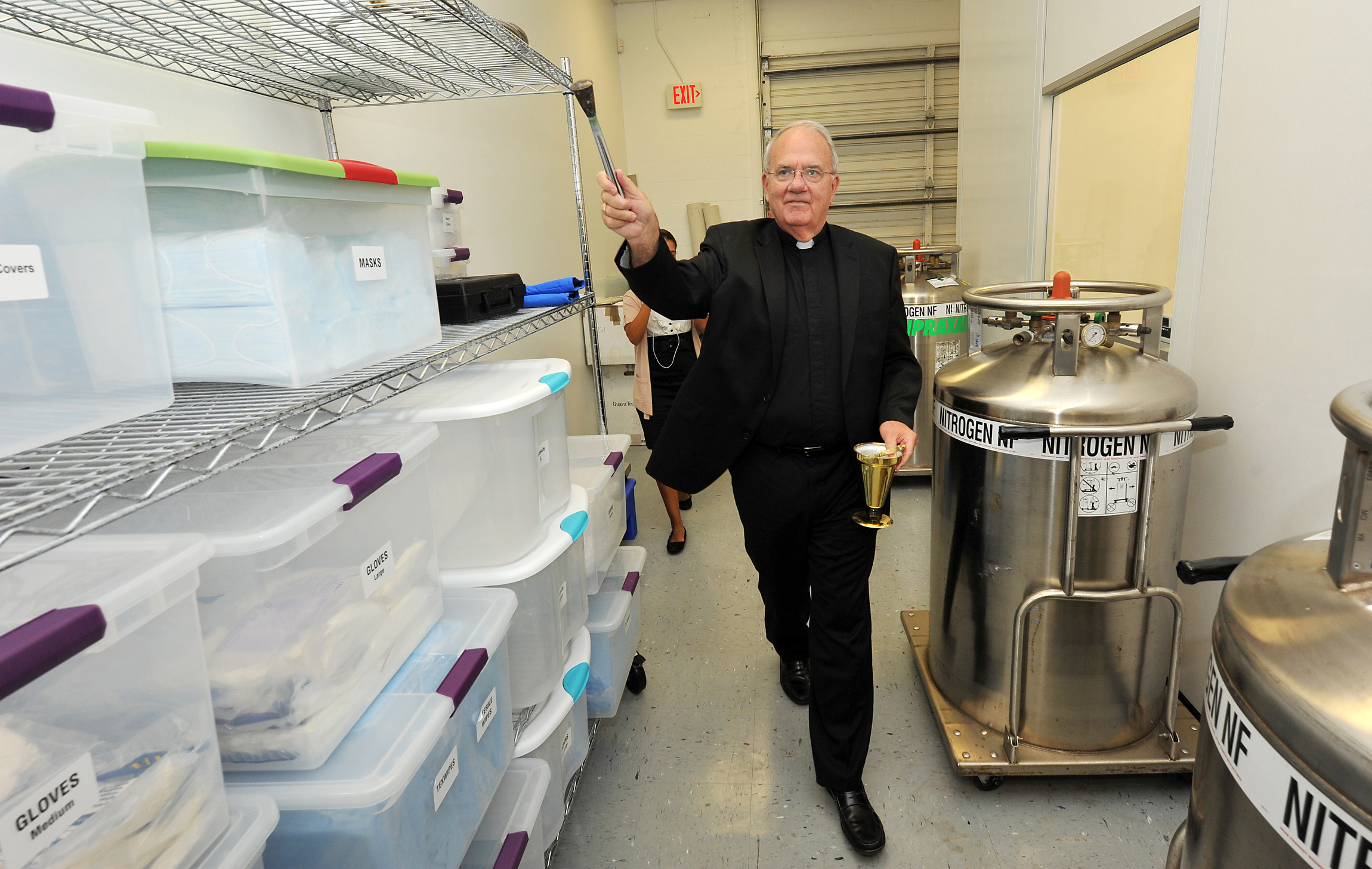
Bishop Robert N. Lynch of St. Petersburg, Fla., blesses the then-new Stemnion facility Sept. 23, 2010 in Clearwater, Fla. The Pittsburgh-based regenerative medicine company had opened the Florida lab near a Catholic hospital where placentas are donated for use in adult stem-cell research. (Tim Boyles/CNS via Catholic Health Association)

NEW ORLEANS (CNS) — Adult stem cells, easily harvested from human bone marrow, umbilical cord blood and fat tissue, have a successful track record in treatments for more than 90 medical conditions and diseases, including sickle cell anemia, multiple myeloma cancer and damaged heart tissue.

Stem cells can be retrieved and used in treatments while doing no harm to donor or recipient.

So why do so many Americans, including some physicians, continue to champion research involving embryonic stem cells when this type of intervention has no documented cases of improving health and also requires the destruction of human life in its youngest form?

That question was pondered by David Prentice July 10 at the National Right to Life Convention during his presentation “Adult Stem Cells: Saving Lives Now.”

Prentice, vice president and research director for the Washington-based Charlotte Lozier Institute — the education and research arm of the pro-life Susan B. Anthony List — reported that more than 70,000 patients throughout the world are receiving adult stem-cell transplants annually, with an estimated 1 million total patients treated to date.

“How many people have been cured using embryonic stem cells?” Prentice asked his audience. “Zero,” he answered, noting that misinformation in the media and the Internet continues to promote “fairy tales” about the promise of embryonic stem cells in curing disease and being the elusive “fountain of youth” for mankind.

“You’ve got to destroy that young human being to get the embryonic stem cells,” Prentice said of the over-hyped technology.

Conversely, adult cells — undifferentiated cells that already exist among the differentiated cells that make up specific tissues or organs — can be isolated and deployed to various parts of the body to regenerate and repair diseased or damaged tissue.

There is more good news about adult stem cells besides its ethical supremacy, Prentice said. Unlike embryonic stem cells, adult stem cells are readily available to the majority of patients.

Many types of adult stem cells can be harvested in relatively painless, outpatient procedures. For example, adult stem cells from bone marrow, once accessible only by deep needle extraction, can now be collected in a process akin to giving blood. Another source of stem cells — fat tissue — can be tapped via liposuction.

Also, despite being tagged as “adult,” children can receive the therapy as early as the in-utero stage, and the donors of adult stem cells do not have to be adult at all.

“Babies are born with (adult) stem cells throughout their body,” said Prentice, an adjunct professor of molecular genetics at the Pontifical John Paul II Institute for Studies on Marriage and Family at the Catholic University of America. “The umbilical cord that we cut off after the baby is born is rich in what we call adult stem cells.”

Besides requiring the killing of human life, Prentice said, embryonic stem-cell research posed a major threat to women’s health that went largely unpublicized during the height of the push for this technology in the first decade of the 21st century. Women between the ages of 21 and 35 were actively sought and handsomely paid for their eggs to keep pace with the demands of heavily funded research. To harvest a woman’s eggs, the donor is given a regimen of hormones over a period of three to five days, Prentice said. Unforeseen side-effects included ovarian hyperstimulation syndrome, kidney failure and infertility.

“Some women have even died in the process,” Prentice said.

Because of these and other ethical objections, France, Canada, Germany, Norway, Switzerland and about 25 other countries, excluding the United States, have banned human cloning, which uses living embryos for experimental purposes before killing them in the lab.

“We’re actually behind the international curve here in the United States,” Prentice said, noting that the FDA has hit a new low by looking into the possibility of approving the production of three-parent embryos — those involving cellular donations from one father and two mothers.

To offset the bad press — including public repugnance to the idea of “designer babies” — Prentice said private companies seeking funding for embryonic stem cell research have begun to refer to cloning in a less “science fiction” way — as “somatic cell nuclear transfer.”

“It’s kind of science run amok,” Prentice said. “They’re not actually correcting or treating anybody (with embryonic stem cells). They’re talking about new individuals who will be genetically engineered to their specifications.”

Current protections in place include the federal Dickey-Wicker Amendment, which prohibits the use of taxpayer dollars to create or destroy human embryos for experiments; and some states, including Louisiana, have banned research related to human cloning and human-animal hybrids.

As adult stem cell treatments gain credibility in science journals, insurance companies increasingly are covering the procedures, Prentice notes.

Interventions in more experimental phases of study, such as those treating spinal cord injuries, are less likely to be covered by insurance plans, he said.

“The bottom line is the adult stem cells are the ones that work — they’re working now in patients,” Prentice said. “I’m telling you all these (stories of success), but you’re probably not seeing it in the news, right?”

Prentice said the website www.stemcellresearchfacts.org offers statistics and patient testimonials; information on current trials can be found at www.clinicaltrials.gov; and the Lozier Institute’s website is www.lozierinstitute.org.

— By Beth Donze, staff writer at the Clarion Herald, newspaper of the Archdiocese of New Orleans.

Lessons from South America: How to greet and understand Pope Francis

Pope Francis celebrates Mass in Nu Guazu Park in Asuncion, Paraguay, July 12. (CNS photo/Paul Haring)

VATICAN CITY (CNS) — People make special preparations for welcoming a special guest, and watching what worked and did not work in Ecuador, Bolivia and Paraguay may help people preparing for Pope Francis’ visit to the United States in September.

Some of the plans, however, will require common-sense adjustments, especially because the U.S. Secret Service is likely to frown on certain behavior, like tossing things to the pope — a phenomenon that occurs much more often with Pope Francis than with any previous pope. At the Vatican, the items tend to be soccer jerseys and scarves; in Ecuador, it was flower petals — lots of them.

Watching the pope July 5-12 in South America it is clear:

  • Pope Francis loves a crowd. He walks into events with little expression on his face, then lights up when he starts greeting, blessing, kissing and hugging people. Persons with disabilities, the sick and squirming babies come first.
  • The pope does not mind being embraced, but he does not like people running at him. As a nun in Our Lady of Peace Cathedral in La Paz rushed toward Pope Francis July 8, the pope backed up and used both hands to gesture her to calm down and step back. In the end, she did get a blessing from him, though.
  • In South America, Pope Francis specifically asked that his meetings with the bishops be private, informal conversations — similar to the way he handles the regular “ad limina” visits of bishops to the Vatican to report on the state of their dioceses. For the “ad limina” visits, he hands them the text of a rather general look at their country and Catholic community, then begins a discussion. But when he makes a formal speech to a group of bishops, his words can seem critical. But, in fact, the tone tends to be one of addressing his “fellow bishops” and his words are more of a collective examination of conscience than a scolding.
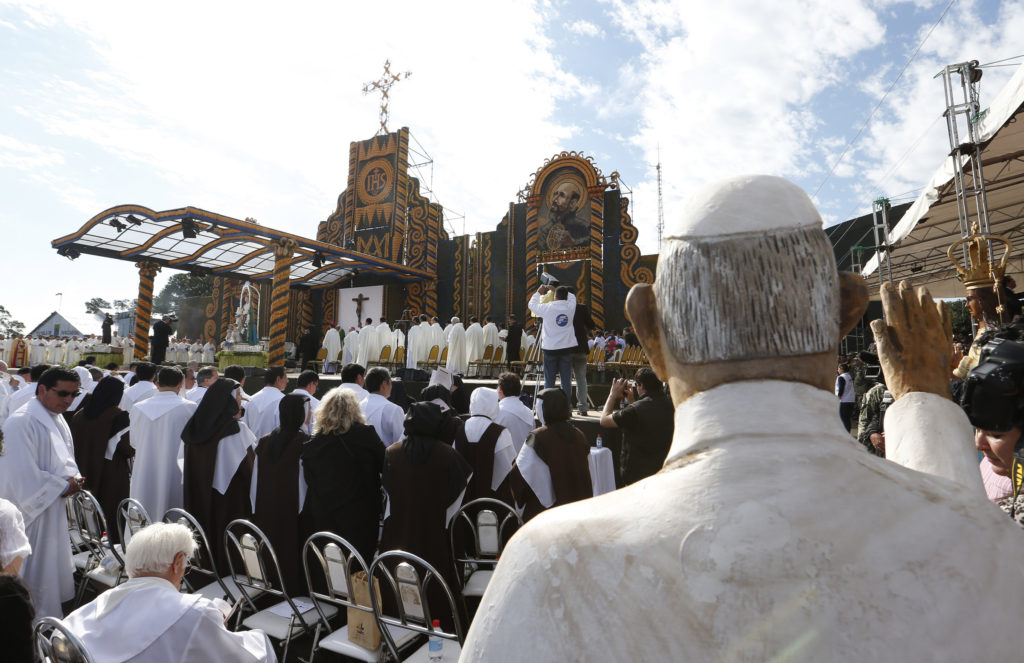
  • A statue of Pope Francis is seen as the pope celebrates Mass in Nu Guazu Park in Asuncion, Paraguay, July 12. (CNS photo/Paul Haring)
    A statue of Pope Francis is seen as the pope celebrates Mass in Nu Guazu Park in Asuncion, Paraguay, July 12. (CNS photo/Paul Haring)

    A meeting with priests, religious and seminarians is a fixture on papal trips within Italy and abroad; in Cuba and the United States, the meetings with take place during vespers services, Sept. 20 in Havana and Sept. 24 in New York. At vespers, like at Mass, Pope Francis tends to follow his prepared text. However, when the gathering takes place outside the context of formal liturgical prayer, he never follows the prepared text, even if he may hit the main points of the prepared text as he did in Bolivia July 9.

  • At Mass, Pope Francis tends to be less animated. His focus and the focus he wants from the congregation is on Jesus present in the Eucharist. At large public Masses on papal trips, he sticks to the text of his prepared homilies, although he may look up and repeat phrases for emphasis.
  • Pope Francis has said he needs a 40-minute rest after lunch and his official schedule always includes at least an hour of down time. However, like his “free” afternoons at the Vatican, the pope often fills the breaks with private meetings with friends, acquaintances or Jesuits. In fact, his trips abroad have always included private get-togethers with his Jesuit confreres, although in South America one of the meetings — in Guayaquil, Ecuador — was a luncheon formally included in the itinerary. But he also spent unscheduled time with Jesuits at Quito’s Catholic university the next day. In Paraguay, he made an unscheduled visit to 30 of his confreres in Asuncion and then went next door to their Cristo Rey School to meet with more than 300 students from Jesuit schools.
  • Pope Francis’ speeches in general — whether to presidents, civic and business leaders, young people or even, for example, the prisoners in Bolivia — acknowledge what is going well and being done right, then seeks to build on that. It’s a combination of a pat on the back and a nudge forward. While Bolivia’s Palmasola prison is notorious for its difficult conditions and while the pope pleaded for judicial reform in the country, he also told the prisoners: “The way you live together depends to some extent on yourselves. Suffering and deprivation can make us selfish of heart and lead to confrontation.”
  • Since the days of the globetrotting St. John Paul II, the nunciature stakeout has been a staple of papal trips. In fact, anywhere a pope sleeps, people will gather — shouting and singing — in the hopes that the pope will make a special appearance. St. John Paul, retired Pope Benedict XVI and Pope Francis have all obliged on occasion. Although in Quito, Ecuador, it seems that Pope Francis was inspired at least partially by the complaints of neighbors about the noise. The three nights Pope Francis stayed there, he came out to say good night. Increasingly his tone was that of a dad who had already told his children five times to go to bed.

By Cindy Wooden, Catholic News Service.

Forgiveness conquers hate — a truth Christians should witness

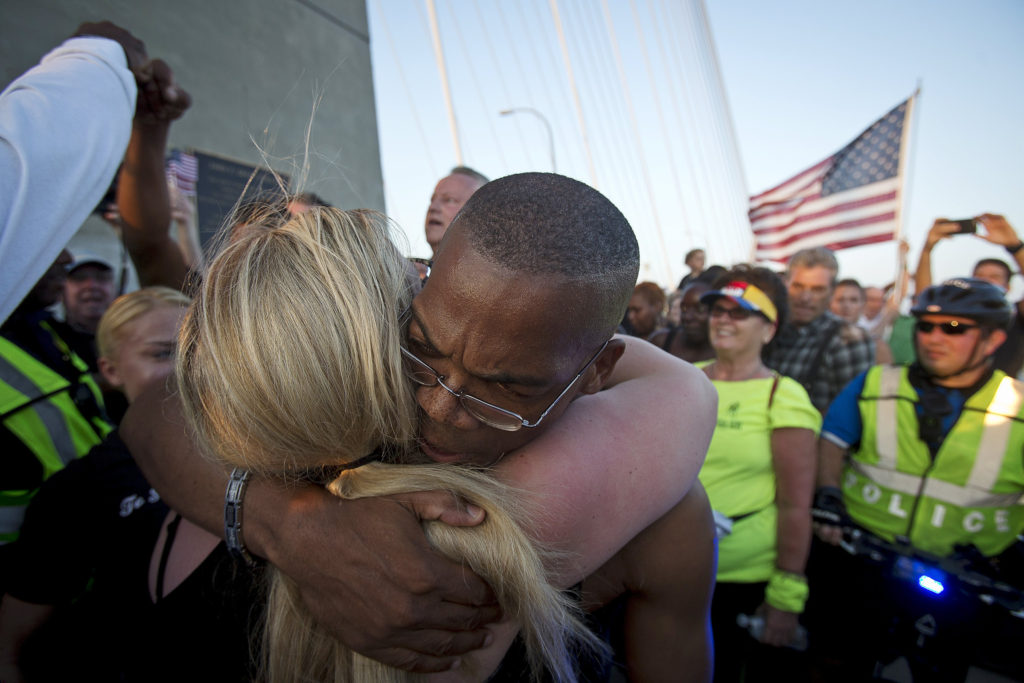
People hug as they gather on the Arthur Ravenel Jr. Bridge in Charleston, S.C., June 21. Thousands gathered on the bridge to show solidarity after nine African-Americans were shot to death by a young white man the evening of June 17 at the city's Emanuel African Methodist Episcopal Church. (CNS photo/Carlo Allegri)
People hug as they gather on the Arthur Ravenel Jr. Bridge in Charleston, S.C., June 21. Thousands gathered on the bridge to show solidarity after nine African-Americans were shot to death by a young white man the evening of June 17 at the city’s Emanuel African Methodist Episcopal Church. (CNS photo/Carlo Allegri)

[dropcap type=”4″]T[/dropcap]he last few years have been marked by more than a few unexpected tragic incidents involving gunmen lashing out at innocent people. There are things we can do as a society to try to prevent these events in the future or to mitigate the effects of these events. And those can and will be discussed by our talking heads and our policy makers.

Chris Benguhe is a columnist for The Catholic Sun. Opinions expressed are the writers’ and not necessarily the views of The Catholic Sun or the Diocese of Phoenix.

But more than anything we can refuse to allow this type of activity to win. We can refuse to allow such culprits to dominate the conversation and our culture. And we can do that by replacing their hate with love. It’s a little idea that Jesus Christ left us with a few thousand years ago. And it’s one that can and is making amazing things happen in the world.

First of all, it’s what inspired the family members of the nine victims last month after their loved ones were brutally gunned down in South Carolina. One by one they faced the man who shot and killed members of their family and forgave him. One by one they insisted that love would win. And one by one they took the power of this event from negative to positive.

A daughter of Ethel Lance, 70, who left five children, seven grandchildren and four great-grandchildren behind said: “I will never be able to hold her again. But I forgive you and have mercy on your soul. It hurts me, it hurts a lot of people, but God forgives you and I forgive you.”

The sister of the Rev. DePayne Middleton-Doctor, 49, who was a mother of four said: “We have no room for hate. We have to forgive.”

“We are here to combat hate-filled actions with love-filled actions,” declared Alana Simmons whose grandfather, the Rev. Daniel Lee Simmons, Sr., was killed. “And that is what we want to get out to the world.”

Some with agendas of one sort or another have tried in vain to minimize the significance of these powerful expressions of forgiveness. But all that hot air just lifts higher the real and undeniable power of these acts to change the mindset and direction of a nation that has of late been resonating with a little more violence and hate than any of us would like. Their words of forgiveness made the front pages of most papers in America, and rightfully so, redirecting the media coverage from the horror of the act to the magnificence of the forgiveness.

One by one they faced the man who shot and killed members of their family and forgave him. One by one they insisted that love would win. And one by one they took the power of this event from negative to positive.

And it inspired what so many protests, marches, and exaltations of so many of those talking heads over the last 50 years could not. It inspired the leaders of that state to remove the age-old symbol of division and hatred from their state house — the Confederate flag.

Now this isn’t the first time victims’ families have forgiven a killer. But every time it happens, amazing things follow. I interviewed a man a few years back named Billy Moore who was on the forgiving end of that. One night after his wife left him and cleaned out his bank account, leaving him in a depressed haze, he got drunk, and went to rob an elderly man of his life savings. When the old man confronted him, he shot him dead in cold blood. He confessed to the killing less than 24 hours later and was sentenced to death a few months later.

But after the victim’s family went out of their way to forgive him, he had an amazing conversion of faith and feeling while on Death Row. He wound up reaching out to young people, to gang members, to inner city children all over America who were caught in the destructive downward spiral of hate, and turning their heads and hearts to love. He stopped prison riots and saved lives of those behind bars with him. And he joined with the family members of his victims to help members of their community to see another way, all from behind bars.

His extraordinary acts caught the attention of Mother Teresa who called the governor of Georgia just hours before Billy was to be executed asking for his life to be spared. Amazingly it was. And then even more incredibly, Billy was released a few years later with the victim’s family’s blessings. Today he travels the country and the world turning hate to love.

Now this column isn’t about ending the death penalty in America, although every Catholic out there should want to. What this column is about is convincing you that love is more powerful than hate, that life can conquer death, and that we should believe the words in the first letter of John that read: “Beloved, let us love one another, because love is of God; everyone who loves is begotten by God and knows God” (1 Jn. 4:7).

And God — and love — can make amazing things happen in every one of our lives.

Jordan bank of river where Jesus baptized declared UNESCO heritage site

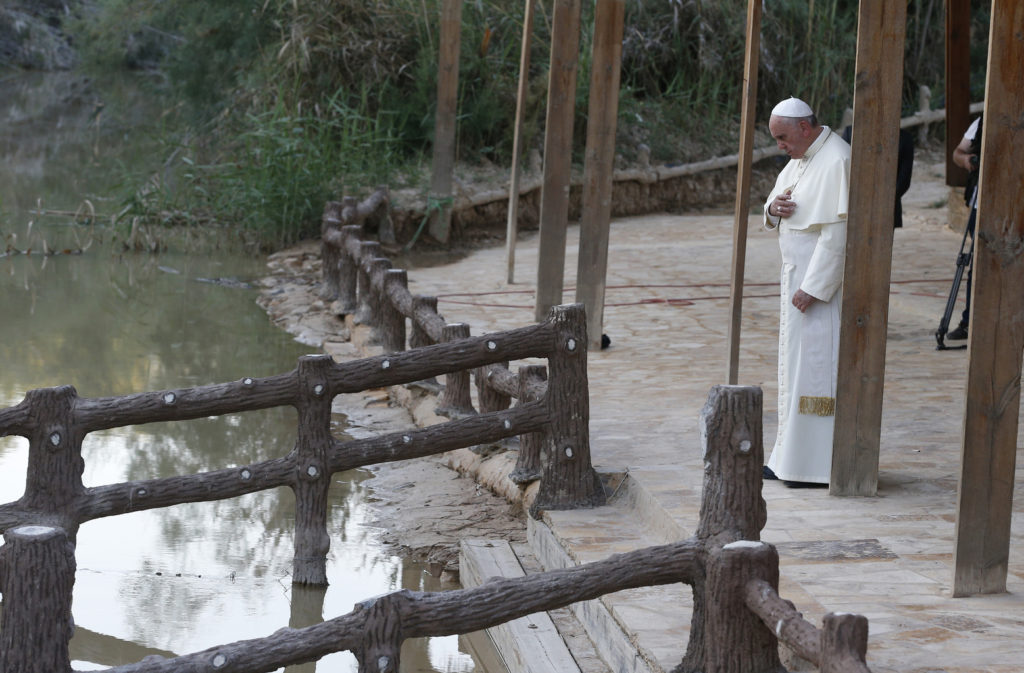
Pope Francis makes the Sign of the Cross in 2014 after praying at Bethany Beyond the Jordan, which UNESCO just declared a World Heritage site and the location of Jesus' baptism. (CNS photo/Paul Haring)
Pope Francis makes the Sign of the Cross in 2014 after praying at  Bethany Beyond the Jordan, which UNESCO just declared a World Heritage site and the location of Jesus' baptism. (CNS photo/Paul Haring)
Pope Francis makes the Sign of the Cross in 2014 after praying at Bethany Beyond the Jordan, which UNESCO just declared a World Heritage site and the location of Jesus’ baptism. (CNS photo/Paul Haring)

JERUSALEM (CNS) — UNESCO declared Bethany Beyond the Jordan, on the eastern side of the Jordan River, as a World Heritage site and the location of Jesus’ baptism.

“The decision is logical. The Eastern side is where all the Byzantine antiquities and churches are located,” said Franciscan Father Eugenio Alliata, professor of Christian archaeology at Jerusalem’s Studium Biblicum Franciscanum. He said pilgrimages to the Western side began only about 600 years ago. “But for us it is the Jordan River, the middle, which is the most holy place.”

For years, Israel and Jordan have been at odds as to which side of the Jordan River is the actual site of Jesus’ baptism, as both sides vie for the title to increase tourism. Israel upgraded its shoreline with changing rooms and a wooden deck access to the murky waters.

But three popes have visited Jordan’s eastern shore as a sign of the Catholic Church’s official recognition of the site known as Bethany Beyond the Jordan. The Gospel of John (1:28 and 10:40) records this place as where John the Baptist carried out his baptisms, including that of Jesus.

Pope John Paul II made the first visit to the site on his millennial pilgrimage to the Holy Land in 2000, followed by Pope Benedict XVI in 2009 and Pope Francis last year.

The remains of more than 20 Christian sites over six centuries and dating to Roman and Byzantine periods have been discovered near the site. They include several churches, a prayer hall, baptismal pools and a sophisticated water reticulation system.

Pope Francis visits Bethany Beyond the Jordan, the traditional site of Jesus' baptism, southwest of Amman, Jordan, May 24. (CNS photo/L'Osservatore Romano, pool) (May 25, 2014)
Pope Francis visits Bethany Beyond the Jordan, the traditional site of Jesus’ baptism, southwest of Amman, Jordan, May 24. (CNS photo/L’Osservatore Romano, pool) (May 25, 2014)

At least 12 new churches are under construction in the area, with the Catholic Church expected to become the largest church complex in the Middle East, at nearly 323,000 square feet.

Fr. Alliata said ancient iconography shows Jesus in the middle of the river rather than on any of the two shores, and there are accounts by ancient pilgrims of marble columns in the middle of the river marking the site of Jesus’ baptism.

“History has different ways of being remembered,” he said. “If there was an agreement between Israel and Jordan (on the issue) they could combine the place East and West. Both have importance, the East in ancient times and the West in modern times.”

By Judith Sudilovsky, Catholic News Service. Contributing to this story was Dale Gavlak in Amman, Jordan.

Jóvenes hispanos acuden a primer ‘Youth Catholic Congreso’

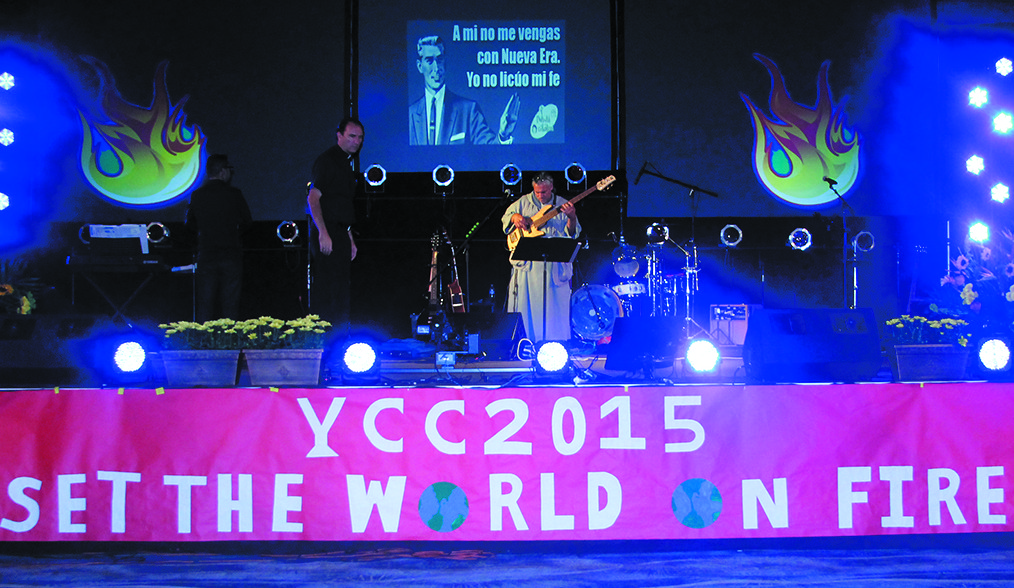
El P. Stan Fortuna, CFR, tocó la guitarra en el primer “Youth Catholic Congreso” que atrajo jóvenes católicos bilingües de toda la diócesis del 12 al 14 de junio. (Joyce Coronel/CATHOLIC SUN)

Vinieron de todas partes de la diócesis, unos 1,500 adolescentes y adultos jóvenes católicos, para pasar un fin de semana en oración, alabanza y charlas dedicadas a la evangelización.El primer “Youth Catholic Congreso”, un congreso juvenil diocesano bilingüe, conocido como #YCC2015, tomó lugar del 12 al 14 de junio, y fue un esfuerzo dedicado a atraer a hispanos católicos jóvenes y los líderes de sus grupos juveniles para tres días de diversión y formación.

Guadalupe Vásquez, directora del grupo “Jóvenes de Fuego” de la Parroquia de Santa Margarita en Tempe, acompañó a 40 adolescentes.

“Los traje aquí para que se acercaran a Dios y para que consiguieran esa esperanza que necesitan”, dijo Vásquez. “Nadie dijo que ser católico es algo aburrido y este evento es una manera de ayudarles a ser más activos”.

Cuco Ortiz, de 14 años de edad y miembro de Jóvenes de Fuego, dijo que asistió al evento de tres días para crecer en su fe.

“Vine aquí hoy debido a mi relación con Dios para que pueda tener una mejor conexión y llegar a conocerlo más y para estar más involucrado en la Iglesia”, dijo Ortiz.

El Padre Agustino Torres, un Fraile Franciscano de la Renovación, fue uno de los conferencistas destacados durante el Congreso. Fue presentado a la multitud en el Centro de Convenciones de Phoenix junto a uno de los fundadores de la Orden, el Padre Stan Fortuna. Arlededor de 200 de aquellos que querían escuchar la presentación del sábado por la mañana en español siguieron al P. Torres al Centro Pastoral Diocesano.

“Es increíblemente importante alcanzar a nuestros jóvenes”, dijo el P. Torres al Catholic Sun. “Están abiertos y tienen una disposición natural para Dios, pero también tienen una gran necesidad de que este mensaje sea presentado de una manera en que lo puedan entender”.

Para realizar esto, el P. Torres presentó las verdades de la Teología del Cuerpo para la juventud a través de su guitarra acústica, chistes y narración dramática que incluyó una demostración de malabarismo con pelotas.

“No es necesariamente sólo en un salón de clases. Debe ser una presentación actualizada del Evangelio”.

El P. Fortuna, en una charla que incluyó español, chistes y breves melodías de guitarra, estuvo de pie en el escenario en el Centro de Convenciones detrás de grandes pancartas del Papa Francisco y la Virgen de Guadalupe. Recalcó que sólo Jesucristo puede satisfacer verdaderamente el corazón humano.

“Si quieren aceptar menos, pueden comprar un taco en Taco Bell. O, pueden ir a la casa de la Abuela. ¿Entienden”? el P. Fortuna le dijo a la multitud. “Los obispos aquí y la diócesis entera, los aman con un amor loco y quieren que ustedes sepan eso”.

Carmen Portela, directora de liderazgo parroquial en español, ayudó a organizar #YCC 2015 y dijo que esperaba que la gente joven pudiera pensar sobre su futuro a la luz de lo que habían aprendido en el Congreso.

“Dios no los hizo para nada”, dijo Portela. “Los hizo para un propósito bien definido y queremos ayudarles a entender cualquier plan que Dios tiene para ellos”. Los participantes tuvieron la oportunidad de escuchar a un panel vocacional hablando de la vida consagrada y religiosa.

Cristofer Pereyra, director de la oficina de la misión hispana, dijo que asistió al Congreso con su hijo de 12 años de edad y su hija de 14 años de edad. No tenían muchas ganas de asistir a un día completo de catequesis, dijo, pero descubrieron que el evento sobrepasó sus expectativas.

“Resultó ser no sólo una experiencia buena y edificante, y una buena experiencia de formación, sino también una oportunidad para encontrar a Cristo”, dijo Pereyra. “Mis hijos salieron con la idea de que la fe no tiene que ser aburrida. Se puede transmitir de una manera natural e incluso puede ser una experiencia divertida”.