
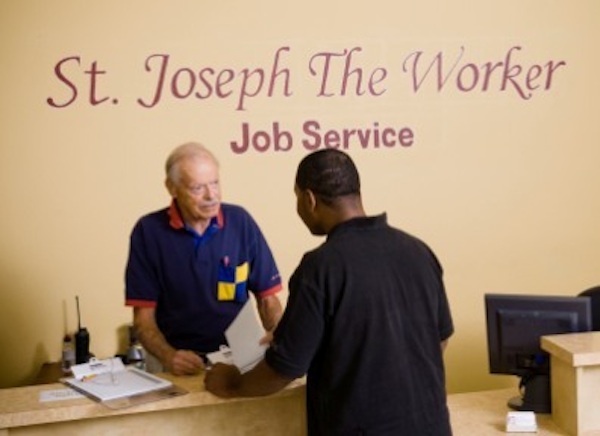
St. Joseph the Worker aids homeless job seekers

St. Joseph the Worker staff and volunteers work year-round to help homeless clients secure employment. Photo courtesy of St. Joseph the Worker

Being a job seeker is stressful enough without the added weight of being a home-seeker too.

The challenging, but all-too-common duo makes up the bulk of St. Joseph the Worker’s clients. The nonprofit, located on Phoenix’s Human Services Campus, provides basic job services and employment resources for 1,500 client contacts per month. At least 75 men and women visit the office daily to create resumes, prepare for interviews in the clothing closet or secure bus passes for an interview or the job itself.

“We average a person getting employed every day,” said Brent Downs, St. Joseph the Worker’s executive director.

Lately, clients, who are hired on their own merit, have been doing better than that with 422 of them gaining employment last year. Roughly 35 percent had benefits.

Whether they’re employed or still looking, this week marks a special time of all clients.

St. Joseph the Worker kicked off its annual “hydrate the homeless” water drive May 1, a date that lined up with the feast of its patron saint. Tomorrow, the agency’s job developers will honor four of St. Joseph the Worker’s stand out clients and one corporation during its annual feast day celebration at the Diocesan Pastoral Center.

“We have a fantastic support network,” said Molly Pino, development specialist for St. Joseph the Worker.

Volunteers spent 2,200 hours last year helping clients write resumes, learn interview skills and other administrative tasks. Pino said they’re viewed more as staff than volunteers.

She credited Scottsdale Healthcare, who will be recognized as Corporation of the Year, for recently expanding a benefit hike — the agency’s primary fundraiser — to a second location and taking care of logistics. More than 1,100 hikers joined the annual Hike for the Homeless in both Goodyear and Fountain Hills in March.

The hikes raised more than $65,000. That’s roughly the amount St. Joseph the Worker spends on bus fare annually to get clients to interviews and to work before those first paychecks arrive.

The privately-funded organization also provides employed clients with gift cards to area eateries for lunch. It could be their only food source when long bus rides to and from the homeless shelter have clients returning to nearby shelters after dinner hours.

“It’s those simple little things that we don’t think twice about,” said Downs, executive director.

He said it’s easy for homeless individuals to become the “invisible population” and knows all-too-well the importance of having a practice and moral support network for them. He once spent a month on the streets eating out of dumpsters and selling the quality food he salvaged. Downs ultimately hit rock bottom and reached out to family who helped him,.

“A lot of people don’t have that option,” Downs said.

Like Lisa — clients are known publicly by first name only. None of the interviews she had lined up before moving to Arizona panned out. She ultimately received an offer from a local gym to be a fitness instructor. St. Joseph the Worker’s resources helped her fill out and send initial paperwork, select clothes for orientation and funds to buy quality footwear.

Things don’t always work out the way they’re planned though and when they don’t, their personal job developer and the rest of St. Joseph the Worker’s staff is there for moral support and strategy. Four clients lost their job in March as a direct result of several Valley Metro bus drivers going on strike. One client was due to start a new job the same day bus drivers temporarily halted theirs.

All have since found other jobs and credit the job coaching and motivation that are a constant at St. Joseph the Worker.

“We want to be that support system for the clients,” Downs said.


______________________

Support St. Joseph the Worker


On the road again: Poirier to give farewell concert

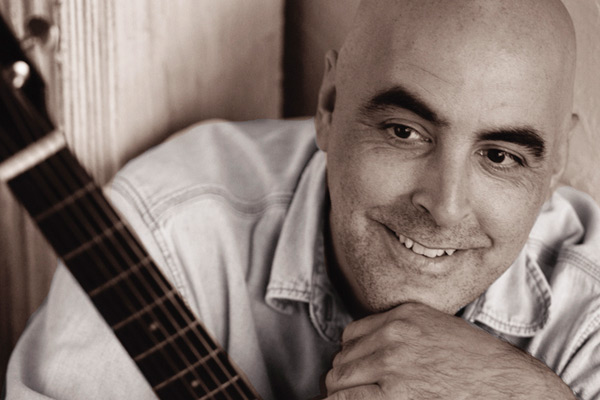
World-renowned Catholic composer and musician Michael John Poirier will head back out on the road with his wife and three children this summer to continue his life’s work of evangelization through music.

For the last year and a half, Michael and his wife, Mary, have lived in south Scottsdale with their three children, renting a home. Most of their marriage and family life, however, has been out on the open road in their motor home.

For 18 years, the Poirier family has toured the country, visiting almost all 50 states, so that Michael can share his gift of music with the faithful. Mary has home-schooled the children, though they did attend Ville de Marie Academy during the last two school years.

“We want to give the whole world a prayer break,” Michael said of his musical outreach, Holy Family Apostolate. It’s a prayer break that’s also available via the Internet at prayerbreaks.org, where listeners can hear the psalm from the Mass of the day chanted by Michael.

On board their motor home, the Poiriers will carry the Divine Mercy image as well as a relic image of Our Lady of Guadalupe, signed by Cardinal Norberto Rivera Carrera, the archbishop of Mexico City.

Though they don’t perform with their dad, the Poirier kids—Joseph, 16, John Paul, 12 and Therese, 6 — love to sing and are used to the troubadour lifestyle. They’re anxious to reconnect with friends they’ve made along the way at parishes across the country.

“They are excited about going back on tour,” Mary said. “We want to focus more on doing things together to help families pray.”

The family visits parishes and schools where Michael teaches the faithful through songs and stories. He also leads them in adoration of the Blessed Sacrament. The Poiriers often revisit the same areas around the country and Mary said they are encouraged by the feedback they receive.

“What is really cool is that when we make our rounds, people tell us what has happened since we saw them last,” Mary said. Oftentimes, it’s how God put their marriage back together or answered a prayer.

“God gives us the stories to encourage us,” Mary said. It’s moments like those that keep the Poiriers focused on serving God and relying on Him completely.

Mary, who said she comes from a business-oriented background that fostered a go-getter approach to life, said living month-to-month and embracing utter dependence on God has been a radical change for her.

“It’s really been a huge transformation for me,” Mary said.  “Sometimes it’s so hard but God shows us every month that He provides — it’s amazing how He comes through.”

Michael recently decided he would no longer sell his CDs after Masses or require a stipend. Instead, he hopes fans will become subscribers to his website, PrayerBreaks.org. For $9.95 a month, subscribers support his work and gain multiple privileges, among them, the opportunity to download and keep five different songs every month.

Subscribers will automatically have their seat reserved at a May 21 farewell concert that will feature Michael’s meditative, soulful music as well as that of well-known Catholic musician Danielle Rose. Tickets for the concert will also be available for purchase at the door.

Money raised at the May 21 concert at Xavier College Preparatory will support the work of Holy Family Apostolate, but some of the funds will be set aside to help children in need.

“A portion of the proceeds will go to China Little Flower Orphanage,” Michael said. “It’s a ministry that has a U.S. anchor but they provide care for orphans in China.”

– – –

May 21 concert at 7 p.m. at the Virginia G. Piper Center for Performing Arts at Xavier College Preparatory, 4710 N. 5th Street

Website: PrayerBreaks.org.

For more information, call (405) 833-0111.

Bioethics Defense Fund exposes abortion fund in health care reform act

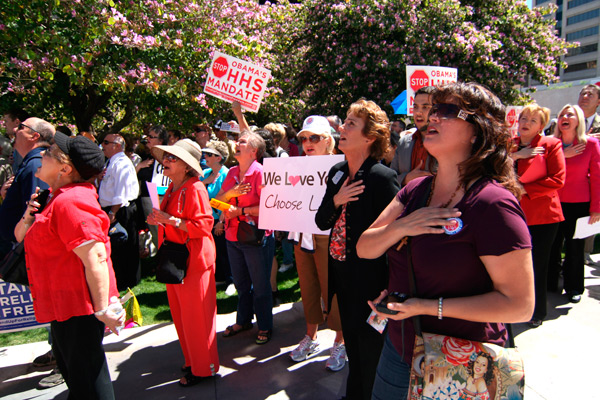
Hundreds join together in the Pledge of Allegiance during a March 23 rally in downtown Phoenix. (J.D. Long-Garcia/CATHOLIC SUN).

Portions of the Patient Protection and Affordable Care Act violate religious freedom and rights of conscience, according Nikolas Nikas of the Bioethics Defense Fund.

While the United States Supreme Court weighs the constitutionality the health care reform measure, often referred to as Obamacare, Nikas made his case to Catholics across the Phoenix Diocese.

Nikas has spent the last several weeks traveling the diocese and educating Catholics about the intricacies of the health reform law. To begin with, he said, the law includes three mandates.

“We can agree to disagree on the minimum coverage mandate. If that were the only issue, I wouldn’t be here,” Nikas told about 250 people at Our Lady of Joy Parish April 18.

Nikas likened the administration’s health reform to a Russian nesting doll. His partner, Dorinda Bordlee, read the nearly 2,800 page law and discovered the Abortion Premium Mandate buried deep inside. “She ought to get a lifetime plenary indulgence for that,” Nikas quipped.

Technically, federal dollars won’t be used to pay for abortion — but up to 150 million employees could each contribute $1 monthly to the fund out of their own pockets, adding up to a staggering billion-dollar fund, all to pay for abortion.

Under the new health-care exchange, employees won’t know if the plan their employer offers includes the monthly contribution to the abortion fund until they enroll. And, they won’t be allowed to decline abortion coverage based on moral or religious objections.

The other aspect of the health reform act that Nikas said violates the religious liberty of Catholics is the Employer Mandate that requires employers to provide coverage for contraception.

“They picked a fight with the Catholic Church,” Nikas said. “Who else has a well-defined teaching on contraception?”

Catholics can agree to disagree on the merits of socialized medicine, Nikas said. “I’m not here about politics — this isn’t about Democrat or Republican — I’m here because of the profound effect on religious liberty. If Reagan or Bush were doing this, I’d be fighting it.”

Nikas and Bordlee filed a friends-of-the-court brief, or amici curiae, on behalf of six national pro-life, medical organizations, including the Catholic Medical Association.

The brief states at the outset that the health reform act “violates the Free Exercise Clause of the First Amendment by effectively forcing millions of individuals to personally pay a separate abortion premium in violation of their sincerely held religious beliefs.”

The Employer Mandate portion of the health reform act that requires employers to provide free contraception, Nikas said, reflects the culture of death. “We have a culture right now that says abortion and contraception are the most important things,” Nikas said. “Is pregnancy a disease? To them, it is.”

He said the Department of Health and Human Services has narrowly defined religious employers, who would be exempt from having to provide free contraception.

According to the mandate, Nikas said, religious employers must have the inculcation of their religious beliefs as their primary objective, and must primarily employ and serve people who share their religious beliefs.

“Who gets this exception?” Nikas asked the crowd rhetorically. “Bishops and priests. Jesus himself wouldn’t qualify.”

The violation of religious liberty inherent in portions of the health reform measure “needs to get out,” Nikas said. “This is a teachable moment.”

For more information or to read the amici curiae brief, visit bdfund.org. To schedule a presentation by Nikas, contact him at ntnikas@bdfund.org.

Progress brings problems without guidance from truth, faith, pope says

Pope Benedict XVI waves as he arrives at Rome's Sacred Heart University May 3. The pope spoke to hundreds of people, including Italian government officials, gathered in the square outside the auditorium of the university's Department of Medicine and Surgery. (CNS photo/L'Osservatore Romano via Reuters)

VATICAN CITY (CNS) — Excluding truth and the transcendent from scientific debate and research has impoverished modern thought and weakened the intellect’s ability to understand reality, Pope Benedict XVI said.

True intellectual and scientific progress requires an openness to dialogue with opposing views, rather than settling with the “mere repetition” of what one already knows, he added.

The pope made his remarks May 3 in an address to faculty, doctors and students at Rome’s Sacred Heart University, one of the biggest Catholic universities in the world.

The pope spoke to hundreds of people, including Italian government officials, gathered in the square outside the auditorium of the university’s Agostino Gemelli Department of Medicine and Surgery. His visit marked the 50th anniversary of the faculty’s founding.

The pope praised the scientific and technological discoveries that have been made in modern times, saying they rightly are a source of pride. However, the “breakneck” speed of innovation sometimes has brought with it “disturbing consequences.”

Lurking behind the optimism about all the new possibilities now open to humanity is “the shadow of a crisis of thought,” he said.

Mankind has a plethora of new tools and means but often lacks noble ends because the prevailing culture of “reductionism and relativism” has led to the disappearance of the true meaning of things, he said.

“Almost blinded by technical potency, (humanity) forgets the fundamental question of meaning, thereby banishing the transcendental dimension to irrelevance,” he said.

In this kind of environment, the pope said, intellectual thought “becomes weak” and is based on impoverished ethical foundations, which “clouds valuable normative points of reference.”

“A mentality that is basically techno-practical creates a risky imbalance between what is technically possible and what is morally good, with unforeseeable consequences,” he said.

Therefore, it is critical that modern culture rediscover the meaning and role of the transcendent, he said.

Scientific inquiry and the search for meaning both share the same source — the “logos” or creative rationality of God himself, Pope Benedict said.

In fact, the search for truth and for the absolute has been part of what fuels the desire to deepen scientific enquiry and all areas of human knowledge, he said.

The very same motivation behind scientific discovery “originates in the longing for God that dwells in the human heart: essentially scientists aim — often unconsciously — to obtain that truth that can give meaning to life.”

Science and faith have a mutually enriching relationship, the pope said, and reflect an “almost complementary requirement” for discerning reality.

“Yet paradoxically, a positivistic culture, which excludes the question of God from scientific debate, leads to the decline of thought and the weakening of the intellect’s ability” to understand reality, he said.

Christianity doesn’t drive faith into the realm of the irrational, rather it shines light on the dizzying maze of options and alternatives in the world, and guides people toward the right path of “the way, the truth and the light” in Jesus Christ.

When it is carried out correctly, “research is illuminated by science and faith and draws its impetus and enthusiasm from these two ‘wings’ without ever losing the accordant humility and sense of limits,” he said.

Thus, “the search for God becomes fruitful for the intellect, a leaven of culture, a promoter of true humanism and a quest that doesn’t stop at the surface,” he said.

Sacred Heart’s teaching hospital — usually referred to as the Gemelli Hospital and known for treating popes — has always known that healing isn’t a job, but a mission, the pope said. Research, teaching and study come together so that the institution reaches its full innovative potential, he said.

“No progress, let alone in the cultural sphere, feeds on mere repetition, but requires an ever new beginning” that demands an “openness to comparison and dialogue, which broadens the intellect and gives witness to the rich, prolific nature of the heritage of the faith.”

A strong, well-formed Christian identity will influence everything one does and can be expressed by top-notch professionalism, he said.

Catholic universities have a particular tie to the church and are called to be “exemplary institutions” that don’t reduce their vision to what is the most pragmatic, productive or economically advantageous or necessary. Rather, they enlarge their horizons to use human wisdom to explore and develop the gifts of creation, he added.

Merging scientific research with unconditional service to life is what defines the university’s department of medicine because faith is being used as an inner resource and guide that does not overpower or oppose professional research and avid learning, he said.

The pope encouraged the university to continue its work protecting human dignity and protecting life at all its stages.

Love for the human person, especially the weak, helpless and suffering must be at the core of medicine and research because “without love, science, too, loses its nobility. Only love guarantees the humanity of research,” he said.

— By Carol Glatz, Catholic News Service 

Mexican ‘Cristero’ fight relevant to actor’s Cuban heritage

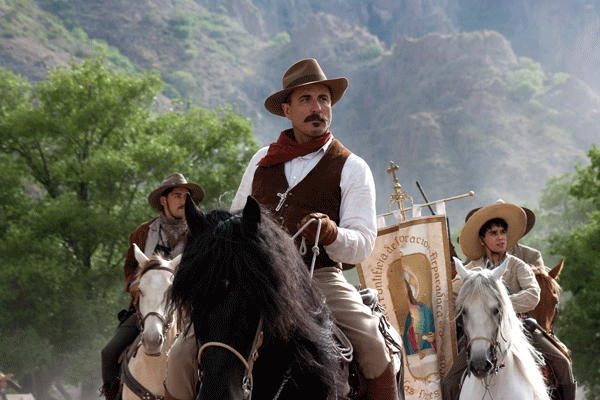
Andy Garcia stars in a scene from the movie "For Greater Glory." Garcia, a Catholic, plays a Mexican Revolution-era general lured out of retirement a decade later to fight his own government's severe curbing of religious freedoms. (CNS photo/ARC Entertainment)

WASHINGTON (CNS) — In the upcoming movie “For Greater Glory,” Catholic actor Andy Garcia plays a Mexican Revolution-era general lured out of retirement a decade later to head the insurgent “Cristero” forces doing battle against their own government’s severe curbing of religious freedoms, which included the murder of priests, the desecration of churches, and laws designed to reduce the visibility of the Catholic Church in the overwhelmingly Catholic country.

It is a battle that the Cuban-born Garcia feels strongly about.

Garcia, 56, was taken by his family out of Cuba when he was 5 years old after Fidel Castro grew more firmly entrenched in power. “I’m a Cuban exile,” Garcia says.

He followed Pope Benedict XVI’s trip to Cuba in February.

“It’s good that he went,” Garcia told Catholic News Service in a telephone interview to promote “For Greater Glory.” “I’m glad the Catholic churches have a little more religious freedom now. Because Fidel Castro abolished the church when he took over. So it’s good that the church has more freedom. But what about the synagogues in Cuba? Are they open? Because Castro abolished them, too, at the same time.”

Garcia added, “There is this group in Cuba, the Ladies in White, who go out into the public after Mass and do peaceful, nonviolent protests to seek the release of political prisoners, who are their husbands, their brothers and their cousins. And sometimes they get beat up.

“The group requested an audience with the pope. And they didn’t get it,” he said. “I understand that this can’t always happen. Politics happens. Sometimes politics and religion are in cahoots, sometimes politics and religion are in complete opposition, as they are in this movie.”

Also starring in “For Greater Glory” are Eva Longoria (“Desperate Housewives”) as Garcia’s wife, singer Ruben Blades as Mexican President Plutarco Calles, Nestor Carbonell (“Lost,” “The Dark Knight”) as a sides-switching mayor, and Peter O’Toole as a foreign-born priest whose life is in mortal danger from the new laws.

Some moviegoers may spot some connection between Mexico in the 1920s and the current debate in the United States over religious liberty issues. “There may be some relevance,” Garcia said, “but people can see relevance in other countries, like in my (home) country.”

Garcia’s character, Enrique Gorostieta Velarde, is portrayed as a man without much religious faith, especially compared to that of his wife or their two daughters, whose confirmation has been delayed due to their church being shuttered by the government. However, after he takes on the task of training a peasant Cristero army and leading them into raids against the better-armed Mexican government forces, his faith is reawakened within him.

The actor told CNS, “You don’t have to be a killer to play a killer. You don’t have to be in the Mafia to play Don Corleone. I’m Catholic and I play a guy who’s Catholic. He’s not really very Catholic at the beginning of the movie. He grows more into it as the movie goes on.”

Garcia was in Mexico in mid-April for the Mexican premiere of “For Greater Glory,” which he said broke box-office records there; the film does not premiere in the United States until June 1.

“It’s a very sensitive subject” in Mexico, Garcia said, “and it’s still taboo in many quarters. People don’t know the history and they don’t understand the history.”

Garcia, who had a string of film successes in the 1980s and 1990s, said he can afford to “work when I want to work,” taking on roles in film and television projects that interest him. An intensely private person, Garcia said he seems to stay out of the celebrity magazine spotlight because “I don’t have a publicist.”

— By Mark Pattison, Catholic News Service 

Vatican strengthens oversight of Caritas Internationalis

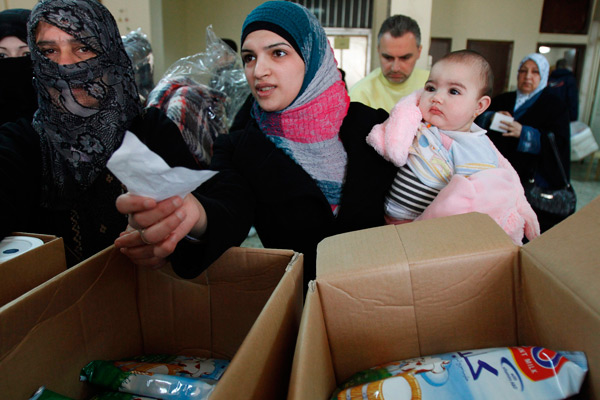
Syrian refugees receive humanitarian aid from an Islamic organization in Tripoli, Lebanon, March 6. As temperatures drop to near freezing in Lebanon, Caritas is working to find shelter for Syrian refugees, mostly women and children. (CNS photo/Omar Ibrah im, Reuters)

VATICAN CITY (CNS) — A Vatican decree established new statutes and norms for Caritas Internationalis, giving Vatican offices, including the Secretariat of State, greater authority over the work of the Vatican-based umbrella group of Catholic aid agencies.

The decree strengthens the roles Vatican offices and the pope play in working with the charity confederation, including naming and approving new board members and approving its texts, contracts with foreign governments and financial transactions.

It also creates a special “support commission” of legal, technical and organizational experts named by the pope to help the organization follow the new norms as well as canon law and the laws of Vatican City State concerning the procurement and distribution of aid, and employment of workers.

At least three members of Caritas’ executive board will be papal appointees, and Pope Benedict XVI named U.S. Bishop Bernard A. Hebda of Gaylord, Mich., as one of them.

The general decree — signed by Cardinal Tarcisio Bertone, Vatican Secretary of State, and approved by Pope Benedict XVI — was published by the Vatican May 2 and went into effect the same day. At the same time, the new statutes and internal rules of the federation were published on the Caritas website.

Prepared by the Secretary of State in conjunction with the Pontifical Council Cor Unum, the Pontifical Council for Legislative Texts and legal experts, the decree said it was meant to “complete and interpret” Caritas Internationalis’ juridical status and give the organization a legal foundation and reference point for the application of the new statutes.

Honduran Cardinal Oscar Rodriguez Maradiaga of Tegucigalpa, Caritas Internationalis president, said, “This is a day of joy and hope” for the organization.

“Our new statutes and rules will modernize our work in delivering humanitarian assistance and development in service to the poor. They will provide us with the framework to carry out our work as part of the mission of the church,” he said in a written statement.

Secretary General Michel Roy said the new statutes and rules clarify that Caritas is “both at the service of the confederation members and of the Holy See.”

The revision process began in 2007 as a follow-up to Blessed John Paul II having raised the technical status of the federation to a “public juridical entity” of the church in 2004. The new status formally recognized that Caritas carries out its charitable activities in the name of the Catholic Church and it meant the organization would function under the administration of the Vatican.

Caritas Internationalis, whose original statutes were approved by the Vatican in 1951, is made up of 164 Catholic relief, development and social service agencies working in almost 200 countries. Most of the member agencies are Caritas or relief and development agencies sponsored by national bishops’ conferences, such as the U.S.-based Catholic Relief Services or the Canadian Catholic Organization for Development and Peace.

Cor Unum is the Vatican office responsible for coordinating and promoting charitable giving.

Msgr. Osvaldo Neves de Almeida, an official in the Vatican’s secretariat of state, said in an explanatory statement accompanying the decree that the updated status was meant to better support the federation’s activity.

Given Caritas’ worldwide presence, international profile and that it acts in the name of the church, the Vatican “has the task of following its activity and exercising vigilance in order that both its humanitarian and charitable action and the content of the documents that it disseminates may be in harmony with the Apostolic See and with the church’s magisterium, and in order that it may be administered with competence and transparency,” the monsignor wrote.

According to the new norms, the Congregation for the Doctrine of the Faith will continue to give doctrinal oversight to texts that are of a moral or doctrinal nature and the Prefecture for the Economic Affairs of the Holy See will continue to monitor the administration of temporal goods.

The Secretariat of State will have to approve official grants coming from governments and international organizations and non-emergency aid and development projects that have been started or are being run by Caritas Internationalis. Cor Unum and the secretariat of state will have to be notified of any agreements made with government authorities or nongovernmental organizations when Caritas Internationalis responds to emergency humanitarian situations.

The new norms are part of Pope Benedict XVI’s concern over the authentic Catholic identity of church-run or sponsored aid and development programs, and his teaching that Catholic charitable activity should not be simple philanthropy, but a reflection of Christian faith and the obligation to love others as Christ loved.

In fact, Pope Benedict “set out the fundamental principles to be developed in the new norms” in a speech to the Caritas general assembly last year and he “gave precise instructions” to the secretary of state on the contents of the new statutes, Msgr. Neves wrote.

The pope told the assembly that the Vatican is responsible for following the activities of Caritas and “exercising oversight to ensure that its humanitarian and charitable activity, and the content of its documents, are completely in accord with the Apostolic See and the church’s magisterium.”

Some new elements laid out in the statutes include:

— Cor Unum will name an ecclesiastical assistant whose role will be to foster “a spirit of communion” between the Vatican and members of the organization, foster reflection on theological questions and promote Caritas’ Catholic identity.

— The list of candidates for president, secretary general and now treasurer will require approval from Cor Unum, the Secretariat of State and the pope.

— The new papal appointees to the executive board are Bishop Hebda, Archbishop Paul Yembuado Ouedraogo of Bobo-Dioulasso in Burkina Faso, and Maronite Archbishop Youssef Soueif of Cyprus.

— Caritas Internationalis and all of its employees, including those working on contract, will have to abide by the new norms, the norms of canon law and the laws of Vatican City.

Cardinal Robert Sarah, president of the Pontifical Council Cor Unum, said in a statement that the new legal framework does not apply to national Caritas organizations, which will maintain their autonomy; however, the new norms “could inspire the bishops and bishops’ conferences to eventually review their diocesan or national Caritas statutes.”


— By Carol Glatz, Catholic News Service

Speakers examine controversies over collision of art, religious imagery

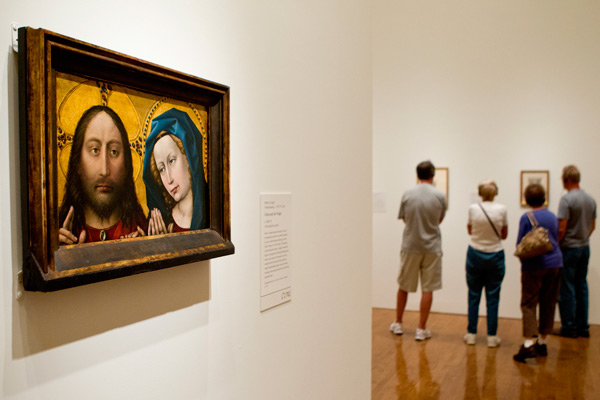
A classical painting of Christ and Mary by Flemish master Robert Campin is displayed in a Rembrandt exhibit at the Philadelphia Museum of Art last August. The contemporary art world lacks a transcendent religious vision, said art critic and poet Dana Gio ia at a recent Fordham University program. (CNS photo/Nancy Phelan Wiechec)

NEW YORK (CNS) — The relationship between art and the sacred is an unsolved problem of culture that exposes contradictions among society’s less-than-consistent moral, religious and political ideologies, according to speakers at an April 25 forum at Jesuit-run Fordham University. The program, “Taking Offense: When Art and the Sacred Collide,” examined controversies over disturbing artistic treatments of religious imagery.

Speakers said thoughtful consideration of the collision is often precluded by reflexive, cliched, self-righteous reactions to provocative art of negligible significance.

“Most of the public discussion over the conflict between art and the sacred is simplistic, partisan, shrill and sublimely dopey,” said Dana Gioia, former chairman of the National Endowment for the Arts and professor of poetry and public culture at the University of Southern California.

Camille Paglia, university professor of humanities and media studies at the University of the Arts in Philadelphia, criticized contemporary artists for mediocrity, “cynical snarky atheism,” cowardly provocation and ignorance of religion. A self-described atheist who was raised Catholic, Paglia said, “Respect for religion and interest in religion should be absolutely basic in any educated person. In order to understand the history of art, you need respect for religion.”

Gioia said there is a chasm between the church and the contemporary arts world. The church has moved away from its historic role as patron, promoter and conservator of the arts and “retreated mostly into sentimental kitsch.” The American arts have become isolated from one another, collectively remote, increasingly irrelevant and starved for something, he said.

As a result, the American arts world is spiritually impoverished by the loss of “a transcendent religious vision and a refined and rigorous sense of the sacred,” he said. Concurrently, “the loss of the aesthetic sensibility of the church and its disengagement with the broader artistic culture has weakened its ability to make its call heard in the world.”

“Once you remove the religious as one of the possible modes of art, once you separate art from the long-established traditional discipline of the spiritual, once you remove 2,000 years of religious symbol, ritual, language and mythos that has long animated Western art, you don’t remove the spiritual hunger of the artist or the audience, but you satisfy it more crudely with vague, pretentious and sentimental substitutes,” Gioia said.

Artists in America have no idea of their general audience and live in an echo chamber, where they hear only their own voices, Paglia said. As a result, they are widely disrespected by a majority of the population and considered hoaxsters and con men.

“The art world has been staking its own exclusivity and prestige on works of mediocrity,” she said. “The provocations that make people who live in Manhattan proud have resulted in the gutting of art programs nationwide. Schoolchildren are paying the price for Manhattan arrogance.”

She faulted artists for making uninteresting work and then hiding behind banal explanations when controversy erupts. “If you’re going to have blasphemous art, it should be done with imagination. And if you’re going to commit blasphemy, cop to it!”

Paglia dismissed Andres Serrano’s photo of a plastic crucifix immersed in the artist’s urine as “a work of schlock” and said it gained importance because it caused “a big political dustup” and not because it was high quality. She said the artist gave a mealy-mouthed explanation of the piece, rather than admitting his intent, and the art world was foolish to “go to the mat” in his defense.

Museums have “milked controversy to get better box office” and exhibited third-rate works of art below their standards, she said.

Both speakers said the church’s discomfort with nudity contributed to the tension between art and the sacred. Paglia said church art should not be innately lustful, but should acknowledge the Renaissance concept that physical beauty mirrors spiritual beauty. “To understand the history of art, you need to be able to be able to appreciate sex and eroticism,” she said.

The program was sponsored by the Fordham Center on Religion and Culture and marked the center’s final presentation under the leadership of founding co-directors Peter and Margaret O’Brien Steinfels, who are retiring.

The Steinfels established the center in 2004 to explore questions arising at the intersection of religious faith and contemporary culture. James P. McCartin, co-director since September 2011, will become the center’s director.

—By Beth Griffin, Catholic News Service

Irish cardinal defends role in 1975 abuse inquiry, says he won’t resign

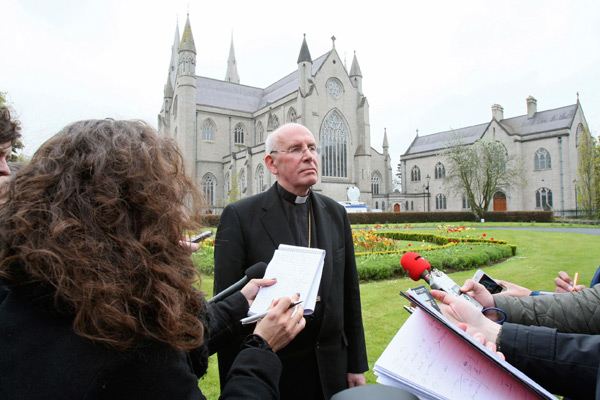
Cardinal Sean Brady of Armagh speaks to members of the media outside the Armagh cathedral in Northern Ireland May 2. He has said he will not resign despite criticism of his role in a 1975 canonical inquiry into a pedophile priest, Norbertine Father Brend an Smyth. (CNS photo/Reuters)

DUBLIN (CNS) — The primate of All Ireland has said he will not resign despite criticism of his role in a 1975 canonical inquiry into a pedophile priest, Norbertine Father Brendan Smyth.

In a statement issued in Armagh, Northern Ireland, May 2, Cardinal Sean Brady defended his involvement in the inquiry and accused the BBC documentary “The World: The Shame of the Catholic Church” of making a number of claims that overstated and misrepresented his role.

He also highlighted that no state or church guidelines existed in the 1970s in the Irish Republic to assist those responding to an allegation of abuse against a minor.

The BBC documentary reported the testimony of Brendan Boland, a 14-year-old victim of Father Smyth, arrested in 1994 and convicted in 1997 of sexually assaulting 20 victims over a period of 35 years.

In 1975, Boland told a three-priest inquiry team, which included the then-Father Brady, of his two years of abuse at the hands of Father Smyth. This became public knowledge in 2010 and led to calls for the cardinal to step down over the oath of secrecy that Boland was forced to sign and the fact that the civil authorities were not informed of the abuse.

The BBC program reported that, during his deposition, Boland also furnished the inquiry with the names and addresses of other victims of Father Smyth.

According to journalist Darragh MacIntyre’s report, the parents of these victims were never notified by the church of the abuse allegations.

One of the victims said in the documentary that he was sexually abused for a further year by Father Smyth after the inquiry was completed, while his sister was abused until 1982 and that four of his cousins were abused until 1988.

According to Cardinal Brady, when the inquiry was completed he passed all the information he had obtained to his bishop, Bishop Francis McKiernan.

In his May 2 statement, Cardinal Brady rejected the program’s claim that he was an investigator in the inquiry.

“I did not formulate the questions asked in the inquiry process. I did not put these questions to Mr. Boland. I simply recorded the answers that he gave,” he said.

“The documentation of the interview with Brendan Boland, signed in his presence, clearly identifies me as the ‘notary’ or ‘note taker.’ Any suggestion that I was other than a ‘notary’ in the process of recording evidence from Mr. Boland is false and misleading,” Cardinal Brady said.

He said he subsequently interviewed one of the alleged victims who lived in his own diocese.

“That I conducted this interview on my own is already on the public record. This provided prompt corroboration of the evidence given by Mr. Boland,” he said.

The cardinal also said it was incorrect to suggest that he had the “power to stop Brendan Smyth in 1975.”

He said even Bishop McKiernan had limited authority over Father Smyth, and that those culpable for the inadequate response were the Norbertine abbot and religious superiors.

Describing himself as “shocked, appalled and outraged” when he “first discovered in the mid-1990s that Brendan Smyth had gone on to abuse others,” he said he thought that Bishop McKiernan had taken the evidence to the abbot of Kilnacrott and that the abbot would then have prevented Father Smyth from abusing others.

In an interview with RTE Radio May 2, Msgr. Charles Scicluna, the promoter of justice in the Congregation for the Doctrine of the Faith, defended Cardinal Brady’s handling of the case.

“He was doing his duty to investigate something that had come to the knowledge of the church, and I think he fulfilled his duty well,” he said, adding that the then-36-year-old priest acted as a notary, not an investigator.

Cardinal Brady did say that he was part of “an unhelpful culture of deference and silence in society and the church” which he said was now “a thing of the past.”

In the wake of the publication of the Murphy Report in 2009, Cardinal Brady told RTE that he would resign if he found that a child had been abused as a result of any managerial failure on his part.

Two years ago, the cardinal refused to resign, offering to remain on to lead the church in Ireland forward on its path of renewal as a “wounded healer.” He suggested he was better placed to help it deal with the tragedy of child sexual abuse on account of his brokenness.

Marie Collins, an abuse survivor from Ireland who recently participated in a Vatican symposium on abuse, said she was repeating her 2010 call for Cardinal Brady to resign.

“What I saw in that documentary was just appalling. He has to go and, if he doesn’t, how can a man like that lead the church in Ireland?” she said.

“I was devastated by Msgr. Scicluna’s comments in which he backed Cardinal Brady. I was so impressed with him at the symposium on abuse in Rome in February, and then to hear him defend the indefensible. They are circling the wagons, and the Vatican has decided that Brady cannot go because they are afraid of the domino effect.

“The church in Ireland has no credibility left,” she said.

— By Sarah MacDonald, Catholic News Service 

Pugin at 200

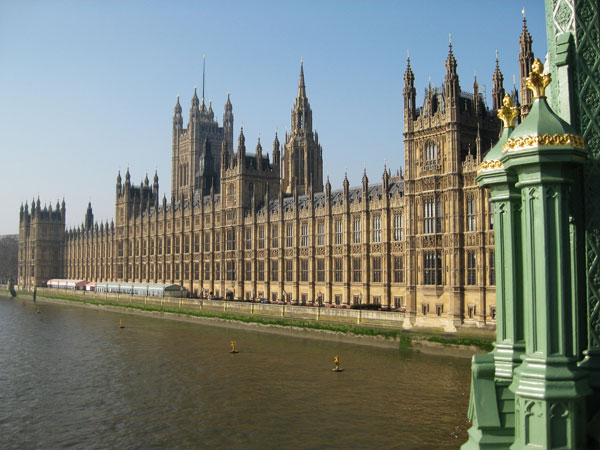
Houses of Parliament from Westminster Bridge. Source: UK Parliament

The prospect of “redecorating,” or any other form of “home improvement,” generally gets me thinking, quickly, about a lengthy research trip abroad. Yet I can, and recently did, spend several pleasant hours contemplating ceramics, furniture, and — would you believe it? — wallpaper. But not at Home Depot, I quickly add; rather, in a book — “Pugin: A Gothic Passion,” published in 1994 by Yale University Press in association with London’s Victoria and Albert Museum.

I dug out Pugin — stuck among the oversized art books in my home library for the better part of two decades — when I learned that 2012 is the bicentenary of Augustine Welby Northmore Pugin, pioneer of the Gothic Revival style and one of the aesthetic geniuses of the 19th century. Best known for his work on the Palace of Westminster (home of the Houses of Parliament), Pugin was also an ecclesiastical architect of note, with almost 50 churches to his credit. And although the Luftwaffe and the Blitz wrecked what may have been his masterwork of church design, the Cathedral of St. George in Southwark, there are still Pugin churches to be admired throughout Great Britain, Ireland and Australia.

As I suggested at the top, however, Pugin’s genius was not limited to architecture and other grand schemes of design. He also worked magic on a much smaller scale: custom-designed wallpaper; magnificent pieces of furniture (dining-room cabinets, armoires, tables, desks and tables); beautifully intricate ceramic tiles, plates, and dinner and tea services — all of them a delight to the eyes.

Born on March 1, 1812, Pugin was received into the Catholic Church in 1835, and his passion for the Gothic (by which he meant, not hair-raising horror novels but the civilization of the Middle Ages and its distinctive aesthetic) was obviously enmeshed with his religious convictions. For the Gothic, as Pugin understood it, communicated even more than that sense of transcendence that is palpable in a great medieval cathedral like Chartres. The Gothic bespoke a sensibility about this world, the human place in it, and the moral life appropriate to men and women made in the image and likeness of God. Buildings tell us something about the people who live, work and worship in them, Pugin, believed: they tell us what those people think of themselves, their destiny and their responsibilities.

Thus in an 1836 polemic, Pugin, arguing on behalf of the Gothic Revival to which he and Sir Charles Barry gave noblest expression in the Palace of Westminster, contrasted a medieval monastery with a 19th-century poorhouse. The monastery, Pugin noted, was a place where the monks grew their own food, made their own clothes, shared what they grew and made with others, and offered the poor a decent place to be buried. Compare this, Pugin wrote, to “a panopticon workhouse where the poor were beaten, half-starved, and sent off after death for dissection. Each structure was the built expression of a particular view of humanity: Christianity versus Utilitarianism.”

Considering which, we may well hope that the Department of Health and Human Services never gets into the architecture business.

Pugin’s magnificent ecclesiastical architecture and church decoration, like the extraordinary interiors he designed for the Palace of Westminster, were, to adapt Blessed John Paul II, material exercises in philosophical anthropology — expressions of an idea of the human person. Pugin’s churches were built for people whose baptism had given them a unique dignity: through the eternal priesthood of Christ, exercised through the ordained ministry of the Church, the baptized were empowered to offer true worship to the Father. The same was true of the Houses of Parliament. They were designed by Barry and Pugin to reflect the dignity of self-governance among free citizens, whose participation in public affairs was another expression of their innate human dignity.

Churches that look like Pizza Huts are expressions of a dumbed-down theology and (if you’ll pardon the word twice in one column) anthropology. On Pugin’s bicentenary, the Church might well reflect on how it can do better than that.

Good Shepherd Sunday

Students decorate sheep for local priests in honor of Good Shepherd Sunday (Photo courtesy of Bl. Pope John XXIII School).

SCOTTSDALE — Bl. Pope John XXIII School shared some photos of their students hard at work on a special “Good Shepherd Sunday” project. Kindergartener up through fourth-graders decorated sheep using their thumbprints and signed a letter for the pastors of their parishes. Bishop Thomas J. Olmsted, Bishop Eduardo A. Nevares and Fr. Paul Sullivan, the diocesan director of vocations, received the same token of appreciation.

Don’t be fooled into thinking this was a quick project. The school, which is on 60th Street south of Bell Road, draws students from 15 parishes:

  • Blessed Sacrament, Our Lady of Perpetual Help, St. Bernard of Clairvaux, St. Bernadette, St. Maria Goretti, St. Patrick — all six in Scottsdale
  • St. Rose Philippine Duchesne in Anthem
  • Our Lady of Joy in Carefree
  • St. Gabriel in Cave Creek
  • St. Francis Xavier, St. Joan of Arc, St. Joseph, St. Paul, St. Theresa, St. Thomas More — all six in Phoenix

Students delivered the sheep and their special notes to the parishes on Sunday when Catholics worldwide heard the Gospel reading of Jesus as the Good Shepherd (review the Gospel readings). Priests and deacons at the school’s “home parish” of St. Bernadette received a special bonus.

Students didn’t just sign and decorate sheep for Fr. Pete Rossa, the pastor, but also for Fr. Joe Cornelia, the parochial vicar, and plastered them all over their office doors. They did the the same for the parish’s four deacons.

What did your school, parish, ministry or family do to celebrate Good Shepherd Sunday?