
St. Joseph School breaks ground for new campus home

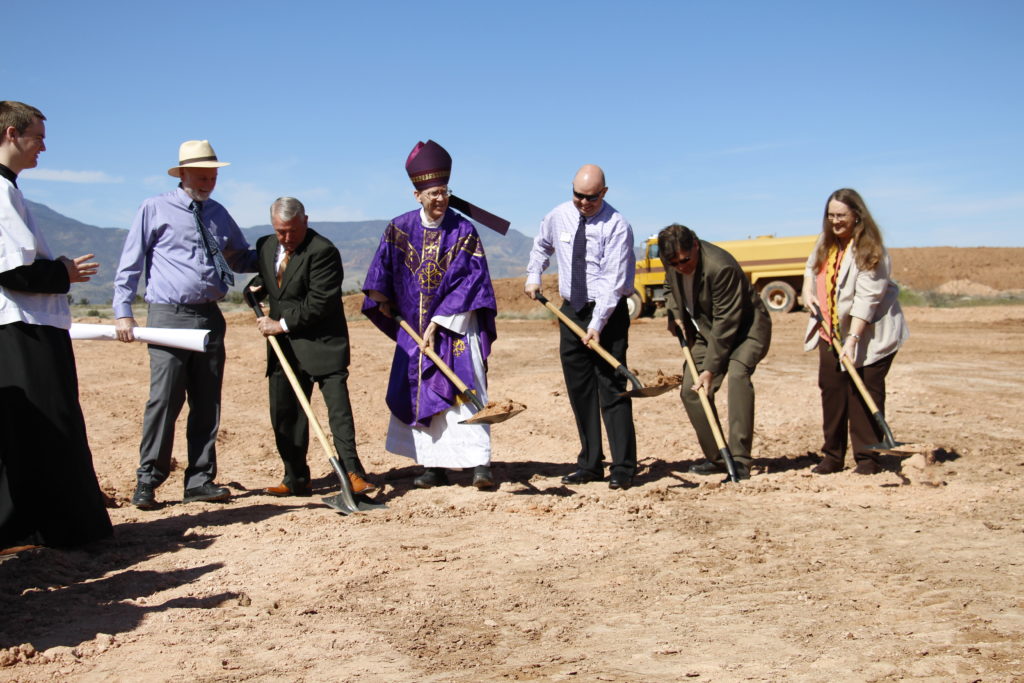
Brent Maupin (engineer) Bob Backus (builder), Bishop Thomas J. Olmsted, Mark Tufti (VP/branch manager, commercial lender Country Bank ) and Cottonwood Mayor Diane Joens turned over the first shovel of dirt at the March 22 ground-breaking for St. Joseph School. (Ambria Hammel/CATHOLIC SUN)
Brent Maupin (engineer), Bob Backus (builder), Bishop Thomas J. Olmsted, Mark Tufti (VP/branch manager, commercial lender Country Bank ), Greg Kirkham (principal) and Cottonwood Mayor Diane Joens turned over the first shovel of dirt at the March 22 ground-breaking for St. Joseph School. (Ambria Hammel/CATHOLIC SUN)

COTTONWOOD — The first several graduating classes from St. Joseph School in Cottonwood will soon be the only ones able to recall its original campus.

School leaders broke ground for new facilities March 22 between Sunday liturgies at Immaculate Conception Parish, an appropriate time considering the new campus will share grounds with the church.

St. Joseph School has sat 2.7 miles southwest of the parish in a converted ranch house on donated land since it opened in 2006. It transformed from a one-room Montessori school serving 12 students to a traditional kindergarten through eighth-grade campus of 130, and a preschool that still teaches using the Montessori method.

Administrators have simply run out of space and see the move as a step toward envisioning a more efficient future. It will eliminate two bus trips to get the students to school Masses and allow all of the students to learn under one roof again. The sixth- and seventh-graders already learn on the school’s future land inside a temporary building.

“It is a joy to have the beginnings of our Catholic school being built here on the main campus of the parish,” said Fr. David Kelash, pastor. “The school is a great way for evangelization. We have 40 percent of the students who are not Catholic and it is one way to let the word out that it is OK to be Catholic.”

Administrators are hopeful that a reunited campus sandwiched near Immaculate Conception and All Souls Catholic Cemetery will open by Christmas break. Fr. Kelash looks forward to easier and more frequent classroom visits once the parish and school campuses are one. He said it would bring more life and unity.
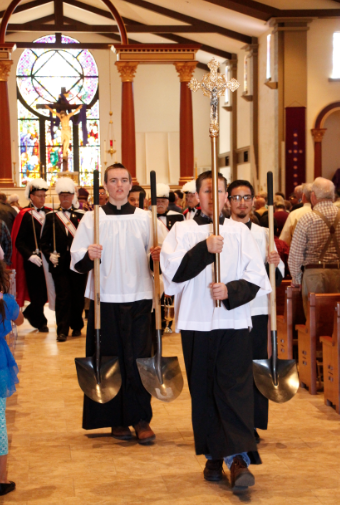
Jake Sweeney, John Paul Hansen, Arom Burgueno and Hayden Smith helped form the procession for the March 22 Mass at Immaculate Conception Parish in Cottonwood prior to the ground-breaking for St. Joseph School.  (Ambria Hammel/CATHOLIC SUN)
Jake Sweeney, John Paul Hansen, Arom Burgueno and Hayden Smith helped form the procession for the March 22 Mass at Immaculate Conception Parish in Cottonwood prior to the ground-breaking for St. Joseph School. (Ambria Hammel/CATHOLIC SUN)

Parish altar servers, some of whom are students and alumni, carried shovels during the Mass’s closing procession to St. Joseph’s future campus.

Their younger peers in plaid and green uniforms, along with teachers and parishioners who have supported the school, joined them at the edge of the parking lot.

A few ventured onto the hard-packed dirt. Heavy construction equipment has already cleared and flattened the land.

During the blessing, Bishop Thomas J. Olmsted said that all teachings must have as their final purpose true knowledge. He blessed the land and the crowd and prayed that the benefits of a sound education may quickly be spread throughout the world.

The school has already seen its first graduating class — who are now old enough to be finishing their freshman year of college — return as guest speakers in St. Joseph classrooms and at parish pulpits. The school draws students from Clarkdale, Camp Verde, Jerome, Sedona and the greater Verde Valley.

“They had all kinds of wonderful things to say. They’ve done well,” said school board member Jeff Leonard.

Merrily Pychinka, who serves as the school’s business manager among many other informal titles depending on the task, credited Ted Foley from Sedona and his grown children for making the dream of expanding the school a reality. St. Joseph’s future home received a combined $500,000 from them.

It will have two preschool classrooms, 10 classrooms and a courtyard with the idea of a multipurpose center in the future. Principal Greg Kirkham said the design is intended to maintain the community feel.

Beyond being a small school, students have faith buddies, peer buddies, a strong school board partnership and a greater community of benefactors including the Ann Gillen Foundation whose partial sponsorship of nine students each year — one student per grade level — makes tuition manageable.

“We’ve always had to put two nickels together to make anything happen,” Pychinka said.

Campus leaders are excited for the future. They’ve grown steadily, increased the number of Catholic students enrolled and have found a few who chose to become Catholic. Administrators are eager to launch more aggressive marketing knowing that they will have the space to accommodate new students.

Kirkham said the school’s strengths are the passion for the teachings of Christ. “It’s a school where everybody believes in it.”

Pope warns religious against ‘crisis of quality’ in consecrated life

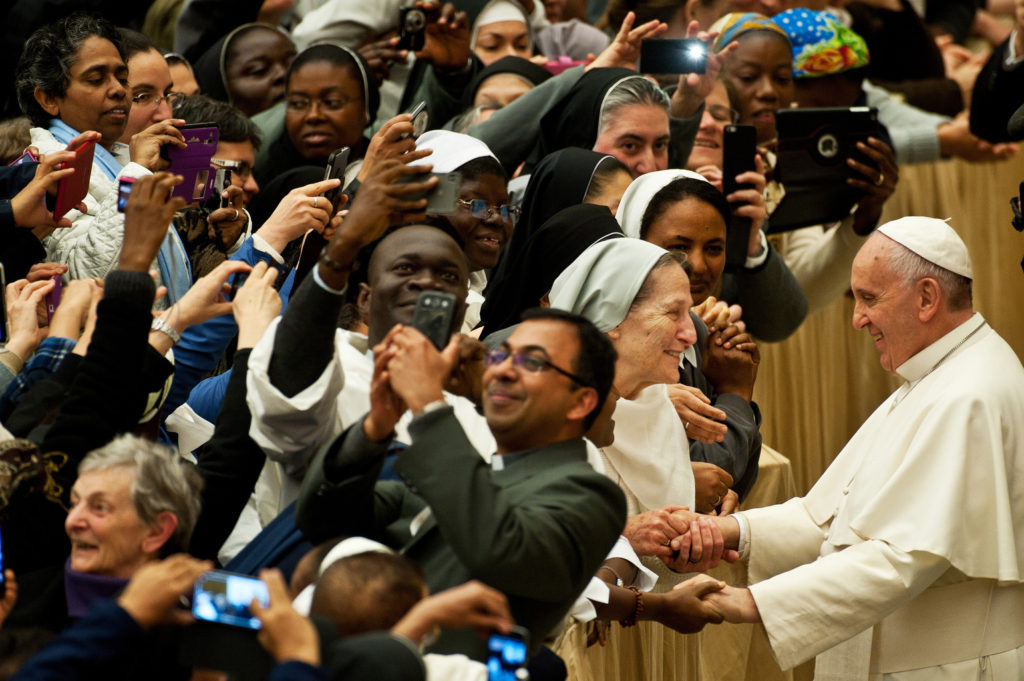
Pope Francis greets nuns and priests during a meeting with participants in an international congress organized by the Congregation for Institutes of Consecrated Life and Societies of Apostolic Life in Paul VI hall at the Vatican April 11. (CNS photo/Massimiliano Migliorato, Catholic Press Photo)

VATICAN CITY (CNS) — Despite fewer vocations to consecrated life, those responsible for formation in religious institutes must know how to say no to unsuitable candidates, so as to avoid a “graver crisis of quality” down the road, said Pope Francis.

During an audience with about 1,300 novice directors and other formation ministers at the Vatican April 11, the pope said seeing consecrated people “in such great numbers” would give the impression “that there is no vocations crisis.”

“But in reality, there is an indubitable decrease in quantity, and this makes the work of formation — one that might truly form the heart of Jesus in the hearts of our young people — all the more urgent,” he said.

The formation staffs were in Rome for an international congress April 7-11, organized by the Congregation for Institutes of Consecrated Life and Societies of Apostolic Life. The congress was one of several events organized for the Year of Consecrated Life, which Pope Francis opened in November. Its aim was to reflect upon the main aspects of consecrated life and the demands placed on formation today.

The pope described consecrated life as “beautiful” and “one of the most precious treasures of the church.” He called it is “a privilege” to be in formation work and to “participate in the work of the Father, who forms the heart of the Son, in those whom the Spirit has called.”

Novice directors and others responsible for formation must have “a great heart for the young, so as to form in them great hearts, able to welcome everyone, rich in mercy, full of tenderness,” he said.

He also noted that initial formation is only the first step of a lifelong process.

Rejecting the idea that young people today are “mediocre and not generous,” he said they need to experience that it is “more blessed to give than to receive, that there is great liberty in an obedient life, great fruitfulness in a pure heart, and great richness in possessing nothing.”

He emphasized the need for formation staff members to be “lovingly attentive” to each candidate and “evangelically demanding” in every phase of formation, so that the “crisis of quantity might not produce a much graver crisis of quality,” he said, adding that “this is the danger.”

Underlining the importance of vocational discernment, the pope noted that psychologists and spiritual directors have said “young people, who unconsciously feel they have something of an imbalance … or a deviation, unconsciously seek solid structures that protect them, to protect themselves.”

“And here is the discernment: knowing how to say no,” the pope said.

Just as formation experts accompany candidates upon entry to their institutes, so too sometimes they must “accompany the exit, so that he or she will find a life path, with the necessary help,” he continued.

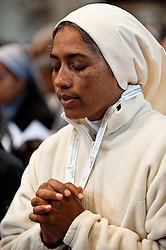
A nun prays during an April 11 Mass in St. Peter's Basilica at the Vatican. The Mass was for participants in an international congress organized by the Congregation for Institutes of Consecrated Life and Societies of Apostolic Life. (CNS photo/Massimiliano Migliorato, Catholic Press Photo)
A nun prays during an April 11 Mass in St. Peter’s Basilica at the Vatican. The Mass was for participants in an international congress organized by the Congregation for Institutes of Consecrated Life and Societies of Apostolic Life. (CNS photo/Massimiliano Migliorato, Catholic Press Photo)

Those involved in formation also must imitate God in exercising the virtue of patience, the pope counseled.

“God knows how to wait. You, too, must learn this attitude of patience, which many times is a little martyrdom,” he said.

The pope noted the fine quality of many consecrated people. He said there is much to learn in particular from the faithful, years-long witness of missionary sisters and the wisdom among the aged. He said visiting elderly consecrated people would be good for young people, who seek wisdom and authenticity.

Thanking the formation staffs for their “humble and discreet service,” he urged them not to be “discouraged when the results do not correspond to the expectations” and to learn from these “failures” as part of their own formation.

“It is painful when a young man or young woman, after three or four years (of formation) comes and says, ‘This is no longer for me. I found another love that is not against God, but I cannot (continue) and I am leaving.’ This is difficult. But this is also your martyrdom,” he said.

The pope said some religious who work in formation may live their charge as a burden. “But this is a lie, a temptation,” he said.

When they feel their work is not appreciated, he said, they should “know that Jesus follows you with love and the entire Church is grateful.”

“Some say consecrated life is heaven on earth,” the pope said. “No. If anything it is purgatory! But go forward with joy.”

The pope also said he is “convinced” there is no vocations crisis where consecrated people witness to “the beauty of consecration.”

“If there is no witness, if there is no coherence, there will not be vocations,” he told the group. “This is the testimony to which you are called. This is your ministry, your mission. You are not only ‘teachers.’ You are above all witnesses to the discipleship of Jesus within your proper charism. And this can be done if every day you rediscover the joy of being disciples of Jesus.”

By Laura Ieraci, Catholic News Service.

‘Little Boy’: Changing the culture, one film at a time

“Little Boy” (Metanoia Films) a powerful, moving film about an 8-year-old boy (Jakob Salvati) who is willing to do whatever it takes to bring his father home from World War II. (Courtesy Metanoia Films)

[dropcap type=”4″]I[/dropcap]f there’s one thing Americans can agree on in this era of social discord, it’s that we love film. We spent a staggering $10 billion on movie tickets in 2009.

Joyce Coronel is a regular contributor to The Catholic Sun and author of “A Martyr’s Crown.” Opinions expressed are the writers’ and not necessarily the views of The Catholic Sun or the Diocese of Phoenix.

After a long week at work, there’s nothing like a getaway to the local cinema. Throw in a bucket of popcorn and an ice-cold soft drink and we’re lifted out of the humdrum of ordinary life.

And yet, when was the last time you saw a truly great film, one that inspired you, made you laugh or even shed a tear or two? There aren’t many movies like that these days.

Little Boy,” set to open nationwide on April 24, is just such a film, and its producers are hoping Americans will pack theaters and prove once again that there is a hunger for enduring themes such as faith, hope and love.

Local Catholic attorney John Jakubczyk has been helping to promote “Little Boy” over the last several months.

“The power of film in today’s society cannot be overestimated. Everyone is affected by the movies,” Jakubczyk said. “The big blockbusters are seen by everybody and those films influence the way people behave and the way they think.”


Auxiliary Bishop Eduardo A. Nevares of the Diocese of Phoenix offered a similar take on the impact of movies on culture.

“It’s very important that we get our Christian messages across in that medium to offset what is being produced by Hollywood and trying to be shown as the norm of our culture today,” Bishop Nevares said. “We need to always be in that medium with our countercultural message.”

It goes without saying that Hollywood’s agenda is, for the most part, unapologetically opposed to the principles of the Catholic Church. There’s a hunger inside of each of us, a void that can only be filled by love. And Hollywood’s version of love is a cheap imitation of the real thing.

Real love goes beyond the butterflies-in-the-belly phase and instead requires sacrifice, total self-giving and fidelity even when all seems lost. Real love is the stuff of the cross, in other words. Real love took on flesh and dwelt among us in the person of Jesus Christ.

If you care about rebuilding our culture, if you want to see films like this succeed, then make sure you see “Little Boy” opening weekend, April 24.

Consider if you will the fundamental shift in our country over the last 10 years regarding the truths of marriage and ask yourself if Hollywood has had any part in changing public opinion.

Through movies and television, the message has been loud, persistent and omnipresent: same-sex marriage is a social good; those who oppose it are haters.

Then a movie like “Little Boy” comes along and without ever entering the debate over marriage, shows us the depth of love between a father and son, between a husband and wife and the power of simple faith in God. There’s no ridicule of religion, no jabs at traditional values.

Eduardo Verástegui, one of the producers of “Little Boy,” said the goal was to not only entertain viewers, but to inspire them.

“Alejandro, Leo and I started this company with the goal of making films that would make a difference in people’s lives,” Verástegui said.

If you care about rebuilding our culture, if you want to see films like this succeed, then make sure you see “Little Boy” opening weekend, April 24. Attendance that weekend will determine how many prints of the movie get ordered.

I believe that people of good will are dismayed by Hollywood’s relentless campaign to redefine the family and by the amount of crassness and violence in today’s films. A movie like “Little Boy” offers a beautiful alternative. Let’s work together to help it succeed.

Pope says Year of Mercy will be time to heal, to help, to forgive

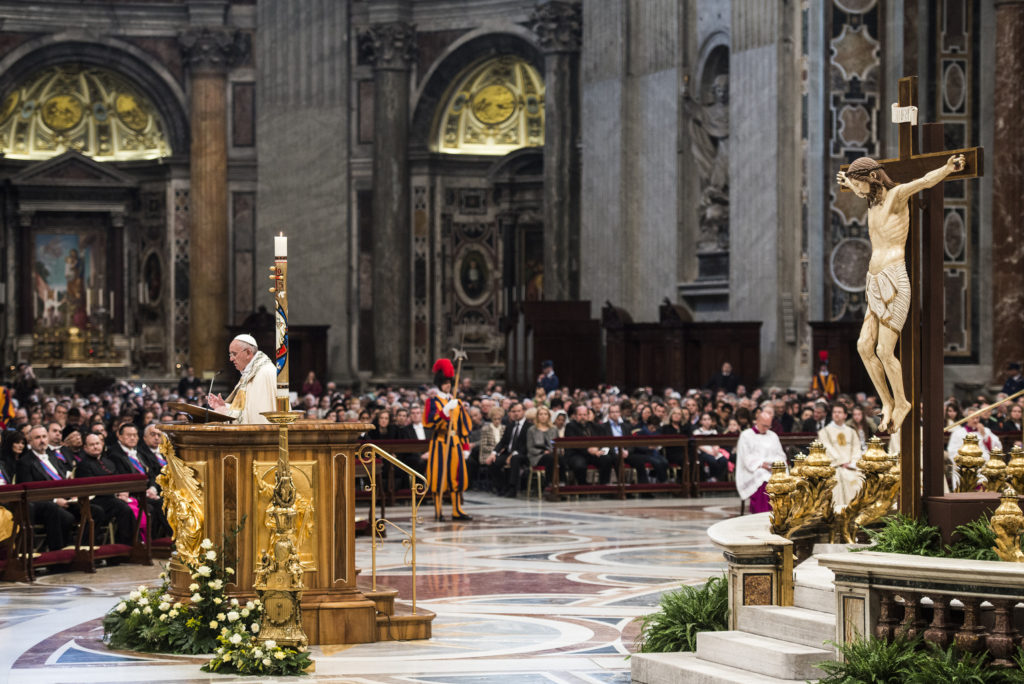
Pope Francis preaches during first vespers of Divine Mercy Sunday in St. Peter's Basilica at the Vatican April 11. Before celebrating vespers, the pope released a 9,300-word document officially proclaiming the 2015-2016 extraordinary Holy Year of Mercy. (CNS photo/Cristian Gennari)
Pope Francis preaches during first vespers of Divine Mercy Sunday in St. Peter’s Basilica at the Vatican April 11. Before celebrating vespers, the pope released a 9,300-word document officially proclaiming the 2015-2016 extraordinary Holy Year of Mercy. (CNS photo/Cristian Gennari)

VATICAN CITY (CNS) — Mercy is what makes God perfect and all-powerful, Pope Francis said in his document officially proclaiming the 2015-2016 extraordinary Holy Year of Mercy.

“If God limited himself to only justice, he would cease to be God, and would instead be like human beings who ask merely that the law be respected,” the pope wrote in “Misericordiae Vultus,” (“The Face of Mercy”), which is the “bull of indiction” calling a Holy Year to begin Dec. 8.

Pope Francis processes into St. Peter's Basilica to celebrate first vespers of Divine Mercy Sunday at the Vatican April 11. Before celebrating vespers, the pope released a 9,300-word document officially proclaiming the 2015-2016 extraordinary Holy Year of Mercy. (CNS photo/Stefano Spaziani, pool)
Pope Francis processes into St. Peter’s Basilica to celebrate first vespers of Divine Mercy Sunday at the Vatican April 11. Before celebrating vespers, the pope released a 9,300-word document officially proclaiming the 2015-2016 extraordinary Holy Year of Mercy. (CNS photo/Stefano Spaziani, pool)

Standing in front of the Holy Door of St. Peter’s Basilica April 11, Pope Francis handed copies of the document to the archpriests of the major basilicas of Rome and to Vatican officials representing Catholics around the world.

Portions of the 9,300-word proclamation were read aloud before Pope Francis and his aides processed into St. Peter’s Basilica to celebrate the first vespers of Divine Mercy Sunday.

In his homily at vespers, the pope said he proclaimed the Year of Mercy because “it is the favorable time to heal wounds, a time not to be weary of meeting all those who are waiting to see and touch with their hands the signs of the closeness of God, a time to offer everyone the way of forgiveness and reconciliation.”

The boundless nature of God’s mercy — his willingness always to forgive anything — has been a constant subject of Pope Francis’ preaching and is explained in detail in the document, which outlines some of the specific projects the pope has in mind for the year.

The Old Testament stories of how God repeatedly offered mercy to his unfaithful people and the New Testament stories of Jesus’ compassion, healing and mercy demonstrate, the pope said, that “the mercy of God is not an abstract idea, but a concrete reality through which he reveals his love,” just like mothers and fathers love their children.

“How much I desire that the year to come will be steeped in mercy, so that we can go out to every man and woman, bringing the goodness and tenderness of God,” he wrote. “May the balm of mercy reach everyone, both believers and those far away, as a sign that the kingdom of God is already present in our midst.”

Nothing in the church’s preaching or witness, he said, can be lacking in mercy.

Pope Francis asked that all dioceses around the world designate a “Door of Mercy” at their cathedral or another special church or shrine, and that every diocese implement the “24 Hours for the Lord” initiative on the Friday and Saturday before the fourth week of Lent. In Rome the last two years, the pope has opened the celebration with a penance service in St. Peter’s Basilica and churches around the city were open for the next 24 hours for confessions and eucharistic adoration.

The pope said he will designate and send out “Missionaries of Mercy” to preach about mercy; they will be given special authority, he said, “to pardon even those sins reserved to the Holy See.” Under church law, those sins involve:

  • a man who directly participated in an abortion and later wants to enter the priesthood
  • priests who have broken the seal of confession
  • priests who have offered sacramental absolution to their own sexual partners
  • desecrating the Eucharist
  • making an attempt on the life of the pope.

Usually, the Apostolic Penitentiary, a Vatican court, handles those cases.

And he urged all Catholics to spend more time practicing what traditionally have been called the corporal and spiritual works of mercy. The corporal works are: feeding the hungry, sheltering the homeless, clothing the naked, visiting the sick, visiting the imprisoned, giving drink to the thirsty and burying the dead. The spiritual works are: converting sinners, instructing the ignorant, advising the doubtful, comforting the sorrowful, bearing wrongs patiently, forgiving injuries and praying for the living and dead.

The date the pope chose to open the year — Dec. 8 — is the feast of the Immaculate Conception and the 50th anniversary of the closing of the Second Vatican Council. Both dates, he wrote, are related to the Year of Mercy.

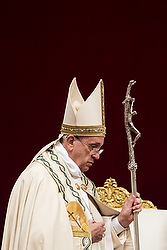
Pope Francis holds his crosier during first vespers of Divine Mercy Sunday in St. Peter's Basilica at the Vatican April 11. Before celebrating vespers, the pope released a 9,300-word document officially proclaiming the 2015-2016 extraordinary Holy Year of Mercy. (CNS photo/Cristian Gennari)
Pope Francis holds his crosier during first vespers of Divine Mercy Sunday in St. Peter’s Basilica at the Vatican April 11. Before celebrating vespers, the pope released a 9,300-word document officially proclaiming the 2015-2016 extraordinary Holy Year of Mercy. (CNS photo/Cristian Gennari)

Mercy, he said, is “the bridge that connects God and man, opening our hearts to a hope of being loved forever despite our sins.” That bridge was made concrete when God chose Mary to be the mother of his son.

The Year of Mercy, Pope Francis wrote, is also a way to keep the Second Vatican Council alive. “The walls which too long had made the church a kind of fortress were torn down and the time had come to proclaim the Gospel in a new way,” he said. The council recognized “a responsibility to be a living sign of the Father’s love in the world.”

The life and action of the church, he said, “is authentic and credible only when she becomes a convincing herald of mercy,” a mercy that “knows no bounds and extends to everyone without exception.”

While some people try to argue that mercy, even God’s mercy, is limited by the demands of justice, Pope Francis said mercy and justice are “two dimensions of a single reality that unfolds progressively until it culminates in the fullness of love.”

Preaching mercy, he said, is not the same as ignoring sin or withholding correction. Instead, mercy invites repentance and conversion and ensures the sinner that once God forgives a sin, he forgets it.

The pope addressed direct appeals in the document to members of the mafia and other criminal organizations as well as to officials and others involved in corruption. “For their own good, I beg them to change their lives,” he wrote. “I ask them this in the name of the Son of God who, though rejecting sin, never rejected the sinner.”

“Violence inflicted for the sake of amassing riches soaked in blood makes one neither powerful nor immortal,” he continued. “Everyone, sooner or later, will be subject to God’s judgment, from which no one can escape.”

At the same time, Pope Francis wrote, many of those who insist first on God’s justice are like the Pharisees who thought they could save themselves by following the letter of the law, but ended up simply placing “burdens on the shoulders of others and undermined the Father’s mercy.”

“God’s justice is his mercy,” the pope said. “Mercy is not opposed to justice, but rather expresses God’s way of reaching out to the sinner, offering him a new chance to look at himself, convert and believe.”

Recognizing that they have been treated with mercy by God, he said, Christians are obliged to treat others with mercy. In fact, the Gospel says that Christians will be judged by the mercy they show others.

“At times how hard it seems to forgive,” he said. “And yet pardon is the instrument placed into our fragile hands to attain serenity of heart. To let go of anger, wrath, violence and revenge are necessary conditions to living joyfully.”

Pope Francis also noted that God’s mercy is an important theme in Judaism and Islam, and he urged efforts during the Year of Mercy to increase interreligious dialogue and mutual understanding with followers of both faiths.

By Cindy Wooden, Catholic News Service.

Half of newest class of Holy Cross priests made Phoenix pit stop during formation

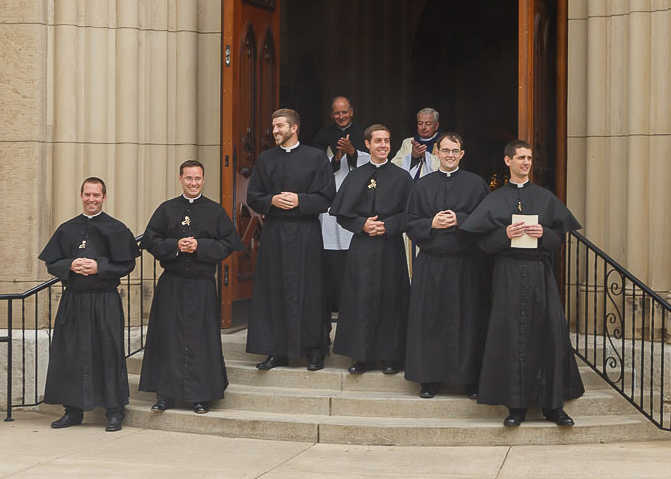
Holy Cross Deacons Matthew Fase, David Halm, Timothy Mouton, Stephen Chase Pepper, Daniel Ponisciak, and Christopher Rehagen will be ordained as priests for the Congregation of Holy Cross tomorrow. They're pictured here after professing their final vows Sept. 13, 2014 in the Basilica of the Sacred Heart. They were ordained to the order of the diaconate the next day. (photo courtesy of Congregation of Holy Cross)
Holy Cross Deacons Timothy Mouton, David Halm, Matthew Fase, Stephen Chase Pepper, Daniel Ponisciak and Christopher Rehagen will be ordained as priests for the Congregation of Holy Cross tomorrow. They’re pictured here after professing their final vows Sept. 13, 2014 in the Basilica of the Sacred Heart. They were ordained to the order of the diaconate the next day. (photo courtesy of Congregation of Holy Cross)

Three of the six men who will be ordained to the priesthood for the Congregation of Holy Cross tomorrow at the Basilica of the Sacred Heart at the University of Notre Dame spent at least part of their formation serving parishes in the Diocese of Phoenix or André House, which reaches out to the area’s homeless.

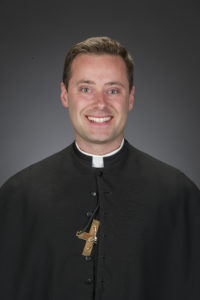
Dcn. David Halm, C.S.C.

Holy Cross Dcn. David Halm, an Ohio native, is the only son among four children. He is currently serving his diaconate year at St. John Vianney in Goodyear. His formation has taken him across the country in religious education, counseling and ministry to the sick as well as to Rome and to Phoenix’s St. Gregory Parish in 2005.

Dcn. Daniel Ponisciak, C.S.C.

Dcn. Daniel Ponisciak is the middle of three boys raised in Pennsylvania. He served across the country during his formation in parish, hospital and homeless ministry including André House in Phoenix.

“Identifying hope in the midst of great suffering and being able to offer that to people going through these difficult times is something I will take with me into ministry,” Dcn. Ponisciak said. “Hope through the Cross […] is an instrument of our salvation – an instrument that provides hope for all who believe that suffering and death are conquered through it.”

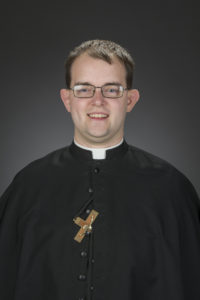
Dcn. Christopher Rehagen, C.S.C.

Dcn. Christopher Rehagen is a twin and the oldest of four sons from Missouri. He spent his novitiate year at St. John Vianney beginning in 2010.

“I am very, very excited as Ordination approaches,” Dcn. Rehagen said, “… to give my final yes … to be able to celebrate the Sacraments. I know there will be many challenges ahead, but I trust that God will provide the strength to meet them.”

His latest blogpost through the Holy Cross Vocations Office reflects on his pending ordination.

These six soon-to-be priests join the roughly 500 priests, brothers and seminarians in the United States Province. There are some 1,200 Holy Cross religious working in 16 countries and on five continents to educate both the hearts and minds of believers of Jesus Christ.

UPDATE April 13

Photos and video from the ordination

‘Priest for a Day’ is a wish come true for 11-year-old Missouri boy

Father Nicholas Smith helps Brett Haubrich, a sixth-grader at St. Mark School in Affton, Mo., who was diagnosed with a brain tumor last summer, with his vestments before Mass on Holy Thursday, April 2, at the Cathedral Basilica of St. Louis. At the invitation of St. Louis Archbishop Robert J. Carlson, Brett took his place beside the altar at the cathedral as "Priest for a Day." (CNS photo/Lisa Johnston, St. Louis Review)

ST. LOUIS (CNS) — Make-A-Wish requests often involve meeting athletes, attending sporting events or traveling to amusement parks or beaches.

When it came time for 11-year-old Brett Haubrich of St. Mark School in Affton to make his wish, he not only listed none of those things but had no request at all.

“He didn’t want anything,” explained his mother, Eileen. “They had to keep asking him, ‘What would you like to do? Do you want to meet anybody? What do you want to be when you grow up?'”

The answer to the last question became part of his wish — what Make-A-Wish calls “wish enhancement” to complement the main wish. Turns out he wants to be a priest, a doctor or an engineer, in that order.

So, on Holy Thursday, at the invitation of St. Louis Archbishop Robert J. Carlson, Brett took his place beside the altar at Cathedral Basilica of St. Louis as “Priest for a Day.”

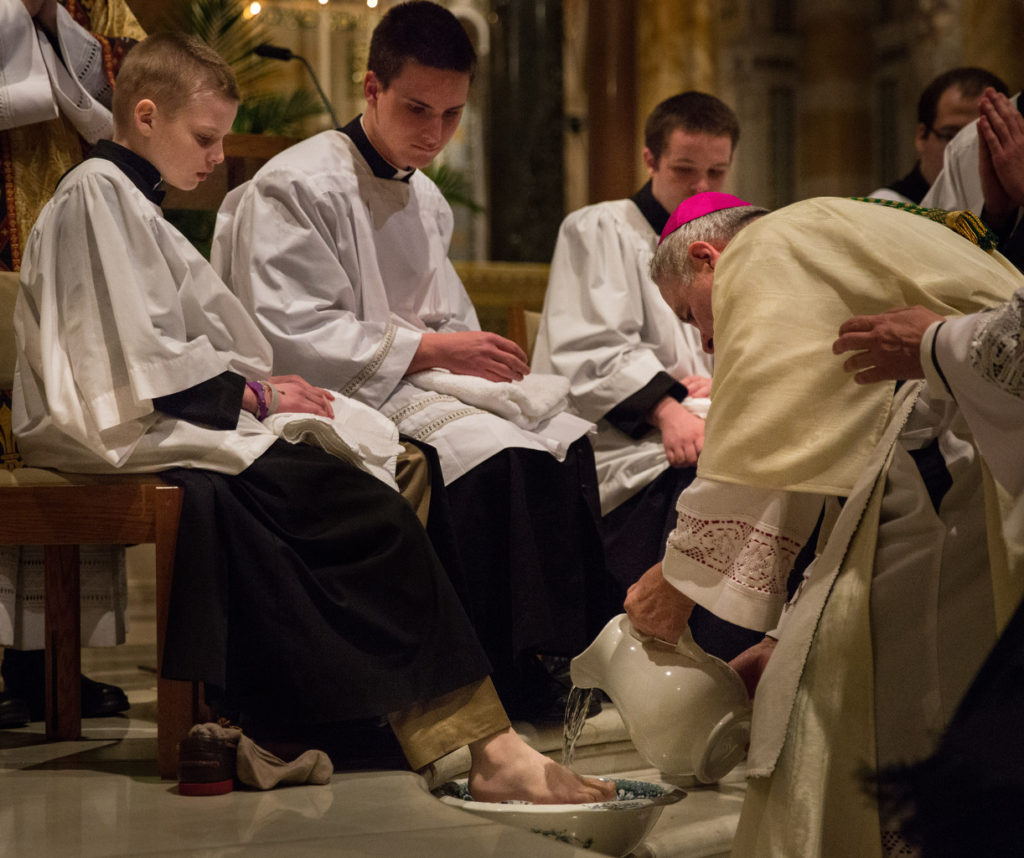
Brett, a sixth-grader who was diagnosed with a brain tumor last summer, served two Masses — the chrism Mass and the evening Mass of the Lord’s Supper — and held the book for Archbishop Carlson for prayers after the homilies. At the evening Mass, he joined 11 seminarians whose feet were washed by Archbishop Carlson and his parents brought up the offertory gifts.

Brett Haubrich, a sixth-grader at St. Mark School in Affton, Mo., who was diagnosed with a brain tumor last summer, center, walks with seminarians during Mass on Holy Thursday, April 2, at the Cathedral Basilica of St. Louis. At the invitation of St. Louis Archbishop Robert J. Carlson, Brett took his place beside the altar at the cathedral as "Priest for a Day." (CNS photo/Lisa Johnston, St. Louis Review)
Brett Haubrich, a sixth-grader at St. Mark School in Affton, Mo., who was diagnosed with a brain tumor last summer, center, walks with seminarians during Mass on Holy Thursday, April 2, at the Cathedral Basilica of St. Louis. At the invitation of St. Louis Archbishop Robert J. Carlson, Brett took his place beside the altar at the cathedral as “Priest for a Day.” (CNS photo/Lisa Johnston, St. Louis Review)

He also joined Archbishop Carlson for two meals; a luncheon with archdiocesan priests and deacons after the chrism Mass and a dinner with seminarians at the archbishop’s residence before the evening Mass.

Best of all, he wore a collar provided by a seminarian from Kenrick-Glennon Seminary in Shrewsbury.

When asked about his favorite part of the day, Brett was unequivocal in his answer.

“The whole thing,” he said as he waited for his dad, Conrad, near the Cathedral Basilica sanctuary with his mom and older sister Olivia after the chrism Mass. “It was really neat for them to let me do this stuff.”

And cool, too — a term he used often in describing the day.

“Just a really cool experience,” he told the St. Louis Review, the archdiocesan newspaper.

His actual wish is cool, too.

“Eating mangoes on a beach,” his mother said. That trip will come later.

Brett’s interim “Priest for a Day” request didn’t surprise his family.

“For years, he has loved the Mass and been religious,” said his mom. “He has such a good heart. He’s a very caring boy.”

Brett is the second oldest of Eileen and Conrad’s four children. He has served at his school church and at his parish, St. Martin of Tours in Lemay, which is visible from the back door of his house only a short walk away.

He likes the smell of incense, enjoys confession and likes “Communion, and the songs, too.”

Communion — the Eucharist, the living presence of Jesus Christ — stands out. “I like receiving the body and the blood” of Christ, he said, simply.

When Brett and his family told several priests about his desire to be a priest for a day, they offered several options. He could shadow a priest for a day, spend the night at a rectory with his dad or serve Saturday morning Mass at the cathedral.

St. Louis Archbishop Robert J. Carlson washes the feet of Brett Haubrich, a sixth-grader at St. Mark School in Affton, Mo., who was diagnosed with a brain tumor last summer, during Mass on Holy Thursday, April 2, at the Cathedral Basilica of St. Louis. At the invitation of Archbishop Carlson, Brett took his place beside the altar at the cathedral as "Priest for a Day." (CNS photo/Lisa Johnston, St. Louis Review)
St. Louis Archbishop Robert J. Carlson washes the feet of Brett Haubrich, a sixth-grader at St. Mark School in Affton, Mo., who was diagnosed with a brain tumor last summer, during Mass on Holy Thursday, April 2, at the Cathedral Basilica of St. Louis. At the invitation of Archbishop Carlson, Brett took his place beside the altar at the cathedral as “Priest for a Day.” (CNS photo/Lisa Johnston, St. Louis Review)

When Father Nick Smith, master of ceremonies at the cathedral, was asked if Brett could serve at a Mass his initial response was “no way,” followed quickly by “we can do way better than that.”

Sure enough, they did.

Father Smith suggested that Brett serve the two Masses on Holy Thursday — the chrism Mass, which is for priests, and that night’s Mass, “which is always about the Eucharist.” Archbishop Carlson, who was with the priest when he got the request, immediately joined in with other ideas for the day — having Brett attend the seminarians’ dinner and participate in foot washing.

Father Smith prepared an itinerary and delivered it in person to Brett along with a letter signed by Archbishop Carlson asking for Brett’s help at the Masses.

“I handed it to him, and when he got to the first line, ‘I’m making you a priest for a day,’ his eyes got as big as half-dollars,” Father Smith said.

Brett admitted to being a little nervous heading into Holy Thursday, but the events went off like clockwork. Wearing the collar, Brett processed down the center aisle with priests, deacons and seminarians at the chrism Mass — at which Archbishop Carlson blessed the oils to be used throughout the archdiocese for sacraments for the next year — and took his spot near the altar.

He performed flawlessly.

Or as Archbishop Carlson put it: “He did pretty well.”

— By Dave Luecking, Catholic News Service. Luecking writes for the St. Louis Review, newspaper of the Archdiocese of St. Louis.

Bishops object to death penalty as punishment in Boston bomber case

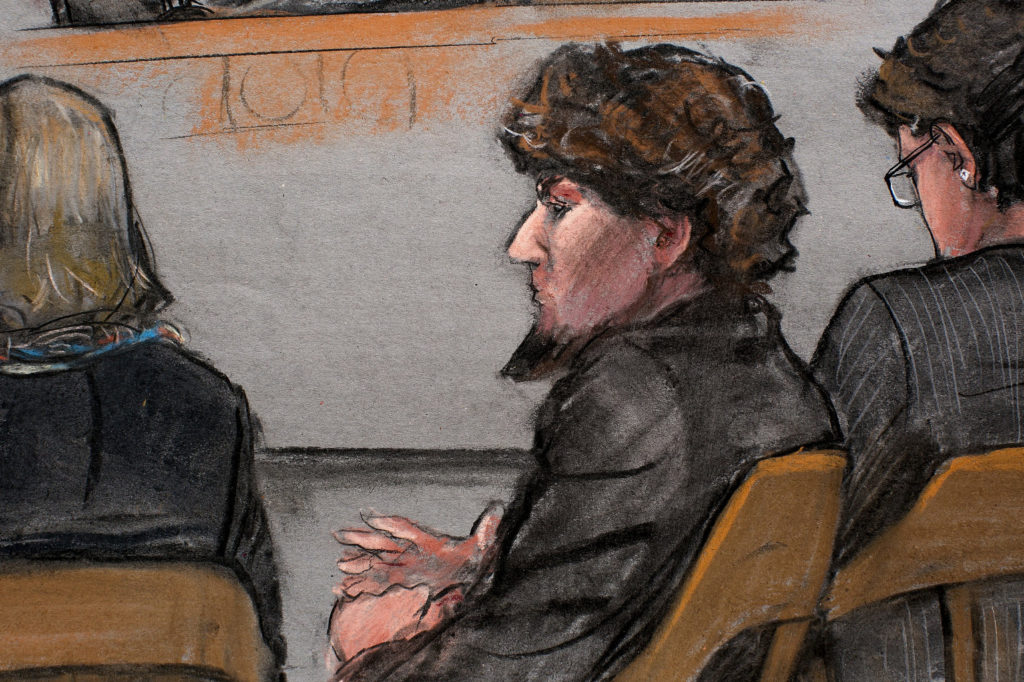
A courtroom sketch shows accused Boston Marathon bomber Dzhokhar Tsarnaev during closing arguments April 6 in his trial at the federal courthouse in Boston. The bishops of Massachusetts urged against a death sentence for the bombing defendant, reiterating Catholic teaching that says cases where capital punishment is acceptable are practically nonexistent. (CNS illustration/Jane Flavell Collins via Reuters)
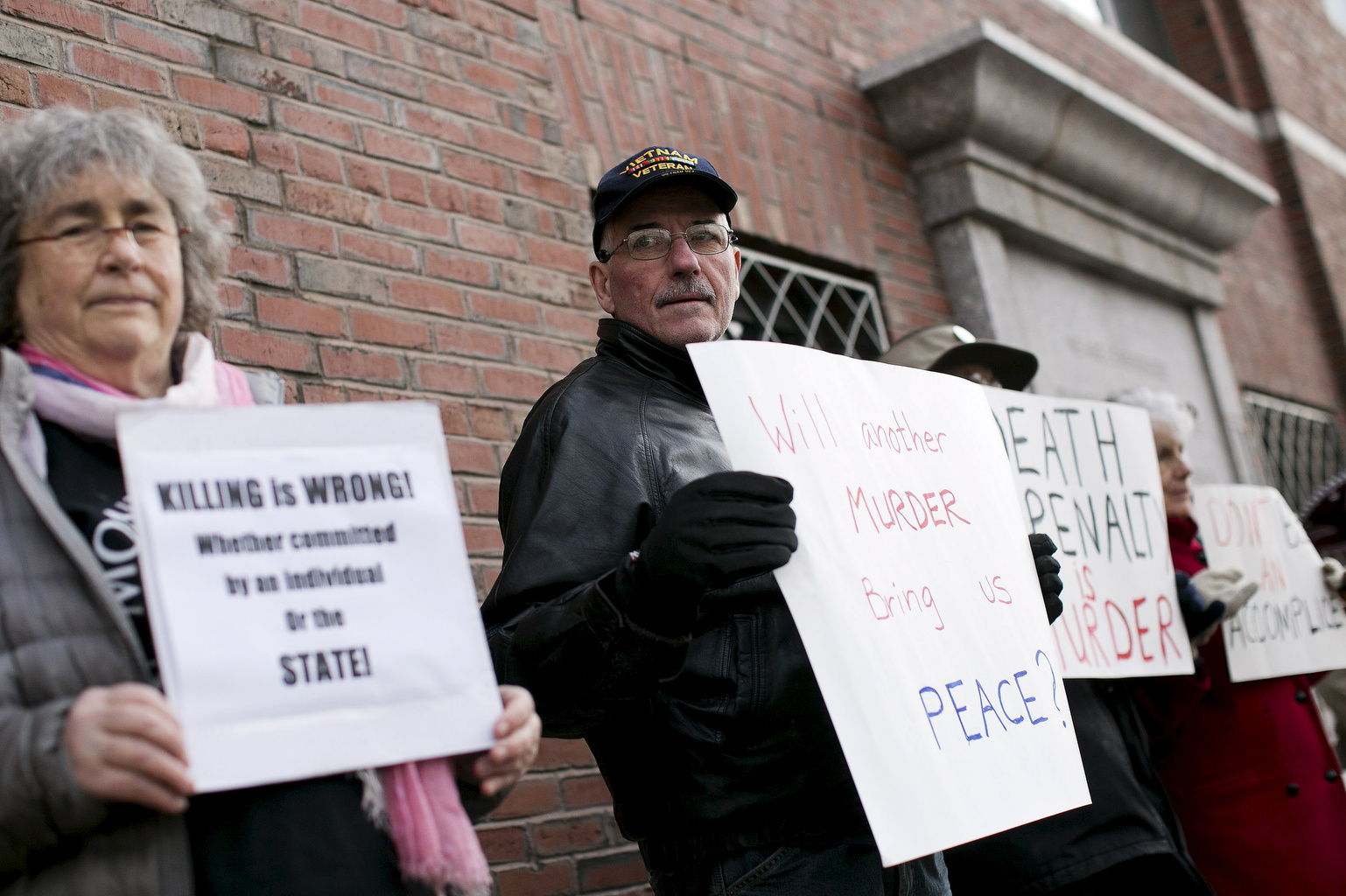
Protesters against the death penalty hold signs before closing arguments took place April 6 in the trial of accused Boston Marathon bomber Dzhokhar Tsarnaev at the federal courthouse in Boston. The bishops of Massachusetts urged against a death sentence for the bombing defendant, reiterating Catholic teaching that says cases where capital punishment is acceptable are practically nonexistent. (CNS photo/Dominick Reuter, Reuters)

BOSTON (CNS) — As the trial of Boston Marathon bombing defendant Dzhokhar Tsarnaev went to the jury April 6, the Catholic bishops of Massachusetts released a statement reiterating the church’s teaching on the death penalty.

The Catholic Church opposes the death penalty except “if this is the only possible way of effectively defending human lives against the unjust aggressor,” but such cases “are very rare, if not practically nonexistent.”

In Tsarnaev’s case, the Massachusetts bishops said, the defendant “has been neutralized and will never again have the ability to cause harm. Because of this, we … believe that society can do better than the death penalty.”

On April 8, the jury convicted Tsarnaev on all 30 counts against him, including the deaths of three spectators and a police officer who was shot as Tsarnaev and his now-dead older brother, Tamerlan Tsarnaev, tried to get away. Tamerlan, 26, died when police shot him and his brother ran over him in the chaos.

Seventeen of the counts Tsarnaev has been found guilty of are eligible for the death penalty. Starting possibly as soon as April 13, the jury was to hear evidence on whether the 21-year-old should be put to death or receive a life sentence.

Tsarnaev’s trial in federal court in Boston began March 4, where prosecutors were presented evidence that he and Tamerlan planted the bombs that exploded April 15, 2013, near the finish line at the Boston Marathon. The attack wounded more than 260 people and killed 8-year-old Martin Richard of Dorchester; 29-year-old Medford native Krystle Campbell; and Lu Lingzi, 23, a Chinese national studying at Boston University.

Later, Massachusetts Institute of Technology police officer Sean Collier was killed as the brothers attempted to escape from the Boston area.

From their opening statements, his lawyers admitted that Tsarnaev participated in the crimes.

Instead, in an apparent attempt to avoid the death penalty, the defense centered their arguments on demonstrating that older brother Tamerlan was the mastermind behind the plot and that then 19-year-old Dzhokhar was merely a follower.

In their statement, the bishops acknowledged the profound effect of the bombings and their aftermath has had on the Boston area.

A courtroom sketch shows accused Boston Marathon bomber Dzhokhar Tsarnaev during closing arguments April 6 in his trial at the federal courthouse in Boston. The bishops of Massachusetts urged against a death sentence for the bombing defendant, reiterating Catholic teaching that says cases where capital punishment is acceptable are practically nonexistent. (CNS illustration/Jane Flavell Collins via Reuters)

“The Boston Marathon Bombing trial is a painful reminder of the harm that impacts many people even beyond those who are killed or maimed by violent criminal acts,” the bishops said in their statement.

The statement also addressed the specifics of the Tsarnaev trial and reiterated Catholic Church teaching on the use of the death penalty.

“Given that the defendant, Dzhokhar Tsarnaev, is being tried in federal court with the possibility of capital punishment, and that the bishops have testified against capital punishment in the past, we feel it is fitting to clarify the church’s teaching regarding the use of the death penalty,” it said.

Drawing on the Catechism of the Catholic Church, the statement said, “The church has taught that the cases in which the execution of the offender is an absolute necessity are ‘rare, if not practically nonexistent.’ The church’s teaching is further developing in recognition of the inherent dignity of all life as a gift from God.”

The statement also quoted the March 20 remarks by Pope Francis to the International Commission Against the Death Penalty, in which the pope called capital punishment “an offense against the inviolability of life and the dignity of the human person.”

“When the death penalty is applied, it is not for a current act of oppression, but rather for an act committed in the past. It is also applied to persons whose current ability to cause harm is not current, as it has been neutralized — they are already deprived of their liberty,” the pope said.

The bishops said with the defendant behind bars, the interest of protecting public safety has been fulfilled.

They added, “As the bishops of the United States said in their 2005 statement ‘A Culture of Life and the Penalty of Death,’ ‘No matter how heinous the crime, if society can protect itself without ending a human life, it should do so.’ We believe these words remain true today in the face of this most terrible crime.”

— By Christopher S. Pineo and Gregory L. Tracy, Catholic News Service. Pineo is a staff writer and Tracy is managing editor at The Pilot, newspaper of the Archdiocese of Boston.

Share Easter joy, defend persecuted Christians, pope says

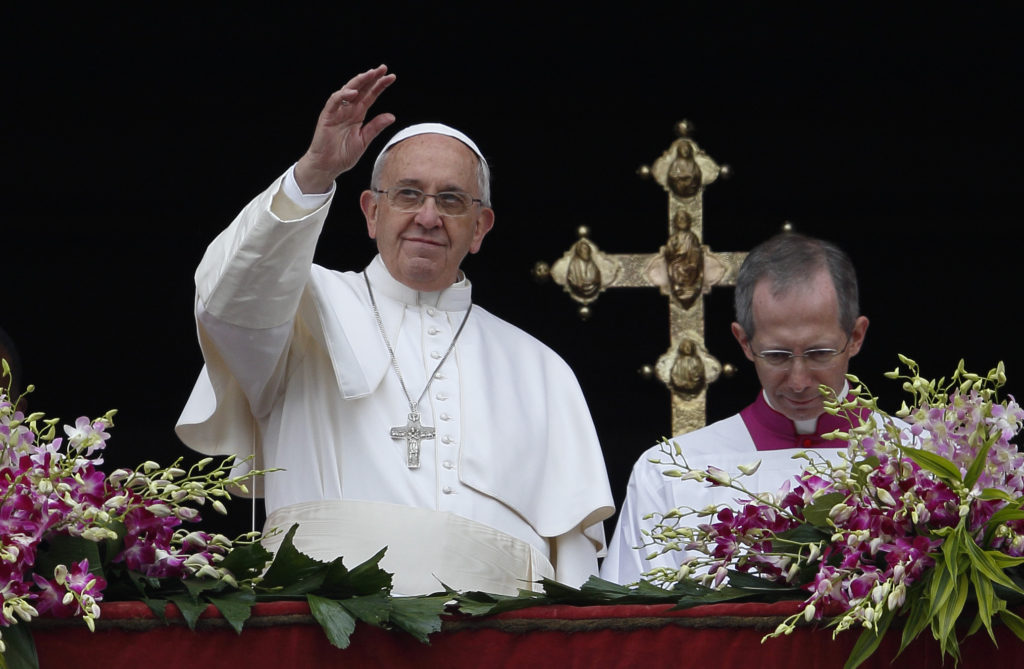
Pope Francis greets the crowd after delivering his Easter message and blessing "urbi et orbi" (to the city and the world) from the central balcony of St. Peter's Basilica at the Vatican April 5. (CNS photo/Paul Haring)
Pope Francis greets the crowd after delivering his Easter message and blessing “urbi et orbi” (to the city and the world) from the central balcony of St. Peter’s Basilica at the Vatican April 5. (CNS photo/Paul Haring)

VATICAN CITY (CNS) — Christians live the joy of the Resurrection when they share a smile with someone, weep with those who mourn and defend the rights of those persecuted for their faith, Pope Francis said.

Reciting the “Regina Coeli” prayer with thousands of people gathered in St. Peter’s Square April 6, the pope demanded defense and protection for “our brothers and sisters persecuted, exiled, killed and decapitated just because they are Christians.”

“I hope the international community will not stand by mute and inert before such an unacceptable crime, which constitutes a worrying deviation from the most elementary human rights,” he said. “The international community cannot look the other way.”

Pope Francis said the good news of Jesus’ resurrection and the promise of new life for all the baptized is something “we are called to bring to others.” It is “the most beautiful gift a Christian can give his brothers and sisters.”

Easter joy, he said, should be obvious on the faces of Christians, “in our sentiments and attitudes, in the way we treat others.”

“We proclaim the resurrection of Christ when his light brightens the dark moments of our existence, and we can share that with others when we learn to smile with those who smile and cry with those who cry, when we walk alongside those who are sad and risk losing their hope (and) when we talk about our faith experience with those who are searching for meaning and happiness,” the pope said.

— By Cindy Wooden, Catholic News Service.

Military chaplains bring God closer to soldiers on Ukraine front lines

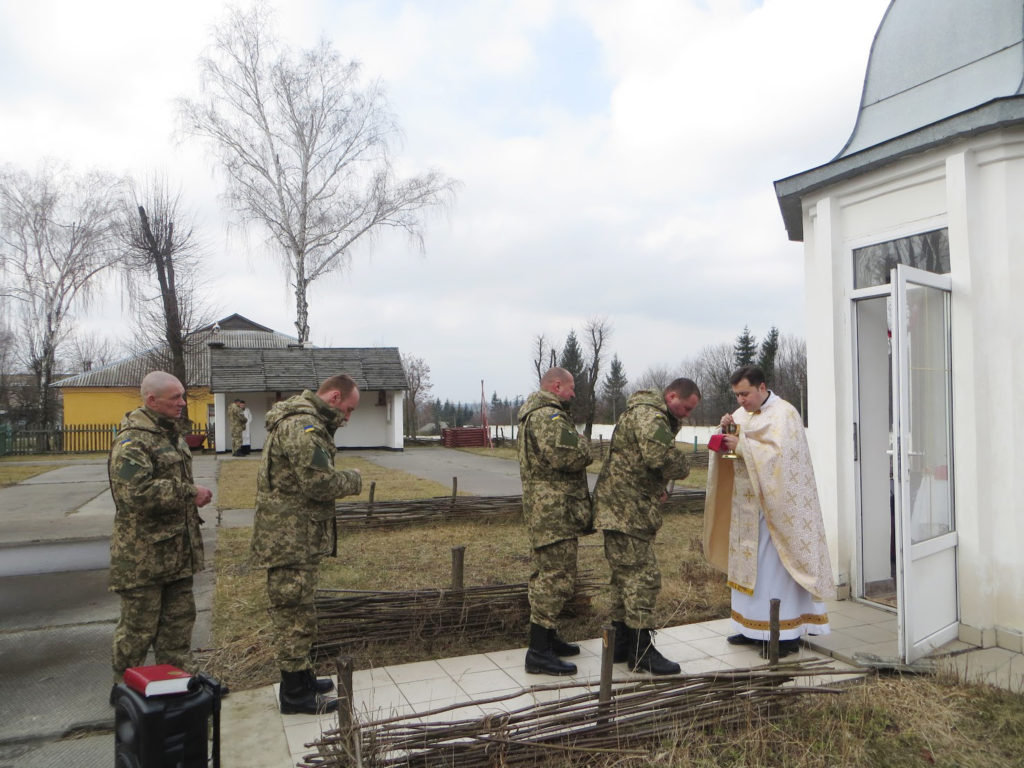
Fr. Taras Mykhalchuk gives holy Communion to Ukrainian soldiers in Yavoriv, Ukraine, in March. (CNS photo/courtesy Mariana Karapinka)

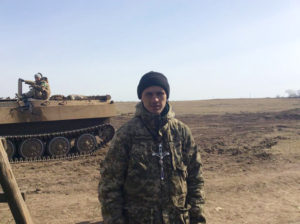
LVIV, Ukraine (CNS) — War is not easy to experience, but Jesuit Father Andrij Zelinskyj has found a calling to be on the front line.

As a military chaplain, Fr. Zelinskyj ministers to members of the Ukrainian army battling separatist rebels in eastern Ukraine’s Donbass region.

“War just reaffirmed me in my vocation,” the priest told Catholic News Service.

He has served as chaplain for 10 years, but it was not until last year when the Russia-backed rebels began an armed uprising that Fr. Zelinskyj experienced the challenges of war.

He is one of the most experienced chaplains among the hundreds of clergy of different denominations who have addressed the spiritual needs of Ukrainian servicemen since the beginning of the yearlong armed conflict in eastern Ukraine. They celebrate Mass and the Divine Liturgy, hear confessions, pray, offer a consoling ear to soldiers and administer the sacraments — even when shells explode all around.

Fr. Zelinskyj said he sees his role as being close to the soldiers, sharing their hardships and risks.

“This war is often called hybrid, but it is only true in the rear. At the forefront the war is real, for real is blood and death. Soldiers see a lot of pain and evil around them. I talk to them about values, about dignity, about their high calling to protect our motherland. I would like to bring heaven closer to them,” he said.

The yearlong war has become a catalyst for recognition of the important role of chaplains ministering to the Ukrainian armed forces. For years, their status was indefinite. The legal ground for military chaplaincy remains uncertain and legal provisions are not fully formed. The result: many priests visit war zone as volunteers and are not considered professional chaplains in the strict sense.

“When the conflict broke out, many priests were not prepared enough. But now they are well trained, for example know how to behave during shelling”, says Fr. Lubomyr Yavorskyj, coordinator of the Ukrainian Greek Catholic Chaplains.

The group includes nearly 100 priests, 74 of whom have visited the war zone in Donbass. Three have been wounded.

In late March, 14 Greek Catholic priests served in the war zone. All have received permission from their bishop and the military command to serve. As civilians, chaplains hold no military ranks.

Pallotine Father Viacheslav Hrynevych, a Roman Catholic priest, said he originally was focused on charity and planned to work with homeless people. Later, he felt called to become a chaplain. He told Catholic News Service that he has been on the front lines during the last year and was so close that he “has seen separatists with binoculars.”

Fr. Hrynevych is part of a mobile group that includes a psychologist and a psychiatrist. They visit various military divisions near Artemivsk, north of rebel-controlled Donetsk.

“I’m always deeply moved when I feel that the person truly trusts me and shares deep feelings or sincerely repents in confession,” Fr. Hrynevych said.

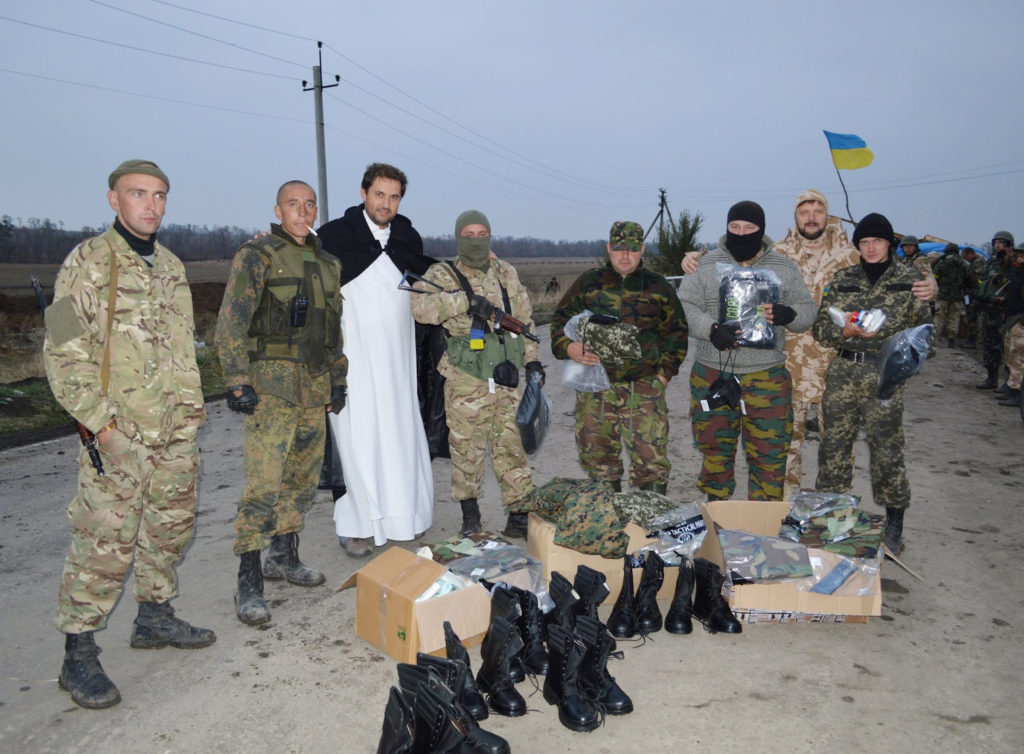
Fr. Leonard Aduszkiewicz, pastor of Our Lady of Czestochowa Parish in Mariupol, Ukraine, poses with Ukrainian soldiers at a checkpoint near the city in this September 2014 photo. (CNS photo/courtesy Mariana Karapinka)

Fr. Leonard Aduszkiewicz is pastor of Our Lady of Czestochowa Parish in Mariupol, less than 30 miles from Russia. When the battle front neared the city, the checkpoints surrounding it became his extended parish. Fr. Aduszkiewicz regularly visits the checkpoints with volunteers and other clergy, bringing Bibles, rosaries and religious books as well as food, clothing and hygiene supplies.

The visits are examples of the ecumenism involved in the military chaplaincy as Roman Catholic, Greek Catholic and Orthodox priests join a Protestant deacon minister together.

“After arriving in Mariupol, I started establishing relations with Orthodox, Greek Catholic and Protestant communities,” Fr. Aduszkiewicz said. “Now these past initiatives bring incredible fruit. Soldiers perceive us differently when they see us together. They see not hostility but friendship and this helps them spiritually.”

In Lviv, hundreds of miles from the war zone, Sts. Peter and Paul Garrison Church, a Jesuit parish, became headquarters for chaplains and one of the main centers for volunteers who help the troops. A team of 13 priests, whose average age is 32, serves at the military bases and in a local military hospital, working with families who have lost someone at war.

The parish has also provides material support to soldiers. They collected more than $340,000 to buy uniform, boots, first-aid kits, hygiene kits and food. Fr. Taras Mykhalchuk, a priest at the church, said clergy appreciate the opportunity to work with the volunteers.

“I thank God that he entrusted us this field of ministry in these difficult circumstances,” Fr. Mykhalchuk said.

The priests acknowledged that working as a military chaplain offered a unique experience for their priesthood. They said the challenges they have faced reshaped their vocation.

“This vocation brings meaning in my life. I want to be useful, to participate in the defense of my country but as a priest,” Fr. Zelinskyj said.

Pallotine Father Viacheslav Hrynevych stands on front line between Ukrainian armed forces and pro-Russian separtists  near Troitske, Ukraine, March 24, 2014. (CNS photo/courtesy Mariana Karapinka)
Pallotine Father Viacheslav Hrynevych stands on front line between Ukrainian armed forces and pro-Russian separtists near Troitske, Ukraine, March 24, 2014. (CNS photo/courtesy Mariana Karapinka)

Despite the rewards, the work becomes especially difficult when a soldier who has become a friend dies, he said.

Even so, the priests know their ministries fill a deep need for the men who face death every day.

“I experience a special spiritual adventure, that’s my chance for meeting with God, a chance to rethink the power of prayer and God’s presence,” Fr. Hrynevych said. “I would say that being in the war zone for me is an accumulation of God’s grace.”

By Mariana Karapinka, Catholic News Service.

Humility is key to understanding Easter, sharing its joy, pope says

Pope Francis reaches to greet a child after celebrating Easter Mass in St. Peter's Square at the Vatican April 5. (CNS photo/Paul Haring)

VATICAN CITY (CNS) — To enter Christ’s empty tomb like the disciples and see that he has risen, Christians today also must “bend down,” Pope Francis said in his Easter message.

“Love has triumphed over hatred. Life has conquered death. Light has dispelled the darkness,” he told tens of thousands of rain-drenched pilgrims in St. Peter’s Square April 5.

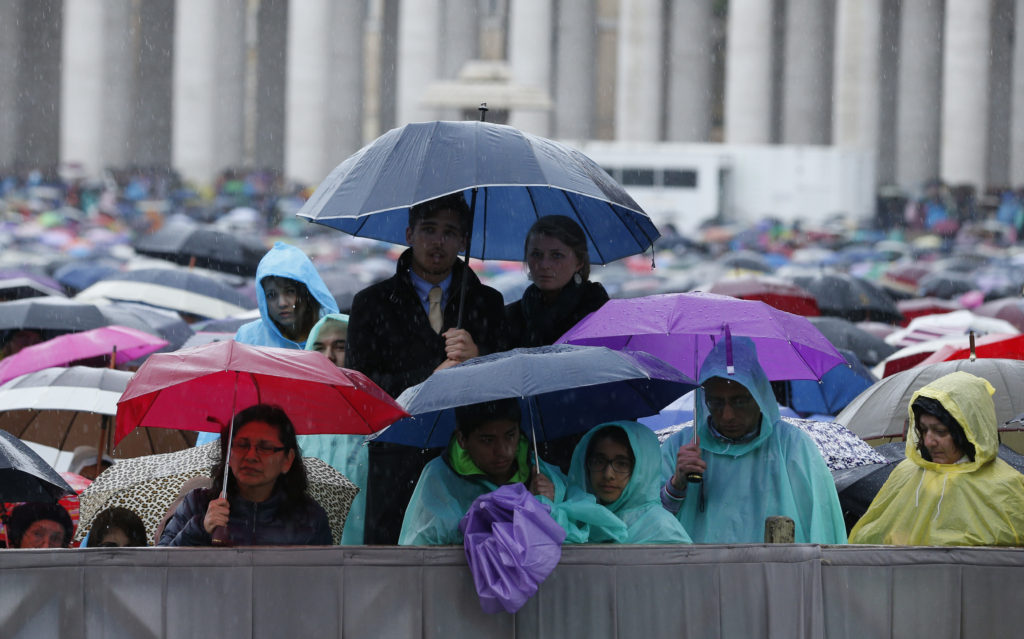
Rain fell and fell hard throughout most of the outdoor Mass. While most people had umbrellas, their flimsy plastic ponchos were no match for the wind and downpour. The ciboria used to distribute Communion to the crowd were covered with plastic wrap, only partially pulled back when the faithful approached.

Still, they stayed for the Mass and for the pope’s solemn Easter blessing “urbi et orbi” (to the city and the world).

Pope Francis greets the crowd after delivering his Easter message and blessing "urbi et orbi" (to the city and the world) from the central balcony of St. Peter's Basilica at the Vatican April 5. (CNS photo/Paul Haring)
Pope Francis greets the crowd after delivering his Easter message and blessing “urbi et orbi” (to the city and the world) from the central balcony of St. Peter’s Basilica at the Vatican April 5. (CNS photo/Paul Haring)

Pope Francis did not give a homily during the morning Mass, but his Easter message before the blessing picked up a theme he had begun at the Easter vigil the night before: The mystery of Easter cannot be understood — and the Christian faith cannot be lived fully — without humility.

“By his death and resurrection, Jesus shows everyone the way to life and happiness: this way is humility, which involves humiliation,” Pope Francis said. “This is the path which leads to glory. Only those who humble themselves can go toward the ‘things that are above,’ toward God.”

To enter into the mystery of God’s love, he said, “we need to ‘bend down,’ to abase ourselves. Only those who abase themselves understand the glorification of Jesus and are able to follow him on his way.”

Obviously, he said, that often involves being countercultural. Instead of putting ourselves first, he said, “Christians, by the grace of Christ, dead and risen, are the seeds of another humanity, in which we seek to live in service to one another, not to be arrogant, but rather respectful and ready to help.”

“This is not weakness, but true strength!” the pope said. “Those who bear within them God’s power, his love and his justice, do not need to employ violence; they speak and act with the power of truth, beauty and love.”

As is traditional for the “urbi et orbi” message, Pope Francis offered prayers for an end to war and violence in specific countries, mentioning by name Syria, Iraq, the Holy Land, Libya, Nigeria, South Sudan, Congo, Yemen and Ukraine.

In better news, the pope said, “in hope, we entrust to the merciful Lord the framework recently agreed to” in order to prevent Iran from developing a nuclear weapon. The pope prayed that it would be “a definitive step toward a more secure and fraternal world.”

People huddle under umbrellas as they wait for the start of Pope Francis' celebration of Easter Mass in St. Peter's Square at the Vatican April 5. (CNS photo/Paul Haring)
People huddle under umbrellas as they wait for the start of Pope Francis’ celebration of Easter Mass in St. Peter’s Square at the Vatican April 5. (CNS photo/Paul Haring)

As he had at every Holy Week and Easter service, Pope Francis offered special prayers for persecuted Christians, asking that “Jesus, the victor over death,” would ease their suffering.

Pope Francis’ Easter celebrations began in the dark of a rainy night April 4 in the atrium of St. Peter’s Basilica. Hot embers glowed until the Easter fire was lit and with it the paschal candle. As a deacon carried the candle into the church, Pope Francis followed with a large taper.

Although only the pope and the deacon had candles, the basilica was aglow with smartphone and tablet displays as people tried to get photos. However, as the pope neared the front of the basilica, the congregation — mostly nuns, priests, bishops, cardinals and ambassadors close to the altar — was more disciplined and the impact of scattered lit candles grew.

While the pope was busy with the Easter liturgies, he sent Archbishop Konrad Krajewski, the papal almoner, out to the city’s train stations, shelters and streets with Easter cards for the homeless. He handed out about 300 envelopes, each of which included an undisclosed amount of money.

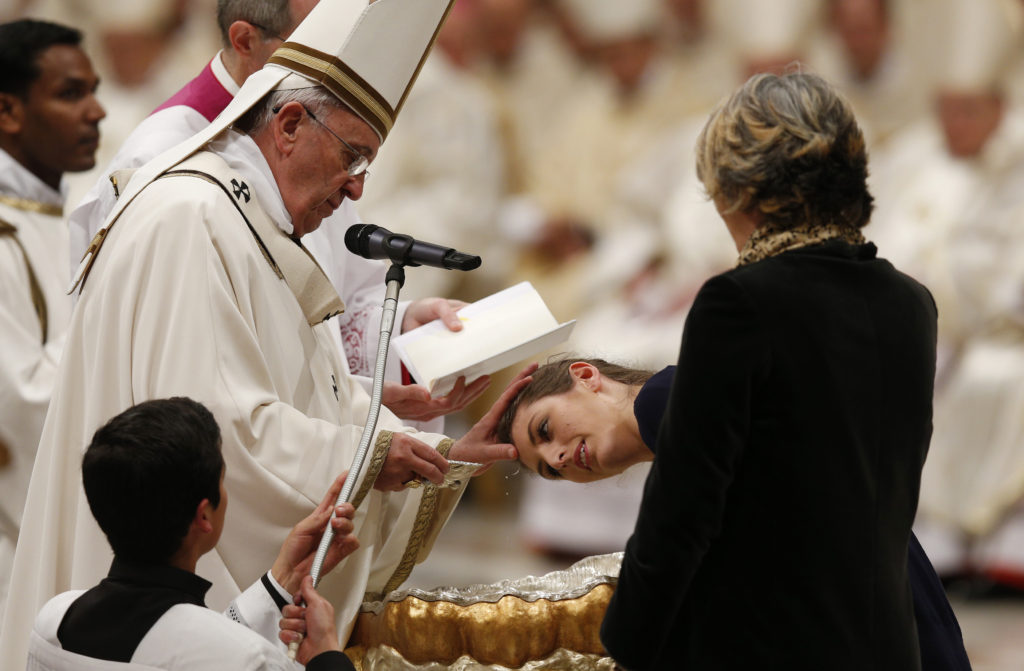
During the Easter vigil Mass, Pope Francis baptized, confirmed and gave first Communion to 10 people, who ranged in age from 13 to 66. Four were Italian, three were Albanian and one each came from Cambodia, Kenya and Portugal.

Pope Francis rubbed the chrism oil all over their foreheads and, during the confirmation rite, tenderly gave each one a kiss on the right cheek.

The youngest of the new Catholics — Champa Buceti, a 13-year-old Cambodian, and Francesco Comegna, a 28-year-old Italian — brought up the gifts at the offertory.

As with his “urbi et orbi” message, Pope Francis’ homily during the Easter vigil, which lasted just over two and a half hours, focused on the humility required of Christians.

Pope Francis baptizes Giulia Riccardi from Italy during the Easter Vigil in St. Peter's Basilica at the Vatican April 4. (CNS photo/Paul Haring)
Pope Francis baptizes Giulia Riccardi from Italy during the Easter Vigil in St. Peter’s Basilica at the Vatican April 4. (CNS photo/Paul Haring)

The only way to enter into the Easter mystery, he said, is with humility, “to come down from the pedestal of our ‘I’ which is so proud, of our presumption; the humility not to take ourselves so seriously, recognizing who we really are: creatures with strengths and weaknesses, sinners in need of forgiveness.”

“It is good for us, on this vigil night, to reflect on the experience of the women” who went to Jesus’ tomb Easter morning to anoint his body, he said. Entering the tomb is to enter “into the mystery which God has accomplished with his vigil of love.”

“We cannot live Easter without entering into the mystery. It is not something intellectual, something we only know or read about,” he said. “It is more, much more!”

Entering the mystery means being able “to wonder, to contemplate; the ability to listen to the silence and to hear the tiny whisper amid great silence by which God speaks to us.”

To enter the tomb and enter the mystery takes courage, the pope said. It “demands that we not be afraid of reality, that we not be locked into ourselves, that we not flee from what we fail to understand, that we not close our eyes to problems or deny them, that we not dismiss our questions.”

— By Cindy Wooden Catholic News Service. Contributing to this story was Carol Glatz at the Vatican.