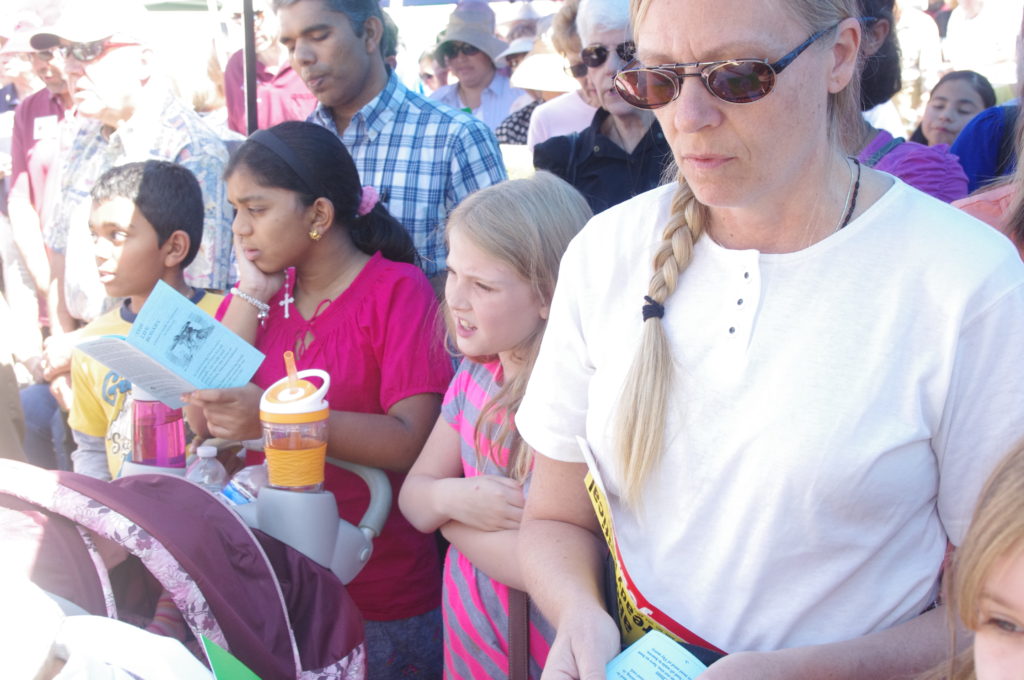
On April 4, about 15 parishioners from St. Maria Goretti Parish lovingly collected the breads, lamb-shaped butter, meat, eggs, horseradish, wine, chocolates and other items their family and friends will feast on Easter Sunday into large wicker baskets and brought them to the church hall on Holy Saturday for the traditional Easter Basket Blessing. It’s a Catholic ritual for many families of Eastern European origin that gained strength in the United States in the 1870s. (Ambria Hammel/CATHOLIC SUN)
On April 4, about 15 parishioners from St. Maria Goretti Parish lovingly collected the breads, lamb-shaped butter, meat, eggs, horseradish, wine, chocolates and other items their family and friends will feast on Easter Sunday into large wicker baskets and brought them to the church hall on Holy Saturday for the traditional Easter Basket Blessing. It’s a Catholic ritual for many families of Eastern European origin that gained strength in the United States in the 1870s. (Ambria Hammel/CATHOLIC SUN)
SCOTTSDALE — It’s not just the Easter Bunny who prepares baskets with goodies for the day of the Lord’s Resurrection. Catholic women do too.
On April 4, about 15 of them from St. Maria Goretti Parish lovingly collected the breads, lamb-shaped butter, meat, eggs, horseradish, wine, chocolates and other items their family and friends will feast on Easter Sunday into large wicker baskets and brought them to the church hall on Holy Saturday for the traditional Easter Basket Blessing. It’s a Catholic ritual for many families of Eastern European origin that gained strength in the U.S. in the 1870s, according to Dcn. Lou Cornille who oversaw the blessing.
Many of the women gathered were of Polish descent with Croatia, Ukraine, Italy and the U.S. also represented. St. Maria Goretti has invited area Catholics to the blessing off and on for the last 15 years and steadily the last four years.
On April 4, about 15 parishioners from St. Maria Goretti Parish lovingly collected the breads, lamb-shaped butter, meat, eggs, horseradish, wine, chocolates and other items their family and friends will feast on Easter Sunday into large wicker baskets and brought them to the church hall on Holy Saturday for the traditional Easter Basket Blessing. It’s a Catholic ritual for many families of Eastern European origin that gained strength in the United States in the 1870s. (Ambria Hammel/CATHOLIC SUN)
Maryann McAllen has been coming since the beginning. It’s generally a small enough gathering that there’s a show-and-tell of sorts prior to the blessing. McAllen, a Scottsdale native, loves hearing about the various cultural traditions.
“I always cry every time because I hear different things from the families and I take something away,” McAllen said.
She brings one of her children every year so they can learn too. That’s exactly why the parish offers an Easter basket blessing, Dcn. Cornille said.
“Parents and grandparents have been doing this for centuries. If we don’t involve the children, the tradition will die,” he said.
Many shared how they or the generation before them once made the Polish sausage, bread or lamb butter. Now many of them choose the quicker option of a local Polish bakery to assist with Easter dinner preparations.
Denise Krupa was excited to have her water blessed so she could spread it to the neighbors. Another woman plans to give each guest a bottle of blessed salt to take home. The life-giving mineral was once believed to keep away evil.
The other traditional Easter basket foods have symbolic meaning too: bread symbolizing Christ’s body, eggs symbolizing victory over death, horseradish symbolizing strength and the bitterness of suffering and ham for health and abundance.
“The Lord gave us senses so we could experience Him. That’s what the Easter meal is all about,” Dcn. Cornille said.
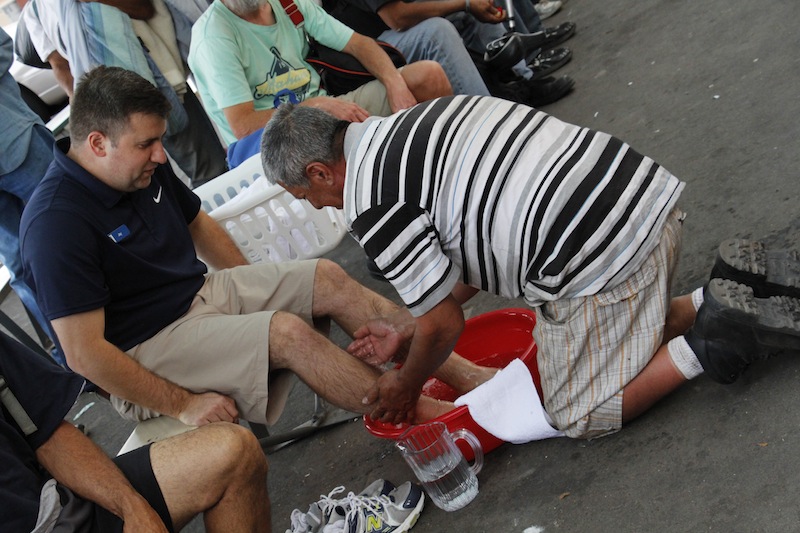
Hector, an André House guest who said he hasn't eaten in three days, insisted on washing the feet of one of the core team leaders. He never did return to the food line, insisting that "someone else needs it more than I do." In remembrance of the humble act of Jesus and His call to humble servitude, each Holy Thursday the André House community in Phoenix gathers and washes the feet of their guests. (Ambria Hammel/CATHOLIC SUN)
Hector, an André House guest who said he hasn’t eaten in three days, insisted on washing the feet of one of the core team leaders. He never did return to the food line, insisting that “someone else needs it more than I do.” In remembrance of the humble act of Jesus and His call to humble servitude, each Holy Thursday the André House community in Phoenix gathers and washes the feet of their guests. (Ambria Hammel/CATHOLIC SUN)
Hector, a guest at André House, had just finished washing and conditioning with lotion the feet of Jay, a second year volunteer on the core team at the Holy Cross-run ministry for homeless in the Phoenix area.
“I can’t believe I did it!” Hector exclaimed with extreme joy in his face and not a hint of hunger.
Hector sat several minutes in the outside line closest to the dining room longing not for food — “someone else needs it more than I do,” he said — but to wash someone’s feet, as part of André House’s longtime tradition: washing and caring for the feet of the guests as they awaited their turn in the soup line.
“That act of service… to have one of our guests insist on washing one of the core member’s feet was very moving,” said Therese Barnhart, director of volunteer services and communication.
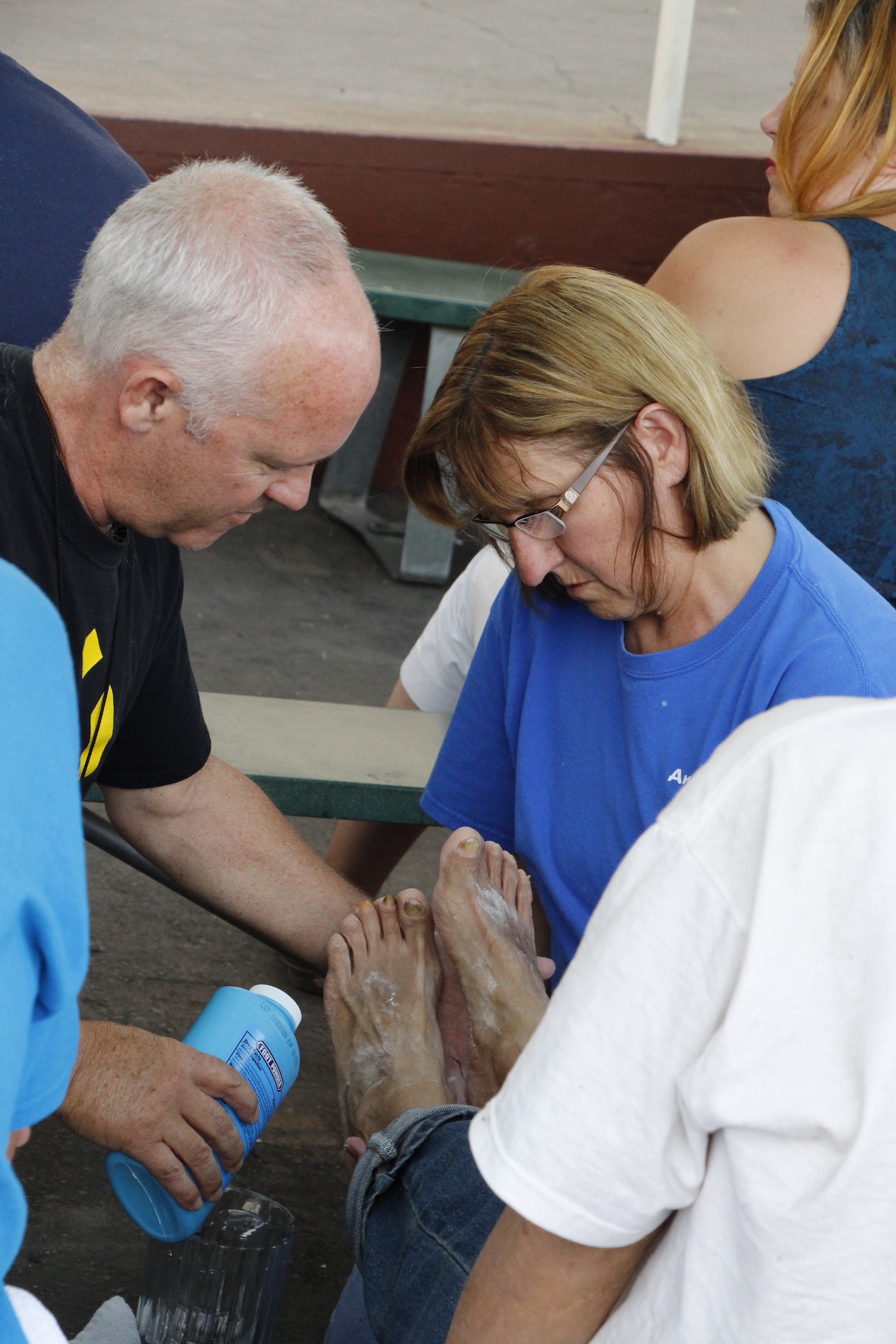
She also noted the relaxed atmosphere of the volunteers and the overall joyful spirit. Some volunteers reminded the guests about the example Jesus showed at the Last Supper while they massaged their guest’s tired, worn feet. They also fitted the guests with new, clean white socks.
“It’s living out the gospel of the day,” Holy Cross Brother Richard Armstrong said.
Volunteers wash the feet of an André House guest on Holy Thursday April 2 in remembrance of the humble act of Jesus and His call to humble servitude. (Ambria Hammel/CATHOLIC SUN)
Carrying on what Jesus did for His disciples is what prompted Allison Ghan to spend a second Holy Thursday at André House April 2. This time she brought two others from City Square Church with her. She found the experience humbling and called it “a beautiful blessing.”
Ghan was very aware that many of André House’s guests may go long periods without experiencing human touch. She is a social worker at the county’s Healthcare for the Homeless on the Human Services Campus next to André House and recognized some of her clients. The foot-washing allowed her to interact with them on a more human level.
James isn’t one of Ghan’s clients, but she did get to wash his feet. It was an opportunity he couldn’t pass up. He didn’t pass up the opportunity to pray either. James, who said Jesus called him to be a preacher, prayed for all of the guests getting their feet washed that evening, for peace in the world and for safety, especially of fellow homeless guests.
Jamie Bailey has been regularly washing feet at André House on Holy Thursday since she visited the facility as a Seton Catholic Preparatory student in 2001. She has missed some here and there if she was pregnant or had very young children, but makes it a priority when she can.
“The people that you meet are so incredible. They do more for us than we do for them,” said Bailey, who got a baby-sitter so she and her husband, Eric, could serve together.
She even had a practice run earlier in the week. To help explain to her 6, 3 and 2-year-olds why they would be away, Bailey held a similar washing of the feet on Tuesday.
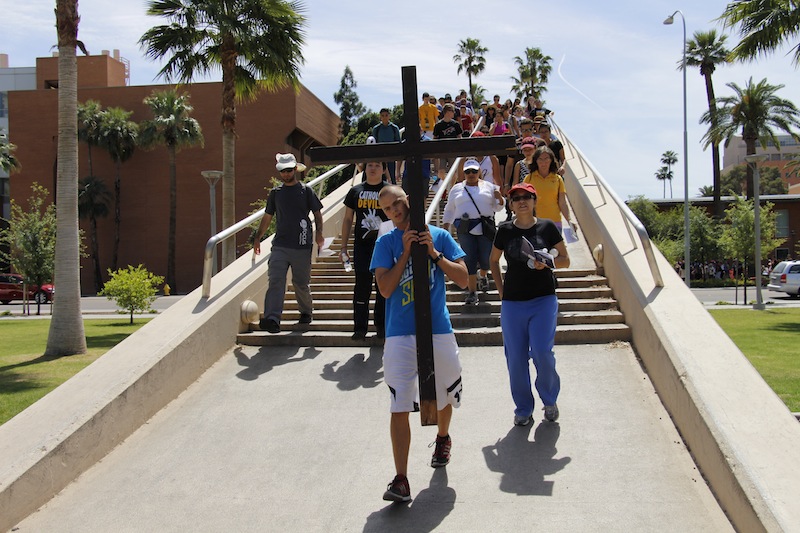
The Good Friday Stations of the Cross at Arizona State University drew hundreds of students, adults and families April 3, 2015. It moved throughout campus and concluded atop “A” Mountain. (Ambria Hammel/CATHOLIC SUN)
TEMPE — The Way of the Cross was hard. That didn’t stop Catholics of all ages from yearning to experience a piece of Jesus’ suffering on Good Friday.
They endured a 90-minute midday walk around Arizona State University April 3 for its annual Stations of the Cross. Families, couples, individuals and even some Northern Arizona University students joined ASU students outside the interfaith chapel on campus to reflect on “Everyone’s Way of the Cross.”
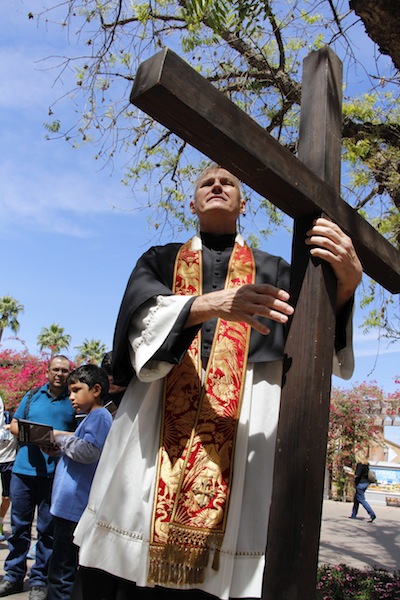
Fr. Rob Clements, pastor and director of the university’s All Saints Newman Center, read the First Station of the Cross and carried it to the second station. Other student leaders took turns with the remaining reflections and carrying the large wooden cross around campus.
Fr. Rob Clements, director and pastor of the All Saints Newman Center in Tempe, holds the cross at the First Station of the Cross outside of ASU’s interfaith chapel. The Good Friday Stations of the Cross at Arizona State University drew hundreds of students, adults and families April 3, 2015. It moved throughout campus and concluded atop “A” Mountain. (Ambria Hammel/CATHOLIC SUN)
“The reading wasn’t bad. The cross was heavier than I thought,” Zach Blomberg told The Catholic Sun on a short walk back to campus.
The sophomore and member of Phi Kappa Theta, the Catholic fraternity on campus, volunteered to be among the cross-bearers who also led one of the meditations. He said it was a good way to put himself in Jesus’ footsteps.
Blomberg visualized each station while walking amongst the crowd. He said the Twelfth Station when Jesus dies always moves him.
“This is always a tough one. I definitely feel my heart breaking a little on that one,” Blomberg said.
Steven Sanchez, a senior and one of the cross-bearers, said he felt humbled and said the journey up “A” Mountain provided only a small view of what Jesus endured for humanity.
Sanchez called his participation in the Stations of the Cross a time to witness to ASU’s secular community too. Several ASU students captured parts of the journey on their camera phones as they continued about their lunch hour.
Natalie Rose, a freshman, joined in the Stations of the Cross because she remembers doing so around the downtown square at her home in Prescott. She said it felt right to continue the tradition. The Seventh Station, when Jesus falls for the second time, often moves her.
“Perseverance always resonates with me,” Rose said.
Some 150 Catholics joined together in front of a Planned Parenthood facility to pray the rosary. Bishop Thomas J. Olmsted has led the rosary prayer at an abortion site each year on Good Friday since he arrived to lead the Diocese of Phoenix in 2003. (Joyce Coronel/CATHOLIC SUN)
Some 150 Catholics joined together in front of a Planned Parenthood facility to pray the rosary. Bishop Thomas J. Olmsted has led the rosary prayer at an abortion site each year on Good Friday since he arrived to lead the Diocese of Phoenix in 2003. (Joyce Coronel/CATHOLIC SUN)
GLENDALE — Good Friday found more than 150 local Catholics praying in front of a Planned Parenthood facility, one that performs abortions up to 24 weeks.
And whether through the use of pills that induce an abortion or surgery, pro-lifers know that many babies die at the facility on a regular basis. Anita Usher, a 40 Days for Life coordinator, said she’s seen women enter the abortion center visibly pregnant.
Luisa Lukaszewski, a mother of seven children ages 2-18, was busy spreading sunscreen as the crowd stood under a cloudless sky, drenched in sunlight on April 3.
“This is our annual tradition. We’re always here on Good Friday and Christmas Eve and we want to stand for life,” Lukaszewski said. “There are babies who are killed here every day and there are moms and doctors that don’t realize the gift that they are getting rid of and throwing away.”
Bishop Thomas J. Olmsted has led a rosary at an abortion site each year on Good Friday since he arrived to lead the Diocese of Phoenix in 2003.
“This is Calvary — this is where the innocent is unjustly killed just as Jesus was on Calvary,” Bishop Olmsted said. “We need to be standing in communion with them and also be here for their mothers and for others. We can assure them that there’s another way and there’s certainly a much better choice they could make.”
As the rosary prayers continued just outside the facility, women continued to arrive for scheduled appointments.
“Come talk to me,” one of the pro-lifers called out to one. “Don’t do this. You’ll regret it for the rest of your life. We can help you. I’ll adopt your baby.”
Laurie Pittsenbarger of Life Choices Women’s Clinic and Tonya Gruszynski of the Hope Mobile stood on the sidewalk adjacent to the facility, attempting to talk to Planned Parenthood clients.
Gruszynski spoke to one woman and persuaded her to seek attention inside the Hope Mobile, a pro-life resource center on wheels that was parked near Planned Parenthood. The woman decided not to keep her appointment at the abortion facility and instead sought services at Life Choices.
Still, he’s frequently found praying in front of abortion facilities, just as he was before the attack that took the life of his brother priest, Fr. Kenneth Walker, FSSP.
“We do this every year,” Fr. Terra said of the Good Friday rosary. “I spend a lot of time out here every week. When the most innocent of all lives is taken, why not?”
Ellen Sweeney, who’s been active in the pro-life movement since the 1970s, shielded her eyes from the sun as she looked out over the crowd.
“The bishop’s right — this is our current Calvary,” Sweeney said. “If we call ourselves Christians, this is where we need to be.”
At 24 weeks, the stage at which some of the abortions take place at the Glendale facility, the unborn child is just one week away from being considered viable. About 36 percent of babies born at 24 weeks survive, though often with serious complications. Abortion services at the Glendale Planned Parenthood range in price from $400 to $1,900.
Schulzetenberg will proclaim one of the readings in English at Easter Sunday Mass with Pope Francis. (courtesy photo)
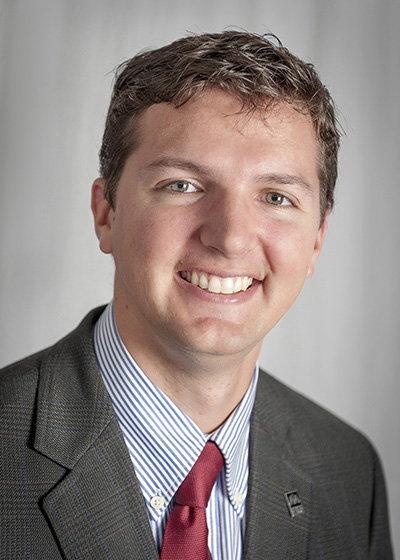
Thomas Schulzetenberg will proclaim one of the readings in English at Easter Sunday Mass with Pope Francis. (courtesy photo)
ROME, ITALY — Even though Thomas Schulzetenberg — pronounced Schull-tzen-berg — comes from great German heritage and is a native Minnesotan, he has a masterful understanding of the English language and especially the Catholic faith.
These are two important prerequisites for the honor that has been bestowed upon him by Pope Francis. The Vatican has asked Schulzetenberg to lector in English during Pope Francis’ Easter Mass April 5 at St. Peter’s Basilica. The Mass itself is attended by thousands of people and watched on TV by millions more around the world.
“I hope to be doing very little thinking during the actual moment,” said Schulzetenberg through email from his home on the University of Mary Rome campus where he is director and administrator of 25 students that are studying there this semester. “I don’t want to stumble upon a word or make any mistakes! I think I just want people to hear the word of God, and not concentrate on the guy who is speaking it.”
Schulzetenberg, who has attended many masses of Pope Benedict and Francis in his three year tenure as director of the University of Mary Rome campus, believes the opportunity for an American to be reading at any Papal mass is extremely rare. “To my recollection, there is not always an English reader at Papal liturgies and those that do are English speaking from other countries. That being said, it’s all that more impressive I was chosen for this specific event.”
The call came from Fr. Geno Sylva, who works in the Pontifical Council for the New Evangelization at the Vatican and who says a mass in English once a week. “He told me he appreciates my work with the University of Mary, and is so impressed by the Mary students that attend his Sunday mass. He feels that our family is not only a good witness to these young men and women, but also a great sign of faithfulness to those pilgrims that attend the Sunday mass. Moreover, he told me that as an English lector, I will be representing not just the University of Mary or the United States, but all English speaking peoples. So, to represent so many people is really humbling.”
Also very humbling to Schulzetenberg is the fact that he is expected to meet Pope Francis in person. “I’ve been told that my family will have special seats, so I’m hoping that we will have a brief opportunity to greet him at some point.”
Schulzetenberg isn’t sure yet which reading he will be assigned or if it will be from the Old Testament or the New Testament. He finds out about all those details Saturday during rehearsal.
“They say that everybody has 15 minutes of fame,” said Schulzetenberg. “Since the reading is not quite that long, I think it will be my five minutes of fame.”
Thomas Schulzetenberg, seen here with his son and University of Mary students in Lourdes, will proclaim one of the readings in English at Easter Sunday Mass with Pope Francis. His students hope to have front row seats for the liturgy. (courtesy photo)
One of Schulzetenberg’s students at the University of Mary Rome campus, Andrew Meyer, already experienced his few minutes of fame in January when he exchanged zucchettos with Pope Francis. It’s unclear whether Schulzetenberg will exchange anything other than a handshake when they meet each other on Easter Sunday.
Schulzetenberg’s students at the University of Mary Rome campus hope to arrive early and have front row seats to the Holy Father’s Easter Mass. Meanwhile, Schulzetenberg’s proud parents back in Greenwald, Minnesota, will also watch it live, but from their living room television beginning at 3:15 a.m. CDT on EWTN.
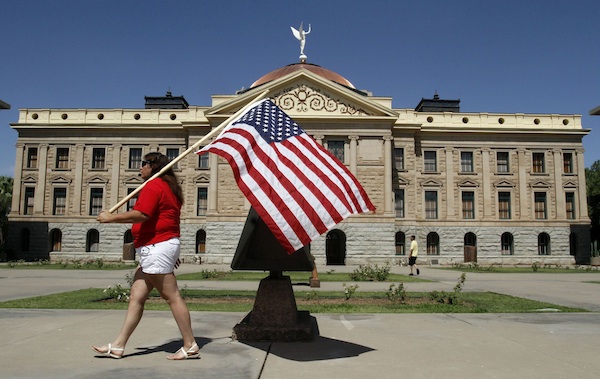
Allison Culver marches with a U.S. flag around the Arizona State Capitol after the Supreme Court upheld a key part of Arizona's crackdown on illegal immigrants in Phoenix June 25. The high court, in a mixed opinion with several dissents, rejected much of the law, known as S.B. 1070. However, it affirmed the section requiring state law enforcement officials to check the immigration status of detainees they suspect are in the country illegally. (CNS photo/Darryl Webb, Reuters)
SB 1318, una medida que require que los impuestos no financien los abortos, se promulgó durante los últimos días en que los católicos anticipan al Domingo de Resurrección, en el que se conmemora el triunfo de Cristo sobre el pecado y la muerte.
La nueva ley también incluye una disposición en el que las mujeres deben ser informadas de que los efectos de la píldora abortiva pueden revertirse.
En un comunicado firmado por los seis obispos católicos que componen el Arizona Catholic Conference, y que incluye Obispo Thomas J. Olmsted y el Obispo Auxiliar Eduardo A. Nevares de la Diócesis de Phoenix, los obispos expresaron su agradecimiento por la nueva legislación.
“SB 1318 es una ley simple que da mejor protección a los contribuyentes que no quieren subvencionar el aborto. Estamos agradecidos por el hecho de que Arizona sigue siendo un estado que valora la vida inocente desde el momento de la concepción hasta la muerte natural, y que la SB 1318 ha sido firmado en ley”, declara el comunicado.
Jason Walsh, director ejecutivo de Arizona Right to Life, dijo que las encuestas indican que el público se opone el uso de los impuestos para pagar el aborto.
Los de la izquierda quieren que nos veamos radicales, pero cuando se trata de proteger vidas humanas inocentes, ese es el enfoque de la ley”, dijo Walsh.
Ron Johnson, director ejecutivo de la ACC, dijo que la disposición de la ley acerca del consentimiento informado con respecto a la píldora abortiva no es garantía de reversión.
“Nunca existe tal garantía, pero hay mujeres que lamentan su decisión”, dijo Johnson. “Hemos escuchado testimonio, en reunion de comisión, de un médico que dijo que tuvo un paciente que vino a su consulta, después de que salió de Planned Parenthood, porque había cambiado su manera de pensar”.
En la clínica, a la mujer se le dijo que “no había posibilidades de reversión pero ella sacó su teléfono, buscó ‘reversión de pildora abortiva’ y descubrió que había posibilidades. Ella fue a ver a un médico y salvó al bebé”, dijo Johnson. “Las afirmaciones de algunos de que no existe evidencia son absurdas, porque sí, hay evidencia. Es que es relativamente nueva.”
El Dr. Alan Sawyer, un obstetra-ginecólogo que testificó a favor de la ley SB 1318, también escribió un artículo de opinión en el Arizona Republic alabando la nueva ley. Sawyer y el Dr. Clint Leonard, también un OB-GYN y coautor del artículo, escribieron que ellos habían administrado el régimen de reversión de la píldora abortiva a mujeres que lamentaron tomar la primera píldora abortiva y que “hasta la fecha, más de 80 nacimientos vivos han sido registrados” y que “hay más de 60 embarazos sanos debido a la reversion de la píldora abortiva”.
Arizona es el primer estado que require que los médicos informen a las mujeres de la posibilidad de reversión de los efectos de la píldora.
VATICAN CITY (CNS) — In a moving ceremony that recalled how Jesus loved the world so deeply that he lowered himself to serve and died for everyone’s sins, Pope Francis washed the feet of 12 prison inmates, plus a small toddler who lives with his incarcerated mother.
“Jesus loved us, Jesus loves us, but without any limits, always, all the way to the end,” he said during the Holy Thursday Mass of the Lord’s Supper April 2.
“He does not tire of loving anyone, he loves all of us” so much that he gave his life in order “to give life to us, for each one of us … for you, for you, for me, for them,” he said, pointing to the men and women inmates gathered in the “Our Father” chapel in Rome’s Rebibbia prison complex.
The pope arrived at the prison to the cheers and shouts of hundreds of prisoners chanting “Francesco” and applauding as they stood along metal barricades lining a prison courtyard.
After getting out of a blue four-door vehicle, the pope turned to a large concrete prison block behind him and waved, presumably because voices and cheers were coming from within the heavily barred windows.
He greeted, hugged, clasped hands with and kissed the scores of inmates outside lining the barricade. Many held plastic rosaries out to be blessed; others wanted just to stroke his hand or ask him to pray for someone in a picture they showed him.
Despite the solemnity during the opening procession of Mass, many could not contain their emotion and joy at seeing the pope and the congregation of 300 inmates, prison staff and volunteers broke out in applause and people leaned in close to touch the pope, congesting an already narrow center aisle.
In his brief, off-the-cuff homily, the pope explained the meaning of the Lord’s Supper and the significance of Jesus washing his apostles’ feet.
Back in Jesus’ era, he said, when people came to visit, their feet would be dirty from wearing sandals on dusty roads.
“They didn’t have sampietrini cobblestones back then,” he said, as people smiled, recalling Rome’s signature lava stone-lined streets.
But instead of having a slave wash the apostles’ feet, Jesus performed the ritual himself to the apostles’ shock and incomprehension, the pope said.
Jesus loved people so much, he said, that “he became a slave in order to serve us, heal us, cleanse us,” he said.
Pope Francis said the church today asks “the priest to wash the feet of 12 people in memory of the 12 apostles.”
But in order to draw authentic meaning from the ceremony, everyone must “have the certainty in our hearts, we must be sure that when the Lord washes our foot, he washes away everything, he purifies us, he makes us feel his love once more.”
He said the men and women who would participate in the foot washing ceremony would be representing everyone, all 2,100 people, housed in the detention facility.
The pope then said that he, too, needed to be cleansed by the Lord, and asked that everyone pray that “the Lord also wash away my filth so that I become more of your servant, more of a servant in the service of the people, like Jesus was.”
Earlier in the day, the pope’s @Pontifiex Twitter account had the tweet: “Jesus washes the feet of the Apostles. Are we ready to serve others like this?”
After his homily, the pope removed his vestments and put on a large white garment tied over his alb. He kneeled before each of the 12 detainees: most were Italian, others came from Nigeria, Congo, Ecuador and Brazil. Two aides assisted the 78-year-old pope in kneeling and pulling him back up.
The pope poured water from a white plastic pitcher over each person’s foot, scrubbed it slowly with a white towel, bent low to kiss it and then looked up into the eyes of each person with a broad smile.
The gentle and caring gestures brought many of the inmates to tears while children’s squeals and banter bounced off the tall brick walls of the chapel.
Before washing the foot of a mother from Nigeria, the pope washed the tiny foot of her small boy, who calmly watched the proceedings from his mother’s lap.
She was one of many female detainees at the Mass who live in the prison’s maternity section, which houses incarcerated mothers with their children who are younger than three.
When the Mass ended, the pope patiently and happily made his way down the center aisle that had now become chocked with inmates eager for a hug and blessing. The pope’s guards, squeezed a few spots behind, appeared relaxed.
The evening Mass was the second of two Holy Thursday liturgies over which the pope presided. The first was a morning chrism Mass in St. Peter’s Basilica.
As Holy Thursday and the Mass of the Lord’s Supper commemorate Jesus’ institution of the Eucharist and the priesthood, the pope continued a tradition he started by having lunch with a small group of priests from the Diocese of Rome.
The Vatican newspaper said the pope used the occasion to have the 10 priests talk to him about their ministry, especially those who were working in very difficult circumstances, and to encourage them in their mission.
FLAGSTAFF — In her poem “Healing,” Diane Vreuls writes, “They say the suffering unto health hurts less than suffering unto death. Those suffering don’t say this.”
In an effort to ease the suffering of victims of abuse, especially those abused by the clergy, Bishop Thomas J. Olmsted celebrated Mass at San Francisco de Asís Parish in Flagstaff March 14, offering words of hope and healing.
It’s among a special set of liturgies hosted each year by the diocesan Office of Child and Youth Protection for survivors of abuse and their families. At the Mass, which came ahead of April being Child Abuse Prevention Month, the bishop reflected on the words of the first reading of the Mass: “Come, let us return to the Lord, … it is He who will heal us … he will bind our wounds” (Hosea 6:1).
Office of Child and Youth Protection
Bishop Thomas J. Olmsted encourages anyone who has been a victim of child sexual abuse by any employee of the Roman Catholic Church to please come forward by contacting the Office of Child and Youth Protection.
We are here because the love of Jesus prompts us, moves us, impels us,” Bishop Olmsted said. “We want whoever has been abused to know that Jesus loves them and that we love them and that they are not alone.”
Ray, a survivor of clergy abuse, knows all too well that feeling of loneliness. When he finally told his parents, they didn’t believe him.
“They thought no priest would do such things,” he said. But through it all, Ray never lost his faith in the Church or in God.
Bishop Olmsted cited a letter from Pope Francis addressing this very issue. “The Holy Father said, ‘that everything possible must be done to rid the Church of the scourge of sexual abuse of minors and to open pathways of reconciliation and healing for those who were abused.’” He said the gospel of the day with the parable of a Pharisee and a tax collector from Luke 18 tells us what attitude we need for our prayers to be heard.
“The Pharisee is arrogant… He tells God how good he is, what good things he does… The tax collector doesn’t even feel worthy to raise his eyes to heaven. He says, ‘O God, have mercy on me, a sinner.’ This is how to begin every prayer.”
Ray and his wife, Paula, now run Healing With Hope, one of the support groups in the Diocese of Phoenix for survivors of clergy abuse. The group’s mission is to provide “a safe, non-judgmental atmosphere where confidentiality is held to the highest regard,” and welcomes anyone older than 18 who has suffered sexual abuse by a clergy member from any religion. Family members are also welcome to attend.
“We discuss different topics, how we are doing, what our current struggles are, and feelings and emotions that just are,” said Ray. “We accept one another right where we are on our journeys.
“We would like to see people return to the Church who left because of the abuse,” Paula added. “But even if they aren’t ready for that, we are here to open windows and let the sun shine in.”
At a reception following the Mass, Bishop Olmsted concluded, “I am grateful to have the opportunity to assure these people that God loves them.”
Resources
Healing With Hope is a support group for victims and family members of clergy sex abuse. For more information, contact Raymondhealingwithhope1@yahoo.com.
Grief to Grace is a retreat for victims and family members of clergy sex abuse. For more information, contact Phoenix@grieftograce.org.
Demonstrators rally at Monument Circle in Indianapolis March 28 to protest a religious freedom bill signed in to law by Indiana Gov. Mike Pence. More than 2,000 people gathered at the state Capitol to protest Indiana's Religious Freedom Restoration Act because they say it would promote discrimination against individuals based on sexual orientation. (CNS photo/Nate Chute, Reuters)
Demonstrators rally at Monument Circle in Indianapolis March 28 to protest a religious freedom bill signed in to law by Indiana Gov. Mike Pence. More than 2,000 people gathered at the state Capitol to protest Indiana’s Religious Freedom Restoration Act because they say it would promote discrimination against individuals based on sexual orientation. (CNS photo/Nate Chute, Reuters)
INDIANPOLIS (CNS) — Indiana’s Catholic bishops April 1 urged people to show mutual respect for one another and allow “the necessary dialogue” to take place to make sure no one in the state will face discrimination, “whether it is for their sexual orientation or for living their religious beliefs.”
Remarking on the state’s Religious Freedom Restoration Act, signed into law March 26, they said it “appears to have divided the people of our state like few other issues in recent memory.”
Their statement came amid protests by gay rights groups and others who say that the new religious freedom law could be a vehicle of legal discrimination.
Republican Gov. Mike Pence said he stood behind the religious freedom bill passed by the Indiana General Assembly when he signed it into law, but has since asked state lawmakers to send him some clarifications to make “it clear that this law does not give businesses the right to deny services to anyone.”
“We want to make it clear that Indiana is open for business, we want to make it clear that Hoosier hospitality is not a slogan, it’s our way of life,” he said at a morning news conference March 31.
Pence attributed the firestorm over the measure to a combination of what he called “mischaracterization,” “misunderstanding” and “sloppy reporting.” As a result “Indiana has come under the harsh glare of criticism from around the country,” he said.
In their statement, the Catholic bishops reiterated the Catholic Church’s teaching that “every human being is created in the image of God,” that “every person deserves to be treated with dignity and respect” and that everyone has a right to life’s basic necessities.
“We believe that it is crucial that religious freedom be protected,” they said.
“We support efforts to uphold the God-given dignity of all the people of this state while safeguarding the rights of people of all faiths to practice their religion without undue burden from the government,” they said in conclusion.
At the signing ceremony, Pence said if he thought the religious freedom bill “legalized discrimination in any way in Indiana, I would have vetoed it. For more than 20 years, the federal Religious Freedom Restoration Act has never undermined our nation’s anti-discrimination laws, and it will not in Indiana.”
“Indiana’s law contains no reference to sexual orientation,” he said, adding that it “simply mirrors” the federal law, known as RFRA.
The 1993 law says that the government “shall not substantially burden a person’s exercise of religion” unless that burden is the least restrictive means to further a compelling governmental interest.” It does not apply to the states, so with Indiana, there are now 20 that have passed such legislation.
In a March 27 post on a blog for lawyers called IN Advance, Indiana trial lawyer Matt Anderson called his state’s measure a “vague and just a poorly written law” that he said could be applied to disputes between private citizens. “You can defend yourself in a criminal or civil action on the very broad basis of ‘any exercise of religion,'” which is how it could be used to discriminate against gays and others, he argued.
Richard Garnett, a law professor at the University of Notre Dame in northern Indiana, in an opinion column in the March 26 issue of the South Bend Tribune, called the state’s RFRA a “moderate measure” modeled after the federal law and those of several other states and said it “does not give anyone a ‘license to discriminate.'”
Garnett noted that the more than 20 years of history of the applying of RFRA statutes to specific cases shows that courts across the country “have not applied it to require excessive accommodations or exemptions from anti-discrimination laws and civil-rights protections.”
In response to criticism, House Speaker Brian Bosma and Senate President Pro Tem David Long announced that the General Assembly will consider legislation to clarify the religious freedom law, which received a large majority of support from both chambers. The Senate passed the bill 40-10, and the House approved it 63-31.
Several House members spoke out against the bill during floor debate.
Democratic Rep. Ed Delaney of Indianapolis called the bill “futile and destructive,” adding that he felt the bill would allow discrimination. House Minority Leader Rep. Scott Pelath, a Democrat from Michigan City, also raised concerns, saying that he also believed the bill would permit discrimination.
Democratic Reps. Vernon Smith of Gary and Cherrish Pryor of Indianapolis, who are African-Americans, said even though they were devout Christians, they opposed the bill because they believed it could potentially cause discrimination.
In his opinion piece, Garnett pointed out that religious freedom laws have helped people of a broad variety of faiths.
“In practice, over the last two decades or so, Religious Freedom Restoration acts have been used not to excuse illegal discrimination or harmful behavior but instead to secure humane accommodations,” Garnett said, “such as allowing members of a small Brazilian church to possess plants that are necessary to make sacramental tea, or preventing the government from firing a Rastafarian with a traditional haircut, or respecting a family’s religious objections to an autopsy of their loved one.”
Professor Daniel Conkle of Indiana University’s Maurer School of Law has repeatedly sought to debunk the claims that RFRA allows for discrimination, citing current legal cases in support of his position. He testified during the House and Senate hearings, and reiterated his position in a recent opinion column in The Indianapolis Star.
Conkle, a constitutional law expert who supports gay rights and same-sex marriage, said the RFRA legislation has “little to do with same-sex marriage and everything to do with religious freedom.”
He added that “most religious freedom claims have nothing to do with same-sex marriage or discrimination.”
Conkle said in his column the Indiana law is “anything but a ‘license to discriminate,’ and it should not be mischaracterized or dismissed on that basis.” According to Conkle, even in the narrow setting of wedding service providers, claims for religious exemptions recently have been rejected in various states, including states that have adopted RFRA legislation.
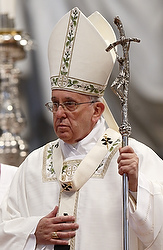
Pope Francis celebrates Holy Thursday chrism Mass in St. Peter's Basilica at the Vatican April 2. (CNS photo/Paul Haring)
VATICAN CITY (CNS) — Priestly ministry is hard, sometimes lonely or dangerous work serving the neediest with an open, vulnerable heart, Pope Francis told the world’s priests.
But priests need to learn how to draw strength from their flock and their love for God, and not look for rest or retreat in “worldly pursuits,” hiding in their office or riding in cars “with tinted windows,” he said April 2 during the chrism Mass in St. Peter’s Basilica.
Priests can find renewal when they do not try to be “supermen,” but instead put their trust in God to embrace them and carry them through, he said.
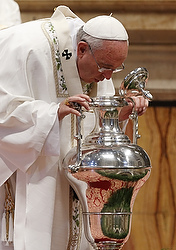
Pope Francis breathes over chrism oil, a gesture symbolizing the infusion of the Holy Spirit, during Holy Thursday chrism Mass in St. Peter’s Basilica at the Vatican April 2. (CNS photo/Paul Haring)
Presiding over the first of two Holy Thursday liturgies, Pope Francis blessed the oils that will be used in the sacraments of baptism, confirmation, ordination and the anointing of the sick.
As Holy Thursday was the day Jesus shared his priesthood with the apostles, Pope Francis led the more than 1,500 priests, bishops and cardinals in a renewal of their priestly vows and dedicated his lengthy homily to the priesthood, focusing on “the tiredness of priests.”
“Do you know how often I think about this weariness all of you experience? I think about it a lot and I pray about it often, especially when I am tired myself,” he told those assembled.
The reading from the Book of Isaiah, he said, outlines the challenging work of priestly ministry: bringing glad tidings to the lowly, healing the brokenhearted, proclaiming liberty to those held captive, releasing the imprisoned and comforting those who mourn.
If a priest is doing his job right — if his heart is open and he experiences with compassion all the troubles, fears and joys of his people, then “so many emotions, so much affection exhaust the heart of a pastor,” he said.
For a priest, knowing what one’s flock is going through is not a detached reading of “a news report,” but comes from “suffering with them.”
Sharing in people’s suffering makes the heart feel “broken into a thousand little pieces” and given away so much it almost seems “eaten up by the people,” he said, drawing a parallel with what is said at the Last Supper: take this all of you, eat this, drink this.
The 78-year-old pope, who works at an often demanding pace and is known to not take vacation, said, “How difficult it is to learn how to rest. What comes into play here is our trust and our remembering that we too are sheep and we need the Lord to help us.”
While he had warned members of the Roman Curia in December of “15 spiritual diseases” they should avoid, in his Holy Thursday homily for priests Pope Francis outlined three kinds of “weariness” they should watch out for:
exhaustion from being with the people
fatigue from fighting “the devil and his minions”
ennui from becoming selfish and worldly
Like Jesus, the priest is called to go out and care for others, he said, which leads to a kind of “weariness of the crowd.”
“People love their priests, they want and need their shepherds,” and a priest “with the smell of sheep” experiences a “good and healthy tiredness” and can smile “the smile of a father who gazes upon his children or grandchildren.”
Pope Francis leaves after celebrating Holy Thursday chrism Mass in St. Peter’s Basilica at the Vatican April 2. (CNS photo/Paul Haring)
But that gaze “has nothing to do with those who smell of expensive cologne and look at you from afar and from on high,” he said in a homily delivered in Italian.
If Jesus is there shepherding with the priest, “we cannot be shepherds whose faces are bitter, grouchy or, even worse, bored,” because being with the flock with the smile of a father reflects a weariness that brings joy, he said.
The “weariness of enemies” comes from defending one’s flock from evil and battling the devil, who tries to silence the word of God and distort it, he said.
Priests must not let down their guard and must “neutralize” the bad without destroying the good, but they also must not presume “to protect like supermen what the Lord alone must protect.”
“In these situations of weariness, the Lord says to us: ‘Have courage! I have overcome the world’ and this word gives us strength,” he said.
When talking about the third form of weariness, the “weariness of ourselves,” the pope emphasized that it was his final point “so that you won’t be too worn out by this homily,” which at 21 minutes, was longer than the norm for Pope Francis.
While the first two kinds of weariness “come from being exposed” to the outside world, which is what pastoral care demands, the third kind of weariness was “perhaps the most dangerous” because it is self-centered, he said.
It was a paradox of giving up everything for the priesthood yet yearning for the fleshpots of Egypt — “a weariness I like to call ‘flirting with spiritual worldliness,'” he said.
The best way to avoid this danger, he said, is to never let go of that first love for Christ. “Only love gives rest,” he said.
The weariness that comes from following Christ and being human “is precious in the eyes of Jesus who embraces us and lifts us up,” he said.
The pope told priests to let Jesus continue to personally wash their feet and cleanse them from “every stain, that worldly and grimy smog that clings to us from the journey we make in his name.”
No priest has to let his feet stay dirty and sore, he said. “Like war wounds, the Lord kisses them so that he washes away the grime of our work,” he said.
“Let us learn to be tired out, but a good tired out!”
Later in the day, the pope was scheduled to celebrate the Holy Thursday Mass of the Lord’s Supper at a Rome prison and wash the feet of six male and six female inmates.