Droplets of holy water dot a portrait of Blessed Teresa of Kolkata during a Mass in 2010 marking the 100th anniversary of the birth of the founder of the Missionaries of Charity at St. Rita of Cascia Church in the South Bronx section of New York. Pope Francis has approved a miracle attributed to the intercession of Blessed Teresa, thus paving the way for her canonization. (CNS photo/Gregory A. Shemitz)
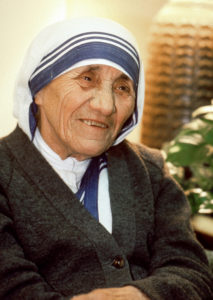
Pope Francis has approved a miracle attributed to the intercession of Blessed Teresa of Kolkata, paving the way for her canonization in 2016. Mother Teresa is seen during a visit to Phoenix, Ariz., in 1989. (CNS photo/Nancy Wiechec)
VATICAN CITY (CNS) — Pope Francis has approved a miracle attributed to the intercession of Blessed Teresa of Kolkata, thus paving the way for her canonization.
Pope Francis signed the decree for Blessed Teresa’s cause and advanced three other sainthood causes Dec. 17, the Vatican announced.
Although the date for the canonization ceremony will be officially announced during the next consistory of cardinals in February, Archbishop Rino Fisichella, president of the Vatican office organizing the Holy Year of Mercy events, had said it would be Sept. 4. That date celebrates the Jubilee of workers and volunteers of mercy and comes the day before the 19th anniversary of her death, Sept. 5, 1997.
The postulator for her sainthood cause, Father Brian Kolodiejchuk of the Missionaries of Charity, said the second miracle that was approved involved the healing of a now 42-year-old mechanical engineer in Santos, Brazil.
Doctors diagnosed the man with a viral brain infection that resulted in multiple brain abscesses, the priest said in a statement published Dec. 18 by AsiaNews, the Rome-based missionary news agency. Treatments given were ineffective and the man went into a coma, the postulator wrote.
The then-newly married man’s wife had spent months praying to Blessed Teresa and her prayers were joined by those of her relatives and friends when her dying husband was taken to the operating room Dec. 9, 2008.
When the surgeon entered the operating room, he reported that he found the patient awake, free of pain and asking, “What am I doing here?” Doctors reported the man showed no more symptoms and a Vatican medical commission voted unanimously in September 2015 that the healing was inexplicable.
St. John Paul II had made an exception to the usual canonization process in Mother Teresa’s case by allowing her sainthood cause to be opened without waiting the usual five years after a candidate’s death. He beatified her in 2003.
The order she started — the Missionaries of Charity — continues its outreach to the “poorest of the poor.”
Among the other decrees approved Dec. 17, the pope recognized the heroic virtues of Comboni Father Giuseppe Ambrosoli, an Italian surgeon, priest and missionary who dedicated his life to caring for people in Uganda, where he also founded a hospital and midwifery school before his death in 1987. His father ran the highly successful Ambrosoli honey company.
The pope also recognized the heroic virtues of De La Salle Brother Leonardo Lanzuela Martinez of Spain (1894-1976) and Heinrich Hahn, a German surgeon.
Born in 1800, the lay Catholic doctor was the father of 10 children and dedicated much of his activity to providing medical care to the poor. He was also involved in public service, even serving in the German parliament. He founded the St. Francis Xavier Mission Society in Germany and the “Giuseppino” Institute for those suffering from incurable illnesses. He died in 1882.
Need knows no season and not every life-changing situation is budgeted for ahead of time.
Fortunately, there’s a no-cost way for Arizona taxpayers to support local nonprofits that help members of the community who are in crisis. It involves taking advantage of the “Credit for Donations made to Qualifying Charitable Organizations.”
[quote_box_right]
Give a little, get a little
➤ Take advantage of “Credit for Donations made to Qualifying Charitable Organizations” by Dec. 31 and get the same amount taken off of your tax liability. Any amount up to $400 for families and $200 for single filers.
➤ Same increments available as a separate tax credit for donations made to organizations involved with foster care. Catholic Charities Community Services is one example.
It’s a very long way of saying that cash donations can become a two-way gift. If they’re sent by mail or online to any of an array of reputable, or “qualifying” charities by Dec. 31, there’s a dual gift involved. The donor strengthened the charity’s operating budget and receives that same amount off of the total tax liability when filing a personal return.
The only catch: there’s a maximum amount the government allows donors to take off of their income tax. It’s up to $400 for families and $200 for those filing individually.
Whether the donation is $1 or any affordable amount up to or beyond the maximum, it makes a huge difference for the charity involved. Its staff and volunteers devote their lives to journeying with those in crisis.
Supporting a pregnancy
Most clients don’t have insurance, but even those pregnant women who do still choose places like Aid to Women Center for prenatal care because they say they feel comfortable there. Staff and volunteers treat each person with dignity and welcome them with open arms, even if they’re abortion-minded, said Kelly Sarotte, R.N., executive director.
One such woman credited Aid to Women Center for saving her baby girl’s life. The center opened a second Tempe location in August to better serve teenagers and young adults who are most vulnerable to having an abortion or a sexually transmitted illness.
“We felt it important to be right where this target group is,” Sarotte said. “We have tremendous foot traffic in our new second location.”
It’s a block or so north of Arizona State University. Aid to Women Center is also on campus weekly when it shares an information table with ASU’s Students for Life club. As a result, the pro-life charity served 880 clients this year, which is a 53 percent increase.
That includes an ASU engineering student who once considered abortion due to the timing of her pregnancy and marital status. That woman’s education track has included Aid to Women Center’s parenting program for over a year now. She is on track to graduate from ASU next year.
Charitable donations would support prenatal medical care and lab work for pregnant women who can’t afford medical care, or ultrasound training for two nurses to provide a window into the womb for abortion-minded women. They would also support educational material for moms and dads in waiting. Those classes, in turn, earn them material support for their baby.
Making people feel at home
Whether it’s making room for a baby or simply starting over in a new place, turning a house — or apartment as the case may be — into a home can be a challenge when there’s a lack of financial resources. That’s where agencies like Furnishing Dignity can help.
(courtesy photo)
Three Catholic moms established the volunteer-driven charity earlier this year to restore the dignity of a person or family bouncing back from homelessness or other major setback while furnishing their new digs. They connect with approved Arizona charities like St. Vincent de Paul and the Arizona Friends of Foster Children Foundation to verify need and secure participants. That way, they know material and financial donations will support clients who have a greater chance at permanent self-sufficiency due to follow up support from referral agencies.
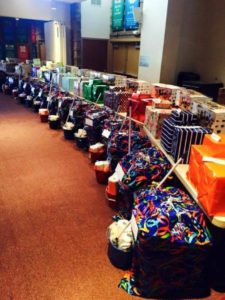
Part of Furnishing Dignity’s unique outreach is supporting teenagers as they age out of the foster care system. The nonprofit recently filled 20 “Baskets of Love” with toiletries, linens and basic kitchen items that teenagers and young adults who were never adopted will need when living on their own.
Each laundry gift basket included a gift certificate of sorts with Furnishing Dignity’s contact information so the two can connect when moving day comes. Some were waiting to secure a roommate or a job and expect to move in the next three-to-six months.
“We may be their only support. There is no one else,” said Lisa Campbell, co-founder and vice president of Furnishing Dignity.
Whether it’s helping someone from foster care or a family of any size, the mission is the same: move in basic furnishings acquired as donations — with the exception of mattresses that are purchased new — and remind clients that caring people are within reach.
“We go into homes where there’s absolutely nothing. Literally blankets on the floor where the kids sleep,” Campbell said.
Volunteers don’t leave until beds are set up, shower curtains are installed and there are places to sit, both comfortably and for dining. One of their latest deliveries even included a Christmas tree.
“By providing the comforts of home that most of us take for granted, it lightens the load a little because most people find refuge at home,” Campbell said.
Aiding job-seeking clients
The individuals that St. Joseph the Worker serves don’t always have a home. They’re in a shelter at the county’s Human Services Campus or elsewhere. Sometimes they recently transitioned to their own place, but that’s only after St. Joseph the Worker gave them the resources and tools to secure meaningful employment.
It’s simple things such as Internet access to complete online applications, resumé help, clothes and coaching for a job interview plus a bus pass to get there that make a world of difference. So does money to purchase work-related items and small McDonald’s gift cards once they’re hired in order to get a true lunch break.
Such items allowed 2,701 St. Joseph the Worker clients to regain self-esteem the last fiscal year and find the positive outlook they lost long ago. More importantly, they secured employment with average wage well above the state minimum and 41 percent of clients eligible for benefits. Such high success rates continue with the opening of a satellite office in Phoenix’s Maryvale office this summer and ongoing outreach via its original location and a mobile unit.
In the first four months of this fiscal year, St. Joseph the Worker already assisted 1,502 individuals in securing employment. That’s a 71 percent increase from the same period last year.
“We are on track to support more than 3,200,” said Candace Sherwood, director of development. “As the largest privately funded employment support agency in Arizona, our work can only go as far as our financial donations allow. With the increase in the number of individuals being served, we rely on the community now more than ever to help fund our work and help transform lives and the communities in which they live and work.”
Helping patients heal
For vulnerable members of the community, working isn’t an option until they heal. Those who are homeless only have the streets to do that. That is, unless they’re fortunate enough to be connected with Circle the City. The organization, founded and led by a Sister of St. Joseph of Carondelet, was established in 2008 to full unmet medical needs of those in Maricopa County.
This last fiscal year alone, its round-the-clock medical team offered nursing supervision — which includes services such as wound care and IV therapy — to 303 patients. The number jumps to more than 700 patients since its inception.
The numbers are great, but Circle the City’s 50-bed medical respite center is full with more than 30 patients on the waiting list, said Liz Meyers, spokesperson for Circle the City. Patients stay an average of 35 days for medical monitoring plus speech and occupational therapy sessions as needed. On-site psychiatric consultations, general mental health counseling and substance abuse services are also available.
“Circle the City is committed to ensuring that each person admitted is given the chance to medically heal and stabilize,” Meyers said. “Circle the City’s case management team works diligently to connect our patients with relevant benefits, income and, most importantly, housing. At CTC we know that stable healthcare and stable housing are synonymous: one can’t exist without the other.”
More than 79 percent of Circle the City patients who successfully completed the program have been connected with housing other than the street or emergency shelter. Donated funds keep its mission going. They’re essential to providing uninsured and under-insured patients with cost-efficient medical care, meaningful human services and assistance in their journey toward independent living.
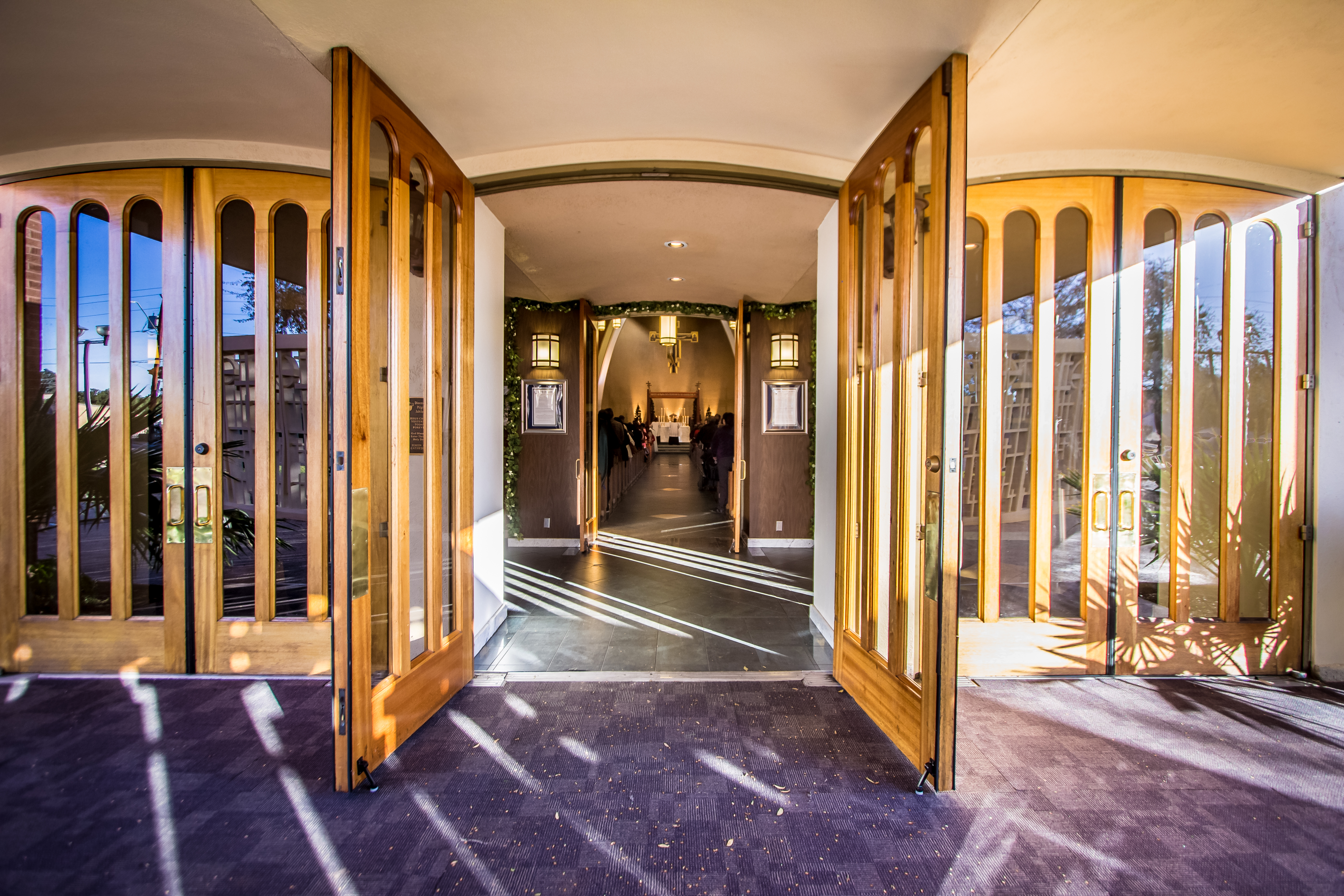
The doors in the front of Ss. Simon and Jude Cathedral were opened and designated as the Holy Doors of Mercy for the Diocese of Phoenix during the Jubilee Year of Mercy. (Billy Hardiman/CATHOLIC SUN)
The doors in the front of Ss. Simon and Jude Cathedral were opened and designated as the Holy Doors of Mercy for the Diocese of Phoenix during the Jubilee Year of Mercy. (Billy Hardiman/CATHOLIC SUN)
“Open the gates of justice, we shall enter and give thanks to the Lord. This is the Lord’s gate: let us enter through it and obtain mercy and forgiveness!”
Dioceses across the world have designated Holy Doors of Mercy as pilgrimage sites for the faithful to pass through, and, accompanied by prayers and the sacraments, to receive a plenary indulgence. Another set of Holy Doors was opened earlier in the day at the Chapel of the Holy Cross in Sedona. All who pass through the doors during the Year of Mercy will receive the indulgence.
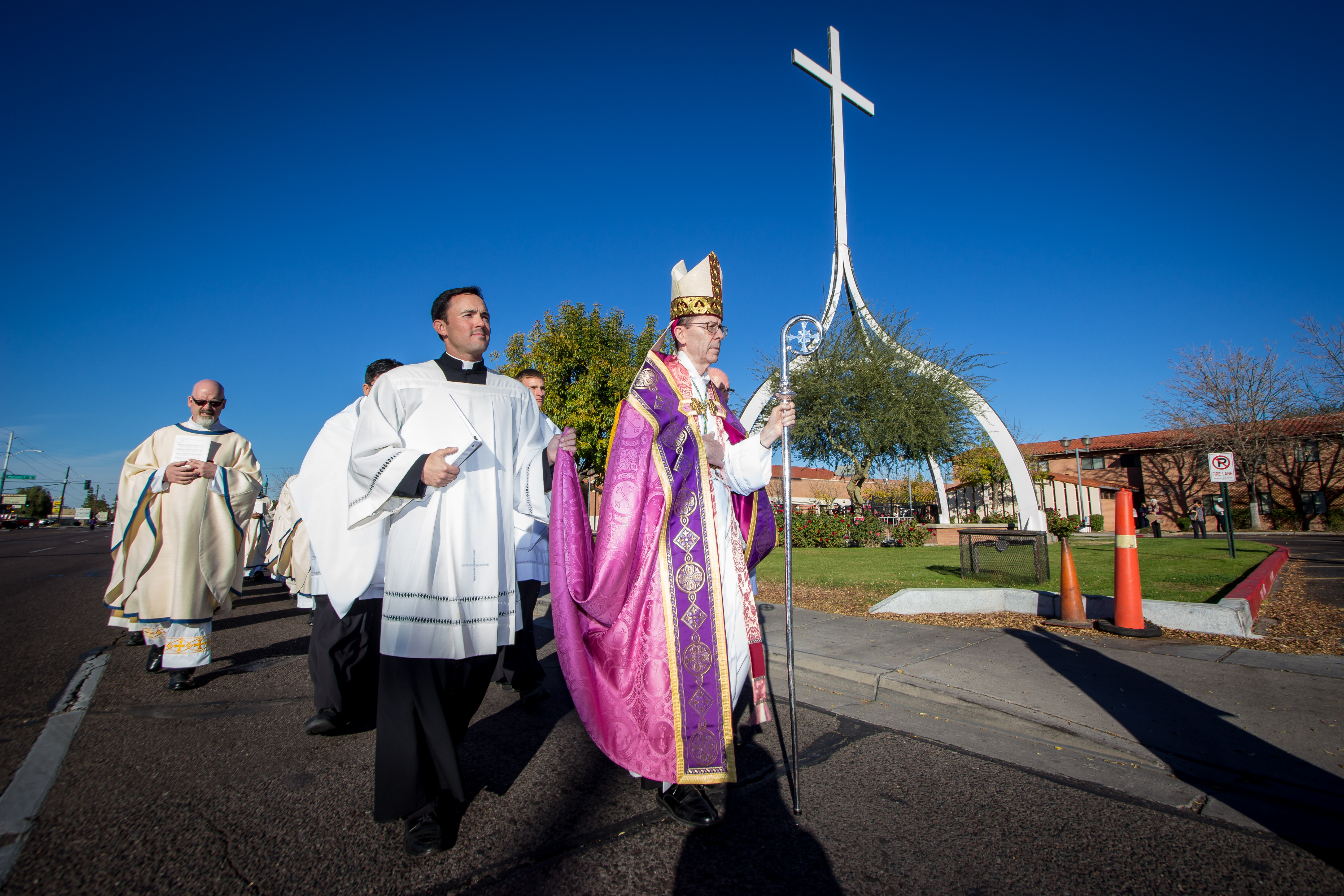
The celebration began with a prayer service at the adjacent Ss. Simon and Jude School, followed by a public procession led by the bishop around the school along Maryland Avenue toward the front of the church. Once at the entrance, Bishop Olmsted blessed and opened the doors.
In his homily for the Mass, cathedral rector Fr. John Lankeit tied the need for mercy in today’s world with the recent terrorist attacks in Paris and San Bernardino.
Noting that Pope Francis released his bull announcing the Year of Mercy a few months after another terrorist attack in Paris, Fr. Lankeit said that “it was clear the Holy Father could see what so much of the world could not — that the only genuine solution to humanity’s brokenness is God’s mercy.”
Referencing the Gospel for the day (Luke 3:10-18), Fr. Lankeit said John the Baptist’s statement that one greater than him was coming contains three key components: that the Savior, Jesus Christ is coming; that He will separate the faithful from the unfaithful; and that this is good news.
Bishop Thomas J. Olmsted leads a procession of approximately 1,200 faithful Catholics along 27th Avenue toward the front of the cathedral Dec. 13. (Billy Hardiman/CATHOLIC SUN)
“Throughout salvation history, God has allowed His people to suffer the consequences of their collective unfaithfulness in order to shake them up, and wake them up. And he is allowing the same to happen in Europe and North America, in particular, because of these societies’ willful disregard for their relationship with him,” said Fr. Lankeit. “But, because God is merciful, He will not let evil run rampant forever.
“It’s as though God is saying, ‘Now that I have your attention, now that your world has been rocked, I am offering you a chance to return to me,’” he added. “And thus we have the Year of Mercy. A year to be freed from sin — in order to be freed for the mission of spreading and sharing this same mercy.”
Roger Fuelling, a Fourth Degree Knight of Columbus from St. Helen Parish in Glendale, was among the Knights in full regalia participating in the ceremony. It was his first time to participate in an honor guard for a diocesan-wide celebration.
“It was a holy experience, emotionally. It was an honor to be here and celebrate with the diocese and my brother knights,” Fuelling said. “The homily was very moving — it hit home,” he added, “I’ll be doing more confessions.”
Cathedral parishioner Vickie Lacek said she was inspired by the fact that she sat next to people from throughout the diocese, including some who’d traveled more than an hour.
“Everyone felt as one,” she said.
Lacek also added that in this Year of Mercy she’s inspired to reach out to non-practicing Catholics. “It’ll inspire me to invite them,” she said, “like my brothers.”
Fr. Lankeit closed his homily by noting that the Year of Mercy particularly invites the faithful to take advantage of the sacrament of Reconciliation. Through this sacrament, he said, we take responsibility for our sins, and thus experience both the justice and mercy of God. This then encourages to share mercy with others.
“Just as the destructive visible violence in our world is a manifestation of the destructive invisible violence of sin in the human heart, so too will visible peace in the world only come about when we have invited the peace of Jesus Christ … to fill our hearts so that there is no room left there for sin to dwell,” he said. “The ‘genius’ of the Holy Spirit — working through our Holy Father in calling for a Year of Mercy — is the call to invite the peace of the Lord into our hearts first, so he can then use us to spread this peace to others.”
On the occasion of Pope Francis’ 79th birthday and the close of 2015, Cardinal Donald W. Wuerl of Washington told Catholic News Service the secret of the pope’s strength.
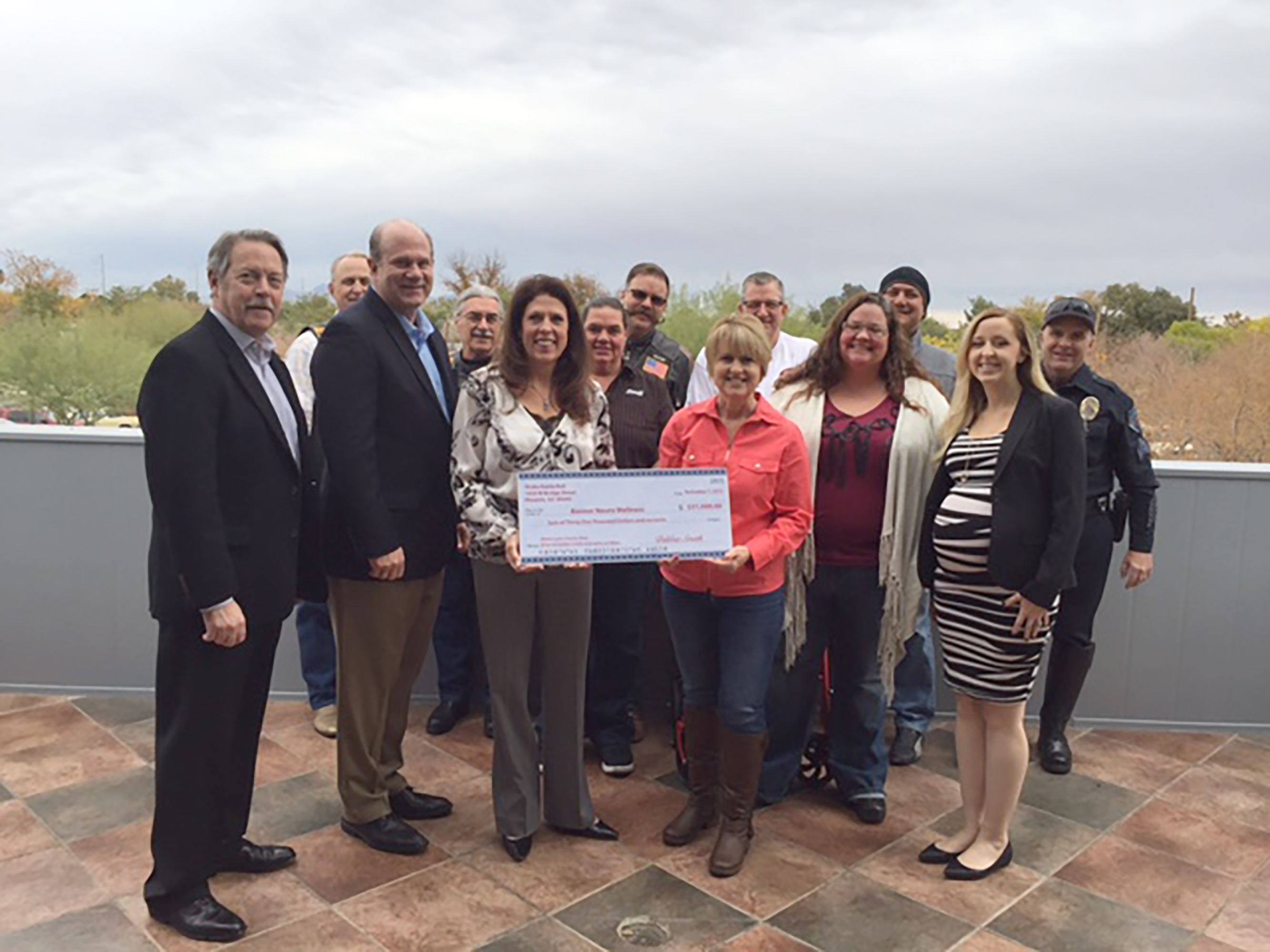
Shake Rattle and Roll organizer Debbie Smith holds the check for $31,000 presented Banner Neuro Wellness Center. With her are representatives of the center’s community and members of the Knights on Bikes organization that raised the money. (Photo courtesy of Chris Matthieu, Knights on Bikes)
Shake Rattle and Roll organizer Debbie Smith holds the check for $31,000 presented Banner Neuro Wellness Center. With her are representatives of the center’s community and members of the Knights on Bikes organization that raised the money. (Photo courtesy of Chris Matthieu, Knights on Bikes)
Knights on Bikes, the motorcycle-riding members of the Knights of Columbus, presented a check for $31,000 to help Parkinson’s patients at the Banner Neuro Wellness Center in downtown Gilbert Dec. 11.
The Knights raised the money at their second annual “Shake, Rattle and Roll” ride that took place in November.
The idea for the ride was the brainchild of Debbie and Brian Smith — Debbie is a patient at the center — and Chris Matthieu, head of Knights on Bikes in the Diocese of Phoenix.
“We put our heads together to see what we could come up with,” Brian Smith said. “This helps the center, and contributes to the well-being of Parkinson’s patients.”
Patients receive physical therapy at the center, but Debbie Smith said the center is more than that.
“It’s a community,” said Debbie. “We have workshops, art, music, speech. It’s a place where we get learn about the medications and the different therapies that are out there. It helps us to live with the disease.”
The money will go for new equipment and for operating expenses so the community can sustain the center, which is supported by donations, she said.
Alan Lessard, another patient, was diagnosed five years ago.
“This center really saved my life because I had no place to go. It’s really helped me out a lot,” said Lessard.
The Knights on Bikes started several years ago and now have chapters throughout the United States and Canada, along with the Philippines, said Deacon Bill Clower, leader of the statewide Knights on Bikes. There may be up to 3,000 members worldwide, he estimated.
“It’s just members of the Knights of Columbus who like to ride motorcycles,” he said. “We do parades and events like this one.”
The November motorcycle ride had five different points along the way. Riders picked up a playing card at each point and — at the end —played a poker hand for prizes.
“We’re hoping to continue to grow and grow this event on an annual basis,” Matthieu said.
The key is lining up sponsors and donors, Brian Smith said. Anyone can donate, whether they ride or not.
Roger Dubin, author of “The Coin of the Realm” and a parishioner at Sacred Heart in Prescott, will never forget his journey from living as a self-described angry, deeply anti-Christian Russian Jew to Catholicism. Recently, Dubin discussed his conversion story and his book on EWTN’s “The Journey Home” hosted by Marcus Grodi .
“I felt kind of ridiculous to be asked, given the very knowledgeable and biblically deep people that so often seem to be on the program,” he explained of the Nov. 9 appearance. “I certainly don’t qualify on either count. But, I asked for guidance and in prayer received this help. ‘Try to see your life as not your own.’ That meant a lot. Plus, the entire staff is so great, and Marcus Grodi makes you feel like you’ve known him your whole life. We went to Mass just before the show — all of which helped me to relax.”
He will never forget the day he decided to become Catholic: April 19, 2005. On a layover at the Phoenix Sky Harbor Airport for a business trip, Dubin noticed the television and the live feed from the Vatican when Pope Benedict XVI was announced as the newest successor to St. Peter. As the new pope emerged on the balcony, it appeared to Dubin as if Pope Benedict’s eyes met with his and his gaze penetrated his soul.
Almost immediately, Dubin burst into tears and knew without a doubt that he was going to become Catholic. He and his wife Barbara entered the RCIA program, under the direction of Muriel Rabideau, at Sacred Heart Parish that same year.
“We both had annulments to handle, so we didn’t enter the church until April 2007,” he said. “That was a very healing and learning period of time, which increased our desire for the sacraments and opened up doors in our life and relationships with others.”
His early life in New York was difficult, as most of his Jewish family lost their faith after the holocaust, believing that God took members of their family away. Dubin managed to go through his bar mitzvah, as more of an obligation to his mother, than a statement of faith.
He left home at 16 and joined the Merchant Marines, traveling to North Africa. His first novel, “The Coin of the Realm,” is loosely based upon his experience with the Merchant Marines and working as a seaman aboard a tramp freighter bound for Tunisia.
“From the time I was a young reader and writer, I knew that someday I wanted to try my hand at writing novels. In the years since I came back from North Africa, I knew that when I finally buckled down to the job, my first novel would be based on that seminal voyage,” Dubin said. “My inner motivation was to show how God moves within the lives of men in ways we rarely see and understand. And even when we do glimpse a piece of the picture, it’s only a tiny fragment of the infinite, divine tapestry.”
Though Dubin admits he is a private person, not looking for recognition, his appearance on EWTN elicited a far-reaching positive response from viewers, including an interview with Gus Lloyd of Sirius Catholic Radio’s “Seize the Day.”
“Hearing from complete strangers about how you affected them is deeply humbling,” he admitted. “In addition, a lot of folks bought my novel, which is nice, because it is a good story and people really seem to enjoy the read.
Roger and Barbara are also active members of Sacred Heart. He is a member of the pastoral council and is involved with the parish’s capital campaign, and the couple attends a weekly holy hour and volunteers with the parish RCIA program.
Claretian Father Darrin Merlino, Sacred Heart pastor, finds the Dubins’ profound conversion experience inspirational.
“Roger has a giving heart, a servant’s heart and I am amazed at how Divine Providence works and how God works and brings people back to Him,” he said. “Roger and I are fans of “The Hound of Heaven” and I am amazed at how the Hound went after him that way in the airport. In meeting he and his wife, you wouldn’t know they weren’t Catholic all along. He and his wife are a great asset to our parish. I am glad he is able to tell his story and hopefully change the lives of other Catholics and Christians.”
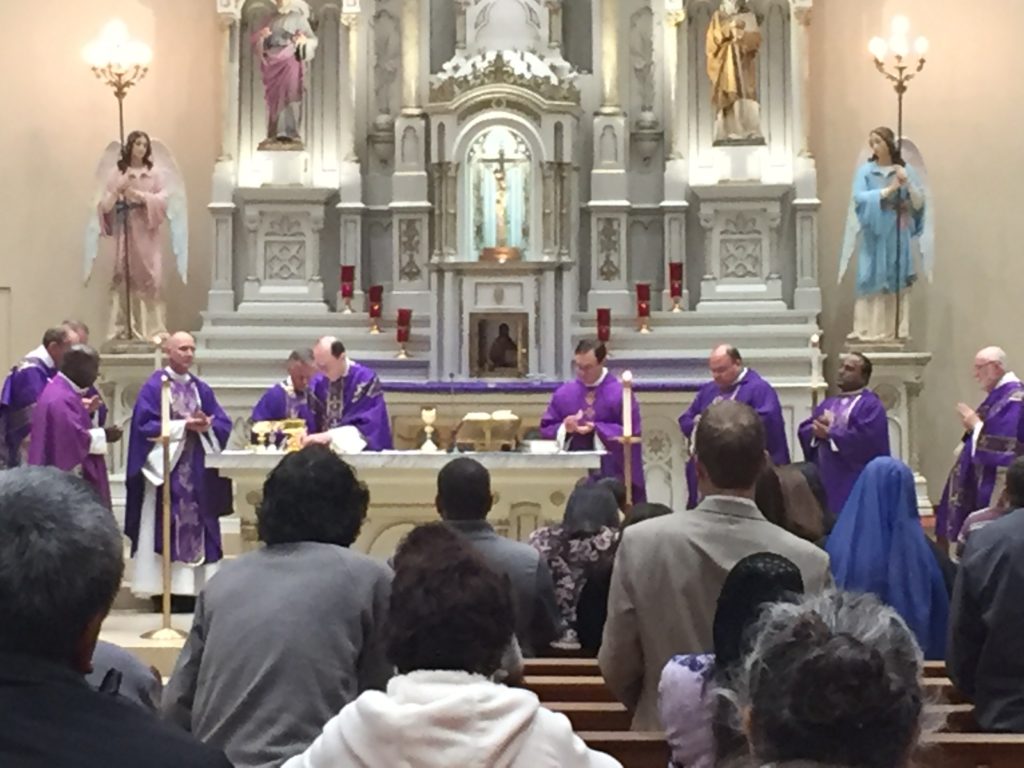
Bishop Thomas J. Olmsted, joined by priests from throughout the Diocese of Phoenix, prepares the altar during a Mass of Healing and Reconciliation at Immaculate Heart of Mary Parish Dec. 1. (courtesy photo)
Christ brings beauty out of brokenness. Bishop Thomas J. Olmsted emphasized this during a Mass he celebrated for survivors of abuse and their families Dec. 1.
“As followers of Christ, we know that only in Him is it possible to find true peace,” Bishop Olmsted said. “Only Christ can mend broken hearts. Only Christ can renew hope. In this Mass we ask the Lord to heal all those who are suffering from abuse in the Church.”
The Mass of Healing and Reconciliation was held at Immaculate Heart of Mary Parish in Phoenix. Throughout the liturgy, Bishop Olmsted pointed out that those who have suffered occupy a special place in the Heart of Christ.
“Jesus found that those who listened and received the Good News were the poor, the persons without guile, those who knew that they needed healing and mercy, and often those who had been mistreated and overlooked in society.”
Bishop Olmsted also explained during his homily that Christ suffered extensively for the human race, in order to relieve our pain.
“Our God is so rich in mercy, He greatly desires that no one should feel trapped in sadness, isolation, feeling alone or abandoned. And so He sent His beloved Son into the world, entering so fully into the human condition, that He took upon Himself every suffering that we could suffer.”
“The journey of healing is a process but I’ve been working with the survivors of abuse for awhile now and the Healing Mass is very impactful, in a lot of ways,” Vargas-Leveriza said. “One of those ways is that everybody is there — the Mass is dedicated solely for all the survivors. Second, the presence of all the clergy at the Mass is very impactful for all the survivors as well.”
The Healing Mass has been celebrated at different parishes in the Diocese of Phoenix since 2006. Bishop Olmsted intends for it to be held twice a year, once during Advent and once during Lent, the two penitential seasons of the Church. The Office of Child and Youth Protection organizes the Mass and invites all the survivors to attend.
“Perhaps there are those of you here tonight who have suffered much … perhaps from abuse within the Church, or in the community or family … suffered without knowing if healing for them was actually possible,” Bishop Olmsted said, offering encouragement to anyone who has been hurt. “Please listen again tonight to the words Our Lord speaks to us through this Eucharist, and especially speaks to us every year through the season of Advent. These words from the Prophet Isaiah, from over 2000 years ago, ‘Be consoled. Be consoled my people. Rise up, come to the Lord and be healed.’”
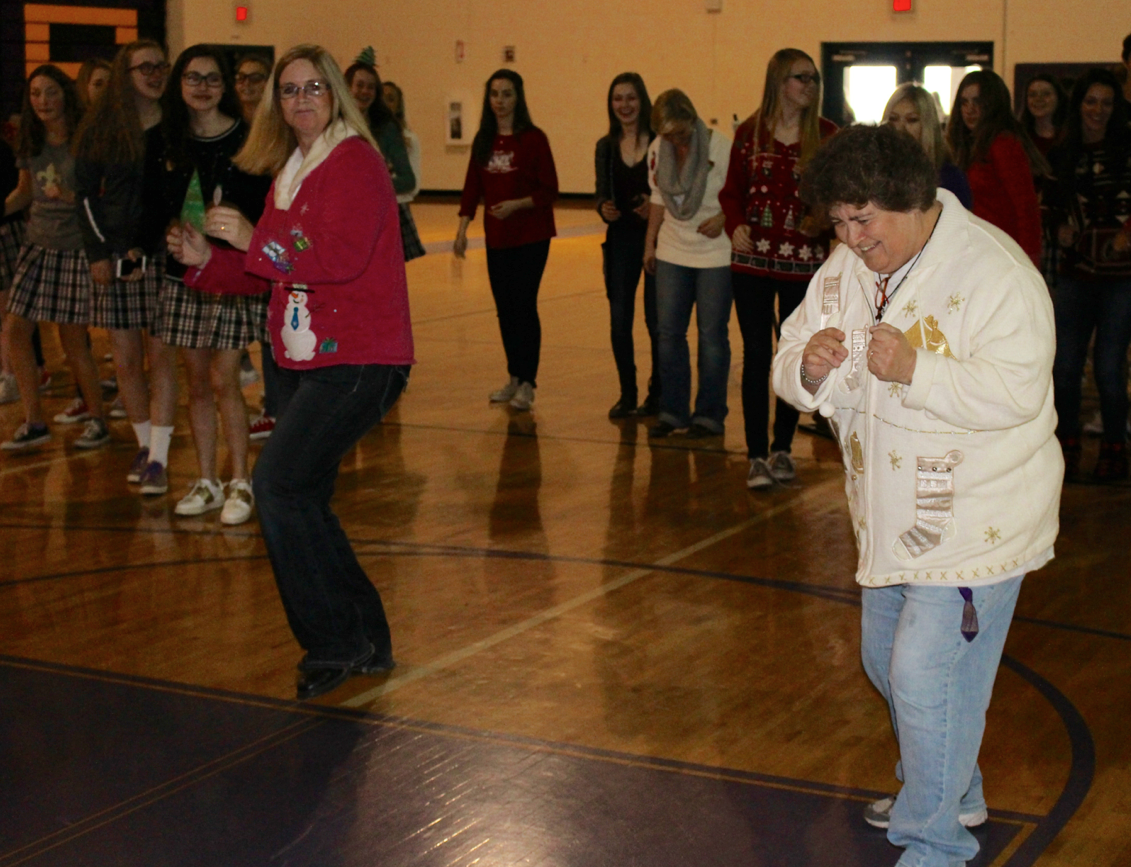
Sr. Yolanda Mendoza, campus minister at Notre Dame Preparatory in Scottsdale, does more than guide students in spiritual matters. During a surprise appreciation event, she guided them through the electric slide. (courtesy photo)
When student leaders at Notre Dame Preparatory in Scottsdale heard about the DUDE. be nice Project, they were inspired to try their own version of a “be nice” surprise. It worked.
Although it wasn’t an official “DUDE. be nice” surprise — a platform that inspires young people to build a positive community by recognizing a person or group in a fun, creative and meaningful way — the NDP surprise was fun and meaningful for “Sister Yo.”
(courtesy photo)
She was the target of the surprise Dec. 11. Sr. Yolanda Mendoza, IBVM, serves as campus minister at Notre Dame. Students planned the entire surprise just outside of her office in the Student Activities Center.
“They had been working under my nose the whole time,” Sr. Yolanda said. “It just made my day.”
More than a hundred students, faculty and staff gathered in the Notre Dame Prep gymnasium with signs, flowers and letters to show Mendoza just what she means to them. Members of NDP Live!, the Multimedia Club, produced a video, with several people on campus telling “Sister Yo” that she is loved.
“It was overwhelming,” she said. “Maybe by seeing the impact the kids can have and how they can make a difference for somebody, it will inspire them to do it more.”
[quote_box_center]
[/quote_box_center]
Mendoza began as Director of Campus Ministry in 2004. She plans and facilitates student retreats and days of reflection. She organizes the monthly all-school Mass and special prayer services. She leads the entire school in the daily examen after lunch Monday through Friday. Sr. Yolanda ends it with her signature line, “And do know that you are loved.”
“The students wanted her to know that SHE is loved,” said Brenda Beers, director of student activities and advisor of student government association.
After the surprise, Sr. Yolanda, who entered religious life 37 years ago, led all those in attendance in the Electric Slide.
“The kids did this all by themselves, and that’s pretty amazing,” she said. “It made more than just my day.”
All three Aguilar children — Matthew, Benjamin and Joseph — join their mom, Crystal, in prayer at Ss. Simon and Jude Cathedral Dec. 9 to demonstrate how they pray over the total tuition number each year and actively seek funding. (Ambria Hammel/CATHOLIC SUN)
There are plenty of reasons and people that keep Catholics in fervent prayer. Financing a child’s elementary and high school education shouldn’t be among them.
That’s constantly on the mind and in the heart of people like the Aguilar family. So much so that the family prominently displays five numbers in their home: 24,070. It’s the total tuition cost the family needed to find for the current school year.
Crystal Aguilar, the matriarch, called it a previous number. It allows all three of her boys to be trailblazers. They’re the first on either side of the family to receive “an education sanctioned by God with Jesus at the center,” Aguilar said.
Matthew, the eldest, is now a sophomore at Bouragde Catholic High School. He was tested and ready to enter kindergarten at Ss. Simon and Jude 11 years ago, but didn’t. The tuition agreement was too much. He spent three years at a public school before the late Sr. Loreto Downing’s persistent urging to keep trying for financial aid and have faith that the tuition would be covered came to fruition.
Matthew’s younger brothers have been at Ss. Simon and Jude since kindergarten. They’re now in the seventh and fifth grades. The worry around tuition costs remains the same. That five-digit number reminds the Aguilars to offer prayers of petition and gratitude.
“We prayed over this number. We lit candles in our church over this number. We stressed over this number,” Crystal Aguilar said. “We were able to chip away at this $24,070 with in-parish discounts, STO scholarship and essay scholarships written by the boys, school financial aid and tax credit recommended funds.”
They made it work this year. Aguilar said there’s usually a few months of peace before beginning the process anew for the next school year.
[quote_box_right]
Support local Catholic education
Donations made to Catholic Education Arizona are eligible for a tax credit up to $2,134 for families and up to $1,067 for single filers.
Mail donations to: 2025 N. Third St. #165, Phoenix, AZ 85004-1425
[/quote_box_right]
The process doesn’t have to work like that though. Especially not when that education is in Arizona. It’s one of a few states that offer an equal trade — in the form of a tax credit — for anyone who supports a school tuition organization.
Individuals and corporations pooled $15.8 million through Catholic Education Arizona last year. It was enough to offer need-based scholarships to just over 6,100 children across the 37 elementary and high schools that serve the Diocese of Phoenix. That was 300 more students than last year. Yet more than $20 million in need went unfulfilled.
Working families like the Aguilars still struggle and pray. Grandmothers and other family members caring for their extended family remain in a bind.
Development directors at each school routinely point out other scholarship and financial resources. Some families must connect multiple dots each year just to keep their child eligible for enrollment. Many families are successful. Some are not.
Students with the most verified need — done through an independent financial review process — get priority for Catholic Equation Arizona’s tuition scholarships. Debra Castro, senior vice president of operations and finance, wants to raise money for every student.
“It’s time to redirect your 2015 state income tax dollars and change a student’s life forever,” Castro said. “You can give them the gift of a Catholic education at no net cost to you. You can choose how your tax dollars are spent and you get a dollar for dollar state income tax credit.”
Arizona offers a dollar-for-dollar tax credit up to $2,134 for families and up to $1,067 for individuals who contribute to Catholic Education Arizona.
[quote_box_right]
[/quote_box_right]
Donors can mail in their contribution or complete it online. They can earmark money for a specific school or allow it to pad the general fund. Phoenix is among the nation’s top financially sound Catholic school systems, but it could be stronger, especially once a greater number of those in parishes without schools understand the ease and benefit of the tuition tax credit, Castro said.
“Having young people formed in the faith and a commitment to service makes for a better community and a better culture. The [Catholic] schools are doing it,” Castro said.
Ken Poocha has seen it with his two boys. Despite being a single parent, he never considered another school. Daily religion and high academic standards was all the info Poocha needed. His first- and fifth-graders have been at Sacred Heart School in Prescott since day one.
“I can tell they are just great kids because of it,” Poocha said.
He noted their respectful nature and general excitement about the faith. Their lives center around the church and Poocha knows each classmate’s family regards one another as their own.
Teachers and administrators take a genuine interest in a child’s emotional and psychological development too, Poocha said. The one thing that kind of bothers him is when random people at a restaurant or somewhere in public compliment his sons on their behavior.
“It kind of makes me feel embarrassed because that’s the way it should be, but upon further reflection, it’s what they see in school,” Poocha said.
Parents might have a set of expectations or ideals for their children, but he said that could get contradicted or undone at other schools. Poocha finds himself in other schools as an investigator and sees a marked difference in the way those children communicate with adults and their overall behavior.
Abel Ortiz has nothing but good things to say since transferring two of his kids to St. Agnes last year. Mia is now finishing her first semester at St. Mary’s High School and her youngest brother is in kindergarten.
He said they’re doing better now that they’re at Catholic schools and know more about religion. The family splits their weekends between St. Agnes and their home parish of St. Mark.
Not all Catholic school students are practicing Catholics though. Roughly 20 percent are not. Still, their families see value in the education. Even non-Catholics count themselves among Catholic Education Arizona donors.
If more Arizonans of any or no faith took advantage of the tuition tax credit, the numbers inside the Aguilar home might disappear altogether. Or if they stay, they would serve solely as numbers of gratitude.