Brophy athletics return to full competition for 2021-22

By Kathy Mabry

After abbreviated seasons at the end of the 2019-20 school year and during the 2020-21 school year, the Broncos were fully back in action this year. Brophy fields teams in 12 sports sanctioned by the Arizona Interscholastic Association, as well as six club sports. The Broncos have won 103 state titles during the school’s history.

Brophy Basketball Ends Stellar Season in the AIA Semifinals

After a 20-2 regular season in AIA Division 1 competition, the Broncos exited the playoffs in the semifinals with a triple-overtime loss to Perry, who went on to win state.

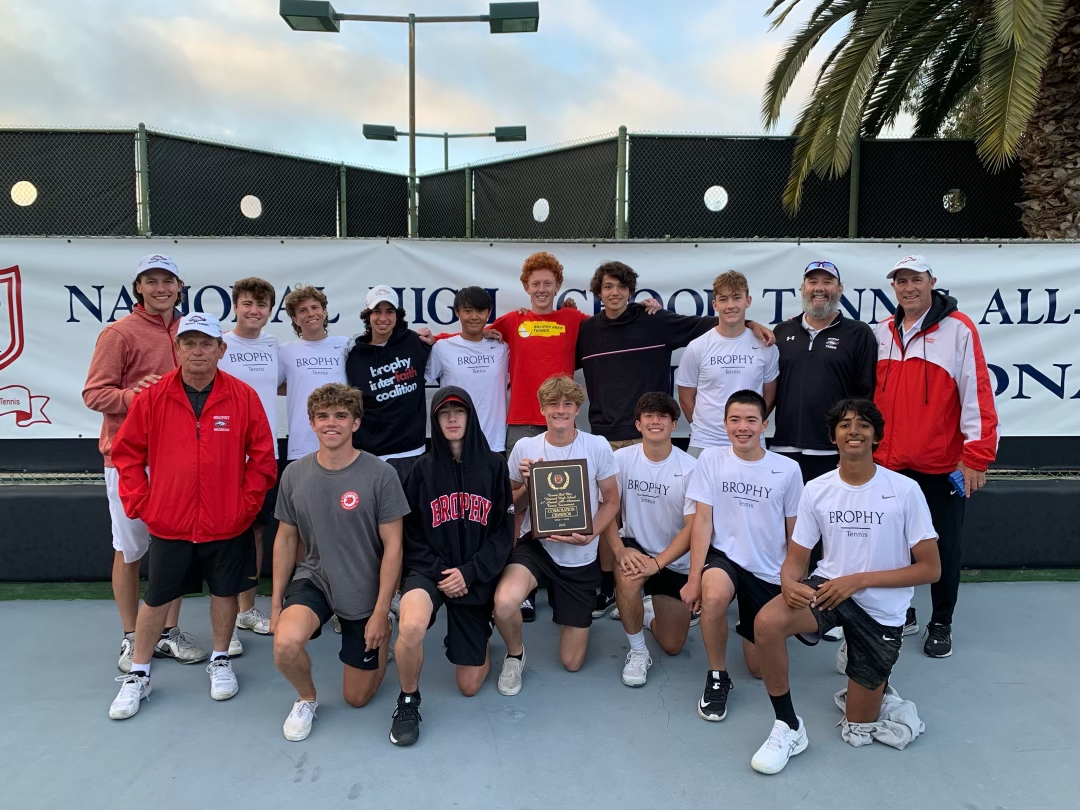
Brophy Tennis Off to a Great Start with Invitational Win

Brophy tennis was canceled in spring 2020 and dealt with pandemic-related issues during its 2021 season. With 21 state titles in the program’s history, this year the Broncos hope to return to its earlier success. The team scored a decisive win in the recent Kiwanis Invitational taking first and second in doubles play and second in individual play, earning the most team points.

On March 25, the Broncos traveled to Newport Beach for the 21st annual National High School Tennis All-American Team Tournament. The Broncos went 3-1, beating several West Coast powerhouse teams and winning the consolation bracket after losing to the eventual third-place finisher. Jack Brown ’22 went 4-0 in No. 1 singles and was selected to the All-Tournament team. Coach Eric Chalmers notes that the Broncos’ performance puts them on the map as one of the top high school teams in the West.

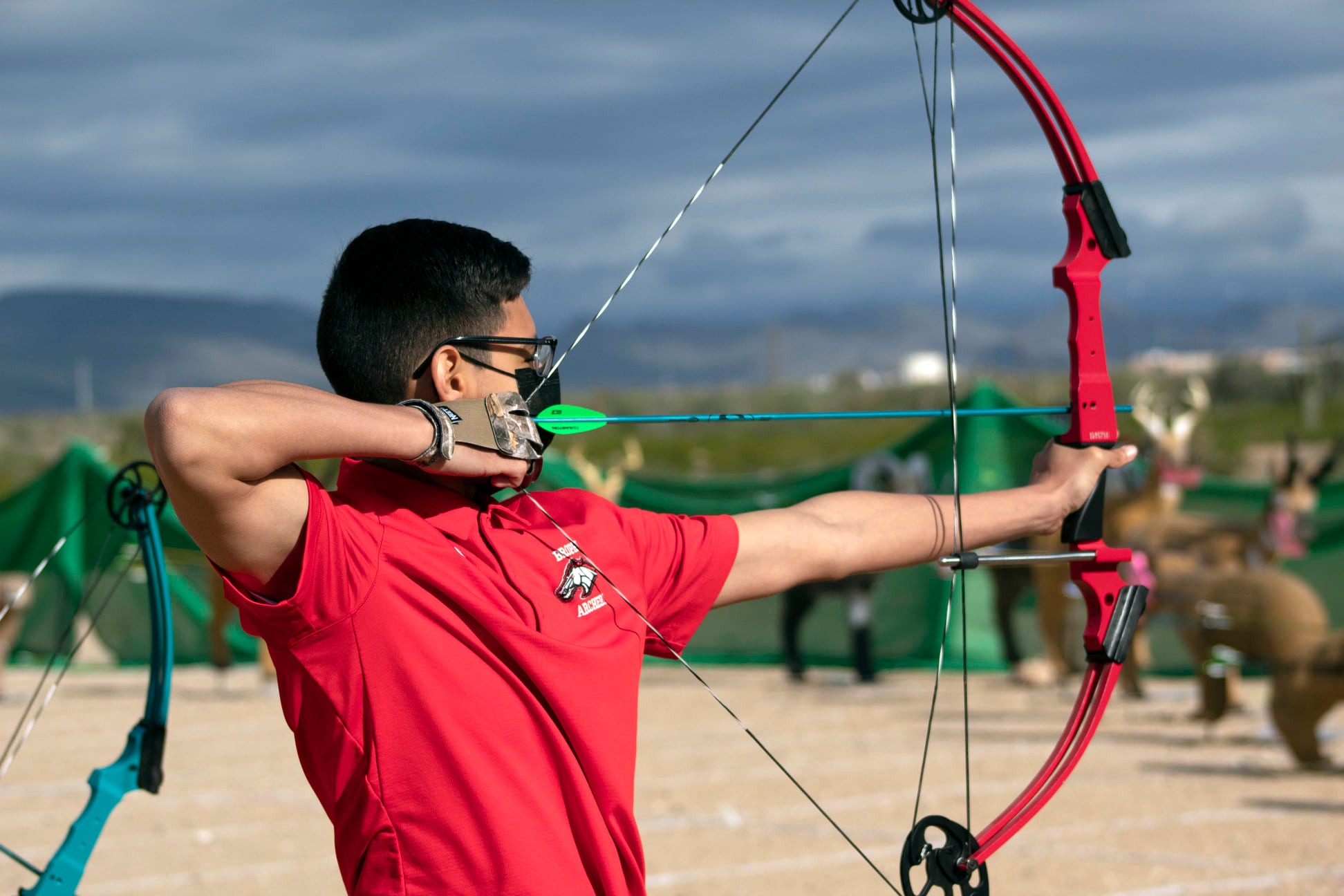
Brophy Archery Wins Second Consecutive Championship

Brophy archery, a club sport, has grown into a sizeable program fielding almost 40 archers this year and once again, winning state competition in both bullseye and 3D disciplines. The Broncos beat last year’s winning score by 14 points.

Brophy Hockey Varsity and JV Win D2 State Titles

The Broncos faced the Flagstaff Avalanche in the Division 2 finals on March 18 at the Scottsdale Ice Den. Both Brophy’s varsity and junior varsity teams prevailed, with 5-1, and 6-1 scores, respectively. Bronco goalies blocked 26 of 27 shots at the net (varsity) and 23 of 24 shots (junior varsity).

Videos prove war in Ukraine is battle against evil, archbishop says

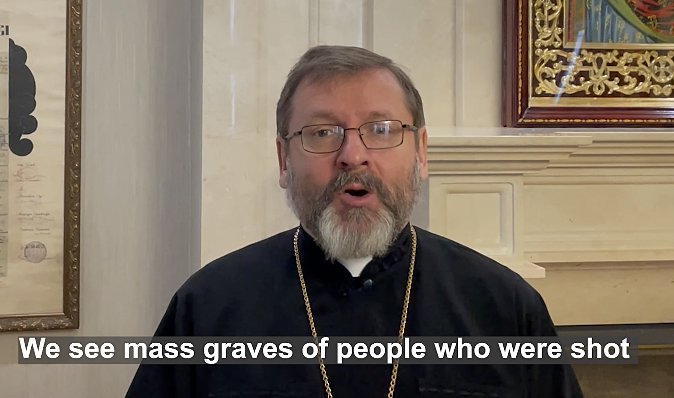
In his daily video message April 4, 2022, Ukrainian Catholic Archbishop Sviatoslav Shevchuk of Kyiv-Halych says footage of the death and mutilation retreating Russian troops left behind prove that the war is a battle against evil, which only can be defeated with a commitment to doing good. (CNS screenshot/Ukrainian Catholic Church)

KYIV, Ukraine (CNS) — Videos of dead Ukrainian civilians, many apparently executed by Russian troops, are further evidence that “the struggle of Ukraine is a spiritual struggle against evil, against the devil and his servants,” said Ukrainian Archbishop Sviatoslav Shevchuk of Kyiv-Halych.

“A mountain of corpses, rivers of blood, a sea of tears” are the ongoing reality of Ukraine, the archbishop said in his daily video message from Kyiv April 4.

The archbishop spoke after the widespread distribution of videos from Bucha and other towns from which Russian troops had retreated. The videos show dead bodies in the streets and in the yards of homes. Many appear to have been shot in the head, execution style, and the hands of many of the corpses are bound.

Ursula von der Leyen, president of the European Commission, announced April 4 that the European Union “has set up a joint investigation team with Ukraine to collect evidence and investigate war crimes and crimes against humanity.”

Archbishop Shevchuk told his people that while it is right to support the military and to keep fighting the Russian invasion, the evil at play can only be vanquished with goodness, holiness and generosity.

“We know that our vices and sins must be overcome by opposing virtues,” he said, in the video subtitled in English by his staff. “Pride is fought through humility, avarice is healed by sacrifice, laziness is treated by diligence,” the archbishop said.

“Today we see horrible footage. Terrible images of everything that the occupier left on Ukrainian soil. We see mass graves of people who were shot in the back of the head. We see destroyed cities and villages. We see mutilated human destinies,” he said. “That is why we must get to work and fight.”

“If the enemy kills us (and) sows death, let us serve life, honor human life from conception to natural death,” he said.

“We see that today the enemy is robbing Ukrainians, robbing, looting,” the archbishop said. In response, Ukrainians should be “generous and support those who need works of Christian charity.”

Where the Russians are “destroying everything,” he said, Ukrainians should try to “build, get to work,” including by starting the spring planting if possible.

“Let us do good, and then evil will be defeated,” he said.

Meeting migrants, pope warns civilization risks being ‘shipwrecked’

Pope Francis walks past Franciscan Father Dionisio Mintoff, founder of the John XXIII Peace Lab's Center for Migrants, as he arrives for a meeting with migrants at the center in Hal Far, Malta, April 3, 2022. (CNS photo/Paul Haring)

HAL FAR, Malta (CNS) — Saying civilization itself risks foundering because of apathy and selfishness, Pope Francis insisted that migrants and refugees must be treated with care and kindness and recognized as brothers and sisters.

In the shipwrecks that lead to thousands of migrants drowning in the Mediterranean each year, “we see another kind of shipwreck taking place: the shipwreck of civilization, which threatens not only migrants but us all,” the pope said April 3 at a meeting with about 200 migrants at the John XXIII Peace Lab in Hal Far.

Imagine, he said, “that those same people we see on crowded boats or adrift in the sea, on our televisions or in the newspapers, could be any one of us, or our sons or daughters.”

“Perhaps at this very moment, while we are here, there are boats heading northward across the sea,” he said. “Let us pray for these brothers and sisters of ours who risk their lives at sea in search of hope.”

The day before the meeting, the pope said, there was the report of a rescue of four migrants off the coast of Libya. More than 90 people were reportedly on the boat; only four did not drown.

Pope Francis sat against a shimmering backdrop of shades of blue topped with blobs of florescent orange — a backdrop built with plastic bottles and life vests pulled from the sea.

Franciscan Father Dionisio Mintoff, the 91-year-old founder of the center, welcomed Pope Francis, telling him, “Your urgent appeals to be close to the weakest spur us to do better and to continue our daily mission toward those who, whether for a limited time or permanently, land on our Island, to escape from misery and to have a better life.”

The pope spoke after listening to Daniel Jude Oukeguale and Siriman Coulibaly describe in harrowing detail how they finally made it to Malta.

Oukeguale said he left his home in Nigeria five years ago. “After 13 days of traveling, we arrived at the desert. While crossing, we passed dead people and animals, burned cars and a lot of empty water cans. After eight traumatic days in the desert, we made it to Libya.”

He would pay smugglers for a place on a boat, only to have the trip canceled and the money unreturned. Twice he attempted the crossing, only to be pushed back by the Libya or Tunisian coast guards and detained.

The sixth time he paid, he said, they set sail, and after three days “it was all smiles when the Maltese coast guard rescued us. I couldn’t believe my eyes! Tears of joy flowing freely. My dreams came true!”

“But these were short lived since we were put in detention for six months the same night we landed. I almost lost my mind,” he said, and he wondered, “Why were men like us treating us like criminals and not like brothers?”

“When you run away from a situation of war, conflict and extreme poverty,” Coulibaly said, “you have nothing except for your determination to live a better life and a lot of courage and resilience to face all the challenges you encounter.”

Unfortunately, he said, too many individuals and governments seem to think a migrant ceases being human when he or she leaves home.

“Today we want to remind people in decision-making positions and who hold power, that human rights and dignity are universal and inherent,” he said. “We are ‘fratelli tutti” (all brothers and sisters), right?”

At the end of the meeting, Pope Francis prayed that God would “free us from fear and prejudice, enable us to share in their sufferings and to combat injustice together, for the growth of a world in which each person is respected in his or her inviolable dignity, the dignity that you, O Father, have granted us and your Son has consecrated forever.”

Located between the Italian island of Sicily and the North African coast, Malta — a tiny nation with fewer than 500,000 residents — has been the first port of call for thousands of migrants and refugees crossing the sea from North Africa in search of a better life in Europe.

Current European Union policies have left Malta and other frontline countries such as Italy, Spain and Greece, on their own to rescue, shelter, verify and try to integrate the migrants.

In his talk at the center, Pope Francis asked, “How can we save ourselves from this shipwreck which risks sinking the ship of our civilization?”

The answer, he said, is “by conducting ourselves with kindness and humanity” and by regarding people not as statistics but as “what they really are: people, men and women, brothers and sisters, each with his or her own life story.”

The Acts of the Apostles says that when St. Paul was shipwrecked on Malta, he and his fellow passengers “were treated with ‘unusual kindness.’ Not merely with kindness, but with rare humanity, a special care and concern that St. Luke wished to immortalize.”

“Let us respond to the challenge of migrants and refugees with kindness and humanity,” the pope said. “Let us light fires of fraternity around which people can warm themselves, rise again and rediscover hope. Let us strengthen the fabric of social friendship and the culture of encounter, starting from places such as this.”

Wahlberg: Real-life Father Stu has him ‘continuing to carry on his message’

Mark Wahlberg stars in a scene from the movie "Father Stu." (CNS photo/Karen Ballard, Columbia Pictures)

By Mark Pattison, Catholic News Service

WASHINGTON (CNS) — Catholic actor Mark Wahlberg, who plays the title role in the upcoming movie “Father Stu,” said the real-life Montana priest is “having me continuing to carry on his message.”

“Father Stu,” in theaters April 13, tells the story of Father Stuart Long, a priest who had been ordained for only four years before he died from a incurable muscle disorder, and the lives he touched along the way before and after his ordination.

Some of those he touched were, in truth, pummeled, as Stuart Long was an amateur boxer, compiling a 15-2 record before he gave up the ring.

In those days, pre-Father Stu was the kind of guy who wouldn’t take no for an answer — and often assembled a string of expletives before rejecting any rebuff to his pursuit of whatever dream he was following at the time. But the priest, who grew up unbaptized, had a near-death experience following a motorcycle accident and determined the priesthood was his true calling.

“I’ve made a movie about a remarkable man, and I know that they had campaigned to get him ordained and petitioned to have him canonized,” Wahlberg told Catholic News Service in a March 31 phone interview from Los Angeles. “I’ll push and campaign for Stu, absolutely.”

He said an archbishop, whom he didn’t name, came to him while he was he trying to make the movie. “He told me, ‘Father Stuart Long did more in his four years than I have in my 40 years of service,'” citing the priest’s “dedication and service to God.”

Wahlberg, also a producer of the movie, said if the real-life Father Stu, as he was best known, had seen his life on-screen, “I think he’d have a big smile on his face, probably saying he’s not as big or strong or as good a boxer. He’s a super-competitive guy, and if I ever get asked who would be one of the few people to have dinner with, dead or alive, he’d be right at the top of my list.”

The priest “had four years to complete his mission here and now he has eternity … having me continuing to carry on his message,” Wahlberg said. “Who knows how long I’ll have?”

Asked what his Catholic faith means to him, Wahlberg replied, “Everything. Everything. There’s so many wonderful things that happened to me — the good, the bad and everything else in between. I’ve been able to appreciate and have gratitude because of my faith. After I’ve done my last interview, I’ll know how to articulate it.”

He added, “This message, this conversation and this commitment to service does not stop when the movie comes out. It’s only a start.”

Wahlberg said this film is different from his other projects because of “how this child (the movie) came into the world, and what it’s doing for people. How it’s touching people … in a good way for everybody. Everybody is finding something they can personally relate to.”

He said, “We were really inspired by Stu’s story. And it’s just a matter of finding the right person to put it on the page, which was not an easy thing to do,” given that many decades of Father Stu’s life had to be condensed into a two-hour movie. Wahlberg talked with screenwriter Rosalind Ross.

“Even though she wasn’t raised Catholic, she could really appreciate someone trying to find their calling,” Wahlberg told CNS. He said he asked Ross, “Why not take a crack at it?” After Ross came back with the script, Wahlberg told her, “This is the script — and I want you to direct,” giving Ross her first directorial assignment.

Ross’ longtime partner, actor Mel Gibson, is cast as Father Stu’s dad, who did his young son no favors. His mother is played by Jacki Weaver, who won an Oscar for her role in “Silver Linings Playbook.” Longtime actress Colleen Camp, an executive producer of “Father Stu,” has a memorable scene as a motel desk clerk. And if you look behind the scruffy beard, that’s Malcolm McDowell playing Msgr. Kelly, the seminary rector.

Wahlberg said he had to go to extremes to play Stuart Long as a boxer and as an infirm priest.

“I was kind of in shape” at the start of filming,” he said. “I had just done an adventure racing movie. I had to reacquire my skill from ‘The Fighter,'” the 2010 movie in which he played real-life boxer Micky Ward. “I just started consuming 7,000 calories (a day) for the fighting scenes” that make up most of the opening scenes of “Father Stu.”

Wahlberg later had to ramp that up to 11,000 calories a day “to try to show how Stu’s physical being deteriorated and how his spirit soared.”

Court rules in favor of inmate’s prayer request during execution

The Supreme Court is seen in Washington March 15, 2022. The justices in an 8-1 decision March 24 ruled in favor of a Texas death-row inmate prisoner John Ramirez, who wanted his pastor to pray aloud over him and place his hands on him in the execution chamber. Ramirez's execution was supposed to take place in September 2021 but it was stayed and a new date has not yet been set. (CNS photo/Emily Elconin, Reuters)

By Carol Zimmermann, Catholic News Service

WASHINGTON (CNS) — The Supreme Court March 24 ruled in favor of a Texas prisoner who wanted his pastor to pray aloud over him and place his hands on him in the execution chamber.

Although the 8-1 decision specifically focused on the case of prisoner John Ramirez, it also will likely impact the cases of other death-row prisoners with similar requests.

Chief Justice John Roberts, who wrote the majority opinion, said: “It is possible to accommodate Ramirez’s sincere religious beliefs without delaying or impeding his execution.”

Ramirez — sentenced to death for the murder of a convenience store clerk in 2004 — had asked that his Southern Baptist pastor be able to lay hands on him and pray aloud with him during his execution.

When the Texas prison system rejected his request, Ramirez challenged it in court, saying the state was violating his religious beliefs.

The lower courts sided with the state, saying the prison system has a compelling interest to keep executions safe and orderly. Then just hours before his scheduled execution last September, the Supreme Court granted a temporary stay and agreed to hear the case, which the justices did in November.

In its ruling, the Supreme Court said the U.S. Court of Appeals for the 5th Circuit was wrong to deny Ramirez’s stay of execution and it handed the case back to lower courts for further consideration.

Justice Clarence Thomas, who dissented, said he would have dismissed Ramirez’s claim because the prisoner did not exhaust other possibilities before filing suit. He also said that tools to protect religious liberty can be “wielded abusively.”

“And few have a greater incentive to do so than death-row inmates,” he said.

Roberts wrote that there was reason to view Ramirez’s request as sincere, noting that asking to have “his pastor lay hands on him and pray over him during the execution” are traditional forms of religious exercise.

“There is a rich history of clerical prayer at the time of a prisoner’s execution, dating back well before the founding of our nation,” he added.

He also noted that he did not see how “letting the spiritual adviser stand slightly closer, reach out his arm, and touch a part of the prisoner’s body well away from the site of any IV line would meaningfully increase risk.”

The chairmen of two U.S. Conference of Catholic Bishops’ committees said in a March 30 statement that the court “has done the right thing in its ruling to honor Mr. Ramirez’s right to seek the mercy of God at the moment of his death.”

“As fallen creatures, we are all in need of God’s grace and forgiveness,” the statement said, noting that Ramirez had asked the state “to allow him what he sincerely believes he needs to prepare for the end of this life.”

“The Supreme Court has rightly ruled that the state did not meet the appropriately high bar the law sets to deny the condemned the accompaniment that their religion prescribes,” said Cardinal Timothy M. Dolan of New York, chairman of the Committee for Religious Liberty, and Archbishop Paul S. Coakley of Oklahoma City, chairman of the Committee on Domestic Justice and Human Development.

The Texas Catholic Conference of Bishops, the public policy arm of the state’s 21 bishops, similarly issued a March 30 statement in favor of the court’s decision.

“Allowing a prisoner to seek mercy at the moment of his death should be a minimal expectation of our society. When a person’s life is already being taken from him, is it too much to simply provide that person with a warm touch and a prayerful presence?” the bishops asked.

During oral arguments, it was not clear how the court would rule in this case as some of justices questioned if allowing the prisoner’s request would open up other appeals or impose a safety risk.

Sister Helen Prejean, a Sister of St. Joseph of Medaille, who is a longtime opponent of the death penalty, tweeted March 24 that she was proud to have been part of an amicus brief siding with the prisoner.

“There was no legitimate reason for Texas to restrict these dignified, prayerful actions in the execution chamber,” she said, adding that she was glad the court agreed.

Last fall, she tweeted that she and the other spiritual advisers and former corrections officials in the brief “believe that the Texas execution protocol violates basic principles of human dignity and religious liberty.”

The Supreme Court has looked at spiritual advisers accompanying inmates during executions several times in recent years with differing opinions. Texas has also had different views on the presence and role of spiritual advisers in the execution chamber.

A specific law at issue in this case was the Religious Land Use and Institutionalized Persons Act, or RLUIPA, passed by Congress in 2000.

The law forbids prisons from imposing a “substantial burden” on an inmate’s faith, unless that burden is “in furtherance of a compelling governmental interest” and the prison uses “the least restrictive means of furthering that compelling governmental interest.”

During oral arguments, Justice Sonia Sotomayor reminded the attorneys arguing against the inmate’s request that “prisons have to work in good faith to accommodate” prisoners’ spiritual needs.

Eric Feigin, assistant to the federal solicitor general, said prisons would have to determine the sincerity of the inmate’s request. That issue came up repeatedly when justices questioned whether inmates’ religious accommodation requests were always sincere or if they were possibly trying to “game the system” by various appeals.

Seth Kretzer, Ramirez’s attorney, noted that his client was not trying to bend the rules. He also pointed out that chaplains have never caused the disruption of an execution.

The USCCB, joined by the Texas Catholic Conference of Bishops, filed an amicus brief in this case that said the role of spiritual advisers to prisoners “is of particularly grave importance at the moment of death.”

Such guidance, the brief said, is “constitutionally protected from government interference.”

The bishops said for the state to allow Ramirez spiritual assistance does not “render his execution a just act” or essentially give a blessing to it, adding that the state “should act with justice by sparing Ramirez’s life. If it will not, it should allow him to seek the mercy of God at the moment of his death.”

Prior to the oral arguments, John Meiser, supervising attorney of the University of Notre Dame Law School’s Religious Liberty Clinic, said it is “difficult to see in Texas’ newest policy anything other than callousness toward those it has condemned to die.”

He also questioned why there was “such reluctance to accommodate these simple requests” especially since the state has “consistently claimed to be a champion of religious liberty.”


New bikes brighten the day for St. Matthew’s students

By Dulce Aguirre, The Catholic Sun

Dulce Aguirre, The Catholic Sun

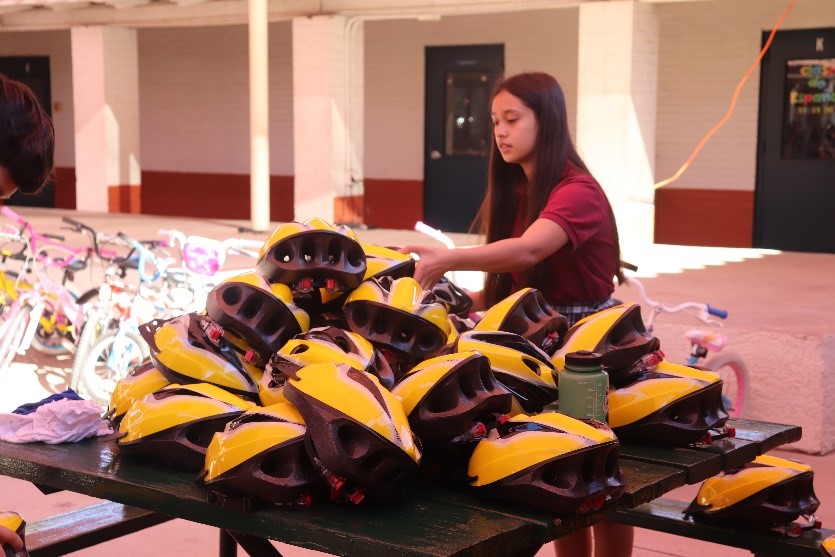
As St. Matthew’s students prayed in Mass, a surprise was waiting for them! On Wednesday, March 23, principal Christine Tax announced after Mass that all the children (grades kindergarten to 8th grade) from St. Matthew’s Catholic School received free bikes thanks to Bob’s Free Bikes as well as ABC 15’s bike drives. Overall 130 bikes were donated to the school.

Dulce Aguirre, The Catholic Sun

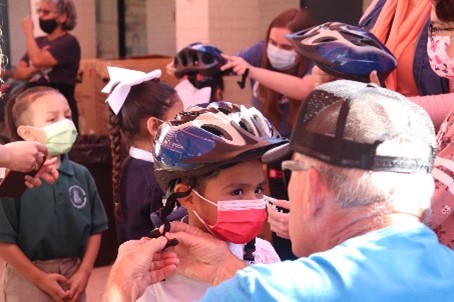
To keep everyone safe, the Injury Health Prevention Department of the Phoenix Children’s Hospital provided free helmets and safety training.

Dulce Aguirre, The Catholic Sun

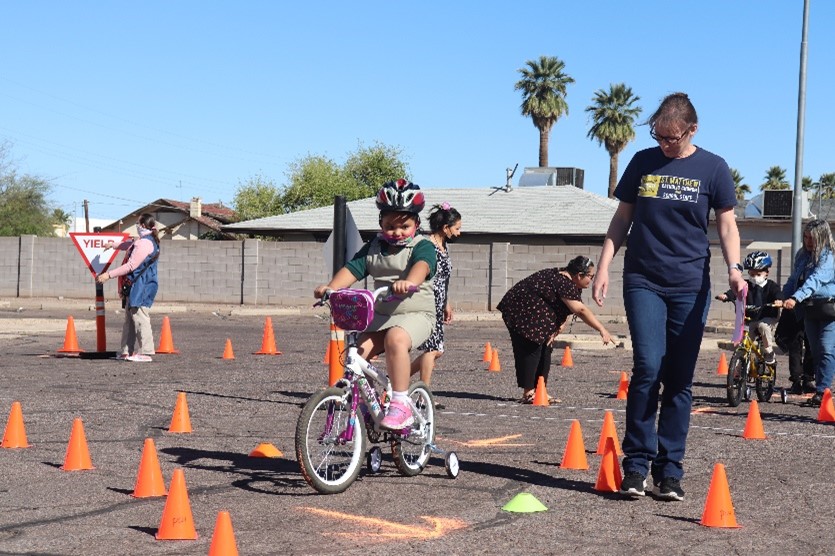
With their fitted helmets and new bikes, students participated in a bike rodeo in the school courtyard, which had been transformed into a small obstacle course.

Teachers, volunteers from Bob’s Free Bikes, the Phoenix Children’s Hospital, students, and parents worked together to make a memorable event.

Dulce Aguirre, The Catholic Sun

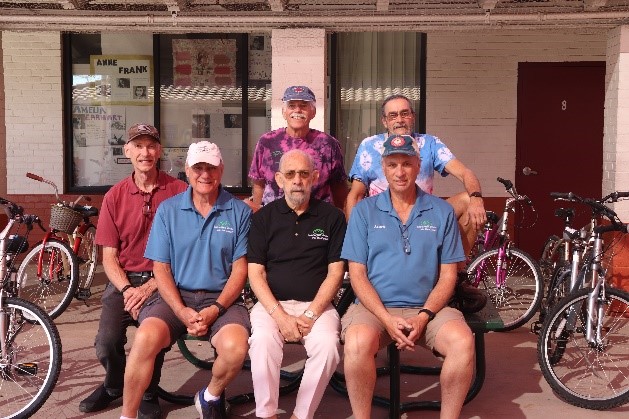
When Bob was 13, he received a free bike, but already having owned one, he decided to gift the bike to another boy that did not have one. He remembers the boy jumping up and down with excitement because it was his first bike. That moment marked his life.

Dulce Aguirre, The Catholic Sun

Bob’s Free Bikes began in 2016 as a non-profit organization that gives children free bikes. All the bikes are donated, cleaned, and fixed by a group of volunteers in the organization. Last year they were able to give away 802 bikes.

The expressions on a few of the mothers’ faces expressed what words could not. One mom said that she was astounded. Another said that it was such a blessing. Another said that it was going to be her child’s first bike ever.

Even though we find ourselves among much adversity in our world, we can still marvel at all the greatness, generosity, kindness, and love that is around us.

Dialogue is part of schools’ Catholic identity, congregation says

Students in grades 6-12 begin their first day of school at Pope John Paul II Preparatory School in Hendersonville, Tenn., in this Aug. 5, 2021, file photo. The Congregation for Catholic Education issued a document on the importance of promoting and safeguarding the Catholic identity of Catholic schools, which includes fostering dialogue. (CNS photo/Rick Musacchio, Tennessee Register)

By Cindy Wooden, Catholic News Service

VATICAN CITY (CNS) — Holding together the obligation to protect and promote the Catholic identity of Catholic schools while reaching out to a broader community of students and teachers requires a commitment to dialogue, said a new document from the Congregation for Catholic Education.

The instruction, “The Identity of the Catholic School for a Culture of Dialogue,” was signed by Cardinal Giuseppe Versaldi, congregation prefect, and was released by the Vatican March 29.

The congregation, Cardinal Versaldi said, was asked to write the document particularly “given cases of conflicts and appeals resulting from different interpretations of the traditional concept of Catholic identity by educational institutions.”

The document, however, did not include any specific description of those cases, which presumably include controversy over teachers being fired or not being fired for marrying a person of the same sex.

Those involved in hiring for Catholic schools, it said, are required “to inform prospective recruits of the Catholic identity of the school and its implications, as well as of their responsibility to promote that identity. If the person being recruited does not comply with the requirements of the Catholic school and its belonging to the church community, the school is responsible for taking the necessary steps. Dismissal may also be resorted to, taking into account all circumstances on a case-by-case basis.”

At the same time, it said, “a narrow Catholic school model” is not acceptable either. “In such schools, there is no room for those who are not ‘totally’ Catholic. This approach contradicts the vision of an ‘open’ Catholic school that intends to apply to the educational sphere the model of a ‘church which goes forth’ in dialogue with everyone.”

The document insisted that Catholic education is not strictly catechetical, nor is it a “mere philanthropic work aimed at responding to a social need,” but is an essential part of the church’s identity and mission.

Catholic schools do not limit enrollment or employment to Catholics alone since, as the Second Vatican Council said, part of their mission is to promote “the complete perfection of the human person, the good of earthly society and the building of a world that is more human.”

To reach that goal, the document said, Catholic schools must “practice the ‘grammar of dialogue,’ not as a technical expedient, but as a profound way of relating to others. Dialogue combines attention to one’s own identity with the understanding of others and respect for diversity.”

Everyone — administrators, teachers, parents and students — has “the obligation to recognize, respect and bear witness to the Catholic identity of the school,” which should be clearly stated in its mission statement and presented to prospective employees and parents of prospective students.

“In the formation of the younger generations,” it said, “teachers must be outstanding in correct doctrine and integrity of life.”

But the entire school community is responsible for embracing and promoting the school’s Catholic identity, it said, so it cannot be “attributed only to certain spheres or to certain persons, such as liturgical, spiritual or social occasions, or to the function of the school chaplain, religion teachers or the school headmaster.”

Taking into account different contexts and laws in the countries where Catholic schools operate, the document urged the schools to “formulate clear criteria for discernment regarding the professional qualities, adherence to the church’s doctrine and consistency in the Christian life” of candidates for positions in Catholic schools.

When conflicts over “disciplinary and/or doctrinal” matters do arise, it said, everyone involved must be aware how “these situations can bring discredit to the Catholic institution and scandal in the community.”

“Dismissal should be the last resort, legitimately taken after all other remedial attempts have failed,” it said.

Noting that “in many countries civil law bars ‘discrimination’ on the basis of religion, sexual orientation and other aspects of private life,” the document nevertheless noted that when “state laws impose choices that conflict with religious freedom and the very Catholic identity of a school,” the rights of Catholics and their schools should be defended “both through dialogue with state authorities and through recourse to the courts having jurisdiction in these matters.”

Pope calls for end to senseless war in Ukraine

Pope Francis bless an ambulance to donate to the Ukrainian city of Lviv, at the Vatican March 26, 2022. Also pictured is Cardinal Konrad Krajewski, the papal almoner, who left the Vatican March 26 to drive the ambulance to Lviv. (CNS photo/Vatican Media)

By Junno Arocho Esteves, Catholic News Service

VATICAN CITY (CNS) — Pope Francis renewed his call for an end to the war in Ukraine and strongly denounced the conflict as a barbaric act used by those in power at the cost of innocent lives.

“We need to reject war, a place of death where fathers and mothers bury their children, where men kill their brothers and sisters without even having seen them, where the powerful decide and the poor die,” the pope told pilgrims gathered in St. Peter’s Square March 27 for his Sunday Angelus address.

The consequences of war, he added, especially the displacement of children, “not only devastate the present, but future of society as well.”

“I read that from the beginning of the aggression in Ukraine, one of every two children has been displaced from their country. This means destroying the future, causing dramatic trauma in the smallest and most innocent among us. This is the bestiality of war — a barbarous and sacrilegious act,” the pope said.

According to UNICEF, Russia’s war against Ukraine — now entering its second month — has displaced an estimated 4.3 million children, which is more than half of Ukraine’s estimated 7.5 million children.

“The war has caused one of the fastest large-scale displacements of children since World War II,” said Catherine Russell, UNICEF executive director, in a statement March 24. “This is a grim milestone that could have lasting consequences for generations to come.”

Warning of the “danger of self-destruction,” the pope said that war “should not be something that is inevitable” and that humanity “should not accustom ourselves to war.”

He also urged political leaders to dedicate their efforts to not only ending the war in Ukraine but “to abolish war, to erase it from human history before it erases human history.”

“I renew my appeal. Enough. Stop it. Silence the weapons. Move seriously toward peace,” the pope said before leading pilgrims in praying the Hail Mary.

The day after the March 25 consecration of Russia and Ukraine to the Immaculate Heart of Mary, Pope Francis met with Cardinal Konrad Krajewski, the papal almoner, and blessed an ambulance he was donating to the Ukrainian city of Lviv which has seen an influx of refugees escaping violence from the eastern side of the country. Cardinal Krajewski left the Vatican March 26 to drive the ambulance to Lviv.

How a saint became part of the tax code, forever changing U.S. philanthropy

This likeness of St. Katharine Drexel is seen at the Katharine Drexel Shrine in Bensalem, Pa. The saint, who founded the Sisters of the Blessed Sacrament, helped lobby Congress in 1924 to make an federal income tax deduction for charitable giving part of the U.S. tax code. (CNS photo/The Crosiers)

By Tim Swift, Catholic News Service

This tax season, Americans have an unexpected figure to thank for one of their most-used deductions. She wasn’t an accountant, a lawyer or even a politician, but an actual saint.

St. Katharine Drexel is well known for being a trailblazing figure in the early 20th century, championing the needs of Native Americans and Black Americans, but few know she may have the most lasting impact on philanthropy of any American in U.S. history.

Her unexpected role in the U.S. tax code began at the outbreak of World War I in 1913, which spurred the creation of the federal income tax.

But by 1917, the tax became a graduated one, sending Mother Katharine’s tax bills skyrocketing and potentially endangering the charitable work of her religious order, the Sisters of the Blessed Sacrament. The sisters motherhouse is in Bensalem, Pennsylvania.

By 1924, Mother Katharine and her influential family successfully lobbied Congress for what later became known as the “Philadelphia nun provision.” Under the provision, anyone who had given 90% of their income to the charity for the previous 10 years was exempt from income taxes.

It was a distinction that described only one U.S. citizen at the time — Mother Katharine, said Seth Smith, a professor of an assistant clinical professor of history at The Catholic University of America in Washington.

Phil Brach, vice president of college relations at Belmont Abbey College in North Carolina, said the “Philadelphia nun provision” goes to the heart of what set Mother Katharine apart from her better-known philanthropic contemporaries such as John D. Rockefeller and Andrew Carnegie.

“What made her unique is the order of magnitude,” said Brach, who has taught courses on philanthropy for Catholic University in Washington. “There were years where the amount she gave was almost equal to the combined amount of all the collections and all the parishes in the entire country.”

Mother Drexel’s giving mostly benefited Black Catholics and Native American Catholics at a time when racial prejudice ran high and those communities struggled with crippling poverty and lack of access to quality education. Her order built schools and churches across the American South and established what is now Xavier University of Louisiana, the nation’s only historically Black Catholic college.

Mother Drexel also was a staunch supporter of the Josephites throughout her life, purchasing land for the religious order to build many of their parishes and schools.

St. Katharine’s family, the Drexels of Philadelphia, was one of the wealthiest families in America. An heiress to a banking fortune who chose religious life, she devoted her wealth to Blacks and Native Americans served by her religious order and to other people in need. She gave approximately $20 million dollars over her lifetime.

Brach said few have been able to match the sheer scope of Mother Drexel’s giving then or now. For example, he cited the Giving Pledge — a well-received philanthropic campaign spearheaded by billionaires Bill Gates and Warren Buffet.

The Giving Pledge encourages wealthy people to donate at least 50% of their wealth to charitable causes, but that’s a far cry from Mother Drexel’s 90% of her wealth.

“There is a reason she’s the patron saint of philanthropy,” Brach told The Josephite Harvest, the magazine of the Josephites, known formally as St. Joseph’s Society of the Sacred Heart.

According to “Sharing the Bread in Service: Sisters of the Blessed Sacrament 1891-1991 — Volume 1,” the “Philadelphia nun provision” was essential to the operation of the order in the years after it became part of the law.

“The exemption was really important because the sisters were responsible for basically taking care of 15,000 dependents annually. They had over 300 employees or teachers,” Smith said. “They also contributed annually over $50,000 to support Black and Native American children in schools outside of their own.”

“Frankly, the church historically has fallen short, with Black Americans to the South, but the greatest legacy of Catholic support is in those schools,” Smith said.

According to “Sharing the Bread,” allies of Mother Katharine urged her to seek a refund for almost $800,000 — the equivalent of about $13 million in today’s money — that she had paid the government before the provision took effect, but Mother Katharine declined, worried that it would exacerbate anti-Catholic prejudices at the time.

While the provision was enacted without controversy in 1924, Smith said opposition to the exemption grew in 1933 during the height of the Great Depression. Only after lobbying from influential U.S. bishops, did the provision survive the challenge.

The charitable exemption continued to support the work of the Sisters of the Blessed Sacrament until Mother Drexel’s death in 1955.

The “Philadelphia nun provision” was eventually written out of the tax code in 1969, but Mother Katharine’s influence on U.S. philanthropy can’t be understated, Branch said.

“The official language may be out of the code, but in general, it is the genesis of the charitable deduction that still exists,” he said.

Tucson bishop recalls Padre Kino’s zeal to evangelize across vast territory

Bishop Edward J. Weisenburger of Tucson, Ariz., offers the final blessing for a solemn vespers service at St. Augustine Cathedral in Tucson March 20, 2022, that commemorated the 311th anniversary of the death of Father Eusebio Kino, jesuit priest and missionary. Holding the prayer book is Father Alan Valencia, cathedral rector. (CNS photo/Tony Gutie?rrez)

By Tony Gutiérrez, Catholic News Service

TUCSON, Ariz. (CNS) — As Father Eusebio Kino was riding his horse through what is now Arizona and Sonora, Mexico, he was known to sing the “O Lux Beata” hymn and recite the Litany of Loreto.

Inspired by this, Carlos Zapién composed music to accompany these traditional hymns and prayers to premiere during a solemn vespers service commemorating the Jesuit missionary’s death 311 years ago.

“As humans, we are attracted to sound, and the sacredness of this composition invites us to reflect,” said Zapién. “Knowing the background of why we are singing ‘O Lux Beata,’ then this will invite people to learn more about what Father Kino did in our area.”

Bishop Edward J. Weisenburger of Tucson presided and preached at the prayer service March 20 at St. Augustine Cathedral.

It was the first opportunity to publicly commemorate the March 15, 1711, death of the Jesuit priest and candidate for sainthood since he was declared “Venerable” by Pope Francis July 11, 2020, during the COVID-19 pandemic. “Venerable” is a declaration of a person’s heroic virtues.

Known as the “Padre on Horseback” and referred to as “Padre Kino,” he brought Christianity to Upper Pimería, a region encompassing parts of what are today southern Arizona in the United States and northern Sonora in Mexico.

The priest also introduced, among other things, ranching and some new agricultural methods to the area.

Born in Segno near Trent, Italy, Padre Kino became a Jesuit priest in 1677 and was sent to New Spain. His body is entombed in present-day Magdalena de Kino in Sonora, Mexico.

“I like the image of the athlete running the race, and it’s immediately applicable not only to the Venerable Padre Kino and the way he denied himself in order to ‘run the race’ of his great mission to the Upper Pimería, but also in what sometimes appears to have been his relentless race across a territory so vast and extensive that few had ever traversed it as he did,” Bishop Weisenburger said in his homily.

He referenced a quote taken from the evening’s reading from St. Paul’s First Letter to the Corinthians: “Like the wisest of all athletes, he had his eye on the prize, and it is our belief that the prize is now indeed his.”

The bishop also compared Padre Kino’s mission to that of the Old Testament figure of Melchizedek, the mysterious priest-king, in Psalm 110, the first reading of the prayer service.

“I found myself wondering one day in prayer, what would it have been like for the local peoples of the Upper Pimería to have this mysterious holy man, this priest, emerge from their own wilderness — arriving from a far distant and mysterious place — and speaking to them of a God who had always been theirs — long before they even heard of him,” he reflected.

“A priest who didn’t begin his preaching with the fact that they were ‘lost’ and needed to be found — because in truth, they weren’t — but rather, that even without yet knowing it, they were loved and embraced and treasured by this God he preached — a God of compassion and mercy,” Bishop Weisenburger said. “A God who actually loved them no less than this mysterious God loved the people who had sent this Padre Kino to them.”

Prior to the evening prayer service, the Knights of Columbus Arizona State Council hosted a luncheon at the Tucson diocesan chancery office adjacent to the cathedral.

“Our vocation as Knights is to support our church and help men become stronger Catholics, better fathers, better husbands,” said the Knights’ state advocate, Lawrence Powers, in an interview. “Father Kino showed that. Most of us are going to fall short, but we look to people like Padre Kino to give us the example on how we should be living our lives today.”

During the luncheon, state Sen. Sally Ann Gonzales — a member of the Pascua Yaqui Tribe, one of the tribes Padre Kino served during his lifetime — presented Bishop Weisenburger with a lapel pin of the tribe’s seal.

“Father Kino is well-respected in the Indigenous community because of the dignity that he gave the people as he did his work here,” said Gonzales.

Her legislative district includes northwest Pima County, covering parts of Tucson and the Pascua Yaqui Reservation. Gonzales attends Cristo Rey Church on the reservation, a mission of St. Kateri Tekakwitha Parish in Tucson.

The Kino Heritage Society, whose mission is to promote Padre Kino’s canonization cause in the United States and educate people about his legacy, organized the event.

Society president Rosie Garcia said the group is planning to celebrate his Aug. 10 birthday, hold a symposium in November and later this year mark the 55th anniversary of the statue of Padre Kino being place across from the Arizona Capitol in Phoenix.

A statue of Padre Kino also represents Arizona in the National Statuary Hall Collection at the U.S. Capitol in Washington.

“We hope that with time, people will learn to recognize that Padre Kino is a man for all seasons, for all times,” said Garcia. “He doesn’t have to be back in the 18th century. He’s here with us. He’s still very much alive.”