
Notre Dame Cathedral in France and St. William in Cashion, Ariz., are about as different as two churches can be.
In appearance, culture and age, they’re at opposite ends of the spectrum.
But aside from their Catholic identity, they share an important common bond: Each was heavily damaged by fire.
A 2019 blaze devastated Notre Dame. The cathedral, officially known as Notre Dame de Paris, meaning “Our Lady of Paris,” was restored and has been welcoming worshippers since December, while its counterpart in the Arizona desert awaits the funding needed to do the same following a fire of unknown cause over a year ago.
On June 15, a group of St. William parishioners got to see firsthand the reopened Notre Dame and feel the sense of hope in this Jubilee Year that their French counterparts experienced. Led by their pastor, Fr. Andres Arango, the Arizonans attended Mass at the Paris icon, singing, praying and receiving the Eucharist. Fr. Arango, who also leads the Diocese of Phoenix’s Office of Human Dignity, was one of the concelebrants.
“What a gift it was to see your pastor concelebrate Mass in such an historic church,” recalled longtime St. William parishioner Karina Richmond, one of the pilgrims. “Going through the fire and seeing it restored, this was so much hope because of what St. William has been through. It was such a blessing.”
And the Mass at Notre Dame wasn’t even the high point of the pilgrimage.
From June 9-22, Richmond, Fr. Arango and 43 others from the diocese journeyed to Spain, Lourdes, France, Assisi, Italy, the Vatican and Rome, where they visited St. Peter’s Basilica, St. Paul’s Basilica, the Archbasilica of St. John Lateran and the Basilica of St. Mary Major, including the tomb of Pope Francis.
“It was life-changing, oh my goodness, it was wonderful,” exclaimed Richmond.
On the morning of June 11, she and her fellow pilgrims were in a packed St. Peter’s Square for Pope Leo XIV’s regular weekly General Audience.
Speaking in several languages, the pope focused on reaching out in faith to Jesus for His healing touch, both in body and soul, as did blind Bartimaeus on the road from Jericho to Jerusalem, where Jesus restored the blind beggar’s sight. (Mk.10:46-52)
“The quietness was amazing,” Richmond said. “You could feel the presence of the pope.”
Prior to the pope’s message, a smaller group from the Diocese of Phoenix pilgrimage was able to press forward to within 10-15 feet of the barricades for a closer look at the pontiff as he rode through the square in his popemobile.
“He passed by [then] he stopped, and one of the security guards brought a small child to him. That took a couple of minutes, maybe, then he continued on,” said Richmond. “He was doing that throughout the plaza.”
The experience fortified her faith.
“In that moment, I truly felt the love of God for me and all of us there,” she continued. “It’s made me stronger in my faith, proud to be Catholic, love Jesus and follow in His footsteps, and be my best and love my neighbors.
“We were all at different parts of our journeys with the Lord, and we each received something unique and special. We all experienced the presence of God and the filling of our hearts.”
It was the trip of a lifetime.
It also was one of several pilgrimages for parishioners of St. William to other parts of the diocese this Jubilee Year.
Organized and led by Fr. Arango, pilgrims are traveling in groups by bus to five of the six Jubilee sites designated last October by Bishop John Dolan. The trips began in March and will continue through Jan. 4, 2026, two days before the Jubilee Year officially ends.
“They are filled with joy, joy, joy,” Fr. Arango said. “[The pilgrims] discover hope because joy is our hope.”
In May 2024, Pope Francis officially proclaimed this year an ordinary Jubilee for the Church, encouraging 2025 as a year of hope. He urged Catholics as “pilgrims of hope” to travel to Rome. But recognizing that many cannot make that trip, he called on the faithful to celebrate in their local churches.
Bishop Dolan, in his October decree responding to the papal bull, encouraged the community here to make a pious visit to one of six sites around the 44,000-square-mile diocese, and, if possible, visit more than one.
“[Making a pilgrimage] is a wonderful opportunity to deepen our faith as individuals, families and faith communities, and to explore the beauty of our vast and diverse diocese,” he said.
The bishop decreed visitors to the sites may gain a plenary indulgence, or total remission before God of temporal punishment for sins whose guilt already is forgiven. The requirement is to take part in one of the following at a Jubilee site: a Liturgy of the Word, Liturgy of the Hours, the Via Crucis, the Rosary, recitation of the Akathis Hymn or a penitential service that includes individual confessions.
Fr. Arango scheduled pilgrimages to five of the sites throughout the year, arranging bus transportation from St. William and back. Some pilgrims are taking their own vehicles, opting to stay overnight in the location they visited.
The journeys began March 9, when approximately 250 pilgrims, mostly from St. William, traveled to yet another church affected by fire.
St. Anthony Mission Church in Sacaton, Ariz., which was destroyed in 2000, labored over two decades to raise the money needed to rebuild. It finally reopened last June.
During their visit, the pilgrims shared a day of community with their hosts, hearing their story, praying the rosary and celebrating Mass.
“It was beautiful,” said St. William parishioner Alice Samarripa. “They went through what we’re going through.”
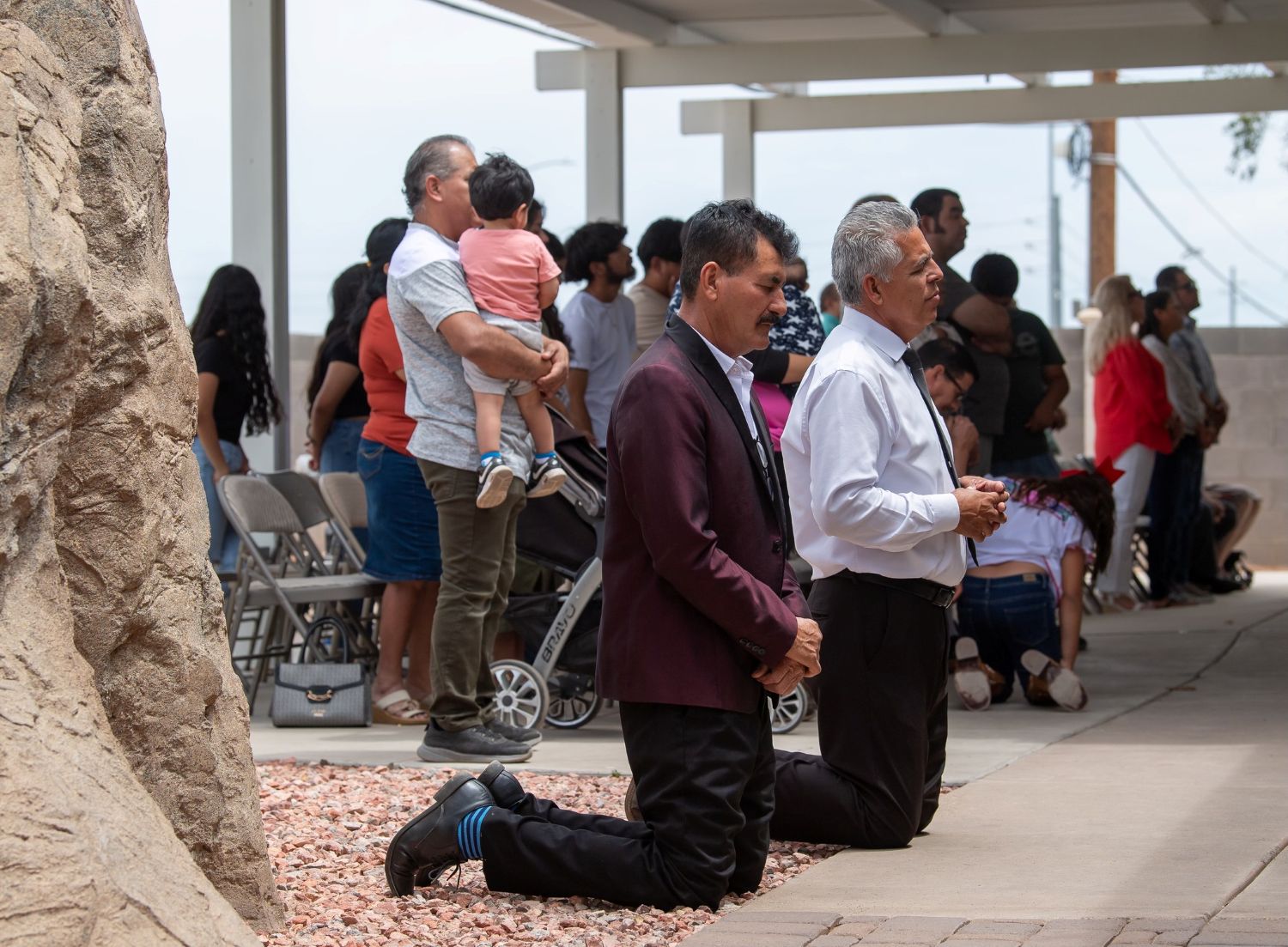
St. William was destroyed early on the morning of May 1, 2024, losing its sanctuary, parish hall, classrooms and food bank that served the close-knit, largely Spanish-speaking blue-collar community. Though the parish plans to rebuild, it has no timetable. It has been raising funds and receiving outside help as it works toward the financial goal.
“We are pilgrims of hope,” Samarripa said. “Though it may take years, eventually we will have our church. [The pilgrimage] did give us hope.”
“Without hope we cannot move forward,” said Fr. Arango.
This year’s second pilgrimage organized by the St. William pastor took place May 11.
Approximately 300 of the faithful journeyed to the Chapel of the Holy Cross, part of St. John Vianney Parish, in Sedona, Ariz. The pilgrims prayed and attended Mass at the church before having lunch with their hosts and making the short climb to the chapel.
Known for its distinctive cruciform design atop the red rocks and views through its floor-to-ceiling windows to the valley below, the site offered a spiritual refreshing, with the pilgrims singing, praying and lifting up heavenly praises.
“You feel the presence of God there. It’s very peaceful. You are with people who believe the same as you. You see all this beauty, and it keeps you in awe,” Samarripa said.
While she may not be on the next pilgrimage Aug. 2 to Kingman, Ariz., a four-hour drive from Cashion, Samarripa plans to go on the remaining trips: to Sacred Heart Parish in Prescott, Ariz., Oct. 12, and St. Mary’s Basilica in downtown Phoenix Jan. 4, 2026.
Richmond will be part of all remaining trips, completing every Arizona pilgrimage in addition to the one to Rome.
“Each location has been special,” she said. “It’s opened my eyes and heart more to the reality that we are all God’s children. We need to embrace one another and encourage one another. It really has amplified our understanding of hope and clinging to it, so we grow and move forward as one body.
“God speaks to each of our hearts [while] in community with brothers and sisters in Christ. It’s been beautiful. I just see God’s hand in everything around me right now.”