
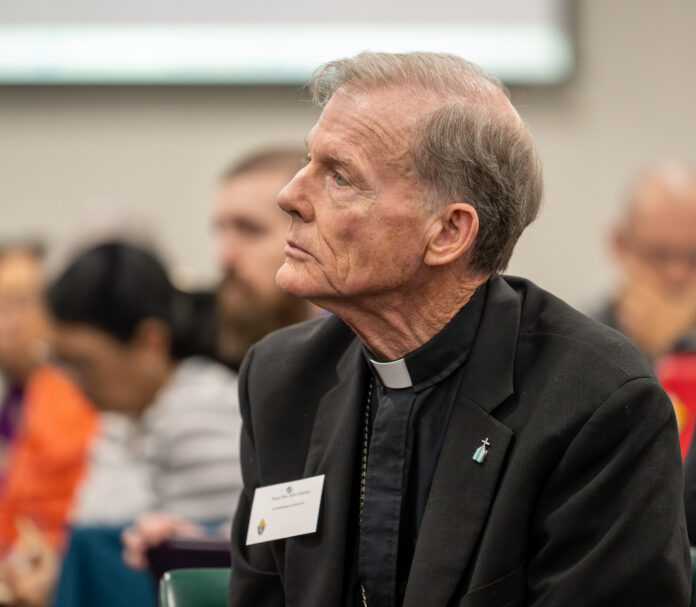
The Diocese of Phoenix, in partnership with the Hope Border Institute (HOPE) of El Paso, Texas, and the Center for Migration Studies (CMS) of New York, brought together faith leaders, diocesan staff, migrant advocates and community leaders from across Arizona and the Southwest for a regional gathering entitled, “Witness to Hope: Responding to Mass Deportations.” The convening on immigration took place Thursday (March 12) at the Diocesan Pastoral Center in downtown Phoenix.
The day-long event included workshops and strategy sessions addressing Catholic teaching on immigration, the current policy landscape and responding to mass deportations, including guidance on sensitive locations, communications and accompaniment of affected families. Bishop John Dolan, Auxiliary Bishop Peter Dai Bui and Bishop John Wester of the Archdiocese of Santa Fe were in attendance.
Supported by the Diocese of Tucson and the Kino Border Initiative, the event was co-sponsored by Catholic Charities USA, Catholic Legal Immigration Network, Inc., Catholic Health Association, Jesuit Refugee Service-USA and the United States Conference of Catholic Bishops.
During the gathering, Bishop Dolan underscored the Church’s moral responsibility to welcome and defend migrants and refugees.
“While our nation’s immigration system is badly broken and desperately in need of repair … any approach that villainizes those in the midst of humanitarian crises is inconsistent with the Gospel of Jesus Christ,” he said. “Meeting in person with those fleeing death, starvation, extreme poverty, persecution or great fear is almost always an intense and powerful encounter with the wounded Christ Himself.”
Fr. Andres Arango, vicar for Human Dignity for the Diocese of Phoenix, also spoke.
“2025 was a Jubilee year, and one of the hopes that Pope Francis placed on us in his time was the love for migrants. With the invitation of Pope Francis, we continue into this new year, 2026. [Pope Francis] is not here, but we are here,” Fr. Arango said.
“The Diocese of Phoenix organized this regional gathering to let us know that it is possible to open doors and be part of the solution,” he continued. “These are very difficult issues, but together we can reflect and find solutions for a better society, where justice and opportunity shine.
“There are many people deprived of a document but never deprived of dignity.”
The gathering took place as part of the Catholic Immigration Prophetic Action Project (Catholic IMMpact), a national initiative organized by HOPE and CMS to assist the Catholic Church in organizing a response on behalf of migrants and refugees living in fear of deportation. Thursday’s event was the second Catholic IMMpact regional gathering, following an event in Providence, R.I., which took place in December.
While many immigrants have been impacted by changes to immigration policies and enforcement efforts, the most vulnerable population in the region comprises the nearly 2.7 million persons without documents in Arizona (269,500), California (2.3 million) and New Mexico (60,500), including children. According to CMS estimates, mass deportations in this region could leave nearly 700,000 U.S. citizen children without both of their parents.
“By grounding the conversation in data, solid policy analysis and community-led initiatives, the Hope Border Institute and the Center for Migration Studies are working to support local dioceses and bishops to develop a robust pastoral response, including parish preparedness and planning, pastoral care and public witness,” said Sofia Lozano Pallares, assistant director of Community Engagement for HOPE and Catholic IMMpact community engagement specialist.
“The regional gathering in Phoenix reflects the moral imperative to respond to mass deportations,” said Kevin Appleby, senior fellow for Policy & Communications at the Center for Migration Studies of New York. “We’re grateful to the Diocese of Phoenix and the Diocese of Tucson for their leadership in making this event happen.
“The Center for Migration Studies and the Hope Border Institute believe now more than ever there is a need for strong local leadership in responding to the real threat of mass deportations in our local Church,” he continued, “and we are committed to advancing this critical work across the country.”