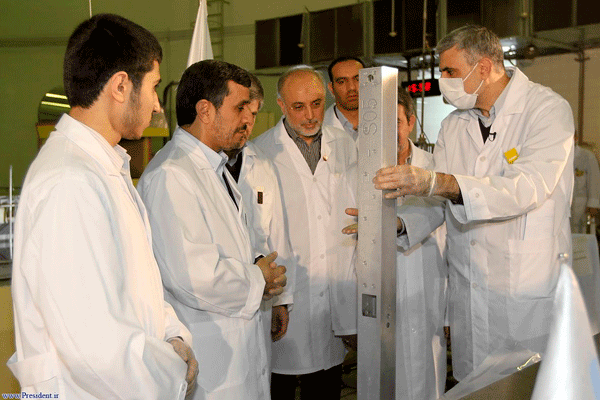
Iranian President Mahmoud Ahmadinejad, second from left, attends a ceremony unveiling new nuclear projects in Tehran in mid-February. The U.S. bishops and other Catholic experts say a military attack on Iranian nuclear facilities would not be justified under Catholic teaching. (CNS photo/handout via Reuters)
WASHINGTON (CNS) — The U.S. Conference of Catholic Bishops joined about four dozen other national organizations in amassing more than 50,000 signatures on a petition asking for a change in the United States’ “outdated” nuclear arms policy.
“You must act now to reduce the nuclear danger and the role of nuclear weapons,” said the petition, addressed to President Barack Obama.
The petition urges Obama to “end outdated U.S. nuclear war-fighting strategy, dramatically reduce the number of U.S. nuclear weapons and the number of submarines, missiles and bombers that carry those weapons, and take U.S. nuclear weapons off high alert. Maintaining large numbers of nuclear forces on alert increases the risk of accident or miscalculation.”
A May 15 announcement from the groups involved said the petition was delivered to the White House May 7. Stephen Colecchi, director of the bishops’ Office of International Justice and Peace, represented the USCCB.
“This is just one of the many expressions of support for overdue changes in the United States’ nuclear weapons strategy which is still burdened by Cold War thinking,” said Daryl Kimball, executive director of the Arms Control Association, which spearheaded the petition drive and assembled the coalition of organizations that signaled their support.
The United States, Kimball told Catholic News Service in a May 15 telephone interview, possesses about 1,700 strategically positioned nuclear warheads. Russia has about 1,500. Each has more strategically deployed warheads than the rest of the “nuclear club” — China, France, Great Britain, India, Pakistan, Israel and North Korea — has warheads of all kinds combined.
“Just one U.S. nuclear-armed submarine can destroy several cities,” Kimball said. “We today possess 12 submarines with nuclear weapons.”
Kimball said, “If our goal is to deter, one of these weapons is far larger than the bombs that destroyed Hiroshima and Nagasaki,” the two Japanese cities targeted by atomic weapons in World War II. He described the stockpile as “massive nuclear overkill that’s … dangerous and costly and unnecessary.”
He called for “a sense of proportionality” as Obama is due to receive soon a comprehensive study on the nation’s nuclear forces. “These decisions coming from President Obama very soon are once-in-a-decade decisions. This is President Obama’s best opportunity to change outdated thinking.”
In a March 2 letter to National Security Adviser Thomas Donilon, Bishop Richard E. Pates of Des Moines, Iowa, chairman of the USCCB Committee on International Justice and Peace, outlined some moral considerations to take into account during the study.
“The horribly destructive capacity of nuclear arms makes them disproportionate and indiscriminate weapons that profoundly endanger human life,” Bishop Pates said. “At a time of fiscal restraints, tens of billions of dollars currently allocated to maintaining Cold War-based nuclear force structures could be redirected to other critical needs, especially to programs that serve poor and vulnerable people at home and abroad.”
For decades, the Vatican and the U.S. bishops have promoted “the twin and interrelated policy goals of nuclear disarmament and nonproliferation,” Bishop Pates said. “This is an ideal that will take years to reach, but it is a task which our nation must take up with renewed energy.
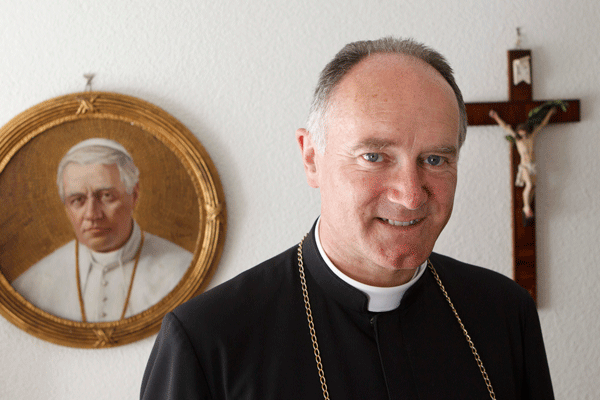
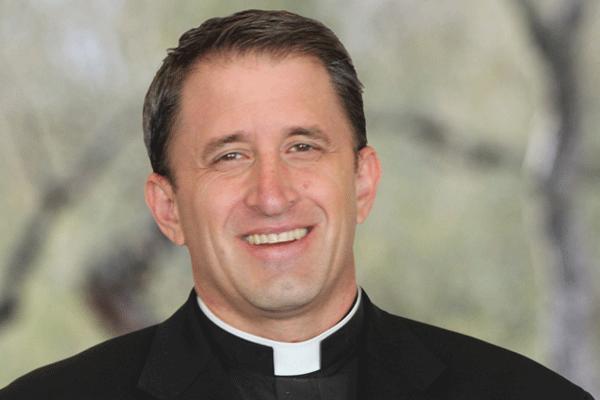
Bishop Bernard Fellay, superior of the Society of St. Pius X, is pictured near an image of St. Pius X at the society's headquarters in Menzingen, Switzerland, May 11. Bishop Fellay acknowledged there could be a split in the breakaway society if it decide s to reconcile with the Vatican. (CNS photo/Paul Haring)
MENZINGEN, Switzerland (CNS) — Of all the controversies associated with the traditionalist Society of St. Pius X, no topic provokes stronger reactions inside or outside the church than the question of the society’s attitude toward Jews.
In 2009, after Pope Benedict XVI lifted the excommunications of all four of the society’s bishops, there was widespread outrage at revelations that one of the four, Bishop Richard Williamson, had denied the gassing of Jews in Nazi concentration camps and endorsed the notorious anti-Semitic forgery, “The Protocols of the Elders of Zion.”
The society’s superior general, Bishop Bernard Fellay, repudiated those statements at the time, saying that “anti-Semitism has no place in our ranks” and that the “position of Bishop Williamson is clearly not the position of our society.”
More than three years later, the society, a breakaway group that rejects the modernizing changes that followed the Second Vatican Council of 1962-65, may now be on the verge of reconciliation with Rome under the leadership of Bishop Fellay and over the objections of other members, including Bishop Williamson.
A prerequisite for such reconciliation is the society’s assent to certain church teachings stipulated by the Vatican in a “doctrinal preamble,” which has not yet been published but which presumably includes elements of the teaching of Vatican II. In April, the director of the Vatican press office described the society’s recent response to the preamble as a “step forward” in the process.
Yet it remains unclear whether the society’s attitude toward Jews is fully in harmony with that adopted by the church at Vatican II, specifically in the 1965 declaration “Nostra Aetate,” which said the Jewish people could not be blamed for the death of Jesus Christ and taught that they “should not be presented as rejected or accursed by God.”
“‘Nostra Aetate’ remains the charter and guide in our efforts to promote greater understanding, respect and cooperation between our two communities,” Pope Benedict told a delegation from the Latin American Jewish Congress at the Vatican May 10.
“The declaration not only took up an unambiguous position against every form of anti-Semitism, it also laid the groundwork for a theological reassessment of the church’s relationship with Judaism and it expressed confidence that an appreciation of the spiritual heritage shared by Jews and Christians would lead to ever greater mutual understanding and esteem,” the pope said.
Interviewed by Catholic News Service the following day, Bishop Fellay said the Society of St. Pius X can accept “some points” of “Nostra Aetate.”
To say that “all the Jews today are responsible for the death of our Lord is not the teaching of the church, and so this is wrong,” Bishop Fellay said. “But to say that people who agree (with the crucifixion), who say, ‘No, they were right to do so,’ there they join themselves with those who were responsible.”
The bishop added that the society teaches that “we Catholics, with our sins, we are more responsible for the death of our Lord than the Jews.”
But in contrast with the pope’s remarks, Bishop Fellay’s description of the relationship between Catholics and Jews today hardly emphasizes cooperation or friendship.
Jews “have a special place in history,” Bishop Fellay said. “Unfortunately, by their refusing of the Messiah, of Christ, that does not change that they have a special role, but for the time being this role in comparison with Catholicism is an unpleasant role.”
The relationship between Jews and Christians is a fundamentally antagonistic one, he said.
Jews “see in Christianity the cause of their situation today,” the bishop said. “If you think of what happened to them during World War II, they claim that the fault or the cause is Christianity, which we claim is wrong.”
“When you see all the comments on the Jewish side about Catholicism, you see this antagonism which does not come first from the Catholics,” he said. “I think it comes more from their side than ours.”
The bishop said that he did not attribute such an attitude to “every Jew, as people,” but to “the religion, Judaism, which is something different.”
“Not all Jews follow Judaism,” he said.
Bishop Fellay said that, despite popular perceptions fed by controversies such as the Williamson case, Judaism is not a preoccupation of members of the society.
“I don’t think that in any talk or sermon, I ever talked about the Jewish question,” he said. “It’s not an issue for us.”
Yet other SSPX members have a history of statements and publications expressing hostility and suspicion toward Jews.
The group’s founder, the late Archbishop Marcel Lefebvre, named “the Jews, the Communists and the Freemasons” as “declared enemies of the church” in a 1985 letter to Blessed John Paul II. Bishop Bernard Tissier de Mallerais, who also opposes Bishop Fellay’s efforts at reconciliation with Rome, said in 1997 that “the Jews are the most active artisans for the coming of Antichrist.”
And in 2009, shortly after the outbreak of the Williamson controversy, the society’s U.S. website (www.sspx.org) removed articles arguing that the “Jewish race brought upon themselves the curse that followed the crime of deicide,” and that the “Jewish people, if it has not converted to Christianity, will, even if it does not wish to, seek to ruin Christianity.”
The society may still be exposing its members and supporters to such ideas today.
In early May, journalists visiting the society’s international seminary in Econe, Switzerland, the burial place of Archbishop Lefebvre, saw copies of a French edition of “The Jew in the Mystery of History” on display near the entrance to a small bookshop attached to the chapel, where members of the local community also attend Sunday Mass.
The book, by Father Julio Meinvielle, an Argentine priest who died in 1973, describes the Jews as historic “enemies of the Gospel,” moved by a “satanic hatred” of Christians, whom they have systematically killed and robbed over the centuries, and whose “corruption and ruin” they continue to seek through their “domination” of world economics, politics and culture.
Justifying the “discipline of the ghetto,” which the church imposed on Jews until the “de-Christianized” modern age, the book calls for a kind of apartheid between the religions to permit the restoration of Christian civilization.
Does the book express mainstream views in the society today? CNS asked Bishop Fellay.
“Not that I would know,” he replied.
Would he endorse such views himself?
“Not like that, no,” he said.
“The topic (of the Jews) is very, very delicate, very delicate, and should be handled with the greatest care,” the bishop added. “We don’t want at all to provoke and to make unnecessary turmoil in the world.”
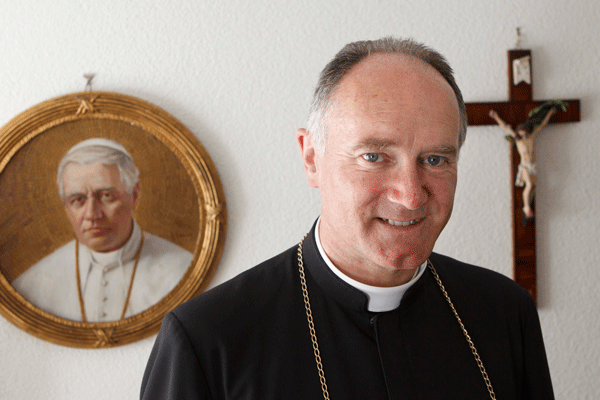
Bishop Bernard Fellay, superior of the Society of St. Pius X, is pictured near an image of St. Pius X at the society's headquarters in Menzingen, Switzerland, May 11. Bishop Fellay acknowledged there could be a split in the breakaway society if it decide s to reconcile with the Vatican. (CNS photo/Paul Haring)
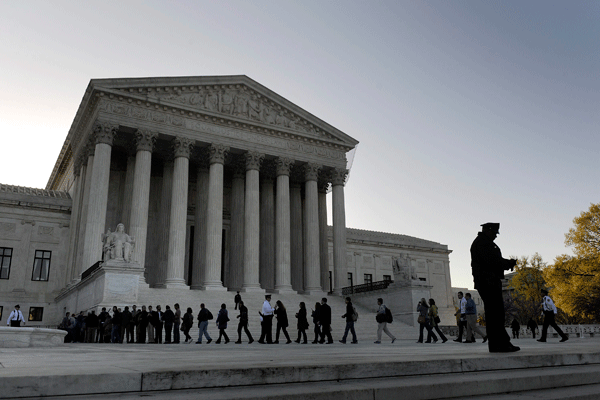
People enter the Supreme Court building in Washington March 26 to attend oral arguments in challenges to the Patient Protection and Affordable Care Act. Two years after President Barack Obama signed the health care overhaul into law, the high court began three days of oral arguments on challenges to various aspects of the law. (CNS photo/Jonathan Ernst, Reuters)
WASHINGTON (CNS) — Although the Obama administration’s proposed “accommodation” for religious employers to the mandate that contraceptives and sterilization be included in most health plans “may create an appearance of moderation and compromise,” it does not change the administration’s fundamental position, attorneys for the U.S. bishops said in comments filed May 15.
“We are convinced that no public good is served by this unprecedented nationwide mandate, and that forcing individual and institutional stakeholders to sponsor and subsidize an otherwise widely available product over their religious and moral objections serves no legitimate, let alone compelling, government interest,” said the comments filed with the U.S. Department of Health and Human Services.
Signed by Anthony R. Picarello and Michael F. Moses, general counsel and associate general counsel, respectively, for the U.S. Conference of Catholic Bishops, the 21-page comments were in response to the administration’s “advance notice of proposed rulemaking” published March 16 in the Federal Register, which proposed new ways for religious organizations that have moral objections to providing free contraceptives to their employees to comply with the requirement.
Among the administration’s suggestions are having the costs covered by a “third-party administrator” of a health plan or “independent agency” that receive funds from other sources, such as rebates from drug makers.
The USCCB comments said the proposed changes would still require “conscientiously objecting nonexempt religious organizations … to provide plans that serve as a conduit for contraceptives and sterilization procedures to their own employees, and their premiums will help pay for those items.”
“As a practical or moral matter, none of (the approaches proposed by the administration) will solve the problem that the mandate creates for nonexempt religious organizations with a conscientious objection to contraceptive coverage,” the attorneys added.
The USCCB comments repeated several times that the best solution to their objections to the mandate would be its complete rescission.
“We believe that this mandate is unjust and unlawful — it is bad health policy, and because it entails an element of government coercion against conscience, it creates a religious freedom problem,” the USCCB attorneys said.
“These moral and legal problems are compounded by an extremely narrow exemption that intrusively and unlawfully carves up the religious community into those that are deemed ‘religious enough’ for an exemption, and those that are not,” they added.
The USCCB submission noted that HHS had not asked for comments on whether contraceptives and sterilization should be among the mandated preventive services for women under the health reform law or on the four-pronged definition of religious organizations that could be exempt from the requirement.
To be exempt from the requirement, a religious organization “has the inculcation of religious values as its purpose; primarily employs persons who share its religious tenets; primarily serves persons who share its religious tenets; and is a nonprofit organization” under specific sections of the Internal Revenue Code.
Both the mandate and the exemption are now final rules, “entirely unchanged from August 2011,” the USCCB said.
It warned that “many religious and other stakeholders with a conscientious objection to some or all of the mandate coverage are ineligible” for the exemption or the one-year “temporary enforcement safe harbor” established by the Obama administration. That safe harbor period is to begin Aug. 1, 2012.
“Absent a change of course by the administration or a court order granting relief, individuals, insurers, for-profit employers and many other stakeholders with a moral or religious objection to contraceptive coverage will be required in the next few months either to drop out of the health insurance marketplace, potentially triggering crippling penalties, or to provide coverage that violates their deeply held convictions,” the USCCB attorneys said.
Before it makes a final decision on its rules for ways religious employers could pay for the mandated contraceptive coverage, the Obama administration is seeking public comment until June 19.
— By Nancy Frazier O’Brien, Catholic News Service
– – –
Editor’s Note: Comments on the proposed “accommodation” announced March 16 can be submitted via this website: www.regulations.gov/#!submitComment;D=CMS-2012-0031-0001. Written comments also can be submitted by mail to: Centers for Medicare & Medicaid Services, Department of Health and Human Services, Attention: CMS-9968-ANPRM, P.O. Box 8016, Baltimore, MD 21244-1850. More information is available at by calling the Federal eRulemaking Help Desk at (877) 378-5457 and pressing 2. Or, go to the website www.regulations.gov, and write CMS-2012-0031-0001 in the search box.
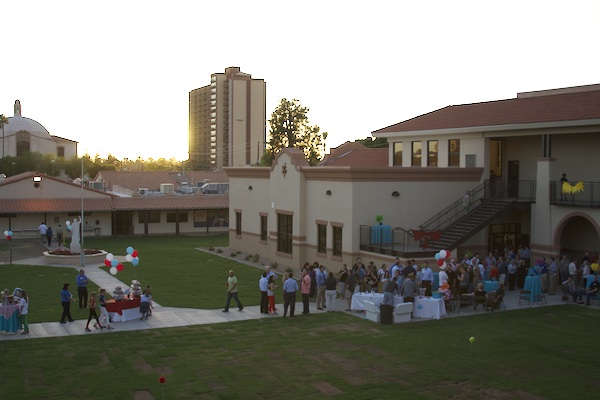
The old St. Francis Xavier campus (background) meets the new one (right) during a May 3 open house. The old buildings will come down this summer and a third be erected as part of an ongoing capital campaign. (Ambria Hammel/CATHOLIC SUN)
As summer vacation inches near, students might be tempted to daydream while at school.
At St. Francis Xavier School, that’s okay. Students will soon have an even greater opportunity to do so. A two-story classroom building, rich with natural light, is set to open in August.
“We wanted a lot of windows so kids could daydream. That’s a really big part of Jesuit spirituality is trust your imagination. That God speaks through our imagination,” Kim Cavnar, principal at St. Francis Xavier told The Catholic Sun after a walking tour of the Jesuit school’s newest classroom building.
More than 300 people including current school families, alumni and benefactors took a guided walking tour May 3. Each room carried a Dr. Seuss theme, building upon that imagination concept. Some rooms also had students dressed up as Thing 1 and Thing 2.
The crowd also found faculty in each room, ready to highlight the latest technology, ample space and furnishings. All 10 elementary–level classrooms will offer high speed and wireless Internet, Britelinks projectors that turns any surface into an interactive learning space and LED lighting. They’re also substantially larger, growing from 650 square feet to more than 1,000-square-feet.
Private, small-group meeting space between the classrooms is another new feature. A larger atrium, a space for Catholic teaching and spiritual retreat, is also part of the new building. During the open house, it showcased a tribute to those honored with memorial gifts.
A key part of the $4.5-million building is a new library. It can support two classes for student learning while others are checking out material. The library, which the librarian reportedly compared to upgrade from a motel to the Ritz Carlton, will also have 16 computers and a dedicated media lab.
Jesuit Father Dan Sullivan, pastor, gave each tour group a whirlwind history of the campus which until recently, hadn’t had a facelift since the ‘50s.
Junior high classrooms and the school gym opened nearly two-and-a-half years ago as the first fruits of the ongoing Etched in Our Hearts capital campaign. Phase B should open in August with the old buildings coming down this summer.
That leaves Phase C, a building that will adequately house administration, Spanish and the arts, just getting underway. A $100,000 matching grant was announced during the open house to help make that vision a reality.
“The buildings are important, but what is more important is that we’re educating children. We’re giving them the best possible educational environment that we can,” Fr. Sullivan said.
Jessica Hajjar, a freshman at Xavier College Preparatory, agreed. She spent five years at St. Francis Xavier and said it’ll be important for the elementary students to be able to learn in so many different ways and adapt with the technology.
Hajjar said she also felt prepared for high school and life beyond through St. Francis Xavier’s commitment to community service. Students learn to be “kids for others” and raise money for local organizations.
That’s something that is subtly woven into the campus’ new look, St. Francis Xavier’s principal said. The ceiling-high windows are thought to symbolize students and alumni bringing the Light out into the world.
_____________________
For more on the Etched in Our Hearts Capital Campaign, visit its website
Editor’s Note: Kristin Parrack, capital campaign coordinator, was listed as the Phoenix Business Journal’s “Forty Under 40” for being such an impressive leader. So was Ann-Marie Donaldson Alameddin, a St. Francis Xavier alum, who was invited into the school’s first “Best in Class” cohort which recognizes outstanding alumni. They’ll be formally recognized June 19.
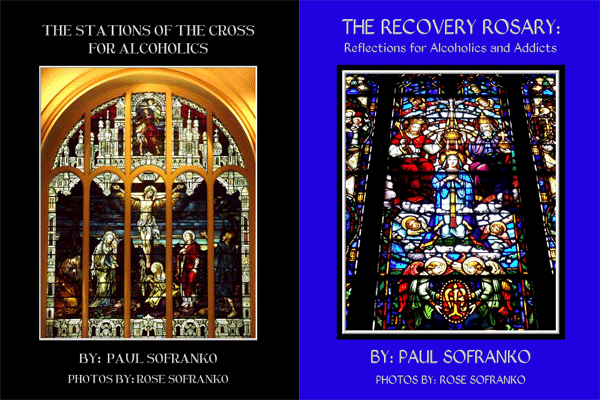
“The Recovery Rosary: Reflections for Alcoholics and Addicts” and “Stations of the Cross for Alcoholics,” by Paul Sofranko are available on his website: www.sobercatholic.com. Follow him on Twitter: @sobercatholic.
Go into any modern bookstore or go online to any major bookseller and you will find oftentimes large self-help sections. Look closer and you can narrow your search down to self-help books for alcoholics and drug addicts.
Look even closer and you might find a book here or there for Catholics suffering from these afflictions. Into all this comes Paul Sofranko with two small books, “The Recovery Rosary: Reflections for Alcoholics and Addicts” and “Stations of the Cross for Alcoholics.”
Sofranko, a recovering alcoholic himself, has added one more element to the whole scheme of fighting addiction — hope. While many or even most self-help books suggest that we are the only ones capable of fixing our brokenness simply by reading the book, Sofranko elevates the place of prayer in the healing process and reminds readers of the necessity of relying on God for the grace to overcome our addictions.
Relying on God and His mercy is primary to our understanding of our place in a fallen creation and unmatchable in pointing us in the direction of healing.
Sofranko offers the standard sets of prayer, like any good book on the rosary or the Stations of the Cross, but he includes commentary, which aids in the understanding of the purpose and function of the prayer. Moreover, Sofranko centers his commentaries on the problem of addiction.
In “The Recovery Rosary,” he likens recovery to the journey of Christ within the Passion — the courage needed to give up the addictive substance or alcohol is the same kind of courage Christ used to avoid the temptation and proceed to His suffering. Just like the scene in the Garden when Jesus stepped away from the disciples: “He advanced a little and fell prostrate in prayer, saying, “My Father, if it is possible, let this cup pass from me; yet, not as I will, but as you will” (Matt 26:39).
Sofranko writes: “Being a Christian isn’t about accepting Jesus Christ as Lord and Savior and then having a life that is all butterflies and buttercups. It’s humbling yourself to the painful reality that there is a God and you are not Him and that you may have to live according to ways that are contrary to your natural tendencies, political and social beliefs and other peer-pressure situations.”
Living according to God’s will is the kind of advice that is good for all of us, addicted as we all are to sin, consumerism, partisan politics and national and cultural boundaries. God’s will takes us outside ourselves and allows us the natural freedom of surrender that comes from giving our lives to Him.
Like “The Recovery Rosary,” “Stations of the Cross for Alcoholics” follows the journey of the Passion in a point-by-point or event-by-event kind of way, mirroring the recognition of the addict or the alcoholic that something is wrong, that the way of living is not the way that God wants us to live, and the slow, painful turn toward the clean life and freedom.
For alcoholics, the path to sobriety is a life-long one, Sofranko intones, the weight of which is beyond any alcoholic’s own strength. Like the promise of the Resurrection as Christ stumbled along the path to Golgotha, the path to the fact of sobriety is as burdensome and fraught with obstacles and pitfalls.
Sofranko writes: “Crushed by the weight of the suffering, crushed by the enormity of the task, crushed by a promise that seems hard to achieve, a person falls. And crushed by the guilt over the failure to remain clean and sober, the temptation to remain fallen looms.”
Just as Simon of Cyrene helped carry the cross and Veronica cleaned His face, Christ can help the recovering alcoholic get up and move along. Our own journey, even without alcoholism or substance abuse, can be as perilous and the advice given by Sofranko in these two wonderful books is rooted directly in Holy Scripture; in other words, it’s good for all of us and both books are excellent, easy, thought-provoking reads.
– – –
Robert Curtis, a life-professed Lay Dominican, is the author of 17 books, holds a master’s in creative writing, teaches composition at the University of Phoenix and creative writing at Rio Salado College.
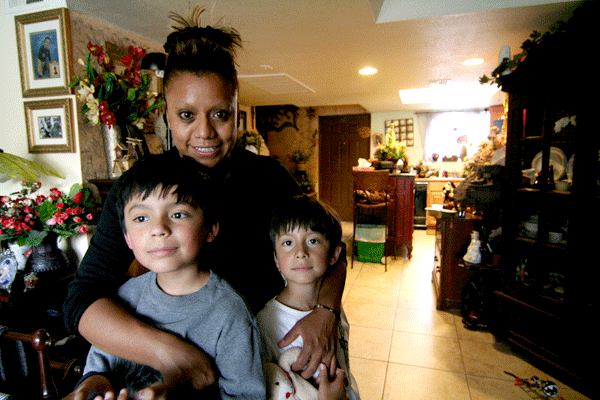
Connie White poses for a photo with her two boys, Joshua and Isaiah. White, whose parents brought her into the United States when she was 14, felt trapped in an abusive marriage because she was an undocumented immigrant. (J.D. Long-García/CATHOLIC SUN)
A Casa Grande police officer told her she needed to go to the emergency room. She brushed it off, said she was OK. She was just worried about her kids.
“Ma’am,” the officers said, leading her to a mirror. She looked at herself.
“I couldn’t even see my face,” she said.
Her two children saw their father pummel their mother. Isaiah, still crawling, followed his mother as she exchanged blows with her husband. Joshua, a couple years older, watched from under the kitchen table.
They saw their father throw their mother against the wall. When she got up from the floor, they saw their father break their mother’s nose with the heel of his palm.
“I’ll bury you in the desert one of these days,” her husband told her, according to the police report. He grabbed his cell phone and keys and left.
She turned to her two children and found Isaiah’s white pajamas soaked red. She panicked, fearing she’d accidentally hit him while defending herself. But all of the blood was hers.
Connie White was one of many undocumented immigrants that, because of their legal status, feel trapped in domestic violence situations. In this case, her spouse was a U.S. citizen who regularly threatened to have her deported if she spoke up.
“People feel they have no recourse,” said William DeSantiago, an attorney with Catholic Charities Immigration Services. When a spouse says they’ll go to immigration, it’s not an idle threat, he said.
In some cases, battered spouses return to their husbands or wives because they have so little support, DeSantiago said. Catholic Charities deals with such domestic violence situations every week.
The Violence Against Women Act, by which spouses or children of lawful U.S. residents can self-petition for legal residency, often comes into play. While the Senate recently reauthorized the legislation, H.R. 4271, the House is taking up its own version, H.R. 4970, which critics say diminishes protection of immigrant women and children who are victims of abuse.
Many undocumented immigrants simply don’t have a pathway to legal residency, DeSantiago said. Of the more than 3,000 immigrants that came to Catholic Charities for a consultation last year, only 1,100 had reason to open a petition.
Crosier Brother Jim Lewandowski, who has worked with immigrants in Phoenix, Nebraska and Minnesota for years, has come across domestic violence issues in his work.
“If the husband gets put away, who supports her?” he said, explaining that even if both husband and wife are undocumented, reporting domestic violence is difficult. He says abuse also happens when undocumented men marry women who are U.S. citizens. Women in these situations sometimes take advantage of their undocumented husbands, benefiting from their income.
“For the undocumented person who married an American citizen, the promise of a future green card carries a lot of weight,” Bro. Jim said. “If there’s domestic abuse, for some of the people I know, the last person they’d be talking to is the police.”
Calling the police would mean facing all the immigration questions themselves.
Backstory
By the time White finally called the police, she’d been through a history of abuse.
She and her husband conceived their first child when her husband was married to another woman. He and his mother came to White and suggested she have an abortion.
She refused. Abortion was unthinkable.
“Children are not something that can be disposed of,” she said. “They are yours — they come from you.”
Her respect for the sanctity of human life comes from, paradoxically, the lack of respect she felt as a child.
“My mom had so many kids,” she said. “My mom abused us when we were little. If we didn’t bleed, then we didn’t learn our lesson.”
White is one of eight children. When she was a child, her mother told her this: “When you were born, I went to sleep with the dogs because I couldn’t stand you.”
White’s family brought her to the United States from Guanajuato, Mexico, when she was 14. That was in 1995. Her father was a farmer, and he wasn’t making enough to provide for his eight children.
Fewer restrictions made it easier to enter the country then. At first her father cleaned houses, but then learned to be a mechanic. When he’d get home, he never wanted to hear anyone’s problems — certainly didn’t want to hear any “girl talk,” White said.
Her sisters got married early. She was interested in college, so she would babysit and clean houses to afford community college.
Her father was disappointed in her when she began dating a Caucasian man.
“White men do drugs,” her father said. “They do crazy things — they hit women.”
When she began seeing her now-ex-husband, her family severed ties with her. They wouldn’t take her back, even after she was pregnant.
So White lived on the streets for months. She gave birth to Joshua before her husband came to her promising to divorce his current wife. He even quoted Scripture to convince her to marry him.
They dated for eight months and were married Dec. 12, 2004.
When Isaiah was conceived, her husband, again, demanded an abortion. And White refused again.
One afternoon — she was four months pregnant — her husband made her a cup of coffee. She drank it. The next thing she remembers is waking up in an emergency room. A nurse asked her what had happened.
“What? I don’t know?” White said as she came to.
“The baby is coming,” the nurse said. “Why is your stomach bruised?”
“I probably fell,” she told the nurse.
She believes her husband had beaten her badly, likely in an effort to kill their unborn child. She’d overdosed on cocaine — presumably in the coffee — though, as she told the nurse, “I never did any of that.”
Miraculously, Isaiah wasn’t born that day. He held on for a couple months, but then was born prematurely. He had to stay in the hospital for several weeks after his birth.
When she threatened to turn her husband into the police, he threatened to have her deported. She would never see Joshua or Isaiah again, he told her.
“It happens all the time,” said Jose Robles, director of Hispanic Ministry for the Phoenix Diocese. “The abuser threatens the victim with deportation.”
His office receives many calls related to domestic violence. The spouses often don’t report the abuse for years, believing things will eventually change.
“It’s a systemic problem that hasn’t come to the forefront,” Robles said. The culture among the undocumented community is one of silence and fear, he said. Things that need to be reported to law enforcement simply aren’t.
At her husband’s insistence, White began cleaning offices at night so she could still care for her children during the day.
White conceived again. This time her husband and his mother enlisted the help of the pastor of their non-denominational church. He too urged her to have an abortion, but she refused again.
Her husband came back from work one day and started kicking her in the stomach. She couldn’t get away.
“So I went to the hospital the next day and they told me my baby was dead,” she said. It was Thanksgiving.
She and her husband conceived a fourth time. At first, her husband acted normal. But then she caught him with another woman in their house. After the woman left, he beat her again, and she lost the child.
Connie White poses for a photo with her two boys, Joshua and Isaiah, in her Phoenix apartment. White felt trapped in an abusive marriage. (J.D. Long-García/CATHOLIC SUN)
Seeing red
The day Isaiah’s clothes were red with White’s blood was the day things changed. The police officer brought her to the mirror to see herself. She didn’t recognize her face, but her situation came into focus.
The police report notes a blood-stained towel near the entrance, another on the washing machine. There were bloody, smeared finger prints on the front door. White’s husband also told police he loved her.
White lost a lot of blood and was rushed to the emergency room. Once there, she met people who would help her leave her husband. She had rights, even as an undocumented immigrant. She divorced her husband.
“No one in my family has gotten a divorce,” White said. “It should have been a sad day, but it wasn’t.”
Free legal advice and representation came from DeSantiago’s office at Catholic Charities.
“Catholic Charities did everything for free,” White said. “I had nothing, and I was living on food from trash cans.”
In the three-year legal process, Catholic Charities helped White with food, employment, clothes and counseling.
She received a visa, won full custody and half of her ex-husband’s business. “All I wanted was a chance to finish my degree,” she said. She did that. White, who supports herself and her boys with a full-time job, plans to return to school to become a nurse.
But the scars remain.
Her ex-husband, who used to introduce her as the house cleaner, would make her look at herself in the mirror.
“He’d tell me he was with me out of pity,” she said. “He told me I was ugly, that no one would ever care for me.”
He would tell her: “That’s why you can’t have my kids. Because they’d turn out so ugly.”
“But look at them,” she said, pointing to a photo of Isaiah and Joshua. “They’re not ugly.” And neither is she.
There are no mirrors in her apartment now.
“I’m here, doing my own thing, living my life,” she said. “It feels good not to be insulted by someone close to you.”
Obesity is a serious issue that brings with it an increased likelihood of health problems, including heart disease, diabetes and stroke.
It’s an affliction that is characterized, in part, by lethargy and breathlessness. It can be remedied, though, by talking with a doctor, eliminating fast food intake from the diet and through regular exercise.
Similarly, America’s got a heavy problem that, figuratively speaking, portends significant threats to the health of the Catholic Church, to religious freedom for all citizens, and the very fabric of our society.
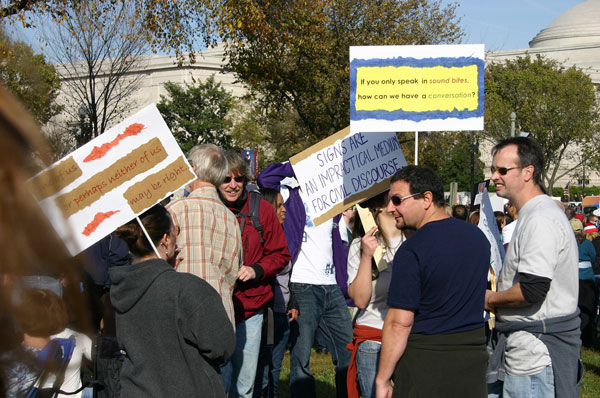
In recent years we have witnessed an astonishing collapse in civil discourse, characterized by scathing, vitriolic and callous exchanges, with seemingly few looking for the truth. We’re looking at you, cable news, Facebook and the comments section of every website.
Take for example the recent debate over same-sex marriage, which hit a fever pitch following President Obama’s public endorsement last week. There are many who continue to stand by and fight for the institution of marriage, who firmly believe that marriage between one man and one woman is the cornerstone of society, and efforts to modify or ignore this unique relationship will only further erode the culture.
Viewpoints contrary to messing with marriage are met by many in the mainstream and social media spheres, sadly, with accusations of bigotry, discrimination and homophobia.
Another example involves a private Phoenix school that forfeited a state championship baseball game last week because its opponent refused to bench its second baseman — who, by all accounts, is a very talented young lady. This was front-page news in Phoenix and was featured all over the evening newscasts. Our Lady of Sorrows is not a diocesan Catholic school, but is run by the Society of St. Pius X, an organization that is not in communion with the Roman Catholic Church.
Lost in the kerfuffle was the school’s reasoning in the matter: “Teaching our boys to treat ladies with deference, we choose not to place them in an athletic competition where proper boundaries can only be respected with difficulty. Our school aims to instill in our boys a profound respect for women and girls.”
Whether this is something one agrees with or not, it was the private school’s decision to make — a decision that probably was not made in haste and which undoubtedly took quite a bit of conviction to stand by. But small, important details such as these tend to get lost quickly. People see the name of the school, perceive an issue with gender inequality, and automatically take to the Internet to air their grievances with the Catholic Church: “War on women! War on women!”
Finally, one must look no further than the ongoing battle being fought by the U.S. bishops in an effort to preserve religious liberty. At the heart of the matter is a recent mandate by the U.S. Department of Health and Human Services that compels all private employers to provide contraception, sterilization and abortafacients as part of its health care coverage for employees. This requires religious organizations, such as Catholic hospitals and universities, to subsidize the costs of drugs and procedures that the Catholic Church considers intrinsically evil. In a very real and concrete sense, religious organizations are now faced with violating this law — and facing penalties — or violating their consciences and deeply held moral beliefs.
Critics of the Church’s position can spout the spiffy “War on women!” sound bite till they’re blue in the face, but it won’t change the truth. The Church’s teaching against contraception and sterilization is based on respect for the miracle of procreation, so health care plans in accord with Church teaching do not cover sterilization, nor do such plans subsidize the pill. Abortion is an affront to God and the miraculous gift of life.
As Americans, all of us should be be deeply troubled by these events. Our nation’s forefathers recognized that religious liberty was so essential to the future of our country that it had the distinction of being in the First Amendment to the U.S. Constitution.
Today we are confronted with many weighty issues that demand analysis, discernment and healthy discussion. Our appeal to you is to read beyond the headlines, to steer clear of the fast food-like news posted on Facebook that’s void of nutritional context. We ask you to delve deeper into stories and fully explore issues of importance, and not to succumb to lethargy of the heart and breathlessness of the spirit.
Bishop Thomas J. Olmsted will ordain Dan Vanyo into the priesthood June 2 at Ss. Simon and Jude Cathedral.
Bishop Thomas J. Olmsted will ordain Dan Vanyo to the priesthood during a 10 a.m. Mass June 2 at Ss. Simon and Jude Cathedral.
The ordination will cap off years of study at the seminary as well as pastoral work, putting what he learned into action. Fr. Paul Sullivan, director of vocations for the Phoenix Diocese, said Vanyo “has had a knack for creating community life.”
“We saw this in the seminary,” he said. “The ability to bring people together will be nice to see in parish life.”
Vanyo, who will begin his priestly ministry at Queen of Peace in Mesa and as a high school chaplain, is looking forward to celebrating Mass, conferring the sacrament of the sick and hearing confessions.
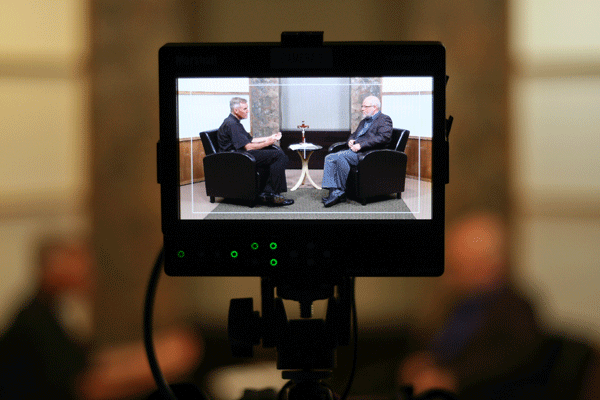
“Catholics Matter” host Fr. Rob Clements interviews Youth Protection Advocate Paul Pfaffenberger May 9 at Skyline Productions in Phoenix. (J.D. Long-García/CATHOLIC SUN)
In a world flush with instant communication via Facebook, Pinterest, Twitter and Instagram, is it any wonder Pope Benedict XVI has taken to the social media sphere to share the Good News?
Last year from his iPad, the Holy Father used Twitter (@news_va_en) to announce a new Vatican website, and has since tweeted messages to thousands of faith-filled followers.
The Phoenix Diocese isn’t a stranger to the tidal wave of mass media. Its Communications Office leads the diocese’s internal and external communication initiatives to ensure the Church’s priorities are effectively expressed in a variety of ways between Church leadership, churchgoers, employees, parishes, schools, the public and the media.
A component of the communications strategy that is quickly growing is the diocese’s social media outreach, which boasts digital initiatives spread out over several of the popular social media websites, including Facebook, Twitter, Tumblr, YouTube and Vimeo.
Robert DeFrancesco, director of communications, said vehicles used for communication and evangelization include the “critically important” Sunday Mass, broadcast live from Ss. Simon and Jude Cathedral — alongside The Catholic Sun newspaper and website, Catholic radio and various websites.
Platform for the Church
Giving voice to the Church’s mission is the annual Catholic Communication Campaign. Catholics locally and nationwide will participate in the annual collection, taking place during Masses May 19-20. Half of all donations received from local parishes will directly benefit the diocese’s communication efforts.
“Today’s mainstream media and popular culture are increasingly hostile to Christians and religious liberty,” DeFrancesco said. “The Catholic Communication Campaign provides the Church a platform that cuts through the noise of what’s in the mainstream.”
DeFrancesco said donations to the Catholic Communication Campaign primarily support the Sunday Mass broadcast, which serves elderly and homebound Catholics who are not able to be physically present at Mass.
He said that some 65,000 people tune in each Sunday to the live television broadcast. The Mass is also simulcast on 1310 AM, as well as over the Internet, reaching thousands more.
“Thanks to the web, we are now bringing the Word of God to 900 cities across the United States and more than 100 countries around the world,” DeFrancesco said.
The national campaign ensures that the voice of the Church is broadcast over television, Internet, radio, newspapers and podcasts.
“Those who generously support the Catholic Communication Campaign understand the importance of Catholic media,” DeFrancesco said.
The task of sharing the Catholic Church’s worldwide vision and Gospel message of Jesus through mass media is as varied and diverse as the people who receive it.
The local audience includes 820,000 Catholics, 92 parishes and 35 schools; however, millions of Catholics gain a deeper understanding of their faith through resources they use every day.
Ana Sill, media relations specialist with the Communications Office, said social media sites like Facebook and Twitter have helped the mission of the Church.
“We are able to share important news with the Catholics of the diocese and around the world almost immediately,” Sill said. “Also, it allows our department to be more mobile. We don’t have to be sitting at our desk to get something out. We can post things from our phones, too, and share news and pictures in real time.”
DeFrancesco said it’s important to keep in mind that the diocesan’s mass media services are made possible by the generous support of the Catholic Communication Campaign.
“As Catholics, we are called to be evangelists — to bring the Gospel to the masses. It is critically important to be where the people are,” he said.
– – –
A Catholic voice
The diocesan Communications Office is well versed in providing informed news, thoughts and perspectives on matters of faith and the intersection of Church and society.
It has a distinct Catholic voice that offers unique Catholic perspectives locally, nationally and internationally.
Each Sunday, the Catholic Mass is broadcast live from Ss. Simon and Jude Cathedral at 9 a.m., on KAZT-TV (AZ-TV7, Cable 13), followed by local talk show, “Catholics Matter,” hosted by Fr. Rob Clements.
Every Monday the diocese’s locally produced radio program, “The Bishop’s Hour,” takes on current issues from a Catholic viewpoint.
Hosted by Michael Dixon, it is broadcast at 11 a.m. on 1310 AM Immaculate Heart Radio.
Listeners can catch an encore presentation every Thursday at 9 p.m. Information is available at www.thebishopshour.org.
The Catholic Sun newspaper is published once a month, with timely updates on the Web at www.catholicsun.org.
Catholics can stay connected with the Phoenix Diocese online at several sites:
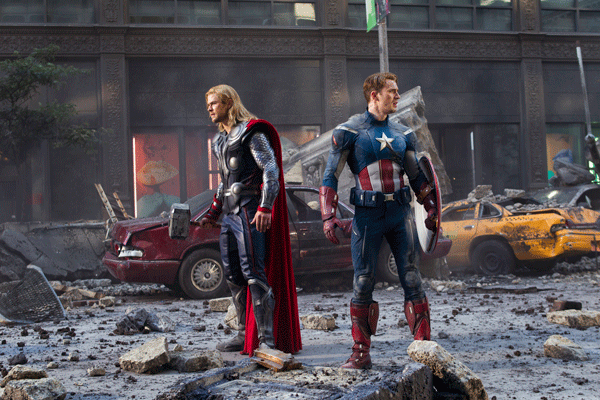
Chris Hemsworth and Chris Evans in Marvel’s “The Avengers.” (CNS/DISNEY)
Stan Lee’s Marvel Comics have been the subject of many on-screen interpretations, including the “Spiderman” and “Iron Man” series as well as several others. Some were great, many were mediocre and still others were outright bad.
The characters in “The Avengers” (Disney) avenge the world and the film itself makes up for the bad ones. It’s terrific, fun, and immersion into the comic book world without the confusion of a laborious back-story or caricatured soul-searching.
Marvel fan and aficionado Joss Whedon wrote and directed the clever script. Yet without seeing the films prequels, it requires concentration from the audience. Every superhero in the film has been part of a previous Marvel film — most have had their own (“Ironman,” “Captain America,” “Thor,” “The Hulk,” and “The Incredible Hulk”).
Loki, the jealous and evil brother of Thor — both gods from another planet — has found a way to make himself the leader of an army of aliens, whose intention is to take over the Earth. He attains an energy source that enables him to gain control of humans. A government agency, S.H.I.E.L.D., led by Nick Fury (Samuel L. Jackson), seeks out a group of superheroes referred to as the Avengers to help fight Loki and his supernatural powers.
The Avengers include Ironman (Robert Downey Jr.), Captain America (Chris Evans), Thor (Chris Hemsworth), the Hulk (Mark Ruffalo), Black Widow (Scarlett Johansson) and Hawkeye (Jeremy Renner). All of these superheroes are reluctant to work together, but are eventually drawn together by the need to serve a bigger cause — saving the world — and come together for an epic fight.
“The Avenger” cast’s performance is pitch perfect and impressive, especially considering how well so many of these A-list actors and actresses share screen time. No one dominates the film, but all of them add to the quality — particularly during the shared scenes that have snappy and witty dialogue.
Tension permeates the superhero relationships and the best part of the film is watching the dynamic evolve. This the moral message: When the heroes abandon their egos and their selfish pursuits, they are able to effectively work together for the good of a people. The Avengers might be saving the world, but any group of people can realize that coming together to serve a cause bigger than themselves makes a positive impact.
Whedon and his team of Avengers have successfully reclaimed what has been a sometimes strong and other times weak franchise. There is certainly going to be more avenging in the future. And that’s a good thing.
Media critic Rebecca Bostic is a regular contributor to The Catholic Sun. Comments are welcome. Send e-mail to [email protected].
– – –
The Avengers (Disney)
The CNS classification is A-III — adults. Motion Picture Association of America rating, PG-13 — parents strongly cautioned.