
Stay or go? Syrian refugees in Jordan face winter with lack of hope

Volunteers wrap insulating material around a shivering refugee child on a beach near Molyvos, on the Greek island of Lesbos, Oct. 30. The child was on a boat full of refugees who paid huge sums to traffickers to travel from Lesbos to Turkey. (CNS photo/Paul Jeffrey)

ZAATARI CAMP, Jordan (CNS) — As a number of Syrian refugees enter their fourth winter of displacement, without an end in sight to violent fighting in their nation, Mahmoud summed up how they feel.

“There seems to be nothing ahead of us or behind,” the father of four told Catholic News Service in early November. “Every day, week or month, people are being buried back home. But nothing changed for the positive in this situation.”

“Our life in Syria was different from our difficult existence in this camp living as Syrian refugees,” Mahmoud said, referring to Jordan’s largest camp, located in the desert, a mere dozen miles away from the border of his war-torn homeland.

Because of a lack of international funding to the United Nations and host countries, such as Jordan, financial aid for food and living expenses has been cut. Refugees now get just 50 cents a day per person, forcing some Syrians to consider whether to remain in Jordan, travel back to Syria or beyond.

“At the moment, refugees are leaving because the overall assistance is not sufficient and they have had a lack of hope here,” said Andrew Harper, the U.N. refugee agency’s representative in Jordan. He said that despite some success in providing badly needed aid, “it’s a very tough environment for refugees. We have to do much more than we are currently doing.”

The U.N. refugee agency reports that, currently, about 100 Syrians living in Jordan return home nearly every day.

One refugee, a 30-year old-divorcee with three young children, said she planned to return to Syria in early November with the intention of making the increasingly dangerous sea voyage to Europe’s shores and beyond.

More than 400 refugees, including many children, mainly from Syria, Iraq and Afghanistan, have drowned in the Aegean Sea since the start of the year in their attempt to cross from Turkey to Greece.

However, scores of Syrians still cross Jordan’s border in search of safety, particularly as Syria’s southern Daraa province has come under renewed bombing. Activists there believe Russia is also now involved in carrying out airstrikes on behalf of Syrian President Bashar Assad.

Syrian refugees walk at Zaatari refugee camp in the Jordanian city of Mafraq, near the border with Syria, Nov. 1. The U.N. refugee agency reports that currently about 100 Syrians return home nearly every day from Jordan. (CNS photo/Muhammad Hamed, Reuters)

With winter’s approach, Syrian refugees like Mahmoud said they prefer to stay put in Jordan. They have heard tales from relatives and friends saying the journey to Europe in search of a better life has turned sour for some who have risked the perilous trip.

“Some friends and my brother went to Germany. I speak with him on Skype,” Mahmoud said. “He finds himself moving from one place to another there.”

Mahmoud said his brother told him “he is not happy as he thought he would be.”

“He now wishes that he didn’t make the journey to Germany. He was dreaming of a normal life and to bring his family there, but it takes much longer than he expected, with a lot of paperwork involved,” said Mahmoud, who earns a bit of money by helping other refugees in the camp retrieve precious photos from their cellphones. “The situation isn’t as they saw it on the news.”

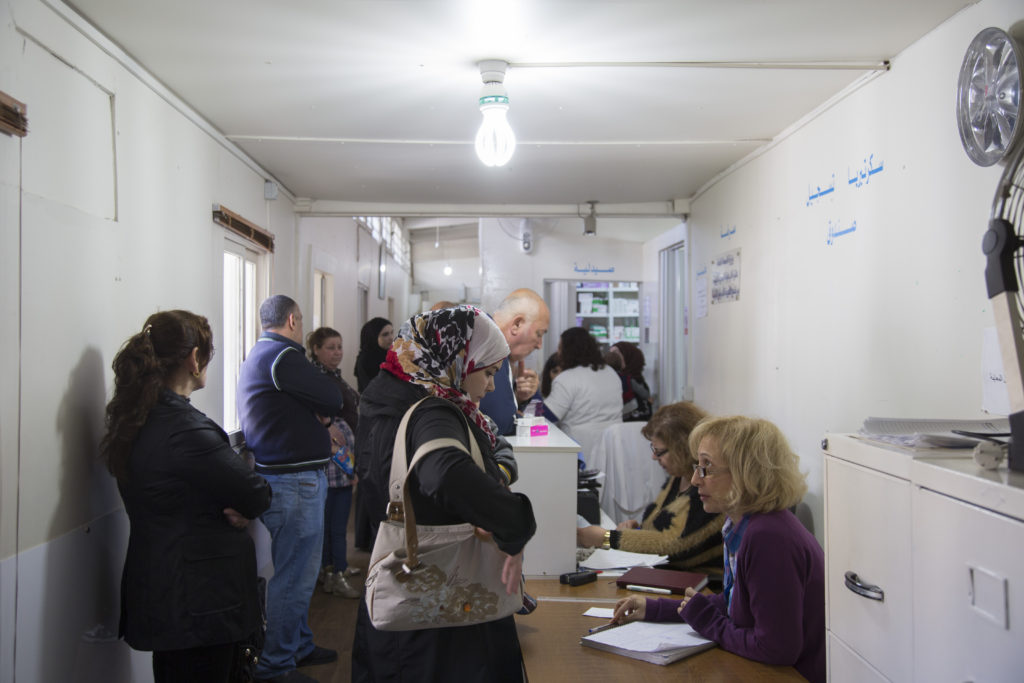
However, most of Jordan’s more than 680,000 registered Syrian refugees live outside camps and in communities. Often, they are more vulnerable than those living in camps, because they find it difficult to pay rent and buy basic necessities.

Rajha was widowed after her husband was detained by Assad’s forces and tortured to death in a jail in the central city of Homs. She fled with her three children for safety to Mafraq, a town that now has more Syrians than Jordanians.

The woman, clad in black from head to toe, including a face veil, said her two adolescent sons must work collecting plastic for recycling and loading boxes of vegetables in the market, rather than attend school in order to help the family pay bills. But the small amount they earn means that she owes her Jordanian neighbors $570 — a huge sum for her family to repay.

Although the U.N. food program has provided the family with aid, Rajha said she appreciates the one-time gift of $380 from the International Catholic Migration Commission, especially for winter.

“We need to buy a heater, heating fuel, food and some winter garments, maybe even change this simple two-room house, because it is so unhealthy,” she said.

“There no proper roof, so when it rains or snows, we have to move to other room,” Rajha said of the shelter that resembles a stable. Rats have infested the basic kitchen.

“My daughter asks why we live in this bad house. The rent is very low and this is only what I can afford,” she said, with tears welling in her brown eyes. Her 11-year-old daughter clings to a photo of her father, the only adornment in the house.

Emma Horton, an International Catholic Migration Commission program manager, said she hopes to refer Rajha to another aid group, the Norwegian Refugee Council, which help refugees locate safer, subsidized housing in the community.

“I don’t have any hope for the future. I can only live from day to day,” said the widow. “For sure, we can never return to Syria. My children and I would face great danger there.”

By Dale Gavlak, Catholic News Service.

Second Vatican Council participants hand legacy on to new generation

People hold candles in the form of a cross during a vigil in St. Peter's Square at the Vatican to mark the 50th anniversary of the opening of the Second Vatican Council in this 2012 file photo. (CNS photo/Giancarlo Giuliani, Catholic Press Photo)

VATICAN CITY (CNS) — A group of young adults from North and South America, Europe, Africa and Asia received scrolls commemorating the 50th anniversary of the Second Vatican Council’s Pastoral Constitution on the Church in the Modern World; dangling from the ribbon around each scroll was a flash drive containing the entire text of the document.

At the Vatican Nov. 5, the document was handed on to a new generation by: Nigerian Cardinal Francis Arinze, 83, a member of the council; Swiss Cardinal Georges Cottier, 93, an expert at the council; Alain Delaunoy, 89, an expert on financial matters at the council; and Cardinal Andrea Cordero Lanza di Montezemolo, 90.

Italian Cardinal Andrea Cordero Lanza di Montezemolo, center, attends a conference on "Gaudium et Spes" at the Vatican Nov. 5. At left is Swiss Cardinal Georges Cottier and at right Nigerian Cardinal Francis Arinze. (CNS photo/Paul Haring)
Italian Cardinal Andrea Cordero Lanza di Montezemolo, center, attends a conference on “Gaudium et Spes” at the Vatican Nov. 5. At left is Swiss Cardinal Georges Cottier and at right Nigerian Cardinal Francis Arinze. (CNS photo/Paul Haring)

In his “testimony” to the young people, Cardinal Montezemolo explained that he was not at the council, but half a world away. He was secretary of the Vatican nunciature in Japan in 1964.

Just before the third session of the council began that fall, he opened a copy of the Vatican newspaper, L’Osservatore Romano, and saw a headline that Blessed Paul VI had decided to name some women as council observers.

“I remember saying to myself, ‘Now women are even entering the council!'” he told the young people in a tone that did not convey complete approval. “Then I read the names and the first woman mentioned was my mother!”

The cardinal said he wrote his mother a letter congratulating her, but adding, “I don’t know if I should greet you as ‘dear mama’ or ‘your eminence’ or ‘most reverend excellency.'”

Amalia di Montezemolo led an Italian association, made up mostly of widows like herself, who worked with the country’s military ordinary providing spiritual and material assistance to members of the military and their families. The cardinal said his mother did not speak much about her experience at the council because she felt bound to secrecy.

The Pontifical Council for Justice and Peace gathered Cardinal Montezemolo and the others as firsthand witnesses to the council and to speak specifically about the pastoral constitution, which is widely known by its Latin title “Gaudium et Spes.” Their “testimony” kicked off a two-day meeting of experts in Catholic social teaching and young Catholics to discuss the ongoing relevance of the council document.

Oblate Father Andrew Small, director of the Pontifical Mission Societies in the United States, told participants that

the document presents the church’s mission as healing the world’s wounds through evangelization and its work for justice and peace. The mission requires recognizing the dignity and responsibility of laypeople, who are called to exercise their vocation in the world, and reading “the signs of the times” in order to respond to God’s call and meet real needs.

Nigerian Cardinal Francis Arinze, retired prefect of the Congregation for Divine Worship and the Sacraments, is pictured outside St. Peter's Basilica after the closing Mass of the Synod of Bishops on the family at the Vatican Oct. 25. Cardinal Arinze spoke at a Nov. 5 Vatican conference on "Gaudium et Spes," the Second Vatican Council document concerning the church in the modern world. (CNS photo/Paul Haring)
Nigerian Cardinal Francis Arinze, retired prefect of the Congregation for Divine Worship and the Sacraments, is pictured outside St. Peter’s Basilica after the closing Mass of the Synod of Bishops on the family at the Vatican Oct. 25. Cardinal Arinze spoke at a Nov. 5 Vatican conference on “Gaudium et Spes,” the Second Vatican Council document concerning the church in the modern world. (CNS photo/Paul Haring)

Cardinal Arinze, who was ordained a bishop in 1965 only two weeks before the start of the council’s last session, said his only contribution to “Gaudium et Spes” was “my signature at the end.”

The document has had a huge influence on the church and “its vision of the world,” he said. The church’s concern for the real world and the concrete situation of human beings flows, as the document said, from the fact that Christ became human and lived in the world.

While all are called to use their earthly lives to prepare for life in heaven, the document makes clear that Christians should not be “irrelevant citizens” of this world, but active participants in making the world a better place, Cardinal Arinze said.

Gaudium et Spes” also emphasizes how one’s temporal duties and duties as a citizen are responsibilities to one’s neighbors and to God, the cardinal said. The document insists that laypeople take charge of their “specific apostolate” of bringing the Gospel to bear on politics, social life and the economy.

“Laypeople must not expect from their pastors an answer to every question that arises in matters social, political, cultural,” he said. “The layperson, paying attention to the doctrine of the church and with the aid of the sacraments, takes on his distinctive role or her distinctive role.”

Swiss Cardinal Georges Cottier and Italian Cardinal Andrea Cordero Lanza di Montezemolo, right, attend a conference on "Gaudium et Spes" at the Vatican Nov. 5. Young people at the event received scrolls commemorating the 50th anniversary of "Gaudium et Spes," the pastoral constitution on the church in the modern world. (CNS photo/Paul Haring)
Swiss Cardinal Georges Cottier and Italian Cardinal Andrea Cordero Lanza di Montezemolo, right, attend a conference on “Gaudium et Spes” at the Vatican Nov. 5. Young people at the event received scrolls commemorating the 50th anniversary of “Gaudium et Spes,” the pastoral constitution on the church in the modern world. (CNS photo/Paul Haring)

Cardinal Cottier said the document “remains as fresh as it was 50 years ago,” calling Catholics to a spirituality that looks for signs of God’s presence in the world and ways to bring God’s love, justice and healing to situations of confusion, poverty, injustice and conflict.

Delaunoy told the young people he sees a “remarkable continuity between St. John XXIII and Pope Francis,” particularly in their “openness to the world and to seeing all people as brothers and sisters.”

Perhaps the most important impact of the council, he said, was the freedom and responsibility it gave laypeople. Although not all the results have been positive, the church at the Second Vatican Council encouraged all Catholics to pray, to read Scripture, to understand church teaching and to apply it in their lives.

When he was growing up, Delaunoy said, “you had to obey before understanding or even without understanding.”

Religion was more a matter of “convention than conviction,” he said. Today young people are questioning and searching; those who arrive at faith, Delaunoy said, will be better Christians and more able to help the world around them.

By Cindy Wooden, Catholic News Service.

Tel Aviv and Jaffa blend ancient and modern world

Joyce Coronel arrived in Tel Aviv, Israel Nov. 4.
Joyce Coronel arrived in Tel Aviv, Israel Nov. 4. (Joyce Coronel/CATHOLIC SUN)

JAFFA — The flight from Los Angeles was 14 and a half hours but worth every second.

We arrived yesterday afternoon in Tel Aviv in the midst of a rare but strangely mystical-seeming dust storm. Tel Aviv is a modern city with a thrumming night life but none of us were up for much of that. Our tour guide, Ziv, took us for a tour of nearby Jaffa, known in the Bible as Joppa.

We stood in front of the Roman Catholic Church there in the town square and read the sign: Masses are available in English, Hebrew, Spanish and Polish at this parish run by the Franciscan Friars. Ziv told us there are many foreign workers here from all over the world including places like Africa and the Philippines. And while Jerusalem is the country’s capital, the diplomatic capital is Tel Aviv. The embassies are here — including the Vatican’s — and thus many in the diplomatic corps attend Mass here at St. Peter’s.

[quote_box_center]

See Also

[/quote_box_center]

Reading from Acts 9, Ziv related the account of St. Peter raising Tabitha from the dead. and his subsequent vision of animals in which he was commanded by heaven to “kill and eat.” In other words, no more Kosher rules about food. This was a revolutionary moment, because Peter observed the Jewish laws about unclean and clean foods. From here on out, the Christian message began moving away from Jewish tradition and toward opening the community to all those who wish to follow Christ.

There’s a Greek Orthodox and Armenian presence here too in Jaffa. The Bible doesn’t relate anything of Jesus having been here, but St. Peter and the early Christian community were here, so it’s definitely worth a visit when you travel to Israel. And hey, the food here is awesome, as it is in all of Israel. There are hundreds of restaurants in Tel Aviv/Jaffa and we visited Bellini’s.

The three other journalists who are here with me were well behaved and had sea bass for the evening meal, but I couldn’t restrain myself from the penne pasta with grilled chicken and tomato sauce, topped with fresh basil and oregano.

We’re on our way shortly to visit Caesarea National Park where Paul was imprisoned and Cornelius was baptized. There’s a Roman theater, hippodrome, bathhouse and Herodian port to see as well and then we’ll set out for Nazareth.

As far as what you’ve seen on the news lately with the violence here, all I can say is, we haven’t seen any of that. This morning’s Jerusalem Post notes that the police are going to be removing some of the roadblocks they’d placed in Arab neighborhoods in Jerusalem as things are calming down significantly. Don’t let fear stop you from visiting this place! Remember the old adage that “If it bleeds, it leads.” The news is never going to feature just how beautiful — and safe — this beautiful country is.

Bemis Bowl tradition continues this Thanksgiving [VIDEO]

The fifth annual Bemis Bowl returns this Thanksgiving with men and women expected to compete in the friendly football tournament. Proceeds support the Scot A. Bemis fund, which is housed with the Catholic Community Foundation.

It’s named after Scot Bemis one of Notre Dame Preparatory’s first teachers and coaches — including football, both American and traditional — who died of lung cancer in 2012. The fund furthers his legacy and the efforts of Team Bemis by supporting the search for a cure for lung cancer and providing scholarships for students.

Support has been overwhelming. A recent Facebook post from Team Bemis reads:

Last year was such a success that this year we need two days to Get After It!

“Get After It!” was Coach Bemis’ catchphrase.

Bemis Bowl schedule:

More of a fan than a player? Recruit yourself as a volunteer.

[quote_box_center]

Fun links via the NFL

Why football on Thanksgiving

Thanksgiving facts, stats and turkeys

A post-Thanksgiving workout

Thanksgiving Day bloopers

Thanksgiving Day game results

[/quote_box_center]

‘Arizona Rosary Celebration’ draws thousands in colorful tribute

A woman holds up her rosaries to be blessed at the 40th annual Rosary Celebration held Sunday, Oct. 25 at the Phoenix Convention Center. (Billy Hardiman/CATHOLIC SUN)

They came from across the Diocese of Phoenix and beyond to show their love for Mary and ask for her intercession.

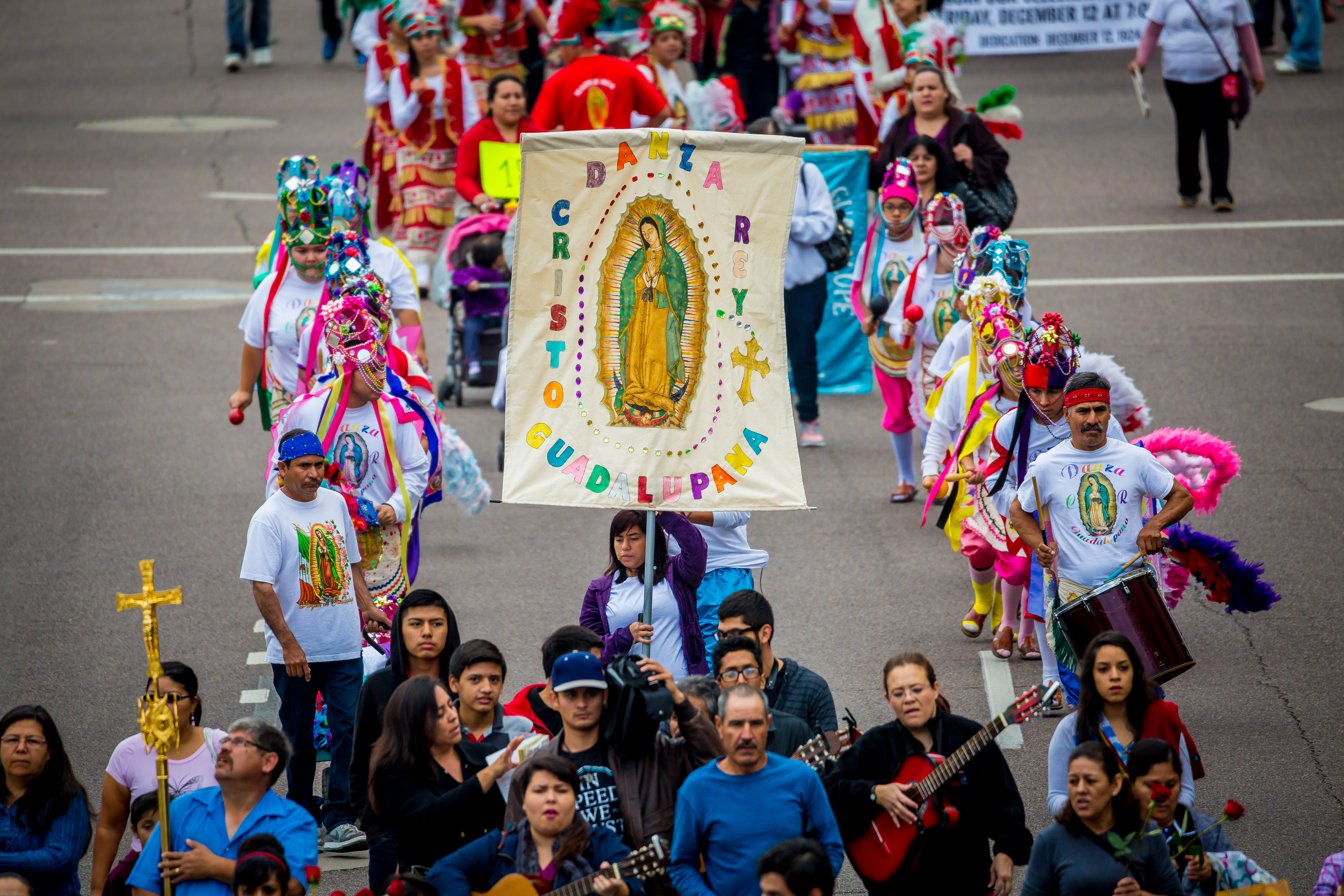
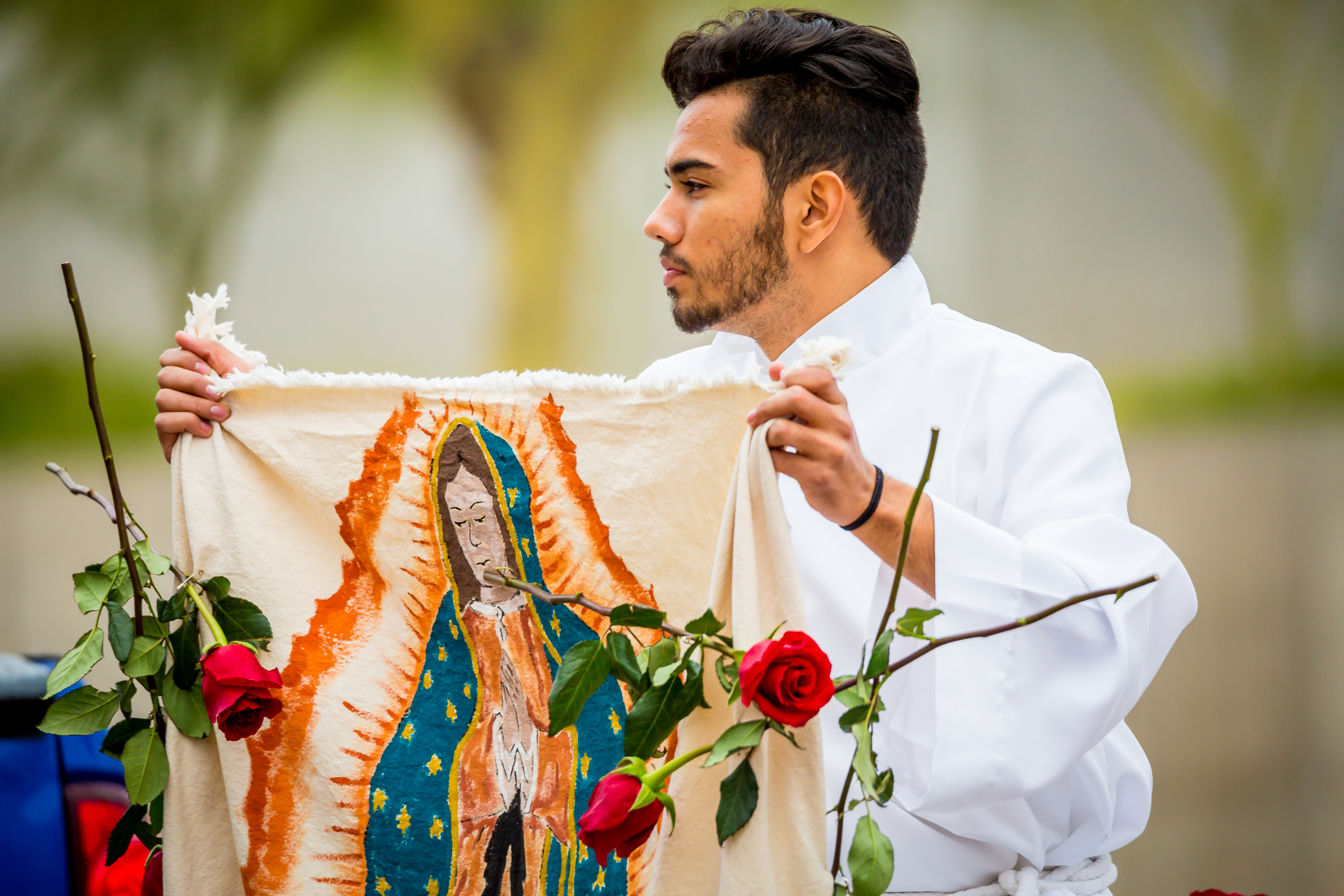
The 40th annual Arizona Rosary Celebration drew several thousand Catholics to the Phoenix Convention Center Oct. 25 to pray the Rosary, listen to an inspirational message and soak up the blessings that poured out on a colorful display of faith and heartfelt affection for the Mother of God.

Matachines, arrayed in their traditional Native attire — many sporting feathered headdresses — beat drums and danced a path through the streets of downtown Phoenix as they made their way to the convention hall. Inside, the faithful waited patiently in line for confession, knelt before the Blessed Sacrament or milled about the hall enjoying a concert by the Christian Singers of Phoenix Music Ministry prior to the program.

Vanessa Rodriguez and Giselle Reyes display their banner at the annual celebration. (Billy Hardiman/CATHOLIC SUN)

Michael Dixon, master of ceremonies, noted the 200 altar servers lined up in the rear of the hall and the fact that the Church is still in the midst of the Year for Consecrated Life.

“It’s in your home that vocations are born,” Dixon said to the crowd. “We need to ask every eligible young man and woman — let God use your voice to cause the seeds of vocation to sprout. … Jesus may be calling you. Ask Him as you pray the Rosary today.”

The Knights of Columbus, who have been organizing the Rosary event for the last dozen or so years, showed in force with their ceremonial capes and swords, solemnly carrying the flag down the center aisle as the national anthem was sung.

John Garcia, the Knight charged with promoting the Rosary celebration, said that at least two seminarians in the Phoenix Diocese once served at the event. Each year the Knights sponsor a luncheon for the altar servers just prior to the program where the children hear a short talk on vocations.

“We have this little captive audience there and it just works wonderfully,” Garcia said with a grin.

More than 200 altar servers served at the annual celebration. Prior to the event each year, the servers attend a luncheon to hear about vocations. (Billy Hardiman/CATHOLIC SUN)

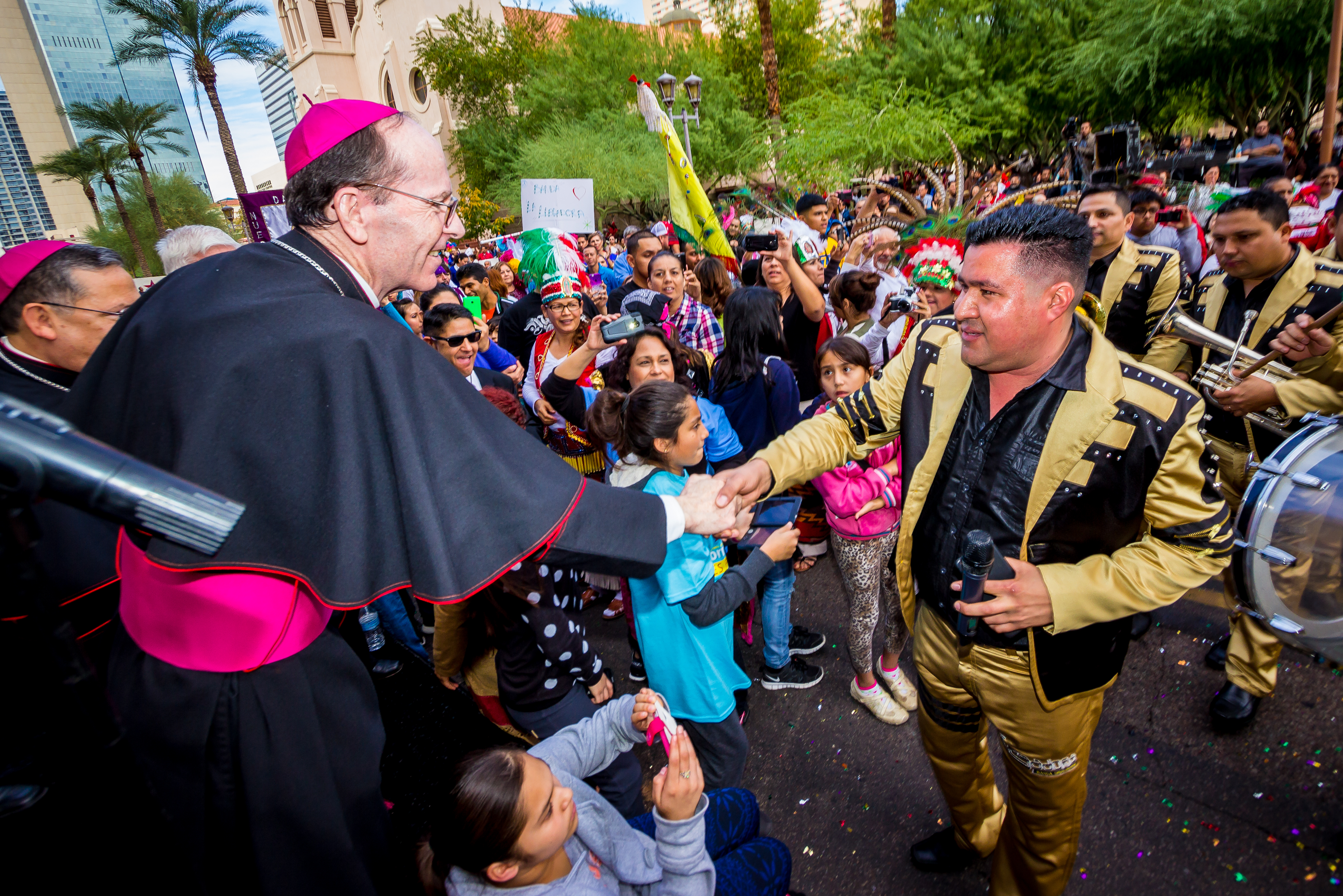
Bishop Thomas J. Olmsted and Auxiliary Bishop Eduardo A. Nevares each addressed the crowd of thousands in both English and Spanish. Decades of the Rosary were led in each language and another was led in Vietnamese.

“We’re gathered here today because of the great love God has for us, that He gave us not only His only begotten Son, but He gave Him to us through Our Lady,” Bishop Olmsted said. Pointing to the recently canonized St. Junípero Serra, the bishop noted that before the saint began his mission in the New World, he made a pilgrimage to visit the shrine of Our Lady of Guadalupe.

“Every place he went he introduced people to Our Lady of Guadalupe and he constantly asked her protection,” Bishop Olmsted said.

Redemptorist Father Dennis Billy, gives the keynote address during the Rosary Celebration. (Billy Hardiman/CATHOLIC SUN)

Redemptorist Father Dennis Billy, the priest who gave the stirring keynote address, pointed to Our Mother of Perpetual Help, the title under which the Blessed Mother was honored during the Rosary celebration. The Redemptorists have a special devotion to Our Lady under this title as Pope Piux IX entrusted them with the icon that portrays her. The original image is in a church in Rome where Fr. Billy said he’s celebrated Mass many times through the years.

Quoting St. Therese of Lisieux, Fr. Billy noted that Mary is both Queen and Mother, but she is more Mother than Queen. The Church celebrates Mary under dozens of titles because our Catholicity embraces all nations and cultures. Her motherly affection is a source of comfort and strength to all, he said.

“You can have the nicest house, the most money, the nicest car but not have any love, that sense of warmth that makes a home,” Fr. Billy said. “Jesus gave us His mother as He hung on the cross. … He wanted to give us this sense of warmth of motherly affection, the same sense of motherly affection he experienced as He grew up in His home in Nazareth.”

Recalling the words of Pope St. John Paul, that “the Church needs to breath with both lungs, East and West,” Fr. Billy explained that the Rosary is a Western prayer tradition while icons are an Eastern prayer tradition.

Bishop Gerald N. Dino of the Byzantine Eparchy of Phoenix flips through the program before the event. This was the first year that Bishop Dino participated in the Arizona Rosary Celebration. (Billy Hardiman/CATHOLIC SUN)

Bishop Gerald N. Dino of the Byzantine Eparchy of Phoenix sat alongside Bishops Olmsted and Nevares and attended his first Arizona Rosary Celebration, a visual witness to the union of East and West through the Catholic faith.

And while the Mother of Perpetual Help icon may seem unrealistic or out of proportion to Western eyes, in actuality it depicts the tender care of Mary for her children. Her eyes are on her children, no matter where they may be. The image recalls a moment when the Christ Child envisioned His future passion. In a similar way, each of us may also sense our future suffering and death, but in that moment, Our Lady and her Son are with us, Fr. Billy said.

“Whatever your needs are, whatever your fears are, bring them to Mary because Mary loves you and she only wants to bring you to her Son. She will never take her eye off of you,” Fr. Billy said.

Dorothy Westfall, who dreamed up the Rosary event four decades ago, marveled at the large crowd that gathered again this year for the celebration. It’s taken the hard work of hundreds of volunteers to keep the effort going.

“The first couple years, we thought, we’ll just do it this one year,” Westfall said. Then they received a call from a woman in Sun City who wanted to arrange bus transportation for the next year.

“At that point, we weren’t going to have another one but we said to the committee, ‘We’ve got to have it because of the bus from Sun City coming.’ So she really prodded us on,” Westfall said.

Fourth Degree members of the Knights of Columbus salute Bishop Thomas J. Olmsted during the opening procession at Rosary Celebration. The Knights have been organizing the annual event for more than 10 years. (Billy Hardiman/CATHOLIC SUN)

So what is it that brings people back, year after year?

“We pray that Rosary in front of the Blessed Sacrament and you just feel the presence of the Lord. You just feel like the Lord’s come down upon all these people.”

Charles Ciarametaro of Most Holy Trinity Parish is one of them. He was there with his five children.

“It’s the third time we’ve been here. It’s a good way to demonstrate to the kids what it means to support your parish and pray to Mary at the same time,” Ciarmetaro said.

[quote_box_center]

Want more photos and videos?

Check out #AZRosary40 as told by you

[/quote_box_center]

What 50 years of talks between Catholics and Lutherans looks like

Bishop Denis J. Madden, auxiliary bishop of the Archdiocese of Baltimore (left) and the Rev. Elizabeth A. Eaton, presiding bishop of the Evangelical Lutheran Church of America, hold copies of “Declaration on the Way: Church, Ministry and Eucharist.” The document highlights the journey toward unity between Catholics and Lutherans. (Photo courtesy of ELCA)

To download “Declaration on the Way: Church, Ministry and Eucharist”, click here.

For more resources from the Diocese of Phoenix Office of Ecumenism and Interreligious Affairs, click here.

WASHINGTON (CNA/EWTN News) — Catholic and Lutheran bishops have signed a declaration that they hope solidifies areas of “consensus” on matters of faith while providing a path forward for more dialogue.

“Pope Francis in his recent visit to the United States emphasized again and again the need for and importance of dialogue,” explained Bishop Denis J. Madden, auxiliary bishop of Baltimore and co-chair of the task force that authored the document the “Declaration on the Way.”

He added that the declaration “represents in concrete form an opportunity for Lutherans and Catholics to join together now in a unifying manner on a way finally to full communion.”

The declaration, published on Oct. 30, Reformation Day, commemorates 50 years of dialogue between Catholics and Lutherans and points ahead to the upcoming 500th anniversary of the Reformation in 2017.

It lists areas of “consensus” between Catholics and Lutherans on matters of the Church, the Eucharist, and ministry while acknowledging that full agreement and communion have not yet been achieved.

Both the U.S. Catholic Bishops’ Ecumenical and Interreligious Affairs committee and the Evangelical Lutheran Church of America‘s Conference of Bishops “unanimously affirmed” 32 statements of agreement on the Church, the Eucharist, and ministry that were outlined in the declaration.

They exemplify the “imperfect but real and growing unity of Catholics and Lutherans,” the declaration stated, and show that “there are no longer church-dividing differences” on those matters, solidifying a platform on which to continue dialogue in the future.

The Lutheran bishops are sending the statements to higher church bodies for acceptance and implementation. For the Catholics, acceptance will also be sought from the Pontifical Council for Promoting Christian Unity.

“Through our dialogues, we are renewed in our commitment to continue together on the way to full communion, when we will experience our unity in sharing the Eucharist, in the full recognition of each other’s ministries and of our being Christ’s Church,” the declaration states.

Although differences still exist, dialogue has brought Catholics and Lutherans much closer than they have been in the past, the Elizabeth A. Eaton, the presiding bishop of the Evangelical Lutheran Church in America noted. The ELCA is represented in Arizona by the Grand Canyon Synod.

“Five hundred years ago wars were fought over the very issues about which Lutherans and Roman Catholics have now achieved consensus,” she said.

“The declaration is so exciting because it shows us 32 important points where already we can say there are not church-dividing issues between us, and it gives us both hope and direction for the future.”

Pope Francis attends a special audience with members of the German Evangelical-Lutheran Church at the Vatican Dec. 18, 2014. Members of the USCCB's committee on Ecumenical and Interreligious Affairs and the Evangelical Lutheran Church of America's Conference of Bishops recently published "Declaration on the Way." (CNS photo/L'Osservatore Romano via Reuters)
Pope Francis attends a special audience with members of the German Evangelical-Lutheran Church at the Vatican Dec. 18, 2014. Members of the USCCB’s committee on Ecumenical and Interreligious Affairs and the Evangelical Lutheran Church of America’s Conference of Bishops recently published “Declaration on the Way.” (CNS photo/L’Osservatore Romano via Reuters)

For instance, some of the statements of agreement centered on the Eucharist. Both Catholics and Lutherans believe that Jesus is present “truly, substantially, as a person” in the Eucharist and is also “present in his entirety, as a Son of God and a human being,” the declaration said.

Catholics and Lutherans also believe that Eucharistic worship is a participation in the “life of the Trinity,” as well as a “memorial” of Christ, “present as the one crucified for us and risen, that is, in his sacrificial self-giving for us in his death and in his resurrection (Romans 4:25), to which the church responds with its sacrifice of praise and thanksgiving,” the document continued.

However, “there are differences in their theological statements and terminology about the mode of presence,” the document explained, although both Catholics and Lutherans believe that Christ is truly present in the Eucharist.

Statements of agreement should be implemented at the local and regional levels, the document recommended.

More opportunities should be made for Lutherans and Catholics to receive Holy Communion together, the declaration said. They should also try to pray and read the Bible together, as well as study each other’s respective histories. Parishes should establish “covenants” with each other by praying for each other at the Sunday liturgy. The declaration emphasized that Catholic and Lutheran clergy should pray together regularly and make regular retreats in manifestation of the “real, if imperfect, communion with each other.”

Pope Francis’ apostolic exhortation Evangelii Gaudium provided inspiration for the declaration.

“The credibility of the Christian message would be much greater if Christians could overcome their divisions and the Church could realize ‘the fullness of catholicity proper to Her in those of Her children who, though joined to Her by baptism, are yet separated from full communion with Her,’” Pope Francis wrote, as quoted in the declaration.

The bishops also commended the 1999 Joint Declaration on the Doctrine of Justification between the Lutheran World Federation and the Catholic Church as an “ecumenical breakthrough” because it clearly explained the difference between “divisive mutual condemnations” and “diversities in theology and piety which need not divide the Church, but which can in fact enrich it.”

“All of this flows from Jesus’ prayer for his disciples after the Last Supper, ‘That they may all be one’ (John 17:21),” the declaration concluded.

— By Catholic News Agency

Families must forgive and not ‘end the day in war,’ pope says

Pope Francis smiles as he leaves his general audience in St. Peter's Square at the Vatican Nov. 4. (CNS photo/Paul Haring)

VATICAN CITY (CNS) — The secret to healing wounds among family members is to “not end the day in war” and to forgive one another, Pope Francis said.

Pope Francis accepts materials from people as he greets the crowd during his general audience in St. Peter's Square at the Vatican Nov. 4. (CNS photo/Paul Haring)
Pope Francis accepts materials from people as he greets the crowd during his general audience in St. Peter’s Square at the Vatican Nov. 4. (CNS photo/Paul Haring)

“One cannot live without forgiving, or at least one cannot live well, especially in the family,” the pope said Nov. 4 at his weekly general audience.

Recalling the recent Synod of Bishops on the family, the pope said that he wanted the final report to be published so that all may take part in the work of the past two years. However, he said, his general audience talk would not examine the conclusions but rather reflect on the great gift that marriage and the family are for society, especially in a world that “at times becomes barren of life and love.”

The pope told the estimated 15,000 people in St. Peter’s Square that families are like “a great gym where one trains in giving and in mutual forgiveness.” Using the Gospel account of Jesus teaching the ‘Our Father,’ the pope stressed that forgiveness heals the wounds often caused “by our weaknesses and our selfishness.”

“There is a simple secret in order to heal wounds and dissolve accusations: Do not end the day without asking forgiveness from one another, without making peace between husband and wife, parents and children, brothers and sisters, daughters-in law and mothers-in law,” he said.

By immediately asking for forgiveness and forgiving others, the pope continued, the family becomes stronger and creates a solid foundation that can withstand any difficulties that may come.

In order to forgive, Pope Francis told the crowd, “you don’t need to make a great speech; a caress is sufficient and it’s all over. But, do not end the day in war. Understood?”

The pope also stressed that the synod emphasized the role that forgiveness plays in the vocation and mission of the family and that it not only saves families from divisions but helps society “become less evil and less cruel” as well.

The church, he assured, “is always near to help you build your house upon the rock of which Jesus spoke.”

Christian families, the pope said, can do much for society and the church and the upcoming Holy Year of Mercy can be an occasion for families “to rediscover the treasure of mutual forgiveness.”

“Let us pray so that families may always be more capable of living and building concrete paths of reconciliation, where no one feels abandoned by the weight of their trespasses,” the pope said.

By Junno Arocho Esteves, Catholic News Service.

Killing people is not compassion — Canadian religious leaders unite against assisted suicide

Photo Credit: photoneye via www.shutterstock.com.

OTTAWA (CNA/EWTN News) — As Canada moves toward legalizing assisted suicide, Catholic bishops and a large Protestant coalition — along with Jewish and Muslim leaders — have joined together to reaffirm the need to help the suffering without killing them.

“On the basis of our respective traditions and beliefs, we insist that any action intended to end human life is morally and ethically wrong. Together, we are determined to work to alleviate human suffering in every form but never by intentionally eliminating those who suffer,” the joint statement said.

The Declaration on Euthanasia and Assisted Suicide is a joint statement from the Canadian Conference of Catholic Bishops and the Evangelical Fellowship of Canada, a coalition of over 40 affiliated denominations. The statement, released Oct. 29, also has support from more than 30 other Christian denominations as well as 20 Jewish and Muslim leaders.

“Humanity’s moral strength is based on solidarity, communion and communication — particularly with those who are suffering,” the statement continued. “It is personal attention and palliative care and not assisted suicide or euthanasia that best uphold the worth of the human person.

“It is when we are willing to care for one another under the most dire of circumstances and at the cost of great inconvenience that human dignity and society’s fundamental goodness are best expressed and preserved.”

The declaration responded to the Supreme Court of Canada’s unanimous February decision which ruled that doctors may help patients who have severe and incurable suffering to kill themselves. The national parliament has a year to develop a legal response to the decision.

Canadian officials in July announced the creation of a three-member panel to respond to the decision, while advocates of assisted suicide have objected that two of the members have opposed legalization of the practice.

Canadian law had previously punished the counseling, aiding or abetting in a suicide with up to 14 years in prison.

In reaction to the court’s decision, the religious leaders’ joint declaration affirmed “the sanctity of all human life” and reaffirmed a commitment to caring for those who are suffering and in pain.

“Euthanasia and assisted suicide treat the lives of disadvantaged, ill, disabled, or dying persons as less valuable than the lives of others. Such a message does not respect the equal dignity of our vulnerable brothers and sisters.”

The religious leaders said the sanctity of human life is a “foundational principle of human society” that is the basis for protecting the vulnerable and for recognizing the equal dignity of individuals regardless of their abilities.

In wake of the court’s decision, the joint declaration said, Canadians should reflect on their personal and societal responses to “those who need our compassion and care.”

The statement criticized the tendency to define human dignity in an emotional, subjective way.

“For us, human dignity is most properly understood as the value of a person’s life before her or his Creator and within a social network of familial and societal relationships.”

The signatories said that helping people live and die with dignity means ensuring their support with love and care; with quality pain control; with psychological, spiritual and emotional support; and with improved palliative and home care.

In addition, the statement distinguished between the deliberate killing of someone and the withholding of burdensome treatment.

“There is a fundamental difference between killing a person and letting her or him die of natural causes.”

The religious leaders said health care systems must maintain “a life-affirming ethos.”

“Medical professionals are trained to restore and enhance life. They are not trained or expected to administer death,” the statement said, warning that assisted suicide distorts the relationship between doctors and patients.

— Catholic News Agency

Myanmar’s cardinal uneasy about pre-election push for one race, religion

Cardinal Charles Bo of Yangon, Myanmar, pictured in an early January photo, has become increasingly outspoken as the Nov. 8 election approaches and has urged the nation to embrace religious diversity. (CNS photo/Lynn Bo Bo, EPA)
People check their names on final voter list displayed at a polling station in Mandalay, Myanmar, Nov. 1. Myanmar will hold its nationwide general elections Nov. 8. (CNS photo/Hein Htet, EPA)

YANGON, Myanmar (CNS) — From his residence at St. Mary’s Cathedral, Cardinal Charles Bo has a front-row seat to the changes sweeping across his country. What he has witnessed ahead of the nation’s Nov. 8 election — the first fully contested since 1990 — has troubled him, reported ucanews.com.

Specific links between political parties and religious groups are outlawed by the constitution, and the situation is now raising fresh questions about the country’s future at a crucial point on Myanmar’s journey from military dictatorship to a functioning democracy.

“The trend is like a mix of religion and politics,” Cardinal Bo told ucanews.com in an interview at his Yangon residence.

[quote_box_left]

Related

Catholic cardinal warns of religious extremism

[/quote_box_left]
His chief concern is the emergence of the hard-line Buddhist monk movement, the Association for the Protection of Race and Religion, commonly known as Ma Ba Tha. The group was formalized in 2014 following two years during which the country’s minority Muslims, who account for about 7 percent of the country’s 50 million people, found themselves under attack in deadly violence that the monks helped ferment.

The movement has taken on a tone that is Buddhist nationalist and overtly anti-Muslim. Some senior members of the movement have given personal endorsements to President Thein Sein, who is seeking a second five-year term.

While the power of such backing can only be measured at the ballot box, the group’s growing influence is undeniable.

It was Ma Ba Tha that successfully lobbied the government for the introduction of four race and religion laws that opposition parties and international observers have condemned as discriminatory. The clerics had argued that Myanmar’s Buddhist identity was at risk, claiming a growing but unspecified influence by the Muslim minority.

Critics say the race and religion laws are squarely aimed at the nation’s 1 million or so ethnic Rohingya people. The regulations impose mandatory “birth spacing” for women; Buddhist women must register their marriages in advance if marrying a man outside their faith; and restrictions on religious conversions have been enshrined in legislation.

Ma Ba Tha’s September “victory” celebrations after the laws were enshrined have only increased perceptions of their political influence.

Cardinal Charles Bo of Yangon, Myanmar, pictured in an early January photo, has become increasingly outspoken as the Nov. 8 election approaches and has urged the nation to embrace religious diversity. (CNS photo/Lynn Bo Bo, EPA)

Yet for Cardinal Bo, this was a disturbing display of “tribalism” in a country that teems with a multitude of languages, ethnicities and religions — although ethnic Bamar Buddhists represent the largest single group.

“The attitude that Myanmar must have one race and one religion, such as Bamar and Buddhist, is not acceptable,” he warned.

Cardinal Bo has been one of the rare voices with international heft in Myanmar to speak out against hate speech and religious discrimination. Many international rights groups had hoped such a role would naturally be taken up by Aung San Suu Kyi, the popular opposition leader and Nobel Peace Prize laureate. Yet she has been largely silent about widespread discrimination against Myanmar’s Muslims — particularly the Rohingya community in tense Rakhine state, where violence in 2012 left scores dead and more than 150,000 people still trapped in internal refugee camps that they are forbidden, at gunpoint, to leave.

“Suu Kyi should speak out on the conflict in Kachin state and on Rohingya Muslims, who are confined to the camps,” said Cardinal Bo, who admitted he admires her personal integrity, fearlessness and passion.

In September, Cardinal Bo issued an appeal denouncing the race and religion laws and demanding their repeal.

“Parliament was coerced by a fringe group of the religious elite to enact four black laws, fragmenting the dream of a united Myanmar,” Cardinal Bo wrote.

He said the compassionate teachings of Buddhism in Myanmar were being threatened by “peddlers of hatred.”

A staff member of a polling station assists people to check their names on final voter list during early voting in Mandalay, Myanmar, Nov. 1. Myanmar will hold its nationwide general elections Nov. 8. (CNS photo/Hein Htet, EPA)

In another message shortly after this, the cardinal urged all of Myanmar’s citizens to vote. The message was framed as a guideline for selecting the best candidate.

While he was careful to avoid supporting any particular candidates or party, Cardinal Bo listed attributes voters should look for when picking their choice at the ballot box. These included an ability to work with “different ethnic groups and religions” and a willingness to safeguard the country’s natural resources, rather than “selling our sacred rivers … to foreign powers.”

Cardinal Bo told ucanews.com that he made his statements because Myanmar has reached a pivotal moment.

Ahead of the controversial religion laws being enacted, divisions were exacerbated when the government stripped about 800,000 Rohingya of “white cards” that previously handed them certain rights, including the right to vote. Then in September, the electoral commission disqualified the vast majority of Muslim candidates who had applied to run in the Nov. 8 election.

Such alienation, Cardinal Bo said, comes at a crucial point in Myanmar’s development.

“It’s time to let a new system run the country, so I vehemently urge people to embrace the opportunity to vote for worthy candidates as a sacred duty,” Cardinal Bo said. “It’s time to end old attitudes, old elites and the old system that has existed for five decades.”

He cited comments from St. John Paul II, who said that “diversity is strength” — something that shouldn’t be merely tolerated, but celebrated.

In December, the cardinal plans to return to his home village to celebrate his 25th year as bishop. There are Catholics in his village, of course, but also Buddhists.

“What I want to highlight is that Catholics and Buddhists in my native village have been living together as a harmonious society for centuries,” the cardinal said. “That’s the interreligious message that I want to share with the people of Myanmar.”

Day of the Dead: A blending of cultures [VIDEO]

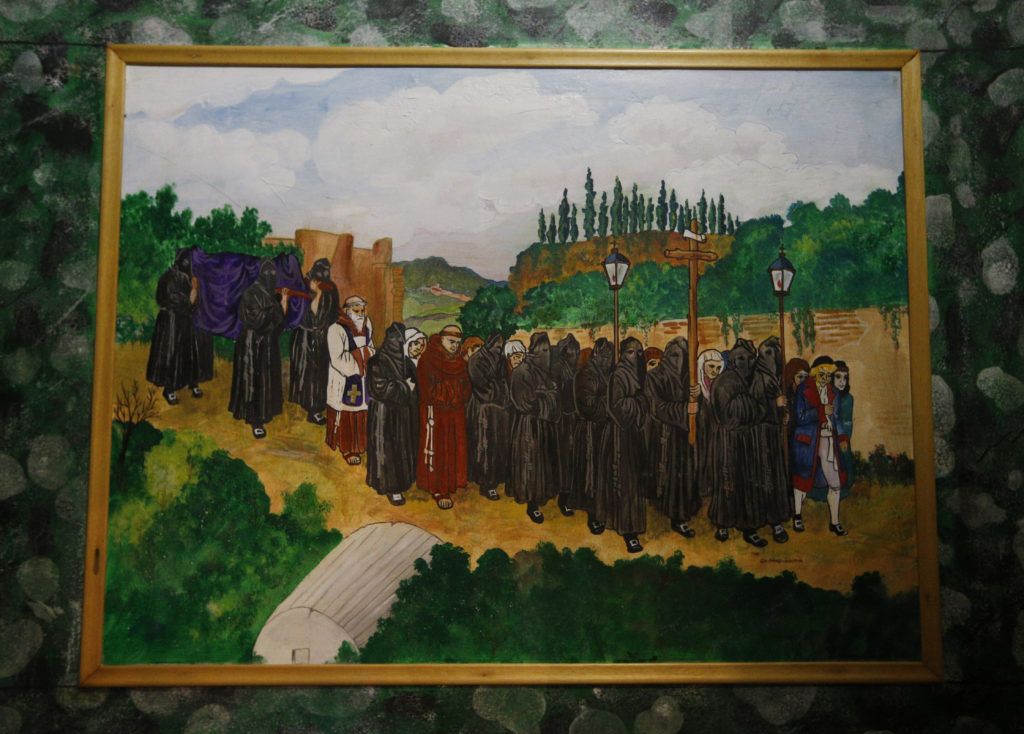
See how parishioners in Idaho Catholic churches mark All Souls’ Day Nov. 2 with the Day of the Dead tradition.