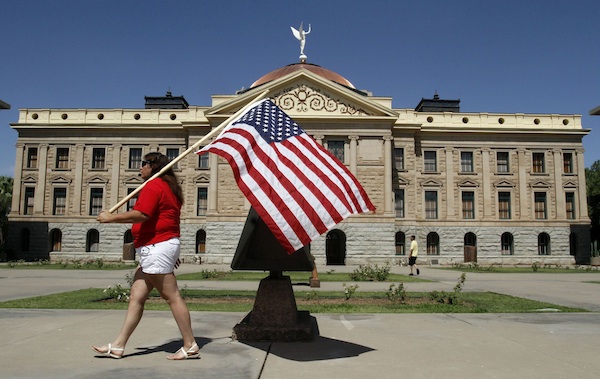
Allison Culver marches with a U.S. flag around the Arizona State Capitol after the Supreme Court upheld a key part of Arizona's crackdown on illegal immigrants in Phoenix June 25. The high court, in a mixed opinion with several dissents, rejected much of the law, known as S.B. 1070. However, it affirmed the section requiring state law enforcement officials to check the immigration status of detainees they suspect are in the country illegally. (CNS photo/Darryl Webb, Reuters)
SB 1318, a measure that ensures taxpayer dollars do not fund abortions, was enacted just as Catholics turn their hearts toward Resurrection Sunday, which marks the triumph of Christ over sin and death.
The new law also includes a provision that women must be informed that the effects of the abortion pill can possibly be reversed.
“SB 1318 is a simple bill that better protects taxpayers not wanting to subsidize abortion. We are grateful that Arizona continues to be a state that values innocent life from conception until natural death, and that SB 1318 has been signed into law,” the statement read.
Jason Walsh, executive director of Arizona Right to Life, said that polls indicate the public opposes taxpayer-funded abortion.
“The left will want to make us look like we’re the radicals, but when it comes to protecting innocent human life, that’s what the bill really focuses on,” Walsh said.
Ron Johnson, executive director of the ACC, said the provision in the law about informed consent vis-a-vi the abortion pill was no guarantee of reversal.
“We heard testimony in committee from a doctor who said he had a patient come to him from Planned Parenthood who changed her mind.”
“There never is, but there are women who regret it,” Johnson said. “We heard testimony in committee from a doctor who said he had a patient come to him from Planned Parenthood who changed her mind.”
At the clinic, the woman was told there was “no possibility of reversal but she pulled out her smart phone, googled ‘abortion pill reversal’ and found out there was indeed something. She went to see a doctor and saved the baby,” Johnson said. “The claims by some that there is no evidence is absurd because there is evidence. It’s just relatively new.”
Dr. Alan Sawyer, an obstetrician-gynecologist who testified in favor of SB 1318, also wrote an opinion piece in the Arizona Republic praising the new law. Sawyer and Dr. Clint Leonard, a fellow OB-GYN who co-authored the article, stated that they had both administered the abortion pill reversal regimen to women who regretted taking the first abortion pill and that “to date, over 80 live births have been recorded” and that “there are more than 60 healthy pregnancies because of the abortion pill reversal.”
Arizona is the first state to require health care providers inform women of the possibility of reversal of the abortion pill’s effects.
Filipinos hang on wooden crosses during the re-enactment of the Crucifixion in the Philippines' Pampanga province in this 2014 file photo. Nearly 20 penitents and a Danish filmmaker were nailed to crosses on Good Friday. (CNS photo/Erik De Castro, Reuters)
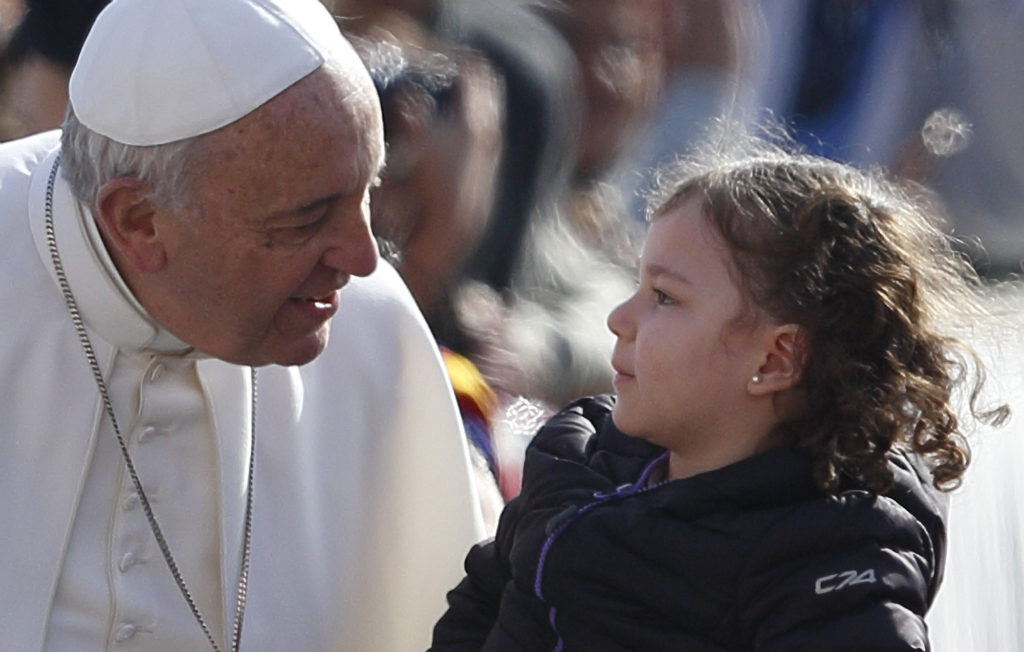
Pope Francis greets a child as he arrives for his general audience in St. Peter’s Square at the Vatican April 1. (CNS photo/Paul Haring)
VATICAN CITY (CNS) — For a “good Easter,” Christians must do more than simply recall the passion of Jesus during Holy Week; they must “enter into the mystery” of the Easter Triduum and make Jesus’ feelings and attitudes their own, Pope Francis said.
During his general audience April 1, he also recalled the “true martyrs” of today, men and women who “offer their lives with Jesus” for their Christian faith. Their witness, in imitation of Christ’s sacrifice, “reflects a ray of this perfect, full and pure love (of Christ),” he said. Theirs, he added, “is a service of Christian witness to the point of bloodshed. It is the service Christ did for us, he redeemed us.”
The pope began his catechesis, dedicated to the celebration of Holy Week and Easter, by saying that the death and resurrection of Christ are “the culmination” of the entire liturgical year and of the Christian life.
The pope offered reflections for each day of the Triduum, beginning with Holy Thursday. With the “prophetic gesture” of washing the apostles’ feet, Jesus expressed “the meaning of his life and passion — service to God and brother,” the pope said.
At baptism, “the grace of God washed us of our sin and we took on Christ,” he said. Every time Catholics receive the Eucharist, “they are united with the Servant Christ in obedience to his commandment to love as he loved,” he said.
“If we receive holy Communion without being open sincerely to washing each other’s feet, we do not recognize the body of the Lord,” he said.
Pope Francis waves as he arrives for his general audience in St. Peter’s Square at the Vatican April 1. (CNS photo/Paul Haring)
The second day of the Triduum, Good Friday, recalls how Jesus “transformed the greatest iniquity into the greatest love” with his sacrifice on the cross, the pope said.
Following Christ, many Christian men and women today are giving their lives as martyrs, the pope said. He gave the example of the “heroic testimony” of Fr. Andrea Santoro, an Italian priest who was killed in 2006 while working as a missionary in Turkey.
“This example of a man of our times, and many others, strengthens us in offering our lives as gifts of love to our brothers in imitation of Jesus,” he said.
The pope also spoke about the significance of Jesus’ last words on the cross: “It is finished.”
“They mean that the work of salvation is accomplished, that all of the Scriptures find their complete fulfillment in the love of Christ,” he said.
“How beautiful it would be if all of us, at the end of our lives, with our mistakes, our sins, even with our good works and our love for our neighbor, can say to the Father as Jesus did, ‘It is finished.’ Not with the perfection (of Jesus) but saying, ‘Lord, I did everything that I could. It is finished,'” the pope said, speaking off the cuff.
On Holy Saturday, the church identifies with Mary and contemplates Christ in the tomb, after the “victorious battle of the cross,” the pope continued.
“In the darkness that envelopes creation, she remains alone to keep the flame of faith lit, hoping against all hope in the resurrection of Jesus,” he said.
“Sometimes, the darkness of night can penetrate the soul and we think, ‘there is nothing left to do,’ and the heart no longer finds the strength to love,” the pope said, speaking about life’s discouragements. “But it is in this very darkness that Christ lights the fire of the love of God.”
The pope said the great mystery of Easter is that “the stone of pain is rolled back, leaving room for hope.”
“As Christians, we are called to be sentinels of the morning, who know how to see the signs of the Risen one,” like the disciples at the tomb on Easter morning, he said.
Pope Francis commemorated the death of Saint John Paul II during his weekly general audience April 1.
VATICAN CITY (CNS) — The example St. John Paul II gave the world is still alive and many people continue to be inspired by his faith, passion and joy, Pope Francis said.
Noting that April 2 marked the 10th anniversary of St. John Paul’s death, Pope Francis asked that people pray the Polish saint “intercede for us, for families, for the church so that the light of the Resurrection shines through all of the darkness in our life and fills us with joy and peace.”
Speaking to pilgrims at the end of his weekly general audience in St. Peter’s Square April 1, the pope highlighted the spiritual legacy of his predecessor, whom he canonized together with St. John XXIII in April 2014.
“Dear young people, learn to face life with his passion and enthusiasm; dear people who are sick, carry with joy the cross of suffering like he taught us; and you newly married couples, always put God at the heart (of everything) so that your conjugal relationship may be more loving and happier,” he said.
In a tradition dating back to the early Church, Bishop Thomas J. Olmsted of the Diocese of Phoenix gathered March 30 with his brother priests to bless the oils that will be used in sacraments during the coming year. (Billy Hardiman/CATHOLIC SUN)
[dropcap type=”4″]I[/dropcap]n a tradition dating back to the early Church, Bishop Thomas J. Olmsted of the Diocese of Phoenix gathered March 30 with his brother priests to bless the oils that will be used in sacraments during the coming year.
More than 130 priests along with 60 deacons, members of assorted religious orders and laity from all over the diocese packed into Ss. Simon and Jude Cathedral for the two-hour solemn celebration of the Chrism Mass.
Since ancient times, the oils used in sacraments are blessed at the Chrism Mass. The Oil of Catechumens, used in baptism, as well as the Oil of the Sick, used in anointing those who are seriously ill, are blessed along with the Holy Chrism for baptism, confirmation and holy orders.
Bishop Olmsted zeroed in on the reality of spiritual warfare during his homily. “Exorcism was an indispensable part of Jesus’ mission from the Father,” Bishop Olmsted said. “As spiritual fathers, which we become through our priestly ordination, we have the honor and the grave duty to prepare our people for spiritual warfare, to ready them for the opposition between ‘the spirit of the world and the Spirit that is from God.’”
This slideshow requires JavaScript.
After the homily, priests stood to renew their promises as Bishop Olmsted asked: “Are you resolved to be faithful stewards of the mysteries of God in the Holy Eucharist and the other liturgical rites and to discharge faithfully the sacred office of teaching?” The priests spoke in unison: “I am.”
Fr. John Muir, assistant director of the office of worship and pastor of St. Rose Philippine Duchesne Parish in Anthem, said the Mass was an occasion for joy and a reminder of his ordination to the priesthood eight years ago.
“It’s like the blessing of a wedding anniversary,” Fr. Muir said. “This is the time when the priests get to renew the promises that we made on our ordination day to love Christ and to love His Church.”
John Nahrgang, a seminarian at the Pontifical College Josephinum, was elated to attend the Mass along with a contingent of his brother seminarians.
“It’s a time of excitement and it’s a time of anticipation too because as seminarians, we can’t help but picture ourselves with that group one day,” Nahrgang said. “On a day when priests are honored in such a profound way and you can see the communion with the bishop, we’re just excited to be a part of that and in an even deeper way, one day as future priests.”
Near the end of the Mass, Bishop Olmsted stood at the table in front of the altar of the cathedral. He chanted words that illuminated the meaning and history of the sacred oils, then breathed on them, invoking the Holy Spirit.
The bilingual Mass featured the choirs of St. Thomas Aquinas Parish as well as Ss. Simon and Jude Cathedral.
A man carries his parish's Book of Elect to the altar for the bishop's signature during the Rite of Election at Ss. Simon and Jude Cathedral in Phoenix Feb. 22. (Ambria Hammel/CATHOLIC SUN)
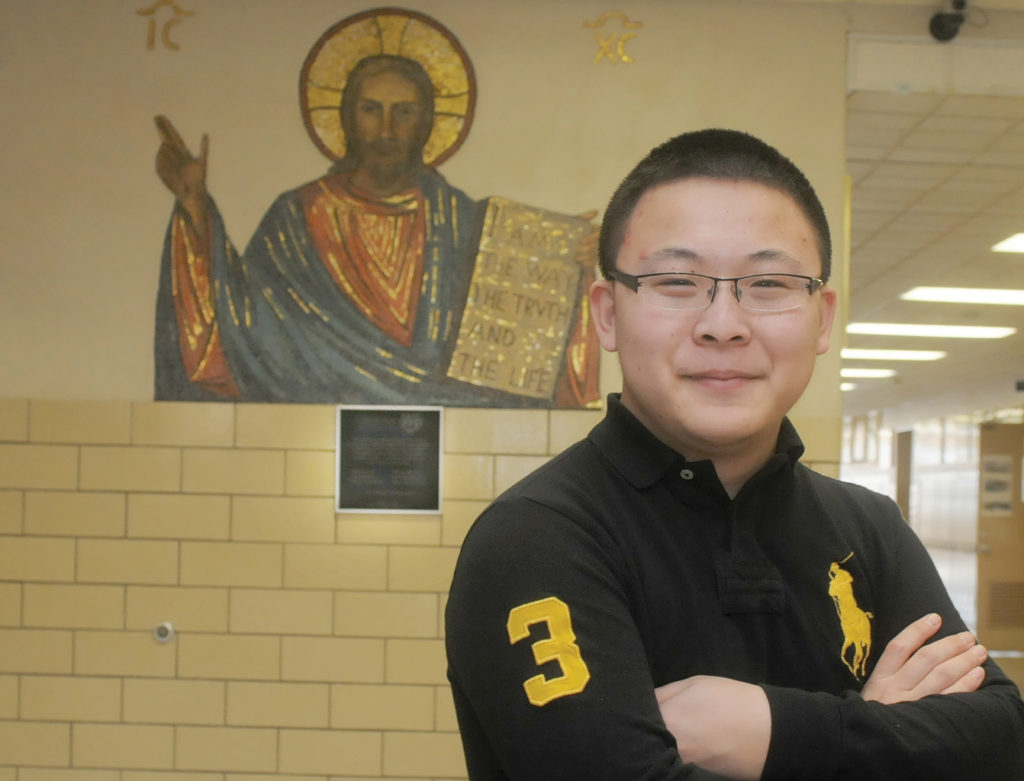
Peter Yang, 18, a senior at Cathedral High School in St. Cloud, Minn., who is going through the Rite of Christian Initiation of Adults tobecome a Catholic at the Easter Vigil, poses for a photo Feb. 8. (CNS photo/Dianne Towalski, The Catholic Spirit)
ST. CLOUD, Minn. (CNS) — Who was Jesus? Why do we need a pope? How were we made by God?
All of these are good questions that anyone considering becoming Catholic might ask.
But the questions are even more poignant when they come from a young man who grew up in a place where the government told him that God cannot mutually exist with science, where one who believes in God is considered weak, and where the only media coverage of the Catholic Church is around abuse scandals.
If this is your background, it’s challenging to talk about God at all.
For 18-year-old Peter Yang, who is from Beijing and is a senior at Cathedral High School in St. Cloud, these were among the questions he had. But thanks to his own curiosity and the support of the school, Yang began a journey to full initiation into the Catholic Church through the Rite of Christian Initiation of Adults program.
He will become a Catholic at the Easter Vigil, April 4, as will thousands of others across the United States.
“I was taught that God did not exist,” he told The Visitor, newspaper of the Diocese of St. Cloud. “I didn’t believe in the church’s teaching. I considered church a place where they were gathering people’s money and taking advantage of it.”
Yang plans to return to China this summer and said he believes his parents will be supportive of his decision to become a Catholic.
For him, living his faith “on the inside” will help him through the difficulties he may face “on the outside.”
The Easter Vigil marks the culmination of RCIA, a process of conversion and study in the Catholic faith for catechumens, those who have never been baptized, and for candidates, who were baptized in another Christian denomination and want to come into full communion with the Catholic Church.
The catechumens receive baptism, confirmation and first Communion at the Holy Saturday services, while the candidates make a profession of faith, are confirmed, if they have not already been confirmed, and receive the Eucharist.
Catechumens and candidates are formally presented to the local bishop during the Rite of Election and Call to Continued Conversion, which this year took place either the last weekend of February or first weekend of March.
According to the 2014 Official Catholic Directory, there were 39,654 catechumens and 66,831 candidates in 2013, the most recent year for which this data is available.
For 2015, here’s a snapshot of this year’s combined numbers of catechumens and candidates from U.S. archdioceses and dioceses: Seattle, 665; Atlanta, nearly 2,000; Brooklyn, New York,1,100; Miami, 600; Oklahoma City, 900, Los Angeles close to 1,900; New York, 1,400; New Orleans, 350; St. Paul and Minneapolis, 687; Omaha, Nebraska, 370; Philadelphia, 700; Kansas City, Kansas, 450; and Arlington, Virginia, more than 700,
In Brooklyn, Bishop Nicholas DiMarzio prayed for the perseverance and strength of the men and women as they entered the final stage of their journey to be members of the diocese. He told them the devil would continue to tempt them, just as he did Jesus in the desert. He said the works of Satan include the 4 “Ds”: deception, division, diversion and discouragement.
Ted Musco, Brooklyn’s diocesan director of faith formation, said that many times people think that great numbers are leaving the Catholic Church and are not aware of those joining.
“More and more people want to get involved,” said Musco told The Tablet, the diocesan newspaper.
For some individuals who will be received into the Catholic Church on Holy Saturday, the event will be a family affair — literally.
In the Diocese of Sioux City, Iowa, Heather Badar and daughter Isabella “Bella” will receive their first Communion April 4.
Heather and her husband, Tracey, were raised by parents who had a strong faith in God and were committed to their religion — Heather as a Missouri Synod Lutheran and Tracey as a Catholic.
“Over our 17 years of marriage, we have been active member of three Lutheran churches,” Heather explained. “We have also attended Mass at Catholic churches on holy days, when visiting relatives, and with our large group of friends who are also Catholic.”
Heather found herself drawn to the reverence of the Mass and the discussion would often surface about embracing membership in a Catholic church.
“My biggest fear was the classes I knew I would need to take to convert,” she told The Catholic Globe, the diocesan newspaper.
But what Heather discovered was that RCIA became the biggest faith journey of her life.
“I have learned about the Catholic faith, but more so I have learned about my relationship with Jesus,” she said. “I went through confirmation and professed my faith as an eighth grader and I have always had a relationship with the Lord, but going through this process again as an adult, when it is my choice and God’s will driving me to once again profess my faith, has a much deeper meaning.”
When she was just a few weeks away from becoming a member of the Catholic Church, 27-year-old Tina Saviano from St. Maria Goretti Parish in Madison, Wisconsin, called preparing for that moment “the best thing ever.” “I love it. I can’t get enough,” she told the Catholic Herald, Madison’s diocesan newspaper, about RCIA.
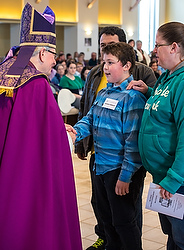
The Rite of Election is the beginning of the final stage of preparing people for initiation into the church at the Easter Vigil. More than 200 candidates and catechumens, along with their sponsors and family members, attended the service. (CNS photo/Sam Lucero, The Compass)
It has been a lifelong journey to the church for Saviano.
After being baptized a Lutheran as a child, her life took many turns through foster homes, exposure to many faiths, but no consistent participation in any faith.
“I knew that faith has always been in my heart,” Saviano said.
After graduating from high school, she wanted to be part of a church again, but kept putting it off.
She found new challenges in her early and mid-20s after a marriage that ended, and now being a single mother to two children, a daughter and son, ages 3 and 1, respectively.
Prior to finding the Catholic Church, her “life was spinning out of control,” as she put it.
In the Diocese of Salina, Kansas, both Lien Tran and Andrew Hecker said they have found a home in the Catholic Church.
“It felt like God had his hands in this. It just came naturally, as if it were meant to be,” Tran told The Register, Salina’s diocesan newspaper.
She became a Catholic two years ago as part of the Rite of Christian Initiation of Adults. Her fiance, Andrew, will follow suit this year. Hecker will be among 190 individuals formally joining the Catholic Church in the Diocese of Salina.
In the Diocese of Jefferson City, Missouri, catechumen Fred Boley said before he decided to join the Catholic Church, he was one of those millions Archbishop Fulton Sheen once described in saying that “there are not 100 people in the United States who hate the Catholic Church, but there are millions who hate what they wrongly perceive the Catholic Church to be.”
Boley told The Catholic Missourian, the diocesan paper, that his parents were Christian missionaries in Brazil and raised him with a deep spiritual devotion, appreciation for the Bible, and a keen vision for mission and evangelism. But he also learned to believe that Catholics do not go to heaven.
But he now sees that God had been calling him to be Catholic at least since he was in college.
In the Diocese of Salt Lake City, CaLee Przybylski, her husband and four children will be among those being baptized into the Catholic Church at the Easter Vigil. It will be the final step in a journey that began when she was a child, resettling in Utah with her parents and siblings, refugees from Laos.
Her family practiced Buddhism and would go to the Buddhist temple for special occasions, “which was fine, but I didn’t feel that I had the guidance that I needed because there’s no teaching,” Przybylski told the Intermountain Catholic, the diocesan newspaper.
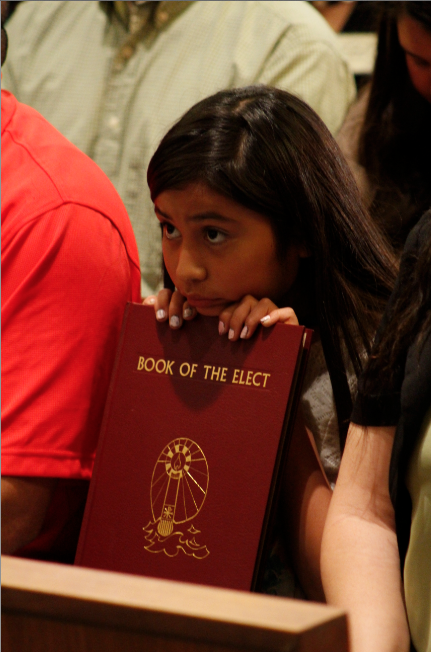
A young girl holds her parish’s Book of Elect during the Rite of Election at Ss. Simon and Jude Cathedral in Phoenix Feb. 22. (Ambria Hammel/CATHOLIC SUN)
Instead, she felt a connection with God. Some years after living in Colorado, where she started RCIA classes but was unable to finish, she returned to Utah and found a spiritual home at the Cathedral of the Madeleine. When she started going to Mass, she invited her children to join her. They did, and “my oldest daughter told me that when she entered the cathedral she had this feeling that she knew that it was right path,” Przybylski said.
Then her husband, Edward, then sat in on an RCIA class and later joined the program.
In the Diocese of Wilmington, Delaware, the RCIA group at St. Elizabeth Ann Seton Parish in Bear includes people from a variety of nationalities, including Vietnamese and Latin American.
That diversity might be attributable to the amount of starter housing around the parish, Fr. Roger DiBuo, the pastor, told The Dialog, the diocesan newspaper.
“This is a place for immigrants to get a foothold to move more deeply into our society,” he said.
As they do that, securing jobs and homes, often their faith life suffers. Many of them have moved several times trying to support their families. When they finally get settled, Fr. DiBuo said, many seek to get themselves and their children back into the faith.
— By Kristi Anderson, Catholic News Service. Anderson is on the staff of The Visitor, newspaper of the Diocese of St. Cloud. Contributing to this story were Ed Wilkinson, Brooklyn; Joanne Fox, Sioux City; Kevin Wondrash, Madison; Doug Weller, Salina; Jay Nies, Jefferson City; Marie Mischel, Salt Lake City; and Mike Lang, Bear.
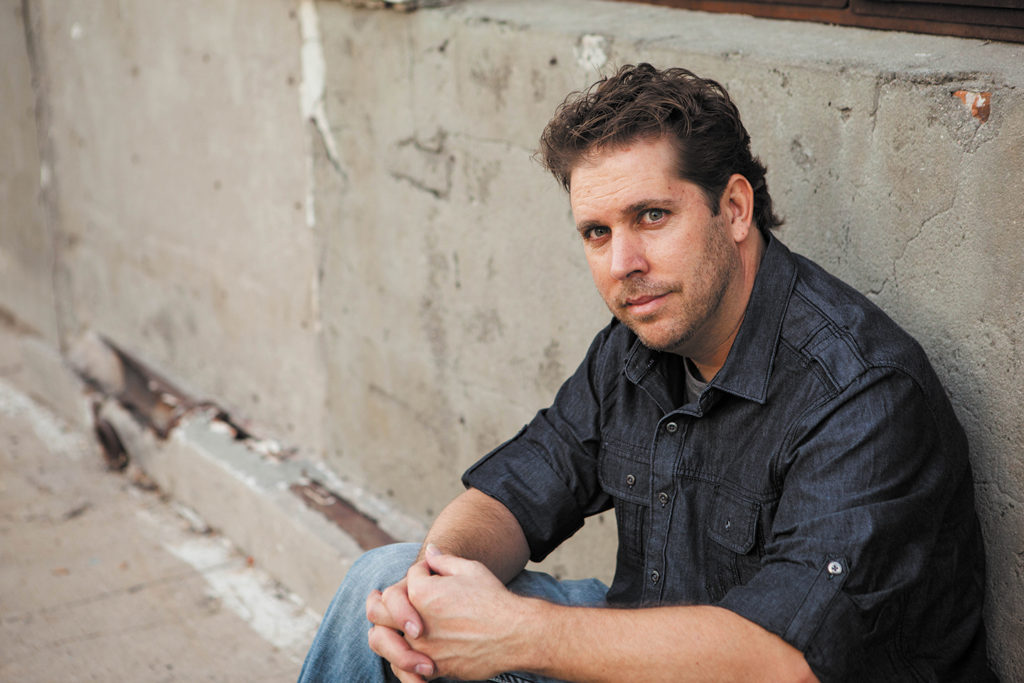
Chris Muglia said he discovered the truth of the Catholic faith during his college years. The father of five travels the country sharing the faith through his uplifting music. (Courtesy photo)
Chris Muglia said he discovered the truth of the Catholic faith during his college years. The father of five travels the country sharing the faith through his uplifting music. (Courtesy photo)
[dropcap type=”4″]L[/dropcap]ocal Catholic singer/songwriter Chris Muglia has just released his fifth compilation of original music, challenging listeners to go deeper in their faith journey. The new CD is titled “Late Check In” and includes 10 new songs. It is Muglia’s first release since 2009 and reflects his own spiritual journey and growth during a two-year absence from music ministry.
The Catholic Sun: What does “Late Check In,” the title of the album, mean?
Chris Muglia: It’s a metaphor for being present. In our humanity, we’re all in danger of imagining a false reality for ourselves if we spend too much time dwelling on the past or too much time wanting things we think we don’t have. It leads to depression or anxiety. When we’re fully checked in and fully alert, that’s where we experience life in its fullness and the blessings God has for us. So it’s really a metaphor for being alert and being present. You can think of yourself as a victim of a circumstance or you can become too anxious because you’re too busy and you’re not where you want to be. There’s freedom and serenity in just being here, being checked in and being OK with that.
How do you come up with your songs?
I think there’s actually a misconception about how songs come to be. Songwriting is work. It’s definitely true that inspiration comes from God and the Holy Spirit, but I would consider it more of a general life inspiration. I still have to write and rewrite and tweak and rewrite until it’s where it needs to be.
How does this new album challenge listeners to grow in their faith?
I would say it challenges you on a number of levels. First, to be present, to recognize the blessing that your life is already. To check into that reality. The album tells a story. It all points to that idea that you need to take responsibility for your own faith journey and your own life circumstance. That’s really the heart of it. I hope that I can appeal to the lost sheep of this world, the broken and lost, addicts and sinners like me.
What’s the purpose of your music?
If my music opens one heart to God, or gets me into a conversation with someone who is wondering if there is something out there that’s bigger than themselves, then I’ve done my job.
What do you find most fulfilling about being a Catholic musician?
I actually don’t find fulfillment from that. I love music but it’s not where I find fulfillment. I find fulfillment in doing the will of God, in being the best husband and father I know how to be, loving my neighbor as myself and staying mindful that life is precious and short. I don’t like to be identified with what I do.
Each Sunday about 70,000 people in the Diocese of Phoenix view the televised Mass live from Ss. Simon and Jude Cathedral at 9 a.m. on AZ-TV 7/ Cable 13. The outreach serves the elderly, disabled and homebound, and is made possible through the generosity of those who support the Charity and Development Appeal. (Billy Hardiman/CATHOLIC SUN)
[dropcap type=”4″]T[/dropcap]elevised liturgies are a ministry of the Church that evangelizes by reaching people unable to be physically present in a worshiping community.
“I don’t know what the people would do without it. Some people can’t get up out of their beds,” she said. “I can feel really, really bad and when it’s time for Communion — and it’s so beautiful — you can just feel Jesus.”
None of this would be possible if it wasn’t for the annual Charity and Development Appeal, which allocated nearly $200,000 last year for the televised Mass.
“Between Pope Francis’ call to abandon indifference and Bishop Olmsted’s heart for life at all stages, it is a priority in the Diocese of Phoenix that we serve our home-bound elderly and infirm with the same pastoral care we offer any other parishioner,” said Katie Burke, diocesan communications specialist.
“The live broadcast of the Mass helps build a sense of community and involvement for many who are unable to be active in their local communities. When Bishop Olmsted arrived in Phoenix, it was very important to him that the home-bound have a live local Mass available at home on Sundays.”
What began in 1952 with Archbishop Fulton J. Sheen’s televised, “Life is Worth Living,” to the debut of Mother Angelica in 1981 on the Eternal World Television Network, Catholic television impacts the faithful.
The U.S. Conference of Catholic Bishops established guidelines and best practices for the televised Mass that ensure people can identify with a worshiping community, hear the Word of God and are moved to express praise and thanksgiving.
Fr. John Lankeit, rector of Ss. Simon and Jude Cathedral, said as an apostolate of the diocese, the televised Mass is an “extremely powerful evangelization tool.”
He shared a story of a homeless man yelling to him from the opposite side of the street asking, “Hey, are you the TV priest?”
After answering, “yes,” Fr. Lankeit was given permission to bless the man as he continued on his way.
He also hears from non-Catholics that watch weekly.
“It’s important to keep the Lord’s day in any circumstance,” Fr. Lankeit said. “Viewers see beautiful liturgy at the cathedral. It’s good for fallen-away Catholics because they get a taste of good liturgy, and it’s non-threatening because it’s in their own home and they are moved to come back.”
Locally, the diocesan Communications Office integrates various means to engage, inspire and inform more than 1.1 million Catholics within its boundaries.
In addition to television, radio and the newspaper, the office is adept at using New Media for its evangelization purposes, such as Twitter, Facebook, YouTube, Tumblr and Twitter.
“We live stream (the Mass) on YouTube which reaches a diverse, world-wide audience including seminarians who are learning how to celebrate the Mass,” Burke said.
Joining the line up of televised liturgies, the Good Friday Service will be broadcast livMe at 3 p.m. on Friday, April 3.
Fr. Gregory Schlarb, vicar of Stewardship, is intimately reminded of the need and benefit of the weekly Sunday televised Mass when he visits friends and former CDA chairs Frank and Kathleen Nageotte.
“Frank will quote a part of the homily during our visit and express his gratitude to ‘at least’ experience the Sunday Mass on television… .”
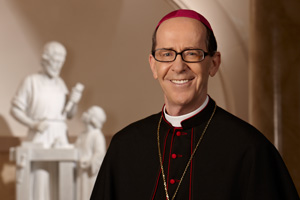
The Most Rev. Thomas J. Olmsted is the bishop of the Diocese of Phoenix. He was installed as the fourth bishop of Phoenix on Dec. 20, 2003, and is the spiritual leader of the diocese's 1.1 million Catholics.
Following is the text from Bishop Thomas J. Olmsted’s homily for the March 29, 2015, Palm Sunday Mass. He celebrated Mass at Ss. Simon and Jude Cathedral.
The Most Rev. Thomas J. Olmsted is the bishop of the Diocese of Phoenix. He was installed as the fourth bishop of Phoenix on Dec. 20, 2003, and is the spiritual leader of the diocese’s Catholics.
[dropcap type=”4″]I[/dropcap]n his First Letter, St. John writes (3:16): “The way we came to know love was that He laid down His life for us; so we ought to lay down our lives for our sisters and brothers.”
The Passion of Christ is the school of love. By gazing with reverence on Jesus in His suffering, husband and wife discover how to live their wedding vows, children and parents learn how to be a family, neighbors and enemies learn how to live in harmony, and we who have sinned learn the way of mercy. In Saint Mark’s account of Jesus’ Passion, the woman who anointed Jesus’ feet teaches us how to respond to His suffering and to our own, and to the sufferings of those whom He gives us to love. Let us look, then, at 4 ways that she loved Jesus.
First, notice how her response to Jesus is the exact opposite of Judas’ betrayal and the chief priests’ treachery, and the Apostles’ cowardice. She boldly enters Simon’s house to show her love for Jesus. She allows nothing to intimidate her, to keep her from expressing without words how much she loved Him. “Perfect love casts out fear.”
Secondly, she comes with an alabaster jar of expensive perfumed oil; and with no hesitancy she breaks the jar and pours its content on His head. At once, her actions infuriate some; she is accused of wastefulness, destroying a jar of such great value, and pouring out precious oil worth 300 days’ wages. But notice that Jesus defends her action because it is not a wasteful, just as coming to Mass is not a waste of time, and providing your children with Catholic education is not a waste of money. Waste implies paying more than something is worth. Is adoration of God a waste? Is virginity for the sake of God’s Kingdom a waste? Are long hours and days and even years of caring for a disabled family member a waste? Is forgiveness of those who hate us a waste?
To love Jesus’ as He deserves is to do something scandalous by the world’s standards. But if we are not extravagant in our love of Him, then we don’t really love Him. Listen again to the two great commandments: “You shall love the Lord your God with all your heart, all your soul, all your strength and all your mind… and you shall love your neighbor as yourself.” This woman who brought expensive oil to anoint Jesus knew that love never counts the cost. Without caring about the scorn of others, “she breaks the alabaster jar and pours out her greatest treasure on Him;” as He is about to “break His own body and pour our His life for her and for all humanity” (Healy, p. 279).
Thirdly, notice that the woman anoints Jesus’ head because unlike everyone else around her she knows Him. In the Bible, this is the way that kings were crowned, and the way that priests were ordained. The Prophet Samuel, by pouring oil over the head of David, anointed him king of Israel (1 Sam 16:13); and Aaron, in the desert, was anointed priest by Moses when he poured oil over his head (Exodus 29:7). Still today in the Church, priests and bishops are anointed Sacred Chrism oil to share in Christ’s Priesthood. Moreover, every Christian at Baptism is anointed, as they begin to share in the kingship and royal dignity of Christ.
It is significant that, at no other time in the Gospel is Jesus literally anointed with oil; and notice that it takes place immediately before Jesus, acting as the Priest institutes the Eucharistic Sacrifice and offers Himself for us on the Cross, while literally wearing a crown, and having a sign posted over His head that read: the King of the Jews. Why is it that no one, except this woman recognized Jesus as King of Kings and High Priest of the New Covenant? Love sees what no one else sees. We shall never understand who Jesus is, we shall never understand love unless we gaze in awe and reverence on the Cross.
Fourthly, this woman’s name is not known. For all time, she shall remain anonymous but, as Jesus says (Mk 14:9), “wherever the Gospel is proclaimed to the whole world, what she has done will be told in memory of her.” This teaches us something else about love; namely, that it is not done to be seen; not done to be noticed or to receive applause. This woman loved because Jesus first loved her and she opened her heart to receive this wondrous gift. We are not told what healing He had done for her; or perhaps what despair He had driven from her heart, or what shame He had taken away and replaced with hope and joy. What we know is that His love had transformed her life; so, what difference did it make if others knew her name or not?
Lifted high on the cross, Jesus attains the heights of love: “Greater love than this no one has, to lay down one’s life for one’s friends.” Even before He was lifted up, this woman with the alabaster jar of oil recognized this wondrous love beyond all telling, and she shall never be forgotten, especially by those of us who wish to love with the same fearless courage, who wish freely to give Him what we treasure, who wish to be extravagant in our adoration of Him and in charity to those He gives us to love.
Let us say with this amazing woman, “We adore you, O Christ, and we bless you, because by your Holy Cross you have redeemed the world.”
The Catholic Community Foundation promotes charitable giving through gift annuities, estate gifts, family funds, special events and scholarship funds and currently manages endowment funds for 150 agencies, including 70 Catholic parishes and 41 Catholic schools.
Bishop Thomas Olmsted calls it a “tragedy” that the Diocese of Phoenix employs teachers in its Catholic schools who cannot afford to send their own children to the schools where they teach. He is doing something about it. The 27th Annual Crozier Gala has as its goal raising funds to assist those teachers with the cost of a Catholic education.
The Catholic Community Foundation promotes charitable giving through gift annuities, estate gifts, family funds, special events and scholarship funds and currently manages endowment funds for 150 agencies, including 70 Catholic parishes and 41 Catholic schools.
“We have 2,500 empty seats in our schools,” the bishop said. “There is no one more deserving (of assistance) than those individuals who have chosen the honorable profession of teacher to make Catholic education accessible for their own families.”
Bishop Olmsted is dedicating this year’s Crozier Gala to bringing a transformational response to this priority. Lisa Staren who is the event’s co-chair this year with her husband, Ed, echoed the bishop’s sentiment.
“We rely on these teachers every day to provide our children with a foundation of faith and discipline,” she said. “It is imperative that their children have the same opportunities.”
The 27th Annual Crozier Gala will be held April 18 at Xavier College Preparatory’s Founders Hall. Organizers anticipate that the effort to help Catholic teachers educate their own children will be ongoing.
The venue is a new one for the event which traditionally has been held at one of the area’s premier hotels.
“We felt we should celebrate Catholic space and introduce attendees to the Xavier campus,” Ed Staren said. “We are planning on making it amazing. We are blessed to have such a beautiful, state-of-the-art Catholic venue and are grateful to Xavier and to Sr. Joan [Fitzgerald, BVM, Xavier principal] for opening their doors to celebrate this occasion.”
For the first time, the Katzin Crozier Honor Choir of 60 students representing all six Valley Catholic high schools will perform under the direction of music directors Betsy Sherf, Paul Olson and Adam Thome.
“The Katzin Crozier Honor Choir is an expression of what Catholic education is all about — bringing goodness, truth and beauty to help us appreciate God’s beauty,” Ed said.
F. Michael and Sheila Geddes are the Bishop’s Crozier Honorees this year and are being recognized for their lifetime of service and leadership both locally and internationally.
“It is my hope that others will shape their lives from the Geddes’ example by giving to the community with their time, commitment and funds,” the bishop said.
The gala raises funds primarily through sponsorships and ticket sales, but donations are also accepted. To purchase tickets visit ccfphx.org/crozier.
In addition to raising funds to assist teachers, gala attendees will assist individual parishes, schools and missions from throughout the diocese by purchasing a leaf from the Wish Tree. Wishes are accepted for $100, $250 and $500. Attendees select from the Wish Tree and send the donation directly to the requesting facility. Past wishes have included training materials for religious education, science equipment, uniforms for students in need and altar server garments. Wishes can also be filled by those not attending the gala through the website.
“Through this specific call, we hope to strengthen our ability as Christians to share the good news of Jesus with our diocesan families and youth,” Lisa Staren said.
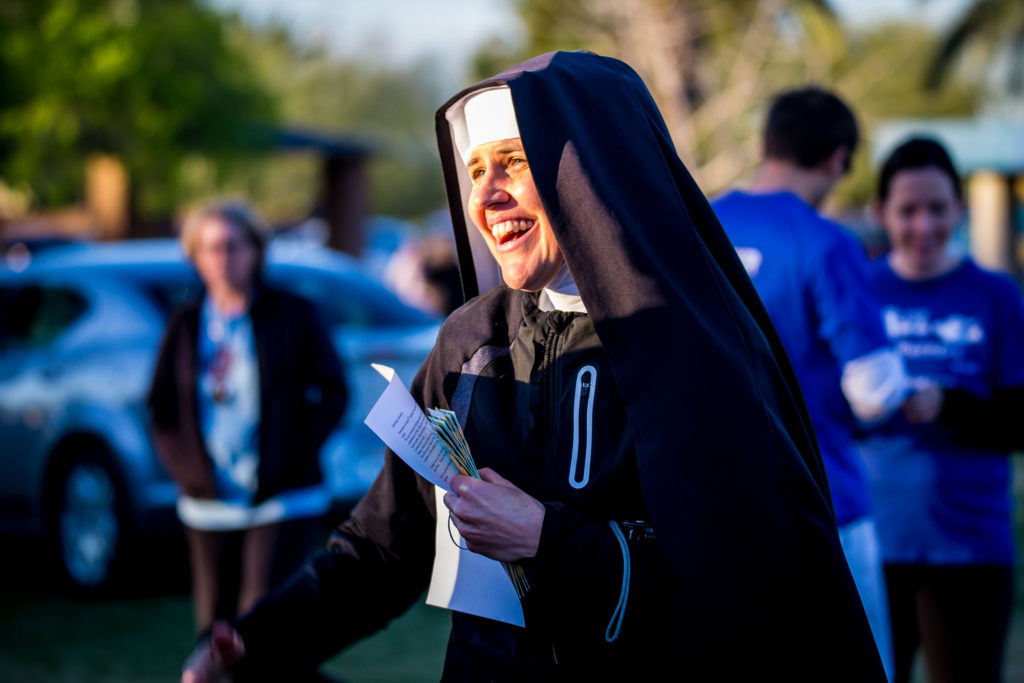
The Desert Nun Run, held March 7 at Tempe’s Kiwanis Park, drew more than 700 Catholic and non-Catholic participants from near and far. (Billy Hardiman/CATHOLIC SUN)
TEMPE — Robert Stilwell, 91, was the oldest runner in the sixth annual Desert Nun Run, placing first in his division — male runners between 90 and 99.
“They didn’t think I could make it — boy did I fool them!” joked the World War II veteran and Riverside, California, resident who ran the race with his wife of 64 years, Madeline, and two of their children. Stilwell’s son, Tom, first participated in the race a few years ago and invited the family to run this year.
The Desert Nun Run, held March 7 at Tempe’s Kiwanis Park, drew more than 700 Catholic and non-Catholic participants from near and far. The annual race is used as a fundraiser for the Poor Clares of Perpetual Adoration, with the goal of eventually building a monastery in Tonopah so the sisters can live out their cloistered vocation.
The Desert Nun Run, held March 7 at Tempe’s Kiwanis Park, drew more than 700 Catholic and non-Catholic participants from near and far. (Billy Hardiman/CATHOLIC SUN)
This year’s theme, “Don’t stop, persevere in running the race,” taken from Hebrews 12:1-2, had special significance for Katie Hodge, a social work graduate student from Arizona State University, who’d never run a 5K before.
“You don’t know the track, so you don’t know where you are in relation to the finish line,” Hodge said. “I wanted to be able to say to myself that I never stopped — that I ran the whole thing.”
The sisters’ spokesperson, Sr. John-Mark Maria, said they don’t run because the emphasis is on people running for the nuns.
“It allows us to be present to the people that gather, so instead of being out on the course running, we’re able to share our life and greet people,” she said. “It’s not about the novelty of a nun running — it’s about sharing our life one-on-one.
“It’s amazing the number of people this is their fourth or fifth Nun Run,” Sr. John-Mark added. “For some people it’s become like a tradition.”
The Desert Nun Run, held March 7 at Tempe’s Kiwanis Park, drew more than 700 Catholic and non-Catholic participants from near and far. (Billy Hardiman/CATHOLIC SUN)