
Pope urges church to listen to sorrows of abuse victims, walk together

By Carol Glatz, Catholic News Service

VATICAN CITY (CNS) — Pain must never give rise to violence, and every Catholic needs to learn to safeguard with tenderness those who are vulnerable, Pope Leo XIV said during a prayer vigil dedicated to people experiencing pain and affliction due to illness, bereavement, violence or abuse.

Recognizing that some members of the church “have unfortunately hurt you,” the pope said, the church “kneels with you today before our Mother (Mary). May we all learn from her to protect the most vulnerable with tenderness!”

“May we learn to listen to your wounds and walk together,” he said in his homily Sept. 15, the feast of Our Lady of Sorrows. “May we receive from Our Lady of Sorrows the strength to recognize that life is not defined only by the evil we suffer, but by the love of God, who never abandons us and guides the whole church.”

The pope led the prayer vigil in St. Peter’s Basilica Sept. 15 as part of the Jubilee of Consolation, which is “dedicated to all those who are experiencing or have experienced moments of particular difficulty, grief, suffering or hardship in their lives,” according to the section of the Dicastery for Evangelization in charge of organizing the Holy Year.

During the vigil, two women offered their reflections and experience of losing a loved one to senseless violence and finding consolation, reconciliation and new life through their faith.

Lucia Di Mauro, spoke about forgiving and supporting the young man who was an accomplice in the 2009 murder of her husband, Gaetano Montanino, in Naples, Italy, and Diane Foley spoke about her son, James W. Foley, a U.S. journalist who worked in conflict zones and was kidnapped, once in Libya, then in Syria, where he was ultimately beheaded by members of ISIS in 2014.

Telling the story of his Catholic faith and passion for “giving voice to the voiceless,” Foley also spoke of the pain and anguish of finding out “my innocent, good-hearted son was taken at gunpoint, sold and held captive for the ‘crime’ of being a journalist — just as our beloved innocent Jesus was condemned to death for our sins,” she said, her voice catching with emotion.

“Anger surged within me — anger at ISIS, at our U.S. government, at those who refused to help. Bitterness threatened to consume me,” she said. She found comfort in the Stations of the Cross, and “Jesus and Mary became my constant companions, along with countless earthly angels whose compassion lifted me up.”

The unexpected happened, Foley said, when Alexanda Kotey, one of the jihadists who had kidnapped and tortured her son, offered to meet with the family after he pleaded guilty to all eight counts of kidnapping, torture and murder.

“The three days of meeting with Alexanda became moments of grace,” she said, as “God gave me the grace to see him as a fellow sinner in need of mercy, like me,” and she turned evil into good by establishing the James W. Foley Legacy Foundation, which advocates for the safe return of Americans taken hostage and educates student journalists about safety practices in places of danger.

In his homily, Pope Leo said, “the testimonies we have heard speak of a truth: that pain must not give rise to violence, and that violence never has the final say, for it is conquered by a love that knows how to forgive.”

“The violence suffered cannot be erased, but forgiveness granted to those who offend us is a foretaste of the kingdom of God on earth,” he said.

“Where there is evil, we must seek the comfort and consolation that can overcome it and give it no respite,” he said. “In the church, this means never being alone.”

“Finding someone who cries with you and gives you strength is a medicine that we cannot do without, because it is a sign of love. Where pain is deep, the hope that comes from communion must be even stronger,” he added.

The pope highlighted the collective anguish of entire peoples “crushed by the weight of violence, hunger and war.”

“The true consolation we must offer to those around us is showing that peace is possible,” he said, appealing to the leaders of nations to listen to “the cries of so many innocent children and ensure them a future that protects and consoles them.”

“Even in the midst of so much arrogance, we are certain that God will inspire hearts and hands to provide help and consolation: peacemakers who can comfort those who are in pain and sadness,” he said.

Among the many prayer intentions read aloud were pleas for those who are: persecuted for their faith; victims of violence and terrorism; children who are abused and neglected; victims of human trafficking and their captors; abandoned by others; suffering from addiction; and mourning the death of a loved one or child.

At the prayer service, people were given a gift of the “Agnus Dei,” a wax medallion depicting the Paschal lamb, a symbol of resurrection and a sign of hope. On the other side was a representation of Rome’s Marian icon, the “Salus Populi Romani,” (“Salvation of the Roman People”). The medallions were blessed by the pope.

Crying out to God can be sign of hope, not crisis of faith, pope says

By Carol Glatz, Catholic News Service

VATICAN CITY (CNS) — Crying out to God during moments of extreme trial does not mark a crisis of faith but can reflect an act of total surrender to and enduring trust in God, Pope Leo XIV said.

“In the journey of life, there are moments in which keeping something inside can slowly consume us,” the pope told thousands of people huddled under umbrellas or dressed in rain gear in St. Peter’s Square Sept. 10 for his weekly general audience.

“Jesus teaches us not to be afraid to cry out, as long as it is sincere, humble, addressed to the Father,” he said.

“A cry is never pointless if it is born of love, and it is never ignored if it is delivered to God,” he said. “It is a way to not give in to cynicism, to continue to believe that another world is possible.”

During the audience, the pope offered special greetings to Arabic-speaking faithful, especially those from the Holy Land.

“I invite you to transform your cry in times of trial and tribulation into a prayer of trust, because God always listens to his children and responds at the moment he deems best for us,” he said.

Pope Leo also asked the faithful to find inspiration in Sts. Pier Giorgio Frassati and Carlo Acutis, the two young men he canonized Sept. 7, and, like them, “learn from Christ the cry of hope and the desire to open our hearts to the will of the Father who wants our salvation.”

In his main talk, the pope continued his series of reflections on lessons of hope from the Gospel stories of Jesus’ last days, focusing specifically on the crucified Christ’s cry to God and his death on the cross.

Before he cried out on the cross, Pope Leo said, Jesus asked “one of the most heart-rending” questions that could ever be uttered: “My God, my God, why have you forsaken me?”

“The Son, who always lived in intimate communion with the Father, now experiences silence, absence, the abyss. It is not a crisis of faith, but the final stage of a love that is given up to the very end,” the pope said. “Jesus’ cry is not desperation, but sincerity, truth taken to the limit, trust that endures even when all is silent.”

“We are accustomed to thinking of crying out as something disorderly, to be repressed,” the pope said. However, “the Gospel confers an immense value to our cry, reminding us that it can be an invocation, a protest, a desire, a surrender,” even an “extreme form of prayer, when there are no words left.”

Crying out can express “a hope that is not resigned,” he said. “One cries out when one believes that someone can still hear.”

“Jesus did not cry out against the Father, but to him. Even in silence, he was convinced that the Father was there,” Pope Leo said. “And, in this way, he showed us that our hope can cry out, even when all seems lost.”

“We come into the world crying: it is also a way of staying alive,” he said. “One cries when one suffers, but also when one loves, one calls, one invokes. To cry out is saying who we are, that we do not want to fade away in silence, that we still have something to offer.”

When the hour of extreme trial comes, he said, “let us learn the cry of hope,” which is not a cry meant to hurt or to shout at someone, “but to entrust ourselves” and “to open our hearts.”

If one’s cry is genuine, it can usher in a new beginning, he said. “If it is made manifest with the trust and freedom of the children of God, the suffering voice of our humanity, united with the voice of Christ, can become a source of hope for us and for those around us.”

‘150 years of love and thanksgiving:’ Diocese celebrates Society of Divine Word’s Foundational Jubilee

When Bishop John Dolan needed to staff St. Augustine Parish in Phoenix almost three years ago, he knew where to turn. 

The author of the Diocese of Phoenix’s bold seven-year pastoral plan, whose broad themes are tied together through evangelization, contacted the Society of the Divine Word’s (SVD) Western USA Provincial Superior, Fr. Jon Kirby, SVD. 

Having become good friends with Fr. Kirby while serving in the Diocese of San Diego, where SVD serves a number of California parishes, Bishop Dolan became familiar with their robust pastoral interaction. He also knew their mission: to “proclaim the Word of God in diverse ministries, focusing on the poor and marginalized. Committed to unity in diversity, we are bridges among peoples.” 

So, the bishop reached out. 

Three years later, the pair led the diocese’s celebration of not one — but three parishes — under SVD leadership as part of the Society of the Divine Word’s 150-year Foundational Jubilee Mass.  

“I grew to know them in San Diego, and we are grateful they are here in the Diocese of Phoenix, representing the call to be proclaimers of the Word of God to all peoples,” Bishop Dolan told a filled Ss. Simon and Jude Cathedral in Phoenix Sunday. 

“We are very happy to have them here with us.” 

In his homily, Fr. Kirby responded, “We rather thank [Bishop Dolan] for being so generous to offer this opportunity to do our mission here in Phoenix and in Arizona as we are doing it in California.” 

One of several orders serving the diocese, the Society of the Divine Word began its work here at St. Augustine Parish in July 2023, when Fr. Jesús Zamarripa, SVD, became parochial administrator of the heavily Hispanic community in west Phoenix’s Maryvale area. A year later, Fr. Zamarripa was installed as pastor.  

Around that same time, Bishop Dolan installed Fr. Krzysztof Pipa, SVD, as the new pastor at Sacred Heart Parish in Prescott, Ariz., and welcomed Fr. Biju Thomas, SVD, and the order’s Phoenix District superior, as parochial vicar. The pair succeeded priests from the Claretians, who had served the diocese’s oldest parish for 100 years before moving out of that role.  

“For me, [the SVD Jubilee] is 150 years of love and thanksgiving,” Fr. Biju said before Mass. 

“We are so grateful to God and all those missionaries; that [the order] has made such progress and such an impact on the world. It is a time for us to celebrate and look to the future with hope,” he said. 

Frs. Biju, Pipa, Zamarripa and four fellow SVD members took part in Sunday’s Mass.  

The others included: parochial vicars Fr. Giresse Etung, SVD, and Fr. Yori Soda Nango, SVD, parochial vicars at St. Augustine; and Fr. Long Phi Nguyen, SVD, and Fr. Predheep Sathiyanathan, SVD, the pastor and parochial vicar, respectively, at Holy Spirit in Tempe, Ariz. — the diocese’s newest parish staffed by the order.  

“We have celebrated [the order’s jubilee] in different parts of the world throughout the year, and for the seven of us, it is an honor to be recognized at the diocesan level,” Fr. Biju said.  

Together, the three parishes represent the diverse population served by SVD. 

The worldwide order includes a variety of races, cultures and ethnicities. Many of its more than 6,000 members serve in poor, underdeveloped countries.  

Founded in 1875 in Steyl, Netherlands, by a German priest, St. Arnold Janssen, the Society is the largest Catholic order that focuses on missionary work. It encompasses 60 provinces worldwide, including the Western USA. Its first U.S. missionary, Br. Wendelin Meyer, arrived in Hoboken, N.J., in 1875.  

The Western USA Province, which includes 72 priests, began in 1964.  

Its seven Arizona priests come from Mexico, Poland, India, the Congo, Vietnam and Indonesia. Flags from each country, along with the U.S. flag and the Society of the Divine Word’s Foundational Jubilee flag, were carried up the cathedral’s center aisle along with the bread and wine during Sunday’s offertory and placed in standards to either side of the main altar.  

The day’s recognition extended beyond the order and its priests.  

The Mass was celebrated on the Church’s Feast of the Exaltation of the Holy Cross, Sept. 14. 

The feast commemorates the discovery of the True Cross, upon which Jesus died, by St. Helen, the mother of the Roman Emperor Constantine in 320 in Jerusalem, and the dedication of the basilica and shrine built on Calvary by Constantine. 

In his homily, Fr. Kirby mentioned the order’s vows of poverty, chastity and obedience, noting priests are sent wherever they’re assigned by their superiors. They have no personal bank accounts and share the order’s resources. 

“We hold no personal possessions,” he said.  

Focused on individual relationships and daily interaction through the sacraments, the order seeks to develop the same missionary mindset among those it serves. 

“We see all of you as our co-workers; co-missionaries,” Fr. Kirby said. 

Referencing the day’s second reading from St. Paul’s Letter to the Philippians, he said that Jesus, even in His divinity, did not consider equality with God something to be grasped, but rather humbled Himself “to become one of us. 

“His life showed our vocation as human beings is to grow continually in the range and depth of relationship with God and with others. 

“We are…continuing His mission in our modern world. We take our lead and inspiration from His message of love and freedom that was shown by a life of continual growth and self-emptying, and going beyond the limits we set for ourselves,” he said. 

He then focused on the laity. 

“Our mission is made possible by your support, time, professional services and donations. Without you, our efforts…would not be possible.” 

Sacred Heart Parish Manager Jim Wren, speaking after Mass, said the SVD priests have had a tangible impact there.  

“They bring a profound sense of reverence to the Eucharist. The parishioners are very inspired by their devotion to the sacraments, particularly the sacrament of reconciliation and the anointing of the sick. They will drop everything to go to see a sick person, and they inspire me because of their devotion,” he said. 

St. Augustine parishioner Andre Castaneda echoed those thoughts. 

“They work so hard, and they minister a sense of unity,” she said. 

Sr. Bonnie Wolff, a member of the Legion of Mary lay ministry at Sacred Heart, also hailed SVD’s inclusive approach. 

“They really believe in the value of each person, each life, no matter who they are,” she said. “It’s very much like Jesus. It is such an inspiration.” 

Fr. Biju said that today’s world culture and social atmosphere have people reaching out for accompaniment. 

“Whether it is the elderly or children, what we need is to be heard,” he said.  

“[People] want to share their struggles, their pain and their loneliness. The world today is in such a rush. No one has time to listen to one another. People want to be listened to and to be understood.” 

SEE FACEBOOK PHOTO GALLERY

Christ in our Neighborhood: 28th Sunday in Ordinary Time (Cycle C)

NOTE: Christ in Our Neighborhood is a parish-based program consisting of small Christian communities that gather in the home weekly to prayerfully discuss the upcoming Sunday Mass readings. It’s easy to form a community and you can find out more at Christ in Our Neighborhood – The Roman Catholic Diocese of Phoenix (dphx.org)

This coming Sunday, we celebrate the 28th Sunday in Ordinary Time. Check out the question the Christ in Our Neighborhood reflection poses: In what way are you returning to the Lord daily with praise and thanksgiving?

When we were growing up and complained about something, our mom liked to teasingly quote this line from Shakespeare’s King Lear: “Sharper than a serpent’s tooth is an ungrateful child.”

And really, a complaining spirit is an embodiment of ingratitude. Those who like to complain are often quick to point out problems but not so speedy when it comes to giving thanks.

In our Gospel this Sunday, Jesus heals 10 lepers, but only one returns to thank Him. How often do we count our blessings and thank the Lord for them? Do we realize that every heartbeat, every breath is a gift from God? Do we recognize how generously God has blessed us or are we more likely to complain about things not going quite our way? Take some time today to think about all God has given to you. How will you show your gratitude today?

If you haven’t joined a Christ in Our Neighborhood small group yet, perhaps you are being called to start one yourself. Check out our website today to find out more: dphx.org/Christ-in-our-neighborhood. 

Watch the video of the weekly podcast segment featuring Christ in Our Neighborhood with Bishop Dolan by clicking HERE.

Be sure to attend our Sept. 6 Morning of Reflection for all CION participants and leaders at the Diocesan Pastoral Center, 8 a.m. to noon. You can RSVP for this free event HERE.

To sign up for our weekly Christ in Our Neighborhood newsletter that has everything you need for your next meeting, visit: https://phoenixdiocese.flocknote.com/CION

Christ in our Neighborhood: 27th Sunday in Ordinary Time (Cycle C)

NOTE: Christ in Our Neighborhood is a parish-based program consisting of small Christian communities that gather in the home weekly to prayerfully discuss the upcoming Sunday Mass readings. It’s easy to form a community and you can find out more at Christ in Our Neighborhood – The Roman Catholic Diocese of Phoenix (dphx.org)

This coming Sunday, we celebrate the 27th Sunday in Ordinary Time. Check out the question the Christ in Our Neighborhood reflection poses: Are you waiting for the right time to share the Gospel of Life?

A dynamic pastor once said that he never counted on parishioners who told him they would make a big contribution if they won the lottery “someday.”  Father wasn’t buying it.

“If they’re not willing to give today, they won’t be willing then, either,” he said. People who are really committed to the mission trust in the Lord and act now, not waiting for some distant and nebulous future. And that’s how it is with sharing the Gospel.

If we’re waiting until we’re “fully qualified” or leaving it up to someone we deem more capable than us to share our faith in Christ, then we’re not doing what Jesus asked. When our Lord asked us to go and make disciples, He didn’t modify the request. He said, “Go.” We are to “go and make disciples,” and that “go” is meant for every person initiated in the faith. If you’ve been confirmed, you’ve been commissioned!

Do you have your elevator pitch for your faith in Christ? Every believer needs to be able to confidently share in 45 seconds why they are Catholic and follow Christ, why they love the Lord and serve Him.

“He gives me hope. He gives me Himself in the sacraments. He is with me in the storms of life and walks with me in my pain.”

As the Catechism of the Catholic Church notes, “The disciple of Christ must not only keep the faith and live it, but also profess it, confidently bear witness to it and spread it … Service of and witness to the faith are necessary for salvation… (CCC #1816).”

If you haven’t joined a Christ in Our Neighborhood small group yet, perhaps you are being called to start one yourself. Check out our website today to find out more: dphx.org/Christ-in-our-neighborhood. 

Watch the video of the weekly podcast segment featuring Christ in Our Neighborhood with Bishop Dolan by clicking HERE.

Be sure to attend our Sept. 6 Morning of Reflection for all CION participants and leaders at the Diocesan Pastoral Center, 8 a.m. to noon. You can RSVP for this free event HERE.

To sign up for our weekly Christ in Our Neighborhood newsletter that has everything you need for your next meeting, visit: https://phoenixdiocese.flocknote.com/CION

Jubilee event to honor modern martyrs as symbols of hope

By Cindy Wooden, Catholic News Service

VATICAN CITY (CNS) — In a Jubilee year dedicated to hope, Pope Leo XIV and Christian leaders will commemorate “new martyrs and witnesses of the faith” — people whose lives were signs of hope to the people around them and who died firm in the hope of being welcomed into God’s presence, said the secretary of the Vatican Dicastery for the Causes of Saints.

Archbishop Fabio Fabene, dicastery secretary, told reporters Sept. 8, “Pope Leo hopes the blood of these martyrs will be seeds of peace, reconciliation, fraternity and love.”

Like St. John Paul II did during the Holy Year 2000, Pope Leo will preside over an ecumenical prayer service for the Jubilee 2025 commemorating Catholics, Orthodox, Anglicans and Protestants who died for their faith between 2000 and 2025.

Pope Francis had established a commission in 2023 to compile “a catalogue of all those whose blood was shed to confess Christ and witness to his Gospel” in the 25 years since the last Holy Year.

Those martyrs — Catholic, Orthodox, Anglican and Protestant — will be remembered Sept. 14, the feast of the Exaltation of the Cross, during a prayer service at Rome’s Basilica of St. Paul Outside the Walls, a frequent site for ecumenical prayer.

At a news conference Sept. 8, Andrea Riccardi, a historian and vice president of the commission, said the catalogue includes 1,624 Christians whose names were submitted by bishops’ conferences, religious orders and nunciatures from all over the world.

Riccardi, who also is founder of the lay Community of Sant’Egidio, also gave a continental break down of those slain: 643 people in Africa; 357 in Asia and Oceania; 304 in North and South America; 277 in the Middle East and North Africa; and 43 in Europe, although 110 of the total killed on other continents were missionaries from Europe.

Archbishop Fabene said the Vatican still was studying how, when and if to publish the names in the catalogue, taking into consideration the possibility that doing so could endanger other Christians living and ministering in the same geographical areas.

“They set the anchor of their hope in God, not in the world,” the archbishop said; “they hoped in the Lord and their reward will be eternal life.”

In addition, said Msgr. Marco Gnavi, secretary of the commission, “The hope that was the motif of their lives before their deaths brought hope” in contexts where their brothers and sisters often were the victims of ethnic conflict, religious persecution, organized crime or the deadly denial of their rights.

For example, the commission members said, the list includes Sister Dorothy Stang, a U.S. member of the Sisters of Notre Dame de Namur, who was shot and killed in the Brazilian Amazon in 2005 for defending the land rights of the Indigenous and poor farmers.

Father Angelo Romano, a member of the commission and official at the Dicastery for the Causes of Saints, told Catholic News Service the catalogue is not part of the official Catholic process for recognizing the martyrdom of a potential saint, however, some of the people included already have a sainthood cause underway, and other causes could begin in the future.

The ecumenical commemoration St. John Paul presided over in 2000 was held at Rome’s Colosseum, a symbol of Christian persecution and martyrdom. Father Romano said the Vatican “would have loved” to do the 2025 prayer service there, but the city of Rome has new archaeological digs just outside the Colosseum, which severely limits the space available for participants.

Knowing that, as Pope Francis often said, the number of Christians martyred today is more than in the first centuries of Christianity should not lead Catholics to feel under attack but should motivate solidarity, Father Romano said.

“A society that may even be aggressive toward the Christian faith is one thing; being persecuted is another,” he said. “Persecution means that going to Mass is a risk, that praying is a risk, that being a Christian is a risk, that practicing charity in the name of faith is a serious risk.”

“Another mistake that I think we must avoid when talking about martyrdom — a mistake in the strictly theological sense — is trying to understand martyrdom only in quantitative terms: how many there are,” the priest said.

The numbers help people understand the scale of the phenomenon, he said, “but theologically we must be careful not to focus too much on quantity, because even one martyr is immense, enormous — a reason for reflection for the whole church.”

“In a world where there is so much to worry about, including increased violence at all levels, the martyr witnesses to nonviolent hope,” Father Romano said. “A martyr chooses not to respond to evil with evil, not to respond to hatred with hatred, but with love.”

Several of the groups of new martyrs mentioned at the news conference were Christians killed in church during terrorist attacks.

Archbishop Fabene was asked if Fletcher Merkel, 8, and Harper Moyski, 10, who were shot and killed during a school Mass at Annunciation Catholic Church in Minneapolis Aug. 27 could be considered martyrs.

“If a diocese or other local ecclesial realties present these figures to us as witnesses of the faith, we will examine them and will see if they can be included in the list,” he said.

New young saints encourage faithful to live life to the full, pope says

By Carol Glatz, Catholic News Service

VATICAN CITY (CNS) — The greatest risk in life is to waste it by not seeking to follow God’s plan, Pope Leo XIV said, proclaiming two new saints — two young laymen of the 20th and 21st centuries.

“Sts. Pier Giorgio Frassati and Carlo Acutis are an invitation to all of us, especially young people, not to squander our lives, but to direct them upward and make them masterpieces,” the pope said Sept. 7.

“The simple but winning formula of their holiness,” he said, is accessible to everyone at any time. “They encourage us with their words: ‘Not I, but God,’ as Carlo used to say. And Pier Giorgio: ‘If you have God at the center of all your actions, then you will reach the end.'”

Before canonizing the first saints of his pontificate, Pope Leo greeted the more than 80,000 faithful who had gathered early in St. Peter’s Square because he wanted to share his joy with them before the start of the solemn ceremony.

“Brothers and sisters, today is a wonderful celebration for all of Italy, for the whole church, for the whole world,” he said before the Mass.

“While the celebration is very solemn, it is also a day of great joy, and I wanted to greet especially the many young people who have come for this holy Mass,” he said, also greeting the families of the soon-to-be saints and the associations and communities to which the young men had belonged.

Pope Leo asked that everyone “feel in our hearts the same thing that Pier Giorgio and Carlo experienced: this love for Jesus Christ, especially in the Eucharist, but also in the poor, in our brothers and sisters.”

“All of you, all of us, are also called to be saints,” he said, before leaving to prepare for Mass and paying homage to a statue of Mary with baby Jesus and the reliquaries containing the relics of the two young men.

In his homily, the pope underlined Jesus’ call in the day’s Gospel reading “to abandon ourselves without hesitation to the adventure that he offers us, with the intelligence and strength that comes from his Spirit, that we can receive to the extent that we empty ourselves of the things and ideas to which we are attached, in order to listen to his word.”

That is what the two new saints did and what every disciple of Christ is called to do, he said.

Many people, especially when they are young, he said, face a kind of “crossroads” in life when they reflect on what to do with their life.

The saints of the church are often portrayed as “great figures, forgetting that for them it all began when, while still young, they said ‘yes’ to God and gave themselves to him completely, keeping nothing for themselves,” the pope said.

“Today we look to St. Pier Giorgio Frassati and St. Carlo Acutis: a young man from the early 20th century and a teenager from our own day, both in love with Jesus and ready to give everything for him,” he said.

Pope Leo then dedicated a large portion of his homily to sharing quotes from the two and details of their lives, which is something Pope Francis had shifted away from, preferring to focus more on the day’s readings.

“Pier Giorgio’s life is a beacon for lay spirituality,” Pope Leo said.

“For him, faith was not a private devotion, but it was driven by the power of the Gospel and his membership in ecclesial associations,” he said. “He was also generously committed to society, contributed to political life and devoted himself ardently to the service of the poor.”

“Carlo, for his part, encountered Jesus in his family, thanks to his parents, Andrea and Antonia — who are here today with his two siblings, Francesca and Michele,” he said, as the crowd applauded, and Antonia smiled shyly at the camera.

St. Acutis also encountered Jesus at the Jesuit-run school he attended and “above all in the sacraments celebrated in the parish community,” he said. “He grew up naturally integrating prayer, sport, study and charity into his days as a child and young man.”

The pope said the new saints “cultivated their love for God and for their brothers and sisters through simple acts, available to everyone: daily Mass, prayer and especially Eucharistic adoration.”

St. Frassati was born April 6, 1901, in Turin and died there July 4, 1925, of polio at the age of 24. St. Acutis was born to Italian parents May 3, 1991, in London and died in Monza, Italy, Oct. 12, 2006, of leukemia at the age of 15.

The pope said that “even when illness struck them and cut short their young lives, not even this stopped them nor prevented them from loving, offering themselves to God, blessing him and praying to him for themselves and for everyone.”

Several family members and people closely associated with the new saints attended the Mass, along with dignitaries, such as Italian President Sergio Mattarella.

St. Acutis’ parents, Andrea and Antonia, and his twin siblings, Michele and Francesca, who were born four years after their brother died, were present and together brought the pope the offertory gifts. Michele also did the first reading at the Mass in English.

Valeria Valverde, who read the first prayer of the faithful, is a young Costa Rican woman who suffered a severe head injury while living in Italy. It was her unexplained healing that provided the second miracle needed for St. Acutis’ canonization.

St. Frassati was active with Catholic Action, the St. Vincent de Paul Society, the Italian Catholic University Federation and the Dominican Third Order. Lorenzo Zardi, vice president of the youth group of Italy’s Catholic Action read the second reading at the Mass and Michele Tridente, the secretary general of the lay movement, also presented the pope with offertory gifts.

Before praying the Angelus, the pope once again thanked everyone for coming to celebrate the church’s two new saints.

However, he also called for people’s “incessant prayer for peace, especially in the Holy Land, and in Ukraine and in every other land bloodied by war.”

“To governing leaders, I repeat, listen to the voice of conscience,” he said.

“The apparent victories won with weapons, sowing death and destruction, are really defeats and will never bring peace and security,” he said.

“God does not want war. God wants peace!” he exclaimed to applause. God gives strength to those who work toward leaving behind the cycle of hatred and pursue the path of dialogue.

Local Catholic finds third-row seat at historic canonization

St. Peter’s Square in Vatican City spilled over with thousands of spectators on Sunday, Sept. 7 as Pope Leo XIV canonized two young men, St. Pier Giorgio Frassati and St. Carlo Acutis — the first canonization of Pope Leo’s pontificate.

Local Catholic, Christine Minch of Mesa, Ariz., was in Rome during the canonization. She was part of the crowd that waited in line for several hours before the doors opened in the early morning, and she found seats in the center third row, where she experienced the two-hour Mass.

“It was like standing at the intersection of heaven and earth,” Minch said. “Witnessing them raised to sainthood deepened my conviction that holiness is truly possible for any ordinary person who chooses to live a Eucharistic-centered life.

“I first learned about [Frassati] 15 years ago,” she continued. “He was born into wealth, yet, behind the privilege, he quietly lived a life of generosity.” Minch noted that Frassati gave away his clothes, shoes and money to the poor and brought medicine and flowers to the sick, befriending those on the margins.

“What makes him so relatable is that he wasn’t a priest or religious — he was an ordinary young man who loved the Eucharist, the Church and the poor.”

Frassati was a 24-year-old mountaineer with a deep love for those in need and is known as “the Man of the Beatitudes.” Acutis, who died at the age of 15, was tech savvy and had a deep devotion to the Eucharist. He is the Church’s first millennial saint. The lives of both men point toward the irreplaceable role of youth in the life of the Church and holiness lived in ordinary life.

The canonization Mass started at 10 a.m. local Rome time and featured relics of Frassati and Acutis, which were placed before a statue of Our Lady. Pope Leo XIV’s homily encouraged young people to “direct their lives upward” and make them “masterpieces,” which Frassati and Acutis exemplified in their own lives.

CLICK HERE TO SEE FACEBOOK PHOTO GALLERY

Diocese brings healing, hope during fourth annual Mass of Remembrance for those who have died by suicide and their loved ones

The line of worshippers carrying white carnations stretched from the altar below an image of Our Lady of Guadalupe inside Ss. Simon and Jude Cathedral in Phoenix along the length of the church’s main center aisle.

While the congregation sang, “Christ, Be Our Light,” tears could be seen on a number of faces. As they reached the altar, each person placed their flower into one of several large vases that were then blessed by Bishop John Dolan.

Minutes earlier, the bishop had begun the procession by laying his own four flowers down — one each for three of his siblings and a brother-in-law who died by suicide. Now, he stood at the side of the altar, smiling warmly at some worshippers, nodding to others and embracing those who reached out for a hug.

More than once, he appeared to wipe away a tear.

“It was a very emotional service,” said Gloria Munoz of St. Clare of Assisi Parish in Surprise, Ariz. Munoz’s mother died by suicide over 65 years ago when Gloria was 5 years old. “I had no idea at the time what was going on,” she said.

“Today was kind of closure for me.”

Sunday’s Mass of Remembrance for those who have died by suicide and their loved ones was the fourth annual rite held by the Diocese of Phoenix.

Begun by Bishop Dolan in 2022 to coincide with National Suicide Prevention Month in September, the Mass is held on the Sunday closest to World Suicide Prevention Day Sept. 10.

It also is a leading component of the bishop’s groundbreaking Mental Health Ministry, also launched in 2022, just a few months after his installation as the diocese’s fifth bishop.

The Mass is an example of accompaniment, one of three pillars of the Mental Health Ministry that the diocese seeks to offer, along with education and advocacy.

It also is intended to help participants heal through a public expression of support and comfort from their Catholic community.

“It’s a beautiful example of the body of Christ coming together,” said Office of Mental Health Ministry Director Mary Permoda.

“We stand with one another as survivors of suicide loss,” Bishop Dolan said as he opened the Mass before more than 800 worshippers.

“I stand with you not only as your bishop but as one who has walked this difficult road myself,” he continued. “When I look at you this morning, I do not look at strangers. I see companions who know this same ache.”

In his homily, the bishop discussed the questions that confront people following a loved one’s death by suicide, including why God allowed such a tragedy.

“There are some wounds, some mysteries too deep for us to solve,” he said.

The bishop recalled grappling with confusion, grief, anger and nights that “the silence felt overwhelming.”

But little by little, he said, God revealed that He was not far away.

Through “the embrace of others, friends who simply sat with us, or people who showed up with meals or someone who just listened without trying to explain everything away,” God ministered to him.

“That is how God often comes to us, not always in loud miracles but in quiet mercy,” the bishop explained. “Over time, I discovered grief does not disappear, but neither does God’s presence. And it is in that presence that hope begins to take root.”

“If you feel broken; if you feel weighed down by unanswered questions, you are not alone.”

The bishop’s words and the flower-placing ceremony touched many.

“I felt the warmth [of the Church],” said Joseph Aja of St. Francis Xavier Parish in central Phoenix. Aja lost his brother, Rudy Gerard Romo, Sr., in June 2024. “I was honored that it was the bishop celebrating the Mass. That was important that somebody so important was doing the Mass,” Aja said.

Jennifer Lazzara of All Saints Parish in Mesa, Ariz., lost her son, Daniel John, in 2021. He was 24.

“It was the worst day of my life,” she tearfully recalled.

“This Mass was really helpful because the bishop is building awareness about mental health. This is a mental health issue. Our Savior loves us no matter what, and He is close to the brokenhearted,” Lazzara said.

Margie LaForest of St. Patrick’s Parish in Scottsdale, Ariz., lost her husband, Steve, five years ago. “It’s still raw,” she said. “Sometimes, it’s hard to cope. It comes back and just hits me.

“It was emotional to see there are many people [affected by suicide], and I’m not alone.”

Tony Munoz of St. Clare of Assisi Parish in Surprise, Ariz., echoed that thought.

Losing a close friend left him confused and angry, but he and other mutual friends found comfort in sharing their reactions and coping skills with one another.

At Sunday’s Mass, he found solace in learning he is not alone in the Church. He was relieved to learn the Church’s current position is that even suicide does not disqualify a believer from heaven (CCC 2282-2283), a shift from a time when the Church taught otherwise.

“What I got is that there is a place for people in heaven; Jesus does have a place, including those who commit suicide,” he said.

A number of worshippers were surprised at how many were affected by suicide.

“I felt a lot of sadness, knowing how many people go through that,” said Joseph Aja’s girlfriend, Lorena Velasquez, also of St. Francis Xavier Parish.

“It doesn’t cross your mind.”

According to the U.S. Centers for Disease Control, suicide is the nation’s eleventh-leading cause of death among Americans 18 years and older. In 2023, the last year final figures are available, 49,316 people died by suicide. Another 1.5 million Americans attempted to take their own life.

“Awareness about mental health and suicide has been improving, although there is still a need for much more,” stated Dcn. Ed Shoener. Dcn. Shoener is founder and president of the International Association of Catholic Mental Health Ministers, a lay association dedicated to helping those with mental illness find pastoral support and needed services through their local Catholic community. Bishop Dolan is the organization’s chaplain.

“In many ways, Church leaders and the laity are now focusing on mental health ministry,” Dcn. Shoener said.

The Diocese of Phoenix’s Office of Mental Health Ministry, now in its third year, continues identifying effective approaches to education, referrals and accompaniment as its established practices bear fruit.

The ministry has three managers in place, one for each pillar, and is about to hire a fourth for a program that has taken off in eight Catholic schools.

“It’s beautiful to observe,” Permoda said. “We are contracting with Catholic Charities for interns, and we have two therapists in schools. They’re doing amazing work.”

The next step is to integrate therapists to address situations students face at home.

“If nothing happens when they go home, the kids come back [to the classroom] the same way,” she explained. “They return to the same situation over and over. We’re looking at therapists who can work within the family system, getting to know those families and what they need.”

Finally, The Well, one of the office’s signature features, is flourishing.

Based on the encounter of Jesus with the woman at the well recorded in John 4, The Well is a space of accompaniment within a parish building. It includes fixtures or décor designed to instill peace and comfort visitors, who can meditate or speak with a priest, deacon or lay person trained in mental health first aid.

The diocesan office created the first Well, and Permoda said there are now 30 such sites within individual parishes throughout the diocese, with more coming.

“Hopefully, that connection will be life-giving,” she said. “People want to be seen, heard and loved. When you do that, they will open up.”

Still, she said, the ministry isn’t about numbers.

“It’s about ‘Is God present?’ [Today] you could feel the presence of God.”

CLICK HERE FOR FACEBOOK PHOTO GALLERY

CLICK HERE TO WATCH BISHOP’S HOMILY

Bishop Dolan celebrates confirmations at state prison

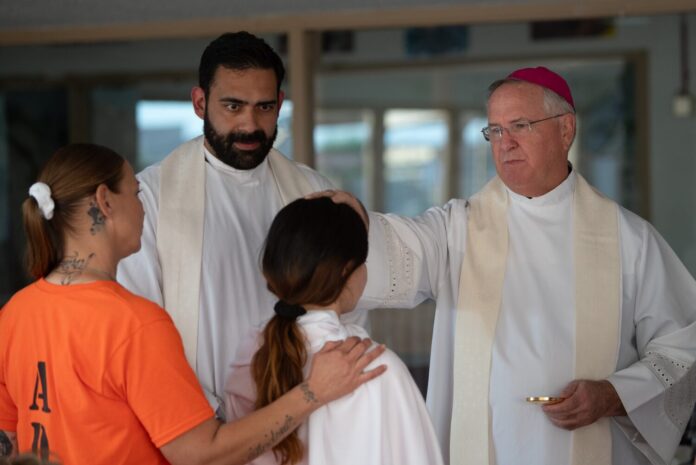
Bishop John Dolan visited the Perryville state prison complex in Goodyear, Ariz., on Wednesday night (Sept. 3), to celebrate Mass and administer the sacrament of confirmation for female inmates. Three women were confirmed in the Catholic Church and several women also went to confession.     

Bishop Dolan was accompanied by Fr. Estevan Wetzel, the director of Prison Ministry for the Diocese of Phoenix, who heard confessions, and Ted Ebner, the coordinator of Prison Ministry for the diocese. 

“It was a wonderful evening, and an incredible moment to see the joy in the eyes of the women receiving their sacraments,” said Bishop Dolan.  “Every person is made in the image of God, and it was my joy to provide hope and encouragement in this case.” 

Held at the Lumley unit, volunteers and a fellow inmate served as confirmation sponsors for the three female inmates, who received special permission to wear white shawls over their orange jumpsuits during the Mass.  

The diocesan Office for Prison Ministry and Restorative Justice evangelizes to the incarcerated and their families, aiming to foster encounters with Christ that inspire conversion and alleviate spiritual struggles. Supported by dedicated volunteers, the office sustains their mission to spread the Gospel’s joy in nearly 20 jails and prisons throughout the diocese, recognizing each interaction as an encounter with Christ that strengthens Church solidarity. 

SEE FACEBOOK PHOTO GALLERY