
God offers new possibilities, not prohibitions, with his invitation to love, pope says

By Carol Glatz

ROME (CNS) — While Satan tempts humanity with the lie of gaining unlimited power, God offers the gift of true freedom that leads to real love, relationships and fulfillment, Pope Leo XIV said.

Beginning with the story of Adam and Eve in the Garden of Eden, humankind has had to face “the age-old dilemma: can I live my life to the fullest by saying ‘yes’ to God? Or, to be free and happy, must I free myself from Him?” the pope said in his homily during a morning Mass celebrated in the Basilica of the Sacred Heart of Jesus in Rome Feb. 22.

Jesus, the incarnate Son of God, shows the world “the new man, the free man, the epiphany of freedom that is realized by saying ‘yes’ to God” and “opposing the snares” of the devil, he said.

The pope also urged the faithful to turn off all devices during certain moments of the day in order to create “space for silence,” prayer, listening and the sacraments.

“Let us dedicate time to those who are alone, especially the elderly, the poor and the sick. By giving up what is superfluous, we can share what we save with those in need,” he said before praying the Angelus at noon with those gathered in St. Peter’s Square.

“Let us create space for silence by turning off televisions, radios and cell phones for a while,” he added.

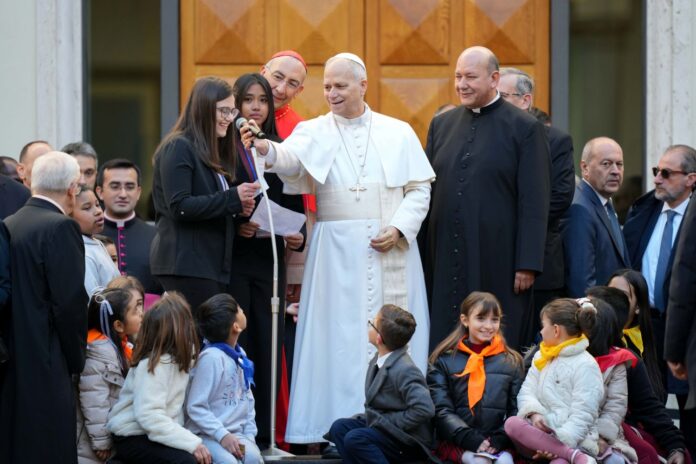
Early in the morning, Pope Leo visited a Salesian-run 19th-century basilica in the city’s center, near the main train station, where more than 450,000 people travel each day, Father Javier Ortiz Rodríguez, the parish priest, told the pope.

This heavy stream of people during the day is “like a full river in a storm,” the priest said, which then turns into devastating “landslides” in the dead of night with increased violence, exploitation, drug use and prostitution.

“Your visit is like a healing ointment” for the community, which includes numerous students, immigrants, people lacking housing and employment, as well as the elderly, the priest told the pope.

It was Pope Leo’s second of five pastoral visits in the Diocese of Rome in the run-up to Easter April 5. The visits include private meetings with members of each parish’s pastoral council, local priests, volunteers and the people they serve.

The Lenten season is a time to rediscover the beauty of Baptism as a grace that does not negate, but that “encounters our freedom,” the pope said in his homily on the first Sunday of Lent.

“The story in Genesis brings us back to our condition as creatures, tested not so much by a prohibition, as is often believed, but by a possibility: the possibility of a relationship” with God the Creator and all his creatures, he said. “Human beings are free to recognize and welcome the otherness of the Creator.”

But the devil, in the form of the serpent, tempted Adam and Eve with the illusion of becoming like God, deceiving them that God was actually seeking to deny them of something “to keep them in a state of inferiority,” the pope said.

Jesus, however, shows how freedom comes from finding fulfillment in loving God and one’s neighbor, he said.

“This new humanity is born from the baptismal font,” which is “the source of life that dwells within us and that, in a dynamic way, accompanies us with the utmost respect for our freedom,” Pope Leo said.

Baptism is “dynamic,” he said, “because it sets us on a journey again and again, since grace is an inner voice that urges us to conform ourselves to Jesus.”

Baptism is about building a relationship, he said, as it “calls us to live in friendship with Jesus and, in this way, to enter into his communion with the Father.”

“This grace-filled relationship enables us to live in authentic closeness with others, a freedom that — unlike what the devil proposes to Jesus — is not a search for power, but love that one gives and makes us all brothers and sisters,” he said.

Pope Leo noted the many challenges facing the neighborhood and praised the work of the Salesians and other church-run organizations ministering to young people and those in need.

It was his namesake, Pope Leo XIII, who asked St. John Bosco to build the basilica dedicated to the Sacred Heart of Jesus that Pope Pius IX wanted built near the then-new railway station.

He encouraged the parish to continue to be “the leaven of the Gospel,” a sign of “closeness and charity,” and “a small flame of light and hope.”

“May Mary, Help of Christians, always support our journey, make us strong in times of temptation and trial, so that we may fully live the freedom and fraternity of the children of God,” he said.

Before praying the noonday Angelus, the pope again reflected on the day’s Gospel reading of Jesus in the desert, where he fasted and resisted the temptations of the devil, showing “how we, too, can overcome the devil’s deception and snares.”

“By means of prayer, fasting and almsgiving, we can renew our cooperation with the Lord in the crafting of our lives as a unique masterpiece,” he said. “This involves allowing him to cleanse the stains and heal the wounds of sin, as we commit to letting our lives blossom in beauty until they attain the fullness of love — the only source of true happiness.”

“This is a demanding journey,” he said, especially when there are promises of “easier paths to satisfaction, such as wealth, fame and power.”

However, these temptations, which Jesus himself faced, “are merely poor substitutes for the joy for which we were created. Ultimately, they leave us dissatisfied, restless and empty,” he said.

That is why penance, “far from impoverishing our humanity — enriches, purifies and strengthens it,” he said. “Indeed, while penance makes us aware of our limitations, it also grants us the strength to overcome them and to live, with God’s help, in deeper communion with him and with one another.”

©2026 Catholic News Service/United States Conference of Catholic Bishops

National Sacred Art Prize Exhibition hosted in Diocese of Phoenix 

The Sacred Art Gallery in Mesa, Ariz., which embodies the mission to inspire a resurgence of meaningful art that calls the viewer to a higher, heavenly reality, hosted a breakfast and kickoff event on Saturday (Feb. 21) to celebrate the grand opening of the National Sacred Art Prize Exhibition, which the gallery will host through March 21.  

Founded by The Catholic Art Institute in 2020, Sacred Art Prize is a national competition that seeks to “recognize excellence in Catholic sacred art” through awarding and promoting work that “demonstrates a mastery of craftsmanship” and depicts “sacred subject matter with a profound theological understanding,” according to their website.  

Each year, hundreds of applicants submit artwork — from oil paintings and sculptures to stained glass windows and medal work. In 2025, there were 360 submissions from 15 countries including Austria, Germany, Ireland, Italy, Jamaica, New Zealand and the United States, among others. 

The National Sacred Art Prize Exhibition, which is featured at The Sacred Art Gallery, displays a selection of works from the winners, finalists and honorable mentions of the competition.  

“Until now it has only ever been a digital art gallery,” said Marcus Sobczyk, The Sacred Art Gallery director. “This is the first year that it will be a live show in a gallery, and we’re thrilled to be the location chosen.” 

The kickoff event began with Mass celebrated by Bishop John Dolan at Holy Spirit Parish in Tempe, Ariz., followed by breakfast at The Sacred Art Gallery. Bishop Dolan and local artist Ruth Stricklin, along with her husband Goeff Stricklin, gave presentations, and the jurors of the competition shared remarks before the exhibit was officially opened for viewing.  

At the heart of our mission [at The Sacred Art Gallery] has always been the desire of doing something beautiful for God, and it has been wonderful to see Him at work and in the many people He has brought into our lives,” continued Sobczyk. “The Sacred Art Prize is another one of these profound blessings.” 

Sobczyk went on to express his gratitude and excitement regarding Bishop Dolan’s involvement in the event.  

Bishop Dolan earned a Master of Arts degree in Liturgy/Church Art and Architecture from St. Patrick’s Seminary and University in Menlo Park, Calif., and weekly shares his insights in the diocesan video series called “Word and Art” where he explores a famous work of art connected to Sunday’s Gospel. 

“I’ve heard [the bishop’s] testimony regarding the importance of art in his life, and he was the perfect person to speak at this event,” said Sobczyk. “As the shepherd for our diocese, having his approval and support means so much to us. 

This exhibition is a beautiful celebration of Christ, and my hope is that it will continue to inspire people of all ages to paint for Him.” 

The National Sacred Art Prize Exhibition is open to the public through March 21. For information on location and hours, click here. 

SEE FACEBOOK PHOTO GALLERY 

Christ in Our Neighborhood: Second Sunday in Lent (Cycle: A)

NOTE: Christ in Our Neighborhood is a parish-based program consisting of small Christian communities that gather in the home weekly to prayerfully discuss the upcoming Sunday Mass readings. It’s easy to form a community and you can find out more by searching “Christ in Our Neighborhood at the Diocese of Phoenix website, dphx.org.

This coming Sunday, we mark the Second Sunday of Lent. The question the Christ in Our Neighborhood Commentary asks us is: This Lent, in what way am I allowing God to interrupt—disrupt — my normal way of life?

Lent is a season the Church gives us to repent of our sins and draw closer to God. If we accept the invitation to do that, we’ll experience spiritual growth and a deeper sense of joy with the celebration of Christ’s resurrection at Easter.

God is inviting us through the three pillars of Lent (prayer, fasting, and almsgiving) to allow His grace, mercy and love to transform our lives. In a sense, Lent is a season to shake things up a bit. It’s been said that a true disciple of Jesus is willing to change his schedule. Are you making more room for Him in your day this Lent?

Don’t let this season go by without digging deep and seeing where God is calling you to follow Him in a more radical way.

If you haven’t joined a Christ in Our Neighborhood small group yet, perhaps you are being called to start one yourself. It’s easy! Check out our website today to find out more: dphx.org/Christ-in-our-neighborhood.

Watch the video of the weekly podcast segment featuring Christ in Our Neighborhood with Bishop Dolan by clicking HERE.

To sign up for our weekly Christ in Our Neighborhood newsletter that has everything you need for your next meeting, visit: https://phoenixdiocese.flocknote.com/CION

Bourgade High School pair deepen their faith, pursue their dreams

Karla Torres Delgado wants to be a surgeon. Unsure of the specific discipline, the Bourgade Catholic High School student has her sights set on a medical career.  

Her dream is alive thanks to the generosity of countless Catholics across the Diocese of Phoenix. 

Each year, donors support over 70 ministries, parishes, schools, charities and programs through the diocese’s Charity and Development Appeal (CDA), “shining Christ’s love where it’s needed most,” said Bishop John Dolan.  

This year’s CDA theme is “Faith Lights the Way.” 

“Your generosity makes that light visible,” the bishop said. 

At Bourgade, Torres Delgado is getting a glimpse into the medical profession through a nursing program offered at no other Catholic school in the diocese.  

“Just being able to go to [medical] clinics every week, I see a vision of what I get to do in the future. I’m very grateful for the opportunity here,” she said.  

Formerly a student at a much smaller school with an arts curriculum, Torres Delgado visited Bourgade at the invitation of a friend and quickly fell in love with the Phoenix campus, which typically carries an annual enrollment of about 335-350 students. 

But without a CDA-supported scholarship, Bourgade would have been out of reach financially for Torres Delgado and her family.  

The school leaders and staff have allowed her and fellow students such as Erick Alvarez to learn in a setting in which they’re supported educationally, emotionally and spiritually. 

“You’re able to be who you are,” Alvarez said. “People are here to support you. You see God’s light shining through them.” 

A member of the student council, Alvarez also repairs some of the school’s Chromebooks and plays soccer. He plans to attend college. 

He said that Bourgade’s Catholic-centered curriculum has deepened his relationship with God. 

“Whenever I go out [outside of school], it doesn’t feel right if I don’t pray before lunch, or before I go to sleep, [or] trusting God before a game,” he said. 

Principal Tom Brennan described Bourgade as a close-knit community, “super-focused” on helping students find and develop their God-given potential. 

“It’s a blessing to be a part of it,” Brennan said. 

A ‘gesture from the Holy Spirit’ 

A veteran educator and public school administrator in the greater Phoenix area, and parishioner at St. Bridget in Mesa, Ariz., Brennan had retired from education four years ago and was contemplating his future when he noticed an ad seeking to fill the Bourgade position. 

“It was really a gesture from the Holy Spirit,” he said.  

“I felt I was done. My wife said, ‘You need to apply. The Lord put that in front of you for a reason.’ And, of course, she was right,” he recalled, laughing.  

Brennan said the difference between a public and a Catholic education is, “We’re grounded in our shared faith. We’re able to focus on … their relationship to the Lord. That’s embedded in everything we do.” 

He said the CDA and parishioners across the diocese are “invaluable” in that effort. The revenue eases financial challenges to families seeking to send their children to a Catholic high school. 

“With the nurturing of our teachers and administrators, by the time [the students] graduate, they’re full of confidence, full of their dreams and goals, realizing the potential God has placed in them.” 

Torres Delgado and Alvarez said they have seen their faith grow during their time at Bourgade. 

 “I was able to be a part of the campus ministry this year. So I’m very excited for that,” Torres Delgado said. “I was also able to go on my first retreat here [at Bourgade] and I’ve gone on many more [retreats] the past year.  

“I think my faith has just helped me grow personally and spiritually and just helped me grow a lot with God.” 

In addition to Alvarez’s activities, he is an ambassador for the school. As part of a group of students who travel with Director of Admissions Ann Williams to junior high and grade schools, he helps promote Bourgade. He also hosts eighth graders and transfer students when they visit. 

“Catholic school has made [me] grow closer to God,” he said. “It feels very blessed.” 

To make a gift to the CDA, visit www.give.dphx.org 

New educational initiative forms professionally qualified, faith-filled counselors

The University of Mary, in partnership with the Diocese of Phoenix, announced the launch of the Photina Center for Catholic Counseling, a new initiative dedicated to forming mental health professionals who are clinically trained and rooted in Catholic teaching on the dignity of the human person. This collaboration builds on the University of Mary’s existing Master of Science in Counseling program, which is fully online, available nationwide and grounded in the university’s authentic Catholic identity and commitment to faith-filled formation. 

Located in downtown Phoenix, mere steps from the Diocesan Pastoral Center, the Photina Center will serve as an in-person hub for select educational offerings, professional development and community resources. 

St. Photina is the name the Eastern Christian tradition ascribes to the Samaritan woman at Jacob’s Well. (Jn 4:4-42) The center draws inspiration from her encounter with Christ, which is the longest conversation Jesus has with anyone in the New Testament. In Jesus, she finds truth, healing and courage for joyful witness. Photina means “light,” embodying the center’s goal to illuminate paths of hope and healing for individuals, families and communities. 

Responding to a Growing Need 

Catholic dioceses, schools and parishes nationwide are grappling with rising mental health challenges among students, families and communities. As part of the University of Mary’s Liffrig Family School of Education and Behavioral Sciences, the Photina Center responds to this need by equipping counselors with the skills to deliver clinically sound care that aligns with the Church’s teachings, fostering holistic well-being rooted in faith. 

“This initiative underscores the Church’s call to address mental health needs while forming professionals who honor the dignity, freedom and vocation of every person,” said University of Mary President Msgr. James Shea.  

“Through our longstanding mission to serve the Church, the University of Mary is excited to partner with the Diocese of Phoenix in bringing academic rigor, Catholic fidelity and regional support to the American Southwest.” 

Academic Programs and Formation  

The center will offer in-person coursework for the University of Mary’s Catholic Anthropology Certificate, available to anyone in a helping ministry or profession, including area counseling students and other professionals seeking to deepen their understanding of the human person through a Catholic lens. 

For employees of the Diocese of Phoenix, it will provide on-site classes for up to 50% of the coursework for the University of Mary’s Master of Science in Counseling program. These diocesan students will experience a blended format that combines asynchronous online instruction with in-person classes, enabling them to pursue advanced clinical training while maintaining full-time employment and benefiting from a supportive community of learners. The center will also coordinate practicum and internship opportunities, allowing students to gain hands-on experience in diocesan schools or with local Catholic mental health practitioners.  

Beyond academic programs, the Photina Center will provide professional development and resources for the local community of Catholic mental health professionals, assist with the Diocese of Phoenix’s Office of Mental Health Ministry, and co-sponsor an annual conference on Catholic Mental Health Ministry. 

Online courses for the Master of Science in Counseling program begin in May 2026, with operations at the Photina Center commencing in Fall 2026. The University of Mary’s M.S. in Counseling is fully accredited by the Council for Accreditation of Counseling and Related Educational Programs (CACREP) and is in the process of seeking CACREP authorization for the blended counseling program offered through the Photina Center in Phoenix. 

An open house hosted jointly by the University of Mary and the Diocese of Phoenix will be held Sunday, March 29, from 1 p.m. to 3 p.m. at the Diocesan Pastoral Center, 400 E. Monroe St., Phoenix. Prospective students, clergy, educators and community members are invited to attend to learn more about the Photina Center and its mission. 

About University of Mary 

A Christian, Catholic, Benedictine institution founded in 1959 by the Benedictine Sisters of Annunciation Monastery, University of Mary offers nearly 60 bachelor’s, 15 master’s and five doctoral programs. With more than 3,900 students, University of Mary has locations in North Dakota, Montana, Arizona, Rome, Italy, as well as online offerings.  

For more information about the University of Mary’s Master of Science in Counseling program or the Catholic Anthropology Certificate, visit online.umary.edu/Photina  


Remarks from Auxiliary Bishop Bui’s Ordination Mass

Auxiliary Bishop Peter Dai Bui was ordained at St. Thomas Aquinas Parish in Avondale, Ariz., on Tuesday (Feb. 17). Click below to hear Bishop John Dolan’s homily, the remarks of Cardinal Christophe Pierre, Apostolic Nuncio to the United States, and the first public remarks of Auxiliary Bishop Bui, which took place at the Mass. 

Bishop John Dolan’s Homily: 

Cardinal Christophe Pierre’s Remarks: 

Auxiliary Bishop Peter Dai Bui’s Remarks: 

Once a child refugee, Bui ordained as diocese’s second auxiliary bishop

Peter Dai Bui, who as a young boy escaped religious and political oppression in his native Vietnam following the country’s fall to Communism, was installed Tuesday (Feb. 17) as the second auxiliary bishop in the 56-year history of the Diocese of Phoenix in a joyful ceremony witnessed by all but two of his large family who emigrated with him. 

Bui was ordained during a Mass celebrated by Bishop John Dolan before nearly 2,500 worshippers, including clergy, seminarians, diocesan officials, dignitaries and laity at St. Thomas Aquinas Church in Avondale, Ariz. There were more than 20 bishops and cardinals, over 200 priests and over 80 religious in attendance. 

Bishop Dolan led the prayers of consecration, assisted by Auxiliary Bishop Eduardo Nevares and Bishop Emeritus Thomas Olmsted, marking an historic moment as all four diocesan bishops took part in the same ceremony. 

Bui was appointed Dec. 19, 2025, by Pope Leo XIV.  

“Today the Diocese of Phoenix rejoices with deep gratitude,” Bishop Dolan said in his homily. 

“Our Holy Father has chosen a wonderful shepherd. One formed by missionary service, refined by pastoral love and marked by the heart of Christ Himself. Peter comes to us with amazing, extraordinary and beautiful credentials.” 

Ordained to the priesthood Dec. 24, 2003, Bui brings a diverse background to his new role, including service as a Legionaries of Christ missionary in South America, leading or assisting pastors at four parishes in the diocese and six years at the Vatican as an official with the Pontifical Council Cor Unum, which leads the Church’s charitable, humanitarian and disaster-relief work around the world. During that time, in 2014, Pope Francis gave him the title of monsignor. 

Fluent in Spanish, German, Italian, English and Vietnamese, Bui studied philosophy and theology at the Pontifical Athenaeum Regina Apostolorum in Rome. 

Bui was named by then Bishop Olmsted as the diocese’s Vicar for Clergy in 2022, a post he will continue as auxiliary bishop.  

Bui’s early life was marked by the perils of his country falling to Communism.  

Following the Vietnam War and the surrender of South Vietnam to the Communist North, Bui’s parents decided to leave their home on Phu Quoc Island on the far southwestern tip of Vietnam, fleeing in the middle of the night in Bui’s father’s packed commercial fishing boat. Under the cover of darkness, Bui’s siblings, parents and nearly three dozen neighbors and friends ventured out into the Gulf of Thailand on a perilous five-day voyage marked by a robbery at gunpoint by pirates before reaching the coast north of Bangkok and an eventual flight to the United States.  

Bishop Dolan said this experience, as well as the years that followed growing up in New Orleans, instilled within Bui an ability to carry out his duties with love  today’s overarching Church mandate. 

“He knows what it means to be a refugee … searching for safety and hope,” said Bishop Dolan. “He knows what it means to arrive in a new land; to depend on the kindness of strangers and discover the providence of God in a new home.” 

In New Orleans, Bui also learned how to value the individual, the bishop continued, using a popular phrase of the city: “Who dat?” 

“‘Who dat?’ At its heart, it’s a chant of belonging. It means, ‘we know who we are, we stand together, we don’t face the world alone.’” 

Cardinal Christophe Pierre, the Vatican’s Apostolic Nuncio to the United States, who presented Bui with the signed papal document of his appointment, said the new auxiliary bishop’s life and service formed him in a Church that is truly universal yet always attentive to the complete needs of God’s people. 

“As an auxiliary bishop, your ministry will be one of closeness, walking with people. Remember, unity is not uniformity but communal, rooted in Christ. As the Holy Father likes to say, ‘In the One, we are one,’” Cardinal Pierre said in his thick French accent. 

Following the Rite of Ordination, during which Bui lay prostrate before the altar, with bishops Dolan, Nevares and Olmsted leading the congregation in prayer to the great saints of the Church, Bui was presented three symbols of his new office: his ring, reflecting his spousal love for and fidelity to the Church and especially for the diocese; his miter, the headdress signifying his authority and function; and his crosier, the shepherd’s crook-shaped staff reflecting the pastoral care and duty entrusted to him.   

Later, following Communion at the closing of the Mass, Bui spoke publicly for the first time in his new role, first thanking his brother priests. 

“St. John Vianney taught us the priesthood is the heart of Jesus. For three and a half years as Vicar for Clergy, I have witnessed that love in your ministry. When you radiate His love, mercy and compassion, God’s people truly encounter the living Christ,” he said. 

He then reflected on the fact that Ash Wednesday, the start of Lent, would begin in less than 24 hours. 

“What better way to begin an episcopal ministry than by entering into Lent together with all of you,” Bui said. “It’s the perfect reminder that this sacred office isn’t about me. It’s about serving Christ and His people with a humble heart. 

“To all the faithful of the Diocese of Phoenix,” he continued, “you have shaped me through prayers, your faith and your example of Christlike love. Please keep me in your prayers.” 

Though his father and one sister are no longer living, Bui said, “I truly felt their presence today.” 

He thanked his mother, 89, who he said still prays the Divine Mercy chaplet daily. 

“Her faithfulness to prayer is the very foundation beneath everything I do. Thank you for teaching me [to] pray; to trust in God’s mercy and to never give up.” 

To his living brothers and sisters in attendance, he recalled, “growing up as one of 12 children was chaotic, loud, but absolutely wonderful. You taught me how to share, how to serve, how to laugh at myself and how to love. I wouldn’t be here without you. Thank you for being my first community, my first teachers in what it means to live together in love.” 

Thahn, Bui’s youngest brother, recalled that while shocked at first when he learned of Bui’s appointment, it ultimately wasn’t surprising. 

“I knew he had a call, the way he handled himself when he was little. I looked up to him,” he said. 

Kim, his oldest sister, called it a touching ceremony. 

“There was a lot of love and joy. [His] was an incredible journey; an incredible story.” 

As auxiliary bishop, he joins Bishop Nevares in assisting Bishop Dolan as shepherd of a culturally and ethnically diverse diocese of over 2 million Catholics, one of the fastest growing in the United States. According to The Official Catholic Directory, a reference resource published yearly by the U.S. Conference of Catholic Bishops, Phoenix is now the nation’s second-largest diocese by Catholic population, exceeded only by the Archdiocese of Los Angeles, which is home to over 3.79 million faithful and six auxiliary bishops. 

In the past decade alone, more than half a million individuals have joined the diocese, either by moving or completing the Order of Christian Initiation of Adults. A record 50-plus seminarians are now in various formation stages at Nazareth Seminary, the diocese’s local seminary.  

“As one of the largest and most rapidly growing dioceses in the nation, Phoenix faces increasing pastoral and administrative complexity…” Bishop Dolan stated the day Bui’s appointment was announced. “Bishop (-elect) Bui’s experience in governance, his deep care for priests and his commitment to accompaniment will be invaluable.”  

The ordination and the surrounding celebrations are made possible through the generous support of Clint and Jennifer Hickman; Dr. Kenneth and Angeline Osorio; The Diane and Bruce Halle Foundation; Catholic Cemeteries and Funeral Homes; Catholic Education Arizona; Notre Dame Federal Credit Union; AllThrive365; Catholic Charities Community Services; The Society of St. Vincent de Paul; and Catholic Community Foundation. With grateful hearts, we thank these benefactors for their faithful generosity and partnership in supporting the life and mission of the Church. 

SEE ORDINATION FACEBOOK PHOTO GALLERY

SEE VESPERS FACEBOOK PHOTO GALLERY


A true parish welcomes everyone, spreads respect, harmony, pope says

By Carol Glatz

OSTIA LIDO, Italy (CNS) — An authentic Christian community knows how to sincerely and joyfully welcome everyone: Catholics, non-Catholics and people of no faith at all, Pope Leo XIV said.

“A true parish” is where “we all learn to say ‘Welcome,’ not only with words, but with a spirit of hospitality, opening the door and welcoming everyone,” he said, speaking to members of the community during his first visit to a parish in his Diocese of Rome.

The pope also celebrated Mass during which he encouraged the faithful to cultivate humble and peaceful hearts that are open to Christ, because “the evil we see in the world has its roots precisely there, where the heart becomes cold, hard and lacking in mercy.”

The pope’s early evening visit Feb. 15 was to the Roman parish of Santa Maria Regina Pacis in Ostia Lido — a seaside community 16 miles southwest of Rome.

Although it was his first visit to Ostia as pope, he had been to the area many times as an Augustinian friar because of the port town’s close connection to the story of St. Augustine and, especially, his mother, St. Monica, who died there in 387; her remains were moved to Rome in the 15th century.

Pope Leo emphasized the need to convert one’s heart for there to be peace in the world, in his homily during Mass inside the large 20th-century church of Santa Maria Regina Pacis.

The path to human fulfillment is fidelity to God based on respect and care for others, he said. But that has to be “cultivated first and foremost in the heart, even before in gestures and words.”

The heart is home to noble feelings and “painful profanations: closed-mindedness, envy, jealousy,” he said. “Those who think badly of their brother, harboring evil feelings toward him, are as if they were already killing him in their hearts.”

He recalled some of the difficulties facing residents in Ostia, including violence, substance abuse and criminal organizations.

He encouraged the parish community to continue its courageous efforts with other organizations “to spread the good seed of the Gospel in your streets and in your homes.”

“Do not resign yourselves to the culture of abuse and injustice. On the contrary, spread respect and harmony, beginning by disarming language and then investing energy and resources in education, especially for children and young people,” he said.

“Unfortunately, even today, many clouds still darken the world, with the spread of ideas contrary to the Gospel, which exalt the supremacy of the strongest, encourage arrogance, and fuel the seduction of victory at all costs, deaf to the cries of those who suffer and those who are defenseless,” the pope said.

“Let us oppose this tendency with the disarming power of meekness, continuing to ask for peace, and to welcome and cultivate its gift with tenacity and humility,” he said.

Pope Leo began the visit by greeting young people and families gathered behind the church. A clutch of gold mylar balloons — depicting a smiling lion and the numbers “one” and “four” — bopped and twisted in the strong breeze coming in off the Mediterranean Sea.

“You are the hope! And you must recognize that in your hearts, in your lives, in your youth, there is hope for today and tomorrow. Hope already begins here, because Jesus walks with us,” he told the small enthusiastic crowd outside.

Inside a nearby gym, home of the local “Starfish” basketball team, the pope thanked the community for their warm welcome. “This is one of the many signs of an authentic Christian community, of a true parish,” he said, emphasizing the need to receive “anyone who comes: Catholic, non-Catholic, believer, non-believer.”

Speaking to the young people, the elderly, people with disabilities, Caritas volunteers and the people they serve, the pope told those gathered that “Everyone is part of this parish family, and everyone has something to say, something to give, something to share.”

“May you have the courage to say ‘yes’ to the Lord!” he said. “Each person’s life has great value: whether I am young, whether I am old, whether I have difficulties or not, human life is a gift from God.”

Speaking to members of the parish’s pastoral council, the pope thanked them for generously offering their time and talent, helping the local clergy, church and faithful. However, “I also encourage you to go out and seek others.”

“Do not remain inside the church and say, ‘It’s OK, those who come are enough.’ It is never enough. Invite, welcome, accompany,” Pope Leo said.

©2026 Catholic News Service/United States Conference of Catholic Bishops

Christ in our Neighborhood: First Sunday of Lent (Cycle A)

NOTE: Christ in Our Neighborhood is a parish-based program consisting of small Christian communities that gather in the home weekly to prayerfully discuss the upcoming Sunday Mass readings. It’s easy to form a community and you can find out more by searching “Christ in Our Neighborhood at the Diocese of Phoenix website, dphx.org.

This coming Sunday, we mark the First Sunday of Lent. The question the Christ in Our Neighborhood Commentary asks us is: In what way am I letting go of the things of this world and freely choosing God?

During Lent, we draw closer to God through prayer, fasting and almsgiving. In order to truly enter into this Lenten spirit, we need to make room. Maybe it’s spending less time on social media or watching television, not just for the sake of giving those things up (they do tend to be time-suckers) but to allow space for getting closer to God.

In other words, don’t just stop scrolling — read a chapter of one of the Gospels each day. Visit the adoration chapel. Attend a weekday Mass. Visit the sick. Call someone who is lonely and listen to him or her.

In this way, we are leaving behind the mindlessness of self-absorption and turning to the King of kings and Lord of lords. We are sharing the love of God with our brothers and sisters.

If you haven’t joined a Christ in Our Neighborhood small group yet, perhaps you are being called to start one yourself. It’s easy! Check out our website today to find out more: dphx.org/Christ-in-our-neighborhood. 

Watch the video of the weekly podcast segment featuring Christ in Our Neighborhood with Bishop Dolan by clicking HERE.

To sign up for our weekly Christ in Our Neighborhood newsletter that has everything you need for your next meeting, visit: https://phoenixdiocese.flocknote.com/CION

The joy of administering the sacraments 

Although Deacon Simon Ortiz’s summer assignment ended at St. Mary’s Parish in Chandler, Ariz., parishioners are still requesting him to baptize their children. Ramona Murga, office supervisor of St. Mary’s, has to politely respond that he is now back in seminary, preparing for his priestly ordination. 

The culturally diverse community hosts a yearly fundraiser for the seminarians and partakes in adopt-a-seminarian. So when Deacon Ortiz arrived at the start of the summer, they welcomed him with open arms. 

Deacon Ortiz went right to work, thankful he was able to practice his Spanish, a real blessing to the roughly 40-percent of the parish community who are Spanish speakers. His ability to connect with any parishioner who walked through the doors made him well-loved among the people. 

Murga has been working at St. Mary’s Parish in various capacities for 27 years. The parish located in Chandler comprises two churches: St. Mary’s and St. Juan Diego. 

“He was loved by [the] English community, Hispanic community and our Filipino community. People just wanted to get to know him,” Murga said. “He was very personable. He was willing to sit and pray with you if that’s what you needed, or just talk to you if you needed to be heard.” 

Between the two churches, he was kept busy, helping with funerals, blessing graves, baptisms, weddings, youth group, Vacation Bible School, serving at the altar and accompanying priests on anointings. He got to know the people. 

Murga expressed how inspiring it was to see Deacon Ortiz and the recently ordained Father Connor Companik serving together at St. Mary’s. 

“To see that these young men … they want to serve the Lord. And that’s what they’ve chosen and they’re happy. It’s very inspiring. To see them together up on the altar … I just see the love they have for the Church.” 

Since Deacon Ortiz’s assignment at St. Mary’s, there’s been an increase in Life Teen attendance and Murga doesn’t think that’s a coincidence. A young adult group was also recently started, drawing over 80 young adults for the first event. 

“To see these young men getting our young adults involved in the Church and really discerning, you know, what they’re being called to do. The young people are definitely surrounding them. They’re a great inspiration to our teenagers and young adults. They attracted the teens, they sat with them and talked to them, which is what our teens need.”   

Deacon Ortiz entered seminary before the Diocese of Phoenix’s new local seminary, Nazareth Seminary, opened its doors in 2023. Because he attends seminary in Denver, coming back to Phoenix every summer for an assignment has been an important time for him. “Phoenix is my home, and being able to serve the people here is just incredible,” Deacon Ortiz said. 
“It gives me a taste of what priesthood will be like.” 

Other summer assignments that Deacon Ortiz has had include serving at Immaculate Conception Parish in Cottonwood, Ariz., his home parish of St. Maria Goretti in Scottsdale, Ariz., and in prison ministry, which was especially impactful for him. 

“In prison ministry, a lot of the men that we ministered to, they have every reason to be hopeless. But even in the midst of that, they’re able to [acknowledge] what they had done was wrong and … turn back to the Lord.” 

This past summer, he was able to see what it’s like to live like a priest, ministering and providing the sacraments as a transitional deacon. Deacon Ortiz enjoys administering baptisms and presiding at funerals and weddings. 

Funerals in particular have been a source of hope for Deacon Ortiz, and it’s that hope that he can pass on to grieving families. “Being able to partake in the funeral rites and being encouraged by the words of hope … I’ve been really grateful to see how faith is lighting the way particularly through the hope of the Resurrection.” 

Deacon Ortiz also shares in the hope of newly baptized as he partakes in the Lord’s commandment to go and baptize all nations. 

“It’s been an incredible experience to be a deacon and to serve at the parish, particularly being able to baptize. The fact that the Lord has chosen me to be able to partake in that commandment is just incredible.” 

Melissa Zamora is a parishioner of St. Mary’s and recently experienced the hope of baptism. Zamora and her husband’s daughter was baptized by Deacon Ortiz on Aug. 2, 2025. 

Zamora is a cradle Catholic and married in 2020. Despite sleepless nights and the challenge of being a mother of two daughters, she sees God’s grace and Mother Mary’s presence every day. She said that getting her daughters baptized was a no brainer. 

“Faith is a big part of my life; always has been. My parents are both very faithful people. I knew that was just something that I wanted to pass on to my daughters. It’s the biggest gift that I can give to them and continue to raise them in our faith, so that she can take on the faith as they get older.” 

Prior to the baptism, Zamora and her husband had never met Deacon Ortiz. They were thankful that he was the one who baptized their daughter, being part of the most important day in their daughter’s life. 

“There was just such a peace about him. So it was such a gift that day to have him with us.” 

Every baptism brings about new life in Christ and the same is true for Zamora’s daughter. What Zamora wasn’t expecting was to see a visible change in her daughter after baptism. Zamora’s daughter had RSV at birth and had constant respiratory issues. 

“I always believe that the Lord works in mysterious ways. But I feel like she was made new at baptism. A lot of those [respiratory issues] disappeared. She was just a happy, healthy girl. So I like to think that was the Lord’s work, just through baptism.”