First-ever Spanish-language Phoenix cohort to begin LIMEX theology studies  

The first-ever Spanish-language cohort of students in the Diocese of Phoenix of those pursuing a certificate in theology and ministry through Loyola University New Orleans is set to begin studies Feb. 23.  

LIMEX, Loyola’s Institute for Ministry Extension, is offering the program for adult learners interested in studying graduate-level theology. The courses feature Ignatian spiritual formation as students deepen their Catholic faith and explore the call to holiness in everyday life. 

This historic Spanish cohort will be led by Ignacio Rodriguez, the manager of Hispanic Catholic Ministry for the Diocese of Phoenix. Rodriguez was selected by Dr. Tracey Lamont and Dr. Francisco Castillo of Loyola as well as by Mary Permoda, director of the Office of Mental Health Ministry for the Diocese of Phoenix.  

Permoda has facilitated LIMEX cohorts in English.  

Fifteen students will participate in three-hour, weekly session for 10-week modules that explore themes such as the origins of Christianity, practical theology, sacraments and grace. This first module will run through April 2026 and take place at the Diocesan Pastoral Center in downtown Phoenix.  

“I am looking forward to the process and the transformation of my spiritual life through the program and the life of the students,” Rodriguez said. “In addition, this formation will allow folks another way to grow their faith and build community.”  

For more information on the program and future cohorts visit cnh.loyno.edu/lim/phoenix/ 

Read more about Loyola University’s Institute for Ministry and the Diocese of Phoenix 

Pathway to becoming Catholic began as a love story that led to the waters of baptism

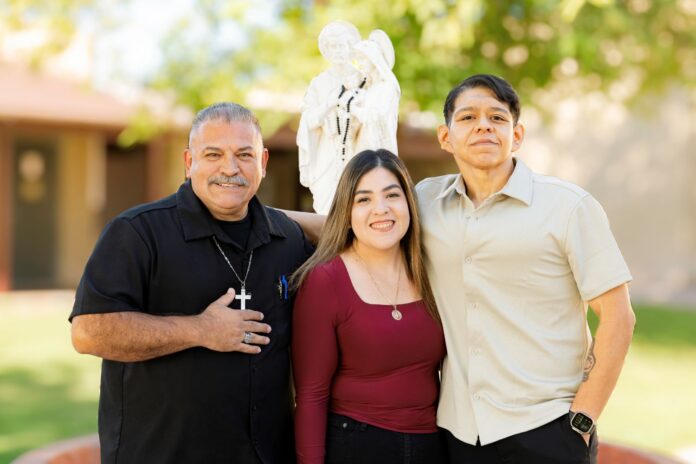
When Omar Gómez thinks about what it was that drew him to becoming Catholic, he smiles. “I feel like God was using my girlfriend as an instrument so that I would turn to the path toward God.” 

That was four years ago when life looked different for Gómez. He was born into a nominally Catholic family in California that later relocated to Arizona. 

“My parents were Catholics, but they didn’t go to church,” Gómez explained. He was never baptized, and the family did not attend Mass. When he was just 16 years old, Gómez’s mother died, leaving him and his seven sisters. His father died a few years later, and just like that, Gómez found himself faced with the heavy responsibilities of family life.   

“I never prayed, I never asked God for things — I knew of Him and that’s it,” Gómez said. “I didn’t speak with Him.” 

And then Maria Margarita Navarro, his girlfriend, came on the scene. 

“I met her four years ago and she would tell me, ‘I’m going to Mass.’” She was also in the young adult group at the church and she would talk to him about it. One day, she invited him to join her. 

“At first, you go and you’re looking at everyone and everyone except you knows what to do,” Gómez said of his first experience attending a Catholic Mass. “She knew all the prayers, and I didn’t know anything. It was all completely new.” 

Gómez discovered something else: God isn’t just a word. 

“He’s someone who can help you if you open your heart.” 

Before becoming Catholic at the Easter Vigil in 2025, Gómez had come up against a harsh reality that so many others before him have discovered: Without God, without love and meaning, there’s an inescapable, aching emptiness in the human heart. 

“You can be at parties or, let’s say, drinking, and in that moment you feel good, but then comes the moment where you just feel so alone,” Gómez said. “There’s an emptiness, and as soon as you’re not doing something fun, you feel alone. 

“Every time I came to Mass with my girlfriend, I felt at peace. When you look at the Blessed Sacrament, you feel a peace, like you’re not alone. You feel hope. And that helped me. I said, ‘I need to know more about God.’” 

It wasn’t long until Gómez began his journey toward entrance into the Catholic Church via the Order of Christian Initiation (OCIA). The months-long OCIA process prepares people to receive the sacraments of initiation and culminates in the Easter Vigil liturgy.   

In Gómez’s case, he needed all three sacraments of initiation: baptism, confirmation and Communion.  

Becoming Catholic has changed his life. 

“Before I used to spend my days mad. I was frustrated. And now instead of being frustrated and angry, I feel like there might be difficulties but God is going to help me with them. He’s got your back.” 

Life looks different in other ways, too. For one thing, there’s more discipline. 

“It used to be on Sundays I would wake up and I didn’t have anything planned. Now I have more order: We have to go to Mass,” Gómez said. “It’s beautiful knowing that you’re going and you’ll be with people who want to be close to God. There’s more meaning in my life.” 

When his ways began to change, Gómez’s family took notice. “It was a little difficult,” he said. At first, they teased him about going to Mass and practicing his newfound faith. 

“Now they understand more.” 

He’s invited them to join him for Mass. One of his older sisters began attending at another parish. 

“My two younger sisters are going now, too.” 

Welcoming approach 

Deacon Martin Gallo, who directs OCIA and religious education at St. Augustine Parish in Phoenix, cited the community’s open, faithful approach to bringing more people into the Catholic Church. There are around 800 children in the religious education program and weddings take place every weekend from Easter through November. On average, Deacon Martin said he baptizes a whopping 40 to 100 children each month.  

That’s not to say he doesn’t ask uncomfortable questions when it comes to signing up for OCIA. 

“When I give them an application, I ask them, ‘Are you living with someone or are you married?’” Deacon Martin said. “I tell them, ‘In order to register for OCIA, you need to get married.’ I convince them one way or another.” 

Many couples have been married civilly for years or are cohabitating, he said. If they don’t wish to marry in the Church, Deacon Martin offers them his blunt assessment: 

“I tell them, ‘If your partner doesn’t want to marry you, it’s because he doesn’t love you or he’s out looking for a 25-year-old.’ That clicks with them.” 

After they fill out the OCIA application, he sends them to the marriage department to start that process. 

Immediately afterward, he meets with couples who have been civilly married or cohabitating and tells them they must live chastely until they receive the sacrament of matrimony. Many agree to do so, but others decide to wait and receive their first Communion at their forthcoming nuptial Mass. 

He said he walks with them once they’re married, too. 

“I tell them ‘In my marriage as a deacon, there are times when I fight with my wife, there are days I have problems with my kids, but that’s the beauty and the flavor of marriage: knowing how to fall but knowing how to get up. Fight before bed, but ask forgiveness and never go to bed angry.’ 

“I share this with them so they can see, yes, matrimony is difficult, but I tell them, ‘Let’s take the devil out of the middle of your marriage and let’s put Jesus in there.’” 

Deacon Martin cites the parish’s 24-hour eucharistic adoration chapel as the fount of its sacramental fruitfulness. OCIA participants and all children attending religious education classes spend time in the chapel before the Blessed Sacrament. 

Gómez, too, cites devotion to the Eucharist as central to his newfound faith. He said that he and his wife — the couple married at St. Augustine in November 2025 — will sometimes visit the chapel at night. 

“Sometimes, it’s not until 10 or 11 at night, but we say, ‘Let’s go visit the Lord,’” Gómez said. 

“Opening your heart there — it moves me. You feel a peace, you feel like you’re not alone, like there’s a person there Who is looking at you and has your back.” 

“I’m proud of him,” Deacon Martin says of Gómez. “And he’s proud of being Catholic.”  

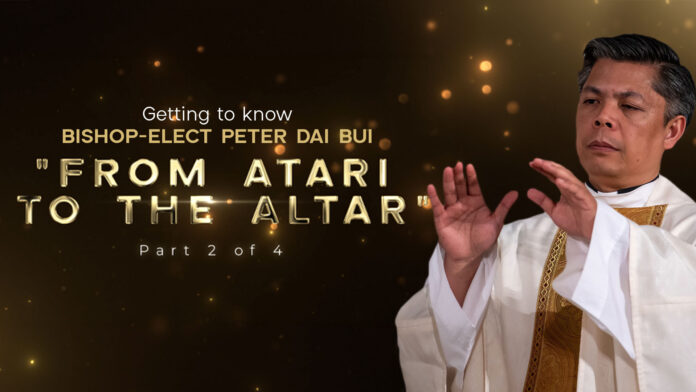
“From Atari to the Altar”; Getting to know Bishop-elect Peter Dai Bui, Part 2 of 4

In “From Atari to the altar,” the second video of a four-part series on getting to know Bishop-elect Peter Dai Bui, the bishop-elect shares how a video game console played an integral role in his vocation to the priesthood. 

Growing up in New Orleans, he and two of his brothers would often go to a friend’s house to play Atari video games after school. That’s when Bishop-elect Bui made a pact with God: he would sneak out every morning before school to attend daily Mass if God gave him and his brothers an Atari gaming console for Christmas. 

Tune in to see what was wrapped under the Christmas tree that year (it’s not what you expect!) and how his daily Mass attendance changed the trajectory of Bishop-elect Bui’s life. 

Check out part one, “Boat of No Smiles” here in case you missed it! 

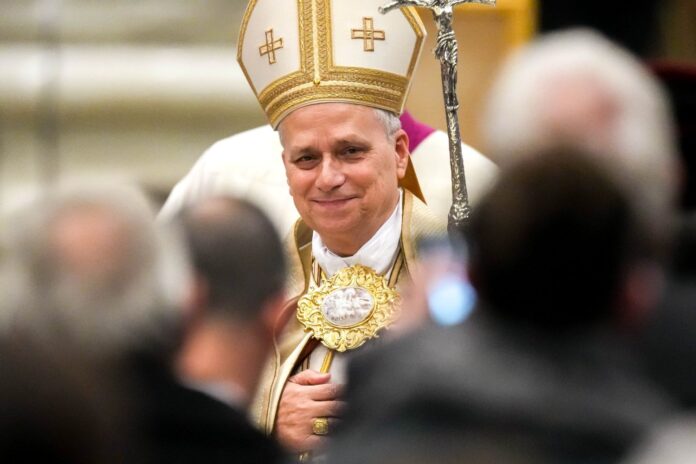
Bishop-elect Bui was appointedas the second auxiliary bishop of the Diocese of Phoenixon Dec. 19 by Pope Leo XIV and will be ordained a bishop on Tuesday, Feb. 17, at 10 a.m. at St. Thomas Aquinas Parish in Avondale, Ariz.Due to limited seating capacity, the Ordination Mass is by invitation only. The Ordination Mass will be broadcast live on More! Arizona, local channel 7 dot 2, Cox Cable 115 and livestreamed on the Diocese of Phoenix YouTube and Facebook platforms, with programing beginning at 9:30 a.m. 

The ordination and the surrounding celebrations are made possible through the generous support of Clint and Jennifer Hickman; Dr. Kenneth and Angeline Osorio; The Diane and Bruce Halle Foundation; Catholic Cemeteries and Funeral Homes; Catholic Education Arizona; Notre Dame Federal Credit Union; AllThrive365; Catholic Charities Community Services; The Society of St. Vincent de Paul; and Catholic Community Foundation. With grateful hearts, we thank these benefactors for their faithful generosity and partnership in supporting the life and mission of the Church. 

Local pilgrimages will bring experience of Lourdes to Diocese of Phoenix

In 1858, Our Lady appeared more than a dozen times to Bernadette Soubirous, a humble 14-year-old girl from a poor family in Lourdes, France. The holy waters that sprang forth during one of these encounters, and the stone grotto where they took place, have become the site of 72 approved miraculous healings and continue to draw millions of visitors annually who are in search of physical and spiritual healing. 

But not all who desire to make the pilgrimage are able to travel to France.  

That’s where Our Lady of Lourdes Hospitality North American Volunteers come in. 

For 20 years the group has sought to “evangelize through the Gospel message of Lourdes through virtual pilgrimage experiences to those unlikely or unable to make a physical journey to Europe,” per their website. The North American Volunteers will be hosting three in-person events at parishes around the Diocese of Phoenix this month to bring the experience of Lourdes to locals in honor of the feast day of Our Lady of Lourdes (Feb. 11). 

These pilgrimage experiences will take place at All Saints Roman Catholic Parish in Mesa, Ariz., on Feb. 7 at 5:30 p.m., St. John Vianney Church in Goodyear, Ariz., on Feb. 9 at 7:00 p.m., and Sacred Heart Parish in Prescott, Ariz., on Feb. 11 at 3:00 p.m. 

During the presentations, “pilgrims will meet Bernadette and discover the history and message of Lourdes through an audio-visual experience of catechesis and commentary from our trained volunteer guides,” shared Alley Marrow, a North American Volunteer who has served at the baths of Lourdes over a span of seven years.  

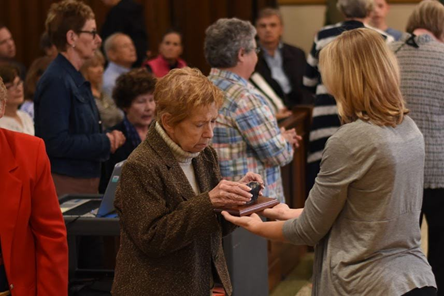
She went on to explain that pilgrims will be invited to touch and venerate a stone relic from the grotto and will receive holy water from Lourdes. There will also be adoration of the Blessed Sacrament and, like in Lourdes, the evening concludes with a candlelight rosary procession. A plenary indulgence has also been granted for these events under usual circumstances. 

“For many, despite ardent desire, it is not always possible to fly across the world to fulfill Our Lady’s request, and yet, her message is for everyone, regardless of circumstance,” Marrow said. 

“Anyone can receive the healing graces of Lourdes.”  

For more information on the local pilgrimages, click here. 

Hundreds gather downtown for Catholic Schools Week Mass and rally

More than 800 Catholic school students, teachers, staff members and chaperones gathered Wednesday (Jan. 28) in downtown Phoenix for the annual Catholic Schools Week Mass and rally. The celebration coincides with National Catholic Schools Week, the annual, nationwide celebration of Catholic education in the United States. 

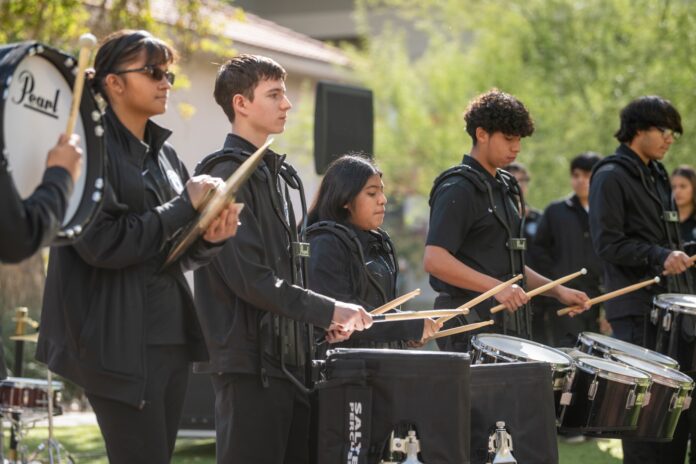
Auxiliary Bishop Eduardo Nevares celebrated Mass at 10 a.m. at the historic St. Mary’s Basilica in downtown Phoenix, followed by a Eucharistic procession around the basilica and the Diocesan Pastoral Center next door. The rally, which included student musical groups, recognition of 25- and 50-year school employees and a shared celebration of Catholic schools, culminated the day’s events. 

The rally took place at The Virginia G. Piper Plaza, an open area between the two properties that was once the location of St. Mary’s Elementary School, which was closed in the mid-1990s. The historic doors of the elementary school remain as a landmark in the park, a reminder of the significance the school played for more than a century and a witness to the lasting impact of Catholic education in the Diocese of Phoenix. 

SEE FACEBOOK PHOTO GALLERY

All Christians must humbly, joyfully invite others to trust in God, pope says

Pope Leo XIV smiles as he leaves after presiding over an evening prayer service at the Basilica of St. Paul Outside the Walls in Rome Jan. 25, 2026, concluding the Week of Prayer for Christian Unity. (CNS photo/Lola Gomez)

By Carol Glatz

ROME (CNS) — All Christians are called to invite everyone to trust in Christ, who enlightens and consoles, Pope Leo XIV said.

“Every authentic encounter with the Lord is, in fact, a transformative moment that grants a new vision and a new direction for the task of building up the Body of Christ,” the pope said as he closed the Week of Prayer for Christian Unity Jan. 25 during an ecumenical evening prayer service at Rome’s Basilica of St. Paul Outside the Walls.

Every year, the week “invites us to renew our commitment to this great mission, bearing in mind that the divisions among us — while they do not prevent the light of Christ from shining — nonetheless make the face which must reflect it to the world less radiant,” he said.

As the service began, Orthodox Metropolitan Polykarpos of Italy and Anglican Bishop Anthony Ball, the archbishop of Canterbury’s representative to the Holy See, joined Pope Leo in descending the stairs under the main altar to pray before the relics of St. Paul. Several leaders and representatives of numerous churches and Christian communions worldwide attended the prayer service, including Armenian Orthodox Archbishop Khajag Barsamian, the representative of the Armenian Apostolic Church to the Holy See,

The theme for the 2026 celebration of the week was inspired by St. Paul’s letter to the Ephesians (4:4), “There is one body and one Spirit, just as you were called to the one hope of your calling.”

“We are one! We already are! Let us recognize it, experience it and make it visible!” Pope Leo said in his homily.

The synodal journey of the Catholic Church, which is and must be ecumenical, he said, “is a path for growing together in mutual knowledge of our respective synodal structures and traditions.”

“As we look toward the 2,000th anniversary of the Passion, Death and Resurrection of the Lord Jesus in 2033, let us commit ourselves to further developing ecumenical synodal practices and to sharing with one another who we are, what we do and what we teach,” the pope said.

The mission of all Christians today is “to proclaim Christ and to invite everyone to place their trust in him,” he said. This shared task is to “say humbly and joyfully to the world: ‘Look to Christ! Come closer to him! Welcome his word that enlightens and consoles!'”

Pope Leo underlined the importance of celebrating the 1700th anniversary of the Council of Nicaea in Iznik, Turkey, in November with representatives of so many Christian traditions.

“Reciting the Nicene Creed together in the very place where it was formulated was a profound and unforgettable testimony to our unity in Christ,” he said. “May the Holy Spirit find in us docile minds even today, so that we may proclaim the faith with one voice to the men and women of our time!”

Concluding his homily, Pope Leo prayed that “the seeds of the Gospel may continue to bear fruit on this continent in unity, justice and holiness, for the benefit of peace among the peoples and nations of the whole world.”

©2026 Catholic News Service/United States Conference of Catholic Bishops

Christ in our Neighborhood: Fourth Sunday in Ordinary Time (Cycle A)

NOTE: Christ in Our Neighborhood is a parish-based program consisting of small Christian communities that gather in the home weekly to prayerfully discuss the upcoming Sunday Mass readings. It’s easy to form a community and you can find out more It’s easy to form a community and you can find out more by visiting the Diocese of Phoenix website: https://dphx.org/Christ-in-our-neighborhood.

This coming Sunday, we celebrate the Fourth Sunday in Ordinary Time. The Christ in Our Neighborhood commentary asks us: Which of the Beatitudes is your favorite?

The Sermon on the Mount, in which Christ gave us the eight Beatitudes, has been called the Magna Carta of Christian morality. In His iconic address to the crowd gathered that day, Our Lord expounded on the fulfilment of the law given by Moses. Rather than simply avoiding certain evil acts, God expects even more from us: He asks us to truly love our neighbor. If we do that, we are living according to the Beatitudes.

The New Law given by Christ is the roadmap for authentic Christian discipleship.

Each of the eight Beatitudes invite us to a deeper, more radical conversion as we seek to follow Christ. Will we be pure of heart, lovers of peace, faithful in spite of persecution, quick to offer mercy? Do we hunger for righteousness and have meek and humble hearts like Jesus?

Take a moment today to ponder the Beatitudes and ask the Lord to give you the grace to live them.

If you haven’t joined a Christ in Our Neighborhood small group yet, perhaps you are being called to start one yourself. Check out our website today to find out more: dphx.org/Christ-in-our-neighborhood. 

Watch the video of the weekly podcast segment featuring Christ in Our Neighborhood with Bishop Dolan by clicking HERE.

To sign up for our weekly Christ in Our Neighborhood newsletter that has everything you need for your next meeting, visit:  https://phoenixdiocese.flocknote.com/CION

Catholic Schools Week celebrates deep faith, supportive community

The last days of January are collectively known as Catholic Schools Week across the nation’s 5,800 Catholic elementary and high school campuses that span 176 dioceses.

During the weeklong celebration — Jan. 25-31 this year — special Masses, assemblies, open houses, student showcases and other activities are planned. Locally, those celebrations will include a diocesan Catholic Schools Week Mass, Jan. 28 at St. Mary’s Basilica in downtown Phoenix, where student council members will fill the pews on behalf of their entire school, followed by a celebratory rally with hundreds of other students from the diocese’s seven Catholic high schools and 29 elementary schools.

At the campus level, each school has unique traditions including dress up days, salutes to special populations — such as veterans and grandparents — student versus staff volleyball games, door decorating contests and service projects. St. Mary’s High School in Phoenix is celebrating by holding its annual Eucharistic procession and all-school adoration to close out Catholic Schools Week.

All observances are designed to honor what makes Catholic schools not just different, but “stellar” — a word the National Catholic Educational Association used to sum up the unique pairing of faith across all academics that comes with Catholic education.

Among the “immense benefits” of Catholic education, the Diocese of Phoenix’s Superintendent Domonic Salce described in a letter to school families that Catholic schools “help prepare their children for successful, fulfilling lives, grounded in a living and active Catholic faith.” Salce is also the executive director of education and evangelization for the diocese.

“Every day, our children grow in faith and knowledge, embody Gospel values and build a strong, supportive community,” he said.

His letter segued well into this year’s Catholic Schools Week theme: “Catholic Schools: United in Faith and Community.”

Life-changing retreats

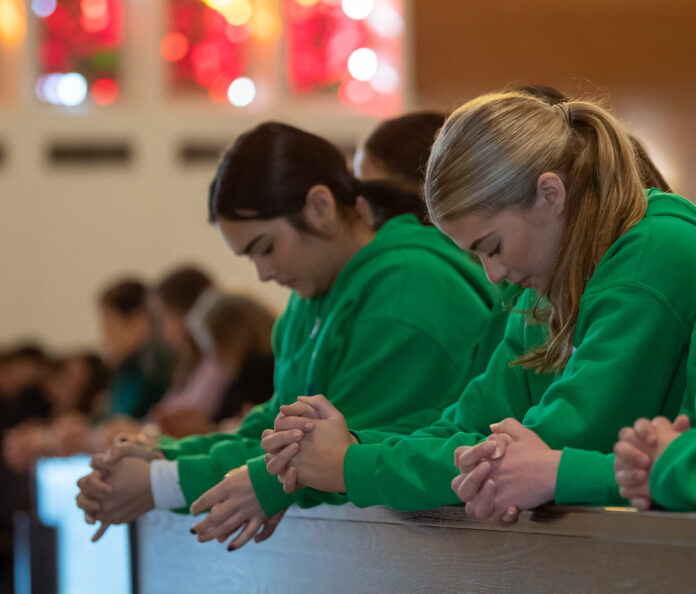
Forty upperclassmen at Notre Dame Preparatory High School in Scottsdale, Ariz., have a newfound experience of what it means to belong in a supportive community. They attended an optional Kairos retreat Jan. 20-23, one of five retreats Notre Dame offers throughout the school year. Kairos, meaning “God’s time,” is a three-and-a-half-day retreat giving students the opportunity to intentionally reflect on their relationships with God, family and friends. Originated in the 1970s, the Kairos retreat format is focused on personal spiritual growth and community building and has since spread globally. This marks the 15th year Notre Dame has coordinated Kairos retreats. Many of the other local diocesan Catholic high schools also run Kairos retreats for students annually.

Fr. Ian Wintering who is the chaplain at Seton Catholic Preparatory in Chandler, Ariz., himself a senior there in 2011, was a visiting member on the first Kairos retreat team at Notre Dame. The retreat, which played a role in his vocation to the priesthood, is a series of structured peer-led talks, meditations and activities followed by small group discussions.

“Everything really changed when I went on a Kairos retreat,” Fr. Wintering once said on The Bishop’s Hour, the Diocese of Phoenix’s weekly radio show. He described it as his first personal encounter with Christ in prayer. He remembered going by a lake during an hour of silence, thinking about the apostles who gave everything and pondering if he was willing to do the same.

At the time, he wasn’t. But God kept speaking to him through other people after graduation. A theology teacher he encountered during a parish pilgrimage encouraged him to remain open to God’s call, and more importantly the Lord’s timing. He entered seminary and was ordained to the priesthood on June 5, 2021.

A family of alumni

Lisa Soroko, a Human Resources benefits manager for the Diocese of Phoenix, can speak to Catholic education on three fronts: as an alumna, a mom whose kids completed preschool through high school in the diocese and a coach’s wife at St. Mary’s Catholic High School in Phoenix, the state’s oldest Catholic high school. Lisa was a fifth grader at St. Mary’s Elementary School in downtown Phoenix when it closed, then continued learning at St. Gregory Catholic School in Phoenix and Bourgade Catholic High School in Phoenix.

“I was taught to live with integrity, accountability and the importance of doing what is right, even when no one is watching. Those principles have guided my work ethic, leadership style and decision-making throughout my career,” Lisa said.

She also noted the strong spiritual foundation she received and wanted the same for her children. Her husband, Troy Soroko, grew up in public school, but when his eldest was in preschool at St. Gregory, he saw value in the teachings and sense of community. The Sorokos have made lifelong family friends as Catholic school parents, who they still attend Mass with.


Academic excellence

With their two children now grown, Troy will be the only Soroko who finds himself on a Catholic campus during Catholic Schools Week, as he is an assistant varsity basketball coach at St. Mary’s High School. His wife said he loves helping the players grow as athletes and as young men with confidence, discipline and character.

The Sorokos children both graduated from St. Mary’s High School and expressed gratitude for the academic discipline they found there. One is studying journalism with a minor in leadership and ethics at Arizona State University’s Walter Cronkite School of Journalism and Mass Communication. The other is studying architecture at the University of Arizona in Tucson, Ariz., and attends Mass at the university’s Newman Center.

Today’s Catholic school students continue to show academic capability as well. Top spellers from each elementary campus faced off at the annual Diocesan Spelling Bee, Jan. 21 at St. Mary’s High School in Phoenix. Sally Salloum from St. John Bosco Catholic School in Phoenix was the winner with the word “cornucopia.” The runner up was Christian Kaeft from Most Holy Trinity Catholic School in Phoenix. The two made it through 19 rounds.

St. Louis the King Catholic School students challenged themselves to go one step further. They competed in a nationwide online Vocabulary Bowl last fall. Fifth-grader Nathan Kil earned fifth place nationally by properly defining 5,471 words. His Glendale school earned second place among Arizona’s middle schools.

Catholic Schools Week provides the opportunity to step back and reflect on the ultimate purpose of Catholic schools: to form disciples of Jesus Christ.

“As the leader of the Catholic Schools Office, this is a week that renews my gratitude for our educators and families who choose this mission every day, and it fills me with hope because I see the Lord at work in our students,” said Salce.

“For our schools, it’s more than a celebration. It is a witness and an investment in the future. We’re not just teaching subjects, but forming saints, building communities of faith and sending young people into the world ready to love, serve and lead with Christ at the center.”

‘This is My beloved Son’

These are the words God the Father spoke over Jesus during His baptism in the Jordan River. But it isn’t just a nice phrase or a happy sentiment that was shared during a historical event 2,000 years ago. These words hold immense significance in each and every one of our lives, pointing toward our deepest identity as beloved sons and daughters.

The Lord loves to reveal Himself and deeper realities through images and stories, and when we take a closer look at the account of Jesus’ baptism in Matthew 3:13-17, there are three wonderful details that help us understand the magnificence of what took place during our own baptism.

First, as Jesus emerges from the waters, we behold “the heavens were opened [for Him].” (Mt 3:16) This image of the heavens being open points back to two significant moments in the Old Testament: Moses leading the chosen people out of Egypt through the parted Red Sea (Ex 14:21-22), and God parting the Jordan River so the chosen people and the Ark of the Covenant could cross into the promised land on dry ground. (Jos 3:14-17)

In the same way, at the moment of our baptism, God breaks wide open the heavens on our behalf, freeing us from the slavery of sin and making it possible for us to spend eternal life with Him in heaven, our promised land.

Next, we see “the Spirit of God descending like a dove [and] coming upon Him.” (Mt 3:16) When we are baptized in the name of the Father, and of the Son and of the Holy Spirit, we become living temples, and the Blessed Trinity comes upon us, making His dwelling within us.

And then God the Father speaks: “This is My beloved Son, with whom I am well pleased.” (Mt 3:17) The two words “beloved” and “Son” stand out to me. Notice that He speaks these words before Jesus does any public work or ministry. God the Father is showing us that our belovedness does not come from what we do, but from who we are — we are His. He also calls us sons and daughters because, through our baptism, we are radically changed — now having a share in Christ’s divine nature, we become heirs to the kingdom of God.

Isn’t it magnificent? And all of this takes place through the totally unmerited and free gift of grace through baptism.

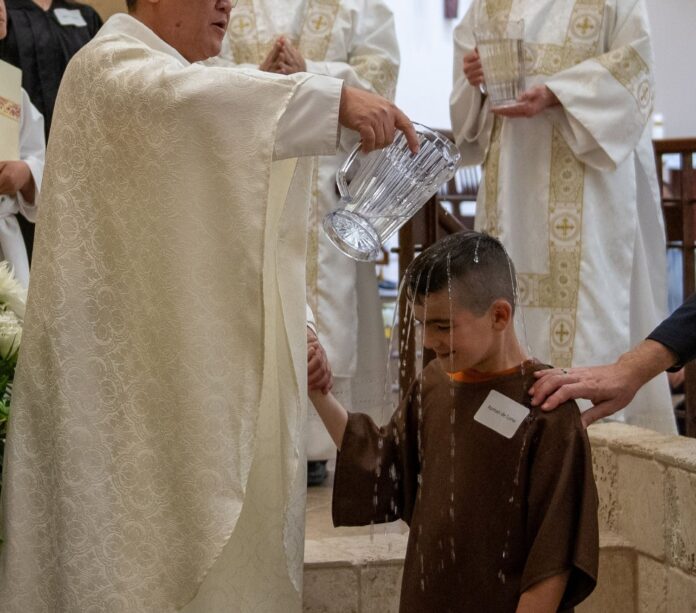
One of the reasons I love infant baptisms is because they remind us of how free this gift really is. All a baby can do is babble and receive — a newborn is completely dependent. And it is the delight of the Father to come to us in our littleness, our “undeserved-ness,” our dependence to offer us everything He has. Just as a baby is born into this world, through baptism, we are born again into the spiritual life. And it changes everything.

During this second year of TILMA, my seven-year pastoral plan on evangelization, I’m excited to delve deeply into each of the seven sacraments with you, both here in my magazine columns, as well as through a diocesan synod on the sacraments, which you can learn more about at tilma.dphx.org as the year unfolds. Through this exploration of the sacraments, we’ll discover in a special way the Father’s love for us through each one, and the immense impact they have on our lives.

As we begin this deep dive into the sacramental life, I encourage you to take a few moments to reflect on your own baptism — the totally unmerited and gratuitous gift that brought you into communion with God. Ask the Holy Spirit to descend upon you anew as you hear the Father speak once again your deepest identity over you: “You are My beloved one, with whom I am well pleased.”

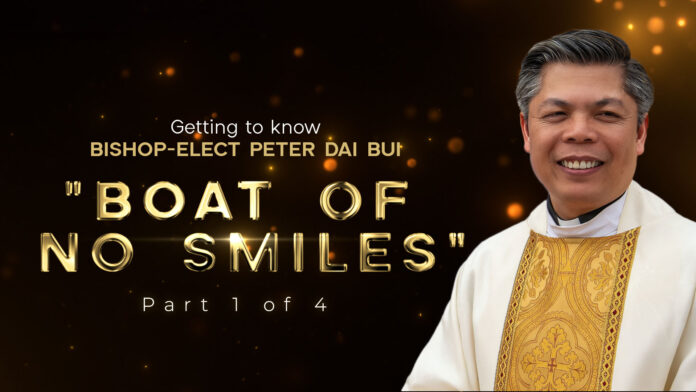
“Boat of No Smiles”; Getting to know Bishop-elect Peter Dai Bui, Part 1 of 4

In “Boat of No Smiles,” the first video of a four-part series on getting to know Bishop-elect Peter Dai Bui, the bishop-elect shares his family’s personal story of fleeing Vietnam in 1975 in his father’s fishing boat. After Vietnam was divided in 1957, there was a significant refugee movement of nearly 1 million people due to the communist rule and fear of political and religious persecution.
.
Escaping in the middle of the night amid darkness, the family — Bishop-elect Bui, his parents and his nine siblings at the time — took a five-day boat trip to Bangkok where they stayed in a refugee camp before eventually flying to Houston, Texas, and finally landing in New Orleans where they made their home. Bishop-elect Bui was 5 years old. The boat journey included an encounter with pirates and the birth of a child on the boat.
.
Famous Associated Press photographer, Eddie Adams, captured images of the family during their escape entitled “Boat of No Smiles.” A series of additional images of the unrest in Vietnam were published in his book, “Eddie Adams: Vietnam.”
.
The second episode of Getting to know Bishop-elect Peter Dai Bui — “From Atari to the altar” — will premiere on Sunday, Feb. 1 at 11 a.m. on the Diocese of Phoenix YouTube channel.
.
Bishop-elect Bui was appointedas the second auxiliary bishop of the Diocese of Phoenixon Dec. 19 by Pope Leo XIV and will be ordained a bishop on Tuesday, Feb. 17, at 10 a.m. at St. Thomas Aquinas Parish in Avondale, Ariz.Due to limited seating capacity, the Ordination Mass is by invitation only. The Ordination Mass will be broadcast live on More! Arizona, local channel 7 dot 2, Cox Cable 115 and livestreamed on the Diocese of Phoenix YouTube and Facebook platforms, with programing beginning at 9:30 a.m. 
.
The ordination and the surrounding celebrations are made possible through the generous support of Clint and Jennifer Hickman; Dr. Kenneth and Angeline Osorio; The Diane and Bruce Halle Foundation; Catholic Cemeteries and Funeral Homes; Catholic Education Arizona; Notre Dame Federal Credit Union; AllThrive365; Catholic Charities Community Services; The Society of St. Vincent de Paul; and Catholic Community Foundation. With grateful hearts, we thank these benefactors for their faithful generosity and partnership in supporting the life and mission of the Church.