Just a few blocks from St. Agnes Catholic Church and School in Phoenix, there’s a small building others may not even know exists. For those inside, it’s sweet relief from the heat and misery they’ve left behind.
Desert Terrace Healthcare houses and cares for mostly elderly patients in poor health who come from difficult circumstances. Traffic whizzes down the busy street in front of the facility as men and women experiencing homelessness push battered grocery carts and beg for money under the shade of a nearby freeway overpass.
The first morning Alex Vinciguerra and Bobby Balser visited Desert Terrace to share the love of God and the Gospel, it was a bit intimidating.
The two men, seminarians for the Diocese of Phoenix, were there to lead a Christ in Our Neighborhood small group for residents. For Vinciguerra, it was the first time he’d ever even been to a nursing home.
Christ in Our Neighborhood is a faith-sharing, small-church-community program where participants gather in small groups weekly to prayerfully discuss the upcoming Sunday Mass readings. Most groups gather in the home as part of a broader parish-wide effort, but some groups meet in nursing facilities like Desert Terrace. The program’s resources have also made their way into prison cells and outreach centers like Andre House in downtown Phoenix.
“The background on most of our residents is, they’re homeless,” explained Rosa Seanez, activities director at Desert Terrace. With very few visits from family members — they mostly come when residents are in their final days, Seanez noted — a visit from two young seminarians is a much anticipated event.
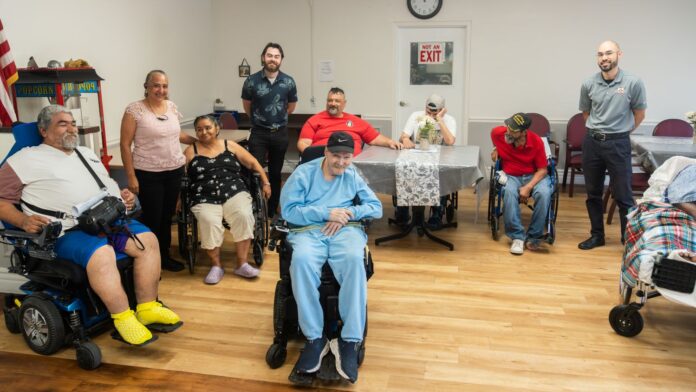
Vinciguerra and Balser smiled and greeted the senior citizens as they entered the brightly lit room, almost every one of them in a wheelchair. For many, the weekly gathering was a staple, something to look forward to on Tuesday mornings. For others, it was uncharted territory. No one had ever asked them the kinds of questions that come up during a Christ in Our Neighborhood group discussion.
That’s because the questions aim to uncover how God is moving participants’ lives and how they are responding to His loving invitation. Normally, activities at the facility center around Bingo games or arts and crafts.
It’s been a learning experience for the seminarians as they’ve come to know the names and faith journeys of the residents at Desert Terrace. Most of those who attend the weekly Christ in Our Neighborhood gatherings aren’t Catholic, and Balser said the temptation might be to catechize.
“This has helped me grow in patience with regard to just meeting people where they’re at and walking with them rather than grabbing them by the collar and dragging them to where I want them to be or where I think the Church would want them to be,” Balser said.
“It’s been a tremendous opportunity to just be able to look at them and see them as a person rather than a project to work on.”
Just happy to be alive
A framed portrait of the Sacred Heart of Jesus stands on the table near where Balser and Vinciguerra preside as they distribute copies of the readings and Christ in Our Neighborhood commentary to residents. Once everyone is assembled, the seminarians lead the group in a brief opening prayer.
As they go through the readings and commentary, there’s a brief question for each member of the group to consider. With no real right or wrong answer, it’s an opportunity to share their thoughts about the reading.
Balser and Vinciguerra move about the room, helping their guests to find the correct passages. The first question, “In what way are you hospitable?” followed a reading from Genesis about Abraham’s hospitality. The residents seem stumped by the query and sit silently.
One man blurted out, “We’re all just happy to be alive. You just try to do what you can to help others.” His response helped a few of his fellow residents offer their views.
The second Scripture passage, pulled from Colossians and dealing with suffering, generated a bit more of a spirited discussion. The question before the group was, “How do you welcome Jesus into your heart?”
One woman called out, “You welcome Him and you tell Him all your problems.” Another resident added, “I talk to Him.”
“That’s huge,” Balser said. “You have to communicate with Him.”
One participant spoke up: “I have no kids. I have nobody. He’s all I need.”
A woman chimed in, “I lost everything, but I still got Him.”
Vinciguerra spoke about St. Paul rejoicing in his sufferings because they were part of Christ’s redemptive work. “Our suffering is not meaningless. No matter how small it is, it can be part of Christ’s work.”
“Amen,” called out one woman, more talkative than the others.
At the end of the session, the residents prayed the Responsorial Psalm and the Our Father together before heading back to their rooms. Vinciguerra and Balser took time to pause and look each person in the eyes before bidding farewell.
One man, who refused to identify himself at the outset of the session, joking that if he were in the presence of a Bible, it would burn up, revealed his name as he was leaving. It might seem a small thing, but it was a small step forward in trust.
Seanez, who has worked at Desert Terrace for more than a decade, says the residents are like family to her and that she loves them. Those who live in the facility are dealing with the aftermath of trauma, homelessness and other struggles. There’s a lot of shame and difficulty in expressing their thoughts, she noted.
“They might not understand that we’re not here to judge. We’re here to listen,” Seanez said.
The weekly Christ in Our Neighborhood meeting at the center is making a difference.
Having the seminarians there, Seanez said, means residents can “speak from the heart. It helps them open up and I think they feel more at peace afterward.
“They like it. One patient told me, ‘We need more.’”
Father Paul Sullivan, rector of Nazareth Seminary, said the experience of sharing the Scriptures with nursing home residents is beneficial to the seminarians’ formation because it helps them share the faith and God’s love.
“It gives them a taste of the priestly work of listening to the faithful and considering God’s presence and inspirations.”
Both Vinciguerra and Balser said the experience of serving at Desert Terrace will stay with them as they continue their formation for the priesthood.
“I’m like one really bad day from being in a very similar situation to them,” Vinciguerra said. “They’re human beings as much as we are. The fact that they’re in these particular circumstances that to our mind might look a little less luxurious doesn’t take anything away from who they are and the rights they have.”
“What they have to say and what they think matters,” Balser said. “To be able to share that moment with them, to hear what they have to say — there’s joy in it.
“There’s beauty.”