“Let the children come to Me, and do not hinder them; for the kingdom of heaven belongs to such as these.” These words from Jesus are the foundation of The Matthew 19:14 Project (TMP), a non-profit organization in Phoenix that supports Arizona Catholic schools in accommodating children with special needs.
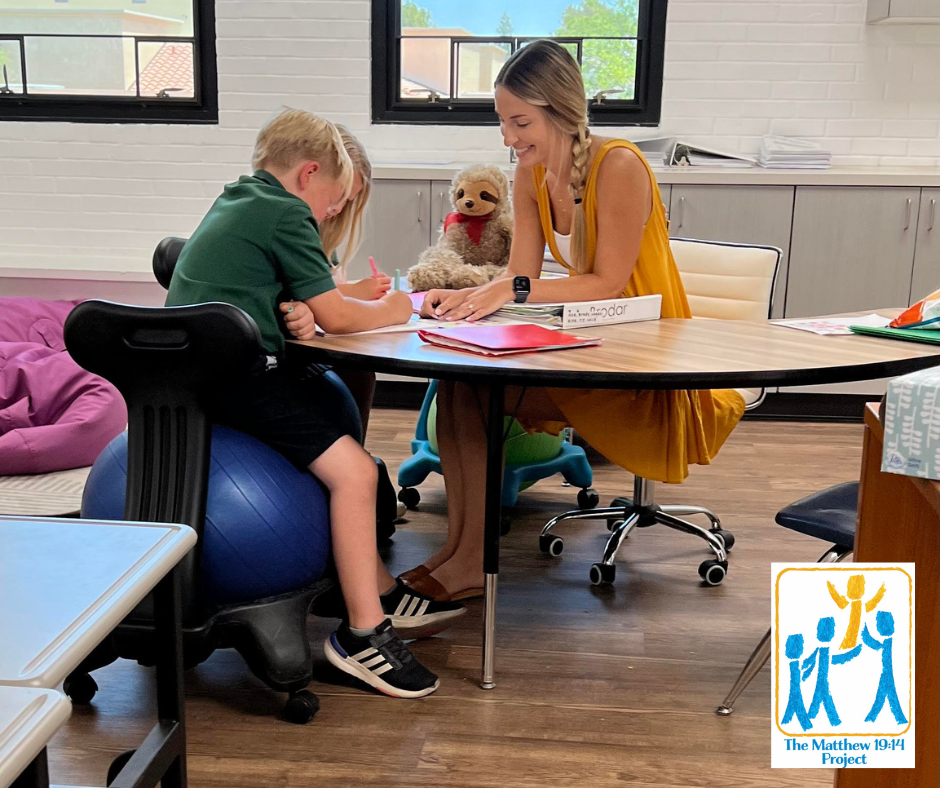
Founded in 2014 by Dr. Lisa Fischer — inspired by her own experiences as a deaf student — and Dr. Colleen McCoy-Cejka — a parent of a child with autism and then-assistant superintendent of Catholic schools, TMP provides “mini grants” to local Catholic schools, typically ranging from $300-$5,000. This support is designed to provide specialized tools, materials and furniture, or to pay for one-time training webinars to address needs within an individual classroom.
“Any [Arizona Catholic] teacher, specialist or principal can apply for a grant from us,” explained TMP Executive Director Jim Pogge. “We open the cycle in late August after the school year starts … to make sure the teachers understand [the needs of the students in their classroom].”
While many materials can be used again, other resources have a shelf life and need updating or replacement. Additionally, as students progress through grade levels, resources are often left behind in their previous classrooms, which limits continued access.
In 2023, TMP conducted a survey of Arizona Catholic school teachers with the goal to find out what would move the needle in helping students with exceptional needs. Teachers reported that they valued the mini grants but emphasized that transforming inclusive education requires professional development for teachers in best practices and strategies to address the needs of all learners.
“Statistically, Catholic schools in Arizona are right in line with national public-school averages. Approximately 15-percent of the students in any classroom have some sort of neurodiversity or learning challenge,” continued Pogge.
From the 74-percent of Arizona Catholic school teachers that responded to the survey, 14-percent have students in their school with Down syndrome, 90-percent of schools have students with autism and 90-percent of schools serve students with dysgraphia and emotional disabilities.
With such high averages, TMP doubled down on equipping teachers with lasting skills that can be used year after year.
A personalized approach
In response to the survey, TMP broadened its scope of service through the creation of the Partner School Grant. Pogge shared that local Catholic schools can apply for this program and, if selected, “we will work with them for the next three years to train every teacher in the building in common vernacular, methodologies and strategies.”
“We will also coach the principal on how to lead this transformational change,” Pogge added. “As you might imagine, this three-year program … is an investment in teacher skill sets, which translates to better outcomes for all students. The return on investment is very high.”
For each school, this training is customized based on the community’s particular needs. The process begins with a 360-degree review that serves as a benchmark, informing both the program’s development and the first year of training. During this first year, systems of support are developed and customized processes for training are put in place.
The second year moves into group presentations on strategies for addressing different learning challenges. Teachers are trained in Universal Design for Learning (UDL), a framework that helps them design lesson plans and learning environments to meet the diverse needs of all learners. This approach lies at the heart of inclusive education.
The third year of the Partner School Grant consists of continued support and individualized in-classroom coaching. Throughout the three years, teachers in the program also have access to a large bank of instructional videos.
The program is facilitated by TMP and implemented by professionals from groups such as Inclusion Solutions LLC, co-founded by McCoy-Cejka, which provide training for the teachers.
In January 2025, the Partner School Grant opened for applications and St. John Bosco Catholic School in Phoenix and Our Lady of Mount Carmel Catholic School in Tempe, Ariz., were selected. TMP reopened the grant cycle again in January 2026, adding four more schools to the program: Bourgade Catholic High School in Phoenix, St. Vincent de Paul Catholic School in Phoenix, St. Thomas the Apostle School in Phoenix and Sacred Heart Grade School in Prescott, Ariz.
Going forward, TMP hopes to offer the Partner School Grant to four or more additional schools annually.
“Our ultimate goal is for every [Catholic] school in the state to go through our program,” said Pogge.
A powerful and positive impact
Jamie Bescak is the principal of St. John Bosco Catholic School. As a 2025 recipient of the first wave of the Partner School Grant, she and the teachers in her community are now in the first year of their three-year partnership.
“This [program] is intentionally designed to build the capacity of our teachers so they can best serve students with a wide range of abilities and truly meet the needs of all learners,” Bescak explained.
In the four months since Inclusion Solutions has been working with St. John Bosco teachers, Bescak has seen a powerful and positive impact.
“Their depth of knowledge, real-world experience and unwavering support are invaluable,” said Bescak. “They are thoughtful partners who genuinely understand schools, teachers and students, meeting us exactly where we are while helping us grow.
“The combination of their robust online learning library, meaningful in-person professional development and ongoing coaching has brought immediate value to our classrooms. We are already seeing growth in instructional practices, student engagement and teacher confidence.”
Bescak is especially looking forward to year two, when she and her team will collaborate with the other Partner School Grant schools. She is eager to see the long-term impact on her school’s methodology, inclusive practices and overall learning environment.
“We are deeply grateful to … The Matthew Project for their encouragement, vision and steadfast support throughout this process,” she continued. “Their commitment to helping schools grow in inclusive practices is truly inspiring … Because of this work, our school is becoming even more inclusive and better equipped to provide a high-quality education for every student entrusted to our care.”
Fostering belonging
“The Matthew 19:14 Project [is] a beautiful ministry that serves one of the Church’s primary missions: supporting Catholic schools as they form young people — especially students with special needs — to know, love and serve Jesus Christ,” said Bishop John Dolan.
He went on to explain that people with disabilities, with their unique talents and needs, are a gift to the Church. He emphasized that the Church’s mission is to welcome them and foster a true sense of belonging — ensuring that they receive access to catechesis, a Catholic education and communities where they are valued and included.
“Through [Matthew 19:14’s] partnership with our Catholic schools,” Bishop Dolan continued, “countless students have been assisted in overcoming learning challenges and physical limitations, enabling them to reach their God-given potential.”