

Eighty years of seeing the face of Christ in every person in need

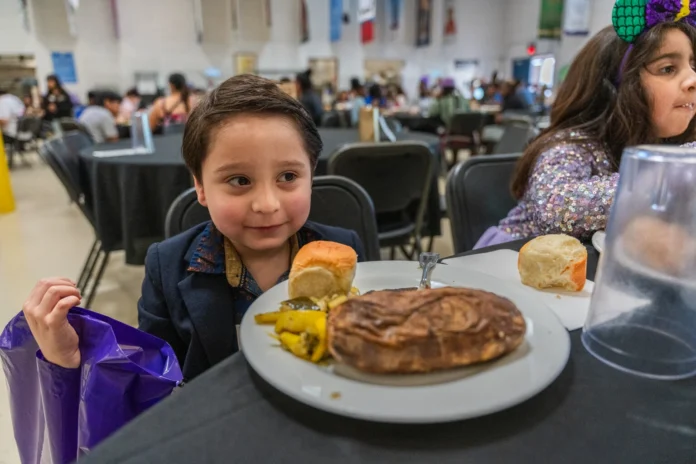
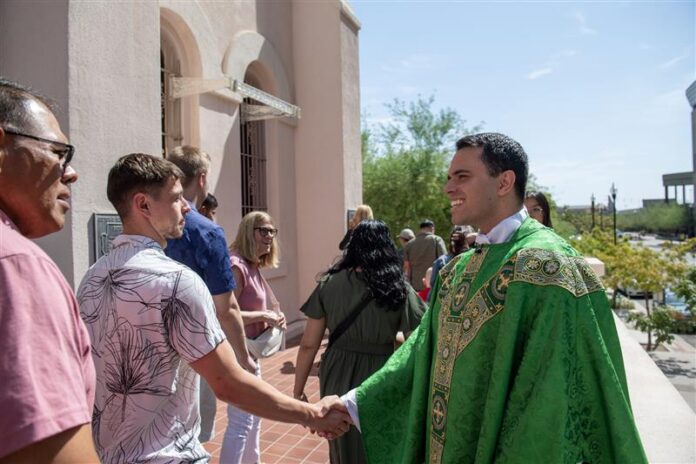
The Society of St. Vincent de Paul (SVDP) in Phoenix — whose mission to those in Arizona experiencing hunger and homelessness goes far beyond sharing a meal, clothing or paying a bill — is marking 80 years of local service this month at the church where it all began: the historic St. Mary’s Basilica in downtown Phoenix.  

Comprised of lay Catholics, SVDP operates via conferences, which are local parish-level groups, though the help of individual members and volunteers called Vincentians. The Phoenix Council, which supports over 80 conferences across central and northern Arizona, will celebrate with its hundreds of Vincentians and the public during a series of events the weekend of April 25-26 at St. Mary’s Basilica. 

“It’s not just celebrating an organization, but [witnessing] to Catholics and the world at large that small fidelity can grow into something much bigger than the people who founded this ever imagined,” said basilica rector Fr. Fernando Camou. 

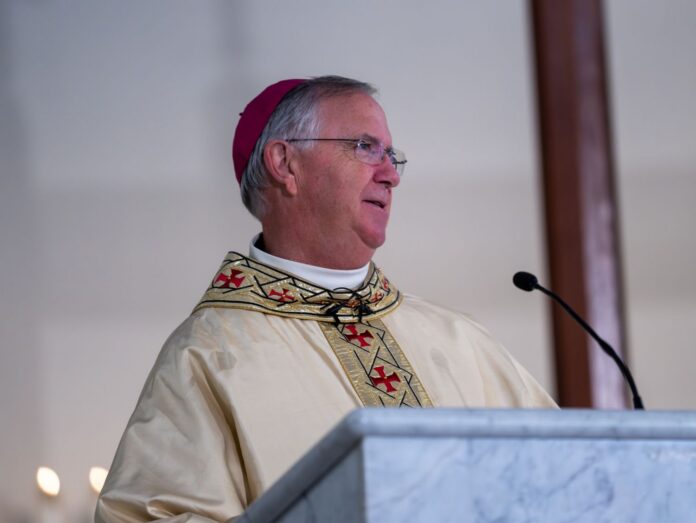
The weekend will start with a Vigil Mass celebrated by Bishop John Dolan at 5 p.m. Saturday, April 25. Bishop Dolan will also offer a blessing for the society’s Phoenix Council members present, thanking them for their dedication and commitment.  

“We really hope that many people can come to that Mass to be recognized and blessed by the bishop, [and] to commemorate the fact that they are a part of this global society,” added Fr. Camou. 

That evening, following Mass, the Phoenix Council and the Diocese will host a private gathering honoring the Vincentians. 

On Sunday, April 26, after each parish Mass, Vincentians from throughout the diocese of Phoenix will take part in a special ministry fair for the public at the Virginia G. Piper Plaza adjacent to St. Mary’s Basilica. It will include booths and numerous pieces of information and children’s activities. 

“We want people to know about the vastness of St. Vincent de Paul and how we’re always looking for volunteers to help us carry that out. At our center here in Phoenix, we have 16,000 people a year who volunteer at different things all over. It is amazing,” said Phoenix Council First Vice President Mary Ann Hunter. 

Sunday Masses start at 7 a.m., 9 a.m., and 11:30 a.m. The fair hours will be 8-9 a.m.; 10-11:30 a.m.; and 12:30-1:30 p.m., also on Sunday. 

Humble beginnings 

April 26 is also Ozanam Sunday, commemorating the worldwide society’s founding nearly 200 years ago.  

Typically the last Sunday in April, Ozanam Sunday recalls the actions of Bl. Frederic Ozanam — a 20-year-old student at The Sorbonne, a Paris university — and five of his fellow students on April 23, 1833. A practicing Catholic, Ozanam had become appalled at conditions in Paris at the time. There was political, social, religious and economic turmoil, and during a student gathering one day, a fellow student told Ozanam that while the Catholic Church had done much good work, he could not see what good it was doing at the present time. Ozanam ran with the challenge, inviting his five colleagues to a meeting, where they founded a “Conference of Charity” to help the poor.  

The Catholic lay organization was intended to help its members increase in holiness by lovingly serving those in need.  

The group named itself the “Society of St. Vincent de Paul” after the saint known for his work among those in need. It soon began working with a member of the Daughters of Charity, Sr. Rosalie Rendu, who oversaw distribution of aid to one of Paris’s poorest areas. The original group Ozanam formed, comprised of his five colleagues and Sr. Rosalie, grew within just a few years to 600 individuals serving 15 other cities and towns in France.  

Word of the society’s work spread, and 12 years later, on Nov. 20, 1845, Fr. Ambrose Heim, a priest in the Archdiocese of St. Louis known for his zeal for the poor and the establishment of a credit union for low-wage earners, was named spiritual adviser to the first U.S. council of the society in St. Louis. The council was based at the city’s Basilica of St. Louis. 

A century later, Tommy Johnstone, a New Yorker living in Phoenix who was familiar with the society, helped form what became Arizona’s first council. Johnstone recruited four other Catholic young men, and with the help of Fr. Louis Shoen, OFM, the pastor of what was then St. Mary’s Church in Phoenix, the group met for the first time on April 26, 1946.  

“It started with five gentlemen who wanted to do something to tackle poverty, [which] was happening in Arizona at the time,” Hunter said. 

Then within the Diocese of Tucson, St. Mary’s became part the Diocese of Phoenix when it was established in 1969. It was elevated to a minor basilica by Pope St. John Paul II in 1985.  

Explosive growth 

The Phoenix Council’s growth has been almost unparalleled across the United States.  

Now one of the global Society’s largest councils in the world, St. Vincent de Paul Phoenix is home to more than 2,000 Vincentians, and serves 2.5 million meals a year, according to its website. The organization provide $8.2 million in rent and utility assistance to help people avoid eviction and homelessness. Its four charity dining rooms serve thousands daily, while food boxes are delivered to hungry families. Three interim housing facilities and one emergency shelter serve the homeless.  

A dozen thrift stores also operate throughout the state. 

Additionally, a total of 17,634 visits take place annually at St. Vincent de Paul’s medical and dental clinics, and center for family wellness.  

This array of services is administered using a structure mirrored throughout the international organization 

The council helps each conference develop its spiritual life, increase services and diversify activities. The council also can create new conferences, help expand existing ones, support training, establish relationships between Vincentians and drive collaboration with other organizations. 

With all the thousands served across so many platforms over a broad geographical area, one constant defines the society’s mission: Seeing Christ in the face of every person in need. 

It seeks to focus on each individual; one at a time. 

“We cannot save the world, but we can help the person in front of us. The people God has put in front of us,” said Cande de Leon, the Society of St. Vincent de Paul Phoenix’s chief mission engagement officer, whose role includes leading capital campaigns, annual appeals and promoting the organization’s programs. 

Igniting faith 

When a Vincentian helps someone, the individual receives much more than a meal or a utility bill payment, but connection to an entire network of people who will pray for them.  

“It’s this idea of sharing not out of pity, but of love for a brother or sister,” de Leon explained. “We look at them and say, ‘Hey, that could be us.’ It’s very relational.” 

During home visits, Hunter said, Vincentians team up in pairs and always pray prior to meeting with someone.  

Divine providence is always at work, she said, citing a pair of recent examples. 

“My partner and I visited two [separate] homes on the same day. Both ladies had been through traumatic life experiences. They were sharing with us what had happened. We helped them pay their April rent. We were able to bring them food and toiletries. At the end of a visit, we always ask, ‘May we pray with you?’ And they both said ‘yes.’ We prayed for their needs. Both of them broke down in tears,” she recalled. 

“Our whole premise is that we want to see the face of Christ in them, but we also want them to see the face of Christ in us,” Hunter explained. 

Doing so takes a relational interaction well beyond handing someone a food box or a check.  

“I had no idea until I became a priest working with Vincentians how they really operate person-to-person, neighbor-to-neighbor, in Christ’s name,” Fr. Camou said.  

“I’ve seen how it ignites the faith, hope and love, and capacities of Catholics who serve as Vincentians. And I see how it’s transformed the lives of people who have been abandoned, who have gotten very ill and have no support system, who have gone into a financial crisis or addiction, and everyone seems to reject them except the Vincentians.” 

Attending one of this month’s basilica events may be the perfect way to join and impact someone’s life. 

“St. Vincent de Paul doesn’t just show up from a distance but face-to-face,” said Fr. Camou. 

“It’s transformational.” 
STATEMENT FROM BISHOP JOHN DOLAN

April 13,2026

ln response to recent comments by Donald J. Trump regarding His Holiness Pope Leo XlV, I would like to offer a few reflections rooted both in truth and in our faith.

First, The Holy Father is elected through the sacred process of the conclave, carried out by the College of Cardinals under the guidance of the Holy Spirit. This is not a political appointment, nor is it subject to influence by any head of state. The Church entrusts this moment to prayer, discernment, and divine guidance.

Second, we have just celebrated the great mystery of Easter. ln the Upper Room, the Risen Lord Jesus Christ-appeared to His apostles, showed them His wounds, and spoke the words, “Peace be with you.” He breathed the Holy Spirit upon them. This moment is not only the foundation of the Church, but also a profound reminder that peace-not power, not force, not victory in worldly terms-is the gift Christ gives to His people.

Jesus Christ is the Savior of the world. There is no other. Our freedom does not come from war, political strength, or human achievement, but from the Cross and the Resurrection. lt is Christ who liberates us from sin and death. War may at times be a tragic necessity against aggression in a fallen world, but it is never our salvation.

Pope Leo has consistently called us to remember this truth: before we lean into conflict, we must first lean into God. The Church does not exist to advance political agendas, but to proclaim the Gospel, to form consciences, and to remind the world of the dignity of every human person.

It is important to say clearly: the Holy Father is not a politician, nor should he be reduced to one. His role is to shepherd souls, to call us to holiness, and to point us toward Christ, the Prince of peace. When he speaks about peace, justice, or the moral dimensions of global affairs, he does so not as a partisan voice, but as a pastor of the universal Church.

At a time when public discourse can become harsh and divisive, we would all do well to return to the words of the Risen Lord: “Peace be with you.” That peace is not weakness, but rather the strength of God. lt is the power that transforms hearts, heals wounds, and ultimately brings about the only lasting victory: the triumph of love over sin and death.

As Catholics, and as people of goodwill, let us remain rooted in Christ, respectful in our dialogue, and steadfast in our mission to be instruments of His peace in the world.”

– Bishop Dolan

BISHOP DOLAN STATEMENT 4-13-26

Fear is not theology: A bishop’s response to the campaign against the synodal church

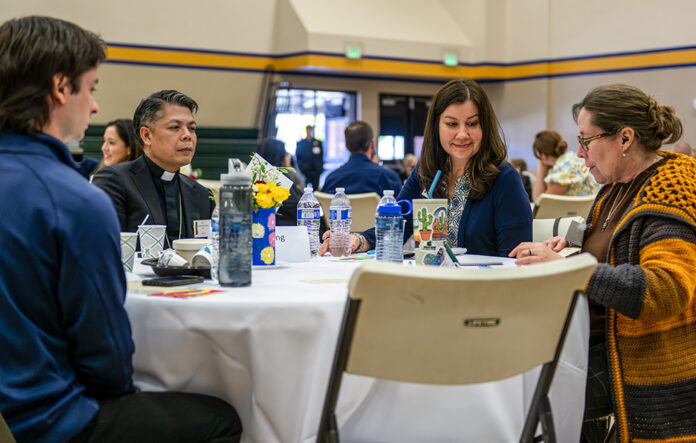
Auxiliary Bishop Peter Dai Bui takes part in the Phoenix Diocese's Synod of Young Adults with lay Catholics and clergy from the diocese in February 2026. (Courtesy of Phoenix Diocese/Brett Meister)

Courtesy of National Catholic Reporter

A book bearing the title The Trojan Horse in the Catholic Church and published by the group Catholics for Catholics arrived in the mailboxes of Catholic bishops across the country this past winter, warning them of hidden forces reshaping the church from within. The book’s central claim is stark: that the synod on synodality, Pope Francis’ three-year global process of listening and discernment that concluded in October 2024, is a calculated effort to dismantle the church’s hierarchical structure and overturn its moral teaching on sexuality and the family.

The book’s author has given no name, only the pseudonym “Enoch” borrowed from an Old Testament prophet who, tradition holds, never died and will return at the end of the world to fight the Antichrist. Its foreword was written by a participant in the very synod it condemns — one voice among more than 300 in that assembly whose account of what took place is directly and specifically contested by others who were present in the same room.

The famous Trojan horse from Greek mythology succeeded because no one looked inside of it. I am one of the bishops who received the book. Unlike in the story of the Trojan horse, I opened it. And as I read, I found myself thinking of the two disciples walking away from Jerusalem.

Two disciples, trying to make sense of a catastrophe they could not yet name. And a stranger joined them on the road. He did not announce himself. He asked, “What are you discussing?” He listened before he spoke. Only when they had been fully heard did their hearts begin to burn, and only then did they recognize him in the breaking of the bread.

That sequence — walking alongside, asking, listening, opening the word — is what the church calls synodality. It is as old as Emmaus, as old as the Council of Jerusalem, where the apostles and the whole community gathered to discern together and wrote: “It has seemed good to the Holy Spirit and to us” (Acts 15:28). Synodality is not a novelty but an inheritance.

Know the source

Before engaging the book’s theological claims, intellectual honesty requires a word about its publisher.

Catholics for Catholics is not a theological institute and it holds no magisterial standing. It is a political-religious activist organization founded in 2022 that describes itself as the “fastest growing Catholic movement in America” and serves as an official partner of the White House’s “America Prays” campaign.

The book, available for sale, is also being distributed through a crowdfunded campaign at $25 a copy with the intention to reach every bishop in the country.

The book’s foreword lends a prestige worth examining carefully. Its author, a senior churchman who attended both sessions of the synod on synodality at the Vatican as a voting participant in 2023 and 2024, describes a process manipulated to produce predetermined outcomes. But another participant present at both sessions, Jesuit Fr. Agbonkhianmeghe Orobator, described the above account as “inconsistent with reality,” writing in America magazine in October 2025.

Pope Leo XIV, himself a voting synod delegate before his papal election, has described synodality as “an attitude, an openness, a willingness to understand.”

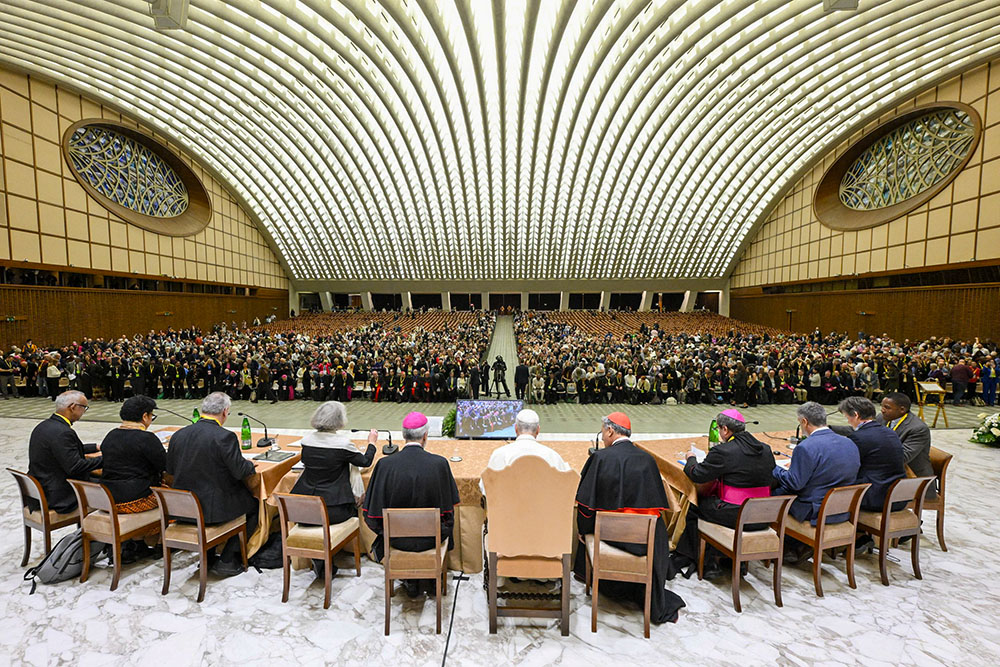
Pope Leo XIV, with regional representatives of synod teams, listens to and answers questions from participants in the Jubilee of Synodal Teams and Participatory Bodies in the Vatican audience hall Oct. 24, 2025. (CNS/Vatican Media)

I am a Vietnamese bishop, and in our culture we have a proverb: “Một cây làm chẳng nên non, ba cây chụm lại nên hòn núi cao,” which means, “One tree cannot make a forest, but three trees gathered together form a great mountain.”

Well over 300 voices were in those assemblies. One account does not make the whole forest.


The book gets tradition backward

The Trojan Horse in the Catholic Church makes two central theological claims. The first is that the synod on synodality was designed to “eradicate the hierarchical structure of the Church as instituted by Christ, replacing it with a democratic model.” The book accentuates the image of an “inverted pyramid” that appeared in synodal discussions as proof of this intent.

The argument sounds alarming, but it is a fundamental misreading of both the image and the final document of the XVI General Assembly of the Synod of Bishops, available in full at the Vatican’s website.

The inverted pyramid was never proposed as a new governance structure. Rather, it was used to describe how authority is exercised in a manner conformed to Christ, who said with startling clarity, “Whoever would be great among you must be your servant, and whoever would be first among you must be your slave, even as the Son of Man came not to be served but to serve” (Matthew 20:26-28). The pyramid is inverted not to place the laity above the bishop, but to place the bishop’s authority in the posture of Christ: at the service of, not in dominion over, the people of God. The bishop who listens is not a weaker bishop. He is a more Christlike one.

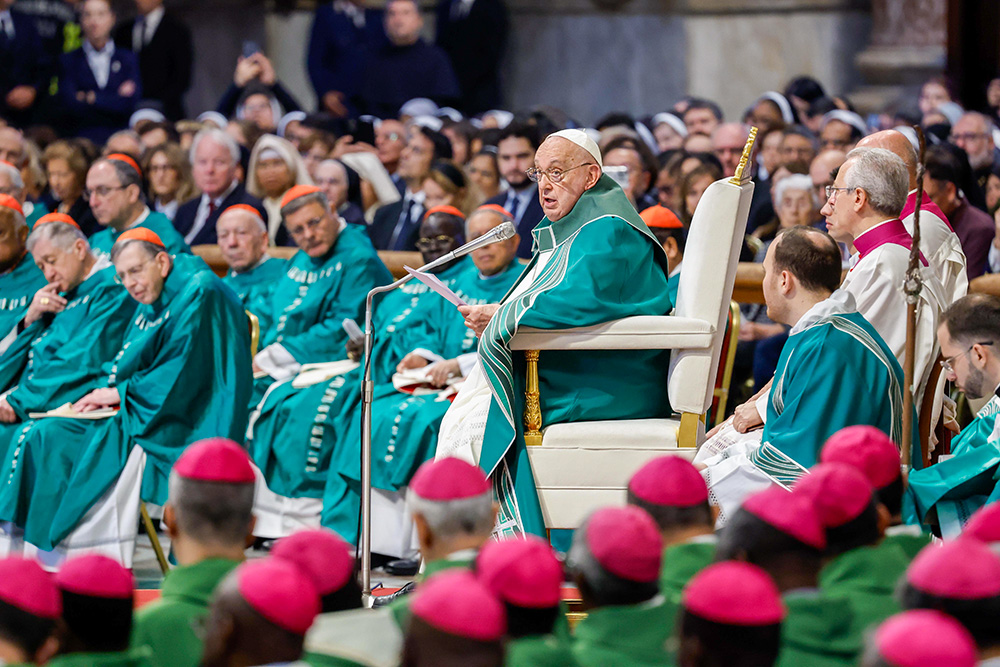
Pope Francis delivers his homily during the closing Mass of the Synod of Bishops on synodality in St. Peter’s Basilica at the Vatican Oct. 27, 2024. (CNS/Lola Gomez)

The final document reaffirms without qualification the teaching of Lumen Gentium on the hierarchical constitution of the church. It states that the episcopal ministry is irreplaceable. It affirms that bishops, as successors of the apostles, hold genuine authority to teach, sanctify and govern. It calls not for the elimination of hierarchy but for its evangelical purification toward a more servant-hearted, listening, missionary exercise of the authority Christ gave his apostles.

The book also claims that a bishop’s authority cannot be “dependent on listening and learning from those under his care.” But this directly contradicts the 1962-65 Second Vatican Council. Christus Dominus teaches that “it is especially the duty of bishops to seek out men and both request and promote dialogue with them.” Lumen Gentium teaches that the whole body of the faithful possesses a supernatural sense of faith, the “sensus fidei,” through which the Holy Spirit illumines the people of God from within.

Listening to the faithful is not a concession to democracy. It is fidelity to the Spirit who speaks through the whole church, not only through its ordained ministers.

Accompaniment is not capitulation

The book’s second claim is more inflammatory: that synodality is a calculated mechanism for overturning Catholic moral teaching, particularly on sexuality and the family. This argument conflates three things that Catholic theology has always carefully distinguished: doctrinal definition, doctrinal development, and pastoral accompaniment. This conflation is not an innocent error.

The deposit of faith — what God has revealed and what the church guards as sacred trust — is not and cannot be subject to revision by any synod, any council, or any pope. The church’s teaching on marriage, on the dignity of every human person, on the moral order that flows from the truth about the human person — none of this is on the table. No vote can or will change it and the final document does not suggest otherwise. Not on a single page.

What synodality opens is the harder, more demanding question: How does the church walk with human beings whose lives are complicated, wounded and often far from the fullness of what the church proclaims?

This is the question that gave us the good Samaritan, the prodigal son, the woman at the well. It is the question Jesus answered by going to where people actually were, listening to what they carried, and only then speaking the word that could reach them. To accompany a person who is struggling is not to approve of the struggle. It is to walk with them, as the stranger walked with the disciples on the road to Emmaus, even when they could not yet recognize him.

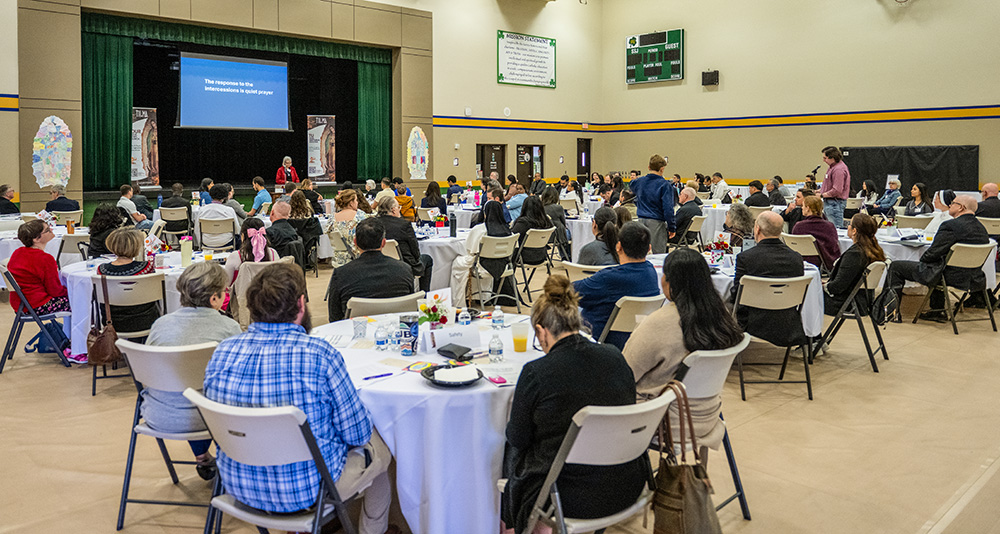
In the Phoenix Diocese, our Synod of Young Adults gave the opportunity to more than 950 young people in 2025 to have their voices heard — some far from the practice of the faith — in venues ranging from parishes to coffee shops to the Arizona Opera. It was not an exercise in doctrinal relativism. It was an act of evangelical courage by going out to find people who had drifted, listening to their real experiences, and asking how the unchanging Gospel of Jesus Christ might be proclaimed to them with renewed credibility and love.

Lay Catholics and clergy take part in the Synod of Young Adults of the Phoenix Diocese in February 2026. (Courtesy of Phoenix Diocese/Brett Meister)

That is precisely what Pope Francis’ Evangelii Gaudium asks of the whole Church. It is what it means to go out, as the Gospel demands, and find the lost sheep where they actually are. The synodal listening sessions revealed that — in many ways — our young adults long for belonging, healing, formation, safety and accompaniment. Our next step is to work with the young people so that we can develop an action plan to begin addressing these needs.

What I know about journeying together

I came to this country as a refugee, crossing the South China Sea by boat in 1977, and the first thing the church gave my family was a community that already knew how to journey together. The boat was not where I began my journey with synodality, but at Mary Queen of Vietnam Church, the parish that eventually received us in New Orleans, where our family first arrived from Vietnam in 1978. Mary Queen of Vietnam was established in 1983 as the first Vietnamese national parish in the United States.

In Vietnamese Catholic communities, both in Vietnam and in the diaspora parishes that carried the tradition across the sea, the parish is divided into neighborhood sections called khu. This is the local expression of what the Vietnamese Catholic tradition formally calls the họ đạo, or the subparish community. Each bears the name of a patron saint. The khu is not an administrative unit. It is a living community.

Families within a khu gather regularly to discuss whatever is happening in their lives — joys, struggles, illnesses, needs. When a member dies, the khu organizes evenings of prayer at the family’s home. In October, the month of the rosary, each household takes its turn hosting the evening prayer, praying the rosary from door to door through the neighborhood like a flame passed from candle to candle. When a great parish feast comes, each khu is given its role, its responsibility, its part to carry in the common celebration.

The leaders of each khu meet periodically with the community president, always a layperson, and with the pastor, bringing the real needs and real voices of the families they serve.

But the khu itself is fed by something smaller and more intimate. The communal life of the parish flows from the life of the family, and the heart of family life in Vietnamese culture is the evening meal.

Every evening, the whole family gathers at the dinner table, not only to eat, but to speak and to listen to one another. What is carried in from the street, from the school, from the fields or the workplace, is laid on that table along with the rice.

The grandparents sit at the center of that circle, honored and consulted, and their wisdom is received as a gift rather than a burden. The young learn from their earliest years that truth is not discovered alone. It is discovered together, around a table, with the elders speaking and the young listening, and then the young speaking and the elders listening in return.

No one in my world used the word synodality. But every structure of that world — the khu, the prayer evening, the shared feast day, the dinner table, the pastor listening to the khu leaders, the khu leaders listening to the families — was synodal to its core.

It is worth pausing to reflect: The họ đạo, the subparish community, did not emerge from a Vatican document or a pastoral planning process. It was forged across four centuries of intermittent persecution of Vietnamese Catholics, when priests were scarce or imprisoned and communities had to pass the faith from household to household. The faith was kept alive through lay leadership, communal prayer and shared responsibility. It survived because it was built on listening. It was a church that listened before it spoke, that walked alongside before it judged, that served before it governed.

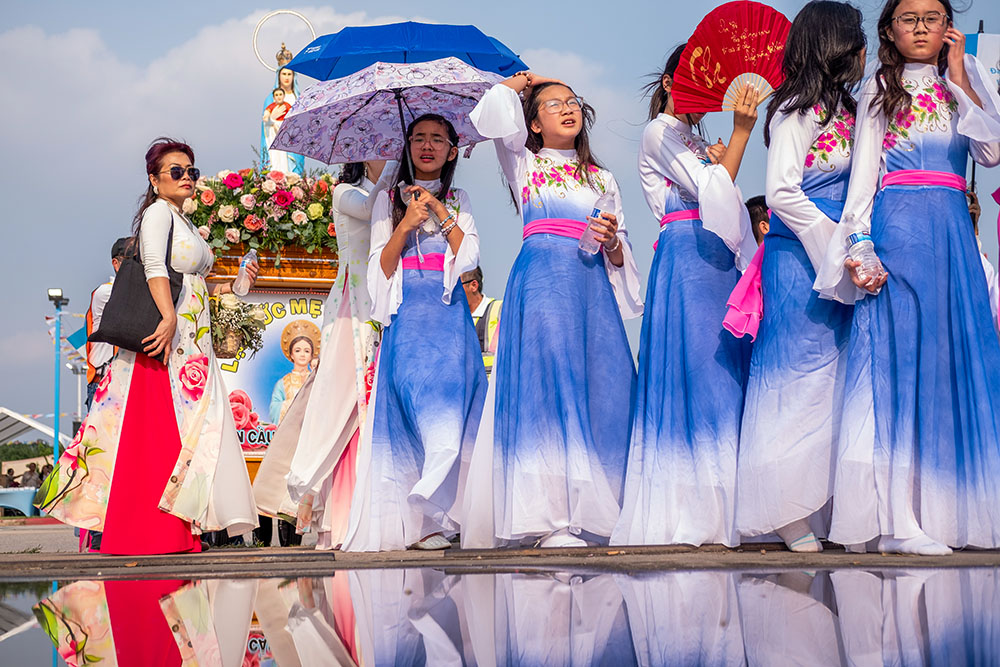
Vietnamese Catholics participate in a Marian procession at Our Lady of Lavang Catholic Church in Houston during a festival May 6, 2023. Hundreds of Catholics joined the procession, some escorting floats carrying statues of the Holy Family, the Divine Mercy Jesus and the Blessed Virgin Mary while praying the rosary. (OSV News/Texas Catholic Herald/James Ramos)

What the final document of the XVI General Assembly has done is give that ancient, living practice a more careful theological name: synodality. It has not invented something new. It has recognized something the people of God have always known.

In the Phoenix Diocese, nearly half of our 228 active priests were born outside of the United States, and our Vietnamese, Latino, Filipino and African communities each carry these deep traditions of communal discernment. As vicar for clergy, I have seen synodality not as a threat to priestly identity but as its deepening.

The priest who listens to his people is not diminished. He is formed. The bishop who walks with his priests, who hears what they carry rather than only directing them, is not abdicating authority. He is exercising it in the only way the Gospel endorses: as service, in love.

My episcopal motto is “Omnia in caritate fiant,” “Let all that you do be done in love” (1 Corinthians 16:14). That includes how we hold the truth, how we respond to those who are anxious and afraid, and how we engage a book that is — whatever its intentions — sowing alarm among the very priests who most need to be accompanied in hope rather than mobilized in fear.

Back to the road

The two disciples walking away from Jerusalem did not know that the stranger who joined them was the risen Christ. They knew only that their hearts burned within them when he opened the Scriptures and that they recognized him, finally and unmistakably, in the breaking of the bread. The church has been making that same journey ever since, walking together, sometimes in confusion, sometimes in grief, but always with the risen one alongside us even when we do not yet recognize him.

To priests and faithful across the country who have received alarming materials about the synod on synodality, your love for the church is not in question. Bring your questions to your bishop and pastor. Read the final document in its own words rather than in the words of its critics. Trust the Holy Spirit who has guided the church through 20 centuries of controversy, council and renewal. The same Holy Spirit who has led the church through the Council of Jerusalem, through Nicaea, through Trent, through Vatican II, and now through this present moment of discernment.

And remember, the tradition has never been preserved by those who walked away from Jerusalem. It has been preserved by those who, despite their fear and confusion, stayed on the road — walking together, listening, waiting for the moment when the stranger beside them would finally be recognized.

Reprinted by permission of NCR Publishing Company www.NCROnline.org. Link to original article: www.ncronline.org/opinion/guest-voices/fear-not-theology-bishops-response-campaign-against-synodal-church

Bishop Nevares receives Faith in Action Award for migrant work

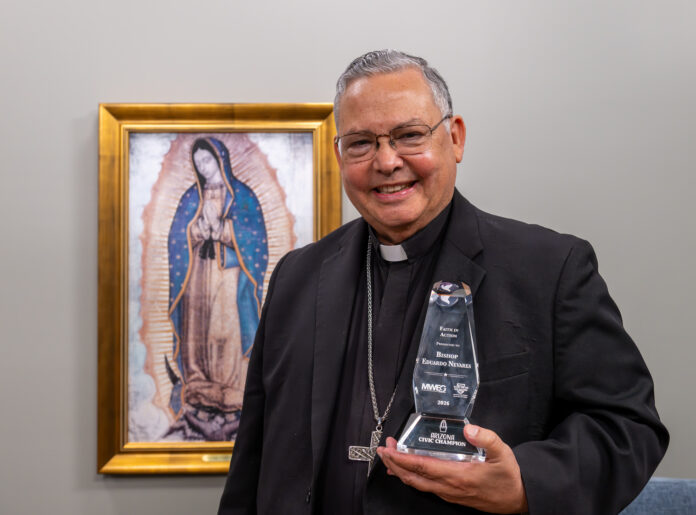
Auxiliary Bishop Eduardo Nevares was presented a Faith in Action Award on Wednesday (April 8) during the 2026 Civic Champion Dinner at the Phoenix Country Club.  

The event, hosted by The Arizona Democracy Resilience Network and Mormon Women for Ethical Government Arizona, seeks to recognize faith in action by honoring exceptional individuals and organizations that exemplify what is means to be a civic champion. 

“It’s the story of neighbors stepping up, leaders leaning in and everyday citizens doing the work to sustain democracy from the ground up,” said Don Henniger and Jane Anderen, representatives of the two groups. “The Arizona Civic Champions project was designed to shine a light on the people and organizations quietly leading efforts to strengthen civic trust and engagement across our state.” 

Bishop Nevares was selected as the Community Media Award winner for his more than 45 years of walking in solidarity with migrants and amplifying their voices through advocacy. During the award ceremony he gave an overview of his work and answered several questions about why he chooses to make an impact in the community.  

“It is our hope that this dinner will shine a light on [Bishop Nevares’] contributions,” said Henniger and Anderen, “and motivate others to follow [his example].”  

Believing changed everything

When I told my husband I was going to become Catholic, he was quite shocked. Before he could respond, I added, “So will you be my sponsor?” We were driving down Rural Road in Tempe, Ariz., on the way home from Mass, with our 2-year-old buckled into the back seat. Although we were married in the Church and committed to raising our children Catholic, I had never before expressed a desire to enter the Church myself. 

My call to Catholicism had come privately, and I chose to discern my response to that call largely on my own. One thing, however, I knew for certain: I wanted my husband to join me on this journey. We began OCIA, the Order of Christian Initiation for Adults (then called RCIA), in the fall and attended the evening classes together, turning them into a kind of weekly date night — sometimes even managing to secure the babysitter early enough to grab a small bite to eat beforehand. 

Although we sat at the same table and heard the same lessons, the experience for each of us was profoundly different. My husband was a cradle Catholic, educated in Catholic schools and faithful to Sunday Mass throughout his life, yet he received a second catechesis. Now, as an adult, a husband and a father, the teachings took on new depth and meaning. I, on the other hand, had grown up a practicing Protestant Christian, heavily involved in my church and in large youth conferences. As I entered OCIA, the vast treasure trove of Catholic knowledge and tradition, the magisterium of the Church, the sacramental life and the lives of the saints were all opened to me. I was amazed at how much there was to learn, and how much I had never known. 

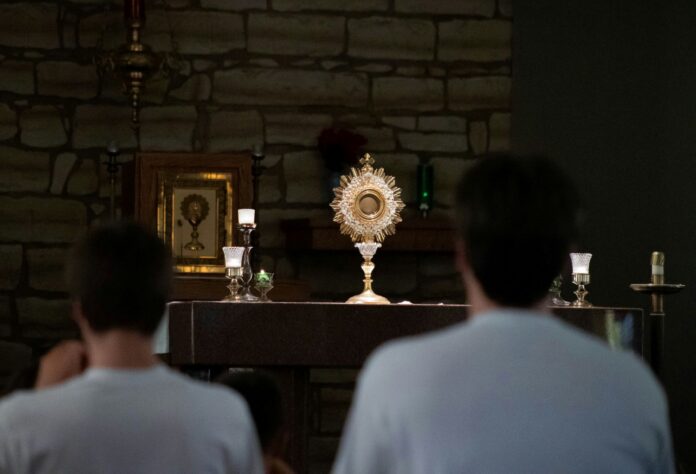
The real transformation, however, did not come through intellectual exercises, reading, lectures or discussion. It came toward the end of the process, when I experienced Eucharistic adoration for the first time. Before stepping into the church that evening, I stood in the narthex with a fellow OCIA catechumen. We made eye contact and exchanged a small shrug, both unsure of what to expect, but trying to remain open because the true presence of the Lord in the Blessed Sacrament had been a reality I struggled to accept. 

We entered the sanctuary together and took our places in a pew near the altar, an arm’s length apart. Jesus in the host was brought forth and placed in the monstrance as the leadership team and sponsors began to sing “O Salutaris Hostia.” 

I gazed upon Him, hidden in the Eucharist, and I just knew. It was my Lord. My eyes saw the consecrated host, but my heart recognized Jesus. I was overcome with emotion and turned to look at my classmate. His eyes were fixed on the monstrance, his face also wet with tears. 

I do not know how long that first period of adoration lasted. Time seemed suspended. But it sealed for me the reality that Jesus was truly present here in this Church, in the Eucharist, in the sacraments. And my heart longed for Him. 

What had begun as an intellectual exercise, a quiet curiosity explored while my toddler napped, became an encounter with the living God and an invitation to a life transformed in, with and through Him.  

That invitation is offered to each one of us. 

More recently, as a sponsor myself, that has been my deepest hope for my OCIA sister: that she, too, would come to recognize Jesus’ presence — body, blood, soul and divinity — in the Eucharist. That reality is what keeps so many of us devoted. Amid seasons of dryness in prayer, moments of despair and frustrations with human imperfection, I hear the words of St. Peter after Jesus’ teaching on the Eucharist: “Master, to whom shall we go? You have the words of eternal life. We have come to believe and are convinced that You are the Holy One of God. 

This mystery can be discussed, shared, taught and defended, but it must ultimately be experienced for true transformation to occur. No amount of explanation can convince the heart. St. Catherine of Siena is attributed as saying, “The human heart is always drawn by love,” and Jesus is love incarnate. 

Shortly after that experience of adoration, I stood before my priest once again during the Easter Vigil with tears streaming down my face as I waited to receive my first holy Communion. My hands trembled as I formed a small cradle for my Lord, and I heard the words, “The body of Christ.” With a pounding heart, I managed to respond, “Amen.” 

I believe. 

Believing changed everything. Becoming Catholic changed everything. Receiving the outpouring of the Holy Spirit in confirmation, sealing the gifts first given in baptism, changed everything. In the silence before the Blessed Sacrament, everything can change.  

Pope at Easter: Jesus showed nonviolence is true power over evil

By Carol Glatz

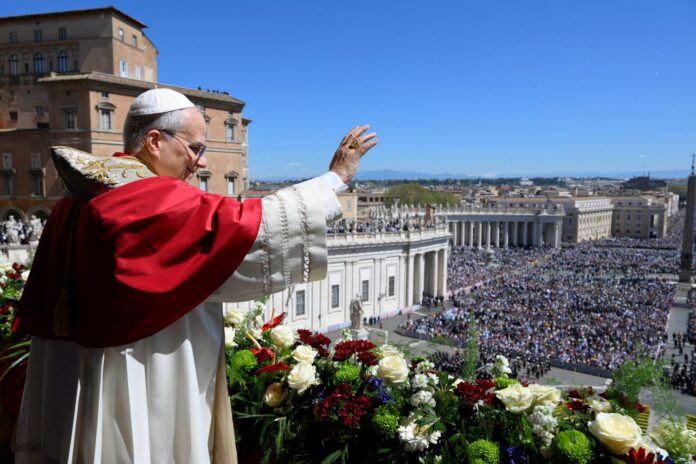
VATICAN CITY (CNS) — Appealing to those in power to end all conflicts through dialogue and not domination, Pope Leo XIV urged humanity to stop growing accustomed to wars and violence and announced a prayer vigil for peace April 11.

“We cannot continue to be indifferent! And we cannot resign ourselves to evil!” he said April 5 before giving his Easter blessing “urbi et orbi” (to the city and the world).

“In the light of Easter, let us allow ourselves to be amazed by Christ! Let us allow our hearts to be transformed by his immense love for us!” he said.

“Let those who have weapons lay them down!” he said. “Let those who have the power to unleash wars choose peace! Not a peace imposed by force, but through dialogue! Not with the desire to dominate others, but to encounter them!”

Before delivering his blessing from the central loggia of St. Peter’s Basilica, Pope Leo said, “The peace that Jesus gives us is not merely the silence of weapons, but the peace that touches and transforms the heart of each one of us!”

“Let us allow ourselves to be transformed by the peace of Christ! Let us make heard the cry for peace that springs from our hearts!” he said. “For this reason, I invite everyone to join me in a prayer vigil for peace that we will celebrate here in St. Peter’s Basilica next Saturday, April 11.”

Christ’s power is nonviolent, Pope Leo said. “Christ, our ‘victorious King,’ fought and won his battle through trusting abandonment to the Father’s will, to his plan of salvation.”

Jesus walked the path of dialogue, “not in words but in deeds: to find us who were lost, he became flesh; to free us who were slaves, he became a slave; to give life to us mortals, he allowed himself to be killed on the cross,” he said in his message.

This strength and power, he said, is the God of love who creates and generates, who is faithful to the end, and who forgives and redeems.

According to the Vatican, more than 50,000 people attended the Easter morning Mass in St. Peter’s Square, where colorful floral arrangements adorned the steps leading to the basilica, highlighting the joyful celebration of Christ’s resurrection.

In his homily, he said, “death is always lurking. We see it present in injustices, in partisan selfishness, in the oppression of the poor, in the lack of attention given to the most vulnerable. ”

“We see it in violence, in the wounds of the world, in the cry of pain that rises from every corner because of the abuses that crush the weakest among us, because of the idolatry of profit that plunders the earth’s resources, because of the violence of war that kills and destroys,” he said.

And yet, because of the Lord’s resurrection, Christ invites the faithful to “lift our gaze and open our hearts,” recognizing that “the Lord is alive and remains with us,” the pope said.

“In every death we experience, there is also room for new life to arise,” he said. Easter gives the hope “that in the risen Christ, a new creation is possible every day” and that “a new life, stronger than death, is now dawning for humanity.”

This is the “song” of hope and joy that today’s Christians must proclaim on “the streets of the world,” and live out in their daily lives, he said in his homily, “so that wherever the specter of death still lingers, the light of life may shine.”

After the Mass, he greeted those gathered in the square and surrounding streets from the central loggia, saying in Italian to great applause, “Brothers and sisters, Christ is risen! Happy Easter!”

He also gave Easter greetings in 10 different languages, including Chinese, Arabic and Latin, though the crowds cheered loudest when he spoke in Spanish and his native English. The crowds enthusiastically waved flags and handed him babies as he was driven around the square in the popemobile after the ceremony.

Before reciting the noonday “Regina Caeli,” and giving his blessing, the pope delivered the traditional Easter message from the loggia, where almost a year ago, Pope Francis gave his final words before his death on Easter Monday, April 21.

Pope Leo repeated his predecessor’s words that day, and his warning against the increasing “globalization of indifference” to the “great thirst for death, for killing, we witness each day in the many conflicts raging in different parts of the world!”

Instead of making a series of appeals for peace regarding specific areas of conflict, as has been the norm, Pope Leo invited everyone to join him in a prayer vigil for peace at the Vatican, a few days before he leaves for a four-country journey to Africa.

“On this day of celebration, let us abandon every desire for conflict, domination, and power, and implore the Lord to grant his peace to a world ravaged by wars and marked by a hatred and indifference that make us feel powerless in the face of evil,” he said.

“To the Lord we entrust all hearts that suffer and await the true peace that only he can give,” he prayed. “Let us entrust ourselves to him and open our hearts to him! He is the only one who makes all things new.”

©2026 Catholic News Service/U.S. Conference of Catholic Bishops.

Evangelization team brings the good news to NCAA basketball fans

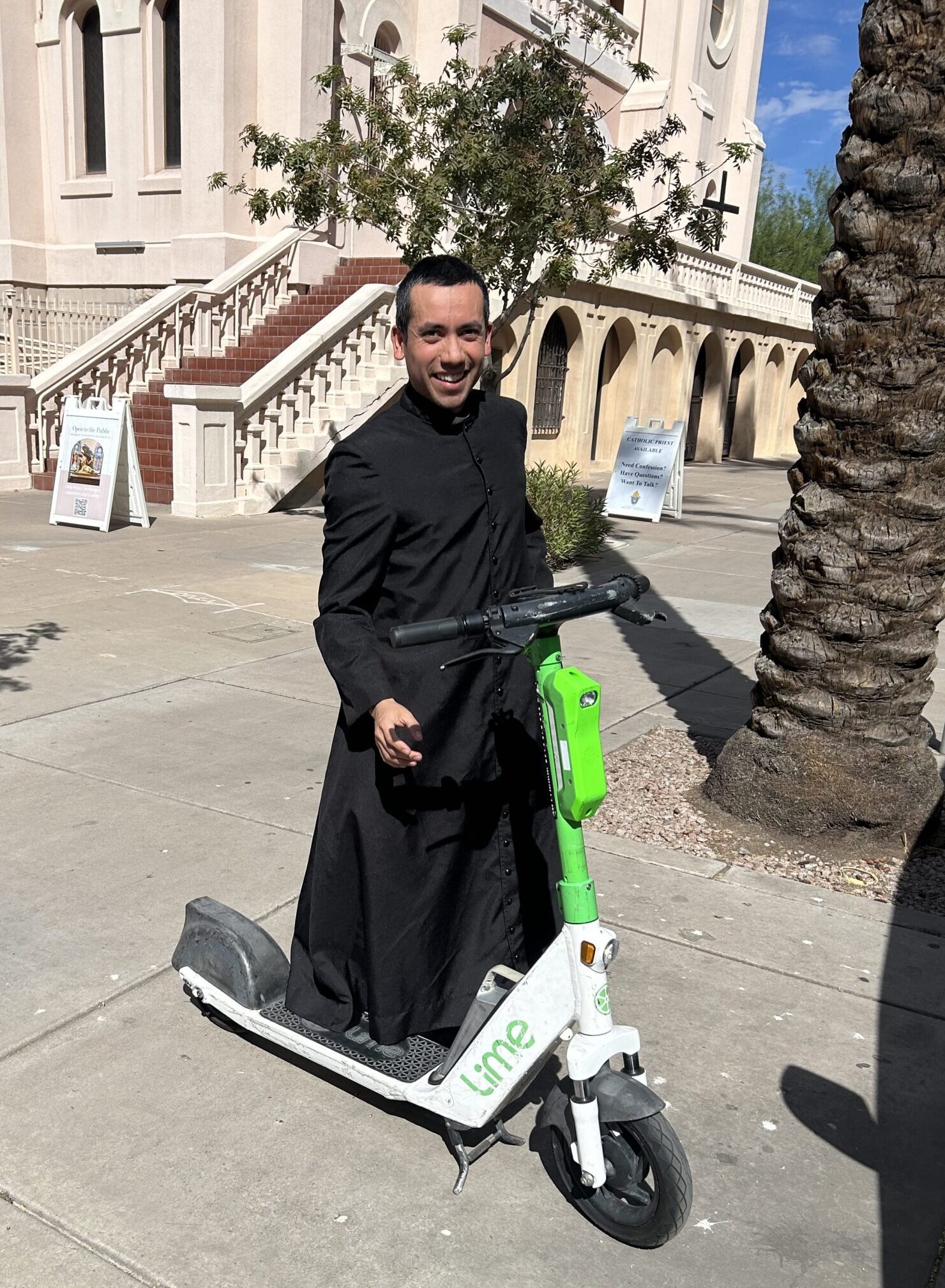
Cassock flaring in the wind behind him, Fr. Emmanuel Galvez, IVE, briskly pulled up on an electric scooter and parked on Monroe Street in front of St. Mary’s Basilica in downtown Phoenix.  

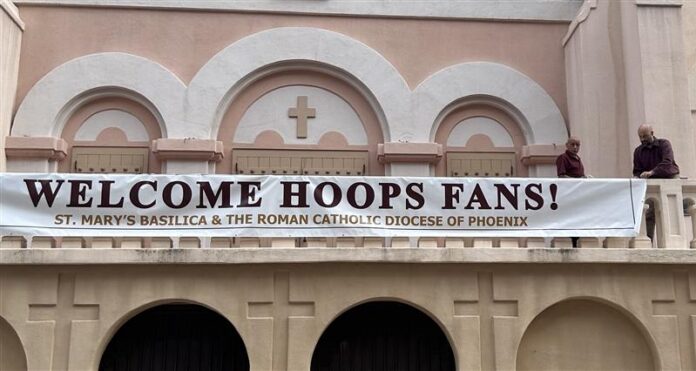
Fr. Galvez was there to join several other priests of the Diocese of Phoenix to offer the sacrament of penance to NCAA basketball fans who flooded downtown during the Women’s Final Four Basketball Tournament last weekend (April 3-5). 

A volunteer team of Catholic evangelizers set up a table on the street for 12 hours on Holy Saturday, offering free rosaries, St. Benedict crucifixes, Miraculous Medals, holy cards and other sacramentals to passersby. Volunteers received their training from St. Paul Street Evangelization

Fr. Emmanuel Galvez, IVE, rides a scooter to St. Mary’s Basilica in downtown Phoenix to hear confessions for NCAA Women’s Final Four Basketball Tournament fans | Joyce Coronel

A mini-basketball hoop attracted families with young children who took turns taking shots while their parents spoke with volunteers. An 8-foot Sacred Heart of Jesus banner as well as signs with messages such as “Can We Pray for You?” and “Catholic Priest Available for Confession” snagged plenty of attention, too.  

At one point, while Fr. Joseph Nguyen, parochial vicar of St. Agnes Parish in Phoenix, was hearing confessions, there were 11 penitents in line for the sacrament. He said he heard about 20 confessions throughout the afternoon.  

“It’s a great blessing to offer God’s mercy to people, especially those who have been gone for a while,” Fr. Nguyen said. “I had a lot of very powerful experiences of people feeling God’s forgiveness and love through the sacrament today and I’m praising God for that.”  

Led by the Diocese of Phoenix’s Office of Evangelization, Discipleship and Spirituality, volunteers gave out hundreds of sacramentals throughout the daylong event.  

For Jack Barone and his wife Jo, serving as evangelizers for the NCAA Women’s Final Four was a slam dunk. The pair volunteered previously at the men’s tournament and during a Super Bowl fan event at the Phoenix Convention Center where local volunteers also hosted evangelization tables. 

Jack admitted he’s an introvert but still feels called to serve as a Catholic street evangelist, offering the hope of Christ to people he’s never met before. 

“It can still be awkward sometimes, but you get past it,” Jack said. “The message motivates me, I guess, because I know it’s an important message to get to the people, and I may not be doing it in the most eloquent manner, but I’m getting the message across, I think.” 

Julianna Bonilla, a young woman from Connecticut, was in town for the tournament and stopped by the evangelization table. She said she was happy to see that St. Mary’s Basilica was open to the public and that confession was available on the street.  

“I came a long way and I’m obviously missing home for Easter. My normal religious kind of standards are over there. But to come to Arizona and have it here and easily accessible, it was a no-brainer for me to stop by. My faith means a lot to me.” 

Tim, a man from Denver, said he was in Phoenix to be the sponsor for his nephew Lawrence who was being received into the Church at the Easter Vigil. Lawrence had been a longtime atheist and he and Tim had a falling out at one point. 

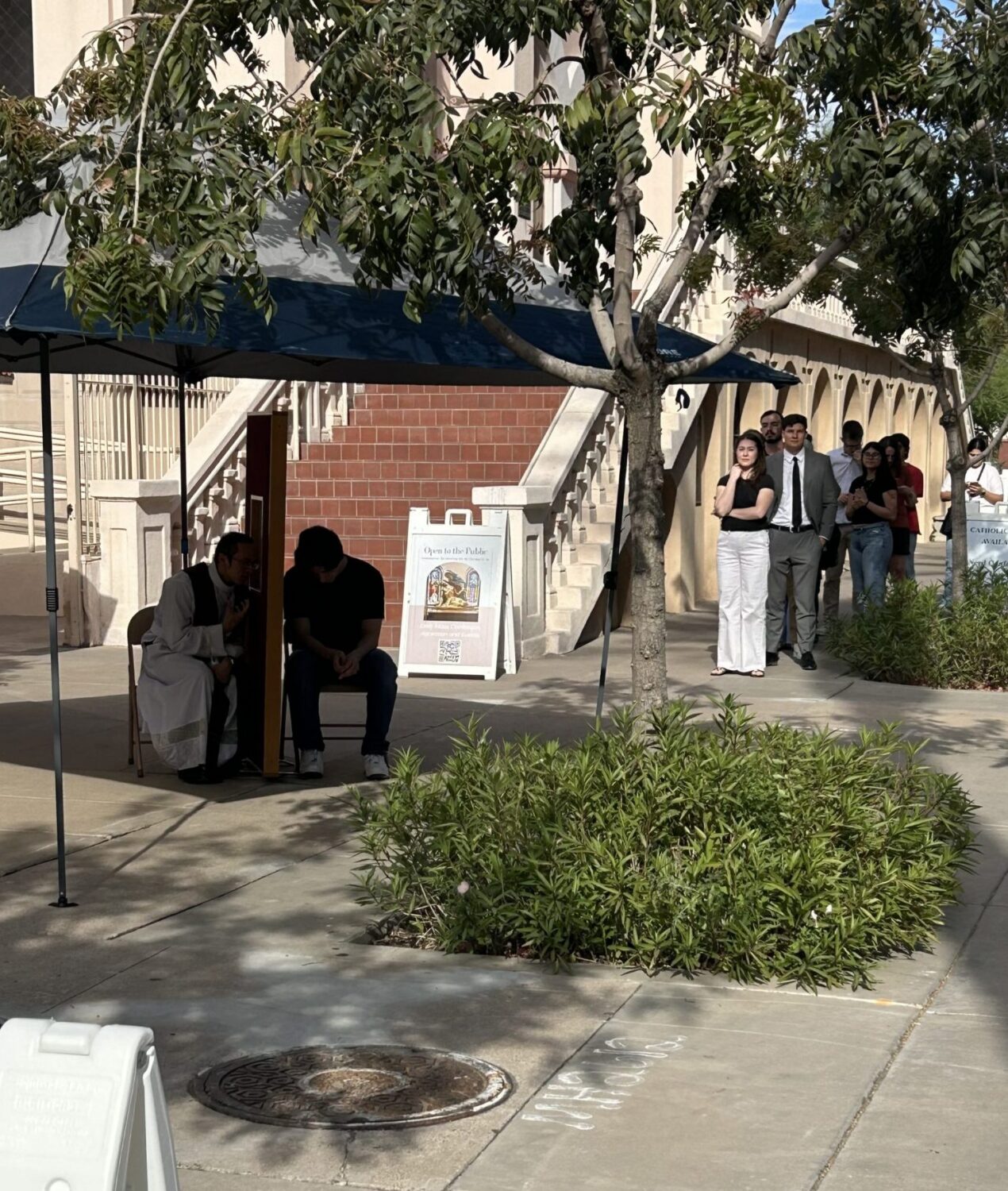
Penitents stand in line for the sacrament of confession outside of St. Mary’s Basilica during the NCAA Women’s Final Four Basketball Tournament | Joyce Coronel

Tim’s mother never gave up on her grandson Lawrence — she has many grandchildren she prays for — and those prayers were heard. When Lawrence decided he wanted to receive the sacraments, it was his uncle Tim he contacted about being a sponsor.   

“We had a very ugly back-and-forth years and years ago. And sorry, it’s very emotional for me,” Tim said as he fought back tears. 

“I don’t know why he chose me but I’m very honored that he did.”  

Fr. Emmanuel Ogla, the parochial vicar at St. Benedict Parish in Phoenix, was the first to arrive and hear confessions.  

“This is a social evangelical drive, taking Jesus to people on the streets through the sacrament of holy confession. I had a lot of people who came and were so happy they had this opportunity. They couldn’t have any Holy Week event, and they were so delighted to see a Catholic priest on the street just by the corner, ready to listen to their confessions.”  

The wooden confessional screen set up on Monroe was an eye-catcher for basketball fans who travelled from Connecticut, Texas, California, South Carolina, New York and other states as well as Arizona-based hoops afficionados who came to cheer on their team.  

Alex England, a student at the Sandra Day O’Connor College of Law at Arizona State University, lives in downtown Phoenix and said he liked seeing the confessional on the street. He stood in line with several others, even though it was a sultry 90 degrees.  

“People are walking by and are able to see what it really is like to be a Catholic. And I think that’s really cool,” said England. “It’s an intimate, you know, sort of connection between you and the priest and you’re having a conversation about some pretty real and pretty tough stuff. But you’ll leave feeling so much better.  

“And you can look at the line. There are plenty of people who agree with me.” 

For more information or to inquire about volunteering for upcoming evangelization events, contact Joyce Coronel at 602-354-2025 or [email protected]. 

New diocesan role established to support wellbeing of priests

The Diocese of Phoenix announced a new role established to support the human, spiritual, physical and emotional wellbeing of priests — the vicar for priestly life and ministry. 

After more than 13 years as pastor of Our Lady of Perpetual Help Parish (OLPH) in Scottsdale, Ariz., Fr. Greg Schlarb will step into the position on July 1, and he will work in tandem with Auxiliary Bishop Peter Dai Bui, who currently serves as the vicar for clergy. While Bishop Bui’s role focuses on practical support for priests such as priestly assignments, day-to-day personnel management and support when problems arise, the new role will take on a more proactive and personal approach. 

“The vicar for priestly life and ministry will walk with priests, listen to them, ask them questions and seek to understand any challenges they may be facing,” said Bishop John Dolan.  

The new role was established to encourage priests, as well as to foster a deeper fraternity with Bishop Dolan and the hundreds of other priests in the diocese. 

“Visits from Fr. Schlarb will revolve around questions that are simple, but some of the most important: How are you doing? How can we help you excel? How can we make sure you’re doing well?” Bishop Dolan continued.  

Fr. Schlarb looks forward to putting almost 30 years of parish life experience into this new role. He will place a particular emphasis on accompaniment, spending time in conversation and listening. 

“As the vicar for priestly life and ministry, I’m there to serve [our priests], be with them, to help them, to encourage them. And really to love them … I [consider] all of them part of my new community that I am going to be focused on first and foremost,” said Fr. Schlarb, who will celebrate his last Mass as pastor of OLPH on Sunday, June 28. 

“They are my priority” 


Watch a special episode of “TILMA” below, where Bishop John Dolan, Auxiliary Bishop Peter Dai Bui and Fr. Greg Schlarb delve into the new vicar for priestly life and ministry role:  

Rafi Law Group, Univision Contigo and Los Altos Ranch Market partner for a food drive supporting Arizona kids

The drive aims to raise $100,000 to help end hunger for children in Arizona

All throughout April, Rafi Law Group, Univision Contigo, and Los Altos Ranch Market are coming together for a food drive benefiting St. Vincent de Paul. The drive aims to raise $100,000 to help feed children who need it most across Arizona.

Rafi Law Group has generously provided a $50,000 matching gift to help spur support. Donate online to support the drive and have your gift matched this month.

Together, we can fill plates, ensuring no child goes to bed hungry.

Why This Matters

Right now, 1 in 7 adults and 1 in 5 children in Arizona face food insecurity, meaning they don’t know where their next meal will come from.

Helping a family put food on the table also helps prevent homelessness. When a family’s food pantry is full, they can focus their limited resources on rent and utilities, keeping them safe and housed.

How You Can Help

  • Donate online: Make a monetary donation directly through the St. Vincent de Paul website
  • Donate in person: Visit any Los Altos Ranch Market location and donate non-perishable food items

Your Impact

  • $10 provides a hot meal and educational support for two children in St. Vincent de Paul’s Family Dining Room.
  • $25 or 15 non-perishable food items can fill one food box that can feed a family of four for 2–3 days
  • $100 provides dinner and educational activities for 22 children in the Family Dining Room

Most Needed Items

Canned proteins (tuna, chicken, beans)

Peanut butter

Pasta

Cereal

Canned fruits and vegetables

Where Your Donations Go

  • Your generosity directly supports St. Vincent de Paul’s hunger relief programs, including:
  • 80+ community food pantries across Central and Northern Arizona
  • Four community dining rooms serving over 5,000 hot meals daily
  • Emergency shelters
  • Partnerships with 30+ community organizations

Together, we can bring hope to thousands of Arizona children.

Oh, how I want to be in that number!

When I was a kid, Easter mornings were always exciting. The night before, all of us Dolan kids would line up our Easter egg baskets in front of the fireplace. When it was morning, we would race out to see what goodies filled them. But we didn’t simply receive whatever was given to us — we spent the morning counting. Every single one of us looked in our own baskets, and each other’s, to make sure we all had the exact same number of Easter eggs and jellybeans. 

Looking back, I can’t help but laugh. We just wanted an equal share in the excitement of the morning, and there’s nothing wrong with that. But we also needed to do some growing; we eventually would need to get out of our own selfish way to start considering those around us. 

I think the same can be said of the spiritual life, especially during the Easter season. 

When we ponder what took place during Holy Week and the salvation we have received, it can be easy to focus on just that: my salvation. 

In the famous hymn “When The Saints Go Marching In,” we hear some version of the line “Oh, how I want to be in that number!” We might think, isn’t that the goal of Easter and the Resurrection: to personally be counted in that number? After all, like each of the Dolan kids on Easter morning, we don’t want to be left out of any of the glory. 

That’s certainly part of the puzzle, but it’s just the start. 

Through our anointing at baptism and confirmation we are consecrated to the Lord for a purpose, for a mission. We become part of a priestly people, called to receive the life of Christ not only for ourselves, but also on behalf of those who can’t or won’t. And in all that we receive, we are also called to intercede for others, that they too may be counted in that number on the final day. 

It’s fitting that Divine Mercy Sunday comes one week after Easter. I think it points us in the right direction. Immediately after the Resurrection, we are called to intercede for all souls, for the whole world. “For the sake of His sorrowful Passion, have mercy on us and on the whole world.”  We also hear an echo of this mission in the Fatima prayer: “Lead all souls to heaven, especially those in most need of Thy mercy.” 

These are priestly prayers. We are a priestly people. We are invited to receive salvation in full, and then to go forth and share it with others. 

This Easter season, particularly on Divine Mercy Sunday, I invite you to ponder this deep reality. Ask yourself: Am I just receiving the sacraments to check boxes? Or am I stepping into the fullness of truth that the life of the Spirit dwells within me not for my sake alone, but for the edification of the whole world? 

Holy Spirit, lead each of us one step further; help us to take our eyes off of our own Easter baskets long enough to see the needs of others and to take ownership of the great call You have placed on our lives. Help us to live our mission fully so when that final day comes, and the saints really do come marching in, we and all those we have interceded for may be counted in that number. Amen.