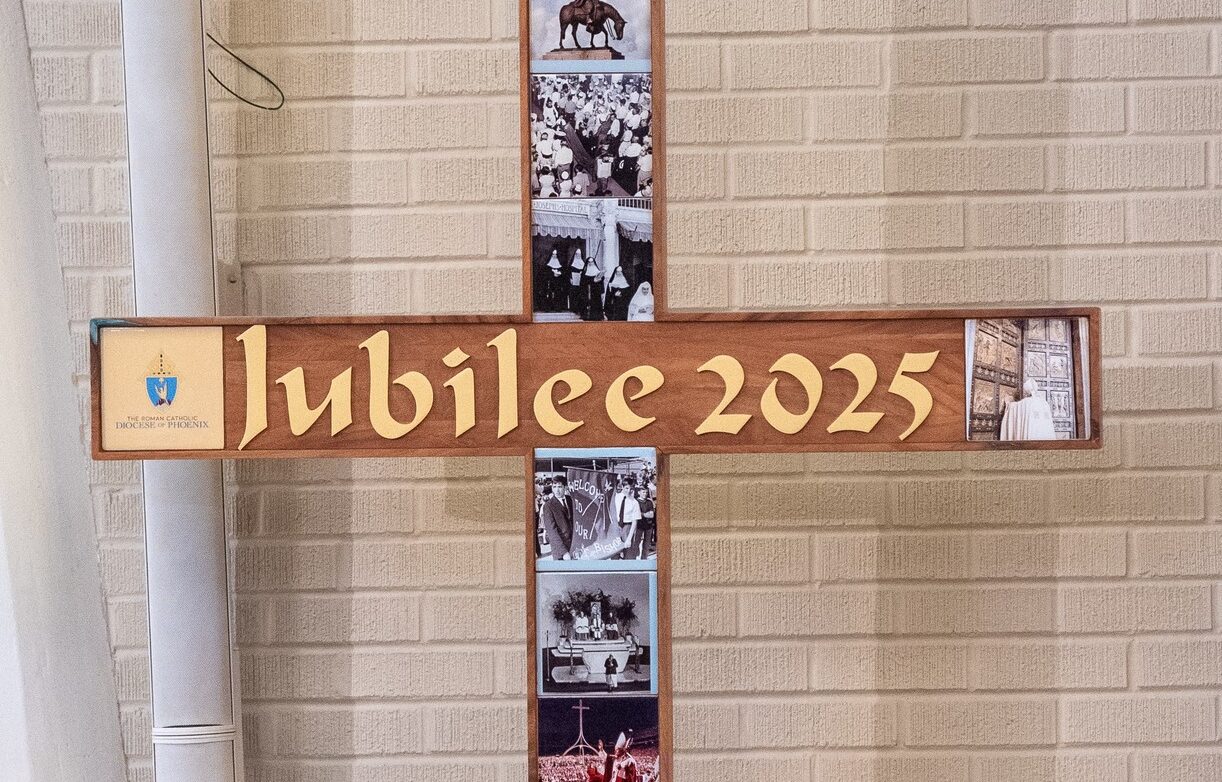
As the Church’s Jubilee Year of Hope draws to a close, its culmination is anything but the end of the hope that defined the year, Bishop John Dolan told the congregation during the Diocese of Phoenix’s Jubilee Closing Mass at Ss. Simon and Jude Cathedral in Phoenix Sunday.
“What we have received in this Jubilee Year is not meant to remain behind stone thresholds or special moments, it is meant to be carried into our ordinary life, into our homes and to our families, into our conversations and our choices,” the bishop told the capacity crowd in his homily.
“Hope is not a place we visit for a year. Hope is Someone: Jesus Christ … who abides with us always. He is truly Emmanuel, God with us.”
Sunday’s Mass was one of thousands that took place in dioceses across the United States and around the world toward the climax of a 12-month period celebrated every 25 years by the Church. Instituted by Pope Boniface in 1300 at a 100-year interval, the gap was cut to 50, and then to its current 25 years by Pope Paul II in 1470.
Inspired by God’s directive to the nation of Israel centuries before Christ, the Jubilee was to be a year for returning land to original owners, freeing Hebrew slaves and forgiving financial debts. In the Catholic Church, it is a time of grace, renewal and pilgrimage.
In his 2024 Bull of Indiction proclaiming the 2025 Jubilee Year, Pope Francis put special emphasis on the phrase “Hope does not disappoint,” from verse five in chapter five of St. Paul’s letter to the Romans. He called on Catholics to fix their attention on Jesus Christ, “our hope,” in his Dec. 18, 2024, general audience, days before opening the Holy Doors to St. Peter’s Basilica in Vatican City, launching the celebration.
Pope Francis died April 21, and his successor, Pope Leo XIV, will close the monumental bronze doors Jan. 6, the Feast of the Epiphany.
During that ceremony, Pope Leo will invite pilgrims to return to Rome in 2033, the Church’s next Jubilee Year. The Extraordinary Holy Year of Redemption will mark 2,000 years since the passion, death and Resurrection of Jesus. The next ordinary Jubilee is slated for 2050.
A fixture remains
On Sunday, Bishop Dolan said while the doors are closing, hope remains.
“It has been entrusted to us,” he said, encouraging the faithful to share that message.
To that end, he announced that one tangible Jubilee Year of Hope fixture will remain in place: The Peace Pole, erected at each of six diocesan pilgrimage sites, will stay up “long after” 2025.
Recalling that Pope Francis encouraged the Church to embrace the “hope for peace,” one of 10 Jubilee “hopes,” the bishop said the past 12 months have reminded us that “peace is difficult to attain on our own.”
“Because peace, as Pope Leo will remind us, comes only from the resurrected Lord,” he said.
Leaving the Peace Poles up is the perfect nudge.
“Jubilee seasons come and go, liturgical years turn, but the resurrected peace of Christ does not expire,” he continued.
Later, referencing the day’s second reading from St. Paul’s letter to the Colossians, Bishop Dolan said Paul’s teaching to let the peace of Christ [control] your hearts draws everything together.
“That resurrected peace of Christ must reign in our heart and control our heart,” he said.
For Ss. Simon and Jude parishioner Claire Yablong, standing with her husband, Noah, and their two children, Oren, 6, and Mirielle, 6 months, that guidance means sometimes stopping and telling oneself about God’s grace.
“In moments of stress or frustration; or just moments when it’s easy to forget, just having that as a reminder; that it is there, and we can ask for it, and we can look for it,” she explained.
Family
Sunday’s Mass took place on the Church’s Feast of the Holy Family.
Celebrating Jesus, Mary and Joseph, the feast portrays the Holy Family of Nazareth as the “true model of life” from which families can draw inspiration and know where to find help and comfort.
Family is often on the mind of Silvia Amaya, a parishioner of Most Holy Trinity in the Sunnyslope section of Phoenix.
A participant in the Flame of Love of the Immaculate Heart of Mary, a worldwide ecclesial movement that promotes God’s graces given through the Blessed Mother, Amaya led a group of about 60 fellow Flame of Love participants through the cathedral’s Holy Doors and up to the altar before Mass, part of their pilgrimage to Ss. Simon and Jude.
Pope Francis had encouraged the faithful during the Jubilee Year to make pilgrimages to Rome and other holy sites. In line with that call, Bishop Dolan designated six locations across the nearly 44,000-square-mile Diocese of Phoenix, including Ss. Simon and Jude Cathedral, historic St. Mary’s Basilica in downtown Phoenix; St. Anthony Mission Church in Sacaton, Ariz., part of the Gila River Indian Community; Sacred Heart Church in Prescott, Ariz.; the Chapel of the Holy Cross in Sedona, Ariz.; and St. Mary Church in Kingman, Ariz.
Amaya and other participants in Flame of Love, its name in Spanish is “Flavimiento llama de Amor del Immaculada Corazon de María,” represented 20 churches across the diocese. The movement utilizes prayer, the rosary and intercession.
“We pray for our families, our priests and our communities,” said Amaya.
With their cathedral visit Sunday, many Flame of Love participants completed pilgrimages to all six diocesan sites.
“It was important to be here,” said Christina Pacheco, parishioner of St. Augustine in the Maryvale area of Phoenix.
TILMA
Others said the past 12 months have infused their hope.
Ss. Simon and Jude parishioner Barb Small, along with her husband, Dcn. Doug Small, leads the parish-based Salt & Light street ministry. Prior to the Mass, she said she was grateful for the influx of new young people to the Church, the gathering of a large number of Catholics at this year’s Arizona Rosary Celebration in Phoenix and the growth of Salt & Light.
“It’s been inspiring,” she said.
“A number of people have wandered away from church. We always invite them back. There is a lot of shame people feel, even the non-homeless, who say, ‘I can’t go back, they wouldn’t take me.’ We just try to convey God’s love and mercy. Sadly, so many tell us how they’re feeling not loved.”
Outreach is fundamental to Bishop Dolan’s vision for the diocese, which he articulated prior to the Jubilee Year opening.
Year two of “TILMA,” the bishop’s seven-year pastoral plan on evangelization, begins Jan. 1.
In late 2024, the bishop urged the diocesan faithful to be characterized in year two by “faith, trust and joyful witness.”
Evangelization, he pointed out, “happens anywhere, through any means and in every encounter.”
And, in any year.
“It is a lifetime emphasis,” said Dcn. Small. “How is God calling us each day to serve Him? How can we be that message of hope each day to those we encounter?”
Like Jesus’ 12 Apostles, ordinary by trade, education and background, anyone can be called by God.
“We often think, ‘I’m not qualified or good enough,’” said Barb. “But God provides the skill. If you’ve been waiting to take the leap of faith, now is the time. God will show you what you need.”