
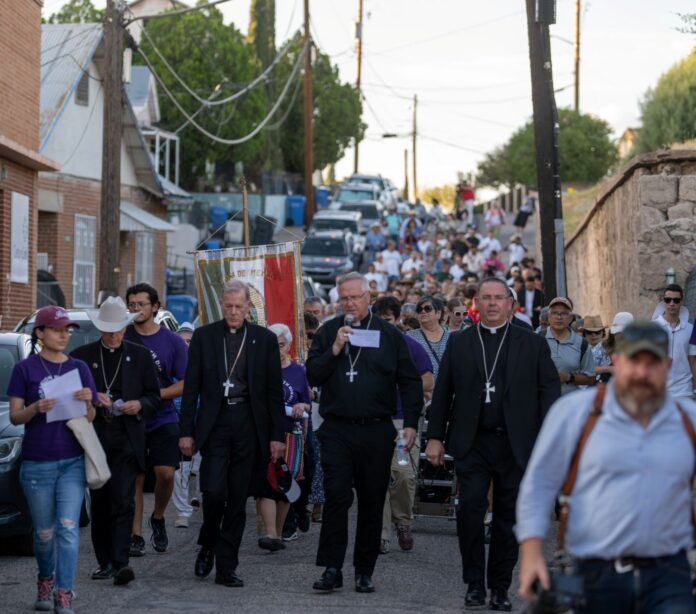
Bishop Dolan joins brother bishops in border Mass, rosary and procession in solidarity with migrants

Five Catholic bishops from the United States-Mexico border region led a day of pastoral accompaniment in Nogales, Ariz., and Nogales, Mexico, Friday (June 26) as the United States approaches its 250th birthday as a nation on July 4.

“We are here as shepherds of the Church,” said Bishop James Misko of the Diocese of Tucson, Ariz., prior to celebrating Mass inside Nogales, Ariz.’s historic Sacred Heart Parish, less than a half mile from the international border.

He was joined by Bishop John Dolan of the Diocese of Phoenix, Archbishop John Wester of Santa Fe, N.M., Bishop Mark Seitz of the Diocese of El Paso, Texas, and Bishop Emeritus Gerald Kicanas of the Diocese of Tucson.

“This is an important place for us to be,” Bishop Misko continued, “because this is where these two nations come together as the people of God. We are here to accompany these [migrants] who find themselves in a complex situation, and to pray for our elected leaders who govern the border, and those [in enforcement] given the very important task of managing our border.”

Following Mass, the bishops led about 200 worshippers in a rosary and procession across the border into Nogales, Mexico, where they spent a brief time in adoration of the Blessed Sacrament at Parroquia de la Purisma Concepción. Along with migrant advocates, the bishops then met and dined at a local migrant advocacy complex before returning to the United States.

“This was a day to say, ‘We see you, we hear you and we walk with you,’” said Bishop Seitz.

The events were co-organized by Kino Border Initiative, a Nogales, Ariz., and Nogales, Mexico, migrant advocacy agency, and Hope Border Institute, a similar agency headquartered in El Paso, as well as the New York City-based Center for Migration Studies, a think tank and educational institute studying international migration.

During his homily, Bishop Misko urged the faithful to conform their hearts to the Sacred Heart of Jesus, adding that the right to migrate humanely reflects the dignity of those created in God’s image and likeness.

Like Christ, he said, we must be sensitive, compassionate and strong in all our dealings with people, including migrants.

“Our hearts must reflect these qualities,” he said.

Bishop Misko also urged prayer for governments and their leaders who craft immigration policy as well as the duly sworn personnel who manage the border and enforce the law.

“We pray that God will fill all hearts with His grace, so that we may see Christ in one another and protect human dignity as the greatest gift given in God’s providential love,” he said.

Prior to Mass, the bishops and advocates put the issue into context.

Bishop Dolan said contributions of immigrants to his state and others cannot be underestimated.

“We belong to a particular community that has continued to show an increase in immigration and refugees,” he said, noting many of these individuals offer potential support to the region’s agriculture.

“Our small business across the country is fueled by the contributions of migrants,” said Dylan Corbett, Hope Border Institute’s founder and executive director and a member of the Vatican’s Dicastery for Promoting Integral Human Development. “We [also] have many serving in health care.”

Juan Cuellar, Kino’s director of education and advocacy, said Church teaching that humans are created in God’s image and likeness supports the freedom to migrate humanely.

“Migration has been a core reality of the human experience for thousands of years. People possess natural rights to migrate to support themselves and their families. Each country has the right to maintain and manage its borders with Christian justice and in a way that equates to a relationship with God and how we treat our neighbors.”

The bishops urged all parties to work for humane, dignified migration solutions.

“We need consistent application of policy from administration to administration and for Congress to work on a true and valuable and sustainable immigration reform,” Bishop Dolan said.

Bishop Kicanas urged the United States to ensure those held in detention centers and or waiting to be granted access to the United States have ample opportunity to practice their faith. At present, he said those opportunities are limited.

“These are people in great need. They’re desperate, they’re fearful, they’re anxious. They need the consolation and hope that faith can bring.”

Inside a Nogales, Mexico, complex operated by Kino Border Initiative, migrants were uplifted seeing the bishops, who made their way throughout the dining room, meeting and talking with individuals.

Some shared their experiences.

Francisco Menjivar, 38, said he fled his native Honduras three months ago, often finding rides on trains to escape family discord and the use of drugs by siblings. Speaking through an interpreter, he explained his job as a ranch and stable hand paid the equivalent of $10 a day.

Menjivar arrived in Nogales, Mexico, only a few hours before the bishops.

“This is a great joy. I thank God we are together,” he said, pointing to a friend sitting across the table, adding that “if God allows it,” he will come to the United States, find work and support himself and his mother.

Azul Guzman, a 19-year-old single mother with a 9-month-old daughter, is seeking to live in the United States with her aunt, who resides in Pennsylvania. Guzman now lives with her parents and her daughter, Natalie, in a three-room efficiency. She has requested asylum and has waited three months for an answer from the U.S. government. Though not a church-goer, she said she believes in God and was grateful for the visit from the bishops.

“It’s very beautiful to have them here.”
SEE FACEBOOK PHOTO GALLERY

Strangers become friends

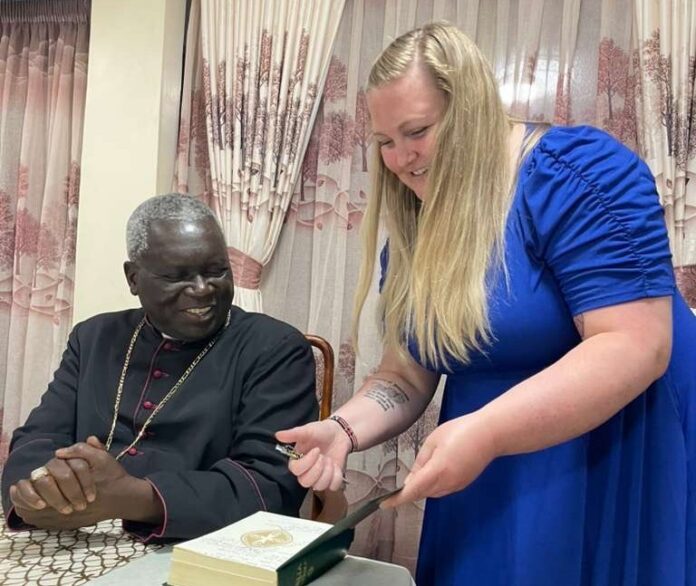
Archbishop Philip Anyolo writes in Christa Sadler's Bible.

Georgia Cobb had no idea what to expect when she left Phoenix to travel to Nairobi, Kenya, yet she resolved to approach her new surroundings with a heart open to God’s graces. She found those graces early into her trip when she visited St. Vincent de Paul preschool in a neighborhood called Kibera.

“Kibera is a slum in every sense imaginable,” Cobb noted. “The homes there are made out of corrugated metal, wood, mud and any other scrap material that can be found. There is open sewage running between the buildings.”

Cobb arrived in Nairobi on June 1, with seven other young adults from the Diocese of Phoenix. Together, they formed the second cohort of the Engage Your Equal (E.Y.E.) program.
Bishop John Dolan created E.Y.E. to encourage young adults to engage with Catholic communities abroad and develop an understanding of the universal Church. Last June, the inaugural cohort spent two weeks in Nairobi. This year, four mentors accompanied diocesan young adults in the immersion program in the same location.

A parishioner of St. Thomas Apostle in Phoenix, Cobb had travelled to 29 countries before Kenya. As Dylan, a preschool student in Kibera, introduced her to his neighborhood and family, Cobb felt God’s presence at work in a special way.

“At this preschool in one of the poorest places of the world, Dylan changed my life,” Cobb shared. “Dylan reminded me that physical possessions do not equal happiness, and that as children of God we are all seeking endless love.

“I learned more about love from a 4-year-old in Kenya than I have in my past 27 years.”

Patricia Walsh, an E.Y.E. participant from St. Rose Philippine Duchesne in Anthem, Ariz., also spoke of her experience engaging with locals in Kenya. For Walsh, Engage Your Equal offered a unique opportunity for social justice outreach, and she applied to the program in part because of the name itself.

“Engage one’s equal captured Pope Francis’ ethos of encounter and promoting human dignity,” Walsh commented. “I was basically sold on the program by the name alone.”
In Kenya, Walsh and the other participants met with religious sisters from the Daughters of Charity at the community’s school for children with disabilities. The school originally opened as a typical elementary program, yet it evolved to serve the needs of the disabled community after a mother sought help for her child. The Daughters of Charity now serve 83 children with disabilities at their school.

The school’s story touched Walsh in a personal way. “I felt affirmed both in my work on the Diocesan Advisory Committee for Persons with Disabilities and as a person with a disability myself,” Walsh stated.

“I felt filled with the Holy Spirit listening to the Daughters of Charity who are fighting to promote the human dignity of individuals with disabilities.”
Another E.Y.E. participant, Christa Sadler, built connections in Kenya through language and liturgy. Received fully into the Church at the Easter Vigil this year at St. Gabriel the Archangel in Cave Creek, Ariz., Sadler was eager to experience the global Church for the first time.

When she arrived in Kenya, Sadler purchased a bible in Swahili. Each day, she asked the people she encountered to write their name and favorite bible verse inside it.
“By the end of our time in Kenya, my book became full of names of people that I will never forget and a special note of scripture that has spoken to each of them,” Sadler recalled. “No matter where we are in the world, what we look like or what our background may be, the words of God impact us all.”

Sadler, along with the other members of the E.Y.E. cohort, attended Mass in Swahili and participated in liturgical dance and song that reflected Kenyan culture. Even as they appreciated the cultural nuances of Mass in Kenya, the group recognized the universality of their liturgical experiences.

“Worship and praise are something we all understand, even if it looks a little different based on where we are in the world,” Sadler said. “Everyone I met was my brother or sister in Christ, and we all received the same Eucharist.”

After two weeks in Kenya, the E.Y.E. cohort returned to Phoenix in mid-June. They spent several days on a post-trip retreat, and they reflected together on the fruits of their immersion trip. Over the coming months, the E.Y.E. members will develop projects to bring their experiences in Kenya to the young adults of the Diocese of Phoenix.

With a deeper understanding of global Catholic solidarity, the group is prepared to nurture relationships and community in Phoenix. They shared that they cherish the kindness, love and community they experienced in Kenya’s Church and hope to reflect Kenyan hospitality as they engage with diocesan locals.

“There is a real beauty in being Catholic because we are all connected as a family within the Eucharist, regardless of time or location,” Cobb shared. “Kenya reminded me of that reality: the stranger becomes a friend, the friend becomes someone you care for … and the Church connects us all in love across time and space.

“I hope that when others encounter me now, they will always feel welcome with the hospitality and love that I encountered in Kenya.”

Diocese of Phoenix receives seven national awards for excellence in communication

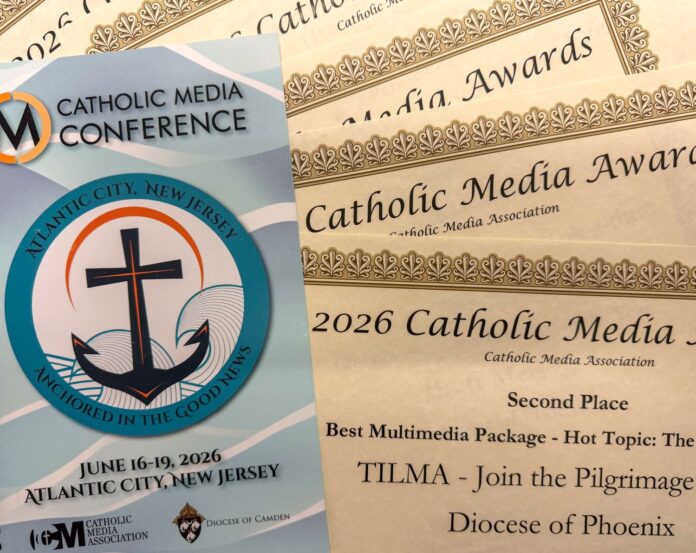
For the second consecutive year, the Diocese of Phoenix’s Office of Communications team was recognized by their peers from across North America for their outstanding work, creativity and commitment at the annual Catholic Media Conference’s Awards Dinner this past Friday (June 19). The diocesan team was honored with seven national accolades by the Catholic Media Association during the event held at Harrah’s Resort in Atlantic City, N.J.

“We are absolutely thrilled and deeply humbled to be recognized nationally with seven Catholic Media Awards,” said Brett Meister, who was appointed director of communications for the diocese in March 2022 after a 24-year career as a communications executive for the Harlem Globetrotters.

“These accolades are a testament to our team’s relentless passion and collaborative spirit as we continue our efforts to grow our multi-platform outreach. Our ultimate goal is to continue to educate, inspire and evangelize to folks across the diocese, meeting everyone exactly where they are on their faith journey.”

Established in 1911, the Catholic Media Association builds and strengthens the value, effectiveness and identity of Catholic media by facilitating the professional development and spiritual growth of its members. The honors presented recognize professionals whose talent and dedication drive the success of Catholic journalism, communications and marketing initiatives across the United States and Canada.

“We also want to share our sincere appreciation for the ongoing generous support we receive for our weekly TV Mass broadcast and multiple communications initiatives. Without the ongoing backing of our dedicated donors and sponsors, achieving these goals would not be possible,” Meister added.

The Diocese of Phoenix received one first place award, two second place awards, one third place Individual Excellence Award and three honorable mention certificates. The Individual Excellence Awards are a premier component of the Catholic Media Awards program. An awards committee from across the country consisting of news editors, journalism professors, sales managers and communications directors reviewed and judged the categories and numerous topics. Their comments are in italics below.

The Diocese of Phoenix’s Office of Communications 2026 accolades:

Catherine Mulhern, Lead Staff Writer

Best Interview

First Place: Building a Culture of Evangelization

This article has a fun, quirky design that absolutely pops! It also includes thought-provoking questions and thorough, informative answers. The pull quote formatting is so eye-catching and interesting. The photos are vibrant and joyful. Readers are sure to enjoy this interview from start to finish.

Content Evangelist, Design and Publisher

Catherine Mulhern, Story Author, Diocese of Phoenix

Brett Meister, Billy Hardiman and Joseph Pillado, Photographers, Diocese of Phoenix


Best Multimedia Package – Hot Topic: Jubilee Year

Second Place: TILMA — Join the Pilgrimage in the Diocese of Phoenix

Bishop Dolan and the Diocese of Phoenix’s creativity launching the Jubilee Year in Arizona is commendable. From a seven-year pastoral plan to an extensive pilgrimage to interesting content in their publications, their coverage of the Jubilee is impressive.

Brett Meister, Diocese of Phoenix


Julian Garoz, Multi-Media Specialist

Best Video, Hot Topic – Pope Francis: Diocesan and National News Organizations:

Second Place: “Todos, Todos, Todos” — Heartfelt Stories from Clergy and Leaders of the Diocese of Phoenix in a 30-Minute Documentary on Pope Francis

This well-produced and highly engaging 30-minute video explores the impact of Pope Francis through the voices of those who were directly touched by meeting him. What makes this entry stand out is its wide range of perspectives and explores the lasting impact Pope Francis had in helping others find Christ.

Julian Garoz, Colleen Gurrola and Brett Meister, Diocese of Phoenix


Brett Meister, Director, Office of Communications

Communications Director of the Year:

Third Place: Brett Meister, Diocese of Phoenix

Brett Meister successfully created multiple innovative media avenues for the Diocese of Phoenix to strengthen connections with parishioners and the broader community. Bringing media production in-house was a bold and ambitious initiative that promises long-term cost savings and expanded creative opportunities. He also modernized digital platforms, enabling the diocese to better engage diverse demographic audiences through more effective communication strategies. Accomplishing these major projects while simultaneously hosting a national conference made the year especially demanding. Through strong leadership, creativity and strategic vision, Meister has generated renewed interest, engagement and interaction across a large and diverse diocesan community. His accomplishments are highly commendable.


Jonathan Fuentes, Digital Video Producer

Best News Video — Diocesan and National News Organizations:

Honorable Mention: St. Mary’s High School Thanksgiving Walk-a-thon

Jonathan Fuentes, Diocese of Phoenix


Best Personality Profile – Laity

Honorable Mention: Bubba’s Lemonade for Life

Catherine Mulhern, Diocese of Phoenix


Backlist Beauty (Books)

Honorable Mention: Sacred Wounds; An Encounter with Jesus on the Holy Ground of Suffering

Catherine Mulhern, Author and Publisher, Diocese of Phoenix

Franciscan Friars of the Holy Spirit celebrate 10 years of serving Native American communities

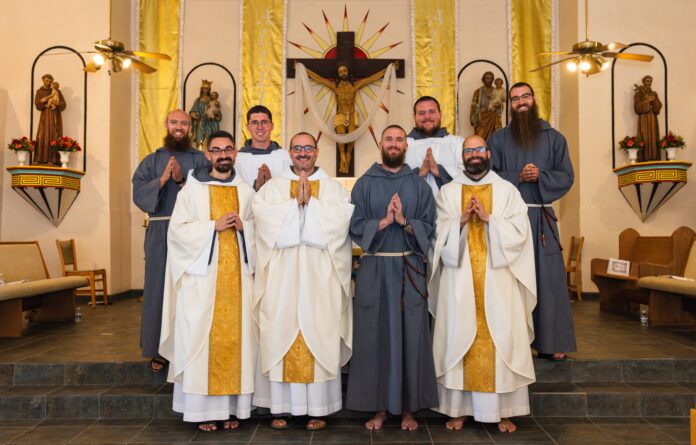
The Franciscan Friars of the Holy Spirit, established in the Diocese of Phoenix with the mission to tend to the pastoral and spiritual needs of Native American communities, will celebrate a momentous occasion on June 29 — 10 years since their founding.

In 2015, there were 11 Native American churches in the greater Phoenix area, which for 30 years had experienced limited access to the sacraments. On the weekends when Mass was not celebrated, parishioners would lead prayer services, praying in a special way for permanent priests to come.

Around the same time, Bishop Emeritus Thomas Olmsted was also praying for permanent priests to serve the missions.

After decades of fervent prayer, five Franciscans arrived at St. John the Baptist in Laveen, Ariz., in 2015. The band of friars lived in an old, unused convent.

Deborah Griffin, longtime parishioner of St. John the Baptist, still remembers the day they arrived. “That was the most exciting day … I just couldn’t believe that it was finally happening.”

Although Griffin did not grow up on the reservation, her mother did. Griffin’s mother led prayer services at the mission for decades before the friars came.

“My mom was always busy trying to keep the faith alive.”

The five priests had been part of a Franciscan religious community in Pennsylvania and had discerned starting a new Franciscan public association of the faithful with the charism of the Holy Spirit. During their first year in Arizona, the friars and Bishop Olmsted took time to discern if they were a good fit for the Diocese of Phoenix and the Native communities.

A year after their arrival, the Franciscan Friars of the Holy Spirit were officially founded as a public association of the faithful on June 29, 2016, by Bishop Olmsted. The friars now oversee and serve 11 locations on four reservations in the greater Phoenix area — Gila River, Salt River Pima-Maricopa and Ak-Chin Indian Communities and the T’ohono O’odham Nation.

Now, Mass is celebrated almost daily at St. John the Baptist Mission and regular Sunday Masses are celebrated at nine of the churches. Numerous anointings, funerals, baptisms and weddings have also been celebrated since the friars’ arrival. Additionally, the friars have started two youth groups, and they minister to Natives in the prisons, juvenile detention center, rehab center and Caring House, a medical rehabilitation facility in Sacaton, Ariz. They also lead monthly praise and worship nights and celebrate frequent healing Masses, praying over people with a wide variety of healing needs and ailments.

When asked what it is like to have weekly access to the sacraments, Griffin said, “It’s the way it should be. It’s just the way of life.”

An eternal impact

Since the establishment of the Franciscan Friars of the Holy Spirit, multiple men have joined the community and are in different stages of the formation and discernment process. Currently, there are four priests, one transitional deacon, one perpetually promised friar and two friars receiving formation at Nazareth Seminary, the Diocese of Phoenix’s fully local seminary. The most recent ordination was Fr. Paul Graupmann, F.H.S., who was ordained on June 6, 2026 at St. Thomas Aquinas in Avondale, Ariz.

“The ordinations [are] just an eye opener of how the faith has come back to our reservation,” Griffins said. She also shared that the friars helped the Native people feel as if they were not forgotten.

There are many people who still have not come back to Mass due to the prolonged period without consistent access to the sacraments. Yet, Griffin has high hopes for the future. “I would hope that [the friars] would bring every Catholic in our community back to the Church … and to carry on with our Native traditions, with Catholicism.”

Fr. Antony Tinker, F.H.S., the community servant who leads the group of friars and was one of the five founding priests said, “I think it’s really beautiful, because … God created a charism specifically to care for Native American peoples. It shows the heart of God, that He cares.”

There have been Franciscan missionaries in the area since the 1760s, including Servant of God Francis Garces. St. John the Baptist was established by Franciscans in the late 1800s.

“We’re [standing] on the shoulders of giants, with the Franciscans and Jesuits and other missionaries,” continued Fr. Tinker. “Unfortunately [a lot of those] missions that were started are no longer staffed because of the lack of priests. And so this [is a] call from God to continue to care for these little missions that the whole Church of America is built on in so many ways.”

Fr. Tinker said that it is a joy to do this work for God. Interacting with the community, getting to know the families and all the baptisms, weddings and everything in between, make the hard moments worth it.

He shared one moment in particular that he will never forget.

There was a Native woman who was completely healed of stage four ovarian cancer after attending a healing Mass hosted by the friars. Not long after, the woman’s father, who wasn’t Catholic, asked to be blessed after hearing about his daughter’s healing. Fr. Tinker blessed him, and he also went into remission. A couple years later, the cancer returned.

By that time, the father was ready to become Catholic.

“[I had] the privilege of baptizing him on his deathbed in his home with his family, confirming him … he died a day or two later.”

Fr. Tinker reflected that if the friars hadn’t been serving on the reservations, the daughter never would have gotten prayed over at the healing Mass, her father may never have reached out and he may not have received the sacraments, passing away as a baptized Catholic.

Fr. Tinker recognizes that good work is happening because of the Lord’s generosity and the generosity of many who have supported the friars over the years.

“We’re able to live the life God’s called us to live because people are so generous.”

Planted in the desert

Fr. Peter Teresa McConnell, F.H.S., vocations director for the Franciscan Friars of the Holy Spirit, moved to Arizona at the end of 2015 to discern with the friars. He was ordained a priest in 2019.

Fr. McConnell talked about the joy-filled Mass on July 2, 2016, celebrating the association being publicly recognized.

“Bishop Olmsted is in many ways the founding father of this community. I just remember him … doing everything that a father does. First, he gave us our names, and then he gave us our habits … he clothed us … he brought us into the diocese and gave us a home here … and then he fed us with the Eucharist.”

Fr. McConnell has found great joy in being received so graciously by the Native communities and by the Diocese of Phoenix.

“It’s hard to imagine my life without the Gila River [community] and these people.”

The friars hope to be like the Franciscan missionaries of the past — like St. Junipero Serra — who never returned home.
“We very much feel like we are like a vine being grafted onto that tree in the Franciscan family … our desire … [is] that we would be grains of wheat here, that we would be planted in this desert, and that we would spend our lives here.”

Fr. McConnell does not want to presume to know what the Holy Spirit will do in the next 10 years, but he is excited for whatever God has in store.

“I have a lot of hope for our community. I have a lot of hope for the people that we serve … I wouldn’t trade these last 10 years for anything.”

Sacred ministers

Br. Damien Van Amerongen, F.H.S., came across the friars online during college and felt a tug in his heart to discern. On May 30, 2026, he made perpetual promises to the community, saying yes to living the statutes that the friars established 10 years ago.

“I did feel the grace to have just a lot of sobriety and clarity in that moment … as I consciously read that I will live poverty, chastity and obedience for the whole of my life, and follow the statutes of the Franciscan Friars of the Holy Spirit with all my heart.”

His next step is to continue formation through Nazareth Seminary. He will continue to live at the friary and commute to Mary College at Arizona State University in Tempe, Ariz., where he will be in the theology program along with diocesan seminarians.

It’s been exciting for him to be part of this “grassroots” public association.

“It feels kind of like [St.] Francis and his first brothers … and then they turned that into the Franciscan order, which still forms the hearts of Christians today.”

He knows that the Franciscan Friars of the Holy Spirit would not have lasted 10 years if it was not for the Holy Spirit, and he sees the Lord at work while living with his fellow friars.

“We carry each other through not only the day-to-day things … but even the hard things, like some of the difficulties in ministry … It’s amazing how the Lord can even just have that foundation of our brotherhood, that makes His yoke easy.”

The journey for Dcn. Lawrence Hogue, F.H.S., to the friars was a little different. Fr. Tinker was his college campus minister. When Dcn. Hogue heard that Fr. Tinker moved to Arizona to help found the Franciscan Friars of the Holy Spirit, he felt a tug to discern with the group. Dcn. Hogue left college a year before he would have gotten his degree in computer programming, and he has not looked back.

On May 16, 2026, Dcn. Hogue was ordained a transitional deacon and will, God-willing, be ordained a priest in 2027. When Bishop John Dolan prayed the prayer of consecration at his transitional diaconate ordination, Dcn. Hogue felt a warmth coming from Bishop Dolan’s hands.

“I was like, oh wow, so I think that was the Holy Spirit … it really strikes me that I’m in the whole apostolic line … just like St. Lawrence.”

Dcn. Hogue is humbled by the people who have supported him

“I know that because of all of [the prayers] that I’m where I’m at … I’m trying to give them a return on their investment … the Church has invested in me to be a sacred minister and I’m just trying to … serve the [Natives] as best as possible.”

As Dcn. Hogue tries “to love people on a daily basis,” he encourages any man who feels a call to religious life to grow in relationship with the Lord.

“Focus on your relationship with God … He’s the guy that’s going to give the call … and He’s the one that will even just move [your] heart.”

Dcn. Hogue is thankful for the ways he’s been able to live out spiritual fatherhood while serving the Native communities.

“The Lord has quite a love for the Natives … they’re the people that I [will] spend my life in service of … I’m just so grateful to be able to do that.”

Christ in our Neighborhood: 20th Sunday in Ordinary Time (Cycle A)

NOTE: Christ in Our Neighborhood is a parish-based program consisting of small Christian communities that gather in the home weekly to prayerfully discuss the upcoming Sunday Mass readings. It’s easy to form a community and you can find out more by searching “Christ in Our Neighborhood at the Diocese of Phoenix website, dphx.org.

This coming Sunday, we celebrate the 20th Sunday in Ordinary Time. The question the Christ in Our Neighborhood commentary asks us is: How does your church support the suffering? How could you participate and pour yourself out by doing God’s work today?

Many of our parishes have a St. Vincent de Paul conference, an excellent means of reaching the poor who live in our own neighborhoods. These conferences often operate a food pantry where food boxes are organized and distributed to the needy. Volunteering for or joining the conference is an effective way to serve those who are suffering.

Our parishes offer many such opportunities to go outside of ourselves and think of others such as the ministry of care that brings Communion to the homebound or hospitalized. Check your parish website or bulletin to see what other ministries might be available for you to join.

It’s often been said that serving others selflessly is a pathway to joy. God made us for joy and invites us to serve as Jesus did when He washed the feet of the Apostles at the Last Supper.

If you haven’t joined a Christ in Our Neighborhood small group yet, perhaps you are being called to start one yourself. It’s easy! Check out our website today to find out more: dphx.org/Christ-in-our-neighborhood. 

Watch the video of the weekly podcast segment featuring Christ in Our Neighborhood with Bishop Dolan by clicking HERE.

To sign up for our weekly Christ in Our Neighborhood newsletter that has everything you need for your next meeting, visit:  https://phoenixdiocese.flocknote.com/CION

Christ in our Neighborhood: 19th Sunday in Ordinary Time (Cycle A)

NOTE: Christ in Our Neighborhood is a parish-based program consisting of small Christian communities that gather in the home weekly to prayerfully discuss the upcoming Sunday Mass readings. It’s easy to form a community and you can find out more by searching “Christ in Our Neighborhood at the Diocese of Phoenix website, dphx.org.

This coming Sunday, we celebrate the 19th Sunday in Ordinary Time. The question the Christ in Our Neighborhood commentary asks us is: In the storms of life, how long do you wait to call on Jesus? Do you try to think your way out of problems or rely on rescue from others before turning to Jesus?

No matter how “perfect” someone’s life may appear on social media, personal storms are as normal as the common cold. They happen in everyone’s life, but what we do and how we react to them makes all the difference.

Do we panic or do we turn to God for guidance? That’s not to say that a wise friend of deep Catholic faith, a spiritual director or pastor shouldn’t be consulted. Far from it. They are gifts from God who can help us discern the correct course of action. That kind of intentional consultation is different from random venting that might feel good in the short run but doesn’t ultimately resolve anything.

If you need to random vent, try turning to the Lord with a heartfelt plea such as: Dear God, get me out of this mess! I’m drowning and don’t know what to do!” Then listen deeply. Seek His wisdom in the Bible, in the Blessed Sacrament chapel, in the silence at dawn. He is as close as your next breath, always ready to assist for “God is our refuge and strength, a very present help in trouble (Psalm 46:1).”

If you haven’t joined a Christ in Our Neighborhood small group yet, perhaps you are being called to start one yourself. It’s easy! Check out our website today to find out more: dphx.org/Christ-in-our-neighborhood. 

Watch the video of the weekly podcast segment featuring Christ in Our Neighborhood with Bishop Dolan by clicking HERE.

To sign up for our weekly Christ in Our Neighborhood newsletter that has everything you need for your next meeting, visit: https://phoenixdiocese.flocknote.com/CION

Christ in our Neighborhood: 18th Sunday in Ordinary Time (Cycle A)

NOTE: Christ in Our Neighborhood is a parish-based program consisting of small Christian communities that gather in the home weekly to prayerfully discuss the upcoming Sunday Mass readings. It’s easy to form a community and you can find out more by searching “Christ in Our Neighborhood at the Diocese of Phoenix website, dphx.org.

This coming Sunday, we celebrate the 18th Sunday in Ordinary Time. The question the Christ in Our Neighborhood commentary asks us is: How do I treat the people around me who are hungry for God’s love? Am I a Eucharistic person who allows my faith to result in compassion for others, especially those I am tempted to dismiss?

When the priest or deacon dismisses us at the end of Mass, the Roman Missal gives him four options. Two of them are, “Go and announce the Gospel of the Lord,” and “Go in peace, glorifying the Lord by your life.”

Do we ever let those words really sink in? At Mass, we’re given the precious Body and Blood, Soul and Divinity of our Lord and we’re sent forth to glorify the Lord by bringing that Eucharistic presence into the world. In fact, the word Mass comes from the Latin word meaning “sending.”

We who have received the love of God in the Eucharist are called to go forth and share that love with everyone we meet, particularly those who may be small, forgotten or marginalized.

If you haven’t joined a Christ in Our Neighborhood small group yet, perhaps you are being called to start one yourself. It’s easy! Check out our website today to find out more: dphx.org/Christ-in-our-neighborhood. 

Watch the video of the weekly podcast segment featuring Christ in Our Neighborhood with Bishop Dolan by clicking HERE.

To sign up for our weekly Christ in Our Neighborhood newsletter that has everything you need for your next meeting, visit: https://phoenixdiocese.flocknote.com/CION

Christ in our Neighborhood: 17th Sunday in Ordinary Time (Cycle A)

NOTE: Christ in Our Neighborhood is a parish-based program consisting of small Christian communities that gather in the home weekly to prayerfully discuss the upcoming Sunday Mass readings. It’s easy to form a community and you can find out more by searching “Christ in Our Neighborhood at the Diocese of Phoenix website, dphx.org.

This coming Sunday, we celebrate the 17th Sunday in Ordinary Time. The question the Christ in Our Neighborhood commentary asks us is: How is the kingdom of God experienced in everyday life?

When we think about what will really matter at the end of our lives, it comes down to love. How much did we truly love others in thought, word and deed? St. Paul lists the fruits of the Spirit in Galatians 5: love, joy, peace, patience, kindness, generosity, faithfulness, gentleness and self-control. Lives that are marked by these fruits of the Spirit help bring about the kingdom of God on earth.

Notice that love is listed first, but all of the other fruits are also critically important.

And, as our Paul’s letter to the Galatians and our Sunday Gospel points out, those who give themselves over to the opposites of these fruits will not inherit the kingdom of God but instead go to the fiery furnace.

Every time we see someone who chooses love and forgiveness rather than hatred and grudges, every time we see someone in recovery reaching a milestone of sobriety, every time we see a driver or shopper choosing patience over fury, we’re experiencing the kingdom of God in our midst.

Ask Christ today to increase and multiply within you and your family the fruits of the Holy Spirit so that the kingdom of God will flourish and grow here and now.

If you haven’t joined a Christ in Our Neighborhood small group yet, perhaps you are being called to start one yourself. It’s easy! Check out our website today to find out more: dphx.org/Christ-in-our-neighborhood. 

Watch the video of the weekly podcast segment featuring Christ in Our Neighborhood with Bishop Dolan by clicking HERE.

To sign up for our weekly Christ in Our Neighborhood newsletter that has everything you need for your next meeting, visit: https://phoenixdiocese.flocknote.com/CION

Pope reflects on Spain trip, says migration concerns call for Christians to reread the Gospel

By Josephine Peterson

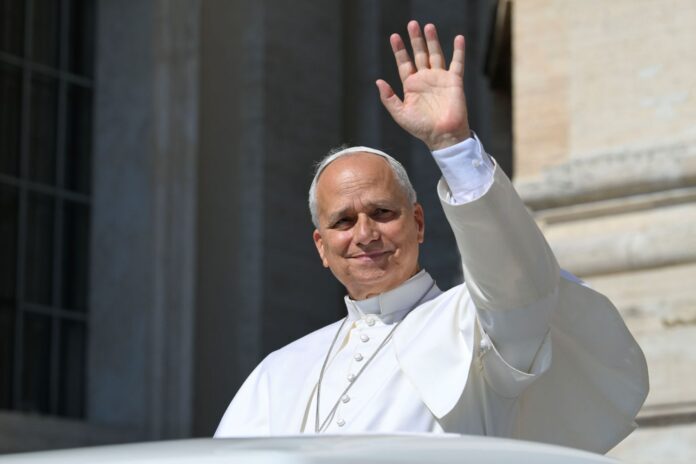
VATICAN CITY (CNS) — Reflecting on his weeklong trip to Spain, Pope Leo XIV said one of his clearest impressions came from the Canary Islands, where migration revealed both the challenges facing Europe and what he described as a Christian path toward a “civilization of love.”

Speaking at his weekly general audience June 17, the pope said the archipelago’s role as a gateway for thousands of migrants from Africa offered a “comprehensive insight” into a complex issue that also challenges Christians to reread the Gospel in today’s world.

He said migration is “complex and requires organic and coordinated action plans,” but it also challenges Christians to “reread the Gospel in today’s world, exchanging with each other the gifts of our respective cultures, and in particular the results produced in them by the fruitfulness of Christ’s message.”

“This path is not easy; it requires goodwill and God’s help, but it is the path that leads to the civilization of love,” he said in St. Peter’s Square.

The pope repeatedly returned to migration during the final days of his trip, delivering some of the strongest language of his pontificate on the issue.

“A human conscience, and even more so a Christian conscience, cannot remain indifferent in the face of these graveyards of the sea, to the victims of shipwrecks and the lack of aid,” he said while meeting organizations helping integrate migrants in Tenerife June 12.

Standing at the port of Arguineguín on Gran Canaria the previous day, he warned against indifference to migrant deaths.
“We cannot grow accustomed to counting the dead,” he said. “Human dignity has no passport and does not lose its value when crossing a border.”

Despite joking with journalists on the flight to Spain that more people might be interested in the Bad Bunny concerts taking place in Madrid the same week, the pope encountered massive crowds throughout the country. More than 1.2 million people attended a Mass at Madrid’s Plaza de Cibeles, and another 500,000 gathered for a youth prayer vigil at Plaza de Lima.

“I was able to observe with joy how much people of every age and situation were looking forward to the pope’s visit: everywhere I found multitudes who welcomed me with great warmth. This fact was not to be taken for granted, and is worthy of reflection,” he said.

Throughout the trip, Pope Leo said the service of the papacy is to promote communion, dialogue and unity through diversity, themes he emphasized in speeches across Spain.

Reflecting on the enthusiastic reception he received, he said, “I believe it reveals a widespread need to find unity on a true and deep foundation, one that is neither ideological nor based on partial interests.” What people are searching for, he said, can ultimately be found only in Christ, whose Gospel responds to humanity’s search for truth and thirst for justice.

Among the major moments of the trip, the pope highlighted his visit to Barcelona’s Basilica of the Sagrada Família, where he celebrated Mass and blessed the newly completed Tower of Jesus Christ, which made the basilica the tallest church in the world.

“This encounter of ancient and modern Catholic tradition and contemporary culture enabled me to perceive first-hand the very character of Europe, its inestimable wealth, as a living reality, not a thing of the past,” he told the crowd in St. Peter’s Square.

“It is a heritage to be safeguarded with care, so that it may be invested in today’s global world with its momentous challenges: peace, integral ecology, equitable and sustainable development, and respect for human dignity.”

The pope also reflected during his weekly audience on his encounters with young people, abuse survivors and prisoners, saying modern society often leaves people searching for hope and meaning.

“It is important to recognize how mental health is increasingly threatened in the context of societies that consider themselves advanced,” he said June 9 at Barcelona’s Lluís Companys Olympic Stadium. “This is a sign that there is something deeply wrong with a certain notion of progress that subjects people to pressures, expectations and tensions that compromise healthy balances.”

While in Spain, he also rejected attempts to “spiritualize pain, superficially attributing it to ‘God’s will’ or to some mysterious plan of his, because this risks minimizing that suffering, silencing it and hurting people.”

“God does not want suffering. He carries it with us and invites us to trust in him with perseverance,” he said, because “with God, life is always reborn.”

The motto of the journey was “Lift up your eyes,” drawn from the Gospel account in which Jesus teaches his disciples to look beyond their circumstance and recognize the desire for life, truth and fullness in others. Pope Leo said he witnessed that longing throughout Spain.

“Today I would like to share this invitation with you: let us lift up our eyes! Let us learn from Jesus to look at our neighbor, at people, at the world ‘through God’s eyes,’ that is, with love, respect and compassion,” he said June 17.

©2026 Catholic News Service/U.S. Conference of Catholic Bishops

Kino Catechetical Institute celebrates 32 new graduates

Photo courtesy of Lisa Soroko Photography

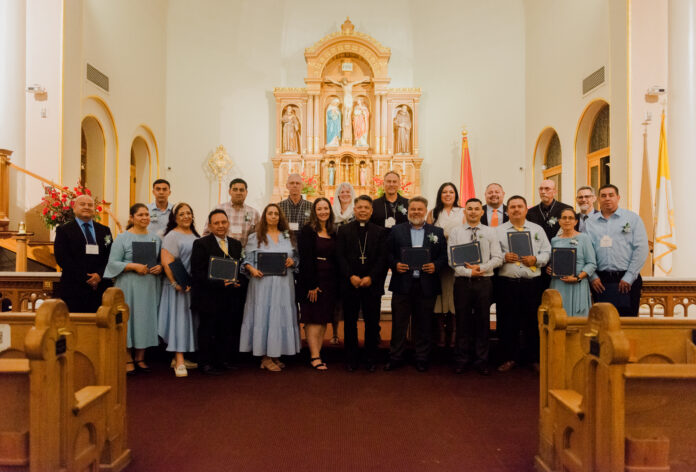
Auxiliary Bishop Peter Dai Bui celebrated the Kino Catechetical Institute graduation Mass for 32 individuals from the Diocese of Phoenix on Tuesday (June 16) at St. Mary’s Basilica in downtown Phoenix.

Originally founded by the Carmelites in 1972 and restructured by Bishop Emeritus Thomas Olmsted in 2011, Kino provides a key component of faith formation in the Diocese of Phoenix. With an emphasis on catechetics, a term that refers to passing on the teachings received from Jesus Christ 2,000 years ago, students come to understand what Catholics believe and why they believe it.

In both Kino’s flagship two-year formation program — which the graduates completed — and the simplified 10-day basic formation, students of all ages, backgrounds and stages of life study Sacred Scripture, the Catechism of the Catholic Church and additional precepts of the faith under the guidance of seasoned faculty. Kino also provides catechetical certification and recertification, as well as initial diaconate formation. The program is available in both English and Spanish.

Tuesday’s graduating class included laity from 26 parishes throughout the nearly 44,000-square-mile diocese, with some students from as far as St. Mary’s in Kingman, Ariz., Sacred Heart in Prescott, Ariz., and St. John Vianney in Sedona, Ariz.

“It was a wonderful experience, a true calling from our Lord Jesus Christ,” said Juan Rodriguez, a distance learner from Sedona in the Spanish program. “I leave with a full heart and the strength of the Holy Spirit to continue discerning the diaconate.

“I am grateful to God and to all the people who helped us.”

For more information, visit kinoinstitute.org