

Baccalaureate Mass honors local seminarians

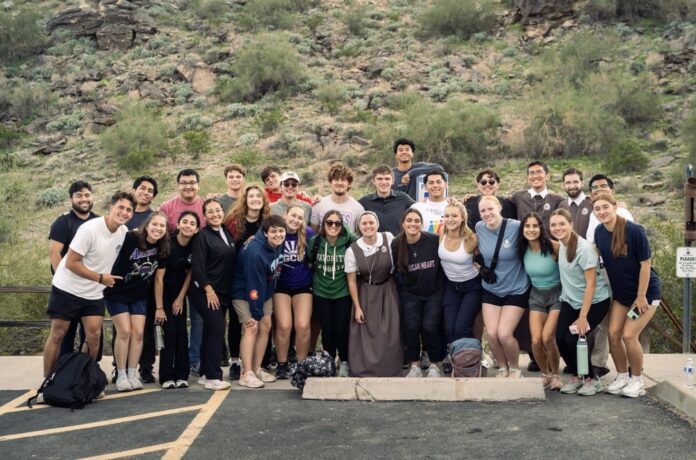
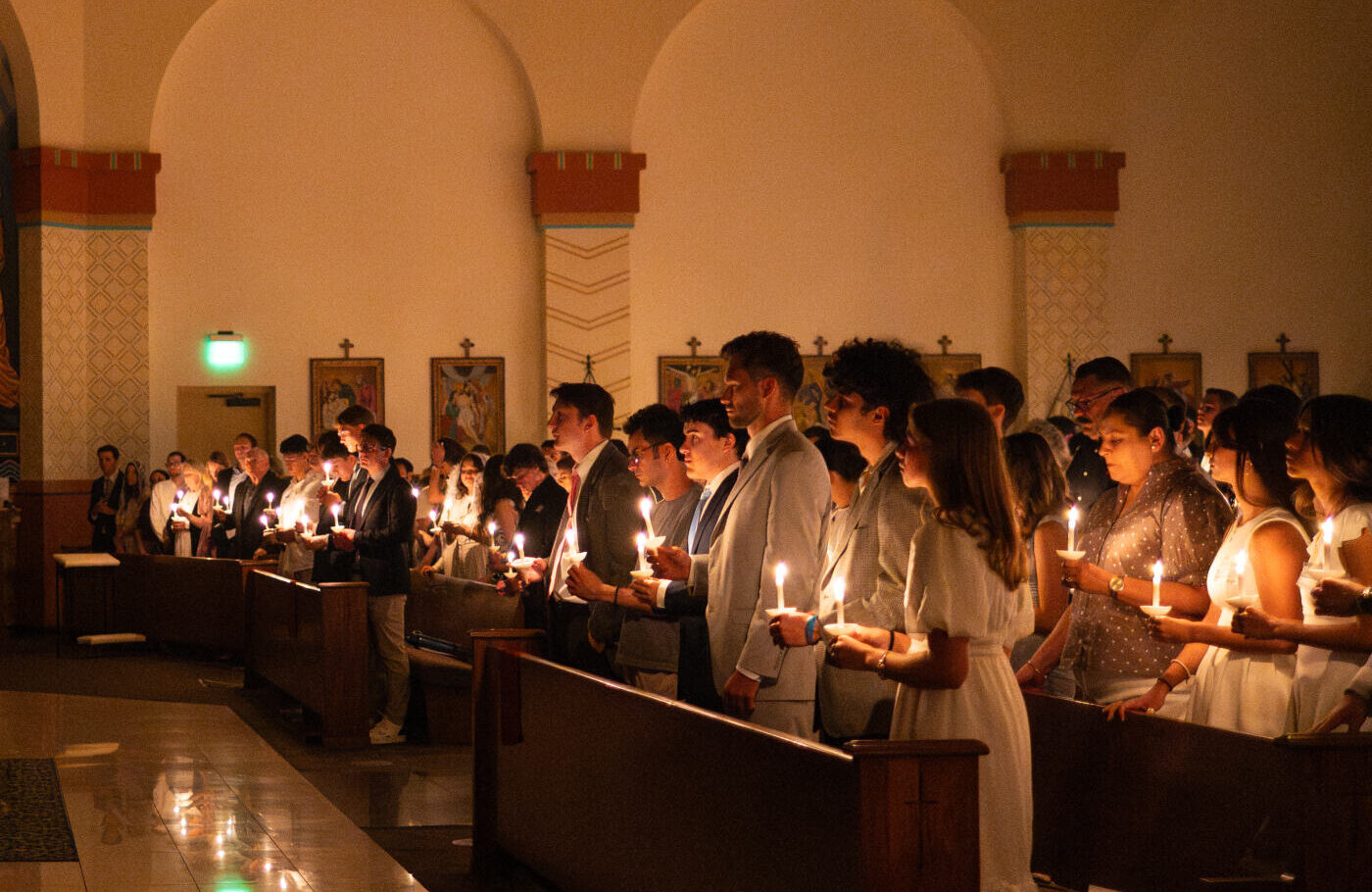
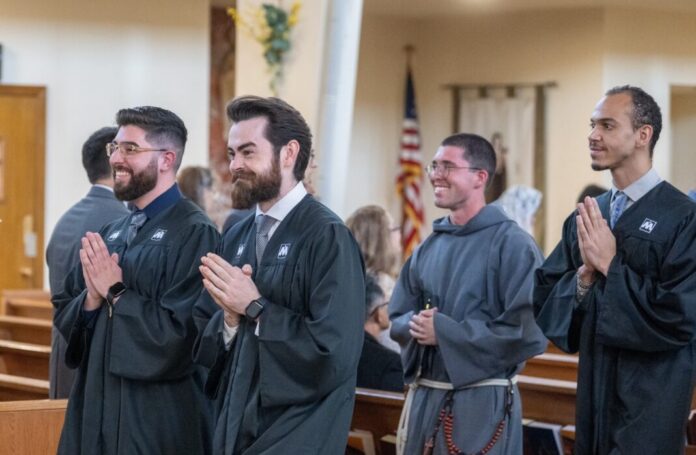
Bishop John Dolan celebrated a baccalaureate Mass at St. Agnes Parish in Phoenix on Monday evening (April 20) for the first-ever graduating class of local seminarians from The University of Mary. The graduates are part of Nazareth Seminary, the historic, fully local seminary in the Diocese of Phoenix.

Auxiliary Bishop Eduardo Nevares, Auxiliary Bishop Peter Dai Bui, Vicar General Fr. John Muir and Rector of Nazareth Seminary Fr. Paul Sullivan concelebrated the Mass. Family members of the seminarians, seminary formation staff members and 15 additional priests — including Vice-Rector of Nazareth Seminary Fr. Kurt Perrera and Director of Vocations Fr. Will Schmid — were also in attendance.

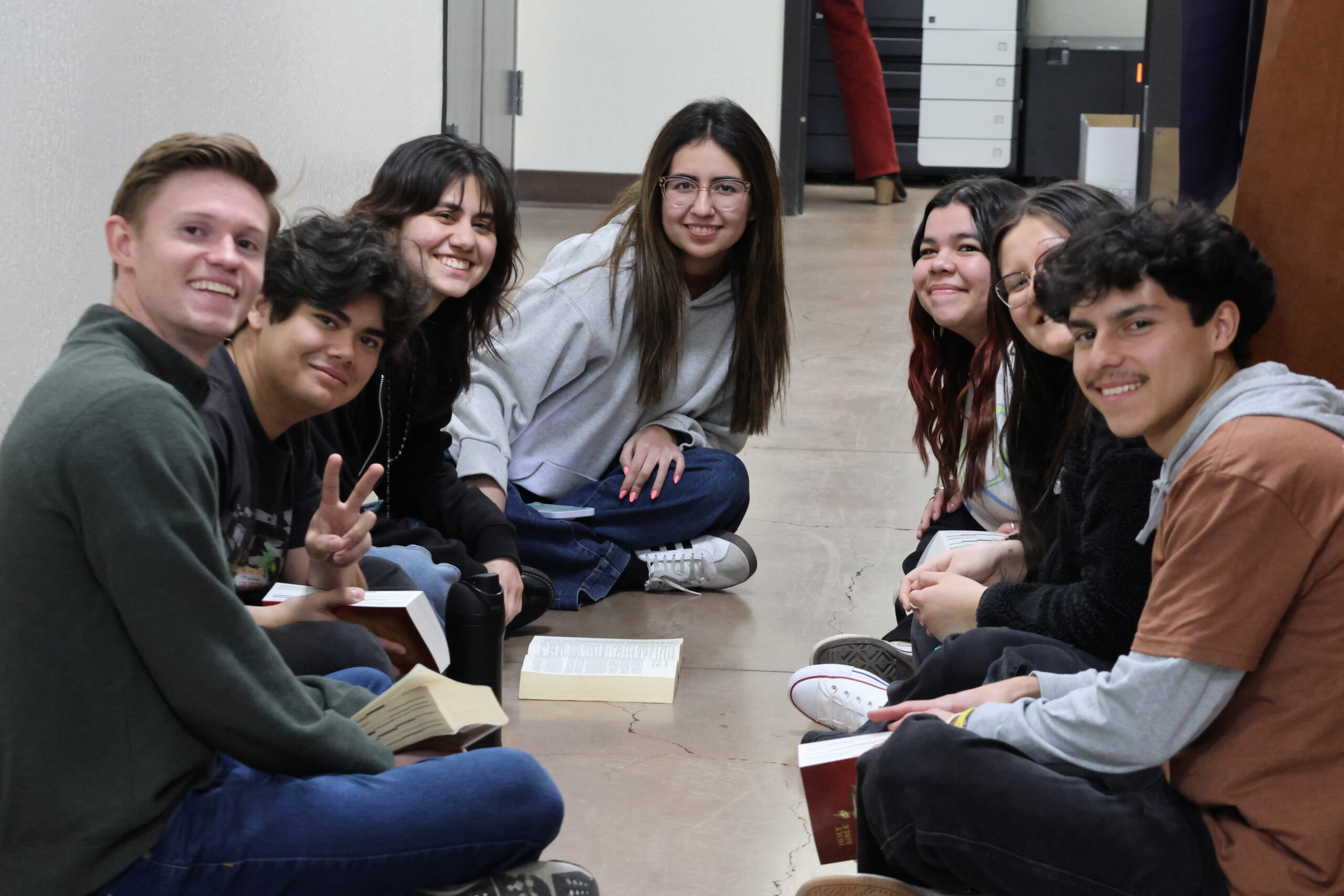
The University of Mary, located in Bismarck, N.D., partners with Arizona State University (ASU) in Tempe, Ariz., to run a local branch of the university called Mary College at ASU. This is where the eight seminarians have been studying for the past three years to earn their bachelor’s degree in Catholic Studies and Philosophy. The young men will be traveling to Bismarck to walk at graduation with fellow students on Saturday, April 25.

Bishop Dolan established a new tradition at the Mass in which seminarians ring a large bronze church bell to commemorate major transition moments in the seminary. The selected bell, which is mounted in wrought iron, was presented by Pope Leo XII to the Saint-Sulpice Seminary in Quebec, Canada in 1892. The bell was later sold at auction and donated to the Diocese of Phoenix. Toward the end of the liturgy, each seminarian was recognized by name and rang the bell.

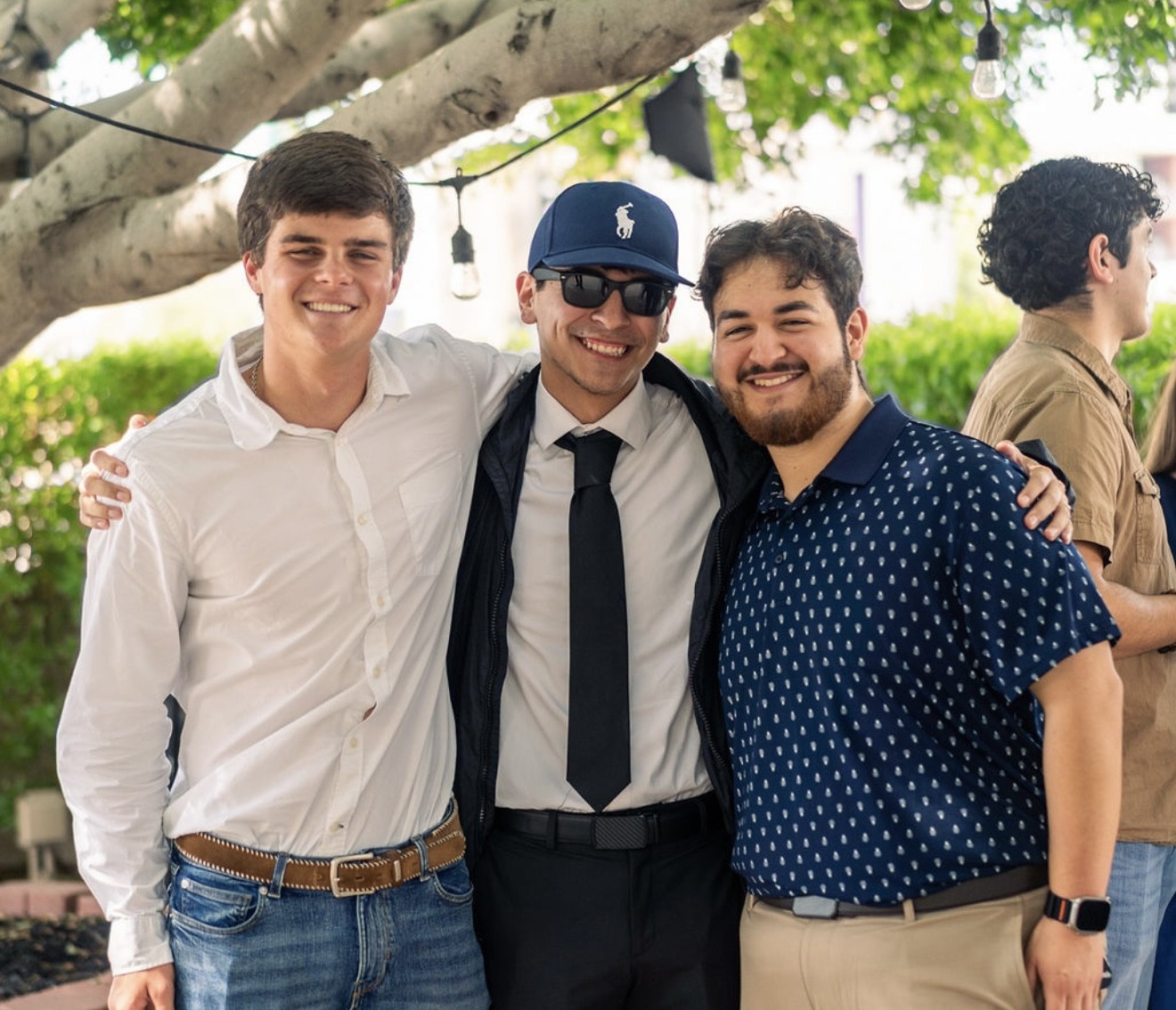
The eight graduating seminarians are Bobby Balser, Jacob Barnett, Chris Lukaszewski, Julian Mena, Jose Munoz, Br. Damien Van Amerongen, Alexander Vinciguerra and David Wilmowski. After graduating they will continue their formation at St. Gregory House in Phoenix for the three-and-a-half-year Configuration Stage of formation. Men from this class are on track for a 2030 priestly ordination.

Nazareth Seminary, which began expansion in October 2023, is a household model of formation and education where seminarians and their formators live, pray, study, cook and care for the home together. The local program also allows men to get to know the cultures, parishes and people they may one day serve as priests. Nazareth Seminary consists of four formation homes, the fourth of which will be St. Agnes House, which will be located at St. Agnes Parish and is slated to open in fall 2026. Discussions are currently underway for a fifth formation house, which will potentially open in fall 2027.

Be on the lookout next week for coverage of the sights and sounds of Bismarck, as we celebrate our seminarians and document this historic occasion for the Diocese of Phoenix.

To learn more about Nazareth Seminary, click here.
SEE FACEBOOK PHOTO GALLERY

Beauty resounds at ASU Newman Center’s new organ dedication

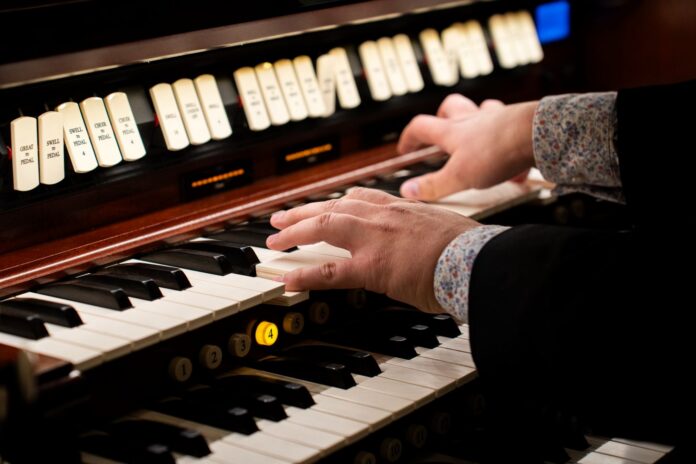
Students, faculty, families and alumni gathered at All Saints Newman Center at Arizona State University (ASU) in Tempe, Ariz., on Monday (April 20) for Mass and the dedication of the new organ by Bishop Emeritus Thomas Olmsted. 

After Mass, tours showed the organ’s internal works. Visitors played the organ with John Peragallo IV — whose family has serviced over 400 instruments across the United States —while John Peragallo III explained its mechanics and pipes, ranging in size from 16 feet to the size of a pencil. There was also a concert featuring performances by John Peragallo III, Lindsey Johnson, Mary Pendleton-Hoffer and Gavan McVey. 

The new pipe organ, built by the renowned Peragallo family, stands as an artistic achievement. With 37 ranks and over 2,100 pipes, it was crafted through four generations of organ builders. Much of the instrument was newly fabricated, while historic pipes — some of which are over 100 years old — were restored and incorporated. The Peragallo tradition traces back to builders trained in Ernest M. Skinner’s heritage, one of America’s great organ craftsmen. 

John Peragallo IV spoke of the care involved in bringing the organ to life. Each pipe was individually voiced to the chapel’s unique acoustics, ensuring beautiful resonance within the sacred space. The instrument connects the Newman Center to a distinguished musical lineage, shared with organs in the historic St. Mary’s Basilica in downtown Phoenix and St. Patrick’s Cathedral in New York. 

For Bishop Thomas Olmsted, the organ’s dedication marked the strengthening of a mission. His homily about the need for beauty in a soul’s formation resonated with one student who shared that sacred music is ancient, holy and draws her deeper into her faith.  

Chris Tawney, head of development at the Newman Center, also emphasized that “this organ is part of [the students’] formation.” Its impact on young men and women in the community is evident by the increase in participation in the choir program at the Newman Center as well as the ever-rising attendance at the 4 p.m. Sunday Mass, a weekly devotion for students, alumni and guests seeking sacred music within the liturgy.  

In a place where young adults seek truth, vocation and conversion, the organ’s voice will accompany prayer for generations to come.  

SEE FACEBOOK PHOTO GALLERY

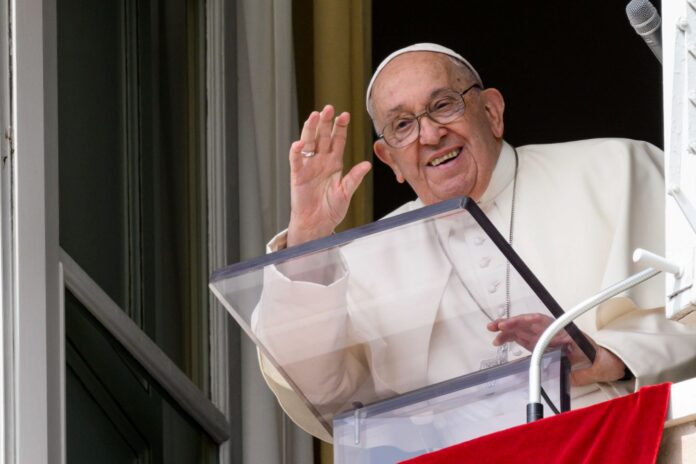
Francis’ First Anniversary

VATICAN CITY (CNS) — One year ago today, Pope Francis died at 7:35 a.m., April 21, 2025. 

It came the day after Easter, when — barely able to raise his hands — he gave his blessing “urbi et orbi” (to the city and the world). Looking drawn and worn, the 88-year-old pope from Argentina took his final ride in the popemobile, spending about 15 minutes among the crowd.

But then, the next morning, which was a major holiday in Italy, church bells tolled the death knell after U.S. Cardinal Kevin J. Farrell, chamberlain of the Holy Roman Church, announced that Pope Francis had died just a few hours ago.

“His whole life was dedicated to the service of the Lord and his church,” Cardinal Farrell said in a video announcement broadcast from the chapel of the Domus Sanctae Marthae, where Pope Francis lived.

The Wikimedia Foundation said that its “Deaths in 2025” entry, which included Pope Francis, was their second most-read entry during the year. And plenty of people took the occasion to learn more about his life too, adding that “His English Wikipedia article was the 11th most-read (page) of the year.”

Elected March 13, 2013, Pope Francis was the first pope in history to come from the Southern Hemisphere, the first non-European to be elected in almost 1,300 years and the first Jesuit to serve as successor to St. Peter.

Following in the footsteps of his predecessors, Pope Francis was an untiring voice for peace, urging an end to armed conflict, supporting dialogue and encouraging reconciliation.

He gave new energy to millions of Catholics — and caused concern for some — as he transformed the image of the papacy into a pastoral ministry based on personal encounters and strong convictions about poverty, mission and dialogue.

His simple lifestyle, which included his decision not to live in the Apostolic Palace and his choice of riding around Rome in a small Fiat or Ford instead of a Mercedes sedan, sent a message of austerity to Vatican officials and clergy throughout the church.

Although he repeatedly said he did not like to travel, he made 47 foreign trips, taking his message of Gospel joy to North and South America, Europe, Africa and Asia.

Jorge Mario Bergoglio was born in Buenos Aires, Argentina’s capital city, Dec. 17, 1936. He earned a chemical technician’s diploma from his high school and entered the Jesuit novitiate in March 1958. He was ordained to the priesthood Dec. 13, 1969, and made his perpetual profession as a Jesuit in 1973.

Father Bergoglio was named an auxiliary bishop of the Archdiocese of Buenos Aires in May 1992, was appointed coadjutor archbishop five years later and became archbishop of Buenos Aires in 1998; Pope John Paul II named him to the College of Cardinals in 2001.

Cardinal Bergoglio was a known and respected figure within the College of Cardinals, so much so that no one disputed a respected Italian journal’s report that he received the second-highest number of votes on all four ballots cast in the 2005 conclave that elected Pope Benedict XVI.

Eight years later, Pope Benedict retired. Cardinal Bergoglio was elected to succeed him and chose the name Francis to honor St. Francis of Assisi.

“Go out” was Pope Francis’ constant plea to every Catholic, from curial cardinals to the people in the pews. More than once, he told people that while the Bible presents Jesus as knocking at the door of people’s hearts to get in, today Jesus is knocking at the doors of parish churches trying to get out and among the people.

©2026 Catholic News Service/United States Conference of Catholic Bishops

Together as neighbors

My husband, Rich, has always supported my work in ministry. But he was initially ambivalent about my involvement with Kino Border Initiative (KBI), a nonprofit that provides humanitarian assistance to families and individuals in Nogales, Mexico — often immediately after deportation. 

Experiencing KBI had enriched my life greatly, so for months I invited him to join me for a weekend there. Eventually, he agreed. 

During that visit, Rich struck up a conversation with a man who had recently been deported from Los Angeles — Rich’s hometown. The man was wearing a Dodgers cap — the team Rich grew up loving. That small, familiar detail opened the door to conversation. 

They talked baseball. They talked about Los Angeles. Slowly, they began to talk about life. 

The man shared that he had two small sons still in Los Angeles and feared losing the landscaping job he had held for five years. Rich and I also had two small sons. We, too, had left Los Angeles for Phoenix so that we could better provide for our family. In that shared space of fatherhood, hope and responsibility, something shifted. 

Rich no longer saw an “immigrant” or a “case.” He saw a father — a neighbor. 

In that moment, they walked a path of encounter, shared humanity and grace together. That walk changed the direction of where the Spirit would lead Rich from then on. As a City of Phoenix police officer, it did not erase his respect for the law, but it expanded his heart. What happened in that shared moment between two fathers did not come through a lecture or a policy decision. It came through relationship. 

It reminded Rich, and all of us, that dignity is not conferred by status, but by God alone. 

In a time when hot button issues all too easily result in policy debates, enforcement strategies and political talking points, what is too often lost is the human face — the inherent dignity of the person standing before us. 

As people of faith, we are called to see God in each other, to accompany and to love. The Church has consistently reminded us of this call. Through the witness of our bishops, the invitation to solidarity and now through El Camino Real, year two of Bishop John’s seven-year pastoral plan, we are encouraged to take ownership of this call and walk the road of life together as neighbors.  

One way I feel called to do this in my daily life is to take the U.S. Conference of Catholic Bishops’ Cabrini Pledge, which offers a concrete way forward. Inspired by St. Frances Xavier Cabrini, patroness of immigrants, the pledge calls us to pray, learn, act and advocate so that our hearts and our communities may be transformed. At its core, the Cabrini Pledge is not about changing laws — it is about allowing God to change us. 

It’s about encountering our neighbors at work and in grocery store aisles and on street corners in the same way Rich and that father in Nogales encountered one another: as neighbors without judgment, without qualification, united by the truth that God created us all. 

I have seen how that transformation happens when we allow the Spirit to lead us and keep our hearts open. In this Easter season, I pray that my own heart remains continually conformed to God’s — open, attentive and willing to be transformed — and I pray that we may all walk together, sustained by the risen Christ.  

To learn more about the Cabrini Pledge, visit www.usccb.org/cabrinipledge 

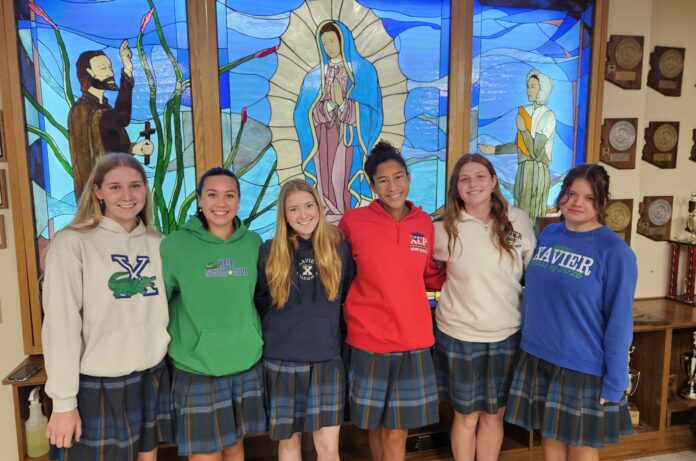
Xavier Prep students recognized for excellence

Xavier College Preparatory’s Swim and Dive team in Phoenix is making waves nationally for their academic excellence. 

The team earned Gold-Level Team Scholar recognition from the National Interscholastic Swimming Coaches Association (NISCA), achieving a 3.928 team GPA, placing them among the top academic programs in the country. 

In addition, six Xavier student-athletes were named Academic All-Americans, an elite distinction awarded to just 10–15 percent of high school aquatic athletes nationwide. To qualify, students must maintain a minimum 3.75 GPA while competing at a high level and contributing positively to their team. 

Xavier’s 2025–2026 Academic All-Americans are Ellie Desmond (Diving), Adriana Lauterborn (Swimming), Audrey McEwen (Swimming), Sophia Villanueva (Swimming), Sophie Dumanski (Swimming) and Stella Vinokur (Swimming). 

“We are incredibly proud of these young women,” said Assistant Coach David “Smitty” Smithers. “What they’ve accomplished goes far beyond the pool. It takes discipline, resilience and real commitment to excel at this level academically while competing in a demanding sport.  

“These honors reflect who they are: driven, focused and committed to being their best in every part of their lives.” 

Xavier Prep students are also making an impact outside of the pool. 

Four students were recently selected to participate in the highly competitive international Sister Cities Youth Ambassador Exchange Program, which offers high school sophomores and juniors the opportunity to engage in cultural exchange and global learning. Each student will spend two-to-three weeks abroad in June, living with a host family and experiencing daily life in their assigned sister city.  

In July, students will host their international counterparts in Phoenix for three weeks, participating in cultural activities and events designed to highlight the region and foster international relationships. Experiences include visits to local landmarks, meetings with city leaders and shared traditions that deepen cross-cultural understanding. 

Through the program, students develop global awareness, leadership skills and lasting international connections. 

Xavier’s Phoenix Sister Cities participants are Claire Allen (traveling to Prague, Czech Republic), Piper Paynter (traveling to Hermosillo, Mexico), Gisela Gutierrez Flores (traveling to Chengdu, China) and Niyati Reddymasu (traveling to Taipei, Taiwan). 

“I’m excited to be fully immersed in a culture so different from my own and to experience what it’s truly like to live in another country,” said Allen. “I hope to learn more about global traditions and perspectives, and I think this experience will challenge me to see the world — and myself — in a completely new way.” 

Xavier’s Swim and Dive program and participation in the Phoenix Sister Cities program exemplify the school’s mission of educating the whole person by developing young women who pursue excellence in the classroom, in competition and in their communities. 

Christ on campus; Newman Centers flourish in Diocese of Phoenix

photo courtesy of Holy Spirit Newman Center

At a time when young adults discover their freedom and often leave the faith, Diocese of Phoenix Newman Centers are present on college campuses to build community, personally accompany students and foster authentic encounters with Christ. All Saints Catholic Newman Center, Holy Spirit Newman Center and Holy Trinity Newman Center have shown abundant growth, serving hundreds of young adults — Catholics and non-Catholics alike — changing hearts along the way. 

House of hope 

Holy Spirit Newman Center, established just 10 years ago, serves the community at Grand Canyon University (GCU). The humble house of hope with a bright purple door stands not too far from campus. Though the building itself is small, the Newman Center has had a big impact on souls in the last decade. 

Senior Karina Avalos, one of the hundreds of students impacted over the years, had a strong encounter with the Lord at a Newman retreat after struggling to have faith in something greater. 

“I was saying constantly, ‘God, if You’re real, just show me and I’ll give You my life,’” Avalos said.  

It was on that retreat that God spoke to her — not in a thunderous way, but in a humble way. She described it as a “sense of love and peace in my heart that I never felt before.” 

“After that, I knew that I had a community.”

photo courtesy of Holy Spirit Newman Center

Such encounters are fostered with the help of the Sisters of the Servants of the Pierced Hearts of Jesus and Mary, a group of religious sisters that serve alongside pastor Fr. David Loeffler. In addition to moments of prayer and encounter, there are also opportunities for students to grow in service. 

Serving is one of the fundamentals at the GCU Newman Center. With the focus on fostering family and community, they are constantly “giving ourselves as a community to others,” Development and Engagement Coordinator Cassy Beltran said. 

“Any leftovers we have [from weekly Newman Night meals], we don’t like to consider a leftover. We just like to consider it as another meal for the people around.” 

The students at the GCU Newman Center are also known for their deep love for the Lord. Weekly, 150-175 students gather for Sunday Mass, which is celebrated on a makeshift altar.  

“There’s [other local] churches where it’s just like a big screen or a huge stage, and [our altar] is just a little platform made 30 seconds ago,” Avalos said. 

But these humble means are a meeting place with the Lord. 

“We just try our best to give God the most respect and love we have.” 

“We are with you”  

Across town in Tempe, Ariz., All Saints Catholic Newman Center at Arizona State University (ASU) has shown tremendous growth. With ASU being a notorious “party school,” All Saints Newman staff take a different approach than might be expected when it comes to encountering students. 

photo courtesy of All Saints Catholic Newman Center

“We do want to stand as a beacon of hope and inspiration for students,” said Ryan Ayala, All Saints’ director of campus ministry. But more than fighting against the culture and the realities many young adults face, his team instead strives to show students that “we are with you, not against you.”

Ayala describes the Newman Center as meeting young adults right where they are on their journey. He wants students to know: “We want to join you. We want to help you. We

want to assist you. We want to walk with you.”

The approach is bearing abundant fruit. In fall of 2025, 52 young adults came into full communion with the Catholic Church through the Newman Center’s Order of Christian Initiation of Adults (OCIA) program, and earlier this month at the Easter Vigil nearly 50 more students joined in. That’s more than double last year’s numbers.

Ayala credits the abundant growth to Bible studies and a strong OCIA formation program. 

“We are seeing a 10-to-12-percent increase across those major programs,” said Ayala, who emphasized studying Scripture as the primary formation for students wanting to grow deeper in their faith. All Saints actively encourages young adults to “really immerse yourself into the written Word … and learn to grow as disciples.” 

Ayala sees the thriving OCIA program as a sign of a healthy Newman Center. 

“At the end of the day, that’s why we exist … to bring souls closer to Christ.” 

An engaging presence 

The Northern Arizona University (NAU) Catholic Jacks at Holy Trinity Newman Center have a strong presence on campus. More specifically, through social media they continue to spread the Gospel at a time when students need it most. 

“The college years are the perfect time where someone has a little bit of space and freedom, where they can make their own adherence to Christ,” said pastor Fr. Matt Lowry. He and his team seek to be present and inviting to students. 

Whether it’s through pickup basketball games or free meals, Fr. Lowry easily connects with young people in many ways. But one of his favorites? Social media.  

The outgoing priest has gone viral on TikTok several times and currently has more Instagram followers than any other Newman Center in the country at 183,000 followers. He also has more followers than the NAU itself. 

photo courtesy of Holy Trinity Catholic Newman Center

Fr. Lowry’s relatability has helped the presence of the Newman Center grow on campus and has given the group a good reputation to both Catholic and non-Catholic students alike, “even before they’ve come to encounter us,” Fr. Lowry said. 

In their own unique ways, the Diocese of Phoenix’s three Newman Centers are doing the important work of engaging students, meeting them where they are and introducing them to Christ. 

“Newman Centers are arguably one of the most important works that we can do right now in the Church’s mission, especially its mission on evangelization because a lot of souls are being won and lost at the college level and at the university level,” said Ayala.  

Fr. Lowry agrees. It’s important work to invite students in “so that they become lifelong missionary disciples.” 

Contributions by Catherine Mulhern

Bishop talks mental health, inspires hope in high school students 

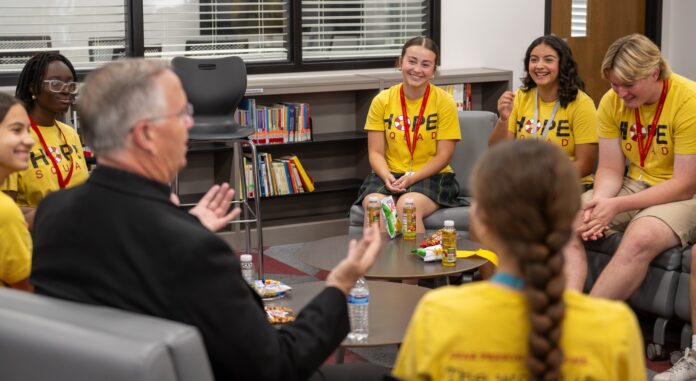
Mental health was the focus of Wednesday (April 15) morning’s school assemblies at Seton Catholic Preparatory in Chandler, Ariz., as over 600 students, faculty and staff gathered to hear Bishop John Dolan share his personal experiences of losing four family members to death by suicide — his brother, Tom, when Bishop Dolan was in eighth grade, his sister, Therese, and brother-in-law, Joe, when he was in seminary and his sister, Mary, in 2022 during his first year serving as Bishop of Phoenix.   

The bishop emphasized that no one journeys alone and that the Church is here for all who experience mental health struggles. This has been a consistent message since Bishop Dolan established the diocesan Office of Mental Health Ministry in December 2022. He also elaborated on the three pillars of the Office of Mental Health Ministry: accompaniment, education and advocacy. 

In addition to speaking at two assemblies, Bishop Dolan gave a blessing to the Hope Squad, Seton’s peer support suicide prevention program that focuses on outreach to increase belonging among the student body. He also met personally with members of the group following the assembly. 

“Our goal is to emphasize that our faith and professional mental health care go hand in hand when we are struggling,” said Principal Victor Serna, Ph.D.   

“We want students to understand the importance of seeking Jesus in our struggles, and also that our Lord provides community, accompaniment and the gift of clinical knowledge to support us when we are struggling.”  

For more information about the Office of Mental Health Ministry, visit dphx.org/mentalhealth/ 

SEE FACEBOOK PHOTO GALLERY

Bishop Dolan celebrates sacraments in the Arizona Department of Juvenile Corrections

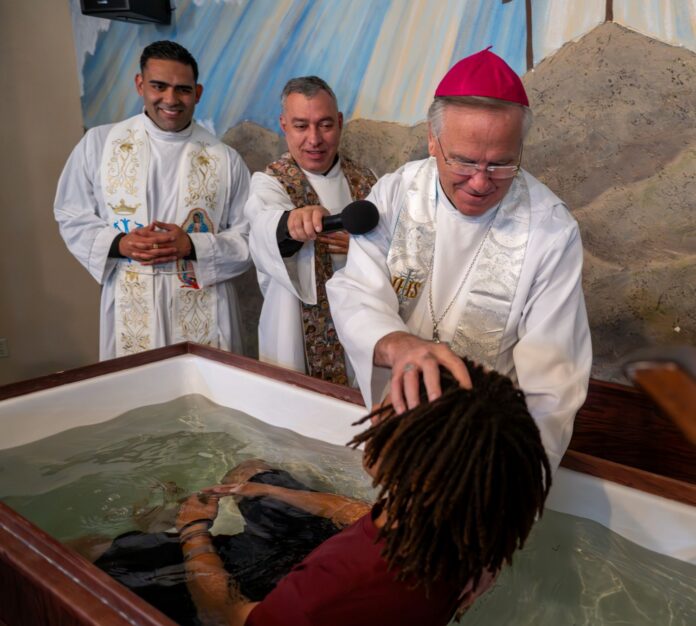
Three young people at Adobe Mountain School in Phoenix, run by the Arizona Department of Juvenile Corrections, were baptized by Bishop John Dolan on Tuesday (April 14), and were joined by four others in receiving the additional sacraments of initiation. Fr. Andres Arango, Vicar for Human Dignity, and Cpt. Fr. Estevan Wetzel, chaplain for the Army National Guard and director of Prison Ministry and Restorative Justice — a branch of the Diocese of Phoenix’s Office for Human Dignity — were also in attendance. Three seminarians from the local Nazareth Seminary played music during the liturgy.

“The baptisms were full immersion, and of the seven kids five are boys and two are girls, all between the ages of 14-17,” said Ted Ebner, coordinator of Prison Ministry and Restorative Justice. “All the kids were allowed to invite family members.”

The Prison Ministry and Restorative Justice team also ministers to men and women in 14 prisons and jails throughout the diocese in addition to Adobe Mountain School, the only juvenile corrections facility in the state. Partnering with employees of Adobe, one of whom is a chaplain, and a team of volunteers, Ebner teaches classes to connect with young people and introduce them to Jesus.

“On Tuesday nights I teach a class on Catholicism at Adobe. If the kids chose to take it further with sacraments we enroll them in an additional Friday afternoon class with the seminarians as teachers,” continued Ebner.

Cpt. Fr. Wetzel also provides the sacrament of confession throughout the month.

“After receiving the sacraments they continue with my Tuesday night classes as well,” said Ebner. “Upon graduating from Adobe, we always provide a ‘Lady of Guadalupe’ framed picture for their room when they return home, and of course a rosary.

“Our Lady of Guadalupe and St. Jude provide a lot of assistance for us in the juvenile world. When we combine that with the Holy Spirit and the strong desire for the truth by our kids, we get tremendous results.”

SEE FACEBOOK PHOTO GALLERY

Pope decries horror, inhumanity that ‘some adults boast of with pride’

By Carol Glatz

VATICAN CITY (CNS) — Warning against an increasingly unpredictable and aggressive “delusion of omnipotence” threatening the globe, Pope Leo XIV called on world leaders and individuals to empty their hearts and minds of hatred and violence, and to start serving life.

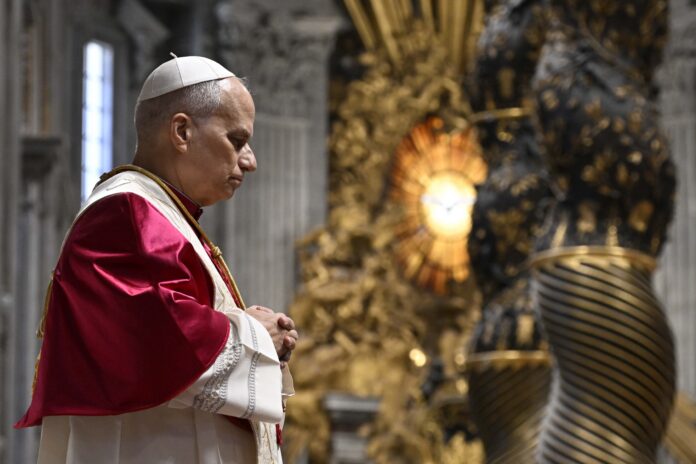
“Enough of the idolatry of self and money! Enough of the display of power! Enough of war! True strength is shown in serving life,” he said during a special evening prayer vigil for peace in St. Peter’s Basilica April 11.

“Those who pray are aware of their own limitations; they do not kill or threaten with death,” he said. “Instead, death enslaves those who have turned their backs on the living God, turning themselves and their own power into a mute, blind and deaf idol, to which they sacrifice every value, demanding that the whole world bend its knee.”

“Let us listen to the voices of children,” who write to him all the time, recounting “all the horror and inhumanity of actions that some adults boast of with pride,” he said.

The vigil, which drew thousands of people inside and outside the basilica, featured the recitation of the glorious mysteries of the rosary. Before each mystery was recited, women wearing traditional dress from countries representing the different continents of the world lit small lamps from a flame from the Lamp of Peace from Assisi that was placed below a statue of Our Lady Queen of Peace.

Prayer can move mountains, he said in his remarks in Italian. “War divides; hope unites. Arrogance tramples upon others; love lifts up. Idolatry blinds us; the living God enlightens.”

It just takes a tiny bit of faith “to face this dramatic hour in history together,” he said.

For a people of faith in the risen Lord who conquered death with love, he said, “nothing can confine us to a predetermined fate, not even in this world where there never seem to be enough graves, for people continue to crucify one another and eliminate life, with no regard to justice and mercy.”

While the pope did not mention any one current conflict in his remarks, he did recall St. John Paul II’s fervent efforts and calls for peace during the 2003 invasion of Iraq conducted by the U.S. with the assistance of a multi-national coalition.

“I make his appeal my own this evening, relevant as it is today,” Pope Leo said, referring to his predecessors’ calls for “No more war.”

“The Church is a great people at the service of reconciliation and peace,” he said. “She advances without hesitation, even when rejecting the logic of war may lead to misunderstanding and scorn.”

The Church “proclaims the Gospel of peace and instills obedience to God rather than any human authority, especially when the inherent dignity of other human beings is threatened by continuous violations of international law,” Pope Leo said.

With the help of prayer and God, people can help “break the demonic cycle of evil” and be at the service of the Kingdom of God, where there is “no sword, no drone, no vengeance, no trivialization of evil, no unjust profit, but only dignity, understanding and forgiveness,” Pope Leo said.

“It is here that we find a bulwark against that delusion of omnipotence that surrounds us and is becoming increasingly unpredictable and aggressive,” he added.

He criticized the use of God’s name in justifying violence, saying “even the holy name of God, the God of life, is being dragged into discourses of death.”

Those invoking God’s name in such a way erase a world made up of brothers and sisters with one heavenly Father and instead create a “nightmare” where the world is made up of enemies and threats, rather than calls to listen and to come together.

Speaking to the world’s leaders, the pope said, “Stop! It is time for peace! Sit at the table of dialogue and mediation, not at the table where rearmament is planned, and deadly actions are decided!”

However, all the world’s people also have a duty to reject the violence in their own hearts and minds, and help build a kingdom of peace each and every day in one’s own home, school and community, he said.

“Let us believe once again in love, moderation and good politics,” he said, urging people to learn more and “get personally involved” in being part of “the mosaic of peace!”

“Dear brothers and sisters, let us return home having made a commitment to pray without ceasing and without growing weary, a commitment to a profound conversion of heart,” the pope said.

Before entering the basilica, Pope Leo greeted the faithful gathered in St. Peter’s Square, thanking them for their presence. He explained his reason for calling for the prayer vigil, which was also being joined by countless others around the world, either online or in their own parishes.

By praying the rosary together, he said, “we want to tell the whole world that it is possible to build peace, a new peace, that it is possible for all people, of all religions, of all ethnicities, to live together, and that we want to be disciples of Jesus Christ, united as brothers and sisters, all united in a world of peace.”

©2026 Catholic News Service/U.S. Conference of Catholic Bishops