NOTE: Christ in Our Neighborhood is a parish-based program consisting of small Christian communities that gather in the home weekly to prayerfully discuss the upcoming Sunday Mass readings. It’s easy to form a community and you can find out more by searching “Christ in Our Neighborhood at the Diocese of Phoenix website, dphx.org.
This coming Sunday, we celebrate the Eleventh Sunday in Ordinary Time. The question the Christ in Our Neighborhood commentary asks us is: Am I aware that I have been sent as part in God’s plan for the salvation of all mankind? What is my part in that plan?
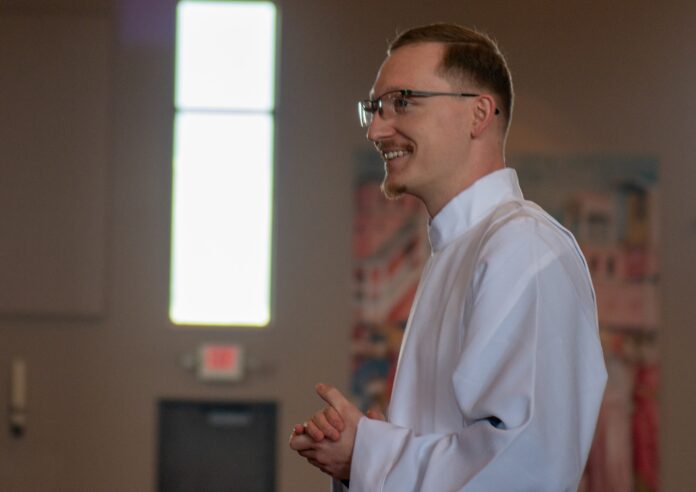
If you’ve been baptized, then you’ve been anointed as priest, prophet, and king. As such, you are called by Our Lord Jesus Christ to be His witness in the world, to share the love, hope and joy of the Gospel.
Many times, we’re tempted to think that’s a role that belongs only to certain “experts” when in fact evangelizing is something each one of us needs to embrace. You might consider starting your day by asking the Lord to show you how to radiate His kindness, tenderness and mercy to others in each encounter you have throughout the day. Lord Jesus, how can I bring Your peace into a broken world? How can I share Your love with my family, my co-workers, my neighbors?
When we begin to move this way in the world, people around us are attracted to it. Listen to them and get to know them. Evangelization happens in the context of relationships and through friendship.
Watch for the right opportunity and when someone asks your advice or wants to know why you are at peace, you’ll be able to honestly tell them, “I entrust everything to the Lord Jesus. He’s my Rock.” And, consider inviting them to your Christ in Our Neighborhood group!
If you haven’t joined a Christ in Our Neighborhood small group yet, perhaps you are being called to start one yourself. It’s easy! Check out our website today to find out more: dphx.org/Christ-in-our-neighborhood.
Watch the video of the weekly podcast segment featuring Christ in Our Neighborhood with Bishop Dolan by clicking HERE.
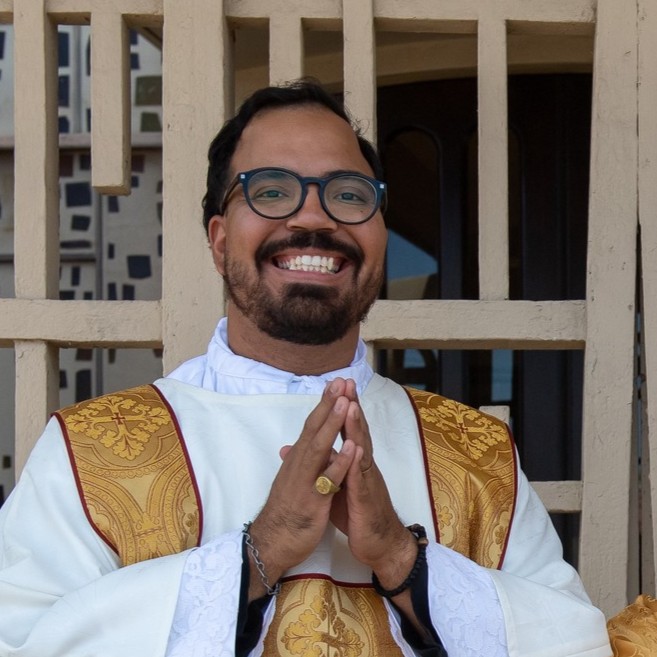
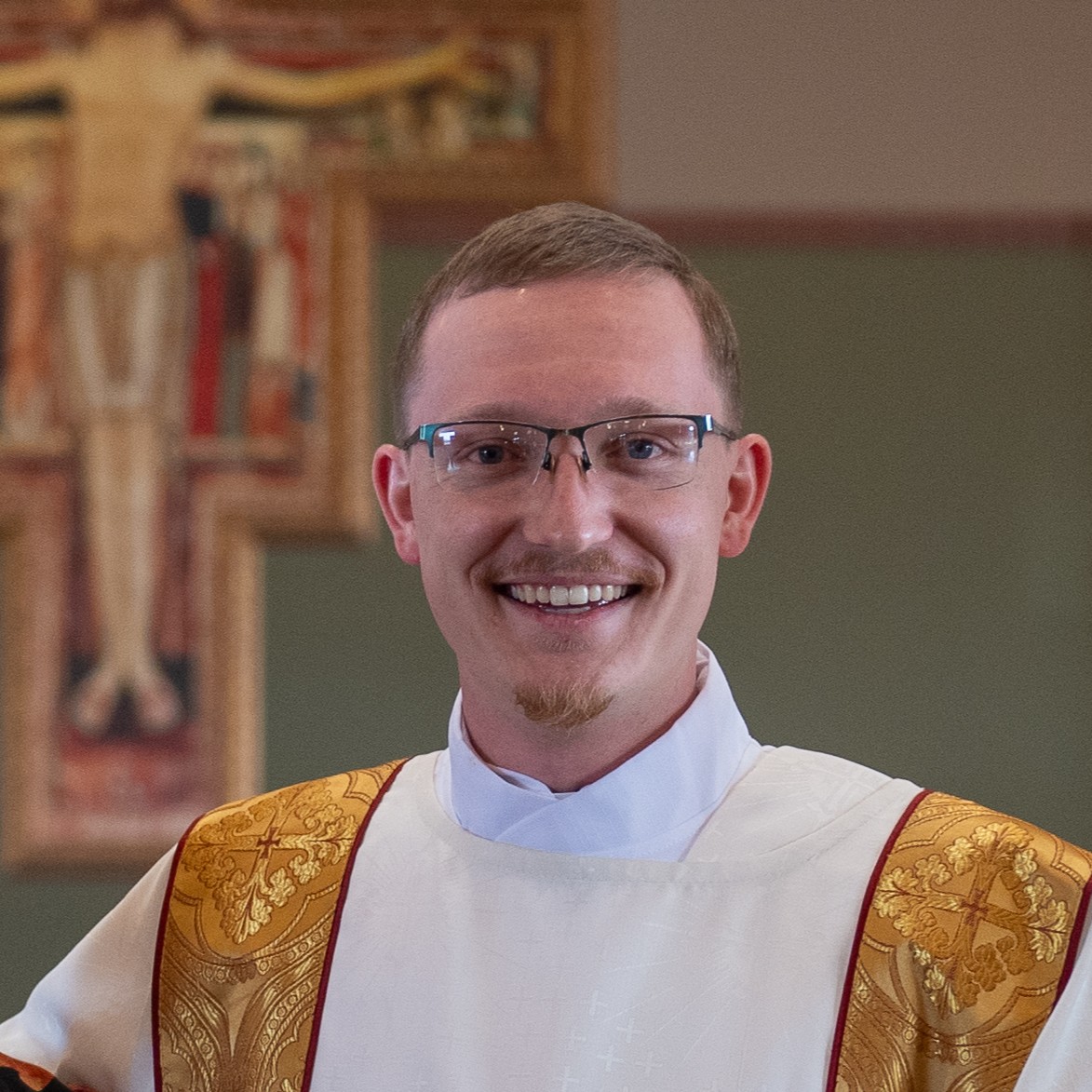
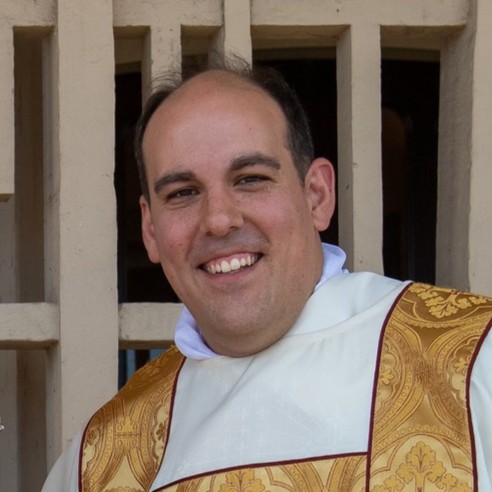
The Diocese of Phoenix, one of the nation’s fastest growing, has four new priests.
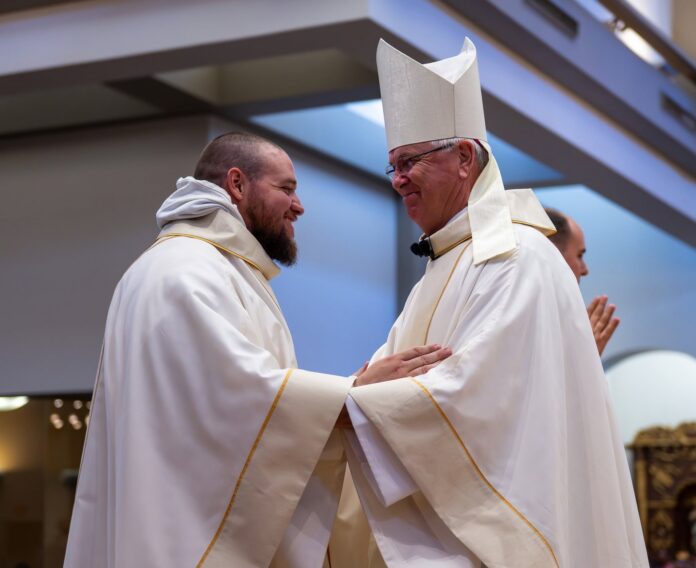
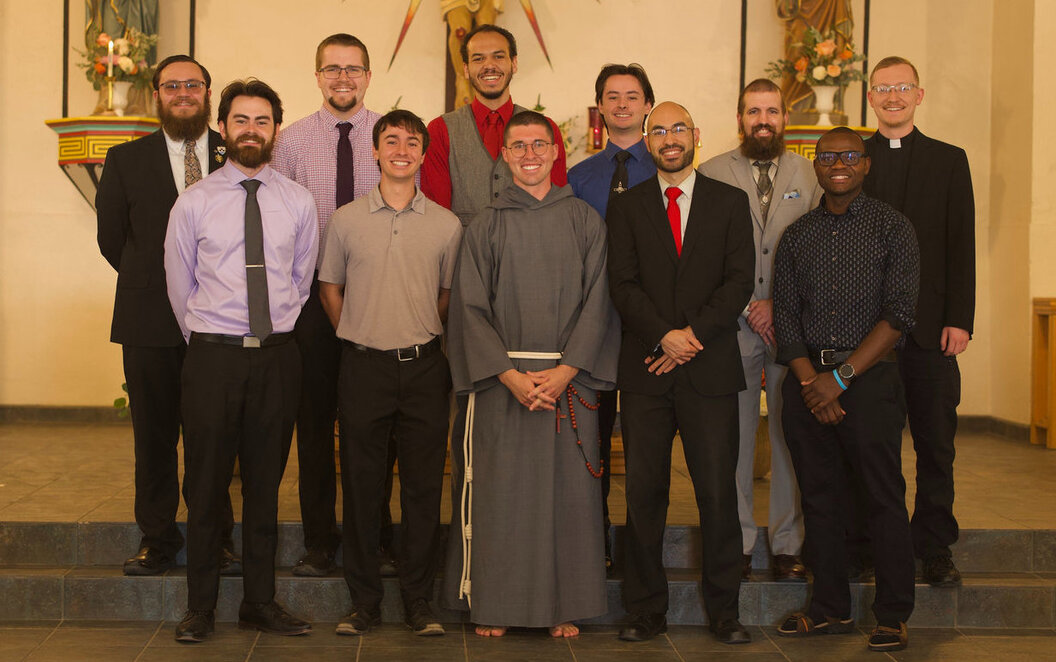
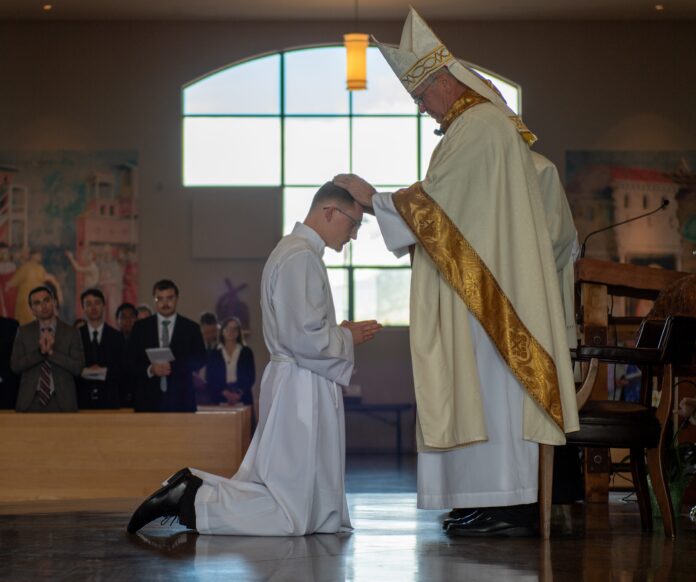
Fr. Nathan Blanchard, Fr. Paul Graupmann, F.H.S., Fr. Simon Ortiz, and Fr. Jeff Pooley were formally added to the fraternity of clergy during a Mass of Ordination celebrated by Bishop John Dolan at St. Thomas Aquinas Parish in Avondale, Ariz., Saturday (June 6).
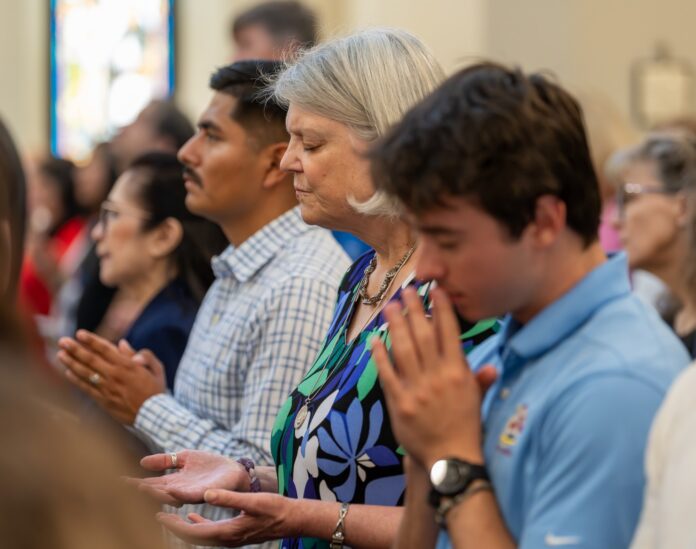
Family and friends of the new priests made up the congregation of more than 1,800 worshippers, which also included priests, women religious, deacons, laity and seminarians who are part of the largest formation wave in diocesan history.
“The Holy Spirit is moving,” Bishop Dolan told the faithful. “The Lord is still breathing life into His Church. You four men are signs of that breath moving you and the Church here in Phoenix.”
After Office of Vocations Director Fr. Will Schmid presented the four as “worthy,” Bishop Dolan spoke briefly about each one.
“Brothers, your stories are beautifully different, but together they proclaim one truth: God acts first,” he said.
Recalling the day’s first reading, the bishop reminded the four that while they answered God’s call, it was He who chose them first.
“Before I formed you in the womb, I knew you, before you were born, I dedicated you, a prophet to the nations I appointed you,” states the book of the prophet Jeremiah.
Bishop Dolan told the ordinands, “Before you ever searched for God, He searched for you. Before you ever loved Him, He loved you. And before you ever chose Him, He chose you.”
“Brothers,” he continued, “there will be days in priesthood when you will feel tired, days when ministry feels heavy, days when the wounds of the world and even the wounds of the Church weigh upon you. And on those days, do not begin with yourself, begin with Him. Because priesthood is not sustained by your personality or your efficiency or your success. It is sustained by abiding in the love of Christ who forms you, and knows you, and dedicates you and appoints you.”
The four men then promised under the Holy Spirit’s guidance to serve faithfully their flocks and the Church, and to be united more closely to Christ each day. They also professed obedience to the bishop and his successors.
Each man then prostrated himself before the altar as the congregation sang in supplication to the saints of the Church.
“It’s a profound moment for the body of Christ to watch, be there with them and pray for them,” said St. Thomas Aquinas parishioner Matthew Scheller, who is scheduled this November to be ordained as a permanent deacon.
“For them, it’s an emptying; they’re giving everything; their lives. When they stand up, they are then representing Christ as servant. They’re changed,” he said.
Proud families, colleagues
What followed brought back memories for Christina Blanchard, Fr. Blanchard’s mother.
As dozens of priests lined up on the altar to bless their four new colleagues, Christina began flipping through visual images.
“I just started thinking of all the 38 years we have been in this diocese, and all the moments of Nathan’s encounters with all of these priests; at our parish, at various functions, and how all these people have impacted our lives, and that we all are connected as the body of Christ.”
Fr. Blanchard’s sister, Sr. Rene Noel Blanchard, O.P., was among the worshippers. She entered religious life with the Ann Arbor, Mich.-based Dominican Sisters of Mary, Mother of the Eucharist in 2010, making her final vows in 2018.
Fr. Blanchard’s father, Dcn. Greg Blanchard of San Francisco de Asis Parish in Flagstaff, Ariz., became emotional as he reflected on the just-concluded Mass.
“I’m just grateful for all that God’s done in all of our lives,” he said, tearing up
Other families and friends were touched as well.
Mary Graupmann, whose husband died two years ago, traveled from her home in South Dakota, where her son, Fr. Graupmann, F.H.S., grew up. By his admission, he had developed a “wild lifestyle,” uninvolved with the faith before a dramatic conversion as a young man.
“I am so extremely proud,” his mother beamed. “I couldn’t be happier for him. He was not holy growing up. But, he found the Lord. His passion was so great; so beautiful. As a mother, it makes my faith stronger.”
Fr. Graupmann’s sister, Jessica Graupmann, who was there from her San Diego, Ca., home, said it was a joyful day.
“Thinking back 10 years, I would not have pictured this moment. I’m so proud of him. He’s going to do amazing things. He has that personality that people are drawn to him. When he is passionate about something, he puts his all into it. He will put his all into being a priest,” she said.
As the Graupmanns spoke outside the parish hall, newly ordained Fr. Pooley was inside with his three new brother priests, administering first blessings to the faithful.
“It’s a beautiful day,” Fr. Pooley said. “So many friends and family are out. I just felt really blessed by the Lord, especially during the Ordination Mass … to celebrate the Mass for the first time with Bishop John, looking at all the people of God present, [sharing] the joy.”
‘A beautiful life’
On July 1, the new priests will step into their first assignments. Fr. Pooley will become parochial vicar at San Francisco de Asis Parish in Flagstaff. Fr. Blanchard will be parochial vicar at Our Lady of Perpetual Help Parish in Scottsdale, Ariz. Fr. Ortiz will become parochial vicar at St. Daniel the Prophet Parish in Scottsdale.
Essentially an assistant pastor, a parochial vicar performs the same ministerial and sacramental tasks as a pastor, but does not share a pastor’s administrative and financial responsibilities.
Fr. Graupmann, a member of the Franciscan Friars of the Holy Spirit, based in Laveen, Ariz., will continue serving the Native American community.
The friars are leading 20 couples in marriage preparation, and there are ministries to youth and to prisoners, as well as mission administration, said Fr. Antony Tinker, their community servant who leads the friars.
“He’ll be doing a little of everything,” Fr. Tinker said, adding that Fr. Graupmann has a gift for connecting with young people.
“A lot of them are fatherless,” he explained. “He’s disciplined, [and] he brings joy and levity that is so often needed for youth.”
All four new priests carry a “peaceful joy,” said Frederick Changho of St. Mary’s and St. Juan Diego Parish in Chandler, Ariz., where Fr. Ortiz served as a deacon last summer.
Changho said despite technology’s many benefits, it also has robbed many of quality, meaningful face-to-face socializing.
“That creates almost an atmosphere of worry, tension and anxiety, and people like [Fr. Ortiz] have that peace; that joy they carry themselves with that only the Lord can provide. The Church needs to encourage that warmth and community, and people gifted like [Fr. Ortiz] can do that.”
Abby Hess, youth minister at St. Mary’s in Chandler worked alongside the future Fr. Ortiz last year.
“He was so helpful, so humble, so involved in everything we did. He loved the people he worked with, and you could tell his calling was the priesthood because of his love for the Lord and his love to share that with other people.”
Fr. Ortiz’s and his colleagues’ ordinations have a message for the young, Hess said.
“Not only for my generation but for those coming up, it’s such an awesome reminder that following the Lord’s will for your life will bring you true peace, that it is cool to be a priest and it gives you so much joy.”
The numbers say the message is getting out. There are currently 48 seminarians in formation and another six applying.
“It’s an exciting time for the seminary,” said Fr. Paul Sullivan, rector of Nazareth Seminary, the diocese’s fully local seminary. “We’re blessed by good men who come forward.”
Fr. Schmid, who will take over as director of the diaconate this year, said, “The Lord’s doing a lot of good work” in the priesthood.
“This is a beautiful life. I’m excited for [these four men] to enter into it and the joy they’re going to encounter.”
Father Eusebio Kino had a vocation that has impacted generations. As a Jesuit priest, he founded 20 missions in Southern Arizona and Northern Mexico in the late 1600s, riding on horseback while spreading God’s love.
The Kino Catechetical Institute in the Diocese of Phoenix, named after this horse-riding priest, helps students experience a deeper sense of their vocation. Founded in 1972 by Father Ernest Larkin, the Kino Institute offers faith formation programs for Catholic school teachers, aspiring deacons, parish catechists and any Catholic adult seeking to deepen their faith.
Among the courses offered is a two-year faith formation program called Agua Viva, which is
active in three parishes in the diocese — Our Lady of Guadalupe in Queen Creek, Ariz., St. Vincent de Paul in Phoenix and St. William in Cashion, Ariz. The program will also be starting at Ss. Simon and Jude Cathedral in Phoenix in September.
A marriage set ablaze
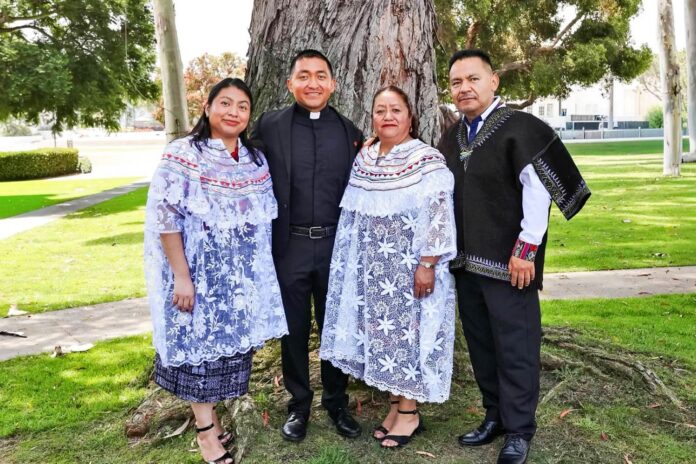
Originally from Guatemala, married couple Felipe Mateo-Martin and Reynalda Sebastian are parishioners at Our Lady of Guadalupe in Queen Creek. They enrolled in Agua Viva nearly 20 years ago. Mateo-Martin, a catechist for the local Guatemalan community at Queen of Peace in Mesa, Ariz., wanted to take the course to be a better leader. Sebastian joined, wanting to share what they learned with their two children.
The fire of the Holy Spirit was enkindled within the couple as they participated in Agua Viva, and they decided to enroll in an additional two-year formation program with the Kino Institute.
Although they were both born and raised Catholic, Sebastian admitted that she didn’t really practice her faith until she married her husband. During the Kino programs, the couple found themselves clinging to the sacraments more than they ever had, and their deepening faith started to impact their children.
“Prior to going through the program, we were not going to Mass every Sunday, not praying very often and put God last,” Sebastian said. “After the program … God is now at the center of our lives as a family.”
Since graduating from the Kino programs, Sebastian has become an Agua Viva instructor herself, and the couple’s vocation has deepened.
“It has helped us understand our marriage and that God is the author,” Mateo-Martin shared.
An intergenerational impact
But the impact didn’t stop there. The flame of the Holy Spirit was passed to their children, Briseyda Mateo-Sebastian and Mike Mateo-Sebastian, SJ, who also decided to go through the same Kino programs as young adults.
Being exposed to religious literature during her time at Kino is what helped Briseyda grow
in her understanding of God. For the first time, she claimed the Catholic faith for herself.
“I wasn’t just praying or believing in something because I was told to. I was praying and believing in something because I now had the knowledge to understand why.”
Although she graduated from the program 10 years ago, she still remembers how it impacted her.
“[Kino] helped me be less influenced by what the world was trying to teach me … I was able to … discern between what would bring me closer to Christ and what would … keep me away from Christ.”
What stuck with her most from Kino were the different types of people she was able to meet.
“We were all there to learn about our faith. It exemplified the universality of our Church,
and that God and our salvation isn’t just for a select few, but for all.”
Now, Briseyda follows the example of her parents, who continue to serve their Guatemalan community, by helping with sacrament preparation classes and the Order of Christian Initiation of Adults (OCIA).
“The Kino program was the start of how I started to serve my people. Before, I never thought about how I can share my faith with others. After having gone through Kino, I had the tools to be confident in being able to do that.”
A family legacy
Briseyda’s brother, Mike, also went through the programs, which inspired him to give back to the Guatemalan community, as well as nearby parishes. The family legacy of service continued.
While Mike was going through Kino from 2014-2016, he was also attending Benedictine University in Mesa, Ariz., majoring in theology. It soon became clear to Mike that he was made for relationship with Jesus.
As he continued to grow in his faith, Mike noticed a new desire blooming — a desire for the priesthood. He first noticed this stirring his freshman year of college and his first year at Kino. He thought there might be something more than having a steady job after college.
“Seeds were implanted … [I thought], maybe there’s something more to simply clocking in and out, day in and day out. There’s something more I can dedicate myself to.”
While attending discernment events hosted by the diocese, he realized he didn’t feel a tug to become a diocesan priest. He continued to discern during his next round of classes at Kino, which included a course on Catholic spirituality. It was in this class that he was introduced to Ignatian spirituality.
“I felt like a match … with Ignatius spirituality … Living the faith day in and day out, [Ignatian spirituality] is something that can help me do that … I want[ed] more.”
Mike put his vocational discernment on hold as he graduated with a degree in theology in 2018. He entered the workforce and continued to serve the Catholic community. It wasn’t until 2020 that he revisited the question of his vocation, feeling a tug in particular to learn about Jesuit saints. Reading St. Aloysius Gonzaga’s biography was a turning point.
“When [St. Gonzaga] decided that he was going to enter the Jesuits … he began to pray for certitude. I was like, ‘St. Gonzaga did it … I might as well do the same thing, too.’ I [prayed], ‘If this is what You want from me … I pray that You confirm this.’”
Like a still, small voice, the Lord continued guiding Mike to the Jesuits.
“I was like, ‘Lord, I really feel and see Your winds guiding me this way. I don’t know how this is going to end, so I trust in You.’”
Mike was accepted into the Jesuit Order two years ago and now attends St. Louis University in Missouri. He resides at the Bellarmine House of Studies, a Jesuit formation house. On Aug. 9, 2025, he professed first vows, and he continues to follow the whispers of the Lord.
“I’m on this journey, but I’m not on this journey alone. No vocation is done alone. With me are my parents and my sister, praying. We’re praying for each other.”
As St. Aloysius continues to guide Mike in his vocation, it’s likely that another Jesuit saint-to-be has been guiding Mike’s footsteps — and the footsteps of his family — all along: Servant of God Father Eusebio Kino.
For more information about Kino Catechetical Institute, visit dphx.org/kino/
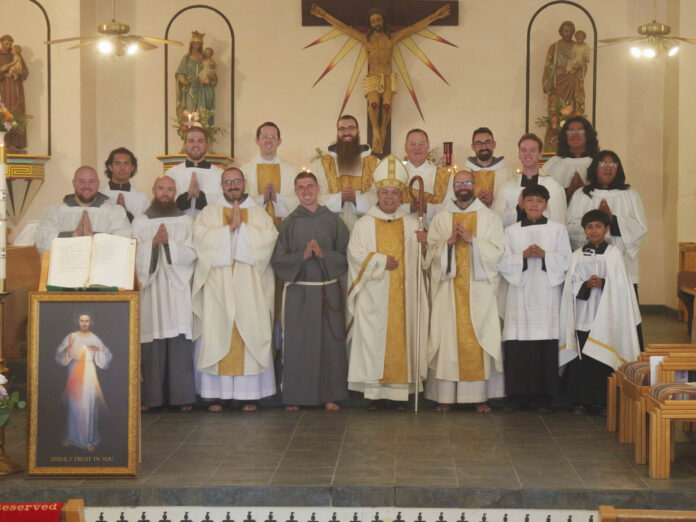
Br. Damien Van Amerongen, F.H.S., made his perpetual promises on Saturday (May 30) with the Franciscan Friars of the Holy Spirit, founded in the Diocese of Phoenix with the mission to tend to the pastoral and spiritual needs of Native American communities. Auxiliary Bishop Peter Dai Bui presided over the liturgy held at St. John the Baptist Parish in Laveen, Ariz.
Below is a letter from the Franciscan Friars of the Holy Spirit describing what perpetual promises are, sharing significant details of the liturgy and explaining what this step means for Br. Damien and the community.
If you haven’t heard the exciting news, Br. Damien made his perpetual promises to the community this past Saturday, and we couldn’t be more thrilled for him.
We get a lot of questions about the different stages of the formation process, one of the questions being, whatareperpetual promises?
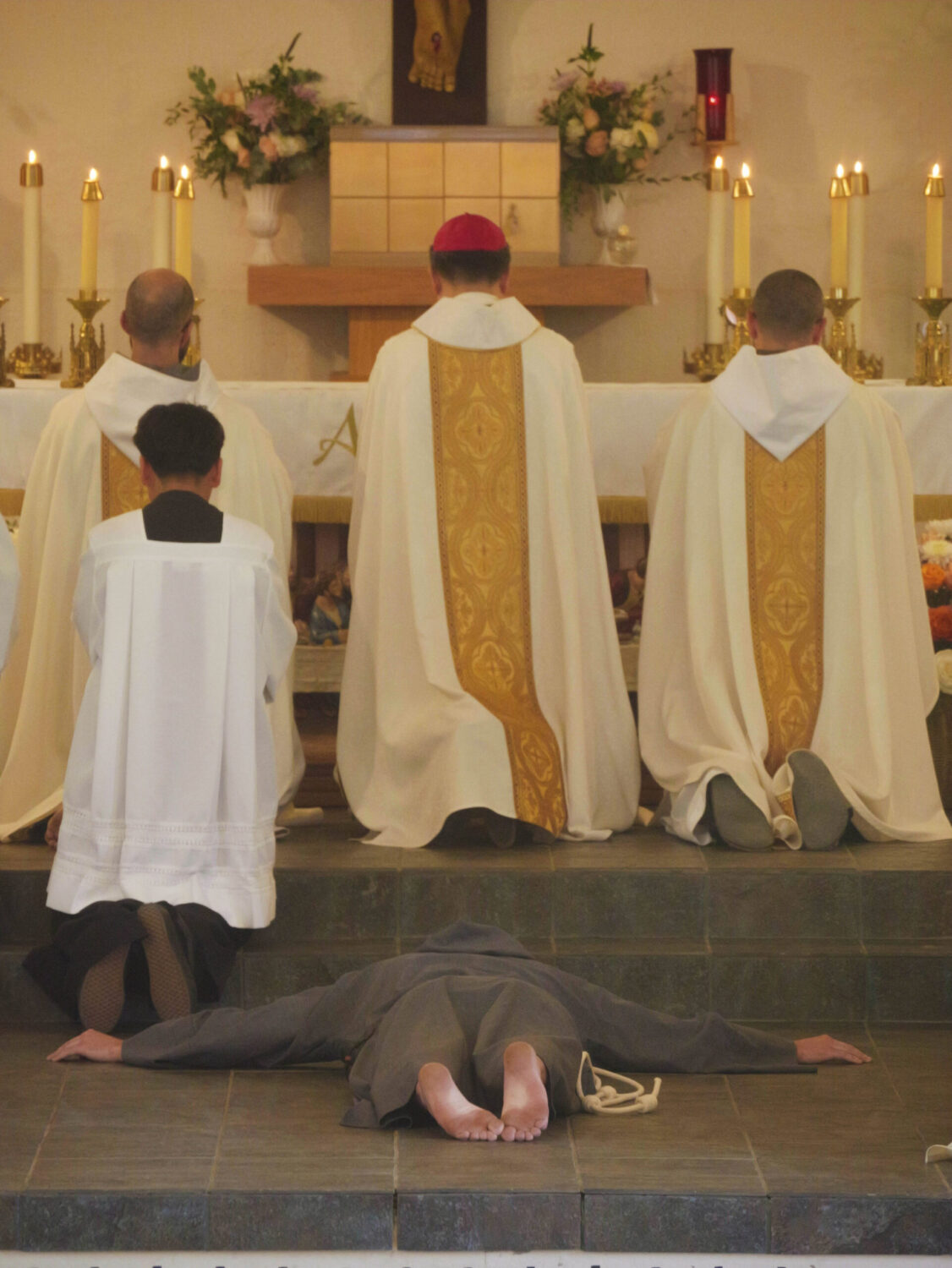
Br. Damien lying prostrate during his perpetual promises.| Hartnett Productions
A brother who makes perpetual promises dedicates their life to God, in service to the mission of their community for the rest of their lives.
At Br. Damien’s perpetual promises, he laid prostrate, a visible sign of his promise to lay down his life for God.
When Br. Damien made perpetual promises, he dedicated his life to God and committed to living the Rules of St. Francis and the statutes of the FHS association. He committed to living our mission, serving underserved Native communities, for the rest of his life.
We had the joy of welcoming newly ordained, Auxiliary Bishop Peter Dai Bui who received Br. Damien’s perpetual promises. Bishop Bui gave a beautiful homily, reminding us that God chooses us before we choose Him. He has a plan for us. During Br. Damien’s perpetual promises, he processed into the Church carrying a lit candle, a symbol of his baptismal candle. It’s a beautiful symbol to show that God had this plan for Br. Damien at his baptism.
Br. Damien with fellow seminarians receiving formation at Nazareth Seminary | Hartnett Productions
Another beautiful part of perpetual promises is a prayer known as the Suscipe, meaning to “receive.” It’s a prayer of surrender to the Lord.
At Br. Damien’s perpetual promises, he prayed the Suscipe twice and on the third time, the rest of the men in our community who have made perpetual promises joined in. It was a reminder to Br. Damien that he is not alone on this journey. He is part of a brotherhood of other Friars who have also dedicated their lives to God.
Thank you to everyone who has supported Br. Damien over the years either with your prayers or financial support. It all made it possible for him to make perpetual promises.
Br. Damien will continue his seminary formation to the priesthood at Nazareth Seminary in the Diocese of Phoenix. Please continue to pray for him in his formation journey.
Bishop John Dolan celebrated the annual Mass of Thanksgiving for Priests and Seminarians on Wednesday (June 3) in the Virginia G. Piper Chapel at the Diocesan Pastoral Center (DPC) in downtown Phoenix. The standing-room-only celebration included DPC staff, 12 priests who support the bishop in a variety of capacities at the diocesan level and 36 of the Diocese of Phoenix’s current 52 seminarians including Dcn. Nathan Blanchard, Dcn. Paul Graupmann, F.H.S., Dcn. Simon Ortiz and Dcn. Jeff Pooley, who will be ordained to the priesthood on Saturday, June 6. Bishop Emeritus Thomas Olmsted, Auxiliary Bishop Eduardo Nevares and Auxiliary Bishop Peter Dai Bui were concelebrants of the Mass.
During the liturgy, Miguel Soto, a Diocese of Phoenix seminarian, was accepted into the candidacy, a formal step into the final stage of formation before ordination. His family was also in attendance.
Priests were honored for the number of years they have been ordained, ranging from Nazareth Seminary Formator Fr. Joseph Nguyen (2 years) to Bishop Olmsted (53 years), at a luncheon following the Mass. Several celebrated significant anniversaries including Director of Ecumenical and Interreligious Ministries Fr. David Loeffler (10 years), Judicial Vicar Fr. Chris Fraser (25 years) and Bishop Nevares (45 years). Between the 26 priests recognized, they have lived a combined total of 542 years of priesthood in service to the Diocese of Phoenix.
The call to the priesthood came during a junior high retreat for Dcn. Nathan Blanchard. After receiving communion he felt the Lord say clearly, “Nathan, I want you to be a priest.” But the journey wasn’t always easy — and he almost walked away.
Tune in to hear Dcn. Nathan’s story of perseverance, deep faith and the providential journey that led him to priestly ordination.
Dcn. Nathan will be ordained to the priesthood at St. Thomas Aquinas Parish in Avondale, Ariz., on Saturday, June 6, at 10 a.m., and will be joined by Dcn. Simon Ortiz, Dcn. Jeff Pooley and Dcn. Paul Graupmann, F.H.S.
To support priests in the Diocese of Phoenix, visit priests.dphx.org
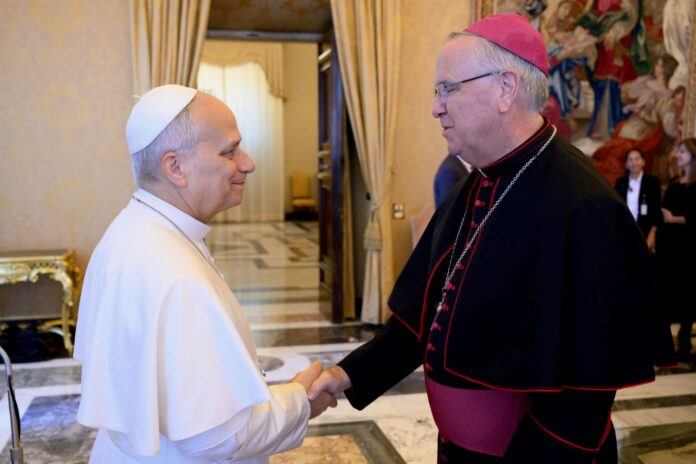
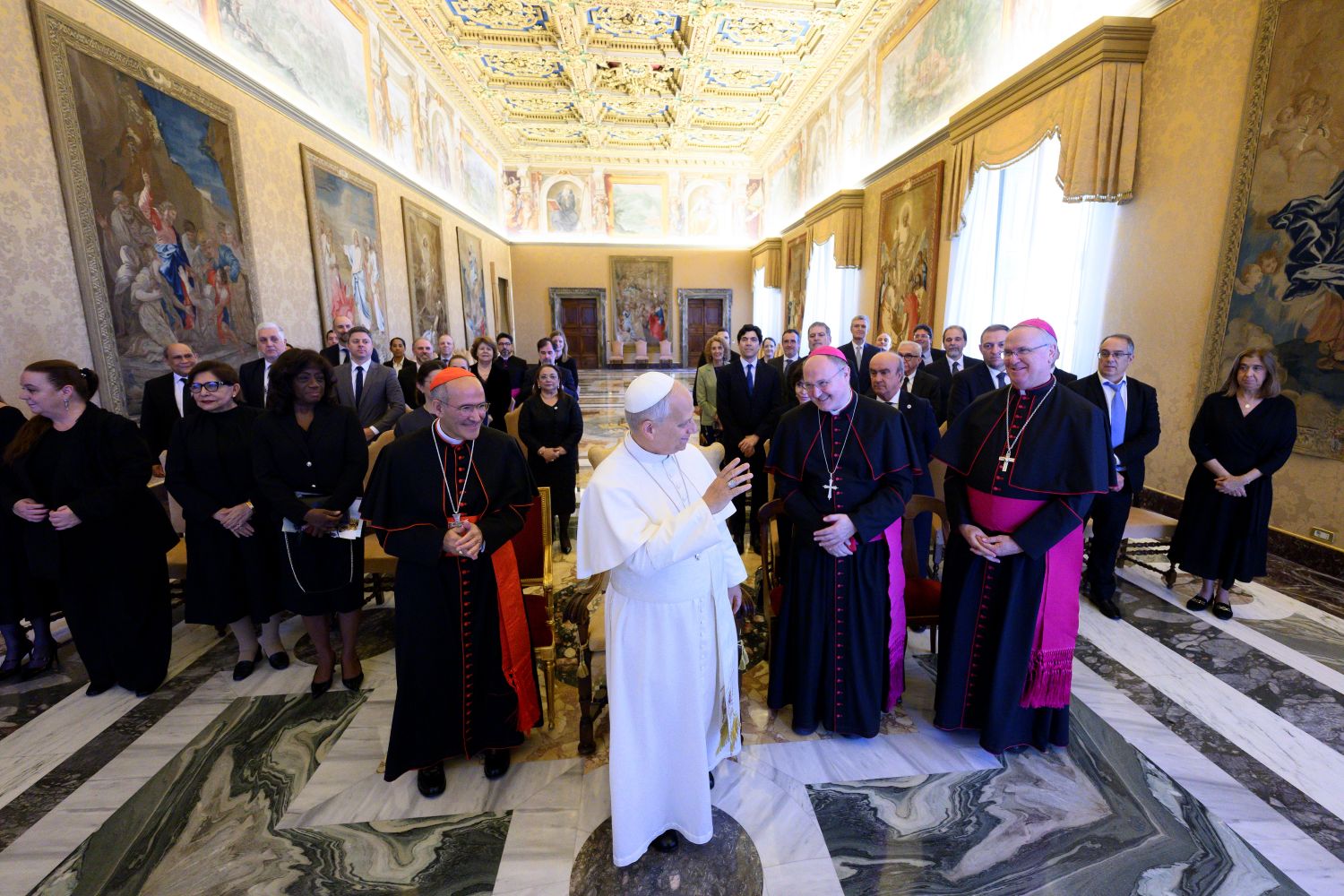
Bishop John Dolan reflects on his recent visit to Vatican City and his meeting with Pope Leo XIV.
Last week I had the privilege of participating in a gathering that took place in Vatican City where ministers of education, representatives from nations across South America and leaders from the Holy See came together to address one of the most pressing challenges facing our world today: the intersection of education, mental health and rapidly advancing digital technologies, including artificial intelligence.
The meeting, which took place on May 29, was entitled, “Maps of Hope for a Regional Educational Agenda: Mental Health, Digital Technologies and Education,” and was held at Villa Pia, the home of the Pontifical Academy of Sciences.
Together, we listened to the experiences, challenges and successes of the various nations that were represented. Throughout the day, one message seemed to continuously emerge: mental health is no longer simply a clinical concern. It finds overlap in the educational, social and cultural challenges that impact children, young people, families and communities throughout the world.
I heard many countries report rising levels of anxiety, physiological distress, suicide attempts and other mental health concerns among youth. I also found great hope and encouragement in the innovative ideas and programs that were described to bring together schools, families, healthcare systems, community organizations and governments. A common theme among participants was an emphasis on prevention, early intervention, teacher formation, family engagement and creating educational environments that promote not only academic achievement but also integrated human well-being.
It made me deeply grateful and proud of the programs we have here in the Diocese of Phoenix, including our Office of Mental Health Ministry and the Office of Human Dignity. Both hold a commitment to serving the human person and promoting the common good — and both ministries helped make my participation in this important international dialogue possible.
Ultimately, our local work and the mission of the universal Church remind us that social ministry is not merely about responding to immediate needs; it’s about building relationships, fostering human dignity and helping create communities where every human person can flourish.
Being human in the digital age
The following day, May 30, we gathered with Pope Leo XIV in the Consistory Hall of the Apostolic Palace. Cardinal José Tolentino de Mendonça, prefect of the Dicastery for Culture and Education, Dr. Emilce Cuda, secretary of the Pontifical Commission for Latin America and Archbishop Carlo Maria Polvani, secretary of the Dicastery for Culture and Education were also present.
Pope Leo addressed us, elevating the discussion even further — beyond programs and policies to the deeper question: what does it mean to be human in the digital age?
The Holy Father observed that while many young people possess increasingly sophisticated technology, they often struggle to find meaning, purpose, hope and belonging. He spoke of what he calls the “loss of inner constellations,” noting that many young people may know how to navigate the digital world, but lack the interior maps needed to answer life’s most important questions.
One of the most memorable lines from his address was: “We are a desire, not an algorithm.” To me, those words capture the heart of the Church’s contributions to this global conversation.
Artificial intelligence and additional emerging technologies hold tremendous promise, but they must always remain in the service of the human person. Technology connects us, Pope Leo reminded us, but education forms us. Human beings cannot be reduced to data points, performance metrics or algorithms. We are persons created in the image and likeness of God, called to relationship, purpose and communion.
Belonging, relationships, meaning and hope
The recommendations that emerged from the conference had several emphases: the need for mental health support to become a structural component of education systems, for families and schools to work in closer partnership and for governments to coordinate policies across education, health and social services. Participants also proposed creating an Ibero-American Network on Education, Health and Holistic Well-Being to foster collaboration and share best practices throughout the South American region.
These conversations resonated with me deeply, particularly with the work our diocesan Office of Mental Health Ministry has undertaken since its founding in December 2022. From day one our approach has been rooted in accompaniment, education and advocacy. We often say that we do not diagnose, prescribe or treat; we love. The conference in Rome affirmed that authentic mental health ministry requires more than clinical care — it requires belonging, relationships, meaning and hope.
I am also excited and encouraged by the opportunities for future collaboration throughout Latin America. Working alongside Deacon Ed Schoener, President of the International Association of Catholic Mental Health Ministers, and other leaders who were present, including the Vice President of Ecuador, María José Pinto, we hope to support the development of Catholic mental health ministries in countries across South America. Our goal is not to replace existing governmental or educational initiatives, but to accompany them, offering the Church’s unique contribution to human flourishing and development.
May the discussions at Villa Pia and the reflections of Pope Leo remind each one of us that the future of education, mental health and technology will ultimately depend on the vision of the human person that guides them. As Catholics, we believe every person possesses an inherent dignity that can never be reduced to an algorithm, that education must form both minds and hearts and that technology must serve humanity rather than define it.
In a world searching for direction, perhaps the Church’s most important task is helping people rediscover those inner constellations that guide them toward meaning, belonging and the love of God.
In doing so, we help draw new maps of hope for future generations.
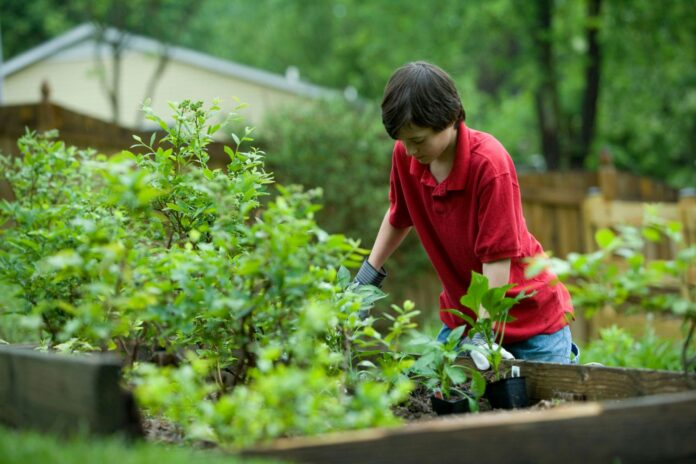
Fruits not commonly found in Arizona — bananas, guavas, mangoes and passion fruit — grow behind the youth center at Annunciation Catholic School in Cave Creek, Ariz. Berries and herbs blossom in the shade of the fruit trees, and vegetables flourish in planter boxes nearby. This thriving food forest and vegetable garden is known as The Angelus.
Annunciation is the only Catholic school in the state with a food forest — a sustainable agricultural system of edible plants that replicates patterns found in nature. Dr. Sharon Pristash, the founding principal when the school opened in 2009, was inspired to start the garden so students could learn where their food comes from.
“I grew up in the country in Wisconsin, so I know all about where food comes from. But I think most kids don’t,” Dr. Pristash said. “We’re big on nutrition here. Kids eat a lot of unhealthy foods, and we want them to learn to eat food straight out of the earth.”
In the fall of 2022, Dr. Pristash recruited a few moms to help start the garden by sending an announcement in the school’s newsletter. She then hired consultant Justin Haddad to design the landscape.
Haddad uses a practice called permaculture — a combination of the words “permanent” and “agriculture.” Permaculture works in harmony with nature to create long-lasting, food producing ecosystems. It is guided by three ethics: care for the earth, care for the people and fair share of the surplus.
In January 2023, Haddad planted over 50 fruit trees in the garden. These trees form a canopy layer that provides shade to the vines, herbs and berry bushes growing below.
Within The Angelus, Haddad never uses weed killer or pesticides. Birds, rabbits and insects are welcome in the food forest and are valued as a natural part of the ecosystem. For Dr. Pristash, her experience of The Angelus reminds her of the Garden of Eden.
“God gave us this earth and said to take care of it. We don’t use any sprays to keep the birds or the bunnies off, because they’re part of God’s creation too.”
The Angelus garden club
Terri Cole, a catechist and parishioner at St. Gabriel the Archangel Catholic Church in Cave Creek, Ariz., began to volunteer at The Angelus in September 2023. The following month, she started a garden club for students at Annunciation.
Now in its third year, the garden club involves two eight-week sessions and is open to fourth through eighth graders. Students learn how to plant their own food and care for God’s creation.
Cole shared that the name of the garden — The Angelus — “just seems to blend with the parish (St. Gabriel the Archangel) and the school (Annunciation Catholic School). It’s all about Mary!”
Cole opens every club meeting with The Angelus Prayer, a traditional Catholic prayer commemorating the Incarnation, or a prayer to St. Fiacre, the patron saint of gardeners. By now, most of the students know The Angelus Prayer by heart.
Students enjoy the garden club because they get to go outside, observe the plants and eat fruit straight from the trees. For many students, it is their first time seeing where their food comes from.
“They think it’s cool the way the trees are growing and producing fruit,” said Cole. “The figs and the pomegranates are the first to show, and the first time they ever saw that, they wanted to pick the fruit right off the trees.”
During the garden club, students decorate signs for each of the plants, learn about the different shapes of the trees and test the soil. Some students even bring a piece of The Angelus home to their families.
“The kids take home herbs like mint, thyme and oregano,” Cole noted. “One of the students’ families even planted a moringa tree at their house.”
In addition to the garden club, Cole also leads The Angelus Stewards, a program open to seventh and eighth graders. These students are knowledgeable about The Angelus and help monitor it during events.
As The Angelus quite literally continues to grow, Cole envisions it as a site for social events or harvesting opportunities. Dr. Pristash also hopes The Angelus can be a way to give back to the community in the future.
“We would love to have our own farmers market or put out a table after Mass on Sundays with ripe produce from the garden,” Dr. Pristash said. “We could give some to St. Vincent de Paul to feed the hungry and live out our Catholic Social Teaching.”
On June 6, four men in the Diocese of Phoenix will be ordained to the priesthood. Get to know them by reading their stories below — from a vocation planted in the heart of a toddler to a St. Paul-like conversion through the power of the rosary.
The ordination Mass will be held at St. Thomas Aquinas Parish in Avondale, Ariz., at 10 a.m. Join the livestream event on the Diocese of Phoenix Facebook and YouTube channels.
–
Rosary inspires veteran’s radical conversion
Photo courtesy of The Franciscan Friars of the Holy Spirit
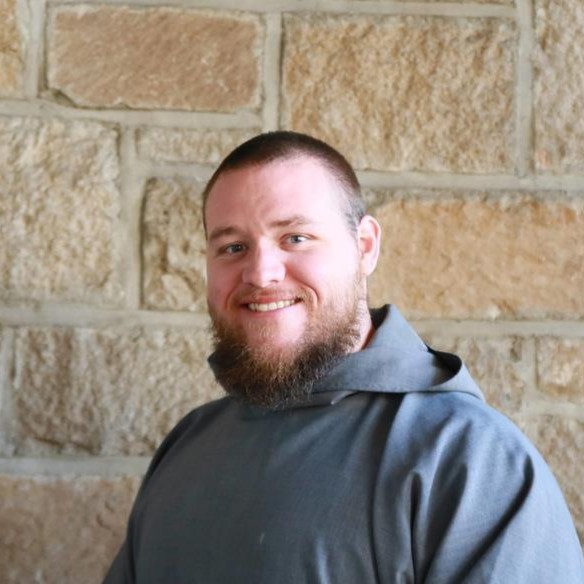
The reversion of Deacon Paul Graupmann, F.H.S., to the Catholic faith was a bit like the conversion of St. Paul: sudden, swift and sure.
He grew up in South Dakota in a family that attended Sunday Mass and always prayed before meals. After high school, he served in the U.S. Navy and was stationed in Japan. By then, he was no longer practicing his Catholic faith.
“I was living a pretty wild lifestyle. I never thought of God and was never praying.”
What happened next can be laid at the feet of his older brother, Andrew.
At that point, Deacon Paul was serving in Washington state and had the opportunity to spend time with Andrew.
“My brother, who was kind of a frat boy, very far from the Lord, had his own conversion experience,” Deacon Paul said. He shared his powerful testimony and “he actually got me to go back to confession.
“To this day, I don’t really know why I went. It was just grace in the moment. And then I was given a penance of five rosaries to pray.”
Five? That took some time but in the end, the penance bore fruit.
“On a whim, out in Washington state, I thought, ‘Why don’t I just try this prayer thing out and kind of see what happens?’ I did, and it totally changed my life.”
Turns out, the rosary has quite a history in Deacon Paul’s family. His mother is one of 14 siblings. Growing up, her family prayed the rosary daily. All of her siblings are Catholic to this day.
“I remember being a kid and you knew you had to leave Grandma and Grandpa’s house by 5 p.m. or else you’re going to be caught praying the rosary,” Deacon Paul noted.
Today, as a member of the Franciscan Friars of the Holy Spirit, he wears a rosary on his waist every day. “It goes with me everywhere,” Deacon Paul said.
His road to the priesthood is rooted in his reversion experience. “It was just so revolutionary — like, God loves me. It was the most authentic thing I’d ever experienced in my life.
“And then it was almost an epiphany: Oh, there’s something God wants me to do.”
Andrew spoke to him about vocations and the different states in life.
Every time Deacon Paul asked the Lord if he was called to the priesthood, he received the same answer: “I felt that same presence, that same kind of consolation that I received the first time I met the Lord.”
He came to know the Franciscan Friars of the Holy Spirit during a retreat in 2015. They invited him to visit the friary for a nine-day novena to St. Francis. Deacon Paul fell in love with the community.
“They were on fire for the Lord and had a deep desire to evangelize and serve people, which was what I felt I was called to do. That’s when I said ‘yes.’”
Home Parish: Our Lady of Victory, Kadoka, S.D.
Favorite Saints: St. Thomas Aquinas, St. Paul
Favorite Scripture: “I consider that the sufferings of this present time are as nothing compared with the glory to be revealed for us.” (Rom 8:18)
Hobbies: Woodworking
Click here to listen to the full interview with Deacon Paul Graupmann, F.H.S.
–
Drawn to Christ through eucharistic encounter
Deacon Simon Ortiz grew up as the youngest of six siblings in a family that was active at
St. Maria Goretti Parish in Scottsdale, Ariz.
“My mom sang in the choir, but I never altar-served or anything,” Deacon Simon said. He attended religious education at the parish and during a retreat his sophomore year of high school, he went to a breakout session on vocations.
“This was my first time being around young priests. They were very lively and joyful about their vocation,” Deacon Simon said.
The retreat took place in Williams, Ariz., and featured a few firsts. “I went to public school my whole life, so I had never seen religious sisters or younger priests,” Deacon Simon said. He’d never seen snow falling either. “It was just a very joyful experience.”
During his senior year, he went on retreat again. This time, during Eucharistic adoration, he felt called to the priesthood.
“That’s when I really received the call in a very profound way. Up until that point, I was thinking about where I was going to go to college. I was going to go to Northern Arizona University or maybe Scottsdale Community College.”
He began going to adoration and praying the rosary daily. “And that’s when the Lord really started to draw me to Himself.”
Not long after, he applied to seminary and was accepted. “I entered at 17. I was only 17 for about a week of the seminary semester because my birthday is in late August, but I like to claim that,” Deacon Simon said with a grin.
His parents were very supportive of his call to priesthood, though his mother said, “You shouldn’t feel any pressure from me. You need to do what Jesus tells you to do.” His father expressed initial concerns, but Deacon Simon said one of the biggest graces of seminary has been to see his father “deepen his own prayer life as a result of me entering into seminary.”
Deacon Simon studied at the Pontifical College Josephinum in Ohio for four years and then transferred to St. John Vianney Theological Seminary in Denver. One of the things he’s enjoyed the most about his seminary years is the fraternity with other men who are in formation.
The daily rhythm of prayer has also been a source of joy. “We have a holy hour every day and we get to go to Mass every day,” Deacon Simon said.
He relished his spirituality year that featured time to grow closer to the Lord without academic pressure. He needed to discern whether he was being called to a religious community like the Carmelites or diocesan priesthood. In the end, it was clear that the Lord was calling him to a life of deeper prayer and to serve as a diocesan priest.
Home Parish: St. Maria Goretti, Scottsdale, Ariz.
Favorite Saints: St. Peter, St. Elizabeth of the Trinity
Favorite Scripture: “Whoever loves Me will keep My word and My Father will love him, and We will come to him and make Our dwelling with him.” (Jn 14:23)
Hobbies: Singing, sports, photography
Click here to listen to the full interview with Deacon Simon Ortiz.
–
Fraternal love rekindles childhood call
Though his call to the priesthood was unmistakable, there was a point during religious studies that Deacon Nathan Blanchard seriously considered giving up.
After entering Pontifical College Josephinum in Columbus, Ohio, out of high school at age 18, Deacon Nathan spent four years there before moving to St. John Vianney Theological Seminary in Denver.
But after three years in Colorado, he found himself unexpectedly at a crossroads.
Deacon Nathan described a sense of disconnectedness, though not from his call or desire, but from the process.
“I wasn’t in a good mental state,” he recalled. “I needed to take a break.”
Then, God intervened through a phone call from Father Paul Sullivan, rector of Nazareth House, the Diocese of Phoenix’s local seminary.
Father Sullivan and Father Kurt Perera, then the vocations director, invited Deacon Nathan to move from Denver to Phoenix, where he settled into fellowship with the vocations team and took a job with a local electrician. Deacon Nathan began soaking in the love of Christ, his formation leaders and the brotherly atmosphere within his local seminary community, including conversations with Bishop John Dolan.
“He felt known and loved again,” recalled his mother, Christina Blanchard. “He was ready to go.”
Deacon Nathan said he might have left seminary altogether.
“But I knew doing that would be turning my back on Jesus Christ and [ignoring] the call God had given me so clearly.”
The fourth of six children born to Deacon Greg Blanchard of San Francisco de Asis Parish in Flagstaff, Ariz., and Christina, Deacon Nathan displayed an affinity for the priesthood at an early age.
“He was less than 2 [years old], barely able to speak,” Christina said. “He would get up into the presider’s chair (the tallest chair where the Mass’ main celebrant sits), and say, ‘Father Nathan, Father Nathan.’ At age 5, he wanted a play paten and chalice, so we made a ceramic set for him.”
Then, in seventh grade, while on a summer camp retreat, Deacon Nathan found himself experiencing a sense of God’s calling he could not ignore.
“On the first night, we were at Mass. I had kind of ‘tuned out.’ I received the Body of Christ and the Blood. The Lord spoke very directly to me. He said, ‘Nathan, I want you to be a priest.’
“I cried for the rest of Mass, tears for this powerful experience and joy and excitement. Right after Mass, I pulled my youth minister aside and told her what happened.”
After spending time at Nazareth Seminary, he returned to priestly studies with a semester of immersion in Honduras and wrapped up at Assumption Seminary in San Antonio, Texas. He was ordained to the transitional diaconate in a Mass celebrated by Bishop Dolan last November at his family’s home parish in Flagstaff, where his dad served as the deacon.
Deacon Nathan’s dad sees his son bringing a friendly, unassuming nature to the priesthood with the heart of a spiritual father, someone who can enable others to feel as if they are the only person that matters when Deacon Nathan is talking with them.
“[Nathan] can make friends with anyone. If you can’t get along with Nathan, you can’t get along with anyone. He’s definitely good with people,” Deacon Greg said.
“What surprises me about him is the incredible growth,” said Christina. “Five years ago, I thought, ‘He has a way to go.’ Now, he’s ready.”
Home Parish: San Francisco de Asís, Flagstaff, Ariz.
Favorite Saints: St. Thérèse of Lisieux, St. Francis of Assisi, St. Louis the King
Favorite Scripture: Luke 15 and John 15
Hobbies: Hiking, writing, ukulele
Click here to listen to the full interview with Deacon Nathan Blanchard.
–
Former pilot soars toward God’s will
As a pilot, Deacon Jeff Pooley soared through the clouds, far above earth and its troubles. Soon, as a newly ordained priest for the Diocese of Phoenix, he’ll guide others toward heaven.
Deacon Jeff grew up in Riverside, Calif., one of three children. He was active in his home parish of Our Lady of Perpetual Help and was an altar server until eighth grade. There were probably inclinations early on about priesthood, but it wasn’t something his family talked about.
Then, when he was 17, the Lord reached into Deacon Jeff’s heart with a prompting. At the time, a religious order priest who had been serving at the family’s parish was retiring and returning to his native Spain. The priest died two weeks later.
“He knew he had cancer and that there wasn’t much that could be done about it, but he chose to serve anyway,” Deacon Jeff said.
At a memorial Mass for the priest, Deacon Jeff was overcome by emotion and asked himself why he was crying so much. In a moment of clarity, he felt an interior voice tell him, “This man laid down his life for you.”
That same voice continued: “I could be calling you to do the same thing.”
“I was petrified,” Deacon Jeff said.
Not long after, he tearfully confided in a teacher at his public high school: “I think I’m supposed to be a priest — but I don’t really want to be a priest!”
His teacher’s words in that moment have stayed with him down through the years: “Pooley, we don’t make decisions in desolation.” She encouraged him to move forward with his life and realize that if God wanted him to become a priest, He would make it clear.
At 18, Deacon Jeff left home to study at Embry-Riddle Aeronautical University in Prescott, Ariz. After earning a degree in aeronautical science, he stayed in Prescott and volunteered with the youth ministry group at Sacred Heart Parish.
“I was telling kids, ‘Do God’s will for your life, and you’ll be happy,’ but it felt like hypocrisy because I knew I had felt this call when I was 17, but I wasn’t responding to it.” He told the Lord, “If You want me to be a priest, make it abundantly known to me.”
Deacon Jeff worked as a flight instructor for two years. During that time, many priests came into his life and walked alongside him. “They loved me and showed me the joyful life of priesthood.”
Then, while visiting a friend during alumni day at his alma mater, he heard that same still, small voice: “What are you waiting for?”
He emailed Father Paul Sullivan, the vocations director at the time, and entered seminary not long after.
Home Parish: Corpus Christi, Phoenix
Favorite Saints: St. Teresa of Calcutta, Pope St. John Paul II and Sister Clare Crockett, whose cause for beatification was opened in 2025
Favorite Scripture: “He has sent me to bring glad tidings to the lowly, to heal the brokenhearted … to place on those who mourn in Zion a diadem instead of ashes …” (Is 61:1)
Hobbies: Cooking, watching movies
Click here to listen to the full interview with Deacon Jeff Pooley.
–
To support formation of priests in the Diocese of Phoenix, visit priests.dphx.org