
SVdP breaks ground on new community and volunteer center

The 26,162-square-foot Center for Purpose, Hope and Mission will serve as a hub for community engagement in service, learning and advocacy

Golden shovels dipped into a dirt box as leaders from St. Vincent de Paul (SVdP),  Ryan Companies, and SmithGroup, gathered outside a former warehouse on SVdP’s main campus just south of downtown Phoenix. Dressed in hard hats, executives and partners stood shoulder to shoulder, symbolically lifting and moving the dirt to mark the official start of construction of SVdP’s new Center for Purpose, Hope and Mission (CPHM).
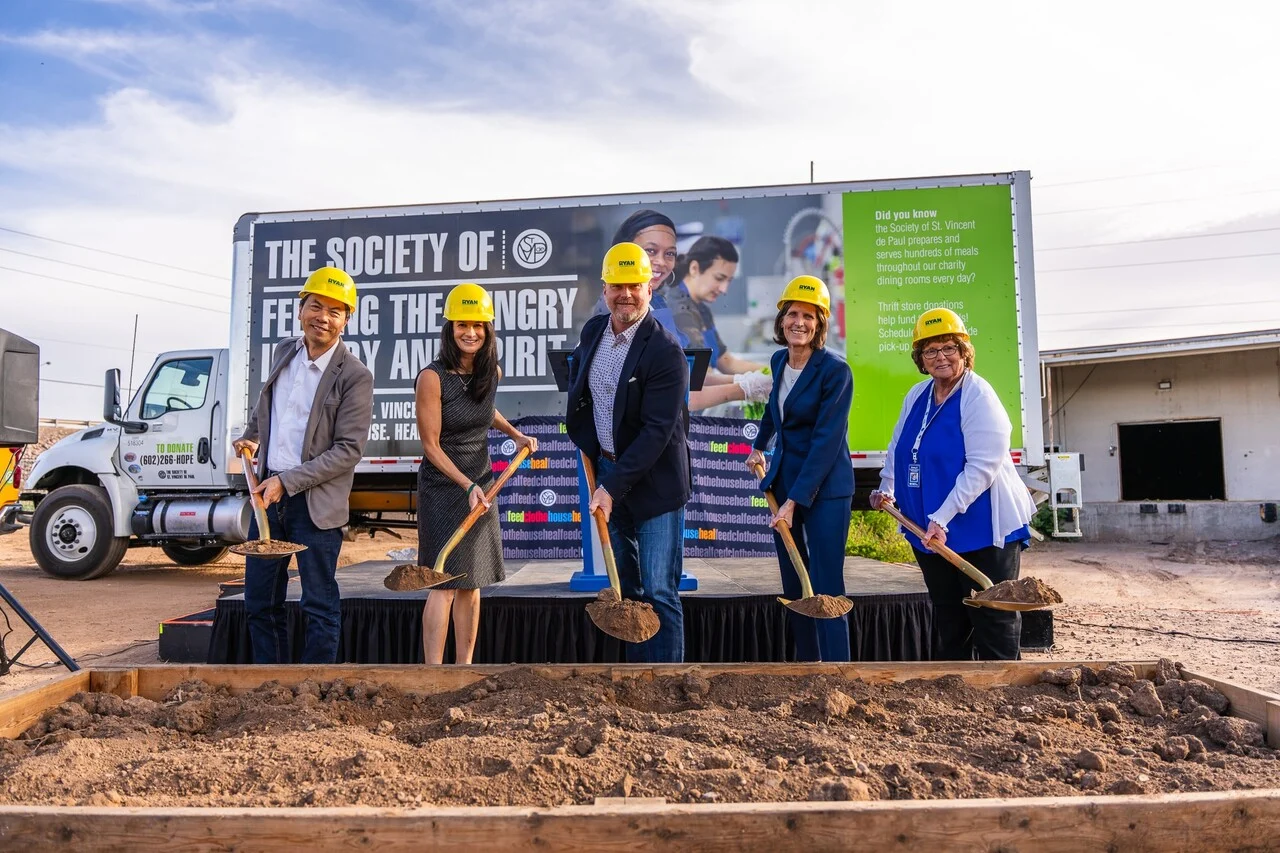
From left to right: SmithGroup Vice President of Design John Tran, Ryan Companies Southwest Region President Molly Ryan Carson, Ryan Companies Western Division Executive Vice President Chuck Carefoot, SVdP CEO Shannon Clancy, and SVdP Phoenix Diocesan Council President Shirley Smalley

Once completed, the 26,162-square-foot center will serve as a hub for community engagement, volunteerism, advocacy efforts and mission-driven programming. It will have an airy check-in lobby, a flexible assembly space, several versatile gathering spaces, conference rooms and a large, shaded courtyard all with community in mind.

The project is a repurposing of an existing north warehouse space, made possible through the generosity of donors and supporters who believe in SVdP’s mission and the importance of inviting people into the mission.

As ceremony began, SVdP Rob & Melani Walton Endowed CEO Shannon Clancy reflected on the deeper meaning behind the construction.

Photo of CPHM’s rendering.

“Providing common ground for people across our community to come together to serve one another and experience the joy of service has always been an equal part of our mission,” SVdP Rob & Melani Walton Endowed CEO Shannon Clancy said. “Our new Center for Purpose, Hope and Mission gives that important work a formal home. It will be an inspiring place where members of our community can gather to learn, advocate, and belong — while working together to build the kind of community where everyone can thrive.”
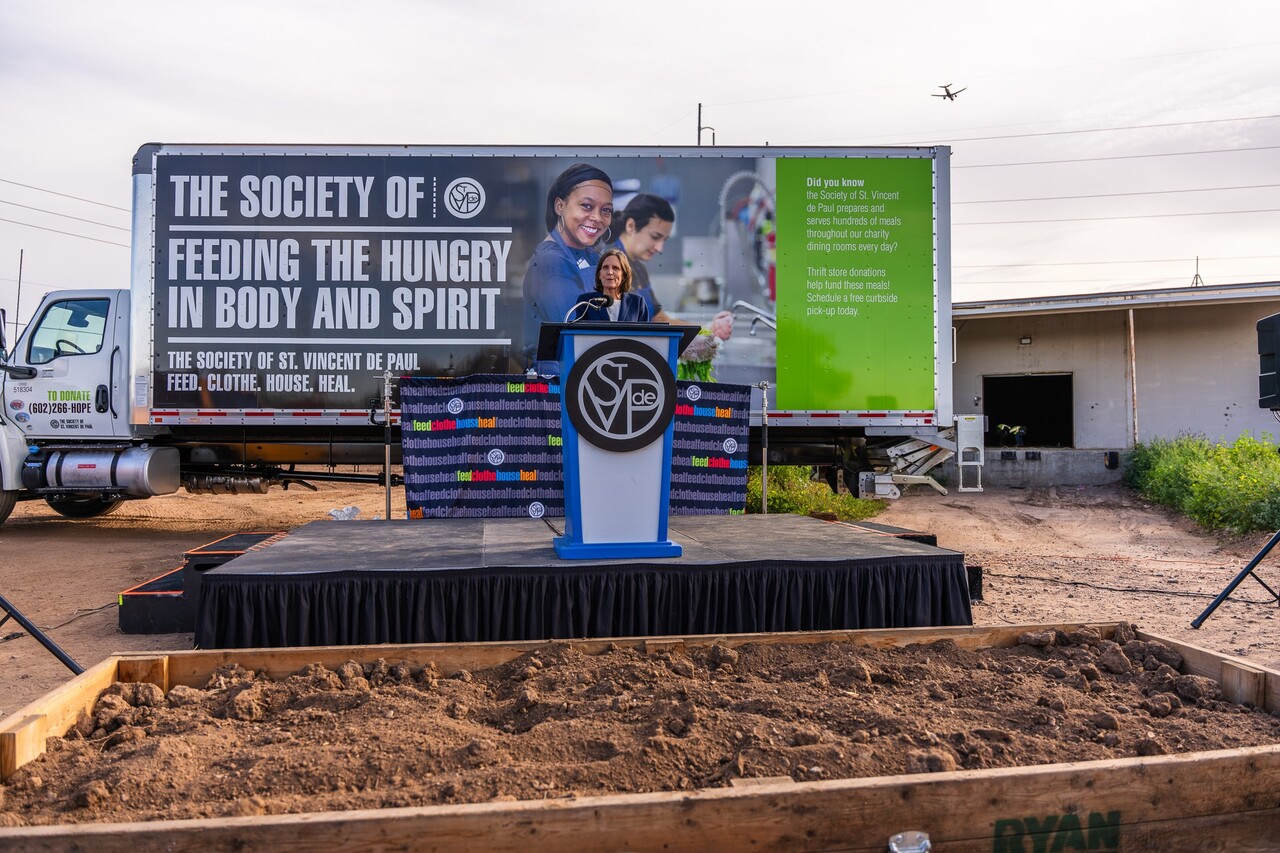
SVdP Rob & Melani Walton Endowed CEO Shannon Clancy addresses a crowd of more than 50 attendees, including Ryan Companies US Inc., SmithGroup, Progressive Roofing, and SVdP staff.

SVdP was honored to celebrate the groundbreaking alongside the project’s general contractor, Ryan Companies US Inc., who has been a long-time partner in SVdP’s campus development and recently helped construct new shelter space for the nonprofit.
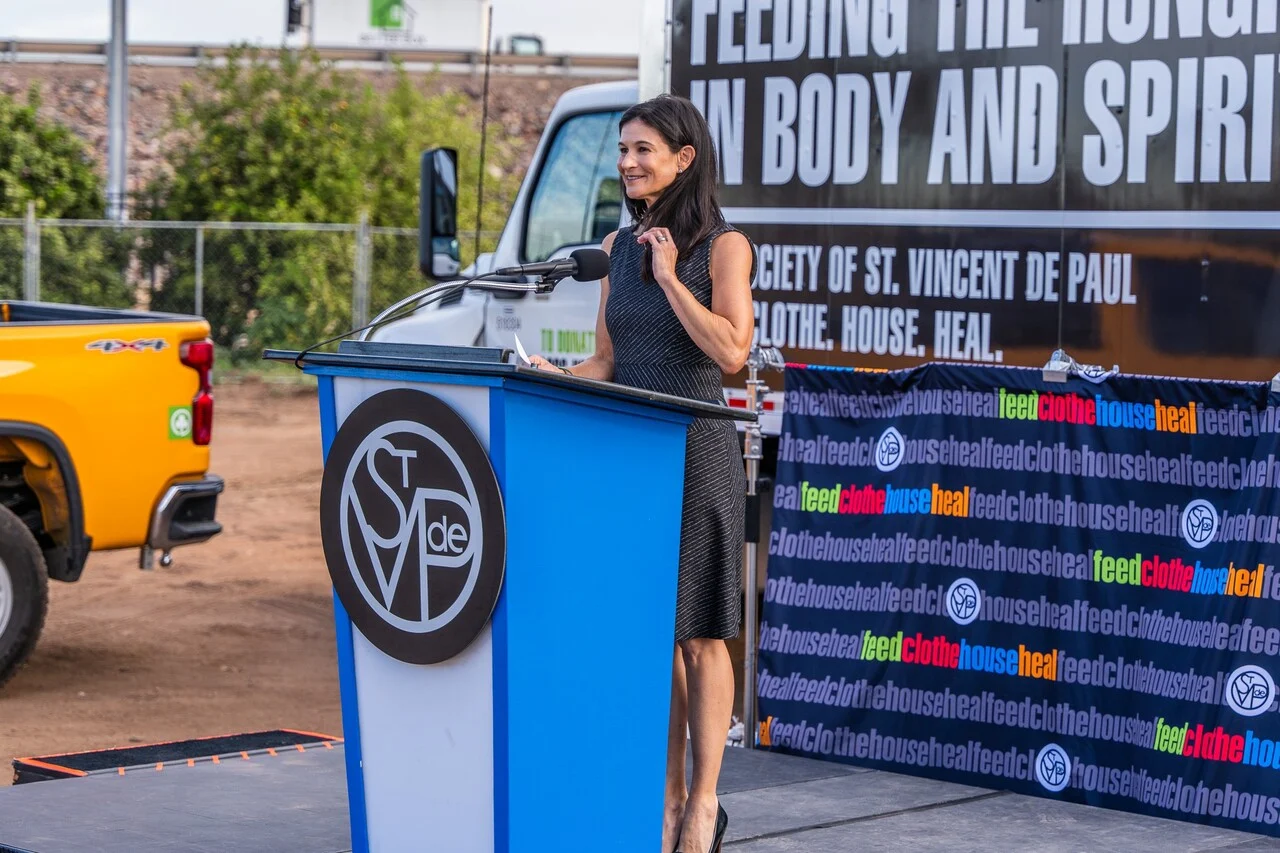
Molly Ryan Carson, Ryan Companies President, Southwest Region, shares how meaningful this project and the SVdP mission is to Ryan Companies.

“Ryan Companies is incredibly proud to continue our long-standing partnership with St. Vincent de Paul, an organization that provides such vital support to our community and neighbors in their time of need,” said John Strittmatter, Southwest region chairman, Ryan Companies. “Our construction team looks forward to delivering the Center for Purpose, Hope, and Mission, which will advance SVdP’s critical mission and serve as a beacon of hope for many years to come.”

SmithGroup, the architects for the project, also joined in the celebration. They will work closely with SVdP to translate its ideas and vision for the Center for Purpose, Hope, and Mission into a functional and welcoming design. SVdP looks forward to seeing that vision take shape as construction progresses and the center becomes a space for community, service, and purpose.
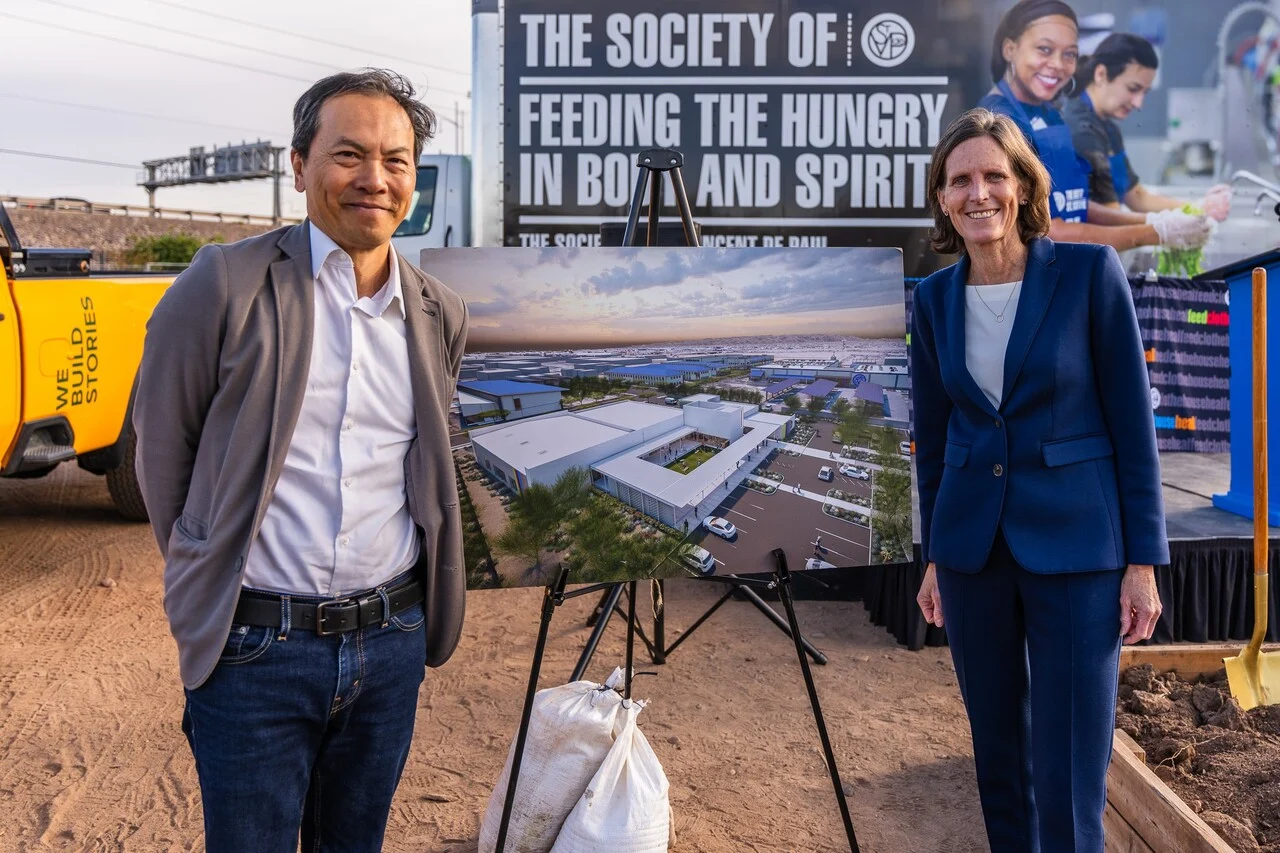
SmithGroup Vice President of Design John Tran and SVdP CEO Shannon Clancy pose beside the rendering SmithGroup created to bring SVdP’s vision of its Center for Purpose, Hope and Mission to life.

In addition, Progressive Roofing, who generously donated the roof for the project, was happy to join the celebration.

“Supporting our community is at the heart of who we are, and it’s an honor to give back in meaningful ways, said Nick Hadden, CEO of Progressive Roofing. “We’re proud to support St. Vincent de Paul with their new roof and help ensure they can continue the incredible work they do for those in need.”

The active construction site, once quiet now buzzed with possibility. The project is expected to be completed by 2027. Upon completion, the Center for Purpose, Hope, and Mission will expand SVdP’s capacity to engage individuals and organizations in service, education, and community-wide collaboration.
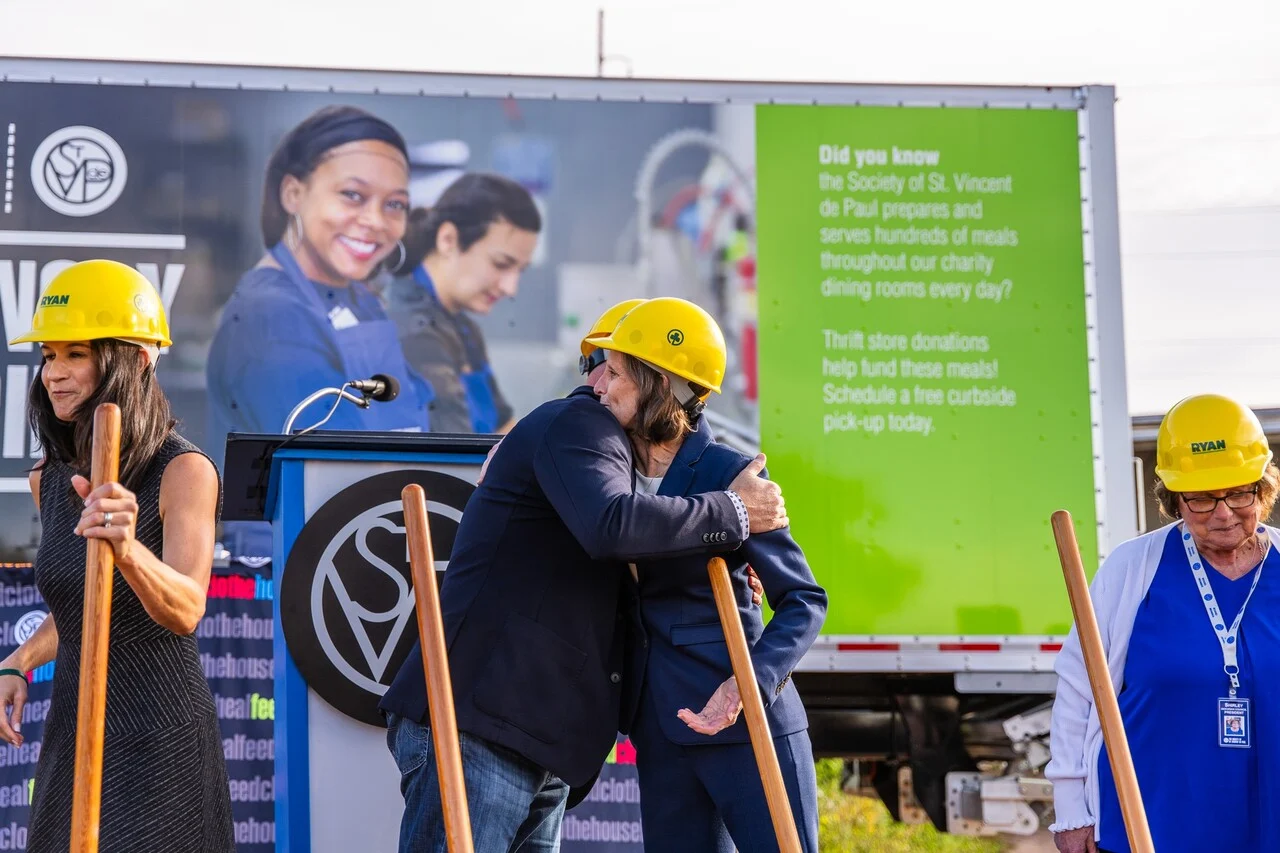
A celebratory hug between SVdP CEO Shannon Clancy and Ryan Companies Western Division Executive Vice President Chuck Carefoot

Pope: Trafficking, cyber-slavery reflect a world blind to dignity of human life

By Carol Glatz

VATICAN CITY (CNS) — Warning against increased cases of “cyber-slavery,” Pope Leo XIV said the violence of human trafficking can be overcome only by seeing every individual as a beloved child of God.

A “particularly disturbing” offshoot in the world of trafficking is “the rise of so-called ‘cyber slavery,’ whereby individuals are lured into fraudulent schemes and criminal activities, such as online fraud and drug smuggling,” he said in a written message released by the Vatican Feb. 6. “In such cases, the victim is coerced into assuming the role of perpetrator, exacerbating their spiritual wounds.”

The “logic of dominion and disregard for human life,” geopolitical instability, armed conflicts and the widening gap between the rich and the poor all help fuel the horrors of human trafficking, he wrote for the 12th International Day of Prayer and Awareness against Human Trafficking.

“These forms of violence are not isolated incidents, but symptoms of a culture that has forgotten how to love as Christ loves,” he wrote.

The world day is observed every Feb. 8, the feast of St. Josephine Bakhita. The saint was kidnapped by slave traders in Sudan in the late 1870s and sold into slavery before she eventually secured her freedom and became a religious sister in Italy.

In the written message, titled “Peace begins with dignity: a global call to end human trafficking,” the pope firmly renewed the Church’s “urgent call to confront and bring an end to this grave crime against humanity.”

“Geopolitical instability and armed conflicts create fertile ground for traffickers to exploit the most vulnerable, especially displaced persons, migrants and refugees,” he wrote. “Within this broken paradigm, women and children are the most impacted by this heinous trade.”

The widening gap between the rich and the poor also leaves many people “susceptible to the deceptive promises of recruiters,” he wrote.

“In the face of these grave challenges, we turn to prayer and awareness,” he wrote.

The “small flame” of prayer provides the strength to resist indifference to injustice while awareness helps identify “the hidden mechanisms of exploitation in our neighborhoods and in digital spaces.”

“Ultimately, the violence of human trafficking can be overcome only through a renewed vision that beholds every individual as a beloved child of God,” he wrote, adding that “true peace begins with the recognition and protection of the God-given dignity of every person.”

Pope Leo thanked everyone who works with victims, including survivors who now advocate on behalf of others.

“May the Lord bless them for their courage, fidelity and tireless commitment,” he wrote.”Let us all join the journey toward a world where peace is not merely the absence of war, but is ‘unarmed and disarming,’ rooted in full respect for the dignity of all.”

The pope reiterated his call after praying the Angelus with those gathered in St. Peter’s Square Feb. 8.

Thanking religious men and women, and all those committed to combating and eliminating current forms of slavery, Pope Leo said, “together with them, I say: peace begins with dignity!”

©2026 Catholic News Service/United States Conference of Catholic Bishops

Awakening a sacred mission

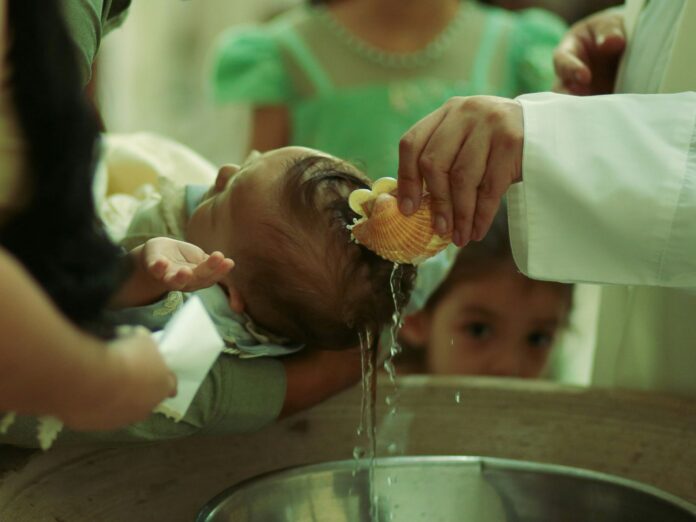
The longer I live my faith, the more I am struck by the beauty and power of baptism as a lifelong mission that calls us into who we are. Baptism is more than an entry point into the Church. It is our awakening to a sacred mission that reveals a world far greater than any one person. Yet, in that vastness, God loves each of us uniquely and fully, without exception. This is true for every person, and baptism is our recognition of and commitment to live out this truth! 

This truth has changed everything for me. 

When I truly believe that I am loved — not because of what I do, but simply because I am God’s beloved — I am set free. Free from the constraints of fear, of comparison, of division. Free to love as I have been loved. Baptism calls us into that freedom rooted not in self, but in service; not in isolation, but in communion. 

The meaning of baptism has come alive most vividly through the baptisms of my sons. Both were baptized on Father’s Day, three years apart at Mary Star of the Sea Parish in San Pedro, California. This is the same church where their father was baptized as an infant and where he and I were later married. 

It’s hard to put into words the depth of emotion I felt on those days. The church was filled with familiar faces — grandparents, godparents, cousins, friends. As Bishop Sylvester Ryan poured water over each tiny head and proclaimed, “I baptize you in the name of the Father, and of the Son and of the Holy Spirit,” I knew in my bones that this was more than a family celebration. It was a moment of profound belonging to God, to each other and to the larger community of faith. 

That same font had been the source of grace for generations before us, connecting us across time and space. 

It anchors and anoints us into a new existence as a beloved child of God with whom He is well pleased. However, when we are baptized, we are not just welcomed and loved into the family of God; we are sent. We are commissioned to be His love in the world. 

That’s the part of baptism that often gets overlooked and yet cannot be separated. The grace we receive is not meant to stay bottled up in the font or confined to a memory or a photograph. It propels us outward — into our workplaces, neighborhoods, schools and families — to bear witness to a love that is generous, forgiving and alive. 

Each time I dip my fingers into the holy water at church, I remember that I have been claimed. I remember that I am part of something far greater than myself, the body of Christ. And I remember that this identity brings both comfort and challenge: comfort in knowing I am never alone, and challenge in knowing that I am called to love as God loves — without exception, without hesitation. 

Baptism is a radical act of inclusion. 

It tells every human heart that you are seen, you are loved, you matter. And if we truly believe this — if we let this truth take root — then hate loses its power, fear loses its grip and we begin to live in the freedom of children of God. 

My sons are older now, but I often think back to those Father’s Days, when we carried them to the same font that had blessed their dad, the same altar that witnessed our vows. In those moments, generations of faith came together in the simple but sacred act of water, oil and Spirit. 

Our faith is beautiful. It is both deeply personal and profoundly communal. 

We are loved and therefore we must love. This is the mission into which we are born. This is the gift of our baptism.  

“Globetrotting the Gospel”; Getting to know Bishop-elect Peter Dai Bui, Part 3 of 4

In “Globetrotting the Gospel,” the third video of a four-part series on getting to know Bishop-elect Peter Dai Bui, we learn about the bishop-elect’s frequent flyer journey to the Diocese of Phoenix, becoming a diocesan priest and his time serving at the Vatican.
.
You’ll hear about his six years of service in the Pontifical Council Cor Unum where he received the title “Monsignor” from Pope Francis, a role in which he traveled to multiple countries, and the humble conversation with Bishop Olmsted that started it all.
.
Tune in to hear how parish life and a humble openness to God’s call around the globe was the very path that prepared Bishop-elect Bui to become an auxiliary bishop.
.
Check out part one, “Boat of No Smiles” here, and part two, “From Atari to the Altar” here, in case you missed them!
.

Bishop-elect Bui was appointed as the second auxiliary bishop of the Diocese of Phoenix on Dec. 19 by Pope Leo XIV and will be ordained a bishop on Tuesday, Feb. 17, at 10 a.m. at St. Thomas Aquinas Parish in Avondale, Ariz. Due to limited seating capacity, the Ordination Mass is by invitation only. The Ordination Mass will be broadcast live on More! Arizona, local channel 7 dot 2, Cox Cable 115 and livestreamed on the Diocese of Phoenix YouTube and Facebook platforms, with programing beginning at 9:30 a.m.
.
The ordination and the surrounding celebrations are made possible through the generous support of Clint and Jennifer Hickman; Dr. Kenneth and Angeline Osorio; The Diane and Bruce Halle Foundation; Catholic Cemeteries and Funeral Homes; Catholic Education Arizona; Notre Dame Federal Credit Union; AllThrive365; Catholic Charities Community Services; The Society of St. Vincent de Paul; and Catholic Community Foundation. With grateful hearts, we thank these benefactors for their faithful generosity and partnership in supporting the life and mission of the Church.
.

The Charity and Development Appeal kicked off Feb. 7-8

Each year, the Charity and Development Appeal (CDA) raises funds to support more than 70 ministries, charities and organizations throughout the Diocese of Phoenix. The multi-million-dollar appeal, which impacts thousands of lives annually, launched in most parishes throughout the diocese the weekend of Feb. 7-8.   

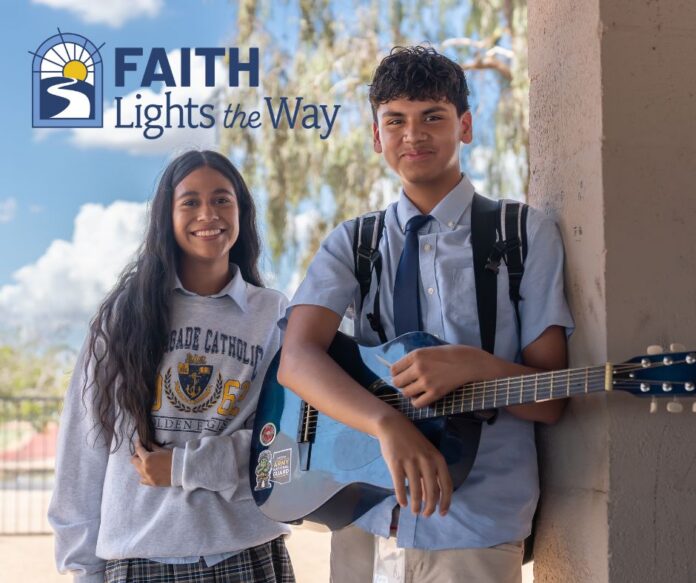
This year’s CDA theme is “Faith Lights the Way,” inspired by John 5:16: “So, your light must shine before others, that they may see your good works and glorify your Father in heaven.”  

“At our baptism, we received the light of Christ — a light meant to guide us and to be shared,” said Bishop John Dolan. “In a world that can often feel uncertain, faith lights the way, helping us see with hope, act with love and serve with compassion. 

“I am grateful to walk this journey of faith with you,” he continued, referring to the 2026 CDA appeal. “Let us continue to be people of light — who shine with the love of Christ and help others see the way to Him.” 

Countless individuals receive support through the CDA including seminarians, priests, deacons, the elderly and vulnerable, those without a home or a meal, pregnant mothers, students and their families and so many more.   

Watch the 2026 CDA video to hear some of their stories: 

To join the CDA impact, visit https://dphx.org/cda/    

AllThrive 365 awarded $100,000 grant from Wellik Foundation to serve Wickenburg residents

AllThrive 365, a nonprofit organization dedicated to helping individuals and their caregivers age safely, independently and with peace of mind, received a $100,000 grant award from The Wellik Foundation to expand and sustain essential food, transportation and basic-needs services for Wickenburg, Ariz., residents. 

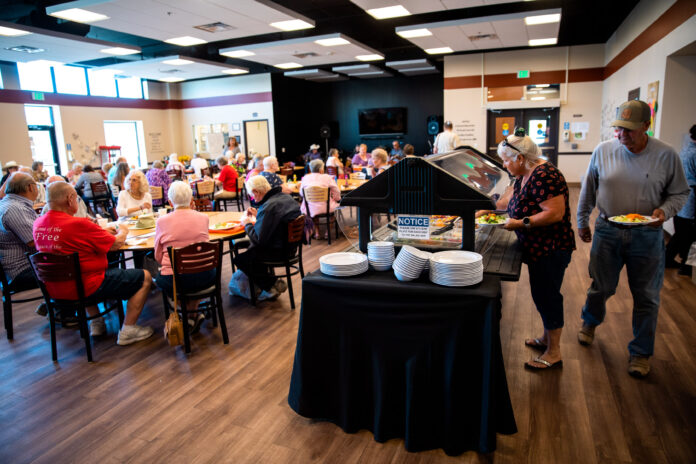
Operating out of the George & Vi Wellik Senior Center in Wickenburg as one of their locations of service, AllThrive 365 has long served as a critical lifeline in the rural area for older adults and low‑income households seeking connection, nutrition and stability. This grant strengthens their legacy of support, ensuring that vital, year‑round services remain accessible to every resident who needs them.  

The needs in Wickenburg have grown dramatically in recent years. Rising living costs have stretched families thin, and more aging adults are walking through the doors of the Senior Center seeking help with food, transportation or simply a place where they feel seen and supported. AllThrive 365 has refused to turn anyone away. The Wellik Foundation’s investment ensures the continuation of core services without interruption.  

“Vi Wellik believed in caring for the people who made Wickenburg unique and a wonderful town in which to live,” said The Wellik Foundation Board of Directors. “By supporting AllThrive 365’s long-standing work providing food, transportation and essential services, The Wellik Foundation continues her vision of strengthening community and helping Wickenburg residents live with dignity and independence.”  

Support from The Wellik Foundation comes at a pivotal moment. Last year alone, AllThrive 365 programming distributed more than 400,000 pounds of food, served over 15,000 hot meals to older adults and delivered an additional 11,000 meals to homebound seniors and adults with disabilities — many of whom live alone and see program staff as their most consistent point of human contact.  

Mobility is just as critical. With no public transit option available in Wickenburg, the program’s Freedom Express provides more than 25,000 miles of transportation each year, helping 400 older adults reach grocery stores, pharmacies, medical appointments and other essential destinations. For many, these rides are a lifeline — removing barriers that would otherwise lead to missed care, increased isolation or declining health.  

“We are deeply honored to continue this decades-long partnership with the Wellik Foundation,” said AllThrive 365 president & CEO Tami Bohannon. “As more Wickenburg residents face rising costs and instability, this support ensures that no one is turned away — whether they need a hot meal, a safe ride or help keeping the lights on.  

“Vi Wellik’s legacy lives on in every aging adult who finds connection through our programs.” 

With the Wellik Foundation’s support, AllThrive 365 will continue to meet rising demand while honoring Vi Wellik’s vision: a Wickenburg where every resident has the resources they need to live with dignity, independence and hope. 

For over 50 years, AllThrive 365, formally known as Foundation for Senior Living, has helped Arizonans thrive through health, housing and connection programs at multiple locations throughout the Valley, providing the support and resources needed to embrace life at every stage — 365 days a year.  

Pope praises religious for courageous witness serving the marginalized

Pope Leo XIV receives the offertory gifts during Mass with consecrated women and men marking the feast of the Presentation of the Lord and the World Day for Consecrated Life in St. Peter's Basilica at the Vatican, Feb. 2, 2026. (CNS photo/Vatican Media)

By Carol Glatz

VATICAN CITY (CNS) — Pope Leo XIV praised consecrated men and women for going to the world’s peripheries and refusing to abandon their people, even amid conflict.

“They remain, often stripped of all security, as a living reminder — more eloquent than words — of the inviolable sacredness of life in its most vulnerable conditions,” he said Feb. 2 in his homily for Candlemas — the feast of the Presentation of the Lord — which also marks the Catholic Church’s celebration of World Day for Consecrated Life.

“Even where weapons roar and arrogance, self-interest and violence seem to prevail,” he said, the presence of these consecrated men and women “proclaims the words of Jesus” in his parable of the lost sheep: “See that you do not despise one of these little ones, for … their angels in heaven always look upon the face of my heavenly Father.”

The pope’s Mass began with the pope blessing with holy water the candles used for the entrance procession. Dozens of consecrated men and women led the candlelit procession while the lights in St. Peter’s Basilica remained dimmed, and thousands of people who filled the basilica held lit candles as well.

After the darkened basilica was filled with light, Pope Leo, who joined the Order of St. Augustine as a young man and served as a missionary in Peru for decades, reflected on the mission of religious men and women in the Church and in the world.

“Dear brothers and sisters, the Church asks you to be prophets — messengers who announce the presence of the Lord and prepare the way for him,” he said in his homily. “You are called to this mission above all through the sacrificial offering of your lives, rooted in prayer and in a readiness to be consumed by charity,” he said.

Docile to the action of the Holy Spirit, the founders and foundresses of their religious orders and communities offer “wonderful models of how to fulfil this mandate faithfully and effectively,” he said.

“Living in constant tension between earth and heaven, they allowed themselves to be guided with faith and courage,” he said. Some founders “were led to the silence of the cloister, others to the demands of the apostolate,” but all of them returned “humbly and wisely, to the foot of the cross and to the tabernacle, where they offered everything and discovered in God both the source and the goal of all their actions.”

Pope Leo highlighted those founders who “embarked on perilous undertakings.”

“They became a prayerful presence in hostile or indifferent environments; a generous hand and a friendly shoulder amid degradation and abandonment; and witnesses of peace and reconciliation in situations marked by violence and hatred,” he said. “They were ready to bear the consequences of going against the current, becoming, in Christ, a ‘sign of contradiction,’ sometimes even to the point of martyrdom.”

One way to honor these brothers and sisters, he said, is “by carrying forward their legacy.”

“You are called to bear witness to God’s saving presence in history for all peoples, even within a society in which false and reductive understandings of the human person increasingly widen the gap between faith and life,” he said.

“You are called to testify that the young, the elderly, the poor, the sick and the imprisoned hold a sacred place above all else on God’s altar and in his heart,” he said, and to show how each of the least is “an inviolable sanctuary of God’s presence, before whom we must bend our knee, in order to encounter him, adore him and give him glory.”

Many religious communities have established “outposts of the Gospel … in a wide variety of challenging contexts, even in the midst of conflict,” he said. “These communities do not abandon their people, nor do they flee” as they seek to uphold the sacredness of human life in its most vulnerable conditions.

“Consecrated life, in its serene detachment from all that is passing, reveals the inseparable bond between authentic care for earthly realities and a hope filled with love for what is eternal” and gives meaning to everything else, he said.

Through their promise to follow Christ more closely by professing the evangelical counsels of poverty, chastity and obedience, consecrated men and women “empty” themselves so that Christ, “the one eternal messenger of the covenant who remains present among humanity today, can melt and purify hearts with his love, grace and mercy,” Pope Leo said.

Through this self-emptying and life in the Spirit, he said, consecrated men and women “can show the world the way to overcome conflict, sowing fraternity through the freedom of those who love and forgive without measure.”

“Dear consecrated men and women, today the Church gives thanks to the Lord and to you for your presence,” he said, encouraging them “to be leaven of peace and signs of hope wherever Providence may lead you.”

©2026 Catholic News Service/United States Conference of Catholic Bishops

First-ever Spanish-language Phoenix cohort to begin LIMEX theology studies  

The first-ever Spanish-language cohort of students in the Diocese of Phoenix of those pursuing a certificate in theology and ministry through Loyola University New Orleans is set to begin studies Feb. 23.  

LIMEX, Loyola’s Institute for Ministry Extension, is offering the program for adult learners interested in studying graduate-level theology. The courses feature Ignatian spiritual formation as students deepen their Catholic faith and explore the call to holiness in everyday life. 

This historic Spanish cohort will be led by Ignacio Rodriguez, the manager of Hispanic Ministry for the Diocese of Phoenix. Rodriguez was selected by Dr. Tracey Lamont and Dr. Francisco Castillo of Loyola as well as by Mary Permoda, director of the Office of Mental Health Ministry for the Diocese of Phoenix.  

Permoda has facilitated LIMEX cohorts in English.  

Fifteen students will participate in three-hour, weekly session for 10-week modules that explore themes such as the origins of Christianity, practical theology, sacraments and grace. This first module will run through April 2026 and take place at the Diocesan Pastoral Center in downtown Phoenix.  

“I am looking forward to the process and the transformation of my spiritual life through the program and the life of the students,” Rodriguez said. “In addition, this formation will allow folks another way to grow their faith and build community.”  

For more information on the program and future cohorts visit cnh.loyno.edu/lim/phoenix/ 

Read more about Loyola University’s Institute for Ministry and the Diocese of Phoenix 

Pathway to becoming Catholic began as a love story that led to the waters of baptism

When Omar Gómez thinks about what it was that drew him to becoming Catholic, he smiles. “I feel like God was using my girlfriend as an instrument so that I would turn to the path toward God.” 

That was four years ago when life looked different for Gómez. He was born into a nominally Catholic family in California that later relocated to Arizona. 

“My parents were Catholics, but they didn’t go to church,” Gómez explained. He was never baptized, and the family did not attend Mass. When he was just 16 years old, Gómez’s mother died, leaving him and his seven sisters. His father died a few years later, and just like that, Gómez found himself faced with the heavy responsibilities of family life.   

“I never prayed, I never asked God for things — I knew of Him and that’s it,” Gómez said. “I didn’t speak with Him.” 

And then Maria Margarita Navarro, his girlfriend, came on the scene. 

“I met her four years ago and she would tell me, ‘I’m going to Mass.’” She was also in the young adult group at the church and she would talk to him about it. One day, she invited him to join her. 

“At first, you go and you’re looking at everyone and everyone except you knows what to do,” Gómez said of his first experience attending a Catholic Mass. “She knew all the prayers, and I didn’t know anything. It was all completely new.” 

Gómez discovered something else: God isn’t just a word. 

“He’s someone who can help you if you open your heart.” 

Before becoming Catholic at the Easter Vigil in 2025, Gómez had come up against a harsh reality that so many others before him have discovered: Without God, without love and meaning, there’s an inescapable, aching emptiness in the human heart. 

“You can be at parties or, let’s say, drinking, and in that moment you feel good, but then comes the moment where you just feel so alone,” Gómez said. “There’s an emptiness, and as soon as you’re not doing something fun, you feel alone. 

“Every time I came to Mass with my girlfriend, I felt at peace. When you look at the Blessed Sacrament, you feel a peace, like you’re not alone. You feel hope. And that helped me. I said, ‘I need to know more about God.’” 

It wasn’t long until Gómez began his journey toward entrance into the Catholic Church via the Order of Christian Initiation (OCIA). The months-long OCIA process prepares people to receive the sacraments of initiation and culminates in the Easter Vigil liturgy.   

In Gómez’s case, he needed all three sacraments of initiation: baptism, confirmation and Communion.  

Becoming Catholic has changed his life. 

“Before I used to spend my days mad. I was frustrated. And now instead of being frustrated and angry, I feel like there might be difficulties but God is going to help me with them. He’s got your back.” 

Life looks different in other ways, too. For one thing, there’s more discipline. 

“It used to be on Sundays I would wake up and I didn’t have anything planned. Now I have more order: We have to go to Mass,” Gómez said. “It’s beautiful knowing that you’re going and you’ll be with people who want to be close to God. There’s more meaning in my life.” 

When his ways began to change, Gómez’s family took notice. “It was a little difficult,” he said. At first, they teased him about going to Mass and practicing his newfound faith. 

“Now they understand more.” 

He’s invited them to join him for Mass. One of his older sisters began attending at another parish. 

“My two younger sisters are going now, too.” 

Welcoming approach 

Deacon Martin Gallo, who directs OCIA and religious education at St. Augustine Parish in Phoenix, cited the community’s open, faithful approach to bringing more people into the Catholic Church. There are around 800 children in the religious education program and weddings take place every weekend from Easter through November. On average, Deacon Martin said he baptizes a whopping 40 to 100 children each month.  

That’s not to say he doesn’t ask uncomfortable questions when it comes to signing up for OCIA. 

“When I give them an application, I ask them, ‘Are you living with someone or are you married?’” Deacon Martin said. “I tell them, ‘In order to register for OCIA, you need to get married.’ I convince them one way or another.” 

Many couples have been married civilly for years or are cohabitating, he said. If they don’t wish to marry in the Church, Deacon Martin offers them his blunt assessment: 

“I tell them, ‘If your partner doesn’t want to marry you, it’s because he doesn’t love you or he’s out looking for a 25-year-old.’ That clicks with them.” 

After they fill out the OCIA application, he sends them to the marriage department to start that process. 

Immediately afterward, he meets with couples who have been civilly married or cohabitating and tells them they must live chastely until they receive the sacrament of matrimony. Many agree to do so, but others decide to wait and receive their first Communion at their forthcoming nuptial Mass. 

He said he walks with them once they’re married, too. 

“I tell them ‘In my marriage as a deacon, there are times when I fight with my wife, there are days I have problems with my kids, but that’s the beauty and the flavor of marriage: knowing how to fall but knowing how to get up. Fight before bed, but ask forgiveness and never go to bed angry.’ 

“I share this with them so they can see, yes, matrimony is difficult, but I tell them, ‘Let’s take the devil out of the middle of your marriage and let’s put Jesus in there.’” 

Deacon Martin cites the parish’s 24-hour eucharistic adoration chapel as the fount of its sacramental fruitfulness. OCIA participants and all children attending religious education classes spend time in the chapel before the Blessed Sacrament. 

Gómez, too, cites devotion to the Eucharist as central to his newfound faith. He said that he and his wife — the couple married at St. Augustine in November 2025 — will sometimes visit the chapel at night. 

“Sometimes, it’s not until 10 or 11 at night, but we say, ‘Let’s go visit the Lord,’” Gómez said. 

“Opening your heart there — it moves me. You feel a peace, you feel like you’re not alone, like there’s a person there Who is looking at you and has your back.” 

“I’m proud of him,” Deacon Martin says of Gómez. “And he’s proud of being Catholic.”  

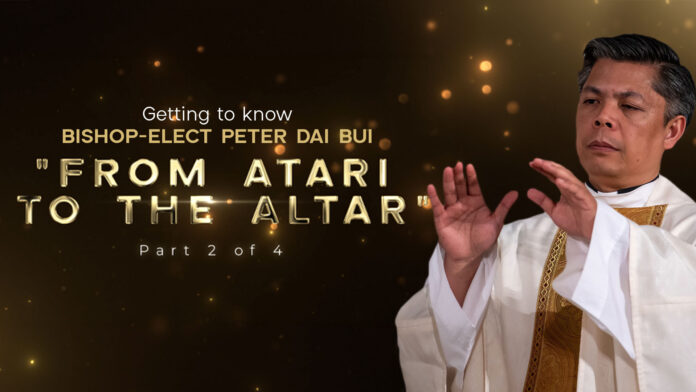
“From Atari to the Altar”; Getting to know Bishop-elect Peter Dai Bui, Part 2 of 4

In “From Atari to the altar,” the second video of a four-part series on getting to know Bishop-elect Peter Dai Bui, the bishop-elect shares how a video game console played an integral role in his vocation to the priesthood. 

Growing up in New Orleans, he and two of his brothers would often go to a friend’s house to play Atari video games after school. That’s when Bishop-elect Bui made a pact with God: he would sneak out every morning before school to attend daily Mass if God gave him and his brothers an Atari gaming console for Christmas. 

Tune in to see what was wrapped under the Christmas tree that year (it’s not what you expect!) and how his daily Mass attendance changed the trajectory of Bishop-elect Bui’s life. 

Check out part one, “Boat of No Smiles” here in case you missed it! 

Bishop-elect Bui was appointedas the second auxiliary bishop of the Diocese of Phoenixon Dec. 19 by Pope Leo XIV and will be ordained a bishop on Tuesday, Feb. 17, at 10 a.m. at St. Thomas Aquinas Parish in Avondale, Ariz.Due to limited seating capacity, the Ordination Mass is by invitation only. The Ordination Mass will be broadcast live on More! Arizona, local channel 7 dot 2, Cox Cable 115 and livestreamed on the Diocese of Phoenix YouTube and Facebook platforms, with programing beginning at 9:30 a.m. 

The ordination and the surrounding celebrations are made possible through the generous support of Clint and Jennifer Hickman; Dr. Kenneth and Angeline Osorio; The Diane and Bruce Halle Foundation; Catholic Cemeteries and Funeral Homes; Catholic Education Arizona; Notre Dame Federal Credit Union; AllThrive365; Catholic Charities Community Services; The Society of St. Vincent de Paul; and Catholic Community Foundation. With grateful hearts, we thank these benefactors for their faithful generosity and partnership in supporting the life and mission of the Church.